The Thematic Set of papers in this issue of Quaternary Research is associated with the conference “Eurasian Environmental Dynamics And Humans: Interactions Over Different Time Scales,” held in Belgrade, Serbia, 27–30 June 2019. The conference was organized by the Loess Focus Group of the International Union for Quaternary Research and the Serbian Academy of Sciences and Arts. The task for this conference was to continue this tradition, and again bring together young and experienced loess researchers (68 participants) worldwide (17 different countries) to discuss the latest research and future plans, and to open loess investigations to a much wider scientific community.
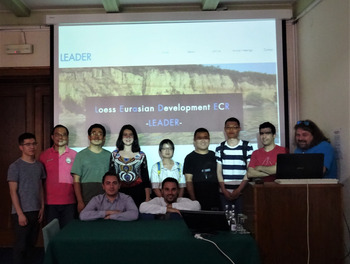
During this conference, the Loess Eurasia—Development of Early Carrier Researchers (LEADER) network was established. Its main goal is to bring together young loess scholars from many Eurasian countries (for the first time at this conference) and provide them opportunities for more intensive development of their research skills and general paleoclimate knowledge (Figure 1). Many Quaternary research communities in countries of the Eurasian loess belt traditionally have been isolated, with very little or no ability to systematically promote young scholars. This issue contains several papers written by members of the LEADER initiative, all of which indicate the bright future of the global loess research community.
Participants of the LEADER kick off meeting.

Climate change has become a popular topic in science as well as in many other social activities. Distancing itself from pure scientific research, climate change ‘problems’ have become more of a political and social issue. One of crucial points in order to better understand present climate dynamics and to perform valid predictions of future climate is to properly understand climate variations in the past, as well as past human adaptations to these changes. This is the main objective of this thematic set of 11 papers—comparison of the climate evolution in two distant regions on the opposite sides of the huge Eurasian continent. Adequate understanding of climate dynamics over Eurasia on different timescales is a crucial component of knowledge about Northern hemisphere climate evolution during the last million years. This knowledge will form the basis of great contributions for forecasting of future interactions between climate and humans.
Recent progress in paleoclimatic aspects of loess and reworked loess deposits distributed in and outside of the Chinese Loess Plateau (CLP) are presented in four papers, two of which address dust provenance related to paleoclimate reconstruction and possibly climate-induced reworked loess deposits in a floodplain. Gao et al. (Reference Gao, Hao, Ge, Han, Fu, Wu, Deng, Marković and Guo2021, this volume) present detailed measurements of the anisotropy of magnetic susceptibility (AMS) on two parallel loess profiles covering the most recent 130 ka in the western CLP to determine paleowind directions. The results demonstrate that the prevailing wind system responsible for dust transport in the western CLP was the northwesterly winter monsoon, rather than the westerly winds, and that dust-bearing wind direction was relatively stable during the last glacial and interglacial cycle. This study contributes to resolving the controversy on the roles of the East Asian winter monsoon and westerly winds in transporting the dust responsible for loess deposition. Wang et al. (Reference Wang, Yang and Ding2021, this volume) study three loess sections deposited since the late penultimate glacial periods, located in the piedmont of the Central Shandong Mountains (PCSM) and in an offshore island in the Bohai Gulf. Application of the “grain size-transport distance” model established for the CLP to grain-size data of the three sections leads to an interpretation that source-sink distance is <300 km for these loess deposits. This suggests that fluvial deposits of the Yellow River system in the North China Plain and sediments on the adjacent continental shelf are the major provenance for the Shandong loess. The lack of a consistent pattern of changes in grain size and magnetic susceptibility in glacial-interglacial cycles, as observed in the CLP, was attributed to unstable dust-source area. This study reinforces the previous view of a proximal sediment source for the PCSM loess deposits (Peng et al., 2018). Li et al. (Reference Li, Wu, Cheng, Zhu, Zhang, Wu, Lin, Li, Ren, Zhao and Zhang2021, this volume) provide a challenging view on the spatial variation of East Asian winter monsoon (EAWM) evolution between northern and southern China since the last glacial maximum. An EAWM proxy record using grain-size variations in the southern CLP was compared with the one using the sea surface temperature gradient in the South China Sea and results of long-term transient simulations. The comparison indicates pronounced spatial differences in EAWM evolution, with a weakened EAWM in northern China, but a strengthened EAWM in southern China from the last glacial maximum to the Early Holocene. The authors argue that the relative importance of insolation, ice sheets, and atmospheric CO2 for EAWM evolution varied spatially within East Asia. It should be noted that the sea surface temperature gradient, which is used as a proxy for the EAWM, had been partly affected by changes in the currents in marginal seas, which are linked with glacial sea level lowering (Huang et al., Reference Huang, Tian and Steinke2011). Vandenberghe et al. (Reference Vandenberghe, Yang, Wang, Wang and Lu2021, this volume) describe a 20-m thick fluvial sediment sequence in the Hanzhong Basin, central China. It is composed of diverse sedimentary facies, from a gravelly, high energy channel (at the bottom of the sequence) to a relatively low energy floodplain, and was inferred to have developed in MIS 16–13. Reworked loess forms the main part of the floodplain deposits, and several paleosols formed under low hydrodynamic conditions in an interglacial environment. The cyclic rhythm of stacked relatively high- and low-energy floodplain sediments is attributed to varied intensity of different hydrodynamic flooding events that may have been due to changing monsoonal rainfall or intrinsic fluvial behavior.
Environmental magnetic mineralogical properties of loess deposits from southeastern Europe are presented in two papers. Namier et al. (Reference Namier, Gao, Hao, Marković, Fu, Song, Zhang, Wu, Deng, Gavrilov and Guo2021, this volume) present the first detailed mineral magnetic investigation of more than nine loess-paleosol couplets of the composite Titel-Stari Slankamen loess section in Serbia. The results show that magnetic variations of the classical section follow the pedogenic magnetic enhancement model, as reported in most regions of the mid-latitude loess belt in the Northern Hemisphere. The overall consistency of ferrimagnetic grain-size parameters in 10 paleosols indicates an absence of dissolution of the fine-grained ferrimagnetic fraction, despite changes in climate regime over the past 1.0 Ma. The authors also explore the possibility of using temperature-dependent magnetic parameters to reflect climate conditions, noting that the proxies show a long-term stepwise increase in aridity during glacials over the last 1.0 Ma, with a major step at ca. 0.6–0.5 Ma. Költringer et al. (Reference Költringer, Stevens, Bradák, Almqvist, Kurbanov, Snowball and Yarovaya2021, this volume) investigated three terrestrial sediment sequences underlying the Holocene marine deposits of the Caspian Sea in the Lower Volga region of Russia. The studied terrestrial portion formed during the Atelian regression (80–27 ka, MIS 4–3). Detailed magnetic mineralogical analyses show clear similarities of silt-sized deposits to loess, and that climate was dry and cool during the time of loess deposition. Although the concentration of ferrimagnetic minerals is well below the threshold value of pedogenic magnetic enhancement, the authors argue that the magnetic properties indicate short episodes of potentially more humid and warmer climate during the late Atelian period.
Three papers provide crucial evidence to understand hominin adaptability to climate changes in glacial-interglacial cycles over the Eurasian continent, with one paper focusing on the cases in Serbian and the other two focusing on northern China. Marković et al. (Reference Marković, Vandenberghe, Stevens, Mihailović, Gavrilov, Radaković, Zeeden, Obreht, Perić, Nett and Lehmkuhl2021, this volume) present OSL dating, grain-size, and geochemical data from an alluvial fine-grained sandy silt (reworked loess) section, with artifacts in the basal part that are situated on a Danube terrace with the top of the bedrock at ~123 m asl. Luminescence ages from the section suggest an age span for the last glacial period, and an uplift rate of the terrace of ~0.73 mm/yr for the last 60 ka. The research suggests that the area close to today's Petrovaradin Fortress was already inhabited in MIS 5, and the relative environmental stability during the last glacial period is likely also a key factor in human occupation. Ge et al. (Reference Ge, Wang, Shan, Feng, Chen, Wu, Li, Zhou, Li, Tang, Olsen, Deng and Gao2021, this volume) conducted a chronological and environmental study of the sediment sequence at the Dayao Paleolithic site in Inner Mongolia on the eastern margin of China's vast northwestern drylands. With constraints from evidence of magnetostratigraphy, OSL dating, and overlying paleosols, climatostratigraphic correlation suggests that two sandy gravel layers containing abundant artifacts in the lower part of the Dayao sequence were formed during MIS 9 and 11. Human occupation before ca. 400 ka at the Dayao site represents the earliest and northernmost archaeological site yet reported in China's arid northwest. During interglacials, northward displacements of the East Asian summer monsoon rain belt provided favorable conditions for episodic hominin habitation in this arid area via a corridor in the Yellow River valley. Zhao et al. (Reference Zhao, Zhou, Chen, Wang, Ge, Gao, Stewart and Li2021, this volume) present a case of “permanent” residence at the Yangshang site in the western CLP during MIS 7–6. A detailed techno-typological analysis on the 1696 lithic artifacts excavated in the loess-paleosol sequence shows that different provisioning systems existed between glacial and interglacial periods, although the Yangshang site is dominated by quartz-based core/flake assemblages typical of most Early Paleolithic sites in North China. The authors argue that these shifts (from place provisioning during MIS 7 to individual provisioning during MIS 6) reflect changes in mobility and land use that were tied to glacial-interglacial climate change.
In addition to the aforementioned papers of climate and hominin behaviors at orbital time scales, two papers address the climate changes beyond the loess-distributed region at shorter time scales. Xu et al. (Reference Xu, Zhu, Wang, Shi, An, Li, Sano, Nakatsuka and Guo2021, this volume) explore the feasibility using long-term intra-seasonal tree-ring cellulose oxygen isotopes (δ18Oc) to reconstruct the Asian summer monsoon's intra-seasonal variations. They divide one tree ring layer into four segments (S1 to S4) for an Abies georgei core covering the period of 1951–2009 from the southeastern Tibetan Plateau, and find that δ18Oc of S1 has the strongest correlations with the onset-phase regional monsoon precipitation, while δ18Oc values for S2, S3, and S4 correlate strongly with the June, July, and August precipitation, respectively. The latter three months represents the mature-phase precipitation. These results shed new light on reconstruction of intra-seasonal rainfall of summer monsoons. Shi et al. (Reference Shi, Duan, Yin, Bruun, Xiao and Guo2021, this volume) reconstruct and compare the new composite summer temperature anomalies over the past 1120 yr (AD 900–2019) in the Qinghai-Tibetan Plateau and Arctic to detect their teleconnection. Temperature correlation during the past millennium in these two regions has a distinct centennial variation. Two intervals with an increase in teleconnection were observed in the sixteenth century and the Modern Warm Period. They concluded that volcanic eruptions and anthropogenic greenhouse gases acted to amplify the teleconnection between the two regions for the two intervals, respectively, which previously had not been recognized.
The articles in this issue show that new and exciting advances are yielding enhanced understanding of climate dynamics over Eurasia at orbital or short time scales, and concomitant varying adaptability and/or adaption strategy of hominins to the glacial-interglacial changes. Most of the present research is case specific, and more detailed studies are needed in various key regions to assess spatio-temporal variations. With the accumulation of evidence from various regions, intercontinental correlation of the past climate and ancient human behaviors under a uniform chronologic framework will significantly extend our knowledge of climate dynamics over Eurasia and its effect on human evolution.