




No CrossRef data available.
Empirical Evidence Against Varieties of Capitalism's Theory of Technological Innovation
Published online by Cambridge University Press: 01 July 2004
Abstract
How can one explain cross-national differences in innovative activity across the industrialized democracies? In this article, I examine the “varieties of capitalism” (VOC) response to this question. VOC theory predicts that societies with liberal-market economies will direct their inventive activity toward radical technological change, while societies with coordinated-market economies will direct their inventive activity toward incremental technological change. I find that these predictions are not supported by the empirical data, and that the evidence offered by VOC proponents depends heavily on the inclusion of a major outlier, the United States, in the class of liberal-market economies. My empirical investigation includes simple patent counts, patents weighted by forward citations, and scholarly publications (both simple counts and citations-weighted). I analyze data covering all of the VOC countries over the course of several decades, little of which reveals the innovative patterns predicted by VOC scholars.For their excellent insights, critiques, and encouragement I gratefully thank Thomas Cusack, Tracy Gabridge, Michael Brewster Hawes, Derek Hill, Daniel K. Johnson, Chappel Lawson, Mark Lewis, Benedicta Marzinotto, Andrew Miller, Michael Piore, Jonathan Rodden, Herman Schwartz, James Snyder, David Soskice, Edward Steinfeld, Scott Stern, Dan Winship, the editors at International Organization, and two anonymous reviewers.
Information
- Type
- Research Article
- Information
- Copyright
- © 2004 The IO Foundation and Cambridge University Press
How can one explain cross-national differences in innovative activity across the industrialized democracies? Politics appear to play a strong causal role here, with case study after case study showing the clear influence of politics and political institutions on technological innovation.1
See Edwards 1996; Bauer 1995; Samuels 1994; Mokyr 1990; Beasley 1988; and Rosenberg and Birdzell 1986.
This question, of why some countries are more technologically innovative than others, should interest scholars of international political economy for several reasons. For example, even among otherwise friendly nations, economic rivalries between states can often come to resemble military ones, with competition over trade, jobs, and markets leading to interstate disputes and strained relations.2
Scholars of security studies will also appreciate the importance of civilian technological innovation and its role in production and the general economy as complementary, if not foundational, to relative military power. See Samuels 1994.
See Tyson 1993; Mokyr 1990; Krugman 1986; and Solow 1957.
Furthermore, VOC scholars see innovation theory as a key to resolving current problems in understanding global trade flows and production patterns. Classic trade theory holds that free trade will not deplete national wealth by impelling production abroad but will instead enhance economic performance and increase each trader's consumption possibilities. In this basic model, societies specialize production in their most efficient sectors and then trade the surplus for more goods than they otherwise could have produced locally. The Heckscher-Ohlin model improves on this basic theory by arguing that nations' relative endowments of basic economic factors (land, labor, capital) should determine the general lines along which international production and trade are structured. However, VOC proponents point to the rise of intra-industry trade during the past thirty years that has contradicted the interindustry trading patterns predicted by the Ricardian or Heckscher-Ohlin models. Instead of specializing in particular sectors of production, the industrialized nations have maintained a broad spectrum of general economic activity and instead have concentrated their sectoral productive efforts geographically. Recent attempts to explain these phenomena posit an initially random distribution of productive activity that is then followed by agglomeration because of either increasing returns to scale or network externalities.4
See Saxenian 1994; Krugman 1991; and Helpman 1984.
Hall and Soskice 2001, 36–37.
VOC's innovation theory offers a resolution to both of the anomalies above, suggesting that domestic institutional structures can account for the different degrees of innovative effort and achievement between nations, and the production and trade relationships that subsequently develop. If VOC theory is correct, it would explain why nations maintain their innovative profiles in spite of strong pressures to change them, and why certain kinds of innovation-dependent production might tend to be concentrated in particular countries. However, the central claim made by VOC's innovation theory has yet to be proven. The purpose of this article is to use new data on patents and scholarly publications to test VOC theory's central assumptions and predictions and to see whether VOC theory properly describes the empirical world of technological innovation. I demonstrate that VOC theory does not accurately predict innovative behavior over time and space, and that VOC's existing empirical support strongly depends on the inclusion of a major outlier, the United States, in the set of radically innovative countries. I also find that some industries are more radically innovative than others in the short run, as assumed by VOC theory, but that this characterization cannot be confirmed in the long run as industries age and mature technologically.
Politics, Economics, and Innovation Theory
For much of the history of political economy, questions about the causes of national differences in technological innovation have remained at the periphery of the field.6
Technology is defined as a physical product, or a process of handling physical materials, which is used as an aid in problem solving. More precisely, technology is a product or process that allows social agents to perform entirely new activities or to perform established activities with increased efficiency. Innovation is the discovery, introduction, or development of new technology, or the adaptation of established technology to a new use or to a new physical or social environment.
For an alternative view of Marx, see Bimber 1994.
Summarized in Mowery and Rosenberg 1979.
A recurring problem encountered in these debates was the contradiction between empirical observation and certain fundamental tenets of the economics of science. Specifically, Arrow had shown that much productive knowledge takes the form of unpatentable laws of nature and advances in basic science, and is therefore a nonexcludable public good available to everyone without charge.9
While patents and trade secrets act as temporary solutions to this appropriability problem in the area of applied knowledge, history has shown that the original inventors of technology often do not capture most of the benefits of their innovations when these inventions are transferred across borders, and that these transfers take place even in spite of considerable efforts to stop them. Theoretically speaking then, in the long run, developed nations should not display significant variation in either per capita innovation rates or in the type of innovative activities that they pursue. Yet differences appear to abound.One possible solution to this paradox focuses on institutions. Institutions are perhaps the only variables that both influence the incentives for innovative behavior and differ across nations. Indeed, political scientists and economists have long recognized the capacity of government, labor, regulatory, and legal institutions to inhibit free market exchange and thereby hamper innovation. But it was not until Romer endogenized technological change that social scientists began to take seriously the ability of institutions to actively enhance aggregate economic performance through their effects on the rate and direction of technological progress.10
To date though, beyond the broadest brushstrokes of political-economic theory, social scientists have yet to pinpoint the specific mechanisms by which institutions cause countries to differ technologically.It is into this environment that VOC theory makes its foray, taking a radical new approach to explaining cross-national differences in the direction of technological progress.11
I am concerned here specifically with those aspects of VOC theory discussed in Hall and Soskice 2001, 1–44.
Varieties of Capitalism's Theory of Technological Innovation
According to VOC theory, technological innovation comes in two types, radical and incremental, each of which forms the basis for a different mode of production. While an exact definition is elusive, VOC scholars describe radical innovation as that which “entails substantial shifts in product lines, the development of entirely new goods, or major changes to the production processes.”13
Hall and Soskice 2001, 38–39.
Ibid., 39.
VOC theory further predicts that LMEs and CMEs will tend to exert greater effort toward, and be successful in, different types of technological innovation. VOC theory interprets innovation as just another productive activity; therefore, innovation should be sensitive to the firm's crucial relationships described above and the institutions that structure them. This does not mean that a given political-economic structure will result in only one kind of innovation, but that different institutions will create different types of comparative advantage for innovators. For example, incremental innovation requires a workforce that is skilled enough to come up with innovation, secure enough to risk suggesting it, and autonomous enough to see it as a part of their job. This in turn requires that firms provide workers with secure environments, autonomy in the workplace, opportunities to influence firm decisions, education and training beyond just task-specific skills (preferably industry-specific technical skills), and close interfirm collaboration that encourages clients and suppliers to suggest innovations as well. These are exactly the kinds of apparatus provided by CME institutions. In fact, CMEs are defined by the very institutions that provide a comparative advantage for incremental innovation. These institutions include highly coordinated industrial-relations systems; corporate structures characterized by works councils and consensus-style decision making; a dense network of intercorporate linkages (such as interlocking corporate directorates and cross-shareholding); systems of corporate governance that insulate against hostile takeovers and reduce sensitivity to current profits; and appropriate laws for relationship-based, incomplete contracting between firms. VOC scholars argue that this combination of institutions results in long employment tenures, corporate strategies based on product differentiation rather than intense product competition, and formal training systems for employees that focus on high skills and a mix of company-specific and industry-specific skills; in other words, the very factors that combine to foster incremental innovation.
On the other hand, VOC scholars argue that these same CME institutions that provide comparative advantages for incremental innovation also serve as obstacles to radical innovation. For instance, worker representation in the corporate leadership combines with consensus-style decision making to make radical change and reorganization difficult. Also, long employment tenures make the acquisition of new skills and rebalancing a company's labor mix difficult. Dense intercorporate networks also make the diffusion of disruptive innovations slow and arduous, and technological acquisition by mergers and acquisitions or takeovers hard. All of these act against, or reduce the potential rewards of, radical innovation.
In LMEs, the situation is reversed. LMEs are defined by institutions that provide a comparative advantage for radical innovation, while creating obstacles to incremental innovation. LMEs have flexible labor markets with few restrictions on layoffs, which means that companies can drastically change their product lines and still acquire the proper labor mix. LMEs also support extensive equity markets with dispersed shareholders providing innovators of all sizes with relatively unfettered access to capital. Also, interfirm relations in LMEs allow for a variety of aggressive asset exchanges with few restrictions on mergers and acquisition, buyouts, personnel poaching, licensing, and so on, which permits firms to easily acquire scientific expertise and new technology. Concentration of power at the top of LME-based firms augments these institutions, allowing management to force major change quickly on complex organizations. All of these factors combine to create large incentives for, and an environment accommodative to, radical innovation. Conversely, LMEs' capacity for incremental innovation is limited because of financial arrangements that emphasize current profitability, corporate structures that concentrate unilateral control at the top and eliminate workforce security, and antitrust and contract laws that discourage interfirm collaboration in incremental innovation. Meanwhile, fluid labor markets and short job tenures motivate workers to pursue selfish career goals and to acquire mobile general skills rather than firm-specific or industry-specific skills. Hence, in VOC's analysis, neither workers nor firms in LMEs tend to have the incentives or the resources for sustained incremental innovation.
Testing the Varieties of Capitalism Claims
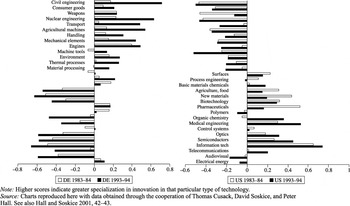
The purpose of the remainder of this article is not to evaluate the accuracy of the LME-CME classification system or test a specific causal mechanism involved in VOC's theory of innovation. Rather, the question I ask here is whether the international patterns of innovation that VOC theory predicts actually exist. The VOC causal story outlined above is both theoretically appealing and dovetails with some widely held stereotypes about national differences in innovation; however, little empirical data has yet been produced to support its central claim. The evidence offered by Hall and Soskice consists of four years of patent data from the European Patent Office (EPO) that shows that Germany and the United States concentrate their patents according to the LME versus CME model discussed above. Specifically, Hall and Soskice examine patenting activity by Germany and the United States in thirty technology classes during 1983–84 and 1993–94 (Figure 1). Overall, they found that Germany's patent specialization was almost equal and opposite that of the United States in both time periods.15
Hall and Soskice's methodology will be discussed in greater detail below.

Patent specialization by technology class
I have identified several possible problems with this approach. First, VOC theory implicitly assumes that some industries are inherently characterized by radical innovation, others by incremental innovation, and that these industries have been correctly identified. Second, in supporting their claims, Hall and Soskice use only four years' worth of patent data from only two countries, one of which, the United States, is an outlier by almost any measure. Third, Hall and Soskice use only simple patent counts as their measure of innovation, hence frivolous patents are counted the same as highly innovative ones; nor do Hall and Soskice use any nonpatent measures of innovation.
In the following sections, I will address these issues in turn. In some instances, I use Hall and Soskice's data and methods to test the generality of their claims. In others, I take advantage of a new data set compiled at the National Bureau of Economic Research (NBER) of more than 2.9 million utility patents granted by the U.S. Patent and Trademark Office (USPTO) to applicants from the United States and 162 other countries during 1963–99, and the sixteen million citations made to these patents between 1975 and 1999.16
Hall, Jaffe, and Trajtenberg 2001; database available at 〈www.nber.org/patents〉. Accessed 24 March 2004.
Independent Variable: LME Versus CME
According to VOC theory, the primary independent variable for predicting innovation characteristics is the type of national political-economic institutional structure (LME or CME) within which innovators operate. The LMEs include Australia, Canada, Great Britain, Ireland, New Zealand, and the United States. The CMEs include Austria, Belgium, Denmark, Finland, Germany, Japan, Netherlands, Norway, Sweden, and Switzerland. In between these two ideal types, and of less importance to VOC scholars, are a handful of hybrids denoted as “Mediterranean market economies” (MMEs) that have mixed CME and LME characteristics. These countries include France, Greece, Italy, Portugal, Spain, and Turkey.17
Countries such as Luxembourg and Iceland are eliminated from the VOC typology because of their small size, while others, such as Mexico, are disqualified because they are developing nations.
Some critics might question the “LME-ness” or “CME-ness” of certain states classified above, for example the Oceanic countries during much of the Cold War. However, I employ the existing VOC classifications for several reasons. First, in VOC theory, it is not the amount of protectionism or regulatory burden that defines an LME or CME and determines its innovative profile, but whether markets or hierarchies form the context within which economic actors organize, conduct their relationships, and solve coordination problems. Therefore when accepting the VOC country classifications, I privilege the relational aspects of the LME-CME distinction as discussed by Hall and Soskice, rather than protectionist or state-interventionist behavior, because the former are the most relevant and active mechanisms in VOC's theory of innovation. Second, recall that the LME-CME dichotomy is not definitive but rather “constitute[s] ideal types at the poles of a spectrum.”18
All states have some degree of tariff and nontariff barriers to trade, and no nation is free from regulation. Therefore, there are shades of LME and CME in every economy, and these qualities change over time. Hence when accepting particular classifications, I pay attention not to absolute qualities but to relative ones. Finally, all classification systems have debatable aspects, and their acceptance is often based more on their usefulness rather than their exactitude. Part of the goal of this article is to test VOC theory as stated, which includes the usefulness of their typology.19Also, although country size, wealth, and other factors may be important to innovation theorists, there is no explicit motivation within VOC theory itself for including these as separate independent variables other than restricting the data to the advanced capitalist democracies.
Dependent Variable: Innovation
The most frequently used measure of innovation is patents. The debate over the proper use of patent data has proceeded vigorously and with increasing sophistication over the past several decades. The current consensus holds that patent data are acceptable measures of innovation when used in the aggregate (for example, as a rough measure of national levels of innovation across long periods of time), but are not appropriate when used as a measure of micro-level innovation (to compare the innovativeness of individual firms or specific industries from year to year). While this debate is ongoing and is better recounted elsewhere, this section will address some of the more pressing issues surrounding patent measures and their use in testing VOC theory.20
For a review of the debate see Griliches 1990; Trajtenberg 1990; Archibugi and Pianta 1996; Harhoff, Narin, Scherer, and Vopel 1999; Eaton and Kortum 1999; Jaffe, Trajtenberg, and Fogarty 2000; and Hall, Jaffe, and Trajtenberg 2000 and 2001.
Strictly speaking, a patent is a temporary legal monopoly granted by the government to an inventor for the commercial use of his or her invention, where the invention can take the form of a process, machine, article of manufacture, or compositions of matters, or any new useful improvement thereof (USPTO).21
Designs and plant life can also be patented; however, most econometric analysis of patent data is confined to utility patents granted for inventions such as those listed above. For a fuller description of patents and patent laws, classifications, and the application process see 〈http://www.uspto.gov/main/patents.htm〉. Accessed 24 March 2004.
Given these qualities, patents have been used as a basis for the economic analysis of innovative activity for more than thirty-five years. Current use began with the pioneering work of Scherer and Schmookler who used patent statistics to investigate the demand-side determinants of innovation.22
See Scherer 1965; and Schmookler 1966.
Summaries of which can be found in Griliches 1984; Pakes 1986; and Griliches, Hall, and Pakes 1987.
However, patents do have significant drawbacks that somewhat restrict, but by no means eliminate, their usage as an index of innovation. First, there is the classification problem, in that it is difficult to assign a particular industry to a patent, especially because the industry of invention may not be the industry of eventual production or the industry of use or benefit. I address this issue, where possible, by using two different patent data sets with assorted systems and levels of patent classification. Second, it is not yet clear what fraction of the universe of innovation is represented by patents, because not all inventions are patentable and not all patentable inventions are patented. This problem is exacerbated when attempting comparative research because different industries and different countries may exhibit significant variance in their propensity to patent. I address these concerns by using publications data in addition to patents. In addition, although patents and publications both may be imprecise measures of innovation, as long as this measurement error is random and uncorrelated with the explanatory variables, then regressions using this data should produce unbiased estimates of the coefficients (and generally with inflated standard errors).
Finally, some critics point out that patents vary widely in their technical and economic significance: most are for minor inventions, while a few represent extremely valuable and far-reaching innovations. Moreover, it has been found that simple patent counts do not provide a good measure of the radicalness, importance, or “size” of an innovation. Simple patents counts correlate well with innovation inputs such as R&D outlays, but they are too noisy to serve as anything but a very rough measure of innovation output.25
Therefore, I use patent counts that have been weighted by forward citations. Forward citations on patents have been found to be a good indicator of the importance or value of an innovation, just as scholarly journal articles are often valuated by the number of times they are cited. The idea here is that minor or incremental innovations receive few if any citations, and revolutionary innovations receive tens or hundreds. Empirical support for this interpretation has arisen in various quarters: citation-weighted patents have been found to correlate well with market value of the corporate patent holder, the likelihood of patent renewal and litigation, inventor perception of value, and other measures of innovation outputs.26See Trajtenberg 1990; Hall, Jaffe, and Trajtenberg 2000; Lanjouw and Schankerman 1997 and 1999; and Jaffe, Trajtenberg, and Fogarty 2000.
Testing the VOC Industry Assumption
Armed with a better understanding of patents, I now use them to test some of the more controversial claims made by VOC scholars. One such controversy resides in their implicit assumption about the innovative characteristics of particular industries. VOC theory assumes that some industries are inherently and statically more radically innovative, and other industries inherently and statically more incrementally innovative. However, this assumption is contradicted by a vast empirical literature that shows that the innovative characteristics of any given industry are not static but dynamic and depend not so much on industry type but on the industry's technological maturity.27
Summarized in Utterback 1994.
If the innovative character of industry changes over time, then Hall and Soskice's use of snapshots of patent activity in particular industries may not properly test VOC theory. That is, for the two brief time periods covered by Hall and Soskice's patent data, do the researchers correctly identify which industries were more radically or incrementally innovative? In order to answer this question I rely on the ability of forward citations to serve as a measure of “degree” or “value” of an innovation. For my empirical evidence, I make use of the newly compiled NBER patent data set described above. Using the USPTO patent classifications, the NBER scholars have grouped their data into six industry categories, each consisting of four to seven subcategories (for a total of thirty-six subcategories), which allows comparison of the average patent citation rates across different industries.
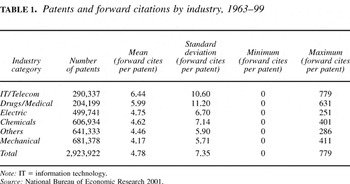
Table 1 shows the means of the forward citations per patent by industry category. The industries generally rank as assumed by VOC theory: information technology and telecommunications patents receive on average the most forward citations, followed by drugs and medical, electronic, chemical, others, and finally mechanical. T-tests reveal that the differences between these means are significant beyond the 99 percent confidence level. Even if one sharpens the level of analysis by further subdividing the industry categories into their smaller subcategories, patent citations would again behave more or less as assumed by VOC theory.28
Exceptions include patents in the drugs, biotechnology, food, and organic compounds subcategories that appear to be relatively poorly cited despite the fact that these are among VOC's “radically innovative” industries; in the “incremental” subcategories, patents related to gas, power systems, resins, and coatings appear to be more highly cited than VOC theory might assume. These might be partially explained by classification problems or by differences in the legal or technical need to cite in these industries.
Patents and forward citations by industry, 1963–99

Of course, analyzing the data in this manner introduces a potential truncation problem: older patents have had more time to be cited than younger patents. This problem is exacerbated in the NBER data set because it only includes citations data from 1975 onwards.29
This is because the citations data were not computerized before 1975.
All regressions reported here use a patent age based on grant year. Regressions performed using a patent age based on application year produced similar results.
“Other” includes innovations in miscellaneous areas such as house fixtures, furniture, pipes and joints, jewelry, cutlery, receptacles, undertaking, and amusement devices.
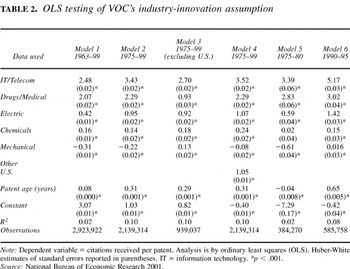
OLS testing of VOC's industry-innovation assumption

As my findings in subsequent sections indicate that VOC's evidence is sensitive to the United States outlier, I run two regressions to consider its effects on the industry rankings. In Model 3, I omit the U.S. data entirely, which drastically reduces the coefficient for the IT/Telecom and Drugs/Medical categories and increases the coefficients for the Chemicals and Mechanical categories. When I instead use a U.S. dummy (Model 4), the coefficients change significantly for only Chemicals and Mechanical patenting. The first thing to note in both these regressions is that the rankings do not change in the areas of most concern to VOC theory: chemicals, mechanical, and “other” patents receive fewer citations than those in VOC's radically innovative sectors. Second, these regressions suggest that the United States is in fact a powerful outlier that affects the nature of global innovation, especially in frontier sectors.
Given the time dynamics of innovation, it is also important to confirm that the findings above are not an artifact of averaging across a long time period. Models 5 and 6 address this concern, revealing that VOC's industry assumption generally holds even when I limit the data set to either the earliest or latest five years of patenting activity. In these regressions, information technology and telecommunications patents consistently received the most citations, again followed by drugs and medical and electronics patents. There is however some shuffling among the remaining categories, especially mechanical patents that may suggest a recent small surge in innovation there. But these minor shifts do not create any major problems for the VOC assumptions. Also, though not shown here, if one were to further subdivide the six categories above into their thirty-six subcategories, patent citations would behave more or less as they do at the category level.32
With the same exceptions at the subcategory level as those found with the citations averages. See note 28 above.
Testing VOC's Predictions About National Innovative Character: Simple Patent Counts
Having confirmed the industry-based innovation assumption above, I now reconsider the evidence offered by Hall and Soskice (Figure 1). Again, this chart is based on EPO patent data for the United States and Germany in thirty industries during two separate two-year periods. For each industry in each time period, Hall and Soskice calculated a patent specialization index (I) that simply subtracts a country's fraction of its total patents in a particular field from the world's fraction of total global patents in the same field.33
For example, in biotechnology: IUS biotech = USbiotech/UStotal − Worldbiotech/Worldtotal .
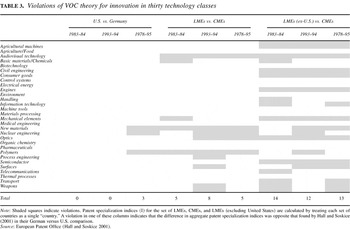
The results of this exercise are summarized in Table 3. Note that rather than requiring an exact quantitative match, I apply a more lenient qualitative standard for VOC theory to pass, only testing which country (or set of countries) has a higher patent specialization index in each of the thirty industries. Using Hall and Soskice's data and methodology, I was able to closely reproduce their findings for Germany and the United States in 1983–84 and 1993–94. However, when I extend the time period to 1978–95, German and U.S. patenting fails to meet VOC predictions in polymers, new materials, and nuclear engineering. Even more discrepancies arise when the data set is expanded to compare patent specialization by the set of all LME countries versus the set of all CME countries. For example, in the 1983–84 period, the set of LMEs had higher patent specialization indices than the set of CMEs in three industries that Hall and Soskice describe as incremental (mechanical elements, basic materials, polymers), while CME patenting had higher specialization scores in two radical industries (new materials, audiovisual technology). But the most striking disparity occurs when the United States is excluded from the set of LME countries; under these conditions VOC theory has only marginally more predictive power than random chance.
Violations of VOC theory for innovation in thirty technology classes

The NBER patent data provides a second data set with which to test the patent specialization indices devised by Hall and Soskice. Such a test adds value in that the NBER data set not only spans over twice the time period (1963–99) as the EPO data used by Hall and Soskice, but the NBER data set also consists of USPTO patents and is therefore completely independent. The NBER data also uses a completely independent classification scheme that provides controls for some of the potential classification problems and idiosyncrasies discussed above. Yet, despite these differences, my test results are generally the same as those found using Hall and Soskice's EPO data. I omit a graphic depiction of the results and instead explain the major findings. Of the eighteen categories of innovation that I was able to map from Hall and Soskice to the NBER data, VOC's predictions were borne out relatively well (approximately 70 to 80 percent of the time, depending on the time period) when applied to the United States and Germany.34
Agricultural machines (a particularly difficult category to define in NBER terms) is the only category that persistently defies the VOC predictions in all time periods; while patenting in optics, pharmaceuticals, transport, organic chemistry, weapons, electrical energy, and nuclear engineering (narrowly measured) each contradicted VOC theory in different time periods.
Testing VOC's Predictions About National Innovative Character: Patent Citations
So far I have used simple patents counts in my comparisons of LMEs versus CMEs, yet as I explained above, forward citations of patents are an even better gauge of radical versus incremental innovation. Therefore, in this section, I use the forward citations data in the NBER patent data set to test the VOC country claims directly, retaining the same techniques that I used above in testing the VOC assumptions about industries. As my dependent variable in all of the following regressions I again use citations-received per patent as a proxy for the radical versus incremental nature of innovation. VOC theory suggests that country dummies or country-type dummies (LME, CME) are the primary independent variables of interest, as well as controls for industry type (again I use industry category or subcategory), and, of course, a control for patent age should be included to address the truncation problem. Since the U.S. outlier proved important in the simple statistical analysis above, I address it in two ways in the regressions. In some regressions a U.S. dummy is introduced, in others the United States is simply omitted from the class of LMEs (creating a new dummy: LMEx). For data, I use the NBER patent data set for all countries' patenting activity during the period 1975–99.
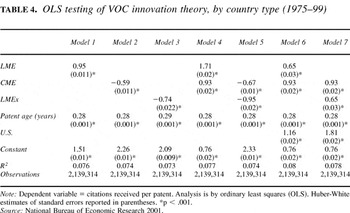
I begin with regressions using controls only for patent age and country type, the results of which (Table 4) reinforce what I found previously: LMEs are more radically innovative than CMEs (Model 1 versus Model 2), but this finding depends entirely on the inclusion of the United States as an LME (Model 3). This effect is apparent even when the CME dummy is run together with that for LMEs or LMEx's (Models 4 and 5). In each of these regressions, the coefficients can be interpreted as the additional number of citations received per patent for patents granted to innovations in a particular set of nations (LMEs, CMEs, or LMEx's) relative to the rest of the world. Note how sharply the LME coefficient drops when I introduce a U.S. dummy variable (Model 6) and, perhaps more interesting, that the LMEx's appear to be less radically innovative than the CMEs (Model 7). Of equal importance is the small size of the coefficients and the differences between them. These indicate, for example in Model 4, that even when I do not control for the U.S. outlier, the innovative difference between LMEs and CMEs is smaller than a single citation per patent. Although this may be a statistically significant amount, it is far smaller than the innovative difference between the most versus least innovative industries found above and does not suggest a large innovation gap.
OLS testing of VOC innovation theory, by country type (1975–99)

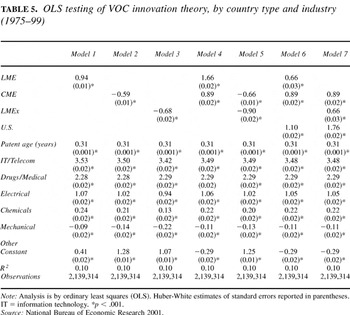
VOC theory also includes industry type as a factor in determining innovative behavior. Hence a second set of regressions are run, identical to those reported in Table 4 but with the addition of controls for industry (Table 5). Yet I find no significant differences when the industry controls are added to the regression models. Again, the LME countries appear at first to be more radically innovative than the CMEs (Model 1 versus Model 2), but not when the United States is excluded from the group of LMEs (Model 3). Note also that the industry coefficients in this regression match those found when I tested the VOC industry-innovation assumption above (Table 2). To test this finding more directly, I add a U.S. dummy, which again severely affects the coefficient of the LME dummy (Models 6 and 7). Regressions run at a finer level of analysis using industry subcategories (not shown) produce similar results.35
An alternate interpretation of VOC theory suggests that in place of LME/CME/LMEx controls, one might include interaction terms (LME*industry, CME*industry, and LMEx*industry). I experimented with such interaction terms but produced the same general results as those reported above.
OLS testing of VOC innovation theory, by country type and industry (1975–99)

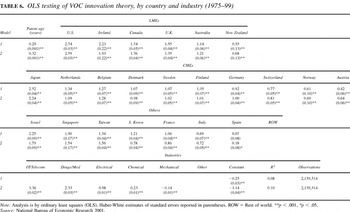
Given the broad nature of VOC theory and the complex array of causal mechanisms it hypothesizes, a fixed-effects model is perhaps the most efficient way to conduct a statistical test of its central predictions. While the NBER data set affords enough degrees of freedom to use countries dummies for all 162 nations, computer memory does not. I therefore run a final set of regressions in which I include dummies for twenty-three countries with the highest patenting activity.36
As before, all pre-1975 patents are eliminated to control for truncation effects.
OLS testing of VOC innovation theory, by country and industry (1975–99)

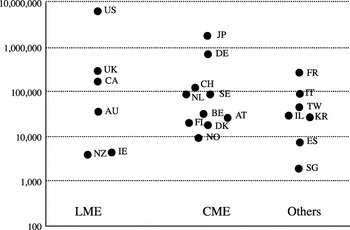
Finally, if one believes that both quality and quantity of patents matter, that Ireland with its relative trickle of few but highly cited patents should not necessarily be considered more radically innovative than Germany with its slightly less cited ocean of patents, then one must instead look at total citations received over time. This data is charted in Figure 2. Here I have merely multiplied the mean citations received per patent by the total number of patents for each country. This captures both the number and value of patents in one measure. The plots are split horizontally into three groups (LMEs, CMEs, and other countries) for comparison. Again the figure shows the U.S. outlier, but no strong general differences in total citations between the different VOC country types.

Total forward citations, 1975–99
In sum, the VOC theory does not appear to explain innovation as measured by patenting activity. Rather, the success of VOC theory in predicting innovation appears to depend on the inclusion of the United States, a major outlier, in the set of liberal market economies. I find this fact repeated regardless of the source of the patent data, the type of the industry classification system used, or whether simple patents or forward citations are used. However, one caveat that bears repeating is that this finding depends on an assumption of random error in using patents as a measure of innovation. Social scientists cannot yet completely describe the correlation between patents (an innovation output) and total innovation, nor do social scientists fully understand how propensity to patent varies across industry, across country, and over time. I therefore, briefly consider the nonpatent evidence for differences in national innovation in the next section.
Additional Evidence
Patent statistics are by no means the only innovation data that paint a picture contradictory to the VOC claims. Scholarly journal articles are another useful measure of innovation that reinforces the cross-national findings discussed above. Scholarly publications data offer advantages similar to those of patents, with each journal article representing a quantum of research innovation that must pass independent review and that tends to be cited in proportion to its innovative impact. More importantly, scholarly publications data are completely independent of patents: they are generally produced by a different set of innovators, affected by different incentives, and judged according to different institutional standards.37
Of course, journal articles also suffer many of the same shortcomings as patents, including difficulties in classification, problems with valuation, and uncertainty regarding to what degree journals represent the universe of innovation.38The innovative “representativeness” of journal articles is more of a problem in the social sciences, and less so in the physical sciences, see Hicks 1999.
VOC theory does not make specific predictions regarding scholarly publications patterns, and indeed its authors may never have intended it to do so. Nonetheless, one might infer from VOC theory the following hypothesis: that scholarly publications by LME researchers should show specialization in fields associated with revolutionary scientific advances, while CMEs should show specialization in fields associated with incremental scientific advances. Although it is not quite clear what a “radically” versus “incrementally” innovative field might be, one could simply map the typology used by Hall and Soskice for industrial sectors as well as academic sectors. For example, CMEs should excel in publishing in the engineering and technology journals, LMEs in biology, medicine, and physics. A second hypothesis might surmise that researchers in the CMEs should excel in professional journals and applied sciences publications where incremental research is more prominent, while LME researchers should publish heavily in the more academic or theoretical sciences journals where the research tends toward the revolutionary. A third, and less controversial, hypothesis would be that LME publications should simply have higher forward citation averages than CME publications.
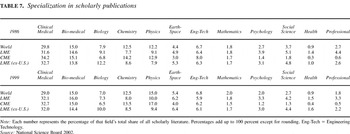
Yet, none of the patterns hypothesized above can be found in the cross-national publications data. Consider the ISI's simple journal publication data compiled in Table 7. Compare the world publication rates by field with those of the LMEs and CMEs. As a group, the LMEs tend to consistently specialize in clinical medicine, biology, earth-space, psychology, social science, health, and professional journals; CMEs tend to consistently specialize in clinical medicine, chemistry, and physics. Over time the CMEs have increased their specialization in biomedical research, physics, and earth-space but have weakened in clinical medicine, chemistry, and engineering and technology; while the LMEs have increased their specialization in biomedical, physics, and earth-space. Using forward citation indices, Table 8 shows the LMEs beating CMEs in all fields. When the United States is excluded from the set of LMEs, the LMEs appear to have higher citations than the CMEs in all fields except earth and space, engineering, and physics. Relatively speaking, LMEs' strengths are in chemistry, physics, biomedical research, and math. CMEs are also strong in chemistry, as well as engineering, physics, and biology. None of these findings is what one might expect from VOC theory.
Specialization in scholarly publications

Relative prominence of scientific literature by country/economy and field (1999)

Finally, despite problems in measuring pre-1960s innovation and diffusion, history provides researchers with some natural experiments that deserve further investigation. For example, Japan, during its first brush with democracy (1910s to 1930s), was distinctively “LME-like” but does not appear to have followed a significantly different innovation pattern than did postwar CME Japan. During this earlier period, labor in Japan was strong and confrontational, and business did not hesitate to inflict frequent and severe employment dislocations for the sake of technological advance. Moreover, the dependence of prewar Japan on external trade and finance exposed even the powerful zaibatsu to the vicissitudes of international markets and created many LME-type incentives for economic actors. Yet the Japanese appear to have been consistent incremental innovators during this time. On the other hand, the Germans of this time period rivaled the United States in technological advance, producing wave after wave of radical innovation in multiple fields including the gas-powered automobile, the Zeppelin, the Haber-Bosch process, blood-typing, aspirin, and organic chemicals to name but a few. Yet, the Germans had many of the same CME-type institutions and incentives as one finds there today, including a national welfare system, national health care, and large business cartels negotiating with each other, and sometimes with workers, in a fairly CME-like manner. These stylized facts, while not conclusive, do suggest areas for deeper research and further testing of VOC claims, both as a theory of innovation and as general theory of political economy.
Conclusions
In this article I have demonstrated that the predictions made by varieties of capitalism theory regarding national differences in technological innovation are not supported by the empirical data, and that the existing evidence depends heavily on the inclusion of a major outlier, the United States, in the class of liberal-market economies. My empirical investigation included simple patent counts, patents weighted by forward citations, and scholarly publications (both simple counts and weighted). I investigated data covering all of the VOC countries over the course of several decades, little of which revealed the patterns predicted by VOC scholars.
These findings carry significant repercussions for both VOC and innovation theory. First, insofar as patents and scholarly publications are good indices of innovation, VOC theory clearly fails to provide an accurate picture of the innovation process, and hence the trade and production patterns that follow. Whether this is a problem with the LME-CME classification system or VOC's assumptions and causal mechanisms is not clear from the evidence presented here. However, I would suggest that while the firm may be the key actor in capitalist economies, and the primary producer of goods and services, it is difficult to ignore the role of the state in innovation as strongly as VOC's theory and classification system do. Throughout the world, much useful innovation is the result of state-sponsored and state-managed R&D, often originating in concerns with national security. Another stream of innovative R&D in many countries comes from the public university system, or private universities benefiting from significant state support. In still other states, innovation takes the form of incremental improvements on imported technologies, where the government has had a heavy hand in deciding which technologies will get imported. Often, the government also plays a key role as a market maker for, and main diffuser of, new innovations. However, VOC's innovation theory omits these causal mechanisms entirely. This does not mean that VOC scholars are wrong to bring the firm onto the center stage of political economy, but rather that in trying to get away from a hackneyed focus on government protectionism and state ownership, they may have overcompensated. Future theorists must find a synthesis between the corporate-centered relationships emphasized by VOC and the state-centered mechanisms employed in traditional political economy.
Second, the statistical analyses above consistently point to the United States as an important factor in explaining global patterns of innovation. Furthermore, the fixed-effects regressions reported in Table 6 reveal that many of the world's most innovative countries are those that also tend to have the strongest military and economic ties with the United States, including Japan, Canada, the United Kingdom, Israel, and Taiwan. Together, these observations suggest that to better understand the political economy of comparative rates of innovation, future research should perhaps focus less on domestic institutions and more on international relations. This is not to argue that domestic institutions are insignificant, but rather that the scope and depth of a country's relationship with the lead innovator may also carry significant weight in determining its technological profile. There are theoretical grounds for this supposition in that while the basic laws of science may be public goods, the tacit knowledge required to apply these laws to proper use and development of new technology is relatively excludable. Therefore, factors such as foreign direct investment, educational exchanges, military assistance, and international flows of science and engineering labor between the lead innovator and other countries should be explored for their effects on innovation and the agglomeration patterns that interest VOC and trade theorists.
Of course, the research reported above, while suggestive, does not necessarily shut the door on a VOC approach to technological innovation. Innovation is a notoriously difficult phenomenon to measure quantitatively, and existing measures carry with them considerable noise, hence further progress needs to be made on method as well as theory. Nor does the critique here necessarily apply to other aspects of VOC theory. VOC is a broad approach to social behavior, consisting of myriad hypotheses regarding almost the whole spectrum of political economy including corporate governance, monetary policy, welfare programs, and labor reform. These hypotheses are not necessarily interdependent and need to be considered and tested each on its own merits. Finally, as social scientists increasingly turn to institutions and international relationships to explain various phenomena related to cross-national variance in innovation, VOC scholars should be applauded for inserting political science into an area of research from which it has been all but absent.40
Notable exceptions include Edquist 1997; Samuels 1994; Nelson 1993; and Lundvall 1992.
References
REFERENCES
Archibugi, Daniel, and
Mario Pianta.
1996.
Measuring Technological Change Through Patents and Innovation
Surveys.
Technovation
16 (9):451–68.CrossRefGoogle Scholar
Arrow, Kenneth.
1962.
Economic Welfare and the Allocation of Resources for Invention. In
The Rate and Direction of Inventive Activity, edited by
Richard R. Nelson,
609–26.
Princeton, N.J.:
Princeton University Press.
Bauer, Martin, ed.
1995.
Resistance to New Technology: Nuclear Power, Information
Technology, Biotechnology.
New York:
Cambridge University Press.
Beasley, David.
1988.
The Suppression of the Automobile: Skulduggery at the Crossroads.
New York:
Greenwood Press.
Bimber, Bruce.
1994.
Three Faces of Technological Determinism. In
Does Technology Drive History: The Dilemma of Technological
Determinism, edited by
Merrit Roe Smith and
Leo Marx,
79–100.
Cambridge, Mass.:
MIT Press.
Bourke, Paul, and
Linda Butler.
1996.
Publication Types, Citation Rates, and Evaluation.
Scientometrics
37 (3):473–94.CrossRefGoogle Scholar
Eaton, Jonathan, and
Samuel Kortum.
1999.
International Technology Diffusion: Theory and Measurement.
International Economic Review
40 (3):537–70.CrossRefGoogle Scholar
Edquist, Charles, ed.
1997.
Systems of Innovation: Technologies, Institutions, and
Organizations.
New York:
Pinter.
Edwards, Paul N.
1996.
The Closed World: Computers and the Politics of Discourse in Cold
War America.
Cambridge, Mass.:
MIT Press.
Garfield, Eugene.
1979.
Citation Indexing: Its Theory and Application in Science,
Technology, and Humanities.
New York:
John Wiley & Sons.
Glanzel, Wolfgang, and
Henk F. Moed.
2002.
Journal Impact Measures in Bibiliometric Research.
Scientometrics
53 (2):171–93.CrossRefGoogle Scholar
Griliches, Zvi, ed.
1984.
R&D, Patents, and Productivity.
Chicago:
University of Chicago Press.
Griliches, Zvi.
1990.
Patents Statistics as Economic Indicators: A Survey.
Journal of Economic Literature
28 (4):1661–707.CrossRefGoogle Scholar
Griliches, Zvi,
Bronwyn H. Hall, and
Ariel Pakes.
1987.
The Value of Patents as Indicators of Inventive Activity. In
Economic Policy and Technological Performance, edited by
Partha Dasgupta and
Paul Stoneman,
68–103.
New York:
Cambridge University Press.
Hall, Bronwyn H.,
Adam Jaffe, and
Manuel Trajtenberg.
2000.
Market Value and Patent Citations: A First Look.
Working Paper 7741.
Cambridge, Mass.:
National Bureau of Economic Research.
Hall, Bronwyn H.,
Adam Jaffe, and
Manuel Trajtenberg.
2001.
The NBER Patent Citations Data File: Lessons, Insights, and
Methodological Tools.
Working Paper 8498.
Cambridge, Mass.:
National Bureau of Economic Research.
Hall, Peter A., and
David Soskice.
2001.
Introduction. In
Varieties of Capitalism: The Institutional Foundations of
Comparative Advantage, edited by
Peter A. Hall and
David Soskice,
1–68.
New York:
Oxford University Press.
Harhoff, Dietmar,
Francis Narin,
F. M. Scherer, and
Katrin Vopel.
1999.
Citation Frequency and the Value of Patented Inventories.
Review of Economics and Statistics
81 (3):511–15.CrossRefGoogle Scholar
Helpman, Elhanan.
1984.
Increasing Returns, Imperfect Markets, and Trade Theory. In
Handbook of International Economics, edited by
Ronald Jones and
Peter Kenen,
325–65.
Amsterdam:
North Holland.
Hicks, Dana.
1999.
The Difficulty of Achieving Full Coverage of International Social
Science Literature and the Bibliometric Consequences.
Scientometrics
44 (2):193–215.CrossRefGoogle Scholar
Jaffe, Adam B.,
Manuel Trajtenberg, and
Michael Fogarty.
2000.
The Meaning of Patent Citations: Report of the NBER/Case Western
Reserve Survey of Patentees.
Working Paper 7631.
Cambridge, Mass.:
National Bureau of Economic Research.
Krugman, Paul, ed.
1986.
Strategic Trade Policy and the New International Economics.
Cambridge, Mass.:
MIT Press.
Krugman, Paul.
1991.
Geography and Trade.
Cambridge, Mass.:
MIT Press.
Lanjouw, Jean O., and
Mark Schankerman.
1997.
Stylized Facts of Patent Litigation: Value, Scope, and Ownership.
Working Paper 6297.
Cambridge, Mass.:
National Bureau of Economic Research.
Lanjouw, Jean O., and
Mark Schankerman.
1999.
The Quality of Ideas: Measuring Innovation with Multiple
Indicators.
Working Paper 7345.
Cambridge, Mass.:
National Bureau of Economic Research.
Lundvall, Bengt-Ake, ed.
1992.
National Systems of Innovation: Towards a Theory of Innovation and
Interactive Learning.
London:
Pinter Publishers.
McMillan, G. Steven, and
Robert D. Hamilton.
2000.
Using Bibliometrics to Measure Firm Knowledge: An Analysis of the
U.S. Pharmaceutical Industry.
Technology Analysis & Strategic Management
12 (4):465–75.CrossRefGoogle Scholar
Mokyr, Joel.
1990.
The Lever of Riches: Technological Creativity and Economic Progress.
New York:
Oxford University Press.
Mowery, David C., and
Nathan Rosenberg.
1979.
The Influence of Market Demand Upon Innovation: A Critical Review
of Some Recent Empirical Studies.
Research Policy
8 (2):102–53.CrossRefGoogle Scholar
National Bureau of Economic Research.
2001.
The NBER U.S. Patent Citation Data File: Lessons, Insights, and
Methodological Tools.
Available at 〈www.nber.org/patents〉. Accessed on 24
March 2004.
National Science Board.
2002.
Science and Engineering Indicators–2002.
Washington, D.C.:
National Science Board.
Nelson, Richard R., ed.
1993.
National Innovation Systems: A Comparative Analysis.
New York:
Oxford University Press.
Pakes, Ariel.
1986.
Patents as Options: Some Estimates of the Value of Holding European
Patent Stocks.
Econometrica
54 (4):755–84.CrossRefGoogle Scholar
Romer, Paul M.
1990.
Endogenous Technological Change.
Journal of Political Economy
98 (5):S71–102.Google Scholar
Rosenberg, Nathan, and
L. E. Birdzell_Jr.
1986.
How the West Grew Rich: The Economic Transformation of the
Industrial World.
New York:
Basic Books.
Samuels, Richard J.
1994.
“Rich Nation, Strong Army”: National Security and the
Technological Transformation of Japan.
Ithaca, N.Y.:
Cornell University Press.
Saxenian, Anna-Lee.
1994.
Regional Advantage: Culture and Competition in Silicon Valley and
Route 128.
Cambridge, Mass.:
Harvard University Press.
Scherer, Frederic M.
1965.
Firm Size, Market Structure, Opportunity, and the Output of
Patented Innovations.
American Economic Review
55 (5):1097–125.Google Scholar
Schmookler, Jacob.
1966.
Invention and Economic Growth.
Cambridge, Mass.:
Harvard University Press.
Solow, Robert M.
1957.
Technical Change and the Aggregate Production Function.
Review of Economics and Statistics
39 (3):312–20.CrossRefGoogle Scholar
Trajtenberg, Manuel.
1990.
A Penny for Your Quotes: Patent Citations and the Value of
Innovations.
RAND Journal of Economics
21 (1):172–87.CrossRefGoogle Scholar
Tyson, Laura D'Andrea.
1993.
Who's Bashing Whom? Trade Conflicts in High-Technology
Industries.
Washington, D.C.:
Institute for International Economics.
Utterback, James M.
1994.
Mastering The Dynamics of Innovation: How Companies Can Seize
Opportunities in the Face of Technological Change.
Boston:
Harvard Business School Press.
Williamson, Oliver.
1975.
Markets and Hierarchies: Analysis and Antitrust Implications.
New York:
Free Press.
Williamson, Oliver.
1985.
The Economic Institutions of Capitalism: Firms, Markets, Relational
Contracting.
New York:
Free Press.
Patent specialization by technology class
Patents and forward citations by industry, 1963–99
OLS testing of VOC's industry-innovation assumption
Violations of VOC theory for innovation in thirty technology classes
OLS testing of VOC innovation theory, by country type (1975–99)
OLS testing of VOC innovation theory, by country type and industry (1975–99)
OLS testing of VOC innovation theory, by country and industry (1975–99)
Total forward citations, 1975–99
Specialization in scholarly publications

Relative prominence of scientific literature by country/economy and field (1999)
 You have
Access
- 116
- Cited by