Introduction
The prevalence of Alzheimer's disease and related dementias is increasing (WHO, 2012). Although in some parts of the world programs of surveillance and care are not fully developed, there is a growing awareness regarding the burden of dementia as well as how it affects health economics, care delivery, and research (Sabbagh et al., Reference Sabbagh2009). The majority of people with dementia in Cyprus live in the community and most care is provided by the families. This support comes at a cost of caregiver distress, burden, and depression (Papastavrou et al., Reference Papastavrou, Kalokerinou, Papacostas, Tsangari and Sourtzi2007). Studies all over the world have well documented that dementia caring is a stressful experience that may result in negative physical and psychological well-being (Etters et al., Reference Etters, Goodall and Harrison2008; Brodaty and Donkin, Reference Brodaty and Donkin2009). Caregiver stress is described as a consequence of a process that comprises of a number of interrelated conditions including the socio-economic characteristics and resources of caregivers and the primary and secondary stressors to which they are exposed (Pearlin et al., Reference Pearlin, Mullan, Semple and Skaff1990). Several empirical studies have associated dementia caregiving with numerous variables including caregivers’ demographic characteristics, duration of caregiving, severity of symptoms, challenging behaviors of the care recipients, dependency on the activities of the daily living, and the coping strategies used by the caregivers. However, the evidence regarding which variables are associated with greater and lower level of strain and psychological morbidity experienced by caregivers and the predictive validity of these variables is sometimes conflicting (Brodaty and Donkin, Reference Brodaty and Donkin2009).
Quality of life (QoL) measures have largely focused on patients, while factors that influence caregivers’ QoL have not been clearly defined. In most cases, QoL is measured indirectly (Lim and Zebrack, Reference Lim and Zebrack2004) either based on negative indicators, such as burden and depression, or on positive indicators such as life satisfaction, support, or adaptation (Kaufman et al., Reference Kaufman, Kosberg, Leeper and Tang2010; Cooper et al., Reference Cooper, Mukadam, Katona, Lyketsos, Ames and Rabins2012), which is indicative of the multidimensional nature of the concept. Studies that have specifically explored caregivers’ QoL argue that this is associated with the experience and nature of dementia, especially the behavioral and psychological symptoms (Thomas et al., Reference Thomas2006; Scholzel-Dorenbos et al., Reference Scholzel-Dorenbos, Draskovic, Vernooij-Dassen and Olde Rikkert2009), and that it is also linked to the patients’ QoL (Thomas et al., Reference Thomas2006). In fact, some studies have shown that dementia caregivers experience significantly decreased QoL when compared to the general population or their care recipients (Scholzel-Dorenbos et al., Reference Scholzel-Dorenbos, Draskovic, Vernooij-Dassen and Olde Rikkert2009; Yeaman et al., Reference Yeaman, Kim, Alexander, Ewing and Kim2012). Caregivers also reported that their QoL was closely related to the care-receivers’ progression of the disease, health, wellness, and independence (Vellone et al., Reference Vellone, Piras, Talucci and Cohen2008). Consequently, a reduced QoL and poor family relationships may contribute to premature patient institutionalization (Etters et al., Reference Etters, Goodall and Harrison2008; Scholzel-Dorenbos et al., Reference Scholzel-Dorenbos, Draskovic, Vernooij-Dassen and Olde Rikkert2009). Even though caregivers’ burden and depression are well documented and there are some indications of associations in the triptych of burden–depression–QoL, there are still gaps of knowledge regarding these variables and how they are related to the QoL.
The aim of this study was to explore how QoL among caregivers is related to their experienced level of burden, their reported number of depressive symptoms, and the level of care recipients’ dependency and demographic variables.
Methods
A cross-sectional survey with a descriptive correlational design was used with a sample of family caregivers of care recipients with a medical diagnosis of Alzheimer's disease and related dementias who are being cared for at home. The participant patient–caregiver dyads were referred by neurologists and psychiatrists from the two main referral centers of patients with dementia in the Republic of Cyprus (i.e. the mental health services and the neurology research center). The inclusion criteria for caregivers were: (a) to be the person with the most frequent contact with the patient and have the main responsibility for their care at least during the past one year, (b) to be able to communicate in Greek, and (c) to be willing to participate. There were 93 referrals meeting the inclusion criteria. On a subsequent contact with the research team, 11 caregivers declined to participate, four individuals did not reply to our request, and one care recipient died by the time a contact was made. One caregiver was responsible for the care of two people (i.e. both parents diagnosed with dementia), and provided separate information for each parent. In total, 76 caregivers (corresponding to 77 patients) participated in the study (response rate = 83%).
Data were collected between December 2010 and April 2012. Care recipients’ and caregivers’ socio-demographic characteristics were collected using a battery of questions on gender, age, marital status, work status, income, education, degree of kinship between the caregiver and the care recipient, number of years caring (in the case of caregivers), and having house-help. Having house-help was defined as the provision of hands-on-care such as bathing, feeding, dressing by an individual paid to live with either the caregiver or the care recipient since such an arrangement is relatively common practice in Cyprus. No data were collected on the progression of the care recipients’ level of dementia. Data were also collected from the administration of four instruments measuring caregiver's QoL, burden, depression symptomatology, and patient dependency on the activities of daily living (ADL). The Greek language version of the following instruments was used:
-
(a) Quality of Life – Alzheimer's Disease (QoL-AD) scale has been developed to assess the current state of QoL of patients and their caregivers (Logsdon et al., Reference Logsdon, Gibbons, McCurry and Teri2002). As the focus in this study was the caregivers, the questionnaire was completed by the caregivers only who assessed their own QoL, consistent with previous studies (e.g. Doudoumi et al., Reference Doudoumi2003; Rosness et al., Reference Rosness, Mjørud and Engedal2011; Bruvik et al., Reference Bruvik, Ulstein, Ranhoff and Engedal2012). The validity of the Greek version of the QoL-AD as a measure of caregiver's QoL was examined by Doudoumi et al. (Reference Doudoumi2003). The scale addresses 13 areas of life (one question for each area) including physical health, energy, memory, and family. The responder is asked to rate each one of these on a Likert-type scale of 1 to 4 (theoretical score range 13–52), where higher scores indicate better QoL. The tool was translated in Greek and exhibited high internal consistency (Cronbach's α = 0.88) in a Greek-speaking sample of dementia caregivers (Doudoumi et al., Reference Doudoumi2003). Principal component analysis with varimax rotation on the 13 questions of the QoL-AD produced four factors reflecting specific aspects of the QoL (namely: general, socio-economic, physical health, and family) and explaining 66.85% of the total variance. In addition, comparison of the caregivers with a control group showed that the former group had lower QoL scores on all four factors, even though only differences on the general and socio-economic aspects reached statistical significance.
-
(b) The Zarit Burden Interview (Zarit et al., Reference Zarit, Reever and Bach-Peterson1980; Papastavrou et al., Reference Papastavrou, Kalokerinou, Papacostas, Tsangari and Sourtzi2007) consists of 22 questions regarding the impact of the patient's disabilities on their life. The overall total score indicates overall level of burden (Likert-type 0–4, theoretical range 0–88, where a higher score indicates a higher level of burden). The construct validity of the Greek version of the questionnaire, based on an exploratory factor analysis of data from dementia caregivers, produced four factors that explained 63.92% of the variance (Papastavrou et al., Reference Papastavrou, Kalokerinou, Papacostas, Tsangari and Sourtzi2007). The four factors were: personal strain (nine questions), role strain (seven questions), relational deprivation (four questions), and management of care (two questions).
-
(c) CES-D: The Center for Epidemiological Studies – Depression Scale (CES-D) was used to assess the overall level of depression experienced in the past week (Raddloff, 1977). This is a 20-item scale (Likert-type 0–3, theoretical range 0–60) while a cut-off point of ≥16 is commonly used to screen for depression. The tool has been shown to have good psychometric properties in several studies, including studies that used the translated Greek version of the tool, both in general population samples (Madianos et al., Reference Madianos, Gournas and Stefanis1992) and in caregivers’ samples (Papastavrou et al., Reference Papastavrou, Kalokerinou, Papacostas, Tsangari and Sourtzi2007).
-
(d) The ADL (Katz et al., Reference Katz, Downs, Cash and Grotz1970) was used for the assessment of care recipients’ autonomy in performing everyday activities. The instrument measures patient performance abilities in six areas – bathing, dressing, toilet, mobilization, incontinence, and feeding. Each activity is rated by the caregiver; a total rating of 6 suggests complete independence, 4 indicates medium functional decline, and 2 or lower indicates heavy functional decline. The tool was translated and validated in Greek (Tsolaki and Kounti, Reference Tsolaki and Kounti2010).
Reliability analysis of the research instruments in this study resulted in a Cronbach's α coefficient of 0.89 for the ZBI while for the remaining instruments, i.e. the CES-D, the QoL-AD, and the ADL, α coefficients were 0.91, which is comparable to previous studies on informal caregivers (Papastavrou et al., Reference Papastavrou, Kalokerinou, Papacostas, Tsangari and Sourtzi2007).
Ethical approval for conducting the study was obtained from the National Bioethics Committee after the submission of a detailed research protocol. Access to the field was granted by the Psychiatric Services of the Ministry of Health, who have responsibility for the community care clinics. The data were collected by nursing graduates, who were trained by a professional psychologist in the use of the instruments as well as on how to approach the families. The information collected was confidential and no names or identifying information would appear in the report. The participants also gave an informed consent and were advised that participation was voluntary and would not affect the services offered by the community clinics.
Statistical analysis
Bivariate associations between the main study variables were investigated using the Pearson correlation coefficient, while differences in any of the study variables by patient or caregiver characteristics were investigated using t-test and one-way ANOVA as appropriate. Hierarchical multiple regressions (forward method) were used to explore the relationship between burden and depression (as independent variables in the first step) with QoL (the dependent variable) while adjusting for the caregiver characteristics (introduced in the second step); these were: gender, age, income, education, degree of kinship with the care recipient, number of years caring, and having house-help. As the overall burden score conceptually overlaps with the four scale components (or factors, i.e. personal strain, role strain, relational deprivation, and management of care), when the overall burden score was included in a model, the individual components were not included and vice versa. Hence, the first model included depression and the overall burden score (first step), but did not include the four burden factors while the socio-demographic variables were introduced at the second step of the regression. The second regression model included depression along with all four burden scale factors (but not the overall burden score) in the first step and the socio-demographic variables in the second step. Missing data were minimal (less than 7% for the caregivers’ variables); variables in the regressions analysis were included based on listwise analysis. In all cases, statistical significance was set at 0.05 while in case of multiple comparisons the p-value was adjusted based on Bonferroni test to reduce Type I error. The data were analyzed using SPSS (version 18.0, Chicago, IL, USA).
Results
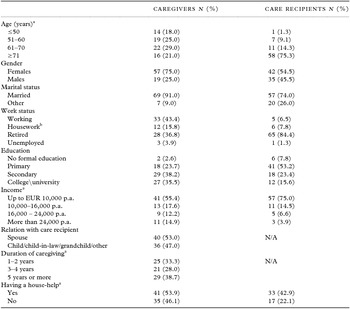
Seventy-six caregivers participated in the study, 57 females and 19 males, the majority being spouses (53%), most of them well educated but with low income, probably because a large number (40.7%) were retired or unemployed. Table 1 presents the socio-demographic characteristics of the caregivers and their care recipients.
Caregivers’ (n = 76) and care recipients’ (n = 77) characteristics

aThe total number varies due to missing data.
bHousework is defined as the regular work of housekeeping such as cleaning and cooking.
Note: p.a. = per annum; N/A = not available.
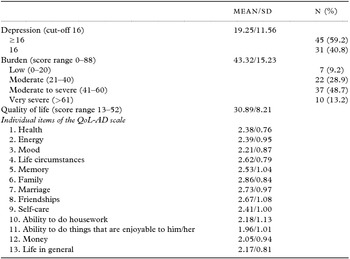
Summary statistics for depression, burden, and caregivers’ QoL (both overall and for the individual items) are presented in Table 2. Forty-five caregivers (i.e. 59.2%) had a score equal or higher to 16 on the CES-D scale while 48.7% caregivers reported moderate to severe burden and 13.2% a very severe burden on the ZBI. The mean value of the QoL-AD was M = 30.89 (theoretical range 13–52), SD = 8.21, Median = 32 (observed range 15–44, IQR = 23.25–38). The highest rating was given for the QoL item related to family (M = 2.86, SD = 0.84) and the lowest for the ability to do things that are enjoyable to them (M = 1.96, SD = 1.05).
Level of depression, burden, and quality of life of the caregivers

QoL-AD = quality of life-Alzheimer's disease.
Concerning the dependency level of the care recipients as rated by their caregivers, the mean score of ADL was 2.27 (SD = 1.96, score range 0–6). The majority of the care recipients received high scores on dependency (n = 39, 50.6%, score range 0–2). An equal number of individuals (n = 19; 24.7%) were classified as having medium (score range 2.5–4) and low level of dependence for their ADL (score range 4.5–6) respectively.
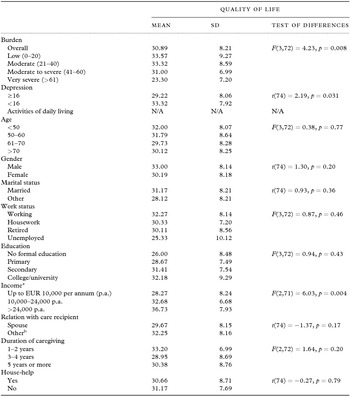
There was a moderate negative correlation between QoL and overall burden (r = −0.32, p = 0.004). Analysis of variance, presented in Table 3, indicated a significant difference in QoL in terms of the caregivers’ overall burden score; F(3, 72) = 4.23, p = 0.008. In fact, there was clear indication of a linear trend of decreasing QoL across categories of increasing burden scores. Those with the highest burden scores (61–88) had the lowest QoL scores, M = 23.30 (SD = 7.20), whereas those with the lowest burden scores (0–20) had the highest mean QoL level of all the caregivers, M = 33.57 (SD = 9.27), p-value for trend = 0.004.
Level of quality of life with respect to burden, depression, and socio-demographic variables: one-way analysis of variance

aSome of the income categories had low number of participants, hence they were grouped together for the purpose of mean comparison in Table 3.
bThe sub-categories of the Relation with care recipient variable “Others” were: child, child-in-law, grandchild, other.
Similarly, a negative correlation was observed between QoL and depression (r=−0.30, p = 0.009). Caregivers with scores ≥16 on the CES-D had on average lower QoL scores (n = 45, Mean = 29.22, SD = 8.06) by comparison to caregivers with CES-D scores <16, indicating no depression, who had significantly higher QoL (n = 31, Mean = 33.32, SD = 7.92); p-value = 0.003.
In contrast, only a weak and non-statistically significant correlation was observed between caregivers’ QoL and patient dependency measured by ADL of care recipients (r = 0.17, p = 0.151).
With regards to the demographic characteristics of the caregivers, also shown in Table 3, QoL appeared lower by increasing age, among those unemployed and those with lower educational attainment. Nevertheless, with the exception of income, none of the observed differences were statistically significant. Across the income categories, there was a significant statistical difference of QoL level, p-value = 0.004. Subsequent post hoc tests showed that only the difference between caregivers whose income was lower than EUR 10,000 p.a. and those with an income over EUR 24,000 p.a. was statistically significant.
Regression analysis
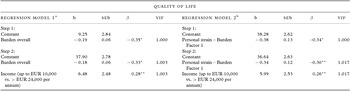
Table 4 presents the results of the hierarchical multiple regression analysis of burden and depression (independent variables) on caregiver's QoL while accounting for the following socio-demographic characteristics of the caregivers: gender, age, income, education, degree of kinship with the care recipient, number of years caring, and house-help. The income category was coded into two dummy variables: “up to EUR 10,000 p.a. versus EUR 10,000–24,000 p.a.” and “up to EUR 10,000 p.a. versus more than EUR 24,000 p.a.” Patient dependency was not included in the multivariate analyses since only a weak non-significant correlation was observed between QoL and ADL. As already mentioned earlier, the overall burden score (Model 1) and its four individual components (Model 2) were modeled separately to avoid colinearity. As shown in Table 4, burden overall score and income were the only factors that contributed significantly in explaining QoL. Burden overall score explained 12.1% as a single factor and the total variance explained increased by 7.8% with the addition of income. The overall variance of the caregiver's QoL explained by the first model was 20%. None of the remaining socio-demographic variables significantly explained any variance. The second model explained 18% of the overall variance of the caregiver's OoL. Personal strain (Burden factor 1) was the only one of the four burden factors that significantly explained, by 11.4%, the QoL variance. Similar to Model 1, income was the only additional factor that significantly increased the proportion of variance explained. The negative coefficients suggest that the higher the burden the lower the QoL. In contrast, under both models the higher the income the better the QoL particularly when income is over EUR 24,000 p.a. compared to incomes less than EUR 10,000 p.a.
Hierarchical multiple regression analysis with forward selection of burden, depression, and caregivers’ characteristics on quality of life (QoL)

aRegression Model 1: Burden Overall Score factor and depression (Step1) and all other socio-demographic characteristics (Step 2). R 2 = 0.121 for Step 1, ΔR 2 = 0.078 for Step 2 (p < 0.001).
bRegression Model 2: Burden individual factors 1–4 and depression (Step 1) and all other socio-demographic characteristics (Step 2). R 2 = 0.114 for model 1, ΔR 2 = 0.066 for Model 2 (p < 0.005). The caregivers’ socio-demographic characteristics in both models were: gender, age, income, education, degree of kinship with care recipient, number of years caring, house-help.
*p < 0.005; **p < 0.05.
Discussion
Consistent with existing literature, both international (Etters et al., Reference Etters, Goodall and Harrison2008; Brodaty and Donkin, Reference Brodaty and Donkin2009; Rosness et al., Reference Rosness, Mjørud and Engedal2011; Bruvik et al., Reference Bruvik, Ulstein, Ranhoff and Engedal2012) and national (Papastavrou et al., Reference Papastavrou, Kalokerinou, Papacostas, Tsangari and Sourtzi2007), the results of this study indicate that caregivers of patients with dementia are sustaining high levels of burden, relatively low QoL, and are likely to show clinical depression.
In fact, observed levels of QoL were lower in this study (M = 30.89) than those reported in previous studies using the QoL-AD in populations of caregivers of people with dementia: M = 37.9 (Rosness et al., Reference Rosness, Mjørud and Engedal2011), M = 40.1 (Bruvik et al., Reference Bruvik, Ulstein, Ranhoff and Engedal2012). Furthermore, the QoL among participants in this study appeared lower by comparison to populations of caregivers of patients with early onset of dementia (van Vliet et al., Reference Van Vliet, de Vugt, Bakker, Koopmans and Verhey2010). In terms of the age of care recipients in our study, the majority (75.3%) were over the age of 71 years. This is comparable to Bruvik et al. (Reference Bruvik, Ulstein, Ranhoff and Engedal2012) where care recipients mean age was 78.4 (+ 7.5) years. In contrast, the sample of caregivers assessed by Rosness et al. (Reference Rosness, Mjørud and Engedal2011) had a mean age of 60.1 (+ 4.9) years. Furthermore, while van Vliet et al. (Reference Van Vliet, de Vugt, Bakker, Koopmans and Verhey2010) found that early-onset dementia caregivers experience high levels of burden, stress, and depression, the results of their study were inconclusive when compared to the results of late-onset dementia caregivers. Thus, differences in the age of care recipients do not seem to provide a valid explanation for the lower QoL observed here. These findings may raise concerns as to the availability and effectiveness of caregiver support programs and the development of public policy advancements in Cyprus. Although a community care program has been established and a national strategic plan for dementia has been submitted, the available resources are yet not sufficient to ensure optimal care for the family caregivers.
Consistent with previous research, burden of care was significantly associated with caregiver QoL. To date, regression analyses in several studies have demonstrated the predictive ability of burden for caregivers’ QoL (Coen et al., Reference Coen, O'Boyle, Coakley and Lawlor2002; Serrano-Aguilar et al., Reference Serrano-Aguilar, Lopez-Bastida and Yanes-Lopez2006; Scholzel-Dorenbos et al., Reference Scholzel-Dorenbos, Draskovic, Vernooij-Dassen and Olde Rikkert2009). Similarly, burden was also found to be a significant predictor of the caregivers’ rating of the patients’ QoL (Karlawish et al., Reference Karlawish, Casarett, Klocinski and Clark2001). The most prominent factor correlated with caregivers’ QoL among the four domains of burden investigated here was personal strain. The ability to do things that are enjoyable to them had the lowest score among the caregivers, suggesting a need for more personal time away from providing care to the patient. In the context of Cyprus, it also highlights the absence of respite services either from the public or the private sector, which could have been used as a relief measure for the highly burdened caregivers. In contrast, the highest rating was given to the family factor, indicating a cultural influence on QoL (Vellone et al., Reference Vellone, Piras, Venturini, Alvaro and Cohen2012) or probably suggesting that people identify more strongly with traditional values and provide care in a collectivistic rather than individualistic caregiving system.
Despite the observed association between QoL and depression, when the depressive symptoms variable was added in the regression model it did not contribute further in explaining the QoL. This finding is in line with Rosness et al. (Reference Rosness, Mjørud and Engedal2011) who found that QoL is more strongly determined by caregiver characteristics than depression. This finding warrants for further investigation, given the strong relationship between burden and caregivers’ depressive symptoms found in other studies (Papastavrou et al., Reference Papastavrou, Kalokerinou, Papacostas, Tsangari and Sourtzi2007).
Over 75% of the caregivers in our study reported medium or high levels of patient dependency as measured on the ADL. Nonetheless, only a weak correlation was observed between QoL and the ADL. There is evidence that impaired function in care recipients predicts caregiver burden and quality of the caregivers’ life (Abdollahpour et al., Reference Abdollahpour, Noroozian, Nedjat and Majdzadeh2012; Bruvik et al., Reference Bruvik, Ulstein, Ranhoff and Engedal2012). However, the evidence is conflicting since a number of other studies report no association between burden and the patient's daily functional abilities (Boutoleau-Bretonniere and Vercelletto, Reference Boutoleau-Bretonniere and Vercelletto2009). Only a handful of studies have actually tried to link patient dependence and QoL. In the PIXEL study (Thomas et al., Reference Thomas2006), it was reported that QoL is associated with the ADL, while Serrano-Aguilar et al. (Reference Serrano-Aguilar, Lopez-Bastida and Yanes-Lopez2006) also found that caregivers’ health-related QoL was inversely associated with the patient dependency level. In a more recent study, the strongest determinants of the caregivers’ QoL were physical fitness of the patient and state of their marriage and family (Scholzel-Dorenbos et al., Reference Scholzel-Dorenbos, Draskovic, Vernooij-Dassen and Olde Rikkert2009). Duggleby et al. (Reference Duggleby, Swindle, Peacock and Ghosh2011) also studied the relationship among demographic variables, hope, QoL, and transitions of family caregivers of persons with AD with the use of a non-dementia-specific QoL measure (the WHOQOL BREF) examining four different domains of QoL. The authors found an inverse correlation between income and QoL only for “physical QoL,” while participants with the highest physical QoL scores were those who had help with caregiving.
A possible explanation for the weak association between ADL and QoL in our study is that a large proportion of the study participants reported that they had full-time helpers who provided hands-on-care, including bathing, feeding, assisting with toileting, dressing, and other daily activities. With the exception of income, which, together with the overall burden score, contributed significantly in explaining QoL, no associations were observed with other caregiver characteristics (e.g. education or number of years caring). The positive correlation seen here between income and QoL, which contrasts the findings reported by Duggleby et al. (Reference Duggleby, Swindle, Peacock and Ghosh2011), could be explained by the lack of infrastructure and appropriate resources for the care of patients with dementia in Cyprus and the need for the families to purchase services. It is also possible that caregivers with a higher income have better access and opportunities for personal entertainment or other services for themselves, which help them relax contributing to an overall improved level of QoL.
The convenience sample and the relatively small sample size are among the limitations of this study. However, the study participants were identified from the two major referral centers in the country; thus, the findings are expected to largely reflect the experiences of the population caring for a person with dementia at home. Another limitation may be that traditional measures assessing daily living, such as the one used in this study, may not be sensitive enough to functional changes related with cognitive decline (Jefferson et al., Reference Jefferson2008). Finally, QoL is a multidimensional construct that could potentially be influenced by other factors that were not measured in this study (e.g. Vellone et al., Reference Vellone, Piras, Talucci and Cohen2008, Reference Vellone, Piras, Venturini, Alvaro and Cohen2012; Cooper et al., Reference Cooper, Mukadam, Katona, Lyketsos, Ames and Rabins2012). In particular, the patients’ behavioral symptoms, the severity of their cognitive impairment, as well as caregivers’ adverse life events outside their caregiving role might have influenced the perception of their QoL (Coen et al., Reference Coen, O'Boyle, Coakley and Lawlor2002; Thomas et al., Reference Thomas2006; Scholzel-Dorenbos et al., Reference Scholzel-Dorenbos, Draskovic, Vernooij-Dassen and Olde Rikkert2009; Duggleby et al., Reference Duggleby, Swindle, Peacock and Ghosh2011).
Conclusion
The increasing elderly population in the Cyprus Republic together with other demographic changes reflect the importance of family care and emphasize the need for policy development and satisfactory public services for supporting families in their caring role. Promoting the level of caregiver's QoL will be beneficial to both caregivers and patients. Although in this study, burden and income alone explained as much as 20% of variance of the QoL, there is still need to explore further the factors predicting the remaining of the variance and the range of issues influencing care and QoL. Additional research is necessary to investigate which other domains determine QoL and increase our understanding of the factors that reduce imposed burden in dementia caregivers.
Conflict of interest
None.
Description of authors’ roles
EP designed the study, supervised the data collection, and wrote the paper; PA assisted in the supervision of the data collection, carried out the statistical analysis, and assisted with writing the paper; NM assisted in the design of the study, supervised the statistical analysis, and assisted with the writing of the paper; and SP and IKG were in charge of the referral of participants and assisted in writing of the paper.
Acknowledgments
The study has been funded by the Cyprus University of Technology. Special thanks to the participating families and the students who helped in the collection of data.