1. Introduction
I am concerned here with the implications of what Darwin called “chance” or “accidental” variation. More specifically, how, according to Darwin, does chance variation affect evolutionary outcomes? To address this question, I will focus on his 1866 book, On the Various Contrivances by which British and Foreign Orchids are Fertilised by Insects. The argument developed in that book played an important role in Darwin's overall case for evolution by natural selection, as articulated in later editions of the Origin.
Darwin's friend and supporter, Asa Gray, praised Orchids as a “flank movement” in the battle for evolution by natural selection. Darwin certainly appreciated Gray's compliment, although he was perplexed that Gray of all people would take such a favorable view. From Darwin's perspective, Orchids was much more radical than his theologically conservative friend was prepared to acknowledge.
2. Chance Variation: Meaning and Implications
What Darwin meant by “chance” or “accidental” variation has been discussed at length (e.g., Gigerenzer et al., Reference Gigerenzer1989, 132–141 and references therein; Lennox Reference Lennox2004). There is general agreement that when he referred to variation as such he meant at least two things. First, variation is not an adaptive response to the environment. Variation is, he thought, caused by the environment—but the environment does not necessarily result in variations that are adaptive (e.g., Darwin Reference Darwin1883, 2:236).
Second, Darwin believed that the causal relations between environment and variation are so complex as to be unpredictable. Ultimately, he distinguished between two classes of variation: those that are in-principle unpredictable (what he called “indefinite” or “fluctuating” variations), and those that are in-principle, though not at present predictable (he called these “definite” variations). He believed that most variations were of the former sort (e.g., Darwin Reference Darwin1872, 5–8; 1883, 2:260–282).
Third (and this is less well recognized, I think), “chance” variation, for Darwin, had something to do with probability more formally construed. For example, he believed that the larger the population, and the longer the time (hence the larger the number of births), the better the “chance” that a favorable variation would appear. Referring in particular to domesticated animals and plants, he argued that this is why commercial breeders are so much more successful than individual breeders, and why rich breeders are so much more successful than their poorer counterparts: “as variations manifestly useful or pleasing to man appear only occasionally, the chance of their appearance will be much increased by a large number of individuals being kept. Hence, number is of the highest importance for success. Of this principle Marshall formerly remarked, with respect to the sheep of parts of Yorkshire, `as they generally belong to poor people, and are mostly in small lots, they never can be improved'” (Darwin Reference Darwin1872, 29). And similarly, “Lord Rivers, when asked how he succeeded in always having first-rate greyhounds, answered, `I breed many, and hang many'” (Darwin Reference Darwin1883, 2:221; see also 230, 234–235). It sounds as though Darwin had something like the law of large numbers in mind here.
So much for the meaning of “chance variation.” For Darwin, the evolutionary implications of chance variation had to do with (1) the contingency of the outcomes of evolution by natural selection of chance variations, which could in turn lead to (2) chance divergence. He argued that two closely related, even initially identical lineages, inhabiting identical environments, may by chance give rise to different variations. Natural selection acting on different variations in the different lineages would then result in different outcomes, and hence divergence. Which outcomes occur would depend on which variations had occurred, and in what order.
3. Chance Variation and Orchid Evolution
Initial recognition of the role of chance variation in contingent evolutionary outcomes and divergence has been traced to the work of the Hermann J. Muller in the 1930s and 1940s (Muller Reference Muller1939, Reference Muller and Huxley1940; see Mani and Clarke Reference Mani and Clarke1990, 30). But Darwin himself was well aware of the evolutionary significance of chance variation. This factor played an especially crucial role in his account of the diversity of orchid floral morphologies.
What Darwin set out to establish and then to explain was that the vastly different forms of orchid flowers all served the same end, namely, to inhibit self-fertilization and facilitate cross-pollination: “In my examination of Orchids, hardly any fact has struck me so much as the endless diversities of structure,—the prodigality of resources,—for gaining the very same end, namely, the fertilisation of one flower by the pollen from another plant” (Reference Darwin[1877] 1892, 284).Footnote 1
The majority of orchid species (and most flowering plants) are hermaphroditic: each individual possesses both male and female reproductive organs. Hermaphrodism might seem like a good way of ensuring reproductive success and hence evolutionary persistence. But Darwin was convinced that self-crossing—and even mating between relatives—decreased the survival and reproductive abilities (the “vigor and fertility”) of the offspring produced (e.g., Reference Darwin1859, 96–97; Darwin worried about how bad it might have been for his own children that he had married his first cousin, Emma; see Desmond and Moore Reference Desmond and Moore1991, 575). The more hermaphroditic plants he studied, the more mechanisms he found for the promotion of intercrossing. Among orchids, self-crossing was exceedingly rare. Darwin knew of only one case, the bee orchid, Ophrys apifera (which he predicted would go extinct, and he confided that he wished he could live a thousand years in order to see the last one go; see Desmond and Moore Reference Desmond and Moore1991, 511–512).
But how do the different flower forms serve the common end of intercrossing? Darwin believed that they all served—in different ways—to enlist flying insects to transport pollen from one plant to another. These different “contrivances” had evolved, Darwin believed, under virtually the same environmental circumstances, for example, the same range of available insects. Sometimes one part of the flower had been modified to entice insects in the vicinity, by mimicry or by scent; sometimes another part had been modified to do the same job. Once the insects had arrived, the pollen had to be attached. Some flowers were so constructed as to catapult pollen at the visiting insects; some catapult the insects against the pollen; some simply induce the visitors to travel past and brush up against the pollen. And so on. Thus cross-pollination was accomplished in very different ways, the different outcomes being due in large measure—Darwin argued—to natural selection acting on chance differences in variation among different lineages.
Darwin might have explained the different outcomes mainly in terms of differences in environmental conditions—for example, differences in the insects available for conscription as pollinators. Thus, he might have presumed that different lineages of orchids experience the same variations, in the same order, and then he might have argued that different variations are selected in different lineages depending on which pollinators are in the vicinity. But he did not. His emphasis was on chance differences in variation among lineages (with one additional factor that I will get to shortly).
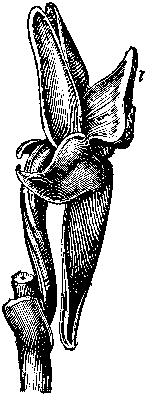
This emphasis might be obscured by Darwin's famous analysis of the Madagascar star orchid, Angraecum sesquipedale, which has an extraordinarily long nectary—up to a foot in length (see Fig. 1). Darwin reasoned that such a long nectary must serve to attract an insect with an equally long proboscis, although no such insect was known at the time to exist in Madagascar (Reference Darwin[1877] 1892, 162–163). The hypothetical scenario was initially dismissed as fantasy. Darwin took satisfaction in Fritz Müller's discovery, reported in the second edition of Orchids, of a moth in southern Brazil (unfortunately, halfway around the world from Madagascar) with an eleven-inch proboscis (Darwin Reference Darwin[1877] 1892, 163). Darwin didn't live long enough to enjoy the satisfaction of Walter Rothschild and Karl Jordan's 1903 description of the long-tongued and appropriately located (in Madagascar) “Morgan's sphinx moth,” subsequently named Xanthopan Morgani praedicta. But Darwinians since then have treasured the successful prediction. And it has also achieved wide popularity (see Nilsson Reference Nilsson1998 for a brief review of the history).
The Madagascar star orchid, Angraecum sesquipedale.

One might get the impression from this case that the differences between orchids, from place to place, have evolved primarily in response to differences in their environments, including the available insects. But actually (from Darwin's point of view), differences in environment (including differences in available pollinators) do not play a significant role.Footnote 2
Again, the main point of Orchids was to attribute differences in floral morphology to natural selection acting on whatever differences chance to arise. My favorite example of this was originally brought to my attention by James Lennox (Reference Lennox1993). It involves the position of the so-called labellum petal, which in most fully formed orchid flowers is the lowermost of the three petals. In that position, it often serves as a landing pad for pollinators. But interestingly, the labellum actually arrives at that position through a 180° twisting of the flower's stem (usually including the ovarium) as the flower develops.
Darwin reckoned that the position of the labellum in the ancestral orchid had been uppermost, presumably on the grounds that this is also the original position in development, and assuming more generally that the order of development reflects the order of ancestry. He understood the now-typical, lowermost position of the labellum to be an outcome of evolution by natural selection of the more twisted variations that had happened, by chance, to arise (Reference Darwin[1877] 1892, 284).
But Darwin was especially intrigued by cases where the labellum had resumed its uppermost position, and more especially still the means of its reascent:
In many Orchids the ovarium (but sometimes the foot-stalk) becomes for a period twisted, causing the labellum to assume the position of a lower petal, so that insects can easily visit the flower; but … it might be advantageous to the plant that the labellum should resume its normal position on the upper side of the flower, as is actually the case with Malaxis paludosa, and some species of Catasetum, &c. This change, it is obvious, might be simply effected by the continued selection of varieties which had their ovaria less and less twisted, but if the plant [for whatever reason, by chance] only afforded variations with the ovarium more twisted, the same end could be attained by the selection of such variations, until the flower was turned completely on its axis. This seems to have actually occurred with Malaxis paludosa, for the labellum has acquired its present upward position by the ovarium being twisted twice as much as is usual. (Darwin Reference Darwin[1877] 1892, 284–285)
So it had apparently become advantageous for Malaxis and some species of Catasetum to have their labellae uppermost. But due to differences in the variations that chanced to occur in the two lineages, evolution by natural selection had resulted in very different means of serving this end: a 360° twist in the first case, and no twist in the second. Darwin invoked basically the same process—evolution by natural selection of chance differences in variation—to account for the endless diversity of floral morphologies among orchids.
With one additional factor: Divergence due to selection of chance differences in variation was, for Darwin, compounded by what we would today call “epistasis”: a very common situation in which the advantage afforded by one trait depends on what other traits are present. A variation in one trait might only prove adaptive after—not before—evolutionary changes in other traits. For example, Darwin speculated that the adaptive value of having the labellum upright for Malaxis paludosa might have been due to some new insects visiting it, but might just as well have been due to a previous change in the shape of the labellum or a previous change in the other petals—a change that was in itself useful for facilitating cross-pollination, but that would work even better with an upright labellum (Darwin Reference Darwin[1877] 1892, 284). However, the fact that the upright labellum was due to a 360° twist, rather than no twist, was a matter of chance.
Thus, natural selection of chance variations might lead to divergence between two or more lineages, and might also affect the adaptive value of subsequent variations, so that even if the same particular variation were to occur in each lineage following the initial divergence, it might have different adaptive values in each, and hence be selected for in one lineage and not in the others. Accumulated differences would be preserved by inheritance, and would become the differential starting points for further divergence due to chance differences in variation and their effects on the adaptive values of subsequent variations. And on and on, until there were contrivances for cross-pollination as diverse as the beautiful star orchid and the twisted flowers of Malaxis paludosa.
To quote Darwin, summarizing the process leading to the diversity of orchid flowers (here I will allow Darwin to repeat himself somewhat):
In my examination of Orchids, hardly any fact has struck me so much as the endless diversities of structure,—the prodigality of resources,—for gaining the very same end, namely, the fertilization of one flower by pollen from another plant. This fact is to a large extent intelligible on the principle of natural selection. As all the parts of a flower are co-ordinated, if slight variations in any one part were preserved from being beneficial to the plant, then the other parts would generally have to be modified in some corresponding manner. But these latter parts might not vary at all [who knows, it is a matter of chance], or they might not vary in a fitting manner [again, who knows], and these other variations, whatever their nature might be [ditto], which tended to bring all the parts into more harmonious action with one another, would be preserved by natural selection.
To give a simple illustration … . (Darwin Reference Darwin[1877] 1892, 284; my emphasis)
At this point Darwin proceeded to relate the case of Malaxis paludosa.
4. Chance Variation and Darwin's Case for Evolution by Natural Selection
It is often suggested that Orchids presented a new sort of case for evolution by natural selection. Darwin appreciated Asa Gray's assessment of the book—that it was a “`flank movement’ on the enemy” (Gray to Darwin, July 2, 1862, and Darwin to Gray, July 23, 1862, in Darwin Reference Darwin1997, 291–292, 330–331). But the identity of the enemy has been a matter of controversy. In his influential account of Darwin's project, Michael Ghiselin argued that teleology was the vanquished enemy (Reference Ghiselin1969, 131–159). To which Lennox objected that “Darwin [himself] was a Teleologist,” and so too was Gray! The enemy was not teleology but special creationism (Lennox Reference Lennox2004).
I agree with Lennox that Darwin was a teleologist in the most basic sense, in that he understood and explained organic form in terms of its usefulness: natural selection favors variants that are more useful for survival and reproduction. Although I would add that Darwin was not as “strictly” teleological (in a sense that I will explain) as some other teleologists of the nineteenth century. I also agree with Lennox that the enemy was special creationism. Although I would want that category to be understood fairly broadly to include anyone who believes that God had foreknowledge of the particular forms that life would take, and that He intentionally brought those forms about, either directly, or indirectly through the legislation of laws of nature that would lead to those results.
But how exactly did Orchids, as opposed to, say, the first edition of the Origin, constitute such a strategic attack on this enemy? To see how, we must first recall that those who invoked God's foreknowledge of the particular forms of life tended to favor one or another of two positions: what were called at the time “teleology” and “unity of plan” (see the discussion of these two approaches in Ruse Reference Ruse1979).
The teleologists sought to explain organic form in terms of its usefulness for survival and reproduction (e.g., Bell Reference Bell[1833] 1855). Thus the form of the human hand makes sense given the use to which we put it: grasping. For instance, one might wonder why our fingers are unequal in length. Well, grasp a narrow rod and look again. Voila! The fingers are now all the same length, and fit perfectly into the palm (Bell Reference Bell[1833] 1855, 87–88). And so on. As to why species have forms that are useful, teleologists—at least the English-speaking, mostly Protestant teleologists, who were Darwin's most “immediate” concern—reasoned that God, in his benevolence and wisdom, had fitted each species with just the right traits needed for its perpetuation (Bell Reference Bell[1833] 1855, passim).
From a strictly teleological point of view, similarities and differences in form should reflect similarities and differences in the uses served. As Charles Bell summarized his study of differences in the skeletal forelimbs of various animals: “changes in the bones [from species to species] suit them to every possible variety of use” (Bell Reference Bell[1833] 1855, 86). And, “We have seen no accidental deviation or deformity [from species to species], but that every change has been for a purpose, and every part has had its just relation” (Bell Reference Bell[1833] 1855, 105).
But as proponents of the unity-of-plan approach pointed out, very similar parts can serve very different uses. Take, for instance, Richard Owen's famous counterexample to Bell's analysis (Owen Reference Owen1849). How similar are the forelimb skeletal structures of dugongs, moles, bats, and humans—the same bones appear, and in the same relationships, over and over. And yet those structures are put to entirely different uses—from swimming to tunneling to flying to grasping. One can make much better sense of these four forms by viewing them as instances of a more general theme: the vertebrate forelimb. This is not to say that each of these limbs is unsuited to its particular use. Teleology has its place within the unity-of-plan approach. But the best way to understand, for example, the dugong's forelimb is not to dwell primarily on how useful it is for swimming, but rather to view it as a useful variant on the vertebrate theme (Owen Reference Owen1849, 1–10, 39–40, 85).
According to many English-speaking proponents of the unity-of-plan approach (again, Darwin's most immediate concern), this vertebrate theme was God's plan for the direct or indirect production of vertebrates (Owen Reference Owen1849, 85–86). That is, He intended that there would be variants upon this theme, differentially adapted to their different circumstances. This is a reflection of God's unity and oneness, in addition to His benevolence and wisdom.
So proponents of the unity of plan one-upped what I would call the “strictly” teleological approach. By “strict” teleology, I mean the view that organic form should be understood in terms of usefulness, and moreover differences in form should be understood in terms of differences in use. Proponents of the unity of plan understood differences in form primarily in terms of differences in theme, and differences within a theme in terms of differences in use.
In Orchids, Darwin one-upped both the strictly teleological and unity-of-plan approaches. Consider, for example, how both would have problems explaining the 360° twist of Malaxis paludosa. First, with respect to the strictly teleological approach: it may well be the case (from Darwin's point of view it certainly was the case) that an untwisted stem and a stem with a 360° twist are both useful, and the usefulness of each explains the presence of each. But the difference between them does not necessarily reflect any difference in use; indeed, the different forms serve the same use. So the strictly teleological approach fails here, and so too the unity-of-plan approach. For in this case, which is repeated in kind over and over among the orchids, even differences within a theme do not reflect differences in use. (I will elaborate a bit more on this point shortly.)
Orchids was published after the first edition of the Origin. This sort of case against the enemy/enemies does not show up until subsequent editions. But when it does appear in the Origin, it has something in common with other arguments in the early editions. From the beginning, Darwin had argued that there are phenomena that can be accounted for in terms of common descent, or common descent supplemented by natural selection, but not by either of the two main versions of special creation. For example, he placed great weight on geographic patterns of distribution of organic form. How, for instance, would a strict teleologist, or a proponent of the unity of plan, explain the fact that there are so many species of armadillos—extant and extinct—but only in the Americas? Why would God have directly or indirectly put them only there, and why would He keep on putting them only there (to replace the ones that go extinct), when there are so many other areas of the world where armadillos could thrive (Darwin Reference Darwin1859, 339–340)? And why did He populate the Galapagos islands (off the Pacific coast of South America) with variants on American mainland forms, and the Cape Verde islands (off the Atlantic coast of Africa) with variants on African forms, even though the environments of the two groups of islands are much more similar to each other than to their larger neighbors (Darwin Reference Darwin1859, 398–399)? (I leave it to the reader to contemplate how these phenomena would be understood in Darwinian terms.)
When Darwin said that there was no “rational” explanation of these and other phenomena in terms of God's intentions to bring these particular phenomena about (Reference Darwin1859, 139), he meant “rational” in two senses. First, he meant that the phenomena do not seem to be the result of a rational creator creating rationally; they would seem to be more a matter of whim than reason. Second, if such phenomena are the result of rational deliberation, then there must be part of the deliberation that we are missing. As Darwin complained, we could at best say in such cases that “it has pleased the Creator” to act thus, which is to say that we really don't know why He did it. It comes down to God's whim, or our ignorance (Reference Darwin1859, 185–186, 435; see also 167, 194, 393, 481–483).
After publishing Orchids, Darwin added to subsequent editions of the Origin an additional class of phenomena that he felt were rationally explainable only in terms of evolution by natural selection, and not by either version of special creationism, namely, differences within a theme that do not correspond to different uses, but rather all serve the same use. He hammered the phenomenon home:
It is a common rule throughout nature that the same end should be gained, even sometimes in the case of closely-related beings, by the most diversified means. (Reference Darwin1872, 266)
This subject of the same end being gained by the most diversified means well deserves attention. (Reference Darwin1872, 267)
How, it may be asked … can we understand the graduated scale of complexity and the multifarious means for gaining the same end? (Reference Darwin1872, 269)
In a section titled, “Summary: The Law of Unity of Type and of the Conditions of Existence [Teleology] embraced by the Theory of Natural Selection,” Darwin explained how his theory made sense of his opponents’ positions, but also made sense of “several facts, which on the belief of independent acts of special creation are utterly obscure,” including the fact that “the common rule throughout nature is infinite diversity of structure for gaining the same end” (Reference Darwin1872, 283, 285).
The example that he discussed in greatest detail was orchid floral morphology. The wide variety of orchid flowers serving basically the same end—to attract the available range of flying insects to transfer pollen—was clearly inexplicable on the strictly teleological approach, since the wide differences in form did not reflect wide differences in use, but was also perplexing on the unity-of-plan approach, since the wide differences in form did not correspond to wide differences in use within the orchid theme. One could at best argue that the Creator had caused this variety to exist “for the sake of mere variety.” As Darwin argued, “this subject of the same end being gained by the most diversified means well deserves attention. Some authors maintain that organic beings have been formed in many ways for the sake of mere variety, almost like toys in a shop, but such a view of nature is incredible” (Reference Darwin1872, 154). I believe Darwin again meant “unreasonable” rather than “incredible.” To appeal to God in this manner is to appeal to His whim rather than His reason, or to betray our ignorance of His reasons.
5. Conclusion
By way of conclusion, I would like to return to Asa Gray, and to the significance of chance variation for the Darwinian revolution more generally. Given the importance of chance variation in Orchids, it is amazing that Gray had such a favorable reaction. How could he not have seen himself among the “enemy”? His own view was that God actively guided, or intentionally predetermined, which variations would occur, where, and in what order, and that natural selection did the rest. (As if God directly or indirectly caused Malaxis to vary in one direction, and several species of Catasetum to vary in the opposite direction, with 360° and 0° outcomes in mind!) And Gray even advised Darwin—in print—to take the same position in order to avoid the charge that God had no role in his system (Gray Reference Gray[1860] 1963, 121–122).
Darwin later rebuked Gray implicitly and explicitly—in print—and fairly scorchingly. Had God also, Darwin asked, directly or indirectly caused just the right variations to appear at just the right times so that breeders could, by artificial selection, produce ferocious fighting dogs that could even bring down bulls by clamping their jaws onto the bulls’ faces and effectively suffocating them? And had God directly or indirectly caused just the right variations to occur at just the right times to ensure the evolution, by natural selection, of cuckoos that exclude their foster siblings from the nest, or ants that make slaves, or parasitic wasps that lay their eggs in caterpillars so that the developing larvae can devour their hosts from the inside out? And if not (because of course not), then why suppose that God directly or indirectly caused just the right variations to occur at just the right times to ensure the evolution of humankind (Darwin Reference Darwin1872, 234; 1883, 2:427–428)?
Darwin had not intended to write God out of creation. God had, he initially believed, designed the sorts of laws—including laws of inheritance and evolution—that would lead to the production of species whose forms were useful for their survival and reproduction. But whether adaptive evolution was accomplished by a twist, or not; whether it was accomplished by parasitism, or not; whether it was accomplished by reflection and morality, or not; none of this was God's concern. As Darwin explained in correspondence to Gray, “I am inclined to look at everything as resulting from designed laws, with the details, whether good or bad, left to the working out of what we may call chance. Not that this notion at all satisfies me” (Darwin to Gray, May 22, 1860; in Darwin Reference Darwin1993, 223–224). Indeed, Darwin was left with as heterodox a view of God as the whimsical view he attributed to his “enemies.” Which turned out to be less and less a problem for Darwin as he gave up his religious beliefs.
Darwin was, I think, somewhat taken aback by Gray's extremely positive remarks about Orchids. He certainly appreciated them: “Of all the carpenters for knocking the right nail on the head, you are the very best; no one else has perceived that my chief interest in my orchid book has been that it was a `flank movement' on the enemy” (Darwin to Gray, July 23, 1862; in Darwin Reference Darwin1997, 330–331). But further down in the same letter, he seemed to wonder if Gray really understood what the book was about. As if to say, “Thanks, but …,” he asked, “I shd like to hear what you think about what I say in last Ch. of Orchid Book on the meaning & cause of the endless diversity of means for the same general purpose.—It bears on design—that endless question— Good Night Good Night.”
Their close and frequent correspondence continued, but there was no answer forthcoming until a year later (and after about two dozen letters in either direction), when Gray finally acknowledged Darwin's prodding about the implications of orchid variation: “Here lives, I suppose the difference between us. When you bring me up to this point, I feel the cold chill” (Gray to Darwin, July 7, 1863; in Darwin Reference Darwin1999, 525–526).
The multiplicity of possible outcomes of evolution by the natural selection of chance variations, and hence the contingency of the actual results (like us), is surely one of the most unsettling aspects of the Darwinian revolution. Darwin chose to demonstrate this contingency empirically in a book on … orchids.