1. Introduction
The extent to which linguistic systems of bilingual speakers overlap is a perennial issue in bilingualism research. Psycholinguistic studies have argued for a large degree of integration in the lexical and grammatical systems of bilingual speakers (e.g., Brysbaert & Duyck, Reference Brysbaert and Duyck2010; Hartsuiker & Pickering, Reference Hartsuiker and Pickering2008). Nevertheless, in community-based studies of spontaneous bilingual speech, there is scant evidence for contact-induced morphosyntactic change in long-standing close contact situations, such as Canadian French (Poplack & Levey, Reference Poplack, Levey, Auer and Schmidt2010), and in relatively recent immigrant communities, such as Los Angeles Spanish (Silva-Corvalán, Reference Silva-Corvalán1994). Structural priming – the tendency for language users to reinvest in previously produced or processed structures in production and comprehension (e.g., Bock, Reference Bock1986) – is a phenomenon particularly suited to the study of overlap in the grammatical systems of bilingual speakers.
In the current paper we explore structural priming in bilingual discourse and, through this, the question of ‘overlap’ in bilingual grammars, guided by three research questions on the relative strength of within- and cross-language priming. First, are within- and cross-language priming equally strong? Second, do within- and cross-language priming persist (or decay) to the same extent across intervening linguistic material? Third, is the relative strength of priming within and across languages accounted for by a lexical boost effect, that is, a strengthening of the priming due to the identity of form of the prime and target? By addressing these questions in spontaneous speech data and with a new structure type hitherto absent from the cross-language priming literature – subject expression – we offer evidence that the strength of priming varies with naturally co-occurring features of the discourse context and the particular construction in which the target occurs.
In all varieties of Spanish, pronominal subjects exist as an option alongside unexpressed (or null) subjects in most contexts, unlike in English where variation in subject expression is much more limited (Travis & Lindstrom, Reference Travis and Lindstrom2014; Torres Cacoullos & Travis, Reference Torres Cacoullos, Travis, Carvalho, Orozco and Shin2015, pp. 89–90). Here, we investigate priming of Spanish variable subject pronoun expression in a new corpus of New Mexican Spanish–English bilingual speech (Torres Cacoullos & Travis, in preparation). As illustrated in (1), the first person singular (1sg) subject is variably expressed as the pronoun yo (lines 2, 9, 12) or is what we will call unexpressed (lines 11 and 12). Zeros (Ø) in the original and parentheses around I in the translation are used to ease identification of unexpressed subjects. In the translation, unambiguous code-switches – that is, multi-word sequences originally produced in English – appear in italics.
-
(1)


1.1 Cross-language structural priming
Community-based studies of language variation have widely reported structural priming (also referred to as perseverance, persistence, parallelism). For example, Poplack (Reference Poplack and Labov1980) found priming in Spanish variable plural (s) expression at the level of the Noun Phrase, where the presence of [s] in a preceding element in the phrase (such as a determiner) favored its presence on a subsequent element (such as the head noun). Scherre and Naro (Reference Scherre and Naro1991, Reference Scherre and Naro1992) showed that priming in variable subject/verb agreement and subject/predicate adjective agreement in Brazilian Portuguese occurred both within the clause and across clauses: morphological plural marking was more likely to occur (on verbs and predicate adjectives) in cases where it had been marked on preceding elements in the same clause or in the preceding clause. Weiner and Labov (Reference Weiner and Labov1983) demonstrated that, in English, if there was an agentless passive in the recent discourse, speakers were more likely to use another such passive than an active clause with a general (non-specific) subject pronoun (e.g., Lower Merion's allowed to smoke in the halls vs. they allow Lower Merion to smoke in the halls).
Experimental studies to date indicate that in bilingual speakers, priming occurs both within and across languages. This cross-language priming was first observed by Loebell and Bock (Reference Loebell and Bock2003), who reported priming of the dative alternation both from German to English and from English to German. Subsequent lab-based studies have confirmed the effect in numerous language pairs and structure types. Priming of the passive has been observed in Spanish–English bilinguals (Hartsuiker, Pickering & Veltkamp, Reference Hartsuiker, Pickering and Veltkamp2004) and in Dutch–English bilinguals (Bernolet, Hartsuiker & Pickering Reference Bernolet, Hartsuiker and Pickering2009). Although much of this past experimental work has concentrated on verb argument structure alternations (see also Kantola & van-Gompel, Reference Kantola and van-Gompel2011; Meijer & Fox Tree, Reference Meijer and Fox Tree2003; Salamoura & Williams, Reference Salamoura and Williams2006, Reference Salamoura and Williams2007; Schoonbaert, Hartsuiker & Pickering, Reference Schoonbaert, Hartsuiker and Pickering2007; Shin & Christanson, Reference Shin and Christanson2009), priming has also been reported for genitive noun phrases from Dutch to English (e.g., the shirt of the boy / the boy's shirt) (Bernolet, Hartsuiker & Pickering, Reference Bernolet, Hartsuiker and Pickering2013) and for adjective-noun/relative clause alternations from Dutch to German (e.g., the red ball / the ball that's red) (Bernolet, Hartsuiker & Pickering, Reference Bernolet, Hartsuiker and Pickering2007). In addition to variation between syntactic alternations, priming has been shown for relative clause attachments from Dutch to English (e.g., someone shot the servants of the actress who was / were on the balcony) (Desmet & Declercq, Reference Desmet and Declercq2006), ambiguous relative clause interpretations from English to German (Kidd, Tennant & Nitschke, Reference Kidd, Tennant and Nitschke2015), and the sentential location of code-switching in Dutch–English bilinguals (Kootstra, Van Hell & Dijkstra, Reference Kootstra, Hell and Dijkstra2012).
The experimental crosslinguistic priming literature has typically been interpreted within Hartsuiker et al.'s (Reference Hartsuiker, Pickering and Veltkamp2004) lexico-syntactic model of grammatical representation, itself an extension of Pickering and Branigan's (Reference Pickering and Branigan1998) ‘monolingual’ model. The model builds upon previous stage-based models of sentence production (e.g., Levelt, Reference Levelt1989), assuming discrete layers of representation for lexical concepts (e.g., GIVE [X, Y, Z]) and for lemmas (e.g., to give). Each lemma is connected to a unit (or node) denoting its grammatical class (e.g., verb), and ‘combinatorial units’ denoting the syntactic combinations in which it can occur (e.g., prepositional dative, double object dative). Cross-language priming is attributed to the interconnected nature of lexical and syntactic representations in the model. Lemmas for translation equivalents (e.g., give, geven, for an English–Dutch bilingual) are considered to be linked to a common conceptual representation and combinatorial nodes. Therefore, following the sentence Simon gave Mary a book, the connections between the conceptual, lemma and combinatorial nodes are activated for both English and Dutch, predicting a higher likelihood that a speaker will produce a double object dative in both languages.
Just as lexical overlap boosts priming within the one language, translation equivalent lemmas are argued to boost priming across languages because of greater network activation. For instance, Simon gave Mary a book is more likely to prime Dutch Andrew gaf Emily een pen ‘Andrew gave Emily a pen’ than Andrew stuurde Emily een cadeau ‘Andrew sent Emily a present’, since in the latter case only the combinatorial node is activated. At the same time, translation-equivalent priming has been reported to be weaker than within-language lexical boost priming (Schoonbaert et al., Reference Schoonbaert, Hartsuiker and Pickering2007), which may suggest that priming across languages is weaker than priming within the one language (see also Bernolet et al., Reference Bernolet, Hartsuiker and Pickering2013).
Utilizing a community-based study of spontaneous discourse, in this paper we provide new insights on bilingual priming unavailable in the lab.
2. A community-based corpus and a new morphosyntactic variable for the study of bilingual priming
2.1 Community-based spontaneous speech
Experimental studies of cross-language priming provide controlled conditions for the investigation of the degree to which bilingual speakers’ linguistic systems overlap, but the data to date are limited in significant ways. First, the participants have typically been late sequential bilinguals, having acquired their second language via instruction in formal education settings. Second, while proficiency is tested, information is often lacking on participants’ language use or linguistic experience and thus it is unknown to what extent, or even whether, they engage in code-switching outside the lab. Finally, by their very nature, experiments neutralize the effect of a host of contextual variables that impact on language use and with which priming may interact. Lacking to date is investigation of cross-language priming phenomena in the spontaneous speech of members of bilingual communities, bilingual speakers for whom code-switching is natural and common behavior.
In light of this gap in the literature, we base the current study on data drawn from the recordings comprising the New Mexico Spanish–English Bilingual speech corpus (NMSEB, Torres Cacoullos & Travis, in preparation). This corpus is made up of 31 sociolinguistic interviews of between 30 minutes and one hour long, for a total of approximately 29 hours of speech, or 340,000 words. The 40 participants are 23 women and 17 men, between the ages of 18 and 89 (born between the years of 1922 and 1993), whose occupations include miners, ranchers and schoolteachers. NMSEB participants are bilingual in Spanish and English, regularly using both with the same interlocutor in the same domain, as observed by the fieldworkers and subsequently confirmed in the recordings (cf., Poplack, Reference Poplack and Preston1993, p. 254). All participants are minimally third-generation New Mexicans from northern New Mexico, home to “arguably the oldest continually spoken variety of Spanish anywhere in the Americas that has not been updated by more recent immigration” (Lipski, Reference Lipski2008, p. 193).
Northern New Mexico was settled by the Spanish colonizers in the 16th and 17th centuries and, for some 200 years, Spanish speakers in this area had minimal contact with speakers of other varieties of Spanish (Gonzales Berry & Maciel, Reference Gonzales Berry and Maciel2000, p. 4; Lipski, Reference Lipski2008, p. 195, 202), coming into contact with English from the mid 19th century when New Mexico became a territory of the United States. Today Hispanics represent as much as 80% of the population in some northern counties, though there is a trend to long-term language shift to English (Bills & Vigil, Reference Bills and Vigil2008) as just 60% of Hispanics in the state report speaking Spanish (U.S. census, 2010 American Community Survey one-year estimates).
All participants and fieldworkers in our study were northern New Mexican Hispanic Spanish–English bilinguals. With the aim of obtaining informal, everyday speech, the interviews were conducted by New Mexican students of the University of New Mexico, who were in-group members of these northern New Mexican communities (cf., Clyne, Eisikovits & Tollfree, Reference Clyne, Eisikovits, Tollfree, Blair and Collins2001, pp. 235–236; Poplack, Reference Poplack and Preston1993, p. 260). The fieldworkers recorded conversations with family members and acquaintances, utilising a loosely structured set of topics to elicit narratives of personal experience, in which the monitoring of speech is minimized (Labov, Reference Labov, Baugh and Sherzer1984, pp. 32–42). The fieldworkers were instructed to speak in both English and Spanish, switching between the two as they naturally would, in accordance with “the appropriate code for the Hispano community” in New Mexico (Gonzales, Reference Gonzales, Galindo and Gonzales1999, p. 29). In this way, the language switching and linguistic structures that occur in the speech of the participants in the corpus arose spontaneously, not in response to direct elicitation from the fieldworkers.
2.2 The target structure: variable 1sg subject expression in Spanish
From this corpus, we extracted all tokens of finite Spanish verbs with (expressed and unexpressed) 1sg subjects produced by the participants (N = 3,766).Footnote 2 After circumscribing the envelope of variation and exclusion of tokensFootnote 3 , there remain for analysis a total of 3,288 instances of variable 1sg subject expression, in which the overall rate of yo expression is 28%.
It is important to note that, despite New Mexican Spanish having been in intense and prolonged contact with English, we have found that the patterning of 1sg subject expression in NMSEB parallels that reported for non-contact varieties of Spanish (on New Mexican Spanish, see Torres Cacoullos and Travis (Reference Torres Cacoullos and Travis2011, pp. 250–251) and Torres Cacoullos and Travis (Reference Torres Cacoullos, Travis, Carvalho, Orozco and Shin2015); on other varieties, see Bentivoglio (Reference Bentivoglio and Givón1983, p. 36, 60), Cameron (Reference Cameron1994, p. 32, 38, 40), Otheguy and Zentella (Reference Otheguy and Zentella2012, pp. 163–165), Silva-Corvalán (Reference Silva-Corvalán2001, pp. 154–169) and Travis and Torres Cacoullos (Reference Travis and Torres Cacoullos2012, p. 726)). Across dialects and genres of Spanish, the likelihood that speakers will use yo vs. an unexpressed 1sg subject is increased with cognition verbs (e.g., yo creo ‘I think’). Also favorable to yo are contexts of lesser subject continuity, as in (2), where between the target verb (line 4) and the previous coreferential 1sg subject (line 1) there intervene two clauses (one of which, furthermore, has a subject with a distinct human referent, ‘the doctor’, in line 2).
-
(2)

The fact that these same constraints are operative in NMSEB provides evidence that, despite lexical borrowing from English and regular multi-word code-switching (Aaron, forthcoming; Wilson & Dumont, forthcoming), these speakers have made no accommodation to English-particular constraints in patterns of subject expression (Torres Cacoullos & Travis, Reference Torres Cacoullos, Travis, Carvalho, Orozco and Shin2015), and nor have they for subject position with respect to the verb (Benevento & Dietrich, forthcoming). Thus, there is no evidence for contact-induced morphosyntactic change in New Mexican Spanish. There is evidence, however, for cross-language priming.
2.3 Priming in subject expression
Priming in subject expression has been observed in several languages, including Spanish. In contexts where speakers have a choice between an expressed or an unexpressed subject, there is a tendency to repeat the same form used previously, or, as Cameron (Reference Cameron1994, p. 40) put it, “pronouns lead to pronouns, and null subjects lead to null subjects”. Such priming has been found in Australian Sign Language (Auslan; McKee, Schembri, McKee & Johnston, 2011, pp. 387–389), Tamambo (Vanuatu) (Meyerhoff, Reference Meyerhoff2009, pp. 308–309), and, in experimental work, in Italian children (Serratrice, Reference Serratrice, Chandlee, Franchini, Lord and Rheiner2009).
The strongest priming effect for Spanish 1sg subject expression is Coreferential Subject Priming, that is, the effect of the realization of the previous coreferential 1sg subject produced by the same speaker (Cameron, Reference Cameron1994, pp. 39–40; Travis, Reference Travis, Gess and Rubin2005, pp. 343–345; Travis, Reference Travis2007; Travis & Torres Cacoullos, Reference Travis and Torres Cacoullos2012, pp. 729–733). Example (3) illustrates Spanish within-language priming: in lines 1–2, an unexpressed subject is followed by another unexpressed subject, and in lines 9–10, the pronoun yo is followed by another yo. Example (4) illustrates cross-language priming, where a previous I primes a subsequent Spanish yo (Torres Cacoullos & Travis, Reference Torres Cacoullos, Travis, Rivera-Mills and Villa2010, Reference Torres Cacoullos and Travis2011, Reference Torres Cacoullos, Travis, Carvalho, Orozco and Shin2015).
-
(3)
-
(4)


Target 1sg subjects were coded for the realization (form) of the previous coreferential 1sg subject (that is, a 1sg subject produced by the same speaker). In this bilingual corpus, a previous coreferential 1sg subject (what we refer to as the prime) was realized as an unexpressed subject with a Spanish verb (illustrated in line 1 in (3)), the Spanish pronoun yo (line 9 in (3)) or the English pronoun I (line 3 in (4)). (The fourth theoretical possibility, that of an English unexpressed subject, occurred only five times in the dataset used for the present study.)
Tokens occurring in contexts which could not be reliably analyzed for priming were set aside. Thus, excluded were tokens for which the previous coreferential mention occurred post-verbally, because it is unknown how position (pre- vs. post-verbal) interacts with the priming of realization (expressed vs. unexpressed); instances where the target or previous coreferential mention occurred in quoted speech (unless both target and prime occurred within the quoted speech, as in example (8)), pending investigation of how quotation may affect priming (N = 314); instances where a previous unexpressed token occurred with unclear speech or truncation (since it is unknown what the speaker intended); and instances where the previous subject pronoun is produced in a distinct prosodic unit (Intonation Unit) from the verb, since its status as a subject may be questioned (see Croft, Reference Croft1995 and Croft, Reference Croft2007 on Intonation Units and grammatical structure) (N = 96). We also excluded all tokens for which there was no coreferential 1sg subject in the preceding five clauses (N = 808), because of the dissipation of priming effects with increasing distance between target and prime (see Section 4).
Having delimited the relevant priming contexts, we now turn to consider further this observation of cross-language priming outside the lab (a first, as far as we know), in particular, how it can illuminate the question of the relative strength of within- versus cross-language priming.
3. Are within- and cross-language priming in bilingual speech equally strong?
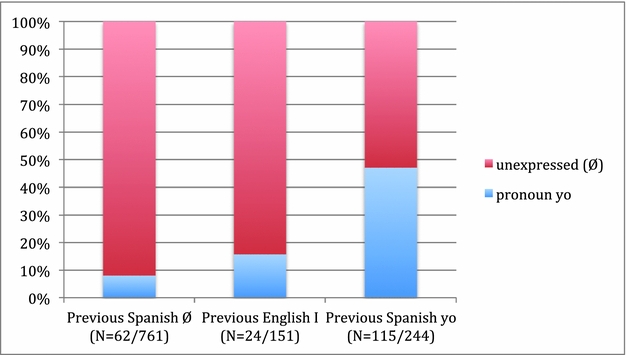
Our first test of the relative strength of within-language (Spanish-to-Spanish) and cross-language (English-to-Spanish) priming focuses on the context of maximal subject continuity: namely, when the clause immediately preceding the target clause has a coreferential 1sg subject, as seen above in lines 1–2, and 9–10, in (3) and lines 3–4 in (4). Figure 1 presents the rate of yo expression in this maximally continuous context according to the realization of the previous coreferential subject. When the previous coreferential subject is unexpressed the subsequent rate of yo is lowest, at 8% (62/761); when the previous subject is English I the rate of yo is 16% (24/151); and when the previous subject is yo the rate of yo is as high as 47% (115/244).
Rate (%) of Spanish 1sg subject pronoun yo by realization of the previous mention in the context of maximal subject continuity (0 intervening clauses between coreferential mentions as subject) (N = 1,156).

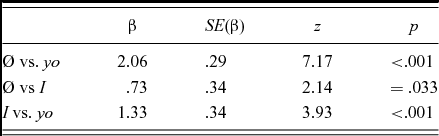
The data were analysed using Generalized Linear Mixed Models (GLMM), which were calculated with the lme4 package for Linear Mixed Effects (Bates & Mächler, Reference Bates and Mächler2010; R Core Team, 2012). A binomial distribution was specified because we were modelling the realization of 1sg Spanish subjects (i.e., Ø versus yo). Out of the four possible primes (unexpressed vs. pronominal Spanish and unexpressed vs. pronominal English), as noted above unexpressed English subjects are vanishingly rare, and therefore we treated the prime form as one variable with three levels (prime form: Ø, I, and yo, Reference level = Ø, as in Torres Cacoullos & Travis (Reference Torres Cacoullos and Travis2011, p. 258, Table 7)). This enabled us to determine whether speakers’ choice of yo is significantly and differentially affected by these different prime types. A model containing the fixed variable of prime form was a significantly better fit to the data than a null model containing only the random effect of speaker (χ2 = 48.01, df = 2, p < .001).Footnote 4 Table 1 reports the pairwise comparisons across the three primes, where β represents the log odds of yo expression in context A (e.g., a Ø prime) compared to context B (e.g., a yo prime) (cf., Jaeger, Reference Jaeger2008). For instance, the log odds of yo expression following the previous expression of yo versus a Ø form (top row) is positive and significant (β = 2.06), which means that yo is significantly more likely than a Ø form following a yo prime than a Ø prime, thus confirming within-language priming. Cross-language priming is confirmed in the second row, which shows that yo is favored with a previous realization of I vs. an unexpressed subject. However, yo-to-yo priming is significantly higher than I-to-yo priming (bottom row).
Pairwise comparisons across prime forms in context of maximal subject continuity (N = 1,156).

Overall yo expression = 17%, log likelihood = −432.7.
This weaker effect for an English prime could be interpreted as a result of a genuinely weaker priming effect across languages, or alternatively, as a weaker effect for ‘translation equivalents’ (I to yo) than for identity priming (yo to yo). The latter would be consistent with a lexical boost account, whereby priming is enhanced due to identity of form. We return to this after considering the question of the persistence of priming, below.
4. Do within- and cross-language priming persist (or decay) to the same extent?
It is well known that priming can persist across intervening utterances in discourse. In sociolinguistic interviews, Weiner and Labov (Reference Weiner and Labov1983, p. 52), for example, found that the occurrence of an agentless passive anywhere in the preceding five clauses favors a subsequent such passive (over a non-specific subject). Persistence of priming in spontaneous discourse has also been found for subject expression in Spanish (Travis, Reference Travis2007, pp. 119–129; Travis & Torres Cacoullos, Reference Travis and Torres Cacoullos2012, pp. 731–732). This result is consistent with the experimental work showing that priming can be retained over intervening linguistic material in both adult and child populations (Bock & Griffin, Reference Bock and Griffin2000; Savage, Lieven, Theakston & Tomasello, Reference Savage, Lieven, Theakston and Tomasello2006; Serratrice, Reference Serratrice, Chandlee, Franchini, Lord and Rheiner2009). At the same time, both corpus and experimental studies have found that priming decays with distance (e.g., Branigan, Pickering & Cleland, Reference Branigan, Pickering and Cleland1999; Gries, Reference Gries2005; Szmrecsanyi, Reference Szmrecsanyi2005).
Here we explore such ‘decay’ and ask whether the coreferential priming from the immediately preceding clause that we observed in Section 3 is maintained over a degree of distance. Measures of distance between target and prime that have been used in corpus studies are elapsed time and number of words or parsing units (modeled logarithmically) (e.g., Gries, Reference Gries2005, p. 120; Szmrecsanyi, Reference Szmrecsanyi2005, p. 371). Following earlier variationist work (e.g., Scherre, Reference Scherre2001; Scherre & Naro, Reference Scherre and Naro1991; Scherre & Naro, Reference Scherre and Naro1992; Weiner & Labov, Reference Weiner and Labov1983), we base our distance measure on well-defined structural units – here, the clause – reasoning that other subjects and verbs affect the strength of a previous coreferential 1sg subject prime more than arbitrary linguistic material or mere time. An example can be seen in (2) above, where there are two clauses intervening between prime (in line 1) and target (in line 4).
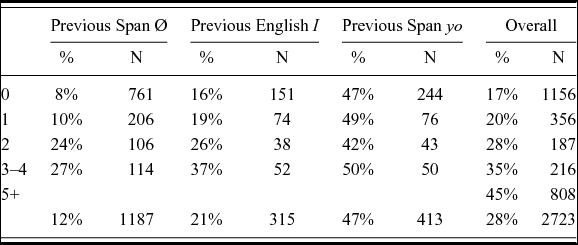
Table 2 depicts the rate of yo in relation to priming by the previous coreferential 1sg subject according to distance in clauses between target and prime. We see here that yo-to-yo priming persists beyond the context of maximal continuity, or zero intervening clauses: across all rows, the rate of yo is higher with a previous yo than with a previous unexpressed 1sg subject. Table 2 also indicates, however, that this priming weakens with distance: at zero intervening clauses, the rate of yo is almost six times as high in the presence of a previous yo than with a previous unexpressed, 47% vs. 8% (p < .0001) (as we saw in Figure 1); at one intervening clause, it is almost five times as high, 49% vs. 10% (p < .0001); but at greater distances, it is just under twice as high (at two clauses, 42% vs. 24% (p = .03), at 3–4, 50% vs. 27% (p = 0.007) (p values from Fisher's exact test).
Rate (%) of Spanish 1sg subject pronoun yo by Coreferential Subject Priming (realization of the previous mention) and Distance in clauses from the previous mention (N = 2,723).

Now considering the cross-language, English-to-Spanish, results in Table 2, we find a similar tendency, but it is shorter lived than the corresponding within-language effect. At zero intervening clauses, the rate of yo expression is twice as high in the context of a previous I vs. a previous unexpressed subject (16% vs. 8%, p = 0.006). At a distance of one intervening clause, it remains almost twice as high (19% vs. 10%, marginally significant at p = 0.06), but at greater distances the tendency is clearly much weaker than the corresponding within-Spanish priming, since the rate of yo is not significantly higher with a previous mention as I than with a previous unexpressed subject (at two intervening clauses 26% vs. 24% (p = 0.83), at 3–4 intervening clauses 37% vs. 27% (p = 0.27). Thus, not only is cross-language coreferential 1sg subject priming weaker to start with (i.e., under maximal subject continuity), it is also shorter lived than the corresponding within-language effect.
4.1 Assessing priming within other variable constraints: interaction with subject continuity
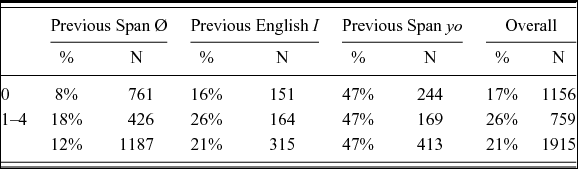
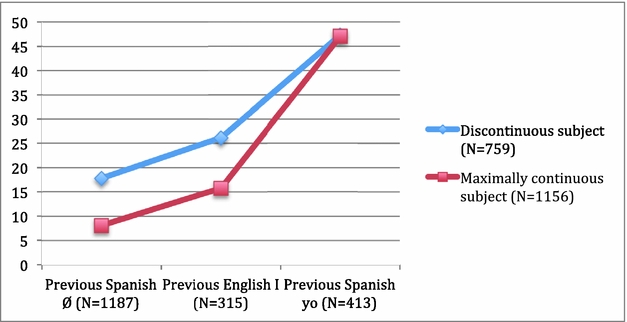
Natural speech data allows – and demands – that priming effects be situated and interpreted within the wider set of constraints operative on variation. For variable Spanish subject expression, we must confront the interplay between priming and subject continuity. According to this well-established constraint (Section 2.2), the rate of yo is lower in continuous than in discontinuous contexts (Table 2, rightmost column), that is, when continuity of reference is broken by the presence of non-coreferential subjects, as in line 4 in (2) above. Table 3 and Figure 2 depict priming in the context of maximal subject continuity (zero intervening clauses) as compared with discontinuous contexts, here combining distances of 1–4 intervening clauses.
Rate (%) of Spanish 1sg subject pronoun yo by Coreferential Subject Priming (realization of the previous mention), for maximally continuous subjects (0 intervening clauses) and discontinuous subjects (1–4 intervening clauses) (N = 1,915).

Rate (%) of Spanish 1sg subject pronoun yo by realization of the previous mention for maximally continuous subjects (0 intervening clauses) and discontinuous subjects (1–4 intervening clauses) (N = 1,915).

We find that the decay of priming is not a straightforward result of increasing distance between prime and target. Rather, there is interaction between coreferential 1sg subject priming and the effect of subject continuity on subject expression, such that priming is stronger in contexts of maximal subject continuity than it is in contexts of discontinuous subjects, as seen by the steeper slope of the line for ‘maximally continuous subjects’ in Figure 2. This reflects the fact that priming works antagonistically to subject continuity when the prime is a previous yo or I (which favors yo) and the context is one of maximal subject continuity (which favors the unexpressed variant), but synergistically when the prime is a previous unexpressed 1sg and the context is one of maximal subject continuity (both environments favoring unexpressed) (Travis, Reference Travis2007, p. 124).
For its part, the subject continuity constraint applies in the context of a previous unexpressed (seen on the left in Table 3 and in Figure 2): the rate of yo more than doubles, from 8% (62/761) in the context of maximum subject continuity to 18% (76/426) in discontinuous contexts. It is weakened, if not nullified, however, in the context of a previous yo (on the right in the table and figure): the rates are identical in both maximally continuous and in discontinuous contexts, at 47% (115/244 and 80/169, respectively). In contrast, in the context of a previous I (in the middle in the table and figure), the subject continuity effect is maintained: the rate of yo is over 1.5 times as high, from 16% (24/151) in the context of maximum subject continuity to 26% (43/164) in discontinuous contexts. Table 3 and Figure 2 thus provide further indication that cross-language I-to-yo priming is weaker than within-language yo-to-yo priming, as the former does not supersede the effect of subject continuity.
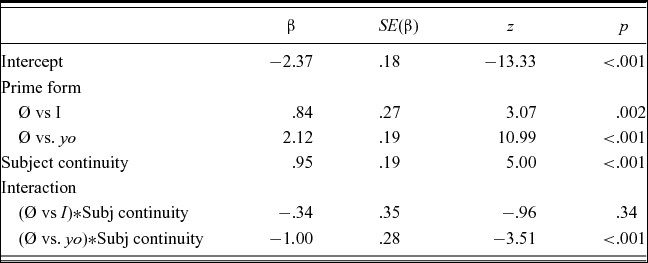
As above, these data were analyzed using GLMMs. The fixed variables of prime form (3 levels: Ø, I, and yo, Reference level = Ø) used in the previous analysis were entered into a factorial model with subject continuity (2 levels: 0 versus 1–4 intervening clauses, Reference level = 0). The final model parameters are shown in Table 4.
Final model parameter estimates for analysis predicting priming of yo by Prime Forms (Ø, I, yo) and Subject Continuity (0 versus 1–4 intervening clauses) (N = 1,915).

Overall yo expression = 21%, log likelihood = −832.96.
The two main effects (priming and subject continuity) were significant, as was their interaction. With respect to the main effect of prime, we observed the same differences across forms as were observed in the previous analysis restricted to cases of maximal subject continuity. This included a significant difference between yo and I primes (β = 1.28, SE(β) = .27, z = 4.7, p < .001), which shows that, when averaging over a distance of up to four intervening clauses, the within-language priming effect is stronger than the cross-language effect. The main effect for subject continuity shows that there is a greater likelihood that yo will be expressed when there are one or more intervening clauses between prime and target than when there are none. Finally, the significant interaction for prime form X subject continuity was driven by the fact that, whereas the (on average lower, or weaker) cross-language priming effect did not significantly change across discontinuous contexts, the (on average higher, or stronger) within-language priming effect did. Specifically, the weak cross-language priming effect appears to be maintained whereas the stronger within-language effect is weakened (Table 2). Since the within-language priming effect is very strong in continuous contexts, this interaction may be at least in part due to the fact that there is more room to significantly decay. The apparent persistence of the weaker cross-language priming effect in discontinuous contexts may be due to the fact that we have collapsed across distances of 1 to 4 clauses.
In summary, while coreferential 1sg subject priming persists with intervening material it decays with increasing distance in clauses from the prime. Furthermore, the priming effect is weaker across languages, and the decay more rapid. In these natural speech data, priming is shown to interact with features of the discourse context, such that it is stronger in contexts of maximal subject continuity than it is with discontinuous subjects.
Once again, these results could be taken as evidence of generally weaker priming across languages. Alternatively, if yo-to-yo priming is viewed as involving a lexical boost, these results could be seen to evidence a weaker effect for ‘translation equivalents’ than for identity priming, as has been reported in prior research (Bernolet et al., Reference Bernolet, Hartsuiker and Pickering2013; Schoonbaert et al., Reference Schoonbaert, Hartsuiker and Pickering2007). We confront this question in the following section.
5. Does lexical boost explain stronger within-language priming? Non-coreferential pronoun-to-pronoun priming
To tackle the question of whether the weaker effect for cross-language priming is attributable to a lexical boost effect of the identity of form, or whether it should be interpreted as due to genuinely weaker cross-language than within-language associations, we next ask whether there is priming in the absence of form-to-form correspondence. Specifically, we investigate whether non-coreferential pronoun-to-yo priming occurs, that is, whether 1sg subject expression can be primed by other (non-1sg) Spanish and English pronominal subjects. If the weaker cross-language than within-language subject pronoun priming seen thus far is due to identity priming, then the difference between English-to-Spanish and Spanish-to-Spanish pronoun priming should disappear when the pronoun is other than a first person, a scenario in which identity priming is ruled out.
We examine non-coreferential priming by considering the realization of the immediately preceding clause subject produced by the same speaker, i.e., excluding potential primes produced by an interlocutor.Footnote 5 Furthermore, as well as the exclusions noted above (Section 2.3), we consider here only specific human referents, excluding tokens where the immediately preceding clause had a non-human or non-specific subject (which do not occur with a personal pronoun variant) and where the subject was a lexical NP, as well as, of course, all 1sg coreferential mentions. Table 5 provides the results.
Rate (%) of Spanish 1sg subject pronoun yo by realization of immediately preceding clause non-coreferential subject (produced by speaker) (N = 483).

There is a patently weaker effect for non-coreferential than coreferential subject pronoun priming, seen by comparing Table 5 with the first row of Table 3. This is due to the subject continuity effect, which results in an elevated rate of yo overall when the subject of the preceding clause is non-coreferential (be it expressed or unexpressed). The data were again analyzed using GLMMs. The main effect for prime type was not significant when compared to a null model containing only the random effect of speaker, χ2 = 4.44, df = 2, p = .11, confirming that overall, non-coreferential subject priming was weaker than coreferential 1sg subject priming (seen above in Tables 1 and 4). When we compare the individual prime forms, we find that there was a significantly higher rate of yo following a Spanish pronoun, as in (5), than when following a Spanish unexpressed subject, as in (6) [52% vs. 33%, β = .62, SE(β) = .3, z = 2.1, p = .036], evidence of a within-language non-coreferential subject priming effect. However, the rate of yo following an English pronoun, as in (7), was not significantly higher than when following an Spanish unexpressed subject [39% vs. 33%, β = .25, SE(β) = .29, z = .85, p = .40], suggesting no cross-language non-coreferential subject priming effect (though the within-language priming effect (rate of yo following a previous Spanish pronoun) did not significantly differ from the cross-language effect (rate of yo following a previous English pronoun) [β = .36, SE(β) = .38, z = .99, p = .32]).
-
(5)
-
(6)
-
(7)


Once again, then, we see a tendency for a weaker cross-language than within-language priming effect. This cannot be dismissed as due to the workings of a within-language lexical boost as compared with translation counterparts, as there are no cases of identity of form here. We note, though, that more than one half of these tokens (270/483) occur with a recent coreferential 1sg subject mention, specifically within the preceding five clauses, as in (8). Thus it could be argued that this is in fact coreferential 1sg subject priming persisting over intervening clauses rather than a within-Spanish non-coreferential subject pronoun priming effect. If this is the case, then a within-language lexical boost remains as a potential explanation for the apparently weaker cross-language effect.
-
(8)

To determine whether lexical boost indeed accounts for weaker cross-language priming, we now limit our view to only those targets lacking a coreferential 1sg prime within the preceding five clauses, presented in Table 6. Here, precisely the same tendency for rates of expression obtains: 42% in the context of a preceding Spanish unexpressed, 44% in the context of a preceding English pronoun, and 62% in the context of a preceding Spanish pronoun. That is, again, the difference in yo rate is slightly greater between a preceding Spanish unexpressed and Spanish pronoun (marginally significant at p = 0.06) than that between a preceding Spanish unexpressed and an English pronoun (p = 0.86), suggesting that the patterning observed for non-coreferential priming (Table 5) is likely not (merely) attributable to the persistence of coreferential subject priming, and hence cannot be dismissed as (solely) a lexical boost effect.
Rate (%) of Spanish 1sg subject pronoun yo by realization of immediately preceding clause subject (non-coreferential subject produced by same speaker, in the absence of a coreferential 1sg subject in the previous five clauses) (N = 213).

What the existence of non-coreferential subject priming suggests is an association between the more specific [(yo) + Verb1sg] target construction (with a variably expressed 1sg subject pronoun and a 1sg verb) and a more schematic [(pronoun) + Verb] construction (a variably expressed subject pronoun of any person and an agreeing verb), and could be taken to support an understanding of subject pronoun priming as operating on abstract syntactic structures, a point to which we return in the following section. In summary, the greater strength of non-coreferential subject priming within Spanish than from English to Spanish suggests that the weaker cross-language than within-language priming effect observed for Coreferential Subject Priming may not be dismissable as simply due to the formal identity that is obtained in yo-to-yo priming and absent in I-to-yo priming. Rather, cross-language subject pronoun priming is indeed weaker than within-language priming, both for coreferential 1sg subject priming (Section 3) (also evidenced in the fact that is decays more rapidly across than within languages, Section 4), and for non-coreferential subject priming.
6. Priming in interaction with particular constructions
Having answered our research questions on the relative strength of within-language versus cross-language priming and having been compelled by the data to dismiss a lexical boost account for the weaker cross-language subject priming effect, we now turn to the question of the grammatical units on which priming operates, namely the much-discussed issue of whether they are lexically-based or are abstract. Although priming effects have been found to be larger when prime and target sentences contain lexical overlap, priming persists in the absence of overlap. For example, for the dative alternation, the girl sent her boyfriend an ultimatum (as opposed to the girl sent an ultimatum to her boyfriend) primes Stephen baked Anthony a cake (over Stephan baked a cake for Anthony). This has been interpreted as evidence that priming acts on abstract linguistic representations (here, the double object dative vs. the prepositional object dative) independently of lexical form (Bock, Reference Bock1986). On the other hand, it has also been shown that the frequency with which a particular verb occurs in prepositional or double object dative contexts moderates the priming effect (Gries, Reference Gries2005) (see also Jaeger & Snider, Reference Jaeger and Snider2013), a finding which has been experimentally supported (Bernolet & Hartsuiker, Reference Bernolet and Hartsuiker2010), and been taken to indicate that priming is not independent from lexical form.
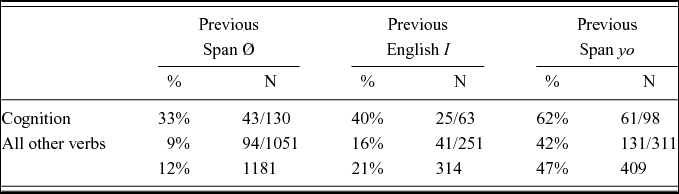
We noted above the interaction between priming and the subject continuity constraint on subject expression that can be observed in spontaneous discourse (Section 4.1). Priming also interacts with the effect for verb class, whereby cognition verbs such as creer ‘think’ favor yo more than other verbs. Table 7 depicts the rate of yo by the class of verb and previous realization.
Rate (%) of Spanish 1sg subject pronoun yo by Coreferential Subject Priming (realization of the previous mention, 0–4 intervening clauses) and class of verb (N = 1,904).

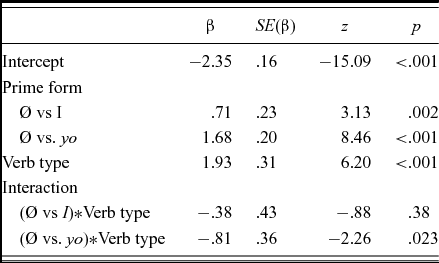
The data were again analyzed using GLMMs, and here, prime type (3 levels: Ø, I, and yo, Reference level = Ø) was entered into a factorial model with verb type (2 levels: Cognition versus ‘Other’, reference level = ‘Other’). All model terms significantly contributed to model fit. The estimates for the final model are shown in Table 8.
Final model parameter estimates for analysis predicting priming of yo by Prime Forms (Ø, I, yo) and Verb Type (Cognition versus Other) (N = 1,904).

Overall yo expression = 21%, log likelihood = −792.8.
The main effects of prime form and verb type were significant. The same pattern of priming effects as in the previous analyses was obtained, and once again further analyses revealed that the difference between yo and I primes was significant (β = .97, SE(β) = .23, z = 4.22, p <.001), supporting stronger within-language priming overall. The main effect of verb type showed that the rate of yo was highest when the target utterance contained a cognition verb. The significant prime form X verb type was driven by the fact that yo-to-yo priming was attenuated when target utterances contained a cognition verb, whereas this was not the case for the (generally already weaker) I-to-yo priming effect. What this demonstrates, then, is that the priming effect may be stronger or weaker depending on the construction in which the target occurs.
The lower susceptibility of 1sg cognition verbs to yo-to-yo priming follows from particular high frequency collocations. The vast majority (84%, 540/640) of the cognition verbs in these data are made up of four particular expressions (yo creo ‘I think’, with a yo rate of 90% (137/153), yo sé ‘I know’ with a yo rate of 80% (37/46), yo no sé ‘I (don’t) know’, with a yo rate of 45% (93/206), and (no) me acuerdo ‘I (don’t) remember, with a yo rate of 13% (18/135)). These are good candidates for lexically-specific constructions by measures of token frequency and linguistic conditioning, and may be more likely to be accessed holistically rather than as combinations of subject and verb.Footnote 6 The lesser priming of subject expression with 1sg cognition verbs is evidence of lesser analyzability of the yo + cognition verb sequence as compared with other yo-plus-verb combinations, attributable to chunking (Bybee, Reference Bybee2010, p. 34, and references therein). Reduced analyzability leads to a weaker association between the 1sg subject of cognition verbs and other instances of the 1sg subject.
This lower susceptibility of more specified constructions to priming suggests that the mental representations of subject pronoun constructions may be of varying degrees of lexical specificity or schematicity (for example, [yo + creo] ‘I think’, [(yo) + Cognition Verb1sg], [(yo) + Verb1sg], [(pronoun) + Verb]). And, crucially, subject pronoun constructions may show varying strengths of association. Szmrecsanyi (Reference Szmrecsanyi2005, p. 139) has shown priming by a lexically-related construction that is not part of the alternation (e.g., priming of English future be going to vs. will by the motion verb go, what he calls β-persistence). Building on this and our current finding, we propose that priming speaks to the strength of associations between constructions and components of constructions (Torres Cacoullos, 2015). In this case, priming serves as a gauge of association between the yo in the cognition verb construction [yo + Cognition Verb1sg], and the yo of the more general [yo + Verb1sg].
Although there has been much discussion about whether priming functions on abstract syntactic representations or is more lexically-based, in our view drawing a sharp distinction between the grammar and the lexicon fails to capture the multiplicity of ways in which lexical and syntactic representations overlap. Rather than compartmentalizing lexicon and syntax, a usage-based approach allows us to view grammatical constructions on a continuum from the more lexically particular to the more schematically general. The question then becomes one of the strength of the associations between constructions. That is, the pertinent question is, to what degree is the more specific [(yo) + Verb1sg] construction associated with a more schematic [(pronoun) + Verb] construction within Spanish and across Spanish and English?
As we have seen, the reduced strength of priming with cognition verbs points to a degree of independence of [(yo) + Cognition Verb1sg] from the more general [(yo) + Verb1sg] construction, while the differential robustness of coreferential and non-coreferential subject priming can be interpreted in terms of a closer association between instances of [(yo) + Verb1sg] than between [(yo) + Verb1sg] and [(Pronoun) + Verb]. In the bilingual case, in the same vein, the associations between [(yo) + Verb1sg]Spanish and [I + Verb1sg]English are less close than the corresponding within-language associations. This makes sense in a usage-based view of grammar, where grammatical constructions are understood to include information about linguistic as well as extralinguistic contexts of use (e.g., Bybee, Reference Bybee2010; Croft & Cruse, Reference Croft and Cruse2004; Goldberg, Reference Goldberg2006).
7. Discussion
In the current study we have investigated within- and cross-language priming of variable 1sg subject expression in a bilingual corpus of spontaneous speech. Although in previous work we have shown cross-language priming in bilingual speech, in this paper we tested the limits of the effect, and in doing so provide the first detailed consideration of cross-language priming outside the lab. Guided by findings in the variationist and experimental literature, we explored the relative strength of within- and cross-language priming to ask (i) whether within-language and cross-language priming are equally strong, (ii) whether they persist to a similar extent and (iii) whether the notion of a lexical boost provides an account for their differential strength.
Our first finding was that, following previous research (Torres Cacoullos & Travis, Reference Torres Cacoullos and Travis2011, Reference Torres Cacoullos, Travis, Carvalho, Orozco and Shin2015), both within-language yo-to-yo and cross-language I-to-yo priming were significant. Consistent with experimental studies (Bernolet et al., Reference Bernolet, Hartsuiker and Pickering2013; Schoonbaert et al., Reference Schoonbaert, Hartsuiker and Pickering2007) the cross-language effect was smaller in magnitude than the within-language effect (Table 1, Figure 1).
Second, in examining the persistence of priming in spontaneous discourse, we have had to take into account another contextual factor that conditions variable subject expression, namely subject continuity. Subject continuity moderates the priming effect, as expressed subjects are favored in discontinuous, and disfavored in continuous, contexts (Table 3, Figure 2). Nevertheless, we find that, while attenuated, coreferential 1sg subject priming persists across intervening material (up to 3–4 intervening clauses, within Spanish, Table 2). Furthermore, in comparison with within-language priming, the cross-language priming effect in discontinuous contexts is both weaker and decays more rapidly (after one intervening clause, Table 2, Table 4).
The present results are interesting in the context of lexical boost effects in experimental studies, which typically show catastrophic decay (Branigan et al., Reference Branigan, Pickering and Cleland1999; Malhotra, Pickering, Branigan & Bednar, Reference Malhotra, Pickering, Branigan and Bednar2008). One possible explanation for the amelioration but not total loss of the yo-to-yo (putative lexical boost) and I-to-yo (putative translation equivalent) priming effects in the presence of intervening material concerns the nature of the phenomena under study. In experimental studies, lexical boost effects result from overlap of primarily main verbs and head nouns, but 1sg pronouns may not undergo lexical boost in the same way; pronouns carry greater functional load, and therefore priming may be considered to be more ‘abstract’, even in the case of identity priming. Furthermore, the notion of translation equivalents is even less straightforward for grammatical morphemes such as subject pronouns than it is for nouns and verbs. The Spanish expressed 1sg pronoun yo (vs. an unexpressed mention) has been said to correspond to the English expressed pronoun I (vs. an unexpressed mention), or, alternatively, to an English stressed (vs. unstressed) I (Givón, Reference Givón and Givón1983, p. 17; Payne, Reference Payne1997, p. 43). But the inter-linguistic functional equivalence of grammatical morphemes or structure types is an empirical question (as noted by Otheguy, Reference Otheguy2004, p. 177), and in fact the constraints on yo expression in Spanish, though similar, are not identical to those on expression and stress on I in English (Torres Cacoullos & Travis, Reference Torres Cacoullos, Travis, Carvalho, Orozco and Shin2015; Travis & Torres Cacoullos, Reference Travis and Torres Cacoullos2014).
Thus, with our third question we sought to explore further the lexical boost account of priming, by testing for non-coreferential subject priming, in which identity of form is absent not only across languages, but also within the one language. Though weaker than Coreferential Subject Priming, yo was found to be primed by non-coreferential Spanish subject pronouns (Table 5, Table 6). This within-language non-coreferential subject priming effect indicates that we must go beyond a lexical boost vs. translation equivalent account of stronger within- than cross-language priming. How, then, may we account for the fact that yo-to-yo priming was stronger than I-to-yo priming?
We propose that the question may be answered by interpreting priming as a gauge of association between constructions. To further explore the interplay between pronominal priming and lexically-specific features of the grammar, we considered priming in interaction with particular constructions, and observed that the priming effect was smaller when targets contain cognition verbs, which favor expressed 1sg subjects more than other verbs (Table 7, Table 8).
Verb type or class effects suggest that we may think of the greater or smaller strength of priming as a measure of stronger or weaker postulated associations between the more particular constructions constituting a general structure type, such as [pronoun + verb]. That is, differential priming effects indicate degrees of association, such as between [(yo) + Cognition Verb1sg] and [(yo) + Verb1sg] or between [(yo) + Verb1sg] and [(Pronoun) + Verb]. The less robust cross-language priming, we suggest, is just a special case of degrees of associations between constructions, here between [(yo) + Verb1sg]Spanish and [I + Verb1sg]English.
8. Conclusions
We set out to examine here the question of ‘overlap’ in bilingual grammars, through an exploration of the relative strength of within- and cross-language priming. We have found that cross-language priming, compared with within-language priming, is narrower (applying only to coreferential pronoun I), less persistent (operative at one intervening clause at most between prime and target), and weaker (in contexts of maximal subject continuity, doubling the rate of yo expression vis-à-vis a previous unexpressed subject, whereas a yo prime increased it six-fold). We proposed that this is best interpreted as a reflection of the degree of association between subject pronoun + verb constructions, which, although existing both within and across languages, are attenuated in the latter case. Given this, it need not be surprising, then, that despite the overlap in their linguistic systems (here, associations between 1sg subject pronoun constructions indicated by cross-language priming), Spanish language-internal constraints on subject expression are not weakened in the Spanish of New Mexico bilinguals, as seen here for the subject continuity and cognition verb effects (Torres Cacoullos & Travis, Reference Torres Cacoullos, Travis, Carvalho, Orozco and Shin2015).
We have also demonstrated that priming is modulated by other factors conditioning variable subject expression in Spanish, namely subject continuity and usage patterns associated with particular classes (and tokens) of verbs. This suggests a need for a model of representation that accounts for variation in representation attributable to a speaker's experience with their language, or languages. Chang, Dell & Bock (Reference Chang, Dell and Bock2006), working with monolingual data, have developed a connectionist model, in which grammatical representations are acquired through experience, inducing abstract knowledge through analysis of the distributional properties of the input. The model successfully explains many priming effects in the experimental literature. From what we have seen here, such a model could extend to the bilingual data, provided that, as for monolingual data, the associations between constructions – form-meaning pairings grounded in their linguistic and extra-linguistic contexts of occurrence – are understood.
The results presented here highlight the value of naturalistic data as a means to challenge and sharpen psycholinguistic theory. Since studies of natural speech require consideration of the contextual distributions of targets and primes, they provide an opportunity to gauge whether and how priming interacts with co-occurring linguistic features in configurations as speakers encounter them in everyday language use.
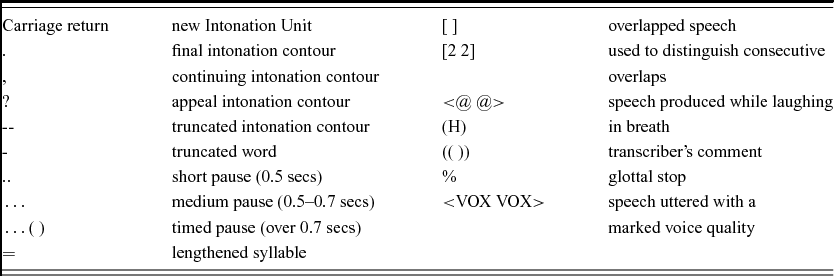
Transcription Conventions (Du Bois, Schuetze-Coburn, Cumming & Paolino, Reference Du Bois, Schuetze-Coburn, Cumming, Paolino, Edwards and Lampert1993)