In the winter of 1772–1773, Joseph Johnson copied musical notation into eight handmade books. He was in the area of Tunxis Sepus, which was (and still is) also known as Farmington, Connecticut. It is a beautiful, fertile valley through which runs a tributary to the Connecticut River. “Tunxis Sepus” refers to a bend in that tributary, and “Tunxis” also acknowledged the name of the people Indigenous to the area. When Johnson arrived, the town was home to an intertribal group of Tunxis, Quinnipiac, and Wangunck (or Mattabesset) people who had converted to Christianity.Footnote 1 They were vastly outnumbered by English colonists, who had begun arriving in the 1640s and incorporated the town under the name Farmington in 1645.Footnote 2 Johnson, a twenty-one-year-old Mohegan/Brothertown Christian who had trained at an evangelical boarding school to be a missionary and teacher, ran a school for the town's children (both Native and colonist).Footnote 3 Twice a week he also led a hymn-singing evening. These were popular and created a demand for music books, which Johnson promptly began to make himself. “The indians are all desireous of haveing Gamuts,” Johnson wrote in his diary on December 3, 1772, using a technical term for the musical scale to refer to the manuscript music books he stitched together and notated.Footnote 4
In making manuscript books, Johnson was participating in a cultural practice that was common among colonists of European descent in the eighteenth century: many women and men in New England were musically literate and created handmade music books, and such books routinely circulated among friends and family members.Footnote 5 Native Americans who could read and write music were less common—or at least, far less documentary evidence of Native music literacy persists in the archival record. Unfortunately, none of Johnson's manuscript music books survive.
Johnson's now-lost music books offer an opportunity to consider the musical and material aftereffects of English Protestant missionizing in the first two centuries of colonial encounter, a consideration that brings into focus how Native Americans living in what became southern New England and upstate New York—peoples such as the Tunxis, Mohegan, and Oneida—used musical expressions of faith strategically to negotiate their interactions with English settler colonists.Footnote 6 English evangelizers had tried to make inroads with diverse Algonquian and Haudenosaunee nations for more than a century by the time Johnson arrived in Farmington on the eve of the American Revolution. Compared to Catholic missionaries in New France and New Spain, and Moravian work in Pennsylvania, however, English attempts to convert Mohegan, Narragansett, Pequot, and mainland Wampanoag nations in New England yielded unimpressive results. Some smaller communities accepted missionaries relatively early (in the mid-seventeenth century), such as the Nipmuck and Massachusett, having suffered huge population losses and facing threats from larger Native nations. Others, such as the Mohegan, resisted at first but eventually allowed missionizing, in part for political reasons as they sought allies against other tribes and protection against mounting land pressure from English colonists.Footnote 7 The presence of a schoolmaster or missionary in a Native community might make encroachment by colonists less likely.Footnote 8
Yet Native Americans did not convert to Christianity for purely tactical reasons. Considering the Christian God to be a potentially useful spiritual resource, Native American people across North America integrated Christian tenets and practices into their cosmogony. Such was the case in southern New England where, even as English missionaries usually coerced Indigenous peoples to abandon their lifeways and traditional lands, Native Americans created an Indigenized Christianity. The history of religious conversion in New England is one in which Native American communities of multiple nations actively sought ways to adapt to the radically changing circumstances of their lives, as the long-term effects of settler colonialism—particularly those stemming from profoundly traumatic epidemics and warfare and the violence of land dispossession (whether by gun or pen)—came to be known.Footnote 9 Singing hymns and psalms was and is central to Native experiences with Christianity, integrated into formal worship services as well as social gatherings where it helped to sustain communities’ spiritual strength.Footnote 10
Johnson's experiences in 1772–1773 shed light on how sacred music, and written music in particular, could mediate relationships between Native American people and settler colonists. After more than a century of continual contact, these groups were deeply aware of their differences, as well as their similarities.Footnote 11 Johnson's time in Farmington reveals that beliefs about racial and cultural difference were not the most salient factors when it came to cross-cultural relationships; rather, what mattered was place and property. Claims of belonging were based on who lived on what land, with what authority, and how (what they built, how they materially sustained themselves). Material objects were used to make claims to place and negotiate relationships, even as conflicts over space were ubiquitous. Johnson's ability to read and write authorized his work in Farmington, yet his “gamuts” were more than expressions of his knowledge and skill: they were symbolic gifts that he bestowed on members of both the Native and colonial communities. The importance of this material exchange is easily overlooked because the books themselves no longer exist. However, as this essay argues, it is through the missing manuscript music books that new insights into hymnody, material culture, and religious conversion in the context of colonialism can be gleaned.
The fact that Joseph Johnson's manuscript music books are missing exposes the difficulty of documenting in a specific manner the role music played in the process of settler colonialism. Serious limitations confront music historians due to the nature of the available archival sources. Whereas people of European descent left a substantial print and manuscript record of their music in pre-1800 America, Native American musical experiences of the first two centuries of colonialism are extremely difficult to access and assess through traditional musicological routes.Footnote 12 Little of what Native Americans thought about newcomers and their music, in what fashion colonialism influenced Native musical life, and how traditional practices persist comes through in historical sources that privilege European worldviews. Added to this is the problem of what Jean M. O'Brien calls “firsting and lasting,” whereby Native Americans are evacuated from historical narratives that mark settler colonists’ achievements as the “beginning” of American history (and make the death of the “last Indian” the “end” of Native history).Footnote 13 Within such narratives can be found (false) assumptions: that Native Americans had vibrant oral traditions, now lost; that when Europeans applied the technologies of literacy and guns, and with the epidemiological advantage of living amidst generations of Old World filth, Native Americans were conquered culturally, politically, and militarily; and, in short, that Native American agency is obviated and eliminated by colonial encounter. In the context of such erroneous but pervasive interpretations, compressed into first encounters and ultimate “disappearance,” Native musical experiences are made to seem either irrelevant to the broader drama (or tragedy) or impossible to access. Such an assessment is mistaken. In the face of scarce or inscrutable sources, what is needed is methodological inventiveness, not resignation.
This article aims to place Native perspectives and experiences at the center of narratives about early American sacred music and work around the dearth of direct archival sources.Footnote 14 I do so by focusing on Johnson's gamuts. I argue that Johnson's music books provide a key to understanding the extent to which shared music could smooth the frictions between Native people and European colonists, who inhabited a complex social terrain where religious practices and material exchanges mitigated (somewhat) land tensions that had been building for generations. This argument directly ties intercultural sacred music to the politics of land. My intervention is methodological as well. The fact that Johnson's gamuts are now gone is emblematic of the destruction that colonialism wrought, but their status as “missing” also invites a reconsideration of how we do music-historical research. The assumption that Johnson's (and others’) experiences are beyond reach facilitates narratives of Indigenous absence rather than presence and should be resisted.Footnote 15 Although challenging, it is not impossible to uncover Joseph Johnson's contribution to early American music history. In what follows I demonstrate a method for witnessing lost materials: gathering a constellation of other meaningful materials that were exchanged and had recognizable intercultural value. By locating and expounding upon this surrogate bibliography, I provide a framework in which the missing gamuts can be understood. In particular, through comparisons to extant materials that illustrate reciprocity, the manuscript music books can be conjecturally reimagined. This method does not represent an attempt at recovery of the lost materials, but rather entails an expansion of the music-historical archive. Yet this expansion must not smuggle in colonialist research impulses; thus I diagnose in the final section of this article a liability for what I call “archival orientalism,” or the desire for scholarly discovery and dominion. Reckoning with such epistemological impulses is essential if we are to work from colonialist archives (that is, repositories that contain documentary records created and/or shaped by colonialist forces). Such a reckoning goes further, however, for it holds the promise of redress for what can be broadly recognized as the “colonialist archive,” the conceptual infrastructure that defines what can even be imagined to be knowable—and worth knowing.
The Native Great Awakening
Joseph Johnson's parents were caught up in the fervor of the Great Awakening, the evangelical revival that rolled through the British colonies, from Georgia to New England, in the 1740s.Footnote 16 Born again (or “converted”) men and women catapulted from despair at their own state as sinners to euphoria when they embraced the boundless love of Jesus. Johnson's parents were joined in their experience by many Mohegans and other Native Americans in southern New England, as well as enslaved and free African Americans.Footnote 17 As more people of non-European descent converted, white evangelicals recognized an opportunity to recruit and train Native missionaries. In the second half of the eighteenth century it was increasingly likely that the schoolmaster or missionary who arrived in Native communities would himself be a Native American (although not necessarily of the same nation).Footnote 18 Eleazar Wheelock, a white minister in Lebanon, Connecticut, established a school for Native Americans in 1754, and his pupils, Johnson included, became missionaries to nearby tribes in the 1760s and ’70s.
Joseph Johnson was seven in 1758 when he moved from Mohegan to Lebanon to attend Wheelock's school. At fifteen, Johnson was sent to Kanonwalohale, an Oneida village where he served as the assistant to another Wheelock student named Jacob Fowler (Montauk). There, Johnson witnessed the popularity of hymnody. “We can sing good many Tunes with all three Parts,” reported Fowler to Wheelock in November 1766, in one of a number of similar endorsements of music's efficacy for proselytizers.Footnote 19 When Johnson opened his own school in Oneida territory in the fall of 1767, he endeavored to do the same; in a letter to Wheelock that winter, Johnson wrote “I would also Enform you that I keep Singing School every Evening [with] very full meetings.”Footnote 20 The singing school's popularity was one of the only positive aspects of Johnson's tenure in his first solo mission. His students departed without notice to undertake extended seasonal hunting trips, and when the students did attend school, Johnson struggled to maintain discipline (some of his pupils were old enough to be his father, as he noted to Wheelock).Footnote 21 Moreover, conflict with his white supervisor, Samuel Kirkland, put Johnson under increasing pressure. According to Kirkland (admittedly a biased source), Johnson “turn'd pagan for about a week—painted, sung—danc'd—drank and whored it, wh some of ye savage Indians he could find.”Footnote 22 Whether true or not, Kirkland's letter was damning. “Pagan” practices had long been anathema to English missionaries, who did everything in their power to snuff out traditional customs in those they were trying to convert. Inebriation and “whoring” were sins any Christian might commit, and colonists might also adopt Native dress and sing and dance “pagan,” temporarily forsaking their Christian identity while “playing Indian.”Footnote 23 However, having a reputation for backsliding (accurate or not) would have been acutely shameful for Johnson, who had gone through the “civilizing” process of Wheelock's school. In December 1768 he fled to Rhode Island and signed up for a whaling ship that took him around the Atlantic basin, from the Azores to the Caribbean. Returning in the autumn of 1771, Johnson worked on his uncle's farm in Mohegan, Connecticut. His diary entries from this time depict his religious rebirth. The next year he left Mohegan, intent on offering his services as a Christian teacher, and ended up in Farmington.
The Tunxis, Quinnipiac, and Wangunck peoples Johnson met in Farmington were, like him, speakers of Algonquian languages whose ancestral lands were stolen over time as wave after wave of English colonists arrived beginning in the mid-seventeenth century.Footnote 24 The intertribal Native community in Farmington strategically accommodated English missionaries beginning in the 1730s, hoping to gain protection from further incursion on their land. When Johnson arrived four decades later, he found a small society of Native Americans whose Christian affiliation ran back at least one generation.Footnote 25 In all likelihood, hymnody was already a part of their religious practice in some fashion in 1772, although possession of music books apparently was not. Nine days after Johnson arrived, he organized an evening “singing meeting” at the house of Samuel Adams (Quinnipiac). Before he went to bed on Friday, November 27, Johnson wrote in his diary of the singing meetings’ success: “at the close we Concluded to have A singing Meeting twice in a week.” They met to sing on Tuesdays and Fridays, as well as on Sundays for prayer, singing, and “reeding some books of Edification.”Footnote 26 The singing meetings were popular: as Johnson wrote on Tuesday, December 1, the second singing evening “was attended with much Earnestness; had a very full Assembly.”Footnote 27 These meetings continued, shifting between Samuel Adams's house and that of another Native Christian, Thomas Occurrum.Footnote 28 No detailed descriptions of this singing exist. But following his positive experiences with Jacob Fowler, Johnson may have encouraged them to sing hymns in three-part harmony. Furthermore, they may have been singing in Wampano (the Paugussett language spoken by Tunxis Indians, which shared features with Mohegan) with the newcomers adding their own dialects for a polyglot hymnody style. Or, because Johnson's job was in part to teach English along with Christian doctrine, perhaps they were singing in that tongue.Footnote 29
Through his teaching and music-leading roles Johnson quickly found a place in the Native community, but he also dealt extensively with the colonists who lived in the town. On arriving in the town, after first introducing himself to Native community leaders, he visited the Farmington Congregational minister, Reverend Timothy Pitkin (son of the Connecticut governor William Pitkin). Johnson had to be vetted by Pitkin, as Johnson later related in his diary: “This Evening was Examined by their Overseer, Rev'd Timothy Pitkin … and he said I was Capable of the bussiness. I read, & wrote, before several.” Importantly, Johnson's abilities were inspected not just by the English men but by local Native leaders as well: as he recounts, “Some of the headmen of the Indian tribe was present.”Footnote 30 He subsequently struck up a relationship with the minister, attending Pitkin's worship services in the recently built First Church. When Johnson went to hear Pitkin preach, he sat in the lower section of the meeting-house with the white congregation rather than in the balcony where Native and African American attendees typically sat.Footnote 31 Pitkin gave Johnson two psalters and six copies of the New Testament to use in his school.Footnote 32 Native but not Tunxis, Western-educated but not white, Johnson mediated between the Native community and colonists.
Johnson's acceptance by Farmington's settler colonial society progressed in stages. After he impressed Pitkin, children of the English colonists began attending his new school. Not without pride, Johnson tracked the increasing number of students who gathered each day, starting with ten students on Monday, November 23, and by mid-week welcoming his first “English lad, Named Simeon Barney.” The second week of school he “had 16 scholars, of which 3 were English.”Footnote 33 Next he was invited to the house of one of the most powerful families in the area, the Wadsworths. Johnson referred to the Wadsworth man he visited as “landlord” without mentioning his first name, and it is unclear who Johnson saw: several men in the Wadsworth family had served as successive local “overseers” whose responsibility it was to mediate between the Native community, English colonists, and the Connecticut General Assembly, but the previous one (William) died in 1769, and the next (Hezekiah) did not assume the role until 1776. Nevertheless, it is clear that Johnson recognized his host as holding a position of authority and endeavored to cultivate the connection. Johnson visited Wadsworth the evening of Thursday, December 3, and enjoyed a sociable evening of rather genteel entertainment. “[I] heard his daughters Sing Several Tunes, and Sang Some at there desire, myself. Very pleasant Evening.”Footnote 34 He visited regularly thereafter, and the occasions often included sociable music making.Footnote 35 Finally, Johnson's welcome in Farmington was confirmed when he managed to integrate one of the singing evenings. The day after Johnson's first visit to Wadsworth's house, “Some white People” came to the singing evening at Thomas Occurrum's house and the following Monday Johnson went “over to the Town” where the “white people had a Singing Meeting.”Footnote 36
Johnson's diary paints a portrait of life at Farmington in which sacred and social experiences were intertwined, and in which people of diverse backgrounds shared these experiences regularly and on surprisingly intimate and tantalizingly egalitarian terms. More than a generation after they converted to Christianity, the Native community was familiar to the English colonists and vice versa. They were neighbors who attended each other's churches and schools, who sang together and kept company. Johnson's music books would reinforce those intercultural bonds.
Making Gamuts
Joseph Johnson began making music books promptly upon arriving in Farmington. The morning after the first singing meeting he went to the main section of town and bought some paper. The following Thursday, December 3, 1772, he wrote in his diary, “I made 3 gamuts or Singing Books, that is, Cut them out, & sewed them together.” After putting the physical books together, he began copying music into them: “I began to write down the rules in one,” he wrote, noting that “I am in Continual hurry. Nevertheless, I purpose to furnish them with Singing books as Soon as time will admit.”Footnote 37 He worked on the “gamuts” nearly every day for two weeks, often rising early to line pages and “prick tunes.”Footnote 38 He finished the first book on a Saturday afternoon, December 12, and possibly gave it to Wadsworth—Johnson visited him that same evening and perhaps wished to bestow a musical favor on the prominent man (Johnson had borrowed a tune-book from him previously).Footnote 39 Two days later, Johnson started his next book, which he completed in just over a week and presented to Samuel Adams, the host of the singing evenings and Johnson's host earlier in the month. He next began one for Hannah Robbins, the Native woman with whom he was then lodging. This pattern of diligently copying and delivering manuscripts to his local hosts seems to have continued through the following month. Johnson left Farmington in early February, and by that time he had copied out eight music books.
Clues as to what Johnson was copying surface in his diary, where his use of the term “gamut” is telling. Ecumenical Protestant psalters and tunebooks regularly included instructional prefaces that took the form of musical primers. These materials were intended to foster music literacy and were called “rudiments of music,” “rules of music,” or simply “the gamut” (referring to the alphabetic and solfège scale of notes, the so-called ABCs of music).Footnote 40 The Sternhold and Hopkins psalter, which in 1562 was the first full English translation of the metrical psalms, included diagrams and instructions for reading music, and as the anonymous author of the psalter's preface asserted, study of the rudiments could result in fluency “in a fewe dayes; yae, in a few houres, easily without all payne” if “any diligence [is] given thereunto.”Footnote 41 From the sixteenth through the eighteenth centuries, cursory yet optimistic instructional prefaces became ubiquitous in tunebooks.Footnote 42 In the latter half of the eighteenth century, ecumenical tunebook publication was on the rise—publication of psalters and hymnals increased threefold in the 1760s and quadrupled by the 1790s, with a concentration of printers in Connecticut.Footnote 43 Johnson may have conflated the term “gamut” with the genre of text he was creating.Footnote 44
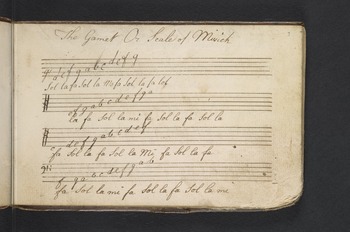
The abundant print record of music instructions is mirrored in manuscript. It was not uncommon for educated women and men who wished to internalize the abstract rules of music to copy instructional material in their personal manuscript music volumes. For instance, the front pages of a manuscript book owned by one George Sanders in 1758 contains explanations of note duration, key signatures, examples of scales, and a code for “The Gamut Or Scale of Musick” with pitch letters copied onto the staff and a text underlay of solfège syllables.Footnote 45 Such manuscripts provide another possible reflection of Johnson's gamuts; perhaps Johnson's hand-stitched, hand-ruled books looked not unlike the many fragile, flimsily bound books that are now scattered in archives and libraries across the United States.Footnote 46
Tunebooks and music manuscripts represent paradigmatic elements of the Protestant Reformation—literacy and communal singing in the vernacular—and to triangulate Johnson's gamuts with these two types of materials is to place weight on his role as an evangelical proselytizer, to recall that propagating Christianity—and specifically the literate, “civilized” form of Christianity endemic to New England missions—was central to his work. The highly atomistic pedagogical mode common to instructional prefaces suggests that solitary study was one, but not the only, intended use; indeed, such materials (both print and manuscript) needed the accompaniment of face-to-face instruction in Singing Schools, where students gathered to learn to read music and sing together.Footnote 47 As noted above, Joseph Johnson wrote in his diary about holding Singing Schools in Oneida; at Farmington he seems to have intended to do so again.
The demand for Johnson's gamuts suggests that members of the Native community wanted to learn how to read music as well, although evidence of their progress is elusive. In his diary, Johnson documented his pupils’ engagement, if not details of their advancement, claiming “I never Saw Indians So much desireous of Learning.”Footnote 48 Before he left Farmington, he wrote ebulliently about the good showing his students made when “the Indians [came] for to see what Proficiency their Children made in the 10 Weeks Past,” but the demonstration was primarily of the students’ general discipline and ability to read text.Footnote 49 Johnson also had words of praise for the entire community's enthusiasm in “Singing, the Musical Art,” but the people Johnson lists as the recipients of his gamuts were his hosts and leading figures in Farmington, not his students.Footnote 50 There are no clues suggesting whether these individuals did or did not use the books to become musically literate. Since literacy alone is an important but insufficient lens through which to interpret Johnson's gamuts, other possibilities must be considered.Footnote 51
The “gamut” in George Sanders's music book. Ms Codex 1721. Courtesy of the Kislak Center for Special Collections, Rare Books and Manuscripts, University of Pennsylvania.

Material Texts, Exchange, and Reciprocity
Johnson's hand-made music books themselves were imbued with intrinsic value, separate from their contents, that stemmed from their reinforcement of social relationships. In this sense, Johnson's gamuts fit existing paradigms from book history for understanding music. First, they align with what scholars recognize as the “colonial mediascape” of early America, entailing hybridized Indigenous material texts that emerged through generations of cross-cultural trade and communication.Footnote 52 Second, the gamuts contribute to considerations of books’ exchange value. In early modern Europe, the circulation of books as gifts flourished even as the commercial book trade emerged in the sixteenth century.Footnote 53 This was also the case in eighteenth-century British America. Moreover, in both places the booming trade in printed music did little to squelch manuscript culture. Exchanging printed and manuscript music books circumscribed boundaries around social groups, for example with the dissemination of hand-copied music books in the elite milieu of seventeenth-century England described by book historian Harold Love.Footnote 54 Internal evidence from eighteenth-century US manuscript tunebooks indicate that such books were shared (such as the appearance of multiple names).Footnote 55 Similarly, Johnson's gamuts were as much instruments of sociability as they were tools of literacy.
Viewing the gamuts through the lens of Native Northeastern North American material culture and textuality sharpens the focus on how music books produced and reinforced social relations while also clarifying the particular pressures felt in colonial scenarios of exchange.Footnote 56 Perhaps no practice, philosophy, and material text better communicated the desire for reciprocal understanding than wampum. Wampum are white and purple beads made from polished quahog shells and woven into patterns of belts and strings that can be transmitted and read. Strings and belts of wampum were exchanged ceremonially intertribally and with European emissaries in the seventeenth and eighteenth centuries; they commemorate treaties, confirm alliances, and outline the conflicts that could result from a breakdown of these social and diplomatic agreements. Wampum solidifies reciprocal relationships and are read not as linear narratives but as maps of Native Northeast social terrain. The exchange of wampum binds symbolic words to concrete deeds, and presentations of wampum in the colonial period were often performative, coordinated with oratory and accompanied by the group intoning of vocables.Footnote 57 Knowledge and agreements reside in wampum, which become tangible, living products of memory and of mutual obligation. Moreover, wampum's value rests in the labor entailed in making it—the ability to marshal the social resources to gather, polish, drill, and weave the beads together was part of the message of social capital communicated by the objects.Footnote 58
Johnson and the Tunxis, Quinnipiac, and Wangunck people in Farmington were immersed in the material and social culture of wampum. Mohegans had been very involved in the wampum trade in the seventeenth century, and Farmington was close to the Connecticut River along which the valued shells were transported. The fact that Johnson put such effort into copying the gamuts as a newcomer, his strategy of giving them to his hosts, that he received psalters from Pitkin, and that likely he borrowed music from Wadsworth all resolves into an image of the books being used to solidify relationships.Footnote 59 Moreover, if wampum could be understood both as the vehicle that carried meaning and the tangible instantiation of the meaning—that is, as both the messenger and the message—perhaps by disseminating gamuts Johnson was fostering a covenant between the Farmington residents, both Native and colonist, to continue being good Christian neighbors.Footnote 60
Johnson's missing gamuts are further illuminated by a comparison to a different textual form, one that was quite familiar to the Native community in Farmington: legal instruments pertaining to land. Such forms became common in the colonial period, as Native Americans in New England found themselves increasingly subjected to tactics of dispossession.Footnote 61 Immigrants from across the Atlantic arrived in growing numbers and families of colonists propagated themselves, stealing land at a ferocious rate. Both Mohegan and Tunxis Indians endured conflicts with their European neighbors that made learning about English law necessary. Mohegans had allied with the English colonists early, siding with them in the 1637 Pequot War; they lived in a territory of 800 square miles for much of the seventeenth century and largely resisted Puritan missionary efforts. A devastating war in 1675–76 and struggles over leadership precipitated a shocking constriction of their homeland, so that by 1721 they had less than a hundredth of that land left: just under eight square miles. Mohegan country was crisscrossed with English fences marking English farms and English roads running through English towns. On a smaller scale, the same process happened in Farmington, where the Native residents found themselves squeezed out by their land-hungry English neighbors. This dramatic infringement on Native title and fundamental disregard for their sovereignty over space was in part due to differences in the conceptions of land ownership held by Native Americans and colonists generally. For the former, to “own” land meant something like the right either to use the land or to collect tribute from those who lived there. A sachem (chief) might sell some of his tribe's land in order to collect the money or prestige it afforded him, without considering the sale to be a total transfer of sovereignty over the territory. English colonists, on the other hand, treated land as alienable property and its sale as a transfer that was absolute.Footnote 62 Native Americans quickly found they urgently needed to master the unfamiliar and counterintuitive conventions of English law.
The historical record is flush with legal documents pertaining to Native land, and one of the common forms used for transferring land in eighteenth-century New England was the conditional bond. The conditional bond was more than a transfer of property; its language locked two parties into a mutual obligation in order to assure both sides that their interests would be protected. For instance, a conditional bond from 1708 gave Thomas Wadsworth the use of an acre of Farmington land, but instead of stating that members of the Native community were selling Wadsworth some land, it promised that they would pay Wadsworth a certain amount of money unless he had unmolested access to this land and, separately, that Wadsworth had given them a certain amount of money.Footnote 63 In other words, as long as Wadsworth had access to the land, Native members’ obligation to pay him was void. In this form the obligation is reciprocal: first, that Wadsworth paid money and second, that he would receive money if his use of the land was interfered with, either by an outside party or by future generations of the Native community who asserted Indigenous title. By the same token, the Native community agreed to first accept money and subsequently to prevent impediments to Wadsworth's ongoing and unimpeded access to the land. The conditional bond meant that the two parties would never be done with each other; he needed them as a type of financial protection against future claims to the land, and they were legally obligated to provide that protection.Footnote 64
Like other forms used in the exercise of British law, conditional bonds were formulaic. Once the formula was learned, it could be applied to a variety of contexts where it would hold parties together, clinched in a multilateral agreement. By the second half of the eighteenth century, land disputes were common, and Elijah Wampey and Solomon Mossuck, two Native community leaders from Farmington, even requested a copy of the colony's laws from the Connecticut General Assembly in order to pursue their land cases.Footnote 65 Eventually most of the Native Christians at Farmington shifted their strategy: anticipating migration, they used legal forms to sell the rest of their land to their English neighbors. Just as English colonists came to understand the material and social protocols of reciprocal agreement used by Northeastern Native Americans (wampum), so too did Northeastern Native Americans come to understand English modes of bonding obligation—and the material, written, and performative/judicial forms they took.
Placed in an intercultural textual-material context among such touchstones as music books, wampum, and legal forms, the boundary-crossing attributes of Johnson's missing gamuts come into focus. Through his music manuscripts, Johnson drew a white-dominated book world into a Native community.Footnote 66 That he did so at the Native community members’ request is important. Rather than translating English materials into an Algonquian dialect or transcribing Native American songs into Western staff notation—two colonialist techniques of interculturalism—Johnson took the Native community's interest in music books as an opportunity to further develop ties with the English residents. In a complicated social milieu in which cordiality was threaded with tensions over land, the gamuts and the singing evenings performed a function similar to wampum and legal forms: they helped to maintain social balance by linking people from vastly different backgrounds to each other.Footnote 67 At Farmington, the balance, such as it was, was short-lived and ultimately served settler colonialist ends. But it offers a glimpse of a mixed community whose ties were musical, social, and religious. Although temporary and fragile, the social balance at Farmington reveals multiple modes of reciprocity that Johnson and the Native community hoped would be an effective strategy for sustaining themselves and retaining sovereignty for future generations. In this regard it is quite unlike narratives of American music history that emphasize indelible and ahistorical Native orality, unilateral colonial domination, and inevitable and tragic oblivion.
Yet Johnson's efforts coincided with a period of acute pressure as colonists, governments, and courts dispossessed Native land. In the years after Johnson copied his gamuts, many of the Tunxis people sold their remaining land and relocated to Brothertown, New York, a new intertribal Christian town in Oneida country. Johnson pushed hard for this relocation, believing that it would secure Native independence for generations, but he died during the American Revolution and thus did not see the town established in 1785.Footnote 68 Territorial incursions from settler colonists did not relent, however, and the Brothertown Indians (now the Brothertown Indian Nation) relocated again in the 1820s, this time to Wisconsin, while many of their Oneida neighbors went to Indian Territory in Oklahoma. Johnson's gamuts, which took musical sounds and disciplined them to an abstract, spatialized, schematic visual representation, foreshadowed the changes Native American homelands underwent as they were measured and carved up, with belonging articulated through complex legal instruments instead of by generations of inherited, emplaced knowledge.Footnote 69
Addressing the Colonialist Archive
Exactly when Johnson's manuscript music books were lost is unknown. Johnson's descendants do not claim to have possession of the music manuscripts, and they are not identified in any of the repositories that hold his writings.Footnote 70 Their missing status serves as a reminder of the difficulty of uncovering facets of the musical past that are undocumented or under-documented, or whose documents were created in conditions of precariousness and passed along transmission paths fraught with violence. But the lack of tangible evidence should not be construed for a lack of agency or the ability to self-represent musically. If they existed for visual scrutiny, Johnson's gamuts would surely be cherished sources that indicated Native American music literacy and Christian sensibility, as prized as Samson Occom's A Choice Collection of Hymns and Spiritual Songs (1774), and Thomas Commuck's Indian Melodies (1845).
It is commonplace in archive studies to highlight the significance of silences—the gaps in the historical record where, due to indifference or explicit design, certain voices are excluded. Silence registers when we read against the archival grain, attentive to what might be missing, and it registers when we read along the grain, trying to latch onto what was common sense (and thus what did not need to be said).Footnote 71 The former approach, reading against the grain, raises the question of recovery: it is impossible yet necessary to try to recover what has not been documented.Footnote 72 This is particularly critical when the intersection of colonialism and slavery devoiced and dehumanized Native American and African women and men at a catastrophic scale. In such instances, existing scholarship provides a guide. Historian Marisa Fuentes addresses such archival voids, analyzing modes of inscription used by slaveholding colonial forces in order to locate enslaved women's experiences in eighteenth-century Barbados. Reading along what she calls “the bias grain” (evoking a tailor's cutting technique to render cloth more flexible), she stretches sources in order to expose both the “mutilated historicity” of enslaved women's objectification (as women were often captured on paper in positions of severe distress), as well as their agency.Footnote 73 For Fuentes, and for others, the work of recovering the voices of their research subjects is nigh impossible, but not to try is also impossible because it suggests unconscionable indifference.
The silence surrounding Joseph Johnson's gamuts is of a different order. For one thing, Johnson left a notable impression on the historical record through his personal reflections, his letters documenting relationships, and his political work in establishing Brothertown. Moreover, his materials are accessible: his diary has been digitized by the holding library (the New York Public Library), and his writings have been gathered in a collection edited by literary scholar Laura Murray.Footnote 74 Engaging with Johnson's writings still requires the along/against the grain habits (as do all primary sources), but the presence of his documents obviates some of the problems of colonialist archival representation. Indeed, it is the availability of Native-authored sources that makes the second half of the eighteenth-century a compelling period for music-historical inquiry.
Nevertheless, Joseph Johnson's missing music books are symptomatic of ruptures in the continuity of knowledge that stemmed from demographic changes and land dispossession, and the coinciding long-term conditions of inequality. Between the abundance of Joseph Johnson's sources on the one hand and the broader awareness of privation and the attendant difficult necessity of recovery on the other, is a tenuous but tangible interstitial space for further investigation. This article has made the case that placing missing documents within a constellation of extant materials affords a clearer view of Native Americans’ active roles in early American musical life. Specifically, this approach highlights the presence of Mohegan and Tunxis-Quinnipiac-Wangunck influences in shaping a sociable sacred music culture in a particular New England town. Listening to the silences of the archive can yield new understandings of early American musical life and Native Americans’ contributions to it.
Adopting a research position that attends to what is missing also permits us to reconsider the sources that do exist, and in so doing, hold up a mirror for a self-reflexive evaluation of the methodologies with which scholars approach colonialist archives. What is shown is unsurprising but should be acknowledged: the extant historical sources on early American music overwhelmingly represent women and men of settler societies. In particular, there are hundreds of manuscript music books that date to the eighteenth century, copied by women and men of European descent. Ranging from a few pieces of paper stitched together crudely to ornate leather-bound volumes, these hand-copied books record settler colonists’ musical preferences, level of education and skill, Christian beliefs (through sacred repertoire), and relative cosmopolitanism (through imported secular repertoire). Even though many manuscript books have not survived, a wealth of social, cultural, and material-historical information is available through this extant corpus.Footnote 75 Moreover, in the same time period, the production of printed music, both sacred tunebooks and secular sheet music, increased dramatically. Both the manuscript and print production of early American music have received bibliographical enumeration and description. As a result, the materials for researching early American music are densely populated with the productions of settler colonists, and the apparatuses for conducting research make it conducive to stick to such materials.Footnote 76 As Michel-Rolph Trouillot warns, silences in the archive infect the sources that are recorded, for if “something is always left out while something else is recorded,” then “whatever becomes fact does so with its own inborn absences, specific to its production.”Footnote 77 Applying Trouillot's critique to the material record of early American music, we find that the “facts” are whitewashed. Absent in the surviving manuscript music books is any indication of Native music literacy, Native musical preferences (particularly for Christian sacred music), and intercultural music-making.
There are other kinds of silences in the historical record in the form of omissions from Johnson himself. What Johnson did not record—the activities of Native non-Christians, details about what and how he and the other Farmington residents sang together, what exactly he copied into his “gamuts”—leaves an impression on what he did write. Johnson's descriptions of visiting Pitkin and Wadsworth and the welcome he received in their spaces might be read as an implicit contrast to ambiguities about his position in the town as an outsider. The enthusiasm of the Native community in Farmington for learning and for singing contrasts with the lack of a similar description for the colonists’ singing in church. Although Johnson's omissions may stem from the conventions of the genre and time period in which he was writing, it is important to note them: it reminds us that Johnson had no prerogative to supply the modern researcher with answers to her questions.Footnote 78 Silences can be structural, as with early American music books. But they can also be a reflection of other priorities and intentions. When the archive refuses to yield answers, the refusal can itself be an answer.Footnote 79
Archives are often framed as sites of discovery, where through diligence or luck the intrepid researcher locates lost or hitherto unknown materials. The desire for an archival discovery is insidious, however, displacing the ethics of recovery with a quest for authority and control that is, very possibly, egotistical. To issue sole claim over archival territory, and the scholarly fruits it might bear, based on the insistence of having been the first to arrive also replicates the patterns of settler colonialism (a form of “Columbusing”).Footnote 80 If the archive can be understood as a structure of power, then it can also be seen as a site of conquest, risk, and reward. In this projection, the archive is a site of fantasy. We might call this “archival orientalism,” borrowing from Edward Said to describe how researchers’ expectations and wishes produce the archive.Footnote 81 In Said's formulation, Orientalism is an invention and reflection of the West, expressed through a range of discursive formations and methods. Archival orientalism can be understood as part of what Said calls the process of “elaboration,” whereby “a whole series of ‘interests,’” including “scholarly discovery,” manifest and perpetuate representations of the Other.Footnote 82 As both an imaginary (the fantasy of discovery) and a method (searching for undiscovered materials) expressed and undertaken by the researcher, this scholarly mode is reflective of a broader colonialist impulse driving Western epistemologies. More tangibly, archival orientalism is an individualist expression of the structural processes that led to the historical establishment of many archives. For example, many repositories where Native American archival materials are preserved today are closely tied to colonial states and US nation-building efforts that were themselves linked to dispossessing and eliminating Native peoples.Footnote 83
This is not to say that individual researchers are culpable for creating the ideology and procedures of archival orientalism. But awareness of the colonialist tendency of archival exploration and conquest can guide the researcher to resist its propagation. Acknowledging the collaborative, rather than individualistic, nature of research is one mode of resistance. For example, Aileen Moreton-Robinson argues for a relational methodology, issuing a critique that deflates claims of objectivity in social science research. As she puts it, “The detached knowing subject, observing from a neutral position following a logic of discovery, does not just rely on a mind/body split to portend to its way of knowing; it also requires being disconnected from the living earth.”Footnote 84 This feminist, environmentalist critique stands as a rebuttal to scholarship that abstracts and universalizes rather than situates and particularizes. As Julie Cruikshank argues, “this underlying universalism can be interpreted as refueling an intellectual imperialism that once again presents Europe as the key historical agent, as though no other actors existed. Yet the aftermaths of colonialism are always local.”Footnote 85 A number of recent works focus on locality, demonstrating the fruitfulness of focusing on emplaced and community-based knowledge.Footnote 86
Writing style can be another mode of resistance, one that entails sharing research in such a way that allows readers to see the vulnerabilities within it. This means questioning “the detached knowing subject, observing from a neutral position.”Footnote 87 Much of this article has been written in an “objective” style, with the aim of providing a precise, clear historical argument. This style offers assurance of the author's expertise and command over the material, but it also obscures the author (a white woman who is an assistant professor at an elite university).Footnote 88 My authority for making the methodological and documentary arguments of this article rests on a solid academic foundation: multi-disciplinary training in musicology, the history of the book, and history; conscientious reading of secondary literatures; presentation of research ideas at scholarly conferences and workshops; and painstakingly drafting, sharing, and revising of this prose. But the impulse behind this labor is not strictly academic; it stems in part from a wish to read more scholarship that accounts for the diversity and complexity of early American musical life, and a decision to try to write some of that scholarship myself.
Constructing a presence, even if a presence in speculative form, of missing materials is a small gesture toward reconstituting early American music studies to be more attentive to Native agency and the reciprocal influences within and across colonial sacred music cultures. The restitutionary value matters as well, particularly as institutions work to comply with the North American Graves Protection and Repatriation Act and Indigenous groups fight ongoing appropriation and theft.Footnote 89 It lies in insisting that missing materials be taken into account and in attempting to overcome, without dismissing, the limitations of the archive.