The Dissertations of Taylor Jaworski, Joshua Lewis, and Roy Mill: 2014 Allan Nevins Prize Competition of the Economic History Association
With last year marking the 40th anniversary of the formal establishment of the Allan Nevins prize for the best dissertation in American economic history, I thought it fitting to begin my remarks about the 2014 panelists by reflecting on the history of the Nevins prize itself.Footnote 1 The dissertation topics of Nevins prize finalists are a sign of upcoming trends in economic history. In his year as prize convener, Paul Rhode (2004) argued that we can read the set of Nevins dissertations like “tea leaves to discern the future direction of the profession” (p. 579). More than just “reading the tea leaves,” I suggest that we can analyze the data on the dissertation topics selected by Nevins prize finalists to determine trends in the field over time. My inspiration in doing so is Robert Margo's (2011) cliometric history of the American Economic Review, which uses the content of the journal as the basis of a theoretically informed intellectual history of the economics profession.
Economic theory provides some guidance about why Nevins prize dissertations are a useful measure of trends in the field of economic history. First, graduate students aim to complete their PhD with a job in hand and so they select their dissertation topic, in part, based on “what sells” (the demand side of the market). Yet, students also consider the cost of various research topics borne in terms of time to completion. As new data becomes more readily available—for example, with the digitization of an increasing number of historical records—the set of feasible questions may shift over time (the supply side of the market). Taken together, then, we would expect that changes in the dissertation topics honored on the Nevins prize reflect both shifts in the demand for economic history research, perhaps reflecting trends and fads in the profession, as well as shifts in the supply of quantitative historical data.
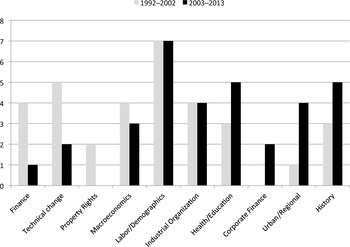
To measure changes over time in the dissertation topics selected for the Nevins panel, I classified the titles of dissertations by topic area according to the JEL coding scheme. Figure 1 presents the patterns for Nevins prize finalists for the 1990s and 2000s, separately by decade. The bars are organized from left to right by the relative popularity of the topic in two time periods.
What do the data show? First, new dissertation research in economic history is moving away from the “classic” topics of financial history, technological change, and property rights, towards a new set of topics in health and education, as well as in urban and regional studies. In this way, economic history is likely following the lead of the economics profession in general, as large micro-datasets and new modes of statistical analysis has increased interested in applied micro-economics. Second, even as economic history has grown increasingly technical over time, the number of qualitative historical studies represented on the panel (labelled as “history” in the figure) has not diminished. Third, despite signs of change, there is also a fair amount of stability in topic selection. Dissertation topics in the middle of the graph were equally prevalent in the 1990s as they are in the 2000s. These topics are the “old-standbys” in economic history—macro-economics, industrial organization, and labor/demographic history.
Dissertation topics on the Nevins Prize panel in the 1990s and 2000s

The three dissertations selected for the panel fit the recent trends in economic history dissertation research. Two of the dissertations covered the “standard” topics of industrial organization and labor history, while the third is properly classified in the “new” topic area of health/education. The three dissertations have in common their creative and effective use of large micro datasets. Two of the dissertations combine data from the public use samples of the U.S. Census with other historical sources (Ruggles et al. 2010). The third dissertation instead creates linked samples of individuals observed in two waves of the U.S. Census. The remainder of my comments will discuss the strengths of each dissertation on the finalist panel in alphabetical order. In each case, I also propose next steps for the authors to consider in revising and deepening their dissertation research.
TAYLOR JAWORSKI
Taylor Jaworski's dissertation, “The Warring Forties,” re-evaluates the role of World War II on the American economy. Conventional wisdom holds that the war pulled the United States out of the Great Depression, built scaffolding for the post-war expansion, and encouraged women to enter the workforce. The first chapter of Jaworski's dissertation carefully reviews this early literature, alongside a series of revisionist studies.
The remainder of Jaworski's dissertation is made up of three detailed studies on aspects of the wartime economy. The first paper focuses on how the war affected young women. Jaworski uses newly-collected state-by-year mobilization rates to show that women living in states with high mobilization during their teenaged years were more likely to leave high school, presumably to take a manufacturing job. As a result of this foregone human capital, women in the affected cohorts then suffered lower wages and higher unemployment rates in adulthood. Jaworski's results, taken together with new work by Claudia Goldin and Claudia Olivetti (2013), teach us that the war had heterogeneous effects on women in different stages of the life cycle. Some older women benefited from the chance to accumulate work experience during the war, particularly highly-educated women who entered clerical positions. However, Jaworski finds that, on average, younger women ended up losing out by foreshortening their education in response to employment opportunities during wartime.
Jaworski's second paper concerns the effect of wartime expenditures on industrial development in the South. Bruce Schulman (1994) and others have argued that federal investment, including war contracts during World War II, played a large role in postwar southern growth. Jaworski shows that, even after controlling for local trends, wartime investments had a positive (albeit modest) effect on establishment creation in the South, especially in higher value-added sectors like transportation, metals, and machinery. Yet because the South was already on a path to industrialization, federal funds were more like a “little shove,” rather than a “big push.” The next iteration of the paper would benefit from a more explicit discussion of magnitudes. How many new establishments in each sector can be attributed to wartime funding? And what is the timing of this process? Were all of these new establishments created during the war itself, or can some activity in the 1950s and 1960s be attributed to spillovers from previous war-related investment?
Jaworski's last chapter addresses the role of war spending on income compression in the 1940s. This chapter is currently the least developed. At present, Jaworski uses Census data from 1940 and 1950 to show that areas that received more supply contracts during the war also were home to greater increases in the employment of some low-paid groups (women and blacks, in particular). The challenge now will be translating these findings into aggregate conclusions about the income distribution.
JOSHUA LEWIS
In his dissertation, entitled “The Impact of Technological Change within the Home,” Joshua Lewis explores the effect of electrification on children's health and human capital accumulation. Lewis argues that, with electrification, mothers reallocated the time that was freed from household chores toward investment in children. Lewis's hypothesis is motivated by data from historical time-use studies showing that, in the United States, women spent just as much time on home production before and after electrification, even if the set of household tasks shifted over time (Ramey and Francis 2009).
One prediction that arises from Lewis's framework is that electrification should lead to an improvement in children's health. Indeed, Lewis finds an association between electrification and declines in infant mortality at the county level. In interpreting this cross-county variation, Lewis faces the standard inference problem that electricity was likely more readily available in economically active areas. To address this issue, he collects a new dataset mapping more than 1,000 new power plants that were constructed between 1930 and 1960 and uses variation in distance to a source of power over time, which likely affected the price of electricity.
Another implication of Lewis's framework is that electrification would eventually increase women's labor force participation, but only in the second generation, that is, for daughters who were raised in electrified households. Lewis observes this effect in the data, and argues that time-saving devices allowed teenaged daughters to reduce hours spent on household chores, and to therefore allocate more time to their school work. Furthermore, these daughters received more maternal investments at home, which may have increased the return to market work.
I would be curious to learn more about the effects of electrification on sons (if any). Even if electrification did not reduce the time that boys spent doing household chores, sons may have benefitted from increased maternal investments. Perhaps sons who were raised in electrified households enjoyed higher earnings or selected a different set of occupations later in life. In comparing Lewis's research with other recent work, I was also intrigued by the quite different effects of electrification in the United States and in contemporary developing countries. Taryn Dinkelman (2011) shows that an electrification program in rural South Africa increased female employment and work intensity. The choices that women make about whether to allocate hours freed from home production to market work or to investment in children will depend on the returns to each activity, which may vary with a country's level of development.
ROY MILL
Roy Mill's dissertation is entitled “Inequality and Discrimination in Historical and Modern Labor Markets.” Mill's first paper tackles one of the central questions in American history: What accounts for the persistent racial gaps in economic outcomes? One possibility is that these gaps are driven by discrimination in the labor market. Alternatively, it may be that these disparities begin in childhood, arising from the substantially different family and school environments in which black and white children are raised.
To disentangle these forces, Mill compares siblings that were raised in the same family environment but who may have been perceived by employers as being of different races. Mill identifies two such contrasts: first, he considers pairs of brothers, one of whom is coded by the Census enumerator as “black” and the other as “mulatto” in 1910. Second, he compares pairs of brothers who were both classified as mulatto in 1910, but who report different races—one white and one black—by 1940. Mill finds that mulatto brothers earned no more than their black counterparts. Yet, among mulatto brothers, being able to “pass” as white in adulthood was associated with a 30 to 60 percent increase in earnings.
The lack of an earnings gap between black and mulatto brothers substantially changes our interpretation of existing work on skin color. Other scholars have found large differences between light- and dark-skinned African-Americans, both in the past and today (Bodenhorn 2002; Bodenhorn and Ruebeck 2007; Hersch 2008). Mill shows that after controlling for family background, these differences disappear, suggesting that they reflect historical advantages accrued in light-skinned families, rather than labor market discrimination on the basis of skin color. The relevant threshold in the labor market appears to be between black and white, rather than between different shades of blackness.
I was more skeptical of the current estimates of the return to passing for white. Why would one mulatto brother be able to effectively pass for white, while the other remained in the black community? Differences in the ability or desire to pass may be correlated with many other life choices that brothers make. For example, passing for white is highly correlated with geographic mobility because it is hard for a person to change his racial identity while remaining in his hometown where his family background is well known (Nix and Qian 2014). Therefore, it is likely that brothers who passed for white were also more likely to leave their home state or even to leave the South altogether. Given the high returns to regional migration at the time, the estimated return to passing as white may be explained, in part, by the association between passing and mobility (Collins and Wanamaker 2014).
Mill is able to follow siblings from childhood to adulthood by creating linked Census samples. The second part of his dissertation proposes a new approach for designing linked datasets. Record linkage tends to occur by standardizing names for spelling errors, and then matching individuals with the same first and last names and a similar age. Mill instead proposes a method to more flexibly measure the distance between name strings, create a combined measure of name and age similarity, and then select matches using a decision rule.
With the digitization of large Census datasets, matched data is an increasingly important tool for economic historians. I expect that Mill's careful and well-explained approach to improving match quality will soon be widely used. Yet, while Mill's paper provides a few examples of how the standard matching approach can go astray, he does not demonstrate that the final results in papers that rely on matched data are meaningfully affected by the choice of matching technology. A next step for this paper would be to demonstrate the sensitivity of results to matching approach.
Leah Boustan, University of California, Los Angeles
-
Bodenhorn, Howard. “The Mulatto Advantage: The Biological Consequences of Complexion in Rural Antebellum Virginia.” Journal of Interdisciplinary History 33, no. 1 (2002): 21–46.
-
Bodenhorn, Howard, and Christopher S. Ruebeck. “Colourism and African–American Wealth: Evidence from the Nineteenth-Century South.” Journal of Population Economics 20, no. 3 (2007): 599–620.
-
Collins, William J., and Marianne H. Wanamaker. “Selection and Economic Gains in the Great Migration of African Americans: New Evidence from Linked Census Data.” American Economic Journal: Applied Economics 6, no. 1 (2014): 220–52.
-
Dinkelman, Taryn. “The Effects of Rural Electrification on Employment: New Evidence from South Africa.” American Economic Review 101, no. 7 (2011): 3078–108.
-
Editor's Notes. Journal of Economic History 33, no. 2 (1973): 467–69.
-
Goldin, Claudia, and Claudia Olivetti. “Shocking Labor Supply: A Reassessment of the Role of World War II on Women's Labor Supply.” American Economic Review 103, no. 3 (2013): 257–62.
-
Hersch, Joni. “Profiling the New Immigrant Worker: The Effects of Skin Color and Height.” Journal of Labor Economics 26, no. 2 (2008): 345–86.
-
Margo, Robert A. “The Economic History of the American Economic Review: A Century's Explosion of Economics Research,” American Economic Review 101, no. 1 (2011): 9–35.
-
Nix, Emily, and Nancy Qian. “The Fluidity of Race: ‘Passing’ in the United States, 1880–1940.” NBER Working Paper No. 20828, Cambridge, MA, January 2014.
-
Ramey, Valerie A., and Neville Francis. “A Century of Work and Leisure.” American Economic Journal: Macroeconomics 1, no. 2 (2009): 189–224.
-
Rhode, Paul. “The Dissertations of Doctors Law, Johnson, and Priest: 2003 Allan Nevins Prize Competition of the Economic History Association.” Journal of Economic History 64, no. 2 (2004): 579–86.
-
Ruggles, Steven J., Trent Alexander, Katie Genadek, Ronald Goeken, Matthew B. Schroeder, and Matthew Sobek. Integrated Public Use Microdata Series: Version 5.0 [Machine-readable database]. Minneapolis: University of Minnesota, 2010.
-
Schulman, Bruce J. From Cotton Belt to Sunbelt: Federal Policy, Economic Development, and the Transformation of the South, 1938–1980. Durham, NC: Duke University Press, 1994.
-
Wright, Gavin. “Dissertation Comments.” Journal of Economic History 34, no. 1 (1974): 304–7.
REFERENCES
The Warring Forties: The Economic Consequences of World War II
Between 1940 and 1945, the United States undertook the largest mobilization of manpower and materiel in the nation's history. Millions of Americans served in the armed forces and the federal government spent billions of dollars to field a military equipped for modern war. My dissertation examines the relationship between mobilization for World War II and the postwar development of the American economy. The first chapter provides background on the institutions established to facilitate mobilization and reviews the literature on World War II. The three substantive chapters examine the response of young women's human capital investment to manpower mobilization in the early 1940s, the war's role in accelerating the transformation of manufacturing in the American South, and provide preliminary evidence on the migration response to war spending and the implications of changes in inequality between 1940 and 1950.
The second chapter uses manpower mobilization under the 1940 Selective Service Act to examine the effect of the war on young women's investment in human capital. Many women entered the labor force during the war, taking advantage of new employment opportunities and filling the gap left by the 16 million men that enlisted or were inducted into the armed services. They were often employed in industries previously closed to women, but in the immediate postwar years female employment declined and still had not yet reached its wartime peak again by 1950. In addition, the decision to enter paid work led many high school age girls to drop out, obtain less education, and may have had negative consequences for their future earnings.
To measure the extent of the decline in educational attainment due to manpower mobilization, I use newly collected annual data on the number of men inducted and enlisted in each state between 1940 and 1945. I use these data to calculate the exposure of each cohort of young women to manpower mobilization and match this to information from the decennial censuses on the cohort's average educational attainment. The results suggest that a woman who experienced the median exposure to World War II manpower mobilization obtained one less year of schooling in 1960. This effect was concentrated on the margin of high school completion and additional evidence suggests lower educational attainment translated into lower rates of employment and earnings and earlier family formation as of 1960.
By 1970, the educational attainment and labor market outcomes of the women most and least affected by manpower mobilization for World War II converged; the cross-cohort differences in years of schooling, employment, and earnings disappeared. This pattern can be explained by initially uncertain returns to schooling and work at the end of World War II, followed by rising returns for women over the second one-half of the twentieth century. In the short run, there were fewer labor market opportunities for women, particularly those with less education, and the evidence suggests many started families by marrying earlier and having children earlier than they otherwise would have. However, in the long run, as women learned about the returns to schooling and work, as work by Claudia Goldin (2006) suggests they did, they returned to school and then the labor force.
The third chapter examines the war's impact on the growth of manufacturing in the American South, focusing on the role of investment in new construction and equipment for the war production. Overall investment in the South during the war years as well as the extent to which investment flowed to higher wage sectors. In theory, this wartime spending could have been a boon to southern industry: promoting learning-by-doing in modern sectors, moving up the manufacturing value-added chain, and fueling structural transformation. However, scholarly debate has so far not decisively settled on whether wartime spending was instrumental in promoting the region's industrialization or whether depreciation during the war years and the mismatch between military and civilian uses limited the beneficial effects in the long run.
Specifically, using newly collected data on the number of manufacturing establishments by two-digit sector and county, matched with the dollar value of war-related government spending at the county-level, I ask: To what extent did mobilization for World War II contribute to industrialization and sectoral diversification in the American South? I model industrialization as establishments choosing among locations in the South. I consider two variables: the amount of government spending on investment and supply contracts. The model incorporates heterogeneity in location decisions by allowing the effects to differ by spending type (i.e., investment and supply contracts) and sector. This ensures that I quantify not only growth or decline in the total number of establishments but also the diversification of manufacturing as well as link these changes to a specific type of government spending.
Two main findings emerge from this exercise. First, supply contracts have little medium- or long-run effect on industrialization in the South. This may, perhaps, not be surprising given that the economy was quick to demobilize at the end of the war. Second, investment played a modest role in diversifying manufacturing away from traditionally southern sectors—that also tended to pay low wages—and toward more modern sectors. The results suggest that, on average, war-related investment was beneficial to some communities that attracted an automobile or chemical plant as opposed to a textile plant. However, the relatively small magnitude of the estimates suggests that the war did not substantially alter the trajectory of industrialization in the region.
In the final chapter I consider the war's effect on migration and the evolution of the wage structure between 1940 and 1950. Over this period, the distribution of the wages compressed substantially in response to short-run factors, including the growth of unionization and minimum wage policy, and long-run factors, including increased supply of skilled workers and increased demand for unskilled workers (Goldin and Margo 1992). Despite the attention paid to the Great Compression—the name given to the mid-century narrowing of the wage structure—there has been relatively little work that integrates its causes with World War II, in particular, the large migrations that took place in response to wartime mobilization.
In the context of a simple theoretical model that describes the response of workers’ location decisions and wages to labor demand shocks, I quantify the impact of World War II on the spatial equilibrium of the U.S. economy between 1940 and 1950. To measure the shocks induced specifically by World War II, I use government spending on supply contracts from 1940 to 1945. In the empirical analysis, I consider the effect of supply contracts on the relative employment and wages within three groups: gender, race, and educational attainment. The results suggest that mobilization for World War II contributed to worker mobility during the 1940s and in ways that were likely to be important for the narrowing of the wage distribution.
Earlier economic histories of World War II emphasize the success of wartime mobilization, the contribution to postwar economic growth, and the boon to female entry into paid work (Gordon 1969; Chafe 1972; White 1980; Vatter 1985). More recently, economic historians have focused on the costs associated with mobilization, reconversion to peacetime production, and the implications of the expanded role for government (Goldin 1980; Higgs 1989; Goldin 1991; Field 2011; Rockoff 2012). Certainly a large portion of the war's influence on today is through this institutional legacy. The war also altered the way and where people lived their lives. For the immediate postwar period, my dissertation provides insight into the changes for young women, the impact on regional industrialization, and the relationship between migration and inequality.
Taylor Jaworski, Queen's University
-
Chafe, William H. The American Woman: Her Changing Social, Economic, and Political Roles, 1920–1970. New York, NY: Oxford University Press, 1972.
-
Field, Alexander J. A Great Leap Forward: 1930s Depression and U.S. Economic Growth. New Haven, CT: Yale University Press, 2011.
-
Goldin, Claudia D. “War in American Economic History.” In The Encyclopedia of American Economic History vol. 3, edited by Glenn Porter, 73–140. New York, NY: Scribner's and Sons, 1980.
-
Goldin, Claudia D. “The Role of World War II in the Rise of Women's Employment.” American Economic Review 81, no. 4 (1991): 741–56.
-
Goldin, Claudia D. “The Quiet Revolution That Transformed Women's Employment, Education, and Family.” American Economic Review 96, no. 2 (2006): 1–21.
-
Goldin, Claudia D., and Robert A. Margo. “The Great Compression: The Wage Structure in the United States at Mid-Century.” Quarterly Journal of Economics 107, no. 1 (1992): 1–34.
-
Gordon, Robert J. “$45 Billion of U.S. Private Investment Has Been Mislaid.” American Economic Review 59, no. 3 (1969): 221–38.
-
Higgs, Robert. Crisis and Leviathan: Critical Episodes in the Growth of American Government. Oxford, UK: Oxford University Press, 1989.
-
Rockoff, Hugh. America's Economic Way of War: War and the US Economy from the Spanish-American War to the Persian Gulf War. Cambridge, UK: Cambridge University Press, 2012.
-
Vatter, Harold G. The U.S. Economy in World War II. New York, NY: Columbia University Press, 1985.
-
White, Gerald T. Billions for Defense: Government Finance by the Defense Plant Corporation During World War II. Tuscaloosa, AL: University of Alabama Press, 1980.
REFERENCES
The Impact of Technological Change within the Home
Between 1930 and 1960, electricity and a host of new consumer durables diffused into most American homes. In 1930, more than 60 percent of American homes lacked electricity or were wired only for basic lighting, and few families owned a single major electric appliance (Tobey 1996, p. 33). By 1960, nearly all families resided in homes equipped with electric lights, running water, and a variety of modern appliances. These new household technologies transformed domestic life by freeing up time from basic housework. Nevertheless, we lack a clear understanding of how the “household revolution” affected families and where the time-savings afforded by these new consumer durables went. In this dissertation, I study the effects of household modernization on families, focusing on fertility, child health, and female labor force participation.
A key challenge to any empirical assessment of the “household revolution” is endogeneity in the decision to modernize. Unobservable determinants of appliance adoption—such as household wealth—may simultaneously influence decisions over child investment and female labor force participation. As a result, a correlation between technology diffusion and these outcomes might simply reflect unobservable differences in family characteristics, rather than the causal effect of household modernization. To address this issue, Chapter 1 introduces a new instrumental variables strategy that provides plausibly exogenous variation in local access to modern home technologies based on the rollout of the U.S. power grid. Using GIS software, I digitize information on the location and characteristics of all U.S. power plants in 1960, based on a Federal Power Commission map of the power industry. This data is then combined with information on the timing of power plant openings to create a panel dataset covering the construction of more than 1,000 power plants between 1930 and 1960. I exploit the geographic pattern of plant construction to estimate instrumental variables regressions, using changes in county distance to power plants as an instrument for changes in the proportion of homes with electrical services.
This identification strategy relies on two assumptions. First, county distance to power plants must be a strong predictor of household electrification rates. This assumption is supported by the direct costs of transmission line construction, which accounted for 15 percent of new industry capital expenditure (Electrical World 1940). Limitations in transmission technology created an added incentive to supply power locally, as power loss is a function of both line voltage and transmission distance. There is strong empirical support for this first-stage relationship: I estimate that a 100 mile decrease in county distance to the nearest power plant is associated with a 5 to 9 percentage point increase in the proportion of homes with electricity. The second assumption requires that decisions about where to locate plants were made independently of contemporaneous determinants of female employment and child investments. Given the long lifespan of plants—ranging from 30 to 100 years (International Energy Agency 2010) – site choices were made predominantly on the basis of long-term projected demand, which is controlled for in the fixed effects specification. Moreover, local geographical features, such as the availability of hydroelectric potential and access to coal for steam generation, played a dominant role in plant location decisions (Lovell 1941).
In Chapters 2 and 3, I apply this estimation strategy to study the effects of household modernization. There has been recent debate over the impact of labor-saving household technologies on investments in children. Jeremy Greenwood, Ananth Seshadri, and Guillaume Vandenbroucke (2005) argue that by expanding the time budget constraint of families, household modernization freed time for child rearing and contributed to the baby boom, although Martha Bailey and William Collins (2011) find limited empirical support for this hypothesis. Alternatively, Joel Mokyr (2000) argues that household modernization allowed families to shift time towards activities that promoted child health and household hygiene. Our understanding of these relationships has been hampered by a lack of disaggregate time-use data, which limits our ability to link changes in parental behavior to the diffusion of these new home technologies. Given this data limitation, I rely on an implication of Mokyr's argument: if household modernization led families to reallocate time towards health investments, then these technologies should be associated with improvements in health-related outcomes. In Chapter 2, I assess these two hypotheses, studying the effects of household modernization on fertility and infant health.
The analysis relies on decennial county- and state-level panel datasets for the period 1930 to 1960. The Census of Housing provides information on appliance ownership rates and the proportion of homes with electrical services for the period 1940 to 1960, and state-level information on household electricity is available from the Edison Electric Statistical Bulletin from 1930 to 1960. These data are combined with county- and state-level fertility rates, along with a host of demographic and economic covariates available in the census volumes. To assess the effects of household modernization on health, I also collect county- and state-level data on infant mortality rates available in the Vital Statistics.
The empirical analysis links changes in household electrification rates to changes in fertility and infant mortality in both fixed effects and instrumental variables strategies. The results suggest that access to modern household technologies led families to make a child quantity-quality tradeoff: household electrification is associated with decreases in fertility and decreases in infant mortality. I interpret these findings in a simple Beckerian model of home production, and show that the empirical evidence is consistent with a setting in which large increases in child quality investments raised the shadow price of fertility.
The effects on infant health were large: the diffusion of electricity into the home can account for roughly one-quarter of the decline in infant mortality between 1930 and 1960. Turning to the mechanisms, I find that household electrification had a larger impact on infant mortality in states that had previously invested heavily in maternal education, suggesting that parental investment played an important role in the health improvements. Household electrification also led to larger declines in mortality in states that were initially more reliant on coal for cooking, suggesting that the diffusion of modern stoves improved air quality.Footnote 1
In Chapter 3, I study the impact of household modernization on female labor force participation and human capital investment. There is little consensus as to the importance of labor-saving appliances for the rise in female employment during the twentieth century. Greenwood, Seshadri, and Mehmet Yorukoglu (2005) argue that the “household revolution” liberated women from domestic work, allowing them to enter the labor market. In contrast, other economists and sociologists argue that the time-savings afforded by modern consumer durables was primarily reallocated within the home (Cowan 1983; Ramey 2009).
To motivate the empirical analysis, I introduce a Beckerian model of home production in which labor-saving household technologies permanently expand the time-budget constraint of current and future generations of women. In this setting, household modernization will have an ambiguous initial effect on female employment, as mothers face a tradeoff between market work and investment in their daughters’ human capital. These new technologies should lead to a differential rise in education attainment for the next generation of women, as forward-looking parents anticipate a greater return to human capital investments, which ultimately generates a larger second-generation labor participation response.
I examine the predictions of the model empirically. To study the short-run impact of household modernization, I relate changes in household electrification rates to contemporaneous changes in female employment and school attendance rates. Household electrification had no immediate impact on female labor force participation. Across a range of specifications, the point estimates for female employment are small and statistically insignificant. On the other hand, household electrification is associated with a differential rise in female school attendance, consistent with accounts that housewives took over many of the domestic duties, such as childcare, that had typically been performed by older daughters (Cowan 1983, p. 178–79).
Next, I examine the second-generation response to household modernization. The analysis draws on individual-level data from the 1980 IPUMS covering cohorts of women born between 1916 and 1955. I use information on state-of-birth and year-of-birth to derive a measure of electricity access during childhood, and then relate this measure to long-run employment outcomes. The results suggest that childhood electricity access substantially improved long-run female employment outcomes. Even after accounting for endogeneity in the decision to modernize, my estimates imply that a woman raised in an electrified home was 15 percentage points more likely to work in 1980. Childhood access to electricity is also associated with significant increases in weekly hours worked and personal income. Importantly, household electrification had virtually no impact on the long-run employment outcomes of men, suggesting that the results are not driven by economic development or infrastructure investment associated with local electrification projects.
Turning to the mechanisms, the results do not appear to be driven by long-run changes in marriage patterns or fertility. Instead, I argue that the findings can be attributed to increases in human capital and revised employment expectations, as younger cohorts of women updated their beliefs over the probability of future employment. In fact, a change in employment expectations may have directly influenced labor market outcomes independently of educational attainment, for example, if women selected into careers that were better suited to long-term employment. Consistent with this mechanism is evidence that young women's expectations regarding future employment raised sharply, beginning with cohorts born during the mid-1940s (Goldin 2005).
These findings suggest that the diffusion of modern technology into the home during the first one-half of the twentieth century played a significant role in the rise in female employment after 1950. In fact, differences in childhood access to modern home technologies can account for almost one-quarter of the cross-cohort rise in employment for women born in 1920 and 1955. These findings also help reconcile a puzzle of the “household revolution”: that modern household technologies substantially reduced the demands of basic housework, but had limited immediate effects on time-use patterns. Instead, it took several decades for the full impact of these new technologies to be felt. The results have relevance for current electricity policy in the developing world today, where 1.3 billion individuals lack access to electricity. In particular, they suggest that studies focused on the immediate impact of new electrification projects may understate the long-term benefits of these infrastructure investments.
Joshua Lewis, University of Montreal
-
Bailey, Martha, and William Collins. “Did Improvements in Household Technology Cause the Baby Boom? Evidence from Electrification, Appliance Diffusion, and the Amish.” American Economic Journal: Macroeconomics 3, no. 2 (2011): 189–217.
-
Barreca, Alan, Karen Clay, and Joel Tarr. “Coal, Smoke, and Death: Bituminous Coal and American Home Heating.” NBER Working Paper No. 19881, Cambridge, MA, February 2014.
-
Cowan, Ruth Schwartz. More Work for Mother: The Ironies of Household Technology from the Open Hearth to the Microwave. New York, NY: Basic Books, 1983.
-
Edison Electric Institute. Annual issues. The Electric Light and Power Industry, Statistical Bulletin. New York, NY: 1933–1961.
-
Electrical World. McGraw-Hill Company: New York, NY, January 13, 1940.
-
Goldin, Claudia. “From the Valley to the Summit: A Brief History of the Quiet Revolution that Transformed Women's Work.” Regional Review 1, no. 14 (2005): 5–12.
-
Greenwood, Jeremy, Ananth Seshadri, and Guillaume Vandenbroucke. “The Baby Boom and Baby Bust.” American Economic Review 95, no. 1 (2005): 183–207.
-
Greenwood, Jeremy, Ananth Seshadri, and Mehmet Yorukoglu. “Engines of Liberation.” Review of Economic Studies 72, no. 1 (2005): 109–33.
-
International Energy Agency. “Renewable Energy Essentials.” International Energy Agency, 2010.
-
Lovell, Alfred. Generating Stations, Economic Elements of Electrical Design. New York, NY: McGraw-Hill Book Company, 1941.
-
Mokyr, Joel. “Why ‘More Work for Mothers?’ Knowledge and Household Behavior, 1870–1945.” Journal of Economic History 60, no. 1 (2000): 1–41.
-
Ramey, Valerie. “Time Spent in Home Production in the Twentieth-Century United States: New Estimates from Old Data.” Journal of Economic History 69, no. 1 (2009): 1–47.
-
Tobey, Ronald. Technology as Freedom: The New Deal and the Electrical Modernization of the American Home. Berkeley, CA: University of California Press, 1996.
REFERENCES
Inequality and Discrimination in Historical and Modern Labor Markets
Economic gaps between racial or ethnic groups are common in many heterogeneous societies. Findings of such inequality are sometimes presented as evidence for discrimination, yet different economic outcomes between demographic groups may arise from different levels of productivity between those groups. To alleviate economic inequality we need to probe into its sources: How much stems from discrimination and how much from productivity differences? How can productivity differences arise?
Chapter 1 studies economic outcomes of African-Americans in the early twentieth century. It is based on joint research with Luke C.D. Stein. We first look at how literacy, education, and income of African-Americans varied by color classification, as determined in the 1910 Census. Differences in color classification within the African-American community allow us to focus on race in its sense as a visual and exogenous signal. The visual aspect sets race apart from the broader concept of ethnicity. We then look at how economic outcomes varied between light-skinned African-Americans who are classified as White or Black by 1940 Census.Footnote 1 Restricting our attention to light-skinned African-Americans and looking at the changing social classification allows us to focus on race as a social category that some individuals can choose by assimilating. In both periods, we look at differences among siblings who share family background but differ in their color or racial classification.
The 1910 Census classified African-Americans as Mulatto or Black based on their appearance. Light-skinned African-Americans tended to have better economic outcomes than the dark skinned both in this era and, to a larger extent, in previous generations. But whether this difference stemmed from color-based discrimination is an open question. We exploit the fact that skin color could vary within African-American families by genetic accident; we compare siblings who were coded to be of different color. While comparisons between the average Black and average Mulatto in the population confound color differences with family background differences, comparisons between siblings control for differences in family background.
We construct a novel panel dataset that links African-Americans in their childhood households in 1910 to their outcomes as adults in 1940. We include all individuals who grew up in households where both Black and Mulatto children in a specified age range were present, and a random sample of individuals from Black-only or Mulatto-only households. Our main outcomes of interest are literacy in childhood, and years of schooling and income levels in adulthood. We find small and statistically insignificant differences in outcomes between the Black and Mulatto siblings, in both childhood and adulthood. In contrast, we document large differences in outcomes of Blacks and Mulattoes in the general population. These findings first show that parents and society more generally did not discriminate against the dark-skinned children of the same family. Moreover, they suggest that differences in family background drove most of the color gap observed in the general population: once family background is held fixed, color-based differences disappear. Caveats regarding these results are discussed in the chapter in detail.
Chapter 1 then turns to the social aspect of race by exploring the phenomenon of “passing for White” (Myrdal 1944). The One-Drop Rule defined people with even a single African ancestor as Black regardless of their physical appearance. Some African-Americans looked White even though they had mixed-race ancestry. Under this rule, they were considered Black as long as society knew about the non-White part of their ancestry. However, when forming new social ties they could present themselves as White if neither their appearance nor their behavior led to the belief that they had African ancestry.
How many light-skinned African Americans passed for White and what was the economic benefit of doing so? The first question is relatively straightforward to answer in the presence of a longitudinal dataset like ours. The second question is more challenging because passing for White is a choice, making it a classical problem of distinguishing returns and selection: those who passed may have been different from those who did not (Borjas 1987). The difference in income between passers and non-passers cannot be ascribed solely to the act of passing, but also to the selection of passers from the wider light-skinned African-American population. To remove at least some of the selection, we follow Abramitzky et al. (2012) and compare siblings or control for years of schooling which takes out selection across families or selection across schooling levels.
Differences between passers and non-passers are much larger than differences by color. Even when comparing siblings who grew up in the same household the passing sibling earns 20 percent more than the non-passer. Even if the gap is only driven by selection, wherein the most productive are the ones who pass for White, this analysis offers valuable insights. First, if a light-skinned African-American is accepted as part of the dominant White society based on his high productivity, then this is another form of discrimination. Second, it suggests a new channel through which racial inequality persists: individuals sort into races based on their earning ability, with the more productive African-Americans more likely to become White, leaving the average income level for the remaining African-Americans lower. Third, it shows how racial boundaries can be endogenously adjusted based on economic ability of certain sub-groups.
Chapter 1 shows how the visual and social aspects of race worked together. While the visual signals of how African one appeared did not cause different economic outcomes within the African-American community, they prevented most African-Americans from assimilating into White society like other ethnic groups have. Even if they wanted to do so, they could not.
Chapter 3 is a methodological contribution developed for the creation of the panel dataset in Chapter 1. The matching technique combines several methods used in various other statistical applications (Jaro 1989; Winkler 1990, 2006; Dempster et al. 1977). I compare my technique with prevailing matching methods.
I first discuss the objectives of record matching: the reduction of bias introduced by the matching procedure, the minimization of false matches, and the maximization of matching rate. Then I introduce several improvements. I propose quantifying distance between names rather than requiring an exact match of their phonetic representation (such as Soundex or NYSIIS). Then, I refer to several algorithms that can translate multiple measures of distance (e.g., name distance, birth year difference) to a single match score that is related to the probability of being a true match. I explain my application of the Expectation Maximization algorithm. Finally, I propose a method to specify a “unique” match that can be customized through the selection of two parameters: the first setting a minimum score to guarantee the best match is good enough and the second sets competing matches apart to deem the best match unique.
The proposed method has several advantages. First, because the Expectation Maximization algorithm is unsupervised, the procedure is replicable. Second, the strictness of the definition of uniqueness can be continuously adjusted, selected to suit the sensitivity of the subsequent econometric analysis to each of the objective functions: false matches, sample size, or selection bias. Third, because the score is correlated with the probability to be a true match it can be leveraged in an analysis that takes into account multiple potential matches instead of just one match deemed unique.
Chapter 2 investigates an online global labor market—freelancer.com—to show that employers use their experience with freelancers from a country to update their expectations about the quality of freelancers from that same country. The updating of expectations in such a way results in hiring decisions that (statistically) discriminate based on freelancers’ country of origin. Employers post a project, freelancers bid, and then employers choose their desired freelancers. Being an online marketplace, employers and freelancers from all over the world can participate. Freelancers from low-wage countries are able to provide services for sometimes one-tenth of what is charged by an American freelancer. However, the quality of the services provided by freelancers in low-wage countries may be lower. A freelancer's country of residence is a salient signal in how the list of bids is presented to employers. Employers can then learn about the average quality of freelancers as they repeatedly hire in the market.
I study how employers react to a freelancer's country of origin. I look at how country and personal reputation interact and show that employers put more weight on a freelancer's country of origin when individual reviews are available. For example, American employers are more likely to hire an unrated freelancer from Canada than from Bangladesh. However, the gap decreases with the number of freelancer reviews. This finding is inconsistent with pure taste-based discrimination. If employers had specific tastes for freelancers’ countries that were unrelated to productivity, then additional information on the specific freelancer's productivity would not change countries’ relative likelihoods of winning a project.
Finally, I look at how experience changes employers’ perceptions of the distribution of productivity of freelancers from a certain country. I follow each employer, classifying her matches as good, bad, or neutral experiences. Then I assign each bid the number of good and bad experience that employer had with freelancers from the same country. I find employers are more likely to hire freelancers from countries providing good past experience. Additionally, as the employer gains experience with a country, each additional match's outcomes contributes less to how the employer updates her hiring decisions, consistent with Bayesian updating.
Distant from each other in terms of time period, medium, and the social category analyzed, Chapters 1 and 2 show that economic inequality on the basis of affiliation with a social group can be found in varying settings. Chapter 1 shows that early life investment, chosen long before entry into the labor market, was a leading factor in determining literacy, years of schooling, and income differences between lighter- and darker-skinned African-Americans in early twentieth-century America. These early differences in investment drove productivity differences that created color inequality within the African-American community at the time. It also allowed me to explore the institution of the One-Drop Rule and show that it was driving much larger inequality than what the visual and exogenous effect of color could bring. In Chapter 2, detailed information and recurring hiring decisions by the same employers allow me to explain inequality in hiring as the result of employers who statistically discriminate based on freelancers’ countries, and who constantly update their beliefs over the signal embodied in a freelancer's country.
Roy Mill, Ancestry.com
-
Abramitzky, Ron, Leah P. Boustan, and K. Eriksson. “Europe's Tired, Poor, Huddled Masses: Self-Selection and Economic Outcomes in the Age of Mass Migration.” American Economic Review 102, no. 5 (2012): 1832–56.
-
Borjas, George J. “Self-Selection and the Earnings of Immigrants.” American Economic Review 77, no. 4 (1987): 531–53.
-
Dempster, A. P., N. M. Laird, and D. B. Rubin. “Maximum Likelihood from Incomplete Data via the EM Algorithm.” Journal of the Royal Statistical Society. Series B (Methodological) 39, no. 1 (1977): 1–38.
-
Hochschild, Jennifer L., and Brenna M. Powell. “Racial Reorganization and the United States Census 1850–1930: Mulattoes, Half-Breeds, Mixed Parentage, Hindoos, and the Mexican Race.” Studies in American Political Development 22, no. 1 (2008): 59–96.
-
Jaro, Matthew A. “Advances in Record-Linkage Methodology as Applied to Matching the 1985 Census of Tampa, Florida.” Journal of the American Statistical Association 84, no. 406 (1989): 414–20.
-
Myrdal, Gunnar. An American Dilemma: The Negro Problem and Modern Democracy. New York: Harper & Brothers, 1944.
-
Williamson, Joel. New People: Miscegenation and Mulattoes in the United States. New York: The Free Press, 1980.
-
Winkler, William E. “String Comparator Metrics and Enhanced Decision Rules in the Fellegi-Sunter Model of Record Linkage.” In Proceedings of the Survey Research Methods Section. American Statistical Association, 1990.
-
———. Overview of Record Linkage and Current Research Directions. U.S Bureau Statistical Research Division Research Report Series 2, 2006.
REFERENCES
The Dissertations of Cihan Artunç, Tyler Beck Goodspeed, and Eric Schneider: 2014 Alexander Gerschenkron Prize Competition
CHIHAN ARTUNÇ
Cihan Artunç's dissertation, entitled “Barrators, Berats, and Bandits: Economic Implications of Legal Rules in the Ottoman Empire and Egypt, 1600–1921,” was completed at Yale University under the supervision of Timothy Guinnane and Naomi Lamoreaux. The thesis is a careful analysis of the institutions that together conformed the commercial legal framework of the Ottoman Empire. Focused on the role of the berat—a license conferring the protection of a foreign consulate for tax and litigation purposes—it argues that the multiplicity of legal jurisdictions available to foreign merchants can account for many stylized facts of Ottoman trade. At the same time, it contends that the suboptimal equilibria that resulted plausibly explain the Empire's sluggish growth relative to other European powers.
The dissertation follows the work of Timur Kuran (2012), adding depth to several of its key aspects and challenging some of its central tenets and results. In particular, Artunç takes aim at the interpretation that Ottoman backwardness can be explained by the restrictions that Islamic law imposed on organizational forms. While a literal reading of Isalmic law was certainly rigid in that respect, the thesis documents how its application allowed for a large degree of flexibility. It permitted, for example, the temporary survival of partnerships after the departure of a partner, thus avoiding immediate dissolution and affording an opportunity for a new entrant to continue the business. This approach to institutional analysis—emphasizing institutions “on the ground” rather than to those on the books—was formalized by Avner Greif (2006). Artunç uses it to anchor key arguments of the dissertation, thus casting the institutional structure of the Ottoman Empire in a new, revealing light.
The multiplicity of legal jurisdictions at the center of the Ottoman long-distance trade system allows for a rich analytical environment, one that Artunç cleverly exploits both in the theoretical model and in the subsequent analysis of Imperial legal adjudication and post-Imperial Egyptian legal history. One noteworthy element is the observation that the Imperial government also offered berats that competed with European ones to shield non-Muslim merchants from the jurisdiction of local magistrates. This delicate balance of competition and complementarity in legal options points to the Empire as a supra-national partnership; paraphrasing Henry Kamen (2003), we could call it an enterprise created by British, French, Venetians, Austrians, Dutch, and Turks, for the benefit of the British, French, Venetians, Austrians, Dutch, and Turks. Artunç also extends the framework to the post-Ottoman world, exploring the effects of multiple jurisdictions under the Egyptian system of mixed courts on firm organization and survival.
The dissertation could do more to convince the reader that a handful of licenses were enough to decisively alter the growth path of a giant empire. At the apogee of the system, there were only 340 berats, covering roughly 1,700 individuals. Meanwhile, Muslims trading with Muslims could not engage in forum shopping; this could have been a useful commitment mechanism, allowing for the survival and expansion of Muslim-Muslim trade, something that did not happen. The dissertation does not explore the problem of optimizing the number of berats, nor the sensitivity of Ottoman trade to an increase in the number of licenses. The implicit argument is that there was an oversupply of berats, but without such an analytical approach there can be little evidence offered to support it. The theoretical model in Chapter 2 could serve as a useful foundation to push the analysis further in this direction.
TYLER BECK GOODSPEED
Tyler Beck Goodspeed's dissertation, “Essays in British Financial History,” was completed at Harvard University under the supervision of Richard Hornbeck. It is composed of two articles on the role of Loan Funds in the Irish famine, and a monograph-length chapter on key regulatory and industrial organization aspects of the Scottish free banking system.
Chapters 1 and 2 are a true rarity—a non-Malthusian model of the Irish famine. In them, Goodspeed argues that Loan Funds, which specialized in making large amounts of small loans to working class families, moderated the immediate effects of the famine, as well as its long-term consequences. The presence of Loan Funds in a county is associated with higher buffer animal holdings, as well as with a larger area converted to crops other than the potato after the famine.
Using a non-Malthusian model does have its drawbacks, as the failure to include population in the analysis means that one crucial element is never addressed. The Irish famine was a demographic crisis on a large enough scale to affect the land-labor ratio. The potato is three times as labor intensive as alternative crops, while yielding three times as much per unit of land (Nunn and Qian 2011). It is hence suitable for areas under strong population pressure, but it may well lose its attractiveness once land becomes relatively more abundant. Changes in potato crop share and animal holdings may well reflect differential changes in population pressure after the famine, rather than financially-mediated responses to the shock. One also worries about the potential endogeneity—Loan Fund presence could well have been correlated with land productivity. While Goodspeed seeks to instrument for the presence of Loan Funds using musical societies, one suspects that a clearer identification strategy might produce more convincing results.
Chapter 3 is a thorough inquiry into the Scottish banking reforms of 1765, their impact on the crisis of 1772, and the overall nature of the Scottish free banking system. At times delving deep into both legal history and the history of economic thought, this book-length study highlights the issues of moral hazard, institutional capture, and the extent of liability that continue to dominate financial systems today. Of particular interest are the reflections on the macroregulatory role of banks in the context of a small open economy. In the face of capital flight to England in 1762–1764, Scotland's large banks attempted a classic credit contraction strategy, reducing their circulating notes. With no restriction on issue, small banks responded by simply expanding their own note circulation, undoing the credit constraint. The crisis was stemmed when the large banks restricted convertibility of large notes held by speculators using the optional clause, which allowed them to defer payment for six months. These measures, akin to capital controls, gradually solved the problem without triggering an economic slowdown. The success was short lived as the large banks successfully lobbied Parliament to regulate the small banks out of existence in 1765.
The reconstruction of the liquidation of the Ayr Bank, which Goodspeed retells in a style reminiscent of the classical political economy literature, also yields novel insights. The unlimited liability of partners resulted in shareholders being called to respond for the full extent of their fortunes –a “bail-in” process that resulted in no losses to depositors or taxpayers. The Free Banking system thus provided the same type of backstop as a lender of last resort, with the difference that it was private shareholders and partners, rather than the public purse that ended up footing the bill.
The chapter then ties together these two findings, arguing that the regulations of 1765 exacerbated instability by favoring large banks. While scale allowed large banks to be more efficient, it also undermined the ability of partners to control management. The Ayr Bank failure is traced down to fraudulent management that escaped partner oversight. A doubt nonetheless lingers. The Ayr bank was incorporated with 136 partners at the outset, and grew to more than 220 before its collapse. Given its original size, it is not clear that, absent the 1765 regulations, the outcome would have been any different.
ERIC SCHNEIDER
Eric Schneider's thesis, “Studies in Historical Living Standards and Health: Integrating the Household and Children into Historical Measures of Living Standards and Health,” was completed at Oxford University under the supervision of Robert Allen. It is a multi-pronged analysis and expansion of key aspects of the literature on biological living standards in three distinct parts. The first one is an evaluation of the assumptions commonly used to construct living standard measures for British families, as framed by the work of Allen (2001). The innovation is to examine the biological standard of living at different points in the life cycle of a family, with special emphasis on the periods of maximum dependency ratios. A Monte Carlo simulation based on data from Edward Wrigley and Roger Schofield (1981) suggests that, while current estimates of median living standards are likely accurate, at their maximum dependency ratios families must have relied heavily on an expanded supply of female and child labor, on home production, and on the Poor Law in order to survive. The examination of the evolution of living standards throughout the life cycle is a welcome expansion in a literature that has for too long focused on faceless averages. While one does remain concerned about how much Monte Carlo simulations can really tell us about the actual outcomes of real families, this part of thesis is certainly an agenda-setting work that should yield important results once augmented with microdata.
Part II consists of a single chapter that re-examines the methodology of Roderick Floud et al. (2011) for transforming agricultural yields into measures of calorie availability. First, the costs of digestion, pregnancy and lactation in terms of calorie availability are added to the standard calculation. Digestion is increasingly costly in the fiber content of food. Since changing manufacturing techniques progressively reduced the fiber content of bread between 1700 and 1900, calorie availability per unit of agricultural output increased substantially during that period. Altogether, Schneider calculates that digestion costs reduced calorie availability by more than 12 percent in 1700 relatively to Floud et al.'s figures, but only by 5 percent in 1900. Pregnancy and lactation reduce average calorie availability by an additional 2.5 percent. Since obviously these costs were born by pregnant or lactating women, it would be desirable to add an analysis of calorie allocation within the household to identify the actual impact on different household members.
The third part of the thesis relies strongly on the evolutionary biology literature to propose an adaptive model of nutrition and growth. In utero conditions are hypothesized to program final height, which then depends on the match between the programmed growth path and the actual conditions experienced from early childhood through puberty and beyond. The model is validated with the case of American slaves, who experienced good in utero nutrition but appalling conditions in early childhood, leading to stunting. Once they began work good nutrition resumed, and catch up growth brought them close to their originally programmed final height. The model is then used to argue that the lagging in the height of girls relative that of boys in both Britain and the United States can be traced to gender discrimination in the allocation of resources within the household in early childhood. The situation was rectified once the children entered school, at which point girls caught up. The model is persuasive and innovative, though additional effort should be expended in rejecting alternative biological interpretations, as well as in augmenting the analysis with actual microdata of within family allocation of resources.
Mauricio Drelichman, The University of British Columbia
-
Allen, Robert C. “The Great Divergence in European Prices and Wages from from the Middle Ages to the First World War.” European Review of Economic History 38, no. 4 (2001): 411–47.
-
Floud, Roderick, Robert W. Fogel, Bernard Harris, et al. The Changing Body: Health, Nutrition, and Human Development in the Western World Since 1700. Cambridge: Cambridge University Press, 2011.
-
Greif, Avner. Institutions and the Path to the Modern Economy : Lessons from Medieval Trade. Cambridge; New York: Cambridge University Press, 2006.
-
Kamen, Henry. Empire: How Spain Became a World Power, 1492–1763. New York: Harper Collins, 2003.
-
Kuran, Timur. The Long Divergence: How Islamic Law Held Back the Middle East. Princeton: Princeton University Press, 2012.
-
Nunn, Nathan, and Nancy Qian. “The Potato's Contribution to Population and Urbanization: Evidence from an Historical Experiment.” Quarterly Journal of Economics 126, no. 2 (2011): 593–650.
-
Wrigley, Edward Anthony, and Roger Schofield. The Population History of England, 1541–1871: A Reconstruction. Cambridge: Cambridge University Press, 1981.
REFERENCES
Barrators, Berats, and Bandits: Economic Implications of Legal Rules in the Ottoman Empire and Egypt, 1600–1921
Up until the early 1700s, the Middle East had comparable economic prosperity compared to Western Europe. The Ottoman Empire, which covered a vast territory across the Middle East and Eastern Europe, had comparable economic prosperity throughout the early modern period. However, by the nineteenth century, strong economic disparities emerged between these two regions. The Ottoman Empire and its successors were much poorer and growing more slowly than the United States and Western Europe from the 1800s onwards.Footnote 1
Understanding how the Middle East and Western Europe settled on divergent development paths has been an important challenge in economic history. The literature proposed culture, religion, or Muslims’ attitudes towards commerce to explain the Middle East's failure to catch up with Europe.Footnote 2 In past decades, economists explained persistent variation in economic growth across different societies through institutions.Footnote 3 However, this literature paid little attention to the Ottoman Empire's institutional details.Footnote 4 More recently, Timur Kuran and Şevket Pamuk corrected this oversight in the literature by focusing on institutions and institutional change in the Ottoman Empire to improve our understanding of the Middle East's past economic performance. For instance, Pamuk (2004) shows how the underlying political economy affected the direction of institutional change in the Empire, leading to substantial repercussions in the Empire's economic organization. Kuran (2011), on the other hand, argues that certain features of Islamic law, while beneficial when they were first conceived, had severe dynamic implications, which were realized over the long run. His comprehensive analysis claims that inflexible and egalitarian inheritance law made partnerships particularly vulnerable to untimely dissolution, which firms might have avoided by incorporating. However, Islamic law's disallowance of legal personhood, such complex organizations could not emerge. The absence of the corporate form induced economic actors to endow their assets in pious foundations (waqfs), which were rigid institutions and thus locked capital in unproductive enterprises. Thus, the interaction of Islamic partnership law, inheritance law, and pious trusts kept Middle Eastern enterprises small and ephemeral, prevented long-run capital accumulation, and led to commercial stagnation.
This debate about the Middle East's economic underperformance from the nineteenth century onwards is centered around Muslims’ disappearance from trade. However, as Kuran (2011) shows that non-Muslim minorities in the Empire became very successful in Ottoman trade. In fact, as I show in this dissertation, a very specific group of indigenous non-Muslims, the ones who acquired legal privileges from European powers by paying large sums of money, succeeded in dominating trade and pushed both Europeans and Muslims out. Thus, the Middle East's commercial stagnation can be disentangled into two related questions: how Europeans achieved larger business expansion than the Ottoman enterprises, and how non-Muslim Ottomans under European protection got ahead of Europeans and Muslims within the Ottoman Empire. A closer examination of Ottoman institutions is necessary to understand these puzzles.
Thus, this dissertation's motivation is to deepen our understanding of the institutional framework in the Middle East. While the literature has focused on institutions’ overall impact on economic growth and development, I focus on specific institutions to identify the micro-mechanisms that affected a set of key puzzles. My dissertation comprises three self-contained chapters and addresses three related questions.
The first two chapters examine legal pluralism, or the co-existence of multiple legal systems in the Ottoman Empire. Depending on their religion, Ottoman subjects had access to different court systems. These jurisdictions included religious courts such as Islamic, Greek Orthodox, and Judaic, as well as European consular courts. Muslims could only use Islamic courts (until the 1800s). Non-Muslim minorities, on the other hand, could contract under any of the available legal systems. In disputes, defendants had the option of strategically imposing the most advantageous jurisdiction, thus engaging in “forum shopping.” My primary evidence shows that almost one-half of the time, contested contracts involved some degree of court switching.
The first chapter in my dissertation formalizes this problem by developing a bilateral trade model with overlapping legal jurisdictions. Two agents contract and decide on investments, agreeing on an initial jurisdiction. There is a chance of default ex post. The defaulting party (the defendant) receives private information about the probability with which each jurisdiction enforces the contract, and can choose to defect to a more favorable court.
The model delivers four results. Such a proliferation of legal systems creates enforcement uncertainty and makes contracts less credible. This uncertainty in turn discourages investment. Thus, the model explains the small capitalization in Ottoman partnerships. It is not about the substance of law but rather the co-existence of multiple legal systems and the option to engage in forum shopping. This leads to the second implication. The Ottoman Empire completely transplanted the French commercial code in 1850, but it did not improve the empire's economic performance. The model explains that legal pluralism is the culprit. The new commercial code did not supplant any of the existing legal systems and thus ended up being just one more option over which agents could engage in forum shopping. Adoption of French law only exacerbated the problems legal pluralism created.
Third, there is an option value associated with each additional legal system. This option value explains why non-Muslim Ottomans paid substantial sums in order to acquire access to European law. The model shows that non-Muslim minorities were not seeking “better law;” rather, adding an additional legal system enhanced their position if they defaulted. Hence, consistent with the theory, they purchased multiple protections simultaneously despite the hefty price.
Fourth, in a competitive market, where a subpopulation has access to additional legal systems, agents who have access to fewer jurisdictions exit trade altogether. Thus, the model resolves a key puzzle: why non-Muslim Ottomans who acquired European protection dominated Ottoman commerce and drove both Muslims and Europeans out. I also briefly consider nineteenth-century Morocco, which had legal pluralism but did not restrict access to a subpopulation. Hence, no single group dominated Moroccan trade.
The second chapter analyzes a particular facet of Ottoman legal pluralism: the sale of exemption licenses called berats. These licenses granted their bearers a number of tax deductions as well as the option to use European law for contracting and litigation. While the previous chapter examines legal pluralism's adverse effect on trade and commerce, this chapter studies the pricing of licenses that allowed forum shopping. I use diplomatic correspondence, chancery registers, merchant correspondence, and litigations from the British, French, and Ottoman archives to construct a novel price panel for British and French licenses as well as disputes that involved the licensees.
The price data support five conclusions. First, berats cost on average 55 times the annual Ottoman GDP per capita in 1800. Second, the present discounted value of tax exemptions cannot explain berat prices. Third, there is a systematic and statistically significant variation in berat prices, which reflect ambassadors’ influence at the Ottoman court, rather than substantive differences in law. Fourth, berat holders exploited their legal privileges by engaging in opportunistic forum shopping, which appeared in about one-half of the disputes involving berat holders. Finally, agents tried to acquire multiple berats simultaneously from different European powers in order to expand their legal options, as predicted by the previous model. This evidence shows that non-Muslim Ottoman acquired berats to enhance their ability to do forum shopping. This advantage allowed them to dominate Ottoman commerce by the end of the eighteenth century.
The final chapter explores an important legal reform in Egypt, which had been an Ottoman province until the early nineteenth century. Similar to the Ottoman Empire, Egypt introduced European law to reform its institutional framework. In 1876, the Egyptian government established a new judicial system called the Mixed Courts, which largely applied the French commercial code. One important purpose for this court system's introduction was to resolve conflicts of law that haunted commercial transactions between Europeans of different nationalities, or between Europeans and locals. Thus, while legal pluralism persisted after the Mixed Courts’ emergence, the judicial reform at least succeeded in increasing enforcement reliability by defining a more clear demarcation across jurisdictions.
With the French Law's introduction, European enterprise forms also appeared in Egyptian economy. By law, agents were required to register their partnership agreements and dissolutions. The Mixed Courts published extracts of these contracts in a monthly gazette. Based on these novel firm-level data, I construct a cohort of partnerships and corporations that were established between 1900 and 1921, uncovering patterns in firm size, scale, and enterprise form selection across the decade. Furthermore, I propose a new link between enterprise forms and longevity by exploring firm dynamics.
This chapter reveals that, the majority of business associations between 1910 and 1921 preferred to organize their firms as partnerships. The majority of these partnerships comprised two partners, who exercised joint control over assets. This pattern is similar to European multi-owned enterprises in the nineteenth century as well as Middle Eastern partnerships in the seventeenth and eighteenth centuries.
Furthermore, survival analysis shows that partnerships had a high risk of dissolution within the first two years. Conditional on surviving this period, dissolution risk drops and becomes uniform across the firm's age. Corporations are associated with lower failure risk overall, and their hazard function does not exhibit such spikes.
I interpret these findings through a multi-armed bandit model. Partners have imperfect information about their association's quality, about which they learn through an experimentation period. They dissolve the firm and switch to new partners if their updated beliefs about match quality is sufficiently pessimistic. Partnerships that survive the trial period are more stable and productive. Thus, the theory expands our understanding of partnership forms. The fact that partnerships could be dissolved so easily allowed agents to engage in welfare-improving experimentation, which manifested itself in a high dissolution rate among young firms, and stability among survivors.
Together, the three dissertation chapters show specific ways through which legal institutions affected the Middle East's economic and commercial life. By focusing on individual economic actors’ incentive structures, the thesis improves our understanding of the mechanism through which these effects are realized and explains how they persisted for so long. This methodology shows that formal economic theory and careful archival research can reveal novel answers to important puzzles in the economic history of the Middle East.
Cihan Artunç, University of Arizona
-
Acemoglu, Daron, Simon Johnson, and James A. Robinson. “Institutions as a Fundamental Cause of Long-Run Growth.” In Handbook of Economic Growth Vol. 1, edited by Philippe Aghion and Steven N. Durlauf, 385–472. Elsevier, 2005.
-
Jones, Eric. The European Miracle: Environments, Economies and Geopolitics in the History of Europe and Asia. Cambridge: Cambridge University Press, 2003.
-
Kuran, Timur. “Islam and Underdevelopment: an Old Puzzle Revisited.” Journal of Institutional and Theoretical Economics 153, no. 01 (1997): 41–71.
-
———. The Long Divergence: How Islamic Law Held Back the Middle East. Princeton, NJ: Princeton University Press, 2011.
-
Landes, David. The Wealth and Poverty of Nations: Why Some Are so Rich and Some so Poor. New York, NY: W.W. Norton & Company, 1998.
-
Özmucur, Süleyman, and Sevket Pamuk. “Real Wages and Standards of Living in the Ottoman Empire, 1489–1914.” Journal of Economic History 62, no. 2 (2002): 293–321.
-
Pamuk, Şevket. “Institutional Change and the Longevity of the Ottoman Empire, 1500–1800.” Journal of Interdisciplinary History 35, no. 2 (2004): 225–47.
-
———. “Estimating Economic Growth in the Middle East since 1820.” Journal of Economic History 66, no. 3 (2006): 809–28.
REFERENCES
Essays in British Financial History
In this collection of essays, the third of which constitutes a stand-alone, book-length manuscript, I study the “informal” or “shadow” banking sectors of the eighteenth- and nineteenth-centuries Scotland and Ireland. It is a study of the vital role of the more mundane—the corn brokers, vintners, drapers, tanners, mongers, building and friendly societies, lending cooperatives and countless other quasi-banking institutions—in managing risk and financing economic trade, development, and growth before the twentieth century. In these essays I seek to recover some of that diversity by studying two prominent sets of institutions active in the British shadow banking sector throughout the eighteenth and early nineteenth centuries, namely, the Irish Loan Funds and the “free” banking system of Scotland. In particular, I examine the critical role these institutions played in mitigating the effects of adverse exogenous shocks on the developing Irish and Scottish economies.
The first two essays analyze the Irish Loan Funds—privately-run microfinance organizations operating throughout Ireland from the 1740s through the early twentieth century—and the Great Famine of Ireland. Since many Irish tenements were too small to post sufficient collateral for conventional bank loans, and since in any event on the eve of the Great Famine Ireland possessed just one bank for every 115,000 inhabitants, none of which was involved in the business of extending loans below mean annual household income, the Loan Funds operated in a critical credit void within the Irish economy, particularly for small- to medium-sized Irish farms. On the eve of the famine, 300 Loan Funds were extending some 400,000 loans annually, to approximately 20 percent of Irish households, with an average loan size of roughly £3 (Mokyr 1985; Hollis and Sweetman 2004).
In the first essay, “Famine, Finance, and Adjustment to Environmental Shock: Microcredit and the Great Famine in Ireland,” I thus analyze the margins of adjustment and corresponding time horizons along which Irish farmers responded to the shock of potato blight, asking, first, whether districts which suffered more heavily from blight shifted agricultural production away from potatoes toward other forms of tillage and animal husbandry sooner and to a greater extent than did districts less affected by blight; and, second, inasmuch as these agricultural adjustments did not take place, to what extent might lack of access to microfinance credit have limited the ability of Irish agriculture to absorb and adjust to the adverse environmental shock?
To answer these questions, I use original archival resources—the annual reports of the Loan Fund Board of Ireland and the Distress Papers of the Parliamentary Relief Commission—to construct a micro-level database of blight severity. I find that in the short run, districts more severely infected by blight experienced larger population declines and accumulations of buffer livestock by small- and medium-sized farms, while in the medium and long runs, worse affected districts experienced greater substitutions toward other tillage crops and grazing livestock, the latter particularly by medium-sized farms.Footnote 1
I further find that access to microfinance credit from the Loan Funds was an important factor in short- and long-run adjustment to blight; worse affected districts with at least one microfinance fund during the famine experienced substantially smaller relative population declines and larger increases in buffer livestock during and immediately after the famine, and greater medium- and long-run substitutions toward other crops and grazing livestock, than worse affected districts without a fund. Estimated effects of Loan Fund lending appear, however, to have had the largest impacts on small- to medium-sized farms, which suggests that the very smallest farms remained vulnerable to adverse environmental change. Not only do these panel estimates include all available pre-famine control variables for initial differences in demographics, wealth, poverty, and geography, they are furthermore robust to tests of potential non-randomness in blight severity and Loan Fund location, as well as to re-estimation by two-stage least squares.
Since a major potential challenge confronting MFI's even today is that they may be ill-equipped to absorb the kinds of spatially correlated shocks typical of agricultural loan portfolios (Braverman and Guasch 1986; Rosenzweig 1988), in the second essay of this dissertation, “Environmental Shocks and Sustainability in Microfinance: Evidence from the Great Famine of Ireland,” I analyze the effects of the Great Famine on the Irish Loan Funds themselves, and explore the management and lending practices that allowed some Loan Funds to survive a major covariate shock while others failed. I find that funds in districts worse affected by blight experienced higher failure rates, greater declines in total lending and deposit capital, and significantly raised credit standards, relative to funds in less affected districts. I further observe relative declines in average interest rates for funds in worse affected districts, indicating that while overall MFI lending contracted where the magnitude of the aggregate shock was larger, borrowing costs for qualifying borrowers actually fell as funds in worse affected districts contracted lending and significantly raised credit standards.
While greater leverage, lower staff salaries, and more depositors were generally associated with higher predicted probabilities of institutional survival, the reverse was true where blight infection was more severe, and while funds with higher pre-famine profit margins were generally no more likely to survive, higher pre-famine margins were positive predictors of institutional survival where blight infection was worse. Moreover, I find that whereas funds with higher pre-famine profit margins and better remunerated staff were able to contract lending and raise credit standards to a greater extent than funds with lower margins and salaries, the opposite was true of funds with more depositors, while funds that had been more highly levered before the famine experienced relative increases in the unit cost of credit intermediation and declines in unit profitability. The results presented in this essay therefore suggest that optimal lending models in ordinary circumstances may render MFI's more vulnerable to tail-probability aggregate shocks, with higher leverage, lower paid staff, lower economic rents, and more extensive liabilities limiting scope for credit retrenchment and flight-to-quality. Results further indicate that one cost of MFI resilience to adverse environmental change is substantially reduced outreach to borrowers of lower-credit quality.
Finally, in the third, book-length essay, “Upon Daedalian Wings of Paper Money: Adam Smith, Free Banking, and the Financial Crisis of 1772,” I turn to Adam Smith and Scotland, 1716–1845. During these 130 years, the Scottish financial system functioned with no official central bank or lender of last resort, no public (or private) monopoly on currency issuance, no legal reserve requirements, and no formal limits on bank size. Consistent with previous research on Scottish “free banking” (White 1984; Selgin 1988; Kroszner 1995; Hickson and Turner 2004) I find that this absence of legal restrictions on Scottish banking contributed to a proliferation of what Smith derisively referred to as “beggarly bankers”—often bankers only in the sense that they were in the business of issuing short-term liabilities—which rendered the Scottish financial system both intensely competitive and remarkably resilient to a series of severe adverse shocks to the small developing economy.
Drawing on quantitative and qualitative evidence alike, I show that in the latter half of the eighteenth century Scotland's was a rapidly emerging economy with a fixed exchange rate, large external debt, and a chronic current account deficit balanced by large but often highly volatile capital inflows. In particular, in 1756 and 1762–1764, large capital outflows due to exogenous political events relating to the Seven Years’ War exerted immense pressure on the Scottish financial system, triggering acute balance of payments crises as investors rushed to remit capital for speculation on the London exchanges. Without recourse to higher deposit rates, owing to a binding usury ceiling, Scotland's largest banks responded exactly as the IMF would likely have instructed—by attempting to grind out a real exchange rate depreciation through a painful credit contraction. But for an economy already short on circulating media due to the speculative external drain of specie, the consequent cash crunch invited numerous small-scale note issuers, Smith's “beggarly bankers,” to plug the gap, which merely frustrated the larger Edinburgh banks’ efforts to defend the exchange rate.
Ultimately, I find, the incipient balance of payments crises were resolved only when the country's leading banks resorted to imposing capital controls, in the form of highly discriminate exercise of banknote “optional” clauses, effectively converting large-denomination demand notes held by high-volume arbitrageurs into six-month, interest-bearing promissory notes. Temporary capital controls appear, then, to have allowed time for depreciation of Scottish bills of exchange to gradually pass through to relative prices and a current account-led recovery, without requiring a disruptive contraction of the money supply and accompanying deflation, thanks largely to the surrogate provision of money and credit by Smith's beggarly bankers. Far from contributing, therefore, to economic instability, the Scottish financial system actually exhibited considerable resilience and flexibility in absorbing these shocks, and in limiting transmission to the real economy the effects of external reserve drains.
I further find, however, that the introduction of regulatory restrictions in 1765—specifically, the prohibition of small-denomination and contingent liability banknotes—was the result of aggressive political lobbying by the largest Scottish banks, and effectively raised barriers to entry and encouraged banking sector consolidation. Using original archival sources, I argue that while these results did not cause the severe financial crisis of 1772—the salient financial crisis of the Scottish “free banking” period, about which Smith wrote extensively in Wealth of Nations—they did nothing to resolve the emerging economy's perennial balance of payments problem, while at the same time introduced new problems of bigger, more systemically important financial institutions, higher barriers to entry for new banks, and no contractual “circuit-breaker” to allow temporarily illiquid but otherwise solvent banks to liquidate assets without incurring fire-sale losses. In other words, regulatory capture amplified the level of systemic risk in Scottish credit markets and increased the likelihood that portfolio losses in the event of an adverse economic shock would be transmitted to depositors and noteholders through disorderly bank runs, suspensions of payment, and institutional liquidation.
Finally, I find that unlimited liability on the part of Scottish bank shareholders attenuated the effects of financial instability on the real economy, as sequestration of shareholders’ personal estates in the event of institutional bankruptcy effectively “bailed in” equity holders for more than their subscribed capital, thereby mitigating counterparty risk in the Scottish financial system and facilitating a more rapid recovery in the flow of credit. Essentially, in the absence of a formal lender of last resort, the unlimitedly liable shareholders in Scottish banks, particularly those of extensive landed wealth, served that function.
Tyler Beck Goodspeed, University of Oxford
-
Braverman, Avishay, and J. Luis Guasch. “Rural Credit Markets and Institutions in Developing Countries: Lessons for Policy Analysis from Practice and Modern Theory.” World Development 14 (1986): 1253–67.
-
Fafchamps, Marcel, Christopher Udry, and Katherine Czukas. “Drought and Saving in West Africa: Are Livestock a Buffer Stock?” Journal of Development Economics 55, no. 2 (1998): 273–305.
-
Hickson, Charles, and John Turner. “Free Banking and the Stability of Early Joint-Stock Banking.” Cambridge Journal of Economics 28, no. 6 (2004): 903–19.
-
Hollis, Aidan, and Arthur Sweetman. “Microfinance and Famine: The Irish Loan Funds during the Great Famine.” World Development 32, no. 9 (2004): 1509–23.
-
Kroszner, R. 1995. “Free Banking: The Scottish Experience as an Example for Emerging Economies.” Working Paper 1536. World Bank Policy Research.
-
Mokyr, Joel. Why Ireland Starved: A Quantitative and Analytical History of the Irish Economy, 1800–1850. London: Allen and Unwin, 1985.
-
Rosenzweig, Mark. “Risk, Implicit Contracts and the Family in Rural Areas of Low-Income Countries.” Economic Journal 98, no. 393 (1988): 1148–70.
-
Selgin, George. A Theory of Free Banking. Totawa: Rowman and Littlefield, 1988.
-
White, Lawrence. Free Banking in Britain: Theory, Experience and Debates, 1800–1845. Cambridge: Cambridge University Press, 1984.
REFERENCES
Studies in Historical Living Standards and Health: Integrating the Household and Children into Historical Measures of Living Standards and Health
This dissertation attempts to improve the theoretical and methodological basis for studying how labour opportunities and decisions made at the household level affected the living standards of the household as a group and individuals within it, especially children. The dissertation is broken into three parts consisting of five chapters.
The first part develops a Monte Carlo simulation based on early modern English demographic data to tackle three problems. First, it tests some of the simplifying assumptions of Allen's real wage methodology, namely his estimate of average family size, which is held constant over time, his exclusion of women and children's income from his calculations, and his exclusion of female-headed households. Second, because each family's welfare ratios (real wages) are measured across the family life cycle, the family's welfare ratios can be recorded for the median or the minimum point in the family life cycle. Thus, we can know how families were doing at an average point in their life cycle and how they were doing at the hardest point in their life cycle when they were supporting the largest number of children. Third, the simulation allows a distribution of families to be predicted, so it is possible to measure the adequacy of the male breadwinner wage by considering the number of families below a certain welfare ratio threshold and the inequality in real income that is determined by family size and composition.
Both chapters in Part 1 use demographic data drawn from Edward Wrigley et al. (1997) family reconstitutions of 26 English parishes to adjust Allen's (2009) real wages to the changing demography of early modern England. Using parity progression ratios (a fertility measure) and age specific mortality for children and parents, model families are predicted in two reference periods 1650–1700 and 1750–1800. There are two main findings. First, pregnancy and lactation do not create cyclical effects in the family's income because the consumption of children is slowly added to the household from pregnancy to nursing to weaning. Instead, most families’ welfare ratios decline steadily across the family life cycle until children begin to leave the household, increasing the welfare ratios. Second, Allen's real wages understate or match the median of the predicted demography-adjusted welfare ratio distributions.
Chapter 2 complicates the model developed in Chapter 1 to better understand the way households earned their living. Poor households in eighteenth-century England used a number of strategies to combat poverty and increase their income formally in the labour market and informally outside it. These strategies included sending women and children into the labour market, allocating resources unequally within the household, self-provisioning on garden plots of land, appealing to the Poor Law for aid, and expanding the number of days worked by household members. These strategies constituted an economy of makeshifts, which allowed the poor to at least scrape by and even reach respectable levels of consumption for the period. While social and economic historians have studied these individual strategies for eighteenth-century England, few historians have been able to integrate them all to determine how these strategies influenced the income of the average family and how large a gap had to be filled by the economy of makeshifts for the poor to reach target consumption levels. This chapter seeks to integrate these strategies in such a way.
Thus, the original Monte Carlo simulation is expanded to incorporate women and children's labour force participation and the unequal distribution of resources within the household. In addition, for each level of women and children's labour force participation and each household resource distribution assumption, I calculate the level of self-provisioning, Poor Law support, or additional days of work necessary for the family to reach a certain target consumption level.
The results suggest that at the average median welfare ratio in the life cycle, agricultural labourers’ families could get by at a low consumption level through either self-provisioning or working a few more days. However, at the average minimum welfare ratio in the life cycle, this was much more difficult, and the Poor Law likely had to play a strong role in keeping these families afloat. Women and children's labour force participation increased the average family welfare ratios by 31 to 48 percent depending on the specification used, and could even put agricultural labourer families within stabbing distance of Allen's respectability level of consumption. However, even with women and children's labour force participation, families still struggled to make ends meet at the low point in the welfare ratio curve. Thus, the results highlight the precarious position of agricultural labourers in the late eighteenth century, the importance of women and children's labour participation in keeping poor families afloat, and the importance of life-cycle poverty, which is ignored when real wages are only measured for the average family at the average point in the life cycle.
Part 2 of the dissertation consists of one chapter. The chapter provides a critical review of some of the methods used for calculating the number of calories available in the British economy from 1700 to 1909. All of the authors working with this method have made judicious use of agricultural output data and trade statistics, and their results provide an interesting additional welfare measure with which to compare trends in real wages, nutritional status (stature), and mortality rates. However, the figures are somewhat biased because they do not account for the costs of digestion, lactation, and pregnancy. Digestion costs arise because the body has more difficulty breaking down certain components of food (dietary fibre and protein) than others. These additional costs are not incorporated in the Atwater factors Roderick Floud et al. (2011) and Craig Muldrew (2011) used to convert food production into calories. Thus, their figures overestimate the amount of calories that people could absorb from their food. Adjusting for these digestion costs is complicated by changing diets over the period studied. The average bread and other cereals consumed in the early eighteenth century contained much more dietary fibre than the average bread consumed in the early twentieth century. After making estimates of digestion costs in each benchmark year, digestion costs reduce the average calories available per capita by 12.7 percent in 1700 but only by 4.9 percent in 1909. The energy costs of pregnancy and lactation were lower than the digestion costs only reducing average per capita calorie consumption by 2.5 percent. Taken together the digestion, pregnancy, and lactation adjusted figures suggest a more pessimistic level of calorie availability than Floud et al. and Muldrew argue.
Part 3 of the dissertation attempts to advance the theoretical framework and introduce a new methodological strategy for studying children's growth in historical populations, hopefully making some interesting points about the growth pattern of antebellum American slaves and gender differences in health in late-nineteenth and early-twentieth century Britain and America.
Chapter 4 presents a new adaptive framework for understanding children's growth in the past. Drawing upon the recent work of Peter Gluckman and Mark Hanson (2006) and their co-authors on adaptive responses in relation to growth, I present four adaptive mechanisms that affected the growth patterns of children. First, acute poor prenatal conditions can trigger an immediate adaptive response where the foetus slows its growth until conditions improve. Second, the general or average conditions in utero lead to a predictive adaptive response where the foetus develops assuming that the postnatal environment will closely match prenatal conditions. Thus, the metabolism and growth trajectory of a child is programmed during the prenatal period: children experiencing good conditions in utero would have a higher metabolism and growth trajectory than their counterparts facing poor conditions. Third, a nutritional or disease shock in childhood or adolescence can lead to an immediate adaptive response where growth is temporarily slowed until the child has enough energy to continue growing. Finally, poor conditions before the pubertal growth spurt can prompt the child to delay his/her growth spurt until conditions improve. All of these responses are adaptive because they increase the probability that a child will survive to reproductive age and produce viable offspring, but this does not mean that there are no costs involved. These stunting events have negative consequences for the long-run mortality risk of the child.
Having discussed the framework in great detail, I then use it to reinterpret the growth pattern of American slaves (Steckel 1986). I argue that the mismatch between relatively good conditions in utero and absolutely appalling conditions in infancy and early childhood led slave children to become incredibly stunted by age three or four. However, after this age slave children experienced rapid catch-up growth, first because their immune systems had become more developed and had adapted to the poor disease environment and later because their diet improved tremendously when they entered the labour force at around age ten. Thus, American slave children were able to experience rapid catch-up growth because they were prenatally programmed for a higher metabolism and growth trajectory. The chapter concludes by setting out some stylized facts about children's growth in the past and pointing toward areas of future research.
Chapter 5 measures the relative deprivation of children admitted to the Marcella Street Home in Boston, MA (1889–1898) and the Ashford School in London, U.K. (1908–1917) by studying their longitudinal growth, a first for a historical study. By comparing the catch-up growth of boys and girls, a proxy for health and nutritional conditions before entering the institutions, I find that in both the Marcella Street Home and the Ashford School girls experienced slightly faster height gain relative to modern standards than boys. There are three potential explanations for this result. First, girls could have been treated better than boys in the schools, but this does not seem to have been the case. Second, girls might have a greater natural propensity for catch-up growth; however, there is no scientific consensus on this question, so we can tentatively reject this explanation. Therefore, it seems likely that girls were relatively worse off when compared to boys. The most parsimonious explanation for girls’ relative poor health is that girls may have been discriminated against in the allocation of household resources before entering these institutions. This finding is contradictory to household budget studies, which found no gender discrimination in household resources (Horrell and Oxley 1999). Female deprivation could have played a role in slowing the progression of improvements in health across the late nineteenth- and early-twentieth centuries, at least for a portion of the population. Thus, it was only when resources became incredibly abundant in the twentieth century and female deprivation disappeared that the biological living standards of the population could increase substantially.
Eric Schneider, University of Sussex
-
Allen, Robert C. The British Industrial Revolution in Global Perspective. Cambridge: Cambridge University Press, 2009.
-
Floud, Roderick, Robert W. Fogel, Bernard Harris, and Sok Chul Hong. The Changing Body: Health, Nutrition, and Human Development in the Western World since 1700. Cambridge: Cambridge University Press, 2011.
-
Gluckman, Peter D., and Mark A. Hanson. “Evolution, Development and Timing of Puberty.” Trends in Endocrinology and Metabolism 17, no. 1 (2006): 7–12.
-
Horrell, Sara, and Deborah Oxley. “Crust or Crumb?: Intrahousehold Resource Allocation and Male Breadwinning in Late Victorian Britain.” Economic History Review 52, no. 3 (1999): 494–522.
-
Muldrew, Craig. Food, Energy and the Creation of Industriousness: Work and Material Culture in Agrarian England, 1550–1780. Cambridge: Cambridge University Press, 2011.
-
Steckel, Richard H. “A Peculiar Population: The Nutrition, Health, and Mortality of American Slaves from Childhood to Maturity.” Journal of Economic History 46, no. 3 (1986): 721–41.
-
Wrigley, Edward A., R. S. Davies, J. E. Oeppen, and Roger S. Schofield. English Population History from Family Reconstitution, 1580–1837. Cambridge: Cambridge University Press, 1997.