1. Introduction
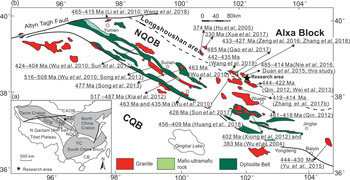
As a part of the Qilian orogenic belt, the North Qilian orogenic belt (NQOB) is a typical early Palaeozoic accretionary orogenic belt located between the Alxa Block and the Central Qilian Block (Fig. 1a). The 550–450 Ma Yushigou, Jiugequan and Dachadaban ophiolite complexes confirm the existence of the North Qilian Ocean (Song et al. Reference Song, Niu, Su and Xia2013; Xia et al. Reference Xia, Li, Yu and Wang2016). An abundant amount of 517–446 Ma arc magmatic rocks are exposed in the NQOB (Fig. 1b), indicating the N-wards subduction or bidirectional subduction of the North Qilian oceanic slab (Wang et al. Reference Wang, Zhang, Qian and Zhou2005, Reference Wang, Wu, Lei, Chen, Li and Zheng2017; Wu et al. Reference Wu, Xu, Gao, Li, Lei, Gao, Frost and Wooden2010; Xia et al. Reference Xia, Song and Niu2012, Reference Xia, Li, Yu and Wang2016). Similar results are observed from the metamorphic age of eclogites (489–463 Ma, Song et al. Reference Song, Zhang, Niu, Song, Zhang and Wang2004; Zhang et al. Reference Zhang, Meng and Wan2007) and the high-grade blueschists (467–445 Ma, Liu et al. Reference Liu, Neubauer, Genser, Takasu and Handler2006; Lin & Zhang, Reference Lin and Zhang2012; Cheng et al. Reference Cheng, Lu and Cao2016). Evidence, such as the widespread incipient Silurian molasse unconformably overlying the pre-Silurian strata in the Qilianshan area (Song et al. Reference Song, Niu, Su and Xia2013; Xia et al. Reference Xia, Li, Yu and Wang2016), the latest arc volcanic magmatic activities (446 Ma, Wang et al. Reference Wang, Zhang, Qian and Zhou2005) and the 465–440 Ma syn-collisional magmatism (adakite and S-type granite) (Chen et al. Reference Chen, Xia and Song2012; Yu et al. Reference Yu, Zhang, Qin, Sun, Zhao, Cong and Li2015), suggests that the final closure of the North Qilian Ocean and collision of the Alxa Block and Central Qilian Block took place during the Late Ordovician period. Subsequently, the NQOB entered an episode of intraplate evolution.
(a) Tectonic units of China (after Song et al. Reference Song, Niu, Su and Xia2013). (b) Geological map of the NQOB and the southern margin of Alxa Block (modified from Song et al. Reference Song, Niu, Su and Xia2013). YC –Yangtze Craton; CB – Cathaysian Block; AB – Alxa Block; CQB – Central Qilian Block; QDB – Qaidam Block; CAOB – Central Asian Orogenic Belt; NQOB – North Qilian Orogenic Belt; N. Qaidam UHP belt – North Qaidam ultrahigh-pressure metamorphic belt.

Studies have shown that subduction zones play an important role in the study of crust–mantle interaction and lithospheric mantle evolution (Goodenough et al. Reference Goodenough, Upton and Ellam2002; Ma et al. Reference Ma, Jiang, Hou, Dai, Jiang, Yang, Zhao, Pu, Zhu and Xu2014). Fluids and/or melts that were released from the subduction plate would lead to the metasomatism of the overlying lithospheric mantle. However, studies of the compositions and evolution of the lithospheric mantle of the NQOB during the early Palaeozoic period are relatively sparse.
The Longshoushan area extends as a long narrow strip at the SW of the Alxa Block, which is directly connected to the NQOB on the south side. There are extensive intrusions of the early Palaeozoic igneous rocks in the Longshoushan area (Duan et al. Reference Duan, Li, Qian and Jiao2015; Zeng et al. Reference Zeng, Lai, Mao, Li, Ju and Tao2016; Zhao et al. Reference Zhao, Zhang, Tang, Yao and Yang2016; Wang et al. Reference Wang, Yu, Yan, Liu, Liu and Pan2019). Mafic–ultramafic magmas from the mantle can be used directly to reflect their magmatic sources and tectonic setting (Meng et al. Reference Meng, Liu, Liu, Liu, Yang, Wang, Shi and Cai2014). However, previous studies focused on the widely exposed granitoid rocks, and were not concerned with the mafic rocks. Only Gao et al. (Reference Gao, Zhao, Wang and Nie2017) and Duan et al. (Reference Duan, Li, Qian and Jiao2015) reported two early Palaeozoic mafic rocks in the Longshoushan area, but these studies pay less attention to the composition of their mantle source. In this paper, we present an integrated study of geology and petrology with zircon U–Pb–Hf isotopes and whole-rock geochemistry (major- and trace-element analysis, and Sr–Nd–Pb isotopic compositions) on the Yushigou diabase from the central Longshoushan area to precisely determine the age, petrogenesis and mantle source of the diabase. Combined with the available mafic rock information in the research area, we evaluate the nature and evolution of mantle sources and the geodynamic setting of the Longshoushan area during the early Palaeozoic period.
2. Geological setting and petrology
The Longshoushan, the study area extends in an NWW–SEE direction and is located in the SW of the Alxa Block. This area is bounded by faults to the south against the NQOB (Fig. 1) and known for the Jinchuan deposit, the third-largest copper-nickel sulphide deposit in the world.
The Longshoushan area consists primarily of outcrops of the Mesoarchean–Palaeoproterozoic Longshoushan Complex (Gong et al. Reference Gong, Zhang, Wang, Yu, Li and Li2016; Zeng et al. Reference Zeng, Lai, Mao, Li, Zhang, Bayless and Yang2018), the late Mesoproterozoic Dunzhigou Group (Xu & Jiang, Reference Xu and Jiang2003) and the Neoproterozoic–Cambrian Hanmushan Group (Xie et al. Reference Xie, Xiao and Yang2013). As the basement rock, the NWW-striking Longshoushan Complex is exposed in a long narrow belt that is approximately 500 km long and 30 km wide (Tung et al. Reference Tung, Yang, Liu, Zhang, Tseng and Wan2007). It is in unconformable contact with the overlying strata of the Dunzhigou Group. The Longshoushan Complex underwent strong deformation, low-amphibolite facies regional metamorphism and migmatization during the middle–late Orosirian period (Tung et al. Reference Tung, Yang, Liu, Zhang, Tseng and Wan2007; Zeng et al. Reference Zeng, Lai, Mao, Li, Zhang, Bayless and Yang2018). It mainly consists of marbles, amphibolites, schists, leptynites and migmatites.
The extensive development of Palaeozoic magmatism is a major feature of the Longshoushan area. These Palaeozoic magmatic rocks can be roughly divided into two stages: c. 485 Ma and 445–414 Ma. The c. 485 Ma magmatic rocks, consisting mainly of intermediate and mafic rocks, are exposed at the Jiling in the central region of the Longshoushan area (Nie et al. Reference Nie, Zhao, Chen, Feng, Wang and Li2016; Gao et al. Reference Gao, Zhao, Wang and Nie2017). The 445–414 Ma felsic rocks widely occur in the Longshoushan area, with high contents of potassium and sodium, and most of them belong to the alkaline series (Zhao et al. Reference Zhao, Zhang, Tang, Yao and Yang2016; Zeng et al. Reference Zeng, Lai, Mao, Li, Ju and Tao2016; Zhang et al. Reference Zhang, Zhang, Zhang, Xiong, Luo, He, Pan, Zhou, Xu and Liang2017 b; Wang et al. Reference Wang, Yu, Yan, Liu, Liu and Pan2019). In addition, the 424–421 Ma Jinchang diabase (Duan et al. Reference Duan, Li, Qian and Jiao2015) and the mafic microgranular enclaves (MMEs) in the 442–435 Ma Jiling pluton (Wang et al. Reference Wang, Yu, Yan, Liu, Liu and Pan2019) indicate that there is a small amount of mantle-derived magmatism in the Longshoushan area. Since then, a small number of Middle Devonian – middle Permian magmatic rocks have been sporadically exposed in the Longshoushan area, such as the 374 Ma Zhigoumen pluton (Hu et al. Reference Hu, Xu and Yang2005), the 361 Ma Jinchang granite porphyry (Zeng et al. Reference Zeng, Lai, Mao, Li, Ju and Tao2016), the 330 Ma Taohualashan granite (Xue et al. Reference Xue, Ling, Liu, Zhang and Sun2017) and the 280 Ma Xiaokouzi mafic–ultramafic rocks (Jiao et al. Reference Jiao, Jin, Rui, Zhang, Ning and Shao2017). In the Longshoushan area, the Early Palaeozoic and Devonian magmatic events are generally associated with the evolution of the NQOB (Hu et al. Reference Hu, Xu and Yang2005; Wei et al. Reference Wei, Hao, Lu, Zhao, Zhao and Shi2013; Duan et al. Reference Duan, Li, Qian and Jiao2015; Zeng et al. Reference Zeng, Lai, Mao, Li, Ju and Tao2016; Zhang et al. Reference Zhang, Zhao, Wang and Nie2017 a, b, Reference Zhang, Wang, Wang, Liu, Liu and Wu2018). The small amount of 330–230 Ma magmatic rocks are considered to have formed under the influence of the Central Asian orogenic belt (Jiao et al. Reference Jiao, Jin, Rui, Zhang, Ning and Shao2017; Xue et al. Reference Xue, Ling, Liu, Zhang and Sun2017).
3. Field relationship and petrography
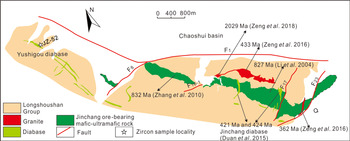
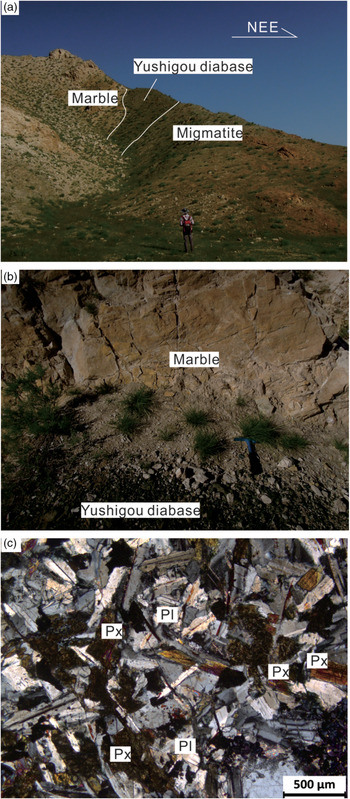
Diabase dykes are common throughout the Jinchuan mining area (Fig. 1), central to the Longshoushan area (Figs 1, 2), although these are generally smaller in size (approximately 3–30 m in width and 300–900 m in length). These dykes show two distinct orientations: N–W and N–E. The NW-trending Yushigou diabase dyke, which is 5–15 m wide and 600 m long, occurs c. 1 km NW of the c. 830 Ma Jinchuan ore-bearing mafic–ultramafic rock (Li et al. Reference Li, Su, Song and Liu2004; Zhang et al. Reference Zhang, Kamo, Li, Hu and Ripley2010) and c. 5 km NW of the 424–421 Ma Jinchang diabase (Duan et al. Reference Duan, Li, Qian and Jiao2015) (Fig. 2). It intrudes into the marble and migmatite of the Longshoushan Complex (Figs 2, 3a), which commonly have sharp contact (Fig. 3b).
Geological map of the Jinchuan mineral area.

Photographs and corresponding micrographs. (a) Diabase dyke intruding marble and migmatite of the Longshoushan Complex. (b) Contact between diabase and marble. (c) Diabasic texture (perpendicular polarized light). Mineral abbreviations: Px – pyroxene; Pl – plagioclase.

The Yushigou diabase is generally yellow-green-grey in colour and has a characteristic diabasic texture (Fig. 3b). Compositionally, the rocks are mainly composed of plagioclase (c. 60 vol%), pyroxene (c. 30 vol%) and opaques (e.g. magnetite c. 10 vol%). The accessory phases include apatite and zircon. The plagioclase crystals are euhedral to subhedral, with grain sizes ranging between 0.6 mm and 0.8 mm (Fig. 3c). The pyroxene crystals are mainly anhedral and 0.1–0.4 mm in size, and they occur as interstitial grains between plagioclase. Most plagioclases have experienced sericitization, and some pyroxenes were altered to chlorite and amphibole. Twelve samples of the Yushigou diabase were collected along the strike of the diabase dyke on the surface. Each sample was collected from the centre of the diabase dyke. Zircon sample JZ-52 was obtained from one sample collected at the locations shown in Figure 2.
4. Analytical methods
4.a. Major- and trace-element analyses
A total of 11 fresh rock samples from the studied area were selected for geochemical analysis. Whole-rock major- and trace-element analyses (except for Pb and Ni contents) were determined at ALS Chemex (Guangzhou) Co. Ltd. Major oxide concentrations were measured by X-ray fluorescence (XRF) spectrometry. Fused glass disks with lithium borate were used and the analytical precision was better than ±0.01%, estimated from repeated analyses of the standards GSR-2 and GSR-3. Trace elements were detected using the lithium borate dissolution method and inductively coupled plasma – mass spectrometry (ICP-MS). Analyses of United States Geological Survey rock standards (BCR-2, BHVO-1 and AGV-1) indicate precision and accuracy are better than ±5% for trace elements.
Whole-rock element analyses of Pb and Ni for five samples (J7-1 to J7-6) were carried out at Nanjing FocuMS Technology Co. Ltd. Rock digestion diluent was nebulized into Agilent Technologies 7700× quadrupole ICP-MS (Hachioji, Tokyo, Japan) to determine the trace elements. Geochemical reference materials of USGS – basalt (BIR-1, BCR-2, BHVO-2), andesite (AVG-2), rhyolite(RGM-2) and granodiorite(GSP-2) – were treated as quality control. Measured values of these reference materials were compared with preferred values in GeoReM database (http://georem.mpch-mainz.gwdg.de). Deviations were better than ±10% for the elements that exceeded 10 ppm and better than ±5% for the elements that exceeded 50 ppm.
4.b. Zircon U–Pb dating and Hf isotope analyses
Zircon U–Pb dating analyses were performed at the Key Laboratory of Crust–Mantle Materials and Environments of CAS at the University of Science and Technology of China (USTC), using a laser ablation (LA) (ICP-MS; Perkin Elmer Elan DRC II) equipped with a Microlas system (GeoLas 200 M, 193 nm ArFexcimer laser). Zircon 91500 and SRM610 were used as the external standards for U–Pb isotope ratios and element content, respectively. The spot diameter of laser ablation pits is 32 μm and the average power output about 4 W. For detailed instrument parameters and analysis processes, refer to Sun et al. (Reference Sun, Xiao, Gao, Lai, Hou and Wang2013) and Gu et al. (Reference Gu, Xiao, Santosh, Li, Yang, Pack and Hou2013).
In situ Hf ratio analyses were performed using the 193 nm ArF laser and Thermo Scientific Neptune multi-collector (MC) ICP-MS at the Advanced Analytical Centre at James Cook University. Spot sizes were 44 μm, with a 4 Hz laser pulse repetition rate. The analytical protocols were similar to those outlined in Næraa et al. (Reference Næraa, Scherstén, Rosing, Kemp, Hoffmann, Kokfelt and Whitehouse2012). The Mud Tank reference zircon (MTZ) and the Geostandard FC1 zircon were used as the external standards; the 176Hf/177Hf ratios of these two external standards are 0.282184 and 0.282507, respectively (Woodhead & Hergt, Reference Woodhead and Hergt2005). Standard zircon MTZ and FC1 were analysed in the experiment, and the 176Hf/177Hf ratios were 0.282148–0.282175 and 0.282488–0.282502, respectively, in accordance with the recommended value.
4.c. Sr–Nd–Pb isotopic analyses
High-precision isotopic (Sr, Nd, Pb) measurements were carried out at Nanjing FocuMS Technology Co. Ltd. The Sr-, Nd- and Pb-bearing elution was dried down and re-dissolved in 1.0 mL 2 wt% HNO3. Small aliquots of each were analysed using Agilent Technologies 7700× quadrupole ICP-MS (Hachioji, Tokyo, Japan) to determine the exact contents of Sr, Nd and Pb available. Raw data of isotopic ratios were corrected for mass fractionation by normalizing to 86Sr/88Sr = 0.1194 for Sr, 146Nd/144Nd = 0.7219 for Nd and 205Tl/203Tl = 2.3885 for Pb with exponential law. In the experiment, repeat analyses yielded an 87Sr/86Sr ratio of 0.710240–0.710250 for the NBS-987 Sr standard, a 143Nd/144Nd ratio of 0.512111–0.512135 for the JNdi-1 Nd standard, and a 204Pb/206Pb of 0.05902–0.05904, 207Pb/206Pb of 1.09277–1.09353 and 208Pb/206Pb of 2.16609–2.16711 for NBS981 Pb standard.
5. Analytical results
Tables 1–4 list the data for major and trace elements, zircon U–Pb ages, Hf isotopes and Sr–Nd–Pb isotopes, respectively.
Major element (wt%) and trace element (ppm) compositions of the Yushigou diabase

Note: Mg no. = molar (Mg×100)/(Mg+Fe); FeOtotal = all Fe calculated as Fe2O3; LOI – loss on ignition; ND – not determined. Whole-rock major- and trace-element analyses (except the Pb and Ni contents) were determined at ALS Chemex (Guangzhou) Co. Ltd.; Pb and Ni analyses of whole-rock for five samples (J7-1 to J7-6) were carried out at Nanjing FocuMS Technology Co. Ltd.
Zircon LA-ICP-MS U–Pb isotopic data and ages of the Yushigou diabase

Note: σ is mean square error.
Zircon Hf isotopic data of the Yushigou diabase

For the calculation of ϵHf(t) values, we adopted the 176Lu decay constant of 1.867 × 10⁻¹¹ (Söderlund et al. Reference Söderlund, Patchett, Vervoort and Isachsen2004), and the present-day chondritic values of 176Lu/177Hf = 0.0332 and 176Hf/177Hf = 0.282772 (Blichert-Toft & Albarède, Reference Blichert-Toft and Albarède1997). To calculate one-stage model ages (T DM1) relative to a depleted-mantle source, we adopted the present-day depleted-mantle values of 176Lu/177Hf = 0.0384 and 176Hf/177Hf = 0.28325 (Vervoort & Blichert-Toft, Reference Vervoort and Blichert-Toft1999).
Sr, Nd and Pb isotopic compositions of the Yushigou diabase

λ Rb = 1.42 × 10⁻¹¹ a−1, λ Sm = 6.54 × 10⁻¹²a−1 (Lugmair & Marti, Reference Lugmair and Marti1978); (147Sm/144Nd)CHUR = 0.1967 (Jacobsen & Wasserburg, Reference Jacobsen and Wasserburg1980); (143Nd/144Nd)CHUR = 0.512638 (Goldstein et al. Reference Goldstein, O’Nions and Hamilton1984); (143Nd/144Nd)DM = 0.513151, (147Sm/144Nd)DM = 0.2136 (Liew & Hofmann, Reference Liew and Hofmann1988).
5.a. Geochemical characteristics
Table 1 shows that 11 diabase samples have SiO2 contents from 48.30 to 49.90 wt% and Al2O3 contents from 13.70 to 15.65 wt%. The contents of K2O and Na2O are 0.96–2.88 wt% and 2.40–2.93 wt%, respectively, with a Na2O/K2O ratio of 0.98–2.74. All samples fall in the gabbro and monzo-gabbro fields in the total alkali versus silica (TAS) diagram (Fig. 4a). The contents of MgO and FeOtotal (FeOtotal = all Fe calculated as Fe2O3) are 4.76–5.40 wt% and 13.16–14.64 wt%, respectively, with Mg no. values (Mg no. = molar (Mg×100)/(Mg+Fe)) of 41–44. All rocks are tholeiitic series in the FeOT/MgO versus SiO2 diagram (where FeOT is all Fe calculated as FeO) (Fig. 4b).
(a) Total alkali versus silica diagram (after Middlemost, Reference Middlemost1994). (b) FeOT/MgO versus SiO2 diagram (after Miyashiro, Reference Miyashiro1974).

The LaN/YbN values of the Yushigou diabase range from 8.54 to 10.16, showing enrichment of light rare earth elements (LREEs) and depletion of heavy rare earth elements (HREEs) (Fig. 5a). All samples display no clearly Eu anomalies (δEu = 0.97–1.09) and slight positive Ce anomalies (δCe = 1.02–1.08). In the primitive-mantle-normalized trace-element diagram (Fig. 5b), the samples show enrichment of La and large-ion lithophile elements (LILEs; e.g. Rb, Ba and K), and depletion of high-field-strength elements (HFSEs; e.g. Nb, Ta, Th, U and P).
(a) Chondrite-normalized REE patterns. (b) Primitive mantle-normalized trace-element patterns. Chondrite, primitive mantle, OIB (oceanic island basalt), N-MORB (N-type mid-ocean ridge basalt) and E-MORB (E-type mid-ocean ridge basalt) values are from Sun & McDonough (Reference Sun and McDonough1989).

In the Harker diagrams (Fig. 6), MgO is shown to be positively correlated with FeOtotal, V and Ni, but has no correlation with Al2O3, TiO2 and CaO.
(a–f) Harker diagrams.

5.b. Zircon U–Pb ages and Hf isotopes
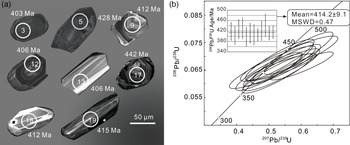
Cathodoluminescence (CL) images of zircons from JZ-52 are shown in Figure 7a. The lengths of these zircons range from 60 to 110 μm and display either weak oscillatory or banded zoning in the CL images. In the U–Pb concordia diagram (Fig. 7b), 12 spots are clustered on the concordia curve of 206Pb/238U with ages of 398–442 Ma and Th/U ratios of 0.61–1.16, defining a weighted mean age of 414 ± 9 Ma (mean square weighted deviation or MSWD = 0.47).
(a) CL images of zircons. (b) Concordia diagrams for zircon LA-ICP-MS U–Pb analyses. Numbers in the circles are the spot numbers. Numbers near the analytical spots are the U–Pb ages (Ma).

Six zircons were analysed for Lu–Hf isotopes from sample JZ-52. By using the U–Pb age for each zircon, 176Hf/177Hf ratios and ϵHf(t) values of 0.282232 to 0.282578 and −10.3 to 1.8, respectively, were determined.
5.c. Whole-rock Sr–Nd–Pb isotopes
The samples of the Yushigou diabase have (206Pb/204Pb)i ratios of 16.811–17.157, (207Pb/204Pb)i ratios of 15.331–15.422 and (208Pb/204Pb)i ratios of 37.768–37.895 (the initial isotope ratios of diabase, calculated for t = 414 Ma). They plot significantly above the North Hemisphere Reference Line (NHRL) and in or near the enriched mantle (EM-) I field in the (207Pb/204Pb)i versus (206Pb/204Pb)i and (208Pb/204Pb)i versus (206Pb/204Pb)i diagrams (Fig. 8a, b).
(a) (207Pb/204Pb)i versus (206Pb/204Pb)i diagram. (b) (208Pb/204Pb)i versus (206Pb/204Pb)I diagram. (c) ϵNd(t) versus (87Sr/86Sr)i diagram. (d) ϵNd(t) versus ϵHf(t) diagram (after Vervoort et al. Reference Vervoort, Patchett, Blichert-Toft and Albarède1999). Data sources include I-MORB (Indian mid-ocean ridge basalt), P&N-MORB (Pacific and North Atlantic mid-ocean ridge basalt), EM-I (enriched mantle type-I) and EM-II (enriched mantle type-II) as well as NHRL (Northern Hemisphere reference line) and 4.55 Ga geochron from Barry & Kent (Reference Barry and Kent1998), Zou et al. (Reference Zou, Zindler, Xu and Qi2000), Hart (Reference Hart1984) and Zindler & Hart (Reference Zindler and Hart1986). S&K (crustal lead evolution) is from Stacey & Kramers (Reference Stacey and Kramers1975). LCC (lower continental crust), MCC (middle continental crust) and UCC (upper continental crust) are from Jahn et al. (Reference Jahn, Wu, Lo and Tsai1999). Jinchuan ore-bearing mafic–ultramafic rock data are from Zhang et al. (Reference Zhang, Du, Tang, Lu, Wang and Yang2004), Duan et al. (Reference Duan, Li, Qian, Jiao, Ripley and Feng2016) and Tang et al. (Reference Tang, Bao, Dang, Ke and Zhao2018). Adakites derived from slab melting and from thickened lower crust in North Qilian are from Zhang et al. (Reference Zhang, Zhang, Zhang, Xiong, Luo, He, Pan, Zhou, Xu and Liang2017 b).

The samples of the Yushigou diabase have uniform (87Sr/86Sr)i ratios of 0.7086–0.7106 and ϵNd(t) values of −14.4 to −13.4. As shown in the ϵNd(t) versus (87Sr/86Sr)i diagram (Fig. 8c), the samples plot above the evolutionary trend defined by mid-ocean ridge basalt (MORB) and lower or middle continental crust (LCC/MCC) as well as near the EM-I field. As shown in the ϵNd(t) versus ϵHf(t) diagram (Fig. 8d), the samples plot significantly above the mantle array.
6. Discussion
6.a. Emplacement age
Zircons in mafic rocks are generally characterized by homogenous structures and/or banding and/or weak oscillatory zoning on CL images, while Th/U ratios (generally > 0.6, often > 1.0) are significantly higher than those of granitic igneous zircons (generally between 0.3 and 0.8) (Wang et al. Reference Wang, Griffin, Chen, Huang and Li2011, Reference Wang, Wang, Lei, Wang, Qing, Jia, Chang, Kang and Hou2016). Based on banded zoning or weak oscillatory zoning structures and high Th/U ratios (0.61–1.16; average, 0.88), the zircon grains from the Yushigou diabase can be ascribed to typical magmatic zircons crystallized from mafic rocks. In addition, the diabase dyke intrudes into the early Precambrian metamorphic basement, which is characterized by a large amount of Palaeoproterozoic zircon (Tung et al. Reference Tung, Yang, Liu, Zhang, Tseng and Wan2007; Zeng et al. Reference Zeng, Lai, Mao, Li, Zhang, Bayless and Yang2018). The youngest detrital zircon in the metamorphic basement is dated at 1724 ± 19 Ma (Tung et al. Reference Tung, Yang, Liu, Zhang, Tseng and Wan2007). Moreover, there are no late Silurian intermediate–acid igneous rocks in the Jinchuan mining area, and the c. 416 Ma Jilin granitic pluton occurs at c. 33 km SW of the Yushigou diabase. These c. 414 Ma zircons are therefore not likely the inherited zircons from the surrounding rock. The weighted mean 206Pb/238U age of 414 ± 9 Ma (MSWD = 0.47) is taken to represent the crystallization age of the Yushigou diabase.
6.b. Petrogenesis
Magmatic evolution, such as wall-rock assimilation or contamination, magma mixing and fractional crystallization, can exert important effects on the compositional and isotopic variations. Prior to exploring the nature of its mantle sources, the possible influence of magmatic evolution in the Yushigou diabase is evaluated below (Allen et al. Reference Allen, Kheirkhah, Neill, Emami and Mcleod2013).
6.b.1. Crustal contamination
Contamination by crustal materials will generally result in an increase in SiO2 content and a decrease in MgO content. The Yushigou diabase samples have low and uniform SiO2 contents (48.30–49.90 wt%), and there are no correlations between SiO2 and Mg no. (Fig. 9a), which is inconsistent with the results of crustal contamination. Moreover, the Yushigou diabase has higher FeOtotal (13.16–14.64 wt%), Ba (401–986 ppm) and Sr (473–626 ppm) contents than the average continental crust (FeOtotal = 6.71 wt%, Rudnick & Shan, Reference Rudnick and Shan2003; Ba = 390 ppm, Sr = 325 ppm, Rudnick & Fountain, Reference Rudnick and Fountain1995), which is an unfavourable effect of significant crustal contamination. Furthermore, the diabase has a weak variation in trace elements and no negative anomalies of Eu and Ti (Fig. 5). There are no linear correlations between Mg no. value and (Th/Nb)N ratio (Fig. 9b). The above features imply that the major and trace elements were not obviously affected by crustal contamination (Rudnick & Fountain, Reference Rudnick and Fountain1995; Ma et al. Reference Ma, Jiang, Hou, Dai, Jiang, Yang, Zhao, Pu, Zhu and Xu2014; Wang et al. Reference Wang, Wang, Lei, Wang, Qing, Jia, Chang, Kang and Hou2016). In addition, the samples of the Yushigou diabase have relatively uniform ϵNd(t) values (−14.4 to −13.4). Although (87Sr/86Sr)i and (207Pb/204Pb)i have a relatively large range of variation, the crustal contamination trend is absent from the (87Sr/86Sr)i versus Mg no. diagram and (207Pb/204Pb)i versus Mg no. diagram (Fig. 9c, d). The combined evidence therefore indicates that the Yushigou diabase encountered negligible crustal contamination during their ascent.
(a) SiO2 versus Mg no. diagram. (b) (Th/Nb)N versus Mg no. diagram. (c) (87Sr/86Sr)i versus Mg no. diagram. (c) (207Pb/204Pb)i versus Mg no. diagram.

6.b.2. Fractional crystallization
As shown in the La/Sm versus La diagram (Fig. 10a), increasing La content with constant La/Sm shows that fractional crystallization is the main factor controlling the composition of the Yushigou diabase. Compared with the primitive mantle magmas, the low MgO (4.76–5.40 wt%), Ni (56.98–68.64 ppm) and Cr (30–40 ppm) contents and Mg no. value (41–44) of the Yushigou diabase imply that fractional crystallization of mafic minerals, such as olivine and pyroxene, occurred prior to its emplacement (Frey & Prinz, Reference Frey and Prinz1978; Wang et al. Reference Wang, Wang, Lei, Wang, Qing, Jia, Chang, Kang and Hou2016). This result is consistent with the positive correlation of MgO content with FeOtotal, V and Ni contents (Fig. 6). The increasing Mg no. value and Ni content with nearly constant CaO/Al2O3 ratio and Cr content indicate that olivine is likely dominating the fractional phase (Fig. 10b, c). The increasing La content with constant (La/Yb)N ratio (Fig. 10d), along with the clear P anomalies in the primitive-mantle-normalized trace-element diagrams (Fig. 5b), implies the fractionation of apatite (Wang et al. Reference Wang, Wang, Lei, Wang, Qing, Jia, Chang, Kang and Hou2016). The plagioclase fractionation is precluded by the absence of the Eu anomaly (Fig. 5). Accordingly, the compositional characteristics of the Yushigou diabase are consistent with olivine and apatite fractionation.
(a) La/Sm versus La diagram (after Treuil & Joron, Reference Treuil and Joron1975). (b) CaO/Al2O3 versus Mg no. diagram. (c) Ni versus Cr diagram. (d) LaN/YbN versus La diagram.

6.b.3. Source characteristics
The Yushigou diabase is characterized by a relatively low ϵNd(t) value (−14.4 to −13.4), EM-I-like Pb isotopic compositions, an enrichment in alkali, LREE and LILE contents, and a depletion in HFSE and HREE contents. These results indicate that the rock was derived from an enriched mantle source and/or it underwent extensive crustal contamination during ascent within the continental crust (Li et al. Reference Li, Jiang, Zhang, Zhao and Zhao2015; Zeng et al. Reference Zeng, Lai, Mao, Li, Zhang, Bayless and Yang2018). As mentioned in Section 6.b.1, the Yushigou diabase did not undergo substantial crustal contamination during magmatic evolution. The geochemical and isotopic features of the Yushigou diabase were therefore mainly inherited from their EM-I-type magma source, rather than from a MORB- or ocean-island-basalt (OIB) -type asthenospheric mantle source.
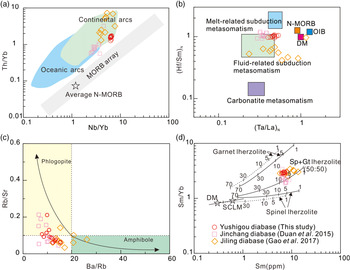
The Yushigou diabase shows a depletion in HFSE content, negative Nb–Ta anomalies and high La/Nb ratios (> 1) (Fig. 5b), a characteristic of a subduction process (Zeng et al. Reference Zeng, Lai, Mao, Li, Zhang, Bayless and Yang2018). Furthermore, compared with normalized (N-) MORB, the samples of the diabase have a higher Th/Yb ratio (Fig. 11a), indicating the addition of Th from the downgoing slab in the mantle source (Li & Chen, Reference Li and Chen2014). During subduction processes, slab-derived fluids and sediment-derived silicic or carbonatite melts can change the chemical composition of the mantle wedge (Menzies, Reference Menzies, Rogers, Tindle, Hawkesworth and Menzies1987). The samples of diabase have (Hf/Sm)N and (Ta/La)N ratios of 0.95–1.07 and 0.40–0.53, respectively, and plot in or near the fluid-related field (Fig. 11b), indicating that slab-derived fluids acted as the predominant metasomatic agent (LaFlèche et al. Reference LaFlèche, Camiré and Jenner1998). We therefore suggest that the enriched mantle source of the Yushigou diabase experienced metasomatism by fluids released from the subduction slab.
(a) Th/Yb versus Nb/Yb diagram (after Pearce & Peate, Reference Pearce and Peate1995). (b) (Hf/Sm)N versus (Ta/La)N diagram (after LaFlèche et al. Reference LaFlèche, Camiré and Jenner1998). (c) Rb/Sr versus Ba/Rb diagram. (d) Sm/Yb versus Sm diagram. Modelling results of mantle melting with different starting materials (garnet lherzolite, garnet-spinel lherzolite and spinel lherzolite) are shown, based on the non-batch melting equations of Shaw (Reference Shaw1970). The dashed and solid lines are the melting trends for depleted mantle (DM, Sm = 0.3 ppm and Sm/Yb = 0.86, McKenzie & O’Nions, Reference McKenzie and O’Nions1991) and enriched subcontinental lithospheric mantle (SCLM, Sm = 0.6 ppm and Sm/Yb = 0.96, Aldanmaz et al. Reference Aldanmaz, Pearce, Thirlwall and Mitchell2000), respectively. Partition coefficients used in the modelling are from McKenzie & O’Nions (Reference McKenzie and O’Nions1991). The numbers beside the lines are degrees of partial melting for a given mantle source. Average N-MORB (normal-MORB) value is after Sun & McDonough (Reference Sun and McDonough1989).

The high K2O contents and significant enrichments in LILEs and LREEs in the Yushigou diabase require the presence of volatile-bearing minerals such as phlogopite and amphibole in the mantle source (Foley et al. Reference Foley, Jackson, Fryer, Greenouch and Jenner1996). Melts of an amphibole-bearing source have lower Rb/Sr ratio (< 0.1) and higher Ba/Rb ratio (> 20), while melts in equilibrium with phlogopite have higher Rb/Sr ratio (> 0.1) and lower Ba/Rb ratio (< 20) (Furman & Graham, Reference Furman and Graham1999; Ma et al. Reference Ma, Jiang, Hou, Dai, Jiang, Yang, Zhao, Pu, Zhu and Xu2014). The Yushigou diabase shows a wide range of Rb/Sr (0.06–0.21) and lower Ba/Rb (7.81–15.47) ratios (Fig. 11c), implying that amphibole and phlogopite might coexist in its mantle source area.
Since Sm is significantly affected by variation in the source mineralogy (e.g. garnet or spinel), whereas Yb is compatible with garnet but not with clinopyroxene or spinel, the two incompatible elements can be used to determine the mantle source mineralogy (Li & Chen, Reference Li and Chen2014). As shown in the Sm/Yb versus Sm diagram (Fig. 11d), all samples of the Yushigou diabase plot between the partial melting curves of garnet lherzolite and spinel+garnet facies (1:1) lherzolite. Garnet and spinel therefore coexist in the mantle source area of the Yushigou diabase. This view is further reinforced by the Dy/Yb ratios (2.19–2.41) of the Yushigou diabase, which is between the spinel stability field (Dy/Yb > 2.5) and the garnet stability field (Dy/Yb < 1.5) (Ma et al. Reference Ma, Jiang, Hou, Dai, Jiang, Yang, Zhao, Pu, Zhu and Xu2014). It is generally considered that the depth of the garnet–spinel stability zone is between 75 and 85 km in the upper mantle (McKenzie & O’Nions, Reference McKenzie and O’Nions1991). The Yushigou diabase was therefore likely formed in the spinel–garnet transition zone at a depth of 75–85 km.
6.c. Implication for the lithospheric mantle beneath the Longshoushan area
In the Longshoushan area, there are two other early Palaeozoic mantle-derived magmas: the 485 Ma Jiling diabase (Gao et al. Reference Gao, Zhao, Wang and Nie2017) and the 424–421 Ma Jinchang diabase (Duan et al. Reference Duan, Li, Qian and Jiao2015). As shown in Figure 9, there are no linear correlations between Mg no. value and either SiO2 contents, (Th/Nb)N ratios, (87Sr/86Sr)i or (207Pb/204Pb)i, indicating that the parental magmas of two diabase dykes most likely experienced negligible crustal contamination during their ascent. Their geochemical composition can therefore be used to reflect the nature of the mantle source. The Jinchang diabase and the Jiling diabase have similar geochemical compositions to the Yushigou diabase, such as the enrichment in LREE and LILE, the depletion in HREE, Nb and Ta (Fig. 5), Dy/Yb ratios of 1.89–2.42, and the enriched Nd and Hf isotopic compositions (Fig. 8d). Moreover, as shown in Figure 11, the samples of the two diabase dykes fall within the same fields as those of the Yushigou diabase. Similar to the Yushigou diabase, the Jinchang diabase and the Jiling diabase were derived from partial melting of the enriched mantle source in the spinel–garnet transition zone, which was previously metasomatized by the slab-derived fluids. Nd model ages for the Jinchang diabase range between 1385 and 1620 Ma, suggesting that Sm/Nd fractionation in the lithospheric mantle from which these dyke magmas were derived began after 1620 Ma (Goodenough et al. Reference Goodenough, Upton and Ellam2002). The main tectonic event in the region, before the North Qilian orogeny, was the 1950–1800 Ma orogeny (Zeng et al. Reference Zeng, Lai, Mao, Li, Zhang, Bayless and Yang2018). The enrichment of the mantle source was therefore most likely related to the North Qilian orogeny. We therefore suggest that the spinel–garnet transition zone in the lithospheric mantle beneath the Longshoushan area experienced metasomatism by fluids released from the subduction slab during the North Qilian orogeny.
Since the Lu–Hf and Sm–Nd isotopic systems have similar geochemical characteristics, the ϵHf(t) and ϵNd(t) values are commonly correlated (Vervoort et al. Reference Vervoort, Patchett, Blichert-Toft and Albarède1999). However, the values of the Yushigou diabase and Jinchang diabase significantly deviate from the mantle array (ϵHf(t) = 1.33 × ϵNd(t) + 3.19, Vervoort et al. Reference Vervoort, Patchett, Blichert-Toft and Albarède1999) (Fig. 8d). Meanwhile, the two diabase dykes have different Nd–Hf decoupling types, and the ϵNd(t) values of the Jinchang diabase are obviously higher than those of the Yushigou diabase (Fig. 8d).
The Nd–Hf decoupling of magmatic rocks is usually related to the garnet effect and the zircon effect (Patchett et al. Reference Patchett, Kouvo, Hedge and Tatsumoto1982, Reference Patchett, Vervoort, Soderlund and Salters2004; Vervoort & Blichert-Toft, Reference Vervoort and Blichert-Toft1999; Vervoort et al. Reference Vervoort, Patchett, Albarede, Blicherttoft, Rudnick and Downes2000; Wang et al. Reference Wang, Huang, Ma, Zhong and Yang2015). The garnet effect involves the presence of garnet residue during partial melting of mantle. Since the partition coefficients of Lu, Hf, Sm and Nd between garnet and melt are Lu > Sm > Nd > Hf, garnet residue surviving from a melting event will mean that the decrease of the Lu/Hf ratio in the magma is greater than that of the Sm/Nd ratio. This means that the magma will have a slower Hf evolution than that of Nd and, with time, will diverge from the mantle array with increasingly negative ϵHf(t) values (Vervoort et al. Reference Vervoort, Patchett, Blichert-Toft and Albarède1999). On the other hand, since Hf4+ and Zr4+ have similar ionic radii, Hf can exist in the zircon in form of isomorphism. Zircon therefore has a high Hf value and extremely low Lu/Hf ratio (much lower than most other rock-forming minerals) (Vervoort et al. Reference Vervoort, Plank and Prytulak2011). Over time this results in lower ϵHf(t) value of zircon than that of other minerals. The ϵHf(t) value of zircon-rich sediments/rocks is therefore relatively low and that of zircon-free sediments/rocks is relatively high (Patchett et al. Reference Patchett, White, Feldmann, Kielinczuk and Hofmann1984; Carpentier et al. Reference Carpentier, Chauvel, Maury and Mattielli2009), while the Sm–Nd isotopic system is not affected by zircon since Sm/Nd ratios of zircons and bulk rock are similar. This striking feature is referred to as the ‘zircon free’. In addition, Nd is more soluble than Hf in both aqueous fluids and siliceous melts, especially in the aqueous fluids (Pearce et al. Reference Pearce, Kempton, Nowell and Noble1999; Polat & Münker, Reference Polat and Münker2004). The lithospheric mantle metasomatized by subduction-derived fluids and/or melts would therefore be expected to result in deviations from the mantle array on the ϵHf(t)–ϵNd(t) isotope projection.
The zircon ϵHf(t) value of the Jinchang diabase deviates negatively from its whole-rock ϵNd(t) value with reference to the mantle array (Fig. 8d). Due to the low zircon content in mantle source, the Nd–Hf isotopic decoupling of the Jinchang diabase should not be related to the existence of a large amount of ancient zircon in the source area. As mentioned before, the Jinchang diabase is derived from a garnet–spinel transition region. The Nd–Hf decoupling of the Jinchang diabase is therefore most likely controlled by the residual garnet in the source area. Meanwhile, the Jinchang diabase, which has not experienced significant crustal contamination but has a variable ϵHf(t) value, is most likely related to the inhomogeneity of garnet residue surviving in the source area from the melting event. The Yushigou diabase has significantly lower ϵNd(t) value than that of the Jinchang diabase, indicating a higher metasomatism degree of subducted materials in its mantle source. This is consistent with the feature in the (87Sr/86Sr)i–ϵNd(t) diagram showing that the samples of the Yushigou diabase drop further to the MORB area than that of the Jinchang diabase (Fig. 8c). The Yushigou diabase has no negative Eu anomalies, which are different from the characteristics of oceanic gabbros (Sobolev et al. Reference Sobolev, Hofmann and Nikogosian2000). Moreover, as shown in Figure 8c, the ϵNd(t) values (−14.4 to −13.4) of the Yushigou diabase are much lower than those of the Qilian adakites, which were derived from partial melting of the North Qilian oceanic crust. Ancient continental materials from the subduction slab therefore seem to be a better candidate for the source of recycled materials in the mantle source. The ϵHf(t) values of the Yushigou diabase are obviously higher than its ϵNd(t) value, indicating that the recycled materials should be derived from zircon-free sediments or rocks such as mud, shale and pelagic sediment. This is consistent with the fact that the Nd/Zr ratios of Yushigou diabase are significantly higher than those of the primitive mantle (NdN/ZrN = 1.22–1.47). Similar to the Jinchang diabase, the Yushigou diabase is likely to be affected by the garnet residue surviving in the source area, causing the variable ϵHf(t) value. However, the recycled low zircon-free sediments or rocks in the source area is the main factor that determines the Nd–Hf decoupling type of the Yushigou diabase.
Two possible mechanisms can be considered for the different Nd–Hf decoupling types of the two diabase dykes. One is that the lithospheric mantle in the Longshoushan area is not uniformly metasomatized by the subducted slab. Another possibility is that the lithospheric mantle in the Longshoushan area was strongly metasomatized during the period from the formation of the Jinchang diabase (424 Ma) to the formation of the Yushigou diabase (414 Ma). As mentioned above, the Yushigou diabase and the Jinchang diabase are exposed in the same area, and have the same nature of mantle source, indicating that the two are likely derived from almost the same lithospheric mantle region. Because the incompatible elements (e.g. Th and U) tend to be enriched in the silicate melt during partial melting process, magmatic activity will lead to the depletion of Th and U in the source area. The younger Yushigou diabase therefore has significantly lower Th and U contents than those of the older Jinchang diabase, which also implies that these two diabases were likely generated from the same magmatic source. Hence, the second mechanism is most likely the reason for the different Nd–Hf decoupling types between the two diabase dykes, although more work is needed to verify this conclusion.
6.d. Tectonic implication
LA-ICP-MS zircon U–Pb data constrain the emplacement age of the Yushigou diabase and the Jinchang diabase at 414 Ma and 424–421 Ma, respectively, which obviously occur later than the closure of the North Qilian Ocean during Late Ordovician time (Song et al. Reference Song, Niu, Su and Xia2013; Yu et al. Reference Yu, Zhang, Qin, Sun, Zhao, Cong and Li2015; Xia et al. Reference Xia, Li, Yu and Wang2016; Zeng et al. Reference Zeng, Lai, Mao, Li, Ju and Tao2016; Sun et al. Reference Sun, Qian and Zhang2017; Zhang et al. Reference Zhang, Zhang, Zhang, Xiong, Luo, He, Pan, Zhou, Xu and Liang2017 b). In addition, the samples of the Yushigou diabase have high Th/Nb (0.52–0.66) and Nb/Zr (0.057–0.061) ratios, and the samples of the Jinchang diabase have high Th/Nb (0.15–0.71) and Nb/Zr (0.035–0.046, average value = 0.041) ratios, which are similar to intraplate basalt ratios (Th/Nb > 0.11 and Nb/Zr > 0.04; Sun et al. Reference Sun, Zhang and Zhao2007). Moreover, in the Zr/Y versus Zr diagram and 2Nb – (Zr/4) – Y diagram, the samples of the Yushigou diabase and the Jinchang diabase both fall in the within-plate basalt field (Fig. 12). In addition, Zeng et al. (Reference Zeng, Lai, Mao, Li, Ju and Tao2016) and Zhang et al. (Reference Zhang, Zhang, Zhang, Xiong, Luo, He, Pan, Zhou, Xu and Liang2017 b) reported that the Silurian A-type granites in the Longshoushan area were formed in the intraplate-extensional post-collisional setting. The Yushigou and Jinchang diabase in the Longshoushan area was therefore most likely formed in the intraplate environment after the closure of the North Qilian Ocean.
(a) Zr/Y versus Zr diagram (after Pearce, Reference Pearce1982). (b) 2Nb – (Zr/4) – Y diagram (after Meschede, Reference Meschede1986). WPB – within-plate basalt; MORB – mid-ocean ridge basalt; IAB – island-arc basalt; WPA – within-plate alkali basalts; WPT – within-plate tholeiites; VAB – volcanic-arc basalts.

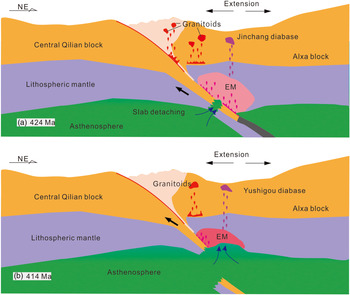
There are two different views about the mechanism for the post-collisional magmatism in the NQOB: the slab break-off (Song et al. Reference Song, Niu, Zhang, Wei, Liou and Su2009; Xiong et al. Reference Xiong, Zhang and Zhang2012; Xia et al. Reference Xia, Li, Yu and Wang2016; Huang et al. Reference Huang, Zheng, Li, Dong, Fu, Xu and Gao2018); and lithospheric delamination (Wu et al. Reference Wu, Xu, Gao, Li, Lei, Gao, Frost and Wooden2010; Yu et al. Reference Yu, Zhang, Qin, Sun, Zhao, Cong and Li2015; Zhang et al. Reference Zhang, Zhang, Zhang, Xiong, Luo, He, Pan, Zhou, Xu and Liang2017 b). As mentioned above (Section 6.c), the Yushigou diabase and the Jinchang diabase are derived from the enriched lithospheric mantle. This is different from the mafic magma formed under the tectonic background of lithospheric delamination, which has generally depleted radiogenic isotopic signatures (Wang et al. Reference Wang, Song, Niu and Su2014; Song et al. Reference Song, Wang, Wang and Niu2015). In addition, the Ar–Ar ages of 423–411 Ma and zircon retrograde metamorphic ages of 424–404 Ma from North Qilian high-pressure–low-temperature (HP-LT) metamorphic rocks are considered to represent the age of greenschist facies overprinting during the exhumation (Zhang et al. Reference Zhang, Meng and Wan2007; Song et al. Reference Song, Niu, Zhang, Wei, Liou and Su2009, Reference Song, Niu, Su and Xia2013; Li et al. Reference Li, Zhang and Han2010; Xia et al. Reference Xia, Li, Yu and Wang2016). During continental exhumation, the mantle peridotite of the overlying lithospheric mantle would be intensively metasomatized by hydrous melts or supercritical fluids released from the slab, as a result of the significant differences in compositions between the deep subducted continental crust and the overlying mantle (Xiao et al. Reference Xiao, Sun, Gu, Huang, Li and Liu2015; Zheng et al. Reference Zheng, Chen, Dai and Zhao2015). This is consistent with the fact that the mantle source of the Yushigou diabase experienced strongly metasomatism by fluids released from the subduction slab, as mentioned above (Section 6.c). We therefore propose to use the slab break-off model to explain the post-collisional magmatism in the Longshoushan area during the middle–late Silurian period (Fig. 13).
Tectonic evolution of the NQOB in two phases during the middle–late Silurian period.

During the exhumation of the subducted continental crust, the zircon-free sediments or rocks on the continental crust underwent strong dehydration and melting, which metasomatized the overlying lithospheric mantle beneath the Longshoushan area. This resulted in a strong enrichment of Nd isotopes in the lithospheric mantle of the Longshoushan area. Subsequently, hot asthenospheric mantle upwelling occurred near the break-off point, which provides the thermal flux to melt the overlying lithospheric mantle and the lower continental crust. A series of post-collisional acid and mafic magmatic rocks therefore formed in the Silurian period.
7. Conclusion
-
(1) LA-ICP-MS zircon U–Pb dating indicates that the Yushigou diabase in the Longshoushan area formed at 414 Ma.
-
(2) Geochemical and isotopic tracing suggests that the Yushigou diabase was derived from partial melting of an EM-I-type subcontinental lithospheric mantle, which was metasomatized by slab-derived fluids released from the subducted slab. During emplacement, the parental magma of the Yushigou diabase experienced fractionation of olivine and apatite.
-
(3) The different types of Nd–Hf isotope decoupling between the Yushigou diabase and the Jinchang diabase can be explained by the fact that the lithospheric mantle beneath the Longshoushan area experienced strong metasomatism by the zircon-free sediments or rocks on the exhumation of the continental crust during the middle–late Silurian period.
-
(4) The post-collisional magmatism of the NQOB in the Silurian period is associated with post-collision slab break-off.
Acknowledgements
We thank the editor Kathryn Goodenough and anonymous reviewers for their constructive suggestions. This research was funded by the National Nature Science Foundation of China (grant nos 41772349 and 41902075); the Project of Innovation-driven Plan in Central South University (grant no. 2015CX008); the Jiangxi Provincial Department of Education (grant no. GJJ170463); research grants from the East China University of Technology (grant no. DHBK2017103); and the Open Research Fund Program of the Key Laboratory of Metallogenic Prediction of Nonferrous Metals and Geological Environment Monitoring (Central South University), Ministry of Education (grant no. 2018YSJS05).