INTRODUCTION
Since the seminal paper by Park (Reference Park1948), demonstrating reversed relative frequencies of 2 sympatric species of flour beetles (Tribolium) in the presence of their common protozoan parasite, parasitic apparent competition (hosts do not compete) and parasite-mediated competition (hosts compete for resources) have been recognized across ecosystems as key processes determining the relative abundance of coexisting host species (e.g. Holt and Lawton, Reference Holt and Lawton1994; Bonsall and Hassell, Reference Bonsall and Hassell1997; Hudson and Greenman, Reference Hudson and Greenman1998; Tompkins et al. Reference Tompkins, White and Boots2003; Hatcher et al. Reference Hatcher, Dick and Dunn2006; Fenton and Brockhurst, Reference Fenton and Brockhurst2008). Generally, where a specialist parasite or a shared generalist parasite with asymmetrical impact on its host species affects the numerically dominant or competitive superior host, it may serve to maintain host coexistence. On the other hand, if a rare or competitive inferior host is preferentially attacked, the likelihood of coexistence is decreased and local extinction of the inferior host may be the ultimate outcome. Regardless of the scenario, the processes of parasitic apparent and parasite-mediated competition provide unequivocal evidence for the influence of parasitism on the organization of natural communities.
Because a wide range of macroparasites utilize ectothermic hosts in their life cycle, aside from also having free-living larval stages, their development and transmission rates are strongly affected by environmental factors, particularly temperature (e.g. Mouritsen and Jensen, Reference Mouritsen and Jensen1997; Marcogliese, Reference Marcogliese2001; Mouritsen and Poulin, Reference Mouritsen and Poulin2002; Pietrock and Marcogliese, Reference Pietrock and Marcogliese2003; Poulin, Reference Poulin2006; Thieltges and Rick, Reference Thieltges and Rick2006; Studer et al. Reference Studer, Thieltges and Poulin2010). The outcome of parasitic apparent or parasite-mediated competition, – and the resulting effects on community structure and function, – may therefore be influenced by climate fluctuations, and hence, show great temporal and spatial variation according to known and expected climate variability, including global warming. However, to our knowledge, the importance of environmental factors such as temperature for the outcome of parasitic apparent and parasite-mediated competition in situ has not hitherto been addressed.
The coastal amphipod Corophium volutator (Pallas) commonly serves as second intermediate host for a range of microphallid trematodes (Microphallidae) that use mud snails of the genus Hydrobia as first intermediate hosts and shorebirds as definitive hosts in European waters. The host–parasite system is directly affected by climatic conditions because the transmission rate of infective trematode stages (cercariae) from mud snails to amphipods, and hence the rate of intensity-dependent parasite-induced amphipod mortality, is accelerated by increasing temperature (Mouritsen and Jensen, Reference Mouritsen and Jensen1997; Meissner and Bick, Reference Meissner and Bick1999a, Reference Meissner and Bickb). Indeed, model simulations of the system predict that under certain conditions a temperature increase of a few degrees is sufficient to cause dramatic parasite-induced declines in the population of C. volutator (Mouritsen et al. Reference Mouritsen, Tompkins and Poulin2005). A field survey on an intertidal mudflat in the Danish Wadden Sea provides an illustrative in situ demonstration of the sensitivity of this host–parasite association to climatic conditions (Jensen and Mouritsen, Reference Jensen and Mouritsen1992). In spring 1990, a dense population of C. volutator vanished completely due to microphallid trematodes, all other factors being ruled out. The incident coincided with unseasonably hot weather, increasing the transmission of cercariae from snails to amphipods. The massive boost of cercariae eventually caused an infection intensity-dependent die-off in the amphipod population during only 5 weeks.
Although entirely dominating the soft-bottom crustacean community in terms of abundance, C. volutator occasionally co-occurs with the much less abundant congeneric amphipod Corophium arenarium (Crawford). Corophium arenarium is competitively inferior to C. volutator (Jensen and Kristensen, Reference Jensen and Kristensen1990), but also less susceptible to microphallid infections than its superior congener (Jensen et al. Reference Jensen, Jensen and Mouritsen1998; see Discussion). We therefore hypothesize that the coexistence of these two species of amphipods is at least partially maintained by parasitism and, in turn, that their relative frequencies are mediated indirectly by climatic conditions affecting the level of trematode parasitism.
Here, we provide novel evidence that the parasite-induced collapse of the competitively superior C. volutator population in the Danish Wadden Sea 1990, resulted in competitive release of the inferior C. arenarium population. Specifically, we address the possible links between (1) highly positive indices of the North Atlantic Oscillation (NAO), (2) high ambient temperatures, (3) high densities of definitive shorebird hosts, and (4) high densities of infected first intermediate snail hosts during spring 1990, which combined to provoke a massive transmission of trematode larvae from snails to amphipods. Hence, our study provides a field example of parasite-mediated competitive release in a metazoan host species influenced by climate forcing.
MATERIALS AND METHODS
The population dynamics of C. volutator and C. arenarium were monitored at the upper intertidal zone (400–600 m from mean high water level) on a 1500 m wide mudflat in the southern part of the Danish Wadden Sea (54°56′ N, 8°39′ E) from September 1989 through June 1992. In the beginning, the study area was characterized by a well-developed Corophium-bed, composed of a mosaic-like patchiness of alternating tidal pools and emerged plateaux during low tide (see Mouritsen et al. Reference Mouritsen, Mouritsen and Jensen1998). The amphipods occurred mainly on the plateaux. Ten benthic core samples (each 50 cm2, 25 cm deep) were obtained on each sampling occasion (n=16) and sieved on location through a 500 μm mesh. The samples were collected on 10 haphazardly and previously undisturbed plateaux within an approximately 1 ha large area during each sampling event (i.e. 1 core sample per plateau). Retained macrozoobenthic organisms were preserved in neutralized formaldehyde (4%) for later identification and counting. Specimens of Corophium were separated from the remaining macrobenthos and identified to species according to Lincoln (Reference Lincoln1979) under a stereomicroscope. Mud snails, Hydrobia ulvae, were dissected and examined for the presence or absence of primary infections by larval trematodes in the gonad-digestive gland complex in order to determine the infection rate of microphallid trematodes. Parasites were identified to species level according to Deblock (Reference Deblock1980).
As an index of prevailing climatic conditions, we used the annual winter (December–March) index of the NAO based on the difference of normalized sea level pressure between Lisbon, Portugal, and Stykkisholmur, Iceland, from 1960 to 1992 (data available at http://www.cgd.ucar.edu/cas/jhurrell/indices.html). The NAO is the main driving force determining the inter-annual variation of winter temperatures in the northern hemisphere (Hurrell, Reference Hurrell1995). A highly positive index is associated with warm and wet winters/early springs in northern Europe whereas negative values give rise to cold and dry winter/early spring conditions. Additionally, the mean air temperature for the winter (December–March) and spring (March–May) was calculated and used as a local climate indicator. These season-based mean temperatures were derived from data on daily mean temperature in Denmark acquired from the Danish Meteorological Institute, Copenhagen (see Cappelen and Jørgensen, Reference Cappelen and Jørgensen2009).
As a proxy for the abundance of definitive shorebird hosts, we used yearly maximum number of dunlins, Calidris alpina, recorded at 2 major high water roosts immediately adjacent to the study area (Laursen et al. Reference Laursen, Hounisen, Rasmussen, Frikke, Pihl, Kahlert, Bak and Amstrup2009). Dunlin is the dominating shorebird species serving as host to microphallid trematodes in the Danish Wadden Sea, and is known to feed intensively on Corophium-beds during low tide (Deblock, Reference Deblock1980; Laursen and Frikke, Reference Laursen, Frikke, Evans, Goss-Custard and Hale1984; Mouritsen, Reference Mouritsen1994; Laursen et al. Reference Laursen, Hounisen, Rasmussen, Frikke, Pihl, Kahlert, Bak and Amstrup2009). These bird data were used to examine the relationship between the abundance of dunlins and the NAO as well as a proxy for the transmission of trematode eggs from birds to the population of the first intermediate snail hosts, H. ulvae.
Statistical analyses were performed in SPSS. We used non-parametric Spearman's correlation analysis to examine the temporal non-linear relationship between the abundance of C. volutator and C. arenarium. The positive relationship between the NAO index and the annual maximum density of C. alpina was evaluated using Pearson's correlation.
RESULTS
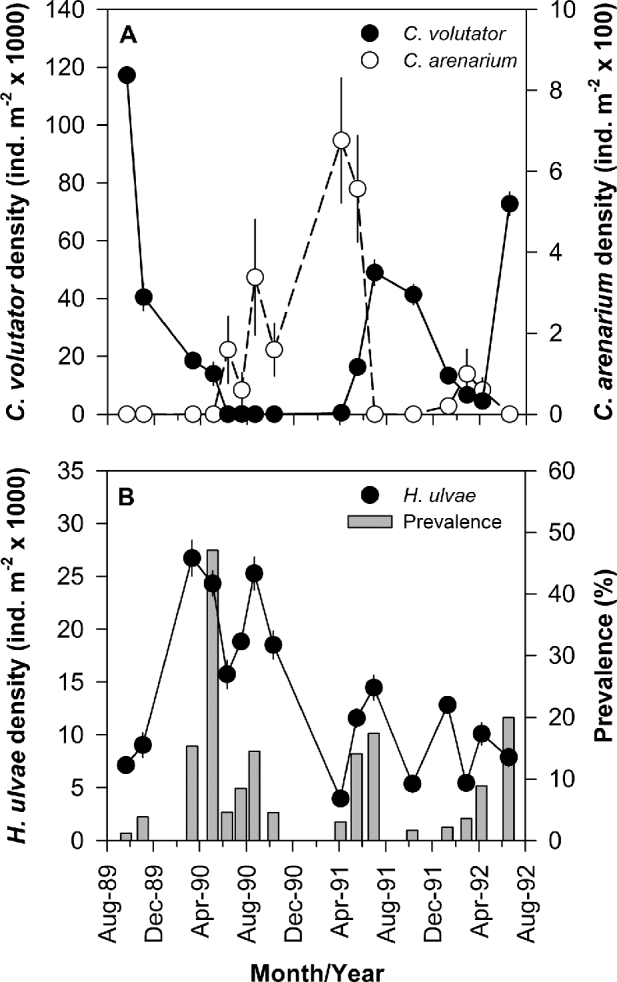
During the investigated time-period, the population dynamics of C. volutator showed great seasonal as well as annual fluctuations (Fig. 1A). Disregarding the period of spring 1990 to spring 1991, the population dynamics is consistent with a general seasonal pattern of peaking densities in early autumn following from bursts of summer reproduction and subsequent post-reproductive and winter mortality (Watkin, Reference Watkin1941; Möller and Rosenberg, Reference Möller and Rosenberg1982). Hence, minimum population densities are seen during early spring. However, the year 1990 clearly deviates from the general pattern: between May and June, the population of C. volutator vanished completely from the study site and did not return until spring the following year (Fig. 1A). This collapse of the amphipod population has been attributed to microphallid infections (Jensen and Mouritsen, Reference Jensen and Mouritsen1992). During the next 2 active seasons, C. volutator gradually regained its former population density seen prior to the die-off (>100 000 ind. m−2, autumn 1989).
The phenology of amphipods, mud snails and trematode parasites at the Danish Wadden Sea study site during 1989–1992. (A) Density (mean numbers m−2±s.e.) of Corophium volutator (filled circle, continuous line) and Corophium arenarium (open circle, broken line). (B) Density (mean numbers m−2±s.e.) of Hydrobia ulvae (filled circle, continuous line) and the prevalence of infection (%) by microphallid trematodes (Microphallus spp. and Maritrema spp.) in the snail population (bars). Data on the density of C. volutator and H. ulvae as well as the prevalence of infection in the snail population for the period March–June 1990, have been published previously (see Jensen and Mouritsen, Reference Jensen and Mouritsen1992).

The inferior competitor, C. arenarium, showed a population dynamics entirely complementary to that of its superior congener. After being initially absent, C. arenarium instantly invaded the study area and increased in density following the disappearance of C. volutator in spring 1990 (Fig. 1A). However, the abundance of C. arenarium rapidly decreased again during spring 1991 as C. volutator increased in abundance. Hence, the two amphipod species differed considerably in their abundance pattern in that high densities of C. volutator were generally associated with low abundance of C. arenarium. This temporal negative relationship between the abundance of the two competing amphipod species is highly significant (Spearman's rho, r s=−0·78, P<0·001, n=16). It has to be emphasized though, that all data points in this analysis cannot be considered entirely independent.
Throughout the study, the density of the sympatric mud snail H. ulvae ranged between ca. 4000 and 27 000 ind. m−2 (mean±s.e.: 13 580±1848) without any consistent seasonal pattern (Fig. 1B). However, the snail population reached its highest density in early spring 1990. Species from 4 trematode families were found to infect the snails: Himasthla spp. (Echinostomatidae); Cryptocotyle concava (Heterophyidae); Levinseniella carmarguensis, Maritrema spp. and Microphallus spp. (Microphallidae); Notocotylidae spp. (Notocotylidae). The microphallid species of the genera Microphallus and Maritrema were the most common (68·0% of all infections during March through June 1990). Their combined infection prevalence within the snail population displayed clear seasonal fluctuations varying from a few to 47% and generally peaking during late summer (Fig. 1B) as previously seen in this and other temperate snail–trematode associations (Pohley, Reference Pohley1976; Mouritsen et al. Reference Mouritsen, Jensen and Jensen1997; Field and Irwin, Reference Field and Irwin1999; Kube et al. Reference Kube, Kube and Bick2002). However, in March 1990 the Microphallus/Maritrema prevalence was remarkably high for the season (15%) and preceded the extreme high of 47% recorded in May (corresponding to a density of 11435 infected snails m−2) at which time the C. volutator population collapsed (Fig. 1).
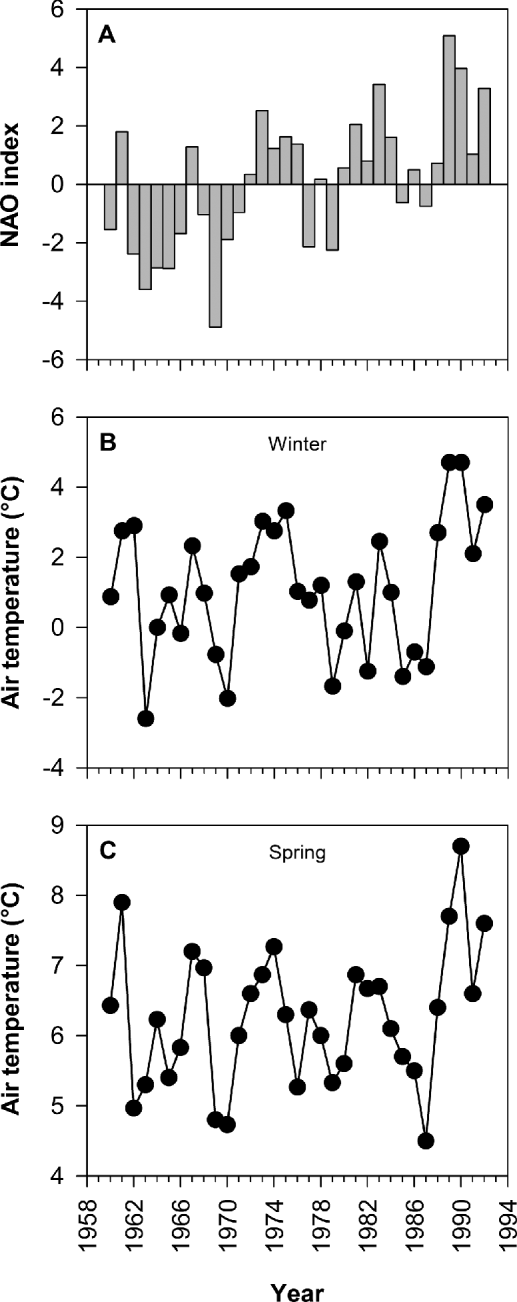
The winter NAO index from 1960 through 1992 revealed an increasing frequency of positive anomalies with particularly high values in 1988/89 and 1989/90 (Fig. 2A). The high NAO indices during winter 88/89 and 89/90 were associated with historically mild winter temperatures (Fig. 2B), and for the year 1990, also exceptionally high spring temperatures (Fig. 2C). In spring 1990, the weekly mean ambient temperature at the study site exceeded 20°C for several consecutive weeks in addition to reaching unusually high weekly means above 25°C in May just prior the C. volutator die-off (see Jensen and Mouritsen, Reference Jensen and Mouritsen1992).
Environmental variables during 1960–1992. (A) The winter (December–March) NAO index based on the difference of normalized sea level pressure between Lisbon, Portugal and Stykkisholmur, Iceland. Mean air temperature (°C) for (B) the winter (December–March) and (C) spring (March–May) based on daily mean temperature for Denmark as a whole. Temperature data have been previously published in a different form for the period March–June 1990 (see Jensen and Mouritsen, Reference Jensen and Mouritsen1992).

As a proxy for the abundance of definitive hosts, the annual maximum count of C. alpina ranged at the study site between ca. 18 000 and 84 000 birds during 1988 to 1995 with highest numbers recorded in 1989 and 1990. Moreover, the abundance of dunlins was positively related to the NAO winter index (Pearson's correlation, r 6=0·748, P=0·016) suggesting that mild winters favour their occurrence in the Wadden Sea.
DISCUSSION
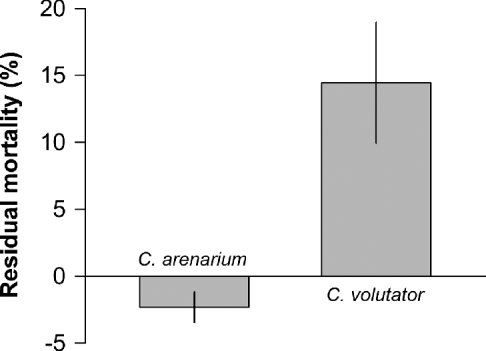
Our results show clear temporal complementary distribution of C. volutator and C. arenarium and highlight the competitive relationship between these two coastal amphipods: the latter inferior species managing to expand its distributional range when the population of C. volutator declines. Moreover, the sequence of competitive release of C. arenarium in the present study was evidently associated with a massive transmission of microphallid trematode larvae that caused a rapid infection intensity-dependent die-off in the C. volutator population (Jensen and Mouritsen, Reference Jensen and Mouritsen1992). Because C. volutator is more sensitive to microphallid infections than C. arenarium (Jensen et al. Reference Jensen, Jensen and Mouritsen1998; Fig. 3), the latter competitively inferior species may have survived in low densities in marginal microhabitats during the parasite-induced collapse of the C. volutator population, and subsequently invaded the areas previously occupied by the competitively superior C. volutator. The mechanisms by which C. volutator affects C. arenarium negatively likely involve both direct and indirect processes: (1) directly through interference competition (see Jensen and Kristensen, Reference Jensen and Kristensen1990), and (2) indirectly through C. volutator's tendency to incorporate finer sediment particles into the substrate, which appears unfavourable to C. arenarium (see Flach, Reference Flach1993; Mouritsen et al. Reference Mouritsen, Mouritsen and Jensen1998).
The relative impact of the microphallid trematode Microphallus claviformis on the residual mortality (mean%±s.e., n=6) of Corophium arenarium and Corophium volutator during an 11-day laboratory experiment. Mean residual mortality values for both amphipod species were obtained by subtracting the mean of 6 control values (no microphallids present) from each of 6 treatment values (microphallids present). The mortality rate of C. volutator is significantly higher than the control (i.e., different from zero; LSD test, P<0·05), whereas the mortality of C. arenarium does not deviate significantly from the control (data re-analysed after Jensen et al. Reference Jensen, Jensen and Mouritsen1998).

Such dramatic parasite-mediated competitive release in the shape of an epizootic event in the superior competitor population is probably rare and associated with a combination of specific circumstances that together substantially elevate the rate of parasite transmission to the amphipods: (1) high density of infected first intermediate snail hosts and (2) high ambient temperatures greatly promoting the release of trematode larvae from the infected mud snails (Mouritsen and Jensen, Reference Mouritsen and Jensen1997; Meissner and Bick, Reference Meissner and Bick1999a; Mouritsen, Reference Mouritsen2002). The former is accomplished by high abundance of snails and/or high prevalence of infection in the snail population, with snail infection prevalence in turn governed by high abundance of definitive bird hosts as the only source of parasite eggs. As a further requirement, these circumstances have to coincide in spring prior to the amphipod's burst of summer reproduction, as a high density of second intermediate hosts will effectively dilute the number of parasites reaching individual hosts (e.g. Mouritsen et al. Reference Mouritsen, McKechnie, Meenken, Toynbee and Poulin2003; Thieltges and Reise, Reference Thieltges and Reise2007). These conditions were all met in 1990 and, interestingly, for the most parts correlated with the NAO index. Firstly, dunlin abundance that likely affects infection prevalence and hence the density of infected snails is positively related to the NAO index. Secondly, NAO affects ambient temperatures in the area and brings mild weather conditions in its positive phase (Stenseth et al. Reference Stenseth, Ottersen, Hurrell, Mysterud, Lima, Chan, Yoccoz and Ådlandsvik2003), which in turn positively affects parasite transmission. Alternatively, the relatively high density of infected snails in spring 1990 might in itself, and unrelated to the simultaneous heat wave, have lead to the amphipod die-off. This is, however, not a plausible scenario because the transmission of the involved microphallids is largely restricted to temperatures ⩾20°C (e.g. Mouritsen and Jensen, Reference Mouritsen and Jensen1997; Mouritsen, Reference Mouritsen2002). Hence, while high host densities surely represent a potential threat to the amphipod population, high temperatures are needed to release this threat.
That the C. volutator population did not also collapse in 1989 while experiencing a remarkably high 1988/1989 NAO winter index and associated high winter temperatures, emphasizes that benign climatic conditions do not necessitate the development of an epizootic event, but rather increase its probability. Unfortunately, data necessary for a proper evaluation of critical circumstances emphasized above are unavailable for spring 1989. However, the August-December data suggest a considerably lower mud snail density in 1989 than in 1990, which affects the density of infected snails and hence parasite transmission rates negatively. The somewhat lower spring temperatures in 1989 than in 1990 have a similar negative effect on transmission, and together these factors may have contributed to the persistence of the C. volutator population throughout 1989.
Although epizootics in the C. volutator population necessary for C. arenarium to succeed invasion, may have been rare in previous years, the ongoing global warming (IPCC, 2007) can be envisaged to increase the frequency of such epizootics. Indeed, model simulations of the present host–parasite system developed by Mouritsen et al. (Reference Mouritsen, Tompkins and Poulin2005) emphasize that following an increase in ambient temperature of less than 4°C, the populations of C. volutator are likely to crash repeatedly due to microphallid-induced mortality. It seems, therefore, that the combined effects of parasitism and moderate increases in ambient temperatures can alter the community structure of coastal amphipods. Clearly, however, a multitude of factors other than parasitism may also contribute to determining the relative frequency of the two amphipod species, both now and under a future climate scenario. Regarding the 1990 decline of C. volutator, however, obvious alternative processes such as predation from birds and benthic invertebrates, oxygen depletion, prolonged desiccation, sea-bed erosion and detrimental temperatures can all be excluded (see Jensen and Mouritsen, Reference Jensen and Mouritsen1992).
Aside from providing a field example of parasite-mediated competition with consequences for – in this case – intertidal community structure, the present study emphasizes that parasite-mediated competition, and for that matter also apparent competition, indeed can be sensitive to environmental forcing. Hence, the synergy between climate fluctuations (global warming as well as underlying climate oscillations) and parasitism may result in changes to natural communities that can be difficult to interpret if the two factors are considered in isolation.
Although there exists little comparable evidence, other crustacean–trematode associations show similar temperature sensitivity (Bates et al. Reference Bates, Poulin and Lamare2010; Koehler and Poulin Reference Koehler and Poulin2010; Studer et al. Reference Studer, Thieltges and Poulin2010). Hence, the phenomenon may be more common in such systems than hitherto realized. Moreover, a couple of studies suggest the phenomenon to be of general importance across ecosystems: in laboratory experiments Brockhurst et al. (Reference Brockhurst, Fenton, Roulston and Rainey2006) showed that the relative dominance of 2 species of bacteria in the presence of a phage was affected by temperature, whereas Fleury et al. (Reference Fleury, Ris, Allemand, Fouillet, Carton and Boulétreau2004) showed a temperature-dependent impact of a parasitoid on the relative frequency of 2 Drosophila species. Similarly, Hoenicke (Reference Hoenicke1984) found that a fungus altered the structure of a zooplankton community by influencing the relative abundance of the dominant species in a temperature-dependent manner.
ACKNOWLEDGEMENTS
We thank K. Laursen, National Environmental Research Institute, Aarhus University, for access to bird data and A. B. Neuheimer for constructive comments on the manuscript. This study was supported by grants from WWF/Novozymes and The Carlsberg Foundation (to K.N.M.).