American and British politics scholars increasingly emphasize the dramatic changes in the tenor of elite policy debates in their countries. In the United States these changes entail growing elite-level polarization, as the policy gap between Republicans and Democrats in Congress has widened sharply over the past three decades on both social welfare issues and on cultural issues.Footnote 1 In Britain, by contrast, the Labour and Conservative party elites have depolarized dramatically on economic and social welfare policy during the post-Thatcher era, as Tony Blair's ‘New Labour’ party moderated its stances on taxes, income redistribution and nationalization of industry, while the Conservatives – at least prior to the economic downturn in 2008 – have increased their support for public services.Footnote 2
The phenomenon of US elites’ policy polarization, and of British elites’ depolarization, has inspired extensive research on whether the mass publics in these countries have polarized (in the United States) and depolarized (in Britain) in response to party elites, and, if so, whether specific subgroups have reacted disproportionately to these elite-level policy shifts.Footnote 3 These questions are important because they bear on how strongly party elites influence public opinion, whether the public holds elites accountable for their policies, and whether, more generally, the public approves of policy moderation by political elites.Footnote 4 The studies cited above report consistent evidence that, taken as a whole, the mass publics in both countries have followed the leads of political elites, i.e., that the American mass public has polarized over the past three decades while the British public has depolarized during the post-Thatcher era.Footnote 5 By contrast, these studies reach conflicting conclusions with respect to subconstituency-based polarization: namely, studies on the United States conclude that subgroups of affluent, educated and politically engaged citizens have polarized more than other subgroups in the electorate, while studies on Britain conclude that mass depolarization extends roughly equally across different subgroups.Footnote 6
Although the research summarized above illuminates mass–elite policy linkages in Britain and the United States, it is unclear whether we should expect these patterns to extend to other Western democracies. In particular, both Britain and the United States employ plurality voting systems and feature two dominant, mainstream, political parties,Footnote 7 while most Western democracies employ some form of proportional representation and feature both mainstream parties and smaller ‘niche’ parties that present more radical policies and/or that emphasize alternative policy dimensions.Footnote 8 In addition, the United States and Britain arguably differ from other Western democracies in terms of the number and types of social cleavages and the degree of governmental stability.Footnote 9 Prompted by these considerations, we analyse mass responses to elite policy shifts in a political context that differs sharply from those of Britain and the United States: namely, the Netherlands during the 1980s and the 1990s. Unlike the United States and Britain, the Netherlands employs a highly proportional system to elect its members of parliament and also features multiple parties including the large, mainstream Christian Democrats (CDA) and Labour (PvdA), along with several smaller but influential parties.Footnote 10 Furthermore, between the mid-1980s and the late 1990s the CDA and PvdA party elites depolarized dramatically on social welfare policy along with support for nuclear power – developments that, as we discuss below, plausibly created an opening for the subsequent polarization of the party system on immigration and cultural issues, debates over which have dominated Dutch politics since 2000.Footnote 11 We asked whether during this 1986–98 time period the Dutch public depolarized along with the elites from the two largest parties; whether the different Dutch subconstituencies, defined in terms of education, income, political knowledge and interest, depolarized to roughly the same degree; and whether our findings on the Netherlands illuminate mass–elite policy linkages in Britain and the United States.
The answer we provide to each question posed above is ‘Yes’. We report longitudinal analyses of Dutch Parliamentary Election Study survey data over the period 1986–98 on citizens’ partisan loyalties along with their policy preferences, which suggest that the public depolarized significantly in terms of three distinct criteria: the dispersion of citizens’ policy preferences; their degrees of attitude constraint; and the differences between the policy preferences of CDA supporters versus the policy preferences of PvdA partisans. Furthermore, we conclude that these mass-level patterns extended equally across the subconstituencies of the most affluent and the least affluent; the more educated and the less educated; and the politically knowledgeable along with the less informed. We label this phenomenon electorate-wide depolarization, a pattern that contrasts with the unequal or subconstituency based polarization in the United States, which has occurred primarily among affluent and educated subgroups. By contrast our findings on the Netherlands parallel the conclusions that Adams, Green and Milazzo report on the British public.Footnote 12
We propose a simple explanation for the electorate-wide depolarization that has occurred in the Netherlands and Britain in response to parties’ policy shifts, as opposed to the subconstituency-based polarization observed in the United States, which is that the Dutch and British parliamentary delegations – in common with the delegations in most Western democracies outside the United States – are highly unified and thereby convey clear policy cues to citizens, compared with the weaker policy cues delivered by the more ideologically diverse, decentralized American parties.Footnote 13 The challenges of perceiving and reacting to West European party elites’ clear policy cues plausibly place fewer cognitive demands on citizens than do the more ambiguous and diffuse policy messages that American party elites convey to the public. For, while citizens’ education and political knowledge plausibly mediate their abilities to assess and react to ‘difficult’ or confusing political scenarios, citizens’ political capacities may be less relevant to their interpretations of ‘easy’ scenarios, where the relevant political signals are clear-cut. Put differently, West European party elites convey clear policy cues that should register even with citizens who possess limited information about politics and modest educational backgrounds. Therefore, we believe that our findings of electorate-wide depolarization in the multiparty, PR-based Dutch political system, in combination with earlier, parallel findings on the two-party, plurality-based British system, support the following proposition:
PROPOSITION: West European citizens’ reactions to party policy shifts will extend roughly equally across different subconstituencies in the electorate.
We believe that our findings are significant for three reasons. First, the aggregate-level patterns that we identify are intrinsically important for understanding public opinion and mass–elite policy linkages in the Netherlands. To our knowledge ours is the first study that analyses how the Dutch electorate reacted to the dramatic policy depolarization between the CDA and PvdA party elites, which was arguably the key development in Dutch politics during the 1980s and the 1990s. Furthermore, as we discuss below, this CDA-PvdA depolarization created the conditions that facilitated the subsequent elite polarization on immigration and cultural issues, which is the dominant feature of contemporary Dutch politics.
Second, our findings have an important implication for parties’ election strategies, which is that, in forecasting the electoral effects of policy shifts, Dutch party elites – and, we believe, the party elites in other West European democracies – should project that citizens from all walks of life may display reactions of equal magnitude to those of educated, affluent, politically aware citizens. Thus, in situations where educated and affluent citizens’ policy preferences diverge from those of less-educated, lower-income citizens, political elites cannot cater to the policy beliefs of socioeconomically advantaged subgroups without sacrificing support from less-advantaged groups.
Third, and related to the previous two issues, our findings suggest that West European party elites have electoral incentives to provide more equal representation of different subconstituencies than do American politicians. American politics scholars conclude that elected officials respond disproportionately to the policy preferences of affluent, educated and politically involved citizens.Footnote 14 This pattern of unequal representation plausibly stems in part from American politicians’ perceptions that the members of these privileged subgroups respond disproportionately to the policy behaviour of elites, i.e., American elites are motivated to cater on policy grounds to the subgroups that are most likely to perceive and reward these policy appeals. By contrast, the electorate-wide reactions to party elites’ policy shifts that we document in the Netherlands – and which previous research has documented in Britain – may motivate party elites to provide more nearly equal representation of different subgroups’ collective preferences.Footnote 15 To the extent this is the case, the electorate-wide depolarization that we observe in the Netherlands appears normatively desirable.
Mass reactions to elite policy shifts: previous research and its relevance to The Netherlands
American and British politics scholars have begun to explore whether elite policy polarization (in the United States) and depolarization (in Britain) have been mirrored in the mass publics in these countries. Several studies on the United States argue that mass-level polarization should develop disproportionately among educated and politically informed citizens, because these individuals are most likely to perceive the growing policy polarization between Republican and Democratic elites, and would therefore exhibit the strongest reactions to elite polarization.Footnote 16 Thus, Hetherington demonstrates that educated and affluent Americans have perceived elite polarization to a greater extent than have other citizens, while Baldassarri and Gelman find that over the past thirty years the degree of partisan sorting in the American electorate, i.e., the correlation between citizens’ policy beliefs and their party identification, has increased disproportionately among affluent and politically engaged citizens.Footnote 17
Research on Britain, by contrast, does not identify subconstituency-based differences in citizens’ reactions to Labour–Conservative elite policy depolarization during the post-Thatcher era. Thus Andersen et al. find that while policy-based voting is most pronounced among British citizens who accurately perceive the parties’ positions, perceptual accuracy is not closely tied to citizens’ general political knowledge.Footnote 18 Adams, Green and Milazzo analyse over-time changes in the policy preferences and party support among different British subconstituencies during the post-Thatcher period, and find that all of the subgroups they examined – the affluent and the poor; the more highly educated and the less-educated; the more and the less politically knowledgeable – depolarized to roughly the same extent.Footnote 19 Adams, Green and Milazzo attribute this electorate-wide depolarization to the clear policy cues that the unified British parliamentary parties communicated to the public, cues that were received even by citizens with low levels of education and political interest.
Given that West European parties’ parliamentary delegations are typically highly unified, the Adams-Green-Milazzo argument suggests that we might expect electorate-wide reactions whenever European party elites significantly shift their policies. However, there are reasons to question whether these authors’ findings on Britain during the post-Thatcher era extend to other West European electorates. First, post-Thatcher Labour–Conservative policy depolarization is arguably the most striking instance of elite depolarization in Western Europe over the past twenty years, and is thus not typical of elite-level policy shifts in other party systems. Second, the large, mainstream, Labour and Conservative parties constitute the left-most and right-most ‘poles’ of the British party system,Footnote 20 so that these parties arguably have the leeway to converge on policy without sacrificing electoral support to more radical rival parties – a luxury that mainstream parties lack in many multiparty democracies. Third, and related, Britain typically features single-party government while most West European democracies – including the Netherlands – feature coalition governments. This distinction is important because Stevenson and his co-authors report remarkable findings that coalition governments create different incentives and opportunities for citizens to infer parties’ policy positions, compared with single-party governments.Footnote 21 These considerations cast doubt on whether we can use British citizens’ reactions to party elites’ depolarization post Thatcher to project how citizens in other West European democracies may react to party policy shifts. Below we explore the extent to which Dutch citizens depolarized during the 1980s and the 1990s in response to elite-level policy depolarization between the two largest parties, the CDA and the PvdA, and whether the mass-level trends we identify extend across different subgroups in the electorate.
An Overview of the Dutch Elites’ Policy Depolarization during the 1980s and the 1990s
The Dutch political system has been classified by Lijphart as a consociational democracy that features considerable power-sharing across different parties including those in opposition.Footnote 22 The features of Dutch politics that promote power-sharing include: a large number of political parties (described below) combined with a highly proportional voting system;Footnote 23 decentralization of certain policy making to advisory bodies; and a tendency towards oversized coalitions and political accommodation.Footnote 24 These power-sharing features of Dutch politics contrast with majoritarian British politics, which feature a plurality-based electoral system, single-party government (with rare exceptions, such as the current Conservative–Liberal Democrat governing coalition) and few provisions for policy-making influence from opposition parties. Furthermore, while British parties have competed primarily on economic and social welfare policy during the post-war era, Dutch parties compete on several salient dimensions including economic and social welfare policy; a secular–religious dimension; and, over the past decade, immigration and cultural issues.Footnote 25
During the 1980s and the 1990s the Dutch party system featured four major governing parties including the economically right-wing Liberal party (the VVD), the centrist Democrats '66 (the D66), and two large, dominant parties, the centre-left Labour party (the PvdA) and the centre-right Christian Democratic Appeal (the CDA).Footnote 26 Following the Second World War, the major Dutch parties represented the ‘pillars’ of Dutch social-political cleavages, and, as predicted by Lipset and Rokkan, citizens’ party support was tied to their social class and religion.Footnote 27 However, electoral volatility jumped in the 1980s and 1990s as voting patterns relating to socioeconomic cleavages declined, to be replaced with higher levels of issue-based voting.Footnote 28
The 1980s featured sharp fluctuations in the electoral fortunes of the Dutch parties, which coincided with major shifts in the policy positions of the two largest parties, the PvdA and the CDA. While the leftist PvdA and the more right-wing CDA diverged on economic and cultural issues in the early 1980s, they depolarized sharply later in the decade and on into the 1990s. During this period, the CDA, formed in 1980 from a merger of the three largest religious parties in the system, moderated its economic and social welfare policies in an attempt to seize the middle ground between the left-leaning PvdA and the right-leaning Liberal party (the VVD), while maintaining conservative positions on religious issues.Footnote 29 However, the growing secularization in Dutch society was problematic for the CDA, and the issue of euthanasia captures this religious–secular dimension. Euthanasia, which had long been controversial in the Netherlands, re-emerged following the introduction of a 1986 bill that would have de-criminalized physicians engaging in the practice, a policy the CDA vehemently opposed. The issue exacerbated tensions between the CDA and its coalition partner, the VVD, during the Lubbers government of 1982 to 1986, and eventually prompted the exclusion of the CDA from the 1994 governing coalition.Footnote 30 Thus, while the CDA moderated its positions on economic and social welfare policy during the latter half of the 1980s and into the 1990s, it maintained its conservative stance on the moral issues that had traditionally defined it.Footnote 31
During the 1980s the PvdA shifted its policy emphasis away from its long-term advocacy for social welfare programmes and income redistribution and towards an emphasis on ‘new left’ issues, including environmental protection, which appealed to the ‘postmaterial’ voters, outside the party's traditional support constituency.Footnote 32 This environmental emphasis was marked by the PvdA's strong opposition to nuclear power during the early and mid-1980s. The conflict over nuclear power between the PvdA and the CDA (which advocated continued use of nuclear energy) precipitated the dissolution of the Van Agt government of 1981–82.Footnote 33 The PvdA subsequently softened its opposition to nuclear power, thereby bridging its policy differences with the CDA.Footnote 34 This increasing policy moderation of PvdA elites during the 1980s and 1990s was driven by electoral and coalition-based considerations.Footnote 35 While this strategy proved successful in the short term, the policy depolarization of the two dominant Dutch parties along the main dimensions of political competition created an opening for political entrepreneurs to gain traction by mobilizing voters on new policy issues.Footnote 36 By 2002, Dutch politics witnessed an ‘earthquake election’ in which Pim Fortuyn successfully introduced a new dimension of polarization on the basis of issues relating to immigration and to the integration of foreigners into Dutch society.
Did the Dutch public perceive and react to elite depolarization?
The policy depolarization between the CDA and the PvdA during the 1980s and the 1990s raises the questions of whether the Dutch public perceived this elite-level depolarization and, if so, whether they depolarized along with the political elites? Here we address these questions with respect to the public as a whole, while the next section addresses subconstituency-based reactions. To assess whether the public perceived elite depolarization, we analysed Dutch Parliamentary Election Survey (DPES) respondents’ placements of the CDA and the PvdA on the four policy scales that were included in the 1986, 1989, 1994 and 1998 surveys and which relate to the parties’ positions on income inequality, nuclear power, euthanasia and Left–Right ideology.Footnote 37 We focus on the 1986–98 period because the pre-1986 DPES surveys featured different wording for some of the policy scale questions, while the post-1998 Dutch elections – as noted above – have revolved around a new set of policy debates relating to immigration and cultural assimilation, which differ dramatically from the salient policy debates of the 1986–98 period.
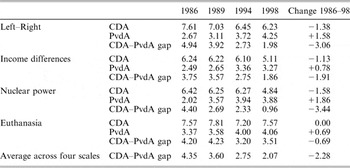
In the original version of the surveys, the Left–Right scale ran from 1 to 10 while the three policy scales ran from 1 to 7; however, we recalibrated respondents’ party placements on the policy scales to run from 1 to 10 so that these placements could be compared meaningfully with Left–Right party placements. For each scale, higher numbers denote a more right-wing position.Footnote 38Table 1 reports, for each scale in each election year, the DPES respondents’ mean placements of the CDA and the PvdA, along with the difference between respondents’ mean party placements (the ‘CDA-PvdA gap’), which provides an index of the policy-based party differences that Dutch respondents perceived. These computations reveal that respondents perceived dramatic party convergence between 1986 and 1998 on the Left–Right dimension, as well as on income inequality policy and on nuclear power. On the Left–Right scale, for instance, respondents placed the CDA at 7.61 (on average) and the PvdA at 2.67 (on average) in 1986, so that they perceived a Left–Right gap between these parties of nearly five units on this 1–10 scale. However, respondents’ perceptions of both parties moderated consistently across the 1989, 1994 and 1998 surveys, so that by 1998 DPES respondents placed the CDA at 6.23 and the PvdA at 4.25 (on average); that is, the perceived Left–Right gap between the parties had shrunk to less than two units on the 1–10 scale by 1998, a decline in perceived elite divergence of nearly 60 per cent compared with 1986. The computations in Table 1 reveal that DPES respondents perceived similarly dramatic party policy depolarization on income inequality and nuclear power, but perceived only modest depolarization on the euthanasia issue. These mass-based perceptions accord well with expert accounts of Dutch elites’ policy convergence during this period, which (as discussed above) emphasize that the PvdA and the CDA depolarized on social welfare and environmental issues but maintained sharp differences on euthanasia.
Dutch Survey Respondents’ Mean Placements of the CDA and the PVDA, 1986–98

Notes: The numbers reported in the table are the mean positions that Dutch Parliamentary Election Study respondents ascribed to the CDA and the PVDA along the Left–Right scale and the issue scales, computed, for each scale in each year, over all respondents who gave a valid party placement on the scale (see Appendix on Cambridge University Press website for the wording of the issue scale questions). All four scales run from 1 to 10, with higher numbers denoting a more right-wing response. (We note that in the original surveys the Left–Right scale ran from 1 to 10 while the three issue scales ran from 1 to 7; we have recalibrated the issue scales to run from 1 to 10, so that they are comparable to the Left–Right scale.) The rows labelled ‘CDA–PVDA gap’ report the difference between respondents’ mean placement of the CDA and their mean placement of the PVDA.
Policy-Based Depolarization Trends in the Mass Public
We now consider the question of whether the Dutch public, as a whole, depolarized along with the political elites of the CDA and the PvdA? We initially address this issue by analysing two policy-based features of mass depolarization, which relate to citizens’ policy preferences without regard to their party loyalties. The first is the change in the diversity of citizens’ policy preferences. According to this policy dispersion criterion, an over-time decrease in the dispersion of Dutch respondents’ self-placements on the policy scales would be evidence of policy-based depolarization; that is, this would indicate that the electorate had converged on policy along with party elites. Adams, Green and Milazzo document that the British public depolarized along with party elites on social welfare policy during the post-Thatcher era,Footnote 39 while scholars are divided about whether the American public has polarized significantly on policy over the past thirty years, a time period when Democratic and Republican party elites have diverged dramatically.Footnote 40
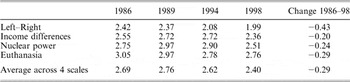
Table 2, which reports the standard deviations of DPES respondents’ self-placements on the scales relating to income inequality, nuclear power, euthanasia and Left–Right ideology, presents evidence that the Dutch public depolarized between 1986 and 1998 according to the policy-dispersion criterion. The table reports these standard deviations on each policy scale for each election year, while the column on the right-hand side reports the change in the standard deviations between 1986 and 1998. These computations reveal that the dispersion of DPES respondents’ self-placements declined noticeably on each scale. On the Left–Right scale this standard deviation declined from 2.42 in 1986 to 1.99 in 1998, while there were significant declines in the dispersion of respondents’ self-placements on the three policy scales as well. The dispersion of DPES respondents’ self-placements, averaged across the four scales, decreased from 2.69 in 1986 to 2.40 in 1998 (see the bottom row of the table).
Standard Deviations of Dutch Survey Respondents’ Self-Placements on the Policy Scales, 1986–98

Notes: The numbers reported in the table are the standard deviations of the Dutch Parliamentary Election Study respondents’ self-placements along the issue scales, computed, for each scale in each year, over all respondents who gave a valid self-placement on the scale. All four scales are from 1 to 10, with higher numbers denoting more right-wing responses (see Appendix on the Cambridge University Press Journals website for the wording of the issue scale questions). We note that in the original surveys the Left–Right scale ran from 1 to 10 while the three issue scales ran from 1 to 7; we have recalibrated these issue scales to run from 1 to 10 so that they are comparable to the Left–Right scale. The right-hand-side column gives the change in the standard deviation of respondents’ self-placements in 1998 compared to 1986.
A second policy-based perspective on mass depolarization pertains to the connections between citizens’ positions across different issues, i.e., to what Converse labelled attitude constraint and which we label policy constraint.Footnote 41 Baldassarri and Gelman analyse attitude constraint in the American public by computing the correlations between survey respondents’ self-placements across different policy scales.Footnote 42 According to this perspective, if these correlations decrease over time this constitutes evidence of decreased policy constraint – and hence of depolarization – in the mass public.
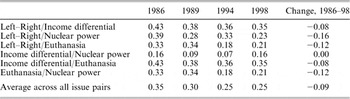
Table 3 reports the correlations between DPES respondents’ positions across pairs of issues, where these positions are measured via respondents’ self-placements on the scales relating to income inequality, nuclear power, euthanasia and Left–Right ideology. The table gives the correlation for each possible issue pair (six pairs in all) for 1986, 1989, 1994 and 1998, while the column on the right-hand side reports the change in the correlation for each issue pair between 1986 and 1998. To the extent that these correlations diminished over time will imply that citizens’ tendencies to align their positions across different policy/ideological dimensions decreased over the 1986–98 period, i.e., that the Dutch public depolarized according to the policy constraint criterion. The computations reported in Table 3 support this hypothesis. The correlations between DPES respondents’ self-placements on pairs of issues decreased significantly between 1986 and 1998 for five of the six issue pairs, while on the sixth issue pair (income inequality and nuclear power) there was no change over time. The average correlation across the six issue pairs, which is reported in the bottom row of the table, decreased from 0.35 in 1986 to 0.25 in 1998, which denotes a significant decline in policy constraint in the mass public across this period.
Correlations between Dutch Survey Respondents’ Self-Placements on Pairs of Issues, 1986–98

Notes: This table reports the correlations between Dutch Parliamentary Election Study respondents’ self-placements on the pairs of policy scales listed in the column on the left-hand side, with correlations computed for all respondents who gave valid self-placements on both scales (the question wording for each policy scale is presented in the Appendix on the Cambridge University Press Journals website). The column on the right-hand side reports the change between the correlations for the issue-pair in 1998 compared to 1986.
Partisan-Based Depolarization Trends in the Dutch Public
Much of the American and British literature on mass polarization emphasizes the relationship between citizens’ partisanship and their policy beliefs. According to this partisan sorting perspective, the widening gap between the ideologies of the Democratic and Republican parties-in-Congress has prompted a corresponding divergence between the policy preferences of the parties-in-the-electorate; that is, the difference between the mean policy preferences of Democratic partisans and those of Republican partisans has increased over time.Footnote 43 Similarly, Adams, Green and Milazzo find that the mean social welfare policy preferences of British Labour and Conservative party supporters have converged during the post-Thatcher era, in tandem with elite depolarization.Footnote 44 These findings imply that, in the Netherlands, the policy preferences of the CDA and the PvdA partisans should have converged across the 1986–98 period, as these parties’ elites depolarized on policy.
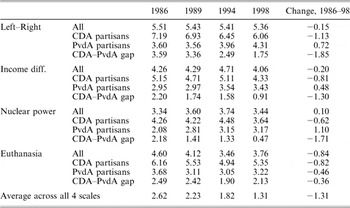
Table 4 reports analyses that pertain to the hypothesis outlined above, with respect to Dutch citizens’ partisan sorting on the issues of income inequality, nuclear power, euthanasia and Left–Right ideology. For each policy scale in each election year, the table reports the mean self-placement computed over all respondents; the mean self-placement computed over respondents who reported that they identified with the CDA; and the mean self-placement computed across all PvdA identifiers.Footnote 45 We also report the policy distance between the mean self-placements of CDA and PvdA identifiers (the ‘CDA–PvdA partisan gap’ variable), which provides an index of the mass-level partisan differences on the policy scale. To the extent that the Dutch public depolarized according to the partisan sorting criterion between 1986 and 1998, we expect the CDA–PvdA partisan gap to diminish over time. The computations reported in Table 4 support this expectation: the mean distance between CDA and PvdA partisans decreased on each policy scale between 1986 and 1998, and on three of the four scales this partisan convergence was dramatic. On Left–Right ideology, for instance, the mean self-placement of CDA partisans was 7.19 in 1986 while the mean self-placement of PvdA partisans was 3.60, so that the partisan gap was about 3.6 units on the 1–10 scale; by 1998 this partisan gap had shrunk to 1.85 units, with CDA supporters self-placing at 6.16 (on average) and PvdA supporters at 4.31 (on average); that is, the distance between the mean Left–Right positions of the CDA's supporters versus those of the PvdA's supporters declined by nearly 50 per cent between 1986 and 1998. The partisan convergence between the CDA and the PvdA parties-in-the-electorate was equally dramatic on income inequality and on nuclear power: on both policy scales the CDA–PvdA partisan gap declined by more than 60 per cent between 1986 and 1998.Footnote 46
Changes in Dutch Survey Respondents’ Mean Self-Placements on the Policy Scales, 1986–98

Notes: The numbers reported above are the Dutch Parliamentary Election Study respondents’ mean self-placements on the policy scales in the 1986, 1989, 1994 and 1998 surveys. Mean self-placements are given for all respondents (‘All’); for all respondents who reported that they identified with the CDA (‘CDA partisans’); and for all respondents who reported that they identified with the PvdA (‘PvdA partisans’). The figures given in the rows labelled ‘CDA-PvdA gap’ report the differences between the mean self-placements of CDA and PvdA partisans on the policy scale. All four scales are from 1 to 10, with higher numbers denoting more right-wing responses. (We note that in the original surveys the Left–Right scale ran from 1 to 10, while the three issue scales ran from 1 to 7; we have recalibrated these issue scales to run from 1 to 10, so that they are comparable to the Left–Right scale.) The texts of the policy scale questions are reported in the Appendix available on the Cambridge University Press website.
In sum, we find consistent evidence that the Dutch public depolarized in terms of its policy beliefs and its partisan loyalties between 1986 and 1998. Specifically, we document significant declines in mass policy dispersion as measured by the standard deviations of DPES respondents’ self-placements across the policy and ideological scales, and in mass policy constraint as reflected in the correlations between respondents’ self-placements across different policy scales. We also document a sharp decline in partisan sorting, in that the CDA and PvdA partisans’ policy and Left–Right preferences converged sharply between 1986 and 1998. These partisan-based results suggest that mass–elite policy linkages between the two largest Dutch parties and their supporters changed fundamentally between 1986 and 1998: the 1986 party system featured left-wing and right-wing parties-in-parliament supported by left-wing and right-wing parties-in-the-electorate, but the 1998 party system featured centre-left and centre-right parties-in-parliament supported by centre-left and centre-right parties-in-the-electorate. We conclude that during the 1986–98 period when the Dutch public perceived dramatic elite depolarization between the PvdA and the CDA, the public itself depolarized sharply in terms of its policy beliefs and its partisan loyalties.
Finally, we briefly address the question of how much the mass-level depolarization that we document in the Netherlands between 1986 and 1998 reflects the Dutch public's response to elite-level policy shifts, as opposed to a reciprocal process whereby party elites reacted to depolarization in the mass public. While it is beyond the scope of this article to parse out this issue fully, there is extensive previous research documenting that citizens in Western democracies update both their party attachments and their policy beliefs in response to their perceptions of parties’ policy positions.Footnote 47 Given our finding that Dutch citizens clearly perceived the policy depolarization of the CDA and the PvdA during the 1980s and 1990s (see Table 1 above), this suggests that the mass-level policy-based and partisan-based depolarization that we document in the Dutch public between 1986 and 1998 was at least partly a consequence as opposed to a cause of elite-level depolarization. We leave for future research the question of whether the Dutch public's depolarization reciprocally moved the political elites of the CDA and the PvdA to moderate their policies during this period.Footnote 48
Subconstituency-based depolarization in The Netherlands
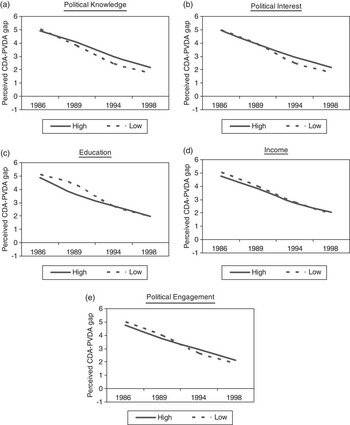
We next address the question of whether the mass-level depolarization patterns that we document in the Netherlands extend equally across different subconstituencies in the electorate. Figures 1A–1E, which display the mean perceptions of party Left–Right positions for subgroups defined in terms of political knowledge, political interest, education and income, suggest that the members of all of these subgroups perceived similar degrees of ideological depolarization (on average) between the CDA and the PvdA party elites between 1986 and 1998.Footnote 49 The analyses subdivided by political knowledge (Figure 1A) display the difference between respondents’ mean Left–Right placements of the CDA and their mean placements of the PvdA (the ‘CDA–PvdA gap’), for respondents who scored above-average on a general political knowledge quiz (the solid line) and for those who scored below-average on this quiz (the dotted line).Footnote 50 We see that both the knowledgeable and the less-knowledgeable respondents perceived comparable degrees of elite Left–Right depolarization between 1986 and 1998: for the knowledgeable group, the mean perceived gap between the CDA and the PvdA declined from about 4.9 units on the 1–10 Left–Right scale in 1986 to about 2.5 units in 1998, while for the less knowledgeable group the perceived CDA–PvdA gap declined from about 5.0 units in 1986 to 2.1 units in 1998. Thus, both subgroups perceived comparable degrees of ideological depolarization between party elites across this time period, and in fact less-knowledgeable respondents actually perceived slightly more elite depolarization than did the high-knowledge group.Footnote 51
Respondents’ perceptions of differences between the Left–Right positions of the CDA and the PvdA, stratified by subconstituency, 1986–98 Notes: The figures display the differences between the mean Left–Right position that Dutch Parliamentary Election Study respondents ascribed to the CDA versus the mean position they ascribed to the PvdA on the 1–10 Left–Right scale, across the years 1986–98, and stratified by the respondents’ level of political knowledge, political interest, education, income and political engagement. The definitions of these different subconstituencies (high and low political knowledge, political interest, etc.) are given in the text.

Figure 1B displays trends in DPES respondents’ party placements among respondents who displayed high levels of interest in politics versus those who displayed less interest, calculated using the DPES political interest index.Footnote 52 These subconstituency patterns based on political interest are nearly identical to the patterns based on political knowledge that were displayed in Figure 1A above: namely, both the high-interest and the lower-interest subconstituencies perceived nearly identical degrees of Left–Right depolarization between the CDA and the PvdA party elites, across the 1986–98 time period.
Figures 1C and 1D extend these analyses to DPES respondents subdivided by education (Figure 1C) and by income (Figure 1D), i.e., according to whether they ranked in the top or the bottom half of the survey sample in these categories. Education was calculated as the respondent's highest completed education level, which ranged from elementary-only education to university-level education. Income was measured as average household income, ranging in guilders from less than NLG 1,700 to NLG 73,000 or more per year. We observe that over the period 1986–98, each subgroup of respondents – the highly-educated and the less educated, and the more and less affluent – perceived dramatic ideological depolarization between the CDA and the PvdA, and furthermore these perceptions were quite similar across different subconstituencies.
Finally, one might expect that while no single citizen characteristic – i.e., political knowledge, political interest, education, or income – is sufficient to identify a stratum of voters who disproportionately perceived elite depolarization, citizens who possessed combinations of these attributes might be especially likely to perceive elite policy shifts. Figure 1E displays data on DPES respondents’ perceptions of the parties, for two groups of voters. The first is a high-engagement group consisting of DPES respondents who possessed at least three of the following four attributes: they scored above average on the political knowledge quiz; they scored above average on the political interest index; they were above average in educational attainment; they received above-average incomes. The second group consists of low-engagement respondents who were below the mean on at least three of these attributes. The patterns displayed in Figure 1E are similar to those for the previous figures: over the period 1986–98, the high-engagement and low-engagement subgroups displayed similar perceptions of the elite-level Left–Right depolarization between the CDA and the PvdA.
Our finding that perceptions of elite policy depolarization cut across Dutch subconstituencies defined in terms of education, income, political knowledge and political interest parallels the findings that Adams, Green and Milazzo report with respect to British subconstituencies’ perceptions of elite policy depolarization during the post-Thatcher era.Footnote 53 By contrast, Heatherington concludes that American subgroups of educated, affluent and politically interested voters have perceived substantially greater increases in the policy polarization of Democratic and Republican party elites over the past thirty years, compared with the perceptions of less affluent and educated citizens.Footnote 54 These patterns support the hypothesis that the unified parliamentary delegations in Western Europe provide clear policy cues that register roughly equally with citizens with different sociodemographic characteristics and levels of political interest, while the more diffuse policy cues provided by the decentralized American political parties register primarily with the subconstituencies of affluent, educated and politically sophisticated citizens.
Subconstituency Depolarization in the Netherlands: A Policy-Based Perspective
While the analyses presented above suggest that Dutch citizens’ perceptions of party elites’ ideological depolarization between 1986 and 1998 extended to the socioeconomically advantaged and the politically engaged along with the disadvantaged and the less engaged, this does not guarantee that these different subconstituencies reacted similarly to the party convergence they perceived. Suppose, for instance, that politically engaged citizens evaluate parties primarily based on their policy positions, while less-engaged citizens prioritize factors such as national economic conditions and party leaders’ personal images.Footnote 55 In this case, we might expect politically engaged citizens – but not the less engaged – to adjust their partisan loyalties in response to elite-level policy depolarization. Similarly, politically knowledgeable, socioeconomically advantaged citizens may differ from other citizens in their openness to elite policy persuasion, i.e., in their willingness to shift their policy positions in response to their preferred party's policy shifts.
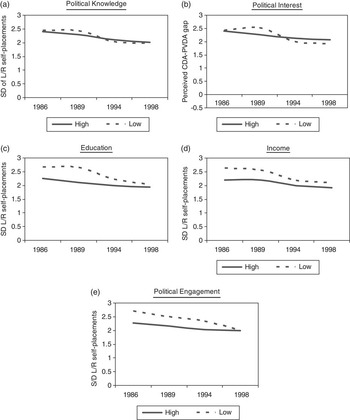
We begin by analysing whether there were subconstituency-based differences in Dutch citizens’ policy-based patterns of mass depolarization. Figure 2, which reports changes in the standard deviations of DPES respondents’ self-placements on the Left–Right scale between 1986 and 1998, presents evidence on changes in the degree of policy dispersion across different subconstituencies.Footnote 56 The results displayed in Figure 2A show that the degree of policy dispersion among respondents with above-average political knowledge (i.e., those who scored above average on the political knowledge quiz) and those with below-average political knowledge declined nearly equally across this period: for both subgroups, the standard deviation of respondents’ Left–Right self-placements declined from roughly 2.4 units in 1986 to 2.0 units in 1998, on the 1–10 Left–Right scale. We observe similar patterns when we compare the subconstituency of respondents who scored above average on the political interest index to the subgroup of lower-interest respondents (Figure 2B). The computations for the remaining subgroups that are subdivided according to their levels of education, income and political engagement (Figures 2C–2E) reveal slightly different patterns: in each case, the socioeconomically disadvantaged subconstituency (i.e., the less educated, the less affluent, and the least politically engaged) was more ideologically dispersed than its socioeconomically advantaged counterpart in the cross-sectional comparisons, and these disadvantaged subconstituencies displayed larger declines in their ideological dispersion across the 1986–98 period. For instance, the standard deviation of less educated DPES respondents’ self-placements on the 1–10 Left–Right scale declined from roughly 2.7 units in 1986 to 2.0 units in 1998, a 0.7 decline, while the standard deviation of better-educated respondents’ self-placements dropped from roughly 2.2 units in 1986 to 1.9 units in 1998, a 0.3 decline (see Figure 2C). The patterns are similar when DES respondents are subdivided by income (Figure 2D) and political engagement (Figure 2E).Footnote 57 These results suggest that every subgroup that we examined depolarized between 1986 and1998 according to the policy dispersion criterion, and that to the extent that we identify subconstituency-based differences it was the less-educated and less-affluent subgroups who displayed stronger reactions to the elite-level policy depolarization of the CDA and the PvdA; that is, these subgroups depolarized to a greater extent than did other subconstituencies in the electorate.
The standard deviations of respondents’ Left–Right self-placements, stratified by subconstituency, 1986–98 Notes: The figures display the standard deviations of the self-placements of Dutch Parliamentary Election Study respondents on the 1–10 Left–Right scale, across the years 1986–98 and stratified by the respondent's level of political knowledge, political interest, education, income and level of political engagement. The definitions of these different subconstituencies (high and low political knowledge, political interest, etc.) are given in the text.

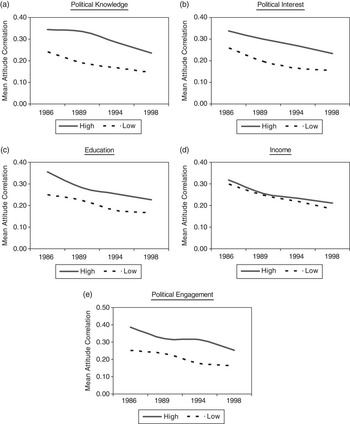
Next, we analysed subconstituency-based depolarization differences judged according to the policy constraint criterion. Recall that our measure of policy constraint, borrowed from Baldassari and Gelman, relates to the correlations between DPES respondents’ positions across pairs of issues, where these positions are measured via respondents’ self-placements on the three policy scales and the Left–Right scale.Footnote 58Figures 3A–3E report these correlations for 1986, 1989, 1994 and 1998, averaged across the six possible issue pairs.Footnote 59 The patterns displayed in these figures suggest that all of the subconstituencies that we analysed depolarized, in that the correlations between group members’ positions on different issues diminished between 1986 and 1998. Note, furthermore, that the magnitudes of these decreases in policy constraint are similar across all of these subgroups. For instance, among DPES respondents who scored above average on the political interest index the mean correlation between their positions across pairs of issues decreased from 0.37 in 1986 to 0.26 in 1998, a 0.11 decline, while for low-interest respondents this mean correlation decreased from 0.29 in 1986 to 0.18 in 1998, an identical 0.11 decline (see Figure 3B). We observe similar patterns in comparisons of the politically knowledgeable versus the less knowledgeable (Figure 3A), the highly educated versus the less educated (Figure 3C), and the politically engaged versus the less engaged (Figure 3E): namely, in each cross-sectional comparison the more knowledgeable/educated/engaged subconstituency displays modestly higher levels of policy constraint, but in over-time comparisons all subgroups depolarized to roughly the same extent. These patterns on the Netherlands parallel the results that Adams, Green and Milazzo report with respect to Britain during the post-Thatcher period,Footnote 60 namely that more educated and knowledgeable subgroups displayed greater degrees of policy-based polarization than less-educated and knowledgeable subgroups in cross-sectional comparisons, but that all of these subconstituencies displayed comparable over-time changes in their levels of policy polarization.
Correlations between Dutch survey respondents’ self-placements on pairs of issues, stratified by subconstituency, 1986–98 Notes: The figures display the mean correlations between Dutch Parliamentary Election Study respondents’ self-placements on pairs of policy scales (the vertical axis in the figures), averaged across the following six issue pairs: Left–Right/income inequality; Left–Right/euthanasia; Left–Right/nuclear power; income inequality/euthanasia; income inequality/nuclear power; euthanasia/nuclear power. These mean correlations are reported across the years 1986–98, and stratified by the respondents’ level of political knowledge, political interest, education, income and political engagement. The definitions of these different subconstituencies (high and low political knowledge, political interest, etc.) are given in the text, and the wordings of the policy scale questions are presented in the Appendix on the Cambridge University Press Journals website.

Subconstituency Depolarization: A Partisan-Based Perspective
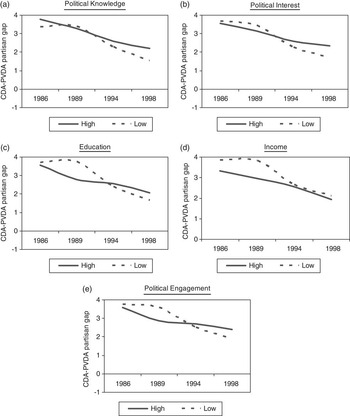
Next, we evaluated subconstituency-based differences in Dutch citizens’ patterns of mass depolarization, judged according to the partisan sorting criterion. Figure 4 reports computations of the differences between the mean self-placements of CDA partisans versus the mean self-placements of PvdA partisans on the 1–10 Left–Right scale (the ‘CDA–PvdA partisan gap’), computed across time for different subconstituencies defined in terms of political knowledge and interest, education, income and political engagement.Footnote 61 The patterns displayed in these figures suggest that all of these subconstituencies depolarized sharply according to the partisan sorting criterion. Specifically, for each subgroup the mean Left–Right positions of CDA and PvdA supporters converged between 1986 and 1998; that is, the magnitude of the CDA–PvdA partisan gap declined across this period. Furthermore, the degree of partisan-based polarization was similar across all subgroups. Note that to the extent that there were modest differences across subconstituencies, it was the less educated and less politically interested subgroups that actually depolarized to a greater degree than their more educated and interested counterparts (see Figures 4B and 4C). Hence, we find no evidence that more affluent, educated and knowledgeable respondents depolarized disproportionately between 1986 and 1998, according to the partisan sorting criterion.
Gaps between mean Left–Right self-placements of CDA and PvdA partisans, for different subconstituencies, 1986–98 Notes: The figures display the differences between the mean self-placements of Dutch Parliamentary Election Study respondents who identified themselves as CDA partisans versus the mean self-placements of PvdA partisans, on the 1–10 Left–Right scale. The definitions of the different subconstituencies (high and low political knowledge, political interest, etc.) are given in the text.

Overall, we conclude that all of the different Dutch subgroups that we examined – the more and the less politically knowledgeable and politically interested, and the more and the less educated, affluent and politically engaged – depolarized between 1986 and 1998, according to the policy dispersion criterion, the policy constraint criterion and the partisan sorting criterion. Furthermore, we find no evidence that the subconstituencies of more knowledgeable, interested, educated and affluent citizens responded disproportionately to the depolarization between the CDA and PvdA party elites that occurred during the 1980s and the 1990s: across 1986–98, all of these subconstituencies displayed roughly similar over-time changes in the dispersion of their ideological positions, in the correlations between their positions across pairs of issues, and in the differences in the mean positions of CDA partisans versus those of PvdA partisans. Although we detected modest differences in the depolarization patterns across different subconstituencies – in particular, that more knowledgeable/educated/engaged subgroups displayed greater levels of policy constraint in cross-sectional comparisons, while less-knowledgeable/educated/affluent subgroups displayed greater changes in their degrees of partisan sorting in over-time comparisons – these differences are trivial compared with the striking similarities across the different subgroups we analysed. Simply put, we find that all of these subconstituencies perceived the elite-level policy depolarization between the CDA and the PvdA that occurred across the 1980s and the 1990s; that these subconstituencies all depolarized across this period according to both policy-based and partisan-based criteria; and that these subgroups all depolarized to roughly the same extent.
Discussion and conclusion
Our findings on the Netherlands during the 1980s and the 1990s enhance our understanding of mass depolarization trends in western democracies, and also illuminate political developments in the Netherlands over the past decade. With respect to the first point, our findings on the Dutch public parallel those that Adams, Green and Milazzo report on the British public during the post-Thatcher period: namely, that during periods of dramatic elite policy depolarization the mass publics in both countries also depolarized in terms of their policy beliefs and their party attachments, and that these depolarization patterns extended across all the major subgroups in the electorate.Footnote 62 Furthermore, these patterns of electorate-wide depolarization in the Netherlands and Britain contrast with subconstituency-based polarization patterns in the United States, which have occurred disproportionately among the subconstituencies of affluent, educated and politically engaged citizens.Footnote 63 As we stated in the introduction, we believe the most plausible explanation for these cross-national differences is that the unified parliamentary delegations in Western Europe provide clear policy cues to voters, while the decentralized American political parties provide diffuse policy cues that are difficult for politically unsophisticated citizens to interpret. In this regard, it is significant that the Netherlands and Britain display similar subconstituency-based depolarization patterns, given that these two democracies differ with respect to the number of salient political cleavages, the number of significant political parties and their tendencies to feature single-party as opposed to coalition governments. What unites these two democracies – and what separates them from the United States – is that Britain and the Netherlands – in common with other West European democracies – feature unified parliamentary delegations. Our findings suggest that this feature of West European democracies has a crucial implication for mass–elite policy linkages: namely, that when party elites shift their policy positions, citizens from all walks of life will perceive and react to these policy shifts to roughly the same degree. These electorate-wide reactions that we observe in Western Europe appear normatively desirable, since they give political elites incentives to attach equal weight to all citizens’ policy preferences. By contrast, the subconstituency-based reactions that we observe in the United States plausibly motivate political elites to provide unequal representation, i.e., to tailor their policies towards the preferences of the affluent and educated citizens who respond disproportionately to elite policy behaviour.Footnote 64
Our findings on the Dutch public's reactions to elite policy depolarization in the 1980s and 1990s also shed light on the subsequent elite polarization on immigration and cultural issues, which has occurred over the past ten years. The convergence of the two dominant parties on the main dimension of political competition in Dutch politics, namely the Left–Right dimension, opened up the possibility for political entrepreneurs to gain traction by mobilizing new policy issues, such as immigration, in order to reap electoral gains. In addition, our finding that the Dutch public followed political elites by converging on Left–Right ideology plausibly illuminates why political entrepreneurs did not seek to ‘enter’ the Dutch party system by mobilizing extremist voters on traditional Left–Right issues: namely, the supply of voters who held extreme viewpoints on these types of issues declined sharply across the 1980s and 1990s. Consequently, the public and mainstream party depolarization on the traditional Left–Right dimension created additional incentives for political entrepreneurs to mobilize new policy issues. During the late 1990s and early 2000s, political entrepreneurs did exactly that by highlighting the immigration issue. By 2002, Dutch politics witnessed an ‘earthquake election’ in which Pim Fortuyn successfully introduced a new dimension of polarization on the basis of issues relating to immigration and to the integration of foreigners into Dutch society. We believe that our analyses of mass and elite depolarization on traditional Left–Right issues (along with euthanasia) during the 1980s and the 1990s thereby illuminate the subsequent polarization of Dutch elites and the mass public on immigration and cultural issues.