IntroductionFootnote 1
The French Jesuit Joachim Bouvet, Bai jin (白晋) (1656–1730) studied the Yijing (易經) or Zhouyi (周易) (Book of Changes). One of the five Chinese Classics, this book describes a system of notation for acts of divination, listing all the possible interpretations of sixty-four figures resulting from a divination technique based on the counting of yarrow stems. The basic figure is the gua (卦) or hexagram, because it is made up of six lines (yao 爻). These lines are of two types: the broken line—yin (陰), and the solid line—yang (陽). The different combinations of the two types of lines in groups of six yield the sixty-four hexagrams. The hexagrams are themselves the combination of two figures of three lines (also gua 卦), the “trigrams.” There are eight possible combinations, hence the eight bagua trigrams (八卦).
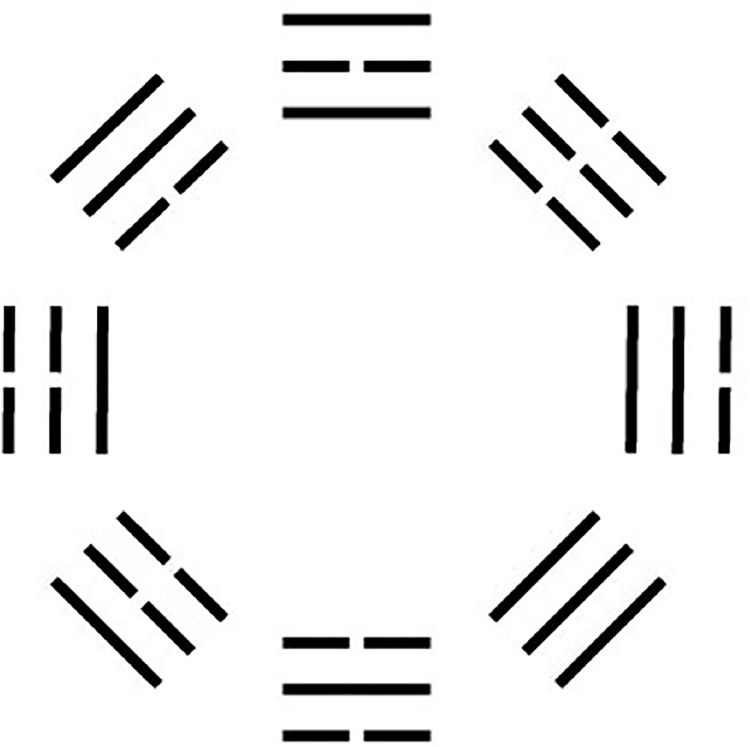
Chinese tradition dates the eight trigrams to the time of the mythical emperor Fuxi (伏羲) (2900 BCE). They were combined into sixty-four hexagrams by King Wen, Wen Wang (文王). From the second century BC, under the Han dynasty (206 BCE–220 CE), the eight trigrams were presented according to two models: the Xiantian (先天) or Fuxi order (fig. 1) and the Houtian (後天) or Wen Wang order (hereafter WW64) (fig. 2).
Trigrams according to the Xiantian/Fuxi order. Diagram drawn by the author.

Trigrams according to the Houtian/Wen Wang order. Diagram drawn by the author.

Joachim Bouvet particularly focused on the diagram of the sixty-four hexagrams according to the Xiantian model (fig. 3), the Fuxi liushisi gua fangwei (hereafter FX64) (伏羲六十四卦方位—Fuxi’s sixty-four hexagrams diagram).Footnote 2 This diagram is the system of sixty-four hexagrams organized according to the eight trigrams of the Fuxi/Xiantian order (fig. 4).Footnote 4 It therefore differs from the eight trigrams and the sixty-four hexagrams organized according to the Wen Wang/Houtian order (fig. 4). Although Bouvet attributed it to Fuxi by naming it “Fuxi’s diagram”,Footnote 5 Zhu Xi attributed this diagram to Shao Yong.Footnote 6
Fuxi liushisi gua fangwei (伏羲六十四卦方位) [Fuxi’s sixty-four hexagrams diagram], sent by Bouvet to Leibniz with his letter of 4 November 1701.Footnote 3 (Source: Gottfried Wilhelm Leibniz Bibliothek – Niedersächsische Landesbibliothek, Hannover (shelf mark: LBr 105, Bl. 27 (LK-MOW Bouvet10).

Houtian liushisigua (後天六十四卦) [Houtian sixty-four hexagrams diagram—hereafter WW64] (Couplet Reference Couplet1687, 44). Source: Staatliche Bibliothek Regensburg, shelfmark 999/2Philos.3043.

While Xiantian and Houtian are often translated as “pre-Heaven or precosmic” and “post-Heaven or postcosmic” orders, this paper will deliberately use them untranslated, and explain them in the light of Shao Yong’s philosophy. Shao’s intention was to explain the changes in the universe. He chose to do so through Yijing cosmology according to the Xiangshuxue (象數學) (Number-picture study), an approach based on iconographic and cosmological concepts. This domain is that of a theoretical order and of an abstract structure which systematizes the world. Xiantian and Houtian are two types of reality, that of theory and that of experience. Shao was mainly interested in the theoretical aspects of reality, that is, in Xiantian. These two domains of Xiantian and Houtian exist simultaneously. As Anne D. Birdwhistell explains: “Houtian refers to the domain of particular experience, and Xiantian to the domain of abstract patterns of structure, which particular experience follows” (Birdwhistell Reference Birdwhistell1989, 66).
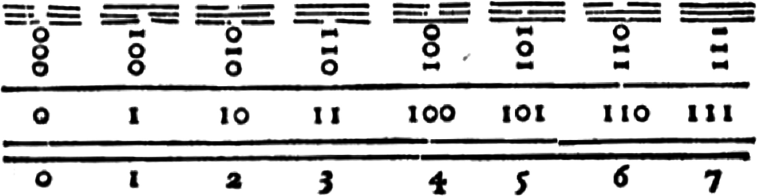
While exchanging letters with Bouvet, the German philosopher G. W. Leibniz (1646–1716) explained to him his binary arithmetic, or dyadic, whose first written record is the De Progressione Dyadica dated March 15, 1679. It is a binary number system for noting all numbers, which uses only two digits—1 and 0—instead of ten as the basis of a scoring scale. The missionary then discovered an analogy between this new calculation and the FX64 diagram.Footnote 7 When one replaces 0 and 1 with the broken lines of the yin and the unbroken lines of the yang, the two systems are analogues (see fig. 5), in the sense of an identity of the relationship that unites, two by two, the terms of two or more pairs of objects. In other words, it is a system of terms having the same relationship between them.
Correspondence between the bagua and the binary arithmetic of Leibniz (Reference Leibniz1703, 88). Source: https://hal.archives-ouvertes.fr/ads-00104781.

This analogy has raised and still raises the question of whether the FX64 diagram is binary. The answer to this question matters because it has implications for the history of binary arithmetic, or more broadly, in the general history of logic, or of logic in China. Indeed, it could be seen as an early form of binary notation system that resembles modern binary numbers, not only because of its material (two elements that are not necessarily 0 and 1), but also because of its arrangement, which—as I will show—is the reverse of the binary table presented by Leibniz. In other words, Leibniz’ sequence of 0 to 63 binary digits was already present in the FX64 diagram, but in reverse. Attempts by scholars to address the question of whether Shao Yong’s diagram was binary, however, have produced conflicting answers, which call for a clarification of this issue.
First, to assert this analogy is to maintain that the two systems have an identity of relation which unites their terms two by two, in other words, that it is a system of terms having the same relation between them (Lalande Reference Lalande1999, 1:51). To assert this identity is to certify that these two distinct systems are identical, or that they have the same properties or qualities (ibid., 454). So, when Joachim Bouvet observes an analogy between the two systems, he maintains that the two terms which constitute the two systems—namely the 1 and the 0 for the dyadic and the yang, or solid lines (—) and yin, broken lines (– –) for the FX64 diagram—have the same relation between them. Likewise, when the Jesuit notes the identity between the two systems, he asserts that they have the same properties or qualities. Therefore, regarding the idea of analogy, the question is whether the FX64 diagram and binary arithmetic have the same properties or qualities. And regarding the idea of identity, the question is whether the relationship between the two terms is the same.
Second, answering the question of whether the FX64 diagram is “binary” also requires asking what the term “binary” means, in order to study its properties and qualities and see if they coincide with the diagram. Generally speaking, something is binary when it is made up of two elements, or when it has two aspects. In arithmetic and computing fields, binary is a number system in which the symbols used are 0 and 1, like in a binary system or a binary code. From the point of view of mathematics, binary is a relation that verifies certain characteristic properties which link two elements of a set, as in a binary form or binary structure. Between them, these three definitions of the adjective “binary” offer indications as to its nature and meaning. The first qualifies the type of material used into a structure that requires two elements. Next, the arithmetic sense indicates the nature of binary, namely a number system, but also the purpose and the material used from this point of view. Finally, the third definition concerns the relationship between the two elements of a set, namely what gives it its shape and structure, and comes from its construction methodology.
Third, to question whether the FX64 diagram is binary is to study this issue being guided by the definition of the essence of an object. The characteristics that define an object’s essence are: the material with which it is formed (the elements which constitute it); the methodology that presided over its creation and that gives its structure; the structure which confers its form; the meaning of the whole or of its parts; and the purpose of this object.
In light of the multiplicity of contradictory answers still clouding this issue, the objective of this article is therefore to determine whether the characteristics of the FX64 diagram meet the criteria of the “binary” notion. I will argue that the FX64 diagram is binary for a number of reasons. First, because it is constituted by two elements – the yin and the yang. Second, it is binary in the sense of a numerical system constituted by two symbols—using 0 and 1 is facultative. Third, its construction, which organizes the relationship of the yin and the yang—the division of the dyad by two—is the reverse of the construction that Leibniz used, namely multiplication by two. However, it eventually creates the same pattern, readable from one or the opposite direction.
This solves the problem of the opposite reading direction used by Bouvet and Leibniz. It is precisely the reverse methodology of construction—multiplication by two for Leibniz and division by two for Shao Yong—that creates an identical structure which can be read in one direction or the opposite, because the two arithmetical operations are reversed and their principle—the radixFootnote 8 two—is the same, such as in 7x6 = 42 and 42/6 = 7.
The opposite reading direction used by Bouvet and Leibniz becomes logical since Leibniz read in the direction of the construction process that he used (multiplication), and the direction in China is according to the construction process employed by Shao (division). Second, it consequently invalidates the other main counterargument of the different methodologies of construction of the two systems. Third, it links the two counterarguments into one issue, since the reversed construction allows the possibility of reading the structures in one direction or the other.
To address this problem, I will begin by comparing the characteristics of the FX64 diagram to the first and second definitions of the adjective “binary.” Next, I will develop my argument in opposition to the two counterarguments of the construction methodology and the different reading direction used by Bouvet and Leibniz by analyzing the properties of the diagram from the point of view of the third definition of “binary”.
I. The FX64 diagram is binary as it is a numbering system made up with two elements where 0 and 1 are facultative
1.1 The first definition of binary
The FX64 diagram is binary because it is formed of only two simple elements, the yin, represented by a broken line (– –); and the yang, represented by a solid line (—) (Shi Reference Shi, Wenchao and Poser2000, 167; Zacher Reference Zacher1973, 74; Birdwhistell Reference Birdwhistell1989, 61; Nikolic Reference Nikolic1994, 76; Alcantara Reference Alcantara2006, 24). This idea is not, to my knowledge, subject to any counterargument in the secondary literature. However, being composed of two elements, though necessary, is not enough for the system to form a binary progression analogous to that of binary arithmetic, otherwise the WW64 diagram (fig. 4) would also be analogous to binary arithmetic, and that is not the case. Therefore, one or more additional elements are required for the FX64 diagram to be considered as binary.
I.2 The second definition of binary
The FX64 diagram is also binary according to the definition of “binary” as a numbering system in which the symbols used are 0 and 1, though various scholars have argued to the contrary. Zhou Qibing (周琪兵), for instance, argued that the digital system in China is the decimal system, with a base of ten, and that therefore in China the binary system was not used (Zhou Reference Qibing2012, 96). Nevertheless, it is possible to point out that although Leibniz and others before him developed the binary system, there was not much practical common use of it in Europe. Indeed, Leibniz explained that “the new numerical calculus which I invented [is] not for common usage but for the theory of science, for it opens a vast field for new theorems”.Footnote 9 It was then rather theoretical for work on the theory of numbers.Footnote 10 Thus, the use of the decimal system in China does not exclude the development of the binary system.
Some scholars have argued against drawing a correlation between the FX64 diagram to Leibniz’s binary system because the two systems diverge in their material, their nature, and their purpose. The mathematical nature of binary arithmetic created not only to note numbers but also to calculate, they argued, differs from the symbolic philosophical nature of the FX64 diagram (Shi Reference Shi, Wenchao and Poser2000, 165). In addition, the ancient Chinese did not create binary arithmetic “and were not aware that they had happened upon the binary system” (Cammann 1991, 588). The purpose underlying the creation of the circle and square diagrams was the explanation of the reality of the world. Finally, the hexagrams do not represent a binary number system (Zacher Reference Zacher1973, 74).
Other scholars maintain that the FX64 diagram could not be binary in this arithmetical sense because, from the strictly material point of view, the two elements that constitute it are not the 0 and the 1, based on the argument that the concept of zero was not acknowledged in China at the time of Qin (221–206 BCE) and Han (Pelliot Reference Pelliot1922, 90–91; Cammann 1991, 588; McKenna and Mair Reference McKenna and Mair1979, 428; Zhou Reference Qibing2012, 96). However, this counterargument is not relevant since the diagram attributed to Shao Yong was constructed around the eleventh century, a period in which zero (or its symbol) had been known for at least several centuries in China (Needham Reference Needham1956, 13; Martzloff Reference Martzloff2009, 121).
In any case, since zero is facultative, because it is only necessary to have two elements or two states to qualify an object as binary, it is therefore possible to create a binary system with two simple and different elements, a square and a triangle, 0 and 1, a yin and a yang, on/off or open/closed, etc. Furthermore, other scholars have argued that the material of the FX64 diagram corresponds to binary numbers, and that it is possible to translate hexagrams and trigrams into numbers (Roy Reference Roy1972, 164), or to consider them comparable to binary numbers (McKenna and Mair Reference McKenna and Mair1979, 424). Among them, some even claim that the Yijing itself is made up of binary numbers (Secter Reference Secter1998, 89). Thus, the FX64 diagram could be considered as a numbering system despite the fact that it does not use the 0 and the 1, which are not necessary for a system to be binary.
2. Analysis showing that the FX64 diagram is binary because it contains a relationship of characteristic properties which binds its two elements
The FX64 diagram is analyzed from the angle of the third definition of “binary” as a binary relation, or a relation linking two elements of a set and having characteristic properties. Some scholars have argued that the different construction of the two systems (Sypniewski Reference Sypniewski2000, 310; Shi Reference Shi, Wenchao and Poser2000, 166; Cammann 1991, 588), as well as the “wrong” reading direction used by Bouvet and Leibniz—opposite to the one used in China—creates this analogy (Arrault Reference Arrault2001, 87; McKenna & Mair, Reference McKenna and Mair1979, 423; Makeham Reference Makeham1986, 55–54; Wei and Wang, Reference Wei and Wang2014, 87), and therefore would invalidate this identity (Sypniewski Reference Sypniewski2000, 295; Zhang Reference Zhang2016, 49 and 55).
As an answer of these two counterarguments, this section of the article shows that the FX64 diagram is binary in the third sense of the term and offers an analysis of the way in which the relation between the two elements yin and yang was established. It does this, firstly, by describing the methodology employed in its construction, then by describing what structure this methodology created, and thirdly by showing what form this structure gave to the diagram, and how it solves the counterargument of the “wrong” reading direction used by Bouvet and Leibniz.
2.I. The reversed construction of the two systems
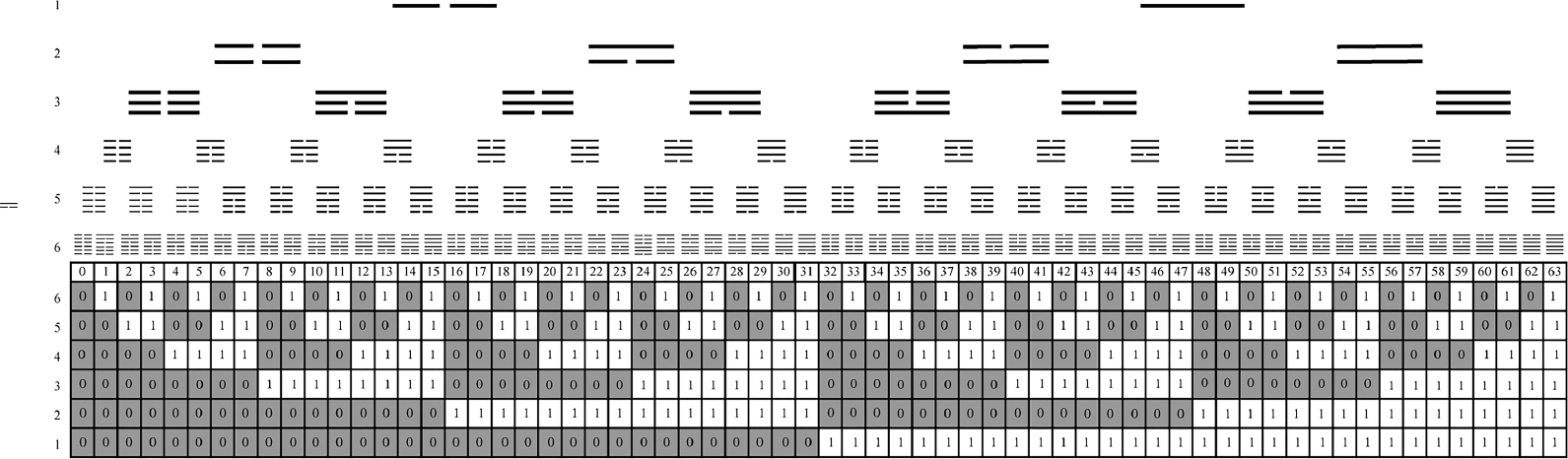
The following analysis is based on figure 6 (below), which represents the superimposition of the Shao Yong derivation table and the binary table up to sixty-three posited by Leibniz. It helps to understand the construction of the two systems: Leibniz’s binary table is represented there directly, as well as the derivation process which dissects the construction of the progression of the sixty-four hexagrams diagram. It is therefore possible to superimpose the table of Shao Yong and that of Leibniz, and to do this, a 0 is added on the yin represented by the color black, and a 1 on the yang represented by the color white. Then, lines are drawn starting from each alternation of the yin and yang dyad at the level of line 6 (that of the hexagrams). This does not distort the derivation table since one reads it like this for the hexagrams. For example, on the far left, kun (坤) is read from the bottom (so line 1) yin, yin, yin, yin, yin, yin or six times the color black; and bo (剝) yin, yin, yin, yin, yin, yang or five times the color black and once the white, etc. One can observe the progression of hexagrams not in a circle or a square, but in lines.
Superimposing the Shao Yong derivation table and the Leibniz’s binary table up to 63. Developed by the author using the segregation table of Gorai Kinzō in Aiton and Shimao Reference Aiton and Shimao1981, 84, and of Shao Yong 2004, 164–165, 235.

2.I.I. The methodology
From the point of view of the methodology, that is to say the technical process of calculation (Lalande Reference Lalande1999, 1:623-624), or here of the construction of the system, it is necessary to differentiate between (a) the starting point, (b) the operating process and (c) the principle.
2.I.I.I. Starting point for building the two systems
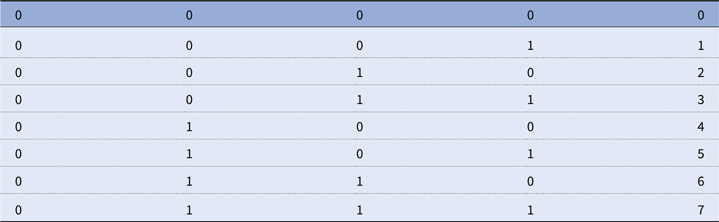
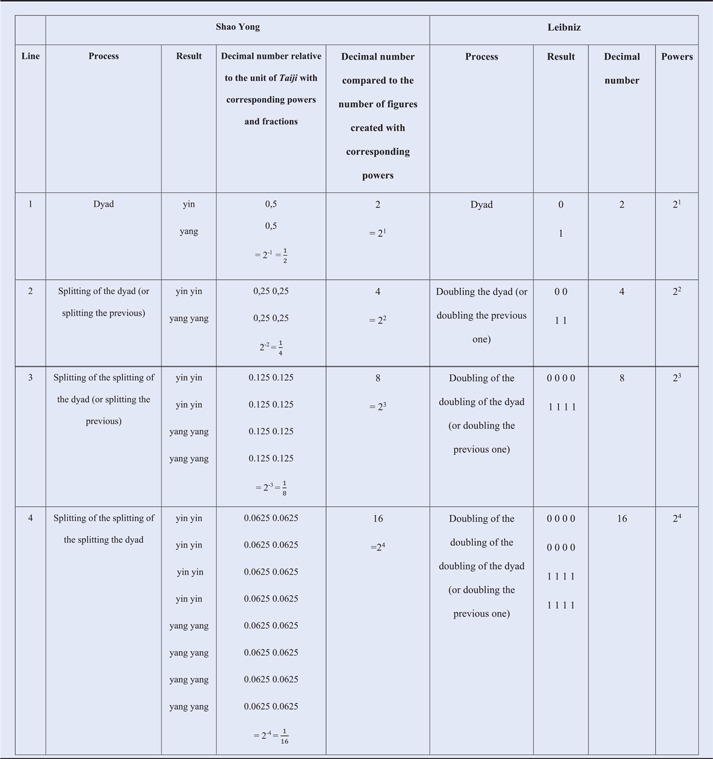
First, the two philosophers begin construction of their systems with a dyad, that is to say two complementary or opposite principles, yin and yang for Shao Yong, and the 0 and 1 for Leibniz. However, Leibniz begins his binary table with an alternation of the dyad 0 and 1. In a letter to Duke Rudolph August of Brunswick-Lüneburg-Wolfenbüttel on January 2, 1697, he describes his methodology as “a continual rule of alternating progression” (Ching and Oxtoby Reference Ching and Oxtoby1992, 72). In table 1, the second column starting from the right shows the alternation of the dyad 0 and 1, or the repetition of the dyad 0 and 1, namely 0, 1, 0, 1, 0, 1, 0, 1, etc. Shao Yong begins his system with a single yin and yang dyad. The top of figure 6 shows the construction of trigrams, then hexagrams, from the yin and yang couple. The starting point is therefore different, with Leibniz starting from the alternation of the dyad, and Shao Yong from the simple dyad.
Binary table from 0 to 7

In addition, spatially, the starting point and the direction of progression are different. Leibniz starts from a column (lines in fig. 6) and alternates the dyad vertically. Shao Yong places the dyad that begins his diagram above in the derivation of the solid and broken lines (top table of fig. 6), and down in the derivation table (bottom table of fig. 6); and enchains his splits horizontally.
Shi Zhonglian remarks that Leibniz’s system “advances one place of binary digit when it comes to two,” and that is where the difference lies in the way of proceeding (Shi Reference Shi, Wenchao and Poser2000, 166). But it seems that Shao Yong also proceeds by a displacement in space. When he transitions to a division by two, he moves to another line in his derivation diagram, which gives six lines for the confection of the sixty-four hexagrams. Leibniz did the same when he created his table in six columns or more. If Shao Yong did not advance in space, the result, the arrangement of yin and yang, would not be the same. So the argument that proves the difference between the two systems by advancing one place in Leibniz’s and not in Shao Yong’s, would not be valid.
2.I.I.2. System construction operating process
Second, the operating process for building the two systems is reversed: Leibniz proceeds by multiplication and Shao Yong by division. After starting his binary arithmetic table in the first column (line 6 in fig. 6) with the alternation of dyad 0 and 1, Leibniz continues by doubling the cycle of alternation of the dyad in each column. Thus, in the second column (line 5 in fig. 6), he doubles the cycle of alternation of the dyad 0 and 1, which gives 0, 0; 1, 1; 0, 0; 1, 1, etc. In the third column (line 4 in fig. 6), he continues with the same principle of the repetition of the previous repetition, that is to say the action of doubling the previous cycle of alternation of the dyad, which gives 0, 0, 0, 0; 1, 1, 1, 1; 0, 0, 0, 0; 1, 1, 1, 1, etc. Then in the fourth column (line 3 in fig. 6), the repetition of the repetition of the previous repetition, 0, 0, 0, 0, 0, 0, 0, 0 continues; 1, 1, 1, 1, 1, 1, 1, 1; 0, 0, 0, 0, 0, 0, 0, 0; 1, 1, 1, 1, 1, 1, 1, 1, 1, etc. Table 1 represents the transcription of his explanation (see Ching and Oxtoby Reference Ching and Oxtoby1992, 72).
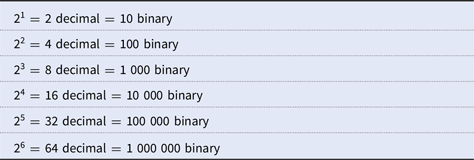
Thus, the principle which presides over the binary system is the multiplication by two, the repetition with each column of the preceding alternation period. Finally, it is a redoubling of the previous cycle and so on, the alternation of the dyad (21), then the alternation of the repetition of the dyad (22), then the alternation of the repetition of the repetition dyad (23), etc. The progression is noted with powers because Leibniz builds his binary system in a power of 2. In binary, the 0 reflects the power of 2, as shown in table 2. The power of a number is the result of the repeated multiplication of this number with itself. The power of the number 2 is therefore the result of the repeated multiplication of 2 with itself.
Correspondence between the powers of 2 and the 0 in the binary system

Shao Yong, in contrast, proceeds by division by two. As Anne D. Birdwhistell explains, Shao Yong thinks that reality has an order because phenomenal reality is partly divisible in a way that we can count (Birdwhistell Reference Birdwhistell1989, 71). The regularity of this structure not only allows the representation of its elements by images, but also by numbers. The FX64 diagram therefore represents the possible changes in the universe, and these can be represented by numbers.
The connection between the numbers of the trigrams from 1 to 8 that form the hexagrams and the FX64 diagram appears in the diagram called “Chart of the numbers of the sixty-four hexagrams which govern the world” (fig. 7). This diagram is found in the Huangji jingshi shujie (皇極經世書解), [Interpretation of the Book of the August Ultimate through the Ages], compiled by Wang Zhi (王植) (1681–1766). It introduces the way Cai Yuanding (蔡元定) (1135-1198) reads the FX64.Footnote 11 Wang Zhi quotes the son of Shao Yong, Shao Bowen (邵伯溫) (1057–1134) who described his father’s book (Arrault 2012, 43–45) and explained the way the FX64 diagram should be read.
Jingshi liushisi gua zhi shu tu (經世六十四卦之數圖) [Chart of the numbers of the sixty-four hexagrams which govern the world], in “Huangji jingshi shujie” (皇極經世書解) [Interpretation of the Book of the August Ultimate through the Ages], in Qinding siku quanshu (欽定四庫全書) [Complete books of the Four Storehouses], Juanshou xia 卷首下 [The first volume], 9–10.

Wang Zhi introduced the numbers given to each trigram following the arrangement of Fuxi/Xiantian. The correspondence with Chinese numbers and the eight trigrams is:
一 = 1 = qian (乾);
二 = 2 = dui (兌);
三 = 3 = li (離);
四 = 4 = zhen (震);
五 = 5 = xun (巽);
六 = 6 = kan (坎);
七 = 7 = gen (艮);
八 = 8 = kun (坤).
He used the trigram numbers in the FX64 diagram to clarify how the arrangement of the sixty-four hexagrams should be read and understood, according to the Fuxi/Xiantian order of the eight trigrams. It therefore may be possible to say—as Alain Arrault said, using the terms of Jean-Pierre Brach—that this diagram contains the “arithmology” of Shao Yong in the sense of “numerical speculation symbolic order,” where “numbers certainly play a major role but are devoid of divinatory function” (Arrault Reference Arrault2013, 184–185).Footnote 12 Here, a numerical speculation symbolic order explains the changes in the universe and the way to cross the trigrams/numbers.
Shao Yong evokes the creation of the universe, which illustrates the place of numbers in his cosmological philosophy, where “the numbers express an unfolding of the world” (ibid., 186).
The Taiji dividing, the two models (liangyi) are established. The yang interacts with the yin below, the yin interacts with the yang above and the four figures (sixiang) are born. The yang interacts with the yin, the yin interacts with the yang and they give birth to the four images of the sky. The firm interacts with the flexible, the flexible interacts with the firm and they generate the four figures of the earth. Thus are formed the eight trigrams. The eight trigrams mix together, then all things are born. This is why one divides in two, two in four, four in eight, eight in sixteen, sixteen in thirty-two, thirty-two in sixty-four.Footnote 13
Although one gives birth to two, it is not a number for Shao Yong and it is motionless. The “two” introduces the mutation, which is mobile, and therefore introduces the possibility of change. Anne D. Birdwhistell explains that the “one” is not a number like the others and represents the whole and not a part of the whole: “Since numbers arise only when the whole is divided, numbers represent divisions” (Birdwhistell Reference Birdwhistell1989, 79).
If Shao Yong’s method proceeds by divisions—one into two, two into four, four into eight, eight into sixteen, sixteen into thirty-two and thirty-two into sixty-four—the number of figures increases as the lines in the derivation diagram for trigrams and hexagrams increase. This is an apparent contradiction, as Shi Zhonglian has noted (2000, 166), since there is a division which gives the result of a multiplication. In other words, Leibniz, with his doubling of the alternation of the dyad, enlarges the numbers. But Shao Yong’s operation seems to be a division, which changes the big to small from the point of view of the cosmological symbol—the Taiji (太極). The whole of the world divides itself into two fundamental elements, yin and yang, which give the four figures, which give the eight trigrams etc. The generated entities are smaller, but more numerous. The idea of multiplication of the figures is found in the procedure from 1 to 2, 2 to 4, and so on, which is called jia yi bei fa (加一倍法), “the law of doubling”. It was already used during Song Dynasty to describe the process from 1 to 64, and was assimilated to the Triangle de Pascal under Bouvet’s influence (see Han Qi Reference Han, Bussotti and Drège2015).
Birdwhistell explains the principle of dividing the qi (氣) through the eight images of heaven and earth. From the unified unity (or Taiji), the qi is divided into two forces, which are divided into four images, which are subdivided again into four. Linked to those divisions, “[t]he images of heaven and earth correlate with various other sets of symbols, including the eight trigrams “(Birdwhistell Reference Birdwhistell1989, 67). However, this operation is also a multiplication from a quantitative point of view, since the number of figures increases. In the division presented by Shao Yong, the quality decreases but the quantity increases. In other words, the number of the figures increases, but their size decreases; it is indeed division.
To explain this apparent contradiction, it is helpful to consider that Shao Yong used numbers in his correlative thinking to classify the world and its content. For example, he correlated numbers with classes of things, starting with the four social classes. He believed that numbers represented patterns of order and regularity and “that if there can be more or less of something, then one can talk about that something in numerical terms” (ibid., 92). In his classification of things, he thinks of classes as homogeneous in size, no matter how many parts they have. A class is equal to the number 1, or to the whole of the quality considered. Consequently, for the philosopher, “the only member of a class of one entity is large in comparison to a member of a class of one thousand entities. One out of one is larger than one out of one thousand” (ibid., 89). These are the fractions 1000/1000 = 1/1 = 1, which corresponds to the whole. Therefore, an element of a class of a thousand elements is a small thing, while that of a class of a single element is a greater thing.
Birdwhistell remarks that Shao Yong used a numerical method, using fractions to construct a comparison of things (ibid., 89). This remark suggests that Shao Yong proceeds by divisions in his diagram of derivation of hexagrams because he thinks that the things of the universe are the result of the divisions of yin and yang, which themselves come from the unit that the Taiji represents. Finally, the fact that the figures increase in the derivation diagram, and the fact that things are a myriad in the universe, comes from the division into fractions. On the bottom table of figure 6, the beginning of the derivation table gives the first line 1 yin and 1 yang, and the second line 1 yin, 1 yang, 1 yin, 1 yang, or 2 yin and 2 yang. The figures of broken or solid lines representing yin and yang increase, but mathematically, they represent elements smaller than those of the original dyad yin and yang. Namely, 1 yang/2 = twice 0.5 yang, and 1 yin/2 = twice 0.5 yin which gives the second line, 0.5 yin, 0.5 yang, 0.5 yin, 0.5 yang. It is possible to continue the derivation by division along the lines.
This chain of divisions of the universe—of one into two, two into four, four into eight, eight into sixteen, sixteen into thirty-two and thirty-two into sixty-four—is reminiscent of the powers of 2 that are 21, 22, 23, 24, 25, 26 (Alcantara Reference Alcantara2006, 23). But it seems that, unlike Leibniz, they are negative powers when it comes to the division from the unit of Taiji, since the powers with negative exponent represent divisions. These powers are noted in the derivation of the lines in figure 6, where on the first line there are two figures (2-1) or a fraction, since here the division begins. From a cosmological and qualitative point of view, the divisions that are at work in the universe according to Shao Yong would give line two—2-2—namely the fraction where yin and yang divide into four, or 2x0.25 yin and 2x0.25 yang. This respects the idea of the philosopher that one yin and one yang are divided into a fraction. The same number of figures is found if 2x0.25 yin = is added to 2x0.25 yang = 1 yin and 1 yang. It is possible to continue at line three with eight figures (2-3), then in line four with sixteen figures (2-4), then in line five with thirty-two figures (2-5) and in line six with sixty-four figures (2-6).
Then, how do the two philosophers conduct their process? The operating process shown in table 1 is done as a whole for Leibniz because he proceeds by alternating the dyad in the first column (line 6 in fig. 6), then in the second column (line 5 in fig. 6) by alternating the doubled dyad, then in the third column (line 4 in fig. 6) by alternating the repetition of the previous product, and so on. A look at the table at the top of figure 6 shows that Shao Yong proceeds in two stages which give two results. From a quantitative point of view, in comparison with the figures created, the first is the number of figures created, namely 2, 4, 8, 16 and 64, which are found in the horizontal lines, each of which is the product of the previous one and that we can note here by the powers of 2 namely 21, 22, 23, 24, 25, 26.Footnote 14 Then there is the composition of the lines which form the figures in question, which is now explained in the derivation table of the lines yin and yang.
Shao Yong therefore begins on the first horizontal line with the yin and yang dyad, that is, yin yang (21). Then the next line (line 2 in fig. 6), it goes from two to four figures (22). On this second line, each figure is made up of two lines. They are made up in two stages, for the top line, it is twice the alternation of the yin and yang dyad, making yin yang yin yang (like the first column on the right of the binary table). For the bottom line, he doubles the cycle of alternation, which gives yin yin yang yang.
Thereafter, on line three, it goes from four to eight figures (23). On this third line, each figure is made up of three lines. Shao Yong continues this movement of: 1) alternating the yin and yang dyad four times, which gives for the top line, yin yang yin yang yin yang yin yang; then 2) double the previous alternating cycle, which gives yin yin yang yang yin yin yang yang; and finally 3) double the previous alternating cycle, which gives yin yin yin yin yang yang yang yang.
Therefore, Shao Yong repeats the alternation of the yin and yang dyad with each division of the figure. Leibniz proceeds differently, in a vertical manner, by repeating the alternation of the dyad. Thus, what Shao Yong dissects in the derivation of the yin and yang lines by returning to the alternation of the dyad after a division, Leibniz does continuously by repeating the alternation of the dyad. In figure 6, there is a wave of splitting in two, which creates the figures composed of unbroken and broken lines, while Leibniz’s arithmetic is presented in the continuous form of alternation of the dyad 0 and 1, which is doubled from one column to the other. Spatially, a difference therefore appears in the derivation of the yin and yang figures. Shao Yong proceeds horizontally and gradually in stages at each power, while Leibniz proceeds vertically by alternating repetition in a column.
2.I.I.3. Principle governing the construction of the system
Third, the principle behind the construction of the two systems is the same: it is the multiplication by two or the division in two; and more particularly, in the progression, the previous product is multiplied or divided by two. It is the same radix, here base 2, which is expressed in the powers of 2, which give the progression of the system. It is therefore an arithmetical progression, since the procedure is made by two of the four elementary operations of arithmetic, which are addition, subtraction, multiplication and division. Besides, the two operations of multiplication and division are even more interrelated, since they are the reverse of each other.
During this geometrical progression of the diagrams of the Yijing, “the ratio is ‘double’ or 2; that is, each number in the sequence is multiplied by 2 in order to attain the next number,” as explained by David E. Mungello (Reference Mungello1977, 147). In Shao Yong’s double geometric progression, as Birdwhistell points out, “the same ratio exists between each number in a series; in this case, 2” (Birdwhistell Reference Birdwhistell1989, 72). Indeed, a geometric progression is based on successive numbers such that each is equal to the previous multiplied by a fixed value, called radix. So it is not an arithmetic progression, like when one counts 10, 20, 30 etc., adding 10 each time. It is a geometric progression, because one counts in 10, 100, 1000, 10000 etc., multiplying by 10 each time, the multiplication factor 10 being the radix for this progression (ibid.). In the case of the FX64 diagram, there are 2, 4, 8, 16 figures, etc., and the radix for this progression is two.
This is why Shao associates the Taiji with 1, the two forces that are yin and yang with 2, the four images with 4, the eight trigrams with 8 (with the insertion of the intermediate numbers 16 and 32, which do not correspond to any figure or concept), and the sixty-four hexagrams with 64. Here a relationship between two elements, namely the yin and yang dyad, verifies the property of being based on an identical radix—namely, two—which corresponds to this double geometric progression.
Mungello describes the progression of the FX64 diagram as “geometric,” just as Leibniz himself called the progression of his binary table “double geometric progression.” In a letter to Bouvet on February 15, 1701, referring to the progression of ordinary arithmetic calculation by ten, Leibniz explained that he wanted to find the simplest progression possible, which is “binary progression or double geometric progression”,Footnote 15 since 10 contains ten characters ranging from 0 to 9, while the double would only contain two, namely 0 and 1. Geometry being the study of space and the figures that can occupy it, Leibniz’s binary table develops a sequence of two numbers, 0 and 1, by their multiplication by two, and this in a space where the derivation is done vertically and by column. For example, in the bottom table of figure 6, in line 6 (column on the figure) which is the starting point of Leibniz, there are 32 repetitions of the number 1 and 32 of the number 0. In line 6, they are alternated; in line 5, they are alternated in groups of two; at line 4, they are alternated in groups of four. This shows that the same number of elements is arranged in a different way in space, according to a geometric progression in repetition, where the elements of the dyad are alternated and follow the principle of double the alternation.
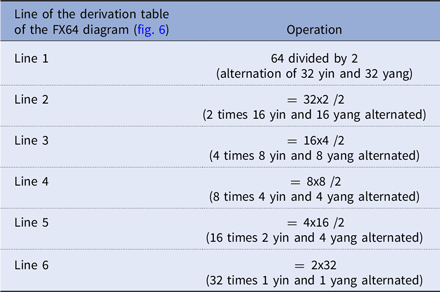
The superimposition of Leibniz’s binary table on that of Shao Yong’s derivation (fig. 6) reveals the similarity of the principle that governed their construction. The principle behind the development of the two systems is identical but applied in reverse. This principle is represented in table 3:
The principle behind the development of the two systems

This superposition of the two tables also shows that in line 6, Leibniz starts from the alternation of the dyad 0 and 1, which is the end point of the derivation table of Shao Yong (see bottom table of figure 6). Leibniz builds his binary table in the sense of multiplication, which can be read on the diagram, from top to bottom (line 6). In the first column, there is the alternation of 0 and 1, then in the second 0, 0, 1, 1 etc. which is a doubling of the previous alternation. Shao Yong starts from the yin and yang dyad, which is on line 1, that is to say opposite the starting line of the Leibniz system. Shao Yong builds the FX64 diagram’s derivation table in the direction of the division, which can be read in the diagram from bottom to top. The transformed derivation table shows the division of line 1 of 32 yin into two times 16 yin and of the 32 yang into two times 16 yang on line 2. This gives the following progression:
Derivation of the lines and the corresponding operation

Leibniz’s starting point is therefore Shao Yong’s point of arrival if one reasons according to the direction of creation of the two systems. Leibniz does not end at line 1 (or column 1 in fig. 6) at the simple dyad, but at a repetition of an element of the dyad, namely 0000000000 and 1111111111 from the point of view of numbers and quantity. Thus, from the point of view of form and philosophical symbolism, there is a set of 1 which gives a large yang unit and a set of 0 which gives a large yin unit.
This clarifies the analysis of Olivier Roy, who argues that it is possible to assign a binary number to each hexagram and states that it “is not surprising, from the moment we have a progression of two elements — and – –, 0 and 1, etc.” (Roy Reference Roy1972, 164). This remark is indeed not surprising, but for a different reason than that which he invokes. When one considers the superposition of the derivation table of Shao Yong and the binary table of Leibniz, the two systems coincide because they are built according to the same principle, the radix two, namely the multiplication by two or the division in two of a dyad in a different sense as already seen, from top to bottom for Leibniz with multiplication and from bottom to top for Shao Yong with division. Since the two systems are superimposable, so are the elements. Thus, to each hexagram can be assigned a binary number. It is not only because there are two elements that a hexagram coincides with a binary number; it is mainly because they are organized according to the same principle. Each hexagram of the WW64 diagram is also translatable into a binary number, but this arrangement is not organized according to a binary principle, it is a different order.
2.I.2. The structure of the FX64 diagram
In addition to the method of the diagram’s creation, the structure created by that method is itself binary. The structure is a whole formed of united phenomena, each dependent on the others, and only able to be what it is in this relationship with them (Lalande Reference Lalande1999, 2:1031). The methodology and its principle create the structure of the FX64 diagram, and this structure, as seen in the superposition of figure 6, is identical to that of Leibniz’s binary table. Stephen E. McKenna and Victor H. Mair assert in this sense that Shao Yong indeed “derived his binary code not mathematically but by means of a chart” (McKenna and Mair Reference McKenna and Mair1979, 428). A code is a system of symbols, and it is binary if it is made up of two elements. Thus, the FX64 diagram, the system that Shao Yong built, is composed of the symbols yin and yang, and can be called binary. The two authors maintain that there is an almost perfect correspondence between the diagram and Leibniz’s binary number system, and that the structure represented by the code is indeed binary (ibid., 423).
In her explanation of Shao Yong’s philosophy, Anne Cheng specifies that the philosopher’s goal was to “show the correlation between the structure of Heaven-Earth and human knowledge through the hexagrams of Mutations,” which represents evolving situations and an elaboration of reality (Cheng Reference Cheng1997, 434). Shao Yong thus tried to explain the nature of the change that represents the first motive of the dynamism of the world, and finds its origin in the Taiji. As seen in the Taiji, the different levels of reality follow one another, represented by yin and yang for two, the four images of the sky for four, etc. In his analysis of reality, Shao Yong therefore distinguishes various levels, which are relative to an adopted point of view. Cheng explains that the structure of explanation of the different levels of reality is binary (ibid., 435). It is based on two—or on a pair of—elements. It is therefore logical that the explanatory diagram of the mutations of the world is based on this binary structure, which characterizes Shao Yong’s thought.
2.I.3. The form of the FX64 diagram
Finally, one can argue that the FX64 is binary from the point of view of the form, understood as the quality of an object resulting from its structure, which is embodied by the lines and surfaces that delimit it. The methodology and its principle, which create the structure of the FX64 diagram, shape a relation that links the two elements of the system (yin and yang) in such a way that the structure of this system is supposed to be binary, since the methodology and its principle are themselves binary.
According to some scholars, this relationship, organized according to the principle of doubling for Leibniz, or splitting in two for Shao Yong, of the alternation of a dyad, produces a binary representation or a binary model. Andreas Schöter indeed asserts that the Yijing itself is “a system of symbols based on a binary representation” (Schöter Reference Schöter1998, 19). The FX64 diagram is taken from the explanation of the world structure coming from Taiji, which generates yin and yang. It is not only binary by its two elements, but binary on its structure, which represents a binary relation. James A. Ryan uses the same expression of binary representation and argues that “the Diagram” is “itself a de facto representation of the binary system” (Ryan Reference Ryan1996, 66).
The FX64 diagram would therefore be a binary representation, but also a binary “model” as a diagram of the Taiji. A model is a thing or a person who, by virtue of its characteristics, its qualities, can serve as a reference for imitation or reproduction. According to Gu Mingdong, the FX64 diagram represents this binary thought because it represents Chinese thought, the mechanisms of which are based on binary opposition. This suggests that binary opposition is the very way of thinking in Chinese philosophy. Thus, for the scholar, the FX64 diagram, as a Taiji diagram, is a system whose logic is common with binary arithmetic, and which, in this sense, represents a model of the functioning of the human mind, which rests on two elements, just like binary arithmetic and computer language (Gu Reference Gu2009, 171). Ultimately, then, the FX64 diagram is binary as it contains a relation, verifying certain characteristic properties, which links two elements of a set and which has a binary form or a binary structure.
2.2. Solving the “wrong” reading direction used by Bouvet and Leibniz
Bouvet and Leibniz read the square and round diagram in the opposite direction to that used in China (see fig. 8).
Reading directions of the circle and square diagrams the FX64 diagram sent by Father Bouvet to Leibniz, attached to his letter of November 4, 1701 (Widmaier and Babin Reference Widmaier and Babin2006, 376–377). Source: Gottfried Wilhelm Leibniz Bibliothek – Niedersächsische Landesbibliothek, Hannover (shelf mark: LBr 105, Bl. 27(LK-MOW Bouvet10); LBr 105, Bl. 28 (LK-MOW Bouvet10)).

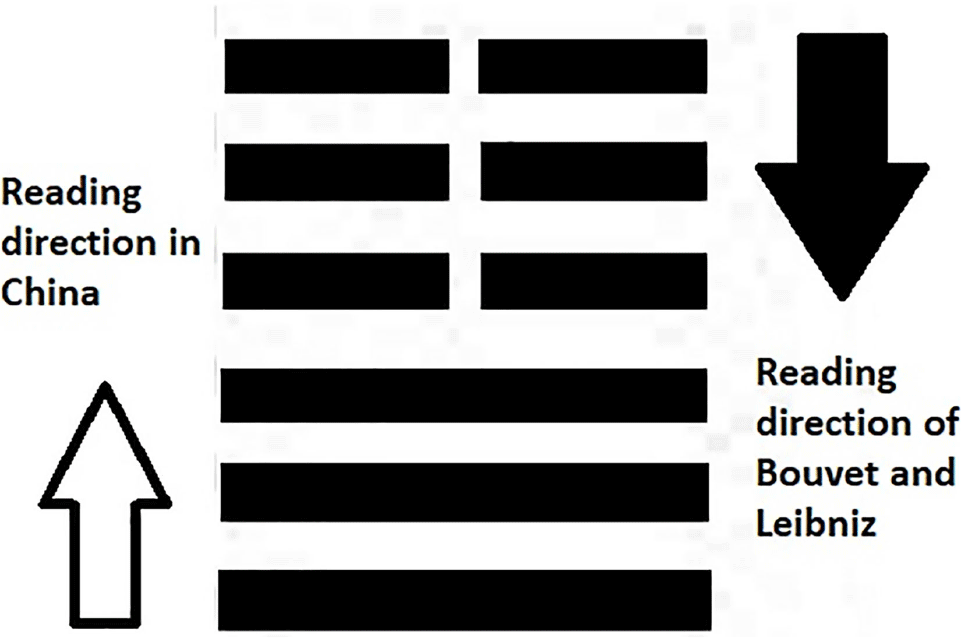
Leibniz describes the reading direction for the round diagram in his letter of May 18, 1703 to Bouvet, where he writes that one is to start at the bottom of the right half, then go up to the top in the center; then start again at the bottom of the left half and go up to the top. However, if one follows the order of the hexagrams, the reading direction of the FX64 circle diagram begins with the left half from top to bottom, then the right half from top to bottom. Likewise, for the reading of the square, Bouvet and Leibniz start reading from the top left, reading the lines from left to right, to finish at the bottom right. The Chinese way starts from the bottom right, reading the lines from right to left, and going up to the top left. The reading directions are therefore opposite (see fig. 8). Likewise, the reading direction of the hexagram itself is from bottom to top (see fig. 9). In other words, one has to start from the center of the circle to go up, the top of the hexagram being outside the circle. However, even if Leibniz was aware of this direction,Footnote 16 he and Bouvet read them the reversed way, from top to bottom (see fig. 9).
Reading directions of hexagram. Drawn by the author.

Some scholars argue that the reverse reading direction for the square diagram does not invalidate the analogy established by Joachim Bouvet between the two systems. Bouvet and Leibniz start with kun  , 0 in decimal system, and assign it 000 000, then they continue with bo , 1 in decimal system 000 001, and so on. But they read the hexagram in the opposite direction from the tradition in China, which is from bottom to top. Thus, according to Mungello, the sequence of kun 000 000, namely 000 001 in binary, would be fu instead of bo. However, this difference in reading does not invalidate the analogy established by Bouvet. Mungello argues that “such a reversal of the order of counting lines would complicate, but not invalidate the correspondence in principle,” Adding that “the correspondences between the hexagrams and the dyadic were remarkable and neither Bouvet nor Leibniz was in frame of mind to disregard them as coincidental” (Mungello Reference Mungello1989, 319).
Mungello therefore specifies that the FX64 diagram matches with a binary progression, while this is not the case for the other orders of hexagrams like the WW64 diagram (ibid., 206). The FX64 diagram would therefore conform to a binary progression. Since Bouvet studied the Yijing, Mungello thinks he could not have been unaware of the reading direction used by the Chinese. This is why he thinks that reading from top to bottom was not a sign of Bouvet and Leibniz’s ignorance, but rather a mark of the flexibility of Shao Yong’s system (Mungello Reference Mungello1977, 51). He therefore concludes that the analogy comes “from the basic fluidity of that order, which permits several possible readings” (ibid., 52).
The flexibility noted by Mungello is also reflected in Anne Cheng’s reference to the “mechanical play” of combinations of the yin and yang dyad.Footnote 17 The Yijing contains a possibility to play and explore all the possible combinations of the two terms, such as negation (transformation of a hexagram into its negative line for line), inversion (hexagram read backwards), modification of lines, “nuclear trigrams” (lines 2-3-4 and 3-4-5), etc. But in doing so, the tremendous figurative potential of the Mutations is channeled and compartmentalized in a grid that ends up being limited to a purely mechanical game (Cheng Reference Cheng1997, 278).
However, figure 6 shows that the flexibility of the FX64 diagram in allowing different reading directions does not make the diagram binary. Rather, it is binary because the reverse construction of the systems allows the opposite reading direction and leads to the same structure. The reading direction therefore does not invalidate the analogy between the FX64 diagram and binary Leibniz arithmetic, and consequently the progression of this diagram is indeed binary because of the reversed construction of the two systems.
As a consequence, this mechanical game of the trigram formation is not devoid of methodology or guiding principle, which orchestrates the construction so as to give a binary arrangement. Were that the case, a combinatorial without a binary principle would produce a diagram like the WW64 diagram. A combination of two elements is common in the methodology that presides over this common arrangement. One just has to combine the lines with each other in a certain manner, but when it comes to ordering according to the Xiantian, it is not so obvious. This is not compatible with the idea of flexibility. The manner of combining must follow a certain methodology and a certain order, and they are determined by the principle which presides over the construction of the arrangement of the two systems.
Finally, the reversed methodology of the two thinkers, multiplication and division, explains the counterargument of the opposite reading direction. It is possible to read the derivation table (fig. 6) from the bottom (division of the dyad), or from the top (multiplication of the alternation of the dyad). Division is the reverse of multiplication. For example, 7x6 = 42 and 42/6 = 7. The multiplier or divisor is the same, and gives the same results in one direction or the other. This close relationship between division and multiplication explains why Bouvet read the FX64 in reverse from the Chinese, and it is indeed the key to the analogy between the two systems. Leibniz started on one side, while Shao started on the other. The two result in the same arrangement although the method is reversed. Finally, the arrangement is an identical system that can be read from above or below, namely by beginning either with Leibniz’s methodology, multiplication, or with Shao Yong’s methodology, division.
3. Conclusion
The purpose of this article was to clarify whether the FX64 diagram could be qualified as “binary.” To conclude, the FX64 diagram is “binary” in the first sense because it has two simple and complementary elements, yin and yang. This, however, is not sufficient for the system to form a binary progression analogous to that of binary arithmetic; otherwise the WW64 diagram could also be qualified as “binary” in the third sense, whereas it is only in the first sense. Thus, concerning the second sense of binary, the FX64 diagram is binary because the zero is not necessary for an object to be binary. It is enough that it consists of two states, represented by a pair of signs.
Finally, regarding the third sense of “binary,” the analysis based the superposition of the two systems (fig. 6) reveals three points. The first is that the starting point for the development of the two systems is different. Shao Yong begins with a dyad while Leibniz alternates the dyad. Shao Yong starts from the bottom and horizontally while Leibniz starts from the top and vertically. Secondly, the process of operation is reversed, since Leibniz proceeds by multiplication, while Shao Yong proceeds by division, or more specifically—by division when it is a question of cosmological symbolism, but by multiplication when it is a question of the number of formed figures which are smaller in size. These two processes of multiplication and division are therefore reversed because of their different purpose, but ultimately produce the same arrangement. This proves that the principle that governs the arrangement of the pairs of signs is identical, because the two thinkers operate by the application of a radix two, in other words their system rests on a base two, either a repetition (doubling) for Leibniz or a duplication (splitting in two) for Shao Yong.
Finally, since these operations can be the reverse of each other, this gives an arrangement that can be read one way or the other. When Shao Yong creates his system by division, it is possible to read it backwards and find the multiplication process that Leibniz used to build his binary arithmetic. If the directions are different, it is because the two systems have the same principle, producing the same result but starting and proceeding in a reversed way. This analysis thus solves the issue of the reading direction used by Bouvet and Leibniz being the opposite of that used in China. This does not invalidate the analogical relationship between the two systems, which are identical in form caused by the reverse construction of the systems.
Identifying the methodologies of construction of the binary arithmetic and the FX64 diagram not as different, but reversed with the multiplication and division, offers an original contribution to this debate of recognizing the FX64 diagram as binary. This new analysis solves the problem of the opposite reading direction used by Bouvet and Leibniz and consequently invalidates the other main counterargument of the two systems’ different methodologies of construction. Finally, it links the two counterarguments into one issue, since the reversed construction allows the possibility of reading the structures in one direction or the other. This has consequences for the history of binary arithmetic, or the general history of logic or of logic in China, since the FX64 diagram could appear as an early binary form.
Competing interests declaration
The author declares none.
Marie-Julie Maitre is professor at French National Education in France since 2023. Between 2012 and 2022, she was Associate Professor of French Literature and Philosophy in the French Department at Tamkang University, Taiwan, and Research Fellow in the Department of Asian and International Studies of City University of Hong Kong in 2010-2012. She researches East-West Cross-Cultural Intellectual Studies, especially reception and influence of the Yijing (易經), the Book of Changes, among philosophers and writers in Europe/France. Her Ph.D. dissertation on philosophy, completed in 2010, addresses the travel of ideas and theories, in particular the reception and representation of Chinese philosophy in France from the sixteenth to the twenty-first century.