Anomalous aortic origin of a coronary artery with an interarterial, intramural, and/or intraconal course is a relatively rare congenital anomaly that may be associated with increased risk of ischaemia of the myocardium, lethal arrhythmias of the ventricle, and sudden death. Although most anomalous coronary arteries are benign and are of intellectual interest only, it is imperative for medical professionals to recognise those in which the risk of sudden death may be greater than what is expected in the general population. Observational studies have identified those coronary anomalies in which the risk of sudden death appears to be very high: when both the coronary arteries arise from the same aortic sinus with either one ostium or two separate ostia. This is what we refer to as anomalous aortic origin of a coronary artery from the wrong or inappropriate coronary sinus.
There are different courses that the anomalous coronary artery can take, and the risk appears to be related to which coronary artery is arising aberrantly and the subsequent course that it takes. Both the anomalous aortic origin of the left main coronary artery and the anomalous aortic origin of the right coronary artery can travel anterior to the pulmonary artery or posterior to the aorta. The anomalous left main coronary artery or the left anterior descending coronary artery may course through the conal septum. These subtypes are generally not believed to carry a significantly increased risk of ischaemia of the myocardium and sudden death. On the other hand, when the anomalous left main coronary or the right coronary artery courses between the aorta and the pulmonary artery, it has the potential to increase the patient’s risk for sudden death, notably in otherwise healthy young people usually during or just after exercise. The interarterial course is believed to be clinically significant due to the acute angle with which the coronary artery arises from the aorta, creating an ostium that is narrow and elliptical, along with a course within – or intramural – the aortic wall.Reference Angelini, Velasco, Ott and Khoshnevis1–Reference Frescura, Basso and Thiene4
Prevalence and sudden death risk
The true prevalence of congenital coronary anomalies in the general population is difficult to ascertain. The differences are likely due to the definition of coronary anomalies, the patient population selected (autopsy series versus alive patients) and the imaging modality utilised. Focussing specifically on the anomalous aortic origin of a coronary artery, estimates in the population range from 0.1 to 0.7%.Reference Yamanaka and Hobbs5–Reference Angelini8 In most studies, interarterial anomalous right coronary artery is three to six times more common than interarterial anomalous left coronary artery.Reference Yamanaka and Hobbs5, Reference Angelini8
Risk of ischaemia to the myocardium, arrhythmias of the ventricle, and sudden death appear to be the highest in those participating in vigorous athletics.Reference Basso, Maron, Corrado and Thiene9–Reference Maron, Haas, Ahluwalia and Rutten-Ramos11 Maron et al in 2009 published an analysis of competitive athletes over a 27-year period who experienced sudden death in the United States of America.Reference Maron, Doerer, Haas, Tierney and Mueller10 For those with anomalous coronary arteries, the incidence of sudden death would be ~0.1/100,000 person-years. Using these data and making certain assumptions, Brothers et al calculated the cumulative risk of death for competitive athletes over a 20-year period between 15 and 35 years of age and found it to be 6.3% for those with interarterial anomalous left coronary artery and 0.2% for those with interarterial anomalous right coronary artery.Reference Brothers, Carter, McBride, Spray and Paridon12 These analyses pertain to those competing in competitive athletics. Apart from competitive athletes, in whom only a very small number (<100) of sudden death events occur every year, in young people with anomalous coronary arteries not participating in sports, even in those with anomalous left coronary arteries, the risk of sudden death is likely no more than the risk of sudden death for other young people participating in competitive sports who do not have an anomalous coronary artery.
Nevertheless, it is important to recognise that these statistics are obtained from autopsy series data. It is imperative to prospectively evaluate the risk of sudden death and what may cause this risk in living patients, and therefore the Congenital Heart Surgeons’ Society Registry of Anomalous Aortic Origin of a Coronary Artery was formed.
Rationale for and the objectives of the registry
The multi-institutional Congenital Heart Surgeons’ Society Registry of Anomalous Aortic Origin of a Coronary Artery was formed in 2009 and was created by the Anomalous Coronary Artery Working Group, which is an interdisciplinary group of cardiologists and cardiothoracic surgeons who are members of the Congenital Heart Surgeons’ Society. It was formed because of the many challenges practitioners experience when a patient is diagnosed with a coronary anomaly; details of the establishment of the Registry were presented in a previous manuscript.Reference Brothers, Gaynor and Jacobs13 Largely because of our inability to adequately risk-stratify patients, treatment and management of patients with anomalous aortic origin of a coronary artery remain controversial and is institution- and clinician-dependent. Although a prospective randomised, case-controlled clinical trial is the gold standard, it is not feasible in this population as the end points that would need to be followed-up, such as ischaemia to the myocardium, arrhythmias, and sudden death, occur far too rarely. In addition, in order learn more, we need larger patient numbers. Thus, the Registry was started with the following objectives: (1) to determine the natural and “unnatural” (surgical) history of anomalous coronary arteries, (2) to develop predictive models of these natural and “unnatural” histories, allowing risk stratification, (3) to determine the morbidity and mortality of different management methods, (4) to obtain follow-up data to assess long-term clinical outcome over time, and (5) to develop evidence-based treatment and management guidelines.
Our inclusion criteria were the following: 30 years of age or younger at the time of diagnosis, diagnosed or treated at a Congenital Heart Surgeons’ Society member institution from 1998 to present, and patients without complex congenital heart lesions. We did not include older adults in the Registry for two main reasons. First, because sudden death is significantly higher in the young, and this was the population that we wanted to study. Second, as this was a Congenital Heart Surgeons’ Society study, nearly all of the member institutions treat children and young adults, and thus would not include the older adult population.
Results from the registry
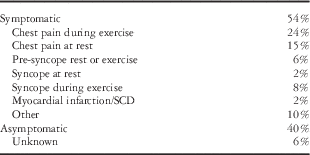
After collecting data for over three years, members of the Anomalous Coronary Artery Working Group analysed the data from the first 198 patients enrolled in the Registry from 23 member institutions. We published our findings in early 2014, and an overview is discussed below.Reference Poynter, Williams and McIntyre14 The median age at diagnosis was 10.2 (range 0–29.3) years, and the median age as of June 2012 was 14.3 (range 0.7–32.8) years. The cohort at that time was comprised of 64% males. There were 143 patients with anomalous right coronary artery, 51 with anomalous left coronary artery, and four where both the coronary arteries arose aberrantly. This resulted in an approximately three-to-one ratio of patients with anomalous right to anomalous left coronary arteries. A little over half (54%) of the patients presented with symptoms at the time of diagnosis (see Table 1), with nearly 40% of the patients experiencing chest pain at rest or during exercise. Half of the patients with anomalous right coronary artery (n=71) were referred for surgery, whereas nearly two-thirds of the patients with anomalous left coronary artery (n=30) underwent surgical repair; three of the four patients with both coronary arteries arising anomalously (75%) were referred for surgery. When looking at all the patients, 102 (52%) underwent surgery for anomalous coronary artery. In addition, two patients were diagnosed with coronary anomaly at autopsy after experiencing sudden death: one with anomalous left coronary artery and one with a single ostium above a commissure from which both the left and the right coronary arteries arose.
Symptoms at diagnosis.
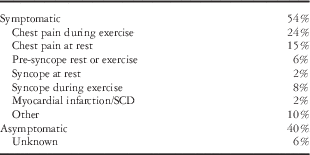
SCD=sudden cardiac death
Adapted from Poynter et alReference Poynter, Williams and McIntyre14
When patients are enrolled in the registry, medical record data are obtained from the patient’s chart and abstracted into the database at the Congenital Heart Surgeons’ Society Data Centre. As part of the abstraction, characteristics of the coronary anatomy found during imaging and operative reports are separated into individual parts to enable us to better categorise and evaluate the anatomy. We called this “atomised” data. From these data, we used univariable and multivariable regression analyses to evaluate demographics, symptoms and coronary morphology, and their association with surgical referral. We found that surgical referral was associated with the following: symptoms at presentation, certain coronary morphology, and an older age at diagnosis; however, anomalous left coronary artery with an interarterial and intramural course was by far the most influential predictor of referral for surgery. Interestingly, no predictor variables were identified on multivariable regression. In those who were referred for surgery, 91 patients (87%) underwent a modified unroofing procedure.
We also utilised a modified Pearson’s correlation coefficient – Cramer’s V – to correlate coronary morphology with clinical history. When looking at anomalous left coronary artery diagnosed by imaging and intramural anomalous left coronary artery at surgery, there was a small-to-moderate positive association with syncope with exercise. There was a negative association between anomalous right coronary artery and syncope with exercise, but a small-to-moderate association with intramural anomalous right coronary artery at surgery and chest pain with exercise. Indeed, it is important to remember that association is not causation. It is not surprising that anomalous right coronary artery, which is a much more common coronary anomaly, is associated with chest pain, which is also a frequent complaint in the paediatric population as well as the population with anomalous right coronary artery. Nevertheless, it is interesting that there is an association between the anomalous left coronary artery, which is much less common than anomalous right coronary artery, and syncope with exercise, which is also an uncommon presentation. In someone who experiences true syncope with exercise, close attention should be paid to the coronary anatomy during echocardiography.
From this study, we concluded that approximately half of the patients with anomalous right coronary artery and nearly two-thirds of those with anomalous left coronary artery underwent surgery. Most of those referred for surgery had an intramural anomalous coronary artery and underwent the modified unroofing procedure. Surgical referral appears to be related to symptoms and coronary morphology. There continues to be significant variability in management practices among individuals and institutions.
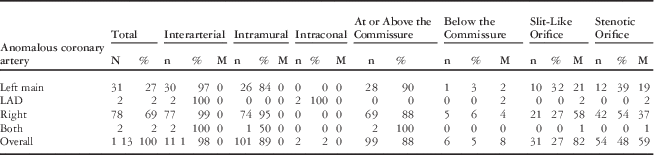
The following year, members of the Anomalous Coronary Artery Working Group reviewed the Registry data to evaluate the surgical techniques utilised for different coronary morphologies and the results were subsequently published in 2014.Reference Poynter, Bondarenko and Austin15 At the time of analysis, the Registry consisted of 217 patients from 29 member institutions, 113 of whom had undergone surgical repair, and the manuscript focussed on these 113 patients. The study population consisted of 78 patients (69%) with anomalous right coronary artery, 31 (27%) patients with anomalous left coronary artery, 2 (2%) with anomalous left anterior descending coronary artery, and 2 (2%) with both the coronary arteries arising from the wrong sinus. The median age at surgery was 12.6 years. As described above, we utilised “atomised” data to describe the morphological features of the coronary anatomy that was encountered during the operation, as noted on operative reports. The anatomical data are shown in Table 2. Almost all surgeries (n=111, 98%) were performed on patients with interarterial coronary arteries; the other two patients (2%) had an intraconal course of the left anterior descending coronary artery. In addition, nearly all patients had an intramural component (n=101, 89%). When looking at the proximal coronary anatomy at surgery, the anomalous coronary ostium was located at or above the commissure in 99 patients (88%). A slit-like or stenotic orifice was noted in 85 of them (75%), but there was a large number of cases with missing information regarding the description of the anomalous ostia.
Morphological characteristics encountered at operation for AAOCA.
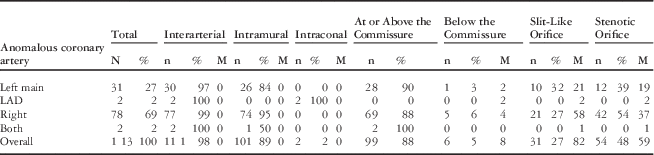
M=number missing; LAD=left anterior descending coronary artery; AAOCA=anomalous aortic origin of a coronary artery
Adapted from Poynter et alReference Poynter, Williams and McIntyre14
n=113 patients
Surgical techniques utilised for different coronary morphologies were analysed. The unroofing procedure was the most common surgery performed in all except one of the 101patients with an intramural anomalous coronary artery (n=100, 99%). The exception was a coronary artery bypass graft performed in a patient with both an intramural and a deep intraconal course with evidence of ongoing ischaemia of the myocardium. An aortic valve commissure was taken down in 37 (33%) of the operations and re-suspended in most cases (n=33, 89%). Although there were no data on the length of the aortic valve commissure taken down, it was often described as “short” in the operative report. Other surgical techniques utilised included the following: coronary artery re-implantation in 11 patients, five of which were interarterial but not intramural, relocation or translocation of the pulmonary artery in seven patients, five of which were interarterial but not intramural and two that were also intramural and included unroofing, simple ostioplasty in three patients, ostial window in three patients, coronary artery bypass graft in two patients, and side-to-side anastomosis from outside the aorta without unroofing in one patient.
From these data, we concluded that unroofing of an intramural segment was the most common technique, but morphological variants require other surgical strategies. Owing to the amount of missing information detailing the coronary and ostial morphologies, more detailed operative reports are necessary.
Another manuscript from the members of the Anomalous Coronary Artery Working Group is currently under peer review for publication. This review focusses on assessing variability among echocardiographic images and reports, correlates echocardiographic images with surgery, and includes recommendations for “best practice” for imaging coronary arteries. Details of our findings and recommendations will be present in the manuscript after publication.
Current status of the registry
As of January 2014, there are 378 patients enrolled in the Registry from 35 participating member institutions (see Fig 1). There are 281 patients (74%) with anomalous right coronary artery, 91 with anomalous left coronary artery (24%), and 6 (1.6%) with both the coronary arteries arising aberrantly. There continues to be an approximate three-to-one ratio of anomalous right to anomalous left coronary artery. With regard to the management, just over one-half (n=158, 56%) of those with anomalous right coronary artery were referred for surgery, whereas 69% (n=63) of those with anomalous left coronary artery underwent surgical repair. In total, 225 of the patients (59.5%) in the Registry have undergone surgical repair to date.
Cumulative yearly enrollment and number of participating institutions in the registry.

Future directions
The Congenital Heart Surgeons’ Society Registry of Anomalous Aortic Origin of a Coronary Artery is the largest registry focussing solely on anomalous coronary arteries in the world and it continues to grow. We look forward to many future studies from the registry, with projects including but not limited to the following: evaluating body mass index in relation to diagnosis and management; examining the influence of coronary morphology and the surgical technique on outcomes; comparing the medium- and long-term natural history with the post-operative outcomes; defining the optimal imaging technique for assessing the length of the intramural segment and comparing with surgery or autopsy reports; and determining which, if any, morphological characteristics are associated with symptoms and ischaemia to the myocardium.
Acknowledgements
The authors express their gratitude to the Anomalous Coronary Artery Working Group members as well as to the patients and families participating in the Congenital Heart Surgeons’ Society Registry of Anomalous Aortic Origin of a Coronary Artery.
Financial Support
The Congenital Heart Surgeons’ Society Registry of Anomalous Aortic Origin of a Coronary Artery has been graciously funded by Michael H. Ludwig Memorial Foundation, Anthony’s Heroes for Hearts, Children’s Heart Foundation, Cardiac Centre at the Children’s Hospital of Philadelphia, Cardiovascular and Critical Care Research Centre, Children’s Hospitals, and Clinics of Minnesota, and Cardiac Surgery Research and Teaching Fund, Hospital for Sick Children, Toronto.
Conflicts of Interest
None.
Ethical Standards
The authors assert that all the procedures contributing to this work comply with the ethical standards of the relevant national guidelines on human experimentation and with the Helsinki Declaration of 1975, as revised in 2008, and has been approved by the institutional review boards or ethics committees at each participating centre. Informed consent was obtained before enrolment into the Registry.