Heart failure (HF) is a serious disease with prevalence rates in Europe and the United States ranging from .3 percent to 2 percent (Reference Dominguez, Parrinello and Amato15). A recent estimate has 5 million cases in the United States alone (2). Patients in end-stage heart failure (ESHF) have a poor prognosis, with 1-year mortality of 50 percent or more (Reference Cleland12;Reference Philbin37;Reference Zaman50). Approximately 100,000 new cases of ESHF each year in the United States could benefit from advanced therapeutic intervention (Reference Long, Kfoury and Slaughter30). In England and Wales, there are 10,000–15,000 new ESHF cases annually (Reference Clegg, Scott and Loveman11). Heart transplant (HT) offers the best outlook in terms of length and quality of life (Reference Fisher, Lake and Reutzel20;Reference Hussey, Bond and Collett25;Reference Noon, Morley, Irwin, Goldstein and Oz34) but is unavailable in many cases (Reference Evans, Rose and Stevenson16;Reference John26;Reference Richards, Nelson and Frazier40). Long-term treatment with a left ventricular assist device (LVAD) was sanctioned by the US Food and Drug Administration (FDA) in 2002 (17) and is widely regarded as the most promising alternative for patients not eligible for HT (Reference Lietz and Miller28;Reference Siegenthaler, Westaby and Frazier44;Reference Stevenson and Shekar46).
There are several types of implantable LVADs. The so-called first-generation devices generate pulsatile flow using a displacement pump. Second-generation pumps provide continuous (nonpulsatile) blood flow and address some of the shortcomings of the first-generation devices (Reference Clegg, Scott and Loveman11;Reference Derose, Jarvik, Goldstein and Oz14;Reference Noon, Morley, Irwin, Goldstein and Oz34;Reference Siegenthaler, Westaby and Frazier44;Reference Tsukui, Winowich and Stanford48). The only completed randomized controlled trial (RCT) of LVADs as destination therapy (the Randomized Evaluation of Mechanical Assistance for the Treatment of Congestive Heart Failure [REMATCH] trial) (Reference Rose, Gelijns and Moskowitz42) reported convincing evidence of efficacy and effectiveness for a first-generation device, but has led to unfavorable assessments of the cost-effectiveness of the treatment compared with optimal medical management (OMM). Based on REMATCH data, one study (4) estimated that LVADs are cost-effective at valuations of more than US$800,000 per quality-adjusted life-year (QALY), a figure well in excess of UK norms (Reference Rawlins and Culyer39) and probably too expensive even for the richest healthcare provider.
Advances in pump technology (Reference Kirklin and Holman27), and improvements in the clinical management of LVAD patients (Reference Long, Kfoury and Slaughter30) can be expected to improve the survival prospects for LVAD patients, perhaps to the extent where these improvements would outweigh the high cost of treatment. Second-generation nonpulsatile pumps offer particularly good prospects and are the subject of several ongoing surgical trials (Reference Kirklin and Holman27). Further randomized trials are contemplated, which might throw further light on the benefits of the therapy. At the same time, innovation in pump technology continues unabated (Reference Takatani47), although doubts remain whether the so-called third-generation pumps can generate significant additional health benefit (Reference Hoshi, Shinshi and Takatani24).
In this study, our purpose is threefold: (i) to examine the survival benefit that LVADs would need to generate to be cost-effective compared with OMM; (ii) to provide insight into the likelihood that this benefit will be achieved; and (iii) from the perspective of a healthcare provider, to assess the value of discovering the actual size of this benefit using a Bayesian value of information analysis (Reference Claxton and Posnett9;Reference Claxton, Sculpher and Drummond10). Our aims are addressed through a health–economic model for LVAD therapy based on the REMATCH experience translated into a UK cost setting. In the cost analysis, the price of the device itself is the most significant uncertainty, especially as it may well fall in response to future market growth (Reference Day and Montgomery13;Reference Henderson22). Expectations surrounding future patient survival are captured probabilistically using Bayesian prior distributions elicited from a group of leading experts.
A MODEL FOR LVADS AS DESTINATION THERAPY
The patient population is defined by the entry criteria to the REMATCH trial (Reference Rose, Moskowitz and Packer41;Reference Rose, Gelijns and Moskowitz42). It comprises adults with chronic ESHF not eligible for HT, and with ongoing symptoms of New York Heart Association class IV. This population is modeled as a homogeneous group, disregarding the possible impact of prior risk factors, such as patient age. The operation itself is taken as the starting point for both costs and patient survival, and the modeled pathway terminates with death. Waiting time for the operation to implant an LVAD is not considered here. The operation is followed by a period of “initial hospitalization,” which terminates when the patient is discharged. Subsequently, patients receive ongoing medical care based on regular outpatient visits, and that care may include periods of readmission to the hospital. The treatment cost is taken to include the cost of the device, the cost of initial hospitalization (including all costs associated with the operation), and the ongoing costs of care until the death of the patient. The first two components are treated as fixed costs (i.e., independent of survival time) and the ongoing care cost as proportional to the patient's survival time after discharge. In the REMATCH trial, the initial hospitalization costs for patients successfully discharged from the hospital were substantially less than for those who were never discharged, both in aggregate and also when converted to a daily rate (Reference Oz, Gelijns and Miller35), a finding confirmed by subsequent experience (Reference Miller, Nelson and Bostic31). In the model, LVAD patients are divided into two groups: “Successes,” those who are successfully discharged; and “Failures,” who never leave the hospital. The ratio of average hospitalization costs for Successes and Failures is taken from the REMATCH experience as 1:2.3 per patient (Reference Oz, Gelijns and Miller35). The overall average hospitalization costs derive from UK estimates. Improvements in LVAD therapy will increase both the patients' overall life expectancy and the proportion of treatment Successes. An increase in the latter is automatically associated with reduced hospitalization costs per patient.
Similarly, improvements in patient survival will affect the costs of ongoing medical care. The obvious effect is to increase them. Nevertheless, it is likely that recognized improvements in long-term survival will impact on follow-up protocols and also lead to a reduction in the proportion of survival time spent in hospital readmissions. These effects are modeled by allowing both the frequency of outpatient visits and the fraction of time in readmission to be inversely proportional to the average life expectancy among the treatment Successes. As a result, the outpatient interval ranges from 7 weeks (Reference Siegenthaler, Westaby and Frazier44) to 3 months under an optimistic life expectancy of 80 months postimplantation in the Success group. The time spent in readmission ranges from 10 percent (Reference Rose, Gelijns and Moskowitz42) to an optimistic 5 percent of the time after initial discharge.
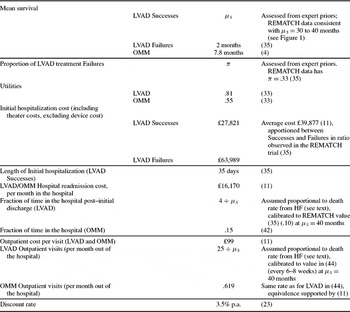
Table 1 summarizes the model parameters. Cost estimates rely heavily on the recent study by Clegg and others (Reference Clegg, Scott and Loveman11). The cost of the device is treated as an exceptional case. It was around US$60,000 for a first-generation device in the REMATCH trial (Reference Rose, Gelijns and Moskowitz42), whereas Siegenthaler and colleagues (Reference Siegenthaler, Westaby and Frazier44) paid GB£60,000 for a second-generation device. In the future, the price may be affected by technological developments and changes in uptake. This uncertainty is treated here by presenting results over a range of device costs.
Sources for Model Parameters

LVAD, left ventricular assist device; REMATCH, Randomized Evaluation of Mechanical Assistance for the Treatment of Congestive Heart Failure (REMATCH); OMM, optimal medical management; HF, heart failure; p.a., per annum.
The incremental cost-effectiveness of LVAD therapy is defined relative to OMM, which entails regular outpatient visits and may include periods of admission to the hospital. The outpatient interval is taken as 7 weeks (Reference Siegenthaler, Westaby and Frazier44), and the hospitalization fraction as 15 percent (4). Daily hospitalization costs are assumed the same as those under LVAD.
Patient Survival
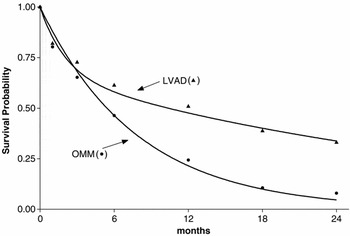
Patient survival under OMM is described by the exponential (constant hazard) distribution (4) in Figure 1, with mean survival suggested by the REMATCH trial (4). For LVAD patients, death can occur either during initial hospitalization (treatment Failure) or following discharge (treatment Success). Separate exponential survival distributions are used for Successes and Failures. The mean survival time for a Failure was taken as 2 months (Reference Oz, Gelijns and Miller35). This timing is the average length of stay in the hospital for a patient who does not survive the initial hospitalization, and is regarded as fixed. The key parameters for determining the life expectancy of patients under LVAD are as follows: π, the proportion of Failures; and μS, the mean survival time for Successes.
Actual and modelled survival of patients in the REMATCH trial. OMM, optical medical management. (Data from ref. 4 with revised 24 month LVAD estimate from Park et al. [36]).

In the REMATCH trial of first-generation devices, π is estimated as .33 (=17/51) (Reference Oz, Gelijns and Miller35), and a good fit to the survival distribution reported to the FDA (3) is obtained by taking μS = 35 months, as in Figure 1. Subsequent improvements in survival under LVAD (Reference Long, Kfoury and Slaughter30;Reference Park, Tector and Piccioni36) can be modeled by increasing μS and/or by reducing π.
The mean survival time is modeled as 2π+μS(1−π). Provided that Successes account for more than half the patients, the median survival time is (approximately) m=μS loge{2(1−π)}.
In this model, the probability of death in the hospital within 30 days of the LVAD implantation is given by 0.39 × π. Hence, π is proportional to a clinical “perioperative mortality rate,” whereas the value of μS is just the life expectancy of successfully treated patients.
THE FUTURE COST-EFFECTIVENESS OF LVAD THERAPY
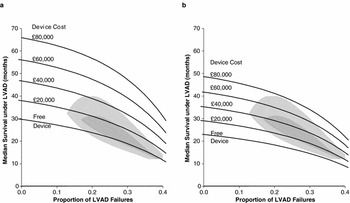
LVAD therapy can be considered cost-effective compared with OMM if the (discounted) value of the additional QALYs it generates exceeds the additional (discounted) treatment costs incurred. The analysis is conducted under valuations of a QALY derived from current UK norms (Reference Rawlins and Culyer39). The model can then be used to identify threshold values of the survival parameters under which the therapy is just cost-effective. The results are shown in Figure 2 for devices at several different prices, including (for reference purposes) a hypothetical device that would cost nothing at all.
Cost-effectiveness thresholds under different assumptions about device cost and quality-adjusted life-year (QALY) valuations, with contours of the joint prior distribution superimposed. Under the model assumptions, the curves show combinations of survival parameters under which left vertical assist device (LVAD) therapy would be just cost-effective compared to optical medical management (OMM) at £30,000 per QALY (a) and £40,000 per QALY (b). The inner shaded region represents 50 percent and the entire shaded region 90 percent of the prior probability.

For ease of clinical interpretation, the parameter plotted on the vertical axis is the overall median survival under LVAD therapy rather than μS, the mean survival time among treatment Successes. For a given device price, a point on the curve corresponds to a combination of survival parameters at which the incremental cost-effectiveness ratio (ICER) for LVAD compared with OMM is exactly equal to the hypothesized value of a QALY. Points above or to the right of the curve have ICERs lower than the QALY valuation and correspond to an LVAD therapy that is cost-effective. Points below or to the left do not give a cost-effective result.
The survival experience of LVAD patients in the REMATCH trial corresponds to a median survival of 408 days (Reference Rose, Gelijns and Moskowitz42)—or 13.4 months—combined with a Failure proportion π of .33 (Reference Oz, Gelijns and Miller35). From Figure 2, it is clear that this could not represent a cost-effective therapy at current UK QALY valuations at any positive value of the device cost. This conclusion concurs with that suggested by the model in one study (4), despite using more favorable UK treatment costs in the current work. It is clear that the cost-effectiveness of the therapy will depend on substantial improvements in survival being achieved by later generations of devices.
PRIOR ASSESSMENTS OF LVAD SURVIVAL PARAMETERS
It is difficult to give precise estimates of the survival benefits of the latest generations of LVADs. The REMATCH trial is the only RCT to report results for LVADs as destination therapy, and these results were for first-generation pulsatile devices. While further results are awaited, a way forward can be found by exploring the expert opinions of those cardiac specialists best able to assess the likely effectiveness of the current generation of devices. This assessment was done by eliciting Bayesian prior distributions for the survival parameters. The priors were used in two ways: first to estimate the probability that LVADs will turn out to be cost-effective when their full benefits are known; and second in a Bayesian value-of-information analysis (Reference Morris32) to arrive at a prospective monetary valuation of the information that a future trial might uncover.
A group of five leading clinicians was assembled at the 51st annual conference of the American Society for Artificial Internal Organs (ASAIO) in Washington (2005). All had substantial experience with the use of current generation LVADs for the treatment of ESHF. The elicitation procedure was that described in Garthwaite et al. (Reference Garthwaite, Kadane and O'Hagan21). It was applied to obtain priors for the perioperative (30-day) mortality and the overall median survival for LVAD in patients fulfilling the entry criteria to the REMATCH trial: New York Heart Association (NYHA) class IV/American College of Cardiology and the American Heart Association (ACC-AHA) class D, with contraindications rendering them ineligible for cardiac transplant. For each parameter, the procedure entails a discussion of a small number of quantiles of the prior distribution among the group, feeding back a computer-generated density function in real time, which is then amended as necessary until a shape satisfactory to the whole group is obtained. Consensus was achieved for both parameters. For median survival, the consensus density occupied the range 12–40 months, was centered on 25 months, and attached a prior probability of .22 to the range 12–20 months and a prior probability of .23 to the range 30–40 months. The density for 30-day mortality occupied the range 3–16 percent, was centered on 10 percent, and attached prior probabilities of .22 and .25, respectively, to the ranges 3–8 percent and 12–16 percent. These results are similar to those obtained during 2005 in separate elicitations from six individual clinicians in the United Kingdom as described by one of the authors (J.G.) in a forthcoming study (unpublished, 2007). The individual elicitations furnish a useful check on those from the Washington group but have not been formally incorporated into the current analysis.
The elicited densities were combined to form a joint prior density for the proportion of Failures (π) and the median survival (m). Contours of the joint density are present in Figure 2a and 2b. They were derived assuming prior independence between the proportion of Failures and the survival prospects for treatment Successes—that is, treating π and μS as statistically independent parameters. Details of the calculations are available on request from the corresponding author.
COST-EFFECTIVENESS PROBABILITIES AND THE VALUE OF FURTHER INFORMATION
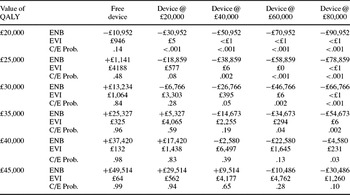
In Figure 2a and 2b, the probability assigned to the area above and to the right of a threshold curve can be interpreted as the chance, as perceived by leading clinical experts, that the device will turn out to be cost-effective at a specified QALY valuation. Results of this kind over a range of LVAD costs are included in Table 2.
Cost-Effectiveness Results over a Range of LVAD Costs

Note. Given are the following: (i) the expected value of the net benefit per patient under LVAD therapy (ENB), (ii) the expected value of acquiring perfect information about LVAD survival parameters (EVI), and (iii) the probability that LVAD therapy is cost-effective compared to OMM (C/E Prob.). Results are computed using expert priors for the survival parameters in the model described in section 2, with UK treatment costs from Table 1. Several plausible device costs and QALY valuations derived from UK practice are represented. LVAD, left ventricular assist device; QALY, quality-adjusted life-years.
The tabulated cost-effectiveness probabilities confirm that LVAD therapy is extremely unlikely to be cost-effective at current UK QALY valuations of around £30,000 if the device costs as much as the £60,000 incurred by Siegenthaler and colleagues (Reference Siegenthaler, Westaby and Frazier44). In fact the cost-effectiveness probability is no more than 84 percent even in the (implausible) case that the device costs nothing at all! Nevertheless, the figures are not inconsistent with an ultimately favorable assessment of LVAD therapy if the cost of the device were to fall in the future.
The subjective nature of the cost-effectiveness probabilities means that healthcare providers may view them with little more than academic interest–even in systems (such as the UK National Health Service) where economic evaluations form an explicit component of reimbursement decisions. It is generally recognized that the highest grade of evidence for such decisions is supplied by the results of RCTs, and it is therefore unlikely that an answer to the primary question of whether to reimburse LVAD treatment as destination therapy would be given on the basis of the prior probabilities reported here, however eminent the clinical source. Nevertheless, the absence of a definitive evidence base means that any decision to carry out an RCT will be taken in the light of an opinion about its possible benefits that must be, at least in part, speculative. It has been argued that Bayesian prior distributions are the natural vehicle for the quantification of such opinion (Reference Lilford and Braunholtz29;Reference Savage43;Reference Spiegelhalter, Abrams and Myles45). Here, the principal area of scientific uncertainty concerns the likely survival benefits of LVAD therapy. Thus, prior distributions for the survival parameters have a role to play when addressing the secondary question of whether further trials in this area should be conducted. In fact, they can be used to generate a formal value of information analysis, following the methods advocated in several reports (Reference Claxton, Lacey and Walker6;Reference Claxton7;Reference Felli and Hazen18).
The value of information analysis proceeds by examining the likely change in the estimate of net benefit to be expected from LVAD therapy induced by the results of a very large (fully informative) trial. Here, net benefit is defined as the discounted value of the extra QALYs associated with the therapy compared with OMM, net of any additional (discounted) costs. The rows labeled ENB (i.e., expected net benefit) in Table 2 contain current estimates, that is, the net benefit per patient treated averaged over the elicited prior distribution for the survival parameters. A positive value of ENB indicates that LVAD therapy is estimated to be cost-effective under the best information currently available; a negative ENB, that it is estimated to be cost- ineffective.
Thus in theory, an ENB from Table 2could be used to inform an interim reimbursement decision for a second-generation LVAD. Nevertheless, the possibility remains that the wrong decision will have been taken. For example, at the £30,000 threshold, a decision not to reimburse a device costing £20,000 will be taken knowing that there is a 28 percent chance that the therapy will be cost-effective, because of the uncertainties surrounding the survival parameters. For this reason, it may be sensible to sponsor an investigation—for example, an RCT—to refine the estimates of these parameters so that a better-informed reimbursement decision can be taken. Taking the perspective of an insurance provider, expenditure on such an investigation cannot be justified unless it is outweighed by the likely benefits that would be attached to updating the reimbursement decision. Under the precepts of value-of-information analysis, these benefits are identified with the opportunity loss associated with taking the wrong reimbursement decision in the first place. For example, suppose it becomes apparent after a trial that the device is associated with a cost-effective destination therapy. (This finding could happen if the true values of the survival parameters were at the optimistic end of the prior distribution.) Then the opportunity loss associated with the (incorrect) decision not to reimburse would be equal to the true net benefit of the therapy, which is now known to be positive. Expenditure on the trial would then have been justified provided its cost per patient affected had been no greater than the size of the revised net benefit. On the other hand, the trial might simply reveal that the original impression that the device is not cost-effective was correct. In this case, the trial will have no impact on the original decision and will have had no value in terms of avoided opportunity loss. In practice, such calculations cannot be made in advance, because it is not known what the results of a trial will reveal. Instead, the expected value of the opportunity loss can be computed using currently available prior distributions for the survival parameters. This quantity is known as the “expected value of perfect information” (denoted by EVI in Table 2) (Reference Raiffa and Schlaifer38). As expected, it turns out that EVI is greatest when the current reimbursement decision is least clear-cut as reflected by cost-effectiveness probabilities close to .5.
IMPLICATIONS FOR FUTURE TRIALS
The EVI values in Table 2 are computed on a per patient basis. The expected value of the information to the healthcare provider is obtained by aggregation over an appropriate patient population during the anticipated lifetime of the technology, or over a time horizon chosen for political or accounting reasons. For England and Wales, it has been estimated that there are up to 15,000 new cases of ESHF annually. Taking these cases as the patient population, then, over a time horizon of N years, the total (discounted) EVI will be
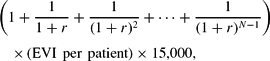
where the discount rate is 100r percent per annum. At 3.5 percent over N=5 years, this value is 4.67×(EVI per patient)×15,000.
For example, suppose the price of the device is the £60,000 paid by Siegenthaler et al. (Reference Siegenthaler, Westaby and Frazier44). Then, at £30,000 per QALY, the expected value of gaining complete information about the survival parameters for patients over the next 5 years is 4.67×£6×15,000=£420,000. Over 10 years, the expected value would be 8.61×£6×15,000=£775,000. Both these values are substantially less than the anticipated costs associated with a meaningful RCT of second-generation LVADs. On the other hand, a trial of a device with a long-term price of £40,000 could yield information with an expected value of 4.67×£395×15,000=£28 million over 5 years and 8.61×£395×15,000=£51 million over 10 years—enough to justify a substantial outlay on an RCT.
The expected value of information calculation attempts to place an upper bound on the justifiable cost to the healthcare provider of a further trial when LVAD research is in competition with other uses to which limited resources can be put. Hence, it can help to prioritize a research agenda, and assist in the allocation of resources between research and direct medical care. Here, it suggests that the costs of a future LVAD trial could not be recouped over any reasonable period unless the cost of the device were substantially less than £60,000, a value that has actually been incurred in a UK context (Reference Siegenthaler, Westaby and Frazier44). On the other hand, the report by Clegg and colleagues (Reference Clegg, Scott and Loveman11) entertains a lower range of device prices (around £30,000–60,000) based on a submission from a device manufacturer. In any case, reductions in price are not implausible once the market expands and have been observed for other medical product (Reference Brown, Young and Meenan5).
DISCUSSION
Value of information is used here as a form of sensitivity analysis to explore the decision-value of parameter uncertainties in a cost-effectiveness model. The focus of our attention is the uncertainty surrounding the survival benefits of second-generation LVADs where these are used as destination therapy in ESHF. The other major source of uncertainty is the price at which the device can be made available, and this price is treated as an exogenous variable in our calculations. It must be emphasized that the relevant price is not the one that is obtained today, nor even over the next few months; it is the price at which the device will be sold in future, assuming a sizeable market. To a large degree, this price is under the control of the manufacturing companies and is difficult to predict without access to commercially sensitive information. Of course, a reimbursement decision—or even a decision to sponsor a trial—can be sensibly taken only when this price is specified, at least within plausible limits. Then the results presented here can be used to inform these decision-making processes.
Uncertainty surrounding other parameters in the model—in particular the treatment costs excluding the cost of the device—does not figure in our analysis. This strategy is both deliberate and rational. The motivation for the example in this study is to assess the potential impact on reimbursement decisions of future trials designed principally to uncover the survival benefits of LVADs. The underlying assumption is that such decisions are informed by a cost-effectiveness analysis using the best available estimates of all model parameters, with only informal attention paid to parameter uncertainties. Following a future trial, the reimbursement decision will likewise be taken in the light of the best available estimates, accompanied by an informal consideration of model sensitivities. Our concern has been to map the effect on this process of a change in the values of the best estimates of a small number of (survival) parameters. Uncertainties in cost parameters make no formal contribution to this process. This approach has been described as “partial” value of perfect information analysis, because it contemplates the effect of eliminating all uncertainty about only some of the parameters (Reference Claxton, Ginnelly and Sculpher8;Reference Fenwick, Claxton and Sculpher19). In practice, this will not be achieved by a single trial, however large. Some statistical uncertainty in the results is unavoidable. Thus, an analysis based on valuing perfect information places an upper bound on the justifiable cost of any trial, but without confirming that any particular trial ought to go ahead. A formal analysis of the information value in a realistic finite trial can be made using previously described sample information methods (Reference Ades, Lu and Claxton1;Reference Willan and Pinto49).
Our aim has been to explore the case for a new trial of second-generation LVADs, given the best available current evidence and clinical opinion. In conclusion, it appears that such a trial would represent value for money in a UK setting, assuming a plausible device-cost of around £40,000.
CONTACT INFORMATION
Alan J. Girling, MA (A.J.Girling@bham.ac.uk), Senior Research Fellow, Department of Public Health and Epidemiology, University of Birmingham, Birmingham B15 2TT, UK
Guy Freeman, MSc (g.freeman@warwick.ac.uk), Research Student, Department of Statistics, University of Warwick, Coventry, CV4 7AL, UK
Jason P. Gordon, BEc (Hons) (jxg402@bham.ac.uk), PhD student, Public Health and Epidemiology, The University of Birmingham UK, Public Health Building, Edgbaston, Birmingham B15 2TT, UK
Philip Poole-Wilson, MD, FMedSci (p.poole-wilson@imperial.ac.uk), Professor of Cardiology, Head of Cardiovascular Sciences, Department of Cardiac Medicine, National Heart and Lung Institute, Imperial College London, Dovehouse Street, London SW3 6LY, UK
David A. Scott, MA (david.scott@oxfordoutcomes.com), Visiting Fellow, Southampton Health Technology Assessments Centre, University of Southampton, Mailpoint 728, Boldrewood, Bassett Crescent East, Southampton, SO16 7PX, UK; Principal Health Economist, Oxford Outcomes Ltd., Seacourt Tower, West Way, Oxford, Oxfordshire, OX2 0JJ, UK
Richard J. Lilford, PhD (R.J.Lilford@bham.ac.uk), Professor of Clinical Epidemiology, Department of Public Health and Epidemiology, University of Birmingham, Birmingham B15 2TT, UK