Introduction
Sexual and reproductive health information is culturally sensitive and rather difficult to collect in cross-sectional surveys. Information on condom use collected from men and women or couples in the Demographic and Health Surveys (DHSs) is now increasingly being used in demographic research, in contexts where unwanted pregnancies and sexually transmitted infections are high. Nevertheless, there has not been any systematic effort to evaluate properly the quality of such data and associated under- or over-reporting problems. The aim of this article is to evaluate the consistency in reporting condom use between married women and their husbands in Bangladesh. The analyses used the couple dataset generated from the 1999–2000 Bangladesh Demographic and Health Survey (BDHS).
The discrepancies between husbands' and wives' responses regarding reproductive attitudes and contraceptive knowledge and use have been reviewed previously (Khan & Singh, Reference Khan and Singh1987; Ahmed et al., Reference Ahmed, Schellstede and Williamson1987; Goyal, Reference Goyal1990; Karra et al., Reference Karra, Stark and Wolf1997; Becker & Costenbader, Reference Becker and Costenbader2001). Respondents generally tend to provide a socially acceptable response regarding certain intimate reproductive behaviour, for instance condom use (Becker & Costenbader, Reference Becker and Costenbader2001). The responses are usually biased towards the practices embedded in social beliefs, values and norms. The evidence shows that married men are likely to report higher levels of contraceptive use than their wives do, particularly for condom use (Koenig et al., Reference Koenig, Simmons and Mishra1984; Ahmed et al., Reference Ahmed, Schellstede and Williamson1987; Ezeh et al., Reference Ezeh, Seroussi and Raggers1996; Ashraf et al., Reference Ashraf2000).
Ahmed et al. (Reference Ahmed, Schellstede and Williamson1987), in a small-scale descriptive study in Bangladesh, concluded that wives were more likely to under-report condom use than their husbands. The results of their study showed that both partners are likely to under-report condom use, but women are under-reporting condom use more than men. The study, however, did not consider the possibility of sex outside marriage and hence the chances of over-reporting condom use, especially by men, were discarded in the analysis. Furthermore, Ahmed et al. provide no statistical examination of the possible inconsistency in reporting condom use between wives and their husbands, particularly at the national level. It is likely that women do not wish to acknowledge that their husbands use condoms, or they do not even want their husbands to use them (Maloney et al., Reference Maloney, Aziz and Sarker1981). Moreover, they are often shy or reluctant to reporting coitus-dependent methods such as the condom (Ahmed et al., Reference Ahmed, Schellstede and Williamson1987; Becker & Costenbader, Reference Becker and Costenbader2001). Becker and Costenbader, in their comparative analysis of data from 23 countries, concluded that wives' reports on contraceptive use have greater validity than those of their husbands. The study further concluded that husbands' reports of condom use were less accurate than those of their wives in thirteen of these countries. On the other hand, over-reporting of condom use by married men could indicate possible sexual activity outside marriage, although there is no empirical evidence to support this argument.
Research studies conducted in the past have investigated the influence of different individual and couple characteristics on the discrepancies of reporting method use (Ezeh & Mboup, Reference Ezeh and Mboup1997; Becker & Costenbader, Reference Becker and Costenbader2001). However, the determinants of consistency in reporting vary across different country settings with diverse socio-cultural backgrounds. Socials norms and cultural taboos, for example shyness associated with purchasing condoms and open discussions of sexual matters in front of family members, are believed to inflict shame on the individual user (Khan & Bairagi, Reference Khan and Bairagi2001). These attitudinal factors could also influence the biases in condom use reporting. The influence of social norms and social desirability in reporting seems to vary with the individual and couple characteristics (Koenig et al., Reference Koenig, Simmons and Mishra1984). These norms also seem more reflected on women than on men (Mott & Mott, Reference Mott and Mott1985; Renne, Reference Renne1993).
Furthermore, the potential power relations and sex differences between interviewer and the interviewee may explain the discrepancies in contraceptive reporting behaviour. These roles are, however, difficult to explore or measure in large-scale surveys such as the DHS. A study by Miller and colleagues reported that sex of the interviewer had little influence on the survey responses (Miller et al., Reference Miller, Zulu and Watkins2001). On the other hand, the presence of ‘significant others’ at the time of survey could potentially influence the reporting behaviour of the interviewee (Koenig et al., Reference Koenig, Simmons and Mishra1984). Unfortunately, most of the surveys, including the DHS, do not record such information, which makes it difficult to understand the role of significant others in reporting contraceptive behaviour (Ezeh & Mboup, Reference Ezeh and Mboup1997). Gray et al. (Reference Gray1999) in a study in Bangladesh demonstrated that a well designed survey can reduce the inconsistency in reporting of contraception to a great extent.
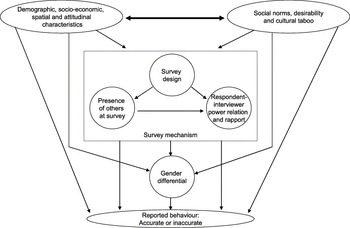
Based on the literature, a conceptual framework incorporating the likely influence of possible factors associated with individual reporting behaviour in an interview survey has been developed, as illustrated in Fig. 1. The framework explains how individual background characteristics, social norms and survey mechanisms interact with each other thereby influencing individual responses in the survey. A survey could be designed in such a way as to control for the influence of significant others, which in turn could reduce the possible response bias, for example by means of telephone surveys. The social status of interviewers and interviewees, for example education, could also influence individual responses. The rapport between the interviewer and interviewee may also influence the response to a specific question. It is also likely that the responses to similar questions are different between male and female interviewees, thus creating a gender bias in survey reporting (Fig. 1). This study acknowledges the potential influence of a range of factors associated with individual responses in a survey. In relation to condom use, it is hypothesized that with proper control of these external survey influences the level of inconsistency in method reporting between husbands and wives could be reduced. However, it has to be noted that although it may not be possible to capture these external effects given the paucity of information in the DHS, it is possible to (a) determine whether there is any inconsistency in condom reporting between husbands and wives and (b) identify the individual attributes associated with possible discrepancies in condom reporting behaviour.
Conceptual framework showing the factors associated with individual response patterns in an interview survey.

Methods
Data
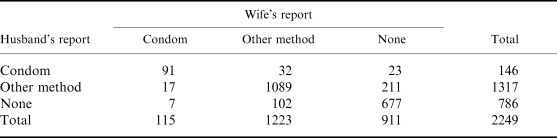
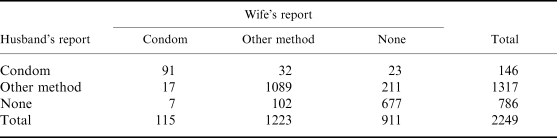
The study used the couple dataset (N=2249) of the Bangladesh DHS (BDHS) conducted during 1999–2000. This dataset was generated from 9696 currently married women aged 10–49 and 2556 currently married men aged 15–59. The BDHS is a nationally representative survey that covered all the six administrative divisions of Bangladesh (NIPORT et al., 2001). Unfortunately, the most recent BDHS did not ask men about their contraceptive use, which restricts the creation of couple data for the analysis (NIPORT et al., 2009). Therefore, the data from the 1999–2000 BDHS are used in order to illustrate the degree of consistency in reporting condom use between husbands and wives. A sub-sample of 170 couples, where either or both of the partners reported current use of the condom at the time of survey, were selected for detailed analysis (Table 1). The reported current method use, for either husband or wife, is restricted to one method. It is likely that there is covert use of methods other than the condom but there was no information of covert method use in the BDHS.
Number of contraceptive users classified by husbands' and wives' reports
Statistical analysis
Multinomial logistic regression models were fitted to understand the characteristics of condom use reporting behaviour. However, in multinomial logistic regression odds ratios are relative odds ratios and these can sometimes mislead the interpretations. The conversion of parameter (beta) estimates into probabilities helps to overcome this problem. Hence, the results of the multinomial logistic regression analysis have been presented in terms of predicted probabilities. The dependent variable was condom use reporting, coded into three categories – both husband and wife reporting condom use (consistent) as reference category and inconsistency in reporting behaviour, i.e. husband reporting condom use while wife did not and vice versa, as the other two categories. It has to be noted that the BDHS data have limitations with reference to the variables addressed in the conceptual framework. For example, the BDHS did not record the presence of significant others at the survey, especially when the respondents were asked about questions related to contraceptive use. Besides, there is no information available on the age and other characteristics of the interviewer, which makes it difficult to control for this possible bias that might have occurred during the interview. Therefore, the analyses reported in this paper do not include all the variables highlighted in the conceptual framework, which obviously is a limitation of this study.
Results
Descriptive results
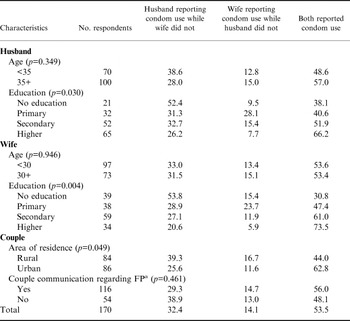
Table 2 shows the percentage distribution of couples' reporting of condom use by socio-demographic characteristics of the husband, wife and couple. The association is examined using χ 2 tests for which p-values are given within parentheses against each variable. Among couples where either of them reported condom use, about 54% provided consistent information about condom use. In about 32% of cases the husband reported condom use while the wife did not, and among the remaining 14% of couples the wife reported condom use while the husband did not.
Percentage distribution of couples' reporting of condom use by different characteristics of husband, wife and couple (n=170)

p-values shown in the table are based on Pearson's χ 2tests. Row sums to 100%.
a As reported by wives.
Consistency in reporting condom use is high among couples where the husbands are aged 35 and above. Among husbands in this group, 57% provided a report consistent with that of their wives. Wives aged less than 30 provided slightly more consistent reporting with their husbands (53.6%) than wives in the age group 30 and above. The analysis shows that education of husbands has a positive association with consistent reporting. Wives whose husbands had only primary education are found to be slightly more likely to report condom use while husbands reported differently (28.1%). Conversely, husbands reporting condom use while their wives do not were negatively associated with husband's education levels. Similar observations were found in the reporting behaviour with regard to wives' education. Urban couples are more likely to report consistently (63%). When there is no couple communication the likelihood of husbands reporting condom use while wives do not is quite high (39%). Further analysis suggests when both partners are educated the likelihood of consistent reporting of condom use is high.
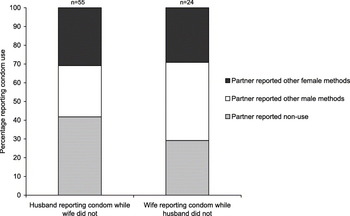
As the DHS allowed individuals to mention only one current method, it was not possible to deduce any information about dual method use or other potential biases in reporting (Becker & Costenbader, Reference Becker and Costenbader2001). The possibility of covert use cannot be ignored, as the sample is restricted to the reporting of condom use from either side. However, there is evidence of reporting non-use against those who report condom use by either the husband or wife (Fig. 2). A husband himself reporting condom use indirectly could indicate his positive attitude toward family planning. However, the fact that the husband might report condom use in non-marital sex and not necessarily approve use within marital union cannot be ignored. On the other hand, a wife's report of condom use against her husband's report of non-use does not indicate that husbands are using methods other than the condom or male sterilization.
Patterns of reporting condom use between husband and wife.

Regression analysis
Multinomial logistic regressions were fitted to understand the influence of different variables simultaneously on couples' reporting of condom use considering the categories as described above, i.e. husband reporting condom use while wife did not, wife reporting condom use while husband did not and both reporting condom use (reference category). To avoid any possible zero cell frequencies most of the variables in Table 2 were recoded with fewer categories than before.
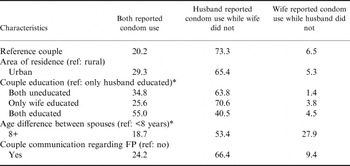
Multinomial logistic regression analysis suggests that couple education and age difference between spouses are the significant determinants of couples' reporting of condom use. When both spouses are educated there is better family planning communication between partners (Islam et al., Reference Islam, Padmadas and Smith2005). Furthermore, educated couples tend to behave rationally without adhering to social norms and taboos and hence are more likely to be consistent with regard to reporting condom use. Regarding age differences, the assumption put forward here is that the greater the age difference between spouses the greater is the likelihood for inconsistency in reporting between spouses. In Bangladesh, cultural and religious norms dictate that husbands must be older than their wives. The DHS data show that in Bangladesh the average age difference between husbands and wives is about 9 years. Consequently, the conjugal relationship for these couples is mostly influenced by social norms, desirability and cultural taboo. Female respondents who are married to much older partners may feel shy in sharing personal family planning matters with an unknown person or the interviewer. In these circumstances, the responses are more likely to be inconsistent with that of husbands or partners. The level of consistent reporting tends to improve with the decreasing age differences between husbands and wives.
The regression results are presented in terms of estimated probabilities corresponding to the estimated coefficients (Table 3). The estimated probabilities are calculated based on the reference couple's characteristics. The reference couple considered in the model was from a rural area, where only the husband is educated, the age difference between the spouses is less than 8 years and there is no couple communication regarding family planning. The results show that the reference couple has nearly 20.2% probability of reporting condom use, 73.3% probability of the husband reporting condom use while the wife did not and 6.5% probability of the wife reporting condom use while the husband did not. The probability of both reporting condom use increases by 9.0 percentage points for urban couples. For all other education categories, the probability of both reporting condom use is higher than that for the reference couple and it is highest when both spouses are educated (55.0%). If the age difference between spouses is more than 8 years, then the probability of both reporting condom use decreases. Couple communication regarding family planning increases the probability of both reporting condom use. The probability of the husband reporting condom use while the wife did not is high only if the husband is educated but not the wife. If the age difference between spouses is 8 or more years the probability of the wife reporting condom while the husband did not increases by 21 percentage points.
Couples' reporting of condom use: estimated conditional probabilities (expressed as percentages) from multinomial logistic regression model

* Statistically significant at 5% level.
Discussion
This paper addresses the problem of inconsistency in condom use reporting by couples and attempts to establish the characteristics associated with reporting behaviour using nationally representative data from Bangladesh. The level of inconsistency was about 46%, of which about 32% was explained by husbands reporting condom use while wives did not, and 14% by wives reporting condom use while husbands did not. The multinomial logistic regression analysis revealed that couple education and age difference between spouses were the significant factors that explained the variations in inconsistent reports. Within a couple, if a husband is educated but his wife is not, the chance of the husband reporting condom use while the wife did not was significantly high.
This study is one of the first of its kind in attempting to evaluate and compare the responses of wives and husbands using a couple dataset derived from the DHS, particularly in the Asian context. One of the caveats of this paper is the lack of data to quantify whether husbands or wives are over-reporting or under-reporting condom use. It was not possible to explore other potential variables of interest, such as social attitude and norms discussed in the conceptual framework. This is a limitation of the present study. Reports of condom use were not treated in isolation from other method use, although multiple methods use is almost non-existent in Bangladesh. Nevertheless, the results obtained indicate some plausible socio-cultural reasons in the Bangladesh context where sexuality and reproduction are not openly discussed.
The inconsistency where husbands reported condom use while their wives did not could be attributed to the fact that (a) wives are reluctant to report condom use for cultural reasons, stigma, shyness and other personal or religious reasons (Ahmed et al., Reference Ahmed, Schellstede and Williamson1987; Becker & Costenbader, Reference Becker and Costenbader2001) – ‘shyness’ in under-reporting condom use by wives may still exist in some parts of Bangladeshi society, as previously demonstrated by Ahmed et al. (Reference Ahmed, Schellstede and Williamson1987); (b) condom use exists outside marital relationships; (c) wives are not aware of husbands' condom use within marriage; or (d) any past experience of condom use within marriage could be misunderstood as current use in the survey. On the other hand, the inconsistency where wives reported condom use while husbands did not might suggest that (a) in most cases, husbands are shy or reluctant to talk about family planning use and (b) wives are giving a socially acceptable response, putting the contraceptive responsibility on their husbands' shoulders, because of the impression that men are the key partners in the family planning decision-making process. Yet another plausible factor is the power relations and rapport between the interviewer and the interviewee, especially when the education or age of the interviewer contrasts with that of the interviewee. Gender differential on the response of a survey question may well be present in the Bangladeshi situation. Furthermore, the DHS asks questions about current method use to husbands and wives rather differently. For example, in the BDHS 1999–2000, wives were asked, ‘Are you currently doing something or using any method to delay or avoid getting pregnant?’ without mentioning the husband. On the other hand, the husbands were asked, ‘Are you or your wife currently doing something or using any method to delay or avoid a pregnancy?’ (NIPORT et al., 2001). Clearly, although the intention of the questions to both husbands and wives are the same, they may yield different responses, especially for specific methods such as the condom. Unfortunately, it was not possible to explore these issues in detail in the present analysis because of the lack of information in the DHS. Although the BDHS does not include the key variables identified in the conceptual framework, it allowed the testing of multiple variables regarded as potential determinants of consistent reporting of condom use in the modelling process as opposed to setting prior hypotheses.
Although the BDHS provides sample weights for the men and women datasets separately, no weights are given for the couple dataset. Therefore, the analysis used un-weighted data. This is not a major limitation since this study focuses on measures of association between variables and not estimation of levels.
The foregoing analysis suggests the need for alternative approaches (questions) in the DHS to ensure consistency in data collection related to family planning methods, particularly reporting of condom use. For instance, the DHS could consider recording the presence of significant others at the time of interview, the educational status of investigators and asking specific questions on social and cultural barriers to using methods.