There is evidence that breastmilk feeding reduces mortality and short and long-term morbidity among infants born too soon or too small (Reference Ip, Chung and Raman14;Reference Quigley, Cumberland, Cowden and Rodrigues23). In 2005, initiation rates of breastfeeding in special care baby units were greater than those in the general population. Bolling et al. (Reference Bolling, Grant, Hamlyn and Thornton2) found that the breastfeeding rate at 1 week was 63 percent in the general population and 68 percent among infants starting life in neonatal units. Neonatal units include both neonatal intensive care units and special baby care units. Nevertheless, health benefits could still be reaped by increasing these rates further and in particular by enabling infants to breastfeed exclusively. Furthermore, there is the possibility of significant cost-savings if complications resulting in long-term disability can be reduced by consumption of breastmilk (Reference Trotter and Edmunds32). Promoting initiation, duration, and exclusivity of breastmilk is a public health priority nationally and internationally and is considered an important mechanism for addressing health inequalities (7;12;35), and it is particularly important in this vulnerable group.
A health technology assessment was conducted on the clinical effectiveness and cost-effectiveness of breastfeeding promotion for infants in neonatal units (Reference Renfrew, Craig and Dyson25). This study reports the cost-effectiveness analysis part, which had a study population of mothers with infants in a neonatal unit with low birth weight. Here, low birth weight is defined as 500–2,500 g. The cost-effectiveness analysis uses clinical evidence summarized in the effectiveness review reported elsewhere (Reference Renfrew, Dyson and McCormick26). A systematic review of the literature for economic evaluations of promotional strategies for breastfeeding in neonatal units was conducted. No economic evaluations that met the inclusion criteria were identified.
A wide range of factors determine the incidence and prevalence of breastfeeding. In the case of neonatal units these additionally include feeding methods, methods of expressing breastmilk and staff training, as well as public health interventions. The effectiveness review examined several of these. The cost-effectiveness analysis focused on evaluating enhanced staff contact. This consisted of providing individualized education, support and care plans to mothers of infants in neonatal units by specially trained staff. The two intervention studies used in this analysis involved either training to International Board Certified Lactation Consultant (Reference Gonzalez, Meinzen-Derr and Burke9) or training in the benefits of and barriers to breastfeeding, physiology of lactation, use of breast pumps, prefeeding interventions based on synactive theory, and breastfeeding interventions acknowledging readiness to infant (Reference Pineda22).
Our study has used these data to evaluate the cost-effectiveness from a National Health Service perspective of enhanced staff contact compared with normal staff contact over the lifetime of an infant admitted to a neonatal unit with low birth weight. It was assumed that breast pumps and facilities for milk expression and storage were freely available. Normal staff contact is an absence of nurses specifically trained to support breastfeeding mothers.
METHODS
Model
The problem was modeled using a decision tree developed in Treeage Pro 2007. The data reviewed for the decision analysis were applicable to mothers with infants in neonatal units with a birth weight between 500 g and 2,500 g. This theoretical population was divided into three birth weight subpopulations: 500 g to 999 g; 1,000 g to 1,749 g; and 1,750 g to 2,500 g. These weight bands were considered appropriate because the incidence of disease increases as the birth weight decreases (Reference Fanaroff, Korones and Wright8;Reference Guthrie, Gordon and Thomas10).
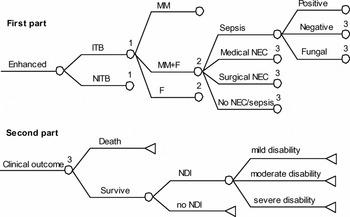
The prevalence of feeding with mothers’ milk depends on whether or not the mother originally intended to breastfeed before being encouraged to express milk in the neonatal unit (Reference Sisk, Lovelady, Dillard and Gruber28). Thus in part 1 of the decision tree, the population that receives enhanced staff contact is divided into those who intended to breastfeed (ITB) and those who did not (NITB) before childbirth (Figure 1). The effectiveness estimate for the study intervention, which concerns increasing breastfeeding rates/feeding with breastmilk, is for all mothers regardless of whether or not they intended to breastfeed.
The decision tree for the enhanced staff contact intervention. Circles indicate that the following states are due to chance. A triangle indicates that the preceding state is the end state. The nodes with the same numbers share the same possible following events. The second part of the decision tree follows on from the first part where node 3 in the second part corresponds to node 3 in the first part.

There is a relationship between the proportion of the total milk intake that is breastmilk and a disease protective effect (Reference Vohr, Poindexter and Dusick34). Convenient categories of levels of breastmilk intake that can be identified in the literature: formula only (F), some mothers’ milk plus formula (MM+F) or donor milk, and mostly mothers’ milk (MM). Mostly mothers’ milk was defined as greater than 80 percent of total milk intake. Consequently, in the tree the infants of both ITB and NITB mothers received either MM, MM+F, or F. Each of these groups of infants was considered to be at risk of one of six possible feeding-related outcomes during the neonatal stay: medical necrotizing enterocolitis (NEC), Bell stage II or greater; surgical NEC; fungal sepsis, Gram-negative sepsis, or Gram-positive sepsis; no NEC or sepsis. These were considered by clinical experts to be the most significant clinical events affected by the consumption of breastmilk. Rehospitalization rates were not included. Due to limited space, the events for every chance node in Figure 1 are not shown. The nodes with the same numbers share the same possible following events. Every chance node labeled 3 follows with death or survival as shown in part 2 of the decision tree.
An infant with any of these six clinical outcomes might survive or die. Survivors might or might not develop a long-term neurodevelopmental impairment (NDI). Those who do develop a long-term NDI were considered to have mild, moderate, or severe disability.
As these conditions were considered to be long-term, the time horizon of the analysis was lifetime. Each health state was allocated utility, life expectancy, and cost values.
A second, identical population of infants passed through the same tree with normal staff contact rather than enhanced staff contact. The corresponding outcome probabilities were different. The model calculated the expected quality-adjusted life-years (QALYs) and cost per patient for each comparator and an incremental analysis was then performed.
Clinical Data
A baseline intention to breastfeed rate of 72 percent for England and Wales was taken from the Infant Feeding Survey 2005 (Reference Bolling, Grant, Hamlyn and Thornton2). The distribution of the three levels of mothers’ milk consumption (MM, MM+F, and F) for mothers who intended to breastfeed and for those who did not, given enhanced staff contact, was obtained by personal communication from the author of the only paper (Reference Sisk, Lovelady, Dillard and Gruber28) with such data that was identified in the searches for the effectiveness review (Reference Renfrew, Dyson and McCormick26) (see Supplementary Table 2, which is available at www.journals.cambridge.org/thc2010010).
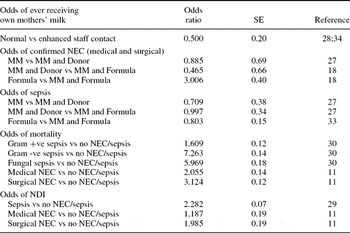
To obtain the distribution of these different levels of mothers’ milk consumption for normal staff contact, we needed the odds ratio of an infant receiving his or her own mothers’ milk during neonatal stay given normal staff contact compared with enhanced staff contact. This required studies comparing the two interventions for all mothers with infants in neonatal units regardless of whether or not they intended to breastfeed before birth. A pooled odds ratio weighted by sample size was derived from two relevant papers identified from the effectiveness review (Reference Gonzalez, Meinzen-Derr and Burke9;Reference Pineda22) (see Table 1). One study (Reference Gonzalez, Meinzen-Derr and Burke9) studied the introduction of a lactation consultant and the other (Reference Pineda22) studied the introduction of staff education and leaflets, both with a view to improve the encouragement and advice on breastfeeding that mothers with infants in neonatal units receive. Both were before and after studies from the United States which considered all mothers with infants in a neonatal unit. In the base case, it was assumed that the pooled odds ratio was the same for both ITB and NITB mothers.
Odds ratios used in model

NEC, necrotizing enterocolitis; MM, mother's milk; NDI, neurodevelopmental impairment.
To identify the evidence for breastmilk effectiveness on the six clinical outcomes, MEDLINE and in-process citations, EMBASE, NHS EED, HEED, and Econlit were searched from 2003 to February 2008, and the references of the identified papers reviewed. This search provided the following data: the incidence given mothers’ milk and formula supplements and odds ratios of sepsis given different milk consumption (Reference Fanaroff, Korones and Wright8), medical NEC (Reference Guthrie, Gordon and Thomas10;Reference Lucas and Cole18;Reference Schanler, Lau, Hurst and Smith27), surgical NEC (Reference Guthrie, Gordon and Thomas10;Reference Lucas and Cole18;Reference Schanler, Lau, Hurst and Smith27); the distribution of positive, negative, and fungal sepsis (Reference Schanler, Lau, Hurst and Smith27;Reference Stoll, Hansen and Fanaroff30;Reference Vohr, Poindexter and Dusick33); and the incidence and OR of mortality (Reference Fanaroff, Korones and Wright8;Reference Hintz, Kendrick and Stoll11;13;Reference Stoll, Hansen and Fanaroff30) and NDI given each health outcome (13;Reference Larroque, Ancel and Marret16;Reference Stoll, Hansen and Adams-Chapman29) (see Supplementary Tables 1 and 2, which are available at www.journals.cambridge.org/thc2010010).
The papers selected had to include adequate information to calculate odds ratios comparing outcomes for MM, mothers’ milk plus donor milk (MM+D), MM+F, and F.
Supplemental literature searches identified a paper, Larroque et al. (Reference Larroque, Ancel and Marret16), published in March 2008 that provided the incidence of NDI given no disease and the distribution of mild, moderate, and severe NDI given some degree of NDI for children of 5 years of age. These “Larroque” disability states are listed in column 2 of Supplementary Table 3, which is available at www.journals.cambridge.org/thc2010010. It was assumed that this distribution of NDI states would persist for life.
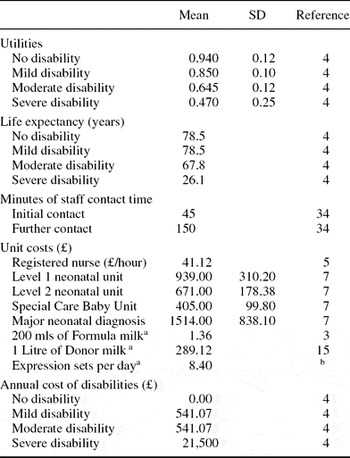
The life expectancy for infants in these long-term disability states was taken from Colbourn et al. (Reference Colbourn, Asseburg and Bojke4), which used Office of National Statistics (ONS), published data and assumptions to determine life expectancy for infants with no, mild, and severe disability. See Table 2.
Utility, life expectancy, and cost data used in the model
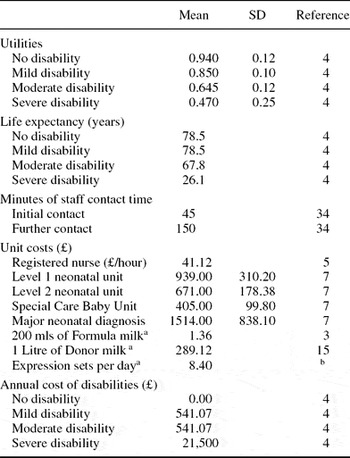
aIncluded in sensitivity analyses only.
bBy personal communication.
Utilities
NHS EED, HEED, Econlit, and MEDLINE were searched for utility data for health states given different clinical outcomes for the population of interest. Preference was given to EQ-5D data. One study (Reference Oostenbrink, Moll and Essink-Bot21) provided EQ-5D utility data for permanent sequelae given childhood bacterial meningitis. The authors presented vignettes to 28 pediatricians in the Netherlands for seven case descriptions. In line with the approach taken by Colbourn et al. (Reference Colbourn, Asseburg and Bojke4), utilities for mild, moderate, and severe disabilities were derived from these seven case descriptions by grouping them into three clusters of severity and taking the average. The result was that utilities determined for the “Colbourn” health states listed in column 3 in Supplementary Table 3, which is available at www.journals.cambridge.org/thc2010010, were used for the corresponding “Larroque” health states listed in column 2.
Cost Data
The study perspective was the NHS. The costs included in the analysis were the intervention costs; treatment of confirmed NEC and sepsis; inpatient stay in level I, II, and III units; and the lifetime cost of disability.
The cost of formula milk, donor milk, milk expression pumps, and disposable milk expression kits are all affected by the employment of enhanced staff contact. These were included in the cost of an inpatient stay in a neonatal unit. They were not included as independent cost items in the base–case analysis because no estimate of the actual cost of the provision of breast pumps per infant was available. It was inappropriate to exclude breast pump costs and not formula milk costs as independent cost items. These costs were investigated through sensitivity analyses.
The price year was 2006. All costs were valued in pounds sterling. All costs were inflated using the health component of the consumer price index. All costs were discounted at a rate of 3.5 percent (20).
The cost of the intervention was the extra time dedicated to mothers by specially trained staff. The minutes of staff contact time were derived from Gonzalez et al. (Reference Gonzalez, Meinzen-Derr and Burke9), and the hourly cost of a registered nurse was derived from the Unit Costs of Health and Social Care 2006 (Reference Curtis and Netten5) (see Table 2).
The incremental cost incurred from an episode of sepsis or NEC involves the additional disease-specific cost of treatment, the additional cost due to increased length of stay in level I, II, and III units, and the additional cost due to lifetime disability. The cost of a sepsis or NEC illness episode was assumed to be closest to a major neonatal diagnosis quoted in the NHS Reference Costs (7). The unit cost of 1 day's stay in each unit of levels I, II, and III were also obtained from the NHS Reference Costs (7).
For data on length of stay for different clinical outcomes, the papers identified from the literature search on breastmilk effectiveness were reviewed. Two U.S. studies (Reference Fanaroff, Korones and Wright8;Reference Stoll, Hansen and Fanaroff30) provided length of stay for neonatal infants with sepsis and one study provided length of stay for neonatal infants with either medical or surgical NEC. The length of stay data reported in Supplementary Table 4, which is available at www.journals.cambridge.org/thc2010010, for a level I unit represent the incremental length of stay for sepsis and NEC outcomes compared with no NEC/sepsis, hence, the length of stay of 0 days for the control. Infants that died were given an estimate of 20 days stay in a level I unit. It was assumed that this covered the cost of treatment for an infant that died in a neonatal unit.
The cost of disability was identified from a search for papers with cost data for the health outcomes for preterm infants. Trotter et al. (Reference Trotter and Edmunds32). identified costs for mild, moderate, and severe disability given survival of meningococcal disease, using the Unit Costs of Health and Social Care 2000.
For sensitivity analyses, the unit cost of 200 ml of formula milk was derived from the British National Formulary. The unit cost of 1 liter of donor milk was derived from a report to the Department of Health of the Breastmilk Banking Working Group in 2003 (3). The quantity of milk per kg of the infant consumed was assumed to increase to 150 ml/kg from 60 ml/kg and remain there for the rest of the inpatient stay. The rate of increase depended on the birth weight. The cost of a single use expression kit was £1.20 (Camilla Kingdon, personal communication). It was assumed that an average of seven such sets would be used every 24 hours.
Uncertainty
A probabilistic sensitivity analysis was conducted with a theoretical cohort of 10,000 patients to explore uncertainty in the model parameters. Binary probabilities and multiple event probabilities, odds ratios, and cost and utility estimates were given beta, Dirichlet, and gamma distributions, respectively. The results are reported using cost-effectiveness acceptability curves (CEACs).
One-way sensitivity analyses were conducted, where one parameter is varied while the rest are kept constant, to explore the effect of changes in model assumptions and different parameter estimates on the cost-effectiveness results. The effect of including costs of formula feeding, provision of donor milk supplements and expression kits was evaluated. Because of the varied availability of donor milk across the country and the relatively high cost of its provision, a policy of allocating donor milk only as a supplement to mothers’ milk was evaluated in sensitivity analyses. Donor milk outcome probabilities were added to the model.
The effect on the results of the treatment effect being based solely on Gonzalez et al. (Reference Gonzalez, Meinzen-Derr and Burke9) rather than a pooled estimate from two papers due to slightly different interventions was investigated. The effectiveness of the intervention may vary depending on whether or not the mother intended to breastfeed before childbirth, so a sensitivity analysis was conducted with an odds ratio of 0.4 for those mothers who intended to breastfeed and 0.6 for those who did not and vice versa. The intention to breastfeed proportion was varied from 50 percent to 90 percent as it varies significantly between regions in the United Kingdom (Reference Bolling, Grant, Hamlyn and Thornton2). The odds of confirmed NEC given formula feeding alone compared with mothers’ milk feeding plus formula supplements was also reduced to 1.48 from 3.01 given that one paper, which could not be used in the model, suggested a much lower effect.
Instead of a registered nurse providing the intervention at £41.12 per hour, the cost of providing a hospital midwife (£65.57 per hour) was substituted. The length of stay was halved for each of the clinical outcomes (sepsis, medical NEC, and surgical NEC) because the length of stay estimates were based on U.S. data and assumptions, and this is the major cost factor. The initial probability of a mother intending to breastfeed was varied to cover varying rates between regions and ethnic groups. The only evidence available suggested that the probability of severe disability was greater in the 1,750–2,500 g weight group than the 1,000–1,749 g weight group (Reference Larroque, Ancel and Marret16). Because this was counterintuitive, sensitivity analysis was conducted to explore the impact of a greater probability of severe disability in the 1,000–1,749 g weight group compared with the 1,750–2,500 g weight group.
RESULTS
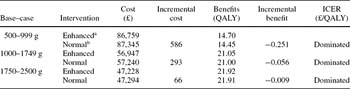
For the base–case model, the enhanced staff contact intervention reduced overall costs compared with normal staff contact and increased the gain in QALYs for each of the birth weight groups. In other words, enhanced contact dominated normal contact (see Table 3). The lower the birth weight, the greater the cost-savings and the greater the QALY gain. This was because the incidence of NEC decreased as the birth weight increased, which reduced the potential cost-savings and health benefits from the effectiveness of breastmilk.
Base–case results from the model

aEnhanced staff contact.
bNormal staff contact.
QALY, quality-adjusted life-year; ICER, incremental cost-effectiveness ratio.
For the donor milk model, the enhanced staff contact intervention was only dominant in the 500- to 999-g weight group. For the 1,750- to 2,500-g group, the cost-effectiveness ratio was £34,905/QALY. The effectiveness of the intervention resulted in more women expressing milk and, because most women provide only a portion of the milk consumed, there was increased consumption of donor milk supplementation, which increased costs. The enhanced staff contact increased health outcomes across all birth weight groups.
The probabilistic sensitivity analyses showed that, in the base–case, the enhanced staff contact intervention was highly likely to be cost-effective at any cost-effectiveness threshold (see Supplementary Figure 1, which is available at www.journals.cambridge.org/thc2010010).
The sensitivity analyses showed that, for the 500- to 999-g weight group, the only scenario in which the intervention was not dominant was where the cost of expression kits was added to the model with donor milk supplements. The cost-effectiveness ratio was £355/QALY.
For the 1,000- to1,749-g group, only the sensitivity analyses with full-cost donor milk made the intervention more costly than the comparator, but the highest cost-effectiveness ratio was only £5,550/QALY. For the 1,750- to 2,500-g group, in addition to the donor milk analyses, increasing the labor cost to that of a midwife, halving the length of stay and including the cost of single use expression kits made the intervention more costly than the comparator. The highest cost-effectiveness ratio of sensitivity analyses excluding donor milk was £5,591/QALY for the inclusion of expression kit costs.
DISCUSSION
This study links three factors: a significant reduction in NEC due to consumption of breastmilk versus formula milk; an absence of significant adverse events from the consumption of breastmilk compared with formula milk; and a relatively cheap intervention compared with the cost savings from reduced NEC. Taken together they suggest a cost-effective result, where a policy of providing donor milk as supplements only is not used.
The intervention would no longer be cost-effective if donor milk were allocated exclusively as a supplement to mothers’ milk. This is because it is expensive and the intervention to increase provision of mothers’ milk coincidentally increases the consumption of donor milk in this scenario.
This study focused on two outcomes (sepsis and NEC) considered to be clinically important and supported by evidence. The literature showed little effect of mothers’ milk consumption on sepsis rates so the health outcomes were principally determined by the effect of mothers’ milk consumption on NEC. The lack of adverse events contributes to a cost-effective result. Two possible adverse events are infection from expressing, storing, and delivering mothers’ milk, and transmission of disease, for example cytomegalovirus and HIV, by means of mothers’ milk. Postdischarge re-hospitalization also was not included, and this may have positive or negative cost implications for the intervention. Whereas the model could be refined to include the possibility of cytomegalovirus transmission and postdischarge hospitalization, we did not consider either to be prevalent adverse health outcomes relative to sepsis or NEC in this UK population.
Given the low prevalence of maternal HIV infection (15) and low frequency of mother to child transmission (Reference Townsend, Cortina-Borja and Peckham31), a high estimate of the probability of an infant in a neonatal unit contracting HIV as a result of breastfeeding would be 0.00002. Postnatal cytomegalovirus transmission by means of breastmilk is more common than HIV transmission in the United Kingdom but has not been definitively associated with long-term adverse effects (Reference Luck and Sharland19). Pasteurization of donor milk prevents postnatal cytomegalovirus transmission but heat treatment of a mother's own milk is neither recommended nor widely practiced in the United Kingdom.
This study focused on NDI as the major long-term outcome following NEC. Some infants with NEC may develop short bowel syndrome (SBS). A proportion of the mortality, although not all, from SBS will have already been captured in the in-hospital mortality rate due to surgical NEC. Adding the full health outcomes of SBS will increase the cost-effectiveness of breastfeeding promotion in this model. Were the model to be developed further, mortality due to NEC with and without SBS would need to be distinguished. The cost of prolonged hospital stay due to SBS survivors should be included in the model cost estimates.
This study used evidence obtained from systematic reviews of the literature to obtain the clinical effectiveness data and utilities. There were many limitations to this evidence. For example, data on the effectiveness of enhanced staff support, the incidence data for NDI, and the length of stay data in level I, II, and III neonatal units were not derived from UK studies. The health states associated with the utility estimates do not perfectly match the health states in the model. Furthermore, it was assumed that the disability states would remain constant over the lifetime of the child. No estimate of the cost of breast pumps per infant was available and a generic cost estimate of a major neonatal diagnosis was used for surgery. Ideally, the incremental cost of breast pumps, formula milk, and expression kits would be included as independent cost items in the base–case analysis. The use of non-UK data necessitated extensive sensitivity analyses.
More accurate UK data are required especially with regard to the length of stay and cost data, the effectiveness of enhanced staff contact in an average UK neonatal unit, and the long-term health outcomes of infants who experience preventable complications.
Despite these limitations, this study managed to link breastfeeding with long-term outcomes using the best available information. The model presents the minimum information required to evaluate the cost-effectiveness of enhanced staff support. As new data become available, the model can be developed in future studies.
The lack of data or existing studies in this important field is in itself a finding of interest. Without good quality data on short, medium and long-term outcomes and resource use, it is hard to make definitive cost-effectiveness conclusions about the use of a specific approach to promote breastfeeding in a neonatal setting.
Current practice in the United Kingdom and internationally varies greatly, but it is known that staff with the expertise to promote and support breastfeeding are not widely available in most countries (1;Reference Liu, Laudert and Perkins17;Reference Redshaw and Hamilton24). The evidence available suggests that the provision of enhanced staff contact to promote breastfeeding in neonatal units is cost-effective. However, the lack of UK-relevant evidence from high quality studies places some uncertainty around this result and suggests the need for more evidence; this model offers a basis for future studies.
SUPPLEMENTARY MATERIALS
Supplementary Table 1
Supplementary Table 2
Supplementary Table 3
Supplementary Table 4
Supplementary Figure 1
CONTACT INFORMATION
Stephen J. C. Rice, MSc (sjcr1@york.ac.uk), Research Fellow in Health Economics, Centre for Reviews and Dissemination, Dawn Craig, MSc (dc19@york.ac.uk), Research Fellow in Health Economics, Centre for Reviews and Dissemination, Felicia McCormick, MSc (fm510@york.ac.uk), Research Fellow, Department of Health Sciences, Mary J. Renfrew, RM, PhD (mjr505@york.ac.uk), Professor of Mother and Infant Health, Mother and Infant Research Unit, Department of Health Science, University of York, Heslington, York, YO10 5DD, United Kingdom
Anthony F. Williams, DPhil (Oxon), MB BS, FRCPCH (awilliam@sgul.ac.uk), Reader in Child Nutrition & Consultant in Neonatal Paediatrics, Clinical Developmental Sciences (Child Health), St. George's, University of London, Cranmer Terrance, London SW17 0RE, United Kingdom