

The year 2015 was a tumultuous year in Guatemala. Following a corruption scandal involving the customs service and then massive street protests, the president ultimately resigned and was arrested and ordered to stand trial on corruption charges. Just two years earlier, a former president was convicted of genocide in national courts, although his conviction was swiftly overturned by the Constitutional Court.
How did these events become possible in Guatemala while remaining unlikely in either Honduras or El Salvador? These two countries are often grouped with Guatemala as the violent Northern Triangle of Central America, where crime, corruption, human rights abuses, and impunity have proliferated. Peace agreements and transitions to democracy more than two decades ago included only minimal transitional justice measures and also did not effectively institute the rule of law. Indeed, “impunity for past crimes and impunity in the present are inextricably bound together” (Roht-Arriaza and Bernabeu Reference Roht-Arriaza and Bernabeu2012, 205).
All three countries can be argued to have been “impunity states”—states in which both official and unofficial violence and criminality go unpunished—for the past two decades, although the roots of this impunity stretch much farther back. Even with the dramatic events of 2015, Guatemalans continue to live with the reality of significant and persistent impunity, including attacks against the international anticorruption commission by President Jimmy Morales (2016–).
This study argues that the explanation for Guatemala’s moves away from impunity in areas of both transitional justice and high-level criminality is that the country has made a substantial institutional transition toward a more independent justice sector, whereas Honduras and El Salvador have not. This gradual development of institutional capacity and autonomy in the justice sector, specifically the courts and prosecution, has done more to allow for the prosecution of past human rights violations than any of the truth commissions or other past or proposed transitional justice efforts. These institutional changes have also had positive effects for the prosecution of official corruption and unofficial criminality. In Guatemala, at least, nascent rule of law construction through institutional strengthening has proved beneficial for posttransitional justice, combating corruption, and enhancing citizen security. Meanwhile, the partisan and criminal influences in the justice systems of Honduras and El Salvador have circumvented many similar reform efforts and allowed impunity to persist in those countries.
The rule of law, defined as a system in which “legal rules are applied fairly, consistently, and predictably across equivalent cases, irrespective of the class, status, or power of the subject of the rules” (Diamond Reference Diamond1999, 11), has been a central part of democracy promotion efforts (as “rule of law reform”), as well as efforts to understand democratic development since the so-called Third Wave of democratization in the 1980s (Carothers Reference Carothers1998, Reference Carothers2006; Domingo and Sieder Reference Domingo and Sieder2001; Linz and Stepan Reference Linz and Stepan1996; Huntington Reference Huntington1993; Popkin Reference Popkin2000). Although it still animates discussions about human rights and democracy, we continue to know the rule of law primarily intuitively without widely accepted measures. (For a strong effort, see Nardulli et al. Reference Nardulli, Peyton and Bajjalieh2013.) This article focuses primarily on rule of law construction as a means of enforcing law and ending impunity.
Much of the early literature on the rule of law expected that politically independent judiciaries would also protect human rights, especially when pushed by activist nongovernmental organizations and the international community (Epp Reference Epp1998; Vondoepp Reference Vondoepp2006; Keck and Sikkink Reference Keck and Sikkink1998; Lutz and Sikkink Reference Lutz and Sikkink2001; O’Donnell Reference O’Donnell1999a; Prillaman Reference Prillaman2000). But neither Guatemala, Honduras, nor El Salvador came out of their civil wars with strong justice systems, and reform efforts were slow to take root in all three countries.
This article argues that direct measures to explicitly strengthen justice sector institutions are necessary for reining in impunity. The limited application of transitional justice measures in the 1990s proved insufficient in the Northern Triangle. Change began to be possible in Guatemala, however, when institutional changes pushed by international actors took root and empowered a new generation of judges and prosecutors. The diminution of impunity can be seen in recent high-profile trials for both human rights violations and corruption, as well as improving homicide rates and impunity rates. The comparative case studies in this article provide support for the necessity of institutional strengthening before efforts such as transitional justice will have any likelihood of producing positive long-term effects for the rule of law. While impunity had been the trend in the Northern Triangle since before transitions to democracy, recent events in Guatemala demonstrate that institutional strengthening can make later transitional justice, especially transitional trials, possible.
This article proceeds to discuss the different approaches in the literature to the effects of transitional and posttransitional justice on the rule of law, and vice versa. It connects institutionalist literature to the literature on transitional justice to elucidate the argument that institutional strengthening best explains posttransitional justice. Furthermore, it argues that at least those forms of transitional justice seen in Central America have not been sufficient to foster the rule of law. Case studies of Guatemala, El Salvador, and Honduras illustrate these points. These three countries all have long histories of impunity for human rights violations, which were deepened by political violence in the 1980s.
Transitional Justice and the Rule of Law
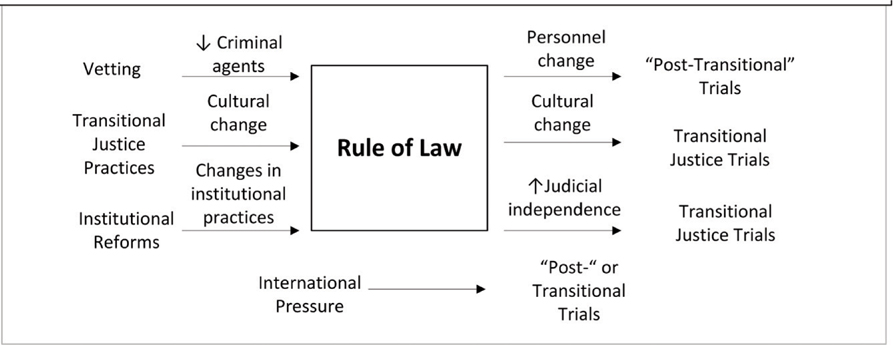
Instead of focusing narrowly on holding human rights violators accountable for their actions (see, e.g., Skaar et al. Reference Skaar, García-Godos and Collins2016), the present research extends into the longer-term relationships between the rule of law and transitional justice measures, such as amnesties, trials, truth commissions, and lustration. The literature on this relationship focuses on three main causal mechanisms: personnel change, cultural change, and institutional change. In addition, a prominent subset of the literature gives primacy to “norm entrepreneurs” in driving transitional justice. This literature can be broken down further into two groups, depending on whether authors are treating the rule of law or transitional justice as the dependent variable. These pathways are summarized in figure 1.
Causes and Effects of (Post)Transitional Justice

A further complication in this literature is the tendency to define the rule of law differently depending on the primary focus of the argument, whether it is institutional strengthening, social and cultural attitudes about abiding by the law, or the treatment of human rights violations as an important indicator. This article defines the rule of law in terms of the extent of impunity for both human rights violations and general crime.
Personnel Change
An early impetus for transitional justice efforts was to remove human rights violators from the political arena, preferably permanently, allowing for changes in personnel. This impulse fit in well with the desire to do right by the victims, either by conducting transitional trials or, at the least, by making public the truth of those violations. Some observers cautioned that attempting to try high-ranking officers would create instability; granting amnesties became common to avoid or defuse negative military responses to the boldest transitional justice efforts, in what Olsen et al. call a minimalist approach (2010, 19–21). Lustration or vetting processes, in which offending officials are purged from even the lower levels of relevant state institutions, were carried out nonetheless in some countries, including El Salvador and Guatemala, with varying levels of success (Mayer-Rieckh and De Greiff Reference Mayer-Rieckh and De Greiff2007). Vetting, as a transitional justice strategy, is theorized to promote rule of law development and reduce the likelihood of new human rights violations by increasing the legitimacy of reformed state institutions, eliminating disloyal public servants, and dismantling criminal networks that may have penetrated state institutions (Duthie Reference Duthie2007).
The amnesties that were passed in all three countries under study limited the ability to change personnel. This contradicts the observation of Olsen et al. (Reference Olsen, Payne and Reiter2010) that an early amnesty may produce very good outcomes for democracy and the rule of law when it is followed by subsequent (post)transitional trials. Embedded in that finding is a focus on trials of high-profile violators, such as occurred in Chile. Collins (Reference Collins2010) observed the opposite phenomenon in El Salvador: amnesties had not been reversed because both partisan politics and the justice sector remained in the control of the same parties (if not the same individuals). (The amnesty has since been invalidated, in 2016.) Ferrara (Reference Ferrara2015) traced the impact of the personnel changes that occurred in Chile following the report of its Truth and Reconciliation Commission and found that turnover in the criminal justice sector was essential for strengthening the rule of law and ending impunity. Thus, we should see a greater willingness to prosecute past human rights violations (as well as other high-profile violations) following personnel changes that enhance the rule of law.
This inability to vet the judiciary may be one source of the common obstructionism by judges in judicial reform efforts (Popkin et al. Reference Popkin, Spence and Vickers1994; Hammergren Reference Hammergren2007; Sieder Reference Sieder2004). Although the passage of time has led to substantial personnel turnover, institutional reforms in Guatemala have been more successful than in Honduras or El Salvador at empowering new justice sector personnel who seek to promote the rule of law.
Culture Change
The rule of law may also be strengthened by cultural changes that flow from a wide range of transitional justice measures. McAuliffe (Reference McAuliffe2013) has argued that the type of process followed in transitional justice efforts—most notably transitional trials—may cause citizens to view the justice system as more (or less) legitimate. An enhanced perception of legitimacy will produce greater law-abidance, an increased willingness to resolve private disputes through legal or formal channels, and a stronger overall rule of law. If transitional justice processes in fact harm the legitimacy of the justice system overall, the reverse is likely: citizens will be less willing to follow the law and more likely to settle disputes through informal means, including violence, thus diminishing the rule of law (McAuliffe Reference McAuliffe2013). Vetting processes are similarly argued to improve trust in institutions and related cultural values (Mayer-Rieckh and De Greiff Reference Mayer-Rieckh and De Greiff2007).
Cultural changes that come with the development of the rule of law may also increase demand for (post)transitional justice, including trials for past human rights violations. In addition, those cultural changes may enhance the likelihood that transitional justice efforts will foster reconciliation and meet with less resistance. McAuliffe specifically suggests that fair and equal treatment of noncombatants in courts will foster reconciliation better than high-profile trials (2013, 145).
Cultural changes that allow for greater openness and opportunities for popular action may also allow citizens to push for transitional justice “from below” (McEvoy and McGregor Reference McEvoy and McGregor2008). When governments decline to provide transitional justice “from above,” citizens may choose to take action themselves, in response to their own demands for justice, bringing civil suits, demanding criminal trials, or participating in community-level grassroots activities that resemble the national-level transitional justice efforts that did not materialize or were cut short. Collins (Reference Collins2010) traces how these efforts helped to produce a situation in which Chilean judges were able to pursue transitional trials beginning in 1998 for human rights violations that occurred decades earlier. Citizen efforts have been common in Central America, with significant overlap between activism in favor of human rights or transitional justice and activism against impunity for crime and corruption more generally.
Institutional Change
Transitional justice processes may include the reform of institutions, which can itself strengthen the rule of law. “Rule of law reforms,” almost universally introduced at the time of transitions to democracy in Latin America, often included or were associated with transitional justice measures, such as vetting or transitional trials. The optimism associated with these reforms has proved premature, but some improvements have been made (see, e.g., Hammergren Reference Hammergren2007). Stromseth et al. (Reference Stromseth, Wippman and Brooks2006) have argued that the institutional changes produced by some of these reform processes strengthened the rule of law in some countries. Additionally, the absence of internal accountability within the judiciary specifically is argued to produce a weak rule of law, in which rights can rarely be successfully claimed; conversely, the introduction of more robust internal accountability should enhance the rule of law (Yusuf Reference Yusuf2010).
To successfully produce or allow for (post)transitional justice, institutional reforms must build judicial independence. Skaar (Reference Skaar2011) addresses this pathway directly, arguing that countries in which transitional justice was not possible, due to weak or dependent domestic courts, may see later prosecutions following institutional reforms that build stronger and more independent courts. Alongside the persistence of particular individuals in the case of El Salvador, as described by Collins (Reference Collins2010), is the failure of judicial reform processes to produce genuine judicial independence there, thus further foreclosing the possibility of reconsidering amnesty laws. Therefore, we should expect to see transitional trials become possible only following justice sector reforms that enhance judicial and prosecutorial independence. The experiences of Guatemala, El Salvador, and Honduras bear this out.
International Influence
Transitional justice and rule of law construction are argued to be the result of a number of other causes as well. International “norm entrepreneurs” have been lauded by Lutz and Sikkink (Reference Lutz and Sikkink2001) for driving what they call a “justice cascade” that has created a number of (post)transitional justice openings (see also Sikkink Reference Sikkink2011), as well as by Keck and Sikkink (Reference Keck and Sikkink1998) for inculcating human rights norms more broadly. In Latin America, the Inter-American Court of Human Rights has been quite active in directing national governments to enforce international human rights norms, including the prosecution of past and present human rights violations (González Morales Reference González Morales2012).
The focus on international norm entrepreneurs has been criticized for making too much of the globalization of human rights practices when it should be better understood as merely another type of opportunity structure (Collins Reference Collins2010, 21–35). One might also criticize it for locating human rights enforcement agency outside the countries in which the enforcement occurs instead of within those national communities, given the high risks that domestic human rights activists frequently face.
Another problem with the international focus stems from the immense difficulty of ensuring national compliance with international rulings. However, Roht-Arriaza and Bernabeu (Reference Roht-Arriaza and Bernabeu2012) argue that the transnational process that occurred between Spanish and Guatemalan courts attempting to try former military members—including military ex-presidents Fernando Remeo Lucas García (1978–82), Efraín Ríos Montt (1982–83), and Óscar Mejía Víctores (1983–86)—helped to strengthen both norms and institutions in Guatemala.
Transitional Justice, Institutionalization, and Impunity
Long-term rule of law construction requires that accountability be institutionalized beyond high-profile trials. Transitional justice can interrupt past patterns of toleration of human rights violation by removing criminal agents, fostering cultural change, and strengthening institutional processes that encourage accountability. The absence of transitional justice for long periods can also reinforce those patterns of toleration and create impunity as violators are allowed to remain in their posts, cultures of political fear and domination persist, and accountability institutions writ large continue to support the interests of powerful elites, even in the face of democratization.
Continued toleration of such elite impunity may have been the price of the “contingent institutional compromise” of liberalization and early stages of democratization in Latin America (Przeworski Reference Przeworski1986; O’Donnell and Schmitter Reference O’Donnell and Schmitter1986). The spectacle of such impunity and elite power being reinforced posttransition is the primary driver of O’Donnell’s later concern for creating institutions for “horizontal accountability” that could hold powerful political institutions and their incumbents accountable to new or reinvigorated democratic constitutions (O’Donnell Reference O’Donnell2003, Reference O’Donnell1999a). O’Donnell saw strong institutions, such as independent courts, human rights ombudsmen, and even auditors, as the primary democratic means to control the powerful and to provide some measure of justice and participation to the powerless (O’Donnell Reference O’Donnell1999b).
While O’Donnell may be correct that institutions of horizontal accountability are necessary for a robust democracy, the relationship of transitional justice to the development of those institutions has remained murky. This study argues that transitional justice efforts rely on the existence of strong and independent institutions, such as prosecutors and courts. Furthermore, where independent institutions are not already present, transitional justice efforts are unlikely to produce them.
Transitional justice, thus, has not produced rapid or sudden change in the path-dependent development of legal institutions. Amnesties, especially, may be likely to reinforce path-dependent impunity. Major rule of law reform programs that began around the time of transitions to democracy and were frequently sponsored by international donors helped to create the institutional space for actors to pursue transitional justice measures after the fact. These reforms met with considerable resistance in the target countries, producing patterns of institutional development that do not follow punctuated equilibrium models of path dependence.
Instead, these patterns are more in keeping with Thelen’s emphasis on “the political contestedness of institutions” (2004, 294). Thelen argues that “emphasizing interests and alliances allows us to examine intriguing power reversals that sometimes flow from changes in the coalitional foundations on which institutions rest” (2004, 33, emphasis in original). However, this study focuses more on individual agency, following Levitsky and Murillo (Reference Levitsky and Murillo2013). The agency, choices, and alliances of those actors who exercise power in legal institutions accrue to produce changes that affect the rule of law, including transitional justice. The present research argues that the political contestation of rule of law institutions in Central America is a significant factor making transitional justice efforts possible or impossible.
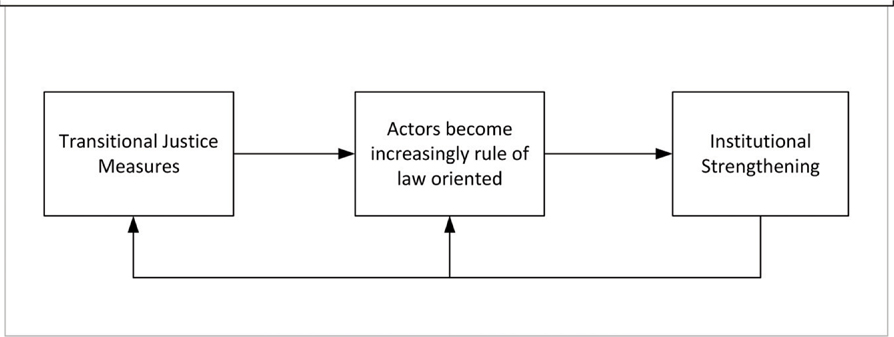
These transitional justice pathways can better help us to understand the relationship of transitional justice to rule of law construction if we place them into a feedback loop. As depicted in figure 2, transitional justice efforts may help to orient actors toward the rule of law and open institutional pathways for officials to be empowered to act with increasing independence. Those actors can then push to accept or even initiate reforms within their institutions, which then provide openings for further transitional justice efforts. Domestic actors, working through the institutions in which they are employed, can push their institutions to be more powerful and active in resisting impunity, including through posttransitional justice. The success of reformist institutional actors can be seen through high-profile trials for corruption and human rights violations, as well as decreases in general criminal impunity. The experiences of Guatemala, Honduras, and El Salvador suggest that international actors typically are not determinant, although they can provide important support for some institutional actors and condemn others.
Relationship Between Transitional Justice and the Rule of Law

Comparing Impunity States in Central America
If we look beyond individual accountability as the goal of transitional justice to consider how transitional justice efforts enhance or harm the rule of law, we see little positive effect in Central America’s Northern Triangle in the initial posttransition years of the 1990s and into the 2000s. On the contrary, historical patterns of impunity were not interrupted in these years, as crime skyrocketed—even though large-scale human rights violations ebbed.
Earlier transitional justice efforts were dominated by amnesties in Central America in the years following the gross human rights violations that peaked in the 1980s. Activists and others in civil society assisted with or actually convened truth commissions; demanded transitional trials in domestic, foreign, and international courts; and sought to build peace through projects that would foster cultural and social changes. Yet past violations of human rights, as well as past and present gross corruption, were not prosecuted in the Northern Triangle for at least the first postwar decade. Indeed, very little ordinary crime was prosecuted, either. Militaries largely returned to the barracks, reducing the frequency of official violations of human rights, but impunity continued.
Guatemala, El Salvador, and Honduras provide a fertile comparison of institutional reform and rule of law construction. While political violence in Honduras did not amount to a civil war and therefore included no internationally overseen peace process, Honduras experienced political violence, a transition to democracy, international justice sector reform efforts, and an explosion of criminal violence nonetheless, on a similar timeline as El Salvador and Guatemala. Although no transitional trials took place in any of these countries in the first decade posttransition, attempts at reform of legal institutions moved forward in Central America. Efforts were made to enhance the independence of judges, to improve the efficiency of courts, and to increase access to justice (Prillaman Reference Prillaman2000; Popkin Reference Popkin2000; Hammergren Reference Hammergren2008).
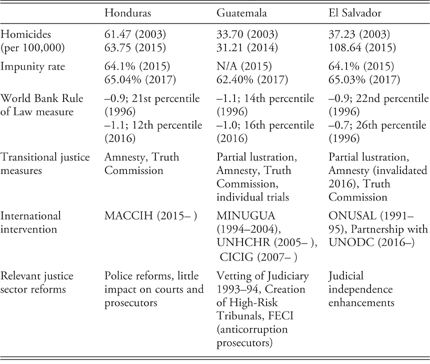
Table 1 summarizes the effects of these changes: high homicide rates, high impunity rates, and low scores on the World Bank’s Rule of Law measure. Homicide rates in Guatemala, while still high, are substantially lower than in Honduras or El Salvador. In addition, all three countries share a history of amnesties combined with truth commissions. In Guatemala, amnesties have been partially pierced to allow for limited posttransitional trials, primarily in the 2010s. El Salvador’s amnesty was invalidated only in 2016; prosecutorial activity has so far been limited. Honduras extended amnesties after the violence of the 1980s, as well as issuing another amnesty after the 2009 coup, which followed the established pattern of official impunity. While all three countries are now partnering with international institutions on control of corruption and crime, Guatemala’s partnerships began much earlier and were much more extensive.

Guatemala: Interrupting the Continuous Past
How did it happen that Guatemala, long a weakened state that failed to challenge either official or criminal impunity, put a president on trial for corruption after a popular groundswell forced him to resign in 2015, and quickly thereafter arrested 18 high-ranking military officers on charges of past human rights violations? The most significant reason is institutional change, forged through decades of international partnerships and pressure.
Guatemala was subject to repressive military rule from 1954 to 1986 and a civil war that lasted from 1960 until its formal conclusion in 1996, during which two hundred thousand people were either killed or “disappeared” and many more fled into exile. Approximately half of those deaths occurred in the period 1979–83 (Comisión para el Esclarecimiento Histórico 1999; Proyecto Interdiocesano 1998). Early transitional justice was limited by a 1996 amnesty law, although there were two truth commissions, one of which was spearheaded by a religious human rights organization. Partial vetting of the judiciary also occurred following a failed autogolpe by President Jorge Serrano in 1993. Nevertheless, civil society activists pursued cases and investigations in Guatemalan and international courts, making use of laws permitting individuals to act as private prosecutors through the Guatemalan legal institution of the Querellante Adhesivo.
While transitional justice issues advanced very little in Guatemala during the 1990s and 2000s, pressure to protect human rights and to prosecute violations of them mounted, driven by both domestic nongovernmental and international actors. In the early years following the transition to democracy and the peace process, efforts for official accountability came largely from the private, nongovernmental actors who functioned as private prosecutors. Until recently, very few trials for pretransition human rights offenses took place; all those that did were very high profile cases that attracted strong pressure from the international community. Two military officers were convicted in 2001 of the 1998 murder of Monsignor Juan Gerardi, founder of the Archbishop’s Office on Human Rights (ODHA). The Guatemalan government acknowledged in 2004 that anthropologist Myrna Mack had been killed by a military death squad 14 years earlier, but only after her family brought the case to the Inter-American Court of Human Rights.
Recent high-profile trials, including that of Ríos Montt, have been possible because of institutional changes that are producing a stronger rule of law in Guatemala, going well beyond transitional justice. These changes included the creation of the “high-risk tribunals,” having greater security and independence protections, where the cases were tried, and significant enhancements in training, independence, and protections for the prosecutorial service. Alongside the Gerardi and Mack cases, investigations into state-sponsored massacres during the civil war were initiated, and activists began to press for prosecutions of former heads of the military governments in both foreign and domestic courts, beginning in the 1990s.
Indigenous Guatemalan activist Rigoberta Menchú tried unsuccessfully to bring charges against Ríos Montt in Spain between 1999 and 2007, when he reentered Congress and regained official immunity. Efforts to try Ríos Montt in Spain were invigorated by his failed 2003 candidacy for president but were stymied by a court ruling that refused to acknowledge Spain’s jurisdiction or allow Spanish prosecutors to conduct depositions in Guatemala. Ríos Montt was finally arrested and put on trial in 2012 by Guatemalan attorney general Claudia Paz y Paz. He was convicted of genocide in 2013 for ordering massacres and other atrocities as president and sentenced to 80 years in prison, the first time a former head of state has been tried and convicted in his own country for genocide.
However, reflecting the tensions between the various courts in Guatemala, that verdict was invalidated by the Constitutional Court, and a new trial was ordered in May 2013, which reopened for the final time in October 2017, albeit behind closed doors (AFP 2017). Although he died in April 2018 a free man, the overturned verdict against Ríos Montt retains considerable symbolic importance. Even with these changes, Paz y Paz was forced to step down early as attorney general following the Ríos Montt conviction in 2013. It is notable that her early departure followed a February 2014 Constitutional Court decision regarding the technical length of her term, suggesting that even those seeking to maintain impunity must use legal means to do so (Lohmuller Reference Lohmuller2014).
Institutional change was bolstered by the work of an international commission with its roots in a 2003 constitutional crisis. Guatemala’s Supreme Court and Constitutional Court disagreed about Ríos Montt’s eligibility to run for president because he had previously come to power through a coup. The subsequent upheaval included riots, seemingly orchestrated by Ríos Montt and his supporters, against perceived enemies, such as the Supreme Court, the Human Rights Ombudsman, and other unfriendly government offices. These events were said to “partially reveal” the influence of organized crime in government (Hernández Pico Reference Hernández Pico2003), and international actors began to cooperate in creating what eventually became the International Commission Against Impunity in Guatemala (Comisión Internacional Contra la Impunidad en Guatemala, CICIG).
Since 2007, the CICIG has been working alongside the Guatemalan government to investigate and prosecute high-profile crimes while simultaneously advocating for justice sector reforms. The CICIG lists 81 cases between 2009 and 2018, each of which involves many defendants (CICIG 2018). Just one recent case, the “Migración” case, resulted in the convictions of 39 persons by a high-risk tribunal in March 2018 (Ministerio Público de Guatemala 2018). Through its work with the Special Prosecutor Against Impunity (Fiscalía Especial Contra la Impunidad, FECI) unit in the national prosecutorial service, the CICIG reported a decrease in impunity levels from 95 percent in 2009 to 72 percent in 2012 (CICIG 2013).
It appears that, in Guatemala at least, institutional change has produced opportunities for transitional justice, as well as movement toward the rule of law, confirming the value of institutional strengthening even without initial transitional justice. The international presence through the CICIG has been important primarily for its support of domestic institutions and some of their more active incumbents. Strengthened justice sector institutions with increasingly empowered actors at their heads are pushing back at both official and unofficial impunity—even as many powerful politicians continue to have ties to organized crime.
Changes in justice sector institutions and attitudes toward the rule of law went so far, in 2015, as to allow for a mass social movement against official corruption, which led to the resignation of President Otto Pérez Molina to stand trial on charges brought by Attorney General Thelma Aldana. The investigation that led to those charges had already led to the arrest of the vice president and numerous government officials in a customs scandal known as La Linea. The dramatic changes brought by FECI’s prosecutions, along with increasingly powerful and independent domestic prosecutors, may yet produce lasting change in Guatemala, despite the continued contestation over democracy and the rule of law.
El Salvador: Amnesty Is Overturned but Impunity Continues
El Salvador continues to struggle with impunity as a result of continued partisan influence in institutions that limit institutional changes. Despite a surprising Supreme Court decision to reverse the 1993 Amnesty Law in 2016, El Salvador’s justice institutions largely continue to decline to support transitional justice efforts stemming from the civil war.
The guerrilla war and accompanying extensive state violence ended with the signing of a peace accord in 1992 (Bird and Williams Reference Bird and Williams2000; Tulchin and Bland Reference Tulchin and Bland1992). The Salvadoran peace process of 1989–92 was one of the earliest to include a United Nations monitoring agency, ONUSAL, which officially began operation in 1991. “In one of the most comprehensive operations in United Nations history, ONUSAL monitored the accords and verified the demobilization of combatants, their reintegration into society and the respect by both parties of their human rights commitments” (ONUSAL 2003). During its brief tenure in El Salvador, this mission sought to build peace while deepening democracy in several ways: it created an institutional path to incorporate the FMLN into civilian politics, led a truth commission, and participated in a vetting process. The Truth Commission released its report on March 15, 1993, recounting some 22,000 incidents involving extrajudicial killings, disappearances, and torture (UN Security Council 1993).
The vetting process focused on the civilian police, which was reconstituted as a new National Civilian Police. The new organization included quotas of 20 percent former members of the National Police, 20 percent former members of the FMLN, and the remaining 60 percent civilians who had not participated on either side of the civil war (Zamora and Holiday Reference Zamora and Holiday2007). During the initial transition period, this reform was hailed as a highly successful one, but even by 2001, there were problematic indicators (Popkin Reference Popkin2001). Moreover, the vetting process was applied only to the applicants to the new PNC and did not address personnel issues in other justice sector agencies, such as the courts or the prosecution. A comprehensive Amnesty Law was passed in 1993.
Attempts at institutional reform have been limited by the strength of El Salvador’s postwar two-party system. Salvadoran politicians can exert more pressure on judges and prosecutors than can their Guatemalan counterparts, who operate within a feckless and often personalistic party system. In El Salvador, the power of partisanship was able to overwhelm the institutional reforms of the 1990s and also prevent further reforms in the 2000s and beyond, thus short-circuiting efforts to build the rule of law. Moreover, El Salvador has seen no recent anti-impunity or anti–organized crime efforts on the scale of the CICIG. After the governing FMLN clearly rejected the idea of a “CICIG for El Salvador,” citing the politicization of the CICIG and arguing for domestic institutions, the government did accept a partnership with the United Nations Office on Drugs and Crime (UNODC) to strengthen the prosecutorial system (El Mundo 2015). Even discussions of posttransitional justice have been infused with partisan concerns: right-wing politicians suggest that left-wing FLMN president Salvador Sánchez Cerén (2014–) should be tried for human rights violations committed by FMLN guerrillas when he was one of their leaders (After the Amnesty Law 2016).
Recent changes have yet to interrupt the longtime patterns of partisan impunity in El Salvador. Since the Salvadoran Supreme Court overturned the Amnesty Law in July 2016, several posttransitional trials have been initiated by private litigants. The best-known transitional justice trial in El Salvador to date involves the massacre at El Mozote. The El Mozote massacre, which took place in December 1981, has been under investigation in various forms since 1990. In 2012, the Inter-American Court of Human Rights ordered the government of El Salvador to reopen the case and declared the 1993 Amnesty Law to be inapplicable to the incident (Inter-American Court of Human Rights 2012). The case was reopened in 2016 and is expected to continue into 2019 (Malkin Reference Malkin2018). It is also promising that El Salvador’s attorney general since 2016, Douglas Meléndez, has taken steps to attack corruption in the justice sector, arresting 14 judges, prosecutors, and others in August 2017 (Clavel Reference Clavel2017). Attorney General Meléndez, however, does not have a special prosecutorial unit, such as the FECI in Guatemala, with its special training and protections.
While it is easy to blame the current problem of criminal impunity in El Salvador on the rise of gang violence, we need to understand that the roots of that impunity are in the violence of the 1980s and the transitional period of the 1990s. At the same time that crime was beginning to rise, the failure to vet the prosecution or the courts was frustrating efforts to control corruption in the justice sector. The same patterns of corruption that had allowed some civil war detainees to escape government violence remained in place, and now allow for many to escape criminal prosecution. This corruption allows the wealthy and violent to win their freedom through bribery or brutality; it also leaves the vast majority of defendants without trial and the vast majority of victims without vindication. The judiciary cannot escape the control of a brutal society. Simultaneously, patterns of political dependence reemerged within the judiciary after a brief period of reform. Thus, we should understand that El Salvador has neither established a new democratic order nor simply reestablished the old elite-dominated order. The span of acceptable ideologies has grown; the rise of the FMLN as a mainstream political party provides a voice for the Salvadoran left. Nevertheless, the past casts a long shadow. The openings created for crime and the corrupt patterns (re)established in the posttransitional period are responsible for these problems.
In addition to impunity for human rights violations, the power of organized crime has increasingly overwhelmed protections of judicial and prosecutorial autonomy that were never fully established. Crime has grown since the end of the civil war, and Salvadorans today live in a very violent society, with early-2000s progress now backsliding again (UNODC 2016). By 2015, the murder rate was back on the rise, with violent deaths reaching levels not seen since the war years.
El Salvador has very powerful street gangs, which are largely independent of drug-trafficking gangs but nonetheless a major contributor to public insecurity (Bruneau et al. Reference Bruneau, Dammert and Skinner2011). With corruption rampant in the judiciary and among groups such as prison guards, the maras are frequently able to operate with impunity, even in the face of official pressure on the justice sector to control crime. These gangs are more influential in El Salvador than their analogs in Guatemala or Honduras. The March 2012 mara truce that produced some short-lived respite from violence in El Salvador (Economist 2013) reflects that impunity—only the maras can control the maras.
Indeed, events in 2014 and 2015 suggest that the maras are increasingly trying to flex political muscle. Mara leaders bargained with political leaders leading up to the 2014 presidential election, according to Salvadoran activists the author interviewed in 2015. In 2017, 18 state agents were tried for providing benefits and contraband to imprisoned gang members as a part of these negotiations, but all 18 officials were acquitted (Kiernan Reference Kiernan2017). These developments reflect the contestation between impunity and the rule of law. At this point, it appears that impunity is winning in El Salvador.
Honduras: Repeating Patterns of Impunity
In the absence of either substantial transitional justice or penetrating institutional reforms, Honduras has retained an elite political culture that contributes to abuses and prevents institutional reform. Due to that lack of institutional reform, continuing amnesties, and the maintenance of the same political parties in power, Honduras experienced a near-total lack of transitional justice following the “dirty war” of the 1980s.
Following the 1987 Esquipulas II regional peace accord, Honduras began to take cautious measures to address human rights abuses. A human rights ombudsman was soon appointed, and he ultimately released a truth commission report in 1993. However, amnesties passed in 1987 and 1991 proved a strong impediment to attempted human rights prosecutions. Although these amnesty laws were declared unconstitutional by the Honduran Supreme Court in 1995, the first final sentence was not entered against a military officer until ten years later. In 2005, Lt. Marco Tulio Regalado was sentenced to 12 years in prison for the murder of a Honduran Communist Party leader in 1983. Beyond limited prosecutorial activities, the majority of the human rights ombudsman’s recommendations were never implemented.
While transitional justice measures are theoretically possible in Honduras, they remain politically improbable as time runs out on the practical ability to prosecute human rights abusers from the “dirty war” era before they die. Honduras followed a similar pattern of a truth commission followed by only minimal prosecutorial activity after the 2009 coup against President Manuel Zelaya. Political control of the judiciary is reflected in, and appears to have contributed significantly to, those events. The magistrates of the Supreme Court who authorized the military to remove Zelaya had only recently been appointed by Roberto Micheletti, then-president of the Congress; that they then approved Micheletti’s assumption of the presidency is typical of a partisan, politically dependent court.
As the coup’s denouement dragged on through the installation of newly elected president Porfirio Lobo in January 2010, the Supreme Court was the loudest and most insistent proponent of the coup, even invalidating a congressionally approved power-sharing agreement that would have partially reinstated Zelaya and restored Honduras’s international standing. In the year following the coup, political control of the judiciary was reinforced: members of the judiciary who had opposed the ouster were subjected to forced transfers to less desirable posts, disciplinary processes, and removal of judges and even one magistrate from their positions (Amnesty International 2010).
This partisan exercise of judicial power should not be surprising, as the judiciary has followed highly political, highly partisan processes for decades. Since the pactito (little pact) that gave the National Party members of Congress the “control of the Supreme Court and half of the other judicial appointments” after the 1985 election (Schulz and Schulz Reference Schulz and Schulz1994), partisan control has been paramount. By 2003, two-thirds of Honduran judges identified membership in a political party as a prominent qualification for becoming a judge (Díaz Rivillas and Linares Lejarraga Reference Díaz Rivillas and Lejarraga2005). The political dependence of the judiciary and other justice sector institutions contributed to the 2009 coup and the subsequent impunity, just as it did to impunity for the human rights abuses of the 1980s.
A truth commission was established under the auspices of the Organization of American States after the election of President Porfirio Lobo in late 2009. The Truth and Reconciliation Commission found, in July 2011, that the removal of Zelaya had indeed been an illegal coup, that Congress had overstepped its authority in appointing Micheletti, and that at least 20 people had been killed by agents of the state and their allies. Nevertheless, there has been no substantive accountability for abuses connected to the coup because President Lobo passed an amnesty for coup-related crimes in 2010. Honduran human rights activists also initiated their own truth commission in response to concerns about the process followed by the official commission. In October 2012, this truth commission published its own report, which explicitly tied the 2009 coup to a century of political instability, laid blame on business interests with ties to the military, and analyzed 1,966 citizen complaints of human rights violations (Comisión de Verdad 2012).
International institutions also declined to prosecute, however; the International Criminal Court turned its eyes to Honduras beginning in 2010 and found that crimes against humanity had not occurred under Article 7 of the Rome Statute (Office of the Prosecutor 2015). While there may not have been crimes against humanity, widespread human rights violations remain in impunity, both domestically and internationally.
This impunity contributes to perpetuating a variety of other official and unofficial violations of human rights. The politicized judiciary has also resisted efforts since 2013 by Honduran attorney general Óscar Chinchilla to prosecute organized criminal rings with ties to politicians—a move that has also increasingly isolated the attorney general from a president who was once his patron (Dudley and Puerta Reference Dudley and Puerta2017). Although the level of violence and threats against judges, journalists, and activists has diminished since the months immediately following the coup, both official and unofficial actors continue violating human rights with impunity. The Inter-American Commission on Human Rights has explicitly tied high rates of criminality to impunity for human rights abuses (Inter-American Commission on Human Rights 2015). Like Guatemala and El Salvador, Honduras faces a daunting level of violent criminality. Murder rates were around 90 per 100,000 inhabitants in 2010 and 2011, although they had dropped to the low 60s by 2015, according the United Nations Office on Drugs and Crime.
Institutional weakness that had persisted since the 1980s allowed public and private criminality in Honduras to grow. Institutional weakness allows many people to get rich from drug trafficking and propels some into political prominence. However, in September 2015, Honduras and the Organization of American States announced the creation of an international anticorruption commission, the Mission Against Corruption and Impunity in Honduras (MACCIH), that would also promote public security (OAS 2015). This commission was designed with the intention that it would be less politicized and would create more local “ownership” of the process than did the CICIG in Guatemala, but this has made it possible for the Honduran government to interfere in the MACCIH’s work (Dudley Reference Dudley2018). Honduras has not yet seen either a change in political culture or significant institutional change; it is unclear whether the new OAS-sponsored commission, which is expected to strengthen institutions, may eventually also open possibilities for posttransitional trials.
Conclusions: Institutional Transitions, Impunity States, and the Rule of Law
Rule of law construction requires stronger institutions that can enforce accountability. The impunity that plagues Central America can be confronted and the rule of law can be built only if the justice system is strengthened by protecting judges, prosecutors, and other actors from political and societal interference. Although they may contribute to beneficial cultural changes, transitional trials are likely to be insufficient on their own to routinize accountability.
These difficulties are especially pronounced when we consider the rule of law not just from the perspective of prosecuting high-profile violators but also from the perspective of protecting the capacity of the ordinary citizen to be free of these violations by government and private actors. Without significant and lasting institutional reforms, the CICIG model is likely to produce little lasting impact. Even in Guatemala, it remains to be seen how the recently emboldened prosecutorial service will fare once the CICIG’s international support is gone. Ultimately, the real challenge lies in convincing politicians that it is in their interest to build and empower stronger justice institutions.
How does persistent impunity intersect with processes of transitional justice or lack thereof? These three case studies support a focus on institutional strengthening for producing the rule of law, including control of crime in the streets and corruption in the government. Enhancing the independence of the justice system must be central to this institutional reform. This institutional strengthening, along with cultural change, may even produce trials for pretransition human rights violations. Ending impunity also requires building stronger institutions; the progress that has been made in combating impunity in Guatemala has come from strengthening justice sector institutions and protecting their incumbents.
Transitional justice itself if not a panacea. When law enforcement is conducted as an act of political vengeance or primarily to satisfy international pressure, there is no reason to believe that it will be extended against private actors or in particular circumstances. Furthermore, the window for “transitional” justice—or even “posttransitional justice”—is rapidly closing in Latin America, as dictators and other human rights violators age and die. High-profile trials alone will have little impact if the necessary steps are not taken to routinize that accountability. It is not necessarily the transitional trials themselves, then, that may aid the rule of law in transitional and weak democracies, but rather the related institutional reforms that may accompany them.