Scholars have long noted the role of substances inducing altered states of consciousness in the development and maintenance of political and religious authority among state societies. Neoevolutionary theory emphasized the importance of the ecclesiastical religion of ancient states, where full-time, state-sanctioned religious practitioners (i.e. priests) performed standardized rituals meant to strengthen state allegiance and disseminate state ideology. These ceremonies communicated the unique and privileged role of leaders in maintaining the universe and reiterated their divine right to rule, while art and special spaces—temples and public buildings—acted as visual reminders that social inequality was justified. For example, state priests and élites are known frequently to have consumed and distributed alcohol (e.g. Marcus Reference Marcus, Marcus and Williams2009), an attractive emphasis for state ritual since alcohol is associated with agriculture and the intensification of farming infrastructure.
Neoevolutionary theory predicted that other activities inducing altered states of consciousness, such as the shamanic consumption of hallucinogens, were abandoned or at least reformed in state societies due to the personalized and individualized (rather than standardized) nature of these rituals (VanPool Reference VanPool2009). In this perspective, ancient religion was conceived as shamanic in its earliest phases and ecclesiastical in the more recent past; this transition would have coincided with the emergence of social complexity. However, research on ancient and contemporary ritual practices clearly shows that hallucinogens and other activities inducing altered states of consciousness were not abandoned in state societies. For example, ancient Maya rulers regularly consumed hallucinogens (Grube Reference Grube and Grube2012), and healers continue to exist in modern-day Peru (e.g. Bussman & Sharon Reference Bussmann and Sharon2006; De Feo Reference De Feo2004).
Moving away from the shaman/priest dichotomy, this article focuses on the construction of ritual-political power and the tension between élite-sponsored public rituals in the context of state expansion and the ritual practices of smaller-scale societies that met with state colonists. Unlike state authorities who often organized large gatherings in public plazas for the consumption of alcohol, sometimes reaching several thousand people (e.g. at the Inka settlement of Huánuco Pampa: Morris et al. Reference Morris, Covey and Stein2011), hallucinogens usually involve smaller groups (e.g. Dobkin de Rios Reference Dobkin de Rios1972). Hallucinogens facilitate the journey to the supernatural realm, and this journey's objective is not to convince people of the legitimacy of the élites, but to divine the future, heal the ill, or communicate with deities.
The tension between the public state-sponsored rituals and the more private ceremonies involving hallucinogens can be exacerbated in a period of state expansion when state élites meet with local communities. The existence of practices inducing altered states of consciousness during those periods of early state expansion binds people across regions, regardless of state boundaries and irrespective of what states are trying to accomplish. Individuals might interact with areas outside state control for the procurement of hallucinogenic plants and the sharing of esoteric knowledge, while ill patients may travel great distances to meet with reputable healers. The potential impact of the persistence of hallucinogenic practices for expanding states is therefore non-negligible, since certain individuals can continue to operate outside state control, escape new state regulations, or promote ideas that might not align with those of the expanding state's élites.
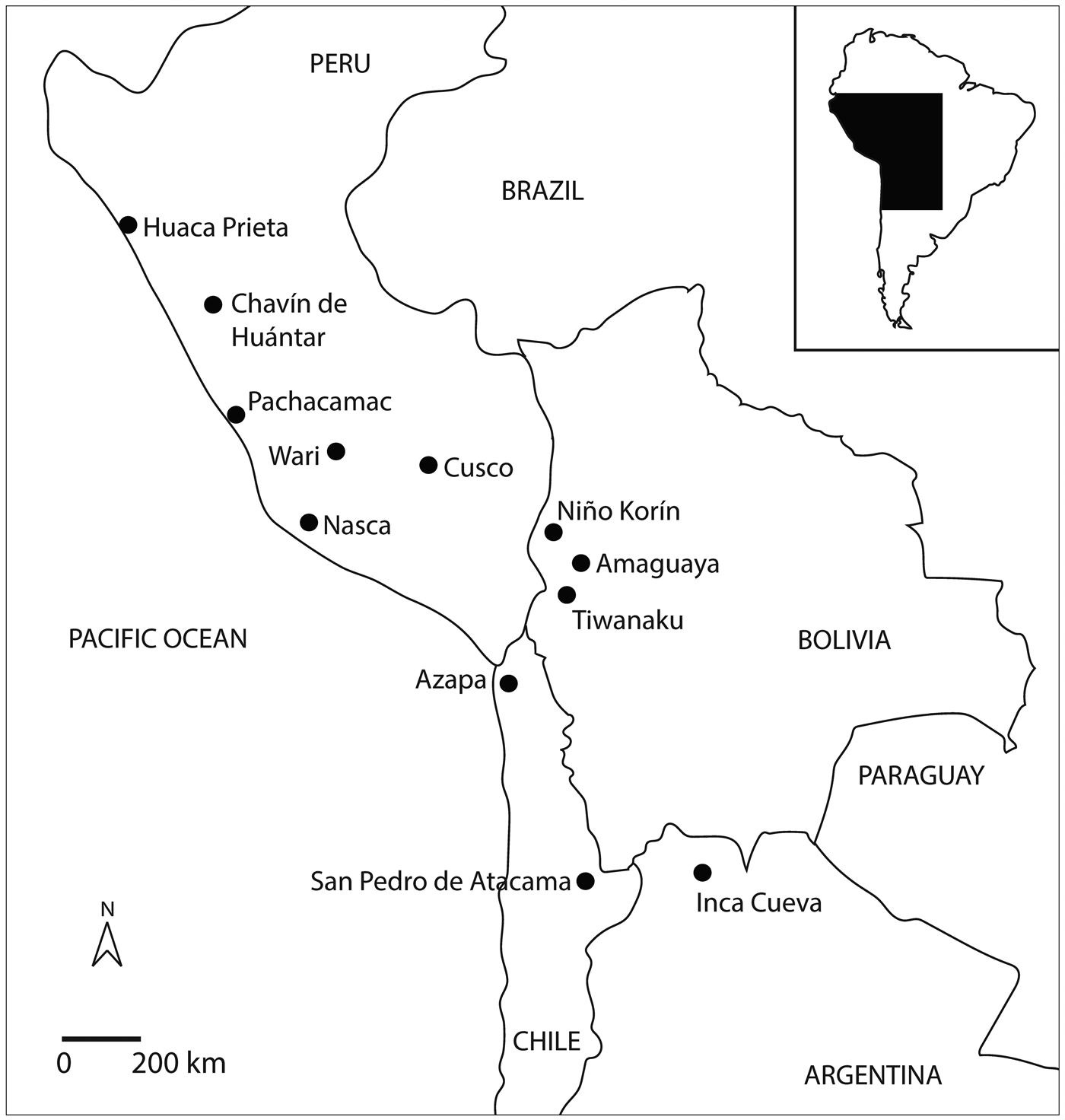
In the Andes, the use of mind-altering substances has been studied in periods characterized by complex societies such as Chavín de Huántar (Fig. 1). The ingestion of psychoactive substances continued in subsequent periods; however, Andean archaeologists working on highland states have focused on the role of corn beer (chicha) in state-sponsored feasts among the Wari, Tiwanaku and Inka polities. For example, scholars have demonstrated the central role of chicha in the operation of the Middle Horizon (ad 600–1000) Wari state, showing that the preparation and consumption of maize beer was key to the development of alliances and asymmetrical relationships between state agents and local populations (e.g. Jennings & Bowser Reference Jennings, Bowser, Jennings and Bowser2009; Moseley et al. Reference Moseley, Nash, Williams, deFrance, Miranda and Ruales2005). Chicha was used to host feasts and create obligations to the state, including the payment of tribute.
The Andes, with important regions and archaeological sites mentioned in the text.

During the Middle Horizon, chicha had become an important element of local and regional politics, and Wari élites organized large feasts during which they served chicha that on occasion may have been mixed with hallucinogenic substances (Knobloch Reference Knobloch2000). Conversely, some local communities were focusing their ritual activities on the consumption of hallucinogens, despite the presence of Wari representatives in their region. This paper addresses the impact of the persistent consumption of hallucinogens inducing altered states of consciousness during the Middle Horizon, examining the tension between state political feasts and local rituals. I present new evidence for the ingestion of hallucinogens from the site of Ak'awillay in the Cusco region, focusing on paraphernalia and ritual spaces recovered in large horizontal excavations. Cusco is a good candidate for exploring this tension, since the Wari state constructed large installations in the area (McEwan Reference McEwan2005). Before presenting these new data, I start with a definition of altered states of consciousness and examine the use of known hallucinogens from South America and some of the archaeological evidence supporting their consumption.
Altered states of consciousness
In a recent effort, a team of cognitive neuroscientists attempted to define altered states of consciousness (ASC), emphasizing the importance of distinguishing ASC from ‘normal states of consciousness’ (Revonsuo et al. Reference Revonsuo, Kallio and Sikka2009, 187). They argue that being in an ASC ‘is to deviate from the natural [world-consciousness] relation in such a way that the world and/or self tend to be misrepresented’ (Revonsuo et al. Reference Revonsuo, Kallio and Sikka2009, 194). They define a misrepresentation as an object or event that either appears without being present or that fails to appear when present (Revonsuo et al. Reference Revonsuo, Kallio and Sikka2009, 195).
Most people who experience an ASC would disagree with this definition. A ritual practitioner, for example, does not conceive an ASC as a ‘misrepresentation’, but rather as an opening to another, very real, world or universe that only a few can experience. This other world is always present, but hidden and remote, and it is only accessible through an ASC which enables the individual to make the journey from the here and now to this distant world.
An alternative definition for an altered state of consciousness is a temporary, reversible state in which perceptions of the world are changed. One can reach an ASC through rhythmic sounds and chanting, fasting, dreaming, sleep deprivation and extreme pain (VanPool Reference VanPool2009, 180), but one of the most effective (i.e. fastest) ways is through the consumption of hallucinogens. The use of psychoactive substances does not necessarily preclude the other ways of inducing an ASC and hallucinogens are often combined with drumming, singing and other consciousness-altering actions.
Most known hallucinogens are natural and come from plants, although a few animals are known to contain them (e.g. some toads) and experiments of the twentieth century have produced synthetic hallucinogens such as LSD. From a botanical standpoint, hallucinogenic plants contain active chemical compounds (alkaloids) that have psychotropic properties. When consumed, they trigger changes in brain functions inducing temporary changes in perception, thought and mood. Some of these alterations in perception may result in actual hallucinations, which can involve all five senses (Schultes & Hoffman Reference Schultes and Hofmann1980). Some hallucinogens result in visions that include bright, colourful, fast-moving, rapidly changing geometric motifs and narrative content (Stone Reference Stone2011), while others involve black-and-white visions (VanPool Reference VanPool2009). These visions are multisensory and synesthetic: for instance, colours may have textures.
Due to the nature of the human brain, visions may be similar from one person to another. For example, many individuals see spirals and undulating and radiating movements. The visions’ interpretations, however, are culturally specific and culturally defined (Reichel-Dolmatoff Reference Reichel-Dolmatoff and Furst1972; Sharon Reference Sharon and Furst1972). For instance, ethnographic studies suggest that while people living in the Amazon forest interpret some of their visions as snakes and large felines, people who did not grow up in that environment are unlikely to interpret their visions in that way (Dobkin de Rios Reference Dobkin de Rios1972, 116–27). Instead, they will see things that are culturally relevant to them.Footnote 1
Hallucinogens in South America
Uses
Ethnohistoric and ethnographic accounts from the Amazonian region, the Andes and the Antilles suggest that psychoactive plants are consumed in two contexts: (1) in healing ceremonies and (2) in divination or magic rituals where ritual practitioners communicate with and propitiate the supernatural (Dobkin de Rios Reference Dobkin de Rios1972, 37–47; Torres Reference Torres1996). These two contexts are not mutually exclusive, and healing often involves communicating with spirits or supernatural beings. In these instances, hallucinogens are used as entheogens, i.e. substances that can give access to or generate what participants often label ‘the divine’. In these rituals, the healer acts as the link between this world and that of the supernatural (De Feo Reference De Feo2004).
Contemporary healing ceremonies generally involve a healer, their assistants and patients. They all consume hallucinogens to induce visions that will allow the healer to discover the causes of illnesses and neutralize or cure the effects of evil spirits or people (Dobkin de Rios Reference Dobkin de Rios1972). Healers interpret their patients’ visions and their own and provide them with advice and a treatment plan. Psychoactive substances thus play a key role in the healing process—they open up the patient's mind and allow the healer to express and set in motion their healing forces (Sharon Reference Sharon and Furst1972). Therefore, hallucinogens are not medicine, but ‘tools for therapy’ (Schultes & Hofmann Reference Schultes and Hofmann1980, 18).
In other contexts, select individuals consume hallucinogens to communicate with a wide range of spirits and supernatural beings to propitiate them, receive their protection and divine the future. In the Andes, Spaniards recognized the highly sacred and ritualized use of psychoactive plants early on, as evidenced by an order to destroy snuffing paraphernalia that appeared in Spanish sixteenth-century documents (Gade Reference Gade2016, 201–9; Torres Reference Torres1996, 20). Despite the Spaniards’ attempt at eliminating this practice, the consumption of hallucinogens for divination, magic rituals and healing continues throughout the Andes today (e.g. Bussman & Sharon Reference Bussmann and Sharon2006; Torres & Repke Reference Torres and Repke2006).
Plants
According to Schultes and Hofmann (Reference Schultes and Hofmann1980, 21–2), there are approximately 7000 plant species containing alkaloids, of which only 90 to 100 are used as hallucinogens. South America is home to several of these hallucinogenic plants, many of which have a long history of use that dates back to the pre-Inka period. The following description includes four of the most commonly used hallucinogenic plants in Peru today; based on archaeological evidence, they were also among the most frequently consumed in the past.Footnote 2
The San Pedro cactus (Echinopsis pachanoi, also known as Trichocereus pachanoi) is native to Peru and Ecuador and generally grows between 2000 and 3000 m above sea level (masl), although specimens have been observed at lower elevations close to the coastline (Sharon Reference Sharon and Furst1972). The columnar cactus contains several alkaloids, among which the most important is mescaline (Crosby & McLaughlin Reference Crosby and McLaughlin1973). To extract the alkaloids, the cactus is cut into slices and then boiled in water for several hours. Its consumers drink the resulting beverage. Ethnographic accounts from the north coast of Peru indicate that today the San Pedro cactus is often drunk in healing ceremonies (Bussman & Sharon Reference Bussmann and Sharon2006).
Banisteriopsis caapi is a vine indigenous to the tropical forest and is one of the ingredients in a drink called ayawasca in the Andes or yajé or capi in the Amazon (de Smet Reference de Smet1985; Schultes & Hofmann Reference Schultes and Hofmann1980, 172–3). The vine is not hallucinogenic on its own, but is essential for providing the monoamine oxidase (MAO) inhibitors such as harmine and harmaline in the mixture of ayawasca. The MAO inhibitors found in the bark of B. caapi are mixed with the leaves or bark of plants containing dimethyltryptamine (DMT), which allows the DMT to be absorbed through oral ingestion. People who have consumed ayawasca report colourful visions accompanied by euphoria and sometimes nausea, vomiting and terror. Some individuals report flying, communicating with supernatural beings or ancestors, or dying and rebirth (Reichel-Dolmatoff Reference Reichel-Dolmatoff and Furst1972; Schultes Reference Schultes and Furst1972, 35).
The Brugmansia tree or shrub, also known as angel's trumpet, grows in tropical regions of South America or in the cooler highlands above 1830 masl (Schultes et al. Reference Schultes, Hofmann and Rätsch1998, 37).Footnote 3 Brugmansia contains many alkaloids, including scopolamine, atropine and many others (De Feo Reference De Feo2004; Schultes et al. Reference Schultes, Hofmann and Rätsch1998, 37). Depending on the species, healers apply or rub the leaves and flowers on the body of an ill person to cure or relieve pain and aches; absorb an extract (tincture) through the nasal membranes; or squeeze or ferment the leaves and flowers to produce a beverage (De Feo Reference De Feo2004). This plant can produce strong hallucinogenic effects, and usually only healers drink it for the visions that the plant triggers.
The Anadenanthera (previously referred to as Piptadenia) tree grows in dry tropical and sub-tropical regions up to approximately 2700 masl (Torres & Repke Reference Torres and Repke2006, 6). There are two closely related species, A. peregrina and A. colubrina (de Smet Reference de Smet1985; von Reis Altschul Reference von Reis Altschul, Efron, Holmstedt and Kline1967, 307). The first, known as yopo, currently grows in Colombia, Venezuela and northeastern South America. The second, known as vilca, is presently only found south of the equator in Peru, Bolivia, northern Argentina, Paraguay and southern Brazil, and is believed to have been used in the past in the Andes. Early attempts to identify the plant have found specimens in herbariums from Huacavelica and Apurimac in Peru, as well as east of La Paz in Bolivia (von Reis Altschul Reference von Reis Altschul, Efron, Holmstedt and Kline1967, 308, 312). In a visit to the Vargas herbarium of the Universidad Nacional de San Antonio Abad del Cusco in July 2017, I noted the presence of Anadenanthera growing in the Department of Cusco.
Anadenanthera’s main alkaloids are tryptamines, including bufotenine and DMT (Gade Reference Gade2016; Torres & Repke Reference Torres and Repke2006). Today the plant is mostly consumed as snuff, although people also use it as enema, smoke its seeds, apply it as an unguent, or mix the ground seeds with chicha or tobacco (von Reis Altschul Reference von Reis Altschul, Efron, Holmstedt and Kline1967; Wassén Reference Wassén, Efron, Holmstedt and Kline1967). The snuff is usually prepared by toasting and grinding the tree's seeds, mixing the resulting powder with water and limeFootnote 4 and drying the mix. When mixed with chicha and drunk, as reported for the Inkas (von Reis Altschul Reference von Reis Altschul, Efron, Holmstedt and Kline1967; Wassén Reference Wassén, Efron, Holmstedt and Kline1967), the hallucinogenic properties of the plant are diminished because the intestines and liver produce enzymes that deactivate some of the alkaloids (de Smet Reference de Smet1985), unless mixed with plants containing β-carbolinesFootnote 5 that inhibit these enzymes. Nevertheless, snuffing or smoking the seeds provides a stronger effect, and this might explain why snuff is the preferred method of consumption today.
Expected archaeological evidence
The beverages made from the San Pedro cactus, the B. caapi vine and the Brugmansia tree are unlikely to leave many traces in the archaeological record (Torres & Repke Reference Torres and Repke2006, 12), unless select cooking pots and cups were used for that specific purpose and residue analyses identify the plants’ alkaloids. Conversely, the snuff made from the seeds of Anadenanthera is particularly interesting from an archaeological perspective because its consumption necessitates distinctive paraphernalia that can be preserved in the archaeological record. Ethnographic observations indicate that the snuff is generally either inhaled using tubes, trays, spoons and spatulas (the self-administration method) or blown forcefully into someone's nostrils with long tubes (the collaborative method), all of which could be recovered in archaeological contexts (Torres & Repke Reference Torres and Repke2006, 11). When the snuff is blown forcefully, it is more likely to reach further into the body, possibly even the lungs, and therefore strengthen the effects of the hallucinogen (de Smet Reference de Smet1985). Alternatively, smoking the seeds of Anadenanthera requires pipes, which can be made from bone, stone, or fired clay (Torres & Repke Reference Torres and Repke2006, 12).
Apart from paraphernalia, all hallucinogenic plants, as well as the visions they induce, could be represented in the art of past societies. Religious practitioners often depict their tutelary spirits and the supernatural beings with whom they communicate, in addition to the images that they see while under the influence of hallucinogens, such as colourful geometric motifs (VanPool Reference VanPool2009). The art can also portray humans with animal characteristics, symbolizing that individual's journey to the other world as they become supernatural creatures or transform themselves into their tutelary spirits.
Finally, the hallucinogenic plants themselves (or their residues) can be recovered in well-preserved archaeological contexts, although finding the plant itself with no other evidence might not necessarily point to its consumption as a hallucinogen (e.g. it could have been used topically for medicinal purposes). A more direct method is to detect alkaloids in the hair found in burials (Ogalde et al. Reference Ogalde, Arriaza and Soto2010).
Whether through the plant remains or the nature of the paraphernalia recovered, the identification of the specific type of hallucinogen consumed is useful to understand patterns of procurement and exchange. In the Andes where specific resources grow in particular ecological zones, the presence of a plant not available locally can shed light on regional or long-distance trade.
Early uses of hallucinogens in the Andes
Several pre-Inka cultures used psychoactive substances. Some of the earliest known evidence for their use comes from Inca Cueva in the Puna de Jujuy in northwestern Argentina (see Fig. 1) (Aguerre et al. Reference Aguerre, Fernández Distel and Aschero1975; Fernandez Distel Reference Fernández Distel1980). In Preceramic contexts dated to 4080±80 bp and 4030±80 bp, archaeologists recovered pipes made from the long bones of a puma (Aschero & Yacobaccio Reference Aschero and Yacobaccio1998–99, 13), Anadenanthera seeds and other items possibly related to the consumption of hallucinogens, including spatulas, spoons and small containers. Chemical analyses of the pipe residues established that it is highly probable that what was smoked in these pipes was Anadenanthera (Fernández Distel Reference Fernández Distel1980, 75). These and other findings from northern Chile and northwestern Argentina (Torres Reference Torres1998) suggest that hallucinogens were smoked early on, while the practice of inhaling appeared somewhat later. Some of the earliest examples of snuff paraphernalia, corresponding to a snuff tablet and snuff tube made from whale bones, were recovered at the Preceramic site of Huaca Prieta in the Chicama Valley on the north coast of Peru (Wassén Reference Wassén, Efron, Holmstedt and Kline1967, 257).
The best-known case of early consumption of hallucinogens, however, is probably that of Chavín de Huántar. During the latter part of the Initial Period and the first half of the Early Horizon (1200–500 bc), the site was host to ceremonies and processions that are believed to have welcomed pilgrims from northern Peru and beyond (Kembel & Haas Reference Kembel and Haas2015; Rick Reference Rick, Vaughn, Ogburn and Conlee2005; Reference Rick, Conklin and Quilter2008). Archaeological evidence from the site suggests that the pilgrims enhanced their experience with the consumption of hallucinogens. Evidence includes stones friezes in the Circular Plaza depicting anthropomorphic beings holding a San Pedro cactus, small mortars in the shape of jaguars that could have been used to process snuff (probably Anadenanthera) and tubes, trays, spatulas and miniature spoons used to inhale the snuff (Burger Reference Burger1992, 157–9; Reference Burger2011; Cordy-Collins Reference Cordy-Collins, Cordy-Collins and Stern1977; Rick Reference Rick, Conklin and Quilter2008, 22; Sayre Reference Sayre and Fitzpatrick2018; Torres Reference Torres, Conklin and Quilter2008). In addition, archaeologists have documented stone tenoned heads decorating the temples’ façades that seem to represent individuals going through different stages of metamorphosis; from their human form they become felines or other jungle animals. This metamorphosis is possible through the consumption of hallucinogens, indicated on the stone by the representation of mucus flowing down from their nose. Psychotropic snuff is irritating for the nasal membranes, therefore the discharges on the tenoned heads are a possible indicator of the consumption of these substances (Burger Reference Burger2011; Cordy-Collins Reference Cordy-Collins1980).
The figure of the jaguar is significant. The élites’ religious authority and the prestige of Chavín as a whole depended on their ability to propitiate the supernatural (Burger Reference Burger1992, 159), an activity that is argued to have been anchored in shamanism and that could have allowed emerging leaders to justify their authority (Rick Reference Rick and Sharon2006; Reference Rick, Conklin and Quilter2008). Ethnohistoric and ethnographic accounts from the Amazonian region have documented the importance of felines and other jungle animals in ceremonies involving the consumption of hallucinogens (e.g. Dobkin de Rios Reference Dobkin de Rios1972; Furst Reference Furst and Benson1968; Wassén Reference Wassén, Efron, Holmstedt and Kline1967). In many cases throughout South America, healers are able to transform themselves and express their jaguar selves following the consumption of hallucinogens, after which they can initiate communication with the supernatural (Furst Reference Furst and Benson1968; Wassén Reference Wassén, Efron, Holmstedt and Kline1967, 279). Healers can also connect with other jaguars, who can be their spirit helpers or the spirits of deceased healers (Furst Reference Furst and Benson1968, 156-60).
Hallucinogens in Andean Middle Horizon societies
Paraphernalia
Most of the evidence for the preparation and ingestion of psychoactive plants during the Middle Horizon comes from Tiwanaku-related paraphernalia recovered at sites in Bolivia, southern Peru, northern Chile and northwestern Argentina. Over a century ago, Uhle (Reference Uhle1898; Reference Uhle and Lehmann-Nitsche1912) reported the presence of snuff tubes and trays from unknown contexts at the Tiwanaku capital in Bolivia. Much later, Janusek (Reference Janusek2004, 102–3, 208, 217) also recovered small spoons, snuff tubes and spatulas in excavated contexts starting in the Late Formative (100 bc–ad 500) and continuing in the Tiwanaku period. At the nearby settlement of Lukurmata, Bermann (Reference Bermann1994, 136–43) excavated snuff tubes, spoons and spatulas on the floor of residential structures and in domestic patios and refuse outside these houses starting in the sixth century ad and continuing into Tiwanaku IV times. The presence of snuff paraphernalia in domestic contexts in the Titicaca Basin suggests the possibility that snuff was used in household rituals or that some individuals kept snuff paraphernalia at home. Farther away from the Tiwanaku heartland, snuff tablets have been found at Niño Korín and Amaguaya east of Lake Titicaca (Janusek Reference Janusek2008, 222–5).
The area with the highest concentration of hallucinogenic paraphernalia is the Chilean desert oasis of San Pedro de Atacama at 2450 masl. It is not clear if this high concentration is due to the exceptional preservation typical of the region or to cultural practices encouraging the consumption of hallucinogens. There, archaeologists have excavated 5000 burials and found over 600 snuff kits since the 1950s (Torres et al. Reference Torres, Repke, Chan, McKenna, Llagostera and Schultes1991). A complete snuff kit included a well-preserved snuff tray and tube, a spoon or spatula, a mortar and pestle, and leather pouches with snuff, all of which were stored in a small woollen bag. The snuff kits mostly appeared in male burials, and archaeologists estimate that 20–22 per cent of the male population from San Pedro de Atacama consumed hallucinogens between ad 200 and 900 (Torres Reference Torres1995, 310). Before ad 200, people in San Pedro de Atacama smoked hallucinogenic plants in ceramic pipes (Torres Reference Torres1998).
Most snuff trays and tubes from San Pedro de Atacama are decorated with local and regional iconography, with 17.5 per cent of the snuff paraphernalia containing Tiwanaku motifs (Llagostera Reference Llagostera2006).Footnote 6 One of the motifs is that of a clenched fist on spoons and snuff trays from Tiwanaku, Niño Korín and sites in San Pedro de Atacama (Janusek Reference Janusek2008, fig. 4.30; Torres Reference Torres, Kaulicke and Isbell2001). Some amulets in Bolivia still have this motif today, whose goal is ‘to ward off illness or fright and to induce prosperity’ (Janusek Reference Janusek2008, 224).
Art
The best-known representations of snuff paraphernalia or psychoactive plants are probably those at Tiwanaku. There, the Ponce and Bennett monoliths depict individuals holding a chicha drinking vessel in one hand and a snuff tablet in the other, with San Pedro cacti decorating their waist (Janusek Reference Janusek2008, 139). In addition, Patricia Knobloch (Reference Knobloch2000) may have identified the seedpods, leaves and flowers of the Anadenanthera plant in the iconography of different types of items from the Andes, including pottery, textiles, snuff tablets and stone sculpture. For example, she documented possible Anadenanthera motifs on Wari pottery from Conchopata (close to the Wari capital), textiles from Nasca and Pachacamac and snuff tablets from Tiwanaku and San Pedro de Atacama. Certain renditions are realistic, while others are stylized and are part of anthropomorphic figures holding staffs. Since large Wari urns that were probably used in ceremonial contexts might have depicted psychoactive plants, Knobloch (Reference Knobloch2000, 399) suggests that Wari priests ingested Anadenanthera that was mixed with chicha and offered the beverage to individuals participating in the ritual. This hypothesis needs to be verified with chemical analyses.
Berenguer (Reference Berenguer1987) further proposes that the effects of hallucinogens were immortalized in Tiwanaku art, appearing on monoliths and snuff tablets found at Tiwanaku, San Pedro de Atacama and elsewhere. Based on ethnographic analogies with groups known to consume hallucinogens in the Amazon, Berenguer argues that some elements of artistic depictions, such as heads looking up, kneeling positions and emissions coming out of a figure's mouth (saliva or vomit) might represent individuals under the influence of psychoactive substances. He explains that people who consume such substances in the Amazon today kneel as they become jaguars and often salivate or vomit throughout the process.
Plant remains
Archaeologists have rarely found botanical remains or powder (snuff) from hallucinogenic plants due to preservation issues. The desert sites in San Pedro de Atacama constitute a notable exception, where archaeologists recovered seeds and snuff from Anadenanthera in burials (Torres et al. Reference Torres, Repke, Chan, McKenna, Llagostera and Schultes1991; see also Albarracin-Jordan et al. Reference Albarracin-Jordan, Capriles and Miller2014, for evidence from Bolivia). In Tomb 112 from the Solcor 3 cemetery, dated to 1170±60 bp, archaeologists have recovered an adult male, approximately 45 years old. This individual was buried with two intact snuff kits, which included leather pouches whose content was analysed with a gas chromatographic-mass spectrometer. Results indicate the presence of tryptamines, including bufotenine, pointing to Anadenanthera (Torres et al. Reference Torres, Repke, Chan, McKenna, Llagostera and Schultes1991). In addition, Casas and colleagues conducted a CT scan of this individual, revealing a hardening of tissue (sclerosis) around the nose that suggests the repeated inhaling of psychoactive substances (Ogalde et al. Reference Ogalde, Arriaza and Soto2010, 442).
North of San Pedro de Atacama in the Azapa valley, Ogalde and colleagues (Reference Ogalde, Arriaza and Soto2010) used gas chromatography-mass spectrometry to analyse the hair of 32 individuals found in burials dated to the Middle Period (ad 500–1000). Results indicate that two individuals, an infant (1–2 years old) and an adult male (30–35 years old), tested positive for harmine, an alkaloid of ayawasca. Since the plants used to prepare ayawasca only grow in the Amazon, Ogalde and colleagues conclude that people from Azapa were involved in long-distance exchange to procure the plant. The detection of ayawasca from this sample is significant considering that the paraphernalia used for its consumption is rarely recovered in archaeological contexts and that snuff tubes and tablets are relatively scarce in the Azapa region.
Pre-Inka Cusco
In the Cusco region of southern Peru, I have identified the use of psychoactive substances starting in the Late Formative and continuing through the Middle Horizon. The Late Formative (500 bc–ad 200) in Cusco was characterized by hilltop settlements and villages exploiting a mixed economy with a ritual life focusing on artificial platforms. The Early Intermediate (ad 200–600) was a time of change as local populations abandoned hilltop sites for lower, non-defensible locations close to maize-producing lands. A few regional polities developed in the area and regional exchange intensified (Bauer Reference Bauer2004; Bélisle Reference Bélisle and Covey2014; Covey Reference Covey2006; Davis Reference Davis and Covey2014).
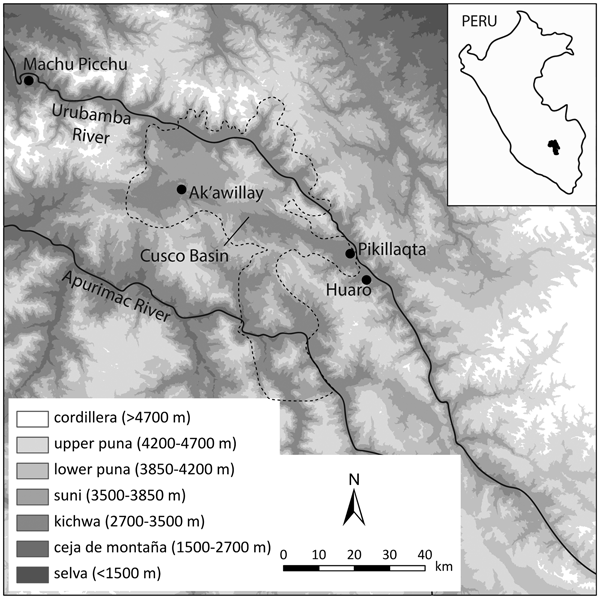
The Middle Horizon saw continuity in settlement patterns despite Wari colonization in the Lucre Basin and Huaro Valley. At that time, the Wari state expanded from its heartland in Ayacucho and built a series of sites and colonies across the southern Andes, including Cusco (Fig. 2). Archaeologists working at Pikillaqta and the Huaro Archaeological Complex have argued that the Wari conquered the region and controlled its resources and occupants throughout the Middle Horizon (Glowacki Reference Glowacki, Isbell and Silverman2002; McEwan Reference McEwan2005). However, survey data suggest that Wari influence was limited to the small area surrounding the colony, and that local populations continued to occupy the same settlements as before (Bauer et al. Reference Bauer, Araóz Silva and Hardyin press; Covey et al. Reference Covey, Bauer, Bélisle and Tsesmeli2013).
The Cusco region, showing the contour of the surveyed area (dotted line), the location of the Wari colony and the village of Ak'awillay, and major rivers.

The site of Ak'awillay, occupied from the Late Formative on, was one of the largest settlements in the Cusco region during the Middle Horizon (Bélisle Reference Bélisle and Covey2014; Reference Bélisle2015). Large-scale excavations at the site since 2006 have uncovered 632 sq. m of Late Formative, Early Intermediate and Middle Horizon village contexts. These include 12 houses and their adjacent outdoor spaces, two kitchens, a public building, a small cemetery and middens. Excavations have uncovered a large number of items, including artefacts related to the consumption of hallucinogens.
Snuff paraphernalia at Ak'awillay
Data from Ak'awillay document the use of psychoactive plants, more specifically snuff, probably Anadenanthera. The excavation team did not recover any macrobotanical remains of cactus, vine or seeds, and the art on pottery vessels at Ak'awillay does not depict scenes involving hallucinogenic plants, visions, healers or ritual ceremonies. However, we did recover paraphernalia used to consume hallucinogens, comprising snuff tubes, a snuff tray and spoons and spatulas.
Snuff tubes
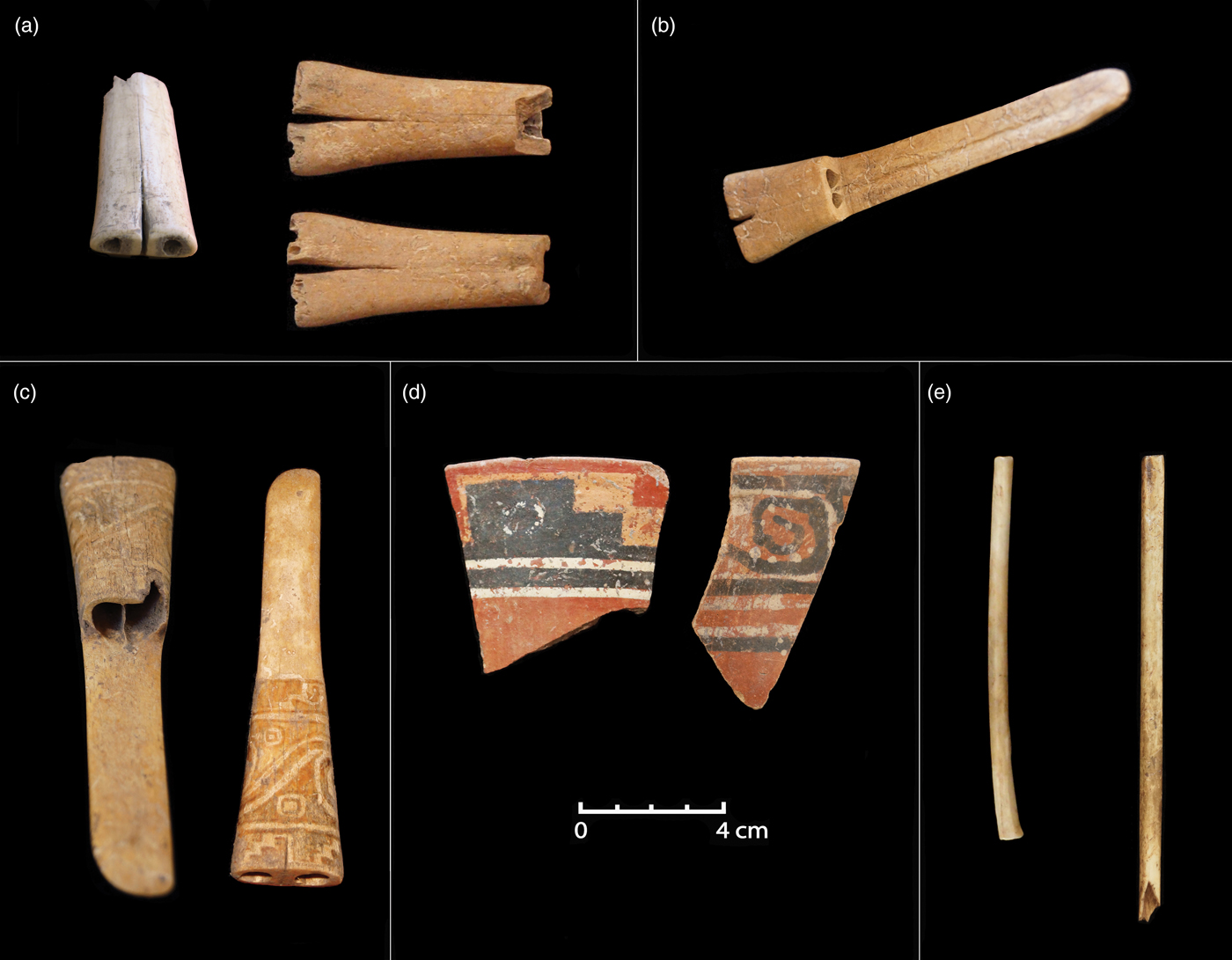
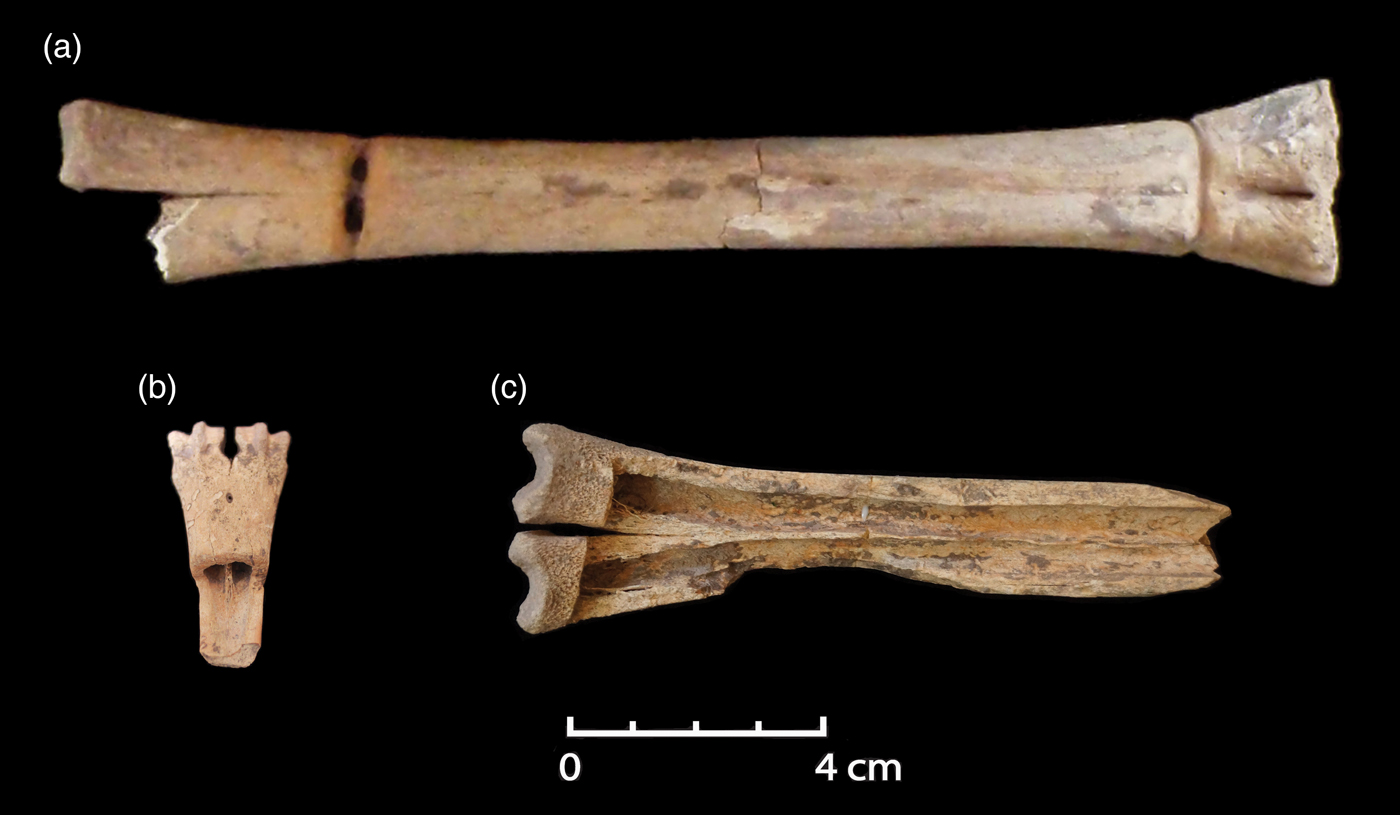
The Ak'awillay collection contains 15 snuff tubes, about half (8/15) of which are complete, while the others are broken. All the snuff tubes are made from bone. The absence of wooden snuff paraphernalia is likely due to the poor preservation of wood and other organic materials in the Cusco region. Snuff tubes from Ak'awillay are double or single. The double tubes are by far the most common, with 12 examples (Fig. 3a). These were made from the metapodials of camelids or deer: the extremities of the bone were cut and discarded, after which the diaphysis (middle part) was transformed into a snuff tube. The natural anatomy of the bone resulted in a double tube, with one opening for each nostril. The openings are polished to provide a smooth surface for the person inhaling the snuff, while the rest of the tube is either smoothed or polished. The tubes measure between 5 and 7 cm long, suggesting that individuals self-administered the snuff.
Snuff tubes from Ak'awillay: (a) double tubes; (b) double tube with a tail; (c) double tube with a tail, decorated with pyro-engraved motifs reminiscent of Muyu Urqu pottery; (d) Muyu Urqu pottery; (e) single tubes.
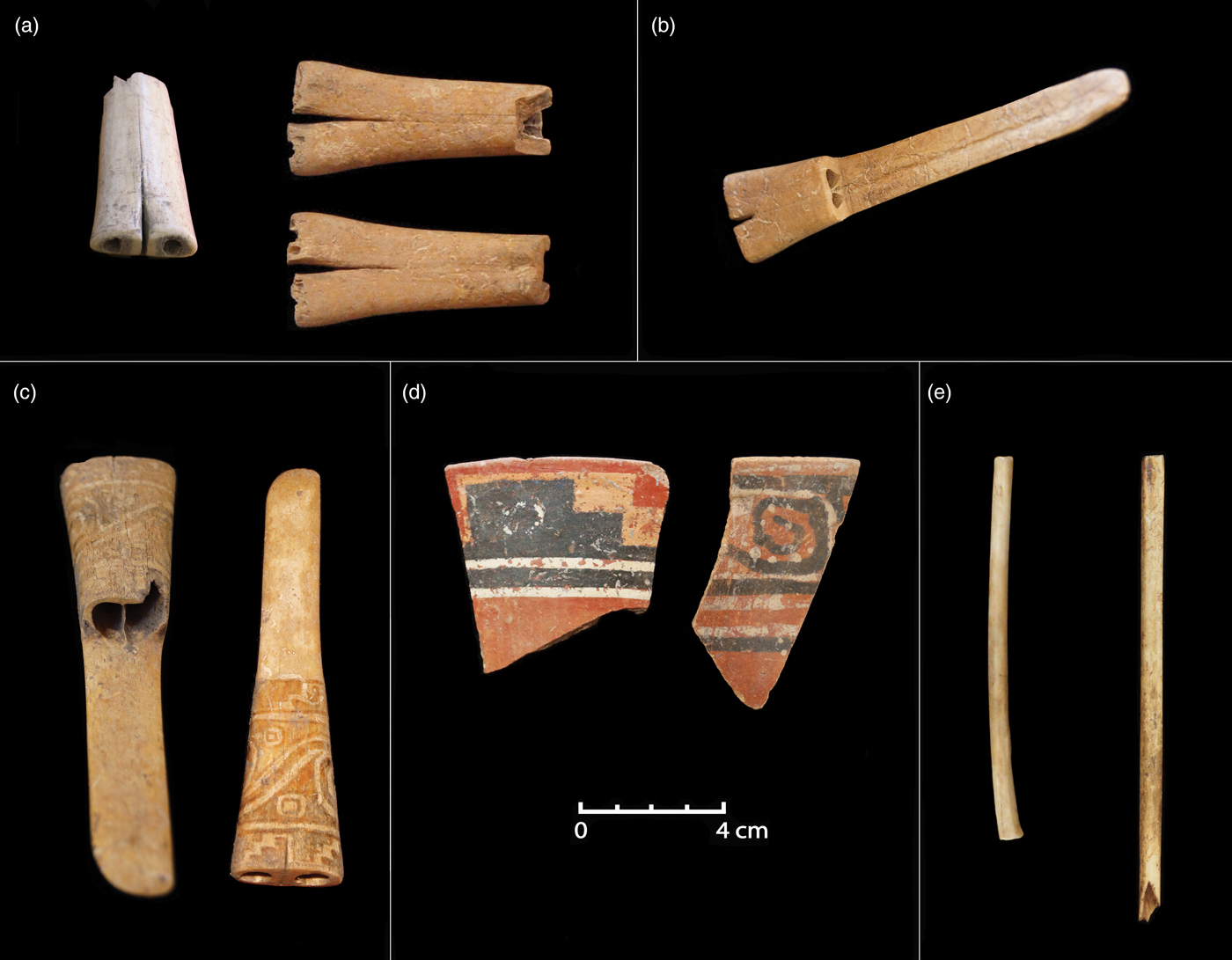
The double tubes might have been dipped directly in a tray or mortar containing the snuff, although five tubes included a ‘tail’ that did not allow that (Fig. 3b). These tails were part of the metapodial bone that was left in place during the manufacturing process. The tails prevented the users from dipping the tubes directly in the snuff; instead, the snuff could have been placed on these tails for inhaling, or reed (or other perishable tube) could have been inserted in their far end to facilitate snuffing. Alternatively, these tubes could have been multifunctional, with the tails used as spatulas to mix the powder in the preparation of the snuff.
One double tube with a tail is decorated with pyro-engraved motifs (Fig. 3c). The motifs are executed on the tubes and the tail is left undecorated. The motifs included volutes, steps and circles that are reminiscent of a regional pottery style called Muyu Urqu (Fig. 3d). This fine polychrome pottery was widespread in the Cusco area during the late part of the Early Intermediate period and the Middle Horizon (Bauer Reference Bauer1999; Reference Bauer2004, 50–51; Bauer & Jones Reference Bauer and Jones2003; Bélisle Reference Bélisle and Covey2014). Brian Bauer (Reference Bauer1999, 84–5) suggests that Muyu Urqu was a style made in the Cusco region that was influenced by Titicaca Basin artistic traditions, including Tiwanaku.
The second type of snuff tubes recovered at Ak'awillay are made from bird bones. The three specimens were highly polished but, unlike those made from metapodials, they provided a single tube for the inhaler (Fig. 3e). They were also much longer, measuring between 10 and 13 cm; these could have allowed individuals to self-administer the snuff, or use the collaborative method, with one person blowing the snuff into another's nostril.
Snuff tubes in the making
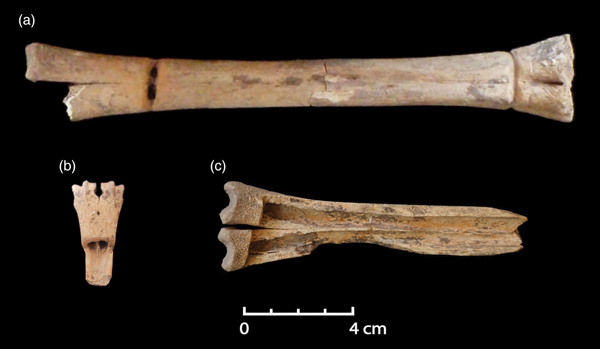
Apart from finished snuff tubes, we recovered four snuff tubes discarded in the process of manufacture (Fig. 4a and b) and two pieces of bone that were left over from making tubes (Fig. 4c). All of these items are metapodials, suggesting the production of double tubes. These artefacts are significant, because they indicate that the people living at Ak'awillay were manufacturing their own snuff paraphernalia at the site.
Snuff-related items from Ak'awillay: (a) and (b) snuff tubes abandoned in the process of manufacture; (c) bone left over from making a snuff tube.
Snuff tray
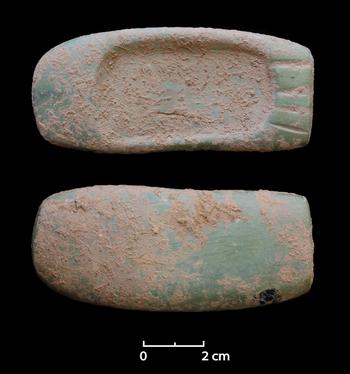
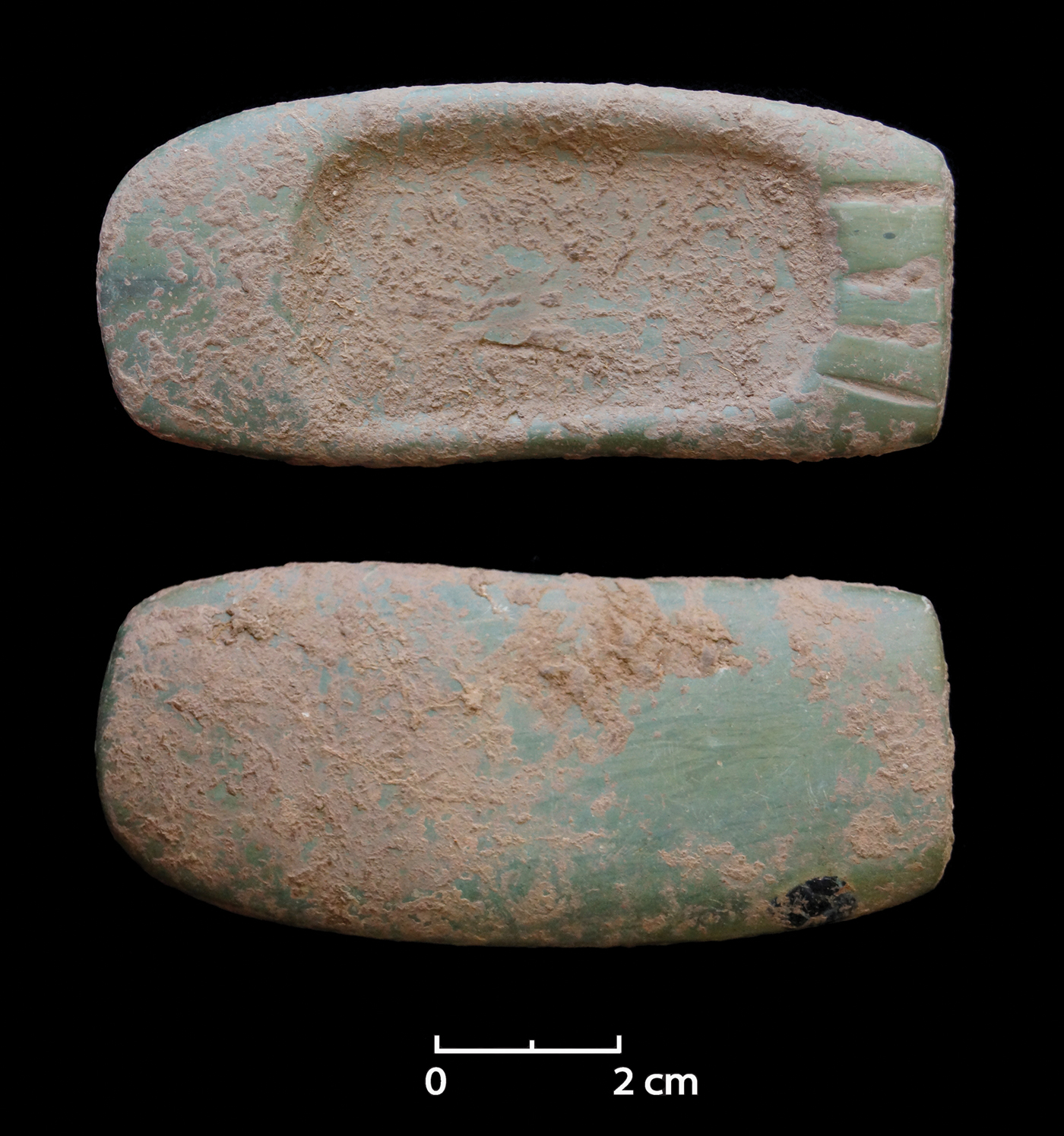
Excavations at Ak'awillay uncovered one snuff tray made from stone (Fig. 5). The stone tray is 9.2 cm long, 4 cm wide and 1.5 cm thick, and weighs 94 grammes. It is relatively simple, with a rectangular recessed area to put the snuff on one surface and one side decorated with four short parallel lines. It is unlike any other artefact found at the site, and the general shape and recessed area are reminiscent of the wooden snuff trays found elsewhere in the southern Andes. However, unlike some of the trays from northern Chile and Tiwanaku, the one from Ak'awillay has no appendages or highly intricate motifs of figures.
The snuff tray from Ak'awillay.
Spoon and spatulas
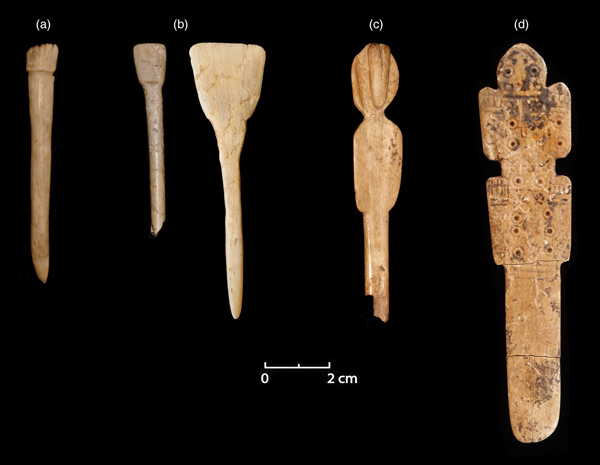
Other items that could have been used in the preparation and consumption of hallucinogenic snuff at Ak'awillay include a spoon and four spatulas, all made from bone. The spoon (Fig. 6a) is much smaller than ceramic spoons used in domestic contexts (see Bélisle Reference Bélisle2011) and is decorated with a carved hand. This hand is similar to the clenched fists found on bone spoons and wooden snuff trays from Tiwanaku and San Pedro de Atacama (Janusek Reference Janusek2008).
Other snuff paraphernalia from Ak'awillay: (a) spoon decorated with a carved hand; (b) undecorated spatulas; (c) spatula decorated with an anthropomorphic being; (d) spatula decorated with a jaguar.
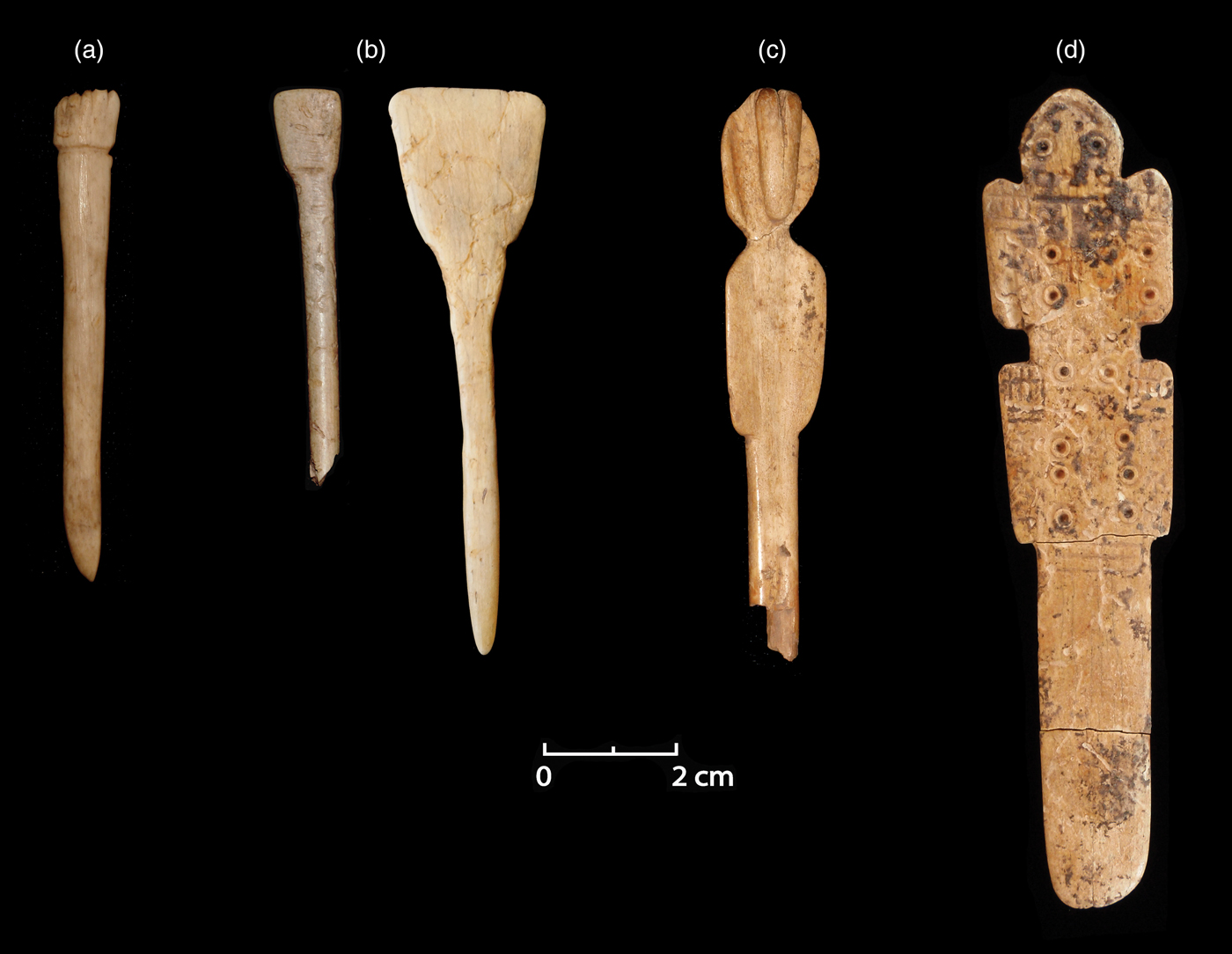
Two undecorated spatulas were also recovered (Fig. 6b). Although they seem appropriate for the preparation of psychoactive substances, the people from Ak'awillay could have used them for other purposes. Another spatula has a carved decoration that appears to represent an anthropomorphic being (Fig. 6c). The last spatula is decorated with an incised zoomorphic motif (Fig. 6d). The four legs and the dots that adorn the back of the animal suggest that it may represent a jaguar. The combination of the spatula with a jaguar motif is significant considering the importance of felines in rituals involving the transformation of humans into jungle creatures that communicated with the supernatural.
Contexts of snuff paraphernalia at Ak'awillay
Chronology
People living at Ak'awillay used snuff paraphernalia starting in the Late Formative and continuing into the Middle Horizon. The oldest item related to snuff usage is a snuff tube in the making. This object was found on the floor of House 1, whose occupation dates to the Late Formative (2071±37 bp [AA81955], cal. 139 bc–ad 53, 2 sigma).Footnote 7 This house is the earliest excavated context at the site. It included several domestic features, including a hearth and a storage bin in addition to Derived Chanapata pottery, chipped stone tools and ground stone, obsidian and many other items (for more details, see Bélisle Reference Bélisle2011, 109–17). The presence of a snuff tube in this early context indicates that psychoactive substances have a long history of use at the site.
One other snuff-related item from Ak'awillay was used before the Middle Horizon. It is a single snuff tube recovered in Unit G, not near, but at the same depth as Houses 2 (end of Late Formative: 1898±37 bp [AA81954], cal. ad 69–240, 2 sigma) and 3 (Early Intermediate, based on stratigraphy and material culture). All the other snuff-related items date to the Middle Horizon.
Contexts
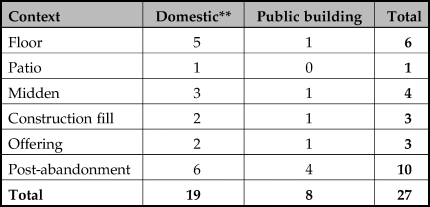
The snuff paraphernalia from Ak'awillay came from different contexts, domestic and public, on occupation floors, but also in middens, fill and offerings (Table 1). Unlike San Pedro de Atacama and other regions in Chile, the snuff-related items from Ak'awillay were not concentrated in burials. In fact, none was found in mortuary contexts. One third (9/27 or 33.3 per cent) were associated with domestic occupations, including house floors, patios and middens surrounding houses and kitchens. Three items were recovered in the fill used to level the terrain before the construction of different spaces. Two spatulas came from domestic offerings. The first, the one with the incised jaguar, was found in a pit immediately outside House 6, dated to the Middle Horizon. This pit also included burned stones, and the people of Ak'awillay might have burned an offering in this pit prior to the construction of their house to ensure prosperity, as highland villagers continue to do today. The other spatula was associated with a jar that was buried below the entrance of House 11, also dated to the Middle Horizon. This dedicatory offering was made at the time of building the house.
Contexts of snuff-related items from Ak'awillay.*

* Includes snuff tubes, snuff tubes in the making, snuff tray, spoon and spatulas.
** Includes houses and kitchens.
Four snuff items were associated with the construction and occupation of a public building, a circular structure 11 m in diameter that was built with a stone foundation and adobe mud-bricks at the beginning of the Middle Horizon. One snuff tube was on the floor of the building and was associated with decorated pottery, including local and regional Cusco styles and one Wari fragment. Another item was part of an abandonment offering that included a Muyu Urqu drinking vessel (qero) that was left (perhaps intentionally broken) on the wall of the public building.
The fact that several of the snuff items were recovered in domestic spaces points to household rituals or to people bringing back home certain ritual items at the end of ceremonies that were taking place elsewhere. In addition, the presence of some snuff paraphernalia in middens and fill suggests that these items were not disposed of in a special way. The fact that snuff tubes were sometimes discarded with minimal visible damage further indicates that they were not ritually broken, but simply abandoned, perhaps because, once used in a ritual ceremony, they had lost their special power (Stone Reference Stone2011).
Discussion
Based on current evidence, it is impossible to say if people living at the site of Ak'awillay drank hallucinogenic beverages, or rubbed leaves or flowers on the body of the ill; however, the use of snuff is well documented. The contexts in which paraphernalia was recovered suggest that people mostly ingested snuff in houses—perhaps where individuals healed the ill and divined the future—and sometimes used entheogens to communicate with the supernatural during ceremonies taking place outside domestic spaces.
It is important to note that the contexts in which the people at Ak'awillay consumed hallucinogens are different from the ones in which Wari élites drank chicha and might have ingested snuff. If, as suggested by Knobloch (Reference Knobloch2000), Wari élites mixed powdered Anadenanthera seeds with chicha, the iconography and large dimensions of the urns from which they may have served that chicha suggest that the rituals were not small, individualized ventures, but large, standardized, state-sponsored feasts presided over by sanctioned élites. Whether chicha included Anadenanthera or not, these feasts would presumably have involved large groups of people who would have been reminded of the importance of Wari élites for their own well-being and survival. Some of these Wari feasts presumably took place in plazas and patios (McEwan Reference McEwan2005, 150–52), while others may have occurred in D-shaped structures. The D-shaped structures from Conchopata, for example, contained oversized urns and face-neck jars used to store and serve chicha, in addition to drinking vessels, offering pits with camelid burials, and human trophy heads (Ochatoma & Cabrera Reference Ochatoma Paravicino, Cabrera Romero, Silverman and Isbell2002). No snuff implements have so far been recovered in Wari D-shaped structures.Footnote 8
The hypothetical oral ingestion of hallucinogens in Wari society stands in contrast with Tiwanaku. At the Tiwanaku capital, important monoliths show figures holding snuff tablets, and beyond the heartland, a number of snuff tablets have Tiwanaku motifs, suggesting that hallucinogens (and the portability of the snuff paraphernalia) played an important role in Tiwanaku statecraft and the dissemination of state ideology. The politico-religious role of hallucinogens in Tiwanaku society is also different from that of Ak'awillay, where the ingestion of Anadenanthera was a more private, small-scale activity conducted without state political sanction.
During the Middle Horizon at Ak'awillay, ritual practices involving the consumption of snuff persisted despite Wari state presence in Cusco and Wari focus on different ritual practices. The people of Ak'awillay consumed hallucinogens from the time the village was established in the Late Formative, suggesting that select individuals remained connected to areas for procuring snuff and perhaps esoteric knowledge even after the Wari settled in Cusco. The persistence of this practice in a period of state expansion has important implications for understanding the degree of penetration of state control and the extent to which local communities continued to engage in their own traditions.
The precise location from which the people of Ak'awillay procured Anadenanthera is unknown; however, the environment around the site is not conducive to the tree's growth. While Ak'awillay sits on a low hill at 3480 masl, the Anadenanthera tree's current distribution limits its presence to areas up to 2700 masl. Anadenanthera seeds stored at the Vargas herbarium of the Universidad Nacional de San Antonio Abad del Cusco were collected from the provinces of La Convención (to which Machu Picchu belongs) and Anta (to which Ak'awillay belongs) (see Fig. 2, ceja de monta ñ a and selva ecological zones). In La Convención, Anadenanthera grows in the Urubamba Valley past Machu Picchu (from around Santa Teresa to Koribeni, between 1600 and 650 masl) and further west around Vilcabamba, where the Inkas are known to have cultivated the tree (Gade Reference Gade2016). Further west and close to the Department of Ayacucho, the Wari could possibly have obtained Anadenanthera around Espíritu Pampa.
This region northwest of Ak'awillay would have been very far for the people living at the site, in addition to the thick jungle one would have had to cross. It is thus unlikely that this was the source of Anadenanthera seeds ingested at Ak'awillay. The presence of Anadenanthera in the southern part of the Province of Anta, along the Apurimac Valley (Gade Reference Gade2016), makes this area a more likely candidate for the seeds consumed at the site (see Fig. 2). The fact that Anadenanthera could be procured at lower altitudes a few hours south and southwest of Ak'awillay suggests that hallucinogens came from outside the territories of the earliest Andean highland states. This area lies well outside the Wari colony in Cusco (Covey et al. Reference Covey, Bauer, Bélisle and Tsesmeli2013), and no Wari material culture or architecture have been reported in that area. Some individuals from Ak'awillay were bound to this region to procure the ingredients and perhaps the esoteric knowledge necessary for conducting their rituals. This exchange continued despite Wari presence in Cusco, who could have had their own supply of Anadenanthera coming from the northwest. These data suggest that some individuals from Ak'awillay had a broader world experience than other people and that they operated outside Wari state control. Furthermore, the use of snuff in domestic and village-level rituals points to the promotion of ideas that did not align with those of Wari élites.
Conclusions
The village of Ak'awillay provides an example of a community that was able to maintain local power in a context of state expansion. The persistent intra-community consumption of hallucinogens inducing altered states of consciousness was fundamentally different from Wari public élite-sponsored rituals. Wari state control did not penetrate local ritual practices that had been established centuries earlier, and Ak'awillay individuals continued to use hallucinogens, presumably to heal the ill, divine the future and communicate with the supernatural.
This case study warns us against the superficial comparison of religious practices and the attribution of similar traditions to unidirectional influence. In the case presented here, both the people of Ak'awillay and the Wari consumed hallucinogens, but the contexts of ingestion were so different that they reflect fundamentally different bases for religious authority. For example, the fact that the most common context for the recovery of snuff paraphernalia at Ak'awillay was houses, and not the public building, suggests that individuals did not use entheogens to subsidize political ambitions, as the Wari élites did. Hallucinogens and their associated rituals provided Ak'awillay individuals with power over the supernatural, but not necessarily the living.
The building of a public space at the beginning of the Middle Horizon at Ak'awillay, coupled with the proliferation of small cups and bowls used for the consumption of chicha (Bélisle Reference Bélisle2015), points to the co-existence of hallucinogenic practices and incipient leadership at the site. These leaders, who likely organized feasts and served chicha to their followers in the public building, might have met with Wari colonists. Indeed, these leaders developed bases of authority that were similar to the ones supporting the Wari élites, albeit in an embryonic stage. Future efforts will attempt to evaluate the potential conflicts that could have emerged between the well-established practices involving hallucinogens and emerging leadership focusing on feasts at Ak'awillay, but for now it is reasonable to conclude that some individuals were more interested than others in developing relationships with Wari colonists or neighbouring groups who were trading with Wari colonists. Nevertheless, the people from Ak'awillay continued to practise their rituals inducing altered states of consciousness outside Wari state influence.
The data presented here are an example of the resilience of local practices and local power in the face of expansionist states. The spread of the state and state-affiliated religion did not displace hallucinogenic practices, which operated in distinct domains. These data warn us against the common assumption that expanding states profoundly change local cultures. Early states may not necessarily expand with a firm plan or desire to conquer and administer local populations (e.g. Covey et al. Reference Covey, Bauer, Bélisle and Tsesmeli2013; Stein Reference Stein, Lyons and Papadopoulos2002), or with an agenda to change local cultures. These data also warn us against a similar conjecture, that local groups adopt an expansionist state's beliefs and practices as if they were inherently desirable. The members of local communities had more decision-making power than previously assumed, and further research on hallucinogens and other ritual practices will hopefully expose the depth of this local power.
Acknowledgements
Fieldwork at Ak'awillay was funded by grants from the Social Sciences and Humanities Research Council of Canada (Awards 756-2011-0405 and 752-2003-1515), the Wenner-Gren Foundation, the National Science Foundation (BCS-0726568), the University of Michigan, Trent University and Millsaps College. I would like to thank Hubert Quispe-Bustamante, Vicentina Galiano Blanco, Carlos Delgado González, students and the people of Piñanccay for their support in the field, as well as biologist Efrain Sucli Montañez for welcoming me to the Vargas herbarium at UNSAAC. I also thank R. Alan Covey, Howard Tsai, Brian Bauer and anonymous reviewers for their insightful and constructive comments on previous drafts of this paper.