1 Introduction
Market-oriented healthcare reforms have in recent years created hospital competition in both Germany and in the Netherlands (Lisac et al., Reference Lisac, Reimers, Henke and Schlette2010; Schut and van de Ven, Reference Schut and van de Ven2011).Footnote 1 For such competition to be effective, insurers and patients must be able to choose from a sufficient number of alternative providers. Competitive pressures, however, generally provoke consolidation (mergers) of healthcare providers, including hospitals. To safeguard competition, both German and Dutch hospital merger proposals are subject to antitrust law. The common objective of preventive merger control is to protect consumer welfare by prohibiting anticompetitive mergers.Footnote 2 Defining the relevant geographic market is necessary to this process because antitrust authorities typically use market shares to make inferences about the likely effects of mergers. Although appropriate market definition is challenging in any industry, it is particularly so in the hospital industry. In general, antitrust enforcement agencies use the ‘Small but Significant Non-transitory Increase in Price’ (SSNIP) test to define the relevant market,Footnote 3 which is difficult to implement in hospital markets for at least two reasons. First, prices for most hospital services are regulated. A hospital's quality elasticity of demand rather than its price elasticity is then of primary interest. Second, in (sub)markets where prices are not regulated,Footnote 4 the necessary data for estimating hospitals’ price elasticities are most often unavailable (Capps et al., Reference Capps, Dranove, Greenstein and Satterthwaite2002). Actual prices negotiated between hospitals and insurers are not readily available and even if these prices are available to antitrust agencies as part of their merger review, they do not represent the costs faced by patients. As the vast bulk of hospital services is covered by health insurance, hospitals are largely reimbursed by third-party payers; the patient, therefore, has a price elasticity close or equal to zero. Because of the difficulty of applying the SSNIP test in hospital markets, geographic market definition has historically relied heavily upon two alternative, less formal approaches: the Elzinga–Hogarty (E–H) test and critical loss analysis.
In this article, we examine the role of geographic market definition in hospital merger control. Using evidence from the United States, we explain why geographic market definition can be seen as the Achilles’ heel of hospital merger control. We then focus on hospital merger control in Germany and the Netherlands, discussing a landmark case for each where definition of the relevant geographic market played a decisive role.Footnote 5
2 Geographic market definition: Achilles’ heel of hospital merger control
No country has more experience with hospital merger enforcement than the United States. After the first hospital merger was challenged in 1981, the Department of Justice (DOJ) and Federal Trade Commission (FTC) initially had considerable success litigating hospital merger cases.Footnote 6 From 1989 to 2001, however, the federal antitrust agencies were defeated in all but one case brought to court (Gaynor and Vogt, Reference Gaynor and Vogt2000; Ashenfelter et al., Reference Ashenfelter, Hosken, Vita and Weinberg2011).Footnote 7 Most were lost because the court identified highly expansive geographic markets that resulted in low post-merger concentration levels.Footnote 8 Supported by empirical evidence on the anticompetitive effects of consummated hospital mergers (e.g. Vita and Sacher, Reference Vita and Sacher2001; Simpson, Reference Simpson2003), the courts’ reasoning in these cases was widely criticised (e.g. Greaney, Reference Greaney2002; Conners, Reference Conners2003; Richman, Reference Richman2007). Most importantly, by accepting the E–H test or critical loss analysis to define the relevant geographic market, courts systematically underestimated the potential anticompetitive effects. Both approaches have proven inaccurate. Their most important shortcomings are summarised below.Footnote 9
2.1 E–H test
The E–H test is easy to apply and uses commonly available patient flow data. It begins with a narrowly defined market and then expands the boundary until threshold conditions are met for both imports [‘little in from outside’ (LIFO)] and exports [‘little out from inside’ (LOFI)] of hospital services.Footnote 10 In various court cases, the analysis has focussed on identifying geographic areas such that both statistics are either below 25% (‘weak market’) or 10% (‘strong market’). The central problem underlying the E–H test is the ‘silent majority fallacy’ (Capps et al., Reference Capps, Dranove, Greenstein and Satterthwaite2002): the presence of travelling patients who import and export hospital services does not necessarily discipline hospitals from exercising market power over the silent majority of non-travelling patients. In other words, in markets with heterogeneous tastes for different services, the presence of some travelling patients with one set of needs does not necessarily restrain the pricing of services to non-travelling patients with different needs. Suppose that 25% of all patients in an area travel significant distances to receive care. This does not in any way indicate that the remaining 75% would be willing to similarly travel in response to a price increase – the assumption implicit in the E–H test. Hence, price increases are certainly feasible even in the presence of significant patient outflows. One might argue that use of the E–H test would be less problematic if disaggregated clusters of hospital services that are close substitutes were analysed. However, this would only solve part of the problem, as it incorrectly assumes that the only reason the ‘silent majority fallacy’ exists is that patients’ propensity to travel varies across types of hospital care. Other reasons the propensity to travel varies include, for example, unobserved personal preferences. Selecting a non-arbitrary way to aggregate the results of disaggregated, hospital service-level E–H analyses is also problematic. In a recent antitrust complaint involving a merged hospital (Box 1), both the FTC and the defendants agreed that applying the E–H test to define the relevant geographic market would be inappropriate (Elzinga and Swisher, Reference Elzinga and Swisher2011).
Box 1 Federal Trade Commission (FTC) vs Evanston Northwestern Healthcare Corporation (ENH)

2.2 Critical loss analysis
Critical loss analysis involves three consecutive steps. The first is to compute the hospitals’ contribution margins, defined as price minus average variable costs. The contribution margin is used in step two to identify the percentage of patients hospitals could lose before a small price increase – 5% is typical – becomes unprofitable: this is the critical loss. The final step is to analyse whether the actual loss of patients would exceed the critical loss if all hospitals in the proposed market implemented a small but significant non-transitory price increase. If so, then the price increase would be unprofitable, indicating that the hypothetical geographic market is too narrow and should be expanded to include more hospitals. The expected actual loss of patients is most commonly assessed using the concept of contestable zip codes. That is, all patients currently choosing a hospital within the proposed market but living in an area where many other patients (e.g. 50% or more) select hospitals outside the proposed market would switch to those outside hospitals in response to a price increase. Under this assumption, critical loss analysis also suffers from the ‘silent majority fallacy’. Danger and Frech (Reference Danger and Frech2001) detail an important methodological shortcoming of critical loss analysis: market definition via this approach is highly sensitive to the initial degree of market power. If price is already at the monopoly level, then any further increase in price will by definition result in lower profits. In such a situation, critical loss analysis incorrectly leads to an overly broad market.
3 Hospital merger control in Germany
3.1 Act against Restraints of Competition
The 1958 Act against Restraints of Competition [Gesetz gegen Wettbewerbsbeschränkungen (GWB)] assigned the task of protecting competition at the national level in Germany to the Federal Cartel Office [Bundeskartellamt (BKA)]. A 1993 amendment introduced a procedure for preventive merger control in the GWB, which has been enforced relatively strictly, leading to a considerable number of merger prohibitions, proposal modifications and dismissals (Motta, Reference Motta2004: 11). A main principle behind competition policy in Germany is to protect the economic freedom of competitors. A merger will therefore be prohibited if it is “expected to create or strengthen a dominant position”, unless it “will also lead to improvements of the conditions of competition and that these improvements will outweigh the disadvantages of dominance” (Section 36.1). According to the GWB, a firm is dominant when in a properly defined market it (i) has no competitors, (ii) is not exposed to substantial competition or (iii) has a paramount market position relative to its competitors (Section 19.2). To assess a firm's market position, several factors should be taken into account: its market share, its financial power, any legal or factual barriers to market entry by other firms, actual or potential competition by firms and the ability of the opposite market side to resort to other firms.
The BKA's preventive merger control applies only to mergers whose aggregate global sales would exceed €500 million, with at least one firm realising €25 million in Germany. Mergers subject to control must subject themselves to examination by the BKA whose preliminary review leads to a more substantive examination if necessary. The BKA decides whether a merger is cleared, prohibited or cleared conditionally. If cleared, the parties must inform the BKA upon its consummation. Although the notification threshold is rather high, that it has resulted in an overly permissive antitrust enforcement policy is unlikely; so far mergers between German hospitals have typically involved the acquisition of public hospitals by large private hospital chains. It is important to recognise, however, that mergers between small independent hospitals may not be subject to the BKA's merger control, even though they may substantially reduce competition at the local or regional level.
3.2 Experiences with hospital merger control
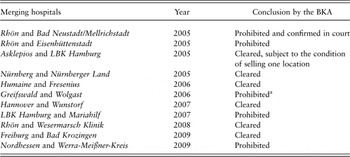
Until 2011 the BKA has examined more than 100 hospital merger cases, clearing most within one month. Some, however, have been challenged (Bangard, Reference Bangard2007; Denzel et al., Reference Denzel, Krolop and Dürr2010). Since 2000, an increasing number of public hospitals were sold to private hospital chains driven mainly by public authorities’ large budget deficits at the regional and municipal levels (Schulten, Reference Schulten2006). To ensure that hospital markets are organised as competitively as possible, the BKA applies the GWB rather strictly in the industry. From 2005 to 2010, five proposed hospital mergers were prohibited and one was cleared, subject to the condition that the merging parties sell one hospital location to a third party (Table 1).
Hospital merger cases in Germany, 2005–2010

BKA = Bundeskartellamt (Federal Cartel Office).
aIn January 2008, the Federal Minister of Economics and Technology (Bundesminister für Wirstschaft und Technologie) permitted the merger on appeal, arguing that, despite its likely anticompetitive effects, it served the public interest since one party involved was a small university hospital suffering from scale-related inefficiencies.
The first BKA-prohibited hospital merger was in March 2005, after which the Federal Court of Justice [Bundesgerichtshof (BGH)] in Germany confirmed the GWB to be fully applicable to the hospital industry (BGH, 2008). No social or hospital law precludes the GWB's merger control provisions to markets for hospital services. In addition, the court concluded that the objectives of antitrust law and health policy do not conflict with one another.
3.3 Approach to defining geographic hospital markets
The BKA defines the relevant product market as the market for acute hospital services, including general hospitals and specialised clinics but excluding rehabilitation and other nursing centres. To define geographic hospital markets, the BKA uses a backward-looking approach based on the analysis of patient flow data. Rather than ‘merely theoretical’ hospital alternatives, the BKA argues that only ‘practical’ alternatives should be taken into account when defining the relevant geographic market (BKA, 2005a). By considering where patients have gone in the past for hospital services, the BKA infers which hospitals are substitutable from the patient's perspective. Generally, the BKA's approach to defining geographic hospital markets consists of two steps. First, the catchment areas of each hospital – starting with an area of ∼100 × 120 km around the merging hospitals – are identified. The second, decisive step is to analyse the travel behaviour of patients.
Because the BKA approach to defining geographic hospital markets also relies on patient flow data, at first sight it seems closely related to the widely criticised E–H test. There are, however, two fundamental differences. First, when computing the export of hospital services, the BKA does not aggregate patient inflows to all hospitals within the hypothesised geographic market, but rather takes into account only patients travelling to the merging hospitals. Overstatement of the true size of geographic hospital markets – an important pitfall when analysing patient flow data – is therefore less likely. This is illustrated by the hypothetical case described in Box 2.
Box 2 Illustration of Bundeskartellamt (BKA) approach vs Elzinga–Hogarty (E–H) test for defining geographic hospital markets

The second difference between the E–H test and the BKA's approach is that the latter is based on pragmatic considerations, including case-specific characteristics, rather than fixed thresholds. From the BKA's decisions, it follows that generally only areas from which a substantial percentage of patients travel to one of the merging hospitals are potentially included in the relevant market (Kallfass and Kuchinke, Reference Kallfass and Kuchinke2006). That is, mutual patient flows between both areas need to be substantial.Footnote 11 Whereas the E–H test tends to include gradually more areas simply to meet the 90% or 75% import and export thresholds, the BKA only includes or excludes neighbouring areas after assessing their specific competitive situation.
The BKA's approach is unlikely to suffer from the ‘silent majority fallacy’: it recognises that the presence of travelling patients does not necessarily restrain hospitals from behaving anti-competitively. More specifically, although the E–H test incorrectly assumes that the presence of some travelling patients disciplines hospitals from exercising market power over the silent majority of non-travelling patients, the BKA assumes that only the presence of many travelling patients disciplines hospitals from exercising market power over the then silent minority of non-travelling patients. Despite its use of patient flow data to define geographic hospital markets, the BKA is therefore not likely to overstate the true size of the relevant market. On the contrary and as argued by Badtke (Reference Badtke2008), the BKA's approach may result in hospital markets that are too narrowly defined. Hence, the BKA seems keener on avoiding the risk of being too lenient (i.e. allowing hospital mergers that may restrict actual hospital competition) rather than being too stringent (i.e. prohibiting hospital mergers that may not restrict actual hospital competition).
3.4 Landmark case: Rhön-Klinikum AG/Bad Neustadt/Mellrichstadt
In August 2004, Rhön-Klinikum AG, one of the leading private hospital groups in Germany, notified the BKA of its plan to acquire two public hospitals: one in Bad Neustadt (∼150 km east of Frankfurt am Main) and one in Mellrichstadt (∼15 km north of Bad Neustadt). At the time, Rhön-Klinikum operated 30 hospitals nationwide with an aggregate turnover of more than €1000 million; the BKA therefore decided to substantively assess the likely competitive effects of the proposed acquisition and concluded that the transaction would further strengthen Rhön-Klinikum's dominant position in the two markets concerned (BKA, 2005a). It is a landmark case because it was the first time the BKA prohibited a hospital merger and prevailed in court.Footnote 12
3.4.1 Geographic market definition
By applying its two-step approach to defining geographic hospital markets, the BKA in this particular case concluded that (i) for most general hospitals, the vast majority of patients live nearby, implying that the export of hospital services from one area to another is low and (ii) most patients do not travel to more distant alternatives, implying that the import of hospital services from one area to another is also low. The BKA agreed that some patients are willing to travel; however, as they do so for particular reasons (e.g. specialised care), such behaviour was not expected to significantly affect hospital competition. As a result, two different geographic markets were defined that were both rather small: the Bad Neustadt/Bad Kissingen market and the Meiningen market. With these areas, the merger would have increased Rhön-Klinikum's market shares to ∼65% and 60%, respectively (BKA, 2005a).
3.4.2 Court decisions
Following its decision to prohibit the hospital merger, the BKA twice prevailed in court. First, in April 2007, the Düsseldorf Higher Regional Court (Oberlandesgericht Düsseldorf) confirmed the approach used by the BKA for defining the relevant geographic market. The court stated that patient flow data provide reliable information about the substitutability of hospitals and the BKA could therefore use it for market definition. As hospitals’ substitutability crucially depends on the distance patients are willing to travel, the court argued that it was appropriate to analyse where patients had gone in the past. The conclusion was that areas only belong to the same geographic market when mutual patient flows between them are ‘substantial’ (OGD, 2007). Second, an appeal on points of law by the merging hospitals was dismissed in January 2008 by the Federal Court of Justice, making the BKA's prohibition of the merger final. The highest court in Germany confirmed that the use of patient flow data is appropriate when defining the relevant geographic market in hospital merger cases. The BKA's approach to defining geographic markets was deemed ‘legally tenable’ (BGH, 2008). In its decision, the court also argued that patients’ potential hospital alternatives should not be taken into account if they had not actually visited them in the past, implying that most value is attached to revealed preference data, but emphasising that potential alternatives were not meaningless. They were called ‘particularly useful’ when assessing the factors that may limit or extend the merged hospital's market power.
4 Hospital merger control in the Netherlands
4.1 Competition Act and guidelines for antitrust enforcement in health care
The Dutch Competition Act [Mededingingswet (Mw)], implemented in 1998 and amended in 2004, is enforced by the Netherlands Competition Authority [Nederlandse Mededingingsautoriteit (NMa)]. In addition to prohibiting cartels and abusively dominant positions, the Mw practises preventive merger control. The latter generally only applies to mergers between companies whose combined turnover has exceeded €113 million in the preceding calendar year, with at least €30 million realised in the Netherlands by at least two of the companies involved. Because geographic markets for health care tend to be small and the emerging competition in the Dutch healthcare system is fragile, as competition among providers has only gradually been introduced since 2005, thresholds for the healthcare industry were temporarily lowered in January 2008 to €55 million and €10 million, respectively. To prevent them from applying to mergers of companies whose healthcare services are but a small part of their business, a third threshold was added: for at least two of the companies involved, turnover from healthcare services alone must exceed €5.5 million.Footnote 13
Qualifying merger proposals must be reported to the NMa before consummation for a general review. A merger requires a license when there is reason to assume that “a dominant position that appreciably restricts competition on the Dutch market or a part thereof could arise or be strengthened as a result of the said concentration” (Mw, Section 37.2). Upon license application, the NMa begins a more substantial assessment of the proposed merger, deciding to allow, prohibit or conditionally allow the merger based on its findings: “A license shall be refused if, as a result of the proposed concentration, effective competition on the Dutch market or a part thereof would be appreciably impeded, specifically as a result of the creation or strengthening of a dominant economic position” (Mw, Section 41.2). On the basis of supranational European guidelines, a dominant position is defined as “a position of one or more undertakings that enables them to prevent effective competition being maintained on the Dutch market or a part thereof, by giving them the power to behave to an appreciable extent independently of their competitors, their suppliers, their customers or end-users” (Mw, Section 1.i).
In 2002, the NMa issued their first guidelines for antitrust enforcement policy in markets for health care, updating them in 2007 and 2010, which include a section on preventive merger control. After explaining the procedures of the notification and licensing phases, they discuss how they assess a dominant position. Several elements are considered, including market shares and concentration levels, countervailing buyer power and the likelihood of entry (NMa, 2010). When assessing the likely competitive effects of a proposed hospital merger, the NMa takes into account the opinion of the Dutch Healthcare Authority [Nederlandse Zorgautoriteit (NZa)].Footnote 14
4.2 Experiences with hospital merger control
Before 2004, the NMa did not assess proposed hospital mergers; they argued that hospitals were not able to compete because of supply and price regulation. In 2004, however, the NMa issued a position document in which it stated that institutional and regulatory changes in Dutch healthcare markets had created scope for competition (NMa, 2004a). Because providers of hospital services compete, the Mw applied to the hospital industry.
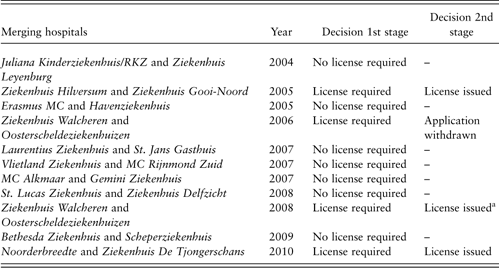
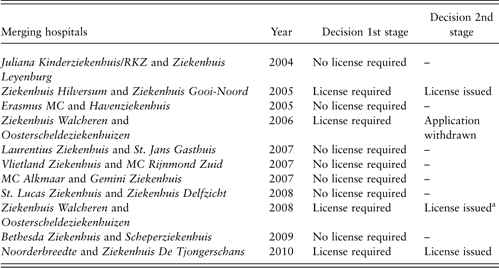
Until 2011, eleven hospital mergers have been assessed by the NMa (Table 2),Footnote 15 seven of which did not require a license. In only four cases, a license was required. After the substantive assessment, three were cleared and one was withdrawn. No decision has therefore been challenged and, unlike the United States and Germany, no court decisions on hospital market definition have yet been made, implying no industry-specific case law.
NMa's decisions in hospital merger cases in the Netherlands, 2004–2010
NMa = Nederlandse Mededingingsautoriteit (Netherlands Competition Authority).
aIn March 2009, the NMa approved the merger to ‘safeguard the quality of basic hospital care’ in the central region of the sparsely populated province of Zeeland. To prevent the merged hospital from exercising market power, ‘strict conditions’ were imposed (NMa, 2009). The geographic market was not in dispute.
4.3 Landmark case: Ziekenhuis Hilversum – Ziekenhuis Gooi-Noord
In April 2004, two neighbouring general hospitals (Hilversum and Gooi-Noord), located in the region between Amsterdam and Utrecht, notified the NMa about their plan to merge. After the first general assessment in the notification phase, the NMa in July 2004 concluded that a license was required for the proposed merger as it could restrict actual competition in the Dutch market for hospital care. Following the hospitals’ application for a license, the NMa in December 2004 started a more specific and substantial assessment of the concentration. As the first proposed hospital merger subject to a substantive assessment by the NMa, it therefore created a precedent and constituted a landmark case.
4.3.1 Geographic market definition
On the basis of market research and case law from other countries, the NMa identified two separate product markets: one for inpatient and one for outpatient general hospital care. In the first general assessment during the notification phase, the E–H test was used to define the geographic market, which turned out to be rather small, despite the E–H tendency to overstate true market size. The NMa therefore concluded that patients currently preferred hospitals close to their homes and that, as a consequence, the proposed merger would substantially lessen competition (NMa, 2004b). At the same time, they declared the E–H test static and concluded that further research on where patients would be willing to go when given incentive to do so was therefore necessary.
The in-depth analysis carried out in the licensing phase had three major findings. First, general practitioners (GPs),Footnote 16 other hospitals and health insurers were interviewed. GPs and other hospitals expected patients to bypass the merged hospitals if they exercised market power, but health insurers did not expect patients’ willingness to travel to be high. Second, patients’ stated preferences were investigated by a conjoint analysis,Footnote 17 the result of which was that the vast majority of patients would travel to other hospitals if the nearest hospital increased its price or lowered its quality. This indicated that the relevant geographic market was larger than that initially assumed. Third, econometric simulations to examine patients’ willingness to travel to alternative hospitals using actual hospital choices (revealed preferences) within a logit demand model confirmed the initial assumption that the geographic market was rather small.
Therefore, unfortunately for the NMa, the research findings in this merger case were ambiguous. On the basis of the geographic market defined on the stated preference data, the merger should be allowed; when defined on revealed preference data, the merger should be prohibited. Confronted with these contradictory findings, the NMa concluded that, although greater value should be attached to revealed preferences, patients’ willingness to travel could increase in the near future because of the increasing availability of consumer information about quality differences within the Dutch hospital sector. According to the NMa it was therefore “less evident that greater weight should be given to the revealed preferences in the assessment of the present case” (NMa, 2005). As a result, the NMa decided there were ‘insufficient grounds’ for defining a smaller geographical market.
4.3.2 Final decision
In June 2005, the NMa decided to clear the merger because there was “insufficient evidence to deem it plausible that a dominant position will arise or be strengthened as a result of the proposed merger on the markets for clinical and non-clinical general hospital care” (NMa, 2005). The conclusion implied that greater weight was given to consumers’ stated preferences – even though they admitted that what people say they will do is often not the same as what they will do should the hypothetical situation become reality. In addition, the expectation that Dutch patients’ willingness to travel was likely to increase because increased transparency was not based on empirical evidence and therefore (highly) speculative. All in all, this decision shows that, contrary to its German counterpart, the Dutch competition authority is keen on avoiding the risk of being too stringent (i.e. prohibiting hospital mergers that may not restrict actual hospital competition) rather than being too lenient (i.e. allowing hospital mergers that may restrict actual hospital competition). Future analysis of post-merger market performance results should reveal whether the NMa erred in this case.Footnote 18
5 Discussion
To safeguard competition in market-oriented healthcare systems, preventive merger control is critical. For hospital services, however, its major problem is to define the relevant geographic market. Evidence from the United States shows that the method used for this has a huge impact on the outcome of hospital merger control. Here, we examined how geographic hospital markets are defined in two European countries with competitive hospital industries: Germany and the Netherlands. For each country, we discussed an important landmark case in which the definition of the relevant geographic market played a decisive role.
As a general observation, we argue that defining geographic hospital markets in Germany and the Netherlands seems less complicated than in the United States because of the absence of managed care. In such a setting, typical in the United States, the key issue for geographic market definition is which hospitals are important for managed care organisations to include in their networks. In a setting where hospitals compete directly for patients by non-price factors only – as is the case in Germany and the Netherlands because in both countries out-of-pocket payments, if present at all, do not differ across hospital alternatives – hospitals’ substitutability crucially depends on patients’ willingness to travel.Footnote 19 When used properly, commonly available patient flow data is then useful for defining geographic hospital markets.Footnote 20 Exploring innovative approaches,Footnote 21 empirical analyses of where patients have gone in the past can be used to substantiate any conclusions about other hospitals as feasible alternatives for the merging hospitals (Varkevisser et al., Reference Varkevisser, van der Geest and Schut2010). In addition, as seen from the FTC's Hospital Merger Retrospectives Project (Farrell et al., Reference Farrell, Pautler and Vita2009), ex post analysis of consummated hospital mergers can provide important information about ex ante geographic market definition for future cases (Ashenfelter et al., Reference Ashenfelter, Hosken, Vita and Weinberg2011).
An important conclusion is that, despite the fact that within the EU national antitrust laws are to a large extent based on the same legal principles, enforcement policies in German and Dutch hospital markets are notably different. Germany's BKA follows a thorough and pragmatic two-step approach to analyse patient flow data for geographic market definition, which is more likely to result in hospital markets that are too narrowly defined. In the first Dutch hospital merger case in which definition of the geographic market played a decisive role, the NMa adopted an effects analysis that is more likely to approve mergers. That is, although the analysis of patient flow data pointed to the presence of a rather small market in which the proposed hospital merger would substantially reduce competition, the NMa used stated preference data to argue that the relevant market might change substantially in the near future in the case of readily available quality information. Hence, we find that different methods of defining geographic hospital markets result in much more stringent hospital merger control in Germany than in the Netherlands. Given the uncertainties in defining appropriate hospital markets, the German competition authority seems to be inclined to avoid the risk of being too permissive, whereas the opposite holds for the Dutch situation. As a result, in Germany, since 2005, five proposed hospital mergers have been prohibited by the BKA and only one was cleared, subject to the condition that the merging parties sell one hospital location to a third party. By contrast, all proposed hospital mergers in the Netherlands have been allowed thus far.
Empirical studies have provided clear evidence that hospital mergers may have serious anticompetitive effects, while claimed cost savings are most often not achieved (Vogt and Town, Reference Vogt and Town2006; Weil, Reference Weil2010). Therefore, the reduction in social welfare caused by allowing a hospital merger that restricts hospital competition is likely to be greater than the reduction in social welfare caused by blocking a hospital merger that does not restrict hospital competition. This implies that for society the risk of being too permissive with regard to hospital mergers may be larger than the risk of being too stringent.Footnote 22 This asymmetry is even more relevant in light of the following two facts. First, the unscrambling of consummated hospital mergers is rather problematic. If there is real clinical and medical integration, then divestiture is even less likely to be a good remedy, as it then has a greater risk of unforeseen costs and failures. This makes pre-merger enforcement decisions in this industry more important. Second, ex post identification of the exercise of market power is difficult in most European countries where hospitals typically compete for patients by quality rather than price. In hospital markets with quality competition, post merger antitrust enforcement may therefore not be an effective safety net. Hence, in view of the uncertainties about the true size of geographic hospital markets, antitrust enforcement agencies may do better to risk being too restrictive when assessing proposed hospital mergers rather than being too permissive. This may be particularly true for the emerging hospital markets in Germany and in the Netherlands, given their long-standing tradition of collective bargaining and concerted practice, and the substantial entry barriers.
Acknowledgement
We thank seminar participants at the Netherlands Competition Authority (NMA, 13 January 2009), the German Bundeskartellamt (BKA, 9 May 2008) and Erasmus University Rotterdam (4 December 2008) for helpful comments.