
Introduction
Defects and impurities in semiconductors have decisive effects on their transport and optical properties, as demonstrated in current microelectronic devices. Recently, branched nanowires have captured considerable attention due to their unique physical properties for applications like photovoltaics and catalysis.[Reference Cheng and Fan1] On the theoretical side, such branches can be modeled as Fano defects that consist of atomic chains joined to a low-dimensional system.[Reference Miroshnichenko, Flach and Kivshar2] In the last years, the existence of null and ballistic conduction states in periodic chains with a single Fano defect is found.[Reference Ramírez and Sánchez3] Moreover, a novel ballistic conduction state in two-dimensional belts with a non-periodic arrangement of atoms along the Fano plane defect has been analytically proved.[Reference Wang, Ramírez, Sánchez and Sánchez4] In addition, enhancements to the ballistic alternating current (AC) conductivity are also reported when quasiperiodically placed Fano defects are introduced to a periodic chain or nanowire.[Reference Sánchez and Wang5]
These peculiar transport properties of Fano systems could be used for clean energy conversion through thermoelectric devices, including deoxyribonucleic acid (DNA)-based self-assembled systems.[Reference Maciá6] The efficiency of thermoelectric devices is generally determined through the dimensionless thermoelectric figure-of-merit  $ZT\, \equiv {{\sigma S^2 T} / {(\kappa _{{\rm el}} + \kappa _{{\rm ph}} )}}$, where σ, S, T, κ el, and κ ph are respectively, electrical conductivity, Seebeck coefficient, temperature, thermal conductivities by electrons and by phonons.[Reference Maciá-Barber7] These thermoelectric quantities can be determined by using the Boltzmann formalism.[Reference Tritt8] Nevertheless, the inherent correlation between them, as exposed by the Wiedemann–Franz law for metals, makes it difficult to improve the value of ZT. A recent study of poly(G)-poly(C) DNA chains without including κ ph predicts a huge ZT induced by the sugar-phosphate backbones.[Reference Fu, Gu, Wu and Zhang9] However, the presence of κ ph in ZT could be decisive specially for
 $\kappa _{{\rm el}} \approx 0$ when the chemical potential (μ) is located outside the electronic conducting band. In this paper, we report novel analytical results of ZT obtained from the Kubo–Greenwood formula applied to both electronic and phononic transports in periodic chains with and without Fano impurities. Moreover, numerical calculations of ZT in periodic and quasiperiodic DNA systems, as well as their comparison with previous works are presented.
The Boltzmann–Kubo model
Let us consider a linear chain of N atoms along the x-direction with N F single-atom Fano defects perpendicularly attached to each of them. The single-band tight-binding Hamiltonian of this chain can be written as
 $$\eqalign{{\hat H} & = \sum\limits_{j = 1}^N \left({\varepsilon_j \vert j \rangle \langle j \vert + t_{j,j + 1} j \rangle \langle {j + 1} \vert + t_{j,j - 1} \vert j \rangle \langle {j - 1} \vert}\right. \cr & \quad + \left.{\sum\limits_{s = 1}^{N_{\rm F}} (\varepsilon_s \vert s \rangle \langle s \vert + t_{j,s} \vert j \rangle \langle s \vert + t_{j,s} \vert s \rangle \langle j \vert)}\right)},$$
where εj is the self-energy of j-th atom in the chain, εs denotes the site-energy of its s-th Fano defect, t j,j+1 represents the hopping integral between the j-th atom and its nearest-neighbor atom j + 1, and t j,s specifies the hopping integral between the j-th atom and its s-th Fano impurity. Hence, the linear momentum along the x-axis is
 $$\eqalign{{\hat p}_x & = \displaystyle{{i m} \over \hbar} [\hat H,\hat x] \cr & = \displaystyle{{i m\,a} \over \hbar} \sum\limits_j {\left( {t_{\,j,j + 1} \left \vert j \right\rangle \left\langle {\,j + 1} \right \vert - t_{\,j,j - 1} \left \vert j \right\rangle \left\langle {\,j - 1} \right \vert} \right)},} $$
where m is the mass of electrons, a is the interatomic distance, 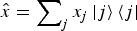 $\hat x = \sum\nolimits_j {x_j \left \vert j \right\rangle \left\langle j \right \vert} $, and
 $x_j = j a$ is the x-axis coordinate of j-th atom.
Thermoelectric quantities within the Boltzmann formalism are given by,[Reference Tritt8]
 $$\sigma (\mu, T) = e^2 L_0 (\mu, T),$$
 $$S(\mu, T) = - \displaystyle{{L_1 (\mu, T)} \over { \vert \,e\, \vert TL_0 (\mu, T)}},$$
 $$\kappa _{{\rm el}} (\mu, T) = \displaystyle{1 \over T}\left( {L_2 (\mu, T) - \displaystyle{{L_1^2 (\mu, T)} \over {L_0 (\mu, T)}}} \right),$$
and
 $$\eqalign{ZT(\mu, T) & = \displaystyle{{\sigma (\mu, T)S^2 (\mu, T)T} \over {\kappa _{{\rm el}} (\mu, T) + \kappa _{{\rm ph}} (T)}} \cr & = \displaystyle{{{{L_1^2 (\mu, T)} / {L_0 (\mu, T)}}} \over {L_2 (\mu, T) - {{L_1^2 (\mu, T)} / {L_0 (\mu, T)}} + T\kappa _{{\rm ph}} (T)}},}$$
where e is the electric charge of electrons and
 $$L_n (\mu, T) = \displaystyle{{ - 2\hbar} \over {\pi m^2 \Omega \,}}\int\limits_{ - \infty} ^\infty {{\rm d}E(E - \mu )^n \displaystyle{{\partial f} \over {\partial E}}Tr\left\{ {\hat p_x {\mathop{\rm Im}\nolimits} G^ + (E)\hat p_x {\mathop{\rm Im}\nolimits} G^ + (E)} \right\}} $$
is calculated by means of the Kubo–Greenwood formula,[Reference Markussen10] in which Ω is the system volume,  $f\,(E) = \{ 1 + exp[{{(E - \mu )} / {(k_{\rm B} T)] \} ^{ - 1}}} $ is the Fermi–Dirac distribution with chemical potential μ and temperature T,
 $G^ + (E) = \mathop {\lim} \limits_{\eta \, \to 0^ + } G(E + {\rm i}\eta )$ is the retarded electronic Green's function determined by Dyson's equation
 $(z - \hat H)G(z) = 1$ with z = E + iη.[Reference Economou11] In Eq. (6), the thermal conductivity by phonons κ ph (T) can be calculated by using the Kubo–Greenwood formula for phonons given by[Reference Flicker and Leath12]
 $$\eqalign{\kappa _{\rm ph} (T) & = \displaystyle{{ - 2\hbar ^{2}} \over {\pi \Omega \,k_{\rm B} T^{2}}} \sum\limits_{l = 1}^{3} \int\limits_{0}^{\infty} \displaystyle{{\omega ^2 {\rm e}^{{{\hbar \omega} / {k_{\rm B}}} T} {\rm d}\omega} \over {({\rm e}^{{{\hbar \omega} / {k_{\rm B}}} T} - 1)^{2}}} \cr & {\rm Tr}\left\{ {{\bf A}_x {\rm Im}G_{\rm ph}^{+} (\omega ^2 ){\bf A}_x {\rm Im}G_{\rm ph}^{+} (\omega ^2 )}\right\}_l}, $$
where the summation of l is over a longitudinal (L) and two transversal vibrational modes (T),  $G_{{\rm ph}}^ + ({\rm \omega} ^2 )$ is the retarded phononic Green's function determined by Dyson's equation
 $(\omega ^2 {\bf I} - {\bf \Phi} )G_{{\rm ph}} (\omega ^2 ) = {\bf I}$ with
 ${\bf I}$ the identity matrix and the element (μ, ν) of matrix
 ${\bf A}_x $ is given by
 $$\eqalign{[{\bf A}_x ]_{\mu, \nu} (\,j,k) & = \displaystyle{1 \over 2}({\bf R}_j - {\bf R}_k )_x \Phi _{\mu, \nu} (\,j,k) \cr & = \displaystyle{{({\bf R}_j - {\bf R}_k )_x} \over {2\sqrt {M_j M_k}}} \displaystyle{{\partial ^2 V(\,j,k)} \over {\partial u_\mu (\,j)\partial u_\nu (k)}},}$$
in which  ${\bf \Phi} $ is the dynamic matrix,
 ${\bf R}_j $ (M j), and
 ${\bf R}_k $ (M k) are equilibrium positions (mass) of atoms j and k, respectively. The interaction potential V(j, k) between nearest-neighbor atoms j and k within the Born model is given by[Reference Alfaro, Cisneros, Bizarro, Cruz-Irisson and Wang13]
 $$\eqalign{V(\,j,k) & = \displaystyle{{\alpha _{\,j,k} - \beta _{\,j,k}} \over 2}\left \vert {[{\bf u}(\,j) - {\bf u}(k)] \cdot \hat {\bf n}_{\,j,k}} \right \vert ^2 \cr & \quad + \displaystyle{{\beta _{\,j,k}} \over 2} \left \vert {[{\bf u}(\,j) - {\bf u}(k)]} \right \vert ^2,} $$
where  ${\bf u}(\,j)$ is the displacement of j-th atom with respect to its equilibrium position, α j,k and β j,k are respectively the central and non-central restoring force constants between atoms j and k, whose bond direction is indicated by the unitary vector
 $\hat {\bf n}_{\,j,k} $. In Eq. (10), index k runs over all nearest neighbors of j-th atom, including the Fano defect atoms.
Analytical study
For a periodic linear chain without Fano defects of N atoms with mass M, null self-energies, constant hopping integral (t), uniform central (α), and non-central (β) restoring force constants, connected to two semi-infinite periodic leads with the same parameters at its ends, as shown in the inset of Fig. 1(c), the traces of Eqs. (7) and (8) can be analytically evaluated as[Reference Wang, Salazar and Sánchez14]
 $${\rm Tr}\left\{ {\hat p_x {\mathop{\rm Im}\nolimits} G^ + (E)\hat p_x {\mathop{\rm Im}\nolimits} G^ + (E)} \right\} = \displaystyle{{(N - 1)^2 a^2 m^2} \over {2\hbar ^2}} \Theta (2\left \vert t \right \vert - \left \vert E \right \vert \,),$$
and
 $$\eqalign{& {\rm Tr}\left\{ {{\bf A}_x {\mathop{\rm Im}\nolimits} G_{\,ph}^ + (\omega ^2 ){\bf A}_x {\mathop{\rm Im}\nolimits} G_{\,ph}^ + (\omega ^2 )} \right\}_l \cr & \quad = - \displaystyle{{(N - 1)^2 a^2} \over 8}\Theta (4\omega _l^2 - \omega ^2 ),}$$
where
 $$\Theta (x) = \left\{ {\matrix{ {0,{\rm if} \; x \lt 0} \cr {1{\rm, if} \; x \ge 0} \cr}} \right.$$
is the step function and
 $$\omega _l = \left\{\matrix{\sqrt{\alpha / M}, {\rm if} \, l = {\rm L} \cr \sqrt{\beta / M}, {\rm if} \, l = {\rm T}} \right..$$
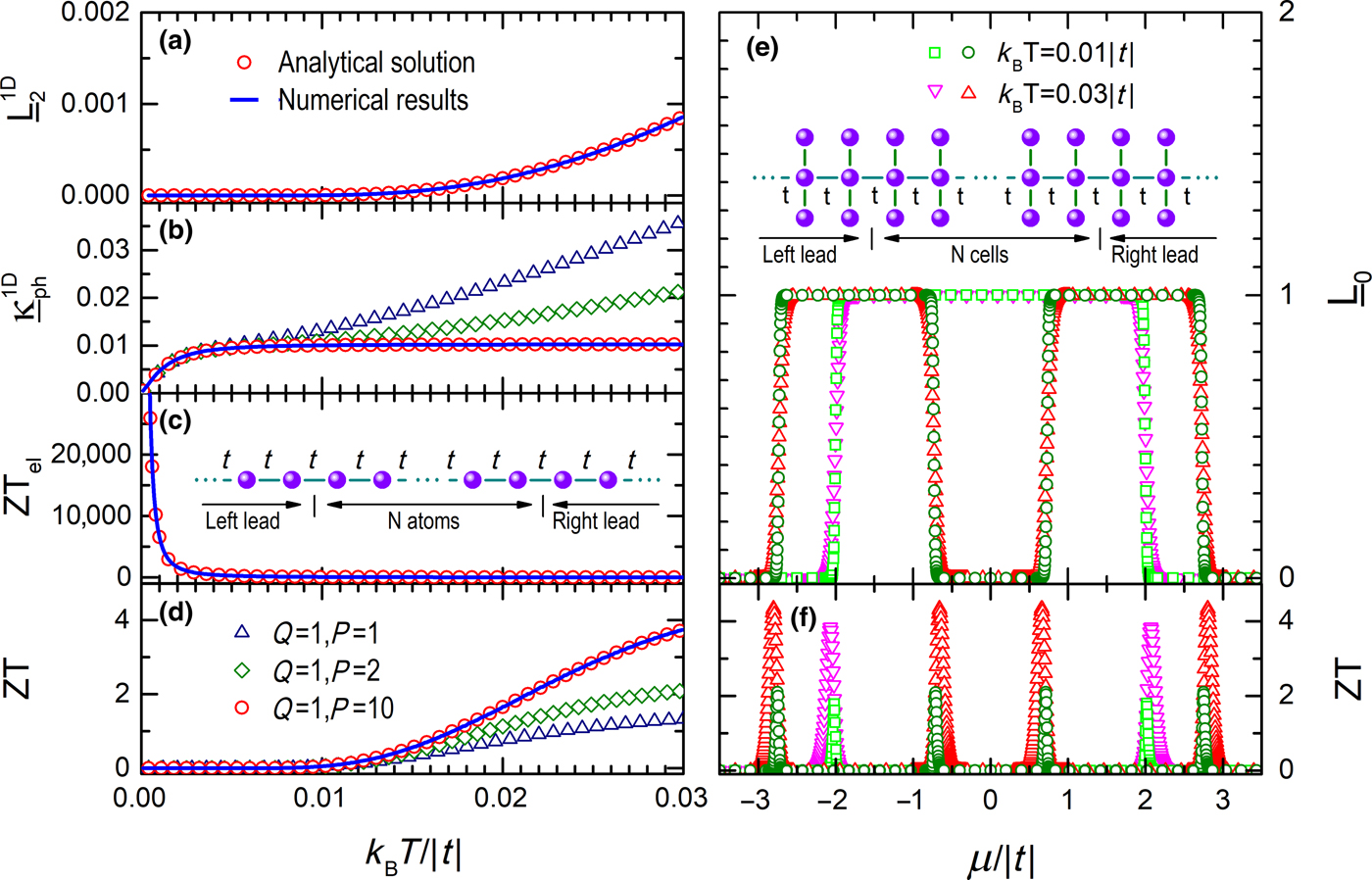
Analytical results of dimensionless thermoelectric quantities (a)  $\underline L _2^{1{\rm D}} $, (b)
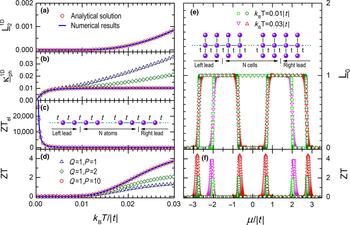
 $\underline \kappa _{\,ph}^{1{\rm D}} $, (c)ZT el, and (d) ZT as functions of the temperature (T) for a periodic linear chain with μ = −2.08| t | connected to two semi-infinite periodic leads, obtained from Eqs. (6)–(23) truncating their summations until Q = 1 and P = 1 (blue open triangles), P = 2 (green open rhombuses) and P = 20 (red open circles) in comparison with the corresponding numerical ones (blue lines), while (e) L0 and (f) ZT as functions of the chemical potential (μ) for periodic chains with (circles and up triangles) and without (squares and down triangles) Fano impurities at k BT = 0.01| t | (circles and squares) and k BT = 0.03| t | (up and down triangles). These chains are connected to two semi-infinite leads at their ends, as shown in the insets of (c) and (e).
In consequence, Eq. (7) gives the rise to
 $$L_0^{1{\rm D}} (\mu, T) = A( - 2 \vert \,t\, \vert - \mu ) - A(2 \vert \,t\, \vert - \mu ),$$
 $$L_1^{1{\rm D}} (\mu, T) = B( - 2 \vert \,t\, \vert - \mu ) - B(2 \vert \,t\, \vert - \mu ), $$
 $$\eqalign{& L_2^{1{\rm D}} (\mu, T) \cr & \quad = \left\{ {\matrix{ {\hskip23ptC( - 2 \vert \,t\, \vert - \mu ) - C(2 \vert \,t\, \vert - \mu ), \qquad \ \ {\rm if}\ \mu \lt - 2 \vert \,t\, \vert} \cr {\displaystyle{{ \pi \Omega \,k_{\rm B}^2 T^2} \over {3\hbar \,}} - C(2 \vert \,t\, \vert - \mu ) - C(\mu + 2 \vert \,t\, \vert ), \ {\rm if} \ \vert\mu \, \vert \, \lt 2 \vert \, t \, \vert \,} \cr {\hskip23ptC(\mu - 2 \vert \,t\, \vert ) - C(\mu + 2 \vert \,t\, \vert ), \quad\quad \quad {\rm if}\ \mu \gt 2 \vert \,t\, \vert \,} \cr}}\right.,}$$
where  $\Omega = (N - 1)a$ is the linear chain length,
 $$A(x) = \displaystyle{\Omega \over {\pi \hbar}} \displaystyle{1 \over {{\rm e}^{{x / {k_{\rm B} T}}} + 1}},$$
 $$B(x) = \displaystyle{\Omega \over {\pi \hbar}} \left[ {\displaystyle{x \over {{\rm e}^{{x / {k_{\rm B} T}}} + 1}} + k_{\rm B} T\ln (e^{ - {x / {k_{\rm B} T}}} + 1)} \right],$$
and
 $$\eqalign{C(x) = & \displaystyle{\Omega \over {\pi \hbar}} \left[\displaystyle{{x^2} \over {{\rm e}^{x / {k_{\rm B} T}} + 1}} + 2 x\,k_{\rm B} T\ln (e^{ - x / k_{\rm B} T} + 1)\right. \cr & \left. \,- 2(k_{\rm B} T)^2 \mathop {\lim} \limits_{Q \to \infty} \sum\limits_{s = 1}^Q \displaystyle{{{\rm e}^{- s x / k_B T}} \over {( - 1)^s s^2}} \right].}$$
Moreover, equations (8) and (12) lead to
 $$\kappa _{{\rm ph}}^{1{\rm D}} (T) = \displaystyle{{\Omega k_{\rm B}} \over {\pi \hbar \,}}\sum\limits_{l = 1}^3 { \left[ {\displaystyle{{\pi ^2 k_{\rm B} T} \over {12}} + D(2\omega _l )} \right]}, $$
where
 $$\eqalign{D(\omega ) & = \displaystyle{{\hbar^{2} \omega^{2} {\rm e}^{- \hbar\, \omega / k_{\rm B} T}} \over {4k_{\rm B} T({\rm e}^{ - \hbar\, \omega / k_{\rm B} T} - 1)}} + \displaystyle{{\hbar \omega} \over 2}\,\ln (1 - {\rm e}^{ - \hbar, \omega / k_{\rm B} T}) \cr & \quad - \displaystyle{{k_{\rm B} T} \over 2}\mathop {\lim} \limits_{P \to \infty} \sum\limits_{s = 1}^P {\displaystyle{{{\rm e}^{ - s \hbar\, \omega / k_{\rm B} T}} \over {s^2}}}.}$$
From Eqs. (13)–(15) and (19) we can define dimensionless thermoelectric quantities by underlined symbols given by
 $$\underline L _n^{1{\rm D}} = L_n^{1{\rm D}} \displaystyle{{\pi \hbar} \over {\Omega \vert \,t\, \vert ^n}} $$
and
 $$\underline \kappa _{{\rm ph}}^{1{\rm D}} = \kappa _{{\rm ph}}^{1{\rm D}} \displaystyle{{\pi \hbar} \over {\Omega \,k_{\rm B} \vert \,t\, \vert}}, $$
for n = 0, 1 and 2. In Figs. 1(a)–1(d), we compare the analytical solutions (open symbols) of (a)  $L_2^{1{\rm D}} $, (b)
 $\kappa _{{\rm ph}}^{1{\rm D}} $, (c) ZT el, and (d) ZT with their respective numerical results (blue lines) as functions of the temperature (T) for the periodic chain shown in the inset of Fig. 1(c) with a chemical potential located at μ = −2.08|t |, | t | = 1 eV, a site mass of 5.12 × 10⁻²⁵ kg, central and non-central restoring force constants of α = 31.1 N/m, and β = 5.36 N/m, as occurred in a DNA-like structure discussed in the next section. The numerical calculations were carried out in macroscopic length systems by using an exact renormalization procedure developed for periodic and quasiperiodic lattices.[Reference Sánchez and Wang15] In Fig. 1(c), ZT el denotes the dimensionless thermoelectric figure-of-merit by electrons, neglecting the phonon participation as in Ref. Reference Fu, Gu, Wu and Zhang9 given by
 $$\eqalign{ZT_{{\rm el}} (\mu, T) & = \displaystyle{{\sigma (\mu, T)S^2 (\mu, T)T} \over {\kappa _{{\rm el}} (\mu, T)}} \cr & = \displaystyle{{{{L_1^2 (\mu, T)} / {L_0 (\mu, T)}}} \over {L_2 (\mu, T) - {{L_1^2 (\mu, T)} / {L_0 (\mu, T)}}}}.}$$
The analytical solutions of  $L_2^{1{\rm D}} $ and ZT el, red open circles in Figs. 1(a) and 1(c), were obtained from Eqs. (13)–(23), whose summations were performed until Q = 1, while in Fig. 1(b) the analytical solutions of
 $\kappa _{{\rm ph}}^{1{\rm D}} $ were gotten from Eq. (19) whose summation was truncated at P = 1 (blue open triangles), P = 2 (green open rhombuses), and P = 20 (red open circles). The corresponding analytical solutions of ZT are shown in Fig. 1(d).
Notice the remarkable accordance between the numeric and analytic results, as well as the number of summation terms required in the analytical solutions, i.e., Q = 1 for  $L_2^{1{\rm D}} $ while P = 20 for
 $\kappa _{{\rm ph}}^{1{\rm D}} $. This truncation difference between electric and thermal contributions is originated from electron and phonon characteristic energies, respectively, given by |t | and
 $\hbar \omega _l $, where
 $\vert t\, \vert \, \gg \hbar \omega _l $ leading to a reduced summation-term requirement for the electron case. Moreover, observe the divergence of ZT el in Fig. 1(c) when the temperature goes to zero, following
 $$\eqalign{& ZT_{{\rm el}} (\mu, T) \approx \displaystyle{{( - \mu - 2 \vert \,t\, \vert + k_{\rm B} T)^2} \over {(k_{\rm B} T)^2}}, \cr & \quad {\rm for}\,{\rm} \mu \lt - 2 \vert \,t\, \vert \;{\rm and}\; T\, \to 0,}$$
which can be obtained by taking  $\ln [{\rm e}^{{{(\mu + 2 \vert \,t\, \vert)} / {k_{\rm B} T}}} + 1] \approx {\rm e}^{{{(\mu + 2 \vert \,t\, \vert )} / {k_{\rm B} T}}} $,
 ${1 / {[{\rm e}^{{{( - \mu - 2 \vert \,t\, \vert )} / {k_{\rm B} T}}} + 1]}} \approx {\rm e}^{{{(\mu + 2 \vert \,t\, \vert)} / {k_{\rm B} T}}} $, Q = 1 in Eq. (18), and neglecting
 $A(2 \vert \,t\, \vert - \mu )$,
 $B(2 \vert \,t\, \vert - \mu )$ and
 $C(2 \vert \,t\, \vert - \mu )$ in Eqs. (13)–(15), since
 $\mu = - 2.08 \vert \,t\, \vert $ is close to the lower band edge (
 $ - 2 \vert \,t\, \vert $) and far from the upper one (
 $2 \vert \,t\, \vert $). In contrast, ZT goes to zero when T decreases in Fig. 1(d), due to the presence of thermal conductivity by phonons in Eq. (6) which can be expressed as
 $\kappa _{{\rm ph}}^{1{\rm D}} \approx {{\Omega \pi k_{\rm B}^2 T} / {(4\hbar )}}$ at very low temperatures.[Reference Wang, Salazar and Sánchez14] Then, Eq. (6) leads to
 $$\eqalign{ZT(\mu, T) & \approx \displaystyle{{ ZT_{{\rm el}} (\mu, T)} \over {1 + \exp {{[( - \mu - 2 \vert \,t\, \vert )} / {k_{\rm B} T]{{\pi ^2} / 4}}}}}, \cr & \quad {\rm for}\ \mu \lt - 2 \vert \,t\, \vert\ {\rm and} \; T\, \to 0.}$$
Now, we consider a periodic chain with two single-atom Fano defects attached to each atom of the main chain, which is connected to two semi-infinite periodic leads with the same Fano impurities, as shown in the inset of Fig. 1(e). All these atoms have a null self-energy and are linked with their nearest neighbors through a hopping integral t, central (α) and non-central (β) restoring force constants. The coordinates of these two single-atom Fano defects can be renormalized producing an effective self-energy (εimp = 2t 2/E) at atoms on the main chain[Reference Nandy, Pal and Chakrabarti16] and then, the original problem is reduced to an equivalent one-dimensional (1D) linear chain. This Fano-defect induced self-energy leads to new electronic band edges located at  $E_1 = - \vert \,t\, \vert (\sqrt 3 + 1)$,
 $E_2 = - \vert \,t\, \vert (\sqrt 3 - 1)$,
 $E_3 = \vert \,t\, \vert (\sqrt 3 - 1)$ and
 $E_4 =\vert \,t\, \vert (\sqrt 3 + 1)$, being solutions of
 $E - {{2t^2} / E} = \pm \,2 \vert \,t\, \vert $. Hence, the trace of Eq. (7) can be written as
 $$\eqalign{& {\rm Tr}\left\{ {{\hat p}_x{\mathop{\rm Im}\nolimits} G^ + (E){\hat p}_x{\mathop{\rm Im}\nolimits} G^ + (E)} \right\}\, \cr & \quad = \displaystyle{{{(N{\kern 1pt} - 1)}^2a^2m^2} \over {2\hbar ^2}}\left[\Theta {\kern 1pt} \left( {2{\kern 1pt} \vert\,t\,\vert - \left\vert {E{\kern 1pt} + \,{{\sqrt 3 {\kern 1pt} \vert\,t\,\vert} / 2}} \right\vert} \right) \right. \cr & \qquad \left. + \Theta {\kern 1pt} \left( {2{\kern 1pt} \vert\,t\,\vert - \left\vert {E{\kern 1pt} - \,{{\sqrt 3 {\kern 1pt} \vert\,t\,\vert} / 2}} \right\vert} \right)\right]}.$$
There are three different vibrational modes in this periodic chain with Fano defects, and they are longitudinal (L), transversal along the Fano impurities (T 1), and transversal perpendicular to the Fano impurities (T 2). The trace of Eq. (8) is given by
 $$\eqalign{& {\rm Tr}\left\{{{\bf A}_x{\rm Im} G_{\rm ph}^ + (\omega ^2){\bf A}_x{\rm Im} G_{\rm ph}^ + (\omega ^2)} \right\}_l \cr & \quad \quad = - \displaystyle{{{(N - 1)}^2a^2} \over 8}\left\{{\Theta \,[(\omega _1^l )^2 - \omega ^2} \right.\cr & \quad \quad \quad \left.{+ \Theta \,[(\omega _3^l )^2 - \omega ^2]\,\Theta \,[\omega ^2 - (\omega _2^l )^2]}\right\} },$$
where the phononic band edges ( $\omega _1^l $,
 $\omega _2^l $, and
 $\omega _3^l $) are presented in Table I for the three mentioned vibrational modes.
Phononic band edges for a periodic chain with Fano defects.

Evaluating Eqs. (7) and (8) for this periodic chain with Fano defects we obtain
 $$\eqalign{L_{0}^{\rm F} (\mu, T) & = A(E_1 - \mu ) - A(E_2 - \mu ) + A(E_3 - \mu ) \cr & \quad - A(E_4 - \mu ),}$$
 $$\eqalign{L_{1}^{\rm F} (\mu, T) & = B(E_1 - \mu ) - B(E_2 - \mu ) + B(E_3 - \mu ) \cr & - B(E_4 - \mu ),}$$
 $$L_2^{\rm F} (\mu, T) = \left\{ {\matrix{ {\hskip19ptC(E_1 - \mu ) - C(E_2 - \mu ) + C(E_3 - \mu ) - C(E_4 - \mu ), \quad {\rm if}\ \mu \lt E_1} \cr {\displaystyle{{ \pi \,\Omega \,(k_{\rm B} T)^2} \over {3\,\hbar \,}} - C(E_2 - \mu ) - C(\mu - E_1 ) + C(E_3 - \mu ) - C(E_4 - \mu ), \quad\! {\rm if}\ E_1 \, \le {\rm \vert} \,\mu \, \vert \, \lt \,E_2} \cr {\hskip53ptC(\mu - E_2 ) - C(\mu - E_1 ) + C(E_3 - \mu ) - C(E_4 - \mu ), \quad {\rm if}\ E_2 \, \le {\rm \vert} \,\mu \, \vert \, \lt \,E_3} \cr {\displaystyle{{ \pi \,\Omega \,(k_{\rm B} T)^2} \over {3\,\hbar \,}} - C(\mu - E_3 ) - C(E_4 - \mu ) + C(\mu - E_2 ) - C(\mu - E_1 ), \quad {\rm if}\ E_3 \, \le {\rm \vert} \,\mu \, \vert \, \lt \,E_4} \cr {\hskip17ptC(\mu - E_2 ) - C(\mu - E_1 ) + C(\mu - E_4 ) - C(\mu - E_3 ), \quad {\rm if}\ \mu \ge E_4} \cr}} \right.,$$
and
 $$\kappa _{{\rm ph}}^{\rm F} (T) = \displaystyle{{\Omega k_{\rm B}} \over {\pi \hbar \,}}\sum\limits_{l = 1}^3 { \left[ {\displaystyle{{\pi ^2 k_{\rm B} T} \over {12}} + D(\omega _1^l ) - D(\omega _2^l ) + D(\omega _3^l )} \right]}. $$
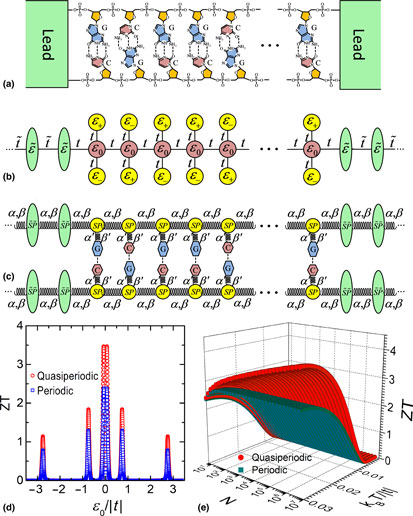
In Fig. 1, the dimensionless (e) L0 and (f) ZT as functions of the chemical potential μ obtained from Eqs. (28)–(31) are comparatively presented for periodic chains with (circles and up triangles) and without (squares and down triangles) Fano impurities at k BT = 0.01| t | (circles and squares) and k BT = 0.03| t | (up and down triangles). Observe in Fig. 1(e) the appearance of a central energy gap of 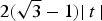 $2(\sqrt 3 - 1) \vert \,t\, \vert $ around μ = 0 induced by the Fano defects and two shifted bands conserving their original band width of
 $4 \vert \,t\, \vert $. Note also the height and full-width-at-half-maximum (FWHM) of ZT peaks around each band edge increase with the temperature, while their location shifts away from the band edge. Moreover, the maximum ZT grows with the presence of Fano defects. It is important to stress that the analytical expressions (11–31) are valid only for periodic systems, e.g., quasiperiodic or random disorders generally require numerical analysis.
Application to DNA-like systems
The model described in the section The Boltzmann-Kubo model can be applied to address the thermoelectric properties of DNA molecules, such as a poly(G)-poly(C) DNA chain schematically illustrated in Fig. 2(f). These molecules can be self-assembled to create long double chains.[Reference Cuevas and Scheer17] One of the most used DNA semi-empirical approaches for electrons is the so-called fishbone model,[Reference Cuniberti, Craco, Porath and Dekker18] in which each base pair, guanine–cytosine (GC) or adenine-thymine (AT), is considered as a single site with self-energy ε0. Such model also considers hopping integrals t of π-electrons between nearest-neighbor base pairs as well as between the nucleobase and sugar-phosphate backbone represented as Fano defects, whose self-energies depend on the environmental condition[Reference Cuniberti, Maciá, Rodríguez, Römer and Chakraborty19] and are denoted by ε+ and ε− in Fig. 2(g). These backbones are crucial for the electronic transport in DNA double helix, since they can induce a metal–insulator transition.[Reference Guo, Xiong, Yang and Zhu20, Reference Guo, Yang, Zhu and Xiong21] In fact, the semiconducting behavior of DNA molecules can be used for thermoelectric applications.[Reference Maciá6] For example, a notable growth of the Seebeck coefficient was observed when a couple of AT base pairs is introduced into a DNA molecule with GC sequence.[Reference Li, Xiang, Palma, Asai and Tao22] Recently, a giant thermoelectric figure-of-merit by electrons (ZT el) induced by the sugar-phosphate backbones in a finite two-dimensional (2D) poly(G)-poly(C) DNA chain was predicted.[Reference Fu, Gu, Wu and Zhang9]
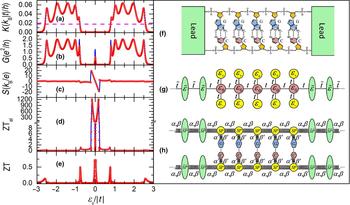
(a) Thermal conductance (K) by electrons (red spheres) and by phonons (magenta dashed line), (b) electric conductance (G), (c) Seebeck coefficient (S), (d) electronic (ZT el), and (e) full (ZT) thermoelectric figures of merit as functions of the nucleobase self-energy (ε0) for a poly(G)-poly(C) DNA chain of five nucleotides at k BT = 0.01|t| with μ = 0,  $\varepsilon _ \pm = \varepsilon _0 \pm 0.1\,\vert \,t\, \vert$,
 $\alpha ' = \alpha = 31.1\;{{\rm N} / {\rm m}}$ and
 $\beta ' = \beta = 5.36\;{{\rm N} / {\rm m}}$ connected to two semi-infinite leads with
 $\tilde \varepsilon = 0$,
 $\tilde t = 2t$ and
 $M_{{ {\tilde {\rm S}} {\tilde P}}} = M_{{\rm SP}} $, in comparison with the results of Ref. Reference Fu, Gu, Wu and Zhang9 shown by blue lines in (a–d). Schematic representations of (f) this DNA double chain terminated by two leads, (g) the fishbone model for electrons and (h) the two-site coarse-grain model for phonons are illustrated. In the last two sketches, (g) and (h), the chains are connected to two semi-infinite periodic leads at their ends.
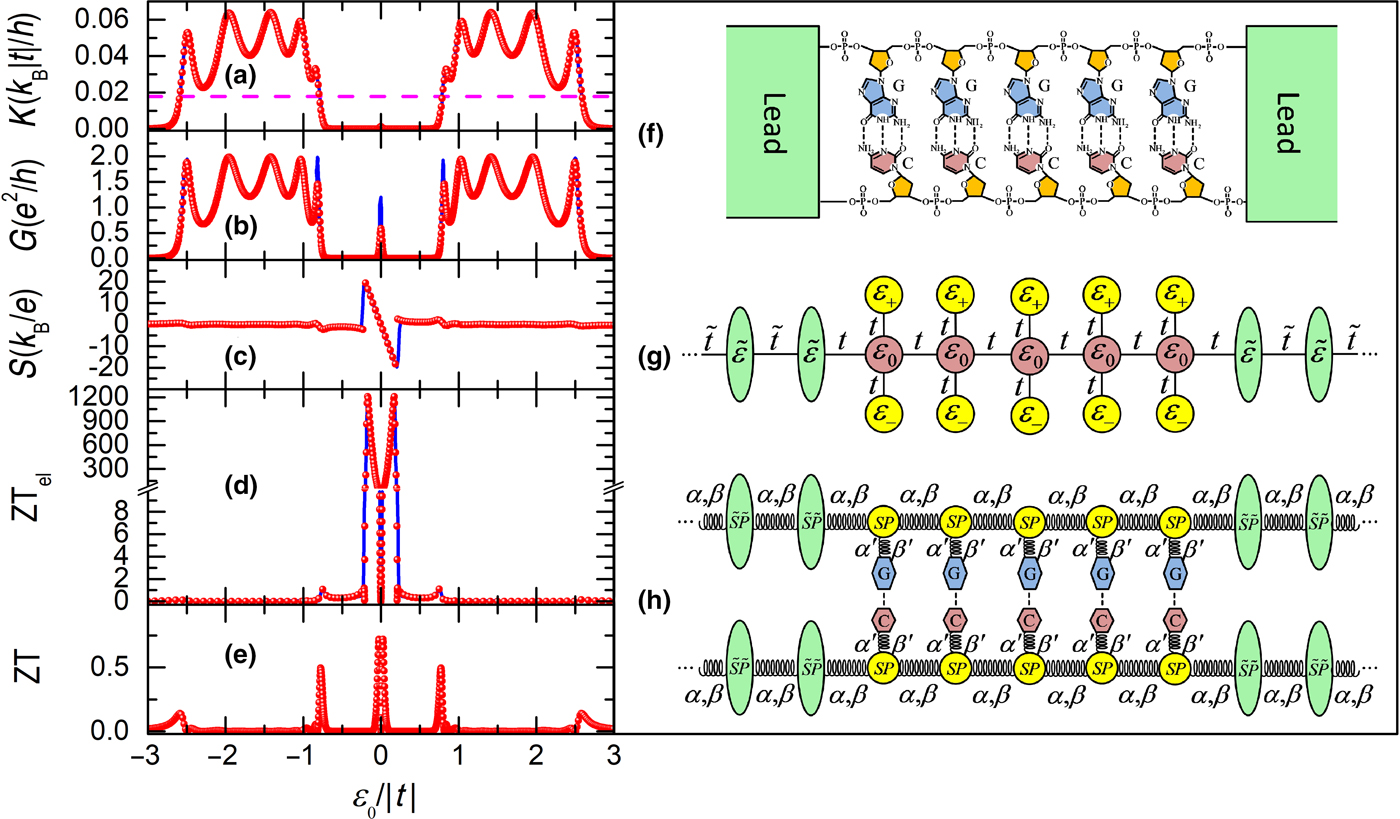
In this section, we present a full semi-empirical calculation of thermoelectric properties of DNA molecules that includes the phonon participation through a 2D coarse grain model of two sites per nucleotide, similar to that of Ref. Reference Maffeo, Ngo, Ha and Aksimentiev23. Our two-site coarse-grain model consists of one site representing the nucleobase that could be guanine, cytosine, adenine or thymine, and the other symbolizing the sugar-phosphate molecule, as presented in Fig. 2(h). The interaction between these two sites are modeled by central (α′) and non-central (β′) restoring force constants, while those between nearest-neighbor sugar-phosphate molecules are characterized by α = 31.1 N/m and β = 5.36 N/m. These last two constants were calculated from DNA longitudinal  $(v_{\rm L} = 2650\,{{\rm m} / {\rm s}})$ and transversal
 $(v_{\rm T} = 1100\,{{\rm m} / {\rm s}})$ sound velocities estimated by the inelastic x-ray scattering,[Reference Krisch, Mermet, Grimm, Forsyth and Rupprecht24] through the relations
 $v_{\rm L} = a\sqrt {{\alpha / {(M_{{\rm SP}} {\rm +} M_B )}}} $ and
 $v_{\rm T} = a\sqrt {{\beta / {(M_{{\rm SP}} {\rm +} M_B )}}} $ where a = 3.4 × 10⁻¹⁰ m is the distance between nearest-neighbor base pairs, M SP ≈ 2.96 × 10⁻²⁵ kg is the mass of sugar-phosphate molecule and
 $M_B { = (M_G + M_C + M_A + M_T )} /{4} \approx 2.19 \times 10^{ - 25}\, {\rm kg}$ is the average mass of four-type nucleobases, since they are almost randomly presented in a DNA double helix. In this coarse-grain model, the interactions between complementary nucleobases and between stacked bases via hydrogen bonds are omitted, since the corresponding force constants are typically smaller than 0.1 N/m.[Reference Yakushevich25] Hence, the vibrational modes of poly(G)-poly(C) DNA chains can be described through two independent chains with guanine and cytosine Fano defects, as shown in Fig. 2(h).
In Figs. 2(a)–2(e), we present the results denoted by red spheres of (a) 1D thermal conductance by electrons and by phonons (magenta dashed line) defined as  $K(\mu, T) = {{\kappa (\mu, T)\,\Omega _ \bot } / {\Omega _\parallel }} $, (b) 1D electrical conductance given by
 $G(\mu, T) = {{\sigma (\mu, T)\,\Omega _ \bot } / {\Omega _\parallel }} $, (c) Seebeck coefficient (S), (d) electronic (ZT el), and (e) full (ZT) dimensionless thermoelectric figures of merit as functions of the base pair self-energy (ε0) with μ = 0,
 $\varepsilon _ \pm = \varepsilon _0 \pm 0.1\, \vert \,t\, \vert $,
 $\alpha ' = \alpha $,
 $\beta ' = \beta $, and at k BT = 0.01|t| for a poly(G)-poly(C) DNA chain of five GC base pairs connected to two semi-infinite atomic leads with
 $\tilde \varepsilon = 0$,
 $\tilde t = 2t$ and
 $M_{\tilde {\rm S}\tilde {\rm P}} = M_{{\rm SP}} $, as illustrated in Fig. 2(g). In Figs. 2(a)–(d), the results of Ref. Reference Fu, Gu, Wu and Zhang9 are plotted as blue lines, in order to compare them with our calculations.
Note the good coincidence of ZT el from Ref. Reference Fu, Gu, Wu and Zhang9 and our calculations, whose difference observed in Fig. 2(b) is due to the dissimilarity of modeling the leads. In addition, we present a full calculation of ZT including the phonon contribution to Eq. (6), which generates a realistic small value of ZT shown in Fig. 2(e). The initial value of  $ZT_{{\rm el}} \approx \,1200$ is originated from an almost null denominator in Eq. (23) and the inclusion of a finite thermal conductivity by phonons [see the dashed line in Fig. 2(a)] into Eq. (6) rectifies this effect and produces a final ZT ≈ 0.75. It is worth mentioning that in Fig. 2 we have considered
 $\alpha ' = \alpha $ and
 $\beta ' = \beta $, as assumed in Ref. Reference Kovaleva, Manevich, Musienko and Savin26, and the effects of these parameters on the ZT will be analyzed in detail.
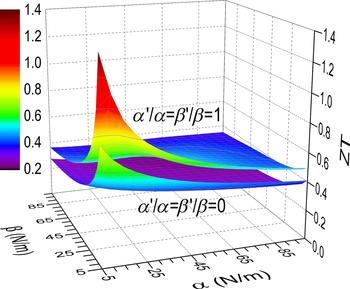
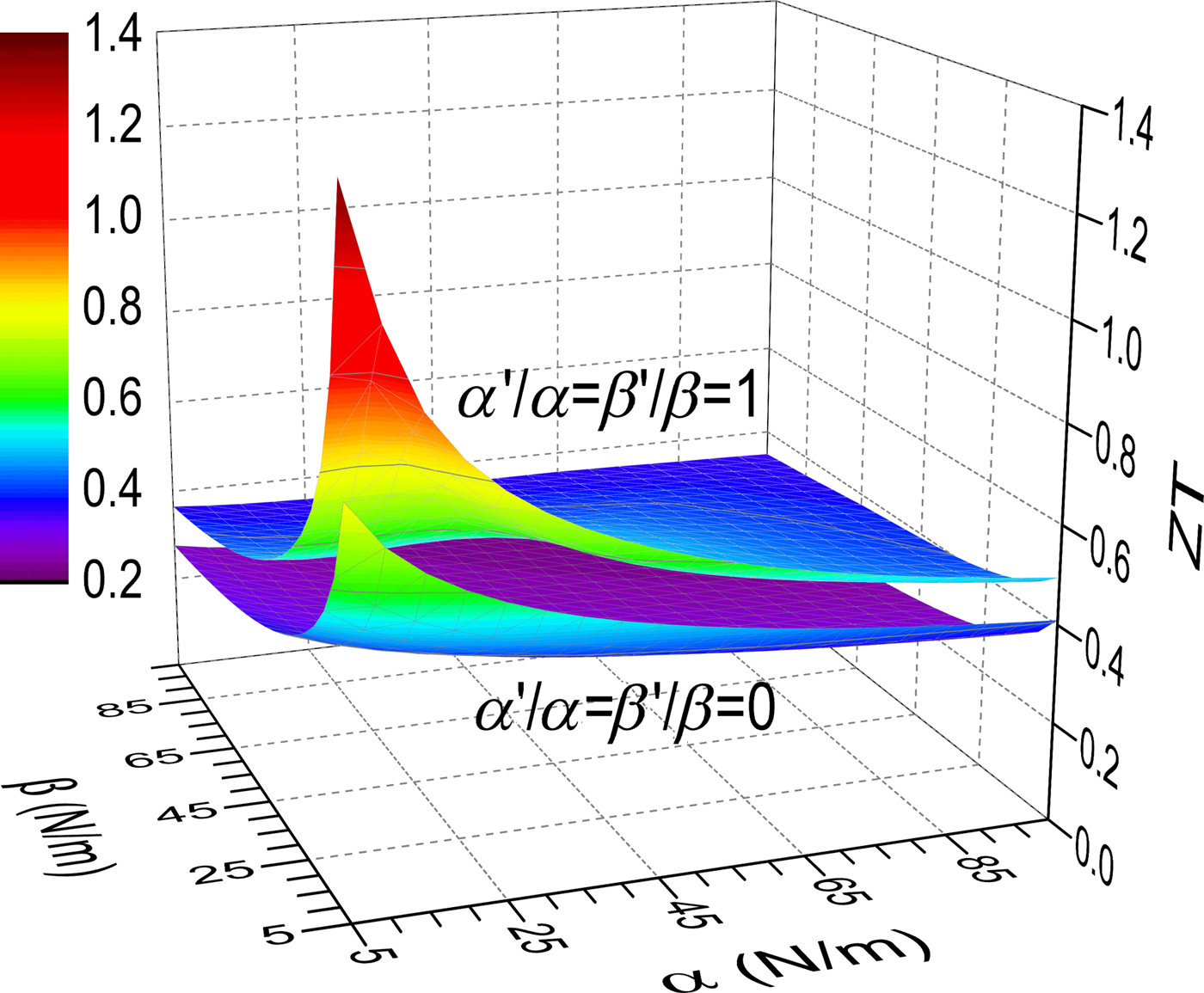
In Fig. 3, we present the ZT variation as a function of vibrational parameters α and β for α′/α = β′/β = 1 and α′/α = β′/β = 0 analyzed in the same poly(G)-poly(C) DNA chain of Fig. 2 with the nucleobase self-energy ε0 = −0.027 | t | corresponding to the maximal ZT in Fig. 2(e). Notice that ZT grows with the decrease of α and/or β, since it reduces the phononic band width and then its participation in the thermal conductivity. Also, observe the diminution of ZT when  $\alpha ' = \beta ' = 0$, which corresponds to the case without phonon Fano defects, whose presence induces a phononic central band gap, as occurred in the electronic case shown in Fig. 1(e). Such band gap diminishes the thermal conductivity by phonons and then yields a larger ZT. For the limiting case of
 $\alpha = \beta = \alpha ' = \beta ' = 0$, ZT should recover the value of ZT el.
Dimensionless thermoelectric figure-of-merit (ZT) as a function of the central (α) and non-central (β) restoring force constants with ε0 = −0.027 | t | for a poly(G)-poly(C) DNA chain of five GC base pairs connected to two semi-infinite atomic leads with the same parameters of Fig. 2.
Quasiperiodic poly(G)-poly(C) double chains
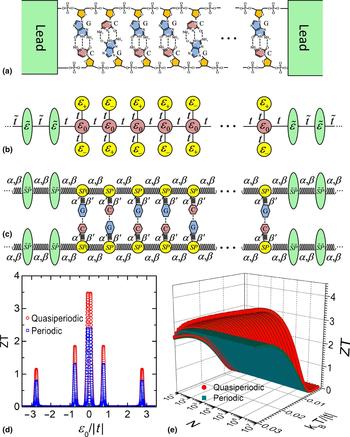
In this section, we study quasiperiodically ordered poly(G)-poly(C) double chains following the Fibonacci sequence given by ABAAB,[Reference Wang, Salazar and Sánchez14] as shown in Fig. 4(a) being A = (GC) and B = (CG) base pairs, and we analyze the effects of quasiperiodicity on the thermoelectric figure-of-merit ZT. The electronic transport in this quasiperiodic double chain is modeled by the fishbone model, Fig. 4(b), while its lattice thermal conductivity is described by means of the previously discussed two-site coarse-grain model, schematically presented in Fig. 4(c). Notice that the fishbone model is insensitive to the (GC) base-pair ordering, i.e. the structures of Figs. 2(g) and 4(b) are described by the same electronic Hamiltonian of Eq. (1). In contrast, the quasiperiodic order of (GC) base pairs modifies the dynamic matrix of phonons.
Schematic representations of (a) a quasiperiodically ordered long poly(G)-poly(C) DNA double chain terminated by two leads, (b) the fishbone model for electrons, and (c) the two-site coarse-grain model for phonons, as well as (d) the dimensionless thermoelectric figure-of-merit (ZT) versus the nucleobase self-energy (ε0) for periodic (blue open squares) and quasiperiodic (red open circles), shown in (a), poly(G)-poly(C) double chains of 1346269 base pairs at k BT = 0.02|t| with the same system parameters of Fig. 2. Variation of ZT as functions of the system length (N) and temperature (T) for both periodic (blue solid squares) and quasiperiodic (red solid circles) poly(G)-poly(C) double chains of (d) with ε0 = −0.0718 | t | is shown in (e).
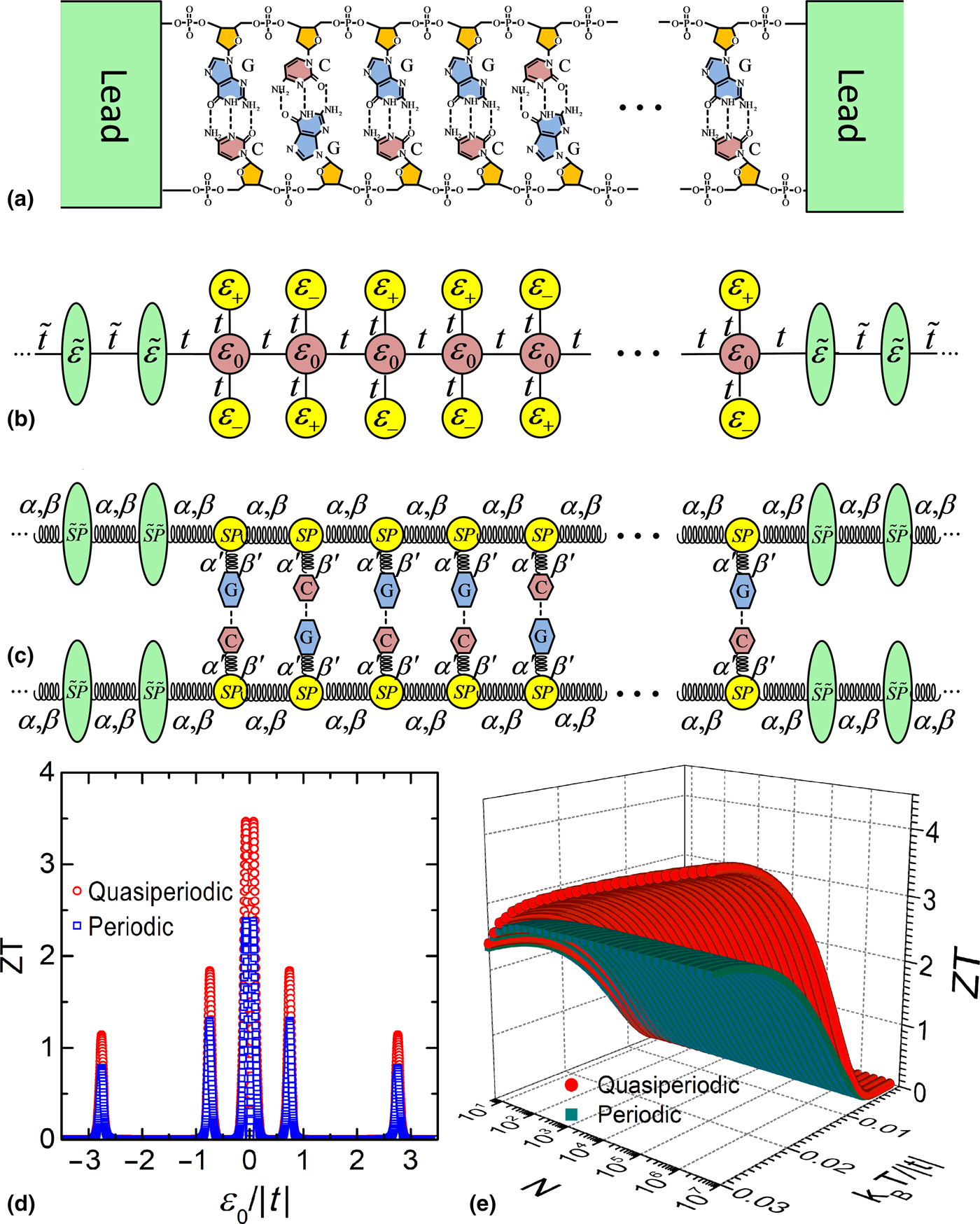
Figure 4(d) shows the thermoelectric figure-of-merit (ZT) versus the nucleobase self-energy (ε0) for a quasiperiodic poly(G)-poly(C) chain of 1346269 base pairs (red open circles), corresponding to the generation 30 of the Fibonacci sequence, with μ = 0,  $\varepsilon _ \pm = \varepsilon _0 \pm 0.2\, \vert \,t\, \vert $,
 $\alpha ' = \alpha $,
 $\beta ' = \beta $, k BT = 0.02|t| and the same periodic leads as in Fig. 2. Such results are compared with those obtained from the periodic poly(G)-poly(C) double chain of the same length (blue open squares) schematically shown in Fig. 2(f). Observe in Fig. 4(d) the enhancement of ZT when the quasiperiodicity is introduced. Notice also the growth of ZT from 0.75 to 2.5 for the periodic case archived at
 $\varepsilon _0 = 0.0718 \vert \,t\, \vert $ in a longer system at a higher temperature. The effects of system length and temperature on ZT are analyzed in Fig. 4(e), where a growth of ZT with the system length (N) and temperature (T) is noted in both periodic (blue solid squares) and quasiperiodic (red solid circles) poly(G)-poly(C) double chains studied in Fig. 4(d). However, there is a qualitative difference between the periodic and quasiperiodic cases in the growth of ZT with N, i.e. a continued progress for the Fibonacci systems versus an almost constant behavior for the periodic ones. Such contrast is derived from the suppression of low-frequency phonon transport by the long-range quasiperiodic structural disorder.
Conclusions
The analytical solutions for periodic chains of N sites with and without Fano impurities reported in this article let us visualize the contribution of each component of ZT and the intrinsic correlations between L 0, L 1, and L 2, as established in the Wiedemann–Franz law for metals. For example, simple analytical expressions of ZT el and ZT, respectively given by Eqs. (24) and (25) for low-temperature regime, summarize such intrinsic correlations and are obtained from analytical cancelations of distinct terms of ZT. Frequently, these cancelations are difficult to numerically carry out, since it involves the summation of quantities that differ by more than 40 orders of magnitude in the numerator and/or denominator of ZT. Hence, analytical solutions of the limiting case could serve as a guide for the analysis of numerical results.
These analytical solutions were confirmed by numerical calculations and both predict a general improved ZT of periodic chains with Fano impurities, due to the reduction of thermal conductivity by phonons caused by the appearance of a central band gap in the phononic density of states DOSph (ω 2). This effect is even enhanced if a quasiperiodic disorder is introduced since it highly diminishes the thermal conduction of long wavelength acoustic phonons, which are responsible of the phonon transport at low temperature and not easy to be suppressed since they do not feel local defects neither impurities.[Reference González, Sánchez and Wang27]
In addition, we apply this analysis of Fano impurities to a poly(G)-poly(C) DNA system by means of simple coarse-grained models for both electron and phonon descriptions. The results of ZT reveal a crucial participation of vibrational contributions, decreasing from ZT el ≈ 1200 to ZT ≈ 0.75, where the central (α) and non-central (β) restoring force parameters along the double strands were obtained from the DNA sound velocity measurements while α′ and β′ have a limited influence to the resulting ZT as shown in Fig. 3. Moreover, a non-perturbative study of macroscopic-length poly(G)-poly(C) DNA chains with the quasiperiodic Fibonacci sequence by alternating (GC) and (CG) base-pair order reveals an additional improvement of ZT with respect the periodic case by more than 30% for a macroscopic-length system. Finally, the new analytical expressions and novel analysis of long quasiperiodic poly(G)-poly(C) DNA chains presented in this communication can be useful for the study of branched nanowires with long-range aperiodically ordered Fano impurities through the convolution theorem,[Reference Sánchez and Wang15, Reference González, Sánchez and Wang27] whose chemical potential location can be fixed by applying an external gate voltage.[Reference Tian, Sakr, Kinder, Liang, MacDonald, Qiu, Gao and Gao28]
Acknowledgements
This work has been partially supported by CONACyT-252943, UNAM-PAPIIT-IN114916 and UNAM-PAPIIT-IN116317. Computations were performed at Miztli of DGTIC-UNAM.