For more than150 years, red rice (Oryza sativa L.) has been recognized as one of the most troublesome weeds in rice production throughout the southern United States (Craigmiles Reference Craigmiles and Eastin1978; De Wet and Harlan Reference De Wet and Harlan1975; Fish et al. Reference Fish, Webster, Blouin and Bond2015, Reference Fish, Webster, Blouin and Bond2016; Gealy et al. Reference Gealy, Mitten and Rutger2003). Imidazolinone-resistant (IR) rice (O. sativa L.) was introduced in 2002, allowing producers to manage red rice with postemergence herbicides while simultaneously producing a rice crop for the very first time (Croughan 1999, Reference Croughan2003). IR hybrid rice was introduced for commercial use in 2003. Although IR hybrid rice is still widely planted throughout the southern United States, research has indicated that the technology used in IR rice production can naturally outcross to red rice, resulting in IR red rice (Chen et al. Reference Chen, Lee, Song, Suh and Lu2004; Majumder et al. Reference Majumder, Ram and Sharma1997; Messegeur et al. Reference Messeguer, Catala, Guiderdoni and Mele2004; Rajguru et al. Reference Rajguru, Burgos, Shivrain and Stewart2005; Song et al. Reference Song, Lu, Zhu and Chen2002, Reference Song, Lu, Zhu and Chen2003). Another conspecific pest to cultivated rice is volunteer IR hybrid rice (Sudianto et al. Reference Sudianto, Beng-Kah, Ting-Xiang, Saldain, Scott and Burgos2013). Hybrid rice seed can contain prolonged dormancy characteristics and become weedy in succeeding growing seasons. In addition, these F2 generations can segregate with many different phenotypic characteristics and potentially be IR (Steve Linscombe, LSU Ag Center Rice Breeder Emeritus, personal communication). From this point forward, the entire complex of red rice, outcrosses, and volunteer hybrid rice will be referred to as weedy rice.
Weedy rice, more specifically IR weedy rice, presents a serious weed management issue in rice-producing areas throughout the southern United States (Gressel and Valverde Reference Gressel and Valverde2009). Although weedy rice is taxonomically classified as the same species as cultivated rice, weedy rice can include a broad range of different phenotypic characteristics, including various grain color and size, presence or lack of awns, dark to light green vegetation, variable plant height, and glabrous to pubescent leaves (Gressel and Valverde Reference Gressel and Valverde2009; Rustom et al. Reference Rustom, Webster, Blouin and McKnight2018, Reference Rustom, Webster, Blouin and McKnight2019). Red rice, a variation of weedy rice, is reported to have superior growth and tillering capabilities in comparison with cultivated rice, and therefore, it can interfere with nutrient and light utilization of cultivated rice in a competitive environment (Estorninos et al. Reference Estorninos, Gealy, Gbur, Talbert and McClelland2005; Kwon et al. Reference Kwon, Smith and Talbert1992). Smith (Reference Smith1988) reports one red rice plant per square meter can reduce yield by 219 kg ha−1, and red rice infestations can reduce cultivated rice yield by up to 80% with season-long competition.
Barnyardgrass [Echinochloa crus-galli (L.) P. Beauv] is another troublesome weed throughout rice-producing areas in the southern United States and is capable of reducing rice yields by 80% (Smith Reference Smith1965). Weed control programs throughout rice-producing areas in the southern United States often included the use of propanil for barnyardgrass management (Carey et al. Reference Carey, Hoagland and Talbert1995; Smith Reference Smith1965; Smith and Hill Reference Smith, Hill, Grayson, Green and Copping1990). By the early 1990 s, 98% of Arkansas rice acreage included at least one propanil application per growing season. Consequently, barnyardgrass that is resistant to propanil presents a serious weed management issue in rice-producing areas in the southern United States. Barnyardgrass that is resistant to other modes of action such as quinclorac or imidazolinone herbicides has also been reported (Riar et al. Reference Riar, Norsworthy, Srivastava, Nandula, Bond and Scott2013; Talbert and Burgos Reference Talbert and Burgos2007).
Acetyl coenzyme-A carboxylase-resistant (ACCase-R) rice was commercialized in 2018 by BASF (Research Triangle Park, NC 27709) in response to IR weedy rice and barnyardgrass resistance to several different modes of action. Quizalofop, a Group 1 aryloxyphenoxypropionate herbicide that inhibits acetyl coenzyme-A carboxylase (ACCase), is the herbicide targeted for use in this system. ACCase-R rice will provide a new tool in cultivated rice production for postemergence management of a broad spectrum of grasses such as weedy rice and barnyardgrass (Rustom et al. Reference Rustom, Webster, Blouin and McKnight2018, Reference Rustom, Webster, Blouin and McKnight2019; Shaner Reference Shaner2014). Quizalofop has historically been used for weedy rice management in soybean production at rates from 35 to 84 g ai ha−1 (Askew et al. Reference Askew, Shaw and Street1998; Minton et al. Reference Minton, Shaw and Kurtz1989). The targeted quizalofop application rate in ACCase-R production is 92 to 155 g ai ha−1, not to exceed 240 g ha−1 per year (Rustom et al. Reference Rustom, Webster, Blouin and McKnight2018, Reference Rustom, Webster, Blouin and McKnight2019).
Herbicides applied in mixtures can have both positive and negative impacts with regard to herbicide activity, crop yield, and overall economic returns (Blackshaw et al. Reference Blackshaw, Harker, Clayton and O’Donovan2006; Carlson et al. Reference Carlson, Webster, Salassi, Hensley and Blouin2011; Osterholt et al. Reference Osterholt, Webster, Blouin and McKnight2019; Pellerin et al. Reference Pellerin, Webster, Zhang and Blouin2003, Pellerin and Webster, Reference Pellerin and Webster2004; Rustom et al. Reference Rustom, Webster, Blouin and McKnight2018, Reference Rustom, Webster, Blouin and McKnight2019; Webster et al. Reference Webster, Carlson, Salassi, Hensley and Blouin2012, Reference Webster, Rustom, McKnight, Blouin and Teló2019; Zhang et al. Reference Zhang, Webster, Blouin and Leon2005). Mixtures can have one of three responses: synergistic, antagonistic, or neutral (Fish et al. Reference Fish, Webster, Blouin and Bond2015, Reference Fish, Webster, Blouin and Bond2016; Rustom et al. Reference Rustom, Webster, Blouin and McKnight2018, Reference Rustom, Webster, Blouin and McKnight2019). Herbicide antagonism is defined as “an interaction of two or more chemicals such that the effect when combined is less than the predicted effect based on each chemical applied separately” (Beste Reference Beste1983:515). ACCase-inhibiting herbicide activity has a history of antagonism when co-applied with other herbicides (Barnwell and Cobb Reference Barnwell and Cobb1994; Blackshaw et al. Reference Blackshaw, Harker, Clayton and O’Donovan2006; Osterholt et al. Reference Osterholt, Webster, Blouin and McKnight2019; Rustom et al. Reference Rustom, Webster, Blouin and McKnight2018, Reference Rustom, Webster, Blouin and McKnight2019; Vidrine et al. Reference Vidrine, Reynolds and Blouin1995; Webster et al. Reference Webster, Rustom, McKnight, Blouin and Teló2019; Zhang et al. Reference Zhang, Webster, Blouin and Leon2005).
Rustom et al. (Reference Rustom, Webster, Blouin and McKnight2018) reported antagonism of quizalofop for weedy rice and barnyardgrass control in ACCase-R rice production when treated with mixtures of quizalofop plus acetolactate synthase-inhibiting herbicides such as halosulfuron, orthosulfamuron, imazosulfuron, bensulfuron, penoxsulam, or bispyribac-sodium. The same study reported an additional quizalofop application 28 d after the initial treatment (DAIT) was unable to overcome the initial antagonism observed for barnyardgrass previously treated with a mixture of quizalofop plus penoxsulam or bispyribac-sodium; however, all other mixtures indicated a neutral response following the second quizalofop application. In a similar study, Rustom et al. (Reference Rustom, Webster, Blouin and McKnight2019) reported antagonism for barnyardgrass or weedy rice control when treated with quizalofop plus propanil, saflufenacil, or bentazon. A second quizalofop application at 28 DAIT was unable to overcome the antagonism observed with a quizalofop plus propanil mixture; however, all other mixtures indicated a neutral response following the second application. Quizalofop activity has also been reported to be antagonized in ACCase-R rice production by 2,4-D, quinclorac, triclopyr, fenoxaprop, cyhalofop, and clomazone (Osterholt et al. Reference Osterholt, Webster, Blouin and McKnight2019; Webster et al. Reference Webster, Rustom, McKnight, Blouin and Teló2019).
Research has indicated that herbicides applied sequentially can be more effective at certain timings than the same herbicides applied in a mixture (Burke et al. Reference Burke, Wilcut and Porterfield2002; Corkern et al. Reference Corkern, Reynolds, Vidrine, Griffin and Jordan1998; Crooks et al. Reference Crooks, York, Culpepper and Brownie2003; Dernoeden and Fidanza Reference Dernoeden and Fidanza1994; Myers and Coble Reference Myers and Coble1992). Myers and Coble (Reference Myers and Coble1992) evaluated a reduction in imazethapyr activity when mixed with clethodim, fluazifop, quizalofop, or sethoxydim, in comparison to imazethapyr alone on large crabgrass (Digitaria sanguinalis L.), fall panicum (Panicum dichotomiflorum Michx.), and broadleaf signalgrass (Urochloa platyphylla Munro ex C. Wright). Imazethapyr applied alone at 5 d before or 1 d after each of the ACCase herbicides were applied resulted in a neutral response when compared with each herbicide applied alone; however, imazethapyr applied 3 or 1 d before or on the same day as the ACCase herbicides resulted in an antagonistic response. Dernoeden and Fidanza (Reference Dernoeden and Fidanza1994) evaluated sequential applications of 2,4-D plus mecoprop plus dicamba before and after a fenoxaprop application for smooth crabgrass control (Digitaria ischaemum Schreb.), concluding that fenoxaprop activity was antagonized when 2,4-D plus mecoprop plus dicamba was applied less than 14 d before fenoxaprop. However, an additive/neutral response was observed when the same herbicide was applied 21 d before or more than 3 d after the fenoxaprop application.
Herbicide mixtures are an integral part of weed management strategies in both conventional and IR rice production. Mixtures can be beneficial in ACCase-R rice production; however, given the history of antagonism of ACCase herbicides applied in mixtures or sequentially with other herbicides, it is imperative to understand the herbicide interactions when applied in a mixture or in a sequence with quizalofop. These potential interactions will have an important role in the development of weed management strategies for ACCase-R rice production. The objective of this research was to compare the activity of quizalofop when applied independently, in a mixture with a prepackaged mixture of propanil plus thiobencarb, or in a sequence before or after a prepackaged mixture of propanil plus thiobencarb application.
Materials and Methods
A field study was conducted in 2015 and 2016 at the H. Rouse Caffey Rice Research Station (RRS) near Crowley, Louisiana (30.180360°N, 92.349383°W) to evaluate quizalofop activity when applied independently, in a mixture with propanil plus thiobencarb, or sequentially with propanil plus thiobencarb. The soil type at the RRS was a Crowley silt loam with a pH of 6.4 and 1.4% organic matter. The experimental design was a randomized complete block with repeated measures replicated four times. Plot size was 5.1 m by 1.5 m with eight 19.5-cm drill-seeded rows planted as follows: four center rows of ACCase-R ‘PVL01’ long grain rice, two rows of ‘CL-111’ long grain IR rice, and two rows of ‘CLXL-745’ hybrid long grain IR rice. Rice lines were planted at a rate of 67 kg ha−1. Awnless red rice was also broadcast in the plot area prior to drill seeding at a rate of 50 kg ha−1. IR rice varieties and red rice were planted to represent a weedy rice population. The research area was also naturally infested with propanil-susceptible barnyardgrass. The area was surface irrigated to a depth of 5 cm 24 h after planting. A permanent 10-cm flood was established when ACCase-R rice reached the 5-leaf to 1-tiller stage and was maintained until 2 wk prior to harvest.
Each herbicide application was applied with a CO2-pressurized backpack sprayer calibrated to deliver 140 L ha−1 with five flat-fan 110015 nozzles (Greenleaf Technologies, Covington, LA 70434) spaced 35 cm apart. A prepackaged mixture of propanil plus thiobencarb (RiceBeaux™; RiceCo LLC, Memphis, TN 38137) was applied at 3,360 g ai ha−1 for each active ingredient at each timing treatment when red rice, CL-111, CLXL-745, and PVL01 rice were at the 2- to 3-leaf growth stage and barnyardgrass was 2- to 4-leaf with a population of 50 to 75 plants per square meter. Quizalofop (Provisia™; BASF, Research Triangle Park, NC 27709) was applied at 120 g ai ha−1 at timings of 7, 3, and 1 d prior to and following the propanil plus thiobencarb application. In addition, quizalofop was applied alone and in a mixture with propanil plus thiobencarb the same day propanil plus thiobencarb was applied for the timing treatments (day 0). A nontreated control was added for comparison.
Visual evaluations included crop injury and barnyardgrass, red rice, CL-111, and CLXL-745 control. Injury and control were recorded as a percent with 0 = no injury or control and 100 = complete plant death at 14, 28, and 42 d after the propanil plus thiobencarb treatment (DAT). The center four rows planted with PVL01 rice were harvested with a Mitsubishi VM3 (Mitsubishi Corporation, 3-1 Marunouchi 2-chome, Chiyoda-ky, Tokyo, Japan) plot combine and grain yield was adjusted to 12% moisture.
All data were arranged as repeated measures and subject to the MIXED procedure using SAS software (release 9.4; SAS Institute, Cary, NC). Years, replications (nested within treatments), and all interactions containing any of these effects were considered random effects. Considering year or combination of years as a random effect accounts for different environmental conditions each year having an effect on herbicide treatments for that year (Carmer et al. Reference Carmer, Nyuist and Walker1989; Hager et al. Reference Hager, Wax, Bollero and Stroller2003). Herbicide treatment and evaluation timing were considered fixed effects. Visual injury and control were considered repeated measures. Type III statistics were used to test possible interactions of fixed effects using the UNIVARIATE procedure of SAS and significant normality problems were not observed. Tukey’s honestly significant difference test was used to separate means at the 5% probability level (P ≤ 0.05).
Results and Discussion
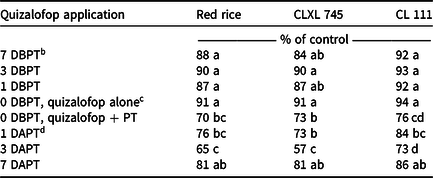
A herbicide application timing main effect occurred for red rice control (Table 1); therefore, data were averaged over 14, 28, and 42 DAT evaluation timings. Red rice control was 87% to 90% when treated with quizalofop 7, 3, or 1 d before propanil plus thiobencarb (DBPT), with no differences in control compared with red rice treated with quizalofop alone at day 0. A similar response was observed for red rice treated with quizalofop 7 d after propanil plus thiobencarb (DAPT). However, quizalofop activity on red rice was reduced to 70% when applied in a mixture with propanil plus thiobencarb at day 0. Similar reductions in red rice control were observed when quizalofop was applied 1 and 3 DAPT with an observed control of 76% and 65%, respectively. These data indicate quizalofop should be applied no later than 1 DBPT and no earlier than 7 DAPT for red rice control.
Control of red rice, CLXL-745, and CL-111 by quizalofop applied at 120 g ai ha−1 alone, mixed with propanil plus thiobencarb each applied at 3,360 g ai ha−1, and sequentially with propanil plus thiobencarb in acetyl coenzyme A carboxylase-resistant rice, averaged over 14, 28, and 42 DAT evaluation timings in 2015 and 2016.a

a Means followed by a common letter do not significantly differ at P = 0.05 using Tukey’s honestly significant difference test within columns.
b Abbreviations: DAT, days after treatment; DBPT, days before propanil + thiobencarb; DAPT, days after propanil + thiobencarb; PT, propanil + thiobencarb.
c Quizalofop applied alone at day 0, or between 1 DBPT and 1 DAPT.
d Quizalofop applied in a mixture with propanil + thiobencarb at day 0, or between 1 DBPT and 1 DAPT.
Similar to red rice control, a main effect of herbicide application timing occurred for CLXL-745 (Table 1); therefore, data were averaged over evaluation timings of 14, 28, and 42 DAT. CLXL-745 control was 91% when treated with quizalofop alone at day 0. A similar response was observed for CLXL-745 treated with quizalofop 7, 3, and 1 DBPT and 7 DAPT. In comparison, control of CLXL-745 was reduced to 73% when treated with quizalofop in a mixture with propanil plus thiobencarb at day 0 or 1 DAPT. Additionally, quizalofop activity was reduced to 57% when applied 3 DAPT. These data indicate that quizalofop should not be applied in a mixture or 1 to 3 DAPT to avoid reductions in quizalofop activity on CLXL-745.
Similar to red rice and CLXL-745 control, a herbicide application timing main effect occurred for CL-111 (Table 1); therefore, data were averaged over 14, 28, and 42 DAT evaluation timings. Quizalofop applied at 7, 3, or 1 DBPT controlled CL-111 by 92% to 93%, similar to that when quizalofop was applied alone at day 0. Control of CL-111 was reduced to 76% when quizalofop was applied in a mixture with propanil plus thiobencarb at day 0, and similar control was observed for CL-111 treated with quizalofop at 1 or 3 DAPT. Similar to red rice and CLXL-745 control, quizalofop can be applied 7 to 1 DBPT to control CL-111; however, quizalofop applications mixed with propanil plus thiobencarb or applied 0 to 3 DAPT should be avoided to prevent reductions in quizalofop activity on CL-111, CLXL-745, and red rice.
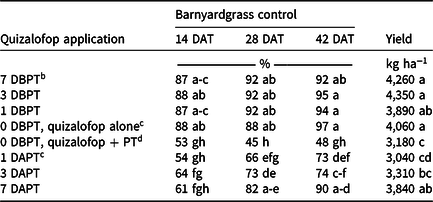
A herbicide application timing-by-evaluation timing interaction occurred for barnyardgrass control (Table 2). Quizalofop applied alone at day 0 or 1, 3, or 7 DBPT controlled propanil-susceptible barnyardgrass by 87% to 97% across all evaluation dates with no differences observed. Initial control of barnyardgrass was reduced to 61% at 14 DAT when it was treated with quizalofop at 7 DAPT; however, by 28 and 42 DAT control was similar to quizalofop applied alone at day 0. Control for barnyardgrass treated with quizalofop mixed with propanil plus thiobencarb at 0, 1, and 3 DAPT was reduced to 45% to 74% at each evaluation date, and these data indicate quizalofop should be applied at least 1 DBPT or delayed to 7 DAPT to avoid reductions in barnyardgrass control.
Barnyardgrass control by quizalofop applied at 120 g ai ha−1 alone, mixed with propanil plus thiobencarb each applied at 3,360 g ai ha−1, and sequentially with propanil plus thiobencarb at 14, 28, and 42 DAT, and PVL01 rough rice yield in 2015 and 2016.a

a Means followed by a common letter do not significantly differ at P = 0.05 using Tukey’s honestly significant difference test.
b Abbreviations: DAT, days after treatment; DBPT, days before propanil + thiobencarb; DAPT, days after propanil + thiobencarb.
c Quizalofop applied alone at day 0, or between 1 DBPT and 1 DAPT.
d Quizalofop applied in a mixture with propanil + thiobencarb at day 0, or between 1 DBPT and 1 DAPT.
PVL01 rice injury was less than 5% across all evaluations (data not shown). PVL01 rice treated with quizalofop at 7, 3, or 1 DBPT resulted in rough rice yields of 4,260, 4,350, and 3,890 kg ha−1, respectively, and these yields are similar to those of PVL01 rice treated with quizalofop alone at day 0 (Table 2). Similarly, PVL01 rice treated with quizalofop at 7 DAPT resulted in a yield of 3,840 kg ha−1. However, PVL01 rice yield was reduced to 3,180 kg ha−1 when treated with quizalofop plus propanil plus thiobencarb at day 0, similar to PVL01 rice treated with quizalofop 1 or 3 DAPT. These data suggest reductions in weedy rice and barnyardgrass control when treated with quizalofop mixed with propanil plus thiobencarb or 0 to 3 DAPT can result in corresponding PVL01 rough rice yield reductions.
In conclusion, it is important to understand the compatibility between quizalofop and propanil plus thiobencarb before developing a herbicide program for ACCase-R rice production. These data suggest applying quizalofop up to 1 DBPT and or delaying the application to 7 DAPT can be beneficial in an ACCase-R rice production system; however, quizalofop applied mixed with propanil plus thiobencarb or quizalofop applied 0 to 3 DAPT can result in reductions of quizalofop activity on weedy rice (Table 1) and barnyardgrass (Table 2). Furthermore, reductions in quizalofop activity will result in corresponding yield reductions. This is similar to the findings reported by Myers and Coble (Reference Myers and Coble1992), indicating that ACCase herbicides applied the same day as or 1 to 3 d following an imazethapyr application resulted in a reduction in ACCase herbicide activity. These data are also similar to the findings of Dernoeden and Fidanza (Reference Dernoeden and Fidanza1994) who reported a reduction in fenoxaprop activity when applied following a 2,4-D plus mecoprop plus dicamba application; however, these data contradict those reported by Dernoeden and Fidanza that fenoxaprop activity was reduced when applied 7 d following 2,4-D plus mecoprop plus dicamba. In order to maximize weedy rice and barnyardgrass control, ACCase-R rice yield potential, and economic returns, quizalofop should be applied at least 1 d prior to propanil plus thiobencarb and no sooner than 7 DAPT.
Acknowledgments
This article is published with the approval of the Director of the Louisiana Agricultural Experiment Station, Louisiana State University Agricultural Center, Baton Rouge, LA 70803, under manuscript number 2019-306-34160. Funding for this research project was provided by the Louisiana Rice Research Board. No conflicts of interest have been declared.