For supplementary material accompanying this paper, visit http://dx.doi.org/10.15184/aqy.2014.50
Indian Ocean trade
At a time when the Atlantic and Pacific oceans isolated the Old from the New World, the trade winds and warm currents of the Indian Ocean created an entangled history of interconnection as generations of traders and settlers brought goods from the Red Sea, the Persian Gulf, India, Southeast Asia and China to the eastern shores of Africa (Freeman-Grenville Reference Freeman-Grenville1962; Wood et al. Reference Wood, Dussubieux and Robertshaw2012). Languages from Indonesia and the Islamic religion from the Arabian Peninsula were also introduced in the first millennium AD. Detailed studies of glass beads, which formed part of this trade, are now shedding light on the ways that fluctuations in the political and economic fortunes of these distant lands are reflected in the changing bead sequences recovered from African Iron Age sites (Wood et al. Reference Wood, Dussubieux and Robertshaw2012). In the interior of Africa, the beads can be likened to the stains that biologists use to expose internal cell structures and neural pathways: they reveal early trade routes into the interior, highlighting the ancient locales where they became concentrated through the operation of indigenous socio-economic and political forces. While there is little evidence that Indian Ocean trade reached the interior of East Africa in the first millennium AD, in southern Africa, the site of Chibuene on the Mozambique coast was “from a time before the Islamic trade [. . .] an important and active trading port that was the hub linking the Indian Ocean trade with an extensive interior trading network” (Wood et al. Reference Wood, Dussubieux and Robertshaw2012: 73).
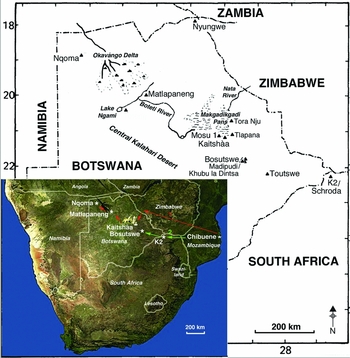
The findings reported here suggest that glass beads and marine shells from the Indian Ocean served not only as status symbols but also functioned as a new medium of exchange for global exports that included ivory, rhinoceros horn, slaves and gold. They also facilitated early trade in locally valued commodities such as specularite, mined from the Tsodilo Hills west of the Okavango Delta (Robbins et al. Reference Robbins, Murphy, Campbell and Brook1998), and salt from the vast expanse of the Makgadikgadi Pans in the central Kalahari (Figure 1). Although specularite and salt are not among the African exports noted by early Muslim chroniclers on the East African coast (Freeman-Grenville Reference Freeman-Grenville1962), their production value in the African interior was great enough to pull Indian Ocean trade goods into the very heart of the subcontinent, centuries before elite centres in eastern Botswana (Denbow et al. Reference Denbow, Smith, Atwood, Mathibidi and Miller2008) and the Limpopo Valley (Huffman Reference Huffman2007) emerged to control long-distance trade after AD 900.
Map of southern Africa showing sites mentioned in the text. Two potential trade routes from the coast to the interior are indicated on the inset (inset adapted from GoogleEarth, Image Landsat, Data SIO, NOAA, US Navy, NGA and GEBCO).

Imported trade goods thus attest not only to the wide reach of early global trade networks but also to the ability of indigenous industries to attract luxury commodities deep into the interior. While the beads might seem small and insignificant in global economic terms, inside Africa they functioned as an important new store of value: they were non-perishable, easily transported, desirable as ornamental objects and had exotic origins that probably imbued them with spiritual as well as economic cachet. In the nineteenth century, glass beads were a well-noted trade currency across southern Africa (Livingstone Reference Livingstone1858); their novelty and scarcity in the first millennium AD undoubtedly made them even more valuable.
The glass beads
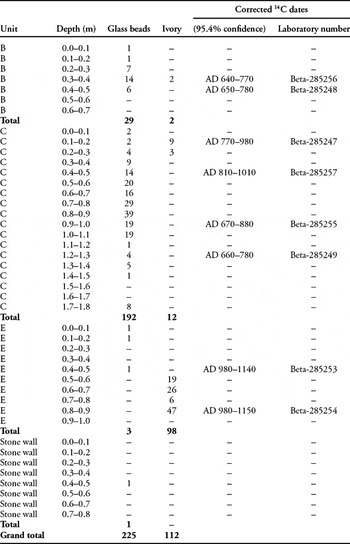
This paper discusses the physical and chemical characteristics and cultural significance of a sample of 23 glass trade beads from 225 beads recovered in 2010 from test excavations at the Iron Age site of Kaitshàa in the Kalahari Desert of central Botswana. Although most of the beads belong to what is known as the Zhizo series from southern Africa (Wood et al. Reference Wood, Dussubieux and Robertshaw2012), two have distinctive glass chemistry previously known only from the site of Chibuene, on the coast, and from Nqoma (Figure 1), in the Tsodilo Hills in the far interior, 1800km to the west (Wilmsen & Denbow Reference Wilmsen and Denbow2010). While Wood et al. (Reference Wood, Dussubieux and Robertshaw2012) argue that the Chibuene series pre-dates Islamic trade with southern Africa, the calibrated date range at 95.4% probability for these beads at Chibuene, Nqoma and now Kaitshàa overlap with those for the early expansion of Islam in the seventh century AD. Since we do not know how long it took the beads to reach Africa or to be transported more than 1000km inland, the religious affiliation of these early traders remains uncertain. However, the beads from Kaitshàa add new dates and a previously unexpected location for the Chibuene series (Table 1).
Dating and provenance of glass beads and ivory.

Chibuene series beads have not been identified from other Zhizo sites such as Schroda, Bosutswe or Mmadipudi that lie between Kaitshàa and the coast (Robertshaw et al. Reference Robertshaw, Glascock, Wood and Popelka2003, Reference Robertshaw, Wood, Melchiorre, Popelka-Filcoff and Glascock2010; Wood et al. Reference Wood, Dussubieux and Robertshaw2012). This suggests that these beads arrived in the interior along a different, previously undetected trade route that operated before AD 900 (Figure 1: route 1). After that date, the flow of luxury goods was redirected through elite sites in eastern Botswana and the Limpopo Valley of South Africa (route 2). Although more chemical analyses of beads from Zhizo sites in Zimbabwe are needed, current evidence suggests the Chibuene route ran from the coast and inland across the Zimbabwe plateau to the Makgadikgadi pans before reaching the Boteti River, which it followed across the Kalahari to the Okavango Delta and Nqoma. Both routes 1 and 2 carried Zhizo series beads, which have a longer period of use than the Chibuene series, and it is possible that both routes operated in tandem. However, the absence of Chibuene series beads in the Limpopo Valley and eastern Botswana sites (route 2), and their consistent presence at sites much farther into the interior, suggest that the Chibuene series arrived along a separate, earlier route that bypassed those areas.
The Kaitshàa site
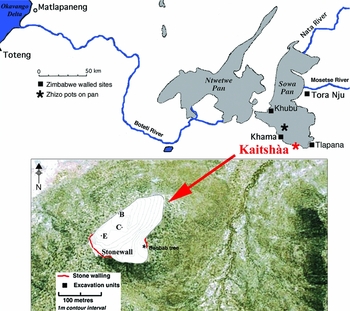
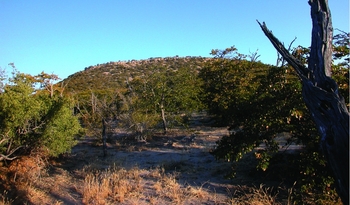
Kaitshàa sits astride a 100m-high headland overlooking the southern edge of the Makgadikgadi Pans, one of the largest saltpans on earth. Prehistoric trade in salt, although difficult to prove, was probably a key element in attracting long-distance trade to the site, which is connected to the surrounding tableland by a narrow neck, 40–50m wide (Figure 2). A rough stone wall 1.5–2m high, broken by an entrance approximately 3m wide, controlled access to the site from the west. The eastern end of this wall guarded the descent to a dry streambed, which probably provided fresh water for the settlement. Overall, the wall was well situated to defend the easier routes of access to the hilltop from the west, south and east. The broken cliffs capping the steep northern slope that faces the saltpan provided a natural defence (Figure 3).
Map of the central Kalahari showing sites mentioned in the text. The inset provides the location of the 2010 excavation units and other features.

View of Kaitshàa looking south from near the pan edge.

Since its discovery in 1994, the site has been described in the archaeological literature by several misnomers, including Kayitshe (Main Reference Main1996), Tshaitshe (Denbow Reference Denbow1999) and Kaitshe (Reid & Segobye Reference Reid, Segobye, Leslie and Maggs2000a), the meanings of which were unknown because the archaeologists were unfamiliar with the local Khoe dialect. During our 2010 excavations, Khoe speakers brought from Bosutswe quickly determined its correct name as Kaitshàa or ‘vulture water’.
The cultural context
The 2010 excavations were conducted in order to clarify anomalies between surface collections made by Main and Denbow in the mid 1990s and later descriptions of the site by Reid and Segobye (Reference Reid, Segobye, Leslie and Maggs2000a). The latter described the ceramics from their excavations as an undifferentiated mixture of Toutswe and Leopard's Kopje traditions associated with radiocarbon dates that suggested that “the entire site, apart from the prominent wall, was occupied simultaneously between c. AD 900 and 1000” (Reid & Segobye Reference Reid, Segobye, Leslie and Maggs2000a: 63). The previous surveys, however, suggested the presence of an earlier Zhizo component that would date to c. AD 650–900.
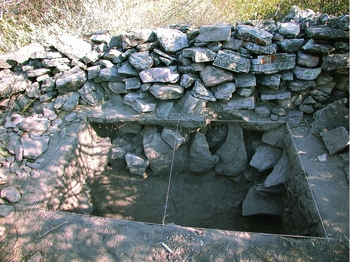
In 2010, four small test units were excavated on the headland. Unit B, a 1 × 2m trench, was placed near the cliff edge on the northern verge of the escarpment and not far from unit C, a 2 × 2m excavation on a mound at the highest point in the centre of the hilltop (Figure 2). Unit E, another 2 × 2m square, was excavated farther west on a low rise located approximately 30m inside the western entrance through the stone wall. A final 1 × 2m unit was placed adjacent to the wall, approximately 30m south of the entrance (Figure 4).
Excavation at the stone wall.

The majority of the deposits in units B and C were composed of animal dung that contained Zhizo ceramics, dated between the seventh and tenth centuries AD (Table 1). The cultural stratigraphy and tenth- to twelfth-century radiocarbon dates from unit E and the stone wall (see Table 1) indicate that the deposits in the western part of the site are later; no Zhizo ceramics were recovered from these units. Wind erosion precipitating the deflation of the sediments in the upper 0.3m of the deposit in units B and C resulted in the ‘mixing’ of Zhizo (misidentified by Reid and Segobye (Reference Reid, Segobye, Leslie and Maggs2000a) as later Toutswe Tradition ceramics) and Leopard's Kopje materials. Toutswe ceramics in eastern Botswana date between AD 900 and 1200 and have been shown to develop from a regional facies of Zhizo known as Taukome (Denbow Reference Denbow1986). The stylistic differences between Zhizo, Taukome and Toutswe ceramics are sometimes minor, but they are important because they indicate that the early cultural affiliations of Kaitshàa were to the north-east (in present-day Zimbabwe), rather than directly east in the Toutswe-Bosutswe region of Botswana.
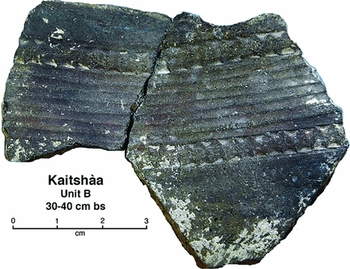
A few sherds from the Zhizo levels have stylistic features such as false relief chevrons (FRC) that align them with western ceramics from Matlapaneng on the Okavango Delta, Nyungwe on the Chobe River and Nqoma (Figures 1 & 5). Kaitshàa thus links these far western expressions of the Early Iron Age (Denbow Reference Denbow2014) with polities east of the Kalahari.
Trade sherd from the northern Kalahari decorated with ochre and false-relief chevron motifs.

The later ceramics from the upper 0.3m of units B and C, and all the deposits in units E and the stone wall, have stylistic features that place them with the Mambo facies ofLeopard's Kopje in Zimbabwe, rather than the K2 facies of this tradition in the Limpopo Valley or Toutswe Tradition materials in eastern Botswana (Denbow Reference Denbow1986; Huffman Reference Huffman2007). Decorated ceramics recovered from the base of the wall indicate that its construction dates to the Mambo occupation—between approximately AD 1000 and 1150.
One notable find from the upper 0.1m of unit E was a pierced lug of probable Khoe manufacture. Although surface finds of lugged ceramics are known along the Boteti River (Denbow Reference Denbow1986), this is only the fourth lug to be recovered from an excavated context in Botswana. A second was found in levels dated c. AD 900–1000 at Matlapaneng, near Maun, on the southern edge of the Okavango, while charcoal-tempered examples of a similar age came from Toteng, near Lake Ngami (Denbow Reference Denbow1986: 27; Denbow & Wilmsen Reference Denbow and Wilmsen1986; Huffman Reference Huffman1994). Deflation in the upper deposits at Kaitshàa makes it uncertain whether the lug is coterminous with the Mambo occupation or possibly later. In either case, it links the site with nearby Khoe peoples and indicates that some hunter-gatherers in the more riverine environments of the central Kalahari manufactured their own styles of ceramics and, by implication, were perhaps also herder-foragers by the late first or early second millennium AD, if not earlier.
After Kaitshàa was abandoned, the cultural affiliations of the greater Makgadikgadi region continued to be with the north-east, as shown by the Zimbabwe-style ruins at Khama, 30km west of Kaitshàa, Tlapana, 30km east, the dated fourteenth century ruin at Tora Nju, 70km north, and, although the wall style is somewhat different, Khubu Island, 40km across the salt flats to the north-west (Denbow Reference Denbow1999).
Long-distance trade
Reid and Segobye (Reference Reid, Segobye, Leslie and Maggs2000a: 64) found just a few glass beads in their excavations, which to them indicated “stringent control of the supply to the Sua pan sites” by elite settlements at the Limpopo-Shashe confluence. However, our new excavations suggest that their 10mm sieve mesh was insufficiently fine-gauged to recover more of the early beads. Using finer 2mm mesh sieves, we recovered 211 glass beads from the Zhizo component. Another 14 beads came from upper (Mambo) levels, postdating AD 1000, and supporting Reid and Segobye's (Reference Reid, Segobye, Leslie and Maggs2000a: 65) contention that trade became more centrally controlled in the first centuries of the second millennium AD. However, this was certainly not the case for the large collection of beads from the earlier Zhizo occupation.
A few high-status garden roller beads (Loubser Reference Loubser1991)—made by melting down several turquoise trade beads in a clay mould—were found on the surface. A broken clay gardenroller bead mould was recovered 0.4–0.5m below the surface in unit E.
Ninety-eight ivory fragments were recovered in post-AD 900 levels of unit E. Such a large quantity in a small unit suggests that Kaitshàa had re-directed some of its resources towards the ivory trade by the beginning of the second millennium—a change also seen in the Limpopo Valley and Bosutswe at that time. Only 14 ivory pieces, mostly bangle fragments rather than unworked ivory, came from the earlier Zhizo levels, even though more cubic metres of deposit were excavated (Table 1; Scott Reference Scott2013). This indicates that it was salt production, not ivory, that brought large quantities of glass beads to the site in the first millennium AD. The reorientation to ivory production after AD 900 does not mean that salt production ceased, but the scarcity of glass beads from the later levels suggests that the terms of trade were less favourable than in earlier times.
Glass bead description
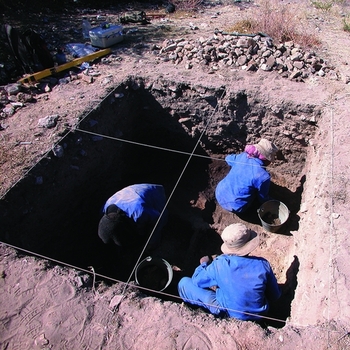
The 23 beads that underwent chemical analysis came from unit C (Figure 6), chosen because it had the highest concentration of beads. The stratigraphy of the unit is bracketed by radiocarbon dates that range from AD 700 at the base to AD 1000 near the surface (Table 1). The majority of the cultural deposit in this area consisted of unburnt and burnt dung, most of which—judging from the faunal remains—came from sheep, which significantly outnumbered cattle and goats at the site (Scott Reference Scott2013).
Excavation of unit C, which had the highest concentration of beads and yielded the 23 beads studied in this research.

Physical description
The typology of the beads from Kaitshàa is consistent with results published by Robertshaw et al. (Reference Robertshaw, Wood, Melchiorre, Popelka-Filcoff and Glascock2010) and Wood et al. (Reference Wood, Dussubieux and Robertshaw2012). In the study by Wood et al. (Reference Wood, Dussubieux and Robertshaw2012: 68) of 1254 Zhizo specimens—865 from Chibuene—85% were tubular in shape, with lengths ranging from short (>2.5–3.5mm) to medium (>3.5–4.5mm). The shape and length ratios at Kaitshàa (Table S1 in online supplementary material) fall well within these parameters.
To determine colour, the Kaitshàa beads were wetted and examined in daylight using a Munsell bead colour chart (X-rite 2012). Many of the colours, however, do not correspond directly with those in Wood's (2005) analysis; this is because two different editions of the Munsell chart were used. The colours presented in Table S1 represent the closest approximations to Wood's classification, where dark blue was the most common Zhizo colour, making up over half of the assemblage. This was followed by yellow (30%) and blue-green (12.5%). Green beads were rare. Dark translucent-blue was also the most common colour at Kaitshàa (46%), followed by turquoise-blue (23%), opaque-yellow (18%) and opaque-green (13%). The high proportion of turquoise-blue and opaque-green beads at Kaitshàa could reflect different cultural preferences or may simply be a product of small sample size.
Elemental analysis
Chemical analysis was carried out at the Field Museum of Natural History in Chicago, USA, using a Bruker Inductively Coupled Plasma Mass Spectrometer (ICP-MS) connected to a New Wave UP213 laser for the direct introduction of solid samples. For the LA-ICP-MS analysis (Laser Ablation ICP-MS), no sample preparation is necessary, and the analytical technique is virtually non-destructive, leaving no visible damage. Major, minor and trace elements were determined. The limits of detection ranged from 10 parts per billion to 1 part per million for most elements. Accuracy ranged from 5–10% depending on elements and their concentrations. More details of the protocol developed for glass analysis at the Field Museum and of the performance of the instrument can be found in Dussubieux et al. (Reference Dussubieux, Robertshaw and Glascock2009).
Major, minor and trace elements in ancient glass can be diagnostic of the geographic region and period of manufacture. The Iron Age occupation at Kaitshàa overlaps with three major bead series in southern Africa: the Chibuene series (AD 600–850), the Zhizo series (AD 600–950) and the K2 Indo-Pacific series (AD 950–1250) (Wood et al. Reference Wood, Dussubieux and Robertshaw2012: 61). The chemical compositions of the Chibuene and Zhizo beads are fairly similar, but they differ from that of the Indo-Pacific beads. Chibuene and Zhizo beads are made from low alumina sand and soda-rich plant ash with rather low (<5%) alumina concentrations and MgO and K2O concentrations higher than 1.5%. These beads were manufactured in the Persian Gulf region. Indo-Pacific beads come from South Asia, and are made from high alumina sand using mineral, rather than plant-based, soda. They have higher alumina and relatively lower MgO concentrations (<1.5%).
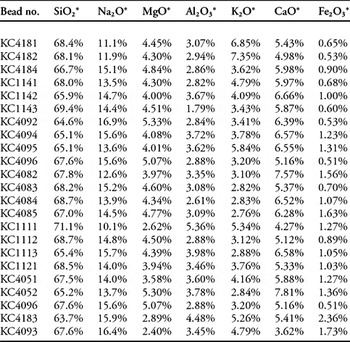
To determine types of sand and flux used, we examined the reduced compositions of SiO2, Na2O, MgO, Al2O3, CaO, K2O and Fe2O3, following the methodology suggested by Brill (Reference Brill1999: 9). All concentrations for these oxides reported here are reduced concentrations (Table 2).
Reduced composition of the Kaitshàa beads used in the PCA analysis.

* reduced compositions
All Kaitshàa samples contained high concentrations of soda (>10%), with greater than 1.5% K2O and MgO, indicating that they were made from plant ash rather than mineral soda. The beads contained alumina concentrations ranging from 1.8–5.4%. The very high value of bead K1111 (5.4%) could be due to corrosion because this bead also had the highest silica and lowest soda concentrations. Corroded glass is often depleted in K, Na, Ca and Mg, while enriched in Si, Al, Ti and Fe (Dussubieux et al. Reference Dussubieux, Robertshaw and Glascock2009: 157–58; Robertshaw et al. Reference Robertshaw, Wood, Melchiorre, Popelka-Filcoff and Glascock2010: 1902). With a maximum concentration of 4.5% for alumina (if K1111 is excluded), the Kaitshàa beads fit the Chibuene and Zhizo profiles of low alumina, plant-ash soda glass. In the Middle East, glass made with soda produced from halophytic plants gradually replaced earlier glass made from natron in the seventh to eighth centuries AD (Gratuze & Barrandon Reference Gratuze and Barrandon1990; Henderson et al. Reference Henderson, McLoughlin and McPhail2004).
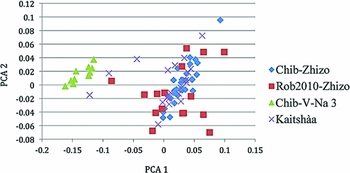
At Chibuene, Wood et al. (Reference Wood, Dussubieux and Robertshaw2012) identified three low alumina plant-ash soda glasses: 1) the v-Na 1 Zhizo series beads; 2) v-Na 2 glass with a high Cr concentration (191±56ppm), which is known only from vessel glass, not beads; and 3) the v-Na 3 Chibuene series beads. Table S2 (online supplementary material) presents the chemical composition of the 23 Kaitshàa beads. With an average concentration of 39±9ppm chromium, it is unlikely that any of the Kaitshàa beads belong to the v-Na 2 group. To determine whether the beads belonged to the v-Na 1/Zhizo or the v-Na 3/Chibuene groups, a principal component analysis (PCA) was conducted to compare the composition of the Kaitshàa beads with the Zhizo series in Robertshaw et al. (Reference Robertshaw, Wood, Melchiorre, Popelka-Filcoff and Glascock2010) and the v-Na 1 and v-Na 3 glass samples from Wood et al. (Reference Wood, Dussubieux and Robertshaw2012). The elements or oxides incorporated in the PCA were selected because they were unlikely to have been included as colouring agents and because they were also present in all three datasets. These comprise: Na2O, MgO, Al2O3, K2O, CaO, Ti, V, Cr, Rb, Sr, Y, Zr, Nb, Cs, Ba, Hf, Th and U.
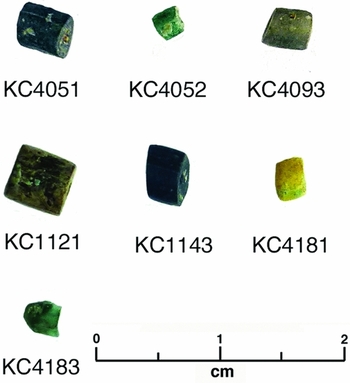
The results show that all but three of the Kaitshàa beads belong to the v-Na 1/Zhizo series (Figure 7). Of the three beads most distant from the v-Na 1 samples, two—KC4183 and KC4093—have significantly higher percentages of Cs, La, Nd and U than is typical for v-Na 1/Zhizo glass (Figure 8). These two beads belong to the v-Na 3/Chibuene series and are indicated in bold face in Table S2. They were found deep in unit C at 1.7–1.8m and 0.8–0.9m below the surface, respectively. A third bead from 1.7–1.8m, KC4181, lies between the v-Na 1 and v-Na 3 groups. It has a higher percentage of Cs than v-Na 1 glass, but its other elements fall within the range of that group. This bead can be associated with the v-Na 1 Zhizo group. From their excavations at Chibuene, Wood et al. (Reference Wood, Dussubieux and Robertshaw2012) suggest that dates for the v-Na 3 Chibuene series fall into the earliest part of the Zhizo bead range, a conclusion consistent with the seventh to eighth century AD dates that bracket the levels containing those beads at Kaitshàa (Table 1).
PCA comparison of Kaitshàa beads with Zhizo (v-Na 1) and v-Na 3 beads from Chibuene (Robertshaw et al. Reference Robertshaw, Wood, Melchiorre, Popelka-Filcoff and Glascock2010).

The range of bead colours at Kaitshàa. KC4183 and KC4093 belong to the Chibuene series while the others are Zhizo series beads.

Two green beads (KC4052 and KC4085) have fairly high lead concentrations (45% and 29%), suggesting that they were manufactured with high lead and low alumina, soda-rich plant ash glass. In all other respects, however, these two beads are indistinguishable from the other Zhizo beads in Figure 7. This suggests that the sands and fluxes used for both types of glass were identical. The lead in KC4052 and KC4085 could therefore be due to the use of tin and lead (PbSnO3) as opacifiers. These elements would confer a yellow colour to glass containing no other colouring agent, or a green colour to glass containing copper. It is difficult to determine whether the KC4052 and KC085 beads were made from a different type of glass or whether the high lead content simply resulted from use of lead stannate as a colouring agent.
Discussion
Nearly half of the beads chemically analysed by Robertshaw et al. (Reference Robertshaw, Wood, Melchiorre, Popelka-Filcoff and Glascock2010) came from Botswana: Bosutswe (3), Nqoma (7), Mmadipudi (1) and Matlapaneng (1). The rest arefrom the Limpopo valley region of South Africa: Pont Drift (2), Schroda (10) and Diamant (2). The Kaitshàa analysis adds both a new site and significant new data to this growing database. What is unique about the beads from Kaitshàa is their location in the central Kalahari region, the large number of Zhizo beads recovered and the presence of the rare Chibuene series beads in the collection.
Kaitshàa's location, approximately 90km west of Bosutswe, at first suggested that it might have formed a node along trade routes through the Limpopo Valley to Bosutswe that continued on to the Boteti River and Okavango Delta, where first millennium AD beads have been recovered at Matlapaneng and Nqoma (Denbow Reference Denbow1986, Reference Denbow1990; Denbow & Wilmsen Reference Denbow and Wilmsen1986; Robertshaw et al. Reference Robertshaw, Glascock, Wood and Popelka2003; Wilmsen & Denbow Reference Wilmsen and Denbow2010). Yet none of the beads chemically analysed from eastern Botswana or the Limpopo Valley belonged to the Chibuene series, while five beads from Kaitshàa and Nqoma belong to this group. Additional unpublished Chibuene beads have recently been identified in the Nqoma sample (Wilmsen pers. comm. 2014) and at Thaba di Masego, near Kaitshàa (Daggett pers. comm. 2014). These findings suggest that the Chibuene series arrived in the interior along a previously undetected route that bypassed the Limpopo-Bosutswe region. Although the precise location of this route is not known, the Zhizo rather than Taukome affiliations of the ceramics from Kaitshàa suggest that it ran westward from Chibuene through present-day Zimbabwe to the Makgadikgadi Pans before turning south to the Boteti River, which it followed across the Kalahari Desert to the Okavango Delta. After AD 900 this route may have been truncated as elite centres in the Limpopo Bosutswe region gained control over trade networks. Identifiable goods moving from west to east along this early route include ivory and charcoal-tempered bowls, such as those recovered at Bosutswe in 1990 and 2002 (Denbow Reference Denbow1990; Denbow et al. Reference Denbow, Smith, Atwood, Mathibidi and Miller2008; Wilmsen et al. Reference Wilmsen, Killick, Rosenstein, Thebe and Denbow2009).
Although thousands of early glass beads have been found in eastern Botswana at Bosutswe, Kgaswe and Khubu la Dintša, the number recovered from the Okavango sites is fewer than 30. All these excavations, including those in the Okavango, were carried out by Denbow and Wilmsen or by Klehm, using 2–3mm mesh sieves. Therefore, the small number of beads recovered from the Okavango sites is not a recovery bias due to large mesh size (as was the case for Reid and Segobye's (Reference Reid, Segobye, Leslie and Maggs2000a) excavations at Kaitshàa).
Bosutswe was involved in the Indian Ocean trade from AD 700 and Indian Ocean imports—including cowrie shells and chickens (Gallus domesticus) —have been found there (Plug Reference Plug1996; Wood Reference Wood2005; Denbow et al. Reference Denbow, Smith, Atwood, Mathibidi and Miller2008). Even though cowrie shells have been unearthed at Kaitshàa, Matlapaneng and Nqoma, the single chicken bone from the Mambo levels of unit C at Kaitshàa marks the farthest west that such remains have been reported; none were found at Matlapaneng, Nqoma or other Okavango sites (Turner Reference Turner1987a & Reference Turnerb; van Zyl et al. Reference van Zyl, Badenhorst, Denbow and Wilmsen2013).
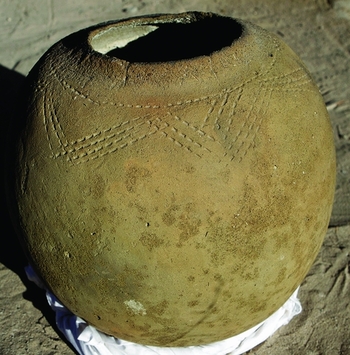
Kaitshàa's location strongly suggests that it was engaged in salt production. The oral tradition of Khoe and Kalanga speakers living around the pans reveals that during the nineteenth and early twentieth centuries evaporite salt slabs were dug directly from low areas or springs; salt was not produced by boiling brine, as was commonly the case in other regions (Fagan & Yellen Reference Fagan and Yellen1968; Evers Reference Evers1979; Matshetshe Reference Matshetshe2001; Denbow Reference Denbow2014). In historic times, these slabs were carried north by donkeys to the Nata River and Zimbabwe. Nothing apart from salt production seems likely to account for the large number of early Zhizo and Chibuene series beads (over 29/m3) recovered at Kaitshàa. Prehistoric salt-working also seems the most likely explanation for the discovery of three complete Zhizo pots (Figure 9), each covered with a bowl and discovered far out in the salt flats of Sowa Pan (Figure 2; Bousfield pers. comm. 2014).
One of three whole Zhizo pots discovered far from shore in Sowa pan. It was probably used in salt production over a thousand years ago (photograph: Ralph Bousfield, Uncharted Africa Safaris).

If the number of beads recovered can be taken as a rough measure of economic power, then Kaitshàa's role declined dramatically at the beginning of the second millennium AD as centralised chiefdoms emerged in the Limpopo Valley and eastern Botswana. New ceramic traditions that appeared at this time at Nqoma and Matlapaneng suggest that the cultural and trade connections of the Okavango region were also realigned as cattle herders filtered into the region from the Zambezi (Denbow Reference Denbow2014: 166–72) and the trans-Kalahari trade route along the Boteti River became redundant.
After AD 1000 the number of beads declined significantly to just 0.7/m3 at Kaitshàa, suggesting that the site's importance declined—or at least the relative exchange value of its salt and ivory in the wider regional economy—as the centralised chiefdoms at Bosutswe and Toutswe in eastern Botswana, and Schroda followed by K2 and Mapungubwe in South Africa, rose to power. The evidence from Kaitshàa suggests these polities redirected long-distance trade routes southward to the Shashe-Limpopo confluence and eastern Botswana as they gained control of the ivory and then the gold trade to the coast. The increase in ivory at Kaitshàa and a cache of ivory bangles found at nearby Mosu I (Reid & Segobye Reference Reid and Segobye2000b) date to this period, supporting the case for a redefined trading system focused on ivory and other export products after AD 1000.
The defensive location of Kaitshàa, and the stone walling constructed there after AD 1000, may foreshadow growing conflict over resources in the second millennium AD. By AD 1300, Zimbabwe-style walled settlements at Khama, Tlapana, Tora Nju and perhaps Khubu Island controlled trade in the region while serving as embodiments of Great Zimbabwe's hegemony on the eastern and southern shores of the Makgadikgadi (Denbow Reference Denbow1999). Conflict is also apparent at this time at Bosutswe, which was burned in a massive conflagration dating to around AD 1350. Some of Bosutswe's elite may have taken refuge at that time at the nearby site of Khubu la Dintša, a defensively walled hilltop similar in topography to Kaitshàa (Klehm Reference Klehm2013). Despite this evidence for conflict, the 200 glass beads recovered at Khubu la Dintša indicate that its residents continued their participation in the Indian Ocean trade before moving back to Bosutswe later in the fourteenth century.
The Kaitshàa excavations show that the central and north-western Kalahari were not isolated from historical events but played an integral role in the evolving political economy of the subcontinent. The Okavango bowls found at Bosutswe, and the FRC ceramics from Kaitshàa, prove that commodities traversed the Kalahari from west to east in the latter half of the first millennium AD (Denbow Reference Denbow1990; Denbow et al. Reference Denbow, Smith, Atwood, Mathibidi and Miller2008). The Chibuene series beads from these western sites suggest that the early trade that flowed from east to west followed a route north of the Limpopo Valley at a time before more centralised polities came to dominate trade in the sub-continent at the beginning of the second millennium AD. Finally, finds of ceramics with pierced lugs from Kaitshàa to Lake Ngami make it clear that people of Khoe descent were involved in these events, although in ways not presently understood. Nonetheless, long before Bosutswe, K2, Mapungubwe and Great Zimbabwe came to dominate trade into the far interior, the small settlement of Kaitshàa on the Makgadikgadi pans was able to attract considerable quantities of luxury goods in exchange for its salt. Instead of conceptualising such trade solely as a testament to external, global forces, or to the economic might of centralised kingdoms in the African interior, the Kaitshàa finds suggest another positionality. This is one in which the heterarchical social and productive entanglements of early indigenous industries were strong enough to draw luxury goods into the very heart of Africa, as communities developed the infrastructure to distribute locally valued commodities, such as salt from the Makgadikagdi and specularite from the Tsodilo Hills.
Acknowledgements
A National Science Foundation Award (no. 0922868) to James Denbow funded the Kaitshàa excavations. Many thanks to Phenyo Thebe, Morongwa Mosothwane and their students from the University of Botswana who participated in the excavation, to Ralph Bousfield of Uncharted Africa Safaris for the photos of Zhizo pots found in the Makgadikgadi and to Mike Main for information on other sites in the region. Peter Mitchell and Pete Robertshaw made helpful comments on the draft manuscript.