


Introduction
Treatment for depressed patients with major depressive disorder (MDD) or bipolar disorder (BD) commonly involves pharmacological therapy with antidepressant medications [Reference Malhi and Mann1, Reference Otte, Gold, Penninx, Pariante, Etkin and Fava2]. Despite the proven moderate efficacy, conventional monoamine-based antidepressants typically suffer from several limitations, including low rates of remission, the failure of most treated individuals to achieve full symptomatic and functional recovery, a similar mechanism of action (largely via enhancement of monoaminergic neurotransmission), and a delayed onset of action requiring weeks to achieve significant therapeutic effects [Reference Malhi and Mann1, Reference Rush and Thase3, Reference Krystal, Abdallah, Sanacora, Charney and Duman4]. The discovery of a rapid antidepressant effect from the N-methyl-D-aspartate receptor (NMDAR) antagonist ketamine can potentially overcome some of the limitations, since mounting evidence supports the rapid antidepressant efficacy of ketamine in treatment-resistant depression, with an onset of action within hours [Reference Krystal, Abdallah, Sanacora, Charney and Duman4–Reference Coyle and Laws6].
The study of brain-based correlates and predictors of antidepressant response to ketamine has been the subject of intensive investigation in neuroscience and psychiatry, providing important insights into the neurobiological therapeutic mechanisms of ketamine. Experimental animal research has documented that ketamine exerts its antidepressant effect via blocking NMDAR-dependent bursting activity in the lateral habenula to disinhibit downstream monoaminergic reward centers [Reference Yang, Cui, Sang, Dong, Ni and Ma7–Reference Ma, Chen, Jiang, Xiang, Wang and Wu9]. In parallel, a large number of human neuroimaging studies have attempted to identify brain biomarkers associated with ketamine administration, but mostly with small sample sizes and substantial methodological heterogeneity that have led to mixed and inconclusive results [Reference Zavaliangos-Petropulu, Al-Sharif, Taraku, Leaver, Sahib and Espinoza10–Reference Kotoula, Webster, Stone and Mehta14], leaving us with a poor understanding of the ketamine-induced brain changes in humans.
The majority of neuroimaging studies have focused on regional brain abnormalities in relation to a psychiatric illness or a therapeutic intervention. However, it is now increasingly evident that psychiatric disorders localize better to distributed brain networks than to individual anatomical regions [Reference Fornito, Zalesky and Breakspear15–Reference Fox17], due to the fact that neuropathological processes do not act in isolation but rather are interconnected via distributed networks. The advanced network-based conceptualization of psychiatric disorders has recently given rise to the revolutionary notion that psychiatric therapeutics also show network-level brain representations and yield clinical benefits in a network-dependent manner [Reference Sobesky, Goede, Odekerken, Wang, Li and Neudorfer18–Reference Scangos, State, Miller, Baker and Williams20]. To achieve network localization, investigators have developed a novel and well-validated functional connectivity network mapping (FCNM) approach [Reference Cheng, Cai, Liu, Yang, Pan and Zhang21–Reference Mo, Zhao, Li, Cai, Song and Wang24] that can map brain locations associated with a disease or a treatment to a common network by use of the human brain functional connectome. This network-based framework has enjoyed significant success in localizing psychiatric disorders [Reference Padmanabhan, Cooke, Joutsa, Siddiqi, Ferguson and Darby25–Reference Jones, Zhukovsky, Hawco, Ortiz, Cipriani and Voineskos30] and therapeutic interventions [Reference Fox, Buckner, Liu, Chakravarty, Lozano and Pascual-Leone31, Reference Siddiqi, Taylor, Cooke, Pascual-Leone, George and Fox32] to specific brain networks, improving our understanding of disease and treatment mechanisms from a network perspective. Despite these previous efforts, studies investigating the network localization of brain functional alterations induced by ketamine administration in depressed patients are still lacking.
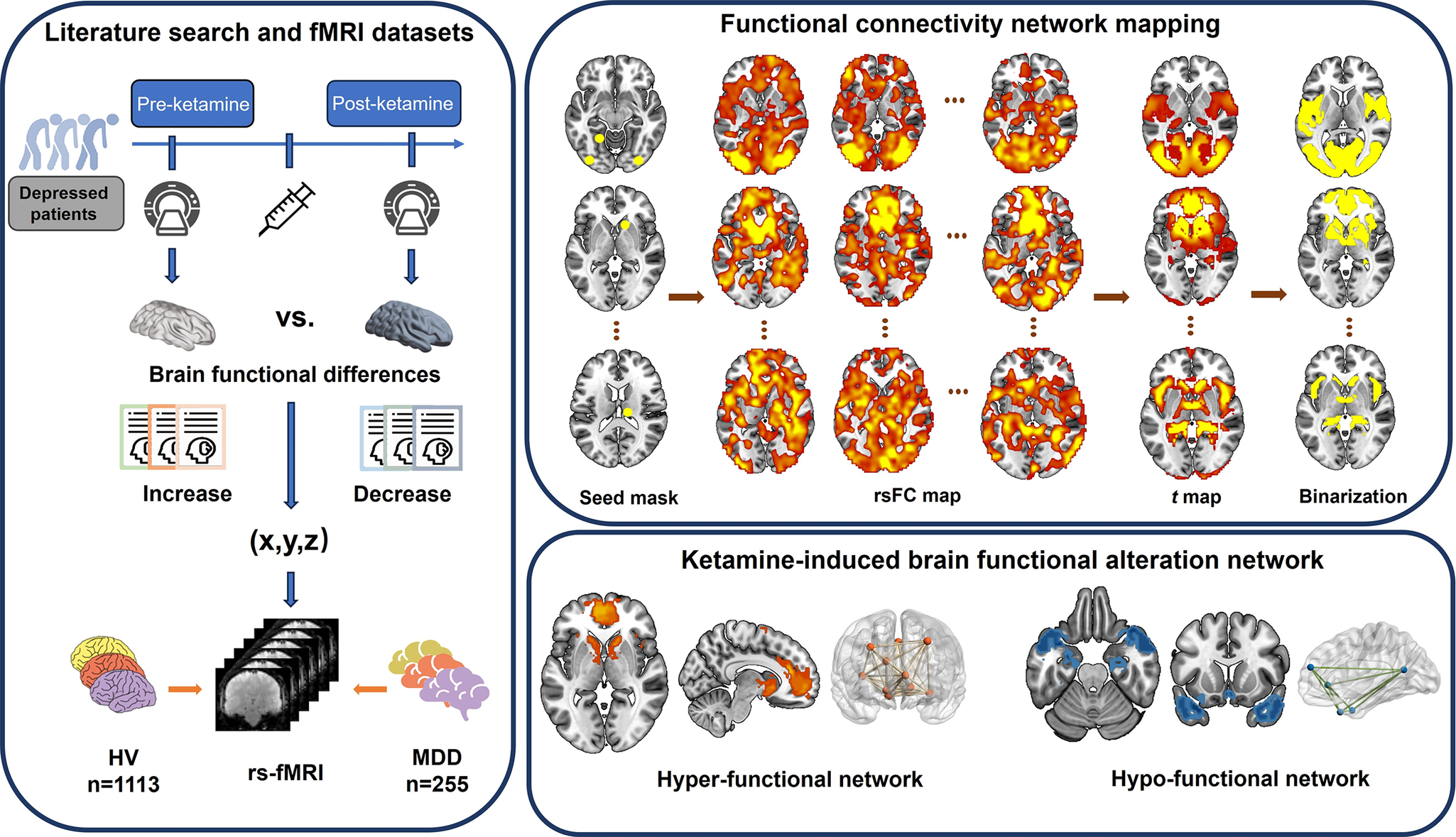
To address this gap, we initially synthesized published literature to identify the locations of longitudinal brain functional alterations (increase and decrease separately) induced by ketamine treatment in depressed patients. By integrating these affected brain locations with large-scale resting-state functional magnetic resonance imaging (fMRI) datasets, we then leveraged the FCNM approach to construct ketamine-induced brain functional alteration networks (hyper-functional and hypo-functional networks, respectively). A schematic overview of the study design and analysis pipeline is provided in Figure 1.
Study design and analysis pipeline. We initially synthesized published literature to identify the locations of longitudinal brain functional alterations (increase and decrease separately) induced by ketamine treatment in depressed patients. By integrating these affected brain locations with large-scale resting-state fMRI datasets (the HV and MDD datasets), we then leveraged the FCNM approach to construct ketamine-induced brain functional alteration networks (hyper-functional and hypo-functional networks respectively). Specifically, spheres centered at each coordinate of a contrast were firstly created and merged together to yield a contrast-specific combined seed mask. Second, in combination with the resting-state fMRI data, we calculated a contrast seed-to-whole brain rsFC map for each subject. Third, the subject-level rsFC maps were entered into a voxel-wise one-sample t test to identify brain areas functionally connected to each contrast seed. Fourth, the resultant group-level t maps were thresholded and binarized. Finally, the binarized maps were overlaid to produce 2 network probability maps, which were thresholded at 50% to yield ketamine-induced hyper-functional and hypo-functional networks respectively. Abbreviations: HV, healthy volunteer; MDD, major depressive disorder; rs-fMRI, resting-state functional magnetic resonance imaging; rsFC, resting-state functional connectivity.
Methods and materials
Study selection
We identified relevant studies examining longitudinal brain functional alterations following ketamine administration (i.e., post- versus pre-ketamine) in depressed patients. Twelve studies published before April 16, 2022, were initially selected from a comprehensive systematic review [Reference Medeiros, Matheson, Demo, Reid, Matheson and Twose12]. To search for additional qualified studies, we then performed a systematic literature search in PubMed and Web of Science to identify relevant studies published from April 16, 2022 to January 2, 2024. The following combination of search terms were used: (“ketamine”) AND (“MRI” OR “fMRI” OR “magnetic resonance imaging” OR “PET” OR “positron emission tomography” OR “SPECT” OR “single photon emission computed tomography” OR “ASL” OR “arterial spin labeling” OR “neuroimaging” OR “FC” OR “functional connectivity” OR “ReHo” OR “regional homogeneity” OR “ALFF” OR “fALFF” OR “amplitude of low frequency fluctuation*” OR “CBF” OR “blood flow” OR “glucose metabolism” OR “VBM” OR “voxel-based morphometry” OR “DBM” OR “deformation-based morphometry” OR “GMV” OR “gray matter” OR “gray matter” OR “EEG” OR “electroencephalogram” OR “MEG” or “magnetoencephalography”). A flow diagram of the study selection process is shown in Supplementary Figure S1. This protocol was registered on PROSPERO (https://www.crd.york.ac.uk/PROSPERO/; registration number: CRD42024565435). It is notable that our initial search terms included structural MRI, EEG, and MEG to ensure a comprehensive review. However, during the full-text screening, we found that the available structural and electrophysiological studies did not meet our inclusion criteria or lacked compatible coordinate data. Therefore, they were excluded from the final analysis. Because a single study may contain multiple contrasts (i.e., within-subject comparisons between pre- and post-ketamine in different brain functional measures), we focused our analyses on contrasts rather than studies. In cases where multiple publications or contrasts utilized the same group of participants, we assessed the neuroimaging measures used. If the measures reflect distinct brain functional properties and contain different neurophysiological information, we treated them as independent inputs. Coordinates of peak voxels of significant clusters reported in each contrast were extracted, with coordinates in Talairach space converted to Montreal Neurological Institute (MNI) space.
To ensure rigor, we designed a specific quality assessment framework based on the Newcastle-Ottawa Scale (NOS), adapted for this study’s context. We evaluated all included studies across four domains: 1) Participants & Selection, 2) Study Design & Treatment Protocol, 3) Imaging Quality (Modality Agnostic), and 4) Statistical Rigor. Based on these scores, studies were classified as: High Quality (14–18 points): no significant shortcomings in design, administration, imaging, or statistics; Moderate Quality (9–13 points): minor defects (e.g., single-blind design or imprecise scan timing) or limitations addressed in the discussion; Low Quality (0–8 points): major defects (e.g., no control, no correction, irregular administration). The detailed scoring criteria and results are provided in Tables S1 and S2 in the Supplementary Materials.
Brain functional connectome datasets
The resting-state fMRI datasets used for constructing the brain functional connectome included a healthy volunteer (HV) dataset and an MDD dataset. The HV dataset included 1113 healthy adults of Han Chinese descent (643 female, mean 32.66 ± 12.78 years, 1110 right-handed), who were enrolled from local universities and communities through poster advertisements. The exclusion criteria included neuropsychiatric or severe somatic disorders, a history of head injury with consciousness loss, MRI contraindications, or a family history of psychiatric diseases among first-degree relatives. The MDD dataset included 255 MDD individuals of Han Chinese (161 female, mean 40.99 ± 12.67 years, 252 right-handedness), who were recruited consecutively from Affiliated Psychological Hospital of Anhui Medical University. Following the International Classification of Diseases (ICD-10), two well-trained clinical psychiatrists confirmed the diagnosis of depression. The exclusion criteria included 1) the presence of other psychiatric disorders such as substance-induced (e.g., drug or alcohol) mood disorder, bipolar disorder, anxiety disorder, schizophrenia, substance abuse or addiction; 2) a history of severe physical or neurological disease; 3) a history of head injury with loss of consciousness; 4) contraindications for MRI such as pregnancy. This study was approved by the ethics committee of The First Affiliated Hospital of Anhui Medical University. Written informed consent was obtained from all participants after being given a complete description of the study. Demographic and clinical information of the two datasets is provided in Table S3 in the Supplementary Materials.
fMRI data acquisition and preprocessing
MRI data of the two datasets were collected on a 3.0-Tesla MR system (Discovery MR750w, General Electric, Milwaukee, WI, USA) with the same imaging protocol. During the scans, all participants were instructed to keep their eyes closed, relax but not fall asleep, think of nothing in particular, and move as little as possible. High-resolution 3D T1-weighted structural images were acquired by employing a brain volume (BRAVO) sequence with the following parameters: repetition time (TR) = 8.5 ms; echo time (TE) = 3.2 ms; inversion time (Tl) = 450 ms; flip angle (FA) = 12 °; field of view (FOV) = 256 mm × 256 mm; matrix = 256 × 256; slice thickness = 1 mm; no gap; 188 sagittal slices; acquisition time = 296 s. Resting-state blood-oxygen-level-dependent (BOLD) fMRI data were acquired using a gradient-echo single-shot echo planar imaging (GRE-SS-EPI) sequence with the following parameters: TR = 2000 ms; TE = 30 ms; FA = 90 °; FOV = 220 mm × 220 mm; matrix = 64 × 64; slice thickness = 3 mm; slice gap = 1 mm; 35 interleaved axial slices; 185 volumes; acquisition time = 370 s. Participants with poor image quality (e.g., visible artifacts) or incomplete brain coverage were excluded.
Resting-state fMRI data were preprocessed using Statistical Parametric Mapping (SPM12, http://www.fil.ion.ucl.ac.uk/spm) and Data Processing & Analysis for Brain Imaging (DPABI, http://rfmri.org/dpabi) [Reference Yan, Wang, Zuo and Zang33]. The first 10 volumes for each participant were discarded to allow the signal to reach equilibrium and the participants to adapt to the scanning noise. The remaining volumes were corrected for the acquisition time delay between slices. Then, realignment was performed to correct the motion between time points. Head motion parameters were computed by estimating the translation in each direction and the angular rotation on each axis for each volume. All participants’ BOLD data were within the defined motion thresholds (i.e., translational or rotational motion parameters less than 2 mm or 2 ° for healthy subjects and less than 3 mm or 3 ° for MDD individuals). We also calculated frame-wise displacement (FD), which indexes the volume-to-volume changes in head position. Several nuisance covariates (the linear drift, the estimated motion parameters based on the Friston-24 model, the spike volumes with FD > 0.5 mm, the global signal, the white matter signal, and the cerebrospinal fluid signal) were regressed out from the data. Next, the datasets were band-pass filtered using a frequency range of 0.01–0.1 Hz. In the normalization step, individual structural images were first co-registered with the mean functional images; the transformed structural images were then segmented and normalized to MNI space using a high-level nonlinear warping algorithm, i.e., the diffeomorphic anatomical registration through exponentiated Lie algebra technique [Reference Ashburner34]. Then, each filtered functional volume was spatially normalized to MNI space using the deformation parameters estimated during the above step and resampled into a 3-mm isotropic voxel. Finally, all functional data were spatially smoothed with a Gaussian kernel of 6 × 6 × 6 mm3 full-width at half maximum.
Functional connectivity network mapping
The FCNM approach was used to construct ketamine-induced brain functional alteration networks based on the extracted coordinates of pre- to post-ketamine changes (increase and decrease separately) in brain function (Figure 1). First, 4-mm radius spheres centered at each coordinate of a contrast were created and merged together to yield a contrast-specific combined seed mask (henceforth referred to as the contrast seed). Second, in combination with the preprocessed resting-state fMRI data of the HV and MDD datasets, we calculated a contrast seed-to-whole brain functional connectivity (FC) map for each subject, by computing Pearson’s correlation coefficients between time courses of the contrast seed and each voxel within the whole brain, followed by Fisher’s Z-transformation to improve normality. Third, the subject-level FC maps were entered into a voxel-wise one-sample t test to identify brain areas functionally connected to each contrast seed. Only positive FC was considered because the biological relevance of negative FC remains controversial [Reference Murphy, Birn, Handwerker, Jones and Bandettini35, Reference Murphy and Fox36]. Fourth, the resultant group-level t maps were thresholded at P < 0.05 adjusted for multiple comparisons and then binarized. Note that a voxel-level family-wise error correction was used for the HV dataset, while a less stringent voxel-level false discovery rate correction was used for the MDD dataset due to its reduced sample size. Finally, the binarized maps were overlaid to produce 2 network probability maps, which were thresholded at 50% to yield ketamine-induced hyper-functional and hypo-functional networks, respectively.
Relation to canonical brain networks
For ease of interpretability, we investigated the spatial relations between the ketamine-induced brain functional alteration networks and 8 well-established canonical brain networks. The 7 cortical networks were defined as the visual, somatomotor, dorsal attention, ventral attention, limbic, frontoparietal, and default networks according to the Yeo et al. study [Reference Yeo, Krienen, Sepulcre, Sabuncu, Lashkari and Hollinshead37]. The Human Brainnetome Atlas [Reference Fan, Li, Zhuo, Zhang, Wang and Chen38] was adopted to define the subcortical network including the amygdala, hippocampus, basal ganglia, and thalamus. The proportion of overlapping voxels between each ketamine-induced brain functional alteration network and a canonical network to all voxels within the corresponding canonical network was calculated to assess their spatial relation. Recently, a network correspondence toolbox (NCT) has been developed to provide a convenient means for computing Dice coefficients with spin test permutations to determine the magnitude and statistical significance of correspondence between user-defined maps and existing atlas labels [Reference Kong, Spreng, Xue, Betzel, Cohen and Damoiseaux39]. Here, we used the NCT to test the statistical significance of the spatial correspondence between the ketamine-induced brain functional alteration networks and the canonical brain networks.
Statistical significance testing
To determine whether the ketamine-induced brain functional alteration networks were statistically different from those generated by chance, we repeated the above-described FCNM procedure 1000 times with random contrast seeds, which yielded 1000 null networks. To quantify the similarity between the actual network and the 1000 null networks, we estimated their spatial overlap by calculating a Dice coefficient, defined as 2 × (overlapping voxels)/(network 1 voxels) + (network 2 voxels). A higher Dice coefficient indicates more similar networks.
Validation analysis
Several validation analyses were performed to verify the robustness and consistency of our findings. To ensure that our results were independent of seed size, the FCNM procedure was repeated using 1- and 7-mm radius spheres. To examine the potential heterogeneity arising from different post-treatment scan timings, we conducted a sensitivity analysis by using the contrasts focusing on the acute phase of ketamine action (scanning within 48 hours post-administration). Finally, to investigate the potential influence of different imaging techniques, we conducted a validation analysis stratified by imaging modality.
Results
Included studies
Our analyses included a total of 16 studies with 20 within-subject pre- versus post-ketamine contrasts from 508 depressed patients with MDD or BD. Specifically, 12 studies with 16 contrasts from 406 MDD and 8 BD patients were included in the ketamine-induced hyper-functional network analysis. Eight studies with 8 contrasts from 145 MDD and 29 BD patients were included in the ketamine-induced hypo-functional network analysis. Our quality assessment identified 20 of the 24 contrasts as high quality, ensuring that our analysis relied on credible and robust data. Sample, treatment, and imaging information of the selected studies are provided in Tables S4 and S5 in the Supplementary Materials.
Ketamine-induced brain functional alteration networks
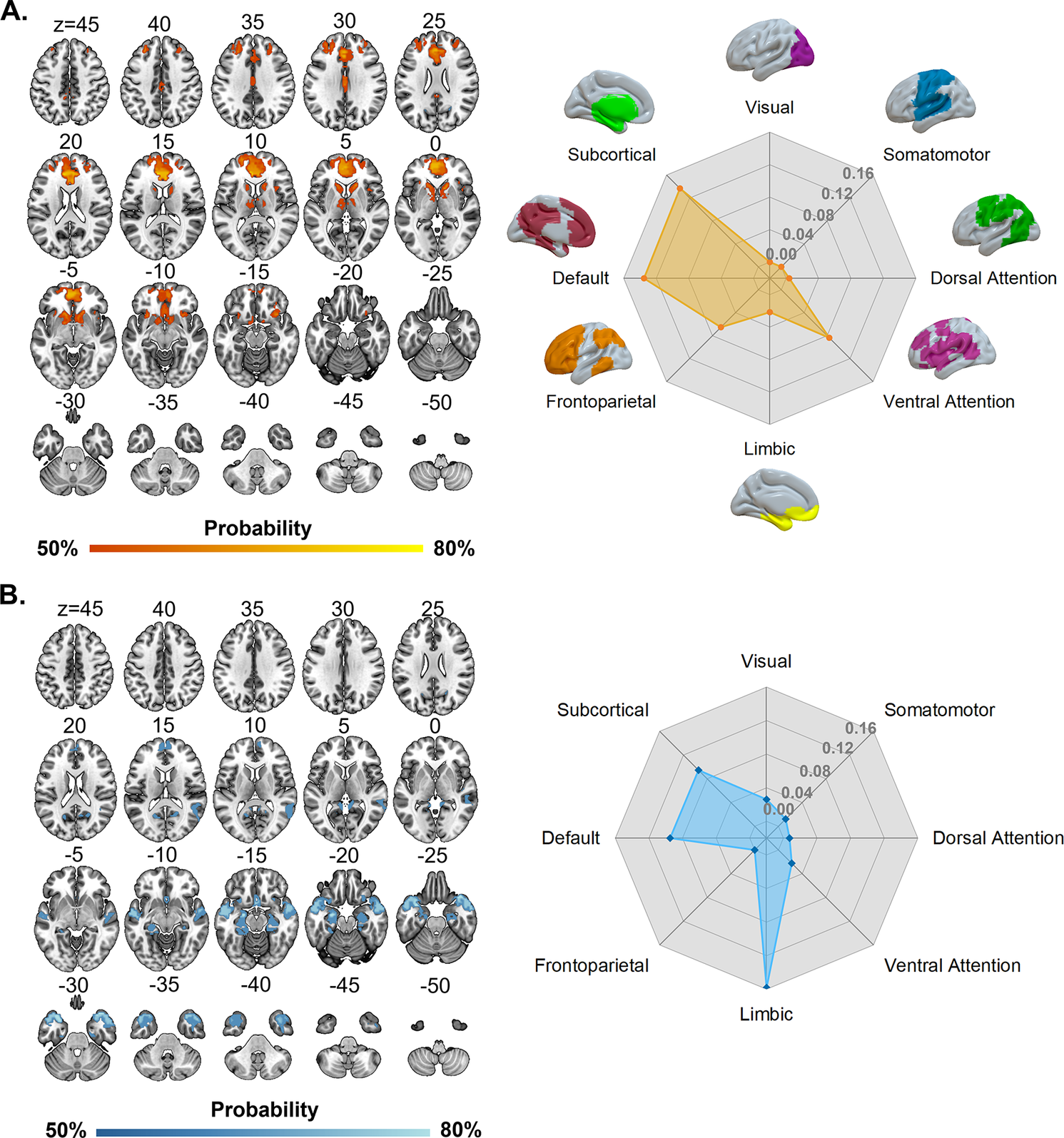
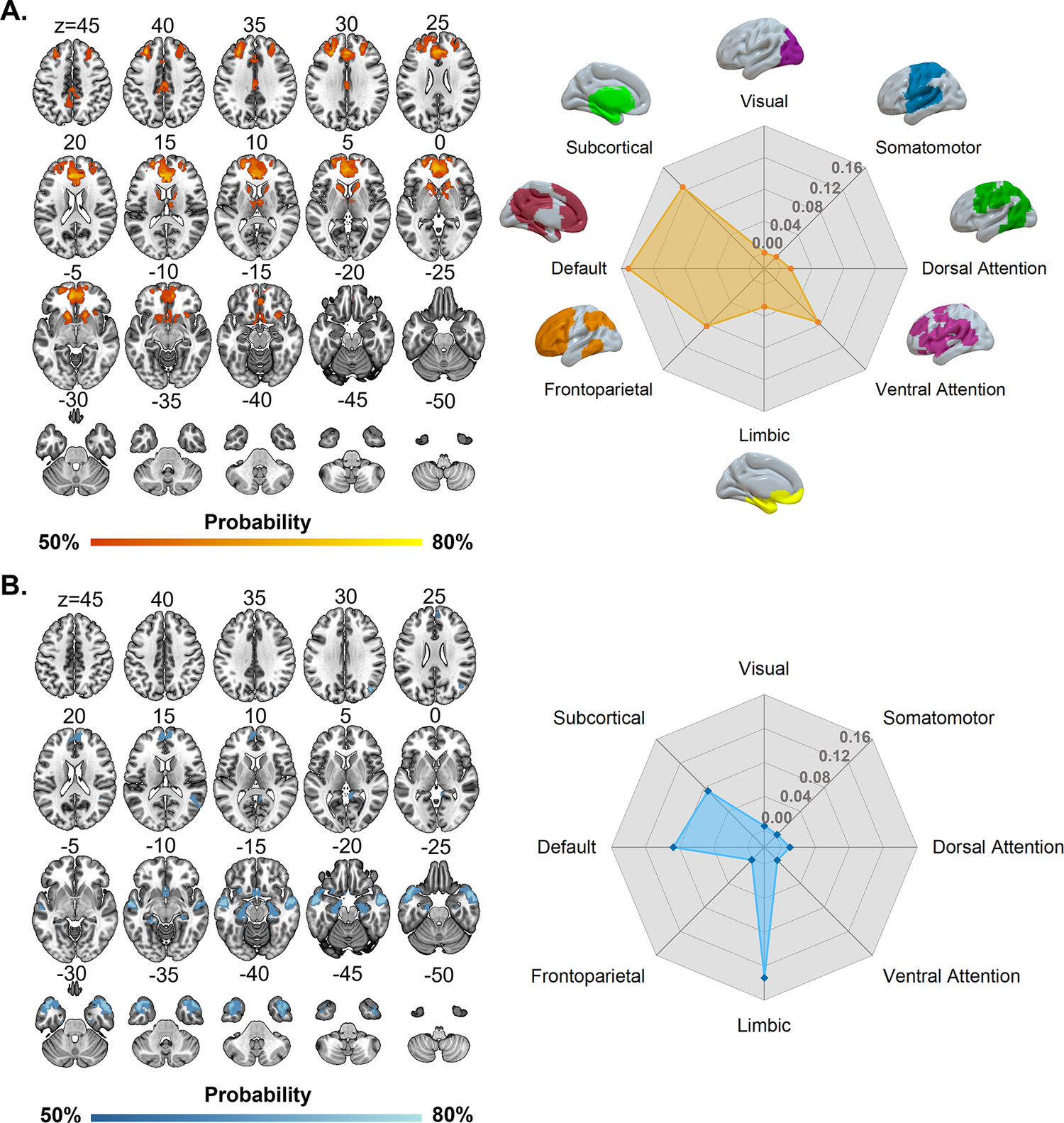
Analyses of both the HV and MDD datasets yielded similar ketamine-induced brain functional alteration networks, with subtle differences largely attributable to variation in sample sizes. The ketamine-induced hyper-functional network primarily included the bilateral caudate nucleus, thalamus, and medial prefrontal cortex (Figures 2A and 3A, left panel). With respect to canonical brain networks, the hyper-functional network principally implicated the subcortical (overlapping proportion: 13.67%) and default (overlapping proportion: 13.51%; Dice coefficient = 0.2882, P NCT = 0.009) networks (Figures 2A and 3A, right panel and Table S6 in the Supplementary Materials). By contrast, the ketamine-induced hypo-functional network chiefly comprised the bilateral temporal pole, hippocampus, amygdala, and lateral temporal cortex (Figures 2B and 3B, left panel). As to canonical networks, the hypo-functional network predominantly implicated the limbic (overlapping proportion: 15.82%; Dice coefficient = 0.2757, P NCT = 0.0779), subcortical (overlapping proportion: 9.45%), and default (overlapping proportion: 9.48%; Dice coefficient = 0.208, P NCT = 0.0819) networks (Figures 2B and 3B, right panel and Table S6 in the Supplementary Materials).
Ketamine-induced brain functional alteration networks derived from the HV dataset. (A) Ketamine-induced hyper-functional network (left panel) and its relation to canonical brain networks (right panel). (B) Ketamine-induced hypo-functional network (left panel) and its relation to canonical brain networks (right panel). Polar plots illustrate the proportion of overlapping voxels between each ketamine-induced brain functional alteration network and a canonical network to all voxels within the corresponding canonical network. Abbreviation: HV, healthy volunteer.
Ketamine-induced brain functional alteration networks derived from the MDD dataset. (A) Ketamine-induced hyper-functional network (left panel) and its relation to canonical brain networks (right panel). (B) Ketamine-induced hypo-functional network (left panel) and its relation to canonical brain networks (right panel). Polar plots illustrate the proportion of overlapping voxels between each ketamine-induced brain functional alteration network and a canonical network to all voxels within the corresponding canonical network. Abbreviation: MDD, major depressive disorder.
Statistical significance testing
By generating 1000 null networks with random contrast seeds and assessing their spatial overlap with the actual network, we observed low similarity of the actual ketamine-induced hyper-functional network (mean Dice coefficient ± SD: 0.050 ± 0.070) and hypo-functional network (0.065 ± 0.083) with their null counterparts (Figure S2 in the Supplementary Materials), suggesting that the ketamine-induced brain functional alteration networks were statistically different from those generated by chance.
Validation analysis
Our comprehensive validation analyses confirmed the robustness of the main findings. First, regarding parameter selection, the FCNM procedure using 1-mm and 7-mm radius spheres yielded networks nearly identical to those using the 4-mm radius sphere (Figures S3 and S4 in the Supplementary Materials). Second, concerning the time window, the sensitivity analysis using the contrasts focusing on the acute phase of ketamine action (scanning within 48 hours post-administration) produced results consistent with the primary analysis (Figure S5 in the Supplementary Materials). Finally, regarding imaging modality, the ketamine-induced hyper-functional network derived from resting-state fMRI studies showed high spatial similarity to that in the main analysis (Figure S6 in the Supplementary Materials), suggesting that our findings were not driven by a single imaging modality. Note that the analyses for PET, cerebral blood flow (CBF), and task-based fMRI were not conducted due to the limited number of eligible studies.
Discussion
By using a combination of the novel FCNM approach and large-scale brain functional connectome datasets, this is the first study to examine network localization of brain functional alterations induced by ketamine administration in depressed patients. Our analyses revealed 2 different and specific brain functional alteration networks related to ketamine treatment. The ketamine-induced hyper-functional network mainly involved the subcortical (caudate nucleus and thalamus) and default (medial prefrontal cortex) networks, while its hypo-functional counterpart predominantly implicated the limbic (temporal pole), subcortical (hippocampus and amygdala), and default (lateral temporal cortex) networks. These findings may not only help resolve previously reported discrepancies in ketamine-induced brain changes across studies, but also aid in elucidating the neurobiological effects of ketamine from a network perspective.
Considerable neuroimaging research effort in the past decade has been devoted to investigating the brain effects of ketamine treatment in depressed patients [Reference Zavaliangos-Petropulu, Al-Sharif, Taraku, Leaver, Sahib and Espinoza10–Reference Kotoula, Webster, Stone and Mehta14], yet inconsistency in the location and nature of the reported effects makes it difficult to unify this research. The substantial variability across studies may emerge for several reasons, including small sample sizes, heterogeneous patient populations, variable study designs, and different analytical strategies [Reference Poldrack, Baker, Durnez, Gorgolewski, Matthews and Munafo40, Reference Etkin41]. In addition to these common challenges in neuroimaging, existing work has focused largely on regional brain effects, violating the concept that neural effects do not occur in isolation but rather rely on distributed, interconnected networks [Reference Fornito, Zalesky and Breakspear15]. Moreover, convergent evidence suggests that several treatments for psychiatric populations show network-level brain representations and exert their salutary effects in a network-dependent manner [Reference Sobesky, Goede, Odekerken, Wang, Li and Neudorfer18–Reference Scangos, State, Miller, Baker and Williams20, Reference Horn, Reich, Vorwerk, Li, Wenzel and Fang42]. In this context, there is growing interest in the development and application of novel network-based approaches to localize psychiatric therapeutics to specific brain networks [Reference Fox, Buckner, Liu, Chakravarty, Lozano and Pascual-Leone31, Reference Siddiqi, Taylor, Cooke, Pascual-Leone, George and Fox32]. In the current work, we adopted the FCNM approach to map the anatomically heterogeneous brain functional alterations following ketamine administration to common networks, highlighting the potential of this network-based framework to advance our understanding of the neurobiological effects of ketamine.
We found that the ketamine-induced hyper-functional network primarily included the caudate nucleus, thalamus, and medial prefrontal cortex, which is coherent with prior observations that depressed patients exhibit increased brain function in these regions after ketamine treatment [Reference Gonzalez, Vasavada, Njau, Sahib, Espinoza and Narr43–Reference Hung, Zhang, Chen, Duann, Lin and Lee47]. Earlier brain imaging studies have shown lower brain function in the caudate nucleus, thalamus, and medial prefrontal cortex in depressed patients [Reference Wu, Li, Kuang, Zhang, Lui and Huang48–Reference Lui, Wu, Qiu, Yang, Kuang and Chan52], indicating that the ketamine-induced increase in brain function may represent normalization or overcompensation. Although the exact mechanisms have been challenging to ascertain, there are several possible explanations [Reference Zanos and Gould53]. Based on the disinhibition hypothesis, ketamine is proposed to selectively block NMDARs expressed on GABAergic inhibitory interneurons, which leads to a disinhibition of pyramidal neurons and enhanced glutamatergic firing. Additionally, ketamine can block NMDAR-mediated spontaneous neurotransmission, which results in the inhibition of the eukaryotic elongation factor 2 kinase activity and subsequently leads to an enhancement of brain-derived neurotrophic factor translation. Ketamine is also proposed to decrease excessive NMDAR-dependent burst firing activity of lateral habenula neurons to disinhibit downstream monoaminergic reward centers. These mechanisms of ketamine’s action are not mutually exclusive and may act in a complementary manner to account for the increased brain function.
Our data showed that the ketamine-induced hypo-functional network chiefly comprised the temporal pole, hippocampus, amygdala, and lateral temporal cortex. It is well established that the hippocampus and amygdala serve as pivotal hubs for emotion regulation and memory processing [Reference Phelps54–Reference Phelps and LeDoux56]. In depression, these regions often exhibit pathological hyperactivity, contributing to negative emotional bias and excessive memory retrieval [Reference Disner, Beevers, Haigh and Beck55, Reference Siegle, Carter and Thase57]. Therefore, the observed hypo-function may represent a critical normalization of the maladaptive hyperactivity typically seen in depression [Reference Siegle, Carter and Thase57–Reference Drevets, Bogers and Raichle60]. Regarding the lateral temporal cortex, its reduced activity might indicate a disruption of the default network. Since default network hyper-connectivity is linked to depressive rumination, ketamine may function by “uncoupling” the hyper-connectivity [Reference Scheidegger, Walter, Lehmann, Metzger, Grimm and Boeker61, Reference Evans, Szczepanik, Brutsché, Park, Nugent and Zarate62]. From a circuit perspective, the subcortical inhibition might result from restored top-down control. The activated medial prefrontal cortex observed in our hyper-functional network could exert stronger inhibitory regulation over the limbic regions [Reference Hare and Duman63]. At the molecular level, ketamine may selectively block extrasynaptic GluN2B-containing NMDARs in the hippocampus. This blockade reduces tonic activation driven by ambient glutamate (background noise), thereby disinhibiting protein synthesis and enhancing synaptic plasticity mechanisms essential for antidepressant response [Reference Miller, Yang, Wang, Hargroder, Zhang and Delpire64, Reference Autry, Adachi, Nosyreva, Na, Los and Cheng65].
Our study is subject to several limitations. First, regarding temporal scope, most included studies focused on acute neural effects. The scarcity of extended follow-up data precludes us from fully characterizing the sustained, long-term impact of ketamine. Second, concerning methodological interpretation, FCNM relies on normative connectome data to generate network maps. Consequently, our results reflect the “network embedding” of ketamine-responsive sites within the healthy brain, rather than a direct quantification of drug-induced activation in every mapped region. Third, we acknowledge data heterogeneity. To maximize statistical power, we pooled coordinates from distinct imaging modalities (BOLD, PET, and CBF). While valid, these modalities capture different physiological processes, potentially introducing variance. Fourth, our analysis relied on published peak coordinates rather than raw neuroimaging data. This coordinate-based approach, while standard, inevitably lacks the spatial precision of mega-analyses based on original statistical maps. Finally, we focused exclusively on functional metrics and employed a consensus threshold. While excluding structural data and setting a 50% overlap ensures specific and robust findings, these choices may omit subtle or trait-related structural alterations.
In conclusion, the current study opens new perspectives by being the first to investigate network localization of ketamine-induced brain functional alterations in depressed patients. By combining the novel FCNM approach and large-scale brain functional connectome datasets, we mapped the anatomically heterogeneous brain functional alterations (increase and decrease) associated with ketamine treatment to specific hyper-functional and hypo-functional networks. These findings may shed light on the neurobiological effects of ketamine from a network perspective, which might represent a crucial step toward fostering the clinical application of ketamine in antidepressant treatment.
Supplementary material
The supplementary material for this article can be found at http://doi.org/10.1192/j.eurpsy.2026.10164.
Data availability statement
The data and analysis codes used in the preparation of this article are publicly available at https://osf.io/w2mp5/.
Acknowledgements
We thank all the participants and their families.
Financial support
The study was supported by the National Natural Science Foundation of China (grant number: 82471952), the Anhui Provincial Natural Science Foundation (grant numbers: 2308085MH277 and 2208085MH257), the Scientific Research Key Project of Anhui Province Universities (grant number: 2022AH051135), and the Scientific Research Foundation of Anhui Medical University (grant number: 2022xkj143).
Competing interests
The authors declare no conflict of interests.


 Open access


Comments
No Comments have been published for this article.