Paul and Jewish Sources
Paul was an original thinker, and his epistles are full of novel, at times paradoxical, ideas. Christology stands at the center of Paul's system, and his Christological teaching is unique among Jewish writings of the Second Temple period. Some, especially non-Christological, elements of Pauline theology do, however, have illuminating parallels in earlier Jewish teachings, which seem to have been modified and adapted by Paul to fit his own revolutionary thought. While Paul's theology cannot be reduced to these elements, they might help to explain (at least partly) its emergence. After all, even the ideas of the most original thinkers owe their emergence to prevailing conceptions of the culture in which those thinkers operated, taking some of them for granted and incorporating them naturally into their thought, while struggling with and reacting to others. In Paul's case, Jewish concepts played a significant role in shaping some central features of his theology.1
An interesting overview of the subject written for the general public is David Flusser, “Die jüdische und griechische Bildung des Paulus,” in Paulus in 114 Farbbildungen erzählt von Erich Lessing (ed. E. Lessing; Freiburg: Herder, 1980) 11–39. For a more detailed and more extensively documented discussion of the affinities of some Pauline passages with Qumranic writings, see n. 3.
Jewish writings sometimes supply precedents for Pauline motifs, conceptions, and terminology, and therefore help in analyzing the elements of Paul's system. The rare cases in which Paul's sources (i.e., literary units reformulated by Paul) can be discerned enable us to observe how he reworked and reshaped existing texts,2
Needless to say, the existing Jewish texts that might be considered his possible sources were not necessarily identical to the texts as we have them in the extant rabbinic collections, nor were all his sources necessarily in writing.
See David Flusser's pioneering work, “The Dead Sea Sect and Pre-Pauline Christianity,” in idem, Judaism and the Origins of Christianity (Jerusalem: Magnes, 1988) 23–74. Flusser's discussion was subjected to harsh criticism by E. P. Sanders in Paul and Palestinian Judaism: A Comparison of Patterns of Religion (Philadelphia: Fortress, 1977) 15–16. Sanders, however, compares Paul's thinking and Judaism as two closed religious systems, while Flusser attempts to demonstrate how contemporary Jewish ideas could have been transformed into Pauline doctrine.
For some examples, see W. D. Davies, Paul and Rabbinic Judaism: Some Rabbinic Elements in Pauline Theology (London: S.P.C.K., 1984).
Today it is clearer than ever that rabbinic literature often preserves motifs from the Second Temple period. The possibility that a certain passage in rabbinic literature may take issue with (Pauline) Christianity should indeed be taken into account, but this can by no means be a default assumption; indeed, many Pauline passages can be illuminated by parallels in rabbinic literature. Moreover, there are cases in which a passage in rabbinic literature that is anti-Christian in its present context is a mere reproduction or elaboration of a pre-Christian tradition. Similarly, a pre-Christian statement can become Christian simply by being included in a Christian context (thus, reproofs of Israel by the prophets become anti-Jewish in the writings of some Church Fathers by their inclusion in anti-Jewish polemics; for further examples, see below).
In this article I will consider a source of Rom 5:12–21, in which Paul contrasts Adam and Christ. I will try to demonstrate that Paul's source was close to a nomistic non-Christological passage attributed to Rabbi Yose in the Sifra, as well as to other Jewish passages. Rabbi Yose and the Sifra are obviously later than Paul, but, as we shall see, the tradition that the Sifra passage reflects (henceforth “the Sifra Passage” or simply “the Sifra”) is much earlier than the compilation of the Sifra itself or even than Rabbi Yose. I will begin my analysis by discussing more primitive forms of the tradition in question, and then continue with an analysis of the actual Sifra text (“Ancestors and Their Descendants”). A detailed comparison of the Pauline passage to the Sifra and to other Jewish passages will follow (“Paul and the Sifra Passage”). Another version of the midrashic passage is found in Theophilus of Antioch, as will be shown (“Theophilus of Antioch and the Sifra”). Finally, a Christianized version of the Sifra passage in the medieval work Pugio Fidei will be discussed (“The Pugio Fidei Version of the Sifra and Modern Scholarship”). This version shows how easily Jewish material could be adapted to the framework of Christian-Paulinian theology.
Ancestors and Their Descendants: From Miqra to Sifra
An anonymous statement in the Babylonian Talmud reads:
[A] Happy are the righteous!
[B] Not only do they acquire merit for themselves (

), but they also acquire merit for (

or

) their children and their children's children to the end of all generations;
[C] For Aaron had several sons who deserved to be burnt like Nadab and Abihu … but the merit (

) of their father helped them.
[A'] Woe to the wicked!
[B'] Not only do they acquire condemnation for themselves (

), but they also acquire condemnation for (

)
5This is not the place to enter into a discussion of the variant readings of talmudic manuscripts (

and

in the qal or in the pi

el, respectively).
[C'] Many sons did Canaan have who were worthy to be ordained like Tabi, the slave of Rabban Gamaliel, but the guilt of their ancestor caused them (to lose the chance). (b. Yoma 87a)

(zky)

(ḥwb). Here as well as in the following pages I chose translations that would fit both the present context and the comparison to the Pauline passage (the consequences of the roots' polysemy will become clear later; see p. 408–9). The verb

(zky), usually translated “acquire merit,” may also be translated “benefit”;
6For a detailed discussion of this verb and the difficulty of translating it, see Sanders, Paul and Palestinian Judaism, 187–88.
These are clearly legal business metaphors of “credit” and “debit.” For a study of “legalistic” approaches in Judaism without any of the pejorative prejudicial connotations of them, see also Gary A. Anderson, “From Israel's Burden to Israel's Debt: Towards a Theology of Sin in Biblical and Early Second Temple Sources,” in Reworking the Bible: Apocryphal and Related Texts at Qumran (ed. Esther G. Chazon, Devorah Dimant, and Ruth A. Clements; STDJ 58; Leiden: Brill, 2005) 1–30.
The idea expressed here is that, for better or worse, the deeds of the ancestors affect the fate of their descendants as decreed by God. This ancient concept occurs in the Hebrew Bible (see, e.g., Exod 20:5–6: “visiting the iniquity of the fathers upon their children to the third and the fourth generations of those who hate me, but showing kindness to thousands [of generations] of those who love me and keep my commandments”; Deut 12:28: “Observe, hear and obey8
The Hebrew word

means both “hear” and “obey.” In the Samaritan Pentateuch and the Septuagint, the sense of obedience is emphasized by the addition of the word

,

.
On the ancient view according to which one's descendants are considered, at least to some extent, extensions of oneself, and on the survival of such views into Late Antiquity, see Menahem Kister, “Some Blessing and Curse Formulae in the Bible, Northwest Semitic Inscriptions, Post-Biblical Literature and Late Antiquity,” in Hamlet on a Hill: Semitic and Greek Studies Presented to Prof. T. Muraoka on the Occasion of his Sixty-Fifth Birthday (ed. M. F. J. Baasten and W. Th. Van Peursen; Leuven: Peeters, 2003; OLA 118) 313–32.
Similarly, we read in the Book of Ben Sira:

, “The righteousness of your father will not be wiped out
10So Genizah ms A; Genizah ms C reads

, “will not be forgotten” (rather than “will not be wiped out”), in keeping with the Greek and the Syriac versions. The relevant pages of ms B have not survived. See also n. 11.

, “forever will their memory abide, and their righteousness will not be wiped out).
11So Genizah ms B (the Syriac version seems to have had a similar Vorlage). The ancient Masada manuscript reads:

, “forever will their seed abide, and their honor will not be wiped out” (Yigael Yadin, The Ben Sira Scroll from Masada [Jerusalem: Israel Exploration Society and Shrine of the Book, 1965] 37); the Vorlage of the Greek version read

, while the Syriac read in this verse

. However, the similarity between Sir. 44:13 and 3:14 according to the Genizah mss and the close relation of both passages to Ps 109:14 suggest that this may well be the original reading; it is highly unlikely that a copyist would create such a thoughtful allusion in two verses so distant and ostensibly different in meaning. This is probably the key to the correct interpretation of the expression

, “the righteousness of your father,” rather than “righteous acts (of you) towards your father (i.e., honoring him),” as it is understood by many commentators.

, “may the sin of his fathers be remembered before God, and the iniquity of his mother not be wiped out” (Ps 109:14),
12Note that at least in this case the ancestors' iniquities are held against a person who is himself wicked. Ben Sira, however, depicts the merits of ancestors as counteracting the iniquities of their descendants.

, “merit of the ancestors.”
13For a discussion of some aspects of this teaching see Solomon Schechter, Aspects of Rabbinic Theology (New York: Macmillan, 1909) 185–88; Arthur Marmorstein, The Doctrine of Merits in Old Rabbinical Literature (London: Oxford University Press, 1920).
Pace Sanders, Paul and Palestinian Judaism, 197–98, 338 n. 24. See the general observations of Anderson (above, n. 7).
The illustration of “passing on guilt” is much milder than the one of “passing on merit”: Aaron's merits prevent his descendants from dying, while Canaan's sin only prevents his descendants from being ordained as rabbis. The talmudic text as received, however, may not reflect the tradition in its most original form; it may be a variation of a sentence such as “Canaan sinned, and all of his seed will be blotted out from earth, and all his remnant, and there is none of him who will be saved on the day of judgment” (Jub 22:21).

), it is acquired for one's descendants and descendants' descendants until the end of all generations,” is developed in other contexts in Tannaitic literature as well.
16See m. Makkot 3:15 (probably an addition to the Mishnah); a baraita added to Sifre Deuteronomy 79 (ed. Finkelstein; Berlin: Jüdischer Kulturbund in Deutschland E.V. Abteilung, 1939) 145; and Mekhilta Deuteronomy (D. Z. Hoffmann, Midrasch Tannaim [Berlin: Itzkovski, 1908] 61) = M. I. Kahana, The Genizah Fragments of the Halakhic Midrashim (Jerusalem: Magnes, 2005) 351 (in Hebrew). These sayings are related to Deut 12:28. See also the medieval compilation Midrash Aggadah to Deut 12:25 (ed. Buber; Vien: Avraham Fanto, 1894) 2.191.
A striking parallel to the passage in b. Yoma 87a, albeit with a somewhat different message, occurs in the Sifra, a Tannaitic midrash. The saying, attributed to Rabbi Yose,17
For a parallel passage, attributed in the Sifre to Rabbi Yose's contemporary, Rabbi Yehuda, see Appendix.

Rabbi Yose
18Thus most textual witnesses; see variae lectiones of the Sifra (ed. Louis Finkelstein; New York: Jewish Theological Seminary, 1983) 3.286. The attribution to Rabbi Yose ha-Gallili; see S. Lieberman, Sheqi
in (Jerusalem: Bamberger & Wahrmann, 1939) 65–66 (in Hebrew) is probably erroneous. R. Yose ha-Gallili was a contemporary of Rabbi
Aqiva (early second century c.e.), while R. Yose was R.
Aqiva's disciple.

), you may learn this from Adam [i.e., from Adam's punishment]: He was given only one commandment, a prohibition, which he transgressed, and see how many deaths Adam was condemned [to suffer] (

) [as a result]: his own, and those of all his descendants and his descendants' descendants to the end of all generations. Now, which (divine) measure is greater (

), the measure of (divine) benevolence or the measure of (divine) punishment (

)? Certainly, the measure of benevolence is greater.
19See Ex 20:5–6, cited above.
The original reading is

, in the sense “refrain from”; the reading

in the printed editions is erroneous. Sanders's statement (Paul and Palestinian Judaism, 112) should be corrected accordingly.
A sacrifice that is unfit because of an improper intention on the part of the officiating priest.
Portions of sacrifices left over beyond the legal time, which must be burned.

) for himself and for his descendants and all his descendants' descendants to the end of all generations!
23Sifra Ḥova, parasha 12:12 (ed. Finkelstein, 1989 2.206–207). For variae lectiones to this passage see ibid, 3.286.
1. In the Sifra, the sinners are represented by Adam, rather than by Canaan, as in the Babylonian Talmud. The consequence of Adam's act—death—is much more severe than that of Canaan, and applies to every human being. On the other hand, no specific personality is named in the Sifra as representing the other pole, that of the righteous. Instead, the text presents every person (i.e., every Jew) who observes the Torah's commandments (by refraining from eating food forbidden by the Torah) as the polar opposite of Adam, the sinner, and therefore such a person acquires merit for his descendants through his righteousness (see Deut 12:28).
2. The subject of the statement is “the reward given to the righteous in the Age to Come.”24
It is not quite clear to what extent “the Age to Come” (literarily: “what is to come, the future,” referring in the context of our midrash to the eschatological future) is equivalent to “the World to Come.” See Chanoch Albeck, Shisha sidre mishnah (6 vols; 2d ed.; Jerusalem-Tel Aviv: Devir, 1965) 4.454, 478, 519 (in Hebrew); and especially Chaim Milikowsky, “Gehenna and the ‘Sinners of Israel’ in the Light of Seder Olam,'” Tarbiz 55 (1986) 312–23 (in Hebrew).
See 4 Ezra 4:29–30: Goodness can be bestowed upon the righteous only after the passing of this world, in which the effects of Adam's sin are dominant.
Needless to say, the emphasis on reward in the Age to Come is very appropriate for the theology of rabbinic Sages.
Sanders writes concerning this source: “The Rabbi does not actually name a reward which is greater than universal death, although the logic of the argument would seem to imply that he should” (Paul and Palestinian Judaism, 190). The apparent asymmetry in the wording, I contend, is due not to theological concerns, but rather to the evolution of the stylistic pattern.
A theologian (and even certain Jewish sages in antiquity) might have asked whether God, by punishing Adam's descendants and bestowing reward on the descendants of the righteous, was being just. Our passage, however, does not question this; rather, it assumes that God is just. A theologian would have also asked whether a descendant of a righteous person who is not personally righteous has a guaranteed place in the Age to Come. Similar questions are raised in the Bible (Ez 18:1–20)
28See H. G. Enelow, ed., The Mishnah of Rabbi Eli

ezer or the Midrash of Thirty-Two Hermeneutic Rules (New York: Bloch, 1933) 93. Instead of

read:

, “their sin (i.e., the ancestors' sin) is (remains) with them (i.e., with the descendants).”
el, ba-ḥodesh, 6).
29Hayyim Saul Horovitz and Israel Abraham Rabin, eds., Mekhilta de-Rabi Yishma
el (Frankfurt am Main: Kauffmann, 1931) 226–27.
3. This passage adds a new theological dimension to the dichotomy of the righteous and the sinful. It includes a statement common in midrashic literature, that the measure of divine benevolence is greater than the measure of divine punishment.
30E.g., t. Sotah 4:1; Mekhilta de-Rabi Yishma
el ba-ḥodesh 6 (ed. Horovitz-Rabin, 227); Mekhilta de-Rabbi Shim'on ben Yoḥay to Ex 16:14 (ed. J. N. Epstein and E. Z. Melamed; Jerusalem: Yeshivat Sha
are Raamim, 1955) 111; Exod 20:6 (ibid, 148), 22:23 (ibid, 211); Sifre Numbers 8 (ed. Hayyim Saul Horovitz; Leipzig: Fock, 1917) 14–15, 15 (ibid, 20) 18 (ibid, 22) 115 (ibid, 127) 160 (ibid, 220); Sifre Deuteronomy 40 (ed. Finkelstein, 83); Eccl. Rab. 4:1.

).
4. Adam's sin is construed not as mere disobedience, but rather as a violation of the first divinely given commandment, anticipating the commandments given at Sinai.31
See, for example, 4 Ezra 7:11–24. See also Joel S. Kaminsky, “Paradise Regained: Rabbinic Reflections on Israel at Sinai,” in Jews, Christians, and Theology of the Hebrew Scriptures (ed. Alice Ogden Bellis and Joel S. Kaminsky; Atlanta, Ga.: SBL, 2000) 15–43.
For an example of the praise of Israel, see Genesis Rabbah 21:7 (ed. Julius [Jehuda] Theodor; Berlin: Ittskovski, 1903) 202. Adam and Israel are dramatically contrasted in Tanḥuma Buber Shemini 13 (ed. Salomon Buber; Vilna: ha-almana veha-ahim rom, 1990) 3.31: Adam could not observe the commandment for one hour, whereas his descendants, the People of Israel, observe many difficult commandments. The passage in the Tanḥuma (and perhaps also the passage in Genesis Rabbah) may well be anti-Pauline, but its elements existed in Jewish thought before Christianity. The polemic against Christianity could only give the pre-Christian elements their anti-Christian dimension; see my remark at the end of the introduction to the present article.
Consider now for yourself:33
Functionally, this term is synonymous to

in the Sifra.
The words

(Syriac) and “quam magnam aream incipient facere” (Latin) reflect the Hebrew expression

. Literally, this expression means “to do a threshing floor,” but in rabbinic literature it means “to pile up the (gathered) harvest” (m. Peah 2:5–6). This phrase is a perfect parallel to the phrase “how much fruit … has it produced” in the preceding verse of 4 Ezra. The temporal expression

(Syriac), or “cum veniet area” (Latin), reflects the Hebrew idioms

. t. Neziqin, Bava metsi'a 9:24; a fragment of a midrash on Job 31:39, published in Abraham Joseph Wertheimer, Batte midrashot (2 vols; Jerusalem: Mosad ha-Rav Kuk, 1955) 2.182; and

(Cant Rab. 7:3).
Cf. Michael E. Stone, Fourth Ezra (Hermeneia; Minneapolis: Fortress, 1990) 90. See Stone's commentary on v. 30 (95) and his discussion of Adam's sin (63–66).
Finally, two details in the wording of this saying may be noted:
1. One would have expected the wording of the Sifra to have been as follows: “Adam was given only one commandment … which he transgressed—how much more will someone who observes commandments be rewarded,”36
In a late midrash parallel to the Sifra, the figure contrasted with Adam is “he who observes the commandments,”

(The Mishnah of Rabbi Eli
ezer [ed. Hillel Gershom Enelow] 55). Elsewhere, the figure is “he who studies Torah and fasts on the Day of Atonement and keeps the Sabbath”

; see B. M. Levin, “Halakhic Midrashim and Maimonides' Pesaqim,” in Rabbenu Moshe ben Maimun: Qovets torani mada'i (ed. Y. L. Fischmann-Maimon; Jerusalem: Yad ha-Rav Kuk, 1935) 124 (in Hebrew). See also Lieberman, Sheqi
in, 66. These secondary readings highlight the awkwardness of the wording in the Sifra.
A Samaritan homily likewise states: “Adam ate, preparing death, Moses fasted, preparing life.” Tibat Marqe: A Collection of Samaritan Midrashim (ed. Ze'ev Ben-Hayyim; Jerusalem: Israel Academy of Sciences and Humanities, 1988) 254 (Book IV, § 30, fol. 194a). This part of the compilation is relatively late (Introduction, 24). Similarly, Christian writers emphasize that Adam was defeated by Satan by eating, while Christ defeated Satan by fasting. E.g., Ephraem Syrus; see Des Heiligen Ephraem des Syrers Hymnen de Ieiunio (ed. Edmund Beck; CSCO 246; Louvain: Secrétariat du Corpus SCO, 1964) 34–35.
Both elements appear one after the other also in Tanḥuma Buber Shemini 13 (ed. Buber, 3.31): After a general statement about observing the commandments, the specific examples of the abstinence of Jews from eating nonkosher food and fruit prohibited by the Torah are contrasted with Adam's eating the food prohibited to him. See also Genesis Rabbah 21:7 (ed. Theodor, 202). The common feature of the three prohibitions mentioned in the Sifra is that their violation is punished by karet (untimely death).
2. The Sifra uses the verb

, “condemned,” or “fined,” instead of its synonym,

, which is used in b. Yoma 87a and is a perfect antonym for

.
Paul and the Sifra Passage
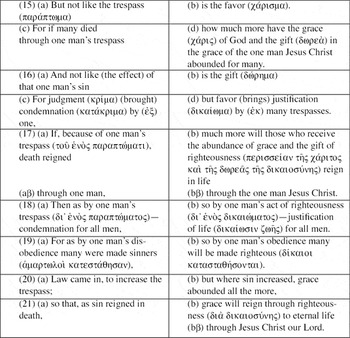
We may now proceed to compare the passage in the Sifra to a particularly well-known and central passage in the Epistle to the Romans in which one man, Adam, is compared to another man, Jesus Christ (Rom 5:12–21). Many of the details of this passage have been the subject of inner-Christian debate throughout the centuries and are prone to divergent interpretations by modern exegetes. I will try to present a fairly literal translation of the passage (suggestions for alternative renderings of some details will be discussed below):39
For a short and lucid commentary on Rom 5:12–21 (in which many of the interpretational options suggested in scholarship are mentioned) accompanied by a detailed study of the passage, see O. Hofius, “Die Adam-Christus-Antithese und das Gesetz: Erwägungen zu Röm 5, 12–21,” in Paul and the Mosaic Law (ed. James D. G. Dunn; WUNT 89; Tübingen: Mohr, 1996) 165–206.
- (12)(a) Therefore, as through one man sin () came into the world

- (b) and through sin death (came into the world)
- (c) and so death came to () all men
- (d) because (? )40all men sinned (
I will not address the meaning of
, which has been much discussed in scholarship. See, e.g., James D. G. Dunn, Romans 1–8 (WBC 38A; Dallas, Tex.: Word Books, 1988) 273–74; Joseph A. Fitzmyer, Romans: A New Translation with Introduction and Commentary (AB 33; New York: Doubleday, 1993;) 413–17. The rendering of these words does not affect my argument.
). - (13)(a) For until the Law sin was in the world,
- (b) but sin is not counted where there is no law.
- (14)(a) Yet () death reigned from Adam to Moses,
- (b) even over those whose sins were not like the transgression of Adam,
- (c) who was a type () of the coming (one / age) ().


Most scholars have overlooked the striking parallel between Paul and the Sifra passage. A few scholars have noted, in passing, individual similarities between elements occurring in Rom 5:12–21 and the passage in the Sifra (among other Jewish texts),41
See below, n. 124.
Michel stresses that this passage is a complete unit. Otto Michel, Der Brief an die Römer (5th ed.; KEKNT 4; Göttingen: VandenHoek & Ruprecht, 1978) 185.
As we have seen above, Rabbi Yose's saying can easily be explained as developing older, more simple and schematic statements, such as the one in b. Yoma. There is no reason to suppose that it was influenced by Christianity.
First, let us compare the Pauline passage to the saying in the Sifra:
1. Both passages consider Adam's sin a violation of God's commandment, and both stress that this single violation had horrible results for all human beings: It was the cause of death for all of Adam's descendants (Sifra), or, in other words, for all human beings (Paul). According to both passages, “a man” is the source of the positive things granted by God to many others, either all his descendants (Sifra) or all human beings (Paul). While the expression “Adam's descendants and his descendants' descendants” (Sifra) is a synonym for “all men” (verse 18a), there is a remarkable difference between all the descendants associated with the positive figure according to the Sifra and “all men” in Romans (verse 18b).
44The awkward wording “all men” in v. 18b (see Sanders, Paul and Palestinian Judaism, 473 and n. 63) might be related to the rhetorical argument of Paul and the Sifra.
One should note here that in the parallel in b. Yoma 87a the positive pole is represented by a specific personality (Aaron). Although Paul's tradition is especially close to the tradition in the Sifra, other parallel traditions might have played some role in formulating Paul's thought. See also n. 46.
In Tanḥuma Niṣavim 2, one finds a cluster of ideas similar to those that occur in Rom 5:15–19. Two figures are contrasted: one sinner (as in Rom 5:19) who brings punishment (Achan, Josh 22:20), and one righteous man whose merit (

) bestows life upon the whole world. The beneficial effect of righteousness is inferred by the argument a minori ad maius from the baneful effect of the sinner, because “the measure of divine benevolence is greater than the measure of punishment” (similarly Rom 5:15; see below). The theme and logic are similar to those of the Sifra and b. Yoma, but according to the Tanḥuma those who benefit from the merit of the righteous are not only their descendants, but rather a much larger circle of human beings (see above n. 45). Although Midrash Tanḥuma is a relatively late composition, one should not necessarily assume that the ideas in this passage were influenced by Christianity: Every element in it is well attested prior to Christianity's emergence. The passage in Tanḥuma Niṣavim also contains elements that are reminiscent of 1 Cor 12:12–30; see Menahem Kister, “‘In Adam’: 1 Cor 15:21–22 and its Jewish Parallels” (forthcoming).

, is mentioned) is that good deeds in general outweigh sin.
47“Condemnation is brought about because all individuals sinned … but righteousness is not brought about because the individuals, as Christ, accomplished obedience; it need only be accepted in faith as procured by Christ.” Rudolph Bultmann, “Adam and Christ according to Romans 5,” in Current Issues in New Testament Interpretation: Essays in Honour of Otto A. Piper (ed. William Klassen and Graydon F. Snyder; London: SCM, 1962) 158.
2. Some exegetes of Paul have interpreted “death” as “spiritual death,” which is presented in perfect symmetry with “eternal life” (21b). While the notion of “spiritual death” did exist in Hellenistic and Palestinian Judaism,48
Menahem Kister, “Leave the Dead to Bury Their Own Dead,” in Studies in Ancient Midrash (ed. James L. Kugel; Cambridge, Mass.: Harvard University Press, 2001) 43–56; idem, “Divorce, Reproof and Other Sayings in the Synoptic Gospels: Jesus Traditions in the Context of ‘Qumranic’ and Other Texts,” in Text, Thought, and Practice in Qumran and Early Christianity: Proceedings of a Joint Symposium by the Orion Center for the Study of the Dead Sea Scrolls and Associated Literature and the Hebrew University Center for the Study of Christianity, 11–13 January, 2004 (ed. Daniel R. Schwartz and Ruth A. Clements; STDJ; Leiden: Brill, forthcoming).
Concerning the interpretation of Paul in the light of parallel motifs in the literature of the Second Temple period, see Thomas H. Tobin, “The Jewish Context of Rom 5:12–14,” Studia Philonica 13 (2001) 160–75. The Jewish parallels cited by Tobin and especially the passage in the Sifra (to which he does not refer) prove that the reason Paul was interested in Adam was not, as Tobin suggests, “because he [=Adam] stands at the ultimate origin of both Jews and Gentiles” (175).
The rabbinic passage is certainly eschatological, though by no means messianic. As for Paul, the future tense of the words “will reign” (Rom 5:17b) and “will be made righteous” (19b) has been interpreted by some scholars as indicating an eschatological future.50
The expression

may also support this position, if it is interpreted as referring to the eschatological era, as will be suggested below (#5).
3. Paul's message in this passage is that after the constitutive event—Jesus' crucifixion—the rules have changed, so to speak, from divine judgment to grace. This is quite different from the rabbinic view, according to which the same rules apply to every transgression of God's commandments, whether committed by Adam or by any other human being until the end of history: All are judged, and in judgment they are either punished or rewarded. Notwithstanding this substantial difference, the structure and formulation of the two texts is very similar. The Sifra makes it clear that the reward for the righteous may be inferred from the punishment by an argument a minori ad maius (

) concerning God's action in the world: “Which (divine) measure is greater, the measure of (divine) benevolence or the measure of (divine) punishment (

)? Certainly, the measure of benevolence is greater. If, then, the lesser measure, that of punishment, resulted in Adam and his descendants … being condemned to so many deaths … how much more does (a righteous person) acquire merit (

) for himself and for his descendants. …” The terms

and

occur several times in rabbinic literature.
51See some references above, n. 30.

, is essentially synonymous with “reward for the righteous.” (N.B.: God rewards and punishes in strict judgment; it is not implied that the righteous are treated with greater mercy than others).
52Unlike the term “reward,” the term “measure of benevolence” does not inherently imply that human beings deserve the beneficial acts of God, so it can be easily adapted to Paul's purposes.
Cf. Ephraim E. Urbach, The Sages: Their Concepts and Beliefs (2 vols; Cambridge, Mass.: Harvard University Press, 1979).
The phrase

; should be interpreted quantitatively (

): God's favor is not on a par with human sins and their punishments, but is much greater. For wording similar to that of vv. 15–16,

, see Ps 103:10–11; contrast Robin Scroggs, The Last Adam: A Study in Pauline Anthropology (Philadelphia: Fortress, 1966) 81.
Franz Delitzsch, Paulus des Apostels Brief an der Römer. Aus dem griechischen Urtext … in des Hebräische übersetzt und aus Talmud und Midrasch erläutert (Leipzig: Dörffling und Franke, 1870) 83. As we shall see below (n. 120), Delitzsch compares Paul to a Christianized version of the Sifra rather than to its genuine text (see below, “Pugio Fidei Version of the Sifra”).
Arthur Marmorstein, “Paulus und die Rabbinen,” Zeitschrift für die neutestamentliche Wissenschaft 30 (1931) 271–77, esp. 277.

and

, usually translated “abundance” and “abounded” in verses 17 and 20, may well be the equivalents of the Hebrew word

(“greater”) used in the Midrash for a deduction similar to Paul's.
57Note the interchange between

and

(Genesis Rabbah 61:2 [ed. Theodor, 659] = y. Neziqin Bava Qama 4:6, [4c]).

can be translated “excess,” and the word

may be rendered “was superior, excessive.”
Although one should not forget that in our passage
58Unlike 1 Cor 15:21–22.

, i.e., a type or example rather than an antitype of Jesus, there is a dichotomy in this passage between Adam and Jesus, sin and justification. Unlike the rabbinic

(“measure of benevolence”), God's “favor” and “gift” in Paul's system (vv. 15–16) has nothing to do with God's recompense and retribution.
59See also Ps 103:10–11 compared above, n. 54.

, “judgment,” stands in opposition to

, “favor,” in a fashion reminiscent of another well-known pair designated in rabbinic writings:

, “the measure of divine judgment” and

, “the measure of divine mercy, grace, favor.” As we shall see below, this pair (albeit not in exactly the same form as the rabbinic terminology) is well established already in the literature of the Second Temple period. According to many rabbinic statements, the “measure of mercy” has the upper hand. In most of rabbinic literature the two pairs are distinct. “The measure of benevolence” (

) and “the measure of mercy” (

) occur simultaneously in rabbinic literature, apparently without any attempt to place them together in one coherent theological system,
60Logically, the “measure of benevolence” (

) and the “measure of punishment” (

) could be considered subdivisions of the “measure of judgement” (

); see M. Kadushin, The Rabbinic Mind (New York: Jewish Theological Seminary, 1965) 219 n.73), but the two systems almost never operate together, to the best of my knowledge. Nor can it be shown that the pair “judgment and mercy” replaces “benevolence and punishment” in different versions of one saying or in close parallels.
In Leviticus Rabbah 24:2 (ed. M. Margulies; Jerusalem: Jewish Theological Seminary, 1993) 550–51, we find the following pairs, which seem to be in parallelism:

(“benevolence / punishment; grace / judgment; judgment / mercy”). In the late Midrash Otiyyot de-Rabbi
Aqiva Version A (Wertheimer, Batte Midrashot, 2.334–35),

, “measure of benevolence” is synonymous with

, “measure of mercy.”
Arthur Marmorstein, The Old Rabbinic Doctrine of God: 1. The Names and Attributes of God (London: Oxford University Press, 1927) 43–53; Sanders, Paul and Palestinian Judaism, 123–24.
In compositions discovered at Qumran, however, God's “benevolence” (

) is synonymous with “grace” (

), “mercy,” (

), and “righteousness” (

or

).
63E.g.:

, “Deal with us, yhwh, according to Your benevolence, according to the abundance of Your mercy and Your just (act)s” (11QPsa 19:4–5);

, “In Your wrath are all verdicts of punishment, and in Your benevolence, abundance of forgiveness; and Your compassion over for all those whom You favor” (1QHa 19:8–9 [=Sukenik, 11:8–9]).

) and “mercy” (

) is a commonplace at Qumran, anticipating the “measure of judgment” (

) and the “measure of mercy” (

) in rabbinic literature. A text from Qumran contrasts God “who judges in annihilating wrath” (

) with God's actions “through the grace of righteousness and abundant mercy, gracious gift”
64The word

is a noun derived from the root

(see Ezra 9:8).

; Hodayot, 4Q427 frg. 7, i, 21–22).
65See Eileen Schuller, Qumran Cave 4. XX: Poetical and Liturgical Texts, Part 2 (DJD 29; Oxford: Clarendon, 1999) 97. The lines probably refer to God's attitude toward the elect and toward sinners; see 4Q434 1 i 5–6. Moshe Weinfeld and David Seely, eds., “Barkhi Nafshi,” in Qumran Cave 4. XX: Poetical and Liturgical Texts, Part 2 (ed. Esther Chazon et al.; DJD 29 Oxford: Clarendon, 1999) 270.

(v. 17b); literally, these Greek words would read in Hebrew:

.
Moreover, according to the Qumranic texts, divine benevolence, mercy, and righteousness (

, the Hebrew equivalent to

) save the elect:
He delivers my soul from annihilation (

) … in His mercies he draws me (to Him), and by His kindness (

) he judges me. He judged me in the righteousness of His truth (

), and in the abundance of His benevolence (

). He atones for all my sins, and in His righteousness (

) He cleanses me from the uncleanness of humans (

) and from the sin of the sons of man (or: sons of Adam,

) (1QS 11:13–15).
66See also: “I was near to death because of my sins. … You, the Lord, saved me according to the abundance of Your mercy and the abundance of Your righteousness” (

). … Bestow on me a spirit of faith and knowledge” (11QPsa 19:9–11).
Notably, in the writings of Qumran the gift is related to the right interpretation of the Torah granted by God, which enabled the members of the sect to observe its commandments, while for Paul it is exclusively Christological.
The Qumran phrases, referring to God's benevolence (

) and abundant mercy (

), though quite distinct in content from the saying in the Sifra, use key terms that are ostensibly similar to those used in the Sifra,
68For a similar phenomenon in other religions see David Flusser, Yahadut u-meqorot ha-natsrut (Jewish Sources in Early Christianity) (Tel-Aviv: Sifriyyat Po'alim, 1982) 359–60 (in Hebrew).

). I would suggest, then, that the grafting of the contrast between the notions of divine “judgment” and “mercy, favor, goodness” (Qumran, rabbinic literature) onto the system of the two complementary divine measures of “benevolence” and “punishment” (Sifra) created an idea that is very different from the one in the Sifra. This grafting might have been done by Paul himself, or it might have taken place before him,
69The Christological elements can be easily set aside without any damage to the argument.
See above nn. 3, 4.
4. The works of Adam and the “other man” are contrasted in our Pauline passage: Adam was punished for “trespass” and “disobedience,” whereas the other man gains “justification” by an “act of righteousness” and by “obedience” (vv. 18–19). In this passage Paul makes no mention of his main argument in the preceding passage (Rom 5:1–11)—that Jesus died for the sinners—nor does he mention the ontological difference between the two men (emphasized in 1 Cor 15:46–49). Paul refers here to Jesus' crucifixion in strictly nomistic terms!
71Michel remarks: “Aber man darf nicht übersehen, dass unser ganzer Abschnitt mit rechtlichen Begriffen arbeitet, und dass die Gegensatz Übertretung–Rechttat auf das Gebot Gottes bzw. das Gesetz bezogen ist.” Der Brief an die Römer, 191–92.

) seems to be Jesus' crucifixion, whereas in a Jewish context the same sentence would refer to observing any commandment. Similarly, for Paul, “obedience” seems to be Jesus' willingness to be executed according to God's will (cf. Phil 2:8), whereas in Jewish terms the observance of the Law is “obedience” par excellence.
72The resemblance between the Jewish and Christian ideas has been noted by W. D. Davies (Paul and Rabbinic Judaism, 268–73). Davies writes concerning Rom 5:17–19: “It was a postulate in Rabbinic thought that a man by his obedience to the Torah could obtain merit. … These merits, however, benefited not merely the person who by his obedience acquired them, but also his contemporaries, and in addition, because of that solidarity of all the members of the community … they would also avail for those who preceded him and those who would follow him both here and hereafter” (268). “Paul could think in terms of a ‘merit’ of Christ, gained through obedience, that was efficacious for all” (273). Unfortunately, these profound observations have not received the attention they deserve as a clue to Paul's theology in commentaries and later studies of Paul's thinking, as far as I have seen. Karl Barth has written: “He was the Jew. … By freely submitting himself to the Law He fulfilled it,” assuming that Christ's “obedience” includes obedience to the Torah. Karl Barth, Christ and Adam: Man and Humanity in Romans 5 (Edinburgh: Oliver & Boyd, 1956) 33. Generally speaking, the gap between Paul and Barth's theological treatise is clear enough to critical readers; I find it highly unlikely that Paul's intention here is the one ascribed to him by Barth. Even if by “obedience” Paul referred not only to Jesus' crucifixion but also to his life, it seems to me out of place in the context of Pauline theology to claim that Christ's redemption was attained by his observance of the Law; see also N. T. Wright's commentary on this verse in The New Interpreter's Bible (Nashville: Abingdon, 2002) 10.529. We do not find here an explicit statement explaining “how gentiles can attain obedience [through] Jesus Christ, [who] introduced an obedience affecting all.” Stanley K. Stowers, A Rereading of Romans: Justice, Jews, and Gentiles (New Haven: Yale University Press, 1994) 252–53. The figure opposing Adam is not an obedient person per se, but rather Jesus Christ, and there is no hint that some people were “obedient” before Christ. An abstract sense of “obedience” is alien to Jewish thought of that period, in which it was always related to divine Law, especially the Torah; the latter is mentioned in this passage, but is not connected to obedience.
See above, n.16.
5. The wording of v. 14c, (Adam)

, resembles the wording in the Sifra:

, “If you wish to know the reward (that will be) given to the righteous in the Age to Come, you may learn this from Adam (i.e., Adam's punishment).” Commentators have almost unanimously interpreted the words

as masculine, referring to Jesus
74Robinson has suggested that the words

in the masculine may “refer to Moses, or, generally, to ‘man under the law.’” John A. T. Robinson, The Body: A Study of Pauline Theology (Philadelphia: Westminster, 1952) 35 n. 1; followed by Robin Scroggs, The Last Adam: A Study in Pauline Anthropology (Philadelphia: Fortress, 1966) 80–81.

, however, may also be interpreted as neuter.
75Haacker, following Johann A. Bengel, Gnomon Novi Testamenti (3d ed., Tübingen: Ludov. Frid. Fues., 1855) 552: “

pro

, quae res, genere congruit cum

. futurum,

, in neutro dicitur”) and some Church Fathers (see below, n. 76), opts for interpreting

as neuter, albeit in a different sense from the one proposed here. Klaus Haacker, “Exegetische Probleme des Römerbriefs,” Novum Testamentum 20 (1978) 16–19.

is the precise equivalent of the Hebrew expression

(“the [Age] to Come”) in the Sifra.
76The word

is interpreted as meaning “the future” in an Armenian commentary attributed to Ephrem, S. Ephraem Syri commentariolii in Epistolas D. Pauli nunc primum ex Armenio in Latinum sermonem a patribus mekitharistis translati (Venecia: Typographia Sancti Lazari, 1823) 15. This commentary is surveyed among other patristic interpretations by Karl H. Schelkle, Paulus, Lehrer der Väter (Düsseldorf: Patmos, 1956) 187–89 (cited by Haacker, “Exegetische Probleme,” 18).

, fitting the Hebrew idiom so well, occurred in a Jewish source of Paul (see below). It may still be open for debate whether Paul meant the word

to be genitive neuter or whether he perhaps transformed it into genitive masculine.
In this sentence another stylistic affinity between the Sifra and Paul may be noted. In the clause “you may learn this from Adam” (Sifra), the word “Adam” is an ellipsis for “Adam's punishment.”
77This may explain the masculine

(see Bengel, Gnomon Novi Testamenti, 552).

may mean “example” (see 1 Cor 10: 6),
78On the similarity of the two passages, see Theological Dictionary of the New Testament (ed. G. Kittel and G. Friedrich; trans. G. W. Bromiley; 10 vols.; Grand Rapids, Mich.: Eerdmans, 1964–1976) 8.252 n. 29 (s.v.

).
6. The form

in vv. 16c, 18a–b is also grammatically ambiguous, and can be interpreted either as masculine or as neuter. The similarity in content and vocabulary to verses 15 and 19 strengthens the view of some commentators that

in v. 18a–b is masculine (“one man's trespass”). On the other hand, the parallel between 16c and 16d makes a strong case for interpreting

in 16c as neuter (“by one [trespass]”).
79To be sure, the word

in 16d can also grammatically be interpreted as masculine (“trespasses of the many”), but contextually it seems more plausible that it is neuter (“many trespasses”).

(“one sinner”), while other (Western) manuscripts read

(“one act of sin”). Again, the comparison to the passage in the Sifra is instructive. In the Sifra, the point of “one transgression” is stressed: “He (Adam) was given only one commandment … which he transgressed” and, as a result, Adam and all his descendants were condemned to death. This passage also includes, implicitly, the view of Adam as one sinner for whose single sin many are punished.
7. In the passage from b. Yoma 87a, the key words

and

(or, according to other text-witnesses, in pi
el,

and

), were translated above as “acquire merit for” (cf.

, merit) and “acquire condemnation for” (from

, guilt), respectively. The word

(translated above as “acquire merit for”) is a key word in the Sifra passage as well. The root

(zky) in Hebrew is polysemic, having a wide range of denotations and connotations that are not always easy to distinguish from one another, let alone to translate into another language.
80Cf. Sanders, Paul and Palestinian Judaism, 183–90.

means, inter alia, “give possession, gift; grant” (concretely and metaphorically) and “acquire merit”;

, in the pi
el, may also be translated “acquit;” “cause to be righteous,” “justified,”
81Note the interplay between different meanings of the root

(acquire merit / cause to [act] righteously / justify, make righteous) in the redactional layer of b. Yoma 87a and m. Mak. 3:16, where the former meaning is juxtaposed to

and

(see also below, n. 96).

(ṣdq) and

(zky) being synonymous.
82The Hebrew root

is rendered in the targumim by the Aramaic root

. We have suggested (above p. 394) that

(Sir 3:14) is synonymous with

in rabbinic literature, and we shall see another example below (#9, p. 411), from m. Mak. 3:16.

means, inter alia, “righteous deed,” “merit” and “acquittal.” The verbs

, and the noun

have the opposite meanings.
In light of the striking parallels in phraseology, rhetoric, and style between Paul's passage and the Sifra, it might be suggested that this multiplicity of meanings of the equivalents of

(16c–d),

(18a–b) are

and

respectively; the pair

(v. 19a–b) could be a clumsy rendering of

and

respectively. The term

(20b–21a) is also the equivalent of

(or:

or:

).
83The argument in vv. 20b–21 has an intriguing stylistic parallel in rabbinic literature, in which the word

is used as the opposite of the biblical word

: “Which (divine) measure is greater (

), the measure of (divine) benevolence or the measure of (divine) punishment (

)? Certainly, the measure of benevolence is greater. If, then, the lesser measure, that of punishment, reminds (God) of (one's) sin (

), the excessive measure of benevolence must, by deduction, remind (God) of (one's) righteousness (

).” Sifre Numbers 8 (ed. Horovitz, 14–15). For v. 29a, see no. 9 below.

(zky)
84Brandenburger has suggested that

(v. 15d) and

(16b) echo the root

in the sense of “to grant”; see Egon Brandenburger, Adam und Christus: Exegetisch-religionsgeschichtliche Untersuchung zu Röm. 5, 12–21 (1.Kor. 15) (WMANT 7; Neukirchen: Neukirchener, 1962) 223.

in b. Yoma). It seems plausible, therefore, that Paul sought to render the Semitic root

Contrast Davies who states, “in Rom. 5 Paul does not make use of any phrase that might be considered the equivalent of the term zakuth.” (Paul and Rabbinic Judaism, 273).

) with different Greek words.
86See also below, Theophilus of Antioch and the Sifra, p. ***.
For Paul's bilingual thinking as reflected in 1 Cor 15:45–49, see also Menahem Kister, “‘First Adam’ and ‘Second Adam’ according to Paul (1 Cor 15) in the Light of Midrashic Exegesis and Hebrew Usage” (forthcoming).
So far I have demonstrated, I hope, the similarity of our passage to the passage in the Sifra. Three points of a possible relationship between this passage and rabbinic literature may also be considered. Paul's statements seem to be an inversion of the Jewish sayings. The content of the following reconstructed Jewish statements is implied in the Sifra passage.
8. A parallel to the phrase “death reigned from Adam to Moses” is found in a saying attributed in the Mekhilta to Rabbi Yose, the same sage to whom the passage in the Sifra is attributed. According to Rabbi Yose, “the Israelites accepted the Torah in Sinai on condition that the angel of death would not have authority over them.” Death, then, had authority until the giving of the Torah, and it regained this authority when the Israelites sinned by making the golden calf. As a prooftext, Rabbi Yose cites Ps 82:6, “like Adam
88The word

in this verse might be interpreted here as “Adam”; see, for instance, Numbers Rabbah 16:24; Exodus Rabbah 32:1. See Gary A. Anderson, “The Status of the Torah in the Pre-Sinaitic Period: St. Paul's Epistle to the Romans,” in Biblical Perspectives: Early Use and Interpretation of the Bible in Light of the Dead Sea Scrolls (ed. M. E. Stone and E. G. Chazon; STDJ 28; Leiden: Brill, 1998) 1–23, esp. 21–22.
el ba-ḥodesh 9).
89Horovitz-Rabin, eds., 237.

, means both “rule” and “have authority.”
90The word occurs in Rom 6:12:

, to which one must compare Rom 6:14:

. The last phrase should be compared to Ps 119:133:

(see also Billerbeck's note, Str-B 3:232, to which Qumranic “apotropaic” prayers may now be added, e.g., 11QPsa XIX:15). The Hebrew and Aramaic root

(and the Hebrew root

) are the exact equivalents of

, but lack the royal aspect of its synonym

.
Cf. Anderson's statement: “He [=Paul] has consciously set Adam within the framework of Jewish Salvation history” (Anderson, “Status of the Torah,” 18); “Paul constructs an exegetical framework that is at one and the same time Jewish and anti-Jewish” (ibid., 21). I think we may take the latter statement one step further and suggest that Paul constructed his anti-nomistic ideas on the basis of a Jewish framework.
See also Anderson, “The Status of the Torah,” esp. 9–23.
9. The paradoxical statement, “Law came in, to increase the trespass” (v. 20) is essential for Paul, and summarizes much of his teaching concerning the Torah in the Epistle to the Romans (see, e.g., 4:15). Paul does not mention righteous deeds as a positive value, and the merit of obedience to divine commandments (especially those of the Torah) does not balance out disobedience; it is only through the obedience of Christ that redemption is possible. (There is no hint in this passage that it refers only to Gentiles, and that there is such a balance for the Jews.)
93Contrast Gaston's statement: “Sin and death were in the world before the Torah came with Moses and therefore all humanity in that period was under the law without the remedy of the Torah (5:14) or the grace of God in Jesus Christ (5:16).” Lloyd Gaston, Paul and the Torah (Vancouver: University of British Columbia Press, 1987) 31; Stowers, Rereading of Romans, 254–55. See also Anderson, “Status of the Torah,” 10–17.

“The Holy One, blessed be He, wished to grant merit (

) to Israel (or: to justify Israel);
94See above, #7.

),
95Cf. lxx,

. It seems that both the Septuagint and the Tanna read

as a pi
el infinitive, i.e., “in order to make him righteous.” But cf. Targum of Jonathan to this verse.
The passage appears in the manuscripts of the Mishnah, but it is probably an addition; see J. N. Epstein, Mavo le-nusah ha-mishnah (3d ed.; Jerusalem: Magnes, 2000) 977–78. For a Tannaitic parallel see Mekhilta de-Rabbi Yishma
el, Pisha 16 (ed. Horovitz-Rabin, 59). For an Amoraic parallel (in the name of Rabbi Aha) see Leviticus Rabbah 31:8 (ed. Margulies, 727). The passage in its Pauline context has been discussed by Davies (Paul and Rabbinic Judaism, 269). Marmorstein (Doctrine of Merits, 16) considers this saying and other, similar ones to be apologetic claims combating Christian and non-Christian accusations (for some reason Marmorstein's statement refers only implicitly to Christianity). I now tend to think that similar statements could well have been made before Paul and the Church Fathers, and not in reaction to their views (although confrontation with the opposite, Christian view could certainly make such sayings all the more relevant).

; see David Flusser, “‘He has planted it [i.e., the Law] as eternal life in our midst.’” Tarbiz 58 (1989) 147–153 (esp. 152–53 and n. 28; in Hebrew). The ancient formula is applied to the same verse (Isa 42:21) in Tanḥuma Buber Shelah 28. Note the use of Isa 42:21, used also in m. Mak. 3:16.
The statement of Hananiah ben Aqashiah is the exact opposite of Paul's statement in v. 20: “Law came in to increase the trespass.” Verse 21, in which it is emphasized that “grace will reign through righteousness (

) to eternal life” is the exact opposite of the notion that the righteousness of observing the Torah leads one to merit (

=

; see above, no. 7 above) and eternal life. Paul clearly inverts these Jewish concepts in vv. 20–21.
98See Flusser, “Die jüdische und griechische Bildung,” 22.
10. In the Sifra passage it is stressed that Adam violated only one commandment. Although several Torah commandments (out of many) are mentioned, Adam's violation of a single commandment is clearly contrasted with Israel's observance of many commandments. This point is made explicitly in the passage of 4 Ezra cited above:
Consider now for yourself how much fruit of ungodliness one grain of evil seed has produced, when ears of good grain without number are sown, how great will be the harvest! (4:31–32)

*, that is, “For (divine) judgment (brought) condemnation by one (viz. trespass), but (divine) favor (brings) justification by many (viz. righteous deeds).” What Paul writes, however, is the exact opposite (v. 16c–d):

That is, “For (divine) judgment (brought) condemnation by one (viz. trespass), but (divine) favor (brings) justification by many trespasses.”
99See above, n. 79.

does not have the same sense in 16c and 16d. The content seems to be highly paradoxical.
100“That one single misdeed should be answered by judgment, this is perfectly understandable; that the accumulated sins and guilt of all ages should be answered by God's free gift, this is the miracle of miracles, utterly beyond human comprehension.” C. E. B. Cranfield, A Critical and Exegetical Commentary on the Epistle to the Romans (2 vols.; ICC; Edinburgh: T&T Clark, 1985) 286. See also Barth, Christ and Adam, 13.
C. K. Barrett, The Epistle to the Romans (Black New Testament Commentaries; 2d ed.; London: A & C Black, 1991) 107. Note that the word

is translated very differently at the beginning of the sentence and at its end.

(“trespasses”).
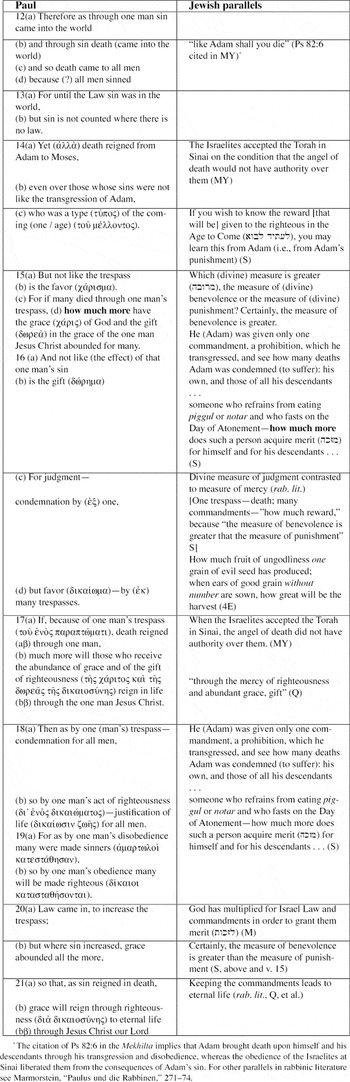
The Jewish parallels, all of which have been discussed above in detail, cover virtually every verse of the Pauline passage. The following table of comparison of the Pauline passage to its Jewish parallels is instructive.102
In the following table, I use the abbreviations: MY = Mekhilta de-Rabbi Yishma
el; S = Sifra; 4E = 4 Ezra; Q = Qumran; M = Mishnah Makkot.

The parallels between Rom 5:12–21 and the Jewish passages, especially the Sifra, are striking. Paul and the Sifra do not merely discuss the same topic (Adam's sin and its effect on future generations) with similar motifs and structure (deduction a minori ad maius). A close scrutiny reveals further that a) many verses in Rom 5:12–21 have an exact counterpart in the Sifra (sometimes gaining a new sense in the Pauline context); b) the Pauline passage uses nomistic language that is very much in keeping with the parallel passage in the Sifra; c) the Hebrew terminology in the Sifra (and the other Jewish parallels) sheds light on Paul's Greek terminology; d) there are reasons to believe that Paul inverted some Jewish statements. The best explanation for all these phenomena is that the whole unit (Rom 5:12–21) is based on a coherent Jewish source that was in Paul's mind while he was expressing his own, very different ideas. I must stress once more: My aim is not to suggest a new interpretation of this passage of Paul, but rather to reconstruct the contours of an earlier, Jewish layer upon which the Pauline passage was established. Needless to say, such a reconstruction is but a heuristic exercise. Although I am well aware that the reconstruction is hypothetical and that many details are far from clear, I find it useful, even illuminating, to do this exercise and compare the Pauline passage to its putative reconstructed Jewish source. A possible reconstruction of this putative source of the Pauline passage would run as follows:
[A] Adam brought death to the world, and death reigned (or: had authority) until the giving of the Torah (for death does not have authority over those who keep it).
[B] Adam's punishment is the example for (the Age) to Come (i.e., the reward of the righteous who observe the commandments), for God's favor is greater than trespass (and punishment), and thus if many were condemned to death by one trespass of a single individual (i.e., Adam), how much more will many acquire merit through the (many) righteous acts of obedience (to the Torah) of a single individual (i.e., of [each] individual who observes the commandments).
[C] For the Torah, containing many commandments, came in to increase righteousness. Inasmuch as sin (and punishment of the transgressors) increased, God's grace (=benevolence for those obeying Him) is even greater. Therefore, as Adam's sin caused the reign of death, the righteousness of keeping the commandments of the Torah leads to eternal life.
For practical reasons, the reconstructed text is based as closely as possible on Paul's wording, taking into account the different Jewish usage and theological setting.

and its counterpart in 17a

; 21b

), change the words “trespass” in v. 20, and omit the word “trespasses” in 16d as Pauline inversions.
104Rom 5:12c–d seems to be a paraphrase of the preceding sentences, perhaps in an attempt to explore all of their theological meanings. Verses 13b and 14b stand in tension with other verses in this passage, and may be regarded as Paul's theological refinement of his source for his own theological purposes; note the striking parallelism between 12a–b and 13a, 14a.

and

are distinctly Pauline; in the Pauline context, Rom 5:18 continues the train of thought of Rom 4:25 (“who was put to death for our trespasses and raised for our justification”), using the same pair of Greek words (

), but I venture to argue that Jewish phrases and concepts were adapted by Paul in this passage to fit his new christological system. In the process of transforming Jewish (generally Hebrew) concepts into Greek, Paul was able to transform the meaning of a few key terms and adapt them to his own theology. By analogy, mutatis mutandis, Paul's hymn to “love” in 1 Cor 13:1–13 (“If I speak in the tongues of men and of angels, but have not love, I am a noisy gong … and the greatest of these is love”), if taken out of context, could be used in modern times as a hymn to romantic love (with the omission of certain sentences, such as vv. 9–12). The use of the word “love” as a translation of the Greek word

, and the romantic connotation of the word “love” in modern Western culture, make such an adaptation possible. To give another example: Verses in Proverbs in which the word

appears were construed by the Sages (and are construed, for that matter, by many Jews to this very day) as referring to the Torah, rather than to human instruction of father or teacher. The very fact that the Hebrew word

came to denote the Pentateuch made such a reading of these verses almost automatic. Likewise, in our passage, the use of theological terms current in Paul's vocabulary may obscure a Jewish usage close to the one found in the Sifra.
105For a similar case, see Esther Chazon's discussion of a striking parallel between a passage of the Apostolic Constitutions and a Jewish liturgical source of the Second Temple period. She states: “This expression is a favorite of the compiler of the Apostolic Constitutions and, therefore, it is usually attributed to him. … The fact that the expression … suited the Hellenistic concepts of implanted knowledge and innate law could account for its appeal to this fourth century Christian redactor / compiler.” She concludes that the passage in the Apostolic Constitutions “made use of a Jewish source like the Thursday prayer [of the Words of the Luminaries—M.K.].” Esther G. Chazon, “A ‘Prayer Alleged to Be Jewish’ in the Apostolic Constitutions,” in Things Revealed: Studies in Early Jewish and Christian Literature in Honor of Michael E. Stone (ed. Esther G. Chazon et al.; SJSJ 89; Leiden: Brill, 2004) 261–76, esp. 268, 270.
A Jewish source similar to the one reconstructed above (mainly on the basis of the Sifra passage) was possibly known to Paul in some form (perhaps orally, either in Hebrew or in Greek). The underlying Jewish phraseology may shed light on some difficult Pauline phrases in this passage. Paul should certainly not be perceived as a redactor who does not fully understand what his source means. Unlike the authors of the Gospels, he does not transmit traditions but rather creates his own innovative theology. In this case, he is reworking existing material, making it an integral part of his own teaching by putting it in the context of his own theological terminology and replacing a few phrases. We shall discuss a similar phenomenon in a medieval text below, pp. 418–20. Even if one is not fully convinced that Paul used a Jewish source, as I have tried to demonstrate, one will hopefully find that the close comparisons I made between the Pauline passage and the striking rabbinic parallels are instructive for discerning the Jewish background of the specifically Pauline emphases in this passage. The topics with which this paper has dealt were of the utmost importance for Paul as well as for rabbinic Judaism.
Theophilus of Antioch and the Sifra
In a work by the early Church writer Theophilus of Antioch (second century c.e.), we find a peculiar version of the Jewish midrash that came down to us in the Sifra:
106On the close relations between Theophilus's work and Judaism in general, see Oskar Skarsaune, “Scriptural Interpretation in the Second and Third Century,” in Hebrew Bible/Old Testament: The History of Its Interpretation, I/1 (ed. Magne Saebo; Göttingen: Vandenhoeck & Ruprecht, 1996) 414–18.
What man <did not>
107One must emend

to

; an emendation not accepted by Gustave Bardy and J. Sender, Théophile d'Antioche, Trois livres à Autolycus (Paris: Cerf, 1948) 111 n. 2; or add

(Miroslav Marcovich, see n. 109).

) through his neglect and disobedience (

), God now freely bestows (

) upon him through love (

) and mercy (

), when man obeys (

) him. For as by disobedience man gained death for himself (

), so by obedience to the will of God whoever wills can acquire for himself (

) eternal life. For God gave us a law and holy commandments;
108The expression is found in 2 Pet 2:21; the context, however, is far from the one in the present passage of Theophilus. Theophilus did not observe the Torah commandments as understood by the Jews, as may be demonstrated by the omission of the Sabbath both in the narrative of the Genesis story and in the account of the Ten Commandments (Ad Autolycum 3.9).

) them can be saved.
109Theophilus, Ad Autolycum 2.27; for an edition of the text, see Miroslav Marcovich, Theophyli Antiocheni Ad Autolycum (Patristische Texte und Studien 44; Berlin: Gruyter, 1995) 77; see also Robert M. Grant, Theophilus of Antioch Ad Autolycum (Oxford: Clarendon, 1970) 70–71.
See the editions of Grant and Bardy (n. 107) and, recently, Marcovich's edition (n. 109) and, in a more elaborate form, Robert M. Grant, Greek Apologists of the Second Century (Philadelphia: Westminster, 1998) 172. (Note also that some of the features of Theophilus's teaching attributed by Grant to his christology on p. 171 are attested in Jewish midrashim in a different context.)
For a similar phenomenon concerning Theophilus, Paul, and the midrash, see Kister, “First Adam and Second Adam” (above, n. 87).
Bardy's comment is worth citing in full: “Cf. Rom. v, 19. Le parallélisme des expressions rend plus sensible la distance qui sépare Théophile de Saint Paul. L'apologiste passe complètement sous silence le rôle rédempteur du Christ et semble croire que l'homme, déchu librement, peut librement se relever. Ce moralisme n'est pas inouï chez les anciens Pères, mais il a quelque chose d'étonnant à notre point de vue” (Bardy and Sender, Théophile d'Antioche, 111 n. 3).
See above, n. 108.

may well be the Greek equivalent of

(“acquired for himself”) in the Sifra. Notably, the influence of one's sin on others, so central to the Sifra passage, is missing in Theophilus; the statement about the impact of Adam's disobedience on his descendants does not occur here (but note that the “man” who disobeyed and acquired for himself death and the “man” who obeys and observes the commandments are not the same!). Did Theophilus, or his source, deliberately play down the notion of transferring merits?
It seems that the passage in Theophilus is another version of the passage attributed in the Sifra to Theophilus's contemporary, Rabbi Yose.
The Pugio Fidei Version of the Sifra and Modern Scholarship
The potential of adapting the Sifra passage to Pauline Christianity was realized as early as the thirteenth century. In Raymond Martini's Pugio Fidei we find the following citation from the Sifre [sic!]:114
Raymundus Martini, Pugio Fidei adversum Mauros et Judaeos (Leipzig: Sumptibus Haeredum Friderici Lanckisi, 1687) 866–67.

Rabbi Yose ha-Gallili says: If you wish to know the merit of the King Messiah and the reward (that will be) given to the righteous in the Age to Come, you may learn this from Adam (i.e., from Adam's punishment): He was given only one commandment, a prohibition, which he transgressed, and see how many deaths Adam was condemned (to suffer as a result): his own, and those of all his descendants and his descendants' descendants to the end of all generations. Now, which (divine) measure is greater, the measure of (divine) benevolence or the measure of (divine) punishment? Certainly, the measure of benevolence is greater. How much more, then, does the King Messiah, who is afflicted and suffers for the sinners—as it is written, “he was wounded for our transgressions” (Isa 53:5)—acquire merit (or: justifies;

) all generations, as it is written: “the Lord has laid on him the iniquity of us all” (Isa 53:6).
There is no Jewish textual evidence for the reading of Raymond Martini in the Sifra,115
See Finkelstein's critical edition of the Sifra, 3.286.
Contrasting views concerning the problem of forgery in the midrashim cited by Raymund Martini have been expressed by Saul Lieberman and Yitzhak Baer. Lieberman, Sheqi
in; Yitzhak Baer, “The Forged Midrashim of Raymund Martini in the Context of the Inter-Religious Controversies in the Middle Ages” in Studies in Memory of Asher Gulak and Samuel Klein (ed. S. Asaf and G. Schalom; Jerusalem: The Hebrew University Press Association, 1942) 28–49 (in Hebrew); Saul Lieberman, “Raymund Martini and His Alleged Forgeries in idem, Texts and Studies (New York: Ktav, 1974) 285–300. Our passage is a good example of a Christianized version—in other words, a forgery—of a midrash. On the origin of the forgery, see below, n. 119.
The wording “the merit of the King Messiah and the reward of the righteous” is clearly secondary. The use of

(in the niph
al stem) in the sense of “suffer” is rare in Mishnaic Hebrew, as is the use of

in this context. The verses from Isaiah at the end of the passage seem to be an interpolation. Hence, there are sufficient philological grounds for inferring that this is not a genuine reading of the Sifra. The interpretation of Isa 53:5–6 given here is also foreign to Jewish sources (in the Targum these verses are interpreted as referring to the Messiah, but not to his affliction), while it is common in Christian writings. The fact that the only textual witness for this reading is a book whose aim is to find Christian truth in rabbinic writings makes it quite clear that it is a Christian forgery.
Thus also Lieberman (after considering somewhat unconvincing emendations of the text); see Lieberman, Sheqi
in, 65–66 (in Hebrew). Lieberman does not refer to the Epistle to the Romans.
The Christian adaptor utilized the word

in the Sifra, meaning “tortured, suffering” (cf. Rom 5:8). Interestingly, the Latin translation of the word

, humiliatus jejunio, is a misinterpretation of the Christianized Hebrew text as referring to fasting (rather than “suffering”). This indicates that more than one person took part in creating the texts of Pugio, for it is doubtful that the Christian “falsification” of the Hebrew text can be attributed to Martini if he himself is responsible for the Latin translation. See Lieberman, Sheqi
in, 66, 69.
The passage in its Christian context in Pugio Fidei demonstrates how easily material can be adapted from one theological system to another by introducing minor textual changes. The substantial difference between the Christianization in Pugio and in Paul is that Martini claimed that he was citing a Jewish passage, while Paul used a Jewish source for his own purposes. The mode of adaptation in the two works, however, is quite similar. In Raymond Martini's context the word

is translated “will justify” (justificabit), and is thus clearly identified with the Pauline term

, “justify, justification.”
This allegedly Jewish source in Pugio Fidei has been cited as a striking parallel to Rom 5:15–19 in the scholarly literature of the nineteenth century (and sometimes later). Franz Delitzsch (1870), who considered the passage from Martini the best parallel to Romans, noted that “Rabbi Yose's saying is not found in the printed editions of the Sifri.”120
Delitzsch, Brief an der Römer, 82–83.
The falsified midrash is cited from Pugio Fidei by G. H. Box and W. O. E. Oesterley in a chapter entitled “Some Characteristics of the Midrashic Literature and Some New Testament Illustrations.” The Religion and Worship of the Synagogue: An Introduction to the Study of Judaism from the New Testament Period (London: Pitman & Sons, 1907) 93. Part of the source (omitting the Christian element) is cited from Oesterley-Box book as “Sifri” (in the name of Martini) by Stone, Fourth Ezra, 95–96 n. 27. Lagrange tends to prefer the non-messianic text of the Sifra, but not without some hesitation and not before saying: “Si le texte le plus rationnel devait être regardé comme seul authentique, il n'y aurait pas à hésiter [= to opt for Martini's text – M.K.]. Mais ce serait faire trop d'honneur à la casuistique rabbinique que de lui refuser les raisonnements bizarres et fantastiques.” Marie-Joseph Lagrange, Le Messianisme chez les Juifs (Paris: Gabalda, 1909) 244–45. The passage from Martini was also cited by Schürer as a Jewish source in the 2d ed. of his Geschichte des jüdischen Volkes im Zeitalter Jesu Christi (2 vols; Leipzig: Hinrichs, 1886) 2.465; whereas in the 3d ed. (2 vols; Leipzig: Hinrichs, 1898) 2.555, he expresses uncertainty whether our texts are shortened or Raymond Martini used an interpolated exemplar. W. D. Davies cited (in 1948) the passage from the English translation of Schürer's work, while dealing with the notion of a suffering Messiah in Judaism (Paul and Rabbinic Judaism, 282), albeit with hesitations expressed at the end of his book (ibid., 335).
Johann J. Wettstein,

: Novum Testamentum Graecum editionis receptae… nec non commentario pleniore (2 vols; Amsterdam: Officina Dommeriana, 1751) 2.48 (cited as “Sifre,” without reference to Raymond Martini).
Str-B 3:230.
Conclusion
Rom 5:12–21 and Sifra ḥova 12:12 are not just two passages with some common elements.124
As I have already noted in the course of this study, some scholars have in the past observed some isolated affinities between the Sifra and Rom 5:12–21. Delitzsch noted the importance of the Hebrew root

for understanding the background of the Pauline passage (Brief an der Römer, 83), but could not apply it to the original, non-Christianized reading of Sifra, of which he was not aware; Str-B, (3:230) noted the similarity in the argument a minori ad maius; Marmorstein (“Paulus und die Rabbinen,” 271–77) suggested that the theological assumption that God's benevolence is greater than his punishment is reflected in Paul's statements; Davies (Paul and Rabbinic Judaism, 268–73) noted some relationship between obedience to the Torah and Christ's obedience; Sanders wrote: “For the form of the argument, compare Sifra” (Paul and Rabbinic Judaism 473 n. 63; see also 190 n. 46); Brandenburger (Adam und Christus, 59–60, 222–23, 277) noted several affinities between Paul and the Sifra in various contexts, but he did not compare the two passages in their entireties, and certainly did not take note of the far-reaching conclusions of such a comparison. Each of these scholars noted only one isolated similarity between the two passages, without paying attention to the other components of the Sifra, on the one hand, and of Paul, on the other.
The assumed Jewish source was strikingly close to the Sifra in its wording, as we have noted above in detail (e.g.,


, above #5). It seems, however, that the source was not fully identical to the Sifra (the opposite of

in this source may indeed have been

, as in b. Yoma 87a, and it apparently included explicit reference to “obedience” (to the Torah).
125See above nn. 16, 73.
See also Kister, “‘First Adam’ and ‘Second Adam’” (forthcoming).
The Jewish parallels give us clues to a better understanding of some details of this passage, especially with regard to how Adam is related to his descendants and Christ to his believers. In this passage, as well as in the other two Pauline passages concerning Adam and Christ, ancient notions found in the Hebrew Bible about the relationship of ancestors to their descendants (and the notion that righteous deeds and sins of an ancestor affect that individual's descendants)127
Davies, Paul and Rabbinic Judaism, 268–73 (above, n. 72).
See my forthcoming articles “‘In Adam’: 1 Cor 15:21–22, 12:27 in their Jewish Setting”; “‘First Adam’ and ‘Second Adam’ according to Paul (1 Cor 15) in the Light of Midrashic Exegesis and Hebrew Usage.”
Appendix: A Parallel to Rabbi Yose's Saying, Attributed to Rabbi Yehuda
The first part of Rabbi Yose's saying in the Sifra is also found in Sifre Deuteronomy 323:
129Sifre Deuteronomy, 323 (ed. Finkelstein, 374).

“Their grapes are grapes of rosh” (Deut 32:32)—He [=God] said to them [=Israel]: You are the children of Adam who was punished by his own death and by the deaths of his descendants to the end of all generations.
Aqiva. It is part of Rabbi Yehuda's interpretation of Deut 32 as praise for Israel.
130See the midrashim in the name of Rabbi Yehuda on Deut 32:28, 32, 37 in the Sifre as well as in Midrash ha-gadol on these verses (cited from the lost Mekhilta Deuteronomy); note especially Rabbi Yehuda's midrash on the preceding stichoi (Deut 32:32; Sifre Deuteronomy, 323 [ed. Finkelstein, 373–80]).
Solomon Fisch, Midrash ha-gadol: Deuteronomy. (Jerusalem: Mosad ha-Rav Kuk, 1983) 723.
Hoffmann, Midrash Tannaim, 200.

“Their grapes are grapes of rosh” (Deut 32:32)—He [=God] said to them: You are the children of Adam who was given only one commandment, a prohibition, which he transgressed, and see how many deaths Adam was condemned [to suffer] (

) [as a result]: his own, and those of all his descendants and his descendants' descendants to the end of all generations. Now, which (divine) measure is greater, the measure of (divine) benevolence or the measure of (divine) punishment? Certainly, the measure of benevolence is greater, and the measure of punishment is lesser. See how many deaths Adam was condemned [to suffer]: his own, and those of all his descendants and his descendants' descendants to the end of all generations.
Certainly, the measure of benevolence is greater, and the measure of punishment is lesser. <If, then, the lesser measure (is) that of punishment,>
133In Hebrew:


) for himself and for his descendants and all his descendants' descendants to the end of all generations>.
134In Hebrew:

This mishap could have occurred in either written or oral transmission.
The history of Rabbi Yehuda's tradition, however, is far more complex and elusive. According to Genesis Rabbah, the same Rabbi Yehuda allegedly identified the Tree of Knowledge as a vine using the same proof-text, the words in Deut 32:32.136
Genesis Rabbah 15:7 (ed. Theodor, 140).
See Louis Ginzberg, Die Haggada bei den Kirchenvätern und in der apokryphischen Literatur (Berlin: Calvari, 1900) 40.
It is unlikely that the Mekhilta Deuteronomy understood the verse as arguing that “Israel's grapes are those of Adam,” taking “grapes” literally rather than as a metaphor.
One may conclude, then, that two traditions were attributed to Rabbi Yehuda. According to both, Rabbi Yehuda interpreted the word

in this verse as Adam (i.e.,

, the first man). The two traditions may represent different interpretations of an ambiguous saying of Rabbi Yehuda in the context of Deuteronomy on the one hand (in the midrashim on Deuteronomy, where Rabbi Yehuda's saying is contrasted, originally or secondarily, with Rabbi Nehemiah's interpretation on the same verse) and of Genesis on the other hand (in Genesis Rabbah; see also 1 Enoch). Rabbi Yehuda's saying in the Sifre and in Mekhilta Deuteronomy is likely an application of the tradition attributed to Rabbi Yose in the Sifra by a later sage who did his best to interpret Rabbi Yehuda's saying.
139Theoretically, both traditions may be remnants of a complex interpretation of Rabbi Yehuda, but the solution suggested above seems more likely.