The Centers for Disease Control and Prevention (CDC) estimated that between 43 million and 88 million H1N1 influenza cases, between 192,000 and 398,000 H1N1-related hospitalizations, and between 8720 and 18,050 H1N1-related deaths occurred between April 2009 and March 13, 2010. 1 Across the United States, racial and ethnic minorities were particularly over-represented among those hospitalized and among deaths.Reference Jain, Kamimoto and Bramley 2 - Reference Dee, Bensyl and Gindler 7
The emergence of a novel influenza virus in the spring of 2009 prompted a race to create an effective vaccine and the need to identify drugs for treatment. With the declaration of a public health emergency by the US Secretary of Health and Human Services in April 2009, the US Food and Drug Administration (FDA) had the authority to initiate an Emergency Use Authorization (EUA) for unapproved drugs or vaccines. 8 - Reference Courtney 12 The EUA mechanism was created to meet exactly the kind of need encountered during this pandemic in which the nation had a new disease threat for which either new drugs or off-label use (use for a purpose other than what the drug was approved for) of approved drugs was necessary. EUAs can also be used for new devices and diagnostic procedures. 10 In April 2009, the FDA approved two EUAs for oseltamivir (Tamiflu) and zanamivir (Relenza) as well as EUAs for H1N1 tests and respirators. 13
Later in 2009, the FDA approved peramivir IV, which was an unapproved antiviral drug then in adult clinical trials in the United States. It had not been tested in any clinical trials with children. 14 - Reference Birnkrant and Cox 16 Under the EUA, peramivir IV could be administered intravenously to hospitalized patients under the care of a licensed clinician. 14 It had to be accompanied by a CDC fact sheet, which indicated use on adult patients for whom therapy with an intravenous agent was clinically appropriate, that a drug delivery route other than intravenously was not feasible, or that the clinician judged intravenous therapy appropriate owing to other circumstances. The drug was approved for use in pediatric patients if the patient was not responding to either oral or inhaled antiviral therapy or when drug delivery by a route other than the intravenous route was not feasible.
There has been little research on public acceptance of EUA drugs and vaccines. The first study to examine EUA acceptance was Quinn et al’s research on public acceptance of the EUA drug oseltamivir for off-label use.Reference Quinn, Kumar and Freimuth 9 They found that just over half (54%) of 1469 respondents would definitely or probably accept the drug for themselves and that 49% would definitely or probably accept the drug for their child. That these results hover around the 50% mark suggests that real ambivalence may exist about the acceptance of an EUA drug. Another potential indication of public response toward peramivir comes from the data on an unapproved vaccine under an EUA; fewer than 10% indicated that they would be willing to take such a vaccine, with African Americans least willing, followed by whites, whereas Hispanics were the most willing. Although the literature on EUA drugs and vaccines is limited, the literature on immunization confirms that racial and ethnic minorities are less likely to be immunized for influenza. Those disparities in immunization for influenza persisted through the 2009-2010 H1N1 pandemic, with African American and Hispanic adults vaccinated at lower rates than whites. 17
This study examined public willingness to accept peramivir in a hypothetical medical crisis situation and the factors associated with the decision. Given the documented racial and ethnic disparities in H1N1 hospitalizations and immunization status, we were particularly interested in understanding the responses of the 2 largest racial and ethnic minorities, African Americans and Latinos. Although the case presented was hypothetical for the individual, the survey was administered during the 2009 pandemic and thus provided a more realistic opportunity to study EUA acceptance.
METHODS
Participants
The participants were randomly drawn from the Knowledge Network online research panel, which is representative of the US population. To recruit panel members, the Knowledge Network uses a combination of random-digit dial and address-based probability sampling methods. The Knowledge Network provides low-income panelists with access to the Internet and hardware, if necessary, to ensure a representative sample. Panelists participate in online research studies in return for Internet access and hardware or for points redeemable for cash. For this study, the sample was limited to the 3 largest racial/ethnic groups (white non-Hispanics [whites], black non-Hispanics [blacks], and Hispanics) who took the survey from January 22, 2010, to February 1, 2010. There were 2042 participants with a completion rate of 56%. The survey instrument was administered in both English and Spanish. Knowledge Network sends e-mails and telephone reminders to panelists to maximize participation. More information on the Knowledge Network research panel is available from their website (http://www.knowledgenetworks.com).
Measures
Demographics
Seven demographic variables were measured: gender, age, race, income, education, regular health care provider, and health insurance. Age was categorized into 3 levels. The majority of participants were aged between 35 and 64 years (54.4%). Income was categorized into 4 levels, which showed roughly equal proportions in each level. There were 4 levels of education: below high school, high school, some college, and bachelor’s degree or higher. About 50% of the participants had some college or a bachelor’s degree or higher. Having a regular health care provider and health insurance were measured dichotomously (yes or no).
Susceptibility
Five items measured the participants’ susceptibility to H1N1 flu. The participants’ perception about whether they had influenza-like illness since April 2009 was measured dichotomously (yes or no). Three 4-point Likert items were measured: (1) how likely are you to become ill with swine flu? (2) If you became ill with swine flu, how severe do you think the illness will be? and (3) I am concerned about getting swine flu. Last, whether the participants had a chronic disease (blood disorder, chronic lung disease, diabetes, heart disease, cancer, kidney disorders, liver disorders, and neurological or neuromuscular disorders) was measured.
Trust in Government Action
Seven items addressed the level of trust the participant felt in the government handling of the H1N1 pandemic.Reference Quinn, Kumar and Freimuth 9 The items measured attitudes toward openness, honesty, commitment, caring, concern, and competence of the government in addressing H1N1; the extent to which the participants believed that the government’s action in response to swine flu was in their personal interest; and how much they believed that the government will protect them from the swine flu. These items were measured on a 4-point Likert scale (a higher number indicated more trust). For the analysis, a composite was created by averaging across all 7 items (Cronbach’s alpha=0.927).
Peramivir Fact Sheet
The survey measured perceptions of the peramivir fact sheet. First, participants read this statement from the CDC fact sheet: 8
Peramivir is experimental because it is still being studied. It is not approved by FDA for use in the United States. There is limited information known about the safety and effectiveness of using Peramivir to treat people in the hospital with 2009 H1N1 flu. There are no medicines approved by the FDA as safe and effective to treat people in the hospital who have the 2009 H1N1 virus.
The information about peramivir was followed by 4 items assessing the information presented: (1) the information about the drug was clearly presented, (2) I understand the information about the drug, (3) I would need more information before I would take the drug, and (4) I believe that the FDA can be trusted to make a good decision about making this drug available for use. These items were measured on a 4-point Likert scale (strongly disagree to strongly agree).
Attitudes Toward Peramivir
Four items measured attitudes about peramivir: (1) I am not confident that the drug would be safe for me, (2) words like “experimental” and “still being studied” make me less likely to take the drug even if I was very ill, (3) I would want more information on the drug’s effectiveness, (4) I would want more information about its side effects. These items were measured on a 4-point Likert scale (strongly disagree to strongly agree).
Acceptance of Peramivir
Four items measured willingness to take peramivir: (1) if hospitalized, (2) if severely ill, (3) if my doctor recommended it, and (4) if I had no alternative treatments. These items were measured on a 4-point Likert scale (definitely would not to definitely would; strongly disagree to strongly agree), which were dichotomized (yes or no).
Analyses
A logistic regression was performed on each acceptance of peramivir condition predicted by demographic variables, susceptibility, trust in government action, and peramivir fact sheet and attitudes for each racial/ethnic group by using a complex survey design in STATA 12.1. Wald F test statistics and McFadden’s Pseudo R2 are reported for each model. Alpha was set at 0.05. Descriptive statistics and frequencies were performed to examine the distribution of variables.
RESULTS
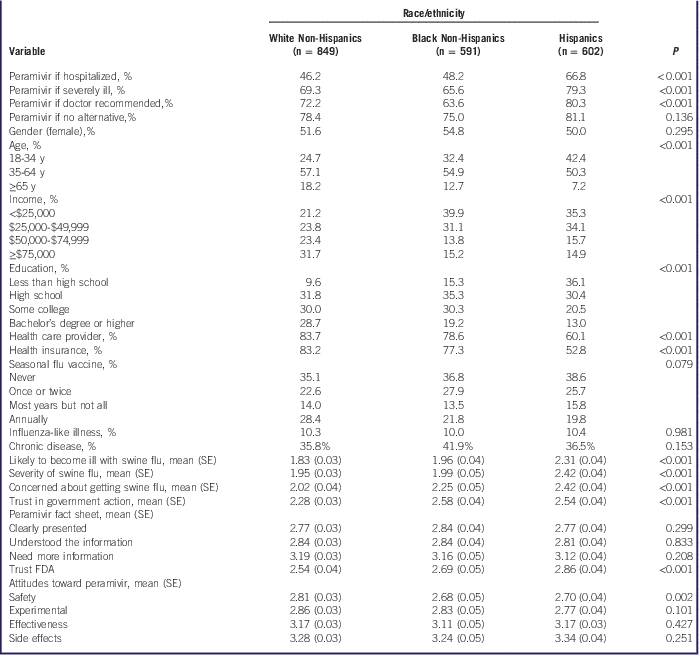
There were significant differences in age, income, education, health care provider, and health insurance between the groups (Table 1). Minorities were younger, had lower income, had less education, and reported less access to health care providers and health insurance than did whites. Furthermore, Hispanics were more susceptible to H1N1 flu than were whites. Blacks and Hispanics had higher trust in government than did whites.
Descriptive Statistics of Variables by Race/EthnicityFootnote a

a FDA indicates Food and Drug Administration.
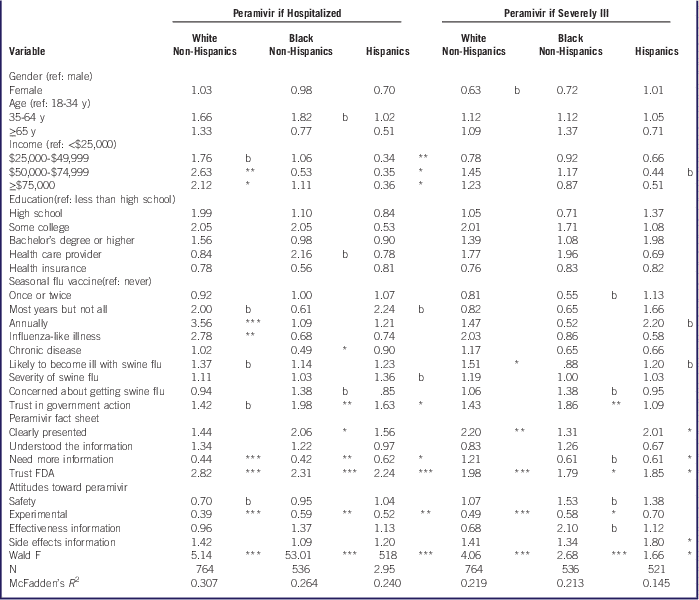
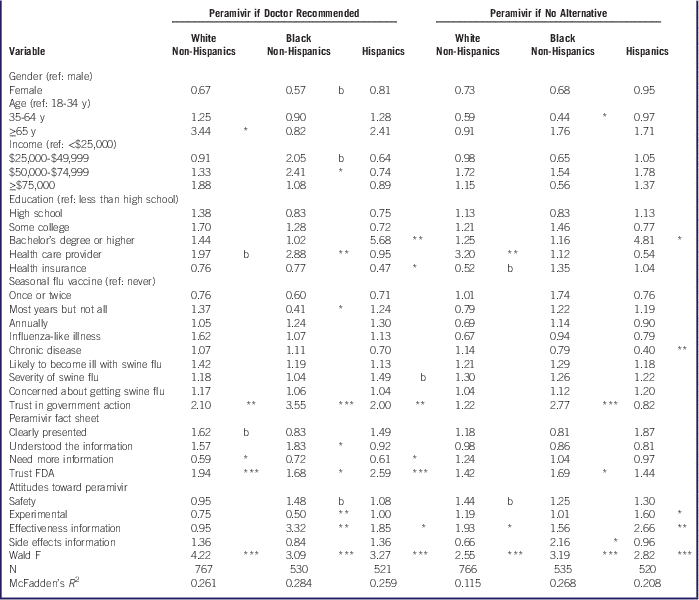
We examined predictors by race/ethnicity for willingness to take peramivir under the following conditions: (1) if hospitalized, (2) if severely ill, (3) with a doctor recommendation, and (4) with no alternative (Tables 2 and 3). There were significant differences between racial/ethnic groups in the proportions of participants willing to take peramivir if hospitalized, if severely ill, and if their doctor recommended it. Hispanics were more likely than any other group to take peramivir under these conditions. The difference in the proportions ranged from about 8% to 19%. However, there was no significant difference between groups in the proportion of participants willing to take peramivir if there were no alternatives. Overall, the likelihood of taking peramivir increased across the conditions from “hospitalized” to “severely ill” and from “if doctor recommended” to “no alternative” for all groups. Hispanics also had higher trust in the FDA than did any other group. Whites had higher safety concerns about peramivir than both blacks and Hispanics. There were no other significant differences between groups in their perceptions of the peramivir fact sheet or in their attitudes toward peramivir.
Odds Ratio of Predictors for the Use of Peramivir if Hospitalized and Severely Ill by Race/EthnicityFootnote a

a FDA indicates Food and Drug Administraion. *P<0.05, **P<0.01, ***P<0.001.
bRefers to nearly significant findings with P<.10.
Odds Ratio of Predictors for the Use of Peramivir if Doctor Recommended and No Alternative by Race/EthnicityFootnote a

a FDA indicates Food and Drug Administraion. *P<0.05, **P<0.01, ***P<0.001.
bRefers to nearly significant findings with P<.10.
For whites, there were 4 significant predictors with large effects for 3 of these 4 situations (hospitalized, severely ill, and doctor recommended). In the context of no alternative, we found a medium effect. Higher-income whites and individuals over 65 were more likely to indicate willingness to take the drugs than were lower income whites or younger adults. White participants who took the seasonal flu vaccine annually were more likely to take peramivir than were those who had never received a seasonal flu vaccine. Last, whites who had influenza-like illness were more willing to take the drug than were those who did not report experiencing influenza-like illness. White participants with a regular health care provider were also more likely to take peramivir.
Whites who trusted the FDA, trusted government action, and reported that the peramivir fact sheet was clearly presented were more willing to take peramivir if their doctor recommended it or if they were severely ill. Whites who felt they needed more information about peramivir were less willing to take the drug under all conditions except when they had no alternative. Whites who were worried about the term experimental in describing peramivir were also less likely to take the drug.
For blacks, there were significant predictors of willingness to take peramivir under the 4 conditions (Tables 2 and 3). There were large effects for all 4 conditions. Blacks with middle income ($50,000-$75,000) were more likely to take the drug than were those with lower income. Those with regular health care providers were more likely to take the drug. Blacks who received seasonal flu vaccine most years but not all were less likely to take peramivir even if their doctors recommended it. Middle-aged (35-64-year-old) participants were less likely to take peramivir than were younger participants.
Across all conditions, black participants who trusted the FDA and trusted government action were more likely to take the drug. However, the use of the term experimental decreased willingness to take the drug across all 4 conditions. Needing more information was also associated with decreased willingness to take the drug, even if hospitalized. Of particular note, blacks who had chronic diseases were less willing to take the drug across all conditions. Blacks who trusted the FDA, trusted government action, understood the peramivir fact sheet, and thought the information was clearly presented were more willing to take the drug if their doctor recommended it. In the context of having no alternative, blacks who trusted the FDA and trusted government action were more likely to take the drug even if they needed more information about the side effects.
For Hispanics, there were significant predictors of willingness to take peramivir under the 4 conditions with large effects for 3 of the 4 conditions (hospitalized, severely ill, and doctor recommended; Tables 2 and 3). Middle- and high-income Hispanics were less likely to take peramivir if hospitalized than were lower-income (<$25,000) Hispanics. Hispanics with a college education were more likely to take the drug than were those with less than a high school education.
For the condition “if no alternative,” we found a medium effect. Hispanics who felt they needed more information were less willing to take the drug, even if hospitalized. However, those who trusted the FDA and trusted government actions were more willing to take peramivir if hospitalized. Hispanics who were worried about the term experimental were less likely to take the drug even if they were severely ill. Hispanics who trusted the FDA, needed more information about side effects, and reported that the peramivir fact sheet was clearly presented were more willing to take the drug.
When their doctor recommended peramivir, Hispanics who trusted the FDA, trusted government actions, but needed more information about the effectiveness of peramivir were still more willing to take the drug. Participants who felt they needed more information about peramivir were less likely to take the drug. Interestingly, those with health insurance were less likely to take peramivir.
Under the condition of no alternative, needing more information about the drug’s effectiveness and worry about the term experimental did not negatively impact willingness. Still, participants with chronic diseases were less likely to take the drug.
Overall, similar effects of the peramivir fact sheet and attitudes toward peramivir were observed between the 3 groups. Higher levels of trust in the FDA led to a greater likelihood of taking peramivir under the 4 conditions. The term experimental led to less likelihood of the participants taking the drug for all groups under all conditions except for Hispanics when there were no alternatives. Unlike other groups and conditions, Hispanics were paradoxically more likely to take the drug when their concern about the term experimental increased. The impact of information about the effectiveness of peramivir was stronger among minorities than among whites. The most noticeable differences between groups were in these variables: income, education, seasonal flu, and trust in government action. As income increased for whites, they were more likely to take peramivir if they were hospitalized. However, for Hispanics, the opposite effect was observed; as income increased, they were less likely to take the drug. Education had a significant effect for Hispanics but not for the other two groups. Some reverse effects were observed between whites and minorities on chronic diseases.
Limitations
Owing to insufficient numbers of other racial and ethnic groups to allow for subgroup analyses, our results focused on the 3 largest racial and ethnic groups in the United States: whites, African Americans, and Hispanics.
DISCUSSION
In this study, there was significantly more acceptance of peramivir as an EUA drug than we found of another unapproved EUA anti-viral drug, oseltamivir (Tamiflu).Reference Quinn, Kumar and Freimuth 9 In the previous study, our finding that 54.4% of respondents would definitely or probably accept oseltamivir for themselves and that 48.8% would definitely or probably accept it for their child is more consistent with the proportion of those who would accept peramivir in this study. This suggests that once people are ill, and severely ill, their willingness to assume any risk that might be inherent in an EUA drug, particularly peramivir (which is an unapproved experimental drug), is influenced by the severity of their illness and their trust in their physician. However, interestingly, both blacks and Hispanics with reported chronic disease diagnoses were less likely to take the drug, which is problematic given that a higher burden of chronic disease can increase susceptibility to complications from influenza, thus potentially prompting the need for the EUA drug. Given that those with chronic disease may also be concerned about medication interactions and disease exacerbation, this finding suggests that these persons may have a real need for specific information before making a decision on acceptance of peramivir.
Although blacks and Hispanics had higher levels of trust in government action during the pandemic than did whites, this difference was not statistically significant.Reference Quinn, Parmer and Freimuth 18 However, trust in government action was a strong predictor of willingness for blacks across all conditions and for Hispanics in 3 conditions, but only for whites when coupled with a physician recommendation. For all groups, a higher level of trust in the FDA was a powerful predictor of willingness. Although it is not surprising that trust in the FDA is associated with willingness to accept peramivir, this finding suggests a stronger role for the FDA in communication about this drug and EUAs in general with both health care providers and the public. In a study of vaccine acceptance during the pandemic, Quinn et al found that the quality of communication and trust in government actions and spokespersons contributes to vaccine acceptance.Reference Quinn, Parmer and Freimuth 18 These current findings about trust in the FDA are further confirmation of the FDA’s efforts to strengthen emergency communication, particularly with minority populations. 19
The role of information in decision-making is important. Having a clear understanding of the fact sheet positively affected willingness for blacks across all conditions; for whites and Hispanics, however, information had a more limited impact. Additionally, we found that Hispanics were more likely to accept peramivir despite the fact that 71% of Hispanics, compared with 72% of African Americans and 79% of whites, understood the drug information. Needing more information on the drug and its side effects significantly decreased willingness to take the drug for all groups, particularly when hospitalized, but became less important when the participants had no alternative.
In the context of peramivir, some information was available on the fact sheet for the patient. However, we must exercise a word of caution about the fact sheet, and potentially any fact sheet in a similar EUA context. In a preliminary readability assessment of the fact sheet language, the grade levels were 12.6 on the Flesch Grade Level Readability Formula, 16.8 on the Fog Scale Index (which considers between 7 and 8 to be ideal), and 49.69 on the Flesch Reading Ease Readability Formula (for which the closer the number is to 100, the more easily read). The poor readability scores demand extra vigilance in ensuring that the information is clear and accessible to patients whose reading ability is more limited, either due to lower education or language proficiency. Additionally, when physicians are working with patients for whom English is a second language, the possibility of communicating through interpreters will require even more effort to ensure that the information is clear. To reach diverse patients requires attention to translation, whether of verbal or written communication, as well as demonstrating sensitivity to the beliefs of those populations.Reference Vaughan and Tinker 20
It is also essential that future fact sheets be produced in accordance with the Plain Writing Act of 2010. 21 Because the patient being offered peramivir is critically ill, it is essential that physicians talk through the fact sheet with the patient or family members and elicit questions and concerns. The stress of facing a critical illness may impede the patient’s or the family’s ability to process the complexity of the EUA, placing a significant burden on physicians to provide opportunities for patients and families to deliberate on their decision.
The desire of respondents for more information on peramivir and its side effects is by definition a challenge. For peramivir, the very limited clinical trials reduced the amount of information available at the time of approval as an EUA. However, by definition, there may not be specific information available on side effects for many potential EUA drugs. That makes the weighing of risks and benefits difficult for any patient, particularly one who is already quite ill. It also means that patients and their families may find themselves weighing not the risk-benefit of the drug itself but the risk of the drug compared to the risk of severe disease or death. This calculus may also be a consideration in the use of other EUA drugs in a future emergency.
Similarly, the use of the term experimental, while necessary and accurate, presented real impediments for willingness among whites under 2 conditions but for blacks across all 4 conditions. Among Hispanics, however, this factor was not significant with a doctor’s recommendation or with no alternative treatment. Having a future EUA drug labeled in a similar way is certainly possible, and extra care will need to be taken to alleviate patient or public concerns about the drug’s experimental nature. This is especially relevant for African Americans for whom the term experimental may hold particular cultural significance owing to the legacy of the US Public Health Service study of syphilis at Tuskegee, fears of experimentation, and distrust of research.Reference Freimuth, Quinn and Thomas 22 - Reference George, Duran and Norris 23 Consequently, this may require that physicians explicitly elicit any concerns and address them straightforwardly.
Having a recommendation for the drug from a personal physician was a predictor of acceptance of peramivir, a finding with several implications. First, the CDC, the FDA, and professional organizations must have strong communication mechanisms in place to keep physicians informed on EUAs during an emergency. However, this finding also suggests that vulnerability at the time of crisis places a burden on physicians to ensure that they are fully knowledgeable and conversant in the risks and benefits of peramivir, or any other EUA drug, and are able to communicate these effectively to their patients.
That Hispanics were more likely to accept peramivir across all models raises several questions. Is there more of a cultural acceptance of medications, particularly with the physician’s recommendation, that may make Hispanic patients more compliant? If so, the burden shifts to physicians to ensure adequate patient and family understanding of peramivir, or in another emergency other potential EUAs, so that patients can make informed decisions about drug acceptance.
CONCLUSIONS
Although the public health emergency and the approval of peramivir as an EUA have ended, 13 , 24 future threats will necessitate the use of other EUA drugs or vaccines. Strong communication between agencies and providers, between the CDC and the FDA and the public, and between providers and patients is critical to ensure that the benefits of these EUAs are realized in the time of crisis. More research is necessary to understand the cultural and demographic reasons behind differences in EUA acceptance and to ensure that clear, consistent communication fosters trust in the EUA recommendation and the responsible governmental bodies, the FDA and the CDC.
Acknowledgements
This study was supported by Public Health Adaptive Systems Studies, a Centers for Disease Control and Prevention Preparedness and Emergency Response Research Center, CDC Grant no. 1P01TP000304-01 (PI, Potter). At the time of the study, Dr Quinn was also supported by the Research Center of Excellence in Minority Health and Health Disparities (NIH-NCMHD: P60MD000207; PI, Thomas). Drs Quinn, Freimuth, and Hilyard are currently supported by the Center of Excellence in Race, Ethnicity and Health Disparities Research (P20MD006737; PI, Thomas and Quinn). The opinions expressed by authors contributing to this article do not necessarily reflect the opinions of the Centers for Disease Control and Prevention or the institutions with which the authors are affiliated. The content is solely the responsibility of the authors and does not necessarily represent the official views of the National Institute on Minority Health and Health Disparities or the National Institutes of Health.
The authors acknowledge the invaluable contributions of Dr Kevin Kim, our colleague who played a critical role in analysis for this paper and many others. Dr Kim died unexpectedly in July 2014. We also acknowledge the assistance of Dr Leah Curran and Ms Erica Casper on the final production of this manuscript.