Much dismay has been expressed about the quality of democratic processes in the world's newer democracies. These new democracies, according to many observers, are not functioning in the way that democracies should. Whether these failings are the result of inexperience with democracy, cultural inheritances or economic circumstances, their existence challenges the significance of the worldwide democratic resurgence. How consequential is a democratic transition if the new democracies do not function very democratically?
A good deal of the lamentation about low quality democracies, however, relies on anecdotal evidence. It is certainly not hard to find individual examples of democratic shortcomings in post-communist Europe or Latin America in the form of public officials who repudiate their campaign promises or ignore public opinion.Footnote 1 But a general assessment of the quality of new democracies must rely on more systematic evidence. This article attempts to provide exactly such evidence for post-communist Europe.
It focuses on an aspect of democratic quality that has long been held up as the key indicator of how a democracy is functioning. This is policy responsiveness. Responsiveness refers to the degree to which policy choices follow public preferences. Democracy should produce exactly such responsiveness. By allowing citizens to render verdicts on sitting officials, democracy gives these office-holders a strong incentive to provide policies that the public wants.
Yet one can imagine a variety of reasons why responsiveness would not follow from democratic elections, particularly in new democracies. Unused to participating in politics, citizens may not hold clear views to which politicians can respond. For the same reason, they may not be able to hold politicians accountable at elections, reducing the incentives for responsive policy making. Politicians, for their part, may ignore citizens – even if it costs them in elections – because they are constrained by a weak economy, international pressures or the need to pay off supporters. They may also be able to win elections without responsiveness by means of fraud or vote buying. All of these phenomena are common in new democracies.
This article attempts to provide a systematic assessment of policy responsiveness in post-communist Europe. It tries to determine whether these cultural, social and political legacies of authoritarian rule limit responsiveness or whether newly-instituted democratic elections give politicians a strong enough incentive to follow public preferences. It does this by looking at one of the central issues in these countries, the transition from a centrally planned to a market economy. It asks whether the rate of economic reform is associated with public support for reform. Are politicians responsive to public preferences about the pace of economic reform, or does reform follow different dynamics?
The theory of responsiveness
Responsiveness refers to the relationship between policy choices and citizen preferences. A government is responsive if it adjusts policy in accord with changes in public opinion. As more citizens come to favour lower taxes, for example, responsiveness implies that politicians will subsequently lower taxes.
Responsiveness has often been proposed as the most fundamental indicator of how well democracy works. At its most basic, democracy is a system of government where the people rule. If the people are ruling, we would thus expect their policy preferences to determine policy. As Dahl writes at the start of perhaps the most cited work in democratic theory, ‘a key characteristic of a democracy is the continuing responsiveness of the government to the preferences of its citizens, considered as political equals.’Footnote 2
The same result derives from a consideration of the incentives inherent in modern representative democracy. The institution of free and fair elections gives elected officials a strong incentive to consider citizens’ policy wishes. Ignoring the public is likely to lead to electoral defeat. All else equal, citizens prefer politicians who consider their preferences over ones who do not. Politicians concerned with retaining office are thus likely to pay close attention to public opinion.
Responsiveness, however, is not an unimpeachable ideal. There are situations where we would prefer less responsiveness. When citizens are systematically misinformed about the consequences of policies, responsiveness can lead to outcomes detrimental to human welfare.Footnote 3 This situation is often said to characterize the domains of foreign policy and national security as well as other technical issues. Better policy, however, requires not only politicians who are better informed, but those who are willing to act on their better information. And there are good reasons to believe that politicians might pursue their own interests if freed from links to the public.
There are ways that relatively uninformed citizens could induce better policy. By retrospectively sanctioning poor performance, for example, they may give politicians an incentive to perform well. However, simple monitoring of aggregate performance (say, of the growth rate) means giving up control over individual policy choices and thus comes at a democratic cost. While responsiveness is a double-edged sword, it is hard to imagine conceptions of democracy that do not take it seriously.
Empirical approaches
Since it has been considered one of the hallmarks of democracy, responsiveness has attracted considerable scholarly attention.Footnote 4 Most initial work on responsiveness studied the phenomenon in terms of correspondence. It asked whether the beliefs or voting patterns of representatives matched the opinions of their constituents, a phenomenon known as dyadic representation, or whether the ideologies of parties matched the ideologies of their electorates, known as party representation.Footnote 5 The idea is that if representatives and their constituents have similar preferences, then policy will follow public opinion. Most of these studies have found reasonable levels of correspondence.Footnote 6
Studies in this tradition, however, suffered from a number of methodological problems.Footnote 7 One issue is endogeneity – it might be the case that politicians were influencing their districts or electorates rather than the other way around.Footnote 8 A second is the dependent variable. Most studies focused on legislators’ or parties’ ideologies or voting records rather than policy outputs; but to assess whether the people are actually ruling, actual policy is arguably the more important dependent variable. Even if all politicians vote in line with their electorates, the policies they produce may still be far from the preferences of the national public due to veto points or social choice issues. A final concern is the failure of these studies to include controls for such influences on legislative behaviour as economic conditions and interest group pressure.
Recent studies have tried to remedy these problems.Footnote 9 First, they have turned to time-series analysis as a way to avoid endogeneity; they ask whether opinion changes lead to policy changes. Responsiveness is an essentially temporal construct – politicians react to citizens’ preferences – and thus demands time-series analysis. The second innovation is the development of quantitative measures of policy outcomes. Pioneered by Mayhew's counts of landmark legislation, numerous scholars have found ways to quantify government outputs, avoiding the indirect or dichotomous measures of previous studies.Footnote 10 The seminal study combining these two innovations is Stimson, MacKuen and Erickson's ‘Dynamic Representation’, which found a high degree of policy responsiveness in the United States.Footnote 11 Other studies of the United States and Western Europe using similar techniques found reasonable levels of responsiveness.Footnote 12
A noteworthy fact about this entire literature is its focus on the established democracies. Only a handful of studies have considered responsiveness in less established democracies and all of them have focused on correspondence measures. Kitschelt and collaborators, for example, linked the opinions of party functionaries with the preferences of their parties’ electorates in four post-communist countries and found a high degree of correspondence.Footnote 13 Luna and Zechmeister followed similar methods in nine countries in Latin America and found variable degrees of correspondence.Footnote 14 The problem with these analyses is that they do not exclude reverse causality and they do not show that representatives actually enact policies that voters want. This article attempts to do precisely this.
Democracy in post-communist Europe
We focus in this article on the new democracies of post-communist Europe, which present an interesting contrast to the United States and Western Europe. Not only are these countries new democracies without recent democratic traditions, but they also face a daunting array of economic and political challenges in moving away from communism.Footnote 15 As such, they present a particularly interesting test case of the high degree of responsiveness found in studies of the established democracies.
Reading the area studies literature, one finds good reasons to be pessimistic about the degree of responsiveness in post-communist Europe. In the first place, many scholars have expressed doubts about whether mass publics in the region hold coherent preferences about policy.Footnote 16 They have little experience both with democracy and with the sort of issues about which they are called on to have opinions. They were also socialized under communist systems which taught them to be at best apathetic and at worst hostile to politics.Footnote 17 The flux of the transition exacerbated the problem. These countries have witnessed a massive reconstruction of their political economies as communist-era structures are discarded and free market ones put in their place. This created enormous uncertainty for citizens.Footnote 18 Finally, even if citizens were able to orient themselves and develop definite preferences, they might still lack the skills, time and energy to monitor politicians and hold them accountable for their actions, all preconditions for responsiveness.Footnote 19
The policy area that we focus on in this article – economic reform – is believed to put even greater constraints on responsiveness. As Greskovits points out, these countries were under enormous pressure to adopt the standard package of market reforms – liberalizing prices and trade and privatizing state-owned industry.Footnote 20 Such reforms produce considerable social pain, particularly unemployment and inflation, and are thus unpopular ex ante and likely to lead to a backlash ex post.Footnote 21 If governments end up adopting reforms, then they will almost by definition be in opposition to public opinion. Luna and Zechmeister in fact found a lower degree of party representation in Latin American countries that undertook drastic liberalization.Footnote 22 It is this contradiction between the necessity and unpopularity of reform which led many to recommend insulating executives from the public as the sole means of enacting reforms.Footnote 23 Governments closely tied to public opinion would purportedly either not begin reforms or cut them off as soon as they produced pain and hence opposition. Most democratic post-communist countries did engage in comprehensive reforms, leading to a presumption of non-responsiveness.
There are responses to all of these points. A number of studies of public opinion in the region have found voters to possess distinct preferences and, moreover, to be able to link these preferences to political parties.Footnote 24 Voting studies have further shown citizens to be capable of both retrospective economic voting and even more subtle prospective voting.Footnote 25 Thus, some form of monitoring is possible. Stokes has even suggested and provided some evidence for the hypothesis that voters might not oppose painful reforms; they might instead blame the old regime or understand that short-term pain leads to long-term success.Footnote 26 Finally, these countries are home to highly educated, urbanized and mostly middle-class citizens, who have the resources necessary to follow and understand politics.Footnote 27 In contrast to the case in many other new democracies, the majority of post-communist citizens are well equipped to participate effectively in politics.
Hypotheses
The main hypothesis we intend to test in this article is whether greater public support for economic reforms leads to faster reform. We focus on economic reforms because these were one of the most salient and consequential policies of the transition period. As such, they provide a particularly important test of whether responsiveness exists.
The most basic version of our hypothesis postulates a direct effect of public opinion on reform. This mechanism relies on politicians whose main goal is to stay in office. In order to remain in office, politicians need to maintain the support of voters and this means enacting policies that satisfy the public. Thus, we should see a consistent and strong relation between opinion and policy.
Hypothesis 1: Reform pace should change directly with public support for reform.
Since responsiveness is driven by the threat of losing elections, those countries where the threat is higher should have greater responsiveness. We believe that the degree of democracy is a proxy for this threat. In less democratic countries, incumbents have alternative means to remain in office besides gaining the favour of voters – for example, stuffing the ballot box or limiting media access to the opposition. Since non-responsiveness may not hurt their electoral prospects, they are likely to pursue goals other than responding to public opinion such as enriching themselves or their supporters. Since our dataset includes both more and less democratic countries, we can test this possibility by looking separately at these two groups.
Hypothesis 2: More democratic countries should exhibit greater responsiveness.
Responsiveness so far has been implicitly defined in terms of the median voter – policy should change only with changes in general public opinion.Footnote 28 Yet there has been much speculation that politicians in these countries are less responsive to the median voter than to elite groups who have captured the state and use it for their own purposes. These groups may exercise influence through campaign contributions, lobbying or outright corruption. No matter the cause, such a phenomenon challenges the basic idea of responsiveness to all citizens ‘considered as political equals’. It is important then to consider whether policy is differentially responsive to segments of the public.Footnote 29
Hypothesis 3: Reform pace will be more responsive to privileged social groups.
While the first hypothesis suggested a direct effect of public opinion on reform, a second mechanism of responsiveness sees changes in reform speed coming only through changes in government. In this view, elections play a decisive role. Governments are elected to pursue a particular mandate – to speed up or slow down reforms – and they pursue this mandate until they are removed from office. When a more reformist parliament is elected, the speed of reforms should increase and vice versa when a less reformist parliament is elected. This mechanism still predicts responsiveness, but is punctuated by elections. To test this idea, we look at whether reform pace changes with the composition of parliament.
Hypothesis 4: Reform pace increases with the strength of pro-reform parties in parliament.
We might also expect responsiveness to vary according to the electoral calendar. As elections approach, politicians should become more attentive to public preferences. This result follows from the fact that voters’ memories are short.Footnote 30 They tend to give greater weight in their vote choices to more recent events. With some qualifications, Canes-Wrone and Shotts find just such a result for the United States.Footnote 31
Hypothesis 5: Responsiveness increases as elections approach.
Finally, as Powell points out, political institutions may affect the degree of responsiveness.Footnote 32 Advocates of majoritarian democracy – characterized by a concentration of power in a single-party executive – claim that it is likely to achieve responsiveness because these governments have the power to enact the policies they wish and can also be held accountable for them. Conversely, division and dispersal of power may allow small groups to veto popular changes and governments to escape sanction. Advocates of consensus or proportional democracy, by contrast, argue that concentration of power can lead governments to stray from the public. They point out instead that division or dispersal of power will lead to more responsiveness by giving more actors a say in policy making. We have phrased our hypothesis here to reflect the majoritarian position, but our expectations are genuinely ambiguous.Footnote 33
Hypothesis 6: Responsiveness increases with the degree of majoritarian rule.
Data
Finding evidence for responsiveness poses a number of difficulties. In the first place, there is the matter of measuring policy outputs. Government outputs come in a startling variety of types and sizes. Moreover, not all governments work in the same way and therefore comparable cross-national measures are at an even greater premium. For an analysis of post-communist Europe, we would like equivalent measures for several countries because the post-transition period is short. We can gain leverage by supplementing time-series analysis with cross-national analysis.
We are fortunate in having two separate cross-national measures of policy outputs in post-communist Europe. Both the World Bank (WB) and the European Bank for Reconstruction and Development (EBRD) have produced measures of progress in economic reform in all post-communist countries.Footnote 34 These measures track annual changes on such reforms as price liberalization, trade liberalization, privatization of small retail services and privatization of large enterprises from the beginning of the transition.Footnote 35 These measures are the main dependent variables in our analyses (Reform Progress) and are widely analysed in studies of economic reform.
To measure responsiveness, we need to link these policy changes with comparable measures of public opinion on reform over time. The Central and Eastern European Barometer (a companion to the well-known Eurobarometer) fulfils these criteria.Footnote 36 It was conducted annually in nearly identical formats from approximately 1990 to 1997 in sixteen post-communist countries.Footnote 37 These countries are Albania, Armenia, Belarus, Bulgaria, Czech Republic, Estonia, Hungary, Latvia, Lithuania, Macedonia, Poland, Romania, Russia, Slovakia, Slovenia and Ukraine.Footnote 38 The scope of this survey delimits the dataset.
While most of the survey was devoted to issues related to the European Union, there was one question which captures citizens’ attitudes towards economic reform. The question's wording is as follows: ‘Do you personally feel that the creation of a free market economy, that is, one largely free from state control, is right or wrong for [our country's] future?’ Taking the difference between the share of respondents who answered ‘Right’ and ‘Wrong’ produces a measure of support for reform (Public Support).Footnote 39 While this question does not specifically ask about support for each of the policy changes in our output measures, it does gauge general support for the progress of reform. Indeed, all of the components of our policy variable measure the steps to achieving a free market economy.Footnote 40
Levels of support for the free market varied widely in the region, from a maximum of +74 per cent to a minimum of −55 per cent with an average +13 per cent.Footnote 41 The positive average is noteworthy. More citizens in the region favoured a free market economy than opposed it. Contrary to expectations, economic reform could achieve popularity in the region.Footnote 42
Though our focus is on the degree of responsiveness to public opinion, we also need to control for other variables that may affect the pace of reform. Here, we relied on the large existing literature on the political economy of reform.Footnote 43 Past reform – the lagged dependent variable – should affect current reform. Past reforms may either encourage future reforms – reform is said to create winners who then support reform more enthusiastically – or discourage reform either because it causes social pain or because winners want to protect their privileged positions as Hellman hypothesizes.Footnote 44 Including a lagged measure of reform also helps to deal with autocorrelation in the data.Footnote 45
A number of economic variables should also affect reform. Previous work has found that higher unemployment, higher inflation and lower growth reduce the pace of reform indirectly by reducing public support for market reform or directly by creating economic constraints on reform.Footnote 46 Data on these variables are drawn from the World Bank, the EBRD and the World Income Inequality database.Footnote 47
Reform and public opinion
We begin our analysis with simple correlations between the main variables that interest us. Looking at all sixteen countries, we find a reasonably strong and significant correlation between public support and changes in the reform scores.Footnote 48 For the World Bank data, they are correlated with each other at r = 0.22 (p < 0.05) and for the EBRD data at r = 0.14 (p = 0.16), suggesting that public opinion and reform may move together.
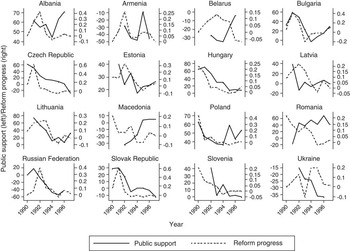
Figure 1 shows a simple graph of public support and changes in reform scores for all sixteen countries and the World Bank measure of reform.Footnote 49 In most cases, an eyeball test shows a fair correspondence between support for reform and actual reforms. The typical case shows high reform support and high progress at the beginning of the transition, with both declining over time. The weakest fits appear to be in less democratic countries like Albania, Armenia, Belarus, Macedonia, Romania and Ukraine.
Public support and reform progress (World Bank measures)

These simple relationships, however, may not reflect a true association after we have controlled for an array of factors that determine support for reforms and reform progress. They may also mask reverse causation – reform may affect public opinion as well as vice versa.
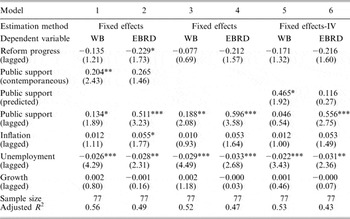
In beginning to assess the nature of the association, we estimated fixed effects regressions of our two measures of reform progress on lagged measures of reform progress and contemporaneous and lagged public support.Footnote 50 Public opinion may affect reform instantaneously or only with a lag.Footnote 51 As controls, we included lagged unemployment, growth and inflation.Footnote 52 The country fixed effects control for time-invariant heterogeneity across countries. Countries may differ in ways that we cannot observe but which may affect reform rates. Table 1 presents the results. Models 1 and 2 show that public support is a significant predictor of reform for both measures of reform. Greater support for the free market is associated with higher rates of reform.Footnote 53 Curiously, the effect is through contemporaneous public opinion for the World Bank measure of reform and through lagged opinion for the EBRD measure. We suspect this may be due to timing issues in the measures.Footnote 54 Among the control variables, only unemployment has a significant effect on reform rates. High unemployment discourages reform.
Effect of Public Support on Reform Progress

Notes: Absolute t-values in parentheses. ***significant at p < 0.01, **significant at p < 0.05, *significant at p < 0.10. Fixed effect robust estimation was obtained by applying a robust option to demeaned variables in each country for all models. In this way, estimation results were corrected for heteroscedasticity. In Models 5 and 6, standard errors bootstrapped with a repetition of 1,000 times to correct for instrumental variable bias. Constants are not reported.
As we mentioned above, endogeneity poses a problem for these results. Contemporaneous public opinion may be jointly determined by reform. Models 3 and 4, therefore, use only lagged measures of public opinion. The results are similar. Public opinion again exerts a positive and significant influence on reform.
Simple lags, however, may not be a strong enough control for endogeneity. We thus turn to two-stage least squares (2SLS) estimates. We first estimate the determinants of support for the free market and then use these models to produce an indicator of public support that is exogenous to reform. Following the literature, we modelled support for the market as a function of the economic variables we used above plus the level of income inequality (measured by the Gini coefficient).Footnote 55 We use inequality as an instrument because it should be exogenous to reform – governments do not introduce reform due to changing levels of inequality – but related to public support for reform.Footnote 56
As expected, higher inflation, unemployment and greater inequality all reduce support for a free market economy. These variables do a fairly good job of explaining differences in support for reform, with R 2s reaching 0.45. This in itself is noteworthy: public opinion in the region is not incoherent, as has been claimed, but can be explained with a small number of economic variables. Using these regressions, we then produce exogenous estimates of public support for the market. We use these estimates in the second phase of estimation.
Models 5 and 6 in Table 1 present the results of the second stage. To control for biases in standard errors with the instrumental variable approach, we relied on bootstrapping.Footnote 57 Again, we see that public support is a significant predictor of reform rates for both measures of reform.Footnote 58 As before, we see that contemporaneous public support leads to faster reform in the models that used World Bank measures while public support in the previous period is positively correlated with reform progress in the models using EBRD measures. Unemployment again slows reform.
The size of these effects is also large. A one standard deviation increase in public support raises reform rates by approximately 0.04 points on a 0 to 1 scale, which is equal to the median reform rate in the sample. Only unemployment has a larger effect on reform rates with a one standard deviation increase in unemployment reducing reform by 0.08 points. At least in the area of economic reform, politicians listen closely to the public.
Democracy and responsiveness
A surprise in these results was that responsiveness applied across the entire region. While there are strong theoretical reasons for expecting democracies to be responsive, there are fewer for expecting non-democratic governments to follow public opinion. To consider the effect of democratic institutions on responsiveness, we first divided the sample into two groups: democracies and non-democracies, as determined by the Freedom House scores for the country.Footnote 59 We labelled a country-year as democratic if a country's Freedom House score was 2.5 or less in that year; that is, it was rated as free. Though we consider continuous distinctions below, this division of post-communist Europe into two groups has been widely noted in the literature.Footnote 60 Scholars frequently point to the large differences between the consolidated democracies – those who quickly achieved standards of human rights and democratic norms comparable to the West – and those who continue to have less than free elections and insecure protection of human rights.
The correlations between public support and reform progress are very different between the two groups. While the correlation coefficients for democracies are higher than previously (r = 0.40, p < 0.05 for World Bank data and r = 0.28, p < 0.05 for EBRD data), for non-democracies they are considerably lower and far from significant (r = 0.09 for World Bank data and r = 0.06 for EBRD data). Similarly, in the eight countries which entered the European Union (EU) in 2004 and are widely regarded as the most successful reformers, support for a free market economy averaged +26.0 (s.e. 2.9). By contrast, in the remaining eight countries, all of which were slower and less thorough reformers, support for a free market averaged only −2.6 (s.e. 5.5). It appears that the more successful reformers enjoyed greater support for reform.
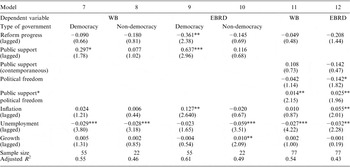
A better test of the responsiveness hypothesis repeats our regression analyses separately for these two groups. Table 2 shows that public support continues to be a strong and significant (though at a slightly lower level of confidence) predictor of reform in democracies, but a weak and insignificant predictor in non-democracies. This result applies whether we use fixed effects with simple lags (presented below) or more complicated 2SLS and Generalized Method of Moments (GMM) models.Footnote 61 The results were even stronger if we estimated using all years of the ten new members of the European Union rather than only the fully democratic years. This addition, however, reduced the sample size of the non-democracies. Models 11 and 12 in Table 2 replace this dichotomous distinction with the continuous seven-point Freedom House scores and these scores are interacted with our measure of public support.Footnote 62 The positive and significant results on the interaction term again indicate that responsiveness increases with democracy.
Effect of Public Support in Democracies and Non-Democracies

Notes: Absolute t-values in parentheses. ***significant at p < 0.01, **significant at p < 0.05, *significant at p < 0.10. Results corrected for heteroscedasticity. Fixed effect robust estimation was obtained by applying a robust option to demeaned variables in each country for all models. In this way, estimation results were corrected for heteroscedasticity. Constants not reported. In Models 11 and 12, we orthogonalized public support and political freedom in order to purge the part highly correlated with the interaction term between public support and political freedom.
The strong effect of public opinion on reform found in the full sample then appears to be concentrated mainly in the most democratic countries. In less democratic countries, by contrast, the effect of public support on policy is weak. This confirms the idea that it is democracy rather than some other factor that causes responsiveness and comports with democratic theory, which argues that regular elections provide strong incentives to politicians to follow public opinion.
The effect is again substantively large. A 10 per cent rise in predicted reform support in democratic countries increases reform progress by 0.05, which is greater than the median of reform progress per year across countries and larger than the effect for the entire sample. This implies that a country can achieve an increase equal to the median of reform progress with only a 10 per cent increase in reform support without a change in any other factor. As an illustration, Latvia, whose annual average reform speed was 80 per cent of the Czech Republic's over this period, could have achieved the same speed as the Czech Republic with an increase in public support from 3 per cent to 16 per cent.
Responsiveness to whom?
Given that most of the effect of public opinion is concentrated in democratic countries, we confine the following analyses to the ten countries that were most consistently democratic and have since entered the European Union.Footnote 63 Our results above suggest that politicians are responsive to something like median public opinion in a country. We measured public opinion as the average support for a free market. Yet there has been much speculation that politicians in these countries are less responsive to the median voter than to upper-class groups who have captured the state and use it for their own purposes.Footnote 64 These groups may exercise influence through outright corruption or through more subtle lobbying and campaign contributions. No matter the cause, such a phenomenon challenges the basic idea of responsiveness to all citizens ‘considered as political equals’.
To determine whether there is an upper-class bias in post-communist Europe, we recalculated our public opinion variable for several demographic groups. In particular, we looked at education and income. We thus calculated the net support for a free market economy for citizens with less than a secondary education and for those with a university education as well as for the top and bottom income quartiles.Footnote 65 These are reasonable proxies for the major class divides in these societies.
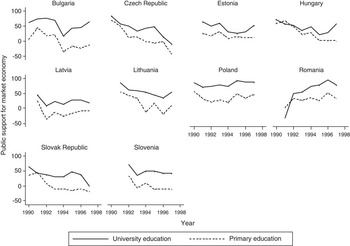
Figure 2 shows the trends in public support for high and low educational attainment in all ten countries. A simple visual inspection suggests that in most cases public support covaries across different demographic groups.Footnote 66 Simple correlations confirm this. The opinions of university and primary educated respondents are correlated at 0.72 (p < 0.01) as are the opinions of the top and bottom income quartiles. Correlations of these groups with the average are even higher – ranging from 0.84 to 0.92. The fact that there is a common trend for all demographic groups suggests that if policy is responsive to average opinion, then it is responsive to all groups.
Public support by educational groups

To push this conclusion farther, we repeated our regression analysis above substituting our newly created opinion variables for average opinion. The results (not shown) confirmed the correlation analysis. For both the income and education measures, the coefficients and standard errors for the two groups were of nearly the same size and their long-run effects were similar. In fact, the coefficients on the variables for the primary school graduates were slightly larger than for university graduates though the long-run effects were again similar. For all four groups, public support had a positive and significant effect on reform.
In short, we found little evidence that policy follows upper-class opinion more than lower-class opinion. It is possible that we have focused on too large an upper-class slice.Footnote 67 It may be a much smaller group that is controlling policy. Yet the fact that the opinions of voters with only a primary education and in the lower quartile of the income distribution have significant effects on reform progress casts doubt on this view.
It is, however, worth noting that upper-class groups were almost uniformly more in favour of the free market than lower-class groups. The average difference between the groups is 35–40 percentage points on a scale of −100 to +100. This is a fairly large difference. It may be possible that the generally high rate of reform in East Central Europe is a consequence of responsiveness to those in the upper classes who are more favourable to reform, but the changes in reform progress are a consequence of responsiveness to all groups.Footnote 68 We cannot assess this possibility because we do not know the true desired rate of reform across different groups, but it should not be neglected. A more complete test of this hypothesis might consider opinions on specific policy options across social classes in the manner of Gilens or Bartels.Footnote 69
Party types, electoral calendars and institutions
We now begin to probe whether the mechanisms laid out in Hypotheses 4–6 affect responsiveness, again focusing on the ten democracies.Footnote 70 We first look at Hypothesis 4, which suggests that changes in the rate of reform are related more to changes in the parties represented in parliament than to changes in public opinion.
Our main measure of parliamentary composition relies on the ratings of party families compiled by Bugajski.Footnote 71 We use party family because it is exogenous to reform rates.Footnote 72 Most alternative measures of ideology are based at least partially on observed behaviour in office and, therefore, are likely to be endogenous to reform.Footnote 73 Party family, by contrast, is an affiliation chosen at a party's birth and thus should be exogenous to its subsequent actions. We defined our reform party variable as the percentage of seats held by liberal and Christian democratic parties (who should support reform) minus the percentage of seats held by socialist and communist parties (who should oppose it).Footnote 74
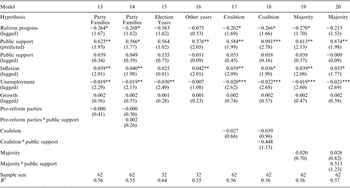
Table 3 presents the results of these regressions using the two-stage least squares (2SLS) technique and World Bank reform scores. Model 13 shows that the reform party variable was far from significant. Its size was also close to zero, indicating a weak substantive effect as well. In Model 14, we examined an interaction between reform party and public support with similar insignificant results. Public support meanwhile remained a significant predictor of reform in these estimations. The effect of public support on reform appears to be direct rather than indirect. Governments respond to the public regardless of their ideological proclivities.Footnote 75
Party Families, Electoral Calendar and Government Types

Notes: Dependent variable is World Bank measures of reform. Absolute t-values in parentheses. ***significant at p < 0.01, **significant at p < 0.05, *significant at p < 0.10. Fixed effect robust estimation was obtained by applying a robust option to demeaned variables in each country for all models. In this way, estimation results were corrected for heteroscedasticity. Standard errors bootstrapped with a repetition of 1,000 times to correct for instrumental variable bias for all models. Constants not reported. In Model 20, we orthogonalized the interaction term between majority and public support in order to purge the part highly correlated with each other (correlation coefficient 0.834).
In Models 15 and 16, we tested Hypothesis 5 about the effect of election proximity. We first divided the sample into two parts: pre-election years (election years and the year before elections) and other years. While we expected higher responsiveness in the pre-election period, in fact we see in Model 15 that public support is only a weak predictor of reform in that period. By contrast, Model 16 shows that earlier in the term, public support has a significant impact on reform.Footnote 76
To explain this apparent anomaly, we would point to the fact that reform has a negative effect on output in the present.Footnote 77 As a result, politicians may be hesitant to introduce reforms in a pre-election period because the positive effects of responsiveness are outweighed by the negative effects of lower growth and higher unemployment. Reform does, however, have positive consequences in the longer run. Politicians may thus be more willing to introduce reform soon after elections in the hopes that growth will resume before the next elections.
We considered one other timing issue in reform – whether responsiveness changed over time. Was it simply a product of the period of ‘extraordinary politics’ early in the transition or did it continue into the later period of more ‘normal’ politics.Footnote 78 We thus isolated the 1993–97 period and found that public support was a significant determinant of reform even in this period (results not shown).
We now turn to Hypothesis 6, which suggests that institutional factors may affect reform. To capture the consensus/majoritarian distinction, we focused on whether governments held a majority and whether they featured multiple parties. These were the main institutional differences among these countries. Though other institutions like separation of powers, bicameralism and federalism could potentially affect the opinion–policy link, they were all either weak or non-existent in the region's democracies.Footnote 79
In Models 17 and 19, we include dummy variables for whether a coalition or majority government held power for the greater part of a given year.Footnote 80 Though the signs of the coefficients on these variables favour the majoritarian side – coalition governments enact fewer reforms and majority governments more – their effects are far from significant. In Models 18 and 20, the same applies to an interaction between government type and public support, which is similarly insignificant. Government type does not have a strong effect on reform rates. We should note that public support remains significant in all of these regressions.
These results are somewhat surprising, since we expected that majority and single-party governments would be better able to promote reform when public opinion is supportive. We suspect that parties in opposition may support reform because the government will lose popularity for poor economic performance in the short run, while the opposition can reap the benefits of these reforms in the longer run. Alternatively, opposition parties may listen to the same public opinion signals as the government; opposing reform may carry political costs when reform is popular.
Conclusion
The main results show a considerable degree of policy responsiveness in the democratic countries of post-communist Europe. Even though we looked at the period directly after the transition when democratic institutions were brand new and at a policy area believed to show limited responsiveness, we found that public officials calibrated the rate of economic reform to public opinion quite well. This responsiveness, moreover, appears to be a direct result of public opinion rather than being mediated by the composition of parliament or the proximity of elections.
These results are rather unexpected considering general doubts about the quality of these new democracies. They suggest that some of this pessimism is misplaced and that the incentives of democratic elections can work very quickly. Soon after the transition, we find democratic governments listening closely to the views of their citizens. In short, the quality of these democracies may be considerably higher than is generally believed.
These results also have important implications for the political economy of reform. In particular, they lead to two policy recommendations. First, since reform proceeds most quickly when the public is behind it, politicians should view manifestations of public support as their window of opportunity to introduce reforms. If, for exogenous reasons, support for reform rises, politicians would be well advised to strike while the iron is hot.
The second, and perhaps more important, implication is that political leaders should do their best to persuade the public of the beneficial consequences of reform. Though we do not have systematic evidence on this point, it is likely that such persuasion did play a role in some of the cases here. Charismatic leaders like Václav Klaus may have been able to convince the public that reforms were for the best. More research is needed on this point.
We would note that these implications are quite different from standard accounts of the political economy of reform. Those accounts argue that politicians should be insulated from the public, perhaps by curtailing democracy, in order to get reforms passed.Footnote 81 While our findings support this implication if publics are permanently opposed to reform, they do not if the public may come to support reform, as happened in post-communist Europe. Other theories argue that an ideologically committed government is necessary for reform. We found, however, that it is the public more than the configuration of parties which affects reform. Our results, however, do support studies that see democracy as beneficial for reform.Footnote 82
Some caution needs to be exercised in extrapolating these results to other new democracies. In some respects, post-communist societies were well positioned to produce responsive politics. Particularly in the more democratic countries in the region, citizens were quite enthusiastic about rejoining the European Union, which entailed undertaking economic reforms. These countries also all had highly educated citizenries with a reasonably high standard of living. As such, they were capable of holding politicians to account for their actions. However, it is noteworthy that the legacies of a particularly repressive regime, often supposed to be all-powerful, did not eliminate responsiveness.
It is also important to consider how much these results can be generalized, even within the post-communist democracies. Does a similar level of responsiveness obtain in other policy areas? Though our evidence is confined to economic reform, our results do shed light on some issues. First, Druckman and Jacobs have asked whether politicians are ‘lumpers’ or ‘splitters’ – whether they respond to a general public mood or to opinions on particular issues.Footnote 83 In line with their conclusions, our results suggest the latter; it was opinion specifically about the economy that affected economic policy. Secondly, the evidence we presented comes from a difficult issue for the responsiveness thesis. Economic reform is generally considered an area where politicians must ignore the public. That we found responsiveness even here suggests that it may be more widespread in these polities. Yet economic reform was a highly salient issue and responsiveness may be stronger when issues are salient. It is thus important to consider responsiveness in somewhat less salient policy areas.
In short, there are a number of avenues along which scholars may extend the study of responsiveness. As perhaps the key standard of democratic functioning, more knowledge of this area is essential to our assessment of the quality of democracy in post-communist Europe and elsewhere. We have produced some of the first evidence that elected politicians in the post-communist region do respond to public opinion. We believe that this is a significant step forward in the study of democratic quality in the region, but it is only the first step.