“I left Tampa en route to St. James City on the S. S. Tarpon,” an enthusiastic sportsman wrote the popular outdoor magazine Forest and Stream, describing one of his angling adventures to southwest Florida's Charlotte Harbor. “The name of the steamer is significant, but one is not at all surprised at it. Tarpon is the order of the day. Everybody talks tarpon, villages spring up near its favorite haunts, and the people flock to them as to some ‘placer’ at the west.” The small frontier settlement of Fort Myers, for instance, owed its “present prosperity, mainly, to the ‘Silver King.’ Every branch of its trade is, more or less, influenced by the fishing industry. The hotels, with few exceptions, are more or less crowded with opulent pleasure seekers, whose sole object is to secure a trophy of this beautiful fish—nothing less will satisfy them.”Footnote 3
Along the coast of southwest Florida, narratives like this angler's illustrate a sporting scene that had developed dramatically by the close of the nineteenth century. The scene, in turn, illuminates American sporting and environmental history in several ways. The tarpon's role in the development of coastal Florida offers an example of nonhuman factors behind what historian Donald Worster calls the “technological environment.” The resort towns of west Florida are, as Worster elaborates, examples of those “cluster[s] of things that people have made, which can be so pervasive as to constitute a kind of ‘second nature’ around them,” but which are, in essence, “a product of human culture as conditioned by the nonhuman environment.”Footnote 4 During the early twentieth century, Florida's Charlotte Harbor region, the focus of this essay, took shape in a way that reflected the mutual relationship between tarpon, the area's natural habitat, the era's sport and leisure culture, and the trajectory of Florida's outdoor industry.
Through the stories such as that of Florida tarpon fishing, historians can explain how sporting pursuits have had the capacity to alter the landscape and growth of entire regions. An examination of tarpon and its connection to southwestern Florida, for instance, begins with a distinctive offshore fish once widely disdained, which was then discovered and rapidly pursued by a large group of wealthy sporting enthusiasts, all the while being ignored by commercial anglers. With the exception of studies of hunting, few scholars of sport or environmental history weave the two together in a way that also encompasses their combined effects on a region.Footnote 5 State and local histories in Florida also pay inadequate attention to the centrality of tarpon fishing in the regional growth of the southwest coast.Footnote 6 The environmental histories of Florida and the Gulf, meanwhile, tend to focus on market forces or the responses that came after human interactions had posed a conservationist dilemma or an environmental crisis.Footnote 7 The few studies that do consider either sport hunting or fishing have focused more on the outdoorsmen themselves as political actors than on the actual sport—on these men's campaigns against market hunters, their role in the conservation of various regions and species, or on the waste and devastation that conservationism was intended to counter.Footnote 8
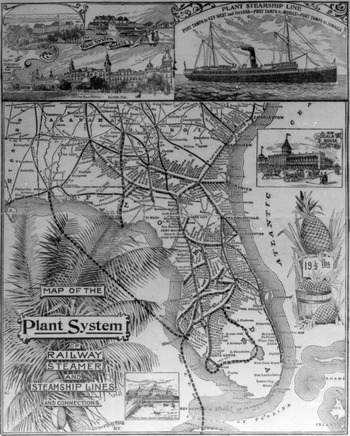
“Map of the Plant System of Railway, Steamer, and Steamship Lines and Connections,” early 1900s. Fort Myers is at the southwest of the rail line. Courtesy of Florida Photographic Collections, RC14378.

Tarpon offer the opportunity to pursue a different narrative, focused on the mutuality between ecology and development. Tarpon is just one example of a species whose sport use dramatically influenced onshore communities and vice versa. Tarpon, sporting men, and southwest Florida were interconnected in a number of specific ways. The Charlotte Harbor region's dynamic marine habitat is singular in its ability to shelter the fish for a period and in numbers not possible elsewhere on Florida's Gulf of Mexico or Atlantic coasts.Footnote 9 The seasonal confluence of humans and a nonhuman specie—tarpon to the beaches and passes and northern fishermen to the same region's coastal resort towns—holds the key to the national success of tarpon as an angling adventure and to the development of coastal southwest Florida. Well-heeled outdoorsmen comprised the majority of anglers. They traveled from the North, Midwest, and even from across the Atlantic to court the silver king, and they mark the sport's popularity as much more than a regional phenomenon. The high price of the adventure, in addition to the lack of a commercial fishing industry in the region and the unmarketable quality of the fish, all combined to keep the fishery in Charlotte Harbor in a healthy condition even after its sporting potential had been realized.Footnote 10 Overall, once tarpon adventure connected southwest Florida to the nation's sporting industry after 1885, the impact of the fishing culture on the region's growth proved extraordinary. Developments like the construction of resort hotels and the increased usage of local guides serve as the best barometer for the impact of fishing on the region.
Florida's coastal marine environments feature a unique “diversity of habitats”—sea grass beds, tidal regions and marshes, areas of soft or hard sediments, oyster and other shellfish beds, and other “transition zones.”Footnote 11 Many of these transition areas are also fertile marine estuaries. Estuaries include regions of high freshwater content, where land runoff and rivers empty into the salinity of the region's backwaters. In the case of Charlotte Harbor, this created a “well defined salinity structure” and a gradation from freshwater to ocean salinity. Estuaries are also areas of development critical to numerous inshore wildlife populations; they contain the environs necessary to develop and sustain countless species of shellfish and finfish.Footnote 12
Charlotte Harbor provides an excellent example of this environment. Not including the rivers and basins, which contribute to its biological profile, the bay encompasses roughly 122,000 acres, making it the second largest in the state.Footnote 13 It is protected naturally from the Gulf of Mexico to the west by a string of barrier islands, which are separated by swift-moving coastal passes. This sequence begins with Little Gasparilla and Gasparilla Islands to the north, separated by Stump Pass; Gasparilla and Cayo Costa Islands, separated by Boca Grande Pass; Boca Grande and Captiva Islands, separated by Captiva Pass; and finally, Captiva and Sanibel Islands to the south, separated by Redfish Pass. Inside these barrier islands, the Peace and Myakka Rivers combine from the north and northeast to form the harbor proper. The Caloosahatchee River flows west from Lake Okeechobee and drains into the southeast of the bay. Inside the barrier keys lies Pine Island, approximately two miles wide and seventeen miles in length, which stretches from north to south down the east side of the harbor. At the extreme south, below the mouth of the Caloosahatchee and the southern edge of Pine Island, lies San Carlos Bay, which opens to the Gulf of Mexico.
The harbor's combination of brackish backwaters, grass and mud flats, and access to ocean water through island passes, provides all of the habitats necessary for tarpon to thrive during all phases of their life cycle. In fact, with its subtropical climate, expansive range, and multiple marine environments, the bay is a complex coastal ecosystem that supports the fish very successfully. This explains why areas like Punta Rassa, Pine Island, Fort Myers, Useppa, and Boca Grande all became “familiar to sportsmen all over the country.”Footnote 14
Anglers first began fishing close to the only lodge available, which was at Punta Rassa, just south of the mouth of the Caloosahatchee River and at the north edge of San Carlos Bay. For this reason, the sport's techniques originally developed around the harbor's flats, rivers, and backwaters. Only here, the pioneer anglers thought, did tarpon supposedly haunt “the shallow bays and creeks and bayous inside the bars and keys.”Footnote 15 There is little evidence that anglers even attempted to fish anywhere else before the 1890s. “Few fishermen have made investigations on their own account,” according to one, “being content to try their fortune where others have been successful.”Footnote 16 St. James City, located only miles from Punta Rassa, also catered to the bay at the southern reaches of the harbor, explaining its development in the early history of the sport as well. Later, the fishing prospects shifted to the Caloosahatchee, which accounts for the development of Fort Myers as the location of choice. As one angler explained in 1891, more were seen and caught in sight of that “beautiful village” than at any other point.Footnote 17
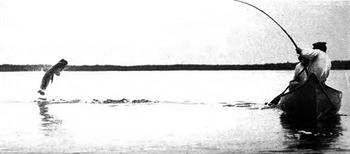
“Seldom an Interval of Ten Minutes Between the Landing of One Tarpon and the Strike of His Successor,” from A. W. Dimock, The Book of the Tarpon (New York, 1911), 128. Courtesy of Google Books.

This range explains the early development of a fishing technique centered on the region's flats and backwaters. It also explains the immediate success of the sport's first three harbor towns—Punta Rassa, St. James City, and Fort Myers—because they were all positioned at the south of the harbor and in areas of shallow, murky, low-salinity water. These estuary regions hold the richest assortment of shell and finfish, and the tarpon's adaptation allows it to exploit reaches of the harbor high in nutrients, yet inaccessible to other species. As juveniles, they are present year-round in these environments; and as they mature and become migratory, they return to the harbor's backwaters during the winter season. Estuaries also function to sustain the fish in extreme weather conditions. Although tarpon are capable of thriving in a variety of low-salinity and low-oxygen habitats, they cannot withstand cold weather or abrupt changes in water temperature.Footnote 18 During the coldest months they retreat into coastal channels, bays, and other backwater regions, all of which maintain warm water temperatures the longest during cold snaps and throughout the winter season. Charlotte Harbor's rivers and bays hold the flats, channels, and backwaters necessary to guard tarpon during these winter months. Punta Rassa, St. James City, and Fort Myers are all settlements located in these regions. The winter seasons popular in these places with northern tourists corresponded well with the months when tarpon would have accumulated around them to escape low water temperatures. These seasonal conditions explain why the harbor towns, hitherto little known for their winter sport offerings, were able to develop tourist trades around tarpon practically as soon as anglers recognized their sporting potential.
Because water temperatures were low, and fish moved little to conserve energy, tarpon were not particularly active. They hugged the bottom of flats and bays, underneath mangroves and in deep holes or channels. As a result, the preferred method of catching them became anchoring the boat, throwing out a strip of mullet, and leaving it to sink. Only after the fish had time to wander upon the bait and then fully swallow it would the angler make his strike. This first predominant style of tarpon angling became known as still-fishing, or as enthusiasts referred to it, “gorge” fishing.Footnote 19
The gorge fishing method was the first detailed tarpon technique to be perfected, and it held sway with anglers from the sport's first season until the mid-1890s. The constant experimentation associated with any new endeavor, however, yielded a new method and fresh locations in southwest Florida's tarpon fishing scene as early as 1895. That year, angling pioneer Edward Vom Hofe drift-fished Captiva pass, thereby developing a new style suitable for a radically different environment.Footnote 20 By the early years of the twentieth century, the technique of drift- or pass-fishing had been perfected, and the sportsmen using this method shifted angling pressure away from the bays and flats and toward the harbor's coastal passes.Footnote 21
Captiva and Boca Grande passes were the prime coastal inlets in which these techniques were developed. All the techniques for tarpon fishing sought to account for the seasonal migrations and other behavior patterns of the fish. Tarpon spawn offshore in the summer months and begin to congregate both off the beaches and in deep coastal passes in the spring as a means to court and prepare for that journey. In addition, amid outgoing tides, massive amounts of water move through the inlets and into the gulf; during these times the passes offer a virtual buffet of crabs, shrimp, and small fish for the tarpon waiting in their deep cuts.Footnote 22 When anglers drifted through these passes in April, May, and June, they naturally encountered staggering numbers of fish collected in a geographically small location and feeding aggressively. The first major coastal inlet to be tested by anglers in this way was Captiva Pass in 1895.
The inlet itself is not very large—approximately a quarter-mile wide and about a half-mile long. Its bottom is rocky at points and moderately deep at twenty-eight feet, and the current moving either in or out can become intense.Footnote 23 When anglers drifted the pass during the spring and summer months, they realized that huge numbers of tarpon inhabited its currents and cuts. The fish saturated the place in “innumerable thousands,” according to one enthusiast, and it was “a fine sight to see the water literally alive” with them. Indeed, in a place with “turbulent waters alive with fish,” where tarpon bit so “voraciously and incessantly,” anglers gladly braved the dangerous waters.Footnote 24 There the fish were reported “in great numbers,” the Fort Myers News Press acknowledged in 1902, adding that “a few years ago,” it was “the greatest fishing grounds on the coast.”Footnote 25
Boca Grande Pass held even more impressive prospects. This large, deep pass separated the north end of Cayo Costa Island from the south end of Gasparilla Island and was the next inlet to the north of Captiva. Its cut was almost a mile wide and held several square miles of water from thirty to over fifty feet deep; its deepest hole reached eighty feet and deeper. Even more than Captiva Pass, Boca Grande's waters were remarkably unpredictable. “There, in the tideway in ten to forty feet,” an angler described one morning, “the sea was rolling in from the gulf, and with tide and cross wind made a turmoil that stirred up the sand and made the water roily.” At times of bad weather, the rollers outside of the pass and its swift currents made the inlet downright dangerous.Footnote 26 Still, as with Captiva, anglers were willing to test the conditions because the large numbers of tarpon captivated them. “For several winters I had felt convinced that in the large, deep water pass there must be good fishing,” one angler confessed in 1898. Just outside the pass, after they had arrived, “we found ourselves literally surrounded by hundreds of tarpon. In fact, for half a mile in every direction one could see them curving out of the water.” One morning, “from 5 A. M. until 9 A. M. they bit like catfish.” “I feel convinced personally,” the enthusiastic angler concluded, “that Boca Grande will turn out to be one of the best, if not the best, tarpon fishing grounds in Florida or anywhere else along the Gulf Coast.”Footnote 27 Photographer A. W. Dimock had a similar experience there. This fishing, he concluded, “I look upon as mighty near the center of the tarpon industry of the country.”Footnote 28
The seasonal nature of tarpon migration connected silver kings with the leisure culture of Gilded Age and Progressive Era sporting men in a fascinating way, highlighting the mutuality of tarpon angling's ecology. If tarpon were not moving through coastal passes and into the region's backwaters during the height of the North's leisure season—the months of February, March, and April—the fishing's popularity would never have developed as it did.
The domination of the sport by wealthy outdoorsmen seeking leisure and sport was a crucial component of the region's success. In the spirit of Theodore Roosevelt, affluent late nineteenth- and early twentieth-century sportsmen reveled in the outdoors, and they soon looked to southwest Florida to fulfill their desires. They longed for struggles with large and potentially dangerous game because of the fight's masculine, regenerative qualities, and they sought elaborate hunting or fishing adventures as a way to identify with those emotions. They looked to wilderness as a way to reconnect with their more manly, self-sufficient ancestors.Footnote 29 As a result, scores of well-to-do sporting men took pilgrimages into the American wilderness throughout the era to hunt bear, moose, and deer, shoot countless birds, and fish never-ending waters. They did so mostly during the summer and spring months; soon after the discovery of tarpon, however, they were traveling south during their winter vacations in search of battles with the silver king. Because of their means and their search for outdoor stimulation, these men constituted the majority of the sport's participants, and their search for adventure developed coastal regions in significant ways.Footnote 30
On the coast of Florida the scene was inviting. In the years immediately after the Civil War, residents began attempts to develop a tourist economy. A few resorts existed on both the eastern and western coasts of the state in the 1870s and 1880s—most notably in the southwestern region.Footnote 31 “The geographical, commercial, and climatic advantages of the place are too apparent to escape notice,” one visitor described in 1879. Charlotte Harbor, by then, was already understood by northerners to be “one of the most popular winter resorts in the State.”Footnote 32 Still, Florida's infrastructure was woefully underdeveloped. Jacksonville, Key West, Pensacola, and Tampa, all cities of well under 20,000 as late 1890, were also the only coastal cities or communities with any sort of regular access by train or steamer.Footnote 33 Perhaps because of Tampa's connection to Key West and Cuba, as well as its usage by American armed forces in the Spanish American War, the southwestern coast developed earlier than the southeastern. That only began changing in the early twentieth century with the emergence of Miami.Footnote 34
After the discovery of tarpon sport in the late nineteenth century, tourist-related businesses in the North's as well as those in southwest Florida's fledgling tourism industry began capitalizing on the region's opportunities. Sporting shops in northern cities embraced tarpon quickly, and within years of the first catch, most large sporting goods purveyors advertised tarpon equipment aggressively.Footnote 35 Train and steamer lines increasingly offered routes into the region and promoted fishing lodges to tarpon anglers.Footnote 36 Transportation expansion was particularly important to Florida; where rail lines were built, development soon followed. Moreover, whereas train service to Tampa had been established for a decade, service into Punta Gorda—a much closer port to the harbor—had just been made available in 1885. Steamer services were beginning to expand into frontier communities like Fort Myers as well, providing the critical connection northern sportsmen needed to make their adventure possible.Footnote 37
Because of these connections to the country's larger sporting and leisure industry, early tarpon fishing action peaked in communities like St. James City or Fort Myers precisely when the North's winter season was in full swing; it seldom continued past May, even though the best fishing was available later in the summer. “Undoubtedly the spring is the superior season,” one angler explained, “though by far the majority of Tarpon anglers choose their outing when they may escape the rigors of a northern winter.”Footnote 38 Most sportsmen preferred to rely on the region's fledgling but pre-existing infrastructure to pursue their fishing adventures. They accelerated development of southwest Florida's tourism industry to a significant degree by doing so, highlighting the sport's association with Gilded Age leisure culture.Footnote 39
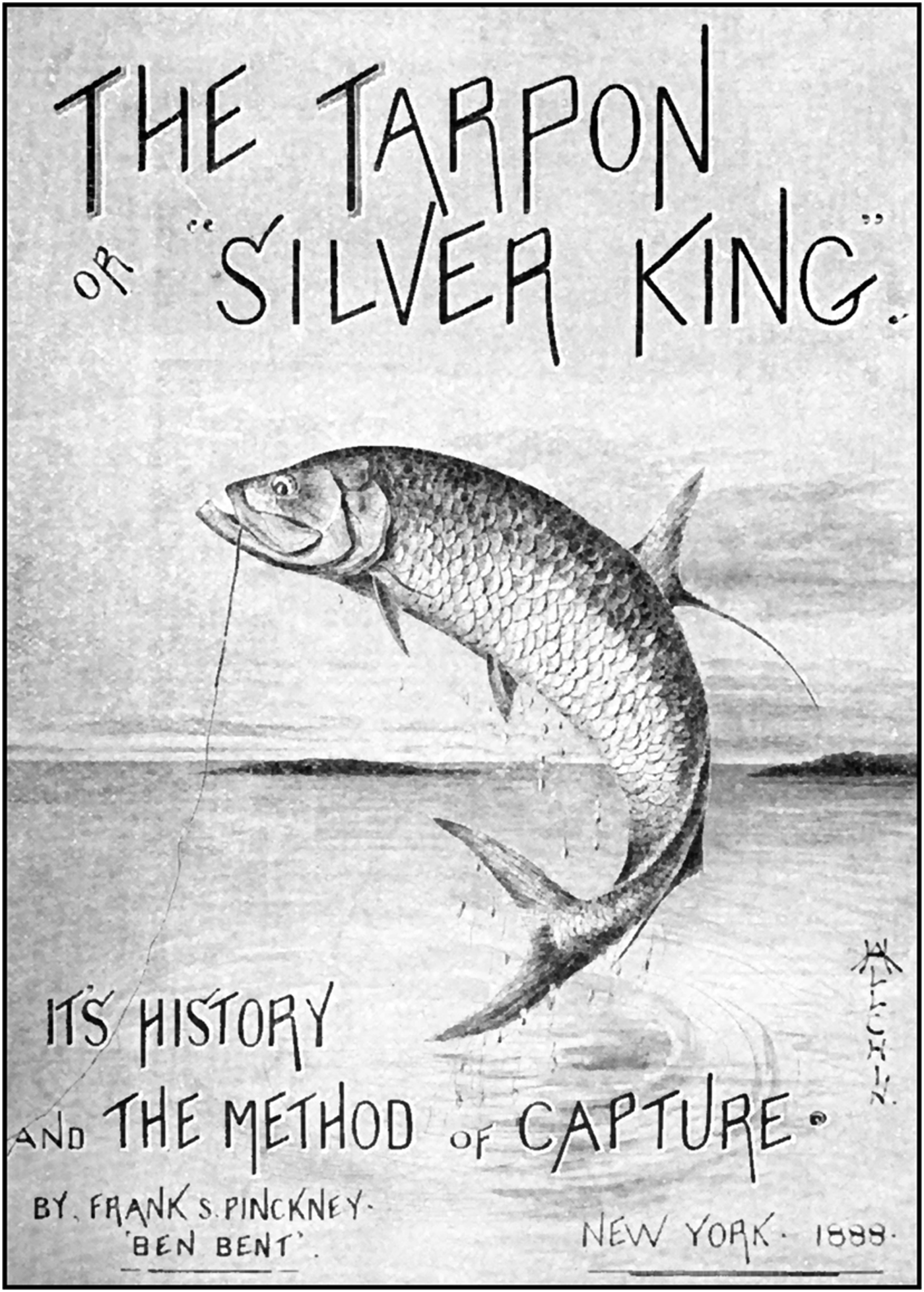
Cover of Frank S. Pinckney, The Tarpon or “Silver King”: Its History and the Method of Capture (New York, 1888). Courtesy of Google Books.

The prices sporting men paid also reveals the exclusive nature of the adventure. Most contemporaries agreed that the sport's costs—many times exceeding hundreds of dollars for each fish killed—made it difficult for lower- and even middle-class anglers to participate. Tarpon fishing was enjoyed “mainly by Northern gentlemen of wealth and leisure,” remarked one, “particularly those who spend part of the summer amid the salmon haunts of Maine and Canada.”Footnote 40 Another explained that it was meant only for the well-to-do, “as the expense that it incurs is comparatively great,” and it involved “nearly always a long journey to and fro.” A New York Times writer similarly cautioned that the equipment, time, and travel necessary made the fishing “quite expensive” and “prevents many sportsmen from enjoying this fun.”Footnote 41 The sport's excessive bills assured that the majority of the anglers partaking in tarpon fishing were men of affluence, with plenty of free time. Many notable sportsmen from the period did indeed enjoy the action.Footnote 42 Senator Matthew Quay of Pennsylvania, for instance, was a staple personality on the tarpon scene.Footnote 43 Florida's railroad magnates Henry Plant and Henry Flagler frequently angled for the silver king as well.Footnote 44
The economic exclusivity of tarpon angling also helps to explain why anglers did not overtax the fish population over years of pressure. The fish's mediocre table quality also contributed to its sustainability. Although a number of Florida species were pursued for the commercial market, tarpon certainly were not. Numerous anglers remarked that the fish was not good fare at all, and few anglers even attempted to cook one. “The flesh is something the color of unhealthy beef,” according to one who tried it, being “flabby and having a strong smell.”Footnote 45 More palatable species, particularly redfish, trout, pompano, mackerel, and grouper, were preferred by the anglers who decided to keep a fish for dinner.Footnote 46 Because of tarpon's poor table quality, a national market never emerged, and commercial anglers never targeted it.Footnote 47 “The seines, trawls, and other wasteful and destructive appliances by which the ingenious market fishermen of the United States have almost annihilated the fisheries of our coast,” one angler explained, were all “fortunately useless against the tarpon,” and so he considered the fishing safe from the “‘improvements’ of civilization.”Footnote 48
That is not to say that anglers treated their captured tarpon in a more conservative way than they did any other game species. Instead, the comparative worthlessness of the fish negatively corresponded to the compassion tarpon were shown in battle, particularly after the weight and measurement of each fish became as important as actually landing it. In the sport's earliest years, thousands of fish were caught, killed, weighed, and measured, and then left to drift back out into the bay. Anglers seldom saved a trophy and almost never let their catch live. Because they viewed the stock of tarpon as limitless and otherwise useless, sportsmen held few moral reservations about killing every single specimen they caught—regardless of its size. Many times anglers caught dozens in a single trip, sometimes in a single day, and in each instance they gaffed and killed their fish for no other reason than that they were easier to weigh when they were dead. In the sport's earliest years, relatively few sporting men detested this practice, and the industry killed hundreds, if not thousands, of tarpon each fishing season.Footnote 49
This disregard for the life of fish—many of which may well have been older than the fishermen themselves—was tragic from a moral standpoint, but it also could have had a catastrophic impact on the regional ecosystem. Tarpon grow quickly during the first two years of their life but do not reach sexual maturity until age ten. They have been known to live as long as fifty-five years. An average-sized specimen weighed approximately 100 pounds and was usually thirteen to sixteen years of age.Footnote 50 Many catches fell within this range, and so capturing and removing too many sexually mature specimens could have easily disrupted the fish's reproductive cycle. In turn, the fish's decreased numbers could have had a significant impact on the balance of the harbor's estuary regions—where both juvenile and full-grown tarpon congregated—causing increased numbers of crustaceans or finfish.
What is surprising, then, is that even under intense fishing pressure, the tarpon population appears to have remained steady and healthy throughout the sport's first generation—a time when the fishing pressure was intensifying rapidly and when even mediocre catches had little hope of being released alive. One angler observed almost a decade after the first tarpon had been caught, “They are more abundant now than ever before. I do not believe it is possible to materially diminish the supply, and I find all those of experience with whom I have talked agree with me.”Footnote 51
Catch lists evince this trend. In 1889, a book on Florida included the entire list of the tarpon caught during the season at Punta Rassa. Seventy-seven fish were captured from February to May, and anglers kept statistics on each fish's weight and length. The average weight of the tarpon that season was 108.5 pounds, with the smallest recorded catch being 53 pounds and the largest being 153 pounds. The average length was 69.8 inches, with the shortest fish being 56 inches and the largest being 78 inches.Footnote 52 Nearly a decade later, in 1898, the Fort Myers News Press published a comprehensive list up to the end of the season in late April. Catches had increased over the nine years from 77 to 163. The average weight of the fish in 1898 was 91.3 pounds, with the smallest recorded catch being 16 pounds and the largest being 185 pounds. The average length for that year was just over 67.2 inches, with the shortest fish being 42 inches and the longest being 87.Footnote 53 Finally, at the end of the 1908 season in May the Fort Myers News Press reported total catches at 152. The average weight of the fish that year was 91.04 pounds, with the smallest catch being 14 pounds and the largest being 185 pounds. The average length was 68.4 inches with the shortest catch being 14 inches and the longest being 86.Footnote 54
Although the number of catches increased dramatically in the 1890s and 1900s—over twofold from 1889—neither the average weight nor length decreased to any significant degree. Although the average weight decreased by seventeen pounds over the twenty years, the average length decreased by only a little more than an inch. These findings become telling when the seasons are combined over the course of the sport's first generation. If we assume that the average number of fish taken per year between seasons 1898 and 1908 was 152, for instance, the total number of tarpon caught and killed in that decade of fishing could have easily exceeded 1,500. At that rate, anglers could conceivably have caught upwards of 4,500 tarpon through three decades of angling. In fact, the aggregates were most likely much higher. More catches by hotel patrons took place than those recorded by the region's presses of course; other anglers not associated with the region's hotels were catching fish as well. This would have raised the number of seasonal kills considerably higher than the numbers in published lists. Also, Fort Myers's tarpon industry peaked in the early 1890s, and the catch numbers were much higher during those seasons than in the early twentieth century. According to one Fort Myers News Press article, 152 tarpon were caught in the 1891 season, 260 in 1892, 236 in 1893, and 389 in 1894, with the total for those four years at almost 1,000. This meant that anglers could have caught and killed upwards of 2,500 tarpon in that decade alone.Footnote 55 The figures published in 1898 and 1908 thus suggest that even the capture of perhaps many thousands of fish over decades of seasons did not seriously disrupt the health of the fishery. Indeed, although the fishing pressure grew dramatically as the sport developed, it did not have long term, negative consequences for either the population of tarpon or the ecology of the Charlotte Harbor estuary.
A number of factors account for the fish's resiliency. The complete lack of a market quality is the single most compelling explanation. Because it offered no table quality, tarpon were not targeted in a large-scale, commercial fashion. Also, the fish's extensive range in other underdeveloped gulf and Caribbean regions surely mitigated the seasonal losses sustained in southwest Florida. Because tarpon could be found in the Gulf of Mexico's offshore waters, in its backwaters, and throughout the Caribbean generally, anglers never had the opportunity to target the total population of the fish. One should note that sporting ideology began to shift in the early twentieth century, and many anglers no longer insisted on killing their fish as the natural end of their adventure. Sportsmen and their clubs, one such angler surmised in 1917, “have now introduced sportsmanlike methods which give a maximum of sport and a minimum of slaughter.”Footnote 56 “Don't carry that criminal weapon, the gaff,” wrote photographer and sportsman A.W. Dimmock in 1909. “Don't murder your game.” Instead, cubing each fish's length in feet and dividing that by two easily and accurately gave a fish's weight, and many anglers increasingly turned to that technique.Footnote 57
In 1916 one report outlining how a single angler caught a record number of fish in an outing at Boca Grande added, “It should be remarked in passing that the fish invariably were released.” Anglers were even going so far as to use barbless hooks—a shift in technique that made it harder to keep a tarpon hooked, but also one that did not “injure the fish for future usefulness and sport of the angler.”Footnote 58 Indeed, one enthusiast in the early 1940s exclaimed that the numbers in Boca Grande and elsewhere were as stunning as they had ever been. “Even a school of five hundred tarpon,” he explained, “the guides will say is no great shucks. From Clearwater to Boca Grande every guide will swear to having seen that many at one time rolling in a long creaming line in the moonlight.” If only 10 percent of a school were visible, as this angler learned from the area's guides, “That would mean schools of at least five thousand fish.” Additionally, by the 1940s new fishing regulations made it illegal to kill more than one tarpon “per rod per trip.”Footnote 59 Tarpon had, therefore, survived the first generation of the sport's growth. Ultimately, by the 1940s and 1950s, developments in sportsmanship and tourism alike guaranteed large tarpon populations along the coast of southwest Florida.
Steamer lines and local sporting stores, local fishing guides, sprawling lodges, and start-up settlements all illustrated the germinating effect of the silver king on Charlotte Harbor's economy and development. In southwest Florida, the growth of these businesses highlights the broad appeal of tarpon fishing. These trends highlight as well the mutuality and close connection of the human and nonhuman worlds in the Charlotte Harbor region.
In particular, sporting lodges provided the boats, provisions, and guides needed to make the adventure successful, and they culled these resources from local communities. These hotels were the objects of intense boosterism, many instances from local sources, but sometimes from railroad or steamship operations as well. For these reasons, hotels offer a visible way to chart the development of the harbor's towns as they responded to the growth of tarpon sport. When tracing the spread of fishing-oriented hotels, it becomes apparent that towns and villages around the harbor responded to the expansion of angling sport as it approached their particular section. Anglers wrote a great deal about the places they stayed, and these reflections are excellent evidence of the influence that tarpon sport exerted over onshore communities.
Although some sportsmen steamed direct from the North, and others even owned their own yachts, most travelers arrived at Charlotte Harbor by train at Punta Gorda, at its northeast corner, and made their way down a long dock that stretched out into the bay.Footnote 60 There they boarded steamers offering ferry service further down the coast toward Pine Island and Fort Myers.Footnote 61 One company offering this service from Tampa aptly named its circuit, “The Route of the Silver King,” using a steamer called the S.S. Tarpon.Footnote 62 Before 1885 access to faraway and isolated tarpon angling locations was disorganized and irregular; steamers expanded their routes to provide service to the harbor's extreme locales soon after the sport's inaugural years, with the S.S. Tarpon highlighting “Tarpon Bay,” among other spots in an 1886 advertisement, as a place “for anglers to direct their travel.”Footnote 63
Early in the development of the sport, Tarpon Bay—a smaller part of San Carlos Bay at the extreme south of the harbor—was critical. One observant angler suggested in 1887 that this location alone was the “best place for an angler” anywhere.Footnote 64 The first tarpon caught on rod and reel were in this area, and the first two lodges to cater specifically to the silver king developed in adjacent settlements. The first, located to the south of the Caloosahatchee River, was Punta Rassa. Originally a Seminole War-era military installation named Fort Dulaney, the old army barracks, a fixture on the beach there, was assigned to George Shultz after the Civil War. Schultz operated the government's telegraph wire to Havana. The fort was also well known in Florida's cattle industry as a shipping depot and a stopover point for local cowmen.Footnote 65 After anglers staying in the old fort caught the first silver kings in the sport's history, it soon became the nationally recognized and cultishly popular “Tarpon House.” The most respected outdoorsmen stayed there only in its first seasons, but the place remained successful into the twentieth century.Footnote 66
Although the Tarpon House held sway with stalwarts as “a sportsman's resort,” its accommodations were primitive. As the sport expanded, more grounds and larger hotels—“keeping with the grandeur of the pastime,” according to one sporting man—were developing. One was constructed across San Carlos Bay from Punta Rassa on the south of Pine Island at a start-up settlement named St. James City.Footnote 67 “Realizing the climatic and sporting advantages” of the harbor, one angler remarked, “a syndicate of wealthy gentlemen” purchased this land and built the San Carlos Hotel, which was up and running by the 1887 season. Two years later, it was reportedly accommodating enough guests to tax its capacity. All were there for “one object—tarpon. Everyone talked of that fish—hoped, longed, expected to, or feared he wouldn't capture it.”Footnote 68
This settlement exemplifies the importance of tarpon angling to the region, because neither the hotel nor the town existed prior to the sport's development.Footnote 69 The men who visited the place in its earliest years made the connection between St. James City's development and its sporting potential. As one angler surmised, anyone “desirous to kill a tarpon have hitherto made their head-quarters” there.Footnote 70 In 1888, another visitor remarked, “Last year's history had gone abroad, and there were collected at both St. James and Punta Rassa fishermen from all over the United States, from Canada, and even from England and France.”Footnote 71 In the 1880s and 1890s, visitors recalled that until recently the area had been “an unbroken wild,” although “for many years a favorite camping place for fishermen and sportsmen.”Footnote 72 Others described St. James City as an “enterprise” and the “new paper city on San Carlos Bay.” Guests at the San Carlos hotel were “evidently not consumptives, seeking refuge from the chilly winds of their Northern homes,” but instead were “vigorous and stalwart anglers,” and “bold tarpon slayers.”Footnote 73 Some guests found the conditions substandard, but then again, first-class hotels “and the best of fishing are rarely found together.”Footnote 74 These observations make it clear that the San Carlos Hotel was, above all else, a resort for tarpon anglers.
Local commercial fisherman recognized the potential of tarpon-related tourism. Many served as the guides whom sporting men hired to row them to the fishing grounds, give them directions and advice, and help land fish. When the fishing was in peak season, sportsmen chartered dozens of guides each day, infusing coastal settlements with greatly needed cash. There was “a considerable choice in guides,” one angler wrote in 1889, so it was important “for a novice to get a skillful boatman who knows the grounds.”Footnote 75 Although anglers brought their own rods, they also needed boats and gear, which neighboring communities could provide as well.Footnote 76 Generally, one journalist wrote, St. James City was “a village that owes its present flourishing condition to the enthusiasm of tarpon fishermen.”Footnote 77 In effect, the settlement was founded on tarpon fishing.
In 1894 another settlement developed into a resort town that challenged the success of the Tarpon House and soon the San Carlos Hotel. Indeed, Fort Myers, which was already experiencing decent development before sport fishing brought it national attention, propelled tarpon onto the national sporting scene with much more success than did earlier settlements. Tourists who visited the town in the 1890s found that tarpon sport defined Fort Myers's commerce and identity. There, on the Caloosahatchee River, adventurers “found the fish obdurate,” and the town had become “the headquarters” for all fishermen pursuing the silver king.Footnote 78 Soon residents were reporting travelers from all over the globe, searching to “try their luck with the big fish.” The tarpon craze was extending into Europe, according to one, “and sportsmen from across the ocean may be expected to journey to Florida expressly to capture the king fish.”Footnote 79
No other town fostered a boosterish environment quite like Fort Myers. This city's engagement of the silver king is a telling indication of the sport's potential. The Fort Myers News Press's “tarpon record” graced the pages of the paper for more than a decade. When first published in 1892, the chart was updated at various points in each season. Beginning weekly in the spring of 1894, however, it would seem as though every tarpon caught, hooked, or sighted anywhere near the Caloosahatchee found its way into the front page of the paper. In one May 1894 edition, the catches totaled 389 and spread across several pages.Footnote 80
Local press reports for the 1898 season are particularly revealing. In terms of newspaper space, fishing competed that year with another event of great interest in southwest Florida: the Spanish-American War. Still, the silver king fought gamely against the war for headlines. “Battleship Maine Blown Up” was the most prominent headline in a February edition, for instance, but was situated directly above a larger “First Tarpon of the Season” announcement.Footnote 81 Incredibly, as spring progressed, the war on the Spanish seemed to lose to the war on tarpon, at least headline-wise, its coverage constantly sidelined by the “Official Tarpon Record for 1898.” The list consistently appeared at the center of the front page and became larger as the season bore on. Some war headlines sacrificed to the tarpon action: “Maine Undoubtedly Blown Up by a Mine” (March 10); “The President's Message” and “Looks Like War!” (April 14); “Ordered to Mobilize” and “To Arm Florida” (April 21); and “Latest War News,” “Condensed War News,” and “Matanzas Captured!” (April 28).
The press certainly did have the right to glow with enthusiasm over the blossoming industry. Catalyzed by fishing-related commerce, the town's population grew dramatically through the late nineteenth and early twentieth century. In 1890, only 575 people lived in Fort Myers. That number almost doubled to 943 within the decade, and by 1910, had tripled again to over 3,000.Footnote 82 The seasonal visitors that fished the Caloosahatchee and its surrounding waters sparked this increase. They patronized local hotels for weeks at a time, and even those who stayed aboard their own ships depended on the ice and provisions from local stores. Anglers also employed guides from Fort Myers—sometimes entire families—who earned daily, cash wages for their expertise. In 1892, one angler reported securing the services of a reputable guide in the town for six dollars a day. He felt comfortable enough dealing with the area's guides to name the best ones and also to warn his friends about some of the less reliable ones. The best guides in the region, another angler concluded, came from Fort Myers.Footnote 83
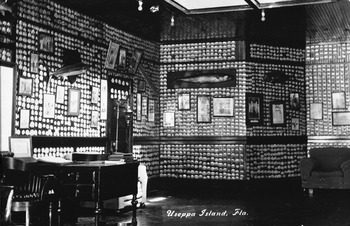
As sporting man A. S. Binion asserted, the town's prosperity was a direct result of the silver king's popularity. This particular enthusiast was writing from the Hendry House—one of several small lodges in the area—and he reported all rooms full during the 1892 season. Everything there “speaks of tarpon”—even the walls were lined with them.Footnote 84 Louis A. Hendry, the owner, was also offering a cash prize to the guest who caught a tarpon over 205 pounds, the record at that time, and an engraved trophy to the angler who caught the largest silver king of the season. Other small hotels in the area endeavored to do the same, including the Hotel Bradford, the Fort Thompson Park Hotel, the Hill House, and the Hotel Marco.Footnote 85
In 1898, the sweeping Hotel Fort Myers—later renamed the Royal Palm—was constructed on the waterfront in downtown Fort Myers.Footnote 86 The lodge advertised tarpon as one of its star pursuits for multiple seasons. From anglers' accounts, it dominated the harbor's fishing scene almost immediately after its opening. Although the hotel was built in a modern style, with all the comforts Fort Myers could provide, it seems that as with St. James City, Punta Rassa, and other spartan places along Charlotte Harbor, people cared a great deal more about the fishing prospects than they did the amenities. By 1903, the most vocal complaints about the hotel concerned its seasonal hours. Anglers grumbled that by the beginning of summer, when the fishing was just peaking, the hotel closed its doors. “It is to be regretted,” a booster remarked in the Fort Myers News Press, “that the house should close just at the height of tarpon season” in April, “when such good sport is being had right near the hotel.” Why not stay open at least until the first of June, sportsmen complained, and cater to fishermen who wished to stay through the height of the season?Footnote 87 Two years later, after the hotel again closed its doors too soon during a productive season, boosters griped that up to its closure, the Royal Palm had benefited from one of its best years yet. It was a shame then “that this business did not warrant keeping the house open until May 1st or even the 10th.” The town's reputation as a fishing resort rested almost entirely “on her tarpon fishing in April and May,” and there was no excuse for its flagship hotel closing during such a prosperous time. The next year, after a similar closure, a frustrated press bluntly protested that the hotel's early closing most likely “had something to do with keeping anglers accustomed to come here in April, away.” Boosters like the editor of the Fort Myers News Press illustrate a community that actively sought anglers and were concerned with accommodations that did not expand as the sport outgrew the traditional leisure season. Soon, however, other hotels appeared to challenge the winter hours of the Royal Palm. By the early twentieth century, hotels such as the Bradford Inn catered faithfully to sportsmen late into the summer months. These newer hotels vied for the patronage of anglers with the Royal Palm Hotel, which became more flexible.Footnote 88
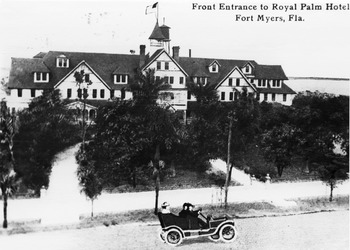
“Royal Palm Hotel—Fort Myers, Florida,” 1912. Courtesy of Florida Photographic Collection, RC08824.

Other businesses emerged in Fort Myers that were clearly influenced by the fishing culture. “TARPON ARE HERE,” read the advertisement headline of a local sporting-goods store, assuring sportsmen that they could catch the grand fish if properly equipped by local merchants. Another sporting shop, owned by local H. A. Hendry, also advertised in the Fort Myers News Press, urging anglers to “secure your tarpon outfit at the proper place.” Photographer E. M. Williams offered to record anglers with their catches. “The Tarpon Restaurant” served meals at all hours, and the Silver King Bar and Billiard Hall featured the finest billiards in South Florida.Footnote 89
Upon gaining prominence in the 1890s, Fort Myers held its command of the sport for over a generation, as sportsmen continued to flood into the region every spring. The fishing “now has a reputation that has spread across the waters of the Atlantic,” the News Press proclaimed in 1897. Three years later, the town celebrated perhaps its most successful season ever. From almost the first week, the Royal Palm “has been crowded with guests and it remained so until the time for closing came.”Footnote 90 It was safe to say, the press gushed, that the hotel was “more successful than any other hotel on the West Coast, not only from a social standpoint but from a financial standpoint also.”Footnote 91 In 1904, the Atlantic Coast Line Railway extended a line to the town. As “the tropical city on the tropical Caloosahatchee is at last connected with the railway systems of the country,” the flow of outdoorsmen to the town's resorts rose accordingly. “Fort Myers Sustains Her Reputation As the Greatest Tarpon Fishing Resort,” the paper proclaimed as that season bore to a close.Footnote 92 The town inaugurated the “Caloosahatchee Fishing and Hunting Club” in 1909. Until 1912 the press still proclaimed that there was no “better hotel to be found in the state” for tarpon fishing than the Royal Palm.Footnote 93
While the Fort Myers sporting industry remained prosperous well into the twentieth century, the region's development continued beyond the Caloosahatchee. After the fishing pressure began to shift away from Charlotte Harbor's backwaters and toward its gulf inlets, so did expansion. The less-than-ideal location of the passes in relation to the harbor's already-established lodges explains the appearance of closer, more well-appointed options. From either St. James City or Fort Myers, for instance, a voyage to Boca Grande Pass could take hours, cutting an angler's fishing time down considerably. The only available hotels in the direct vicinity of the area's coastal passes were small operations that did not cater well to anglers; the only true sporting options were a few large houseboats converted into hotels which were anchored in the inlets during the season.Footnote 94
Useppa Island provided the perfect location for a large sporting lodge to fill that gap. The small island is situated between Cayo Costa to the west and Pine Island to the east. Boca Grande Pass is directly to the northwest, and Captiva Pass to the southwest. Successful midwestern entrepreneur John M. Roach bought the island in 1894 and began building the Useppa Inn—also known as the Tarpon Inn—on its northern tip.Footnote 95 One group made a short trip there in 1903 to find a “comfortable resort well filled with guests.” An “ideal spot for fishermen,” the island and hotel were almost equal distances from both Boca Grande and Captiva Passes, offering tarpon fishing which “cannot be excelled anywhere in the world.”Footnote 96 It certainly was, according to the Fort Myers News Press in 1909, “the Utopia of all for those who love angling.” Although guests found the accommodations acceptable for an otherwise isolated island, one visitor concluded that “everything is made subservient to fishing.”Footnote 97 Another expressed chagrin that “winter resorts” like it catered too heavily to their angler patrons and only somewhat to the rest of their clientele. Although the fishing was great, the hotels were far too rustic, and the inn managers were “totally regardless of the comfort of their guests.”Footnote 98 Such complaints underscored the close connection between the spread of hotels around the harbor and the region's allure to sporting men who cared less about the conditions of the lodge than they did about the great fishing prospects.
“Tarpon scales on the wall—Useppe Island, Florida,” 1920s. Courtesy of Florida Photographic Collection, N044241.

The guides available at the Useppa Inn also suggest the impact of tarpon on the region's economy. According to one resident, “all the fishing guides of [the] area” could be found there during the tarpon season. Many local guides were commercial fishermen who saw opportunities for additional income in tarpon sport. One guide fished commercially for mullet in the off-season months, but “of course, when the tourists were in, he was a fishing guide.” Like those in Fort Myers, these were local men “who had their roots in the area's rich fishing traditions.” Every morning, the guides had their boats towed by a steam launch to the pass, where they met up with prospective anglers ferried from the hotels. At Useppa, these men usually earned five dollars a day for an average of three hours of service in the morning, and three in the afternoon. The inn also provided its boatmen with awards for exceptional work, including diamond pins for prize catches.Footnote 99 Used to the rugged life of commercial fishermen, the local guides realized that guide work was “very convenient and saves much time.”Footnote 100
The Fort Myers News Press began including Useppa's catches in the 1902 season's weekly counts. That same year, Forest and Stream remarked that it had the “Best Tarpon Fishing in the World.” The News Press recognized the first fish of the 1903 season as having been captured there, and early in 1909, one headline read: “Tarpon Season is On: Guests at Useppa Beginning to Make Good Catches: The Inn is Headquarters.”Footnote 101 Useppa reached its peak around 1910, when it gained daily steamer service to the rail terminal at Boca Grande. The Useppa Inn chartered an Izaak Walton Club in 1912, dedicated to “promoting the interests of anglers in the waters of Charlotte harbor.” Among its activities, the club offered gold and silver buttons for tarpon catches, published a book annually containing the official tarpon catch record, and provided bulletins weekly throughout the season. “Society is giving up its golf clubs,” the New York Times reported from the island in 1912, “for the tarpon rod.”Footnote 102
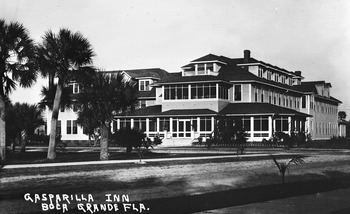
Useppa enjoyed its premiere location well through the turn of the century and grew successful catering to tarpon anglers. As Boca Grande Pass began to replace Captiva Pass in popularity, however, the lodge's location was not as good as many anglers wished. The resulting shift in activity was the last significant development in the region based around the popularity of tarpon as a sport fish. From Useppa, Boca Grande Pass was still an inconvenient commute of five miles, and it did not take long for anglers to desire a closer location, particularly after a railroad was built into the small town of Boca Grande in 1911. Truth be told, one guest leveled, “Useppa Island is inconveniently far from the Pass, but it is the nearest terra firma accommodation available.”Footnote 103 Another angler had already expressed these sentiments in 1899, arguing that there was “no finer place in Florida to put up a large hotel than on Gasparilla Island.”Footnote 104 Business interests promoting Boca Grande as a luxurious tourist destination felt similarly and soon began eyeing the pass and its impressive fishing. By 1909, they had decided to erect a world-class hotel at the railroad's terminus, and the twenty-room Gasparilla Inn was completed by the 1911 season.Footnote 105 Possibly realizing the location's potential, owners soon ordered renovations under a contract with Frank Abbott, manager of the Royal Palm Hotel in Fort Myers. So, for the 1912 season, the Gasparilla Inn reopened at double its previous size and under first-class management.Footnote 106
“Gasparilla Inn—Boca Grande, Florida,” 1920s. Courtesy of Florida Photographic Collection, PR00970.

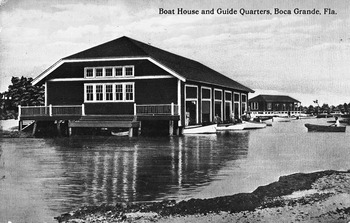
Local residents, who knew “the tricks of the tides and the tarpon,” provided guide service for the guests. Some guides were available on site, living in a separate wing of the hotel.Footnote 107 Gasparilla formed a Pelican Club as its answer to Useppa's Izaak Walton Club.Footnote 108 One local guide remembered the importance of this sporting group, which he described as “a fraternity of fishing enthusiasts from the Gasparilla Inn.” He guided various members of the “hundreds of well to-to-do visitors” who came to the hotel for its “world class tarpon fishing and life style,” while supplementing his income with various off-season jobs.Footnote 109
“Boats and guide quarters,” 1910s. Courtesy of Florida Photographic Collections, PR00984.

Boca Grande and Useppa islands continued to thrive for decades after the initial wave of the sport's spectacular success. Like Fort Myers, businessmen on both islands expanded hotel operations more to suit anglers once they realized that the tarpon season extended well beyond March or April. In 1921, the Tarpon Inn at Useppa had extended its season to the last days of May. Competing hotels were by then leaving their doors open throughout the summer. In Boca Grande, anglers increasingly stayed until late July, with lodges now readily accommodating them in the former off-season months.Footnote 110 The Palmetto Hotel, for example, offered tarpon anglers lodging late into July “and can care of thirty to forty guests at one time,” arranging for guides as well.Footnote 111
When the sport began to cool on these islands in the 1920s and 1930s, this should not be attributed to a decline in the lure of tarpon to sporting men. Instead, the industry simply expanded beyond the confines of Charlotte Harbor. Passes in Texas and Mexico had lured anglers as early as the 1890s, but because of underdevelopment, the lack of booster support, and the difficulty of transportation, these and other regions on the Gulf and Atlantic coasts did not develop until the early twentieth century.Footnote 112 By 1917, one angler reported that the sport was fine “at such well known places” as Port Aransas, Texas; Useppa Island, St. Petersburg, Florida; and Tampico, Mexico. In 1923, the destinations were even more varied: “Every year you find more men and women at South Boca Grande, St. Petersburg, Miami, Charlotte Harbor, Fort Myers, Long Key, St. James City, Tarpon Springs, Homosassa, Sanibel Island, Bradentown, Marco, Cayo Costa and other places along the eastern and western Florida coasts, all seeking tarpon.”Footnote 113 In the 1940s, tarpon tournaments, “held by almost every community from Tarpon Springs to Everglades City,” generally started in mid-May and finished as late as August. Sarasota reportedly claimed to have conducted “the oldest continuous tarpon tournament in the world,” but that was open to debate because so many had taken place in earlier years.Footnote 114 As the development of Florida and the Gulf Coast region continued in the early twentieth century, anglers realized that other coastal communities held tarpon prospects as well, and as more sporting men ventured elsewhere, the dominance of Charlotte Harbor began to recede.
When charting Florida's development, it is important to recognize that it was not simply a leisure industry, but a tarpon fishing industry that gave birth to the lodges that stretched along the southwestern coast. This culture seeded, to a great degree, the region's modern sporting-related commerce. Tarpon angling germinated as a popular leisure sport during the pre-World War I decades, and the tourism associated with it shaped Florida in a foundational way. Outdoor adventures like tarpon angling thus illustrate a distinctive type of mutual relationship between human and non-human species in which the consequences for humans were as dramatic as those for the fish.
Several aspects of southwest Florida's coastal marine and human ecology, and especially at Charlotte Harbor, illustrate such relationships. This region contained all of the environments necessary to support tarpon throughout their life cycle. At the same time, the tarpon's lack of commercial quality allowed the fish to escape the destructive pace of market angling. This, in addition to the expansive habitat and migratory nature of the fish and the changing ideology of sport fishing, allowed the population to remain in a sustainable state despite heavy fishing pressure. The presence of tarpon, meanwhile, fueled southwest Florida's sporting-related economic expansion. Steamer and railroad lines, local stores and services, and local guide businesses all appeared in response to tarpon angling. Most visible were the hotels that marked the physical expansion of the sport around Charlotte Harbor's coastlines. These lodges offer the strongest evidence that offshore species held the potential to shape onshore communities and even entire regions in significant ways—an environmental analysis that can doubtless be applied elsewhere in the history of outdoor sport.
In 1967 Marjory Stoneman Douglas wrote that Florida's “single most important tourist attraction since the first tarpon was caught in the nineties with a light line and rod and reel is fishing.” It took place “in every inlet and bay, river and lake in the state, and around all the coasts, especially on the west, from Tampa to Key West,” and it catalyzed “all the related industries of boats and boat yards, bait, tackle, marine supplies, to say nothing of taxidermists, sea-food restaurants, fish canning and frozen fish export.” This renowned fishing culture can be tied directly to southwest Florida's emergence as a hub for tarpon sport in the late nineteenth and early twentieth centuries.Footnote 115
By the early twenty-first century, as one historian has suggested, there was no longer a great deal of tarpon fishing pressure on Captiva Pass.Footnote 116 Not much of a tarpon culture existed in places like Punta Gorda, Punta Rassa, or Fort Myers either. The seal of Charlotte County, however—containing the lion's share of Charlotte Harbor—still featured a jumping tarpon, and the atmosphere on Boca Grande or Useppa Islands still reflected the sport's feverish prime. There the silver king obsession remained an integral part not only of these islands' local identity, but their national image as well. At the height of the silver king craze, however, in say 1906, many thousands of sporting men across the country were fixed squarely on the region's bright future with the sport. “Fort Myers and the Gulf Coast . . . retain their position as the greatest fishing resort in the country,” one noted. “Royal sport is now being had.”Footnote 117