





1 The sumset intersection problem
Let
$ \mathbf N $
 ,
$\mathbf N _0$
 and
$\mathbf Z$
 denote, respectively, the sets of positive integers, nonnegative integers and integers.
Let S be an additive abelian semigroup and let A be a subset of S. For every positive integer h, the h-fold sumset of A is the set of all sums of h not necessarily distinct elements of A, that is,

For all
$x \in S$
 , we denote by
$r_{A,h}(x)$
 the number of representations of x as a sum of h elements of A, that is,

The subset A is a basis of order h for S if
$hA=S$
 or, equivalently, if
$r_{A,h}(x) \geq 1$
 for all
$x \in S$
 . The subset A is a basis for S if A is a basis of order h for S for some positive integer h. The subset A is a nonbasis of order h for S if A is not a basis of order h for S, that is, if
$hA\neq S$
 . The set A is a nonbasis for S if
$hA\neq S$
 for every positive integer h.
The sequence of sets
$(A_q)_{q=1}^{\infty }$
 is decreasing if
$A_q \supseteq A_{q+1}$
 for all
$q \in \mathbf N $
 . The decreasing sequence
$(A_q)_{q=1}^{\infty }$
 is strictly decreasing if
$ A_q \neq A_{q+1}$
 for all
$q \in \mathbf N $
 and asymptotically strictly decreasing if
$ A_q \neq A_{q+1}$
 for infinitely many q. A decreasing sequence is asymptotically strictly decreasing if and only if it is not eventually constant. Every asymptotically strictly decreasing sequence contains a strictly decreasing subsequence.
Let
$(A_q)_{q=1}^{\infty }$
 be an asymptotically strictly decreasing sequence of sets in the semigroup S and let

For all
$q \in \mathbf N $
 , we have
$A \subseteq A_q$
 and so
$hA \subseteq hA_q$
 . It follows that

This inclusion can be proper. For example, in the semigroup
$\mathbf Z$
 of integers, for every positive integer q, we define

Let
$h \geq 2$
 . For every nonnegative integer n, we have
$\pm (n+q) \in A^{\sharp }_q $
 and
$\pm (h-1)q\in A^{\sharp }_q $
 . It follows that

and

and so
$h A^{\sharp }_q = \mathbf Z$
 .
Let A be any finite set of integers. The sumset
$hA$
 is finite for all
$h \in \mathbf N $
 and so
$hA \neq \mathbf Z$
 . The asymptotically strictly decreasing sequence of sets
$(A_q)_{q=1}^{\infty }$
 defined by

satisfies
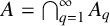
$ A = \bigcap _{q=1}^{\infty } A_q$
 . Because
$hA_q=\mathbf Z$
 for all
$q \in \mathbf N $
 , we have

This example is related to the construction of unique representation bases for
$\mathbf {Z}$
 (see Nathanson [Reference Nathanson5]).
Problem 1.1. When does equality replace inclusion in relation (1.1)? The basic problem is to describe, classify and understand the strictly decreasing sequences
$(A_q)_{q=1}^{\infty }$
 of subsets of an additive abelian semigroup such that

The intersection problem arose in the study of sumset sizes of finite sets of integers. The study of sums of finite sets of integers had mostly concentrated on sets with very small sumsets (Freiman’s theorem and related work) and on sets with very large sumsets (Sidon sets and
$B_h$
 -sets). There has been considerable recent work to understand the full range of sumset sizes

for all positive integers h and k. For related work, see [Reference Fox, Kravitz and Zhang2, Reference Kravitz3, Reference Nathanson6–Reference Schinina14].
2 Intersections of sumsets in discrete groups and semigroups
Theorem 2.1. Let
$h \in \mathbf N $
 . Let S be an additive abelian semigroup such that
$r_{S,h}(x)$
 is finite for all
$x \in S$
 . Let A be a subset of S and let
$(A_q)_{q=1}^{\infty }$
 be a decreasing sequence of subsets of S such that
$A = \bigcap _{q=1}^{\infty } A_q$
 . Then

Proof. For all
$x \in S$
 , the set
$ \mathcal {R}_{S,h}(x)$
 of h-tuples
$(b_1,\ldots , b_h) \in S^h$
 such that

is finite with cardinality
$| \mathcal {R}_{S,h}(x)| = r_{S,h}(x)$
 .
Let
$x \in \bigcap _{q=1}^{\infty } hA_q$
 . We must show that
$x \in hA$
 . For all
$q\in \mathbf N $
 , we have
$x \in hA_q$
 and so there is an h-tuple
$(a_{1,q},\ldots , a_{h,q}) \in A_q^h \cap \mathcal {R}_{S,h}(x)$
 such that

Because
$ \mathcal {R}_{S,h}(x)$
 is a finite set, there is some h-tuple
$(b_1,\ldots , b_h) \in \mathcal {R}_{S,h}(x)$
 such that

for infinitely many q and so, for infinitely many q, we have
$b_i = a_{i,q} \in A_q$
 for all
$i=1,\ldots , h$
 . Because the sequence
$(A_q)_{q=1}^{\infty }$
 is decreasing, we have
$b_i \in A_q$
 for all
$i=1,\ldots , h$
 and
$q \in \mathbf N $
 . It follows that
$b_i \in \bigcap _{q=1}^{\infty } A_q = A$
 and
$x = b_1 + \cdots + b_h \in hA$
 . This completes the proof.
Let
$\mathbf Z^d$
 be the additive abelian group of d-dimensional lattice points in
$\mathbf R^d$
 and let
$ \mathbf N _0^d$
 be the additive abelian semigroup of d-dimensional nonnegative lattice points.
Theorem 2.2. Let
$d \geq 1$
 and let A be a subset of
$ \mathbf N _0^d$
 . Let
$(A_q)_{q=1}^{\infty }$
 be a decreasing sequence of subsets of
$ \mathbf N _0^d$
 such that
$A = \bigcap _{q=1}^{\infty } A_q$
 . For every positive integer h,

Proof. For all
$n \in \mathbf N _0$
 , the number
$r_{ \mathbf N _0,h}(n)$
 of representations of n as a sum of h nonnegative integers is finite. Indeed,
$r_{ \mathbf N _0,h}(n) = \binom {n+h-1}{h-1}$
 . For all
$ \mathbf {n} = (n_1,\ldots , n_d) \in \mathbf N _0^d$
 ,

The result follows from Theorem 2.1.
Theorem 2.3. Let S be an additive abelian semigroup and let
$(A_q)_{q=1}^{\infty }$
 be a decreasing sequence of subsets of S such that
$A = \bigcap _{q=1}^{\infty } A_q$
 . If A is a basis of order
$h_0$
 for S, then

If the semigroup S contains an additive identity and if A is a basis of order
$h_0$
 for S, then

for all
$h \geq h_0$
 .
Proof. For all
$q \in \mathbf N $
 , we have
$A \subseteq A_q$
 and so
$S = h_0A \subseteq h_0A_q \subseteq S$
 . It follows that
$h_0A_q = S$
 and

Let
$h \geq h_0$
 . If S contains an additive identity, then
$h_0A \subseteq hA$
 . If A is a basis of order
$h_0$
 for S, then
$S = h_0A \subseteq hA \subseteq S$
 and so A is a basis of order h for S. This completes the proof.
Note that the additive semigroup
$\mathbf N$
 of positive integers does not contain an additive identity. The set
$A= \mathbf N $
 is a basis of order 1 for
$\mathbf N$
 but not a basis of order h for any
$h \geq 2$
 .
Theorem 2.4. Let
$d \in \mathbf N $
 and let G be any subgroup of
$\mathbf R^d$
 that contains
$\mathbf Z^d$
 . Let A be a subset of G. If A is a nonbasis of order
$h_0$
 for G, then there exists a decreasing sequence
$(A_q)_{q=1}^{\infty }$
 of subsets of G such that
$ A = \bigcap _{q=1}^{\infty } A_q$
 and

If A is a nonbasis for G, then there exists a decreasing sequence
$(A_q)_{q=1}^{\infty }$
 of subsets of G such that
$ A = \bigcap _{q=1}^{\infty } A_q$
 and

for all
$h \geq 2$
 .
Proof. For all
$\mathbf {x} = (x_1,\ldots , x_d) \in \mathbf R^d$
 , define
$\| \mathbf {x} \| = \max ( |x_i| : i = 1,\ldots , d)$
 . For all
${q \in \mathbf N} $
 , let

Note that
$\{ \mathbf {x} \in \mathbf Z^d: \| \mathbf {x} \| \geq q \} \subseteq A_{q,d}^{\sharp }$
 .
Let
$h \geq 2$
 and
$\mathbf {x} = (x_1,\ldots , x_d) \in G$
 . If
$x_1 \geq 0$
 , then

and

and so

Similarly, if
$x_1 \leq 0$
 , then

and

and so

Thus,
$hA_{q,d}^{\sharp } = G$
 for all
$q \in \mathbf N $
 and
$h \geq 2$
 .
For all
$q \in \mathbf N $
 , let

Then
$hA_{q,d} = hA_{q,d}^{\sharp } = G$
 for all
$q \in \mathbf N $
 and
$h \geq 2$
 . The sequence
$(A_{q,d})_{q=1}^{\infty }$
 is a decreasing sequence of sets such that
$ A = \bigcap _{q=1}^{\infty } A_{q,d}$
 . If A is a nonbasis of order
$h_0$
 for G, then

If A is a nonbasis for G, then

for all
$h \geq 2$
 . This completes the proof.
Theorem 2.5. Let A be an infinite set of integers that is bounded below and that does not contain all sufficiently large integers. There exists an asymptotically strictly decreasing sequence
$(A_q)_{q=1}^{\infty }$
 such that
$hA = \bigcap _{q=1}^{\infty } hA_q$
 for all
$h \in \mathbf N $
 .
Proof. Note that a set of integers that is bounded below cannot be a basis for
$\mathbf Z$
 . By Theorem 2.2 with
$d=1$
 , we can assume that
$a^* = \min (A) < 0$
 .
For all
$q \in \mathbf N $
 , let

The sequence
$(A_q)_{q=1}^{\infty }$
 is decreasing and
$A = \bigcap _{q=1}^{\infty } A_q$
 . If
$q \in \mathbf N $
 and
$q \notin A$
 , then
${q \in A_q}$
 but
$q \notin A_{q+1}$
 and so
$A_q \neq A_{q+1}$
 . Because A does not contain all sufficiently large integers, the sequence
$(A_q)_{q=1}^{\infty }$
 is asymptotically strictly decreasing.
For all
$h \in \mathbf N $
 and
$q \in \mathbf N $
 ,

and

Therefore,

This completes the proof.
Let S be an additive abelian semigroup. A subset A of S is a maximal nonbasis of order h for S if A is not a basis of order h for S but every proper superset of A is a basis of order h for S. For example, for every integer
$h \geq 2$
 , the set
$h\ast \mathbf Z = \{ h \ell : \ell \in \mathbf Z\}$
 of multiples of h is a maximal nonbasis of order h for
$\mathbf {Z}$
 if and only if h is prime. Maximal nonbases were introduced by Nathanson [Reference Nathanson4] and the first nontrivial examples were constructed by Nathanson [Reference Nathanson4] and Erdős and Nathanson [Reference Erdős and Nathanson1].
Theorem 2.6. Let A be a subset of the infinite abelian semigroup S. If A is a maximal nonbasis of order h for S and if
$(A_q)_{q=1}^{\infty }$
 is an asymptotically strictly decreasing sequence of subsets of S such that
${A = \bigcap _{q=1}^{\infty } A_q}$
 , then
$hA \neq \bigcap _{q=1}^{\infty } hA_q$
 .
Proof. Let A be a maximal nonbasis of order h for S and let
$(A_q)_{q=1}^{\infty }$
 be a strictly decreasing sequence such that
$A = \bigcap _{q=1}^{\infty } A_q$
 . For all q, the set A is a proper subset of
$A_q$
 and so
$hA_q = S$
 . It follows that
$hA \neq S = \bigcap _{q=1}^{\infty } hA_q$
 . This completes the proof.
Problem 2.7. Let A be a subset of the infinite abelian semigroup S such that A is a nonbasis of order h but not a maximal nonbasis of order h for S. Does there exist an asymptotically strictly decreasing sequence
$(A_q)_{q=1}^{\infty }$
 of subsets of S such that
${A = \bigcap _{q=1}^{\infty } A_q}$
 and
$ hA = \bigcap _{q=1}^{\infty } h A_q$
 ? In particular, consider this problem for
$S = \mathbf Z$
 .
3 Intersections of sumsets in locally compact groups
Theorem 3.1. Let A be a nonempty subset of a locally compact abelian group G. Let
$(A_q)_{q=1}^{\infty }$
 be a decreasing sequence of compact subsets of G such that
$A = \bigcap _{q=1}^{\infty } A_q$
 . Then

for every positive integer h.
Proof. For all
$h \in \mathbf N $
 and
$q \in \mathbf N $
 , the sumset
$hA_q$
 and the sumset intersection
$\bigcap _{q=1}^{\infty } hA_q$
 are nonempty closed compact sets. Let
$x \in \bigcap _{q=1}^{\infty } hA_q$
 . We must show that
$x \in hA$
 .
For all
$q\in \mathbf N $
 , we have
$x \in hA_q$
 and so there is an h-tuple

such that

Consider the sequences
$(a_{i,q})_{q=1}^{\infty }$
 for
$i = 1, \ldots , h$
 . Because the set
$A_1$
 is compact and
$a_{i,q} \in A_1$
 for all
$i = 1, \ldots , h$
 and
$q\in \mathbf N $
 , there is an infinite strictly increasing sequence of positive integers
$(q_j)_{j=1}^{\infty }$
 such that the h subsequences
$(a_{i,q_j})_{j=1}^{\infty }$
 converge:

for all
$i = 1, \ldots , h$
 . Then

Suppose that
$x_i \notin A$
 for some i. Let
$q_0=0$
 . Construct the sequence
$( x_{i,q} )_{q=1}^{\infty }$
 as follows:

Because
$(A_q)_{q=1}^{\infty }$
 is a decreasing sequence, we have
$x_{i,q} \in A_q$
 for all
$q \in \mathbf N $
 and

The group G is locally compact. Because
$A = \bigcap _{q=1}^{\infty } A_q$
 is closed and
$x_i \notin A$
 , there is a compact neighbourhood K of
$x_i$
 that is disjoint from A such that
$x_{i,q} \in K$
 for all sufficiently large q. Then
$x_{i,q} \in K \cap A_q$
 for all sufficiently large q. It follows that, for all
$Q \in \mathbf N $
 , there exists
$q_1 \geq Q$
 with
$x_{i,q_1} \in K \cap A_{q_1} \subseteq K \cap A_q $
 for all
$q \in [1,Q]$
 , and so

Because the sets
$K \cap A_q$
 are compact, the finite intersection property implies

which is absurd. Therefore,
$x_i \in A$
 for all
$i = 1, \ldots , h$
 and
$x \in hA$
 . This completes the proof.
Theorem 3.2. Let
$(A_q)_{q=1}^{\infty }$
 be a decreasing sequence of nonempty compact sets in
$\mathbf R^d$
 such that
$A = \bigcap _{q=1}^{\infty } A_q \neq \emptyset $
 . For every positive integer h,

Proof. This follows from Theorem 3.1 with
$G = \mathbf R^d$
 .
Theorem 3.3. Let G be a locally compact abelian group with Haar measure
$\mu $
 . For
$h \in \mathbf N $
 , let
$\theta _h \geq 0$
 and let
$(\theta _{h,q})_{q=1}^{\infty }$
 be a decreasing sequence of nonnegative real numbers such that
$\lim _{q\rightarrow \infty } \theta _{h,q} = \theta _h$
 . Let
$(A_q)_{q=1}^{\infty }$
 be a decreasing sequence of compact subsets of G such that
$\mu (hA_q) = \theta _{h,q}$
 for all
$q \in \mathbf N $
 . Let
$A = \bigcap _{q=1}^{\infty } A_q$
 . Then
$\mu (hA) = \theta _h$
 .
Proof. For all
$h \in \mathbf N $
 , the sequence
$(hA_q)_{q=1}^{\infty }$
 is a decreasing sequence of compact subsets of G. By Theorem 3.1,

and so

This completes the proof.
4 Additional problems
Problem 4.1. Let
$(A_q)_{q=1}^{\infty }$
 be a strictly decreasing sequence of sets in an additive abelian semigroup and let
$A = \bigcap _{q=1}^{\infty }A_q$
 . Describe the set
$\{h \in \mathbf N : hA = \bigcap _{q=1}^{\infty } hA_q\}$
 . What sets of integers arise in this way?
Problem 4.2. Let
$(A_q)_{q=1}^{\infty }$
 be a strictly decreasing sequence of sets in an additive abelian semigroup and let
$A = \bigcap _{q=1}^{\infty }A_q$
 .
-
• When does $hA = \bigcap _{q=1}^{\infty } hA_q$
 imply
$(h+1)A = \bigcap _{q=1}^{\infty } (h+1)A_q$
?
-
• When does $hA = \bigcap _{q=1}^{\infty } hA_q$
imply
$(h-1)A = \bigcap _{q=1}^{\infty } (h-1)A_q$
?


Problem 4.3. For what sets A of integers does there exist a decreasing sequence
$(A_q)_{q=1}^{\infty }$
 of sets of integers such that
$A = \bigcap _{q=1}^{\infty } A_q$
 and
$hA \neq \bigcap _{q=1}^{\infty } hA_q$
 for all
$h \in \mathbf N $
 ?
Acknowledgement
I thank Diego Marques for helpful comments that suggested Theorem 2.6.



