

1. Introduction
The Australian state of New South Wales (NSW) is endowed with extensive deposits of both steaming and metallurgical coal that are located primarily to the northwest and south of the state’s capital, Sydney. Mining of the deposits has occurred for the past 100 years but has expanded rapidly in the last three decades to supply the local electricity generation and steel manufacturing industries and for export to growing markets in China, Korea, Taiwan, Japan, and India (NSW Trade and Investment, 2011).
As the coal mining industry has expanded, so too have the conflicts with competing uses of the associated landscape. These include agriculture, residential settlements, infrastructure, cultural and historical protection, and the natural environment. These conflicts are particularly apparent when open-cut coal mining techniques are used (as is predominantly the case for the deposits to the northwest of Sydney, especially in the Hunter Valley) but also occur where underground mining causes subsidence. One element of the environmental conflict relates to the release of greenhouse gas (GHG) emissions during the mining (and the burning) of the coal (Quiggin, Reference Quiggin2012).
The task of resolving these conflicts has largely fallen to the NSW state government. The responsible agency in the government is the Department of Planning and Infrastructure (DP&I) and the primary analytical instrument used in the decision-making process is environmental impact assessment (EIA).Footnote 1 This includes the preparation and submission of an environmental assessment (EA)Footnote 2 document. Benefit-cost analysis (BCA) is recognized as a component of EIA and guidelines for its use have been established (James & Gillespie, Reference James and Gillespie2002 and NSW Government, 2012). Australian Government directives have reinforced the use of BCA as the appropriate tool for the evaluation of proposed policies and projects (Department of Finance, 1991; Australian Government, 2013). Despite this, applications of BCA within EIAs have been rare.
One reason – amongst numerous other criticisms leveled at BCA (Ergas, Reference Ergas2009) – for this apparent neglect of the technique has been the perception in policy-making circles that it is unable to incorporate satisfactorily the costs of major projects on the environment. This is despite the widespread acceptance of environmental nonmarket valuation in the academic literature (Baker & Ruting, Reference Baker and Ruting2014) and its approval for use by the Commonwealth Department of Finance (1991) and NSW Treasury (2001).
This paper examines three exceptions to this pattern. These are recent examples where BCAs that included estimates of nonmarket environmental social and cultural values, were incorporated into EIAs of major coal mining project proposals. The reception, given these BCAs in policy circles and amongst lobby groups that were opposed to the proposed mining developments, was at best guarded and at worst, cold. The BCAs became central components of the NSW Government’s decision-making processes and were the focus of heated debate including in one case, an appeal to the Land and Environment Court (LEC). The cases therefore provide a host of lessons both in the technical application of BCA and in the way that BCA interfaces with the politics of decision-making. These lessons are the focus of the paper.
The paper begins by presenting the legislative process used to make decisions regarding new mining projects, focusing on the role of BCA in that process. Then some details of the three projects proposed by three different companies – the Metropolitan Coal Project (Peabody Energy), Bulli Seam Operations (BSO) Project (BHP-Billiton) and Warkworth Extension Project (Coal & Allied). The particular issues faced in the application of BCA in these cases and how those issues were addressed are outlined in Section 4. Section 5 details the responses made to the BCAs by the judiciary and the government. Finally, the current situation facing major project developments is summarized and future prospects for the use of BCA in the context of NSW minerals development are assessed.
2. The legislative setting
Environmental impact assessments began to be used by the NSW Government for the assessment of major projects in the 1980s with the enactment of the Environmental Planning and Assessment Act, 1979 (EP&A Act) (Farrier & Stein, Reference Farrier and Stein2011). Under Part 4 of that act all new mining projects proposed in NSW require a development consent (NSW Government, 2008). Mines that existed prior to the act were permitted to continue to operate without consent under the act until the NSW Government implemented the State Environmental Planning Policy 2005 (NSW Government, 2008). This required existing mines to obtain a project approval by December 2010. An EA addressing the environmental impacts of continued mining was integral to the project approval process (NSW Government, 2008).
Under the act, responsibility for the approval process lies with the Minister for Planning and Infrastructure. However, the Minister has delegated the power to determine mining applications to the Planning Assessment Commission (PAC). The PAC is constituted by the Minister as an independent body and can take two forms. The first, known as a “merit PAC,” undertakes an assessment process, including review of the proponent’s EA, consideration of submissions, and the proponent’s response to submissions and the holding of public hearings, into an application. The second, known as a “determining PAC,” decides the fate of a project. Originally the determining PAC could not be constituted by the members who were involved in the merit PAC (NSW Department of Planning and Infrastructure, 2011a ). However, from November 2013 the Minister has directed that the same PAC members who review an application shall determine the application (NSW Department of Planning and Infrastructure, 2014). The DP&I also undertakes technical reviews of the impacts of projects, including the deliberations of the merit PAC and makes recommendations to the determining PAC. Where no merit PAC is convened, people who have made written submissions to the DP&I objecting to the proposal may appeal the decision of the determining PAC in the LEC (NSW Department of Planning and Infrastructure, 2011a ). In these situations, the presiding judge in the LEC undertakes hearings into the merits of the case and his or her judgment determines the project.
The act does not specifically require that BCA be a component of an EA conducted for a mining consent proposal. However, there is an implied requirement within the act for the economic consequences of projects to be part of the assessment (James & Gillespie, Reference James and Gillespie2002). This arises from:
-
∙ the broad definition of “the environment” in the act including “all aspects of the surroundings of humans, whether affecting any human as an individual or in his or her social groupings” (NSW EP&A Act, Section 4);
-
∙ the stated objects of the act including “promoting the social and economic welfare of the community” (NSW EP&A Act, Section 5);
-
∙ the specification of the content of the EA provided in the EP&A Regulations including a requirement to have “regard to biophysical, economic and social considerations” (NSW EP&A Regulation 1994, Section 7);
-
∙ the Director-General of the DP&I’s “Environmental Assessment Requirements,” issued on a project-by-project basis, which for coal mines generally includes:
-
* a requirement for “a detailed assessment of the costs and benefits of the project as a whole, and whether it would result in a net benefit for NSW”;
-
* a requirement to refer to listed Policies and Guidelines including the Draft Guideline for Economic Effects and Evaluation in Environmental Impact Assessment (James & Gillespie, Reference James and Gillespie2002).Footnote 3
-
The NSW Government (2012) has also prepared a draft guideline for the use of cost-benefit analysis in mining and coal seam gas proposals. While this draft guideline does not make BCA a mandatory requirement for mining projects it provides detail on how to undertake a BCA of mining and coal seam gas proposals, if the development proponent chooses to do so.
Mining project proponents are thus not specifically required by law to undertake a BCA as part of their EA but there is a compelling argument to do so. BCAs that are undertaken and indicate a positive net benefit can be seen to provide a strong justification, at least on economic grounds, for the project to proceed (NSW Department of Planning and Infrastructure, 2011a ). Consequently, while the debate about development projects has traditionally centered around conflicting views on their environmental impacts, more recently economics has become a new focal point for opponents of mining projects (Economists at Large, 2013; UTS Institute of Sustainable Futures, 2012). In particular, the inclusion in BCAs of nonmarketed environmental social and cultural impacts of mining projects has generated significant debate in the approval process (Campbell, Reference Campbell2012).
The challenges presented to the application of BCA in the context of mining projects in NSW are significant and project opponents have been quick to seize upon these as points of criticism of analyses that have been performed. In following sections, a selection of these challenges is set out along with approaches adopted to deal with them. This is carried out in the context of three proposed NSW coal mining projects. Brief details of these projects are outlined in the next section.
3. Three case studies
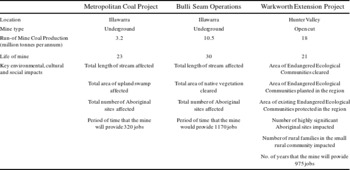
The three mining projects in which BCA was applied as part of the EA submitted in the development approval process were underground, longwall mining at the Metropolitan Colliery and the BSO located south of Sydney and an open-cut operation at the Warkworth Mine in the Hunter Valley, north west of Sydney. All three proposals involved the expansion of existing mine operations. A summary of the projects is provided in Table 1.
Summary information for case study projects.

The Metropolitan Coal Project proposed the mining of up to 3.2 million tonnes per annum (Mtpa) of Run-Of-Mine (ROM) hard and semisoft coking coal, over 23 years, predominantly for export. The mine is situated under the Woronora Plateau, predominantly within the natural areas of Woronora Reservoir catchment. Mining was proposed to be under the Waratah Rivulet and the upper reaches of the Woronora Reservoir (Resource Strategies Pty Ltd and Helensburgh Coal Pty Ltd, 2010).
The BSO Project involved the continued development of underground mining operations within existing coal leases and new mining leases to produce 10.5 Mtpa ROM coal for 30 years for domestic steel production and for export. The proposed mining would take place under the stream catchment systems of the Nepean River, the Cataract River, the Georges River, the Woronora River and O’Hares Creek. Up to 47 rivers and significant streams were identified in these catchments (Resource Strategies Pty Ltd and Illawarra Coal Holdings Pty Ltd, 2011).
The Warkworth Extension Project proposal involved additional open-cut extraction of three Mtpa of ROM steaming coal until 2021 with additional production then being at 18 Mtpa of ROM through until 2031. Production was targeted at export markets. Mining would be in a largely cleared rural landscape adjacent to a rural village, with some patches of remnant native vegetation being cleared (EMGA Mitchell McLennan, 2010).
The BCAs for these three projects, all conducted by the consulting firm Gillespie Economics (2007 Footnote 4 , 2009a ,Reference Harrison b ), involved a trade-off between their net production benefits (producer surplus) and their environmental, social, and cultural impacts (most of which were costs of mining but some of which were benefits). The net production benefits were estimated using market data on the projected financial value of the coal mined less the capital and operating costs of projects,Footnote 5 including any opportunity costs of capital and land already in the ownership of the proponent. These commercial-in-confidence data were provided by the proponents.
The production costs associated with the projects included measures aimed at mitigating, offsetting, or compensating for the main environmental, social, and cultural impacts of the mining operations. This included the costs of purchasing properties adversely affected by noise and dust levels above a government advised threshold, providing mitigation measures for properties identified as being moderately impacted by noise but below the acquisition threshold, the costs of providing and managing ecological offsets and the cost of purchasing groundwater and surface water entitlements in the water market. The costs also included any road works required to address capacity or safety concerns. To avoid double counting of impacts, only residual impacts, after mitigation, offset, and compensation, require additional consideration.
The key nonmarket environmental, cultural, and social impacts of the projects (listed in Table 1) that were not subject to compensation or mitigation were estimated using choice modelling (CM).Footnote 6 These impacts of the underground mines, used as attributes for the CM application, were mainly related to the cracking of bedrock as a result of mine subsidence and included impacts on streams (cracking of the stream bed and diversion of flows), significant Aboriginal heritage sites (collapse of rock shelters), and upland swamps (drainage and change of ecology) (Gillespie Economics, 2008, 2009a ). For the BSO Project, clearing of native vegetation from surface infrastructure extensions was also included as a CM attribute (Gillespie Economics, 2009a ). Both CM applications for the underground mines included an attribute representing the impacts of the proposals on mine employment (Gillespie Economics, 2008, 2009a ).
The nonmarket impacts of the Warkworth Extension Project stemmed from the open-cut nature of the mining operations. They included clearing of endangered ecological communities (EECs), planting of EECs (as an offset), protection of EECs in the region (as an offset), impacts on significant Aboriginal heritage sites, impacts on the social fabric of a small rural community (as a result of noise and dust and acquisition of properties), and the impacts on mine employment (Gillespie Economics, 2009b ).
Choice modeling questionnaires were designed in collaboration with the lead environmental consultants for the projects and with inputs arising from a number of focus groups comprising samples of Sydney residents. For the Metropolitan Coal Project (Gillespie & Kragt, Reference Gillespie and Kragt2012) and BSO Project, focus groups drawing on local area residents were also held. The CM questionnaires were implemented using online panels of NSW residents.
In addition to these CM estimated nonmarketed impacts, the costs associated with GHG emissions were included in the BCAs by applying the Australian Government’s carbon taxFootnote 7 (assumed to represent the social cost of carbon) to the emissions generated from the projects.
The nonmarket value estimates of impacts were combined with the estimated net production benefits of each case study to determine the net social benefit/cost of the projects. In each case, the mine project was found to generate aggregated discounted benefits that exceeded the discounted costs, that is, net social benefits of $1.0B, $8.3B, and $1.9B for the Metropolitan Coal Project, BSO, and Warkworth Extension Project, respectively. The conclusion in all cases was that proceeding with the project was welfare improving compared to the counterfactual of not proceeding (Gillespie Economics, 2008, 2009a , b ).
A number of conceptual and practical issues arose in implementing BCA in the three cases. These issues are outlined in the next section along with details of the approaches taken to address them. These issues and approaches became the focus of much of the policy and public debate that followed the release of the EAs.
4. BCA issues
4.1. Standing
As a tool of investment appraisal for the public sector, BCA can potentially be applied across different definitions of society such as a local area, state, nation or the world. The choice regarding who has “standing” in a BCA and hence what constitutes the definition of society can be contentious. Although a federal government would usually perform analyses from a national perspective it can be argued that where major impacts spill over national borders, then BCA should be undertaken from a global perspective (Boardman, Greenberg, Vining & Weimer, Reference Boardman, Greenberg, Vining and Weimer2001). For the mining case study projects, impacts that spill over national borders include GHG costs and producer surplus benefits to foreign owners. At the other extreme residents living in the coal mining regions and environmental groups opposing mining have suggested that the BCA should be undertaken at the local level where many of the potential noise, dust and amenity impacts would occur and most of the producer surplus benefits of mining could be ignored. In NSW, the legislative context implies that BCAs be focused on the net benefits to NSW.
Limiting the BCA to give standing only to NSW residents creates a number of difficult issues for implementing the technique. State level analysis is confounded by the interconnected nature of the Australian economy where benefits that accrue at the national level are transferred between the States via the tax system. Specifically, company taxes are collected at the federal level but are dispersed between the States. In addition, net profits accruing to companies from a project are dispersed amongst shareholders or retained and reinvested. Determining the component that accrues to people in a specific geographic region is practically problematic. The problem extends to the cost side of the BCA equation. Resources used in a mining development may be drawn from across state boundaries (and even from overseas suppliers). Identifying the source of input supplies and adjusting accordingly would be a complex task.Footnote 8
It is not surprising therefore that Boardman et al. (Reference Boardman, Greenberg, Vining and Weimer2001) advise against conducting BCA at a subnational perspective. Not only can it result in a range of costs and benefits from a project being excluded, thus making BCA a less valuable tool for decision-makers, but from a practical perspective, the task of determining the geographical distribution of benefits and costs is near to impossible. Consequently, for the case studies considered in this paper, the BCAs were undertaken initially at the global level with subsequent consideration of the broad distribution of costs and benefits.
4.2. Definition of the project
How a project is defined has important implications for the identification and valuation of its costs and benefits. Even when a BCA is undertaken from a global perspective, and includes costs and benefits that accrue outside the national border, only the costs and benefits associated with the defined project are relevant.
For the three mining proposals, approval was being sought for the mining of coal and delivery to port for export or to domestic customers. Hence, only the costs and benefits of these activities were relevant. The question arising relates to the scope of GHG emissions to be considered under the project. Coal mining results in the release of “fugitive emissions” when the coal seam is disturbed. The mining operation and the transportation of coal also involve the burning of fossil fuels and hence the emission of GHG. Furthermore, when the coal is burnt – either in steel making or electricity generation – more GHGs are released to the atmosphere. Which of these GHG costs should be included in the BCA? Groups opposing the mining projects considered that GHG emissions associated with the burning of coal should be included in the BCAs (Quiggin, Reference Quiggin2012).
The critical point in addressing this question is that coal is an intermediate good, that is, it is an input to other production processes. These downstream uses of the coal constitute different projects, that themselves may be subject to BCAs. For example, a BCA of a coal-fired electricity generation project would include the cost of coal, labor, land and capital inputs, electricity distribution, and environmental impacts (such as GHG emissions from the burning of coal). The BCA of electricity generation would also include benefits such as the community’s consumers’ surplus from their use of electricity. All of these costs and benefits are relevant considerations in the BCA at this next stage of the production process but not of a BCA of the mining projects.Footnote 9
Hence the approach taken was to cost the GHG emissions arising from fugitive emissions at the mine sites as well as the emissions associated with mining and transportation activities, but not the emissions from the burning of coal. The rate per tonne of carbon dioxide equivalent emissions was the carbon tax rate (AUD23) which was assumed to be set to represent the social cost of carbon.
4.3. Financial values and transparency
At the core of the BCAs was the financial analysis of the projects undertaken by/for the proponent. This included projections of capital costs, operating costs, and revenues. This information is commercial-in-confidence and unable to be published in the EA. Consequently, BCA spreadsheets could not be published in the EA and the analysis could not be completely transparent.
A particular issue relates to assumed coal prices. BCA theory suggests that where markets for commodities are competitive then market prices should be used. International coal markets, on which the production of the case study mines was to be sold are relatively competitive, however, there is not just one price of coal. Coal is a heterogeneous commodity and can have different ash, moisture, calorific value, sulfur content, and other specifications. These factors combine to result in coal price differentiation from project to project as the coal production differed across mines and even from each mine at different stages in the mine’s production history. The case study BCAs therefore relied on the price predictions provided by proponents for the economic analyses, with sensitivity analysis undertaken for higher and lower values.
With different prices used as the basis for different projects and without the ability to always disclose the prices used, difficulties arise in defending the BCAs.
4.4. Valuation of dust and noise impacts
Dust and noise impacts were incorporated into the BCAs based on the outcomes of noise and dust modeling and the use of property values/mitigation costs as value surrogates.
Air quality criteria, relating to total suspended particles (TSP), PM10 and PM2.5, were developed for the projects that take into consideration the existing background dust levels in a region as well as the dust levels that will arise from a project. These criteria were set at levels to protect against health effects and nuisance dust effects (Department of Environment and Conservation, 2005).
Noise impacts were assessed based on the Industrial Noise Policy (INP) of the NSW Environment Protection Authority (EPA) (2000). The INP provides a framework for establishing project specific noise criteria that would protect the community from excessive intrusive noise and preserve amenity (EPA 2000). If these criteria are exceeded at a noise receiver point then the project is considered to have a noise impact. The extent of the noise impact is defined by the extent to which the noise criteria are exceeded (EPA 2000). A five decibel (dB) or more exceedance is considered a significant impact. A 3–5 dB exceedance is a moderate impact and a 1–2 dB exceedance is a minor exceedance (Resource Strategies Pty Ltd and Helensburgh Coal Pty Ltd, 2010).
Where properties are predicted to be significantly impacted by the noise of a mining project, that is, a five decibel (dB) or more exceedance of noise criteria, or where air quality criteria are predicted to be exceeded, the proponent is required to purchase the affected properties on request of the landowner as a condition of the development consent.Footnote 10 These acquisition costs are included in the capital costs of the projects. While the impact of a noise or dust nuisance could be expected to impose a cost on affected residents through deterioration in their properties’ values, the cost recorded in the BCA under the approach used is the full value of the property. The implication may be that the approach used results in an overestimation of the costs of noise and dust to residents experiencing “significant” impacts. However, the property price impact does not account for lost consumer surplus associated with the residents’ enjoyment of their home. The willingness to pay for a property may be in excess of the price actually paid (which in an auction setting would reflect the willingness to pay of the second most interested buyer). Hence, the issue becomes one of comparison between the lost consumer surplus and the extent of the compensation paid in excess of the property value impact.
Where properties are predicted to be moderately impacted by noise impacts (i.e., a three to five dB exceedance of noise criteria) noise mitigation measure must be provided by the proponent at the request of the landholder. These measures can include double glazing of windows and installation of air conditioning units. Where such measures mitigate the noise impacts perfectly, then affected residents are no worse off than they were before and no costs additional to the mitigation expenses warrant inclusion in a BCA. However, it is unlikely that mitigation is complete and to the extent that there remain unmitigated impacts, noise costs are not completely reflected in the BCAs. Nevertheless, these residual impacts are not likely to have a material bearing on the outcome of the BCAs.
In terms of air quality impacts that are not sufficiently severe to require the acquisition of the impacted property by the mine proponent, there are no prescribed mitigation measures. Hence, the costs of moderate and low air quality impacts are not incorporated into the BCA through expenditures on mitigation measures. Again, these residual costs are not likely to be material in terms of the overall net benefit outcome.
4.5. Issues in the application of CM
A range of issues arise through the use of CM to estimate the main nonmarket impacts of the mines that were otherwise not accounted for through financial payments. Of particular interest was the extension of the CM technique to cover not just the environmental impacts of the mines. The CM choice sets were designed to include social, cultural as well as environmental changes caused by the mining operations.
Three separate CM applications were developed for the three different mines. While the details provided to the CM survey respondents in each case were different, the basic format of the CM applications remained consistent.
The first issue arising involved the establishment of the context for the CM questionnaire. If approval was not granted for the proposals to mine at the three mines under examination, existing operations would be forced to cease for lack of access to the resource. Hence, the implication of the consent legislation is that the property right to the resource lies in the “no-mine” context. The framing of the choice questions in the CM survey problem therefore suggests a willingness-to-accept (WTA) format for respondents: that is, respondents should be asked for their WTA compensation to allow mining to continue and cause additional environmental, social, and cultural damage.
While some applications of CM have used a WTA format (e.g., MacDonald, Morrison & Barnes, Reference MacDonald, Morrison and Barnes2010; Garrod & Willis, Reference Garrod and Willis2000) “in practice there is great difficulty in obtaining correct estimates of WTA for decreases in the level of a public good, because respondents tend to reject the implied property right as implausible” (Mitchell & Carson, Reference Mitchell and Carson1989, p. 52). To be consistent with the recommendations of the NOAA Panel (Arrow et al., Reference Arrow, Solow, Portney, Leamer, Radner and Schuman1993) and to avoid the prospect of respondents making choices without any income or wealth bounds (Mitchell & Carson, Reference Mitchell and Carson1989) the CM applications developed for the three mines were framed in a WTP format. That is, the status quo choice option was described as “mining continuing as currently planned” and used the project description in the EA to detail that scenario. The choice set alternatives provided to respondents involved “new government decisions for the mines” that could include mine cessation, limiting the geographical extent of mining or requiring future mining to avoid areas that are located below or adjacent to significant natural features. The choice scenarios provided to respondents were therefore in terms of WTP to avoid an impact, consistent with a compensating surplus measure of welfare.
The second issue of CM application involved sampling. CM practitioners have to determine the population that may hold values for the attributes under consideration. Recognizing the distance decay function for values reported in the literature (Rolfe & Windle, Reference Rolfe and Windle2012), the geographical extent to which a project impacts people is a key consideration: is the project a local, state or national concern. For example in Australia the National Land and Water Audit CM study (van Bueren & Bennett, Reference van Bueren and Bennett2000) investigated the costs of land and water degradation across Australia and hence the sampling strategy for that study involved the Australian population. In contrast, a study commissioned by the NSW EPA on water reforms and environmental flows in major rivers in NSW (Morrison & Bennett, Reference Morrison and Bennett2004), sampled NSW households as well as households living in the catchments of the major rivers.
For the mining project CM applications, the environmental, social, and cultural impacts involved were not considered by the relevant technical specialists engaged by the proponents to be of national significance. Hence the survey sample was drawn from NSW households only.Footnote 11 Whether this strategy is correct remains a testable hypothesis. To the extent that households outside NSW hold values for the impacts of the mining projects, nonmarket impacts will be understated and project net social benefits overstated.
The third CM application issue concerned the inclusion of mine employment as a CM attribute. In the conventional BCA framework, employment is a cost of production and included in the calculation of producer surplus changes. Where labor resources would otherwise be employed at a lower wage or would be unemployed, a shadow price of labor should be included in the estimation of producer surplus change rather than the actual wage (Boardman et al., Reference Boardman, Greenberg, Vining and Weimer2001). However, what became apparent through successive focus groups undertaken in the design phase of the CM application is that respondents enjoy some value from the continued employment provided for others as a result of mining operations. Conversely, they do not like employment opportunities provided to others being reduced. As identified by Portney (Reference Portney1994, p. 13), the concept of existence values should be interpreted more broadly than just relating to environmental outcomes:
“If I derive some utility from the mere existence of certain natural environments I never intend to see (which I do), might I not also derive some satisfaction from knowing that refineries provide well-paying jobs for hard-working people, even though neither I nor anyone I know will ever have such a job? I believe I do. Thus, any policy change that “destroys” those jobs imposes a cost on me – a cost that, in principle, could be estimated using the contingent valuation method …. Since regulatory programs will always impose costs on someone – taking the form of higher prices, job losses, or reduced shareholder earnings – lost existence values may figure every bit as prominently on the cost side of the ledger as the benefit side.”
The utility of individuals may therefore be affected by changes in their own well-being as well as changes in the well-being of others (Rolfe & Bennett, Reference Rolfe and Bennett1996). This is consistent with the observed behavior of altruism (Freeman III, Reference Freeman, Champ, Boyle and Brown2003). To the extent that the community hold these altruistic preferences for other people’s employment they represent a positive externality of coal mining projects and should be included in the neoclassical welfare economics trade-off framework.Footnote 12 This was achieved through the inclusion of an employment impact attribute (number of years the mines would continue to provide a specific level of employment) in the CM choice sets.Footnote 13
Other people’s well-being is the focus of another attribute included in the Warkworth Extension Project CM study. Because the proposed mine extension was predicted to have noise and dust impacts that would result in the acquisition of residential dwellings in an adjacent rural village, there was a potential for the CM respondents to feel a loss associated with the disruption to the local community. To account for that a “social fabric” attribute was included in the Warkworth Extension Project CM choice sets (Gillespie Economics, 2009b ).
Another CM issue relating to attribute selection involved the use of offsets in the management of mining impacts on vegetation. In the Warkworth Extension Project case, the proposal involved clearing areas of EEC to allow for the open-cut mine to be developed. The proponent agreed to offset these impacts by both establishing substitute sites (planting trees and shrubs on adjacent farm land) and purchasing and protecting other stands of the same EEC in the region. In recognition that neither type of offsets provides a perfect substitute for the cleared areas, three vegetation attributes were included in the CM choice sets for the Warkworth study (Gillespie & Bennett, Reference Gillespie and Bennett2012). These were the area of EEC cleared, the areas planted and the area protected. The goal of including all the vegetation attributes was to establish the “exchange rate” between them in terms of the public’s relative values for each. In other words, the idea was to estimate the number of hectares of replanted land that would substitute for one hectare of cleared EEC and so on. With this information the Warkworth Extension Project BCA was able to include the costs associated with the EEC’s cleared and the benefits associated with the offsets proposed.
The CM studies provided estimates of household WTP for unit changes in attribute levels. These values were included in the BCAs by multiplying these unit change values by the predicted level of change between the with and without mining scenarios and aggregating these household WTP estimates to the NSW population. This latter step necessitated assumptions about whether nonrespondents hold the same values as those of respondents included in the sample. Some studies recommend conservative aggregation, by only aggregating WTP values to the proportion of the population given by the questionnaire response rate (see, e.g., Bennett, Reference Bennett2008). However, this may understate community WTP as it assumes that all nonrespondents have a zero WTP. An alternative method has been suggested by Morrison (Reference Morrison2000), who found that approximately one third of nonrespondents hold values similar to questionnaire respondents. van Bueren and Bennett (Reference van Bueren and Bennett2000) support these findings from a follow-up telephone interview with nonrespondents in a CM. Using this approach, extrapolation of the results across all case studies was rounded up to 50% of NSW households.
5. Responses to the BCAs
5.1. Introduction
The BCAs of the coal mining proposals formed part of the EAs that accompanied the applications from the mining proponents. It was for the first time in the NSW planning system that BCAs including the results of bespoke nonmarket valuation studies had been undertaken for coal projects. The analyses received mixed responses from decision-makers and lobbyists and were used in different ways in determining the merits of the projects.
5.2. Reliance on deontic rules instead of BCA
The case study BCAs identified that the benefits of the projects were greater than the costs and that restrictions on the extent of proposed mining operations would be welfare reducing. Sensitivity testing found that the results were not sensitive to reasonable changes in producer surplus estimates or environmental, social, or cultural costs. The outcome was most sensitive to changes in the assumed coal price.
Nevertheless, the merit PACs for the Metropolitan Coal Project and BSO Project recommended the approval of substantially reduced mining operations. The rationale expressed by the Metropolitan Coal Project PAC was to minimize what it considered to be “unacceptable environmental consequences for significant natural features” (NSW PAC 2009, p. 132). The BSO Project merit PAC considered that “it is no longer a viable proposition for mining to cause more than negligible damage to pristine or near-pristine waterways in drinking water catchments or where these waterways are elements of significant conservation areas or significant river systems” (NSW PAC 2010, p. iv).
The Environmental Assessment Report, prepared by the NSW DP&I, for the Warkworth Extension Project (NSW DP&I 2011b ) and provided to the PAC made reference to the BCA undertaken for the Project and concluded that “on balance, the Department believes that the project’s benefits would outweigh its residual impacts that it is in the public interest and should be approved, subject to stringent conditions” (NSW DP&I 2011b , p. iii). The PAC conditionally approved the Project. However, the decision was appealed to the LEC by the Bulga Milbrodale Progress Associated Incorporated and this appeal was upheld (Bulga Milbrodale Progress Association Inc. v. Minister for Planning and Infrastructure and Warkworth Mining Limited 2013). The judge in that case stated: “I have found … that the Project would have significant and unacceptable impacts on biological diversity, including on endangered ecological communities, noise impacts and social impacts” (Bulga Milbrodale Progress Associated Inc. v. Minster for Planning and Infrastructure and Warkworth Mining Limited 2013, p. 173).
The PAC recommendations for the Metropolitan Coal Project and BSO and the LEC findings for the Warkworth Extension Project were clearly based on a rationale beyond that underpinning the conceptual framework of neoclassical welfare economics, and hence BCA. In welfare economics, the existence of environmental effects per se, even significant ones, is not sufficient justification to reject a coal mine proposal. What is relevant is whether the discounted benefits to society exceed the discounted costs. The application of deontic “rules,” which identify an obligation on the behavior of proponents, such as an obligation not to have “unacceptable” impacts, is outside the trade-off logic of economics and raises issues around what is the threshold impact level for unacceptability.
5.3. PAC comments on choice modeling
The PAC for the Metropolitan Coal Project concluded that nonmarket valuation techniques for estimating environmental costs that are based on community attitudes to protection of significant natural features has potential for use in the EIA process. Notwithstanding, it raised questions about the context statements provided in the CM questionnaires regarding:
-
1. the relative scope of impacts provided in the CM questionnaire;
-
2. the validity of the values estimated for the employment attribute.
In making its recommendation for a reduced project scale, the BSO Project merit PAC concluded that:
“the benefits of protecting significant natural features in the eastern and southern areas are likely to be of a similar magnitude to the mining profits that would have to be given up to ensure that protection. So while protection of the significant natural features would involve lower mine profitability, it is likely that society as a whole would gain more from the environmental protection recommended than it would lose in terms of foregone profits” (NSW PAC 2010, p. v).
In coming to this conclusion, the BSO Project merit PAC considered that the CM study provided average unit values for impacts but did not provide sufficiently detailed value estimates to differentiate between the differing quality of natural features across the geographic area to be impacted by the proposed mine. Specifically, the PAC considered that streams in the eastern and southern part of the project area would be of much greater value than those in the rest of the project area. The merit PAC argued that if the upper bound 95% confidence interval for environmental and cultural impacts implicit prices were applied to the eastern and southern part of the project area this would increase the social costs of mining. The potential presence of value interactions where environmental/heritage features occur together was also suggested as potentially further increasing the costs of environmental damage. Other factors suggested as causing an underestimation of environmental costs in the original BCA included a speculated potential future recreation activity in the catchment and uncertainty about the predicted physical consequences of the proposed mining activity (NSW PAC 2010). The BSO Project PAC excluded any consideration of the social value of employment from its calculations.
The BSO Project merit PAC considered that for CM estimates to be relied on in future, the scale at which the studies are undertaken would need to be fine enough to capture significant heterogeneity across a project area in terms of the distribution and/or significance of the natural features (NSW PAC 2010). The BSO Project PAC also raised issues about potential bias in the design of the questionnaire, as it was based on the “proponent’s view of the environmental impacts of the project” (NSW PAC 2010, p. 380). Both these matters raise issues in the practical application of CM in the policy area.
Heterogeneity of physical impacts across a project area could potentially be accommodated by increasing the number of attributes in choice sets or by undertaking separate CM studies for different parts of the mine proposal area that contained features of varying quality. In any CM application, there is a trade-off between the number of attributes included in choice sets (choice complexity) and respondent’s attention to the questionnaire. Most environmental applications of CM include between four and six attributes. Tackling site heterogeneity using increased numbers of attributes would therefore involve potential costs in survey response rate loss or respondent cognition reductions.
The alternative approach to dealing with site heterogeneity involves undertaking separate CM studies for different parts of the mine proposal area that contained features of varying quality. This presents budgetary issues for the proponent and also raises questions regarding the matching of project scope with the scope of the context set out in the CM questionnaire.
With regard to the issue of information bias in the CM questionnaire, all applications of CM rely on the advice of disciplines other than economics regarding the potential impacts of a project or policy. In the coal mine cases, this information came from the consulting firm that was contracted by the proponents to conduct the EAs. Subconsultants were responsible for assessments of subsidence impacts, biodiversity impacts, noise and dust projections, and cultural impacts. The information was therefore based on the analysis of experts in their respective fields. Nevertheless, these studies are commissioned by the proponent and there can be a perception that such assessments are not independent. In the decision-making process, particularly if public submissions are invited and public hearings conducted as part of the merit PAC’s role, a range of alternative views on the impacts of a project can be expressed. However, these alternative views are not available at the time of conducting the CM study for incorporation into an EA. Hence it is difficult to foreshadow them and incorporate varying impact information into split sample analysis. Conflicts over the type and level of the impacts of projects may best be dealt with by the commissioning of CM studies during the decision-making phase of the EA process. This would enable an agreed or independent view of likely impacts to be incorporated.
The Environmental Assessment Report, prepared by the NSW DP&I, for the Warkworth Extension Project (NSW DP&I 2011b ) and provided to the PAC also made reference to the results of the CM study in relation to biodiversity offsets:
“The economic assessment also attempts to calculate an econometric measure to account for clearing of EEC vegetation and provision of biodiversity offsets. The assessment calculates that 1 ha of EEC would be offset by 1.4 ha of protection of existing EEC in the region (i.e., an offset ratio of 1.4:1), or 4 ha of EEC planting (i.e., an offset ratio of 4:1). Whilst the Department is reticent to adopt such an econometric approach to offsetting, it accepts that the proposed offsetting for the project meets these offset ratios. More importantly, the Department is satisfied that the proposed biodiversity offsetting for the project would improve or maintain biodiversity values over the medium to long term” (NSW DP&I 2011b , p. 62).
5.4. Consideration of BCA by the land and environment court
In the LEC judgment (the Judgment) a number of criticisms were made of the BCA method, its specific application to the Warkworth proposal and the use of CM.
The Judgment incorrectly interpreted the role of BCA in decision-making, identifying that “it does not consider all the relevant matters that need to be considered by an approval authority in determining a project” (Bulga Milbrodale Progress Associated Inc. v. Minster for Planning and Infrastructure and Warkworth Mining Limited 2013, p. 155) and that the BCA “seeks to supplant the Court’s essential task, … , of applying the appropriate weight to the relevant matters” (Bulga Milbrodale Progress Associated Inc. v. Minster for Planning and Infrastructure and Warkworth Mining Limited 2013, p. 169).
The Judgment was also concerned that the BCA approach “confines the court to the economists’ assessment of particularity and value, in a context where there is no evidence available to the Court to assign its value” (Bulga Milbrodale Progress Associated Inc. v. Minster for Planning and Infrastructure and Warkworth Mining Limited 2013, p. 169).
BCA does not purport to consider all the matters that are relevant to a decision-maker or seek to supplant the role of the decision-maker. BCA is concerned with evaluating a project against one of the objectives of the EP&A Act, that is, economic efficiency. It provides a comparison of the present value of aggregate benefits to society, as a result of a project, policy or program, with the present value of the aggregate costs. These costs and benefits are defined and valued based on the welfare economic underpinnings of BCA. In particular, it is the values held by individuals in the society that are relevant, including both market and nonmarket values, not the Court’s values. Provided the present value of aggregate benefits to society exceed the present value of aggregate costs (i.e., a net present value of greater than zero), the project is considered to improve the well-being of society and hence is desirable from an economic efficiency perspective.
Decision-making is multiobjective in nature (Loomis & Helfand, Reference Loomis and Helfand2001; Loomis, Reference Loomis1987; Boardman et al., Reference Boardman, Greenberg, Vining and Weimer2001). Decision-makers should consider the evaluation of a project in terms of economic efficiency alongside the evaluation of a project against other, often overlapping and conflicting objectives. In EA this will inevitably include the results of other technical assessments.
Part of the criticism of BCA in the Judgment was that it failed to consider issues of equity and distributional justice. “These failures to consider adequately intergenerational and intrageneration equity limit the utility of the BCA and CM to the Court for the purposes of evaluating, weighting and balancing the relevant matters to be considered in determining the Project” (Bulga Milbrodale Progress Associated Inc. v. Minster for Planning and Infrastructure and Warkworth Mining Limited 2013, p. 172). “With respect to intergenerational equity, the BCA and CM did not consider adequately, or accord sufficient weight to, this principle of Environmentally Sustainable Development (ESD)” (Bulga Milbrodale Progress Associated Inc. v. Minster for Planning and Infrastructure and Warkworth Mining Limited 2013, p. 171).
Again, this is an inappropriate criticism of BCA because, as identified above, BCA is concerned with a single objective of the EP&A Act and governments, that is, economic efficiency, specifically whether the aggregate benefits of a project exceed the aggregate costs. BCA and its welfare economics foundations are explicitly neutral on the distribution of costs and benefits. While BCA can provide information on who bears the economic efficiency costs and benefits of a project, there is no welfare criterion for determining what is a fair, an equitable or a preferable distribution of costs and benefits. As argued by Sinden and Thampapillai (Reference Sinden and Thampapillai1995, p. 210) “the method can hardly be criticized for something it does not pretend to do.” Matters relating to distributional effects are therefore usually left to the political process (James & Gillespie, Reference James and Gillespie2002). The fact that BCA does not consider equity (and other) issues should not limit the utility of it to decision-makers as a relevant piece of information to consider, alongside other relevant pieces of information, in making a decision.
A particular element that the Judgment identified as being omitted from consideration within the BCA is the “distributive justice” associated with “components of biological diversity, such as the EECs and threatened fauna within the disturbance areas, which would also suffer the burdens of the Project” (Bulga Milbrodale Progress Associated Inc. v. Minster for Planning and Infrastructure and Warkworth Mining Limited 2013, p. 171). However, just as BCA is not concerned with distribution issues it is also not concerned with ethical issues about the rights or feelings of plants and animals. BCA is anthropocentric; so too is the EP&A Act, which is concerned with “all aspects of the surroundings of humans, whether affecting any human as an individual or in his or her social groupings.” The environment generates values for consideration in a BCA only to the extent that humans value it.
The Judgment was also critical of aspects of the application of BCA to the Warkworth Extension Project. The Judgment considered that there “are nonmarket values that have either not been, or have been inadequately been, taken into consideration in the BCA, including impacts of noise and dust, impacts on amenity values and ecosystem services” (Bulga Milbrodale Progress Associated Inc. v. Minster for Planning and Infrastructure and Warkworth Mining Limited 2013, p. 168). Part of this criticism related to the Judgment’s differing views on the level of biophysical impacts of the project, for example, noise, dust, and amenity from those of the experts who framed the EA.
5.5. Consideration of choice modeling by the land and environment court
The LEC judgment also leveled criticism at the CM study for:
-
1. limiting the sample frame to NSW instead of surveying Australian households with the Judgment suggesting that the environmental impacts of the mine expansion are of similar national significance to the protection of iconic natural areas in Australia such as the Franklin–Gordon Rivers in Tasmania and the Daintree Rainforest in Queensland;
-
2. aggregating four EECs into one EEC attribute – a common approach in CM to address impacts on vegetation that is of similar conservation importance (e.g., Blamey, Rolfe, Bennett & Morrison, Reference Blamey, Rolfe, Bennett and Morrison2000) and avoid cognitive burden associated specification of a large number of attributes in CM questionnaires;
-
3. having an upper level for the impacts on the EEC attribute that is higher than the area that will actually be cleared by the project – which is a deliberate part of the CM design to ensure that the ultimate level of impact of a project, which is unknown at the time the questionnaire is implemented, is within the attribute level range;
-
4. providing inadequate information on the EECs, which partly reflects the amalgamation of the EECs into one attribute but also limitations in the amount of information that can be incorporated into CM questions. With respect to this last issue, follow-up questions to respondents indicated that they considered the information provided to them was sufficient and understandable;
-
5. not asking respondents what they were prepared to pay – when a direct WTP question is not a component of CM;
-
6. having an upper level of the cost attribute ($625) that did not relate to the costs of the project – when theoretically it should not be related to the costs of the project but should reflect a level of disposable income that few people are willing to give up.
These criticisms largely indicate an unfamiliarity/misunderstanding of the CM method, although future applications of CM in EIA would benefit from considering different sample frames.
Ultimately the BCA and CM results were considered by the Court as having little value for decision-making.
“Having regard to the limitations of the economic analyses as discussed above, I am of the view that the results of those analyses are of limited value in deciding whether I can reach of state of satisfactions as to the nature and extend of impacts in considering each and all of the relevant matters, the weight I should assign each matter, and the balancing of matters, to determine whether the project should be approved or disapproved” (Bulga Milbrodale Progress Associated Inc. v. Minster for Planning and Infrastructure and Warkworth Mining Limited 2013, p. 172).
5.6. Policy response
The decisions of the PACs, and in particular the LEC, in relation to mining proposals have led the NSW Government to prepare the State Environmental Planning Policy (Mining, Petroleum Production and Extractive Industries) Amendment (Resource Significance) 2013. The key aim of the Policy is to redirect the decision-makers to place more emphasis on the economic benefits arising from coal mining: “The primary purpose of the proposed SEPP is to ensure that where mineral resources are demonstrated to be significant to the State, they are given greater consideration in the assessment of development applications” (NSW DP&I 2013a , p. 1). In considering the significance of the resource, the consent authority must have regard to, among other things, the economic benefits, both to the State and the region from development of the resource. The matters taken to be relevant for consideration of the economic benefits are:
-
∙ “employment generation;
-
∙ expenditure, including capital investment;
-
∙ the payment of royalties to the State” (NSW DP&I, 2013b , p. 3).
However, giving greater weight to these matters runs contrary to the foundations of welfare economics which is concerned with consideration of all the economic costs and benefits of projects, not just some of them. It also has a distinct State and regional focus, ignoring costs and benefits that may accrue at the national level. It would be sufficient for decision-makers to recognize BCA as a valid tool for examining the economic efficiency of projects and use the results of the BCAs along with their considerations of evidence relating to other objectives of public policy. In this respect, it is noted that the Policy explanation (NSW DP&I, 2013c ) states that the significance of the resource is not the only factor in the decision-making process and that environmental, social, and economic impacts must also be considered. Hence BCA may continue to play a role in assessing the economic impacts of projects alongside separate consideration of the significance of the resource as defined above.
6. Conclusions
BCA can provide important information to decision-makers on the economic efficiency of coal mining projects. When values from primary valuation studies are integrated into BCA, stronger conclusions can be drawn on whether projects are welfare improving. However, it needs to be recognized that analysis and decision-making do not always sit comfortably together (Harrison, Reference Harrison1977). Even when BCA including nonmarket valuation estimates is incorporated into EIA and recognized as a valid tool for examining economic efficiency it may have a limited role in the decision-making process depending on whether it supports or contradicts the political decision that is being made (Loomis, Reference Loomis1987). Where it does not support the decision that is being taken, it is likely to be subject to a wide range of skepticism and criticism (Garrod & Willis, Reference Garrod and Willis1999). In a policy setting where vagueness and ambiguity around a range of impacts provides decision-makers with considerable discretion, evaluation methods such as BCA that incorporates community valuations of impacts and provide clarity around the economic efficiency trade-offs involved, may be unwelcome (Garrod & Willis, Reference Garrod and Willis1999).
Nevertheless, BCA and nonmarket valuation may in some situations inform and influence the political process (Harrison, Reference Harrison1977) and at the very least can clearly identify the efficiency losses associated with political decisions (Loomis, Reference Loomis1987). For instance, the LEC decision for the Warkworth Extension Project results in economic efficiency losses of $1.9B including foregone royalty payments to the NSW Government of $254M ($679M undiscounted) and foregone company tax payments of $515M ($1.3B undiscounted). Continued use of BCA and nonmarket valuation in EIA may also lead to better understanding of the methods by decision-makers and avoid the misunderstandings evident in the Warkworth judgment. Uncertainty and debate about the physical impact of development projects and the economic values of these impacts also suggest the need for a greater emphasis on sensitivity analysis.