INTRODUCTION
Post-dispersal seed predation is a major source of offspring mortality in trees (Hulme Reference HULME1998, Janzen Reference JANZEN1971a). Many large-seeded tree species escape seed predation through seed dispersal by scatter-hoarding animals (Jansen & Forget Reference JANSEN, FORGET, Bongers, Charles-Dominique, Forget and Théry2001). These animals hoard seeds in shallow single-seeded caches in the soil surface, scattered across the home range, as food supplies for periods of food scarcity (Vander Wall Reference VANDER WALL1990). When the scatter hoarder fails to recover some of the cached seeds, scatter-hoarding reduces seed predation in several ways. The dispersal of seeds away from the parent tree potentially reduces post-dispersal infestation by parent-associated predators and pathogens, the scattering of seeds across a wide area reduces the likelihood of density-responsive seed predators finding and killing the seeds, and the burial of seeds enhances seed survival and seedling establishment (Jansen et al. Reference JANSEN, VAN DER MEER and BONGERS2008a, Jansen & Forget Reference JANSEN, FORGET, Bongers, Charles-Dominique, Forget and Théry2001, Vander Wall Reference VANDER WALL1990). A potential advantage to the plant that has received less attention is a reduction of seed predation rates as a result of the rodents’ tendency to carefully husk and deflesh seeds before caching them (Jansen et al. Reference JANSEN, BONGERS and PRINS2006).
A prime example of seed-defleshing behaviour is seen in the Central American agouti Dasyprocta punctata Grey. This large Neotropical forest rodent meticulously peels off and discards or eats all exocarp and mesocarp material before scatter-hoarding seeds such as those of the fleshy-fruited palm Astrocaryum standleyanum L. H. Bailey (Arecaceae) (Smythe Reference SMYTHE1989, pers. obs.). Smythe (Reference SMYTHE1989) argued that agoutis deflesh A. standleyanum before caching to remove the eggs and larvae of bruchid beetles that are contained in the pulp before those can penetrate the endocarp and attack the seed. Thus, agoutis would reduce seed predation to the mutual benefit of the animal and its food tree. However, recent studies suggest that agoutis prefer to consume bruchid larvae rather than seeds, possibly because larvae have a higher nutritional value than endosperm (Gálvez & Jansen Reference GÁLVEZ and JANSEN2007, Silvius Reference SILVIUS2002). Thus, it might not be in the interest of agoutis to intercept bruchid larvae.
We performed a series of manipulative experiments to evaluate three alternative, but comparable hypotheses on how seed-defleshing behaviour may reduce seed predation to the mutual benefit of hoarder and tree. The first and established hypothesis – the ‘interception hypothesis’ – was that defleshing reduces post-dispersal seed predation by bruchid beetles by removing bruchid beetle larvae (or eggs) present in the material around seeds before these larvae can enter the seed (Smythe Reference SMYTHE1978). The second hypothesis – the ‘theft-prevention hypothesis’ – was that defleshing reduces post-dispersal seed predation by lowering the likelihood that seed-eating mammals recover cached seeds. Odour enhances cache detection by rodents and other macrosmatic mammals (Murie Reference MURIE1977, Stapanian & Smith Reference STAPANIAN and SMITH1978, Vander Wall Reference VANDER WALL1991, Vander Wall et al. Reference VANDER WALL, BECK, BRIGGS, ROTH, THAYER, HOLLANDER and ARMSTRONG2003), and decaying fruit flesh and other soft material has a stronger odour than the seeds themselves. Defleshing might reduce cues that other animals use to find caches, and increase the recovery advantage for the cache owner. Although a proportion of seed pilfered from caches by rodents may be re-cached, every instance of seed handling comes with a risk of seed consumption (Vander Wall Reference VANDER WALL1995). The third hypothesis – the ‘conservation hypothesis’ – was that defleshing reduces seed predation by reducing seed infestation by microbes and invertebrates that first arrive after seeds are cached. Fruit flesh is an excellent medium for microbes (Janzen Reference JANZEN1977). By removing exocarp and mesocarp before caching seeds, rodents might reduce microbial infestation and increase seed storage life (Vander Wall Reference VANDER WALL1990). In each of these three hypotheses, the scatter hoarder and the plant share a common advantage – seed defleshing reduces post-dispersal seed predation – but the mechanisms differ. Note that we do not consider explanations unrelated to seed predation, such as defleshing facilitating the transport and caching of seeds by reducing seed weight and volume, or the material around the seed being removed to be consumed as food. However, these do not explain why seed defleshing is done meticulously and exhaustively.
STUDY SITE AND SPECIES
Our study sites were Barro Colorado Island (BCI) and the nearby Pipeline Road (PLR) in the Parque Nacional Soberania, Panama (9°10′N, 79°51′W). BCI is a former hilltop that was isolated from the mainland by the formation of Gatun Lake to complete the Panama Canal in 1914. BCI and PLR support semi-deciduous tropical moist forest. Mean annual rainfall is 2600 mm, and there is a distinct 4-mo dry season (Leigh Reference LEIGH1998). BCI and PLR have a fairly complete fauna with mammal densities similar to much more remote sites (Wright et al. Reference WRIGHT, GOMPPER and DELEON1994). One important component absent today is the white-lipped peccary (Tayassu pecari), which has relevance to our study because these animals are known to feed on cached palm seeds (Kiltie Reference KILTIE1981).
The Central American agouti is a terrestrial, diurnal caviomorph rodent weighing 2–4 kg that is common in tropical forests from Central America and the West Indies to northern South America. Agoutis are of great ecological importance as seed predators and seed dispersers. They scatter-hoard seeds of several large-seeded plant species during periods of high fruit abundance, and retrieve them during periods of scarcity. They carry seeds in their mouths, one at a time, and bury them individually in widely scattered caches. Because cached seeds may remain unrecovered, agoutis function as seed dispersers of their food plants (Smythe Reference SMYTHE1989, Smythe et al. Reference SMYTHE, GLANZ, LEIGH, Leigh, Rand and Windsor1982). Before caching, agoutis routinely spend time defleshing seeds (Smythe Reference SMYTHE1989), even if the seeds are already free of fruit flesh (P. A. Jansen et al., unpubl. data).
Astrocaryum standleyanum is a monoecious, arborescent cocosoid palm, occurs from Nicaragua to Colombia (Croat Reference CROAT1978), and is among the ten most abundant tree species in central Panama (Pyke et al. Reference PYKE, CONDIT, AGUILAR and LAO2001). On BCI, adults produce up to eight pendulous infructescences, each up to 150 cm long with up to 800 fruits that ripen mainly during April–June (De Steven et al. Reference DE STEVEN, WINDSOR, PUTZ and DE LEON1987, Jansen et al. Reference JANSEN, BOHLMAN, GARZON-LOPEZ, OLFF, MULLER-LANDAU and WRIGHT2008b). Fruits are ovoid drupes that consist of one 20 × 15-mm seed (rarely two or three), enclosed in three layers: a hard endocarp (shell) that is 1.5–3 mm thick; a sweet, fleshy mesocarp (flesh) that is 4–5 mm thick; and finally a harder, bright orange exocarp (skin) that is 0.5 mm thick. In the following, we loosely use ‘seed’ to denote either the actual seed or the stone: the seed plus endocarp. Flesh and seeds are consumed by a variety of frugivorous and granivorous mammals and are one of the most important food sources for the agouti on BCI (Glanz et al. Reference GLANZ, THORINGTON, GIACALONE-MADDEN, HEANEY, Leigh, Rand and Windsor1982, Hoch & Adler Reference HOCH and ADLER1997, Kays Reference KAYS1999, Smythe et al. Reference SMYTHE, GLANZ, LEIGH, Leigh, Rand and Windsor1982). In turn, A. standleyanum is believed to depend strongly on scatter hoarding by agoutis that may cache seeds of A. standleyanum up to >100 m away from the mother tree (P. A. Jansen et al., unpubl. data), which significantly increases the chances of survival and germination (Smythe Reference SMYTHE1989).
The invertebrate seed predators of A. standleyanum include a bruchid beetle (Coleoptera: Bruchidae) and a scolytid beetle (Coleoptera: Scolytidae). The bruchid beetle – identified as Pachymerus bactris (L.) in this study (M. N. Garcia, pers. comm.) – caused high proportions of A. standleyanum seed predation (up to 75%) in previous studies (Smythe Reference SMYTHE1989, Wright et al. Reference WRIGHT, ZEBALLOS, DOMINGUEZ, GALLARDO, MORENO and IBANEZ2000). Pachymerus bactris adults are ~12 mm long, and are believed – with all other pachymerine bruchids – to oviposit on fruits after they fall to the ground (Johnson & Romero Reference JOHNSON and ROMERO2004, Smythe Reference SMYTHE1989). The larvae bore through the endocarp into the seed on which they feed. The beetles pupate and hatch inside the endocarp, spend the dry season inside as adults, and emerge at the onset of the rainy season (P. A. Jansen, pers. obs.). Emerging adults leave unmistakable 5-mm diameter emergence holes (Smythe Reference SMYTHE1989).
The scolytid beetle, Coccotrypes sp., was identified as a major post-dispersal seed predator in the current study. Species of Coccotrypes are post-dispersal seed predators that specialize on palms and can infest nearly 100% of a seed crop (Hammond et al. Reference HAMMOND, BROWN and ZAGT1999, Janzen Reference JANZEN1972, Notman & Villegas Reference NOTMAN, VILLEGAS, Forget, Lambert, Hulme and Vander Wall2005, Silva & Tabarelli Reference SILVA and TABARELLI2001). Adult females (c. 1 mm long) bore their way through the endocarp into the seed in which they lay multiple eggs and form a new colony that feeds on the seed. In other plant species, seeds with low levels of scolytid infestation still germinated, but higher levels killed seeds (Curran & Webb Reference CURRAN and WEBB2000, Russo Reference RUSSO2005). The entrance holes, that can amount to dozens per seed, can be easily counted as an estimate of infestation.
METHODS
Interception hypothesis
We performed three experiments to determine the timing of oviposition by bruchids and evaluate the interception hypothesis, i.e. that seed defleshing reduces post-dispersal seed predation by bruchids. Experiment 1 evaluated the interception hypothesis for ripe seeds that were still on the tree. In April 2006, we collected 440 ripe A. standleyanum fruits from the crowns of eight individual palms at PLR with a 10-m pole saw. Ripe fruits are distinguished by soft exocarp and mesocarp and hard, filled endosperm. We randomized these fruits, left half intact, and removed the exocarp and mesocarp from the remainder with a pocket knife. This treatment mimicked seed defleshing by agoutis; the difference from seeds defleshed by agoutis was indistinguishable to the human eye. We incubated all seeds for 4 mo at ambient temperature and humidity in screen-covered boxes inside a screened shade house to exclude adult bruchids. We then inspected the seeds for exit holes of bruchids, opened the endocarps with a hammer and recorded the presence/absence of bruchid larvae.
Experiment 2 evaluated the interception hypothesis for freshly fallen seeds. In June 2005, we collected 466 fruits fallen overnight by returning on consecutive mornings to 5-m2 pieces of shade cloth suspended below mature infructescences of five individual A. standleyanum along PLR. We immediately placed these fruits in 1.3-cm wire mesh exclosures at the base of the palms to expose seeds to P. bactris but exclude rodents. The exclosures were 50–80 cm diameter wide and 25–30 cm tall, were staked into the ground with 3–5 40-cm-long iron bars, and had a closed top of the same wire mesh. After 0, 1, 2, 4 and 8 d of exposure, we transported 20% of the fruits from each exclosure to the laboratory, where we manually removed the exocarp and mesocarp to simulate seed-defleshing by agoutis (as above) and incubated the defleshed seeds for 3 mo, after which we recorded bruchid infestation as in Experiment 1.
Experiment 3 evaluated whether and to what extent P. bactris oviposits after fruit fall. In June 2004, we collected 850 freshly fallen A. standleyanum fruits from the ground below 20 individual palms on BCI and mixed them. We incubated 50 randomly chosen fruits in an air-conditioned laboratory (20–25 °C) in five styrofoam containers provided with cotton-stoppered tubes of water. We simultaneously placed 50 randomly chosen fruits in each of 16 mammal exclosures (as above) in the forest. The mammal exclosures were ~50 cm in diameter and were separated by >100 m. We removed 10 randomly chosen fruits from each exclosure 5, 10, 20, 40 and 80 d later and incubated them for 12 mo, after which we recorded bruchid infestation as in Experiment 1.
Theft-prevention hypothesis
Experiment 4 evaluated the theft-prevention hypothesis, i.e. whether seed defleshing reduced the pilferage of cached seeds. In June 2005, we collected 50 ripe A. standleyanum fruits from below fruiting individuals on BCI, and removed the exocarp and mesocarp from 25 of them, mimicking seed defleshing by agoutis (as above). Then, we experimentally cached 25 seeds with fruit flesh and 25 without, at 2.5 cm depth in similar-diameter holes, mimicking agouti-made caches. Caches were placed along 2.5 km of trails on BCI at 50-m intervals, spaced out far enough for cache fates to be considered independent (i.e. no animal can use the presence of a cached seed as cue for finding a seed cached ≥50 m further away). Caches were 0.5 m away from a sapling in a fixed direction, and marked with numbered flagging tape attached to the sapling at eye level. We monitored their disappearance, which was evident from empty holes, 1, 2, 4, 8, 16 and 32 d after caching.
Conservation hypothesis
Experiment 5 evaluated the conservation hypothesis, i.e. whether defleshing reduces seed loss to microbes and invertebrates attacking seeds after dispersal. To disentangle any effects of defleshing from those of burial, our experiment mimicked both in a factorial design. In May 2006, we selected eight reproductive A. standleyanum in each of 12 forest plots (six on BCI and six along PLR), placed one mammal exclosure (as in experiment 2) at each palm (96 in total), and placed 25 A. standleyanum seeds in each exclosure (2400 in total, from a single randomized batch, collected from a small number of abundantly fruiting A. standleyanum at PLR). The 25 seeds in each exclosure were either defleshed or not defleshed, as in experiment 1, and buried or not buried. The buried defleshed seeds mimicked agouti caches not pilfered by mammals, except for the fact that they were clumped rather than scattered. After 4 mo, all seeds were collected and externally and internally analysed for infestation by microbes and insects, as in experiment 1.
Scolytid versus bruchid beetles
Results from the above experiments showed that the percentage of seeds that were infested by bruchids was much higher than the percentage of seeds that had bruchid larvae or exit holes under field conditions, possibly due to post-dispersal seed infestation by scolytid beetles. Therefore, we conducted a sixth experiment to evaluate whether bruchid presence in endocarps in the field is negatively related to scolytid infestation. We collected 10–40 freshly fallen ripe fruits with seed traps (as in experiment 2) at five palms in each of 12 forest plots (as in experiment 5) and placed them in mammal exclosures (as in experiment 2) located near the base of each palm (60 exclosures in total) in June 2005. After 11 mo, we collected 1331 seeds from 55 exclosures (five exclosures had disappeared) and recorded the number of scolytid entry holes (1 mm diameter) per seed – each hole represents an independent colonization of the seed by a female – as well as the presence of a bruchid larva or bruchid emergence hole (5–6 mm diameter).
Analysis
All analyses were conducted in R 2.8.0 (R Foundation for Statistical Computing, Vienna, Austria) and its contributed libraries MASS and survival. We used Generalized Linear Modelling with binomial errors to test for differences in the proportion of seeds infested (experiments 1, 3 and 5). We used Generalized Linear Mixed Modelling with binomial errors and random factors for hierarchical levels to test for differences in the proportion of seeds infested in experiments where seeds were grouped within trees and plots (experiments 2 and 6). We used Kaplan–Meier survival analysis and the log-rank test to test for a difference in cache survival time (experiment 4).
RESULTS
Interception hypothesis
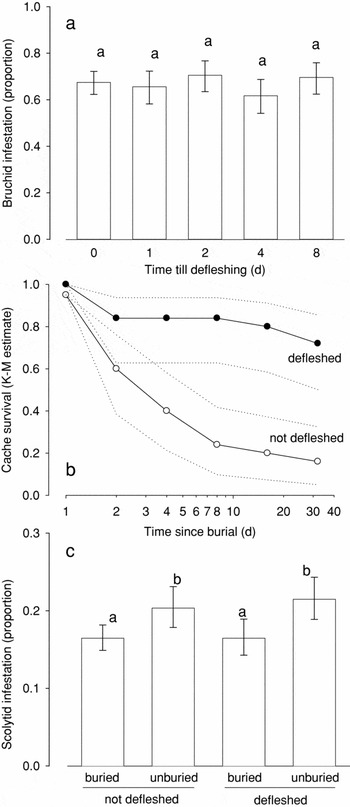
In experiment 1, which evaluated whether seed defleshing affected bruchid infestation of seeds still ripening on trees, bruchid presence was significantly lower in defleshed seeds (16%) than in non-defleshed seeds (24%; GLM with binomial errors: Wald = 4.61, df = 2, P = 0.032). In experiment 2, which evaluated the interception hypothesis for freshly fallen seeds, the proportion of seeds infested by bruchids was independent of how long after fruit fall seeds were defleshed (Figure 1a; GLMM with palms as random factor: χ21 = 0.0259, P = 0.87). Bruchids had infested up to 75% of the seeds defleshed on the same day as fruit fall. In experiment 3, which evaluated bruchid oviposition after fruit fall, we found that the proportion of seeds infested by bruchids (mean = 0.36, SD = 0.18, n = 85 samples) did not increase with the duration of exposure in the forest (GLM with binomial errors, duration log-transformed: t 63 = 1.02, P = 0.31).
Effect of defleshing on seed predation by bruchid beetles, pilferage of cached seeds and seed predation by scolytid beetles in the palm Astrocaryum standleyanum. Infestation by the bruchid beetle Pachymerus bactris for seeds that were defleshed at different times after fruit fall (a). Defleshing did not affect infestation, regardless of the timing. The beetle larvae had already entered the endocarp at the time of fruit fall; Kaplan–Meier survival estimates for experimental caches containing defleshed or non-defleshed seeds (b). Defleshing significantly reduced cache pilferage rates; Infestation by scolytid beetles for seeds that were subject to experimental burial and defleshing (c). Infestation was reduced by burial but not by removal of fruit pulp. Different letters within panels (a) and (c) denote significant differences. Dotted lines in (b) are the 95% CI of the Kaplan–Meier estimates.

Theft-prevention hypothesis
In experiment 4, which evaluated whether seed defleshing reduced the pilferage of cached seeds, we found that caches with defleshed seeds had significantly longer life times (half-life >32 d) than did caches with non-defleshed seeds (half-life <4 d; Figure 1b; Log-rank test on Kaplan–Meier survival estimates: χ2 = 17.9, df = 1, P < 0.001).
Conservation hypothesis
In experiment 5, which evaluated whether defleshing reduces seed loss to microbes and invertebrates attacking seeds after dispersal, we found that only 12 (0.6%) of the 2037 seeds that were recovered (some exclosures had been raided by mammals) contained bruchid larvae, while only 16 (0.8%) had fungus. In contrast, 381 (19%) were infested by Coccotrypes bark beetles. The fraction infested was significantly lower for buried seeds (16%) than for unburied seeds (21%; Figure 1c; GLM with binomial errors: F1,94 = 6.66, P < 0.001), but there was no significant difference between defleshed and untreated seeds (F1,93 = 0.11, P = 0.74), nor was there evidence for interaction between burial and defleshing (F1,92 = 0.09, P = 0.77). Thus, burial enhanced seed conservation but defleshing did not.
Scolytids versus bruchids
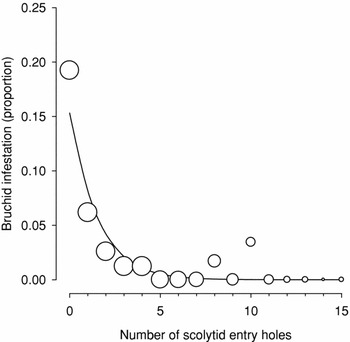
The above experiments showed a discrepancy between the percentage of seeds that were infested by bruchids (65% and 25% in experiments 2 and 3) and the percentage of seeds that had bruchid larvae or exit holes under field conditions (0.5% in experiment 5). Do scolytids reduce bruchid survival? In an additional experiment to evaluate the relationship between bruchid and scolytid infestation of seeds in the field, the proportion of seeds with bruchid larvae or emergence holes was indeed significantly lower for seeds with scolytid entrance holes (0.017) than for seeds without (0.192; GLMM: t 1274 = −6.34, P < 0.001). The proportion of seeds with bruchids also decreased significantly with the number of scolytid entrance holes (Figure 2; t 1274 = −2.46, P = 0.014).
Relationship between bruchid beetle infestation and scolytid beetle infestation of Astrocaryum standleyanum seeds after 11 mo on the forest surface. Significantly fewer bruchids developed as seeds showed more scolytid beetle entrance holes. Symbol size scales with the number or observations over which the proportion was calculated. Line shown is the fitted weighted logistic regression model.

DISCUSSION
The interaction between A. standleyanum and the Central-American agouti has become a classic example of a plant–rodent interaction in which animal and plant both benefit (Leigh Reference LEIGH1998, Leigh & Rubinoff Reference LEIGH, RUBINOFF, Bermingham, Dick and Moritz2005, Moore Reference MOORE, Howard, Giblin-Davis, Moore and Abad2001, Vander Wall Reference VANDER WALL1990), particularly because the defleshing of palm seeds before caching was assumed to intercept an important insect seed predator, to the advantage of the agouti as well as the palm (Smythe Reference SMYTHE1989). Our study, however, shows that agoutis do not in fact intercept bruchid larvae. We found that the bruchid beetle infesting A. standleyanum seeds – now identified as Pachymerus bactris – attacks seeds in the canopy, before they leave the mother tree, and that the larvae have already entered the seed when the fruits fall to the ground. Pachymerus bactris does not infest seeds after seed fall. Monkeys and squirrels feeding on unripe fruit might still intercept beetle larvae, but fruit defleshing by agoutis after fruit fall no longer affects infestation. Also, prolonged exposure of palm seeds on the ground below the palm does not increase the fraction infested by bruchids. Thus, the original interception hypothesis is rejected.
The alternative hypothesis that seed defleshing by agoutis reduces predation of cached seeds by other insects and microbes (conservation hypothesis) also was not supported. Post-dispersal seed predation by invertebrates (i.e. scolytid beetles) was important. However, the infestation of seeds by scolytids was reduced by burial, as in Silva & Tabarelli (Reference SILVA and TABARELLI2001), but not by defleshing. Although we cannot rule out the possibility that agoutis reduce cues for seed finding by scolytid beetles further than we did, for example because they scatter and deflesh seeds better, we consider it unlikely that a strong effect was masked by any such bias. Fungal infestation was unimportant during the 4 mo of this experiment. This seems to be due to the fact that A. standleyanum seeds germinate slowly and have very thick endocarps and thus seem well-protected against fungi, at least until the germination pores open. In general, rodents create their long-term food reserves with well-protected, slow-germinating seeds with a long storage life (Jansen et al. Reference JANSEN, BONGERS and PRINS2006), for which fungal infestation may be less important.
We did find clear support for the hypothesis that defleshing by agoutis reduces cache robbery by mammalian food competitors (theft-prevention hypothesis). Experimentally cached seeds were pilfered at much lower rates when defleshed before caching. Our study site lacks white-lipped peccaries, which are known to forage for buried palm seeds (Kiltie Reference KILTIE1981), but there is no reason to believe that the observed difference in cache survival was due to their absence. Previous studies suggest that olfaction plays an important role in cache pilferage (Stapanian & Smith Reference STAPANIAN and SMITH1978, Vander Wall et al. Reference VANDER WALL, BECK, BRIGGS, ROTH, THAYER, HOLLANDER and ARMSTRONG2003). Thus, we believe that seed defleshing reduces the olfactory cue for food competitors finding and stealing the buried food.
Bruchid versus scolytid beetles
An additional finding from our study is that bruchid beetles were neither an important enemy for A. standleyanum nor an important food competitor for agoutis. Infestation percentages for seeds incubated in the laboratory were important, but bruchids appeared unimportant under field conditions. This was due to low survival of bruchid larvae under field conditions, not to the defleshing of the seeds by agoutis. We found that the major invertebrate seed predators of A. standleyanum are Coccotrypes scolytid beetles, not bruchid beetles. On BCI, up to 78% of the A. standleyanum seeds in the soil show signs of infestation by scolytid beetles (H. Sharrott & P. A. Jansen, unpubl. data). We found that bruchid presence in seeds was negatively correlated with the number of scolytid entrance holes, suggesting that scolytid beetles are responsible for the low survival of bruchid beetles; they either eat or outcompete bruchid larvae in palm seeds.
Bruchids also seem relatively unimportant to A. standleyanum and agoutis because seeds rarely contain more than one bruchid larva, which consumes only a limited portion of the endosperm, after which the seed can still germinate and establish (C. X. Garzon-Lopez & P. A. Jansen, unpubl. data). This contrasts with the sympatric palm Attalea butyracea, where a single larva will typically consume the entire seed (Gálvez & Jansen Reference GÁLVEZ and JANSEN2007). Additionally, recent studies in A. butyracea suggest that agoutis may consider bruchid larvae better food than palm endosperm (Gálvez & Jansen Reference GÁLVEZ and JANSEN2007, Silvius Reference SILVIUS2002). The fact that bruchid larvae spend a long time inside the endocarps – live larvae were present in endocarps after 4 and even 11 mo – implies that bruchid larvae are available to agoutis during August–March, when fruit abundance is relatively low and the rodents feed on cached A. standleyanum seeds. Thus, the selective pressure to prevent bruchid infestation might be negative for agoutis (Silvius Reference SILVIUS2002), and limited for A. standleyanum.
Smythe (Reference SMYTHE1989) based his conclusion that agoutis intercept bruchid larvae on a comparison of results from three experiments. In one experiment 100 fruits were collected the second morning after they had fallen and stored on trays. Seven days later, exocarp and mesocarp were removed and the defleshed seeds were incubated in jars. After 4 mo, 34 bruchid beetles had emerged. In contrast, in two other experiments, no bruchid exit holes were found in 125 seeds that had been defleshed immediately and left buried in germination bags in the field for several months. Smythe concluded that the larvae entered the endocarps during the 8 d following seed fall unless timely defleshing removed them. Our results suggest that differences in bruchid emergence in Smythe (Reference SMYTHE1989) were due not to the defleshing treatment but rather to the different environments in which the seeds were placed; with and without protection of bruchid larvae from scolytid beetles.
Bruchids as pre-dispersal seed predators
Johnson & Romero (Reference JOHNSON and ROMERO2004) distinguish three oviposition guilds in bruchid beetles: guild A includes species that lay eggs on intact fruits when still on the plant, guild B includes species that lay eggs directly on mature seeds when still on the plant, and guild C includes species that lay eggs on fruits or seeds that have fallen to the ground. All palm bruchids (subfamily Pachymerinae) were believed to be in guild C, infesting endocarps only after fruit have fallen to the ground (Johnson & Romero Reference JOHNSON and ROMERO2004). Removal of the exocarp and mesocarp facilitates subsequent oviposition and enhances seed predation by guild C species, for example in Speciomerus giganteus attacking Attalea butyracea in Costa Rica and Panama (Janzen Reference JANZEN1971b, Wright Reference WRIGHT1983), in P. cardo attacking A. maripa in Brazil (Silvius & Fragoso Reference SILVIUS and FRAGOSO2002), and in Caryoborus serripes attacking Astrocaryum chambira in Peru (Delgado et al. Reference DELGADO, COUTURIER and DELOBEL1997). Exocarps protect seeds against guild C species, and fruit handling by mammals gives bruchid beetles access to the endocarps (Silvius Reference SILVIUS, Forget, Lambert, Hulme and Vander Wall2005).
Our study is the first to identify a palm bruchid belonging to guild A, infesting endocarps while still on the parent plant, hence acting as a pre-dispersal seed predator (cf. Johnson & Romero Reference JOHNSON and ROMERO2004). This implies that P. bactris does not require fruit handling by mammals to oviposit successfully. Forget (Reference FORGET1991) reported that an unidentified Pachymerus infested A. paramaca while still in French Guiana, and unidentified bruchids from guild A have also been observed in Attalea maripa in Brazil (J. Fragoso, pers. comm.). Pre-dispersal seed infestation by bruchids is more important than is currently appreciated.
Implications
Seed defleshing has become standard preparation for propagating A. standleyanum in nurseries (Potvin et al. Reference POTVIN, CANSARI, HUTTON, CAISAMO and PACHECO2003) because it was believed to prevent seed infestation by bruchids. Our study suggests that this tedious process will in fact not reduce seed predation by microbes or invertebrates. The only demonstrated effect of defleshing – reduced loss of buried seeds to mammals – is irrelevant in protected nurseries. Whether seed defleshing enhances survival and germination ratios in other ways remains to be shown.
Mammal defaunation could interact with oviposition behaviour of beetles (guild) to have important implications for seed fate. The decline of frugivorous mammals in forest systems reduces access to endocarps for guild C bruchids, which cannot penetrate the exocarp, but not guild A bruchids. Defaunation may therefore differentially affect palm species depending on the oviposition guilds of the associated bruchids (Wright & Duber Reference WRIGHT and DUBER2001, Wright et al. Reference WRIGHT, ZEBALLOS, DOMINGUEZ, GALLARDO, MORENO and IBANEZ2000).
ACKNOWLEDGEMENTS
We thank Pieter van Eijk, Dumas Galvez, Carol Garzon-Lopez, Maaike Renard and Nina Verkerk for help in the field, the Smithsonian Tropical Research Institute for facilities, Jan den Ouden and Pierre-Michel Forget, Tad Theimer and two anonymous reviewers for comments, and the Netherlands Foundation for the Advancement of Tropical Research (Grant W84-584) and the Eliasen-Uytenboogaart Foundation for funding.