The Great Eastern Japan Earthquake and tsunami occurred on March 11, 2011. The magnitude 9.0 earthquake and subsequent tsunami that hit the east coast of Japan killed approximately 16 000 people. 1 The tsunami flooded an area of 560 km2 and destroyed 130 000 buildings. In addition, damage led to explosions and radiation leakage at the Fukushima Daiichi nuclear power plant in the days after this disaster. People who lost their homes and the residents within 20 km of the plant had to evacuate to emergency shelters. The number of evacuees 1 week after the disaster reached approximately 400 000. 2
Immediately after the earthquake and tsunami, the World Health Organization (WHO) cautioned that evacuees at shelters in a disaster-affected area may be at risk of increased transmission of infectious diseases such as acute gastroenteritis, hepatitis A and E, leptospirosis, acute respiratory infection (ARI), and scabies. 3 Such outbreaks have been observed after previous disasters; however, the types of infectious diseases may differ between industrialized and developing nations.
After the 2004 Indian Ocean earthquake and tsunami, 25 000 patients with ARI and 9500 patients with acute watery diarrhea visited health care facilities in Aceh, Indonesia. Clusters or outbreaks of tetanus, hepatitis A and E, and measles also were reported after this disaste.Reference Furber, Gray, Harris-Roxas, Neville, Dews and Thackway 4 In contrast, in 2005, after Hurricane Katrina in the United States, 11% of residents in New Orleans, Louisiana, were diagnosed with ARI and 4% with diarrhea. No clusters of tetanus, hepatitis A or E, or measles were reported. 5 However, limited data are available to verify differences between infectious disease outbreaks in industrialized and developing nations because industrialized countries have reported only 3 such outbreaks after natural disasters (Joplin, Missouri, tornado; Hurricane Katrina; and Tropical Storm Allison, southeast Texas) since 2000. 5 – Reference Waring, Reynolds, D'Souza and Arafat 7
Industrialized countries such as Japan remain at risk for infectious disease outbreaks after natural disasters. Although infectious disease frequency had potentially increased among evacuees after Great Eastern Japan Earthquake and tsunami, to our knowledge, transmission rates have not been empirically observed. Understanding the likelihood of an infectious disease outbreak after a natural disaster could aid emergency management teams in the development of appropriate control measures.
To address these knowledge gaps, we investigated the frequency of common infectious diseases (ARI, acute gastroenteritis, acute jaundice syndrome, scabies, measles, pertussis, and tetanus) among evacuees and the cumulative incidence of each disease at 6 emergency shelters established after the Great Eastern Japan Earthquake and tsunami.
Methods
Study Design
In this retrospective study, we reviewed medical charts of evacuees who visited medical clinics at 6 shelters in the Oukaidou area of Ishinomaki and in the Oukuma area of Watari from March 19, to April 8, 2011.
Study Setting
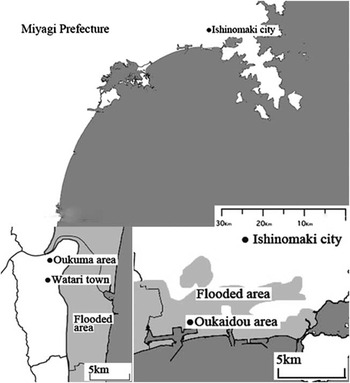
The shelters in this study were in 2 areas of Miyagi prefecture (Figure 1). Ishinomaki is a coastal area of Miyagi and was one of the areas hardest hit by this disaster. Before the disaster, 163 594 people lived there. The disaster destroyed 11 815 homes; 450 people were missing, and 3510 people were killed by the disaster. 8 Of the 556 km2 that constituted Ishinomaki, 73 km2 (13%) were flooded by the tsunami. 9
Location of Evacuation Shelters in Miyagi Prefecture.

Watari is another coastal area of Miyagi. Its population before the disaster was 35 585. The disaster destroyed 3759 homes in Watari; 10 people were missing, and 264 people were killed. Of the 73 km2 that composed Watari, 35 km2 (48%) were flooded by the tsunami. 10 Of 6 shelters we investigated, 4 (A, B, C, and D) were in Oukaidou, a coastal area of Ishinomaki, and 2 (E and F) were in Oukuma, an inland area of Watari.
Schools, hotels, city offices, and other large buildings in affected areas were used as shelters. Approximately 1 week after the evacuation, medical teams from throughout Japan began providing medical care to evacuees at shelter clinics. Almost all medical teams consisted of 2 physicians, 2 nurses, 1 pharmacist, and 1 logistical technician. Laboratory blood tests, radiography, and other diagnostic tests were not available at shelter clinics. Prescription medications, administration of intravenous fluids, simple surgical procedures, and immobilization of fractures were offered.
Patients needing additional medical care were transported to local hospitals. Medical teams from the University of Fukui Hospital provided medical care at 6 municipal shelters: in Oukuma, shelters E and F were visited beginning March 19; in Oukaidou, shelters A and D were visited beginning March 21; shelter C was visited beginning March 22; and shelter B was visited beginning March 29, 2011.
Selection of Participants
We included the medical records of patients who visited the medical clinics at these 6 municipal shelters during a 3-week period that started the day the medical teams began providing care. The municipal shelters were selected because city officials recorded the number of evacuees daily. Gymnasiums and several school classrooms served as municipal shelters in both areas.
In Oukaidou, 4 of the municipal shelters had clinics, and all were included in this study. In Oukuma, 5 municipal shelters had clinics. However, the medical teams from the University of Fukui Hospital provided medical care at only 2 of those shelters during the study period, so only records from those were included. Records from the other 3 were unavailable, which excluded these shelters from the study. Also excluded were medical records of patients who did not live in the selected shelters and medical records lacking a date or patient name.
Data Collection and Processing
Medical records were reviewed by 1 researcher. Patient data, including patient demographics, primary reason for clinic visit, physician diagnoses, preexisting conditions as reported by patients (eg, hypertension, diabetes mellitus, asthma, psychiatric disorders, tuberculosis, and chronic renal failure on dialysis), and disposition were recorded.
Some medical records contained no diagnosis by the physician in charge due to the chaotic situation but did include patient symptoms. In those cases, we made a diagnosis according to the charted symptoms and the following criteria. ARI was diagnosed either by the physician in charge or in the presence of at least 2 of the following signs or symptoms: (1) nasal discharge or sneezing; (2) sore throat, hoarseness, or dysphagia; (3) nonproductive cough; and (4) nasal congestion.Reference McGeer, Campbell and Emori 11 Acute gastroenteritis was diagnosed either by the physician in charge or by the symptom of watery diarrhea. Acute jaundice syndrome was defined by acute onset of jaundice; hepatitis A and E and leptospirosis were included in this syndrome.Reference Junichirou, Yumi and Naoki 12 Scabies, measles, pertussis, and tetanus were diagnosed by the physician in charge.
The cumulative incidence was determined as follows: the numerator represented the total number of evacuees visiting these clinics who became infected with the included infectious diseases for the first time during the study period. The denominator represented the sum of the daily number of evacuees at shelters during the study period. Evacuees in the denominator were not identified by name; city officials only tallied the total daily number of evacuees at shelters. The cumulative incidence of infectious diseases was calculated per 1000 evacuees.
Excluded from the numerator were patients who were suspected to be re-infected; the same person may have had 2 or 3 attacks of ARI or acute gastroenteritis in a given period. However, we could not distinguish re-infected patients from those with an ongoing infection by reviewing charts. We therefore included patients in the numerator only once when they visited shelter clinics repeatedly for either the same symptoms or the same diagnosis during the study period.
Data Analysis
Descriptive analyses were conducted with the use of frequency tabulations. We described the medians and interquartile ranges (IQR) for the number of patients with each infectious disease per week and their cumulative incidence, because these data did not fulfill normal distribution. Data were checked using a Shapiro-Wilk normality test. All analyses were conducted with JMP statistical software version 9.0.3 (SAS Institute).
Ethical Considerations
The study protocol met the guidelines for epidemiologic studies issued by the Ministry of Health, Labor and Welfare of Japan. The ethics committees in Fukui University Hospital approved the research protocol.
Results
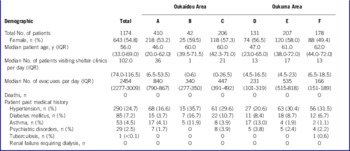
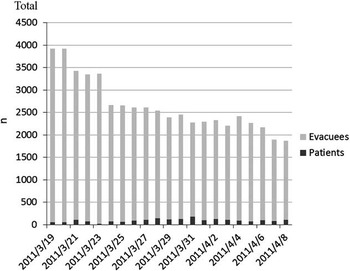
During the study period, 1364 patients visited shelter clinics. Excluded were 190 patients owing to the lack of a patient name or date of visit (shelter A, 12; B, 1; C, 129; and D, 31) and 17 out-of-shelter residents (shelters E, 5; and F, 12). In total, 1167 patient records (86.1%) were eligible for this study. The median total number of evacuees at 6 shelters was 2545 (IQR, 2277-3009) (Table 1). The number of evacuees at each shelter was highest in the beginning of the study and decreased gradually (Figure 2; Appendix [online]).
Demographics and Past Medical History of Evacuated Patients in Shelters A-F

Abbreviation: IQR, interquartile range.
Number of Evacuees at Each Shelter During the Study Period.

Patient demographics and preexisting illnesses were listed in Table 1. The majority of the sample population was female; the median age was 56 years (IQR, 33.0-69.0). The median patient volume at shelter clinics was 102 per day (IQR, 74.0-116.5). No deaths were recorded at study sites during the study period. The most common preexisting illness in this population was hypertension.
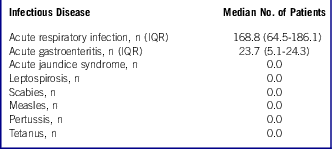
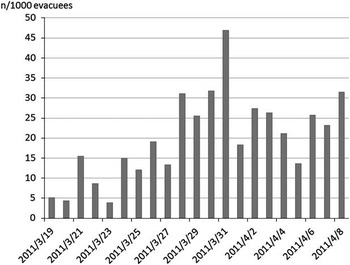
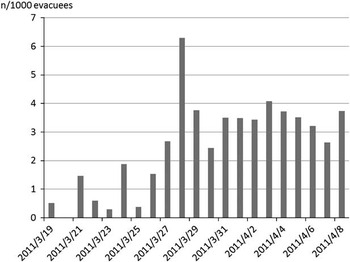
Table 2 listed the number of patients with infectious diseases visiting shelter clinics per week per 1000 evacuees. ARI was the most common infectious disease. Acute gastroenteritis was second-most common. Acute jaundice syndrome, scabies, measles, pertussis, and tetanus were not observed. The number of patients with ARI and gastroenteritis peaked approximately 3 weeks after March 11, 2011, and stabilized thereafter (Figures 3 and 4).
No. of Visits to Shelter Clinics by Patients With Infectious Disease per Week per 1000 Evacuees

Abbreviation: IQR, interquartile range.
Daily number of patients with acute respiratory infection visiting shelter clinics per 1000 evacuees during study period.

Daily number of patients with acute gastroenteritis visiting shelter clinics per 1000 evacuees during study period.

To determine the frequency of the 2 predominant infectious diseases, we determined the cumulative incidences of ARI and acute gastroenteritis in each shelter during the study period. The median cumulative incidence of ARI per 1000 evacuees in each shelter was 13.1 person-days (IQR, 8.5–18.8). The median cumulative incidence of gastroenteritis per 1000 evacuees was 1.6 person-days (IQR, 0.3–3.4).
Limitations
This study contained several potential limitations. First, our data were limited to those obtained from medical clinics within selected shelters; no other data were available for comparison (eg, incidence of infections in individuals in disaster-affected areas who remained at home or in nonaffected areas of Japan during the same period). Second, our findings may not have reflected the incidence of infectious disease in developing countries after natural disasters. Japan has had high levels of sanitation and immunization coverage, 3 which can influence the type and severity of outbreaks among evacuees at shelters. Third, the incidences observed in the selected sites may have been higher than at other shelters in Japan after this disaster. The areas included in this study were affected more severely than in other areas, and sufficient supplies of electricity, food, clean water, and other requirements (ie, medicines) for evacuees were harder to restore.
In addition, serological tests were not available at shelter clinics. Possibly minor cases of pertussis were present but were undetected or erroneously classified as ARI. Medical information was not available in the early-acute phase of this disaster (ie, March 11-20, 2011). Unfortunately, systematic surveillance for infectious diseases at shelters after natural disasters and systematic health care to evacuees at shelters were not organized by the Japanese government. Thus, medical care to evacuees at shelters was not provided during the initial disaster period.
Moreover, the observed incidence may not have represented the true incidence in the population. For example, incidences may have been under-represented because we excluded suspected re-infected patients or over-represented because we inferred diagnoses based on symptoms when no diagnosis was noted in the medical charts. Finally, we could not identify new evacuees who arrived at target shelters during the study period. However, conditions in the area suggest that the number of newly arriving evacuees were likely very low: roadway destruction prevented evacuees from moving between shelters, and shelters had insufficient space and supplies to accommodate new arrivals. Accordingly, evacuees who were able to leave typically moved to unaffected areas. Also, it was noted that medical chart review has inherent limitations such as underdocumentation and miscoding.
Discussion
After the Great Eastern Japan Earthquake and tsunami, 2 infectious diseases were predominantly observed among evacuees at emergency shelters. ARI was observed with a cumulative incidence of 13.1 person-days; of evacuees remaining at a shelter for 3 weeks, approximately 28% was infected with ARI. Acute gastroenteritis was observed with a much lower cumulative incidence of about 1.6 person-days; of evacuees remaining at a shelter for 3 weeks, 3% were infected with gastroenteritis.
The incidence of ARI in this study was higher than previously measured in Japan. For example, the incidence of ARI for employees at a factory infirmary was 0.26 person-days from March to April 2009.Reference Junichirou, Yumi and Naoki 12 In our study, its incidence was 10 times higher than those reported under typical conditions. No cause of this increased incidence could be identified because comparison data from individuals living outside of shelters or in nonaffected areas of Japan during the study period were unknown. However, our findings suggest that the incidence of ARI may be elevated among evacuees in emergency shelters after natural disasters.
Outbreaks of hepatitis A and E, leptospirosis, and scabies have been reported after natural disasters.Reference Turk, Latu and Cocker-Palu 13 – 16 It is likely that these diseases were not observed in our study because they are more often reported in developing countries, where sewage disposal and sanitation systems are poor.Reference Akbari, Farshad and Asadi-Lari 17 Clusters of leptospirosis and hepatitis A and E have not been reported in Japan for more than a decade, 18 – 21 and most clusters of scabies were observed only in care homes for older persons. Therefore, emergency management systems in countries with effective sanitation may not require targeted prevention and control efforts for acute hepatitis, leptospirosis, or scabies.
Our observations were consistent with infectious disease outbreaks after other natural disasters. Indeed, outbreaks of ARI and gastroenteritis have been reported following natural disasters in both industrialized and developing nations.Reference Yee, Palacio and Atmar 22 – Reference Tan, Lee, Chang and Ang 25 After Hurricane Katrina, surveillance was conducted in 4 hospitals and 10 nonhospital facilities in and around New Orleans, 5 and ARI and acute gastroenteritis were common among the residents. After the Indian Ocean earthquake in 2004, ARI was diagnosed in 60% of patients who visited health care facilities, and acute gastroenteritis was diagnosed in 23% of patients.Reference Furber, Gray, Harris-Roxas, Neville, Dews and Thackway 4 However, direct comparisons could not be made between these studies and ours because the earlier studies did not determine a cumulative incidence. Nonetheless, both industrialized and developing nations were likely at risk for outbreaks of ARI and acute gastroenteritis among evacuees after natural disasters.
The risk of ARI and acute gastroenteritis outbreaks among evacuees after natural disasters depends on the degree to which prevention and control measures against these diseases are in place. After natural disasters, evacuees tend to live in overcrowded shelters with poor supplies of water and food.Reference Moszynski 26 Overcrowding in shelters forces close contact between healthy evacuees and others infected with ARI or acute gastroenteritis. In addition, lack of personal hygiene, personal protection, and clean water can increase the transmission of these diseases among evacuees.Reference Howard, Brillman and Burkle 27 After Hurricane Katrina, surveillance had been conducted among evacuees for 4 days. By 5 days after the disaster, clean water, food, and clothes were provided to them. 21
In contrast, after the Great Eastern Japan Earthquake and tsunami, the Japanese government conducted surveillance for 4 months after the disaster, and medical teams provided medical care at only 2 of 6 shelters studied 8 days after the disaster. Sufficient clean water and food were not provided at most of these shelters within 2 weeks after the disaster. Site planning also was not conducted, so evacuees had to live in crowded shelters without a lavatory system. These delays in surveillance and the restoration of health care and sanitary systems may have contributed to the high number of cases of ARI and acute gastroenteritis among the evacuees we observed.
At the beginning of the study (8 days after the initial disaster), the numbers of ARI and acute gastroenteritis cases were quite low (ARI, 5.1 per 1000 evacuees; acute gastroenteritis, 0.5 per 1000 evacuees); however, the numbers of cases gradually increased and peaked approximately 3 weeks after the initial disaster. This finding suggests that close contact among evacuees in shelters contributed to the transmission of these diseases.
After Hurricane Katrina, a gradual increase in ARI cases occurred over time. 5 It was likely that patients with preexisting ARI or acute gastroenteritis were evacuated to shelters, and their close contact with other evacuees at the shelters led to the transmission of the diseases. Many of the evacuees subsequently displayed symptoms after the incubation period. Our findings indicated that health care may be required at shelters for as long as 3 weeks after a disaster.
In summary, in this study of shelters after the March 2011 Japanese earthquake and tsunami, we have observed that ARI and acute gastroenteritis were commonly acquired among evacuees. It is important to note that the risk of infectious disease outbreaks exists in industrialized nations after a natural disaster. Our findings imply that the planning and implementation of appropriate prevention and control measures by emergency management systems are warranted.
Funding and Support
Financial incentives were provided to the authors by Daiwa Securities Health Foundation and Grant-in-Aid for Young Scientists (B) of Japan Society for the Promotion of Science (JSPS).
Acknowledgment
Kaori Tsujita provided research assistance.