


Do treaties change what states do? Scholars of international relations divide into three camps on this question. Realists (e.g., Mearsheimer 1995) contend that states will not place their security at risk through such agreements and so comply with them only if they would without the treaty. Liberals (e.g., Keohane 1984) argue that states form agreements to mitigate international anarchy but that such agreements face opportunistic defections, making enforcement through reciprocity critical to compliance with them. Constructivists (e.g., Wendt 1999) believe that shared understandings of proper conduct structure international politics such that compliance occurs because states have internalized the norms captured in their agreements, making the norms more important than formal treaties. Scholars of international law mirror these differences, divided again to realists (Goldsmith and Posner 2005), liberals (Byers 1999), and constructivists (Franck 1990), based how and why they believe that states comply with international law.
This paper reports the results of a project that explores when states comply with the laws of war, also known as international humanitarian law. These treaties seek to regulate state conduct during wartime on issues such as treatment of prisoners of war and conduct on the high seas. Compliance with these treaties and the norms underlying them pose a particular problem because states have no higher recourse for enforcement as they are already at war.
Compliance with the laws of war was mixed during the twentieth century, making it a useful test of when treaties matter. Some standards, such as the ban on the use of chemical and biological weapons in the Geneva Protocol of 1925, have generally been observed, while others such as the protection of civilians have been much less effective. Even a single country on one issue—Nazi Germany's treatment of prisoners of war during the Second World War—varied greatly based on which country they were fighting; the Nazis generally complied against the Western Allies while committing extensive violations against the Soviet Union. The laws of war also vary widely on possible determinants of compliance—relative power of combatants, domestic political system, ease of reciprocity for enforcement, and degree and clarity of legal obligation.
The variance in compliance with the laws of war addresses one of the main problems facing studies of compliance with international law—the selection issue.1
A recent example of this issue is the interchange between Von Stein 2005 and Simmons and Hopkins 2005 concerning the patterns reported in Simmons 2000.
I advance, test, and find support for an argument about the laws of war, which I call institutional commitment, that draws on all three perspectives. Treaties shape state expectations about what conduct is unacceptable during wartime; states may be able to enforce such agreements by responding to violations with similar conduct (Keohane 1984, 1986; Morrow 2002; Posner 2003). When state ratifies a treaty, it signals its willingness to live up to that standard. Joint ratification of a treaty demonstrates publicly that both sides accept the standards of that treaty and should enforce them through reciprocity. Joint ratification both strengthens reciprocity and leads to compliance generally through effective deterrence. Noise introduced through violations by individual soldiers complicates reciprocal enforcement by obscuring whether violations are a product of state policy or individuals acting against state policy (Morrow 2001). Reciprocity also exists among soldiers on the battlefield where they may retaliate against enemy soldiers after their comrades have suffered at the hands of the enemy. The scope for violations by individual soldiers varies across the issues covered by the laws of war, and compliance should be higher for issues with less scope for such violations.
Compliance with the laws of war is a subject of current relevance. Recent controversies about U.S. treatment of prisoners held at Abu Gharab prison in Iraq and detainees believed to be linked to Al Qaeda or the Taliban at Guantanamo Bay, Cuba, show that even democracies may not always comply with their legal obligations. The results reported here place these recent events into a broader political and historical context by showing how states have acted.1
Morrow and Jo 2006 provides fuller description of the data and descriptive statistics on compliance.
REALISM, LIBERALISM, CONSTRUCTIVISM, AND COMPLIANCE
The three perspectives—realism, liberalism, and constructivism—capture different views of when, how, and why states comply with international agreements. In this section, I seek to draw out specific testable hypotheses about when states should comply with treaty standards and norms. All three perspectives present general explanations of state behavior; they rarely provide immediately testable hypotheses. I go beyond these perspectives to delve into the details of the laws of war in practice to find testable hypotheses, and this synthesis draws on elements of all three perspectives.
Realists give pride of place to calculations of power and interest and believe that such calculations are rarely affected by international institutions, such as international law. If states comply with the standard of an international treaty, they do so because it is in their interest even if the treaty did not exist. Further, existing international institutions mirror the distribution of power. States may follow the laws of war, but the legal status of the treaty has no real effect on whether they do. Variations in the domestic political systems of states also has no effect on whether they comply.
Liberals agree with realists that state calculations of interest are central; however, they believe that institutions can aid states in enforcing agreements. International law can clarify obligations, what acts constitute violations, and appropriate responses to violations. Regime type could influence compliance because democracies are more likely to respect the rule of law, meaning international law can be enforced through domestic institutions. Liberals do not believe that compliance is easy, but that naked self-interest can be overcome through effective institutions.
Constructivists believe that states comply with international obligations because they internalize the norms underlying such obligations. Socialization to norms trumps calculations of interest because norms constitute interests. Regime type matters because democracies are more open to international civil society that advances these norms and legitimates them. States do not always comply with these norms because they may lack the capability to carry out their obligations, the norms may not be fully internalized yet, or multiple norms could conflict.
It is difficult to separate these three perspectives with evidence because all three provide broad view of why compliance occurs, but not necessarily how it varies. Furthermore, the recent empirical literature on compliance suggests a more complicated pattern. In the area of military alliances, Leeds, Long, and Mitchell (2000) show that whereas often allies do not fight together when one goes to war, they do honor the specific pledges in their alliances to come to one another three-fourths of the time. Changes in capabilities are a major reason for one-fourth of cases of violations of specific obligations (Leeds 2003). Simmons (2002) shows that Latin American states that lose territorial arbitrations are more likely to accept those decisions when the arbitrator came from the Americas and if the state in question had an independent domestic judiciary but less likely to accept if it had a change of government. In the area of human rights, Hathaway (2002, 2005) finds that democracies are less likely to ratify but more likely to comply if they do, results similar to those found by Neumayer (2005). Both Hathaway and Neumayer find that human rights can deteriorate in autocracies that ratify the relevant treaties. All of this recent work suggests that the specific institutions of an agreement and their interaction with domestic politics are critical to understand when states comply. I now turn to develop that view for the laws of war.
AN INSTITUTIONAL VIEW OF TREATIES AND COMPLIANCE
Political institutions that persist both induce stable patterns of behavior and are stable against replacement by alternative institutions. In the felicitous phrase of Kenneth Shepsle (1986), they both induce institutional equilibria and are equilibrium institutions. Equilibria in game theory require two conditions: one, that the actors' strategies are mutual best replies, and two, that the actors share a common conjecture that they will play that specific equilibrium. Agreement on normative standards generally and treaties specifically can be thought of as being captured in the common conjecture. They matter when they induce a particular pattern of behavior that a different agreement would not. Compliance then is a property of the equilibrium behavior that institutions induce in actors. Treaties are a public signal that a state accepts a standard by ratifying it, and so will live up to the standard of that treaty if it goes to war. Because common conjectures must be mutual knowledge (Aumann and Brandenburger 1995), ratification by both sides is necessary for them to understand that they intend to honor that standard to the best of their ability.
Compliance becomes problematic when a state at war has not signaled its acceptance of the relevant treaty through ratification or if the prescribed behavior is not an equilibrium. Reciprocity is a tool of enforcement when one side breaches an agreed standard. States that violate treaty standards that both sides have publicly accepted should be more likely to face reciprocal responses by their opponents. Clear legal standards reinforce reciprocal enforcement by clarifying what acts constitute violations and which do not (Axelrod and Keohane 1985). States should be more likely to respond to violations that breach these legal “bright lines” than to acts that are not clearly illegal.
Reciprocal responses should be stronger when both sides have ratified the relevant treaty. The expectation of reciprocal enforcement induces states to comply more often when both have accepted the relevant treaty through joint ratification. The compliance of the warring parties should move together more closely under joint ratification.
Democracies may comply more often than other states. Liberals view the law-bound nature of democracies as central because international obligations can be grounded in domestic law if necessary (Slaughter 1995). Leaders of democracies are also more susceptible to pressure from domestic audiences (Fearon 1994; Schultz 2001). If domestic audiences hold democratic leaders accountable for their public commitments to the laws of war, then democracies should be more likely to comply if they have ratified the relevant treaty regardless of what the other side does. Constructivists view democracies as more likely to comply because their societies are more open to norm entrepreneurs from civil society and so more likely to be socialized to follow these norms (Finnemore and Sikkink 1998; Price 1997). Democratic leaders are more likely to adopt norms of lawful and controlled conflict from externalization of the norms of limited political competition in democracies.1
This point extends the normative explanation for the democratic peace where democratic leaders externalize domestic norms of peaceful competition when dealing with other democracies (e.g., Maoz and Russett 1993).
Reciprocity is typically thought of as a state response to the actions of another state. Reciprocity on the laws of war also occurs at the level of individuals on the battlefield. Individual soldiers possess the ability to commit violations on their own against state policy, with the scope of such violations varying across issues. Individual soldiers also retaliate on their own against violations they perceive against their fellow soldiers. For issues like chemical weapons, control over violations is centralized, making it difficult for individuals to commit violations on their own. For issues like treatment of civilians, every soldier has the ability to commit violations on their own. This reality creates a linked pair of problems, an agency problem in the control of individual soldiers and a problem of reciprocity under noise at the state level. All militaries engage in some attempts to control the acts of their soldiers to reduce violations by individuals (although in some cases state policy encourages violations by individuals). The success of such controls varies with military training, the importance state policy places on them, and the opportunities for violations by individuals. This agency problem produces a problem of noise because states at war can only judge one another's compliance from their actions on the battlefield and reports about their conduct behind the lines. Difficulty in determining the exact nature of the other side's policy could lead to inadvertent retaliation and a breakdown of the agreement (Downs and Rocke 1995; Green and Porter 1984). Either view of the problem posed by individual violations predicts that the average level of compliance should be lower on issues that provide greater scope for violations by individuals. The agency problem looms larger on such issues, and higher levels of noise lead to lower average levels of compliance (Bednar 2006). The only possible way to separate these two arguments about the consequences of individual violations is reciprocal responses to violations which are clearly the product of state policy. The agency argument suggests that states should respond more strongly to centralized violations than those that are the result of individual violations, whereas the noise argument contends there should be no difference in response.
In summary, patterns of compliance with the laws of war could provide evidence to judge among the realist, liberal, and constructivist views of compliance. In practice, it is difficult to pull explicit hypotheses about the patterns of compliance from each view. This difficulty led me to consider specific problems in enforcing the laws of war to deduce testable hypotheses. These testable hypotheses for institutional commitment are as follows:
- Reciprocity exists; the compliance of one side increases with the compliance of the other.
- Joint ratification strengthens reciprocal responses.
- Democracies are more likely to comply when they have ratified the most recent treaty even if the other side has not.
- Reciprocal responses are made to individual violations as well as to state ones.
- Compliance decreases as the scope for individual violations increase across issues.
THE DATA
This paper reports the patterns of compliance with the laws of war. The time period is the twentieth century because the formal body of international law of war begins with the Hague Convention of 1899 and grows with the Geneva Conventions and other treaties regulating conduct among warring parties. The basic unit is the directed warring dyad-issue area. The question is what leads to compliance. I briefly sketch out the data collection here; full details can be found in Morrow and Jo 2006 and in documentary material at the Web site containing the data and replication materials.
First, I take all Correlates of War (CoW hereafter) interstate wars (Sarkees 2000; Small and Singer 1982) from the Boxer Rebellion to the Gulf War (1991, not the sequel). Each multilateral war is broken into warring dyads by pairing off each member of each side with every member of the other side. When additional research determined that neither state in the dyad engaged in military action against the other, the dyad is dropped.
The set of dyads is reduced further by consolidating states that fight under unified command. States that fight under united command have a single leadership group with the power to order subordinate units to comply. States under unified command should not be treated as separate observations, and dropping these observations prevents overcounting of nonindependent observations. Additional research determined when such unified command existed.
The period of fighting for a particular warring dyads is dated from the beginning of military action until fighting ends by agreement.1
This is typically the surrender of one party to the other, but I also end fighting when one side is no longer capable of resisting the other even if there is no formal surrender document.
For each warring directed dyad, I code behavior of the first member toward the second member on eight different issue-areas in the law of war: aerial bombardment, armistice/ceasefire, chemical and biological weapons, treatment of civilians, protection of cultural property, conduct on the high seas, prisoners of war, and treatment of wounded. The set of treaties addressing an issue, including draft treaties that never entered into force, define each issue-area. I used the text of treaties found at the Web site of the International Committee of the Red Cross.1
The treaties were grouped into the eight issue-areas. Issue-areas such as neutrality law were dropped because they do not address the conduct of one warring party toward another. Genocide was also dropped as acts that could be considered genocide during wartime were subsumed under the treatment of civilians. This selection of issue-areas encompasses both areas with well-developed treaty law as well as those that lack any formal treaty law, such as aerial bombardment. This design allows a test whether the existence of a formal treaty aids compliance with the norms of proper conduct in an issue-area.Major and minor violations were identified from the relevant treaties in each issue-area. These coding rules structured the collection of information on violations and compliance for each directed warring dyad. Historical works and contemporary journalistic sources were searched for examples of violations and general judgments on the degree of compliance by each warring party toward the other member of a directed dyad. From this information, I coded the following dimensions of compliance:
- Magnitude: how egregious were the violations? A 4-point scale from none (coded 1) to many major violations such that compliance does not matter (4).
- Frequency: how frequent were violations? A 4-point scale from none (1) to massive violations to the point where the standard is ignored (4).
- Centralization: what was the role of central military and political authorities concerning violations? A 5-point scale from no violations (1) to central authorities punishing individual violators (2) to positive identification of state intent to violate (5).
- Clarity: did the actions clearly violate the treaties? A 4-point scale from no violations (1) to definite legal violation (4).
This breakdown of compliance into four dimensions is designed to make the coding more reliable.
Quality and coverage of the data are key questions facing any analysis on this topic. One, violations are not possible for some issue-areas in some wars. For example, conduct on the high seas was not an issue in the Hungarian-Allies war of 1919 because all the fighting took place on land. Two, missing data is an immense problem for any comprehensive study of compliance with the laws of war. Some of these wars are obscure, meaning little information is available. Those who commit atrocities often attempt to conceal their own participation, meaning there is no record of many violations. Charges that the other side has committed atrocities are also common; sorting out what actually happened can be difficult. I prefer secondary historical sources, particularly academic works written decades after events, over other sources because the authors of such sources have often done the difficult work of separating truth from unfounded accusation. They often make judgments about the nature and extent of violations from an examination of more incidents than they fully describe. Because the amount of information available to use in coding varies greatly from observation to observation, a fifth variable was collected for each observation:
- Quality of the data: do we have confidence in the coding because it is based on substantial and reliable information? A 4-point scale from sketchy evidence (1) to excellent documentation providing strong confidence in coding (4).
I use the score for the quality of the data in some analyses to place greater weight on the cases where we have confidence in the coding.
Given the amount of directed-dyad issue-areas where we had no evidence with which to judge, I used standardized codings for the following issue-areas: treatment of civilians, cultural protection, conduct on the high seas, prisoners of war, and treatment of the wounded. These codings reflect the view that even the best disciplined armies commit some violations.1
These standardized codings are superceded if any information is available. A warring-dyad-issue-area is dropped from the analysis if both sides have a standardized coding on that issue. These codings allow me to use warring dyads where I have information only about what one member of the dyad did. The standardized codings are given data quality 0, which reduces the weight of those cases when I weight them by the quality of the data. I run the main analysis excluding all observations where I have a standardized coding to check that the use of such codings does not bias the results.A standardized coding is also used for the issue of chemical and biological weapons. Accusations of the use of such weapons have been extensively investigated by others (e.g., Harris and Paxman 2002; Stockholm International Peace Research Institute [SIPRI] 1971). We can conclude then that a side did not use such weapons in a war if the sources that focus on chemical and biological warfare do not mention that it did. For chemical and biological warfare, the data set coded a warring party as having no violations if there are no reports in these sources. Data quality is rated 2 for such cases.
Finally, I would like to make clear what the data set is not. It is not a comprehensive listing of all violations for a given warring directed dyad-issue-area. A comprehensive listing would be fantastic for testing the dynamics of compliance, but it is a fantasy to believe that it could be collected for even a small set of the cases. Second, the data are not based on a precise legal analysis of whether particular acts constitute violations of the treaty in question. The legal status of some acts are contested, particularly when questions of military necessity and proportionality arise. Instead, the codings capture whether the broad pattern of acts by a warring party are consistent with the standards of the relevant treaty. When such acts are not agreed to be clear legal violations, the score for the legal clarity of the violations reflects that uncertainty. At the level of aggregation of the data, precise legal analysis of all acts is not necessary to make broad distinctions between behavior that is compliant and that which is not. These limitations remind us what we can learn from these data and what we cannot. The data can help us see broad patterns in compliance, even if it cannot illuminate the full details of how it works in practice.
DATA ANALYSIS
The variables in the data set are defined for the ease and clarity of collection and coding. An appendix provides specific definitions of variables used in the statistical analysis. I use a single measure of compliance from the variables collected. A simple measure of compliance multiplies the scores for magnitude of violations and frequency of violations, ranging from 1, no violations, to 16, frequent and multiple major violations. These scores should not be treated as a ratio-level variable because equal intervals in the score do not necessarily indicate equal changes in compliance. It is more appropriate to treat this measure of compliance as an ordinal variable and then collapse the scores into a smaller set of ordered categories where we have confidence that each level is clearly different from the others. We can say clearly that some cases show lower levels of compliance than others without asserting that equal differences between scores represent equal differences in compliance. The ordinal scale of compliance has the following four levels:
- Full compliance, where no violations are reported,
- High compliance, where only minor violations occur or when major violations are infrequent,
- Low compliance, where major violations occur frequently, and
- Noncompliance, where frequent major violations rise to the level that the standard is ignored.
This ordinal scale of compliance is robust in its separation and order of categories even if we cannot say that the differences in compliance among the levels are comparable.1
I have also conducted the analyses with 3- and 5-point scales of compliance, and those scales produce similar results to those presented here.
Multivariate analysis allows us to judge the effects of many variables on compliance while controlling for others. I use ordered probit analysis because the measure of compliance is ordinal. This technique does not assume that the four levels of compliance are equally spaced as a linear regression would; it does assume that they can be ordered from highest compliance to lowest.
Statistical analysis of compliance under reciprocity faces the issue of simultaneity bias. If reciprocity is present, then each side's compliance depends on the other side's compliance. To test for reciprocity between sides A and B, we include B's compliance toward A on the issue in question in the equation for A's compliance toward B. Because B's compliance toward A is believed to depend on A's compliance toward B, we are effectively including A's compliance toward B in the right-hand side of the equation. This simultaneity bias inflates the coefficient for the effect of B's compliance toward A on A's compliance toward B. Instrumental variables provide a way to address the simultaneity bias, but they come with a cost. I create an instrument for the other side's compliance by regressing it against all the variables in the regression we would like to estimate and a set of variables not included in that regression but correlated with the other side's compliance. By construction, the instrument is uncorrelated with the other independent variables and the bias is eliminated from the estimate. The cost is the instrument by definition is not as accurate a measure of the other side's compliance as the original variable. The instrument effectively includes error not present in the original variable, and so will not fit as well. The issue of lack of fit is aggravated here by the ordinal scale of the compliance measure as instrumental variable analysis treats the included endogenous variable as a ratio-level variable. Further, I lack sufficient unincluded exogenous variables to construct robust instruments for more than one measure of the other side's compliance.
I deal with this pair of methodological issues by running two analyses, each of which addresses one of these issues. I run an ordered probit using the compliance score of the other side directly. The coefficient for the other side's compliance—how we assess reciprocity in these models—should be biased upward. The second analysis creates an instrumental variable for the other side's compliance but treats it as a ratio-level variable. This analysis addresses the simultaneity bias in our estimate of the effect of reciprocity at the cost of efficiency in our estimates of that effect. The hope is that the pair of analysis will provide similar results, and we can conclude that the patterns we find are not the product of either of these threats to inference.
I include Victim's Noncompliance to test for reciprocity, referring to the side whose compliance is being assessed as the violator and the other side as the victim. To see how reciprocal responses vary with the legal status of violations, I include the following interactions of variables:
- Victim's Noncompliance with Clarity of Victim's Violations to test if reciprocal reactions are stronger when the violations of the other side clearly violate the relevant treaty;
- Victim's Noncompliance with Joint Ratification—when both sides have ratified the most recent treaty in the issue-area when the war began1—to test if reciprocal responses are stronger when the parties are both legally obligated to observe the treaty standard;
Data on ratifications can be found at http://www.icrc.org/ihl.nsf/WebPAYS?OpenView.
- Victim's Noncompliance with Joint Ratification and with Clarity to test whether reciprocity is stronger when both parties are legally obligated and the conduct in question clearly violates the “bright line” of the treaty standard;
- Victim's Noncompliance with Individual Violations—whether the violations are committed by individuals against state policy; and
- Victim's Noncompliance with State Violations—whether the violations are the likely result of state policy.1
Individual violations score 2 and 3 on the centralization variable, whereas state violations score 4 and 5.
These last two interactions will show whether state or individual violations trigger stronger reciprocal responses, allowing me to test whether the noise introduced by individual violations aggravates reciprocal responses. The test for reciprocity in the ordered probit analysis is the cumulative effect of all these coefficients concerning the victim's noncompliance. The instrumental variable analyses lacks sufficient instruments to estimate more than one reciprocal term, so that single coefficient suffices as a test of reciprocity.
Before presenting and discussing those two analyses, I briefly discuss the other variables in the analyses.1
EUGene (Bennett and Stam 2000) was used to create most of the exogenous variables.
Analyses using a threshold of 6 on the difference of democracy and autocracy scores produces similar results. See Supplemental Table 1.

Before turning to the results, I review hypotheses about the estimated coefficients. First, reciprocity predicts a positive effect for the compliance of the other side when the coefficients of all the reciprocal terms are summed. Second, if treaties enhance reciprocity by clarifying what acts constitute violations, then the interaction of the compliance of the victim and the legal clarity of its violations should be positive. Third, if reciprocity is stronger when both parties have accepted a legal obligation, the interaction of joint ratification and the noncompliance of the victim should be positive. These reciprocal effects are the sum of the relevant interactive terms in the ordered probit analyses, whereas there is a single coefficient for each in the instrumental variable analyses. Fourth, if ratification binds parties regardless of the acts of the other side, then ratification should have a negative coefficient. Fifth, if democracies have greater moral restraint than other types of systems, the coefficient for whether the violator is a democracy should be negative. Moral restraint also suggests that stronger states should be less likely to commit violations. Sixth, the interaction of ratification and whether the violator is a democracy should be positive if democratic leaders face higher audience costs for treaty violations or if democracies are law-bound states. Seventh, issues with a larger scope for violations by individuals, and hence more noise, should have lower levels of compliance. Eighth, the coefficient for battle deaths per 1,000 prewar population should be positive if more costly wars produce more violations. I do not have clear expectations about the signs of the other coefficients.
Table 1 reports the results of the ordered probit analyses predicting noncompliance. Positive coefficients signify lower compliance; negative ones, greater compliance. I report results with and without weighting the cases by the quality of the data in the first two columns.1
The weight for a given case is the sum of the quality of the data for both sides of the directed dyad on that issue. For instance, a case where I have excellent documentation on the conduct of both sides has a weight of 8 (data quality for each side = 4), whereas a case where I have sketchy evidence for one side and a standardized coding for the other would only have weight 1 (1 for the first side and 0 for its opponent). I divide by the total weights in all the cases included in the analysis to maintain the same number of cases, hence levels of statistical significance, as the unweighted analysis where all cases are treated as having equal weight.
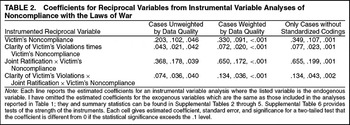
Table 2 presents the results of instrumental variable analyses. These analyses include just one reciprocal term because I lack sufficient excluded variables to construct robust instruments for all the interactive reciprocal terms in the ordered probit analyses.1
The variables used to construct instruments are the full set of included exogenous variables in Table 1 and their parallels for the victim state, such as whether it is a democracy. Supplemental Tables 2 through 5 report the full results for the instrumental variable analyses including the coefficients for the exogenous variables. Supplemental Table 6 reports the results of tests of the strength of instrumental variables that shows that the set of instruments lacks the strength to estimate models which instrument for more than one endogenous variable.

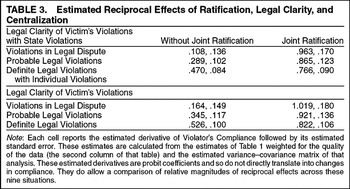
Tables 1 and 2 show a broad pattern of reciprocity in the data. Noncompliance tends to be met with noncompliance. The full effect of reciprocity in Table 1 can be seen by summing all of the reciprocal coefficients. Table 3 gives the full effect of reciprocity for combinations of legal clarity of the victim's violations, whether both sides have ratified the most recent treaty, and whether the violations are the acts of individuals or state policy. This table reports the derivative of the latent variable underlying the violator's compliance in the probit analysis reported in the second column of Table 1. We cannot interpret these derivatives as directly as the change in compliance, but we can compare the magnitude of reciprocal effects across the 12 situations in the table. The patterns are self-evident; reciprocity is stronger when both sides have a legal obligation through joint ratification. Legal clarity matters when legal obligation does not exist, but it has no statistically discernible effect when both sides have ratified the relevant treaty. The difference in reciprocity across levels of legal clarity when at least one side has not ratified the relevant treaty is statistically significant at more than the .001 level, but it is insignificant and in the wrong direction when both sides have ratified the relevant treaty (comparing down the columns of Table 3).1
The first statistical test is that for the coefficient for the interaction of legal clarity and the victim's noncompliance. The second test is whether the sum of the coefficient for interaction of legal clarity with victim's noncompliance and the coefficient of that interaction times joint ratification differs from 0. The sum of the coefficients is −.098, and the estimated standard deviation is .058. Under joint ratification, most violations are definite legal violations. There are only 10 cases of violations in clear legal dispute under joint ratification, and both sides have high or full compliance in these cases. The reversed sign of legal clarity under joint ratification is based on few cases, and so we should place little weight on it.
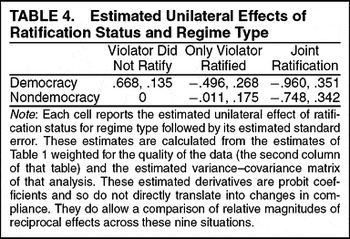
These tests compare the sum of the coefficients which give the differences across the rows of Table 4. The standard errors of these differences calculated from the variance–covariance matrix are .213, .153, .104, .213, .153, and .104, reading from the top row to bottom.


Table 4 shows the effects of regime type and ratification status on average levels of compliance independent of what the other side does. Democracies comply more highly on their own if they have ratified the most recent treaty on the issue; the difference is statistically significant at more than the .001 level.1
The test is the sum of the coefficients for violator ratified and its interaction with violator democracy, which is −1.164 with a standard error of .283.
The test is the sum of joint ratification and its interaction with violator democracy, which is −.464 with a standard error of .454.
Joint ratification has two related effects; it strengthens reciprocity and so produces higher average compliance. Figure 1 depicts the estimated probabilities of each level of compliance in response to the victim's compliance for the six combinations of ratification status and regime type. Each panel shows how the violator's compliance varies with the victim's compliance for a given pair of ratification status and regime type of the violator. The size of the shaded bands gives the estimated probability of the each of the four levels of compliance for each level of compliance of the victim. The overall amounts of shading indicate compliance generally; more white and less black means more compliance on average. The diagonal lines between the shaded regions show the strength of reciprocity; steeper diagonal lines indicate that the violator's compliance changes more as the victim's does, and so reciprocity is stronger. The steeper lines between regions in the two pictures on the right reflect the greater strength of reciprocity under joint ratification, particularly the increase in the chance of low or noncompliance by the violator as the victim's acts reach those levels. The combined effects of ratification and regime type can be seen by comparing across rows. Ratification has little effect on nondemocracies, as reflected in the similarity of the three pictures in the top row. Reciprocal responses are stronger for nondemocracies under joint ratification. Ratification induces restraint in democracies as can be seen in the greater amounts of white and lesser amounts of black in the two pictures in the bottom row with ratification by the violator. Comparing across rows, democracies that have not ratified the relevant treaty have the worst record of compliance, followed by nondemocracies regardless of ratification status, with democracies that have ratified having the best record. At the same time, joint ratification does not appear to prevent democracies from retaliating against opponents whose violations rise to the level of noncompliance. Democracies take their legal obligations more seriously than other states, yet are still willing to respond to violations in kind.

Estimated Effects of Democracy and Ratification on Compliance
The issues present a clear hierarchy of compliance. Chemical and biological weapons have the best record of compliance, followed by armistice/cease fire, conduct on the high seas, and aerial bombing. Treatment of civilians has the worst record, followed by prisoners of war with treatment of enemy wounded and protection of cultural property having better records of compliance.
I briefly comment on the other exogenous variables reported in the ordered probit analyses of Table 1. More powerful violators are more likely to commit violations, but that effect is greatly reduced by joint ratification. Initiators are less likely to comply, and violations are more common the bloodier the war. Sides that lose commit more violations but are less likely to do so as their power grows relative to the other side.
I have focused on the effect of reciprocity under joint ratification, democracy with ratification, and the issue in question because these three conditions have the largest effects on compliance. Their effects on compliance are roughly comparable. From Table 3, a shift of 2 levels in the compliance of the other side produces a movement of 1.5 to 2.0 in the latent variable underlying the violator's noncompliance under joint ratification. Changing a democracy from not ratifying to doing so lowers that latent variable by about 1.1 to 1.5 in Table 4 depending on whether the victim has also ratified. Shifting from the issue with the best compliance, CBW, to the issue with the worst, treatment of civilians, raises the noncompliance latent variable by about 1.5. All of these effects are much larger than any of the other variables in the analysis.
DISCUSSION
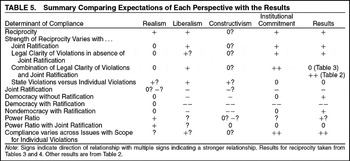
What do these patterns tell us about when states comply with the laws of war? The record is mixed for realism, liberalism, and constructivism; there is some evidence for each but much against. Table 5 summarizes the expectations of these three perspectives, the institutional commitment view, and the results of the data analysis. The realist view predicts the effects of reciprocity and power correctly but cannot account for the role of law in reinforcing reciprocity or in the restraining effect of joint ratification on democracies and the powerful. The constructivist view correctly places importance on how ratification can restrain democracies but misses that ratification does not restrain nondemocracies and that democracies violate norms that are not legally binding. The liberal view emphasizes how law can reinforce the successful operation of reciprocity and correctly concludes that legal obligations should restrain democracies as law-bound states. All of the three perspectives predicts that states should respond more strongly to violations that are state policy than to those committed by individuals, which is not supported by the evidence.

Instead, the practical details of compliance in the institutional commitment argument are more important than any broad perspective about compliance. Reciprocity helps to enforce the laws of war, but reciprocity works in a more complex fashion than the perspectives allow. Joint ratification reinforces reciprocity because both sides understand that they are both committed to the treaty standard. Violations in those circumstances are more likely to provoke a response in kind.
The hierarchy of compliance across issues in the laws of war matches the scope of individual violations across issues. CBW has the greatest compliance, followed by armistice/cease fire and conduct on the high seas with the next-best records of compliance. After them, aerial bombing, cultural property, and treatment of wounded come next, with prisoners of war perhaps having less average compliance and treatment of civilians with definitely the worst record of compliance. Individual soldiers lack the ability to use chemical weapons on their own initiative; they can only use such weapons if their military and political leaders distribute them to the troops to use. At the other end of the spectrum of compliance, every individual soldier possesses the ability to commit atrocities against civilians. Further, civilians often lack the ability to retaliate against soldiers who commit such atrocities, removing the risk of immediate retaliation as a deterrent to such acts. Among the issues that fall between these extremes, the group with higher levels of compliance—armistice and conduct on the high seas—are those where the decisions of central political and military authorities dominate over the scope for violations by individuals. Officers below the top ranks can commit violations on these issues on their own; ship captains can refuse to take in the sailors from enemy ships they sink, for instance. Most violations on these issues result from state policy to violate the relevant standard, such as unrestricted submarine warfare. Aerial bombing has this same characteristic of centralized control of violations; most violations result from a state decision to bomb cities indiscriminately. The other issues—protection of cultural property, treatment of POWs and enemy wounded—provide individual soldiers with the opportunity to use protected cultural locations for a military advantage, to kill enemy soldiers trying to surrender, and to refuse to treat enemy wounded. Unlike treatment of civilians, however, the threat of reciprocity from enemy soldiers on these issues is larger and more immediate, deterring violations.
Violations by individuals pose particular problems for compliance through either agency issues of the control of those individuals or the noise problem that neither side can be sure whether those violations are the result of the policy of the other side. The evidence favors the noise explanation over the agency explanation but not decisively. If the agency explanation dominated, states would respond more strongly to state violations than those committed by individuals, but the results in Table 1 show no difference in the strength of these reciprocal responses. Further, aerial bombing—the issue where average compliance is lower than we expect, given that most violations result from state decisions to conduct city bombing—is also plagued by the noise created from the inaccuracy of aerial bombing during most of the period addressed by the analysis. The Gulf War in 1991 is the only case in the data where a side conducting an aerial bombing campaign possessed precision munitions for the duration of the campaign. The precision of aerial bombing in most cases here was low, making discrimination between bombing military and bombing civilian targets within cities effectively impossible. This noise makes enforcement through reciprocity difficult because the violator may hit civilian targets without intending to and the victim cannot tell whether the resulting bombing of civilians was intentional or in error. This noise leads aerial bombing to have a worse record of compliance than the centralized control of targeting would lead us to expect. The combination of the lack of stronger reciprocal responses to centralized violations and the anomalous compliance record from aerial bombing suggest but do not demonstrate that the noise explanation of the consequences of individual violations is more important than the agency explanation.
Democracies comply more when they are bound through ratification but less when they are not. Their greater response to ratification is consistent with both explanations for why democracies differ—higher audience costs and their law-bound nature. Some of the increase in violations by democracies not bound by ratification occurs on just the issue of aerial bombing. Draft treaties regulated aerial bombing during the 1930s were never signed, much less ratified, so no state has been bound to them. If I drop the aerial bombing cases from the analysis, the decrease in compliance for democracies without joint ratification drops by about one-third.1
See Supplemental Table 7 for ordered probit results dropping the aerial bombing cases: 23% (11 out of 47) of the aerial bombing cases for democracies are low or noncompliance, whereas only 9% (11 out of 122) of those with nondemocracies are low compliance and none are noncompliance.
The evidence here both supports and qualifies the argument in Downes (2006) that democracies are willing to kill civilians if they believe that will shorten the war. Institutional commitment through ratification shapes state strategies; it does not dictate them. If ratification creates audience costs for democratic leaders, they might still choose to violate such a commitment if the consequences for losing were worse. Reciprocity, however, appears to explain his data as well as desperation for victory does; of Downes's 14 cases of democracies that victimized civilians, either the other side also did so or was incapable of targeting civilians in Downes's judgment (and so excluded from his data set) in 12 of the 14 cases. The nondemocracy committed the first violation of civilians in nine of these cases, with the other five cases have first violations against civilians by the nondemocracy within a week of the first violation by the democracy.1
Downes uses the warring state as his unit of observation, which makes testing legal commitment and reciprocity difficult at best. He also examines violations of any issue that victimize civilians, grouping together issues separated here. The two cases of democracies victimizing civilians inconsistent with reciprocity in his data are Israel in the Palestine War and Israel in the 1982 Lebanon War. In the former case, Jordan and Syria did commit atrocities against Israeli civilians. In the latter case, CoW only codes the fighting between Israel and Syria as the war, not the fighting with Palestinian forces because the PLO was not a state. As all the fighting was inside Lebanon and the Israeli Air Force quickly dominated the skies, it is not clear that Syria had the ability to attack Israeli civilians.
The evidence here also undercuts the arguments over selection effects that have dominated studies of compliance. The selection effects argument asserts that states only ratify agreements that they would comply with in any case, so compliance is not evidence that the treaty has changed their behavior. This argument may make sense in cases like human rights where ratification affects only the state in question and the state must act on the issue immediately afterward. The laws of war differ in both ways. First, a state may never have to honor its commitment to a treaty if it never finds itself at war. It further cannot anticipate what states it might find itself at war with in the future and cannot fully anticipate the consequences of a treaty commitment when it accepts it. Second, joint ratification strengthens reciprocity, creating a cost to ratification if one later goes to war with another ratifying states. Noncompliance after ratification is not free when the other side has also ratified. Additionally, the presence of noise on the battlefield raises the unwanted retaliatory spirals when both sides have ratified the relevant treaty. Ratification produces new strategic dynamics among warring parties.1
I would like to thank one of the referees for this argument.
States do ratify agreements with the intent to honor that commitment. These commitments signal future intent to comply, but they also produce dynamics of audience costs that make democracies more likely to comply no matter what the other side does and of reciprocity that both enforce the agreed standard and raise the possibility of unintended escalation. States are willing to commit to the laws of war even on these issues that are inherently difficult to control. Treaties then do change what states do by setting common standards that strengthen reciprocal enforcement. Sometimes, those standards are violated even when both sides have signaled their willingness to abide by them. These commitments are not free for states.
CONCLUSION
The patterns of compliance with the laws of war are consistent with a view of treaty commitments as public acceptances of a standard of conduct. Ratification by a democracy signals its acceptance of the standard of conduct in that treaty. Joint ratification creates the anticipation that both sides are legally obligated, and states at war are more likely to comply when both sides have ratified the relevant treaty. When one side does not comply, the other responds in kind, and joint ratification strengthens that reciprocal response. Noise complicates reciprocal enforcement. Battlefields are chaotic, and soldiers commit atrocities in even the best disciplined armies. The noise produced by individual violations make inferences about when and how to retaliate difficult in practice. Average levels of compliance vary with the scope of noise induced by individual violations on the battlefield. Law is not a substitute for reciprocal enforcement; it can aid such enforcement.
The results cast doubt on arguments about how states will internalize norms of conduct over time. Almost all cases of noncompliance are met with some major violations by the side that suffers the consequences of that noncompliance. Unilateral restraint is rare.1
There are only 16 cases in the data set where a side fully complies when the other side's violations rise to low or noncompliance, out of 254 cases of low or noncompliance.
The central role of noise suggests a different path to the internalization of norms. Military training, which incorporates the law of war, is one mechanism by which states and their soldiers internalize norms of proper conduct during wartime.1
For example, see Jeffrey Legro's (1995) arguments concerning the role of military culture—which he defines as beliefs about proper employment of forces—in producing cooperation on the laws of war.
What do the results tell us about the recent controversies around U.S. treatment of detainees in Iraq, Afghanistan, and Guantanamo Bay? Although democracies are more likely to live up to their legal commitments, such commitments also reinforce reciprocal response against enemies who violate the standards of those commitments. Faced with nonstate opponents who do not recognize the laws of war and adopt atrocity as their central strategy, the willingness of the Bush Administration to stretch and perhaps break the standards of humane treatment to which the United States is legally committed is not surprising in the light of the results reported here. The strategic dynamics of reciprocity and competition against opponents who cannot be readily fought in open combat push even democratic governments toward stretching the standards of treatment. Arguments in favor of those standards will carry more weight with those responsible for policy when they emphasize self-interest in following those standards over legal obligations to do so. After all, the laws of war exist because national leaders have seen such restrictions on violence during wartime as being in their interest when they can be enforced. The recent controversies are hardly the first time that a democracy has abandoned its legal commitments to limit violence in order to prevail in wartime.
APPENDIX
Definition of Variables Used in Statistical Analysis
Noncompliance:
A 4-point scale: 1—Full compliance, where no violations are reported (magnitude = 1 and frequency = 1); 2—High compliance, where only minor violations are reported or when major violations are infrequent (magnitude = 2 or frequency = 2); 3—Low compliance, where major violations occur frequently but the standard is not ignored (magnitude > 2 and frequency > 2, but at least one of them < 4); and 4––Noncompliance, where violations are both major and frequent (magnitude = 4 and frequency = 4).
Clarity of Victim's Violations:
A 4-point scale: 1—No violations; 2––Legal status of violations in clear dispute; 3—Probable legal violation; 4—Definite legal violation.
Joint Ratification:
Dichotomy between 1—Both parties have ratified most recent treaty in the issue-area and 0—At least one side has not. See note on weighting for joint command.
Individual Violations:
Dichotomy between 1—Violations are committed by individuals against state policy and 0—No violations or central political and military authorities probably or definitely authorized them as state policy.
State Violations:
Dichotomy between 1—Central political and military authorities probably or definitely authorized them as state policy and 0—No violations or violations are committed by individuals against state policy.
Democracy:
Dichotomy between 1—Difference in Polity IV scores for Democracy minus Autocracy greater than or equal to 7 and 0—Difference is less than 7. See note for weighting for joint command.
Power Ratio:
The CoW Composite Capabilities of the violator divided by the sum of its and the victim's capabilities. Capabilities of both sides are corrected for distance to the battlefield using the distance correction in Bueno de Mesquita 1981, 104–108 and aggregated across actors with a unified command.
Aerial Bombing, Armistice, Chemical and Biological Warfare, Treatment of Civilians, Protection of Cultural Property, Conduct on the High Seas, Prisoners of War:
Dummy variables for issue-areas. Treatment of wounded is the omitted category.
Violator Initiator:
Dichotomy between 1—Violator initiated war in CoW Interstate War data and 0—Did not. For changes in coding decisions for the breakdown of multilateral wars into warring dyads, see Web site with data.
Violator Battle Deaths per 1,000 Population:
Battle deaths suffered by the violator from CoW interstate war data divided by its prewar population in thousands taken from CoW composite capabilities data.
Violator Lost:
Dichotomy between 1—Violator lost war as judged in CoW Interstate War data and 0—Violator won or war was drawn. For changes in coding decisions for the breakdown of multilateral wars into warring dyads, see http://sitemaker.umich.edu/lawsofwar.
For warring sides that operate under joint command, the variables for joint ratification, democracy and battle deaths per 1,000 population are weighted averages of the scores for each member of the joint command using their relative capabilities as the weights.
The research reported here was supported by the National Science Foundation under grant SES-0111787. The Foundation bears no responsibility for any of the conclusions reported herein. The data used in this paper, replication materials, and supplemental materials for the paper can be found at http://sitemaker.umich.edu/lawsofwar. I would like to thank Bill Clark, Barb Koremenos, and Jana Von Stein for their comments on this paper, and Jake Bowers, Rob Franzese, Jude Hays, and John Jackson for their methodological advice.





Comments
No Comments have been published for this article.