Transdiagnostic Processes in Social Anxiety
The fifth edition of the Diagnostic and Statistical Manual of Mental Disorders (DSM-5; American Psychiatric Association [APA], 2013) defines social anxiety disorder (SAD) as characterised by marked fear or anxiety about social situations where the individual perceives themselves to be scrutinised by others and where they fear they will act in a way or display anxiety symptoms that will be negatively evaluated, causing humiliation, embarrassment or social rejection. Subsequently, social situations are avoided or endured with distress (APA, 2013). SAD is relatively common, with lifetime prevalence rate in a large study of over 9,200 English-speaking individuals in the United States reported to be 12% (Kessler et al., Reference Kessler, Berglund, Demler, Jin, Merhikangas and Walters2005). In Australia, it is estimated that about 4.7% of people aged 16–85 years will meet criteria for SAD across a 12-month period (Australian Bureau of Statistics [ABS], 2008).
The onset of SAD is relatively early, with symptoms manifesting by 11 years of age in about 50% of cases, and by 20 years in about 80% of cases. This early age of onset contributes to the significant educational and occupational impairment associated with SAD (Rosellini, Rutter, Bourgeois, Emmett-Aronso, & Brown, Reference Rossellini, Rutter, Bourgeois, Emmert-Aronson and Brown2013; Stein & Stein, Reference Stein and Stein2008). While effective psychological and pharmacological treatments for SAD exist, only 50% of those with SAD seek treatment, and among treatment seekers, the delay between onset of symptoms and treatment is on average 15–20 years, with around 30–40% not responding to first-line treatments even when these were used (Stein & Stein, Reference Stein and Stein2008). Concerningly, Dalrymple and Zimmerman (Reference Dalrymple and Zimmerman2011), in their study of 819 outpatients with SAD, found that suboptimal treatment seeking for those with SAD was associated with poor access to services, further exacerbating the long-term consequences of SAD.
The findings of Ramsawh, Raffa, Edelen, Rende, and Keller (Reference Ramsawh, Raffa, Orlando Edelen, Rende and Keller2009) also indicated the significant chronicity associated with SAD. Ramsawh et al. examined the effects of age and time on the 14-year course of panic disorder (PD), SAD and generalised anxiety disorder (GAD), and found that although the psychiatric status ratings declined in severity with age for all conditions, this was not significant for SAD, where symptoms were chronic and persistent. Ramsawh et al. attributed this to a higher level of impairment, ineffective treatment, and reduced treatment seeking among those with SAD. Understanding barriers to treatment and poor recovery rates, as well as comorbidity, may be useful in informing future protocols (Dalrymple, Reference Dalrymple2012).
The term ‘transdiagnostic processes’ was introduced to refer to core underlying mechanisms that may account for psychopathology across diagnostic categories (Harvey, Watkins, Mansell, & Shafran, Reference Harvey, Watkins, Mansell and Shafran2004; Iverach, Menzies, & Menzies, Reference Iverach, Menzies and Menzies2014). Transdiagnostic processes are increasingly a focus of research because it has been argued that understanding these processes is essential to explaining high rates of comorbidity (McManus, Shafran, & Cooper, Reference McManus, Shafran and Cooper2010) and high rates of multiple lifetime diagnoses (Brown, Campbell, Lehman, Gisham, & Mancill, Reference Brown, Campbell, Lehman, Grisham and Mancill2001; Iverach et al., Reference Iverach, Menzies and Menzies2014). It has been argued that a clearer understanding of transdiagnostic processes may facilitate the development of more effective interventions for psychopathology (Iverach et al., Reference Iverach, Menzies and Menzies2014).
The transdiagnostic processes of self-esteem and intolerance of uncertainty (IU) are known predictors of SAD symptomatology (Paulus, Talkovsky, Heggeness, & Norton, Reference Paulus, Talkovsky, Heggeness and Norton2015). Paulus et al. (Reference Paulus, Talkovsky, Heggeness and Norton2015) proposed that SAD clustered strongly with fear, which together with IU were strong risk factors predicting SAD. Intolerance of uncertainty was initially defined as an individual's automatic cognitive, emotional and behavioural response to unfamiliar situations (Freeston, Rheaume, Letarte, Dugas, & Ladouceur, Reference Freeston, Rheaume, Letarte, Dugas and Ladouceur1994). While the definition of IU initially encompassed the inability to manage ambiguity (Carleton et al., Reference Carleton, Mulvogue, Thibodeau, McCabe, Antony and Asmundson2012), it has more recently been extended to include aversive experiences that occur in unusual surroundings with limited information (Carleton, Reference Carleton2016). Boelen and Reijntjes (Reference Boelen and Reijntjes2009) were the first to establish a relationship between IU and SAD in their study of 126 participants recruited for a longitudinal study on coping with loss. Regression analysis indicated that SAD was strongly linked with IU, and with well-known transdiagnostic processes of neuroticism and fear of negative evaluation. Carleton et al. (Reference Carleton, Mulvogue, Thibodeau, McCabe, Antony and Asmundson2012) examined IU across groups diagnosed with SAD, PD, GAD, obsessive-compulsive disorder (OCD) and depression, and compared a clinical sample (n = 376) to a sample of undergraduate students (n = 428) and a community sample (n = 571). The clinical participants had higher levels of IU than the community sample, and SAD participants had significantly higher IU than those with PD. Counsell et al. (Reference Counsell, Furtado, Iorio, Anand, Canzonieri, Fine and Katzman2017) examined the relationship between SAD and IU compared to that between GAD and IU. The findings from a sample of 248 patients referred to an outpatient psychiatric clinic showed that aspects of IU were related to symptoms of both SAD and GAD. Subsequently, Counsell et al. proposed targeting IU in transdiagnostic treatment of anxiety disorders.
Schmitt and Allik (Reference Schmitt and Allik2005) identified self-esteem as a universal human phenomenon that may provide a transdiagnostic platform on which to develop effective interventions for anxiety based on data from 169,998 people from 53 countries who completed the Rosenberg Self-Esteem Scale (RSES; Rosenberg, Reference Rosenberg1965), where higher self-esteem was associated with lower anxiety. Previously, Gumley, O'Grady, Power, and Schwannauer (Reference Gumley, O'Grady, Power and Schwannauer2004) had examined self-esteem as a transdiagnostic construct in SAD and found that people with psychosis who had SAD had significantly higher levels of entrapment and shame, and significantly lower self-esteem. In addition, these researchers found that comorbidity between SAD and psychosis was associated with more negative symptoms, more general psychopathology, lower levels of functioning, and greater feelings of self-blame. Gumley et al. recommended that treatment for SAD include targeting self-esteem. Further support for targeting poor self-esteem in the treatment of social anxiety comes from the work of Maldonado et al. (Reference Maldonado, Huang, Chen, Kasen, Cohen and Chen2013), who found that adolescents with SAD, overanxious disorder, OCD or simple phobia also had poor self-esteem, where those with SAD had the lowest self-esteem and were the most resistant to improvement. Maldonado et al. also suggested incorporating self-esteem into general treatments for SAD and advocated early intervention.
It has recently been proposed that death anxiety may be the fundamental transdiagnostic process accounting for both self-esteem and IU (Iverach et al., Reference Iverach, Menzies and Menzies2014), and may therefore also be closely linked with SAD (Finch, Iverach, Menzies, & Jones, Reference Finch, Iverach, Menzies and Jones2016). Finch et al. suggested that death anxiety increases hypervigilance towards social threat and therefore avoidance in those with social anxiety. More broadly, death anxiety is considered to be a basic fear underlying the development and maintenance of numerous psychological conditions, including post-traumatic stress disorder (PTSD), OCD, hypochrondriasis, PD, separation disorder, depression and eating disorders (Iverach et al., Reference Iverach, Menzies and Menzies2014). Fear of death is understood to be a universal characteristic critical for self-preservation that may leave people more vulnerable to developing anxiety disorders if they have poor coping strategies to buffer existential anxiety (Arndt, Routledge, Cox, & Goldenberg, Reference Arndt, Routledge, Cox and Goldenberg2005). Juhl and Routledge (Reference Juhl and Routledge2016) argued that those without sufficient psychological buffers, defined as self-worth and meaning in life, were more likely to develop debilitating anxiety and poor psychological wellbeing. Furthermore, these individuals had a tendency towards poor health choices and behaviours, with increased death awareness (Juhl & Routledge, Reference Juhl and Routledge2016). In support of this view, Greenberg et al. (Reference Greenberg, Solomon, Pyszczynski, Rosenblatt, Burling, Lyon and Pinel1992) conducted three studies examining the anxiety-buffering strength of self-esteem. These authors concluded that self-esteem, defined by feeling valuable, effectively offers protection against anxiety when confronted by threats, including anticipating painful shocks or images of death. That is, high self-esteem may mitigate death anxiety.
In contrast, maladaptive efforts to cope with awareness of inevitable death or the poor management of existential terror may be reflected in psychopathology. Arndt et al. (Reference Arndt, Routledge, Cox and Goldenberg2005) proposed that neuroticism, anxiety disorders, depression, and the need for self-esteem are all rooted in concerns about death and with the individual's ability to cope with their mortality. Strachan et al. (Reference Strachan, Schimel, Arndt, Williams, Solomon, Pyszcnynski and Greenberg2007), from their studies examining the effect of death reminders on cohorts with a simple phobia, excessive hand-washing or SAD, demonstrated an intensification of maladaptive behaviours across all three samples.
It has been proposed that death anxiety may be buffered by religiosity and spirituality (Plante, Vallaeys, Sherman, & Wallston, Reference Plante, Vallaeys, Sherman and Wallston2002). Koenig, McCullough, and Larson (Reference Koenig, McCullough and Larson2001) analysed more than 1,200 studies investigating the relationship between religion and health with inconclusive findings. These authors criticised the quality of the research, highlighting sampling biases and noting that very few studies were focused on intervention. More recently, researchers have attempted to address these methodological concerns while examining the relationship between death anxiety and religiosity.
A common premise in religious research is that a belief in both God and the afterlife reduces death anxiety (Harding, Flannelly, Weaver, & Costa; Reference Harding, Flannelly, Weaver and Costa2005). For example, Norenzayan and Hansen (Reference Norenzayan and Hansen2006) exposed 247 undergraduate students and 41 volunteers to either greater mortality salience or a neutral intervention. In four studies they showed that increased belief in supernatural agents, regardless of degree of religious affiliation, was associated with death anxiety. Vail, Arndt, and Abdollahi (Reference Vail, Arndt and Abdollahi2012) reported that Christian and Muslim participants found comfort in their own faith, but that when mortality salience was added, while atheists did not change their unbelief, agnostics increased their religiosity and belief in a higher power. They concluded that those who were less confident in their beliefs could be influenced by mortality salience whereas those strongly irreligious remained so even when death anxiety was presented. McMordie (Reference McMordie1981) reasoned that belief in a higher power would buffer death anxiety, predicting a linear relationship between death anxiety and the strength of individual's belief convictions and commitments. In contrast, Wink and Scott (Reference Wink and Scott2005) asserted that the consistency between an individual's belief and behaviour would better explain the relationship between beliefs and death anxiety, where those with strong religious beliefs may experience either high or low death anxiety, depending on the extent of dissonance between their beliefs and their behaviour, thus proposing a curvilinear relationship between measures of religious affiliation and death anxiety.
Strachan et al. (Reference Strachan, Schimel, Arndt, Williams, Solomon, Pyszcnynski and Greenberg2007) examined the impact of mortality salience on social anxiety and avoidance. These researchers selected 72 undergraduate psychology students with high or low levels of social anxiety and exposed them to either death reminders or thoughts of dental pain. The findings supported the hypothesis that mortality salience elevates social anxiety as death reminders resulted in greater social avoidance, indicated by greater hypervigilance towards social threat and withdrawal into social isolation, among those high in social anxiety.
If death anxiety is a fundamental transdiagnostic process across psychological disorders then death anxiety may be a better predictor of mental health outcomes in disorders such as SAD than other proposed transdiagnostic processes such as self-esteem or intolerance of uncertainty. No previous study has compared death anxiety, self-esteem and intolerance of uncertainty as predictors of social anxiety, and this is an important gap in the current literature.
As noted previously, spirituality and religiosity have been proposed to buffer death anxiety (Harding et al., Reference Harding, Flannelly, Weaver and Costa2005; Plante et al., Reference Plante, Vallaeys, Sherman and Wallston2002); however, there have been conflicting findings concerning the relationship between measures of spirituality and religiosity and death anxiety (see Ellis & Wahab, Reference Ellis and Wahab2013; Jong et al., Reference Jong, Ross, Philip, Chang, Simons and Halberstadt2018). Here, an exploratory analysis was conducted to examine the relationship between both the Spirituality Scale — Short Form (SS-12) and the Santa Clara Strength of Religious Faith Questionnaire (SCRFQ) and the Death Anxiety Scale (DAS). It was reasoned that the relationship between the DAS and the SS-12, a measure of the intrinsic experience of religiosity/spirituality, and the SCRFQ, a measure of the extrinsic, behavioural aspects of religiosity, may be different. Both Wink and Scott (Reference Wink and Scott2005) and Jong et al. (Reference Jong, Ross, Philip, Chang, Simons and Halberstadt2018) suggested that intrinsic religiosity may account for lower death anxiety, while extrinsic religiosity may heighten death anxiety. Wink and Scott (Reference Wink and Scott2005) argued that the combination of high extrinsic religiosity and low intrinsic religiosity may account for a curvilinear relationship because those who are socially motivated towards religious observances (extrinsic religiosity) without strong religious faith (intrinsic religiosity) have behaviour that is inconsistent with their beliefs and also experience higher death anxiety, while those with strong intrinsic faith have lower death anxiety. Consistent with this view, Ellis and Wahab (Reference Ellis and Wahab2013) reported that participants who engaged in private religious practices (intrinsic religiosity) had lower levels of death anxiety while those who reported religious observance without strong faith (extrinsic religiosity) had higher death anxiety. Ellis and Wahab (Reference Ellis and Wahab2013) reviewed the empirical literature on religiosity and death anxiety and found that of the 84 studies reviewed, 40 studies supported an inverse relationship between religiosity and death anxiety, 9 demonstrated a curvilinear relationship, 27 reported a positive correlation, and 32 found no association between religiosity and death anxiety. More recently, Jong et al. (Reference Jong, Ross, Philip, Chang, Simons and Halberstadt2018) conducted a meta-analysis to test the prediction that those with both the greatest investment and least investment in religion would have the lowest levels of death anxiety. There was evidence of a curvilinear relationship between death anxiety and religiosity in 10 of the 11 studies that specifically examined this.
This study considered the relationship between potential transdiagnostic factors and measures of social anxiety symptomatology in a general population sample. Specifically, it was hypothesised that death anxiety (DAS) and intolerance of uncertainty (IUS-12) would be positively correlated with measures of SAD symptomatology (SPS-6 and SIAS-6), while self-esteem (RSES) would be negatively correlated with measures of SAD symptomatology (SPS-6 and SIAS-6). In addition, the study considered whether death anxiety was the ‘worm at the core’ and would therefore be a better predictor of SAD symptomatology than self-esteem and intolerance of uncertainty. If so, it was expected that in the final step of a hierarchical regression predicting measures of SAD symptomatology (SPS-6 and SIAS-6), DAS would be a significant, independent predictor of the outcome measures but RSES and IUS-12 would not.
The present study also sought to examine the relationship between death anxiety and measures of religiosity (SCRFQ; extrinsic religiosity) and spirituality (SS-12; intrinsic religiosity). If the conflicting findings reported in previous literature are due to different conceptualisations of religiosity, then it is expected that there will be a positive relationship between SCRFQ and DAS and a negative relationship between SS-12 and DAS.
Method
Participants
Participants were Australian residents, 18 years of age or older. A total of 591 participants (445 females; 75%) aged from 18 to 80 years (M = 38.12, SD = 14.5) completed the survey. A total of 202 participants (34.8%) reported a prior or current anxiety disorder diagnosis whereas seven (1%) reported a SAD diagnosis.
Measures
Data were collected through an online survey comprising 93 questions as follows.
Background questions
These asked about age, sex, country of residence, level of education and diagnoses of anxiety disorders.
Short Form Social Interaction Anxiety and Social Phobia Scale
(SIAS-6 and SPS-6; Peters, Sutherland, Andrews, Rapee, & Mattick, Reference Peters, Sunderland, Andrews, Rapee and Mattick2012). The Short Form SIAS and SPS are both six-item scales that measure symptoms of social phobia. These scales were originally developed to assess specific scrutiny fears and generalised social interaction anxieties, which are acknowledged as core features of social anxiety. The statements use a 5-point Likert-type scale, ranging from 0 (not at all characteristic or true of me) to 4 (extremely characteristic or true of me). The SIAS-6 and SPS-6 have demonstrated favourable psychometric properties in clinical and non-clinical samples, with high internal consistency, good test–retest reliability and excellent constructs validity. The SIAS-6 and SPS-6 have retained the sound psychometric properties of the original forms (Peters et al., Reference Peters, Sunderland, Andrews, Rapee and Mattick2012). For this study, the Cronbach's alpha coefficients were .87 and .92 for the SIAS-6 and SPS-6 respectively.
Depression, Anxiety and Stress Scale
(DASS21; Lovibond & Lovibond, Reference Lovibond and Lovibond1995). The DASS21 includes three self-report subscales designed to measure the negative emotional states of depression, anxiety and stress, with seven items per subscale. Participants use a 4-point scale to rate the extent to which they have experienced each state over the past week. Subscale scores for depression, anxiety and stress are calculated by summing the scores for the relevant items. The 42-item DASS has been shown to have satisfactory psychometric properties (Lovibond & Lovibond, Reference Lovibond and Lovibond1995). In this study, the Cronbach's alpha coefficient for the DASS21 total score was .96.
Rosenberg Self-Esteem Scale
(RSES; Rosenberg, Reference Rosenberg1965). The RSES consists of 10 statements that measure self-esteem using a 4-point Likert-type scale ranging from 3 (strongly agree) to 0 (strongly disagree). Total scores on the RSES range from 0 to 30, with higher scores indicating higher self-esteem. The healthy self-esteem range falls between 15 and 25. The RSES is a simple, widely used measure with recognised face validity (Sinclair et al., Reference Sinclair, Blais, Gansler, Sandberg, Bistis and LoCicero2010), structural and predictive validity, internal consistency, and test–retest reliability (Torrey, Mueser, McHugo, & Drake, Reference Torrey, Mueser, McHugo and Drake2000; Schmitt & Allik, Reference Schmitt and Allik2005). For this study, the Cronbach's alpha coefficient for the RSES was .91.
Death Anxiety Scale
(DAS; Templer, Reference Templer1970). The DAS is a forced choice, 15-item well-validated measure of death anxiety, where each positively keyed item is scored 1 (true) or 0 (false). The total DAS score ranges from 0 to 15, with higher scores indicative of greater death anxiety. The DAS has been translated into numerous languages, it has good convergent validity, and adequate test–retest correlations and internal consistency (Abdel-Khalek, Reference Abdel-Khalek2004; Royal & Elahi, Reference Royal and Elahi2011; Tomas-Sabado & Gomez-Benito, Reference Tomás-Sábado and Gómez-Benito2002). For this study, the Cronbach's alpha coefficient for the DAS was .77.
Intolerance of Uncertainty — 12-Item
(IUS-12; Carleton, Norton, & Asmundson, Reference Carleton, Norton and Asmundson2007). The IUS-12 is a measure of responses to uncertainty, ambiguous situations, and the future. Items are scored on a 5-point scale ranging from 1 (not at all characteristic of me) to 5 (entirely characteristic of me). Carleton et al. (Reference Carleton, Norton and Asmundson2007) found excellent internal consistency for the IUS-12 and a strong correlation between the 12-item IUS and the original 27-item IUS (IUS-27; Freeston et al., Reference Freeston, Rheaume, Letarte, Dugas and Ladouceur1994; Khawaja & Yu, Reference Khawaja and Yu2010). The IUS-12 has become one of the most frequently used measures of IU, with satisfactory test–retest reliability and predictive validity (Khawaja & Yu, Reference Khawaja and Yu2010). For this study, the Cronbach's alpha coefficient for the IUS-12 was .94.
The Santa Clara Strength of Religious Faith Questionnaire
(SCSRFQ; Plante & Boccaccini, Reference Plante and Boccaccini1997; Plante et al., Reference Plante, Vallaeys, Sherman and Wallston2002). The SCSRFQ is a brief five-item reliable and valid self-report measure assessing strength of religious faith. It has been used for multiple religious traditions as well as for people without any interest in or affiliation with religion (Plante, Reference Plante2010). The original SCSRFQ (10-item) instrument includes a brief statement about religious faith using a 4-point Likert-type scale ranging from strongly disagree to strongly agree. The total score on the five-item SCSRFQ ranges from 5 (low faith) to 20 (strong faith). For this study, the Cronbach's alpha coefficient for the SCSRFQ was .99.
Spirituality Scale-12
(SS-12; Edwards, Reference Edwards2012). The original Spirituality Scale is a holistic assessment instrument that focuses on the beliefs, intuitions, lifestyle choices, practices and rituals that represent the human spiritual dimension across four interrelated domains (Delaney, Reference Delaney2005) with acceptable psychometric properties. The short, 12-item Spirituality Scale (SS-12; Edwards, Reference Edwards2012) also has acceptable validity and reliability (Edwards, Reference Edwards2012). Cut-off points were suggested as low (less than 52), moderate (53 to 61), above average (62 to 69), and high (70 to 72). For this study, the Cronbach's alpha coefficient for the SS-12 was .87.
Procedure
The study was approved by the institutional Human Research Ethics Committee. Participants completed all measures through an online survey that they accessed through an advertised link. Participants who consented to participate confirmed that they were Australian residents over the age of 18 years before being directed to the survey. Participants first entered background information and were then asked to complete the DASS21, SIAS-6, SPS-6, DAS, RSES, IUS-12, SCSRFQ and SS-12, which were presented in random order. As an incentive for completing the study, participants were offered an opportunity to go into a draw to receive one of three $100 retail gift vouchers.
Results
All analyses were run using the IBM SPSS Statistics v23.0 Graduate Pack.
Relationship Between DAS, SS-12 and SCRFQ
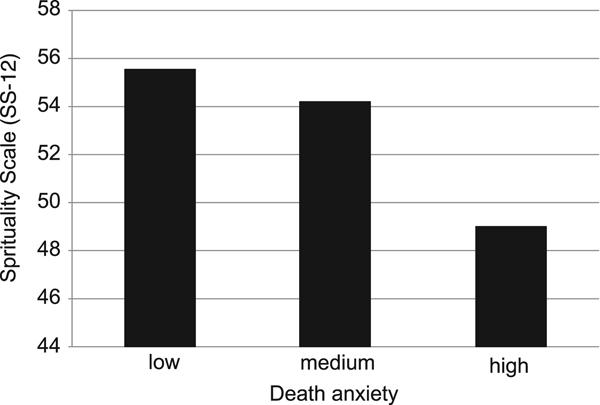
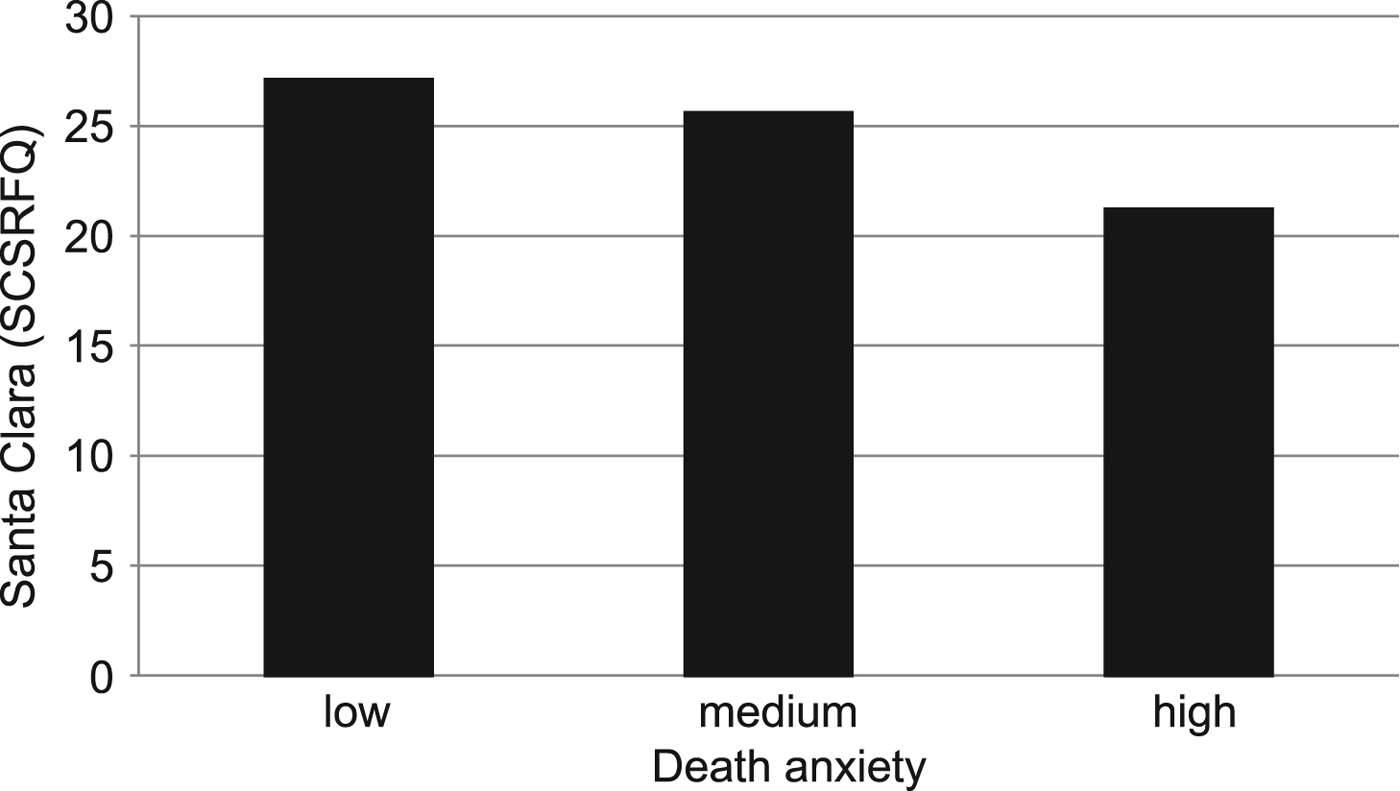
An exploratory analysis was conducted to examine the relationship between those with low, medium and high scores on the DAS and the SS-12 and SCRFQ scores. Participants were divided into three groups on the DAS (Low: 0–4, 31.5%; Medium: 5–7, 33.6%; High: 8–15, 34.9%) and an analysis of variance (ANOVA) was used to examine the linear and quadratic trends. For both SS-12 and SCRFQ there was evidence of a significant linear trend, F(2, 590) = 34.97, p < .001 and F(2, 590) = 25.12, p < .001 for SS-12 and SCRFQ respectively, where it was clear that there was an inverse linear relationship between death anxiety and both SS-12 and SCRFQ (see Figures 1 and 2). However, the quadratic trend was not significant for either variable F(2, 590) = 4.12, p < .05 and F(2, 590) = 1.96, p = .162 for SS-12 and SCRFQ respectively) and there was no evidence of a curvilinear relationship (see Figures 1 and 2).
Mean spirituality scale for groups based on high, medium and low death anxiety scales.

Mean Santa Clara Strength of the Religious Faith Questionnaire (SCSRFQ) for groups based on high, medium and low death anxiety scores.

Correlational Analyses
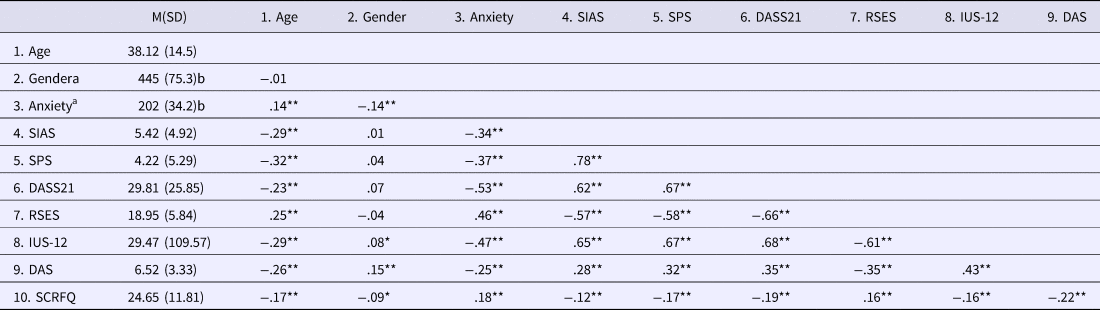
The correlations between the DAS, SIAS-6, SPS-6, age, gender, self-reported anxiety diagnosis, DASS21, RSES and IUS-12 are presented in Table 1. All correlations were significant due to the large sample size (N = 591). As predicted, DAS scores were significantly positively correlated with SIAS-6 scores, SPS-6 scores, gender, DASS21 scores and IUS-12 scores. Similarly, as predicted, DAS scores were significantly negatively correlated with age, self-reported anxiety diagnosis, and RSES scores. Additionally, SCRFQ scores were significantly positively correlated with self-reported anxiety diagnosis, and RSES scores and significantly negatively correlated with age, gender, SIAS-6 scores, SPS-6 scores, DASS21 scores, IUS-12 scores and, as expected, the DAS scores. However, while significant, due to the large sample size, the size of the correlations between SCRFQ and both SPS-6 and SIAS-6 were low (-.12 and -.17 respectively), as was the correlation between SCRFQ and DAS (-.22) and, based on the correlations, the SCRFQ was not included in the hierarchical regression analyses.
Descriptive statistics and zero-order correlations for gender, age, self-reported anxiety disorder diagnostic status, SIAS scores, SPS scores, DASS21 total scores, RSES scores, IUS-12 scores, DAS scores and SCRFQ scores

Note: Anxiety = self-reported anxiety disorder; SIAS = Social Interaction Scale scores; SPS = Social Phobia Scale scores; DASS21 = Depression, Anxiety and Stress Scale - 21 total scores; RSES = Rosenberg Self-Esteem Scale scores; IUS-12 = Intolerance of Uncertainty Scale total scores; DAS = Death Anxiety Scale scores and SCRFQ = Santa Clara Strength of Religious Faith Questionnaire scores.
a = point biserial correlation between dichotomous and interval scales. Dichotomous variable coding: Gender (Male = 0, Female = 1, Unidentified = 3); Anxiety (Yes = 1, No = 2). b = number coded as ‘Female’, ‘Anxiety’; percentage.
*significant at the .05 level (two tailed, **significant at the .01 level (two-tailed).
Predictors of Social Anxiety Symptomatology
To examine the contribution of death anxiety to social anxiety symptomology compared to self-esteem and intolerance to uncertainty, two sequential hierarchical multiple regressions were conducted with SIAS-6 scores as the dependent variable in one and SPS-6 scores as the dependent variable in the other. For both regression analyses, gender and age were entered as predictors at step 1 followed by DASS21 at step 2, RSES and IUS-12 at step 3, and finally DAS at step 4. The sample size (N = 591) was above the minimum recommended by Tabachnick and Fidell (Reference Tabachnick and Fidell2014) for multiple regression analysis with 10 predictor variables (minimum N = 111). The data were screened for outliers, multicollinearity, normality, and linearity and homoscedasticity of residuals, following the guidelines of Tabachnick and Fidell (Reference Tabachnick and Fidell2014). All of the predictor variables, with the exceptions of RSES and SCRFQ, had significant skew and kurtosis. However, as linear regression is robust to violation of the assumptions of normality in large samples such as this (Tabachnick & Fidell, Reference Tabachnick and Fidell2014), and as the transformations recommended to address skew and kurtosis make variables difficult to interpret, the variables were not transformed. Participants with missing data (n = 168) as well as multivariate outliers (n = 10) were removed from the sample prior to analysis.
Predictors of SIAS
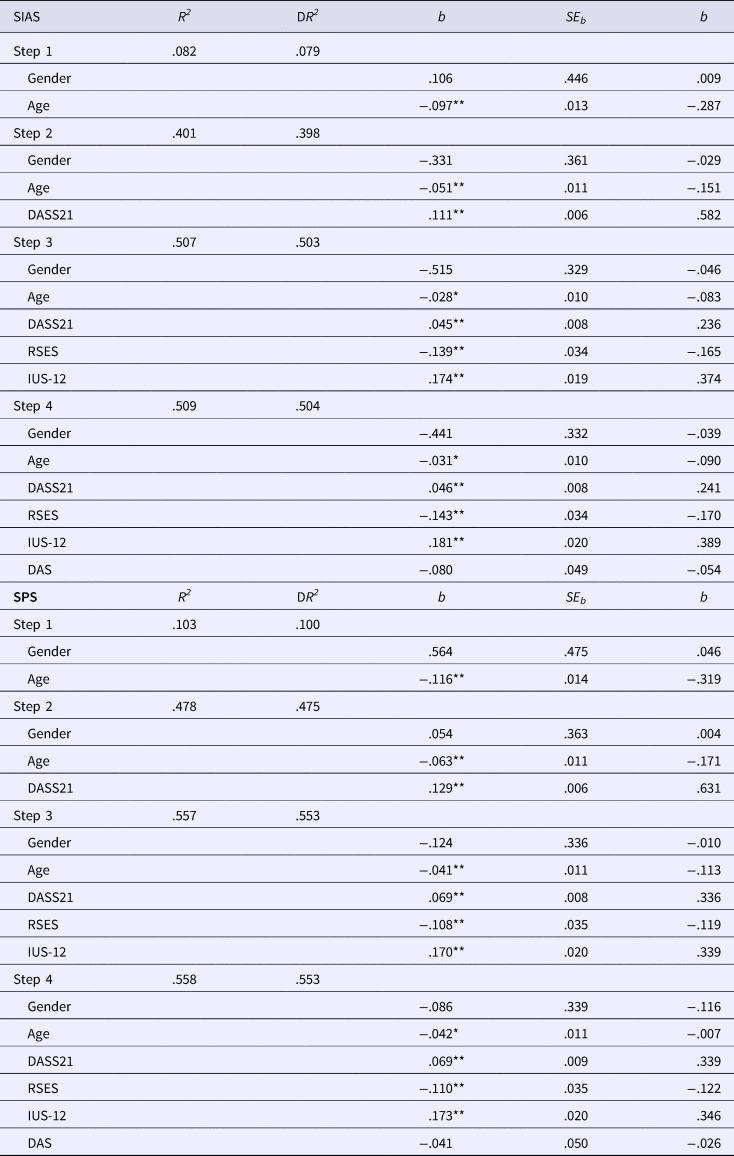
As shown in Table 2, at step 1, gender and age accounted for 8.2% of the variance in the SIAS scores and contributed significantly to the regression model, F(2, 588) = 26.37, p < .001. Introducing the DASS21 at step 2 explained an additional 31.9% of the variance in SIAS-6 scores. This change in R 2 was significant, F(3, 587) = 131.17, p < . 001. Adding the RSES and the IUS-12 at Step 3 explained an additional 10.6% of SIAS-6 variability F(5, 585) = 120.30, p < .001. However, adding DAS at step 4 only accounted for an additional 0.2% of the variance in SIAS-6 scores and was not significant, F(6, 584) = 100.99, p = .102. The overall multiple regression model was significant, and the final model with Age, Gender, DASS21, RSES, IUS-12 and DAS scores explained 50.9% of the variance in SIAS-6 scores, F(6,584) = 100.99, p < .001. As shown in the final model, all predictors except gender and DAS were significant, with DASS21 and IUS-12 scores positively associated with SIAS-6 scores and age, and RSES scores negatively associated with SIAS-6 scores.
Sequential regression model for variables predicting social anxiety: SIAS and SPS

Note: Anxiety = self-reported anxiety disorder; SIAS = Social Interaction Scale (Short form) scores; SPS = Social Phobia Scale (Short form) scores; DASS21 = Depression, Anxiety and Stress Scale-21 total scores; RSES = Rosenberg Self-Esteem Scale scores; IUS-12 = Intolerance of Uncertainty Scale total scores; DAS = Death Anxiety Scale scores.
* Correlation is significant at the .05 level (two tailed), **Correlation is significant at the 0.01 level (two-tailed).
Predictors of SPS
As shown in Table 2, at step 1, gender and age accounted for 10.3% of the variance in the SPS-6 scores and contributed significantly to the regression model, F(2, 588) = 33.90, p < .001. Introducing the DASS21 at step 2 explained an additional 37.5% of the variance in SPS-6 scores. This change in R 2 was significant, F(3, 587) = 179.15, p < .001. Adding the RSES and the IUS-12 at step 3 explained an additional 8% of the variance in SPS-6 scores, F(5, 585) = 147.17, p < .001. However, adding DAS at step 4 only accounted for an additional 0.1% of the variance in SPS-6 scores and was not significant F(6, 584) = 122.66, p = .413. The overall multiple regression model was significant, with the model including all variables (Age, Gender, DASS21, RSES, IUS-12 and DAS) explaining 55.8% of the variance in SPS-6 scores, F(6,584) = 122.66, p < .001. Again, all predictors except gender and DAS were significant, with DASS21 and IUS-12 positively associated with SPS-6 scores, and age and RSES negatively associated with SPS-6 scores.
Discussion
One aim of the present study was to explore the relationship between death anxiety and measures of intrinsic religiosity and extrinsic religiosity. It has been proposed that religious faith may buffer the existential fear of death (e.g., Harding et al., Reference Harding, Flannelly, Weaver and Costa2005; Plante et al., Reference Plante, Vallaeys, Sherman and Wallston2002; Vail et al., Reference Vail, Arndt and Abdollahi2012). However, previous research has been somewhat inconsistent about this relationship, with some studies reporting a linear relationship (both positive and negative) between death anxiety and measures of religiosity, others a curvilinear relationship, and still others finding no relationship between these variables (Ellis & Wahab, Reference Ellis and Wahab2013; Jong et al., Reference Jong, Ross, Philip, Chang, Simons and Halberstadt2018). Jong et al. (Reference Jong, Ross, Philip, Chang, Simons and Halberstadt2018) noted that published studies in this area predominantly included participants who identified as having religious affiliations, so that the inconsistent outcomes may reflect restriction of range on the measures due to this sampling bias. The present study therefore sought to explore the nature of this relationship in a broader community sample, predicting a positive relationship between the DAS and SCRFQ and a negative relationship between the DAS and SS-12. However, the findings of analysis of variance examining both the SCSRFQ and the SS-12 and DAS scores among those divided into high, medium and low death anxiety based on a tertile split on DAS scores found a significant negative linear relationship between both SCRFQ (extrinsic religiosity) and SS-12 (intrinsic religiosity) and death anxiety. Indeed, there was no evidence of a curvilinear relationship between death anxiety and either SCRFQ or SS-12. In both cases, those in the low death anxiety group had the highest scores on SCRFQ and SS-12, while those in the high death anxiety groups had the lowest scores. Those in the moderate death anxiety group fell between these extremes. Thus, the findings supported McMordie's (Reference McMordie1981) prediction but were inconsistent with the findings of Wink and Scott (Reference Wink and Scott2005) and of Helfick and Goldenberg (Reference Heflick and Goldenberg2012). It is proposed that the use of a broader community sample and the inclusion of measures of both intrinsic and extrinsic religiosity addresses some of the limitations of previous research. However, the design of the study precluded demonstration of a causal relationship, and it is proposed that future research where mortality salience is manipulated may further elucidate this effect.
The primary aim of this study was to investigate the relationship between measures of social anxiety symptomatology and key proposed transdiagnostic factors, namely death anxiety, self-esteem, and intolerance of uncertainty. Fear of death, or death anxiety, has been identified as a basic fear underpinning the development and maintenance of psychological disorders, including PTSD, OCD, hypochrondriasis, PD, separation anxiety, depression, and eating disorders (Iverach et al., Reference Iverach, Menzies and Menzies2014). It has also been suggested that death anxiety appears to increase hypervigilance towards social threat, and therefore avoidance in those with social anxiety (Finch et al., Reference Finch, Iverach, Menzies and Jones2016). While there is considerable research evidence confirming the effects of the more established transdiagnostic processes in social anxiety, such as IU (Boelen & Reijntjes, Reference Boelen and Reijntjes2009; Carleton et al., Reference Carleton, Mulvogue, Thibodeau, McCabe, Antony and Asmundson2012; Paulus et al., Reference Paulus, Talkovsky, Heggeness and Norton2015) and self-esteem (Gumley et al., Reference Gumley, O'Grady, Power and Schwannauer2004; Maldonado et al., Reference Maldonado, Huang, Chen, Kasen, Cohen and Chen2013; Routledge et al., Reference Routledge, Ostafin, Juhl, Sedikides, Cathey and Liao2010), there is limited evidence to support the association between death anxiety and social anxiety. However, Strachan et al. (Reference Strachan, Schimel, Arndt, Williams, Solomon, Pyszcnynski and Greenberg2007) found that increased mortality salience elevated social anxiety, where the presence of reminders of death resulted in greater social avoidance by those high in social anxiety. Similarly, Finch et al. (Reference Finch, Iverach, Menzies and Jones2016) posited that everyday functioning in those with social anxiety can be significantly impacted by death anxiety. Thus, in the present study, it was predicted that death anxiety would be positively associated with SAD symptomatology, as would self-esteem and IU. As it has been proposed that death anxiety may be a key transdiagnostic factor, the ‘worm at the core’ of psychopathology (Iverach et al., Reference Iverach, Menzies and Menzies2014), the study also examined whether death anxiety would be a better predictor of SAD symptomatology than self-esteem (Routledge et al., Reference Routledge, Ostafin, Juhl, Sedikides, Cathey and Liao2010) and IU (Carleton et al., Reference Carleton, Mulvogue, Thibodeau, McCabe, Antony and Asmundson2012), which have previously been linked with SAD symptomatology.
As expected, there were significant positive correlations between death anxiety and measures of SAD symptomatology. There were also significant positive correlations between death anxiety, negative affect (DASS21) and IU (IUS-12), and a significant negative correlation between death anxiety and self- esteem (RSES). The transdiagnostic processes of self-esteem and IU are known predictors of SAD symptomatology (Paulus et al., Reference Paulus, Talkovsky, Heggeness and Norton2015), along with negative affect (Barlow, Allen, & Choate, Reference Barlow, Allen and Choate2004). Previously, Paulus et al. (Reference Paulus, Talkovsky, Heggeness and Norton2015) proposed IU was a strong risk factor predicting SAD, and there is extensive support for this view (e.g., Boelen & Reijntjes, Reference Boelen and Reijntjes2009; Carleton et al., Reference Carleton, Mulvogue, Thibodeau, McCabe, Antony and Asmundson2012; Counsell et al., Reference Counsell, Furtado, Iorio, Anand, Canzonieri, Fine and Katzman2017). The current study supported these findings, with IU found to be a significant independent predictor of SAD symptomatology among a large community sample.
Similarly, low self-esteem is a well-known correlate of SAD (e.g., Gumley et al., Reference Gumley, O'Grady, Power and Schwannauer2004; Routledge et al., Reference Routledge, Ostafin, Juhl, Sedikides, Cathey and Liao2010). Merikangas et al. (Reference Merikangas, He, Burstein, Swanson, Avenevoli, Cui and Swendsen2010) and Maldonado et al. (Reference Maldonado, Huang, Chen, Kasen, Cohen and Chen2013) argued for early intervention to promote self-esteem as a means of reducing the likelihood that young people would develop anxiety disorders such as SAD. In fact, self-esteem has also been proposed as a buffer against death anxiety (Greenberg et al., Reference Greenberg, Solomon, Pyszczynski, Rosenblatt, Burling, Lyon and Pinel1992). In the present study, self-esteem was a significant, independent predictor of social anxiety symptomatology, and was also significantly negatively correlated with death anxiety.
In the present study, while age, negative affect, self-esteem, and IU were all significant independent predictors of SAD symptomatology, death anxiety was not. Therefore, the current findings do not support death anxiety as a core transdiagnostic process that underpins SAD symptomatology. Instead, while death anxiety was significantly correlated with SAD symptomatology (SIAS-6: r = .28; SPS-6: r = .32), self-esteem (r = -.35) and IU (r = .43), it was not a significant, independent predictor of either SIAS-6 or SPS-6 when self-esteem and IU were controlled. This finding is inconsistent with the findings of Strachan et al. (Reference Strachan, Schimel, Arndt, Williams, Solomon, Pyszcnynski and Greenberg2007), who concluded that mortality salience exacerbated maladaptive avoidant behaviours in 72 undergraduate psychology students with high social anxiety. Strachan et al.’s findings identified only that those high in social anxiety manifested greater SAD symptomatology when confronted with death reminders in an experimental design. Finch et al. (Reference Finch, Iverach, Menzies and Jones2016) replicated this result in their sample of 73 first-year psychology students divided into high and low groups on a measure of SAD symptomatology. Again, only those high in SAD symptomatology showed an increased attentional bias to social threat.
The present study used a cross-sectional design and recruited a community sample using an online questionnaire with self-report questionnaires, and therefore it is possible that participants recruited for this study did not have levels of social anxiety high enough to demonstrate the relationships identified in previous work. The present sample did not fall within the clinical range on the measures of social anxiety symptomatology (SIAS-6, M = 5,42, SD = 4.92, and SPS-6, M = 4.22, SD = 5.29, compared with Peters’ et al. [Reference Peters, Sunderland, Andrews, Rapee and Mattick2012] clinical sample, SIAS-6, M = 13.16, SD = 4.88, and SPS-6, M = 10.51, SD = 6.36). It may be that death anxiety is only important in those with elevated social anxiety, and further research replicating the study with a clinical sample may elicit a stronger relationship between death anxiety and SAD symptomatology. Alternatively, it may be that this relationship only becomes apparent in environments where those high in social anxiety are confronted with mortality salience.
However, effective intervention must still be a priority given the longstanding concerns about high rates of comorbidity between the anxiety disorders and between the anxiety and depressive disorders (Brown et al., Reference Brown, Campbell, Lehman, Grisham and Mancill2001; McManus et al., Reference McManus, Shafran and Cooper2010), as well as high relapse rates associated with condition-specific treatments (Harvey et al., Reference Harvey, Watkins, Mansell and Shafran2004). Researchers continue to postulate that there may be key psychological processes that account for symptomatology across diagnostic categories. Of the seven DSM-IV anxiety disorders examined by Brown et al. (Reference Brown, Campbell, Lehman, Grisham and Mancill2001), PTSD (80%), followed by SAD (48%) had the highest comorbidity rates with mood disorders associated with depression. Brown et al. (Reference Brown, Campbell, Lehman, Grisham and Mancill2001) argued that this high comorbidity between mood and anxiety disorders, particularly depression, PTSD and SAD, had significant implications for the course and prognosis of the conditions, and that the presence of comorbid anxiety and mood disorders was associated with chronicity, severity of psychopathology, treatment seeking, treatment outcome, relapse, and overall psychosocial functioning. Again, this highlights the urgency for effective treatment.
This study was the first to examine the role of death anxiety compared to the more established transdiagnostic processes of self-esteem and IU as a predictor of SAD symptomatology. While the findings did not support death anxiety as the ‘worm at the core’, replication of the current study with a clinical sample should be undertaken to provide better understanding of the role of death anxiety in SAD patients. SAD has poor response rates to treatment (Stein & Stein, Reference Stein and Stein2008) and high lifetime prevalence (Kessler et al., Reference Kessler, Berglund, Demler, Jin, Merhikangas and Walters2005), suggesting investigation of other possible transdiagnostic processes in social anxiety is warranted. Understanding barriers to treatment and poor recovery rates, as well as comorbidity, may be useful in informing future protocols.
The other area of interest for this current study was the relationship between death anxiety and religiosity. Although the recruitment of a large cohort of participants from the general population was recommended to examine the relationship between death anxiety and the measures of religiosity (Jong et al., Reference Jong, Ross, Philip, Chang, Simons and Halberstadt2018), the level of death anxiety may not have been high enough in this sample to detect relationships.
This study thus found no significant, independent relationship between death anxiety and SAD symptomatology after IU and self-esteem were controlled. However, the results confirm the importance of key transdiagnostic mediators, self-esteem and IU as predictors of SAD symptomatology that have been previously established (Boelen &Reijntjes; Reference Boelen and Reijntjes2009; Carleton et al., Reference Carleton, Mulvogue, Thibodeau, McCabe, Antony and Asmundson2012; Maldonado et al., Reference Maldonado, Huang, Chen, Kasen, Cohen and Chen2013). The current study also showed a strong negative linear correlation between death anxiety and both religiosity and spirituality in a large community sample. Although this result contributes to the literature, the complexity in understanding the impact of religious motivations, culture and ethnicity requires further investigation (Cohen et al., Reference Cohen, Pierce, Chambers, Meade, Gorvine and Koenig2005; Vail et al., Reference Vail, Arndt and Abdollahi2012).
Author ORCIDs
Juanita Lowe, 0000-0002-3868-8942.