Introduction
Ambulance diversion, the practice of transporting patients past the closest receiving center due to emergency department (ED) saturation or other hospital resource issues, is an increasingly common symptom of the crisis in ED crowding. The 2006 Institute of Medicine (IOM) report entitled “The Future of Emergency Care in the United States Health System” identified ED crowding as part of an “epidemic” of overburdened systems with insufficient capacity to provide routine care, much less support a surge of ill or injured patients in response to a disaster. 1 Ambulance diversion, once an infrequent occurrence meant to serve as a safety valve for rare instances of insufficient hospital resources, was reported in half of all US hospitals and almost two-thirds of urban US hospitals in 2003. 1 , Reference Burt, McCaig and Valverde 2 The IOM reports that ambulance diversion “can lead to catastrophic delays in treatment for seriously ill or injured patients.” It also frequently leads to treatment in facilities with inadequate expertise and resources appropriate to the patient's severity of illness, placing the patient at significant risk.”
Many factors contribute to ambulance diversion. Emergency department crowding is a multifactorial problem related to several issues. Boarding of patients that have been admitted and are awaiting an available bed, insufficient staffing within the hospital, inefficient clinical processes, lack of specialists to handle complex medical and surgical cases, and policies restricting the ability to “treat and release” patients who may not need immediate hospital-based care are some of the myriad of causes leading to diversion.Reference Handel, Hilton, Ward, Rabin, Zwemer and Pines 3 – Reference Olshaker and Rathlev 6 The net result is increased time to care with prolonged transport times, increased time out of service for paramedic units forced to travel further from their home area, increased patient dissatisfaction, and increased costs as patients are diverted from their home hospitals.Reference Carter and Grierson 7 – Reference Williams 9 Cost increases may result from unnecessary testing; it is theorized that patients taken to hospitals other than their medical homes undergo redundant testing and treatment, as well as inappropriate changes in treatment, leading to higher expenses for the medical system and increased risk to patients. Increased nonmedical costs are also found as ambulances require more frequent maintenance due to driving longer distances, and patients find themselves seeking transportation home from farther away than anticipated. Repatriation from a receiving facility to a bypassed facility also may occur as resources become available at a hospital that earlier was on diversion. There is also a concern that hospitals may use the diversion policy excessively to reduce exposure to a perceived financial liability (unfunded patients transported by Emergency Medical Services, or EMS).
Controversy exists regarding diversion. Although many feel that it may have a detrimental effect on morbidity and mortality, some literature suggests that diversion has no effect or even a beneficial effect on mortality.Reference Fatovich 10 – Reference Begley, Chang, Wood and Weltge 12 Revenue and profitability, both at the ED and hospital levels, has also been subject to conflicting findings.Reference Pham, Patel, Millin, Kirsch and Chanmugam 8 , Reference Falvo, Grove, Stachura and Zirkin 13 – Reference McConnell, Richards, Daya, Weathers and Lowe 15 Other investigations have studied diversion's effect on crowding and EMS resources.Reference Carter and Grierson 7 , Reference Pham, Patel, Millin, Kirsch and Chanmugam 8 , Reference Burt and McCaig 16 – Reference Upfold 19 However, the authors are aware of only one report that specifically has looked at the characteristics of hospitals that divert ambulance traffic.
In 2006, Sun et al reported on the effect of hospital closures on neighboring EDs.Reference Sun, Mohanty and Weiss 20 This report also described some characteristics of hospitals in the system, and found that county-owned facilities and trauma centers were more likely to go on diversion compared to other facilities. No difference was found for demographic characteristics including percent below poverty level and racial categorizations.
The objective of this study was to describe specific paramedic receiving center characteristics that are associated with ambulance diversion rates in a large suburban EMS system.
Methods
Study Design
This was a retrospective database review. Two distinct public databases were accessed to obtain data related to diversion hours and hospital demographics, as described below. United States Census data were accessed from the 2000 Census. No human subject interaction was performed. The study was approved by the University of California, Irvine Human Subjects Review Committee on an expedited basis.
Study Setting and Population
Orange County, California employs a largely urban/suburban integrated EMS system comprised of 24 currently open paramedic receiving centers (PRCs) working with 22 private ambulance companies, one air ambulance service, and 13 fire-based EMS agencies. During the study period, four PRCs closed, and one new PRC opened. In 2006, ambulances transported 51,699 patients to PRCs. Paramedic receiving centers in this system include three trauma centers (one level 1 and two level 2); ownership ranges from three different types of investor-owned hospitals to 11 nonprofit and one university-owned hospital. All PRCs are acute-care general hospitals licensed to provide basic or comprehensive emergency care, and despite the word “paramedic” in the title, do receive both Advanced Life Support (ALS) and Basic Life Support (BLS) patients.
At the time of this study, Orange County EMS policy allowed PRCs to request diversion status if it was felt that resources did not exist to care for additional ALS patients; BLS patients were not diverted. Patients in acute status, such as those requiring immediate airway management, treatment for uncontrolled hemorrhage, or with unstable vital signs, were not diverted. The three trauma centers maintained a separate trauma diversion category in addition to general ED diversion. Beginning in 2007, a patient's “home hospital” request was allowed to override a hospital's diversion request. While no time limit was placed on the diversion request (eg, must accept at least one new patient after one hour), PRCs requesting diversion for longer than two hours were required to notify the county EMS duty officer.
Study Protocol
All ambulance diversion hours for the general diversion category of ED saturation were collected automatically via a centralized computer system (ReddiNet, Los Angeles, California USA) from January 2000-July 2008. The database records all entries into the diversion request system; a PRC may not go on diversion without entering the request into ReddiNet. Other diversion categories only related to specific categories of patients (eg, trauma patients or patients requiring a CT scanner) and were not included. Information on characteristics of individual PRCs was obtained from the Automated Licensing and Reports Tracking System (ALiRTS), a database maintained by the California Office of Statewide Health Planning and Development that includes licensing and demographic information. Data in ALiRTS were abstracted from licensing information submitted to the state by each hospital; these data were collected for the last year in which they were available, generally 2008.
Measurements or Key Outcome Measures
Paramedic receiving center characteristics included diversion rate (defined as total number of diversion hours divided by the total number of hours in the time period studied), for-profit status, number of specialty services as defined by the state of California (including trauma, burn, cardiovascular surgery, renal transplant services, cardiac catheterization capability [both interventional and diagnostic], and burn surgery), average inpatient bed occupancy rate, annual ED volume (patients per year), ED admission rate (percent of ED patients admitted), and percent of patients leaving without being seen (LWBS). Demographic characteristics included percent of persons in each hospital's immediate census tract below the 100% and 200% poverty lines (each considered separately), and population density (persons/square mile) within the census tract. Although all “rates” listed above are not technically rates, as they are not defined per a unit of time, they are reported as such to maximize usability and maintain consistency with commonly-used terminology.
Data Analysis
All data were collected in a Microsoft Excel 2008 spreadsheet (Redmond, Washington USA), double-checked by hand for accuracy, then imported into Stata 10.1 (StataCorp, College Station, Texas USA) for analysis. The following transformations were performed:
-
1. Ownership type was condensed into for-profit and not-for-profit.
-
2. Number of specialty services was condensed into presence or absence of specialty services (such as trauma, burn, and vascular care).
-
3. Due to a high amount of skewness, ED volume and left without being seen rates underwent a logarithmic transformation in which LWBS=log (LWBS as percentage of ED volume + 0.5) to avoid log(0).
-
4. Linear regression analyses were performed.
Sample Size Determination
The sample consisted of the entire population of hospitals in Orange County. As there was no sampling performed, no sample size calculations were considered.
Results
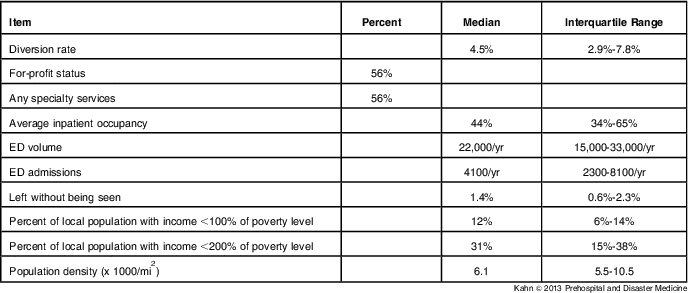
The variables used in the analysis are summarized in Table 1. The median diversion rate was 4.5% (range 0.3%-14.5%). Fifteen of the 27 hospitals were for-profit, 15 had at least one specialty service, and 12 had two or more specialty services.
Study Variables: Percent of Binary Variable, Median and Interquartile Range of Continuous Variables

Abbreviation: ED, Emergency Department
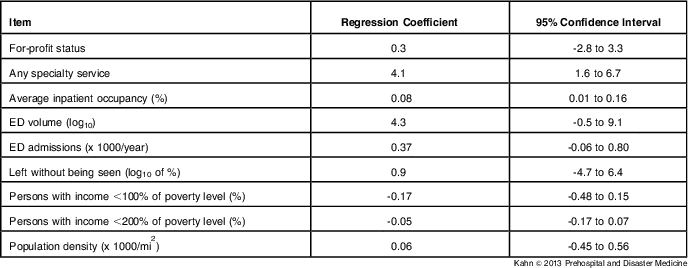
T-test and regression results are listed in Table 2. For-profit status was not found to be a significant correlate of diversion rate. In the linear regression results, ED volume, LWBS rate, percentage of ED patients admitted, and local demographics including population density and poverty rate were not correlated with diversion rate.
Simple Linear Regression of Diversion Rate on Selected Variables

Abbreviation: ED, Emergency Department
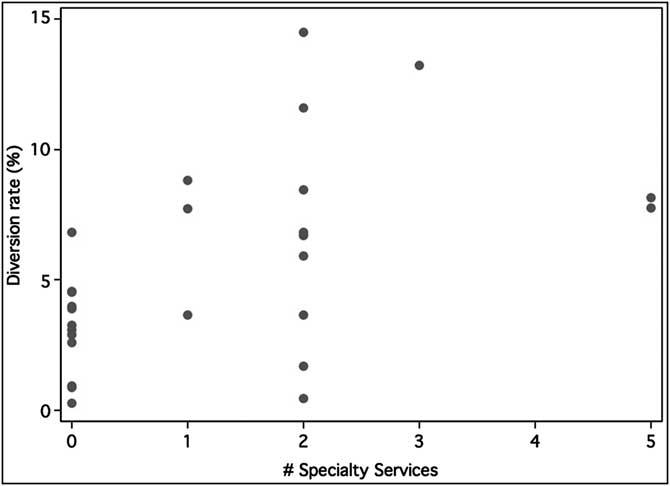
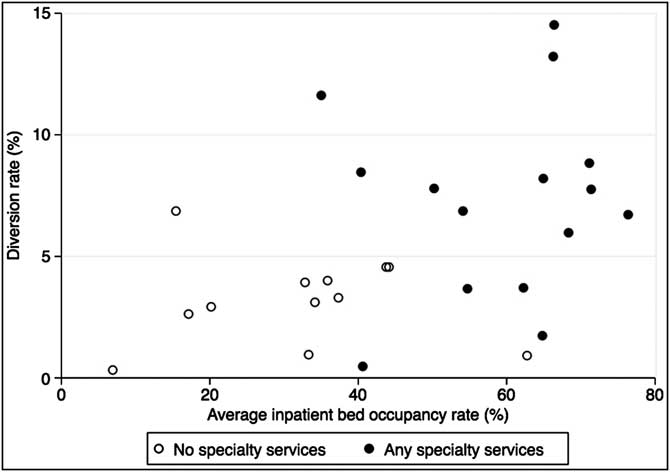
The presence of any number of specialty services was significantly associated with an increase in diversion rate; hospitals providing specialty services had, on average, a 4.1% (95% CI, 1.6%-6.7%) higher diversion rate than other hospitals. Average inpatient occupancy also was associated with diversion rate; each one percent increase in the average inpatient occupancy rate was associated with a 0.08% (95%CI, 0.01%-0.16%) increase in diversion rate. Scatterplots demonstrating these variables are found in Figure 1.
Specialty Services and Diversion Rates

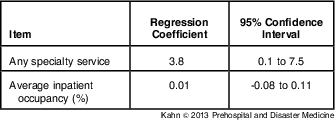
A multiple regression analysis was performed to determine whether average inpatient occupancy rate and presence of specialty services were independent (Table 3). The diversion rate was 3.8% (95% CI, 0.1%-7.5%) higher for hospitals with specialty services, which is similar to the rate from the bivariate analysis. However, there was little relationship between diversion rate and average inpatient occupancy rate: each one percent increase in the average inpatient occupancy rate was associated with a 0.01% (95% CI, -0.08 to 0.11%) increase in diversion rate (Figure 2). Overall, the presence of specialty services and the average inpatient occupancy rate accounted for 31% of the observed variance in diversion rates.
Multiple Linear Regression of Diversion Rate on Selected Variables

Inpatient Occupancy and Diversion Rates by Presence of Specialty Services

Discussion
Despite a wide range of diversion rates, even among hospitals in the system generally considered to have similar capabilities, few characteristics were found to be associated with ambulance diversion rates. The two characteristics with significant associations, presence of specialty services and average inpatient occupancy rate, do not appear to be independent; a regression analysis shows only the presence of specialty services is related to a change in diversion rate.
It is concerning that hospitals providing specialty services are more often on diversion. Sun et al also showed that trauma centers had higher diversion rates than other hospitals.Reference Sun, Mohanty and Weiss 20 This could result in difficulty getting critical patients in need of higher levels of care to centers that can provide that care.
Given the lack of predictor variables related to ambulance diversion rates among a large and heterogeneous group of hospitals in the EMS system studied, it appears that other factors are primarily responsible for the divergence in diversion rates; significant variables only accounted for 31% of this variance. As these factors are unlikely to be directly related to demographics or objective hospital characteristics based on this analysis, they are likely policy- or practice-related at the hospital operation and administration level.
Several concepts have been postulated to explain hospital diversion decision practices; the common denominator among many of these postulates is financial. It has been reported that some hospitals prefer to divert ambulances in favor of their elective patients, in the interest of an improved payor mix and revenue collection; other reports demonstrate that ambulance patients actually provide financial benefit to the hospital.Reference Handel, Hilton, Ward, Rabin, Zwemer and Pines 3 , Reference Falvo, Grove, Stachura and Zirkin 13 – Reference McConnell, Richards, Daya, Weathers and Lowe 15 Anecdotal reports also exist suggesting that some ED staff prefer to divert patients when their waiting rooms are overcrowded, hoping that diverted patients will get care more rapidly at another facility.
Certainly there is a greater interest in ensuring rapid, effective, and safe patient care; this is the general goal of all EMS systems. It has been demonstrated that ambulance diversion often is associated with crowding in the ED, a multifaceted issue that has been addressed extensively in other reports.Reference Hoot and Aronsky 5 , Reference Hoot, Leblanc and Jones 21 – Reference Schull, Lazier, Vermeulen, Mawhinney and Morrison 23
Hospital and demographic characteristics, with the exception of availability of specialty services, do not appear to be associated with ambulance diversion rates. Emergency Medical Services systems should encourage participating hospitals, particularly those with specialty services, to examine their policies and practices to minimize ambulance diversion.
Limitations
This study suffers from the same limitations of all retrospective studies; namely, the authors are unable to show a cause and effect relationship among the variables of interest. It was not possible to collect hospital and population demographic data beyond the last year available; this could skew results if significant changes occurred in these data over the period in which diversion hours were collected for this study. The authors do not believe, however, that there were significant secular trends that would affect these results. Also, the study relies on data from a statewide system as well as a countywide system. Although the county system appears to be robust, as it is the official determinant of whether a hospital is on diversion, it is possible that differences in data entry practices resulted in a systematic difference among various hospitals that was not detectable at the level of the statewide system. Offload delays are not identifiable from the databases used; it is possible that hospitals with low diversion rates had longer offload times. Finally, this study was conducted in California (USA) where nurse staffing and other state-specific regulations may contribute to diversion in such a way that external validity may be affected.
Conclusions
Hospitals in this study providing specialty services such as trauma, cardiac catheterization, burn surgery, and cardiovascular surgery were more likely to have higher diversion rates. This may result in increased difficulty getting patients requiring specialty care to centers able to provide the needed level of service. Using measurable hospital characteristics and service area demographics as variables to account for ambulance diversion accounted for 31% of the variance in diversion among a large and heterogeneous group of hospitals. It appears that other factors, such as those related to policy or practice differences at the hospital administrative level, are primarily responsible for the divergence in diversion rates.