That Rome would come to typify a marble-clad city was far from obvious at the dawn of the Augustan Principate. The material shift in architecture that characterizes this period involved profound changes to the city's color and texture, to the ways in which light carried and reflected off surfaces, and to the technical and stylistic features of buildings’ decorative programs. Roman exploits abroad had resulted in a slow trickle of marble into the city over the previous two centuries, and anyone strolling around its center by the close of the Republic would have caught occasional glimpses of buildings and statues in bright Pentelic. Scipio had set up marble basins before his arch on the Capitoline Hill in 190 BCE, and Q. Caecilius Metellus built Rome's first all-marble temple to Jupiter Stator between 146 and 131 BCE.Footnote 1 Elite residences across Italy were teeming with marble Greek statues, and more would have been scattered among Rome's temples and public spaces.Footnote 2
Still, such examples represent a striking minority when considering the city's appearance as a whole. Marble-faced buildings would have been noticeable – even conspicuous – to passersby. Their materials were manifestly foreign, relying on importation and attesting to Rome's growing dominance over her neighbors in the world.Footnote 3 The sharp increase in imported colored marbles following Octavian's defeat of Antony and Cleopatra at Actium would have further highlighted the material's “foreignness.”Footnote 4 Marble carried connotations of splendor and monumentality, and it would have stood out sharply in a city still dominated by traditional Italic temples decorated with terracotta.Footnote 5
Augustus's oft-cited boast, recorded by Suetonius, that he found Rome a city of brick and left it a city of marble underscores the seriousness with which this material revolution was regarded at the time.Footnote 6 Changing styles in art and architecture were, of course, impacted by Mediterranean-wide trends, as well as by shifts in political ideologies as governance solidified around a single person. All this has by now been amply demonstrated and remains fundamental to current interpretations of Augustan art. Still, it would be a mistake to downplay the sweeping significance of Roman architecture's material transformation during this period, which was made possible by the widespread exploitation of the Luna marble quarries beginning in the mid-1st c. BCE.Footnote 7
Because we are accustomed to accepting this shift to marble as an obvious feature of Rome's march into the Imperial period, we have perhaps failed to adequately consider it from a phenomenological perspective. How would the city actually have appeared to residents and visitors during the early years of the Principate? How did marble structures interact with the more traditional Republican temples that still filled the skyline? What attempts, if any, were made to reconcile the two?
To appreciate the significance of this transformation, particularly in the realm of sacred architecture, we must not forget the ubiquity and symbolic power of terracottas. These had been used in central Italy since before the founding of the Republic to protect and decorate the wooden beams of roofs. Vibrantly painted and often quite ornate, architectural terracottas could be found on virtually every sacred building, whether in a town's forum or cult center, overlooking its port, along a road, or in a remote extramural sanctuary. By the close of the Republic, such terracottas were in some sense synonymous with traditional Italic temples, and they were still used on new constructions by powerful men such as Pompey in the generation before Augustus.Footnote 8
Significantly, the types usually employed for Republican temples are bursting with vegetal motifs, which constitute the single decorative focus outside of the pediment (Fig. 1). Their importance in shaping Augustan aesthetics has not previously been recognized, and I argue that they play a vital role in viewer interaction with monuments such as the Ara Pacis. The large vegetal panels of the Ara Pacis's enclosure walls reveal a sustained reliance on Republican architectural terracottas that is evident in the broad principles of their design as well as in the details of their iconography and style. They represent a remediation in marble of traditional floral motifs that were intimately linked to temple architecture and to notions of religious antiquity.
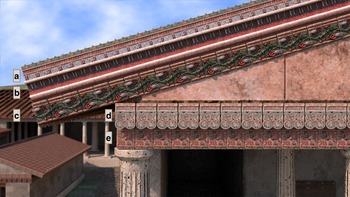
Digital reconstruction of architectural terracottas on the roof of the temple at Monte Rinaldo, with hypothetical color, 2nd c. BCE. From top to bottom: (a) perforated cornice; (b) strigilated sima; (c) revetment plaque with doves and vegetal designs; (d) revetment plaque with looped palmettes; (e) revetment plaque with addorsed palmettes. (3D model by Giacomo Mancuso, based on the study and reconstruction by Francesco Belfiori. Labels added. Image courtesy of F. Belfiori.)

Italy's long tradition of terracotta temple decoration has gone surprisingly unnoticed in scholarship on Augustan Rome, likely due to lingering biases regarding “ornament” and the perceived medial inferiority of terracotta.Footnote 9 For Augustan viewers, however, these objects constituted a fundamental element of their visual vocabulary. Unlike private elite objects or monuments abroad, local temple terracottas were readily familiar to viewers at all levels of the social spectrum, and they would have played an important role in the associative processes of viewing that they performed (whether deliberately or subconsciously) when they encountered new buildings and images.
To illustrate the ubiquity of these objects and the vegetal motifs that filled them, I will first briefly discuss the use and appearance of architectural terracottas on temples in 3rd–1st-c. BCE central Italy. During the Late Republic and Early Empire, the growing interest in marble architecture led to an association between the material of terracotta and notions of an idealized antiquity – at least in the religious sphere – and I suggest that this too is essential for understanding references to terracotta motifs on the Ara Pacis. Campana plaques, the focus of the second section, demonstrate how the vegetal designs of traditional Italic temple terracottas took on an almost numinous significance during the Augustan period. Third, this context then enables a new reading of the Ara Pacis's exterior walls. The lush vegetal friezes transposed ancient and well-known motifs into a new Augustan context, bringing down to eye level what viewers had for centuries looked up to the roof to see. Finally, I consider the broader Augustan cultural interest in religious antiquity and the physical context of the Ara Pacis in a Rome still filled with terracotta-laden temples. Viewers, I suggest, would have been primed to interpret the Ara Pacis's vegetation in relation to traditional terracottas, and this reference constitutes a fundamental aspect of the monument's message and reception. The religious past was reframed to fit Augustus's new Rome, using a visual language that was both deeply symbolic and unanimously recognizable.
Setting the stage: terracotta in Italic sacred architecture
Understanding terracotta's long history in Italic religious architecture is vital in order to contextualize the visual expectations of Augustan viewers. Architectural terracottas first appeared in Italy in the 7th c. BCE and quickly became a fundamental construction element.Footnote 10 Their crowded designs and bright polychromy placed a deliberate emphasis on the upper border of buildings, drawing the eye up to the roof and, by extension, to the heavens. They were used on a range of private and public buildings. Starting in the mid-6th c., however, certain types of simas, cornices, revetment plaques, and antefixes appear gradually to have taken on a more religious connotation and to have been manufactured expressly for temple roofs.Footnote 11
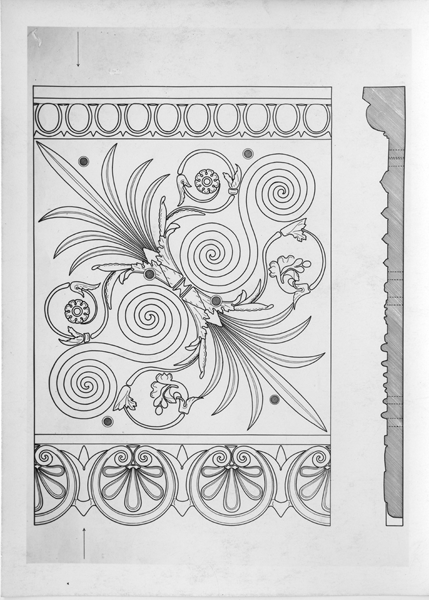
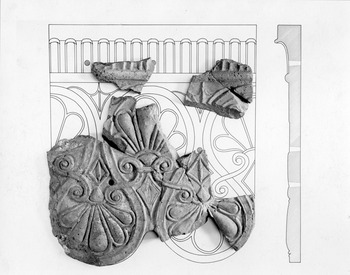
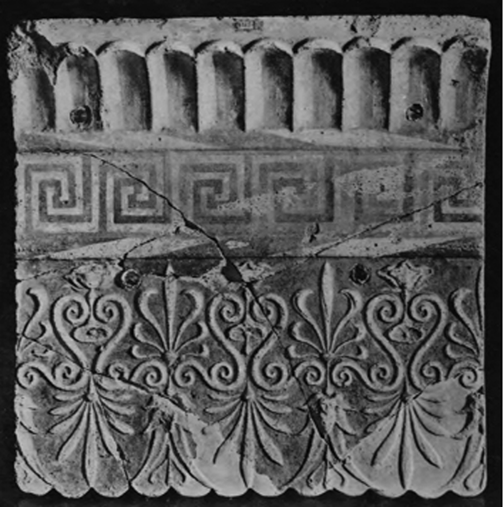
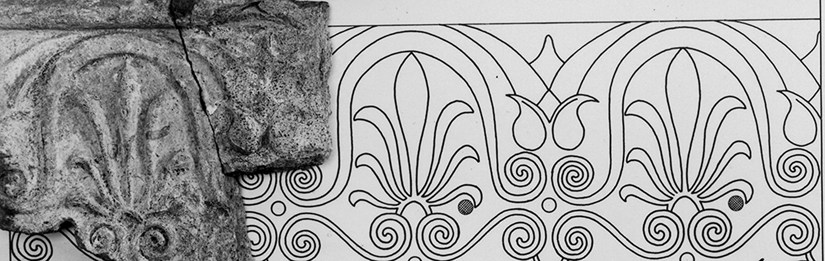
A remarkable feature of the terracotta types employed for central Italic temple roofs is that many remain fundamentally unchanged for over five centuries. Although site-specific examples carrying messages of local identity and mythology abound in all periods, a particular set of simas, cornices, antefixes, and revetment plaques becomes fairly standardized by the 2nd c. BCE in terms of form and iconography (Fig. 1).Footnote 12 Vertical strigil patterns are common for simas, whereas cornices typically feature meanders or figure eights punctuated by flowers, leaves, and buds. Potnia theron (mistress of the animals) appears frequently on antefixes, flanked by rearing felines. Two main types of revetment plaques are repeated on late Republican temples across central Italy, both dominated by palmettes, vines, and s-spirals.Footnote 13 On the first, the large central register is occupied by a pair of mirrored palmettes set diagonally across the plaque (Fig. 1e, Fig. 2). Two s-spirals are set between them on the opposite diagonal, and from each side of the palmettes’ base emerges a delicate stem ending in leaves with a bud or flower. On the second plaque type, large looping vines or ribbons fill the principal register, enclosing palmettes that alternately hang down and stand upright, and that are connected across the loops by s-spirals (Fig. 1d, Fig. 3).
Revetment plaque with diagonal palmettes and s-spirals from Cosa, attributed to the triple-cella temple. This example may belong to the mid-1st c. BCE, but plaques of this type are known at Cosa already in the 3rd–2nd c. BCE. (Courtesy of the American Academy in Rome, Photographic Archive. AAR.Cosa.III.TCR.92, AAR.COSA.1951.8.)

Revetment plaque with looped palmettes from Cosa, attributed to the triple-cella temple. This example is generally dated to the early 1st c. BCE, but it belongs to a type known at Cosa from the 2nd or 3rd c. BCE. (Courtesy of the American Academy in Rome, Photographic Archive. AAR.Cosa.III.TCR.42, AAR.COSA.1949.202.)

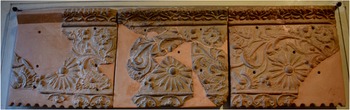
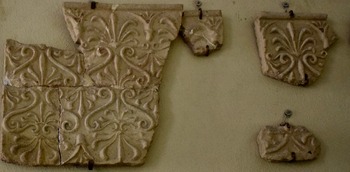
These two revetment plaque types are particularly important for understanding the treatment of plants in Augustan art. Because such terracottas were mold made, the vegetation they so pointedly privilege would have formed a repeated pattern across the entablature and pedimental slopes of a temple roof. This repetition creates a sense of order despite the intricate swirls of individual vines and flowers, a phenomenon visible on many Republican revetment plaques beyond the “standard” two (Fig. 4). When placed in a row along a roof beam, the duplication of the design produces a strongly symmetrical and regular arrangement. In many cases, this repetition occurs even within a single plaque, and the straight vertical lines from which the curls and scrolls emerge lend a rhythmic quality to the composition (Figs. 5–6).
Revetment plaques from a temple in the area of Santa Croce in Arezzo, 3rd–2nd c. BCE. Arezzo, Museo Archeologico Nazionale, inv. 14363. (Courtesy of the Ministero della Cultura, Direzione Regionale Musei della Toscana, Firenze. Photo by Stefan Ardeleanu.)

Revetment plaque from Cività Castellana, Sassi Caduti, first half of the 5th c. BCE. (Andrén Reference Andrén1940, pl. 43, no. 141.)

Fragmentary terracotta plaque from a Republican temple at Volterra, Piano di Castello, 3rd (?) c. BCE. (Courtesy of the Museo Etrusco Guarnacci di Volterra. Photo by Stefan Ardeleanu.)

It is possible that the palmettes and s-spirals so popular on these plaques carried some special significance or cult reference, although little survives to help us decipher such nuances.Footnote 14 The presence of vegetal motifs on temple roofs must also have operated in visual dialogue with temple landscaping and sacred groves, where real and fictile plants stretched from earth to sky.Footnote 15 Whether specific or (more likely) generic, the divine connotations of vegetal terracottas would have been heightened by their placement on a temple's roof: viewers had to look up toward the gods to see them. These plaques became such a staple of central Italic temple architecture between the 3rd and 1st c. BCE that their form and iconography would instantly have signaled to viewers that they were looking at a sacred building.Footnote 16
At least by the 2nd c. BCE, such terracottas also carried connotations of antiquity. Each of the “standard” types mentioned above (perforated cornices, strigilated simas, potnia theron antefixes, and revetment plaques with diagonal and looped palmettes) is first attested at Etruscan sites such as Orvieto, Pyrgi, and Caere between the 6th and 4th c., with a sudden boom in popularity around the 2nd c.Footnote 17 Their reintroduction suggests a deliberate archaism, in which new and newly renovated temples consciously mimicked ancient shrines.Footnote 18 Furthermore, concerted efforts were made in the last two centuries BCE to maintain the appearance of existing sacred structures, including the fashioning of new molds in imitation of earlier designs when roofs were repaired or renovated.Footnote 19 This would have lent an old-fashioned appearance even to freshly built temples, imbuing sacred structures across central Italy with a sense of antiquity and deep-rooted religion. The vegetal motifs that filled temple terracottas are central to these connotations.
Not surprisingly, given their ubiquity and religious significance, terracottas are mentioned in our literary sources as well. The mythology surrounding the construction of the Temple of Jupiter Optimus Maximus on the Capitoline, for instance, preserves the anecdote of the famous Etruscan coroplast Vulca being summoned to Rome from Veii for the project.Footnote 20 During work on the temple's terracotta statuary, the chariot is said to have miraculously grown in the furnace (terracotta usually shrinks during firing), an event interpreted by the Etruscan seers as an omen of the chariot's great power.Footnote 21 Terracotta as a material is explicitly and repeatedly tied to Rome's most prominent Republican buildings by later authors.Footnote 22 As imported marble began to enter Rome more steadily, marble and terracotta were increasingly contrasted as opposing poles from a symbolic and moralistic perspective – terracotta embodying traditional Italic pietas and marble foreign luxuria. Cato, for instance, dramatically decries the use of impiously luxurious (marble) adornments for temples, the rhetorical opposite of his beloved “antefixa fictilia deorum Romanorum.”Footnote 23 Propertius opens his fourth book of elegies by visualizing an explicitly modest early Rome, and he is specific in mentioning terracotta as the medium for ancient images of deities (“fictilibus crevere deis haec aurea templa,” Prop. 4.1.5). Indeed, the combined archaeological and literary record suggests that terracottas were so intimately tied to temple architecture in Italy that by the Mid- to Late Republic, they stood in some sense as a collective visual definition of what indigenous sacred structures looked like.Footnote 24 Terracotta as a sculptural medium was strongly imbued with notions of antiquity and of Rome's deep religious past.Footnote 25
As Cato's indignation makes clear, the “traditional” connotations of terracottas were not lost on viewers. In the years leading up to the Principate, these vegetal terracottas were used to make temples across central Italy look older than they actually were. The perceived antiquity of a building or cult likely lent it an added air of prestige, mirroring broader social interests in archaism during the later Republic.Footnote 26 The plant-rich architectural terracottas that populated the Roman skyline at the moment of Octavian's rise therefore offered an ideal medium for linking past and present within a religious context, and for couching innovation in an aura of traditionalism.
Reframing tradition: Campana reliefs
The “traditional” connotations of the vegetal motifs used on Republican temple decoration explain their persistence not only in remediated form on the Ara Pacis (see below) but also in a new type of architectural terracotta that gained particular popularity in the early years of the Principate – precisely when Luna marble was being widely adopted in Roman architecture. The so-called Campana reliefs represent the last major holdout in terracotta for architectural decoration, a fact that in itself signals their acutely archaizing tendency.Footnote 27 They offer fundamental testimony for the ways in which traditional vegetal designs were reframed in the 1st c. BCE, and consequently help interpret the Ara Pacis and its disproportionate botanical emphasis.
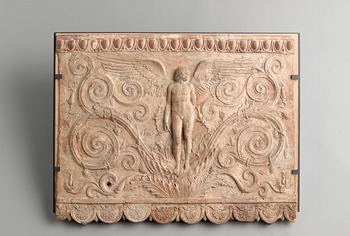
Campana reliefs developed directly from earlier Italic terracottas, a continuity apparent in their material and function as well as their vegetal iconography (Figs. 7–9).Footnote 28 Many acted as decorative architectural elements, just as their predecessors had done, and were placed on roofs as revetment plaques, simas, cornices, and so on. One group of Campana reliefs, the so-called attachment plaques, may represent an entirely new decorative category.Footnote 29 Debate about their architectural placement is ongoing, but there is evidence that they were mortared directly onto walls rather than set on the roof like other Campana relief types.Footnote 30 This means that many could conceivably have sat closer to eye level, bringing architectural terracottas down from the roof to confront viewers more directly. In this, as well as in certain details of their framed borders, iconography, and neo-Attic style, they closely mirror contemporaneous developments in wall painting.Footnote 31
Campana relief of a nude divinity emerging from a plant, second half of the 1st c. BCE. Musée du Louvre, Paris, inv. Cp 3850. (© RMN-Grand Palais / Art Resource, NY.)

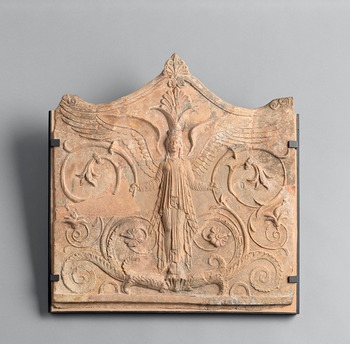
Campana relief of a divinity in archaizing style amid vines, second half of the 1st c. BCE. Musée du Louvre, Paris, inv. Cp 3845. (© RMN-Grand Palais / Art Resource, NY.)

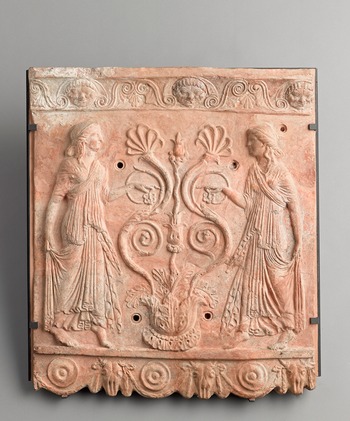
Campana relief with women in archaizing style flanking a plant, second half of the 1st c. BCE. Musée du Louvre, Paris, inv. S 756. (© RMN-Grand Palais / Art Resource, NY.)

Campana reliefs were used extensively in the Augustan Palatine complex, another locus for powerful visual messaging. Patrizio Pensabene's monumental volumes have only recently made clear the extent to which this area privileged terracottas in its early Augustan phases and even after its “marbleization.”Footnote 32 A large number of the Palatine Campana reliefs explicitly emphasize vegetal motifs, drawing a visual reference to traditional Italic temple decoration. According to Pensabene, the use of these familiar images lends a certain religious auctoritas to the new Augustan ideology.Footnote 33 This phenomenon might be compared to the calculated preservation of ancient mythological structures around the new Augustan complex. Rome's past was evoked and made tangible across the southwest Palatine, from the cave of the Lupercal to the Scalae Caci to the black meteorite enshrined in the Temple of Magna Mater.Footnote 34 The Hut of Romulus stood near the Augustan complex, rebuilt, as we know from Dionysius of Halicarnassus, with old materials to give it an ancient and authentic appearance.Footnote 35 Its simple wood and reed structure would have contrasted sharply with the shining surfaces of the new marble complex, simultaneously differentiating the buildings by material, age, and scale, and joining them in a single coherent landscape that united old and new, implicitly proclaiming the continuity of the Augustan program with Roman tradition.Footnote 36 The Campana reliefs also employed a triple archaism of style, iconography, and material in order to couch the new Augustan program in an aura of piety and deep antiquity.
Significantly, however, such reliefs did not simply reference old-fashioned temple decoration; they reframed it entirely.Footnote 37 A notable feature of Augustan Campana reliefs is their increasingly symbolic treatment of traditional vine motifs. These seem to acquire a sacred value of their own, as if the very vines had become an object of worship and a physical manifestation of divinity.Footnote 38 This change is evident on a number of Campana reliefs from the Palatine and beyond.Footnote 39 On one type, a nude figure with wings stands amid neatly swirling vines, as if he himself were the emerging bud of an impossible plant (Fig. 7).Footnote 40 The curved shape of the shoots recalls with remarkable precision the spiral-form vines so popular on Republican revetment plaques. Here, however, the vegetation mingles explicitly with the divine as part of a deity's physical manifestation.
On other plaques, an archaizing female figure stands in the center of the composition, emerging once again from the base of the plant (Fig. 8).Footnote 41 Her wings declare her divine status, and she grasps in each hand the edge of a curved vine ending in a flower larger than her head. Compositionally, she seems to derive from the potnia theron figures so popular on Mid- to Late Republican terracotta antefixes, particularly in the 2nd c. BCE. She remains a figure rooted in nature, over which she is master. Here, however, she is flanked by vines rather than felines – the divine nature to be dominated is the world of plants. This shift is illuminating in terms of Augustan attitudes toward floral motifs, and it underscores the ways in which botanical designs from temple terracottas were actively reformulated to heighten an image's religious potency.
The worlds of plants and deities merge even more clearly in other examples, where the dress of the central female figure is rendered as a leaf, hinting that the divine presence is contained in the plant itself.Footnote 42 Interestingly, similar iconography appears on a marble frieze attributed to the Temple of Divus Julius, where a winged female deity with acanthus leaves in place of legs grasps one of the vegetal scrolls amid which she is floating.Footnote 43 Given the popularity of such imagery on terracotta Campana reliefs during the Augustan period, its appearance on a major marble temple in the Forum is significant. For many viewers, vines like this would have been associated closely with terracotta, creating a neat visual allusion to traditional temple decoration.
Vegetation familiar from Republican terracottas also appears on Campana reliefs showing scenes of cult worship. In some cases, vines have replaced the central candelabrum or tripod. In others, a swirling stalk stands between two archaizing female figures, who approach it as if to worship the very plant (Fig. 9).Footnote 44 Its form is perfectly symmetrical, with a straight central stalk emerging from an acanthus and centering the composition. On either side of the stalk is the familiar spiral motif, and the top of the plant ends in a pair of palmettes at head level with the female figures. Each is slightly tilted so that the palmette is turned to face the approaching figure.
Scenes like this abound on Augustan Campana reliefs and vividly illustrate the ways in which traditional vegetal motifs were being reformulated. Familiar vines and scrolls were isolated and emphasized through their placement within new compositional contexts – alongside divine figures almost like attributes, or between worshippers as if an object of worship themselves. They became a visual quotation, alluding to ancient sacred structures just as those structures were changing materially. This referential use of plant motifs is widely detectable in Augustan art and architecture, and it served to root the transforming city in an easily recognizable visual language. To examine how this operates on one of the most emblematic monuments to survive from this period, I turn now to the vegetal panels of the Ara Pacis.
Looking again at the Ara Pacis's vegetal panels
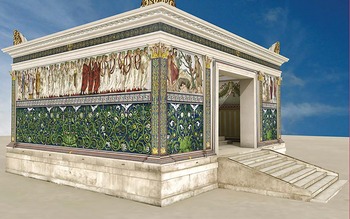
The large vegetal panels that cover the lower register of the Ara Pacis's exterior walls have received increased attention in recent years.Footnote 45 This relates in part to a broader scholarly attempt to collapse the false dichotomy between “figure” and “ornament,” modern categories that have long distorted our understanding of Roman cultural aesthetics.Footnote 46 As these analyses have made clear, the Ara Pacis's vegetal panels constitute a rich world of entangled meanings, and they are essential to the themes and symbolism of the monument as a whole. With vines, flowers, and fruit occupying more than half of its exterior and much of its interior, the Ara Pacis is a stunningly vegetated monument.Footnote 47 The vegetal panels themselves are noticeably larger than their figural counterparts above, and they sit precisely at eye level. It is this section of the monument with which viewers would have interacted most directly, and its prominence would have been heightened by the rich colors painted on the surface (Fig. 10).Footnote 48 Although the surviving traces are insufficient to fully reconstruct the monument's polychromy, traces of green paint have been detected on two fragments of the vegetal frieze.Footnote 49 Comparisons with preserved examples of ancient painting further suggest a base of blues and greens for the swirling vines of the vegetal panels, pierced by scattered buds and flowers rendered in brighter colors.Footnote 50 The processional panels, by contrast, must have been dominated by the white of togas, meaning that the more vivid field of color centered on the vegetal friezes.Footnote 51 They would have been eye-catching – their visual allure inescapable.
Oblique view of the Ara Pacis with reconstructed color, by S. Borghini and R. Carlani. (Rossini Reference Rossini2010, 25; courtesy of Dr. Orietta Rossini.)

Although most would now agree on their fundamental importance, the panels’ precise meaning remains an open topic of discussion. Hans Peter L'Orange described the “opulent vegetal life” on the Ara Pacis in relation to Vergil's fourth eclogue as expressions of the “universal flowering” of the new Golden Age.Footnote 52 Paul Zanker has similarly interpreted vines in Augustan art, and especially on the Ara Pacis, as symbols of the saeculum aureum, although his analysis is more political and message oriented.Footnote 53 A parallel line of scholarship has instead sought explicit links between the lower and upper friezes of the monument's exterior walls. Hermann Büsing's Reference Büsing1977 study pointed out significant alignments between the two, arguing that the swans and certain elements of the vegetal design are placed in direct relation to key figures above.Footnote 54 This approach was taken to an extreme in a series of articles and finally a book by Gilles Sauron, who sees a secret message buried in the Ara Pacis's scrollwork.Footnote 55 He argues that this message, rife with post-Actium political and dynastic propaganda, could and would have been decoded by elite viewers.Footnote 56 A major problem with this line of inquiry is that the identities of many figures in the upper panels continue to be debated. Furthermore, gaps and uncertain restorations in both the vegetal and figural scenes make such precise correspondences difficult to prove.
Broader thematic correspondences between the two levels have also been proposed. John Pollini, for instance, sees symbolic allusions in the vegetal friezes that complement the meaning of the panels above. Both he and David Castriota place particular emphasis on the role of plant species as stand-ins for divinities.Footnote 57 Barbara Kellum interpreted the small animals hidden among the plant life as sharing a metamorphic quality that contributes to an overall “environment of transformation.”Footnote 58 Recent studies have also scrutinized the botanic specificity of the vegetal friezes, which received welcome attention in Giulia Caneva's monumental catalog of the Ara Pacis's identifiable plant species.Footnote 59 Clay Cofer recognized representations of horticultural grafting on the vegetal friezes, rejecting the usual interpretations of the plants as unnatural or fantastical and arguing for the broader symbolic value of grafting in Roman literature and art.Footnote 60
Beyond debates over iconography and meaning, there is also the question of precedent on a formal level. Several studies, beginning with that of Theodor Kraus, have shown convincing parallels between the Ara Pacis and Hellenistic monuments from sites such as Pergamon, a topic discussed at length in Castriota's monograph.Footnote 61 A small altar from Pergamon, decorated with acanthus and floral motifs, is often cited as a direct forerunner of the Ara Pacis's panels.Footnote 62 Indeed, foreign artisans working in Rome must have played an important role in the importation of styles, techniques, and iconography from the east. Robert Cohon has documented the existence of at least two marble monuments featuring vegetal motifs on walls or pilasters and dating to within a generation of the Ara Pacis.Footnote 63 He plausibly attributes these high-quality reliefs to an atelier originating on the coast of Asia Minor and active in Rome in the Late Republican / Early Augustan period.
The diversity of scholarly interpretations, only briefly outlined here, speaks eloquently to the complexity of these vegetal panels and their layered meanings. Augustan art has long been recognized as embracing a broad range of entwined visual traditions, and there is no better expression of this multiplicity than the Ara Pacis.Footnote 64 The disparity in modern interpretations may well reflect a similar one among ancient observers. In the context of a different set of Augustan vegetal slabs, found in the area of the Horti Sallustiani and currently housed in the Centrale Montemartini, Dominik Maschek has observed the potential for gaps between makers’ intentions and viewers’ interpretations, arguing that Augustan vegetal imagery cannot exclusively be defined as a bearer of state ideology.Footnote 65 Rather, in Maschek's view, the semantic connotations of these vines and flowers varied as much as their viewers did.Footnote 66 Placed along a major road, the Ara Pacis similarly presumes a multiplicity of viewers.Footnote 67 Although elite observers trained (and interested) in the art of looking may have easily deciphered codes and visual metonyms such as those identified by Sauron, others would have latched onto more general associations.
A central component of the visual vocabularies of Augustan viewers has, I believe, been overlooked in modern readings of the Ara Pacis's vegetal panels. Viewer response depends largely on an individual's prior experience. For most Augustan viewers – and here I emphatically include non-elites as well – the primary point of reference would have been the buildings of Rome itself, or those of their hometowns or nearby towns. As we have seen, the terracottas that still sheathed most Roman and Italic temples at the time of the Ara Pacis's construction featured vegetal motifs as their primary decorative scheme. It is reasonable to imagine that the appearance of similar designs on the Ara Pacis may, for many viewers, have called to mind traditional Italic religious architecture.
The fact that these same vegetal motifs are explicitly highlighted on contemporaneous Campana reliefs, like those from the Augustan Palatine complex, supports this suggestion. Castriota makes frequent reference to Campana reliefs as evidence for the types of images with which the Ara Pacis's viewers might have been familiar.Footnote 68 Both he and Pensabene note the close similarities between vines on Campana reliefs and on the Ara Pacis,Footnote 69 and Pensabene further sees a compositional connection between a relief showing two seated women flanking an acanthus and the Ara Pacis's “Tellus” panel.Footnote 70 The vegetal motifs of Campana reliefs highlight their debt to traditional temple terracottas, and the appearance of these same forms on the Ara Pacis implies a similar origin and allusion. I suggest that this visual reference was likely intentional, as a meaningful component of the Ara Pacis's symbolic message and iconographic program.
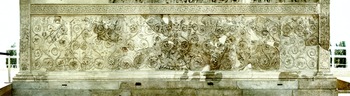
To draw out these connections, it will be worth examining the panels and their proposed predecessors in more detail, in terms of both organization and iconography.Footnote 71 The overall composition of the Ara Pacis's vegetal panels consists, like that of traditional temple terracottas, of repeated elements within a long horizontal band. On the long sides of the Ara Pacis's enclosure walls, a series of stalks rises up the length of the frieze, bending and yielding offshoots that branch out on either side (Fig. 11). The central stalk straightens as it reaches the upper half of the panel to terminate in a swan with its wings spread. The swans would have been even more noticeable with the original paint, and they served to emphasize the rhythmic quality of the vine motifs below (Fig. 10). Horizontally repeated bands of vines and flowers are, of course, a common feature of traditional temple terracottas. S-spirals and curling leaves often flank a single vertical stalk (Figs. 5 and 6), just as on the upper portion of the Ara Pacis's vegetal panels. Although these straight stalks play an organizing role compositionally, the broader effect remains one of swirls, curls, and diagonals.
Ara Pacis, vegetal frieze, long side (north wall of the outer enclosure). (© Charles Rhyne Estate; courtesy Visual Resources Center, Eric V. Hauser Memorial Library, Reed College, Portland, Oregon.)

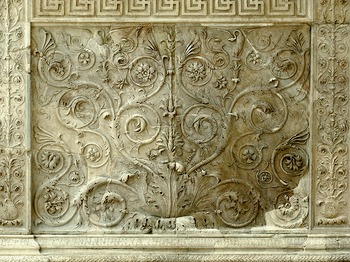
Indeed, the use of abundant swirling imagery within a tightly structured composition is fundamental to the design of both the Ara Pacis's vegetal panels and the vegetal motifs of earlier temple terracottas. In both cases, sprawling buds and vines open into curving offshoots, which might appear wild and untamed up close but reveal a strict overall organization when viewed as a whole (Figs. 1, 2, 11, and 12). The same approach, albeit with fewer vines, is detectable on Campana reliefs of the 1st c. BCE–CE as well (Figs. 7–9). Here, the centrality of the vine's base and the symmetry of its shoots ground the individual scene. Even when the vine splits into multiple curls, a sense of order is retained. Earlier terracottas had similarly emphasized symmetrical arrangements, further reinforced and regulated by the repetition of identical panels along the building's horizontal axis (Figs. 1 and 4). Such duplication is indeed intrinsic to these plaques, which were typically mold made. On the hand-carved walls of the Ara Pacis, however, this same repetition of vines, flowers, and swans cannot be attributed to cost- or time-saving measures.
Ara Pacis, detail of vegetal frieze, short side (left side of the east wall of the outer enclosure). (© Charles Rhyne Estate; courtesy Visual Resources Center, Eric V. Hauser Memorial Library, Reed College, Portland, Oregon.)

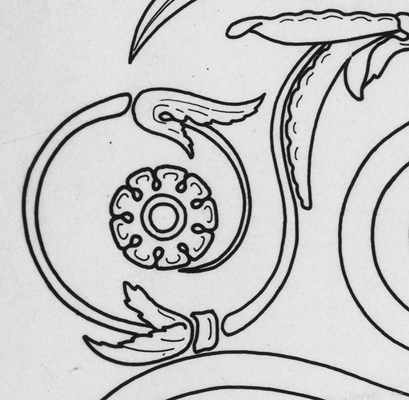
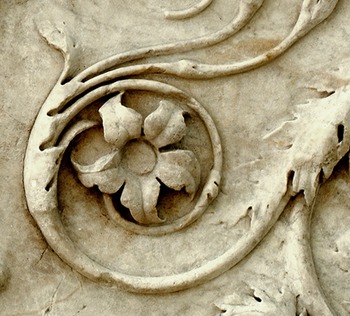
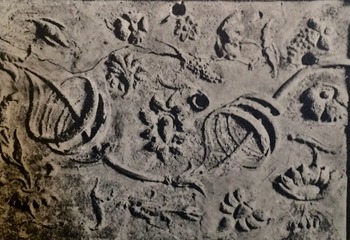
In broad compositional terms, then, the Ara Pacis's vegetal panels are closely related to traditional revetment plaques. Both occupy an architectural exterior, are characterized by repeating vegetal motifs set in a horizontal band, and feature a swirling but highly organized array of plant life. The Ara Pacis's debt to earlier terracottas extends to details of style and iconography as well. Its vegetal panels are dominated by spiral-form vines that further contribute to the overall juxtaposition of order and spontaneity. Indeed, almost every vine on the Augustan monument terminates in a spiral around a flower or leaves. In many cases, the proximity of these tendrils creates a double- or s-spiral. As noted above, spiral-form vines and s-spirals are a fundamental design element of Italic architectural terracottas, appearing on revetment plaques (Fig. 2), antefixes, and simas from at least the 6th c. BCE. In earlier examples, they tend toward simplicity and neatness, whereas later plaques often experiment with additional curls branching out from the central spiral – the very scheme adopted on Campana reliefs and on the Ara Pacis. In each case, spirals and offshoots typically terminate in a flower (Figs. 13–14), and the types of flowers may vary considerably within a single panel (Figs. 15–17).Footnote 72
Detail of Fig. 2 (above).

Detail of the Ara Pacis (right side of the east wall of the outer enclosure). (Detail of image, © Charles Rhyne Estate; courtesy Visual Resources Center, Eric V. Hauser Memorial Library, Reed College, Portland, Oregon.)

Terracotta plaque with floral motifs, 3rd c. BCE. (© Museum of Art and History, City of Geneva, loan Association Hellas et Roma. Photograph by Bettina Jacot-Descombes.)

Detail of the Ara Pacis (north wall of the outer enclosure). (Detail of image, © Charles Rhyne Estate; courtesy Visual Resources Center, Eric V. Hauser Memorial Library, Reed College, Portland, Oregon.)

Revetment plaque from Cività Castellana, Lo Scasato, late 4th–early 3rd c. BCE. (Detail of Andrén Reference Andrén1940, pl. 54, no. 174.)

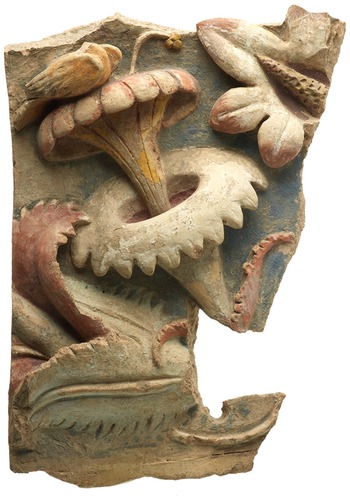
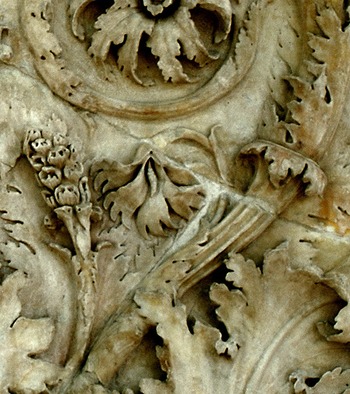
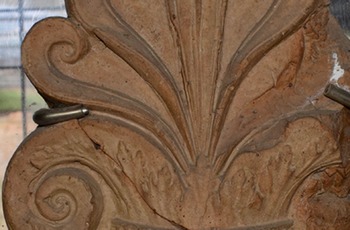
Among the vegetation and flowers of the Ara Pacis's panels, the acanthus features at the base of the central vertical stalk on both the short and long sides (Figs. 11–12). The use of acanthus in Augustan art has been shown to carry regenerative and Apolline connotations, among others.Footnote 73 Architectural terracottas had typically favored the palmette, but the acanthus makes an appearance by the Late Republic and becomes a particular favorite for antefixes, including in the Augustan Palatine complex.Footnote 74 In these examples, it often serves as a base for stalks and flowers, just as on the Ara Pacis (Fig. 18).Footnote 75 Several Campana reliefs feature a strikingly similar arrangement, with a stalk and swirling vines rising up out of an acanthus (Figs. 7 and 9).Footnote 76
Detail of an antefix with acanthus from the so-called Capitolium at Luni, 50–25 BCE. Museo archeologico di Luni, inv. RCGE6028. (Courtesy of the Direzione Regionale Musei Liguria, Museo Archeologico Nazionale e zona archeologica di Luni. Detail of a photo by Stefan Ardeleanu.)

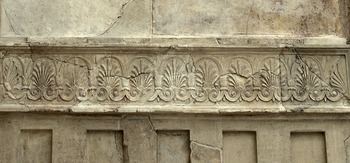
The importance allotted to acanthus on the Ara Pacis does not, however, result in a total absence of palmettes. They are particularly noticeable on the interior, where they are clustered in a strict geometrical arrangement (Fig. 19). This tight horizontal band of alternating palmettes and lotuses is directly related to earlier terracotta architectural plaques, where this is a constantly recurring motif (Fig. 20). In fact, the coloring of the palmettes may have further highlighted this connection. Traces of red paint have been found on the Ara Pacis's palmette frieze, and red is a standard color for the palmette bands of architectural terracottas beginning as early as the 6th c. BCE.Footnote 77 It is also common on the bands of palmettes that frequently decorated the borders of Campana reliefs.Footnote 78
Ara Pacis, interior wall. (© Charles Rhyne Estate; courtesy Visual Resources Center, Eric V. Hauser Memorial Library, Reed College, Portland, Oregon.)

Detail of a revetment plaque from Cosa, attributed to the so-called Temple of Jupiter, 3rd/2nd c. BCE. (Courtesy of the American Academy in Rome, Photographic Archive. AAR.Cosa.III.TCR.74, AAR.COSA.1950.142.)

Among the apparently idiosyncratic details of the Ara Pacis's decoration are the small animals and insects lurking amid the vegetation. Interestingly, even these find precedents in Italic architectural terracottas. A particularly intriguing example comes from a small temple at Fregellae, which was adorned with a rich terracotta vegetal frieze of flowers, vines, and s-spirals. One fragment preserves the figure of an insect, likely a cicada, crawling amid the vegetation.Footnote 79 A number of central Italic sites have yielded comparable examples, in which small birds or erotes appear amid lush plant life (Fig. 1c and 15). Such plaques are often hand worked rather than mold made, and they date mostly to the 2nd c. BCE.Footnote 80
Another significant feature of the Ara Pacis's vegetal panels is the meander pattern that marks their upper border, running across the monument in a horizontal strip and separating the upper and lower registers (Figs. 10–12). The sharpness of its straight lines renders it quite prominent, contrasting with the round curves of the vines below and with the soft forms of the figural scenes above. Although the meander pattern has obvious Greek antecedents, it is also a common motif of Italic architectural terracottas.Footnote 81 It appears to have been especially popular on 6th- and 5th-c. BCE temples – for instance, on the simas and revetment plaques of the Sassi Caduti temple at Cività Castellana (Fig. 5).Footnote 82 The meander also appears on several post-Archaic temple roofs. At Cività Castellana, it once again figures prominently on the simas from Lo Scasato, which are dated to the late 4th / early 3rd c. BCE and which stood alongside “standard” elements such as revetment plaques with looped and addorsed palmettes, together with perforated cornices with spirals and figure eights.Footnote 83 The meander gained widespread popularity once more on perforated cornices of the Mid- to Late Republic, appearing at sites such as Cosa, Luni, Fiesole, Monte Rinaldo (Fig. 1a), Alatri, Segni, Lanuvium, Ardea, and Gabii, as well as Cività Castellana.Footnote 84 These are generally dated between the late 3rd and early 1st c. BCE, by which time the design must have had a somewhat archaizing appearance. Similar examples have also been found at the Largo Argentina in Rome, and meanders are known from an early period on a range of Roman terracottas.Footnote 85 Meander cornices sat at the very top of the temple decoration, above the vines and spirals that decorated the larger bands of revetment plaques. In a sense, its placement atop the Ara Pacis's vegetal panels is simply a compression of this familiar scheme, in which the intermediary sima element (usually mostly undecorated) has been omitted.
Viewers and context
For viewers, the association of these vines and flowers with traditional temple terracottas would have been strengthened by other references on the Ara Pacis to old-fashioned Italic religious spaces. The interior of the precinct wall, for instance, imitates in marble the wooden beams of a simple sacred enclosure. Brown paint would presumably have emphasized the evocation of wood and the “ancient” ambience of the space, just as the exterior vegetal frieze carved in marble remediated the traditional forms of terracotta.Footnote 86 On the mythological panels, images of Romulus and Remus and the sacrificing Aeneas with his old-fashioned toga sine tunica would have underscored the monument's message of reverence for the past and its continuity with the present.Footnote 87 These features doubtless reflect a broader cultural interest in the antiquity of Roman religion and mythology during the Augustan period, a phenomenon I have already discussed with respect to the southwest corner of the Palatine Hill. An interest in the deep religious past is also evident in contemporaneous Augustan literature – for instance, in Ovid's description of the ancient altar and grove at Falerii in Amores 3.13, among many other examples.Footnote 88 In this cultural environment, we can imagine that viewers might have been particularly receptive to visual allusions to religious antiquity. On a monument like the Ara Pacis, they may even have been expected. The vegetal friezes that stretched across its lower walls invited comparison to the “old” (not marble) temples that had long populated Rome. Those that were still standing at the time of the Ara Pacis's dedication would have appeared all the more ancient in a city growing steadily more lithic. Allusions to terracotta vegetal motifs on the marble sides of the Ara Pacis offered a visual bridge between the religious landscape of traditional Rome and that of Augustus.
This is not to say that Italic architectural terracottas constituted the sole point of reference for viewers. There are obvious and important differences. The botanical variety and the specificity with which individual species are portrayed on the Ara Pacis, for instance, far surpass analogous representations in terracotta. This was made more feasible by its stone material and hand-carved manufacture, as opposed to the typically mold-made production of terracottas, which cost considerably less and were created in large repeating series. The individualization of plants and flowers on the Ara Pacis is also likely connected to developments in garden room painting during the ’30s and ’20s BCE.Footnote 89 Livia's villa at Prima Porta preserves the most famous example of this genre, and, like the Ara Pacis, features a variety of precisely rendered plants shown in full bloom in an impossible compression of seasons.Footnote 90
The importance of Hellenistic influences on the Ara Pacis and other Augustan monuments is also clear, and it is not being questioned. Indeed, although vegetal carvings such as those described by Cohon (see above) may well have inspired or guided the carvers of the Ara Pacis, they were too recent and too few to have functioned as a primary referent for most viewers. Elite viewers may have been primed to perform acts of visual decoding or to link the Ara Pacis's vegetal motifs with images from other media such as wall painting, vases, or smaller luxury items, or with monuments known or seen abroad. Most observers of the Ara Pacis, however, would have had a narrower visual vocabulary. They would never have seen the grand monuments of the wider Hellenistic world, making eastern styles or marks of eastern craftsmanship difficult for them to discern.Footnote 91 Nor would they have been looking with the eye of a trained botanist or art historian and closely analyzing stylistic differences or the depictions of individual flowers and vines.
Rather, when faced with these intricate panels, the most likely point of reference for most viewers – their first mental association – would have been the myriad flowery panels that had long decorated their local temples. Although similar vines certainly appeared in other artistic genres, architectural terracottas comprise the largest and most long-lived medium to emphasize vegetal motifs in this manner.Footnote 92 Moreover, they did so by using vivid painted colors designed to catch the eye and draw it to the roof with its botanical abundance. The topmost section of the building would have contrasted sharply with the mostly unadorned columns and walls of the structure below. The Ara Pacis modifies and inverts this scheme, setting the highly colored vegetal panels beneath the more muted palette of the processional friezes.
The public setting of architectural terracottas meant that they were visible to everyone, not only the elite, making them a powerful point of reference across the broad social spectrum of viewers in Augustan Rome. Pliny the Elder remarks on the large number of roofs still decorated in terracotta in his own day, in Rome itself as well as in the municipia.Footnote 93 Many more must have been visible in the late 1st c. BCE, when the Ara Pacis was dedicated. This is also true of the Campus Martius – the area most viewers would have walked through before reaching the Ara Pacis.
Although it is often difficult to pinpoint the precise location of Republican temples within the Campus Martius, literary sources amply attest to their existence. A temple of Iuturna was dedicated in 241 BCE in the Campus Martius, and a temple to the Lares Permarini in 179 BCE.Footnote 94 It is highly probable that both would have been decorated with architectural terracottas, given their construction dates and the absence of any indication that their ornamentation was unusual. A substantial number of architectural terracottas have been found in the Area Sacra di Largo Argentina, where a series of small manubial temples were dedicated between the 3rd and early 1st c. BCE.Footnote 95 The terracottas from this area include fragments of the popular revetment plaque types described above, plaques with acanthus, meander cornices with palmettes, and a range of antefixes.Footnote 96 Some were sealed in the tuff platform contemporary with the construction of Temple B and would therefore not have been visible in Augustus's day.Footnote 97 Many others, however, date to the 1st c. BCE and CE, meaning that architectural terracottas still adorned or partially adorned these temples at the time of the Ara Pacis's construction, and that the medium was used in the Largo Argentina over several centuries without interruption.
Four similar temples may have stood just south of this area – again, likely carrying terracotta decoration – and the preserved examples of Republican temples in the southern Campus Martius and in Rome more generally must reflect only a small fraction of the original number.Footnote 98 Visitors would therefore have passed by a number of shrines decorated with traditional terracottas before reaching the Ara Pacis. The vines and flowers so prominent on temple terracottas were a frequent and integral part of the visual landscape, including in the immediate vicinity of the new Augustan monument.
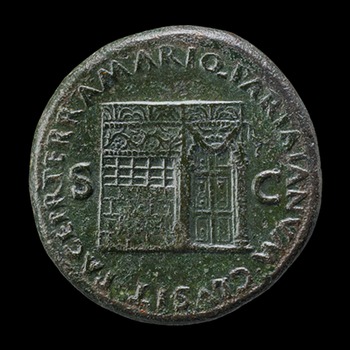
Beyond the general associations with traditional temple decoration that the Ara Pacis would have evoked for viewers, certain structures may have encouraged more specific connections. The shrine of Janus in the Forum, for instance, offered a natural parallel: the Ara Pacis expressly celebrated peace, and the doors of the Janus shrine closed when war ended and peace was finally secured.Footnote 99 As Augustus's Res Gestae (13) proudly declares, Janus's doors were closed three times during his rule. No archaeological remains of the Janus shrine can be identified with certainty, but we can reconstruct its general appearance from Neronian coins (Fig. 21).Footnote 100 These show exterior walls of ashlar blocks, which would have given the monument a somewhat old-fashioned appearance.Footnote 101 Crowning its roof is a prominent row of palmettes, below which can be seen another wide register decorated with flowers and swirling vines. Considering the strong emphasis on floral motifs along the roof, it seems quite likely that the structure retained its terracotta decoration at least through the Neronian period.Footnote 102 With its close connection to war and peace and its conspicuous crown of floral decoration, the Janus shrine may well have suggested itself in viewers’ minds when they were faced with the Ara Pacis.
Neronian coin showing the shrine of Janus (RIC 115). (© The Trustees of the British Museum.)

As marble temples sprang up across the Augustan city, the traditionalism and archaism of older structures was thrown into stark contrast, and the connotations of architectural terracottas themselves began to change. We know from numerous sources that Augustus prized (or claimed to prize) Italic traditions, particularly in the realm of religion, and that he sought to emphasize these “Italic” values even as he built the city anew. Campana reliefs from the Augustan period reflect these wider cultural trends by pointedly retaining the old-fashioned material of terracotta and emphasizing well-known vegetal motifs. Many of these same motifs, as well as the broader compositional principles of Republican temple decoration, are also reproduced on the Ara Pacis's vegetal panels.
Campana reliefs, many of which appear to have been set into walls, brought familiar vines down from the roof to eye level, demanding the viewer's direct engagement at close range. The Ara Pacis went one step further, allowing vines and flowers to fill the space that an approaching body encountered. The traditional features of Italic sacred architecture were therefore enlarged and emphasized – transposed to fit a contemporary ideology. And it is not by accident that, rather than crowning the Ara Pacis, these age-old motifs serve quite literally as the foundation of the Augustan regime. They are the earth, the Italia, from which the images of Augustus and his family rise piously on the panels above.
Recognizing the Ara Pacis's debt to Republican temple terracottas is critical for understanding the phenomenological implications of Rome's marble transformation. As the city shifted materially, the visual language of religious tradition took on a heightened symbolic charge. Architectural terracottas were slowly becoming obsolete, but the vines and flowers that had graced them for centuries were drawn into the fabric of the changing city. For viewers, these age-old motifs became a visual bridge, allowing an idealized religious past to linger in the revolutionary present.
Acknowledgments
This paper is partly derived from a chapter of my PhD dissertation, “Daedala Tecta: Architectural Terracottas and Cultural Memory in Republican Italy” (2019). I am deeply grateful to Brian Rose and Ann Kuttner for their support and insightful feedback as this study evolved into an article. My warm thanks also go to JRA's anonymous readers for their extraordinarily thoughtful and constructive comments. Any errors are, of course, my own.