Introduction
According to the DSM-IV-TR (APA, 2000), ‘A Personality Disorder is an enduring pattern of inner experience and behavior that deviates markedly from the expectations of the individual's culture, is pervasive and inflexible, has an onset in adolescence or early adulthood, is stable over time, and leads to distress or impairment’ (p. 685). Personality disorders (PDs) are widely recognized as being common, chronic conditions associated with considerable impairment and distress and poor long-term outcomes. Since 1980, the DSM (DSM-III, -IV; APA, 1980, 1994) has placed PDs on a diagnostic ‘axis’ separate from the other mental disorders to ‘ensure that consideration is given to the possible presence of disorders that are frequently overlooked when attention is directed to the usually more florid Axis I disorder’ (p. 23).
Despite the DSM's emphasis on the importance of recognizing PDs, it also states that these Axis II disorders are not usually diagnosed before late adolescence or early adulthood (APA, 1994; Bank & Silk, Reference Bank and Silk2001). This is in contrast to the diagnosis of many Axis I disorders (including depressive, anxiety and disruptive disorders) that are specifically recognized as beginning in childhood or adolescence (Cohen et al. Reference Cohen, Cohen, Kasen, Velez, Hartmark, Johnson, Rojas, Brook and Streuning1993; Bank & Silk, Reference Bank and Silk2001). Clinical and population-based studies have led to increased awareness of the negative impact of early onset of Axis I disorders on prognosis and function. For example, the American Academy of Child and Adolescent Psychiatry states that ‘Early diagnosis and treatment are essential for depressed children. Depression is a real illness that requires professional help’ (AACAP, 2003). Nonetheless, similar attention has not been paid to early manifestation of the Axis II PDs even though emerging evidence shows serious long-term consequences of adolescent PDs comparable to those of Axis I disorders (Chen et al. Reference Chen, Cohen, Kasen, Johnson, Berenson and Gordon2006b, Reference Chen, Cohen, Kasen and Johnsonc).
PD frequently co-occurs with Axis I disorders. In a review of the overlap between Axis I disorders and Axis II PDs in 2462 patients admitted to psychiatric services, Koenigsberg et al. (Reference Koenigsberg, Kaplan, Gilmore and Cooper1985) found that 23% met criteria for disorders on both axes. Oldham et al. (Reference Oldham, Skodol, Kellman, Hyler, Doidge, Rosnick and Gallaher1995) examined co-occurrence rates among a range of Axis I and Axis II disorders in a large sample of psychiatric out-patients, and reported that, given a current PD, there was a substantial chance of co-morbid Axis I mood, anxiety, psychotic or eating disorder. Skodol et al. (Reference Skodol, Stout, McGlashan, Grilo, Gunderson, Shea, Morey, Zanarini, Dyck and Oldham1999) found that 61% and 93% of patients with borderline, schizotypal, avoidant or obsessive–compulsive PD reported a current mood disorder and a lifetime history of mood disorder respectively. In a large national US survey, Grant et al. (Reference Grant, Hasin, Stinson, Dawson, Chou, Ruan and Huang2005) reported that among respondents with a mood disorder, the prevalence of at least one PD was 46.8%.
Given the high co-morbidity of Axis I and Axis II disorders in clinical and epidemiological samples, it is important to evaluate the prognostic significance of such co-morbidity when it occurs in young people. With clear evidence of the negative consequences of Axis I–Axis II co-morbidity on mental health, this study investigated whether early Axis I–Axis II co-morbidity similarly signals long-term risk for physical health. In this study physical health is based on self-report. Such reports have been drawing increasing attention as a key parameter in health care, including health policy evaluation, population surveys, and research. There is widespread agreement that such reports provide a useful summary of self-perception of overall health status (Fayers & Sprangers, Reference Fayers and Sprangers2002), predict subsequent mortality (Idler & Benyamini, Reference Idler and Benyamini1997) and are related to biomarkers and endocrine health indicators (Lekander et al. Reference Lekander, Elofsson, Neve, Hansson and Unden2004; Jylha et al. Reference Jylha, Volpato and Guralnik2006). Self-reports have been recommended for population health and health monitoring by the World Health Organization, the US Centers for Disease Control and Prevention, and the European Union Commission (Hennessy et al. Reference Hennessy, Moriary, Zack, Scherr and Brackbill1994; COM(95) 449, 1995; de Bruin et al. Reference de Bruin, Picavet and Nossikov1996; Zack et al. Reference Zack, Moriarty, Stroup, Ford and Mokdad2004).
Poorer physical health in adult populations has been associated with Axis I psychiatric disorders (Ormel et al. Reference Ormel, Von Korff, Ustun, Pini, Korten and Oldehinkel1994; Hays et al. Reference Hays, Wells, Sherbourne, Rogers and Spritzer1995; Spitzer et al. Reference Spitzer, Kroenke, Linzer, Hahn, Williams, deGruy, Brody and Davies1995; Papakostas et al. Reference Papakostas, Petersen, Mahal, Mischoulon, Nierenberg and Fava2004; Rapaport et al. Reference Rapaport, Clary, Fayyad and Endicott2005) and PDs (Jackson & Burgess, Reference Jackson and Burgess2002; Chen et al. Reference Chen, Cohen, Kasen, Gordan, Dufur and Smailes2004, Reference Chen, Cohen and Crawford2006a–Reference Chen, Cohen, Kasen and Johnsonc; Grant et al. Reference Grant, Hasin, Stinson, Dawson, Chou, Ruan and Pickering2004; Huprich & Frisch, Reference Huprich and Frisch2004). When Axis I and Axis II PDs co-occur, they often are associated with markedly poorer physical health (Skodol et al. Reference Skodol, Grilo, Pagano, Bender, Gunderson, Shea, Yen, Zanarini and McGlashan2005; Chen et al. Reference Chen, Cohen, Kasen, Johnson, Berenson and Gordon2006b, Reference Chen, Cohen, Kasen and Johnsonc; Clark, Reference Clark2007). However, evidence regarding the long-term separate and combined impact of adolescent psychiatric disorders and PDs on physical health is absent. Here the long-term impact of adolescent Axis I psychiatric and PDs on physical health is examined using multi-level logistic regression and individual growth models (Chen & Cohen, Reference Chen and Cohen2006). Axis I disorders and PDs were assessed at mean age 13.7 years in 1983, and physical health outcomes were assessed in 1985–1986, 1991–1994 and 2001–2004 in a 20-year study of 736 individuals.
Method
Participants
These analyses used longitudinal data on 736 individuals from the Children in the Community Study, an ongoing investigation of the long-term course and consequences of psychopathology in a community sample of youths, first assessed for Axis I disorders and PD in 1983, between the ages of 9 and 18 (mean age=13.7, s.d.=2.6) years. The sample originated from randomly selected households in 100 randomly sampled census tracts or block groups in upstate New York first surveyed in 1975. The 1983 survey supplemented the sample with 54 families selected to replace participants from housing tracts lost during urban renewal. At that time, mothers and one randomly sampled offspring were interviewed; information from both mothers and youth was available for 749 of the 776 participating families. Follow-up interviews of both mothers and youths with an expanded protocol were conducted in 1985–1986 and 1991–1994, when youths were mean (s.d.) aged 16.4 (2.8) and 22.4 (2.8) years respectively. Retention rate has been over 95% until the most recent mean age 33.2 (2.9) years follow-up of 680. Study procedures were approved according to appropriate institutional guidelines by the Institutional Review Boards of Columbia University College of Physicians and Surgeons and the New York State Psychiatric Institute. Written informed consent or assent was obtained from all participants after the interview procedures were fully explained. Additional information regarding the study methods is available on the study website (www.nyspi.cpmc.columbia.edu/childcom).
Assessment
Axis I disorders in 1983
Diagnoses of major depressive disorder, bipolar disorder, attention deficit hyperactivity disorder, conduct disorder, oppositional defiant disorder, overanxious disorder, separation anxiety disorder, social phobia, and substance abuse disorder meeting criteria established in DSM-III-R (APA, 1987) were derived from maternal and youth responses to the Diagnostic Interview Schedule for Children (DISC-I). Research has supported the reliability and validity of the DISC-I as administered in the present study (Cohen et al. Reference Cohen, O'Connor, Lewis and Malachowski1987). Axis I disorder criteria were met by 150 of 736 participants (20.4%), 81 (11.0%) with no co-morbid PD and 69 (9.4%) with co-morbid PD. Of these, 66 (9.0%), 58 (7.9%), 33 (4.5%) and 27 (3.7%) individuals had disruptive disorder (attention deficit hyperactivity disorder, conduct disorder or oppositional defiant disorder), anxiety disorder (overanxious disorder, separation anxiety disorder or social phobia), mood disorder (major depression and bipolar disorder), and substance use disorder respectively.
Adolescent Axis II disorders
When adolescents were assessed in 1983, no developed instruments existed to assess PDs prior to adulthood. We created such an instrument by age-adapting items from the Personality Diagnostic Questionnaire (PDQ; Hyler et al. Reference Hyler, Reider, Williams, Spitzer, Hendler and Lyons1988), selecting appropriate items from other personality scales that corresponded closely to then-current DSM diagnostic criteria (Bernstein et al. Reference Bernstein, Cohen and Skodol1996), or writing new age-appropriate items when necessary. These scales have since been updated to reflect DSM-IV criteria for PD and include additional items based on an early version of the Structured Clinical Interview for DSM-III-R. Diagnostic criteria were assessed based on information reported by youths and mothers. Convergent and prospective validity is available from previous reports (Crawford et al. Reference Crawford, Cohen, Johnson, Kasen, First, Gordon and Brook2005) and supported by many theoretically predicted associations with risks (Bernstein et al. Reference Bernstein, Cohen and Skodol1996), correlates (Bernstein et al. Reference Bernstein, Cohen and Velez1993) and outcomes (Johnson et al. Reference Johnson, Cohen, Skodol, Oldham, Kasen and Brook1999; Kasen et al. Reference Kasen, Cohen, Skodol, Johnson, Smailes and Brook2001; Cohen et al. Reference Cohen, Chen, Crawford, Brook and Gordon2007). Among 736 participants, 149 (20.2%) met criteria for PD, of whom 80 (10.9%) had no Axis I disorder and 69 (9.4%) were diagnosed with both PD and one or more Axis I disorders.
Demographics and health behaviors
Participants were 50% female, 91% white and 8% African-American. Family socio-economic status (SES) was measured as a standardized sum of standardized scores for parental education level, occupational status and family income category. Age, education and marital status were treated as time-varying predictors in the longitudinal analyses described below. Time-varying health behaviors include smoking, regular exercise and body mass index (BMI), assessed in 1985–1986, 1991–1994 and 2001–2004.
Physical health
Participating youth adults in 1985–1986, 1991–1994 and 2001–2004 reported the following measures of physical health (Chen et al. Reference Chen, Cohen, Kasen, Gordan, Dufur and Smailes2004, Reference Chen, Cohen and Crawford2006a–Reference Chen, Cohen, Kasen and Johnsonc).
Pain
Defined by Brown et al. (Reference Brown, Berenson and Cohen2005) as ‘a lot of headaches or stomach aches’, the question on pain was answered affirmatively by 16.0, 20.8 and 19.3% of the participants in 1985–1986, 1991–1994 and 2001–2004 interviews respectively.
Physical illness
At each assessment the presence of a range of illnesses during the preceding year was reported by youths. These included severe allergies, musculoskeletal diseases (orthopedic problems and chronic pain), neurological disease (migraine or other chronic headache, epilepsy or other neurological problem), chronic respiratory disease, chronic gastrointestinal disease, urinary disease, cardiovascular disease, severe vision or hearing problems, cancer, or diabetes (Chen et al. Reference Chen, Cohen and Crawford2006a–Reference Chen, Cohen, Kasen and Johnsonc). One or more such illnesses were reported by 35.1, 43.4 and 52.1% of the participants in the 1985–1986, 1991–1994 and 2001–2004 interviews respectively.
Physical health scale
The physical health scale is composed of eight items covering the previous year: (1) In general, how was your physical health? (1=poor, 4=excellent); (2) Did you have any chronic pain that prevented you from doing things? (1=a lot, 4=hardly at all); (3) Did any chronic physical problems limit what you could do? (1=a lot, 4=hardly at all); (4) Did any chronic physical problems bother you? (1=a lot or all of the time, 4=less than a week); (5) How many days were you so sick that you had to stay home from school or work or not do what you wanted to? (1=more than 20 days, 4=1 or 2 days); (6) Compared to other people your age, would you say that you have …? (1=a lot less energy, 4=a lot more energy); (7) Do you get a lot of headaches or stomachaches? (1=a lot, 4=hardly at all); (8) Do you get sick? (1=much more often than most people, 4=less often than most people). Internal consistency of this composite ranged from 0.70 to 0.76 in the multiple assessments and its validity has been supported by previous studies (Chen et al. Reference Chen, Cohen, Kasen, Gordan, Dufur and Smailes2004, Reference Chen, Cohen and Crawford2006a–Reference Chen, Cohen, Kasen and Johnsonc; Chen & Cohen, Reference Chen and Cohen2006). Here we aggregated the data over the entire set of assessments and standardized the resulting scores (standardized score). Doing so preserves age differences in these measures and produces estimates of effects of predictors that can be most readily interpreted as standardized mean differences.
Data analysis
Multi-level logistic regression analyses from SAS proc glimmix (SAS Institute, 2007) were conducted to investigate the associations of adolescent Axis I disorders and Axis II PDs assessed at mean age 13.7 in 1983, with binary physical health outcomes (pain and physical illness) assessed in 1985–1986, 1991–1994 and 2001–2004. All analyses include demographics and health behaviors as control variables. The proc mixed procedure from the SAS statistical package (Littell et al. Reference Littell, Milliken, Stroup and Wolfinger1996) was used to estimate the mean level and age trajectory of standardized physical health scores over the 20 years covered by the three follow-up assessments. Mean values estimated at age 22 and annual changes were calculated from growth models that included all control variables. Residual diagnostics were used to assess the adequacy of the fitted models. Histograms of residuals did not indicate discernable skew and normal quantile plots displayed no systematic departure from a straight line, supporting the tenability of the normal residual assumption.
Sequence of analyses
First we focused on Axis I disorders (without PDs) to confirm the findings from previous studies. Analyses compared any Axis I disorder (n=150) with the reference group composed of participants without Axis I disorder (n=586). The second set of analyses compared participants with any Axis I disorder (n=150) with a reference group of those without any Axis I disorder or any Axis II PD (n=506); analyses were repeated to compare participants with specific groups of Axis I disorders to the same reference group. The second set of analyses was designed to remove PDs from the reference group, creating a group without any psychiatric disorder. The third set of analyses began by comparing participants with any PD (n=149) to those without any PD (n=587) and to those with neither Axis I disorder nor PD (n=506). The fourth set of analyses used dummy coding to compare the Axis I disorder only (n=81), PD only (n=80), and co-morbid Axis I disorder and PD (n=69) groups with the reference group of those without either Axis I or Axis II disorder (n=506) to examine all participants in the sample simultaneously. The final set of analyses used dummy coding to compare the Axis I disorder only group (n=81) with the co-morbid Axis I disorder and PD group (n=69), and the PD only group (n=80) with the co-morbid Axis I disorder and PD (n=69) group.
Results
Axis I disorders and physical health
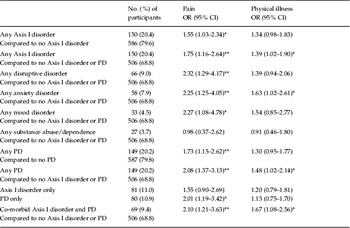
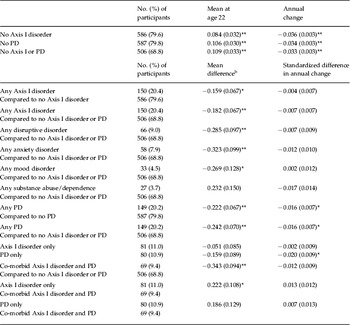
Findings from the first and second sets of analyses are reported in Table 1 (longitudinal reports of pain and serious physical illness) and Table 2 (longitudinal reports of overall physical health). Compared to adolescents without Axis I disorders (n=586), those with any Axis I disorder (n=150) had higher odds of pain [odds ratio (OR) 1.55, 95% confidence interval (CI) 1.03–2.34] and significantly lower physical health score [effect size (ES)−0.16, p<0.05].
Pain and serious physical illness from mean ages 16 to 33 as predicted by Axis I disorder and Axis II personality disorder (PD) at mean age 13.7Footnote a

OR, Odds ratio; CI, confidence interval.
Estimates control for demographic variables (age, gender, race, marriage status, education and socio-economic status) and health behavior variables (smoking, regular exercise and body mass index).
a Separate multi-level logistic regression analyses for pain and physical illness.
* p<0.05, ** p<0.01.
Physical health (standardized score) changes over 20 years associated with adolescent Axis I disorder and Axis II personality disorder (PD)Footnote a

a All parameter entries are maximum likelihood estimates (with standard errors given in parentheses) fitted using SAS proc mixed. Estimates control for demographic variables (age, gender, race, marriage status, education and socio-economic status) and health behavior variables (smoking, regular exercise and body mass index).
b Estimate at age 22.
* p<0.05, ** p<0.01.
Compared to adolescents (n=506) with no psychiatric disorder, those with an Axis I disorder (with or without a co-morbid PD) (n=150) had higher odds of later pain (OR 1.75, 95% CI 1.16–2.64) and physical illness (OR 1.39, 95% CI 1.02–1.90), and lower physical health (ES−0.18, p<0.01). Looking at specific Axis I disorders, the adolescents with disruptive disorder (n=66) reported higher odds of pain (OR 2.32, 95% CI 1.29–4.17) and poorer physical health (ES−0.29, p<0.01); adolescents with anxiety disorder (n=58) reported higher odds of pain (OR 2.25, 95% CI 1.25–4.05) and physical illness (OR 1.63, 95% CI 1.02–2.61) and poorer physical health (ES−0.32, p<0.01). Adolescents with a depressive disorder (n=33) reported higher odds of pain (OR 2.27, 95% CI 1.08–4.78) and lower physical health (ES−0.27, p<0.05). There were no significant long-term health effects associated with adolescents with a diagnosis of substance abuse or dependence (n=27).
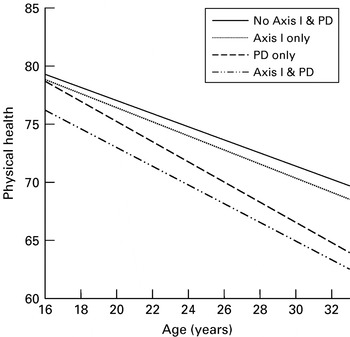
Compared to participants without adolescent Axis I disorders or PD (n=506), adolescents with an Axis I disorder but no co-morbid PD (n=81) reported poorer physical health but the difference did not reach statistical significance (see Tables 1 and 2 and Fig. 1).
Physical health change by adolescent diagnoses. We plotted physical health using the score from 0 to 100 instead of using the standardized score from −2.06 to 1.56 to avoid negative values. PD, Personality disorder.

Compared to participants with co-morbid Axis I disorder and PD (n=69), adolescents with an Axis I disorder but no co-morbid PD (n=81) reported significantly better physical health (ES 0.22, p<0.05, see Table 2).
PD and physical health
Comparisons between the 149 adolescents with PD and the 587 adolescents without PD (without consideration of Axis I disorder) are also reported in Tables 1 and 2. Adolescents with a PD had significantly higher odds of pain (OR 1.73, 95% CI 1.15–2.62) and of lower physical health (ES−0.22, p<0.01), and a more rapid decline in heath of 1.6% (p<0.05) per year than adolescents without PD. These effects were even larger when the comparison group had neither Axis I disorder nor PD (n=506), showing even higher relative odds of pain (OR 2.08, 95% CI 1.37–3.13) and physical illness (OR 1.48, 95% CI 1.02–2.14), poorer physical health (ES−0.24, p<0.01), and a more rapid health decline (p<0.05) per year.
Compared to adolescents without an Axis I disorder or a PD (n=506), adolescents with a PD but no Axis I disorder (n=80) had significantly higher odds of pain (OR 2.01, 95% CI 1.19–3.42) and a more rapid decline of 2.0% per year in physical health (p<0.05) (Tables 1 and 2, Fig. 1).
Compared to adolescents with co-morbid Axis I disorder and PD (n=69), adolescents with a PD but no Axis I disorder (n=80) reported better physical health but the difference did not reach statistical significance (see Table 2).
Co-morbid Axis I disorder and PD and physical health
Compared to participants without adolescent Axis I disorders or PDs (n=506), those with co-morbid Axis I disorder and PD (n=69) in adolescence reported significantly higher odds of pain (OR 2.10, 95% CI 1.21–3.63) (Table 1) and physical illness (OR 1.67, 95% CI 1.08–2.56) (Table 1), and significantly poorer physical health (ES−0.34, p<0.01) (Table 2 and Fig. 1).
Conclusions
These findings from a community-based longitudinal study suggest that long-term physical health outcomes in adulthood are more strongly associated with adolescent PDs than with Axis I disorders. These data also suggest that when PDs are not taken into account, comparisons between people with Axis I disorders and those without such disorders may underestimate the full negative impact of psychiatric disorder on physical health. Finally, the findings reported here indicate that adolescents with co-morbid Axis I disorders and Axis II PDs are at particularly elevated risk for long-term physical health problems.
Long-term links between psychiatric disorders and physical health
What are the mechanisms of the links between adolescent psychiatric disorder and long-term physical health? Adolescent PDs may be characterized by relatively passive behaviors such as neglect of routine preventative care or avoidance of treatment for existing medical conditions. Although non-compliance with treatment has not been reported in the literature about adolescent PD, it has been repeatedly observed in research on medical and psychiatric care among adults with PD (Boehnert & Popkin, Reference Boehnert and Popkin1986; Andreoli et al. Reference Andreoli, Gressot, Aapro and Tricot1989; Matas et al. Reference Matas, Staley and Griffin1992; Shapiro et al. Reference Shapiro, Williams, Foray, Gelman, Wukich and Sciacca1995; Compton et al. Reference Compton, Rudisch, Weiss, West and Kaslow2005). PDs may also promote more active self-destructive behaviors with adverse health impact. For example, borderline PD often includes suicide attempts, or self-mutilating behaviors that have direct implications for physical health. PDs also influence choices regarding relationship partners, which may in turn expose them to significant health risks. For instance, people with dependent PD may become involved with abusive partners who expose them to violent domestic disputes and physical health risks. Our findings suggest that prior comparisons between people with and without Axis I disorders may underestimate the negative impact of psychiatric disorder on physical health. When estimates of the negative consequence of subgroups of Axis I disorders are based on comparisons with a reference group that includes participants with PD, the effects on physical health will be underestimated. When analyzed here, the Axis I disorders were not significantly associated with subsequent physical health, although an effect of this magnitude would be significant in a larger sample.
Long-term trajectories of self-reported physical health
It is surprising that so little is known about the trajectory of self-reported health across the life course. McDonough & Berglund (Reference McDonough and Berglund2003) found a significant linear decline in physical health over 12 years in middle adulthood (1.7% per year). McCullough & Laurenceau (Reference McCullough and Laurenceau2004) showed an accelerating health decline based on young adults followed over 60 years. However, the comparable longitudinal trajectory of self-report health has not been evaluated from adolescence to younger adults. Our data show that the average young adult with no disorder had a physical health score (standardized score) of 0.11 at age 22 and this decreased about 0.033 s.d. units per year from mid-adolescence to mid-adulthood, indicating about 1/3 s.d. decline per decade (Table 2). Those with early personality disorder showed about a 50% faster annual rate of health decline, or a full 0.5 s.d. per decade (Table 2).
Increased risk for medical illness among psychiatric patients may be mediated specifically by dysregulation of the hypothalamic–adrenal–pituitary (HPA) system, a key component of the endocrine system that regulates the release of cortisol into the bloodstream in normal daily cycles but also in response to stress (Smith & Vale, Reference Smith and Vale2006). Elevated stress and abnormal levels of cortisol have been linked with psychiatric disorders such as depression (McEwen, Reference McEwen2000) and more recently with borderline PD (Lieb et al. Reference Lieb, Rexhausen, Kahl, Schweiger, Philipsen, Hellhammer and Bohus2004). Dysregulation of the HPA system has also been linked with medical conditions such as cardiovascular disease, cancer, arthritis and diabetes (Bjorntorp & Rosmond, Reference Bjorntorp and Rosmond1999; Sephton & Speigel, Reference Sephton and Speigel2003; Heijnen & Kavelaars, Reference Heijnen, Kavelaars, Vedhara and Irwin2005; Fenton & Stover, Reference Fenton and Stover2006); and lifestyle problems such as obesity (Epel et al. Reference Epel, McEwan, Seeman, Matthews, Castellazzo and Brownell2000) and fatigue (Bower et al. Reference Bower, Ganz and Aziz2005). More research is needed to understand how abnormal functioning of the HPA system may increase risk for medical illness among psychiatric patients.
Clinical and public health significance
Awareness of the impact of some mental disorders on physical health is gradually gaining acceptance among health-care professionals. Based on these findings, adding PD to the high-risk group of such disorders is clearly appropriate. Psychiatric patients, especially those with co-occurring Axis I and Axis II disorders, are at higher risk for physical illness. This finding highlights the importance of asking about physical health problems when clinicians in psychiatric settings interview adolescents about behavioral or emotional problems. Finally, these findings add to accumulating evidence of the importance of a careful assessment of PDs among patients with Axis I disorders.
Significance and limitations
To our knowledge, these are the only available population-based findings regarding the impact of adolescent PD on long-term physical health. These findings cannot be attributed to effects of demographic differences including gender, race, marital status or SES, or to health risk behaviors including smoking, lack of exercise, or overweight, all of which were controlled in analyses. However, there are clear limitations in the current study. This study sample is 91% Caucasian and 8% African American, making generalization to other subgroups unknown. Furthermore, measures of physical health relied on self-report, which inevitably lacks the accuracy of a complete medical examination.
Acknowledgements
This study was supported by National Institute of Mental Health Grants MH-36971, MH-38914, MH-49191 and MH-60911.
Declaration of Interest
None.