Introduction
Invasive species often acquire native parasites in their adopted habitats. Indeed, native species compose the majority of parasites in invasive hosts (Kelly et al., Reference Kelly, Paterson, Townsend, Poulin and Tompkins2009; Poulin et al., Reference Poulin, Paterson, Townsend, Tompkins and Kelly2011; Paterson et al., Reference Paterson, Townsend, Tompkins and Poulin2012). These parasites tend to be generalists (Kelly et al., Reference Kelly, Paterson, Townsend, Poulin and Tompkins2009), and are frequently helminths with complex life cycles that are transmitted through the food chain (Poulin et al., Reference Poulin, Paterson, Townsend, Tompkins and Kelly2011). If the invasive host is a competent one, it may act as a reservoir for native parasites, which can then be transmitted back to native hosts – a process termed ‘spillback’ (Kelly et al., Reference Kelly, Paterson, Townsend, Poulin and Tompkins2009; Poulin et al., Reference Poulin, Paterson, Townsend, Tompkins and Kelly2011; Hatcher et al., Reference Hatcher, Dick and Dunn2012). Such a process may amplify infections and lead to an increased risk of disease for native hosts (Poulin et al., Reference Poulin, Paterson, Townsend, Tompkins and Kelly2011; Dunn & Hatcher, Reference Dunn and Hatcher2015).
The round goby (Neogobius melanostomus) successfully invaded the Great Lakes in 1990 and the St Lawrence River in 1997 (Gendron et al., Reference Gendron, Marcogliese and Thomas2012; Kornis et al., Reference Kornis, Mercado-Silva and Vander Zanden2012). Since its first appearance, gobies have acquired >20 species of helminths in Lake St Clair alone (Muzzall et al., Reference Muzzall, Peebles and Thomas1995; Pronin et al., Reference Pronin, Fleischer, Baldahova and Pronina1997; Kvach & Stepien, Reference Kvach and Stepien2008; Gendron et al., Reference Gendron, Marcogliese and Thomas2012). Although a more recent introduction in the St Lawrence River, by 2009 gobies were infected with eight species of helminths (Gendron et al., Reference Gendron, Marcogliese and Thomas2012). In both the Great Lakes and the St Lawrence River, the most prevalent and abundant parasite was the digenean Diplostomum spp. (Muzzall et al., Reference Muzzall, Peebles and Thomas1995; Pronin et al., Reference Pronin, Fleischer, Baldahova and Pronina1997; Camp et al., Reference Camp, Blaney and Barnes1999; Kvach & Stepien, Reference Kvach and Stepien2008; Gendron et al., Reference Gendron, Marcogliese and Thomas2012).
Diplostomum spp. have a three-host life cycle (Chappell et al., Reference Chappell, Hardie, Secombes, Pike and Lewis1994). Definitive hosts include birds of the families Laridae, Anatidae, Gaviidae and Ardeidae, from which parasite eggs pass in the feces. Free-swimming miracidia hatch from eggs and infect the first intermediate host, a lymnaeid snail. The parasites reproduce asexually inside the snail, which then releases free-swimming cercariae that infect the fish second intermediate host. In the St Lawrence River, there are at least 21 known fish hosts including cyprinids, centrarchids, percids, catostomids, ictalurids, percopsids, fundulids, esocids and atherinopsids (Marcogliese & Compagna, Reference Marcogliese and Compagna1999; Marcogliese et al., Reference Marcogliese, Dumont, Gendron, Mailhot, Bergeron and McLaughlin2001; Locke et al., Reference Locke, McLaughlin, Dayanandan and Marcogliese2010a). The life cycle is completed when the definitive host consumes an infected fish. In the fish, the parasite resides in either the eye or brain. Larvae are morphologically difficult to distinguish to species, and, using molecular methods, Locke et al. (Reference Locke, McLaughlin, Dayanandan and Marcogliese2010a, Reference Locke, Al-Nasiri and Caffara2015) found 12 different species in fishes from the Great Lakes–St Lawrence River basin. Those infecting the brain and non-lens parts of the eye were host specialists, while those infecting the lens were host generalists (Locke et al., Reference Locke, McLaughlin, Dayanandan and Marcogliese2010a, Reference Locke, McLaughlin and Marcoglieseb, Reference Locke, Al-Nasiri and Caffara2015). Given that Diplostomum spp. cause cataracts in their hosts, leading to reduced growth, emaciation and other detrimental effects (Chappell et al., Reference Chappell, Hardie, Secombes, Pike and Lewis1994), it is important to identify the species of Diplostomum infecting the round goby, which have become widespread and integrated into local food webs in both the Great Lakes and the St Lawrence River (Johnson et al., Reference Johnson, Bunnell and Knight2005; Reyjol et al., Reference Reyjol, Brodeur, Mailhot, Mingelbier and Dumont2010). An extensive study of round gobies in the St Lawrence River showed that Diplostomum spp. only occurred in the lens (Gendron & Marcogliese, Reference Gendron and Marcogliese2017). However, to date, five species have been found in the lenses of native fishes in that river, all of which can be considered generalists (Locke et al., Reference Locke, McLaughlin, Dayanandan and Marcogliese2010a, Reference Locke, Al-Nasiri and Caffara2015). Previous molecular work on a limited number of specimens of Diplostomum spp. from gobies in the Great Lakes and St Lawrence River has shown them to be infected with three species – Diplostomum indistinctum, Diplostomum huronense and Diplostomum indistinctum sensu Galazzo, Dayanandan, Marcogliese & McLaughlin (2002) (nomenclature as in Achatz et al., Reference Achatz, Martensa and Kostadinova2021; and see Galazzo et al., Reference Galazzo, Dayanandan, Marcogliese and McLaughlin2002; Locke et al., Reference Locke, McLaughlin, Dayanandan and Marcogliese2010a, Reference Locke, Al-Nasiri and Caffara2015; Désilets et al., Reference Désilets, Locke, McLaughlin and Marcogliese2013) – but their relative abundance was not quantified. In this study, we expand upon those results in greater detail and provide further data from more specimens infecting round gobies in the St Lawrence River to determine the relative abundance of the different species of Diplostomum. Our hypothesis was that round gobies should be infected with all species of generalists occurring in the St Lawrence River. We use these results in addition to the results of previous studies to pose the suggestion that spillback may be occurring in this system, and that spillback and dilution need not be mutually exclusive.
Materials and methods
Given that previous studies on molecular sequences of Diplostomum spp. in round gobies only published summary information, data were extracted and compiled from all prior publication records (Locke et al., Reference Locke, McLaughlin, Dayanandan and Marcogliese2010a, Reference Locke, Al-Nasiri and Caffara2015; Désilets et al., Reference Désilets, Locke, McLaughlin and Marcogliese2013).
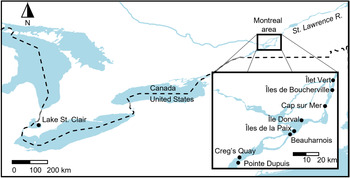
To obtain specimens for the current study, round gobies were collected by beach seine (22.6 m × 1.15 m; 3 mm mesh) towed by hand or partially deployed from a boat from Îles de la Paix (45°20.574′N, 73°50.963′W), Île Dorval (45°26.018′N, 73°44.257′W) and Pointe Dupuis (45°7.683′N, 74°24.233′W) in June, August and September 2012 (fig. 1). Given that infection rates were extremely low at the time of sampling (Gendron & Marcogliese, Reference Gendron and Marcogliese2017), many hundreds of round gobies had to be examined to obtain an adequate number of specimens. However, the total number of fish was not tabulated in this aspect of the study, and, hence, infection parameters could not be determined. Fish were euthanized by immersion in a 400 mg/l eugenol (clove oil) solution, placed in bags and frozen for subsequent analyses. Upon thawing, eyes were removed, and dissected and examined using a stereomicroscope. All 128 specimens of Diplostomum spp. were removed and fixed in 95% ethanol for subsequent molecular analyses.

To determine infection levels of Diplostomum spp. in round gobies, fish were collected, stored and processed using the same techniques from four localities in June 2012 and June 2013. The localities included Îles de la Paix, Île Dorval, Pointe Dupuis and Creg's Quay (45°9.678′N, 74°25.582′W; fig. 1). Twenty fish were collected from each locality on each occasion.
Extraction, amplification and sequencing of the barcode region of cytochrome c oxidase 1 from metacercariae was conducted at the Canadian Centre for DNA Barcoding (Canada) using the protocols and Mplat or plat-diplo primers of Moszczynska et al. (Reference Moszczynska, Locke, McLaughlin, Marcogliese and Crease2009).
Results
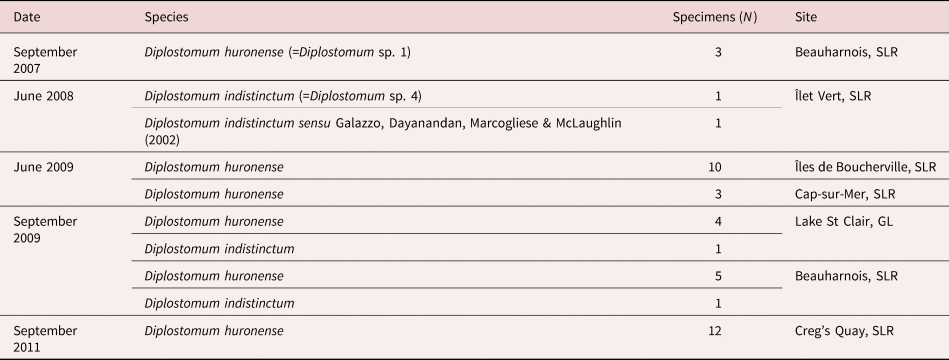
A total of 41 metacercariae were sequenced from 15 invasive round gobies in previous studies (Locke et al., Reference Locke, McLaughlin, Dayanandan and Marcogliese2010a, Reference Locke, Al-Nasiri and Caffara2015; Désilets et al., Reference Désilets, Locke, McLaughlin and Marcogliese2013). These include 37 specimens of D. huronense (=Diplostomum sp. 1), three specimens of D. indistinctum (=Diplostomum sp. 4) and a single specimen of D. indistinctum sensu Galazzo, Dayanandan, Marcogliese & McLaughlin (2002) (table 1). Multiple metacercariae were sequenced from nine fish, of which three contained mixed infections. One fish collected in June 2008 from the St Lawrence River was infected with one D. indistinctum and one D. indistinctum sensu Galazzo, Dayanandan, Marcogliese & McLaughlin (2002). Six specimens from a single fish collected from the St Lawrence River in September 2009 consisted of five D. huronense and a single D. indistinctum. Lastly, of three metacercariae sequenced from a single fish collected in the Great Lakes in September 2009, two were D. huronense and one was D. indistinctum.
Diplostomum species determined by molecular sequencing of 41 specimens recovered from invasive round gobies (Neogobius melanostomus) in the St Lawrence River (SLR) and Great Lakes (GL) derived from original data summarized in Locke et al. (Reference Locke, McLaughlin, Dayanandan and Marcogliese2010a, Reference Locke, Al-Nasiri and Caffara2015) and Désilets et al. (Reference Désilets, Locke, McLaughlin and Marcogliese2013).

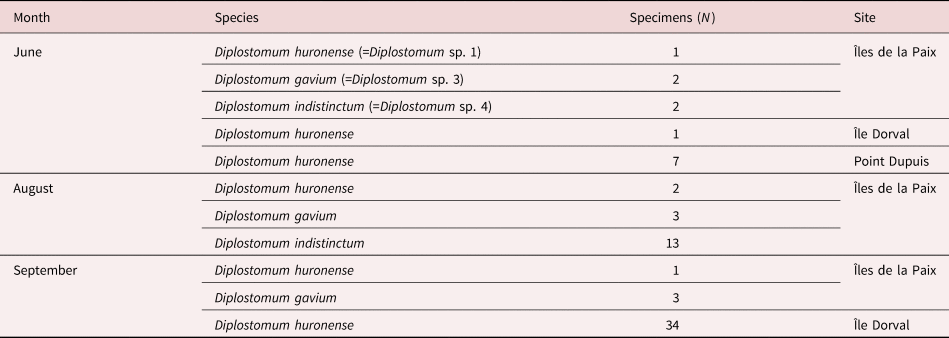
From the 2012 sampling for molecular species discrimination, 69 parasites were sequenced successfully, yielding 40 distinct haplotypes. Of these, 46 corresponded to D. huronense, 15 were D. indistinctum and eight were Diplostomum gavium (=Diplostomum sp. 3) (table 2). All metacercariae were lens forms. Another 59 metacercariae could not be sequenced successfully. Sequenced specimens originated in 15 different individual fish, and multiple specimens of Diplostomum were sequenced in ten fish. Mixed infections were observed in four individual hosts, all from Îles de la Paix. They comprised a co-infection with three D. gavium and one D. huronense; with two D. gavium and one D. indistinctum; with eight D. indistinctum and one D. huronense; and, lastly, with one D. huronense, one D. gavium and one D. indistinctum. A notably homogeneous infection was observed in one fish from Île Dorval, in which sequences obtained from 32 of 46 specimens all corresponded to D. huronense. All the sequences newly obtained from 2012 material were either identical to or differed by at most two nucleotides (>0.5%) from haplotypes of D. huronense, D. gavium and D. indistinctum previously published by Locke et al. (Reference Locke, McLaughlin, Dayanandan and Marcogliese2010a, Reference Locke, McLaughlin and Marcoglieseb, Reference Locke, Al-Nasiri and Caffara2015) under the names Diplostomum sp. 1, 3 and 4, respectively. Newly generated sequences are deposited in GenBank under accession numbers MZ563479–MZ563546.
Diplostomum species determined by molecular sequencing of 69 specimens recovered from invasive round gobies (Neogobius melanostomus) in the St Lawrence river in 2012.

Mean total length (±standard deviation) of round gobies collected to measure overall infection rates pooled from the four localities was 62.2 (±8.16) mm in 2012 and 61.5 (±10.92) in 2013. Prevalence of infection of Diplostomum spp. in round gobies pooled from the four localities was 3.75% and 6.25% in 2012 and 2013, respectively. Mean abundance (±standard error) from the pooled localities was 0.04 (±0.02) in 2012 and 0.11 (±0.05) in 2013. Intensity was 1.0 in 2012 and ranged from one to three in 2013.
Discussion
Results confirm previous studies showing that round gobies in the St Lawrence River become infected with lens forms of Diplostomum, all of which are putative generalists. Diplostomum gavium was found for the first time in the round goby. In 2012, D. huronense was clearly the most common, followed by D. indistinctum and D. gavium. Similarly, D. huronense was the most common form in round gobies collected from 2007 to 2011, followed by D. indistinctum (Locke et al., Reference Locke, McLaughlin, Dayanandan and Marcogliese2010a, Reference Locke, Al-Nasiri and Caffara2015; Désilets et al., Reference Désilets, Locke, McLaughlin and Marcogliese2013). In contrast to previous studies (Locke et al., Reference Locke, McLaughlin, Dayanandan and Marcogliese2010a; Désilets et al., Reference Désilets, Locke, McLaughlin and Marcogliese2013), D. indistinctum sensu Galazzo, Dayanandan, Marcogliese & McLaughlin (2002) was not found. However, these parasites were collected in 2007–2009, and this parasite has only been observed once since that time (2011) in a golden shiner (Notemigonus crysoleucas), out of a total of 703 specimens sequenced from various fish hosts (Désilets et al., Reference Désilets, Locke, McLaughlin and Marcogliese2013). Mixed infections of Diplostomum spp. do occur in round gobies, although they are not common, likely due to the overall low infection levels, especially of the less abundant species. Among native host species, any one Diplostomum species may be the most common, with D. huronense predominant in five fish species, D. indistinctum predominant in five species and D. gavium predominant in two species, with D. gavium and D. indistinctum co-dominant in another three species (Désilets et al., Reference Désilets, Locke, McLaughlin and Marcogliese2013; Locke et al., Reference Locke, McLaughlin and Marcogliese2013). However, the relative distribution of Diplostomum spp. among these hosts is not completely consistent between these two studies, suggesting temporal variation in species composition. Given that there is no phylogenetic pattern to the distribution of these species among fish hosts, the reason for the relatively high abundance of D. huronense in the round goby in this or previous studies is not known. All of the above species are considered host generalists (Locke et al., Reference Locke, McLaughlin, Dayanandan and Marcogliese2010a, Reference Locke, McLaughlin and Marcoglieseb, Reference Locke, Al-Nasiri and Caffara2015), but both D. huronense and D. indistinctum were the most common in native fishes (Désilets et al., Reference Désilets, Locke, McLaughlin and Marcogliese2013; Locke et al., Reference Locke, McLaughlin and Marcogliese2013). Curiously, another generalist found in the St Lawrence River, D. huronense sensu Galazzo, Dayanandan, Marcogliese & McLaughlin (2002) has never been found in the round goby. This species was not common in 2011 (Désilets et al., Reference Désilets, Locke, McLaughlin and Marcogliese2013), while being relatively abundant in 2006 (Locke et al., Reference Locke, McLaughlin and Marcogliese2013). Its limited occurrence may explain its absence from the round goby.
The round goby is among the most successful invasive species in the St Lawrence River, becoming one of the most abundant fish species in the littoral zone (Morissette et al., Reference Morissette, Paradis, Pouliot and Lecomte2018). Gobies have inserted themselves into local food chains and are now prey to avian and piscine piscivores in the Great Lakes–St Lawrence River basin (Johnson et al., Reference Johnson, Bunnell and Knight2005; Reyjol et al., Reference Reyjol, Brodeur, Mailhot, Mingelbier and Dumont2010; Essian et al., Reference Essian, Chipault, Lafrancois and Leonarda2016). Indeed, the round goby is now one of the most important prey items for ring-billed gulls, an important definitive host for Diplostomum spp., in the Great Lakes (Essian et al., Reference Essian, Chipault, Lafrancois and Leonarda2016). Furthermore, the round goby was shown to be a potentially competent host for species of Diplostomum. In a preliminary experiment, ring-billed gulls (Larus delarewarensis) fed wild-caught gobies from the St Lawrence River became infected with adult Diplostomum spp., suggesting some degree of competency (see Gendron & Marcogliese, Reference Gendron and Marcogliese2017). Host competence, the capacity of a host to transmit infection (Stewart Merrill & Johnson, Reference Stewart Merrill and Johnson2020), is a required characteristic of an invasive species for spillback to occur (Kelly et al., Reference Kelly, Paterson, Townsend, Poulin and Tompkins2009; Poulin et al., Reference Poulin, Paterson, Townsend, Tompkins and Kelly2011).
Spillback also depends on the relative abundance of native and invasive hosts (Paterson et al., Reference Paterson, Rauque, Fernandez, Townsend, Poulin and Tompkins2013). In the areas sampled in the St Lawrence River, the round goby comprises 11.6–35.4% of fish captured in the littoral zone (Morissette et al., Reference Morissette, Paradis, Pouliot and Lecomte2018). Of the native hosts of Diplostomum spp., some increased in abundance, some decreased, and others remained stable since the invasion of the round goby (Morissette et al., Reference Morissette, Paradis, Pouliot and Lecomte2018). Thus, other than the huge numerical increase in the round goby population, there is no clear trend one way or another across native host fish species that could influence transmission of Diplostomum spp. Indeed, the fact that the round goby is numerically so abundant lends support to the idea that spillback could occur (Paterson et al., Reference Paterson, Rauque, Fernandez, Townsend, Poulin and Tompkins2013). Confirmation would require determination of the actual relative transmission rates of Diplostomum spp. to the definitive hosts from round gobies compared to native fishes.
Spillback of native parasites from invasive species can result in amplification, an increase in prevalence and abundance in native hosts (Kelly et al., Reference Kelly, Paterson, Townsend, Poulin and Tompkins2009; Poulin et al., Reference Poulin, Paterson, Townsend, Tompkins and Kelly2011). Amplification depends on the invading host's abundance, its susceptibility and the transmission potential (Rohr et al., Reference Rohr, Civitello, Halliday, Hudson, Lafferty, Wood and Mordecai2020). However, abundance and prevalence of Diplostomum spp. in round gobies in the St Lawrence River is quite low (Gendron & Marcogliese, Reference Gendron and Marcogliese2017; this study). Yet, abundance and prevalence of the parasites in numerous native host species has also declined to low levels following the round goby introduction (Gendron & Marcogliese, Reference Gendron and Marcogliese2017). These authors suggested that the presence of the round goby has led to a dilution effect, reducing parasite loads in native fishes, and also explored the potential mechanism(s) in detail as well as alternate explanations (Gendron & Marcogliese, Reference Gendron and Marcogliese2017). These authors found that possible declines in first intermediate hosts or definitive hosts, or changes in hydrological conditions, could not explain the declines in Diplostomum spp. We suggest the infections in the round goby, one of the most abundant hosts in the river, may assist in maintaining infections of Diplostomum spp. in native fishes, albeit at low levels, via spillback, despite the low levels of infection in that host. The abundance of the round goby, its importance as prey for piscivorous birds and its potential competence as a host for the parasite lend support for this idea. This raises the intriguing possibility that dilution and spillback may not be mutually exclusive.
Acknowledgements
John Forest and Sophie Trépanier provided technical assistance. Michel Arseneault, Alex Bibeau, Xavier Bordeleau, Germain Brault, Andrée Gendron, Claude Lessard and Sophie Trépanier helped with sampling in the field.
Financial support
This study was supported by the Canadian Genomics Research and Development Initiative inter-departmental project on Quarantine and Invasive Species (D.J.M) and the National Science Foundation (S.A.L., grant number DEB 1845021).
Conflict of interest
None.
Ethical standards
Collection and treatment of animals follows the guidelines of the Canadian Council for Animal Care and was approved by the Environment Canada Animal Care Committee. Fish were collected under a permit from the Quebec Ministère des Ressources Naturelles et de la Faune.