Implications
In many countries, there is increasing pressure on land use, such that grazing animals, which are normally managed extensively, may be housed more frequently. However, for sheep, there is little information on appropriate housing and the impact that this may have on stress, growth and behaviour. This study demonstrated that small pen sizes reduced ewe–lamb suckling behaviour and increased udder refusals compared with larger pens, although grooming behaviour was also increased. This was accompanied by increased ewe faecal cortisol levels, and this suggests that suckling ewes may be stressed by housing in close confinement, which influences their maternal behaviour.
Introduction
China is the largest sheep-producing nation in the world (183 million head in 2012: www.faostat.org); yet, comparatively little is known about the management and behaviour of these sheep. Many indigenous sheep breeds exist, of both fat-tailed and thin-tailed breeds, including the Small-Tail Han sheep originating from Mongolia. This breed is highly prolific, producing 2.61 to 2.65 lambs per litter (Chang et al., Reference Chang, Liu and Geng1998) with non-seasonal oestrus. Mature ewes can have three parturitions every 2 years, with some animals producing two litters every year. Anecdotally, the level of lamb mortality ranges from 5% to 20% in different Small-Tail Han sheep enterprises in China, which is comparable with studies on other breeds, but not acceptable from both welfare and production perspectives. The behaviours of the ewe and lamb are known to be important for the survival of the offspring (e.g. reviewed by Dwyer, Reference Dwyer2014). However, to our knowledge, there are no published studies describing the maternal behaviour of Chinese indigenous sheep breeds.
In China, economic development is placing greater pressure on land use, and pasture availability for sheep production is declining with increased land use for other agricultural and non-agricultural purposes (e.g. Bosing et al., Reference Bosing, Susenbeth, Hao, Ahnert, Ohm and Dickhoefer2014). As a solution to this, sheep production is gradually shifting from extensive to intensive management, with increased housing of ewes during pregnancy and lactation, and housing at increasing stocking density. However, there is still little information available about the impact of sheep housing and stocking density on sheep production and welfare, although recent studies suggest that high stocking density results in behavioural disturbances, displacements and altered social interactions (Averòs et al., Reference Averòs, Lorea, Beltrán de Heredia, Ruiz, Marchewka, Arranz and Estevez2014a and 2014Reference Averòs, Lorea, de Heredia, Arranz, Ruiz and Estevezb). It is, therefore, relevant to consider how this might also affect the behaviour of Chinese sheep breeds.
High stocking densities affect sheep behaviour, physiology and welfare (Sevi et al., Reference Sevi, Massa, Annicchiarico, Dell'Aquila and Muscio1999; Caroprese et al., Reference Caroprese, Casamassima, Rassu, Napolitano and Sevi2009; Averòs et al., Reference Averòs, Lorea, Beltrán de Heredia, Ruiz, Marchewka, Arranz and Estevez2014a and 2014Reference Averòs, Lorea, de Heredia, Arranz, Ruiz and Estevezb), and it may also affect mother–young interactions (Averòs et al., Reference Averòs, Lorea, Beltrán de Heredia, Ruiz, Marchewka, Arranz and Estevez2014a; Dwyer, Reference Dwyer2014). Crowded conditions may exacerbate lamb desertion or separation behaviour in paddocks (Winfield, Reference Winfield1970) and are likely to be even greater in indoor housing conditions. Ewes giving birth in crowded conditions are often unable to isolate themselves from the flock and may be interfered with by other ewes, or their lambs may become separated and be abandoned (Alexander et al., Reference Alexander, Stevens, Kilgour, de Langen, Mottershead and Lynch1983). Gonyou and Stookey (Reference Gonyou and Stookey1985) concluded that the use of cubicles reduced the incidence of poor maternal behaviour in housed ewes by giving them an opportunity to isolate themselves from other ewes.
The studies mentioned above have focussed on the impact of high stocking density on the onset of maternal behaviour. However, the effect of pen size on established maternal behaviour and physiology, when animals are confined in new environments, has not yet been investigated. The neuroendocrine mechanisms of maternal care in ewes have received considerable research attention in recent years. In particular, oestradiol plays an important role in the onset of maternal behaviour, and cortisol may also influence the expression of maternal behaviour (Dwyer et al., Reference Dwyer, Gilbert and Lawrence2004; Meurisse et al., Reference Meurisse, Gonzalez, Delsol, Caba, Levy and Poindron2005; Bøe et al., Reference Bøe, Berg and Andersen2006; Dwyer, Reference Dwyer2014). In general, primiparous ewes are more likely to show inadequate maternal behaviour towards their neonates than experienced ewes (Meurisse et al., Reference Meurisse, Gonzalez, Delsol, Caba, Levy and Poindron2005; Dwyer and Smith, Reference Dwyer and Smith2008). This may be because hormonal induction of maternal behaviour in primiparous females is less efficient (Le Neindre et al., Reference Le Neindre, Poindron and Delouis1979). Parity effects on maternal behaviour are not related to circulating oestradiol (Dwyer and Smith, Reference Dwyer and Smith2008), but the responsiveness to oestradiol induction of maternal behaviour increases with parity (Poindron et al., Reference Poindron, Le Neindre, Lévy and Keverne1984), which seems to be related to the impact of maternal experience on the central oestradiol receptor-α expression (Meurisse et al., Reference Meurisse, Gonzalez, Delsol, Caba, Levy and Poindron2005). However, most of these studies have focused on hormonal patterns leading to the onset of maternal behaviour, and much less is known about the role of hormonal changes in the maintenance of maternal behaviour.
In many studies, the concentration of cortisol, as an indicator of the activation of the hypothalamic–pituitary–adrenal axis in response to stress, is measured in blood as an indicator of animal physiological status (Palme and Möstl, Reference Palme and Möstl1997), but may only capture acute responses. Non-invasive techniques such as faecal sampling can offer an effective method to reduce the stress of sampling and allow data to be integrated over a longer period of time (Möstl and Palme, Reference Möstl and Palme2002). This study used faecal sampling as the method to assess the impact of housing density on the physiological responses of the ewes.
The aim of this project was (a) to provide new information on the maternal behaviour of the highly prolific Small-Tail Han sheep from parturition to weaning, considering the impact of maternal parity, and (b) to investigate whether pen size affected the expression of established maternal behaviour to provide guidance to farmers on husbandry conditions for these sheep. We hypothesised that restrictive housing conditions will increase ewe stress, reduce the expression of maternal behaviour and affect faecal concentrations of stress and reproductive hormones. Finally, we predicted that differences in maternal behaviour will affect the growth of the lamb.
Material and methods
Animals, housing and feeding
This study was carried out at the Zhong-He farm, Lan-Shan District, Linyi city, Shandong province, China. At the farm, 212 ewes are housed in two big stalls (40.0×15.0 m, about 6.0 m2 per animal). Before the experiment, eighty ewes, which were in good health and condition, were chosen and synchonised in oestrus using progesterone vaginal sponges (Huayu Ltd, Shanghai, China), and were artificially inseminated with semen from six rams over 2 days. Twenty-four pregnant twin-bearing ewes (12 primiparous, 12 multiparous) were selected from the two stalls on the basis of trans-abdominal ultrasound examination. At approximately mid-gestation (75 days), all selected ewes were given ad libitum access to hay. Two hundred g/ewe per day of locally milled ewe nuts (about 200 CP per kg dry mass, Huhui Ltd, Linyi, Shandong Province) were provided. From day 100, concentrates were fed at a ration of 320 g/ewe per day. Rations were doubled every 15 days until day 130 of gestation and then maintained at this level until parturition. At day 145 of gestation, ewes were allocated to treatments at random (n=6 per treatment) in a 2×2 design with parity (primiparous (P) or multiparous (M)) and pen size (large (L): 6.0×3.0 m (3.0 m2 per ewe); small (S): 6.0×1.5 m (1.5 m2 per ewe)) as the factors. Feeders were attached outside the pen walls, and one feeder position per ewe was available in all pens. The individual pen walls were made of 1.5 m-high solid material with cement to avoid visual and direct physical interactions between groups. The primiparous ewes were aged 1 or 2 years, and the multiparous ewes were 3 years old before pregnancy. The parity of multiparous ewes was 3 or 4.
During the parturition period, the pens were checked every morning by the stockperson to find neonates born during the previous 12 h. Each newborn was inspected and weighed. If parturition was observed during the day, to avoid interrupting the process of mother–neonate bonding, neonates were not checked immediately. However, assistance at lambing was provided if required, and three primiparous ewes were assisted for dystocia.
All ewes and neonates were marked with plastic ear-tags and with different colour numbers using stockmarker (an odourless product designed for animal use) for easy identification. The pens were cleaned before morning feeding, and the condition of the ewes and lambs were checked gently by the stockperson. In addition to natural light, artificial lighting was kept on for about 8 h every day. Forty-four of the 48 twin lambs born to the ewes survived throughout the experimental period. One of the multiparous ewes in the large pen lost one of her lambs. Two primiparous ewes in the large pen and one primiparous ewe in the small pen each lost one lamb. The lambs were weighed again at the age of 35 days (weaning). Of the surviving lambs, 23 were male and 21 were female, and the distribution of lamb sexes was approximately balanced across treatment groups (PL: five male, five female; PS: six male, five female; ML: five male, six female; and MS: seven male, five female).
Behavioural data collection
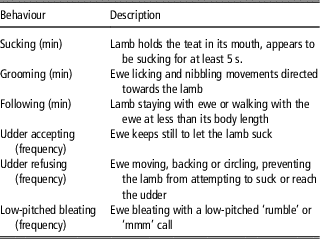
Before the parturition period, ewes were habituated to the workers’ presence by an additional 3-day period before the formal experiment started. In each pen, a four-channel video camera monitoring system (Huiya Ltd, Shenzhen, China) was installed on the wall. The data were collected for 35 days with continuous focal observations of each pen made on the day of birth and every 5 days thereafter (eight observations in total) until weaning at day 35. On each observation day, animals were observed for 6 h: 3 h in the morning (from 0700 to 1000 h) and 3 h in the afternoon (from 1400 to 1700 h), resulting in 48 h of observation per animal. Table 1 gives the definition of ewe and lamb behaviours observed as either events or states according to an ethogram devised from existing work in this area (Dwyer and Lawrence, Reference Dwyer and Lawrence1998; Hild et al., Reference Hild, Coulon, Schroeer, Andersen and Zanella2011). Behaviours directed towards one or both lambs were recorded, and lamb behaviours were summed as litter responses. The durations of sucking, grooming and following of individual ewes and their lambs were recorded as described by Pickup and Dwyer (Reference Pickup and Dwyer2011), and considered as the duration occurring in 6 h. The behaviours of udder accepting, udder refusing and low-pitched bleating of every ewe were recorded as events, each hour of observation was divided into 6×10 min bins to facilitate data analysis, and the data were considered as the frequencies expressed within 10-min periods. Before observation, the three observers who collected all the behavioural data were trained for 10 days with pre-existing video records.
Definition of behaviours expressed by ewes and lambs

Faecal collection and analysis
In order to reduce the disturbance of ewes and lambs, a fresh faecal sample of every ewe was collected gently by the stockperson every 5 days in the morning before feeding. About 1 g of faecal pellets were then placed into micro-centrifuge tubes and frozen at −80°C until extraction. The EIA kit (Yuping Ltd, Shanghai, China) method was used in the experiment to extract the cortisol and oestradiol, as described by Palme and Möstl (Reference Palme and Möstl1997). In brief, 0.5 g faeces was suspended in 4.0 ml methanol and 1.0 ml double-distilled water (=80% methanol) and shaken for 30 min at 2000 g. After centrifugation, all the samples were sealed and kept at −20°C until extraction. Using the method described by Palme and Möstl (Reference Palme and Möstl1997), 50.0 μl samples were gathered and detected with the EIA kit as instructed by the manufacturers (Pulang Ltd, Beijing, China). The oestradiol EIA had a sensitivity of 20.0 pmol/l; the intra-assay coefficient of variation was 0.12, and the inter-assay coefficient was 0.14. The cortisol EIA had a sensitivity of 10.0 μg/l, and the intra- and inter-assay coefficients of variation were 0.13 and 0.16, respectively. All the faecal samples were assayed for oestradiol concentration in a single assay, and similarly for cortisol concentration.
Data analysis
For each observation day, the total duration of each behaviour for each ewe was calculated for the 6 h observation period. For behavioural frequencies, the mean frequency per 10 min was calculated for each observation day. A repeated measures mixed model of variance (REML) was used to analyse maternal behaviours and hormone concentrations with the following fixed factors in the model: parity (multiparous v. primiparous), pen size (large v. small) and the interaction between parity and pen size. The ewe identity was set as random effect, and ewe and lamb age were used as residual term with covariance structure in the model. Before the model was run, all the maternal behaviours were checked to fit a normal distribution. This test generated a Wald statistic (which approximates to a χ 2 statistic), instead of an F-statistic, and this value is given in the text. A mixed model of variance was used to analyse the effect of the pen size and parity on lamb weight. All the data are shown as a mean, significance was set at P=0.05 and all analyses were performed in GenStat (8th Edition) software. It should be noted, however, that only one pen per condition (parity×size) was used, and therefore ewe was treated as the experimental unit in the study. Although maternal behaviour is often considered at the ewe level, there may have been pen-level factors that could have affected the data, but which could not be disentangled by this design, which is a limitation of this study.
All the experimental procedures were performed according to the authorisation granted by the Chinese Ministry of Agriculture. All procedures involving animals were approved by the animal care and use committee at the institution where the experiment was conducted.
Results
Maternal behaviour
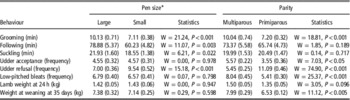
A restricted pen size reduced the amount of following behaviour between ewe and lamb (Table 2, P<0.005), reduced ewe grooming (P<0.001) and suckling duration (P<0.05) and increased udder refusals by the ewe (P<0.001). Multiparous ewes also spent more time grooming their lambs (Table 2, P<0.001), had a higher frequency of low-pitched bleating (P<0.001) and udder acceptance (P<0.05), as well as a lower frequency of udder refusals, than primiparous ewes (P<0.001). There was, however, a significant interaction between ewe parity and pen size for some maternal behaviours. Multiparous ewes allowed suckling for longer at a higher stocking density than at a low stocking density, but these effects were not seen in primiparous ewes (mean suckling duration (min): PL=22.29, PS=18.70; ML=14.82, MS=25.17, s.e.d.=1.92, Wald=26.38, d.f.=1, P<0.001). Multiparous ewes also spent more time grooming their lambs in the large pen compared with the small pen, although this effect of pen size was also not seen in the primiparous ewes (mean duration of grooming (min): PL=7.22, PS=7.18; ML=13.04, MS=7.04, s.e.d.=0.93, Wald=20.71, d.f.=1, P<0.001).
Effects of maternal parity and pen size on maternal behaviour and lamb weight for primiparous and multiparous ewes

All values are means, with standard errors in parentheses. Significance was determined by linear mixed models (REML), statistic is Wald (w, approximates to χ 2; d.f.=1 throughout).
* Large pens provided 3 m2 per ewe, small pens provided 1.5 m2 per ewe.
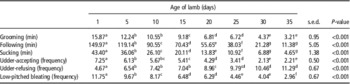
The duration of suckling, grooming and following behaviour declined with increasing lamb age (Table 3, P<0.001 for all behaviours), as did the frequency of low-pitched bleating (P<0.001) and udder acceptance (P<0.001). In contrast, the frequency of udder refusals increased with lamb age (Table 3, P<0.001).
The effect of increasing lamb age on the expression of maternal behaviour

Values are means with pooled standard error of difference (s.e.d.).
Faecal hormone levels
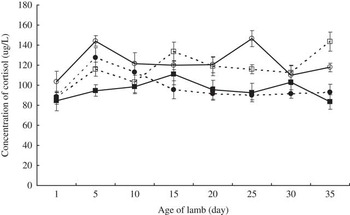
Pen size had a significant effect on cortisol concentration, with higher values for ewes kept in the smaller pens (Figure 1, Wald statistic=32.75, d.f.=1, P<0.001). Cortisol concentrations varied significantly with time (Wald=29.01, d.f.=7, P<0.001), but no overall or consistent pattern of change was detected. There were no significant effects of parity or interactions between parity and pen size in faecal cortisol concentrations.
The effect of lamb age (in days) on ewe faecal cortisol concentrations (μg/l) for multiparous ewes in large pens (solid square and lines), multiparous ewes in small pens (open square, broken lines), primiparous ewes in large pens (solid circle and broken lines) and primiparous ewes in small pens (open circle and lines).

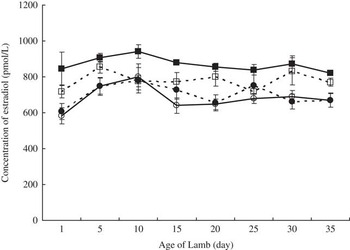
Multiparous ewes had significantly higher faecal oestradiol concentrations than primiparous ewes (Figure 2, Wald=28.37, d.f.=1, P<0.001), and ewes in larger pens also had significantly higher oestradiol concentrations (Wald=4.56, d.f.=1, P<0.05). As with cortisol, there were significant effects of time on faecal oestradiol concentrations (Wald=31.55, d.f.=7, P<0.001), but no consistent pattern of change was observed. There were no significant interactions between parity and pen size on oestradiol concentration (Wald=2.04, d.f.=1, P=0.169).
The effect of lamb age (in days) on ewe faecal oestradiol concentrations (pmol/l) for multiparous ewes in large pens (solid square and lines), multiparous ewes in small pens (open square, broken lines), primiparous ewes in large pens (solid circle and broken lines) and primiparous ewes in small pens (open circle and lines).

Lamb weight
The weight of lambs of multiparous ewes tended to be heavier than those of primiparous ewes at birth (Table 2, Wald=3.05, d.f.=1, P=0.096). By weaning at 35 days of age, lamb weight was significantly greater in lambs of multiparous ewes compared with primiparous ewes (Wald=11.12, d.f.=1, P<0.005).There were no significant effects of pen size or the interactions between pen size and parity for lamb weaning weight.
Discussion
The results of this study indicated that both parity and pen size had effects on Small-Tail Han sheep maternal behaviour during lactation. To our knowledge, this is the first paper to describe maternal behaviour in Chinese native sheep breeds. The most significant finding of this study was that housing in pens providing 1.5 m2 per ewe resulted in changed maternal behaviour (specifically reduced following, grooming and suckling associated with increased sucking refusals) in comparison with ewes housed at 3 m2 per ewe, and multiparous ewes appeared to be more influenced by the pen size than primiparous ewes. This was accompanied by increased faecal glucocorticoid metabolites and reduced faecal oestradiol in the small pens.
Few studies have considered the space requirements for housed sheep (other than during transport or at lairage), and very few studies address the impact of housing on the expression of maternal behaviour during lactation. Studies considering what might be an appropriate pen size for ewes have almost invariably considered the space required by the ewe alone (either while dry, during pregnancy or lactation only in dairy ewes). Chiumenti (Reference Chiumenti1987) suggests that 0.9 to 1.2 m2/head on straw litter and 0.8 to 1.0 m2/head on slatted floor are fit for sheep. However, studies on sheep behaviour suggest that housing at 1 to 1.5 m2 (as in the small pens in the present study) results in higher social interactions and reduced activity compared with lower stocking density (Caroprese et al., Reference Caroprese, Casamassima, Rassu, Napolitano and Sevi2009; Averòs et al., Reference Averòs, Lorea, de Heredia, Arranz, Ruiz and Estevez2014b). Conversely, very low space availability increases activity, as animals are prevented from lying down when they wish (Bøe et al., Reference Bøe, Berg and Andersen2006). Sevi et al. (Reference Sevi, Casamassima, Pulina and Pazzona2009), for lactating dairy ewes, suggested assigning a 2.0 m2 area per sheep to avoid these behavioural impacts. In the present study, although activity per se was not measured, the increased following time in the larger pens suggests that animals may have been more active than in the smaller pens. In a study of mother–offspring recognition, Val-Laillet and Nowak (Reference Val-Laillet and Nowak2006) suggest that lambs kept in small pens take longer to learn to recognise their mothers than lambs in larger pens. This may also have led to the observed increase in following time with more space, if the lambs were better able to recognise and follow their own mother than in small pens, and the reduced sucking refusals (as lambs may be less likely to attempt to suck from a ewe that was not their mother). The increase in grooming behaviour at a lower stocking density may also be associated with improved recognition between ewe and lamb, and a closer bond developing when animals have more space to express maternal behaviour.
In this study, there was a significant interaction between ewe parity and pen size for grooming and suckling behaviours. Multiparous ewes expressed a higher amount of grooming behaviour in larger pens, whereas primiparous ewes were not affected by pen size. Multiparous ewes are known to express a higher quantity and quality of maternal care compared with primiparous ewes (reviewed by Dwyer, Reference Dwyer2014). It may be that the smaller pen impaired expression of maternal care in both inexperienced and experienced ewes, but only multiparous ewes were able to show increased maternal care when the environmental conditions permitted this to occur. The higher suckling responses of multiparous ewes in the small pen compared with primiparous ewes might be a greater responsiveness of these experienced ewes to the behaviour of their lambs. However, as this study focused mainly on ewe behaviour, it is not known whether lamb behaviour was also altered by the housing conditions.
In this study, pen size significantly affected the concentration of both oestradiol and cortisol in ewe faeces during lactation, with ewes in the smaller pen having higher cortisol and lower oestradiol levels than ewes in larger pens. Oestradiol concentration plays an important role in inducing expression of maternal behaviour at parturition (Meurisse et al., Reference Meurisse, Gonzalez, Delsol, Caba, Levy and Poindron2005; Dwyer, Reference Dwyer2014), although its role in the maintenance of maternal behaviour is not well-described. Whether the higher oestradiol levels in ewes housed at greater space allowance can be related to their apparently greater expression of maternal behaviour requires further investigation.
Cortisol is widely measured as an indicator of physiological and psychological stress, and the higher values recorded in this study in ewes maintained in small pens may indicate greater stress in these animals. In our study, we seldom saw that ewes in small pens expressed abnormal or stereotypic behaviour, the main effects of low space allowance were reduced time spent grooming and greater udder refusing frequency (which could be considered as poorer maternal care) than ewes housed in a large pens during lactation. Few studies in sheep have considered the impact of maternal stress on maternal behaviour, and have report conflicting results. In studies examining the effects of maternal stress before birth on the onset of maternal behaviour, Hild et al. (Reference Hild, Coulon, Schroeer, Andersen and Zanella2011) found a positive correlation between maternal experience of stress during pregnancy and maternal grooming in sheep. Dwyer et al. (Reference Dwyer, Gilbert and Lawrence2004) report no relationship between circulating cortisol before birth and maternal behaviour (in a naturally occurring model of differences in circulating cortisol, which may not be related to stress) but a negative correlation between postnatal circulating cortisol and maternal behaviour expression in sheep. In rodents, maternal stress induced by unfamiliar male odours produced similar results to those reported here: increased maternal faecal glucocorticoid metabolites and reduced the expression of maternal care (Heiming et al., Reference Heiming, Bodden, Jansen, Lewejohann, Kaiser, Lesch, Palme and Sachser2011). Similarly in primates, maternal postpartum cortisol level was also correlated with reduced maternal care (Bahr et al., Reference Bahr, Pryce, Dobeli and Martin1998), suggesting that stress during lactation is disruptive for maternal behaviour and may be a consistent response across species.
McNatty et al. (Reference McNatty, Cashmore and Young1972) have shown that an average of 28 days is needed for cortisol to return to ‘normal’ levels when sheep are brought from pasture into an animal house. Although in the present study there is a significant effect of time on faecal cortisol and oestradiol levels, there is no consistent pattern to suggest that animals are habituating or adjusting to the changed housing environment.
Multiparous ewes are frequently reported to show greater maternal care than primiparous ewes (Dwyer et al., Reference Dwyer, McLean, Deans, Chirnside, Calvert and Lawrence1998; Dwyer and Smith, Reference Dwyer and Smith2008). This has been discussed extensively elsewhere (e.g. Dwyer, Reference Dwyer2008 and Reference Dwyer2014), and seems to be related to the increased physiological sensitivity of experienced ewes. The results of the present study indicate that the maternal behaviour of Small-Tail Han sheep, like many other breeds of ewes, is also significantly influenced by parity. Although there was no overall effect of parity on suckling behaviour in this study, compared with primiparous ewes, multiparous ewes had a higher frequency of udder accepting and consequently were less likely to refuse sucking than primiparous ewes. These data support the results observed in other breeds (e.g. Dwyer and Smith, Reference Dwyer and Smith2008). Multiparous ewes also had a higher frequency of low-pitched bleating to their lambs compared with primiparous ewes, which may be indicative of greater maternal responsiveness (Dwyer et al., Reference Dwyer, McLean, Deans, Chirnside, Calvert and Lawrence1998). Low-pitched bleating is also affected by the environment (in outdoor raised sheep), by breed and by nutritional treatment in pregnancy (Shillito-Walser et al., Reference Shillito-Walser, Walters and Ellison1984). Our data differ from that of Dwyer et al. (Reference Dwyer, McLean, Deans, Chirnside, Calvert and Lawrence1998), however, in different breeds of sheep, who report that there is no significant difference between multiparous and primiparous ewes in low-pitched bleat frequency. This may be related to different sheep breeds, different environments or the timing of observations, which extended for a longer period in the present study but excluded the period immediately after parturition, which was the focus for the Dwyer et al. (Reference Dwyer, McLean, Deans, Chirnside, Calvert and Lawrence1998) study.
The Small-Tail Han sheep is noted for its fecundity; thus, good maternal behaviour would be important to increase lamb survival. The neonatal lamb will not survive (without human intervention) if females do not nurse and care for their young (Nowak et al., Reference Nowak, Porter, Levy, Orgeur and Schaal2000; Dwyer, Reference Dwyer2008). In this study, the results suggest that maternal experience plays an important role in the maternal behaviour expression of Chinese ewes, and that multiparous ewes had a higher faecal concentration of oestradiol than primiparous ewes during lactation. Previous studies have suggested that there is a significant positive correlation between circulating oestradiol (before birth) and the subsequent expression of maternal behaviour (low-pitched bleating and grooming) at birth (Dwyer et al., Reference Dwyer, Gilbert and Lawrence2004). This study extends those observations by suggesting that higher oestradiol throughout lactation may also be related to greater expression of maternal grooming and low-pitched bleating.
A small space allowance per animal has been shown to reduce feed intake and weight gain in 11-week-old growing lambs (Horton et al., Reference Horton, Malinowski, Burgher and Palatini1991). However, in this study, we did not observe similar effects on lamb weight. This may be because, at the lamb ages used in the present study, the lambs were almost entirely dependent on the ewe for their nutrition, and thus were relatively protected from the effects stocking density on feeding and social disturbance that may influence growth. This is supported by the significant effect of ewe parity on lamb growth, which suggests that it is the ability of the ewe to provide milk to her lamb, which is the main determinant of lamb weight gain. Younger ewes are known to produce milk with significantly less protein, casein and fat compared with older ewes (Sevi et al., Reference Sevi, Taibi, Albenzio, Muscio and Dell’Aquila2000). Although stocking density did appear to affect suckling duration, at least in the multiparous ewes, this was not associated with reduced milk supply and, therefore, poorer lamb growth in the smaller pens.
Conclusion
This study is the first to demonstrate that stocking density can affect the expression of maternal behaviour of lactating ewes towards their lambs until weaning. A high stocking density increased udder refusals and reduced following behaviour compared with low stocking density, as well as reduced suckling duration and grooming behaviour in multiparous ewes but not in primiparous ewes. Stocking density also significantly increased faecal glucocorticoid concentration and decreased oestradiol concentrations. Other behaviours and lamb growth were affected only by parity. In addition, to our knowledge, no previous research has examined effects on the expression of maternal behaviour in Small-Tail Han sheep, a highly prolific and productive Chinese native sheep breed. This is a relatively small study, and whether the effects of pen size on maternal behaviour is repeated in other studies and in different farm environments remains to be seen. Nevertheless, the study does raise interesting questions about the impact of environment on the maintenance of maternal behaviour, and the role of hormonal factors in maternal behaviour after the initial onset of maternal care.
Acknowledgements
The authors thank Jiang Zi-ming and Yin Zuo-guo for animal husbandry and technical assistance at gestation and during parturition, and Xu Song-shan, Wan Wen-wen and Li Jing for the observation data collection and hormone assays. This study was supported by the National Natural Science Foundation of China (Grant No: 31001027; 31272480); Promotive research fund for young and middle-aged scientists of Shandong Province (Grant No: BS2011NY004), Domesticated Animal Germ plasm Resources Platform of China, Shandong Modern Agriculture Industry Technology System-Sheep Industry Innovation Team (Grant No: SDAIT-09-011-15). SRUC receives grant-in-aid from the Scottish Government.