Introduction
Sudden sensorineural hearing loss (SNHL) is one of the main indications for emergency consultation with ENT specialists. Sudden SNHL is defined as hearing loss of 30 dB or more in at least three contiguous frequencies, with a rapid onset over 72 hours or less. In Germany, the incidence is reported to be as high as 160 per 100 000 persons per year.Reference Klemm, Deutscher and Mösges1,Reference Prenzler, Schwab, Kaplan and El-Saied2 By contrast, other countries such as the USA report incidences as low as 8–15 per 100 000 persons per year.Reference Alexander and Harris3
Different aetiologies, such as infectious diseases, inner-ear fluid disorders, malformations, cardiovascular disease, trauma, toxins, hypoxia, and immunological, neoplastic or haematological disorders, have been reported.Reference Plontke, Meisner, Caye-Thomasen, Parnes, Agrawal and Mikulec4,Reference Hughes, Freedman, Haberkamp and Guay5 However, the aetiology of sudden SNHL can be clearly identified in less than 15 per cent of the cases. The remaining causes are not defined and the term idiopathic SNHL applies to these cases.Reference Stachler, Chandrasekhar, Archer, Rosenfeld, Schwartz and Barrs6
The treatment options for sudden SNHL include rheological agents, local or systemic steroid application, antiviral therapy, antibiotics, hyperbaric oxygen therapy, and stress reduction.Reference Plontke, Meisner, Caye-Thomasen, Parnes, Agrawal and Mikulec4,Reference Hara, Zhang, Gandhi, Flaherty, Barber and Leung7–Reference Marx, Younes, Chandrasekhar, Ito, Plontke and O'Leary10 Hitherto, there is no proven evidence to support the clinical benefit of these therapeutic options.Reference Plontke, Meisner, Caye-Thomasen, Parnes, Agrawal and Mikulec4 Furthermore, a high spontaneous recovery rate of up to 65 per cent of affected patients has been reported.Reference Stachler, Chandrasekhar, Archer, Rosenfeld, Schwartz and Barrs6 Many studies, like those of Samim et al.Reference Samim, Kilic, Ozdek, Gocmen, Eryilmaz and Unlu11 and Pino Rivero et al.,Reference Rivero V, Ruíz G, García M, García C, Palomino A and Hernández CG12 have compared different protocols in the treatment of sudden hearing loss, which makes evaluation of the effect of the various available treatment options difficult. There are just a few controlled studies, which allow an analysis of different therapeutic alternatives.Reference Labus, Breil, Stützer and Michel13,14 Thus, the development of an evidence-based treatment strategy is challenging.
Ruptures of the round or oval window leading to a perilymphatic fistula have also been described as a possible cause for sudden SNHL.Reference Haubner, Rohrmeier, Koch, Vielsmeier, Strutz and Kleinjung15,Reference Bailey and Vrabec16 However, an objective test for the verification of a membrane rupture is difficult and the diagnosis is mainly empirical. Strong pressure elevation in the inner ear, otic barotrauma or diving accidents have been identified as potential underlying pathomechanisms.Reference Haubner, Rohrmeier, Koch, Vielsmeier, Strutz and Kleinjung15 In addition, perilymphatic fistulae may occur despite the lack of any obvious inciting factors. In addition to hearing loss, patients with a perilymphatic fistula may complain about tinnitus and/or vertigo.
In the 1970s, Freeman described sealing of the oval and round window membranes as a therapeutic strategy in patients with a perilymphatic fistula.Reference Freeman17 Since then, exploratory tympanotomy for the identification and the sealing of a perilymphatic fistula has been routinely performed in some centres in patients with sudden hearing loss refractory to conservative treatment.Reference Gedlicka, Formanek and Ehrenberger18,Reference Reineke, Hühnerschulte, Ebmeyer and Sudhoff19 By provoking perilymphatic efflux in the presence of a fistula, the diagnosis of a perilymphatic fistula is confirmed during tympanotomy by increasing the intra-cochlear pressure. Thus, the diagnostic procedure is invasive. Gehrking et al. recommended closing both the round and the oval window membranes, as perilymph is hard to distinguish from exudates and local anaesthetics, even under high microscopical magnification.Reference Gehrking, Wisst, Remmert and Sommer20 Efforts to clearly visualise the exit of perilymph by the intravenous or intrathecal administration of fluorescein have not been successful.Reference Gehrking, Wisst, Remmert and Sommer20,Reference Poe, Gadre, Rebeiz and Pankratov21 For decades, the diagnosis of perilymphatic fistula as a differential diagnosis of sudden SNHL has been subject to controversial discussions. Thus, reports on the presence of a perilymphatic fistula in patients with sudden SNHL refractory to conservative treatment may aid in the justification of this invasive diagnostic procedure.
This retrospective study aimed to investigate the occurrence of round or oval membrane rupture in a case series of patients undergoing exploratory tympanotomy between 2009 and 2016. A review on this topic was also performed.
Materials and methods
Retrospective analysis
Ninety patients with sudden SNHL treated at our institution by exploratory tympanotomy and sealing of the oval and round windows between 2009 and 2016 were included in the present study. Demographic and audiological data, caloric testing results, cone-beam computed tomography (CT) or high-resolution CT findings, and intra-operative findings were evaluated retrospectively.
Inclusion criteria were: sudden-onset SNHL refractory to systemic high-dose steroid treatment, and regular cochlear anatomy on high-resolution CT or cone-beam CT (without anatomical variations such as an enlarged vestibular aqueduct or dehiscent semi-circular canal). Patients with inner-ear diseases such as Ménière's disease or vestibular schwannoma as the cause of the hearing loss were excluded. All patients had been pre-treated with 500 mg of prednisolone 21-succinate sodium] intravenously, for 3 days, without significant recovery (higher than 10 dB) in at least three frequencies.
The indication for exploratory tympanotomy was a threshold shift of 50 dB or more in at least three contiguous frequencies. The surgery was performed under general or local anaesthesia. An endaural approach to the middle ear was utilised to visualise the round and oval window niches after raising a tympanomeatal flap. For close investigation of a possible membrane rupture, a complete overview of the oval and round window niches was achieved microscopically. In some cases, drilling of the bony overhang over the round window, and removal of the false membranes and mucosal folds, was necessary in order to completely expose the round window membrane. The ossicular chain and stapes footplate were subsequently examined. All fluids in the window areas were removed via suctioning and application of Gelfoam™. A perilymphatic fistula was demonstrated by increasing the intra-cochlear pressure through gentle palpation of the stapes, or by increasing the end-expiratory pressure and observing the round window reflex and the stapes footplate. Clear fluid in the round or oval window niche was defined as indicative of a fistula. In all cases, the round and oval windows were sealed by connective tissue harvested from the area of the endaural incision and glued with fibrin glue. Subsequently, wound closure was performed in a standard fashion.
In order to monitor changes in hearing threshold after surgery, pure tone audiograms were performed pre- and post-operatively. Given the retrospective nature of the study, different follow-up time points for post-operative pure tone audiograms were included. The findings of audiograms performed after the removal of the surgical packaging of the ear canal were used to assess the outcome of surgery. These were usually conducted 10–14 days after surgery. If the packaging was removed in an out-hospital setting (private ENT office), the follow-up time increased accordingly.
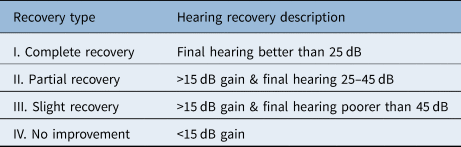
For data analysis, pure tone averages were calculated as a total of the frequencies 0.5, 1, 2 and 4 kHz, and in terms of lower frequencies (0.5, 1 and 1.5 kHz) and higher frequencies (3, 4 and 6 kHz). The resulting averages were compared to each other, and the difference between pre- and post-operative values was calculated. Siegel's criteria (as described by Durmuş et al.Reference Durmuş, Terzi, Karataş, Doğan, Uysal and Şencan22) were used to categorise possible hearing improvement for the patients in the study. Complete recovery was defined by a final hearing level better than 25 dB. Partial recovery was defined by a gain above 15 dB, with a final hearing level between 25 dB and 45 dB. Slight recovery was defined by a gain of more than 15 dB, with a final hearing level poorer than 45 dB. A gain of less than 15 dB was considered as no improvement (Table 1).Reference Durmuş, Terzi, Karataş, Doğan, Uysal and Şencan22
Siegel's criteria of hearing recovery after treatment*

* According to Durmuş et al.Reference Durmuş, Terzi, Karataş, Doğan, Uysal and Şencan22
All patients signed an informed consent form, allowing the use of their data for scientific purposes. All data were analysed in an anonymised way. Patient identification based on the data obtained is not possible.
Statistical analysis was performed using OriginPro data analysis and graphing software (OriginLab, Northampton, Massachusetts, USA). Simple one-way analysis of variance and Bonferroni testing were conducted using the means (and standard deviations) of all data.
Literature review
The literature review aimed to provide an overview of the reported incidence of perilymphatic fistula in patients with sudden SNHL refractory to treatment. Only literature written in English or German was included. A scientific literature search was performed using ‘PubMed’, ‘Cochrane Library’, ‘Web of Sciences’ and ‘Clinical Trials’ databases, with no restrictions placed on publication date. The search terms used included ‘tympanoscopy/tympanotomy’ or ‘idiopathic sudden sensorineural hearing loss’, which yielded 3898 and 1136 results respectively.
Publications had to meet the following criteria in order to be included in the review: a retrospective or prospective analysis; outcomes of adults reported; tympanoscopy or tympanotomy and outcome as the subject of the study; idiopathic hearing loss diagnosed pre-operatively; sealing of one or both cochlear windows; and data for pre- and post-operative pure tone audiometry reported.
Results
Retrospective analysis findings
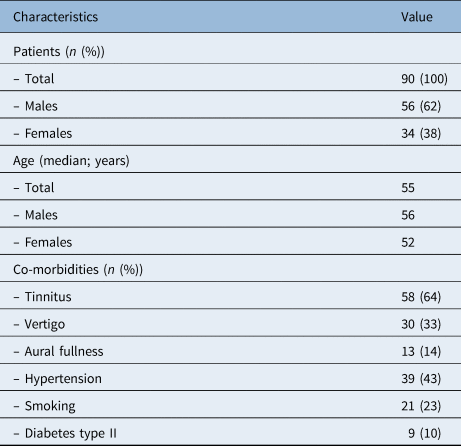
The demographic details of the patients are summarised in Table 2. During the study period (2009–2016), a perilymphatic fistula was suspected in 90 patients with sudden SNHL (mean age = 54.95 years; median age = 54.5 years; age range = 9–86 years). Of the included patients, 34 were female and 56 were male. Co-morbidities were vertigo (n = 30), tinnitus (n = 58), aural fullness (n = 13), hypertension (n = 39), tobacco use (n = 21) and type II diabetes (n = 9).
Demographics and co-morbidities of sudden SNHL patients

SNHL = sensorineural hearing loss
Among the 90 patients who underwent explorative tympanotomy, a total of 10 (11.1 per cent) were found to have a perilymphatic fistula. Identification of the membrane rupture was possible in these cases by provoking perilymphatic efflux, as described above. The presence of the fistula was documented in the patients’ surgical reports. Those cases where the clear identification of a fistula was doubtful were classified as negative (i.e. ‘no fistula’). The membranes were sealed in all 90 patients in order to enable treatment in the case of possible false negative results.
Table 3 summarises the pre-therapeutic hearing thresholds of all patients. The pure tone averages of four frequencies, as well as the mean thresholds for the lower and the higher frequencies, were calculated from pure tone audiometry. More than 50 per cent of the patients showed a hearing loss between 70 dB and 90 dB. This applies not only for pure tone average (n = 72), but also for the high (n = 58) and low (n = 77) frequencies. In addition, 12 patients showed a profound hearing loss of 90 dB or more. Some patients showed moderate hearing loss of 70 dB or less (n = 8). Correlation analyses of hearing loss in terms of age, presence of type 2 diabetes, hypertension or long-term tobacco use did not show any significant results.
Pre-therapeutic audiometric findings classified by degree of hearing loss*

* Total n = 90. †Pure tone averages at four frequencies (PTA4) were calculated as a total of the frequencies 0.5, 1, 2 and 4 kHz. ‡Lower frequencies were defined as 0.5, 1 and 1.5 kHz. **Higher frequencies were defined as 3, 4 and 6 kHz.
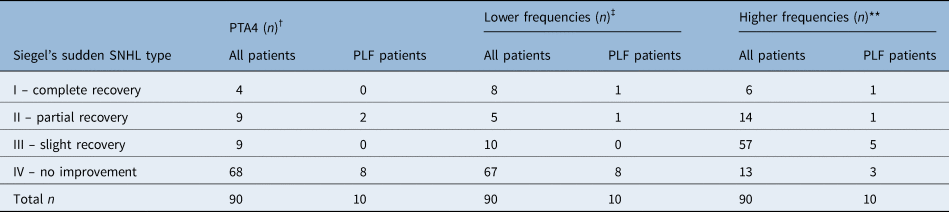
All patients were assigned to one of the four classification types (I–IV) based on Siegel's criteria for sudden SNHL (Table 4). Most of the patients fell into category IV (i.e. no improvement). The highest gain was observed for the higher frequencies.
Post-treatment audiometric findings for all patients and perilymphatic fistula subgroup, classified by Siegel's sudden SNHL criteria

*Total n = 90. †Pure tone averages at four frequencies (PTA4) were calculated as a total of the frequencies 0.5, 1, 2 and 4 kHz. ‡Lower frequencies were defined as 0.5, 1 and 1.5 kHz. **Higher frequencies were defined as 3, 4 and 6 kHz. SNHL = sensorineural hearing loss; PLF = perilymphatic fistula
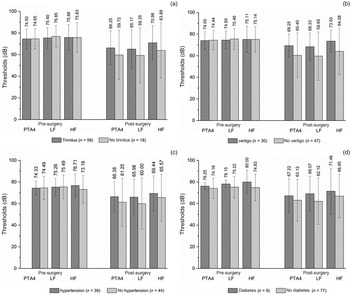
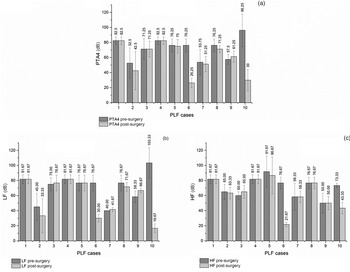
Patients with a definitive perilymphatic fistula were additionally analysed regarding their outcome. Correlation analyses of patients with and without a perilymphatic fistula in terms of co-morbidities did not show any significant findings (Figure 1 and Table 4). In two cases only, the results of the pre- and post-operative audiological evaluations showed a significant hearing improvement after treatment (cases 6 and 10; Figure 2).
Correlation analysis of all patients in terms of their co-morbidities: (a) tinnitus, (b) vertigo, (c) hypertension and (d) diabetes. PTA4 = pure tone averages at four frequencies; LF = lower frequencies; HF = higher frequencies

Pre- and post- tympanotomy results for perilymphatic fistula (PLF) cases, in terms of: (a) pure tone averages at four frequencies (PTA4), (b) lower frequencies (LF) and (c) higher frequencies (HF).

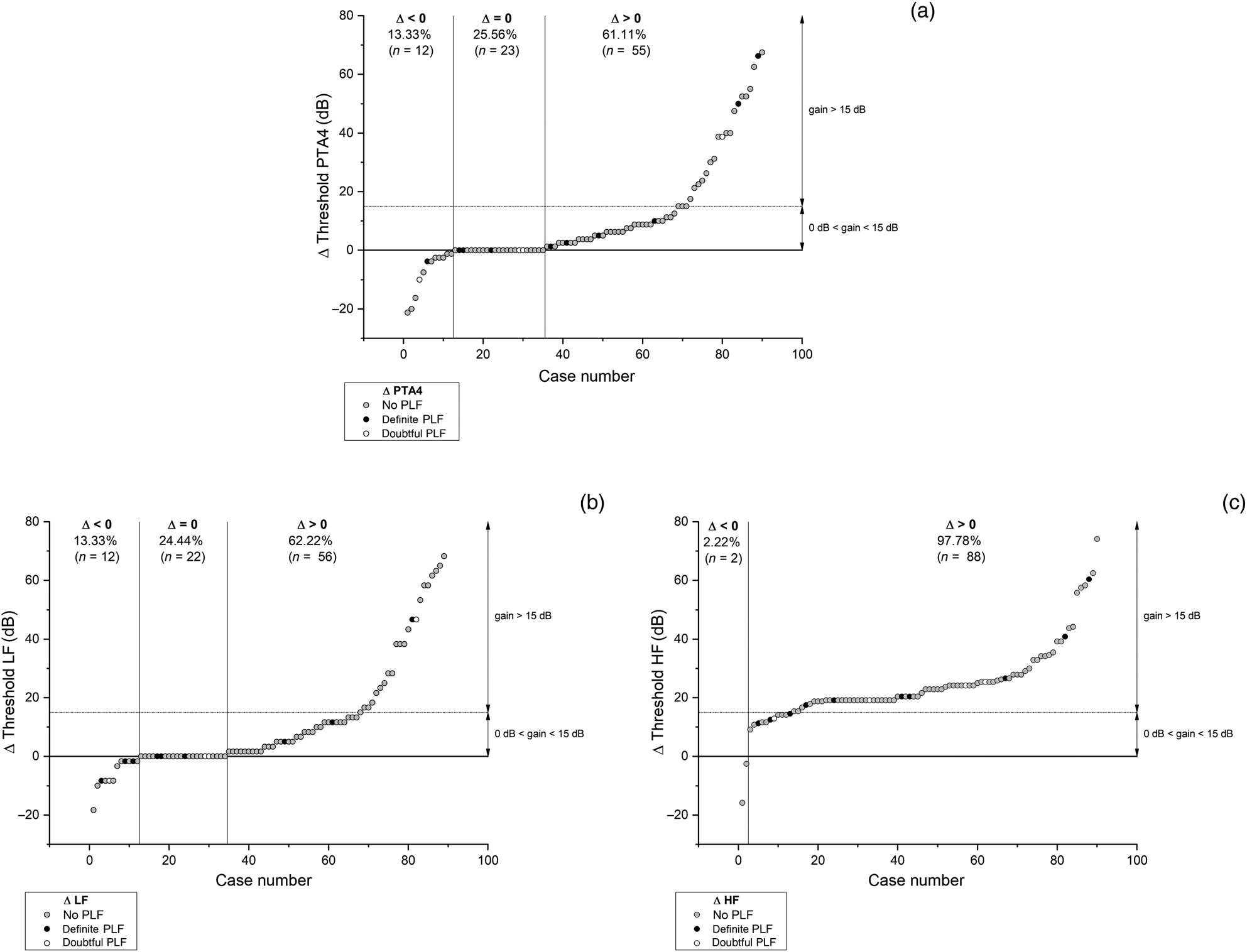
In our study, patients with a perilymphatic fistula but also those without a perilymphatic fistula showed improvement after the sealing of both window membranes (Figure 3 and Table 4). However, it is unclear whether the improvement was spontaneous or the result of surgery. The difference between pre- and post-operative pure tone averages is depicted in Figure 3. The dots represent individual patients. All dots above the zero line indicate an improvement in pure tone averages post-operatively, and most patients are located above this line. Correlation analyses comparing patients with and without the benefit of tympanotomy in terms of age and co-morbidities did not show any significant findings.
Audiological outcome of every patient following surgery based on the difference between pre- and post-operative audiometric classification, in terms of: (a) pure tone averages at four frequencies (PTA4), (b) lower frequencies (LF) and (c) higher frequencies (HF). PLF = perilymphatic fistula

All patients underwent a pre-operative CT scan of the temporal bone to identify possible cochlear pathologies or even a perilymphatic fistula. In all 90 patients in the present study, no indicative morphological changes were identified that could be related to the grade of hearing loss or the presence of a perilymphatic fistula.
Results of review
After an initial search of the literature (see Material and methods section above) and the exclusion of all papers that did not meet the inclusion criteria, eight studies were identified as being of relevance.
Nagai and Nagai described the benefit of sealing of the membrane during tympanotomy.Reference Nagai and Nagai23 However, only patients who were suspicious for having a perilymphatic fistula based on their CT scans were subjected to tympanotomy. As expected, the incidence of perilymphatic fistula in their patient cohort was 100 per cent, indicating the predictive value of high-resolution CT and not the overall incidence of perilymphatic fistula.Reference Nagai and Nagai23
Selmani et al. focused their study on the detection of perilymphatic fistula and not on hearing results after successful sealing of the round window membrane.Reference Selmani, Pyykkö, Ishizaki and Marttila24 Additionally, all patients underwent exploratory tympanotomy by endoscopy, regardless of the cause of the hearing loss. This study's design did not meet our inclusion criteria.
A third paperReference Loader, Seemann, Atteneder, Sterrer, Franz and Lill25 was excluded from the review because tympanotomy and sealing of the membrane was primarily performed to deliver triamcinolone directly to the round window by steroid-soaked fascia, which was used as a novel sealing material.
Other papers, such as that by Tigges et al.,Reference Tigges, Stoll and Schmael26 evaluated the benefit of rheological agents and steroid therapy following tympanotomy with sealing of both the round and oval window membranes. In Tigges’ study, the authors claimed that all patients benefitted from surgical exploration and sealing of the cochlear windows. However, no statistical significance was shown. Additionally, as the patients received rheological agents after tympanotomy and sealing of the membrane, this paper was excluded from the review.
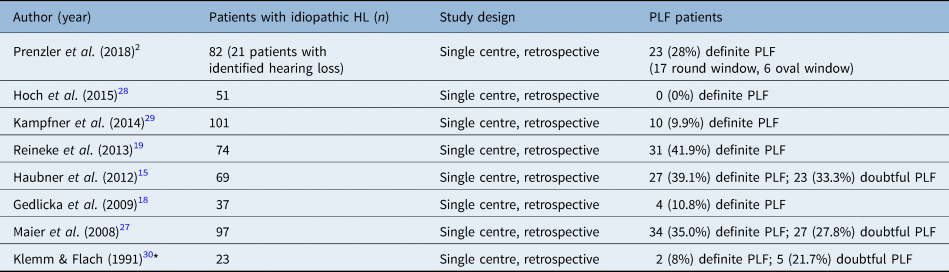
The remaining eight publications were included in our paper (Table 5).Reference Prenzler, Schwab, Kaplan and El-Saied2,Reference Haubner, Rohrmeier, Koch, Vielsmeier, Strutz and Kleinjung15,Reference Gedlicka, Formanek and Ehrenberger18,Reference Reineke, Hühnerschulte, Ebmeyer and Sudhoff19,Reference Maier, Fradis, Kimpel, Schipper and Laszig27–Reference Klemm and Flach30 All studies had been performed retrospectively, and focused on the identification and sealing of perilymphatic fistula, as well as on the benefit for patients with idiopathic sudden SNHL. A total of 534 patients were included in these 8 studies. These patients underwent tympanotomy. A perilymphatic fistula was identified in 131 patients, yielding a historical incidence of perilymphatic fistula of 24.5 per cent. Except for the study by Maier et al.,Reference Maier, Fradis, Kimpel, Schipper and Laszig27 all treatments comprised pre-operative conservative treatment without success prior to the performance of tympanotomy. Klemm et al. included two children and two teenagers in their retrospective analysis.Reference Klemm, Deutscher and Mösges1 These patients were excluded from the review, which included only adults.
Summary of meta-analysis

*Data for two children and two teenagers were excluded. HL = hearing loss; PLF = perilymphatic fistula
In all studies listed in Table 5, an improved hearing performance was documented post-operatively, although this improvement was not statistically significant.Reference Prenzler, Schwab, Kaplan and El-Saied2,Reference Haubner, Rohrmeier, Koch, Vielsmeier, Strutz and Kleinjung15,Reference Gedlicka, Formanek and Ehrenberger18,Reference Reineke, Hühnerschulte, Ebmeyer and Sudhoff19,Reference Maier, Fradis, Kimpel, Schipper and Laszig27–Reference Klemm and Flach30 In addition, there was no correlation between improvement and the presence of a perilymphatic fistula. Klemm and Flach compared surgical with conservative treatment.Reference Klemm and Flach30 The gain of hearing was similar for both treatment modalities, although the gain of hearing after tympanotomy was slightly better than that after conservative treatment.Reference Prenzler, Schwab, Kaplan and El-Saied2,Reference Freeman17,Reference Gedlicka, Formanek and Ehrenberger18,Reference Loader, Seemann, Atteneder, Sterrer, Franz and Lill25–Reference Kampfner, Anagiotos, Luers, Hüttenbrink and Preuss29 In patients with a clinical presentation that was highly suspicious for perilymphatic fistula, only one-third of the cases showed a perilymphatic fistula intra-operatively.Reference Prenzler, Schwab, Kaplan and El-Saied2 Based on the results by Klemm and Flach,Reference Klemm and Flach30 tympanotomy showed superior results when compared with purely conservative treatment and should therefore be recommended. Gedlicka et al. concentrated on the time interval between the onset of hearing loss and the treatment (i.e. tympanotomy and membrane sealing), and showed that surgical treatment performed within 14 days led to an improvement in hearing.Reference Gedlicka, Formanek and Ehrenberger18 In nine patients with a hearing loss of more than 70 dB, no significant improvement could be obtained after treatment.Reference Gedlicka, Formanek and Ehrenberger18
The results obtained from the review are similar to the findings of our recent retrospective analysis. None of the patients showed profound hearing loss post-operatively. However, our data also did not show a significant improvement in hearing after intervention. Though the hearing seemed to improve slightly more in the patients with a perilymphatic fistula, the difference between groups was not significant. Other symptoms such as tinnitus and vertigo do not seem to correlate with the degree of hearing loss.Reference Hoch, Vomhof and Teymoortash28 This was also reflected in our results (Figure 1). To conclude, no predictive factors for the success of surgical sealing of the membranes for treating idiopathic sudden SNHL can be identified based on the presented results.
Discussion
Validated and successful treatment in patients with sudden SNHL still presents a challenge in otology. One main reason is the diversity of aetiologies underlying sudden SNHL. As sudden SNHL is a devastating condition for each affected patient, many treatment options are considered in daily clinical routine. Starting with conservative treatment utilising systemic steroids and rheological therapies, refinement of treatment such as local steroid application (transtympanic) and hyperbaric oxygen therapy can subsequently be considered. In cases of severe hearing loss, in which any of these options fail to restore hearing, an exploratory tympanotomy for the diagnosis of a perilymphatic fistula and sealing of the round and oval windows is offered to the patients. The usefulness of this procedure, however, remains to be elucidated.
In the literature, some retrospective studies of patients undergoing tympanotomy have reported the incidence of perilymphatic fistula and the outcome of sealing the membranes in terms of hearing restoration. However, a review of these studies has not yet been performed. A review was therefore carried out to summarise the reported incidence of perilymphatic fistula and possible improvement in hearing after tympanotomy and sealing of the membranes.
The incidence of perilymphatic fistula as identified in our review ranged from 0 to 42 per cent. Our incidence of 11 per cent is within this reported range. Our review shows that the procedure by which each surgeon determines the presence of a perilymphatic fistula is variable. In some patients, the round window might be covered with a membrane imitating a false round window membrane, obscuring the identification of a fistula. For proper diagnosis of a perilymphatic fistula, this false membrane has to be removed and the intra-cochlear pressure has to be increased. In addition, fistulae at the oval window are more difficult to diagnose intra-operatively and may remain undetected. Furthermore, given the retrospective design of the studies in the review, a failure in documentation may also lead to an underestimation of disease incidence.
For the present study, a retrospective analysis of the patients treated with tympanotomy and sealing of the membranes in recent years (2009–2016) was performed. In 11 per cent of the patients, a perilymphatic fistula was identified. The round and oval windows were sealed intra-operatively in all patients, regardless of an identified perilymphatic fistula. Thus, cases in which a putative perilymphatic fistula remained undetected also received the recommended treatment procedure.
An improvement in hearing was observed in 25 per cent of all patients included in our retrospective analysis. Two of the 10 patients with a perilymphatic fistula showed an improvement in hearing after surgical sealing of the membrane. However, there was no statistical significance to support an overall recommendation for exploratory tympanotomy in sudden SNHL cases. The lack of significance may be a result of the limited statistical power regarding the number of patients included.
Although some of the patients without evidence of a perilymphatic fistula showed no improvement in pure tone averages, symptoms such as aural fullness, tinnitus or vertigo vanished after surgery, thus reducing the burden of sudden SNHL.Reference Klemm and Flach30 Even in cases where a perilymphatic fistula was not identified peri-operatively, an improvement in symptoms was observed after tympanotomy and sealing of the cochlear windows. However, as tympanotomy and sealing of the membranes is an invasive procedure, it should be performed only after careful consideration of the risks and benefits. The procedure may be offered to patients with persistent hearing loss despite pharmacological treatment, after informed consent is obtained. The lack of controlled, randomised clinical trials to provide evidence of its effectiveness should be highlighted, as well as the fact that it might be successful in a small number of cases only.
As a result of the high spontaneous recovery rate, the study set-up and possibly the efficacy of the conservative treatment regimens, only 90 patients treated over a period of seven years were included in the study. This is similar to other centres. Reineke et al. reported on 74 patients who were treated over a period of eight years.Reference Reineke, Hühnerschulte, Ebmeyer and Sudhoff19 Hoch et al. investigated a time period of seven years and included 51 patients in their analysis.Reference Hoch, Vomhof and Teymoortash28 The lower numbers in the study by Hoch et al. may partly be due to the inclusion criteria of a threshold shift of at least 60 dB over five contiguous frequencies.Reference Hoch, Vomhof and Teymoortash28 The cut-off used in the present analysis was set at 50 dB for three contiguous frequencies. Even at a threshold shift of 30 dB, however, patients suffer severely.Reference Tigges, Stoll and Schmael26 Thus, we recommend that a threshold shift of 50 dB or more, refractory to conservative treatment, be used as a cut-off and considered as an indication criterion for exploratory tympanotomy.
• Inclusion of perilymph fistula in the differential diagnosis of sudden hearing loss is controversial
• A review of the current literature was performed for clarification
• Perilymphatic fistula incidence is reported to be around 13 per cent
• Hearing improvement as a result of tympanotomy for cochlear window sealing has not been demonstrated
• Severe side effects due to tympanotomy and sealing of the cochlear windows are not likely
The usefulness of non-invasive and even invasive diagnostic procedures that can be performed pre-operatively to reinforce the suspicion of a perilymphatic fistula remains to be elucidated. The pre-operatively performed high-resolution CT scans did not reveal any signs of perilymphatic fistula in our investigation. This is in contrast to the report of Nagai and Nagai, which identified leaks in every operated ear.Reference Nagai and Nagai23 They describe that, in the presence of a perilymphatic fistula, fluid was identified at the sinus tympani or at the round window recess on CT scans. Thus, pre-operative CT can be helpful to indicate the need for surgical exploration and sealing. However, as also shown by Prenzler et al., CT scans can also show normal anatomy without any pathological fluid accumulation, despite the presence of a perilymphatic fistula.Reference Prenzler, Schwab, Kaplan and El-Saied2 The usefulness of invasive diagnostic procedures as pre-screening to identify patients who should be admitted for surgical exploration needs thorough evaluation. However, the invasiveness of a diagnostic procedure (e.g. intrathecal contrast agent application) should not exceed the risks of tympanotomy itself. Moreover, the invasiveness of the intrathecal application makes it difficult to be introduced into the daily routine and in smaller centres.
The follow up of the patients, especially those in a tertiary referral centre, is incomplete and needs to be standardised in the setting of a prospective study. Despite the limited follow-up period and the retrospective design of the study, exploratory tympanotomy, if performed by an experienced otological surgeon, seems to be a safe procedure. Exploratory tympanotomy can be performed to diagnose a perilymphatic fistula, especially in cases where conservative treatment has failed. The procedure can be performed under local anaesthesia and offers precise access to the round window. Thus, it can also be used for the controlled transtympanic application of substances, offering a reliable route for the local delivery of therapeutics via direct placement of gel or sponges soaked with the therapeutic substances on the oval and round windows. Indeed, Loader et al. reported on the placement of triamcinolone-soaked fascia on the round and oval windows via a transcanal tympanotomy as an experimental treatment approach in 25 patients with sudden SNHL.Reference Loader, Seemann, Atteneder, Sterrer, Franz and Lill25
Precise and effective treatment for hearing loss based on the accurate identification of underlying pathophysiological mechanisms may be routine in the near future. Thus, substances that may aid the restoration or regeneration of hearing may soon become available. Consequently, exploratory tympanotomy will gain in importance, not only for the diagnosis of a perilymphatic fistula but especially for the focused application of emerging pharmacological compounds for the inner ear through the round window.
Competing interests
None declared