1. INTRODUCTION
The separation of household from market work is a fundamental feature of industrialization. Although pockets of home industry certainly existed well into the twentieth century, the household in modern Western society is basically a unit of consumption. On the other hand, opinions about the position and role of the family during the industrialization process are more divergent. Inspired by contemporary observers, some scholars have emphasized the detrimental effects of factory work and urbanization on family ties and on the extended family in particular.Footnote 1 Others have maintained the continuing importance of families, for example in the form of family-based subcontracting systems. In her influential study, Family time and industrial time, Tamara Hareven shows that families could have many functions in later phases of industrialization.Footnote 2 The recruitment of family members to the labour force is claimed to have been important and to have had a bearing on the organization of work in many ways, as it facilitated training, loyalty, work ethics and the enforcement of production goals at a time when factory work still was a novelty.
This article explores the role of kinship in factory work in the Swedish tobacco industry at the very end of the nineteenth century. At this time, the tobacco was imported as well as sourced from parts of Sweden while the industry was mainly located in urban areas, and production was concentrated in factories with a low degree of mechanization but with a pronounced division of labour within as well as between branches, with men dominating the branch of snuff whereas women dominated cigarette production. Our focus is on the role of the family in the recruitment of labour for the tobacco factories.
Using data from a statistical survey covering the entire industry in 1898, we attempt to map out the extent of parent–child relationships among the workers and to analyze the importance of such ties for individual workers, with particular attention being paid to gender aspects. Our conclusions are that relatively few workers (7 per cent) had fathers who were, or had been, employed in the tobacco industry; having a parent in the same industry was most common among male workers who had begun in the trade at an early age. Furthermore, male workers who had followed in their father's footsteps were in a better position, with regard to earnings, than workers whose fathers had been employed in other activities. Such an association could not be established for female workers.
The article is organized as follows. After a brief introduction, section 2 relates the aim of this study to previous research in the field. Section 3 describes the Swedish tobacco industry at the time of 1898 survey and section 4 presents the data and discusses some methodological concerns. Section 5 provides an overview of the incidence of occupational following in the Swedish tobacco industry, and presents results from the multivariate analyses of the probability of having a father in the industry and the importance of family background for the earnings of male and female tobacco workers. Section 6 concludes with a summary.
2. OCCUPATIONAL FOLLOWING
Occupational choice and the process by which individuals enter occupations are poorly understood, in both the past and the present. Basic questions remain over whether the choice of entering an occupation is made by households or individuals, and to what extent these choices are shaped by existing institutions.Footnote 3 In societies where individuals begin their working lives at an early age we may assume that their first jobs are arranged by their parents.Footnote 4 As a young worker grows older, his or her independence may be assumed to increase and he or she encounters greater opportunities to choose whether to continue along the path of the parents – a process dubbed ‘occupational following’ – or to enter a new industry.
The degrees to which individuals can actually choose to deviate from their parents' occupations differ between societies. The Indian caste system is an extreme case, according to which individuals born into a certain caste are predestined to work in certain occupations. In the guild systems of the ancien régime, there were also formal institutions and social norms restricting the freedom to exit and enter occupations. In industrializing nineteenth-century Europe, the scope for occupational choice was likely to have been greater as the economy became more diversified and formal barriers of entry to many industries were removed. Yet there may still have been incentives encouraging occupational following.
These incentives are basically of two kinds, as suggested by economists David Laband and Bernard Lentz: the transfer of skills and of reputation.Footnote 5 Laband and Lentz argue that, to the extent that there is an interface between family life and working life, human capital is acquired ‘as a by-product of one's upbringing’.Footnote 6 This means that children receive informal on-the-job training, which gives them an advantage if they enter the same occupation as one of their parents. Whereas the transfer of human capital between generations requires investment, on the part of both parent and child, the transfer of reputation is merely a rent transfer that has no opportunity cost. Reputation encourages occupational following in two different ways.Footnote 7 Where a parent is self-employed, a good reputation enhances the possibility that customers will remain faithful even after the transmission of the business to a new generation. Where labour power is bought and sold on the market, employers can use the parental occupation as a screening device: individuals whose parents are already known in the industry may be preferred over job applicants who have not inherited their occupation.
Assuming that fathers and sons are rational agents, Laband and Lentz develop a formal theory of occupational choice, which generates several hypotheses, of which the two main predictions of relevance for this study are, firstly, that occupational following will be higher in occupations where the workplace in some way is connected to the home and, secondly, that those who follow in their parents' footsteps will attain higher earnings than non-followers.
It is commonly thought that occupational following is a gendered phenomenon, in that the intergenerational transmission of occupations takes place from fathers to sons and from mothers to daughters. This makes sense in the light of the gender division of labour seen in most societies. An empirical example has been provided by John W. Shaffer in his study of occupational expectations of Parisian female primary-school graduates in 1877. According to Shaffer, the mothers of these young women often had a central role in the daughters' job choices.Footnote 8 However, occupational following across gender lines may nevertheless be seen in contexts where work processes are undergoing transformation. Ivy Pinchbeck has pointed to the example of the transition from handloom weaving to power-loom weaving in Great Britain: the workers employed in power-loom weaving were often the daughters of male handloom workers.Footnote 9
Occupational following is related to social mobility, which has been the subject of a number of historical studies.Footnote 10 These studies investigate the degree of openness in societies and the opportunities that allow individuals to climb the social ladder, but since the occupations in these studies tend to be grouped into social classes, they leave some questions about the operation of labour markets, and about the role of families therein, unanswered. A son who has attained the same social class as his father may have followed in the latter's occupation, but he may also have entered a completely different trade. Moreover, studies of social mobility in the past most often compare the positions of fathers and sons, but the attainments of daughters, compared to their parents' social class, are seldom investigated. In comparison to social mobility, there are few studies that investigate occupational following as a phenomenon in a proper sense. This article aims to fill some of the gaps of knowledge in the case of occupational following during industrialization in a trade where both men and women were present.
Although we may assume that occupational following was more common in pre-industrial society than later, our knowledge of the phenomenon in the era of industrialization, when more complex labour markets were emerging, is poorer. Michael Anderson's study of the role of the family in the Lancashire textile industry is, however, one exception. Anderson refers to a survey of male textile workers in Preston from the mid-nineteenth century in which 73 to 86 per cent of the men's co-residing sons who were working but had not yet turned 20 were in the same trade as their father. Among those co-residing sons who were over 20 the equivalent figure was 50 to 60 per cent.Footnote 11 Richard Wall, on the other hand, argues that industrialization should reduce the extent of such occupational following, because with the emergence of the adaptive family economy, families increasingly attempted to maximize their economic well-being by diversifying the employment of family members – when the local economy permitted.Footnote 12
While quantitative statements on the incidence of occupational following are rare, there is plenty of qualitative evidence on the issue. One aspect often discussed is the employers' practice of recruiting families and giving preferential treatment to children or relatives of already employed workers. Among social historians, Peter Stearns has probably paid the most attention to job choice. In his book, Lives of labour, which covers Great Britain, France, Belgium and Germany in the period from circa 1890 to World War I, a whole chapter is devoted to this issue.Footnote 13 Stearns, who mainly draws on qualitative statements from a wide variety of sources and industrial settings, states that ‘Parental guidance was one of the most common factors cited by workers who could explain their situation, and this was indeed an important element in the lives of many workers.’Footnote 14 Furthermore, he claims that the incidence of occupational following was dependent on future prospects. Fathers found it pointless to encourage their sons to follow them into a trade that was in decline, whereas occupational following became increasingly common in crafts flourishing in urban areas.Footnote 15
In accordance with the theory of Laband and Lentz, some researchers believe that workers who had a father in the same trade were in a better position than their colleagues. Anderson, for example, writes that the fathers could both transfer valuable skills and wield ‘greater influence with the employer’.Footnote 16 Stearns points out that some factories even developed systems of promotion where children of previously or presently employed workers were favoured.Footnote 17 A similar observation is made by Hareven in her study of the Amoskeag Manufacturing Company in Manchester, New Hampshire, USA in the early twentieth century. She states that the relatives of Amoskeag workers not only had a greater chance of getting a job but also had better career prospects once inside the factory gates.Footnote 18 Hareven even sees the role of the family in Amoskeag as being ‘a surrogate for labour unions’, as family members could be protected from fines, layoffs, mistreatment by management or conflicts with co-workers.Footnote 19 However, families also used unions to reinforce and protect their position in the labour market. Some early British unions, for example, tried to introduce family-based restrictions of entry to occupations by prohibiting members ‘from recruiting assistants outside the narrowly defined classes of children, brothers, orphan nephews, etc.’.Footnote 20 These attempts became weaker over time and few trades had rules prescribing preferential treatment of children or other relatives of already employed workers by the end of the nineteenth century.Footnote 21
Traditionally, the parental role in the recruitment process has been seen as particularly pronounced in occupations with a formal apprenticeship system, where apprenticeship contracts were often entered into by fathers who, as well as paying a fee, were expected to guarantee the good behaviour of their son.Footnote 22 As the traditional apprenticeship system dissolved in many countries from the mid-nineteenth century onwards, the incidence of occupational following is thought to have declined, particularly in those trades offering poor prospects of future employment.Footnote 23 Parents in such declining trades increasingly put their children into the formal schooling system.
To summarize, the proximity between work and home, union regulations and apprenticeship contracts are all aspects of the interaction between kinship ties and working life. In the next section we present the case of the Swedish tobacco industry with these factors in mind.
3. THE LATE-NINETEENTH-CENTURY SWEDISH TOBACCO INDUSTRY
In the late nineteenth century, the Swedish tobacco industry included five distinct branches: cigars (including cigarillos), cigarettes, pipe tobacco, rolling tobacco and snuff. The branches had their raw material in common, but differed considerably with regard to production processes and skill requirements. Each branch had its own occupations and workers could not easily move between the manufacture of one tobacco product and that of another. Some cigar factories used a subcontracting system where bunch makers, who manufactured semi-finished cigars, were paid by the cigar makers who continued the work by rolling wrappers over the bunch. However, the extent to which subcontracting was family-based is not mentioned in the secondary literature.Footnote 24
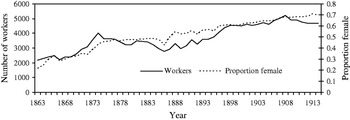
Originally, when the tobacco industry first began in Sweden in the seventeenth century, the workforce was male-dominated. As in other countries, women in Sweden entered the industry in great numbers on the introduction and growth of cigar production from the mid-nineteenth century onwards. Figure 1 shows that while the tobacco workforce more than doubled in size between the 1860s and the 1920s, the proportion of female workers grew from around 25 per cent to virtually 70 per cent.Footnote 25 At the time of the 1898 survey, more than 60 per cent of the workforce was female, although the gender composition differed between branches. In the new branch of cigarette production, for example, women formed 96 per cent of the workforce, while in the production of rolling tobacco the gender composition was more even and snuff production employed only a handful women. Although some low-skilled occupations were almost exclusively female, such as those within the preparation process, women were not excluded from high-skilled occupations: the gender division of labour was less pronounced than it previously had been in the mid-nineteenth century and before.Footnote 26
Numbers of workers in the Swedish tobacco industry and the proportion of the total workforce who were female, 1863–1914. (Source: Bidrag till Sveriges Officiella Statistik: Fabriker och handtverk (Stockholm, 1863–1912), and Industri (Stockholm, 1913–1914), the latter published by Statistiska Centralbyrån.)

In many contexts, the production of tobacco goods is associated with child labour. By the mid-nineteenth century the Swedish tobacco industry was characterized by a relatively high proportion of child workers, but over time this decreased. The decline was initiated well before the prohibition of child labour in 1881, and has been attributed not only to changes in the production process but also to the introduction of compulsory schooling.Footnote 27 By the end of the nineteenth century, child labour in its proper sense had been abolished in the tobacco industry. There was certainly a high proportion of young workers, since 22 per cent of all workers were under 18, but very few of them were under 14.Footnote 28
The incidence of occupational following, as mentioned above, is related to the interface between home and work. In areas where tobacco was grown in Sweden, such as the region around Landskrona, Kristianstad and Åhus, which lies in Scania in the south of the country, there was a tradition of home industry.Footnote 29 Although the interface between work and home was probably closest where production was undertaken in the home, the interface may not have been completely removed in the case of factory work. In some factories, the nature of the production process allowed workers to perform certain tasks in the home. An observer of the late nineteenth century noted, however, that the practice was not very common at the time of observation.Footnote 30
It should also be noted that the tobacco workers were pioneers in the Swedish labour movement, their first local trade union dating from 1883 and the national organization from 1889. The Tobacco Workers' Union was open to all categories of workers in the industry: skilled and unskilled, men as well as women. There were no formal rules restricting union membership. In 1898, 30 per cent of the tobacco workers were union members.
4. THE DATA
The Swedish tobacco industry was the subject of a large-scale survey undertaken in 1898 by the National Board of Trade (Kommerskollegium).Footnote 31 It was carried out by Henning Elmquist, a statistician, with the help of three travelling agents who collected information from all employers and workers. The workers were asked to provide personal information such as birth date, place of birth, parents' occupation, spouse's occupation, number of children, present job title, year when entering the branch/current job/employment at the present factory, weekly income, wage form (piece rates or time wage), whether or not the wage was paid by a middle-man, health status, membership of different organizations, and so on. In total, the agents managed to collect answers from 4,380 tobacco workers (1,621 men and 2,759 women). We have extracted data from all but 5 of these workers, whose forms have been lost. The answers from some of the workers were also incomplete for our purposes, which has reduced the numbers of observations in our analyses somewhat.
With regard to kinship, the survey included several aspects of interest, for example, parents' occupations, husband's/wife's occupation, number of living children, number of children in the home and the number of children employed in the tobacco industry. As a consequence of the cross-sectional nature of our dataset, complete information on the parents' careers is not available; the answers noted in relevant field of the questionnaire should rather be understood as the jobs held by the father and the mother at the time of the survey, or at the time of their retirement or death.Footnote 32 Consistent information is therefore lacking on the father's occupation at the time when the individuals in the survey population entered the tobacco industry. This could be a problem if it was common for male tobacco workers to change occupations as they aged, but there is little reason to believe that this was the case. There was a strong work identity, and the most common career pattern among male tobacco workers in the late nineteenth century was rather that they entered the industry at fairly young ages as apprentices and remained in the industry as long as they could. During the training period the workers made investments in their own human capital, the returns of which would be forgone if they moved to another industry. For many workers there were also experience premiums. Moreover, the opportunities to remain in the tobacco industry for older workers were fairly good, since the tasks were generally physically undemanding and the pace of work was not accelerated by machines.Footnote 33
5. OCCUPATIONAL FOLLOWING IN THE SWEDISH TOBACCO INDUSTRY
In this section, we consider how common occupational following between parents and children was among workers directly involved in tobacco production, and whether it was found more often among certain categories of workers. We also examine the consequent effects.Footnote 34
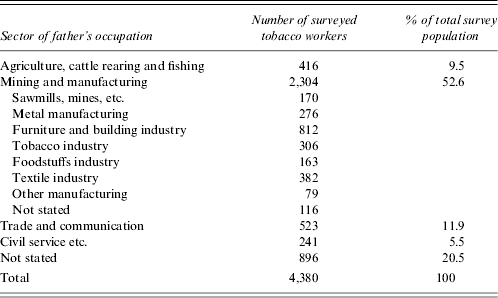
As Figure 1 shows, the Swedish tobacco industry experienced a pronounced growth in terms of numbers employed in the latter part of the nineteenth century. Relatively few of the new tobacco workers were recruited from the agrarian sector. Table 1 indicates that, by 1898, more than half of the tobacco workers had a father who had been employed in mining and manufacturing. In this respect, the tobacco industry's labour force looked much like that in the mechanical engineering industry and other manufacturing industries. Most workers in manufacturing belonged to the second generation of factory workers; however, relatively few of the individuals in our dataset belonged to the second generation of tobacco workers.
The numbers of workers in the 1898 survey according to father's occupational sectorFootnote a

a The occupational classification is in accordance with the one applied in the official population statistics of the time. ‘Workers’ (without further specification) have been included in the group ‘Not stated’.
Source: Henning Elmquist, Undersökning af tobaksindustrien i Sverige (Stockholm, 1899), 88–9.
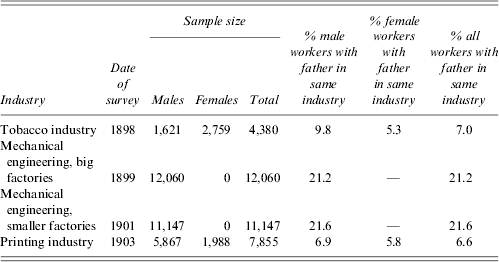
Table 1 also shows that of the 2,304 individuals with fathers in the ‘mining and manufacturing’ category only 13 per cent had fathers who were, or had been, employed in the tobacco industry. Of the 4,380 tobacco workers in the survey the 306 with fathers in the same industry amounted to 7 per cent of the total. Where an industry employed both males and females it was generally more common for the men to have a father in the same trade, as Table 2 indicates for both printing and the tobacco industry. However, comparing the situation in different industries that were also surveyed in the same manner at about the same time as the tobacco industry, from Table 2 it appears that just under 10 per cent of male tobacco workers in 1898 had a father in the industry, whereas in the mechanical engineering industry the equivalent share that year exceeded 20 per cent.
Percentages of workers in selected industries with fathers in the same industry in Sweden, 1898–1909

Sources: Henning Elmquist, Undersökning af tobaksindustrien i Sverige (Stockholm, 1899), 89; Undersökning af den mekaniska verkstadsindustrien i Sverige, vol. 1: Större egentliga mekaniska verkstäder (Stockholm, 1901), 88, and vol. 2: Mindre egentliga mekaniska verkstäder sami vissa specialverkstäder m. m. (Stockholm, 1904), 105; and Undersökning af tryckerier och därmed forenad handtering i Sverige (Stockholm, 1909), 79.
With regard to the mother's occupation, most workers either stated that their mother worked in the home or did not state an occupation at all. Only 12 per cent of male workers and 14 per cent of female workers reported that their mother was or had been employed outside the home. This reflects the importance of the male-breadwinner norm, which prescribed that men were primarily workers whereas women should take prime responsibility for family and household duties.Footnote 35 This norm may have made workers less inclined to state the occupation of their mother. Many of the latter may have been employed during certain phases of their lives but had retreated to the home by the time of the survey. It is possible that some of the workers in the survey were not aware of their mother's previous occupation or occupations. Their weaker labour-market attachment also made it more difficult for women to use their connections to influence the careers of their children. During the time from when a woman left her job to raise children to when the children were ready to enter the labour market, much may have happened in the industry in which the woman had been employed. In the survey there were 592 mothers with a stated labour-market attachment, and 30 per cent of these were, or had been, tobacco workers. This means that only about 4 per cent of the tobacco workers can be said with certainty to have had a mother with experience of the industry. The remainder of this article therefore focuses on occupational following in the footsteps of fathers, considering the career paths of both sons and daughters.
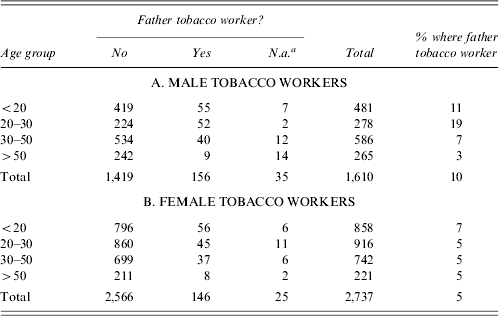
Table 3 shows the absolute numbers and relative frequencies of men and women who stated that their father was or had been a tobacco worker. Two basic observations can be made: first, occupational followers – that is, individuals who were in the same occupation as their father – were more common among men than women in all age groups except for older workers. This finding is in line with conventional ideas of the gender division of labour, according to which it is more natural – and possible – for a son to follow in the footsteps of his father than for a daughter to do the same thing. Second, younger workers of both sexes more often had a father in the same trade than did older workers, which is in line with all other studies of occupational following of which we are aware.Footnote 36 Irrespective of time and space, it appears that young individuals starting out in employment are more likely to be in the same occupation as their parents than individuals further on in their career. This can be seen as a reflection of the fact that workers' ability to exert their own occupational choice usually increases with age. In early industrial society the most convenient thing for parents to do was to introduce a child ready for employment into their own trade. In that way they retained some supervision and control over their offspring. When they came of age young workers could decide to leave the trade originally selected if another trade appeared more attractive. Of course, it is possible that workers who had not originally entered their father's occupation may have moved into that occupation at a later age, but this flow was considerably smaller than the former.
Father's occupation by age and sex of tobacco worker in Sweden, 1898

a Not available.
Source: Specialundersökningar Tobaksindustrien 1898, Statistiska avdelningen, HIII b:1, Kommerskollegiets arkiv, National Archives (Riksarkivet), Stockholm.
What were the determinants of following in one's father's footsteps?
A small but significant group of Swedish tobacco workers in 1898 had fathers who had at some point been employed in the tobacco industry. In order to more fully understand occupational following, we investigate what its determinants were in the tobacco industry, and how it was related to various characteristics at the level of both the individual and the firm using logistic regressions. Occupational following is constructed as a dichotomous variable. The logistic model estimates the effects of various determinants (covariates) on the transformed probability of having a father in the industry or not, and a set of coefficients corresponding to each outcome category (y) is estimated. Vector x is a vector of explanatory variables and β is a vector of estimated parameters. The set of parameters reflects the impact of changes in x on the transformed probability. The logistic model can be written as:

It should be noted that our model is not causal in the sense that the independent variables are thought to be causing the outcome of the dependent variable. Rather, we are using the regression technique to account for, and describe the characteristics of, occupational followers and non-followers. From that we may approach possible explanations of our findings with respect to occupational following.
The explanatory variables include two measures of age: age when entering the industry and present age at survey. The first variable measuring age is expected to be especially important for those entering the industry at young ages. The older the worker was when entering the industry, the less likely that his/her occupational entrance was influenced by parents, and the same is true for age at survey since the older the worker was in 1898 the less likely it is that he/she was to have been in the industry in which he/she was first employed. However, since we are dealing with cross-sectional data, the expected patterns may also be affected by period effects and secular trends. For example, it may be that parents played an important role in recruitment decisions in certain phases, such as in recessions. Potential associations with the tobacco industry's expansion over time are captured by the variable ‘present age at survey’.
We include one variable (‘birthplace, workplace’) which indicates whether a worker was born in the same location as the present workplace or if he/she was a migrant, and another (‘birthplace, home production’) indicating whether the worker was born in an area where tobacco was cultivated and home production of tobacco goods was prevalent.Footnote 37 Both variables are supposed to capture the degree of proximity between home and work, which would increase the likelihood of occupational following.
The inclusion of age and place of birth as variables in our model is motivated by theory but there are further variables that, based on previous research, should also be investigated. Occupational following is often associated with apprenticeship and the existence of family-based subcontracting, and we therefore control for these variables.
All of the abovementioned variables are measured at the individual level. We also take into account characteristics of firms, such as workplace size and workplace location, since these may capture differences in recruitment strategies. It is often believed that the importance of kinship for factory work was greater in the countryside than in urban areas and in small workshops than in big factories. However, kinship ties may also have mattered for big employers in densely populated areas, since workplace location can capture differences in labour market conditions. On the one hand, labour markets in the big cities were more diversified and offered more choices but, on the other hand, the supply of labour was also greater, which may have strengthened employers' incentives to use family background as a screening device.
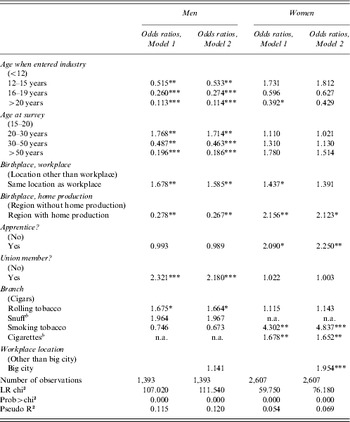
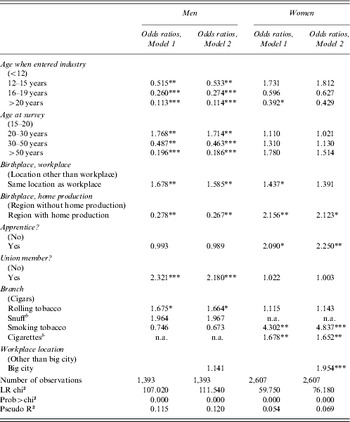
We conducted the multivariate analysis step-wise by first looking into the effects of age and job-related characteristics (Model 1) and thereafter entering workplace-related characteristics (Model 2). Since the underlying mechanisms for the intergenerational transmission of occupations may have been highly dependent on sex, we estimate separate regressions for men and for women for whom we have full information on all the covariates. The results are presented in the form of odds ratios shown in Table 4.
Factors associated with the probability of a worker in the Swedish tobacco industry having a father in the same industry, 1898 (reference categories in parentheses)Footnote a
* p<0.1, ** p<0.5, *** p<0.01.
a We also controlled for whether the individual was paid by a middle-man or not (Model 1 and 2) and for workplace size (Model 2).
b Due to a small number of observations in these categories and very little variation, the maximum-likelihood procedure does not work in those cases where the estimation predicts failure perfectly. This happens typically in the most gender-segregated branches. Therefore, when very small numbers of workers of one or other gender apply, we have not calculated the odds ratios for that gender.
Source: As in Table 3.
Our results show that, as expected, gender clearly mattered for occupational following in the tobacco industry: the characteristics of occupational followers and non-followers were highly dependent on gender, and relationships that were strong for male workers were often weak or reversed for female workers, and vice versa. The significance of these gender differences has been confirmed by estimating regressions on a pooled sample with interaction effects. For male workers, as can be seen in Table 4, age when entering the industry mattered significantly. Compared to boys who began working in the tobacco industry before age 12, those who began at age 13 and older were much less likely to be in the same trade as their father and the chances decreased with age. This pattern is robust, even after adding workplace-related characteristics to the analysis. For female workers, on the other hand, the age pattern is less consistent, and the results are not statistically significant. Nevertheless, it seems as if girls who entered the industry between the ages of 12 and 15 were much more likely to have a father in the industry in comparison to girls who entered the trade at a younger age.
Also, when it comes to age at survey, the patterns differ for men and women. Whereas men in the age span 20 to 30 were most likely to be occupational followers and, as expected, older men in our sample were less likely to be, the same cannot be said for women. For women, age at survey does not really seem to have been related to the probability of being an occupational follower. This may be a result of women having less work experience and a less strict labour market attachment than men due to a different life-cycle pattern.
With respect to birthplace location, men as well as women who were born in the same location as the present workplace were significantly more likely to have a father working in the tobacco industry than their peers born in other locations. Proximity between work and home, however, had a gender dimension. The results show that the transfer of the trade from fathers to sons was not common in areas with home production of tobacco goods. In these areas, the transfer of the trade rather went from fathers to daughters, since women born in areas with home production were significantly more likely to have a father in the tobacco industry than women working in the tobacco industry who were born in other areas. This finding may reflect a preference of families in areas with home production for keeping their daughters in the household as long as possible, or the daughters' own wish to remain with their parents. It could also be understood as an expression of the fact that, during the period under study, home production was contracting and had weak future prospects. In line with the adaptive family economy, fathers probably sent their sons to more rewarding occupations if they had a choice. Moreover, by this time, factory work was the common way of producing tobacco goods and was not necessarily connected to areas with cultivation and home production. It might be, however, that geographical proximity mattered more for the girls' introduction into the trade, via their fathers, since they were equipped with more knowledge and presumably also more skills than girls born in other locations.
Another result that indicates a gender dimension of recruitment of family members is that of entering the trade as an apprentice. Whereas the odds ratios, although not statistically significant for men, indicate that being an occupational follower was equally likely irrespective of having the status of an apprentice or not, women apprentices were significantly more likely to have a father in the trade. Family ties may have served as a guiding principle for the employers in cases where women were recruited to restricted positions or jobs that were uncommon for their gender. Additional evidence demonstrates that in factories, where the great bulk of production took place, female apprentices more often had a father in the same trade than their male colleagues. For the period of study, female apprentices were controversial in the light of the then fairly recent feminization process of cigar production. Girls probably needed the backup of a father in the same occupation to be accepted and recruited, whereas boys did not need this.
Nevertheless, family ties also mattered for men but in a different way than for women, which is evident with respect to the relationship between union membership and occupational following. Unions, especially in the period of study, were often regarded as advocates of male workers' interests. We have elsewhere established that male tobacco workers were more likely to be union members than female workers, even when controlling for differences in experience, occupation and other characteristics.Footnote 38 In this study we see that male union members more often had a father in the same occupation. For women, on the other hand, occupational following was equally likely, irrespective of union status. One interpretation of this finding is that men who had inherited their occupation had a stronger occupational identity: they were more focused on a career in the trade; they learned how to work their way from their fathers; and therefore they had stronger incentives to join the union.
Turning to the workplace-related characteristics, it has previously been established that women constituted a greater share of the workforce in tobacco factories located in big cities than in factories located elsewhere in the country. Employing women was probably less controversial in the cities than in the countryside. Our finding that women working in the big cities were much more likely to have a father in the tobacco industry than other women can be seen as another piece of evidence of the fact that family ties mattered for women and also worked as a principle of selection of potential employees for the employers. In the big cities there were more women looking for jobs and, facing a greater pool of applicants, family background became an important screening device.
What were the advantages of following in one's father's footsteps?
Family background has increasingly been included in recent years as an explanatory variable when analyzing educational attainment and earnings.Footnote 39 For example, having highly educated parents is thought to be positively related to the educational and occupational attainments of individuals in modern society. There are various mechanisms leading to this outcome. Parents may sponsor the schooling of their children, may transfer skills, manners and social networks and may have access to better information on the prospects of various career paths. In some contexts, parents may also be in positions where they may directly favour their own children when it comes to labour recruitment and promotion.
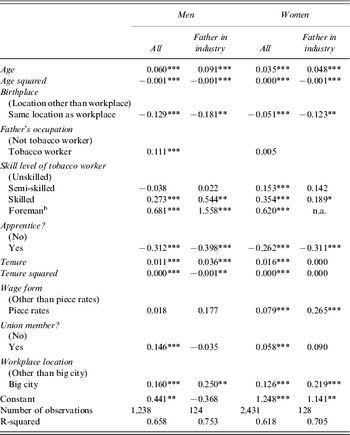
There are as yet few studies of the importance of family background for earnings and careers in the labour markets of early industrial society.Footnote 40 In this section, we concentrate on the role of paternal occupation in the earnings of men and women by estimating standard Mincerian earnings equations that control for a number of individual and firm-level characteristics that are thought to explain earnings differentials among the workers in the dataset.Footnote 41 We estimated separate equations for male and female workers for which we have full information on all the covariates. The results of ordinary least squares estimates with robust standard errors are reported in Table 5.
Ordinary least squares estimates of log weekly earnings (robust standard errors) for workers in the Swedish tobacco industry aged 15 and over in 1898, by sex (reference categories in parentheses)Footnote a

* p<0.1, ** p<0.5, *** p<0.01.
a We also controlled for health status, civil status, children living at home, branch, multiple skills, working hours, whether the individual was paid by a middle-man, membership of friendly society, and workplace size.
b Due to very small numbers of observations, the category ‘Female forewoman with father in textile industry’ has been excluded.
Source: As in Table 3.
The general impression is that the results are to a high degree statistically significant and in line with theoretically based expectations. There are some interesting gender differences to note when it comes to the results. Family background – that is father's occupation – is one such example. Net of all factors, being an occupational follower added a rise to men's earnings but not to women's. There are also gendered earnings effects among those who had a father with experience from the same trade. Table 5 shows that, as expected, age was positively related to the earnings of male as well as female workers, with diminishing returns. Each year added a 6 per cent increase in male earnings, whereas for women each year added about 3.5 per cent to earnings. For those with a father in the industry, age added an even larger increase, irrespective of gender. Birthplace location mattered, but being born in the same location as the workplace actually exerted a negative effect of about 12 and 5 per cent for all men and women, respectively, and this negative effect was even stronger for those with a father in the industry.Footnote 42 The factor that made it easier to get into the tobacco industry was apparently not rewarding in monetary terms. For men, this negative effect was nevertheless compensated for by the positive wage effect of having a father in the trade since that added an increase of 11.7 per cent. For women, there was no positive wage effect of having a father in the same industry. Further dimensions of the gender and earnings effects of having a father in the tobacco industry are indicated by the variables controlling for wage form and union status. Generally these indicators have been found to be important for gender-earnings differentials in different industries at this time and our results confirm the previously established relationships. Piece rates mattered, and exerted a positive wage effect of 8 per cent for all women and added a significantly higher bonus for women with a father in the trade, which is in line with the robust findings of many studies exploring the determinants of performance pay.Footnote 43 Clearly, being paid by the piece was rational for women and probably a way of avoiding discrimination. Being a union member was, as expected, much more beneficial, in monetary terms, for men, which is in line with presumptions that union activities in the formative years of the labour movement were more oriented towards pursuing the interests of men than those of women.Footnote 44 Moreover, net of other factors, men and women in skilled positions earned significantly more than the low-skilled, and the rise in earnings was especially steep among men who had a father with experience in the industry. As expected, there was a strong negative earnings effect of about 27 per cent for men and 23 per cent for women for being an apprentice, and it was even stronger for occupational followers. Generally, it may be said that the effects were basically the same when considering occupational followers only. If there was a change in magnitude, the effects were usually stronger for those with a father in the industry and this is as expected. In line with this, we see that the effects of tenure – that is, another aspect of skill and human-capital accumulation – grew stronger for male occupational followers only, which indicates that they advanced more rapidly and earned higher wages than other workers. Workplace location mattered significantly with respect to earnings in that working in one of the three biggest cities was beneficial for both men and women. For all men, a big-city location added a 17.4 per cent increase and for women the equivalent increase was 13.4 per cent. For both genders, the increase was much bigger for occupational followers.
From Table 5 it becomes evident that there were advantages to having a father in the industry, especially for men, since being an occupational follower added to earnings, net of other factors. But it is also clear that gender mattered. There were systematic differences with respect to what factors mattered, and how much they mattered, for male and female earnings respectively. Among occupational followers, these gender differences became more acute. Taken together, the impact of family background seems to be yet another example of how gender differentials manifested themselves in the labour market of Swedish tobacco workers. Thus, it was not only more common that male workers had inherited their occupation from their father but doing so was also more beneficial for male workers.
6. CONCLUSIONS
The role of the family in the industrialization process is much debated. Here we have looked into occupational following among workers in the Swedish tobacco industry around the turn of the twentieth century. The setting does not stand out as an industry where the transmission of occupations over generations was particularly common. About 7 per cent of the tobacco workers had a father in the same occupation. Male and young workers were overrepresented in this respect. Multivariate analyses confirm that the patterns of occupational following were highly gendered and dependent on age. Male tobacco workers who had entered the industry at a young age were, for example, much more likely to have been introduced to the occupation by their father, whereas this pattern is less clear for women. Gender, however, mattered significantly with respect to recruitment and the determinants thereof. Considering birthplace location, workplace proximity and location and apprenticeship, we see that family ties were even more important for women, as the recruitment often meant crossing gender lines and thus family ties probably served as a guarantee and guiding principle for employers when hiring, and we see that they preferred to recruit daughters of already known individuals in relation to other girls. In big-city areas family ties served as an important screening device for employers who had a large pool of applicants to recruit from. Moreover, the controversial issue of employing female apprentices was mediated by the fact that fathers served as guarantors. One has to consider that, in industrial work in 1898, formal credentials mattered little. However, gender mattered and a woman's place was not primarily seen to be in the workplace. For boys and men, who were primarily wage earners, family ties were not that vital in the recruitment process. They had more options to choose from because they were considered the preferred choice of industrial workers to recruit. Family ties and fathers serving as guarantors were probably more important for the advancement and career prospects of women.
Just as there were significant differences with respect to the characteristics of occupational followers and non-followers, there were significant earnings effects, with father's occupation affecting earnings more for men than for women. The earnings effects were generally stronger for occupational followers. Estimating separate equations for male and female workers turned out to be relevant since the variables of interest had different importance for men and women. Male workers who followed in their father's footsteps earned, net of other factors, about 12 per cent more than their colleagues whose fathers had been employed in other trades. Female workers, on the other hand, did not have the same advantage. On the other hand, there were other things that mattered more for women, such as being paid by the piece, which was a way of avoiding the negative effects of gender stereotyping, which was very prevalent then and still exists in many labour markets today.
ACKNOWLEDGEMENTS
This article is a part of the project ‘Family and factory: kinship, migration and recruitment of labour in Swedish tobacco industry around 1900’, financed by the Centre for Economic Demography, Lund University, and the Swedish Research Council. We thank the two anonymous reviewers and the participants at the annual meeting of the Social Science History Association in Miami, October 2008, for useful comments and suggestions.