INTRODUCTION
Fruit characteristics affect the composition of assemblages of animals that eat tropical fruits and disperse seeds (Jordano Reference JORDANO1994, van der Pijl Reference VAN DER PIJL1982). An ecological reality is that dispersal agents that forage for fruits at a tree species may or may not differ in their effectiveness from the plant perspective. It therefore matters which species of fruit-eating animals visit a given tree species, the frequency of those visits, and where they leave seeds (Schupp Reference SCHUPP1993, Westcott et al. Reference WESTCOTT, BENTRUPPERBAUMER, BRADFORD and MCKEOWN2005). Because dispersal agents differ in susceptibility to hunting, fragmentation, logging and habitat loss (Corlett Reference CORLETT2007, Fa et al. Reference FA, RYAN and BELL2005, Hamann & Curio Reference HAMANN and CURIO1999), the nature of interactions between tree species and intact disperser faunas are important in understanding potential effects of habitat modification and declines of potential dispersal agents from hunting or other disturbances.
Fruit size and nutritional characteristics underpin the ‘specialist-generalist paradigm’ of plant-frugivore dispersal systems (Howe Reference HOWE1993, McKey Reference MCKEY, Gilbert and Raven1975). Consistent with the specialist-generalist framework, large seeds together with particularly fat- or protein-rich fruit pulp typify high-investment dispersal syndromes that attract a few loyal frugivore species that consistently disperse seeds to potentially suitable sites for germination and seedling recruitment (Howe Reference HOWE1993). At the generalized end of the spectrum, prolific small-seeded tree species represent low-investment strategies for attracting many, generalist frugivores (McKey Reference MCKEY, Gilbert and Raven1975). The framework may have little relevance to second-growth forests of small-seeded trees with disperser assemblages of small (most < 100 g) birds (Carlo et al. Reference CARLO, COLLAZO and GROOM2003). Fruit and seed sizes are important in primary and old secondary tropical forests where trees bearing seeds of large dimensions physically restrict the number of animals that eat large-seeded fruits (Jordano Reference JORDANO1995a, Wheelwright Reference WHEELWRIGHT1985). In forests of the Indian Eastern Himalaya, orders of magnitude differences in seed dimensions and in sizes of native fruit-eating animals make tests of specialization-generalization feasible.
Here we study seed removal of hornbill-dispersed tree species in forests of the Eastern Himalaya. We compare the seed-removal effectiveness of hornbills and other frugivores for these tree species. Four tree species have extremely large seeds (> 18 mm width) that can be handled only by birds with wide gapes, while two species have medium-sized seeds (< 7 mm width) falling well within the gape-size range of many frugivorous birds. We use these tree species to test the following hypotheses: (1) Tree species with small- to medium-sized seeds have many disperser species and higher rates of disperser visitation and seed removal than large-seeded ones because smaller seed size permits birds with both small and large gape widths to eat them. Consequently, disperser assemblage size reflects seed size. (2) Large-seeded tree species depend on large-bodied frugivores with wide gapes, like hornbills and large pigeons, for dispersal, while tree species with small seeds have many dispersal agents. Consequently, large-bodied frugivores are quantitatively effective dispersers of trees with the largest seeds, but are likely to play a lesser role as dispersers of tree species with smaller seeds that attract a diverse disperser assemblage. Here we use visit frequency and number of seeds removed per frugivore (the ‘quantitative’ dimension of seed-dispersal, Schupp Reference SCHUPP1993) as approximations of dispersal effectiveness.
METHODS
Study site
The study was conducted in Pakke Wildlife Sanctuary (862 km2) located in the East Kameng district (26°54′N–27°16′N, 92°36′–93°09′E) of Arunachal Pradesh, India. The forests lie within the Eastern Himalayan biodiversity hotspot (Myers et al. Reference MYERS, MITTERMEIER, MITTERMEIER, DA FONSECA and KENT2000) at the confluence of the Indo-Malayan, Indo-Chinese and Indian biogeographic realms, and have close biological affinities to South-East Asia (Mani Reference MANI1974). The forests of Pakke, part of the northernmost tropical rain forests in the world (Whitmore Reference WHITMORE1998), have tropical semi-evergreen vegetation (Champion & Seth Reference CHAMPION and SETH1968). Accessible altitudes are ~200–500 m. Peripheral areas of Pakke sanctuary were commercially logged until the late 1970s, but today logging has ceased and the sanctuary is free of human habitation. Hunting of hornbills in Pakke is negligible due to monitoring by forest staff along with community-centred initiatives of local conservation agencies. The Reserve Forests surrounding the sanctuary are hunted by tribal communities and affected by tree felling.
Tree species
Focal tree species include three large-seeded trees with capsular fruits, Dysoxylum binectariferum (Roxb.) Hook.f. ex Bedd., Chisocheton cumingianus (C. DC.) Harms (synonym: C. paniculatus (Roxb.) Hiern) and Aglaia spectabilis (Miq.) Jain & Bennet (syn.: Amoora wallichii King) (all Meliaceae) and a large-seeded tree bearing drupes, Polyalthia simiarum (Buch.-Ham. ex Hook.f. & Thomson) Benth. (Annonaceae). Species with smaller seeds are Litsea monopetala (Roxb.) Pers. and Cinnamomum bejolghota (Buch.-Ham.) Sweet (both Lauraceae).
Chisocheton cumingianus and D. binectariferum are medium-sized, evergreen trees bearing dehiscent capsules with arillate seeds. Chisocheton cumingianus fruits from April to July with a peak from mid-May to June (Datta Reference DATTA2001). Black seeds are partially surrounded by orange arillodes. Orange fruits of D. binectariferum bear three to four greenish-yellow seeds covered by black arils. Fruiting is from February to May with a peak in March–April (Datta Reference DATTA2001). Aglaia spectabilis is a canopy emergent tree ~ 40 m in height bearing dehiscent brown capsules. Fruits contain two or three seeds surrounded by an edible orange aril. Seed size (with aril) averages 29.5 ×18.8 × 14.7 mm (Sethi Reference SETHI2010). Fruiting is from May to August peaking in June–July (Datta Reference DATTA2001). Polyalthia simiarum, an evergreen tree ~ 31 m in height, bears abundant large drupes that change from green to red when unripe to black when ripe. Most trees fruit from May to August; some also fruit from November to February (Datta Reference DATTA2001, Sethi pers. obs.). Average seed sizes (with aril) of C. cumingianus, D. binectariferum and P. simiarum are 31.4 ×23.7 × 19.3 mm, 29.6 ×22.0 × 17 mm and 28.9 ×19.8 × 17 mm respectively (Sethi & Howe Reference SETHI and HOWE2009).
Litsea monopetala is a dioecious evergreen tree ~ 15 m tall. Single-seeded drupes are 7–12 mm in length and 5 mm in width (Ara et al. Reference ARA, MIA and KHAN2007). Fruiting is from June to July. Cinnamomum bejolghota is an evergreen tree with bisexual flowers. The fruit is ovoid, green when young turning blackish green when ripe. The single-seeded drupe averages 10.8 × 6.5 × 5.9 mm (Sethi Reference SETHI2010). Fruiting is in June and July.
Disperser assemblage
Large birds feeding at focal trees are hornbills (Bucerotidae) and large fruit pigeons (Columbidae). These include the great Indian hornbill, Buceros bicornis (2.2–3 kg), wreathed hornbill, Rhyticeros undulatus (2–2.5 kg), oriental pied hornbill, Anthracoceros albirostris (0.7–0.8 kg) and mountain imperial pigeon, Ducula badia (0.5–0.6 kg). The green imperial pigeon (D. aenea) also occurs in Pakke but did not visit focal trees in this study. The rufous-necked hornbill (Aceros nipalensis) occurs at elevations > 900 m. Pakke also has a large assemblage of frugivorous or granivorous birds with smaller gape widths, some of which such as the blue-throated barbet (Megalaima asiatica), the lineated barbet (M. lineata) and the hill myna (Gracula religiosa), amongst others fed on the fruits of study trees.
Large-bodied, mammalian frugivores of focal trees include the rhesus macaque (Macaca mulatta) (5–8 kg) in some peripheral areas of the park, and possibly Assamese macaque (M. assamensis). The capped langur (Trachypithecus pileatus) (~12 kg) also occasionally eats fruits although it is predominantly folivorous (Solanki et al. Reference SOLANKI, KUMAR and SHARMA2008). Pre-dispersal seed predators include the Malayan giant squirrel (Ratufa bicolor), Pallas red-bellied squirrel (Callosciurus erythraeus) and hoary-bellied squirrel (C. pygerythrus). Post-dispersal secondary predators include smaller rodents (Velho et al. Reference VELHO, DATTA and ISVARAN2009). Taxonomic nomenclature for birds follows Grimmett et al. (Reference GRIMMETT, INSKIPP and INSKIPP2000), and for mammals follows Menon (Reference MENON2003).
Focal tree watches and visitor assemblages
Watches of four large-seeded and two medium-seeded tree species were carried out from March to July, 2005 during peak fruit abundance in Pakke (Datta & Rawat Reference DATTA and RAWAT2003). Watches were conducted at three, nine, seven, nine, four and two trees respectively of Dysoxylum binectariferum, Chisocheton cumingianus, Aglaia spectabilis, Polyalthia simiarum, Litsea monopetala and Cinnamomum bejolghota. To increase sample sizes, we sampled nine additional trees of D. binectariferum and six of C. bejolghota in 2006. Pooling of data might obscure annual variation in visitation rates to focal trees, but larger samples provide a more accurate estimation of the number and types of dispersers and their relative contribution to seed dispersal (Kitamura et al. Reference KITAMURA, SUZUKI, YUMOTO, POONSWAD, CHUAILUA, PLONGMAI, NOMA, MARUHASHI and SUCKASAM2004). We used the pooled data only to estimate the removal efficiency of frugivores.
Individuals of each species were spaced > 100 m apart. Each tree was watched from dawn to dusk, approximately 11–12 h. Watches were temporarily halted during heavy rain or intense elephant activity. Because hornbills are wary, camouflaged hides were in place prior to each watch. Hides were occupied before sunrise to minimize disturbance. Crop sizes of medium-seeded species and drupe-bearing large-seeded trees were estimated by counting fruits on five randomly selected branches, averaging the number of fruits and then multiplying this number by the total number of branches on the tree. For species with fewer, easily countable capsules, crop sizes were directly determined with complete fruit counts. These were then multiplied by the average number of seeds per capsule so that crop sizes of all species were in terms of seeds removed.
To determine visitation to trees, we recorded arrival and departure times of each visitor. Vertebrate visitors were identified, categorized by body size, and classified as dispersers (removed seeds from trees), predators (ate or destroyed seeds or moved seeds to arboreal hoards) or non-dispersers (dropped all seeds under parent crowns, pecked at the fruit without dispersing the seeds, or visited the trees but did not feed on fruit or seeds).
Differences of tree species in size and activity of disperser assemblages
To determine if seed size influences disperser species diversity, abundance, visitation frequency, and visit duration, we grouped tree species into two seed-size classes. For each seed-size class (large and medium) we assessed on a per tree basis differences in: (1) total abundance of dispersers, (2) number of disperser species, (3) number of seeds dispersed (number removed minus the number dropped) and (4) duration of visits. Because fruit crop size influences visitation independently of seed size, we included crop size as a covariate in the analysis. Crop size variation between individuals of a tree species may also influence visitation and seed removal efficiency (Howe & Vande Kerckhove Reference HOWE and VANDE KERCKHOVE1980). We therefore assessed whether crop-size variation amongst individual trees of a particular species influenced visitation rates and/or the number of seeds dispersed per tree.
Removal efficiency of frugivore species
For individual tree species, we determined the relative effectiveness of each frugivore species in its contribution to seed dispersal. To determine removal efficiency of each frugivore species, we multiplied the mean number of seeds taken per visit by the total number of foraging visits made (Holbrook & Loiselle Reference HOLBROOK and LOISELLE2009). This allows estimates of total number of seeds removed by each consumer during the entire observation period across all trees. These estimates were summed across disperser species to estimate the total number of seeds dispersed. The estimate for each disperser species was divided by this sum to yield the removal efficiency of each disperser, relative to other dispersers.
For each tree species, we determined if dispersers varied in the number of visits made to each tree and in the number of seeds dispersed per visit. We calculated the number of seeds dispersed per visit by subtracting the number of dropped seeds from the number removed. For purposes of this paper, we consider removed seeds as dispersed.
Statistical analyses
To determine if seed size influenced visitation in large- and medium-seeded tree species, we assessed differences between these two classes in visitation frequency and seed removal rates using Analysis of Covariance (ANCOVA) with crop size as a covariate and seed size as the independent variable. We included crop size because medium-seeded trees had larger crops (t = −5.4, df = 30, P < 0.001). Data were log-transformed prior to analysis to normalize distributions. The influence of variation in crop size between individuals of a particular tree species on visitation rates was also assessed by regressing crop size against (1) number of seeds dispersed per tree and (2) number of disperser visits to each tree.
Differences among disperser species in the quantity of seeds dispersed per visit and number of visits to each tree were assessed for each tree species. We used non-parametric Kruskal–Wallis and Mann–Whitney tests to test whether individual disperser species varied in the number of visits made to each tree or in the number of seeds they removed per visit. Bonferroni corrections for post hoc Mann–Whitney tests were based on the number of follow-up tests conducted. Analyses were performed using SPSS version 15.0.
RESULTS
Large- and medium-seeded tree classes
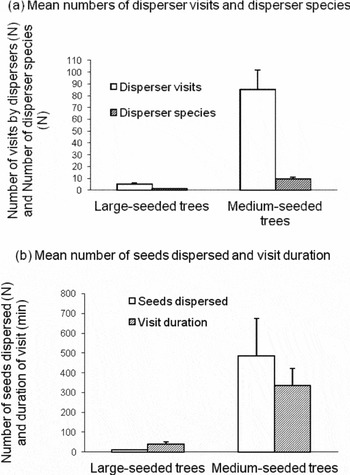
Disperser visitation rates to medium-seeded trees averaged 85 visits per tree per day versus five visits for large-seeded trees (ANCOVA F 1,29 = 20.8, P < 0.0001) (Figure 1a). Each large-seeded tree was visited on average by one disperser species per day, while each medium-seeded tree was visited by a mean of 10 disperser species (F 1,29 = 22.6, P < 0.0001) (Figure 1a). Seeds dispersed per tree per day from large-seeded species averaged 10, as compared with 486 for medium-seeded species (F 1,29 = 13.8, P < 0.002) (Figure 1b). Moreover, large-seeded trees had shorter visit durations per tree (mean ± SE, 41.9 ± 8.3 min) than medium-seeded trees (338 ± 83.7) (F 1,28 = 16.4, P < 0.0001) (Figure 1b). Seed size affected rates of visitation and seed removal, but crop size did not. Variation in crop sizes between individuals of a particular tree species also did not influence the number of disperser visits per tree (linear regression, P > 0.05) or the number of seeds dispersed per tree (linear regression, P > 0.05) for five of six tree species (A. spectabilis, C. cumingianus, D. binectariferum, P. simiarum, L. monopetala). The two C. bejolghota trees that were sampled in 2005 precluded analysis of crop size, visits or seeds removed.
Influence of seed size on the size and activity of disperser assemblages in a semi-evergreen forest of the Indian Eastern Himalaya. Bars represent the number of visits made by dispersers and the number of disperser species (a) and number of seeds dispersed and duration of visits (min) by dispersers (b) per tree per day to large and medium-seeded tree species. Medium-seeded tree species had significantly more disperser species, more visits, more seeds dispersed and longer visit durations by dispersers to trees than did large-seeded ones. Error bars indicate SE.

Removal efficiency and disperser effectiveness
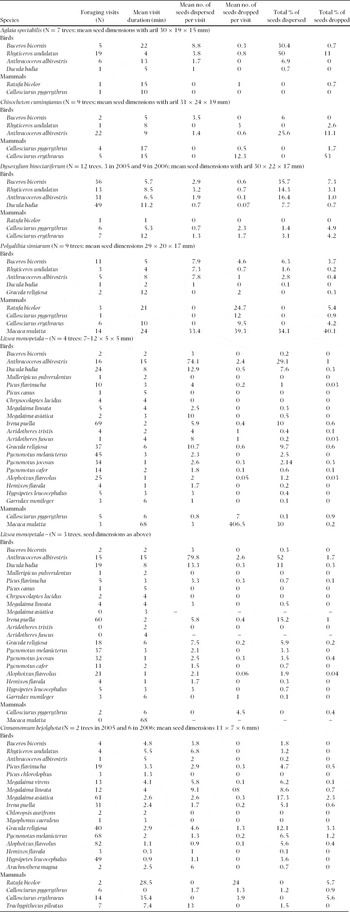
Large-seeded, capsular species (A. spectabilis, C. cumingianus and D. binectariferum) were dispersed by hornbills and Ducula pigeons. Large-seeded, drupaceous P. simiarum (Annonaceae), in contrast, was dispersed by additional animals. Three species of squirrel acted as seed predators, chewing and dropping seeds below parental crowns or moving them away to arboreal caches. Only in rare instances might the few that fell to the ground, sprout. These seeds were considered to be non-dispersed. Details of visitation and seed removal for each tree species is provided in Appendix 1. Six species consumed the fruits of A. spectabilis, of which three hornbill species and D. badia functioned as dispersers. Hornbills were the only avian visitors to C. cumingianus trees (25 visits) and removed 32% of all seeds taken throughout the observation period. Overall 32% of the seeds were dispersed, the remaining seeds were dropped. Visitation details are in Appendix 1.
Amongst large-seeded capsular trees, D. binectariferum had the most seeds dispersed and appeared to be the preferred forage species of hornbills and D. badia. In terms of seeds dispersed per visit, there were significant differences amongst all the four (three hornbill and imperial pigeon) disperser species (Kruskal–Wallis test; H = 7.9, df = 3, P < 0.05). Post hoc Mann–Whitney tests found a significant difference between Buceros bicornis (median = 1, N = 38) and D. badia (median = 2, N = 33) in the number of seeds dispersed per visit. For the number of visits to each tree, there were no significant differences amongst the four disperser species (H = 2.2, df = 3, P > 0.05). Across all sampled trees of D. binectariferum, Buceros bicornis was the main disperser, responsible for 36% of the total dispersal service.
Hornbills visited P. simiarum trees more frequently (19 visits) than Macaca mulatta (14 visits) or D. badia (1 visit). Hornbills dispersed 11% of all the seeds taken and D. badia 0.1%. Tree use by M. mulatta was restricted to removal of seeds from one tree located at the periphery of the forest. This macaque is rarely seen in the forest interior.
The smallest of the three hornbill species, Anthracoceros albirostris, appears to be an important disperser of L. monopetala. Although trees are visited by numerous avian frugivores (e.g. bulbuls, mynas and barbets), each of these small frugivores dispersed only a few seeds at a time. In contrast, hornbills removed significantly (U = 401; P < 0.001) more seeds per visit (median = 50.5 seeds, N = 14) than small-bodied birds (median = 3 seeds, N = 164). Ducula badia also removed more seeds per visit (median = 5 seeds per visit; N = 15) than did small-bodied birds (U = 853, P < 0.05), while hornbills removed more seeds per visit than the imperial pigeon (U = 57.5, P < 0.05). Anthracoceros albirostris removed the same percentage of seeds as other small birds put together. Macaca mulatta also dispersed a similar proportion of seeds to A. albirostris. However, as with P. simiarum, seeds removed by M. mulatta were all from one tree near the forest edge. Because M. mulatta is not found in the forest interior, the actual contribution of this species to dispersal of L. monopetala in the protected area is likely negligible. When we excluded the L. monopetala tree at the park border from analysis, A. albirostris removed most (52.3%) of the seeds while all the smaller-bodied dispersers together removed 33%, suggesting that the A. albirostris hornbill is a key disperser of L. monopetala.
Overall, small birds visited all sampled C. bejolghota trees more frequently (385 visits) than hornbills (14 visits). There were also significant differences in the number of visits paid to each tree by hornbills, Ducula badia, Trachypithecus pileatus and smaller-bodied dispersers (Kruskal–Wallis test; H = 13.5, df = 3, P = 0.004). Significantly fewer visits (U = 357, P = 0.003) were paid to each C. bejolghota tree by hornbills (median = 0, N = 18) than by smaller-bodied birds (median = 2, N = 70), while there were no significant differences in the number of visits paid to each tree by small-bodied birds and T. pileatus (U = 120, P > 0.0167) or Ducula badia (U = 123, P > 0.0167); analyses used a Bonferroni correction against a 0.0167 significance level.
Significant differences existed in the number of seeds removed per visit by hornbills, Ducula badia, T. pileatus and smaller-bodied dispersers (Kruskal–Wallis test; H = 13.2, df = 3, P = 0.004). Significantly more seeds were removed per visit by hornbills (U = 606, P = 0.011) (median = 3, N = 9) than small-bodied birds (median = 0, N = 262) but there were no significant differences in removal rates between D. badia and smaller-bodied birds (U = 337, P > 0.025): analyses used a Bonferroni correction against a 0.025 significance level.
In percentage dispersal service, however, hornbills removed a small fraction (5.2%) of the seeds across all sampled C. bejolghota trees. Small-bodied birds removed the overwhelming majority (69.9%) of seeds. Megalaima asiatica removed the most (17.3%) followed by Gracula religiosa (12.1%) and M. lineata (8%).
DISCUSSION
Visitor species assemblages, visitation frequency and seed removal of six tree species from the Indian Eastern Himalaya reflected seed size. As predicted, on a per tree basis the medium-seeded trees had far more visits by dispersers, more disperser species, longer visit durations and higher visit frequency than did large-seeded trees. Surprisingly, the much larger crop sizes of medium-seeded species failed to influence these parameters leaving only seed size among the variables of interest as the reliable predictor of seed removal.
Studies in South-East Asia (Becker & Wong Reference BECKER and WONG1985, Kitamura et al. Reference KITAMURA, SUZUKI, YUMOTO, POONSWAD, CHUAILUA, PLONGMAI, NOMA, MARUHASHI and SUCKASAM2004) indicate that large seeds are dispersed by small disperser assemblages. These often consist of hornbills and the imperial pigeon, which are consistent with our results obtained from forests in the north-east of India. In Pakke, hornbills disperse the seeds of over 80 plant species (Datta Reference DATTA2001), but likely are far more effective for some than others. At Pakke, B. bicornis, R. undulatus, A. albirostris and D. badia removed the seeds of Aglaia spectabilis. The same four species along with the brown hornbill (Anorrhinus austeni) fed on fruits of this tree in Khao Yai, Thailand (Kitamura et al. Reference KITAMURA, SUZUKI, YUMOTO, POONSWAD, CHUAILUA, PLONGMAI, NOMA, MARUHASHI and SUCKASAM2004). Both A. spectabilis in Thailand (Kitamura et al. Reference KITAMURA, SUZUKI, YUMOTO, POONSWAD, CHUAILUA, PLONGMAI, NOMA, MARUHASHI and SUCKASAM2004) and another Aglaia sp. in Pasoh Forest Reserve in Peninsular Malaysia (Becker & Wong Reference BECKER and WONG1985) depend on hornbills as their primary dispersers. Overall, both our results and the findings from South East Asia suggest that several species of Meliaceae are highly specialized for dispersal by hornbills.
Other vertebrates are unlikely to be important dispersers of large-seed capsular fruits of Meliaceae at Pakke. Capsular fruits of large-seeded Meliaceae do not fit the dull green-yellow or red-brown colour syndrome of fruits dispersed by bats in the Palaeotropics (Hodgkison et al. Reference HODGKISON, BALDING, ZUBAID and KUNZ2003). Further, no evidence of high fruit consumption at night is found in Thailand for Aglaia spectabilis (Kitamura et al. Reference KITAMURA, SUZUKI, YUMOTO, POONSWAD, CHUAILUA, PLONGMAI, NOMA, MARUHASHI and SUCKASAM2004). There is little evidence to suggest that civets eat the seeds of large-seeded Meliaceae (Sethi, pers. obs.). We doubt that night-time visitors are important foragers on fruits of these capsular species. Arboreal squirrels are unlikely seed dispersers (Becker & Wong Reference BECKER and WONG1985, Leighton & Leighton Reference LEIGHTON, LEIGHTON, Sutton, Whitmore and Chadwick1983). Ratufa bicolor, Callosciurus erythraeus and C. pygerythrus are pre-dispersal seed predators, chewing and biting capsules and seeds and dropping them to the forest floor.
The study might underestimate assemblage sizes of dispersers. We did not examine secondary seed removal/predation on the forest floor. However, while high levels of rodent predation have been observed on some Meliaceae species such as D. binectariferum, scatter hoarding is rare; one estimate suggested that only 1.4% of the seeds of five tree species were cached at Pakke (Velho et al. Reference VELHO, DATTA and ISVARAN2009). In Thailand (Kitamura et al. Reference KITAMURA, YUMOTO, POONSWAD, CHUAILUA, PLONGMAI, MARUHASHI and NOMA2002), as in our study, mammals other than rodents avoid the dehiscent fruits of the Meliaceae. This is probably because limonoids, a group of distasteful oxidized triterpenes, are widespread in the Meliaceae (Pannell & Koziol Reference PANNELL and KOZIOL1987), and have been extracted from C. cumingianus seeds (Connolly et al. Reference CONNOLLY, LABBE, RYCROFT and TAYLOR1979, Saikia et al. Reference SAIKIA, KATAKY, MATHUR and BARUAH1978). Squirrels, which feed extensively on Meliaceae seeds, unlike other mammals, appear to have evolved ways (Pannell & Koziol Reference PANNELL and KOZIOL1987) to tolerate these plant chemical defences.
Large-seed-bearing trees like P. simiarum (Annonaceae) may attract more dispersers than those belonging to large-seeded Meliaceae. This is because P. simiarum has multiple fruiting seasons, large crop sizes and easy-to-handle drupaceous fruits. At Pakke, eight frugivores fed on the fruits of P. simiarum, and five species dispersed them. The study did not take into account nocturnal visitors to the canopy such as bats or civets, but other studies suggest that bats disperse the fruits of several Polyalthia species, including P. simiarum (Elangovan et al. Reference ELANGOVAN, MARIMUTHU and KUNZ1999, Hodgkison et al. Reference HODGKISON, BALDING, ZUBAID and KUNZ2003, Kashmira Kakati pers. comm.). We also observed P. simiarum seeds in civet scats. Moreover, while secondary dispersal of the Meliaceae appears unlikely, we cannot discount subsequent dispersal of P. simiarum or of the medium-seeded trees. Nevertheless, the disperser assemblage size of P. simiarum is much smaller than the tree species with medium-sized seeds, indicating that the relationship of large seed size with few dispersers is generally applicable to our study area.
Three of the four large-seeded tree species sampled in this study belong to a single family, Meliaceae, while the two medium-seeded species belong to Lauraceae. This suggests that perhaps phylogeny rather than seed size may be responsible for our observed patterns. Globally, however, community-level studies corroborate the role of morphological constraints in limiting disperser assemblages of trees bearing large-seeded crops (Fleming Reference FLEMING2005, Gautier-Hion et al. Reference GAUTIER-HION, DUPLANTIER, QURIS, FEER, SOURD, DECOUX, DUBOST, EMMONS, ERARD, HECKETSWEILER, MOUNGAZI, ROUSSILHON and THIOLLAY1985, Hamann & Curio Reference HAMANN and CURIO1999, Kitamura et al. Reference KITAMURA, YUMOTO, POONSWAD, CHUAILUA, PLONGMAI, MARUHASHI and NOMA2002, Pratt & Stiles Reference PRATT and STILES1985). While other factors such as nutritional qualities may influence disperser assemblage size, seed size explains most variation in frugivore use elsewhere (Wheelwright Reference WHEELWRIGHT1985), and probably does here too. After accounting for shared ancestry, Jordano (Reference JORDANO1995b) found fruit diameter to be the strongest determinant of disperser type in a sample of fruit traits of 910 angiosperm species.
Hornbills may play a substantial role in the dispersal of some medium-seeded trees with several dispersers. One hornbill species removed significantly more L. monopetala seeds per visit than did a bevy of smaller-bodied birds. Further, when we discounted the tree on the park periphery which was visited by M. mulatta, hornbills, especially A. albirostris, dispersed more than 50% of the seeds. The pooled assemblage of small birds together dispersed just above 30%. Hornbills concentrate their foraging during and close to the breeding season on high-quality, lipid-rich fruits, particularly the large-seeded study species. Afterwards, during periods of fruit scarcity, they forage more opportunistically on small- to medium-sized fruits (Datta & Rawat Reference DATTA and RAWAT2003). The smaller-bodied, A. albirostris, which preferentially eats smaller fruits than B. bicornis or R. undulatus (Datta & Rawat Reference DATTA and RAWAT2003), is likely an important disperser of L. monopetala seeds.
Hornbills may not be important dispersers of C. bejolghota. On a per visit basis, hornbills removed more seeds than small birds. However, small birds visited each tree of C. bejolghota far more frequently than did hornbills, and together removed most of the seeds across all members of this species sampled. Frequent animal mutualists might contribute the most to seed dispersal even if they are not very effective in the number of seeds dispersed per visit (Vazquez et al. Reference VAZQUEZ, MORRIS and JORDANO2005), an effect most relevant to seeds of small or medium size that do not physically restrict ingestion. For C. bejolghota, which does not exclude smaller fruit-eating animals with seeds too large to handle, hornbills appear to be quantitatively trivial dispersers, while smaller Gracula religiosa and barbets were quantitatively more important. However, no species contributed significantly to seed dispersal; each of the frugivores dispersed less than 25% of the seeds. An intriguing thought is that if hornbills were to increase their visitation rates to this species for whatever reason (e.g. preferred species logged out), the situation could alter due to the much greater seed-carrying capacity of the larger birds.
In all the large-seeded and one of the medium-seeded tree species, most disperser species accounted for less than 25% of the dispersal services the tree received. This suggests that only a few disperser species remove most of the seeds of a given tree species, consistent with the results reported by Schupp et al. (Reference SCHUPP, JORDANO and GOMEZ2010). A general pattern of dependence on one or few disperser species has implications for the resilience of dispersal systems, especially by large-bodied frugivores that are particularly vulnerable to habitat loss, fragmentation and hunting.
Qualitative aspects are critical to determining the overall success of a dispersal event. For example, some dispersers that remove relatively few fruits can have a disproportionate effect on plant recruitment, e.g. by providing long-distance dispersal (Jordano et al. Reference JORDANO, GARCIA, GODOY and GARCIA-CASTAN2007) or directed dispersal (Wenny & Levey Reference WENNY and LEVEY1998). Unfortunately, we were not able to assess the qualitative aspects of disperser effectiveness. Nevertheless, our study throws light on the quantitative dimension of dispersal in an understudied part of the world, clearly indicating that few dispersers are responsible for more than 25% of the dispersal services provided to a tree species.
Our results suggest that the relationship of large-bodied dispersers to trees whose fruits are eaten by many dispersers is contingent. Large dispersal agents may be quantitatively important during some seasons for some tree species, but of our sample of two tree species with medium-sized seeds, A. albirostris was important for one tree species but hornbills had rather little effect on seed dispersal of the other.
Dispersal effectiveness is relevant to the conservation of tropical forests disturbed by human activity. Seed-size might predict the sensitivity of tree guilds to habitat alteration and disperser loss (Cramer et al. Reference CRAMER, MESQUITA and WILLIAMSON2007, Nunez-Iturri et al. Reference NUNEZ-ITURRI, OLSSON and HOWE2008, Sethi & Howe Reference SETHI and HOWE2009). In the Indian Eastern Himalaya, determining which guilds of hornbill-dispersed trees actually depend on hornbills and which are effectively dispersed by other animals is crucial where hornbill numbers are fast dwindling. Of the 80 tree species dispersed by hornbills at our site, many include seeds of small to medium size; it is not clear how many of these trees are actually threatened by declining hornbill populations increasingly decimated by logging and hunting. Throughout the tropics, rational management of forests will require identification of the extent to which different dispersal agents are critical to or incidental for the natural regeneration of trees with animal-dispersed seeds.
ACKNOWLEDGEMENTS
The first author thanks the Arunachal Pradesh Forest Department for providing permits. Chuka Loma, Pekyom Ringu and Tana Tapi facilitated this research in innumerable ways. Tejaram, Devar Tachung and Gautam Nath provided invaluable help in the field. Anupam Sarmah identified plant specimens and Aparajita Datta and Kashmira Kakati provided important information. Norbert Cordeiro was a source of inspiration throughout. We thank members of the Howe lab for reviewing earlier versions of this manuscript. Joel Brown, Roberta Mason-Gamer, Christopher Whelan and Daniel Wenny provided helpful insights. We thank three anonymous reviewers for greatly improving this manuscript. Funding to P. Sethi was provided by Rufford Foundation, Wildlife Conservation Society; a Provost's award and University Fellowship from University of Illinois at Chicago.
Visitation and seed removal by consumers of six tree species. The total per cent of seeds dispersed is calculated by (No. of visits × seeds dispersed per visit)/(Total seeds removed by all consumers) × 100. Removed seeds include those that are swallowed/removed away from the focal tree and hence considered dispersed plus those that are dropped/predated under the tree). Similarly, the total per cent of seeds dropped refers to (No. of visits × seeds dropped per visit)/(Total seeds removed by all consumers) × 100. Ratufa bicolor, Callosciurus pygerythrus and Callosciurus erythraeus are seed predators which chewed capsules, seeds or carried seeds away to neighbouring crowns. In the case of Litsea monopetala, the data are shown both for four Litsea trees as well as three Litsea trees excluding the data for one tree which was located at the forest periphery and was visited by the rhesus macaque. The rhesus macaque is restricted to the forest periphery and is not found within the protected area and hence is not necessarily representative of seed dispersal within the protected area. Seed sizes for A. spectabilis and C. bejolghota are from Sethi (Reference SETHI2010), for D. binectariferum, C. cumingianus and P. simiarum are from Sethi & Howe (Reference SETHI and HOWE2009) and for L. monopetala are from Ara et al. (Reference ARA, MIA and KHAN2007).