Motivational theories propose that expressed emotions derive from the activation of survival-relevant systems in the brain. When stimulated by appetitive or aversive environmental cues, these systems organize affective, attentional, and behavioral responses to promote survival (Lang & Bradley, Reference Lang and Bradley2010; Lang & Davis, Reference Lang and Davis2006). The defensive system is activated in threatening contexts and implicated in withdrawal from dangerous situations (Lang, Bradley, & Cuthbert, Reference Lang, Bradley and Cuthbert1990, 1997). The amygdala is closely tied to emotional processing and control of fear, and is directly involved in orienting attention, perception, and action toward motivated goals (Davis & Whalen, Reference Davis and Whalen2001; Lang et al., Reference Lang, Bradley, Cuthbert, Lang, Simons and Balaban1997; Lang & Davis, Reference Lang and Davis2006; LeDoux, Reference LeDoux2000). A significant body of research has identified three main pathways stemming from the amygdala that control aspects of defensive responding: projections from the central nucleus of the amygdala to the lateral hypothalamus, which underlie autonomic responding; afferents from the amygdala to the midbrain central gray, which mediate freezing and other behavioral coping strategies; and direct projections from the amygdala to the reticularis pon caudalis, which modulate fear-conditioned startle responses (Davis, Reference Davis1989). Normative functioning across these pathways is necessary for effective emotional expression and regulation, emotional learning and memory, and motivated behavior (Thompson, Lewis, & Calkins, Reference Thompson, Lewis and Calkins2008).
Significant research has identified deficits in emotional processing and defensive responding in maltreated children and in children with high levels of callous–unemotional (CU) traits. Maltreated children exhibit irregularities in physiological arousal as well as deficits in the identification, expression, and recognition of emotions (Cicchetti & Ng, Reference Cicchetti, Ng and Lagatutta2014; Cicchetti & Toth, Reference Cicchetti, Toth, Lamb and Garcia Coll2015). High CU trait expression in children is associated with physiological hypoarousal and reduced responsivity to environmental cues of distress and fear (Gostisha et al., Reference Gostisha, Vitacco, Dismukes, Brieman, Merz and Shirtcliff2014; Shirtcliff et al., Reference Shirtcliff, Vitacco, Graf, Gostisha, Merz and Zahn-Waxler2009; van Goozen, Fairchild, Snoek, & Harold, Reference van Goozen, Fairchild, Snoek and Harold2007). Few studies have bridged these two bodies of literature despite the presence of significant associations between child maltreatment and high CU traits (Bernstein, Stein, & Handelman, Reference Bernstein, Stein and Handelsman1998; Kimonis, Fanti, Isoma, & Donoghue, Reference Kimonis, Fanti, Isoma and Donoghue2013; Lang, Klinteberg, & Alm, Reference Lang, Klinteberg and Alm2002), shared disruptions in arousal and emotion regulation (Gostisha et al., Reference Gostisha, Vitacco, Dismukes, Brieman, Merz and Shirtcliff2014), and similar behavioral outcomes of conduct problems throughout development (for reviews, see Cicchetti & Toth, Reference Cicchetti, Toth, Lamb and Garcia Coll2015; Frick & White, Reference Frick and White2008). Physiological hypoarousal in children with high CU is conceptualized as a risk factor for fearlessness and may prompt children's engagement in antisocial behaviors in order to increase arousal (Raine, Reference Raine2002; van Goozen et al., Reference van Goozen, Fairchild, Snoek and Harold2007). Some developmental theories of antisocial behavior propose an association between maltreatment and CU traits, whereby maltreatment lowers physiological arousal, further derails emotional functioning, and adversely impacts the development of empathy (Shirtcliff et al., Reference Shirtcliff, Vitacco, Graf, Gostisha, Merz and Zahn-Waxler2009; Susman, Reference Susman2006). Given the relative lack of research on these associations, the independent and combined effects of maltreatment and CU traits on defensive responding to emotional stimuli remain unclear (Kimonis et al., Reference Kimonis, Fanti, Isoma and Donoghue2013).
The developmental psychopathology principles of equifinality and multifinality state that several developmental pathways exist by which contextual and/or biological factors could impact functioning and contribute to shared or divergent developmental outcomes (Cicchetti, Reference Cicchetti2013). In the current study, we examined the independent and joint impact of child maltreatment and high CU traits on emotion modulation of the acoustic startle reflex (ASR), a psychophysiological component of defensive responding. The aim of the present study is to disaggregate maltreatment-related deficits in emotional responding from those related to CU trait presentation so as to further inform developmental models of antisocial behavior and highlight potential avenues for prevention and intervention.
Emotional Dysregulation in Child Maltreatment
Child maltreatment is characterized by marked disruptions in responsive caregiving and provision of basic needs, and is associated with increased risk for psychopathology throughout development (Cicchetti & Toth, Reference Cicchetti, Toth, Lamb and Garcia Coll2015; Cicchetti & Valentino, Reference Cicchetti, Valentino, Cicchetti and Cohen2006). Maltreatment adversely affects the development of effective emotion regulation, interpersonal skills, and cognitive functioning, which are crucial for learning, socialization, and development of appropriate responses to environmental demands (Briere & Jordan, Reference Briere and Jordan2009; Shields & Cicchetti, Reference Shields and Cicchetti2001). One pathway by which maltreatment may impact emotional processing is through the hypothalamic–pituitary–adrenal (HPA) axis, given its adaptive role in regulating the body's stress response and initiation of defensive responding (Herman, Ostrander, Mueller, & Figueiredo, Reference Herman, Ostrander, Mueller and Figueiredo2005; Miller, Chen, & Zhou, Reference Miller, Chen and Zhou2007). Research has found that maltreated children exhibit irregularities in the release of corticotrophin releasing hormone (CRH), response of adrenocorticotropic hormone to CRH, and level of basal cortisol (De Bellis et al., Reference De Bellis, Chrousos, Dorn, Burke, Helmers and Kling1994; Kaufman et al., Reference Kaufman, Birmaher, Perel, Dahl, Moreci and Nelson1997; Tarullo & Gunnar, Reference Tarullo and Gunnar2006). Maltreatment is also associated with abnormalities in waking and diurnal release of cortisol in children, though differential effects are evident as a function of maltreatment subtype and psychopathology (Carrion & Wong, Reference Carrion and Wong2012; Cicchetti & Rogosch, Reference Cicchetti and Rogosch2001a, 2001b; Gunnar & Vazquez, Reference Gunnar and Vazquez2001; Hart, Gunnar, & Cicchetti, Reference Hart, Gunnar and Cicchetti1995). Emerging longitudinal research suggests that high cortisol in childhood may lead to successive blunting of the stress response in adolescence and adulthood (Doom, Cicchetti, & Rogosch, Reference Doom, Cicchetti and Rogosch2014; Tricket, Noll, Susman, Shenk, & Harold, Reference Trickett, Noll, Susman, Shenk and Putnam2010). These findings are consistent with the adult literature, as adults with childhood maltreatment histories exhibit physiological hypoarousal (Carpenter, Shattuck, Tyrka, Geracioti, & Price, Reference Carpenter, Shattuck, Tyrka, Geracioti and Price2011; Miller et al., Reference Miller, Chen and Zhou2007; Weems & Carrion, Reference Weems and Carrion2007).
Maltreatment-related alterations in neuroendocrine functioning may directly contribute to neurotoxic effects within limbic regions of the brain, produce emotionally dysregulated responses to environmental stress, and increase risk for the development of psychopathology (Cicchetti & Rogosch, Reference Cicchetti and Rogosch2001b; De Bellis et al., Reference De Bellis, Keshavan, Clark, Case, Giedd and Boring1999; Heim & Nemeroff, Reference Heim and Nemeroff2001; Rogosch & Cicchetti, Reference Rogosch and Cicchetti2005; Tarullo & Gunnar, Reference Tarullo and Gunnar2006; Teicher, Andersen, Polcari, Anderson, & Navalta, Reference Teicher, Andersen, Polcari, Anderson and Navalta2002; Trickett, Samson, Sheu, Polcari, & McGreenery, Reference Teicher, Samson, Sheu, Polcari and McGreenery2010). Structural changes within emotion and motivational processing networks are present in children who experienced maltreatment and include decreased cerebellar and corpus callosum volume, atypical prefrontal cortex (PFC) maturation, and irregularities within the amygdala (Dannlowski et al., Reference Dannlowski, Stuhrmann, Beutelmann, Zwanzger, Lenzen and Grotegerd2012; Hart & Rubia, Reference Hart and Rubia2012; McCrory & Viding, Reference McCrory and Viding2010; Mehta et al., Reference Mehta, Golembo, Nosarti, Colvert, Mota and Williams2009; Tomoda, Navalta, Polcari, Sadato, & Teicher, Reference Tomoda, Navalta, Polcari, Sadato and Teicher2009). These impairments increase vulnerability for disruptions in attention, perception, information processing, inhibitory control, and emotional processing, all of which are crucial for effective emotion regulation and responding (Beers & De Bellis, Reference Beers and De Bellis2002; DePrince, Weinzierl, & Combs, Reference DePrince, Weinzierl and Combs2009; Hart & Rubia, Reference Hart and Rubia2012; Mezzacappa, Kindlon, & Earls, Reference Mezzacappa, Kindlon and Earls2001; Pollak et al., Reference Pollak, Nelson, Schlaak, Roeber, Wewerka and Wiik2010).
Research examining the relationship between emotion dysregulation and child maltreatment has found deficits in the understanding, recognition, and response to emotional stimuli in maltreated children (Cicchetti & Valentino, Reference Cicchetti, Valentino, Cicchetti and Cohen2006; Dvir, Ford, Hill, & Frazier, Reference Dvir, Ford, Hill and Frazier2014; Kim & Cicchetti, Reference Kim and Cicchetti2010; Maughan & Cicchetti, Reference Maughan and Cicchetti2002). Of particular relevance to defensive motivational systems is research examining emotional responding to threatening stimuli. Numerous studies have found that maltreated children, particularly those who were physically abused, exhibit increased allocation of attentional and perceptual resources to cues of anger and threat than do nonmaltreated children. These children exhibit greater accuracy and faster reaction time to identify angry faces, broader perceptual range when discriminating between angry faces, increased difficulty disengaging from distressing stimuli, and require less information to process angry cues (Pollak, Cicchetti, Hornung, & Reed, Reference Pollak, Cicchetti, Hornung and Reed2000; Pollak, Cicchetti, Klorman, & Brumaghim, Reference Pollak, Cicchetti, Klorman and Brumaghim1997; Pollak & Kistler, Reference Pollak and Kistler2002; Pollak, Klorman, Thatcher, & Cicchetti, Reference Pollak, Klorman, Thatcher and Cicchetti2001; Pollak & Sinha, Reference Pollak and Sinha2002; Shackman, Shackman, & Pollak, Reference Shackman, Shackman and Pollak2007). In addition, neglected children exhibit fewer adaptive emotion regulation skills and greater difficulty identifying, understanding, and discriminating between the emotional expressions of others (Pollak et al., Reference Pollak, Cicchetti, Hornung and Reed2000; Shipman, Zeman, Penza, & Champion, Reference Shipman, Zeman, Penza and Champion2000).
Maltreated children are more likely to attribute hostile intent to ambiguous social situations than are nonmaltreated children, and may show reduced processing of positive cues (Dodge, Pettit, & Bates, Reference Dodge, Pettit and Bates1990; Rieder & Cicchetti, Reference Rieder and Cicchetti1989; Shields & Cicchetti, Reference Shields and Cicchetti2001). These deficits are thought to contribute to increased aggression and reduced social competence (Dodge et al., Reference Dodge, Pettit and Bates1990; Rieder & Cicchetti, Reference Rieder and Cicchetti1989; Shields & Cicchetti, Reference Shields and Cicchetti2001). Much research has indicated that child maltreatment is a risk factor for the development of conduct problems throughout development. Longitudinal studies have highlighted significant pathways between maltreatment during childhood and earlier onset of externalizing behavior, rapid increase in childhood conduct problems, and greater externalizing outcomes in adulthood (Kaplow & Widom, Reference Kaplow and Widom2007; Keiley, Howe, Dodge, Bates, & Pettit, Reference Keiley, Howe, Dodge, Bates and Pettit2001; Rogosch, Oshri, & Cicchetti, Reference Rogosch, Oshri and Cicchetti2010). Inflexibility across attentional, perceptual, and regulatory domains may underlie social–cognitive biases and emotion-regulation difficulties (Mathews & MacLeod, Reference Mathews and MacLeod1994; Monk et al., Reference Monk, Nelson, Woldehawariat, Montgomery, Zarahn and McClure2004), and could contribute to these behavioral outcomes.
CU Traits and Affective Responding
CU traits consist of personality characteristics (e.g., lack of remorse/guilt, lack of empathy, uncaring perceptions, and manipulation of others) that load onto the affective factor of psychopathy (Obradović, Pardini, Long, & Loeber, Reference Obradović, Pardini, Long and Loeber2007; Pardini & Fite, Reference Pardini and Fite2010; White & Frick, Reference White, Frick, Salekin and Lynam2010). The presence of CU traits during childhood is a strong developmental risk factor for persistence of antisocial and aggressive behavior in adulthood (Frick et al., Reference Frick, Cornell, Bodin, Dane, Barry and Loney2003). Conduct problems and high CU traits specify a subgroup of antisocial youth who exhibit a stable, chronic, and severe pattern of delinquent behavior (Frick & White, Reference Frick and White2008). Research suggests that these youth are more likely to exhibit early-onset substance use and delinquency, more severe conduct problems, increased likelihood for both instrumental and reactive aggression, and greater violent transgressions than antisocial children without high CU traits (Enebrink, Anderson, & Langstrom, Reference Enebrink, Anderson and Langstrom2005; Frick, Stickle, Dandreaux, Farrell, & Kimonis, Reference Frick, Stickle, Dandreaux, Farrell and Kimonis2005; Frick & White, Reference Frick and White2008). Independent of conduct problems, the presence of CU traits is associated with psychopathology (e.g., problems with peers, emotional difficulties, attention-deficit/hyperactivity disorder, anxiety, and depression) and greater risk for later diagnosis and delinquent behavior (Kumsta, Sonuga-Barke, & Rutter, Reference Kumsta, Sonuga-Barke and Rutter2012; Rowe et al., Reference Rowe, Maughan, Moran, Ford, Briskman and Goodman2010; Viding, Fontaine, & McCrory, Reference Viding, Fontaine and McCrory2012).
Children with high CU traits exhibit deficits in the processing of negative emotional stimuli, particularly those related to fear (Frick & Dickens, Reference Frick and Dickens2006; Viding et al., Reference Viding, Fontaine and McCrory2012). Youth with high CU traits display lower autonomic arousal (e.g., heart rate and skin conductance) to emotional films, decreased attention to affective stimuli, difficulties processing negative emotions in others, reduced sensitivity to punishment, and decreased anxiety in response to the consequences of their delinquent behavior (Anastassiou-Hadjicharalambous & Warden, Reference Anastassiou-Hadjicharalambous and Warden2008; Blair, Peschardt, Budhani, Mitchell, & Pine Reference Blair, Peschardt, Budhani, Mitchell and Pine2006; Dadds et al., Reference Dadds, Perry, Hawes, Merz, Riddell and Haines2006; de Wied, van Boxtel, Matthys, & Meeus, Reference de Wied, van Boxten, Matthys and Meeus2012; Essau, Sasagawa, & Frick, Reference Essau, Sasagawa and Frick2006; Frick & White, Reference Frick and White2008; Kimonis, Frick, Fazekas, & Loney, Reference Kimonis, Frick, Fazekas and Loney2006; Marsh et al., Reference Marsh, Finger, Mitchell, Reid, Sims and Kossom2008; Pardini, Lockman, & Frick, Reference Pardini, Lochman and Frick2003). Kimonis, Frick, Munoz, and Aucoin (Reference Kimonis, Frick, Munoz and Aucoin2007) found that adolescents with high CU traits and concomitant deficits in orientating to distressing images exhibited greater aggression and violent behavior than did high CU children without these deficits. Therefore, disturbances in emotional processing may also contribute to worsened behavioral outcomes in high CU youth.
Significant irregularities in limbic and prefrontal areas of the brain that underlie basic emotional processing, emotion regulation, and reinforcement learning have been found in children with high CU traits, and are thought to produce these deficits (Shirtcliff et al., Reference Shirtcliff, Vitacco, Graf, Gostisha, Merz and Zahn-Waxler2009; Viding et al., Reference Viding, Fontaine and McCrory2012). Functional neuroimaging studies have found that antisocial children with high CU traits exhibit hyporeactivity in the amygdala, PFC, and hippocampus, as well as reduced functional connectivity between the amygdala and ventromedial PFC, decreased anterior cingulate activation to negative emotional images, and lower limbic activity in response to fear conditioning (Finger et al., Reference Finger, Marsh, Mitchell, Reid, Sims and Budhani2008; Jones, Laurens, Herba, Barker, & Viding, Reference Jones, Laurens, Herba, Barker and Viding2009; Marsh et al., Reference Marsh, Finger, Mitchell, Reid, Sims and Kossom2008; Sterzer, Stadler, Krebs, Kleinschmidt, & Poustka, Reference Sterzer, Stadler, Krebs, Kleinschmidt and Poustka2005). This research suggests that children with high CU traits exhibit cognitive, temperamental, and emotional vulnerabilities that confer risk for both deficient responses to distress in others and abnormal responses to danger or punishment.
The ASR
The ASR is a useful means by which to measure physiological responses to environmental stimuli. The ASR occurs in response to an abrupt and intense sensory event, which prompts an interruption of ongoing behavior and reflexive contraction of the skeletal muscles (Landis & Hunt, Reference Landis and Hunt1939). The most stable, integral, and primary aspect of the ASR is a rapid eyelid closure, which occurs 30–50 ms after the onset of the sensory event (Koch, Reference Koch1999; Lang et al., Reference Lang, Bradley and Cuthbert1990). The ASR is mediated by a simple circuit located in the pontomedullary brain stem, although there is also a secondary pathway involving direct projections from the central nucleus of the amygdala and extended amygdalar structures by which emotional stimuli may modulate the ASR (Davis, Falls, Campeau, & Kim, Reference Davis, Falls, Campeau and Kim1993; LeDoux, Iwata, Cicchetti, & Reis, Reference LeDoux, Iwata, Cicchetti and Reis1988; Lee, Lopez, Meloni, & Davis, Reference Lee, Lopez, Meloni and Davis1996; LeDoux, Reference LeDoux, Gabriel and Moore1990; Walker, Toufexis, & Davis, Reference Walker, Toufexis and Davis2003). Functioning within the secondary pathway is reliant upon the HPA axis. In the context of stressful stimuli, afferents from the amygdala, hippocampus, and medial PFC project to areas of the hypothalamus and brain stem, stimulating the release of CRH (Herman et al., Reference Herman, Ostrander, Mueller and Figueiredo2005).
Emotion-modulated startle (EMS) refers to attenuation of ASR in response to pleasant stimuli and potentiated responses to unpleasant stimuli, particularly those that are rated as highly arousing (Bradley, Codispoti, & Lang, Reference Bradley, Codispoti and Lang2006; Bradley, Cuthbert, & Lang, Reference Bradley, Cuthbert and Lang1993; Dichter, Tomarken, & Baucom, Reference Dichter, Tomarken and Baucom2002; Lang, Reference Lang1995; Vrana, Spence, & Lang, Reference Vrana, Spence and Lang1988). EMS is reliably found in adult samples; however, results are inconsistent in children. Although some studies have found evidence of EMS in children (McManis, Bradley, Berg, Cuthbert, & Lang, Reference McManis, Bradley, Berg, Cuthbert and Lang2001; Quevedo, Benning, Gunnar, & Dahl, Reference Quevedo, Benning, Gunnar and Dahl2009; Quevedo, Smith, Donzella, Schunk, & Gunnar, Reference Quevedo, Smith, Donzella, Schunk and Gunnar2010; van Goozen, Snoek, Matthys, van Rossum, & van Engeland, Reference van Goozen, Snoek, Matthys, van Rossum and van Engeland2004), others have not found differences in ASR across emotional conditions (Armbruster et al., Reference Armbruster, Mueller, Strobel, Kirschbaum, Lesch and Brocke2010; Cook, Hawk, Hawk, & Hummer, Reference Cook, Hawk, Hawk and Hummer1995; McManis, Bradley, Cuthbert, & Lang, Reference McManis, Bradley, Cuthbert and Lang1995; Waters, Lipp, & Spence, Reference Waters, Lipp and Spence2005; Waters, Neumann, Henry, Craske, & Ornitz, Reference Waters, Neumann, Henry, Caske and Ornitz2008). The modulatory effects of emotion on the ASR allow for this reflex to be used as an index of disruptions within emotional and motivational systems. The involvement of the amygdala and other limbic structures in modulating the ASR has also led researchers to examine its utility as an endophenotype for psychopathology (Risbrough, Reference Risbrough, Stein and Steckler2009).
ASR and child maltreatment
Very few studies have examined the ASR in maltreated children, and none to date have examined EMS in maltreated children. In a prior investigation from our lab, ASR was examined in maltreated and nonmaltreated children while they viewed movie clips without sound. Child maltreatment status was related to lower ASR amplitude in boys, particularly those between the ages of 5 and 9 years old (Klorman, Cicchetti, Thatcher, & Ison, Reference Klorman, Cicchetti, Thatcher and Ison2003). Younger maltreated girls exhibited a similar pattern to maltreated boys, whereas older maltreated girls displayed greater magnitude of ASR compared to nonmaltreated children. Therefore, maltreatment was related to baseline ASR differences as a function of age and gender. Two additional studies have examined the ASR in children who experienced child maltreatment, though neither dissociated posttraumatic stress disorder (PTSD) from maltreatment experience in the study design. Lipschitz et al. (Reference Lipschitz, Mayes, Rasmusson, Anyan, Billingslea and Gueorguieva2005) did not find any differences in the magnitude of ASR at baseline as a function of PTSD in a sample of inner-city adolescent girls who were exposed to chronic community and family-based violence. Grasso and Simons (Reference Grasso and Simons2012) also examined the ASR within an oddball attention task in a sample of 10- to 17-year-old children with PTSD secondary to maltreatment or trauma exposure. This study found that children with PTSD displayed greater ASR magnitude as compared to matched controls (Grasso & Simons, Reference Grasso and Simons2012).
ASR and CU traits in children
One of the most consistent findings in adult psychopathy is deficient EMS, such that individuals with high affective traits of psychopathy do not exhibit potentiation to unpleasant images (Patrick, Reference Patrick1994; Vaidyanathan, Hall, Patrick, & Bernat, Reference Vaidyanathan, Hall, Patrick and Bernat2011). In contrast, the research in children and adolescents indicates a normative pattern of EMS (potentiation to unpleasant and attenuation to pleasant images) and an overall blunted reactivity to ASR across image conditions. This pattern of intact EMS and significantly lower ASR across all emotional conditions compared to controls has been shown in male and female adolescents with conduct problems (CPs), adolescent juvenile offenders, and children with disruptive behavioral disorders (Fairchild, Stobbe, van Goozen, Calder, & Goodyer, Reference Fairchild, Stobbe, van Goozen, Calder and Goodyer2010; Fairchild, van Goozen, Stollery, & Goodyer, Reference Fairchild, van Goozen, Stollery and Goodyer2008; Syngelaki, Fairchild, Moore, Savage, & van Goozen, Reference Syngelaki, Fairchild, Moore, Savage and van Goozen2013; van Goozen et al., Reference van Goozen, Snoek, Matthys, van Rossum and van Engeland2004). Few studies have examined both CPs and psychopathic traits in EMS paradigms. Fairchild et al. (Reference Fairchild, Stobbe, van Goozen, Calder and Goodyer2010) found no differences in startle reactivity across emotional conditions for CP children with high versus low psychopathic traits on the Youth Psychopathic Traits Inventory. However, Syngelaki et al. (Reference Syngelaki, Fairchild, Moore, Savage and van Goozen2013) found that juvenile offenders with higher CPs and high psychopathic traits on the Youth Psychopathic Traits Inventory exhibited blunted ASR across all emotional stimuli, regardless of valence. These results indicated an overall deficit in ASR to emotional images for children with greater CP and CU traits.
These studies assessed the general construct of psychopathy and did not specifically examine CU traits. Fanti, Panayiotou, Lazarou, Michael, and Georgiou (Reference Fanti, Panayiotou, Lazarou, Michael and Georgiou2015) specifically examined EMS in children with CU traits (as measured by the Inventory of Callous-Unemotional Traits [ICU]) and CPs. The results indicated that among children with high CU, only those with stable and high CP exhibited attenuated ASR to fearful mental imagery compared to neutral stimuli, suggesting a deficit in fear-potentiated startle for these children. One limitation of the existing literature on EMS and psychopathy in children is that it has largely focused on clinical samples of children (e.g., juvenile justice system, conduct disorder, or oppositional defiant disorder samples), rather than community samples. Further, no studies to date have measured the effects of child maltreatment on EMS in children with CU traits.
Developmental Models of Antisocial Behavior
There have been growing efforts to understand the etiology of CU traits given their strong association with antisocial behavior throughout development. This research has led to the inclusion of the “with limited prosocial emotions” specifier within the DSM-5 diagnosis of conduct disorder (Frick & White, Reference Frick and White2008). Affective traits associated with psychopathy were initially thought to be largely genetically and biologically based (Blair, Reference Blair2004; Hare, Frazell, & Cox, Reference Hare, Frazell and Cox1978; Krueger, Reference Krueger2000). Research does indicate a much stronger genetic influence among antisocial children for those with high CU traits than for children with low CU traits (Viding, Blair, Moffitt, & Plomin, Reference Viding, Blair, Moffitt and Plomin2005; Viding, Jones, Paul, Moffitt, & Plomin, Reference Viding, Jones, Paul, Moffitt and Plomin2008), highlighting a potential neurocognitive pathway by which high CU traits may contribute to antisocial outcomes (Viding et al., Reference Viding, Fontaine and McCrory2012; Jones et al., Reference Jones, Laurens, Herba, Barker and Viding2009). Developmental models of CU trait expression have increasingly taken into account environmental and contextual risk factors when determining risk, and have particularly focused on associations between child maltreatment and psychopathy (Daversa, Reference Daversa2010).
Proponents of the hypoarousal theory suggest that childhood adversity may enhance vulnerability for antisocial outcomes by reducing physiological arousal and impairing the development of empathy (Shirtcliff et al., Reference Shirtcliff, Vitacco, Graf, Gostisha, Merz and Zahn-Waxler2009; Susman, Reference Susman2006; van Goozen et al., Reference van Goozen, Fairchild, Snoek and Harold2007). Therefore, maltreatment-related impacts on stress-responsive systems may become biologically embedded and serve as risk factors for antisocial behavior later in development (Daversa, Reference Daversa2010). The field of developmental psychopathology emphasizes the transaction between biological and environmental factors, while also taking into account differential effects of developmental timing, chronicity, and severity of stress exposure throughout development (Cicchetti & Toth, Reference Cicchetti, Toth, Lamb and Garcia Coll2015). The complexity of factors that may impact the development of antisocial behavior necessitates a multiple levels of analysis approach that incorporates psychological and biological measures and takes into account environmental contributions to stress (Cicchetti & Blender, Reference Cicchetti and Blender2006; Cicchetti & Toth, Reference Cicchetti, Toth, Lamb and Garcia Coll2015; Daversa, Reference Daversa2010). Laboratory measures of emotional processing have been increasingly used in conjunction with self-report measures to reduce response bias and detect underlying temperamental vulnerabilities to psychopathy (Kimonis et al., Reference Kimonis, Frick, Munoz and Aucoin2007).
In the current study, a multiple levels of analysis approach is used to examine the independent and combined effects of child maltreatment and high CU traits on EMS response to pleasant, neutral, and unpleasant images. The aim of this investigation is to delineate transactional developmental processes in children who are at high risk for subsequent developmental maladaptation. Hypotheses included the following: (a) maltreatment status will be significantly associated with high CU traits; (b) both child maltreatment and high CU traits will be significantly associated with child- and counselor-reported measures of externalizing behavior and delinquency; (c) EMS will be present in the overall sample such that children will exhibit potentiated responses to unpleasant images and attenuated responses to pleasant images; (d) consistent with the hypoarousal hypothesis, both child maltreatment and high CU traits will be associated with overall blunting of ASR across emotional conditions; and (e) the combination of maltreatment experience and high CU traits will result in significantly attenuated ASR compared to all other groups. Given the lack of research on emotion-modulated ASR in maltreated children, specific hypotheses were not tested regarding differences among maltreatment subtypes, but rather these analyses were performed in an exploratory manner to determine whether subtype differences were apparent.
Method
Participants
Participants consisted of 132 maltreated (n = 60) and nonmaltreated (n = 72) children (ages 8–12, 48.5% female) from low-income families who attended a recreational and research summer camp program. Children had also attended the summer camp the prior year as part of a longitudinal investigation. The mean age of participants was 10.36 years old (SD = 0.82, range = 9.0–12.0). Children were racially (74.2% Black, 19.7% White, 6.1% biracial or other race) and ethnically diverse (18.2% were Latino). All of the families of participating children reported past or current receipt of public assistance.
Recruitment procedures
Informed consent was obtained from parents of all children for their participation in the summer camp program, and for examination by project staff of any Department of Human Services (DHS) records pertaining to the family, subsequent to study enrollment. Maltreated children were recruited using a DHS liaison, who identified potential participants by examining Child Protective Services reports. Children currently living in foster care were not recruited for participation. The DHS liaison contacted a random sample of eligible families and explained the study. Parents who expressed interest in having their child participate provided signed permission for their contact information to be shared with project staff. These families were representative of those receiving services through DHS. Maltreatment status was verified subsequently by a comprehensive review of all DHS records for each family.
Nonmaltreating families were recruited from those receiving Temporary Assistance to Needy Families to ensure socioeconomic comparability between maltreated and nonmaltreated participants, given the high comorbidity of maltreatment with low socioeconomic status (Sedlak et al., Reference Sedlak, Mettenburg, Basena, Petta, McPherson and Greene2010). The families of nonmaltreated children were screened to determine the absence of any documented child maltreatment or preventative service involvement. In order to further verify a lack of DHS involvement, trained research assistants interviewed the mothers of children recruited for the nonmaltreatment group using the Maternal Child Maltreatment Interview (Cicchetti, Toth, & Manly, Reference Cicchetti, Toth and Manly2003). Record searches were also conducted in the year following camp attendance to ensure that all available information regarding maltreatment had been obtained. Only children without any history of documented maltreatment were retained in the nonmaltreated group. Any families who had received preventative services due to risk of maltreatment were excluded from the sample. Eligible nonmaltreating families were contacted by the DHS liaison, who described the project to parents. Interested families signed a release allowing their contact information to be given to project staff for recruitment.
Maltreatment classification
Child maltreatment information was coded from state DHS records using the Maltreatment Classification System (MCS; Barnett, Manly, & Cicchetti, Reference Barnett, Manly, Cicchetti, Cicchetti and Toth1993). The MCS uses all available information from DHS records of investigations and findings, and does not rely exclusively on DHS determinations. Given that the children were returning to camp, any new information regarding the maltreatment status of families was integrated with maltreatment data from the prior year and recoded using the MCS. Subtypes of maltreatment that are coded on the MCS include physical neglect, emotional maltreatment, physical abuse, and sexual abuse. Physical neglect (PN) refers to failure to provide for the child's basic physical needs (e.g., adequate food, clothing, shelter, and medical treatment) and also includes lack of supervision, moral–legal neglect, and educational neglect. Emotional maltreatment (EM) involves extreme thwarting of children's basic emotional needs for psychological safety and security (e.g., belittling and ridiculing the child, child abandonment, suicidal or homicidal threats, and extreme negativity and hostility). Physical abuse (PA) involves nonaccidental physical injury to the child resulting in bruises, welts, burns, choking, and broken bones. Sexual abuse (SA) involves attempted or actual sexual contact between the child and caregiver for purposes of the caregiver's sexual satisfaction or financial benefit (e.g., exposure to pornography or adult sexual activity, sexual touching and fondling, and forced intercourse). The MCS has demonstrated strong reliability and validity in classifying maltreatment (Bolger, Patterson, & Kupersmidt, Reference Bolger, Patterson and Kupersmidt1998; Dubowitz et al., Reference Dubowitz, Pitts, Litrownik, Cox, Runyan and Black2005; English et al., Reference English, Upadhyaya, Litrownik, Marshall, Runyan and Graham2005, Manly, Reference Manly2005; Smith & Thornberry, Reference Smith and Thornberry1995).
Maltreatment subtype on the MCS is coded in a hierarchical manner. Children who experienced more than one subtype are grouped based on the most severe subtype (in order of severity: sexual abuse, physical abuse, physical neglect, and emotional maltreatment). MCS coding was completed by trained research staff, doctoral students, and clinical psychologists. All coders achieved adequate reliability before coding records used for the study. Kappas for the presence of each of the maltreatment subtype ranged from 86.2% to 98.8%. In the present study, 35% (n = 21) of maltreated children experienced PN, 20% (n = 12) experienced EM, 30% (n = 18) experienced PA, 10% (n = 6) experienced SA, and 5% (n = 3) experienced maltreatment at the family rather than the individual level. The majority of maltreated children (56.1%) experienced two or more maltreatment subtypes (M = 1.70, SD = 0.71). Children with primary designations of EM or PN were grouped together (EMPN), as were children who experienced PA or SA (PASA). The distribution of maltreatment subtypes in the sample was as follows: 55.8% nonmaltreated (n = 72), 25.6% EMPN (n = 33), and 18.6% PASA (n = 24).
Day camp procedure
Maltreated and nonmaltreated children were randomly assigned to groups of 10 same-sex and same-age peers. Maltreatment status was represented equally within groups (5 maltreated, 5 nonmaltreated children). Groups were each led by three trained camp counselors who were unaware of child maltreatment status and study hypotheses. Children participated in recreational as well as research activities throughout the week. Child assent for research assessments was obtained prior to participation. Trained research assistants who were unaware of child maltreatment status and study hypotheses conducted research assessments with children (for detailed descriptions of camp procedures, see Cicchetti & Manly, Reference Cicchetti, Manly, Brody and Sigel1990). Clinical consultation and intervention was conducted if any concerns regarding children's danger to self or others were present during the research sessions. At the end of each week, counselors completed assessment measures on individual children in their respective groups, based on approximately 35 hr of observations and interactions. All counselors had been trained extensively over 2 weeks prior to the initiation of camp. Counselors completed teacher-report forms, because they could observe behaviors that occur in classroom settings within the camp context. Interviews were also conducted with each child's caregiver to obtain demographic information.
Measures
CU traits
CU traits were assessed using the 24-item teacher-report ICU (Frick, Reference Frick2004). The ICU consists of items (e.g, “Does not show emotions”) that are rated on a 4-point Likert scale (0 = not at all true, 3 = definitely true), with higher total scores indicating elevated CU traits. Items 2 and 10 were not administered given prior indication of low item-total correlations (Kimonis et al., Reference Kimonis, Frick, Skeem, Marsee, Cruise and Munoz2008, 2013). The resulting scale consisted of 22 items with three subscales (callous, uncaring, and unemotional). Parent and teacher forms of the ICU are considered favorable to self-report for children (Hawes et al., Reference Hawes, Byrd, Henderson, Gazda, Burke and Loeber2014). In the present study, counselor report was chosen to reduce the potential reporting bias in maltreating parents when rating their children's traits (Dadds, Mullins, McAllister, & Atkinson, Reference Dadds, Mullins, McAllister and Atkinson2002; Miller & Azar, Reference Miller and Azar1996; Montes, De Paul, & Milner, Reference Montes, De Paul and Milner2001). Items on the self-, parent- and teacher-report forms adequately fit a three-bifactor model consisting of a general CU factor as well as callous, uncaring, and unemotional factors (Ezpeleta, Osa, Granero, Penelo, & Domènech, Reference Ezpeleta, Osa, Granero, Penelo and Domènech2013; Roose, Bijttebier, Decoene, Claes, & Frick, Reference Roose, Bijttebier, Decoene, Claes and Frick2010). Though the ICU has strong construct validity, the unemotional subscale on the parent- and teacher-report ICU has poor convergent validity with other factors and low predictive validity with outcome measurements (Hawes et al., Reference Hawes, Byrd, Henderson, Gazda, Burke and Loeber2014; Roose et al., Reference Roose, Bijttebier, Decoene, Claes and Frick2010). To account for this, a 12-item short form of the parent–teacher report ICU was created consisting of only items that load onto the callous and uncaring factors. Hawes et al. (Reference Hawes, Byrd, Henderson, Gazda, Burke and Loeber2014) found high internal consistency, test–retest reliability, and good discrimination of the CU factor using this approach.
The 12-item scoring system was used in the present study. Scores on each item were averaged across raters and summed to create a total score (M = 8.87, SD = 6.77). Average intraclass correlations among rater pairs ranged from 0.66 to 0.76. No rater pairs were excluded from analyses. Given that no studies to date have established a scoring system to classify children dichotomously (high vs. low CU) using the parent- or teacher-report forms, in the present study children were initially classified based on whether they scored 1 SD above the mean (total score ≥16) on the 12-item ICU (n = 20 scoring above threshold; n = 112 scoring below the threshold). We then utilized an established 4-item diagnostic scoring system (Fanti et al., Reference Fanti, Panayiotou, Lazarou, Michael and Georgiou2015; Kimonis et al., Reference Kimonis, Fanti, Frick, Moffitt, Essau and Bijttebier2014) to identify children who meet criteria for the DSM-5 conduct disorder specifier “with prosocial emotions” (American Psychiatric Association, 2013). Consistent with Frick and Moffitt's (Reference Frick and Moffitt2010) recommendations, items were dichotomously coded (0 or 1 = absent, 2 or 3 = present) and summed to create a total score. Children with total scores of greater than or equal to two symptoms met the diagnostic threshold and were grouped together (high CU, n = 29; low CU, n = 103). The 12-item and 4-item ICU total scores were significantly correlated with one another (r = .81; p < .0001). Given that the present study used a community rather than a clinical sample, an either/or approach was employed to classify children into high or low CU groups. Children who met either the 4-item DSM-5 criteria or scored 1 SD above the mean on the 12-item total were grouped together (CU+, n = 31). Children who scored below both cutoffs were also grouped together (CU–, n = 101).
Externalizing behavior/conduct problems
The Teacher Report Form (TRF; Achenbach, Reference Achenbach1991) was completed by camp counselors at the end of each week to assess children's externalizing behavior and conduct problems. The TRF contains 118 items that are rated for frequency, and load onto eight symptom scales (withdrawn, somatic complaints, anxiety/depression, social problems, thought problems, attention problems, delinquent behavior, and aggressive behavior) and three summary scales (internalizing behavior, externalizing behavior, and total behavior problems). The TRF has shown good internal consistency and validity (Achenbach, Reference Achenbach1991). Average intraclass correlations among pairs of raters were 0.64 for internalizing, 0.82 for externalizing, and 0.77 for total behavior problems. Conduct problems were measured in the current study by examining continuous scores on the externalizing composite in addition to the two subscales comprising this dimension (rule breaking/delinquent behavior and aggressive behavior problem subscales). Counselors’ scores for each child were averaged to obtain individual child scores for the externalizing dimension and subscales.
Delinquency
The Self-Reported Antisocial Behavior Scale (SRA; Loeber, Stouthamer-Loeber, Van Kammen, & Farrington, Reference Loeber, Stouthamer-Loeber, Van Kammen, Farrington and Klein1989) is a 33-item child self-report measure of delinquent behavior and substance use in school-aged children. The SRA was developed based on the National Youth Survey and used in the Pittsburgh Youth Study to assess delinquent behaviors in young children (Elliott, Huizinga, & Ageton, Reference Elliot, Huizinga and Ageton1985). The SRA is administered in an interview format and is developmentally sensitive, because questions are first framed to assess children's understanding of each behavior (Loeber, Farrington, Stouthamer-Loeber, & Van Kammen, Reference Loeber, Farrington, Stouthamer-Loeber and Van Kammen1998). Children report whether they have engaged in each behavior over their lifetime and within the past 6 months. Behaviors measured include aggressive behavior/physical assault, cheating, stealing (with and without confronting the victim), trespassing, running away, skipping school, breaking/damaging property, vandalism, setting fires, carrying weapons, and substance use (tobacco, alcohol, marijuana, and glue sniffing). Total scores for lifetime behaviors and behaviors over the past 6 months were summed, with higher scores indicating greater frequency and breadth of delinquent behaviors.
Experimental procedure
Stimulus materials
The International Affective Picture System (IAPS; Lang, Bradley, & Cuthbert, Reference Lang, Bradley and Cuthbert2008) consists of a set of visual stimuli that are used in studies examining emotion and attention. A total of 63 images (21 pleasant, 21 neutral, and 21 unpleasant) were selected for use in the current study.Footnote 1 Selected images did not contain mutilation or pornography and were rated as appropriate for school-aged children by two child psychologists who were unaffiliated with the present investigation. The majority of images that were chosen have been used in prior studies with children (Hajcak & Dennis, Reference Hajcak and Dennis2009; Lang et al., Reference Lang, Bradley and Cuthbert2008; Solomon, DeCicco, & Dennis, Reference Solomon, DeCiccio and Dennis2012).
Due to the unavailability of published child norms for some images, adult normative ratings were used to classify images into pleasant, neutral, and unpleasant categories (Lang et al., Reference Lang, Bradley and Cuthbert2008). These ratings were based on the Self-Assessment Manikin (Lang, Reference Lang, Sidowski, Johnson and Williams1980) valence and arousal scales, which range from 1 to 9 (scores of 9 represent extreme positive valence and high arousal). Means and standard deviations for valence and arousal across these images based on the published adult norms were as follows, valence: pleasant (M = 7.37, SD = 1.49), neutral (M = 5.06, SD = 1.16), and unpleasant (M = 3.44, SD = 1.66); arousal: pleasant, (M = 4.85, SD = 2.28), neutral (M = 2.62, SD = 1.93), and unpleasant (M = 5.58, SD = 2.07). Pleasant images depicted scenes such as children laughing and baby animals, neutral images contained images of nature scenes and household objects, and unpleasant images included snakes and medical procedures. Unpleasant stimuli reflected images that children may see on TV (e.g., plane crash, rubble, or soldiers). Images did not contain mutilation or pornography and were rated as appropriate for school-aged children by two child psychologists unaffiliated with this study.
Startle paradigm procedures
Child assent for participation was obtained prior to the startle procedure. Children were then given a brief overview of study procedures. Children's hearing was tested using an Audiomedtric Technology Maico 27 audiometer by presenting 1-, 2-, and 4-kHz tones to each ear in descending order of intensity (40–20 dB HL). Children's handedness was assessed to determine the dominant eye, and skin was prepared for electrode placement. Two Ag/AgCl disk electrodes were attached over the orbicularis oculi muscle under the dominant eye (Balaban & Berg, Reference Balaban, Berg, Schmidt and Segalowitz2007). The ground electrode was placed on the mastoid bone behind the ear. Electrode impedances were below 10 kΩ.
Children participating in the startle paradigm were randomly assigned to view one of five slideshows to control for habituation and the image order on ASR. Each slideshow contained the same 63 IAPS images (21 pleasant, 21 neutral, and 21 unpleasant), as well as 6 blank slides, but varied in the sequential positioning of images. Children were seated next to a trained research assistant within a dark and sound-attenuated room and were instructed to pay attention and limit movement. Stimuli were presented using Microsoft PowerPoint 2004 Software on a 19-in. computer monitor placed approximately 1 m from the child. Startle probes consisted of a 110-dB 50-ms burst of white noise with instantaneous rise time and were presented biaurally using Sony headphones calibrated by AudioMetric Technology (Balaban & Berg, Reference Balaban, Berg, Schmidt and Segalowitz2007). The timing and presentation of startle probes was controlled by commercial electromyography (EMG) startle response technology (SR-HLAB, San Diego Instruments, San Diego, CA).
The startle paradigm began with a 1-min acclimation period consisting of a 60-dB broadband white noise, which continued throughout the session as background noise. To reduce initial startle reactivity, four habituation startle probes were presented while subjects viewed a black screen (Blumenthal et al., Reference Blumenthal, Cuthbert, Filion, Hackley, Lipp and Boxtel2005). Intertrial intervals (ITIs) were randomly determined by the SR-HLAB computer software and ranged from 5 to 20 s. The slideshow presentation began immediately following the habituation period. Each IAPS image was presented for 5 s, followed by a black screen (ITI = 5–20 s). A total of 63 startle probes were presented during the slide show at different delays. Probes occurred 3200 ms during image viewing (n = 21), 4100 ms during image presentation (n = 21), or 1000 ms following the onset of the blank screen (n = 21). To reduce predictability, six trials did not contain a startle probe. The order of timings was randomized across the slide show session, with the same timing order used for each participant.
EMG response scoring and data preparation
Raw EMG signals were band-pass filtered with high- and low-frequency cutoffs set at 100 and 1000 Hz, respectively. Signals were digitized at 1 kHz and scored by the EMG startle response software, which rectified and smoothed the data using a 10-ms time constant. The startle response was determined using parameters set within SR-HLAB. ASR magnitude was calculated by subtracting the average of 10 data points during the baseline period (0–20 ms following acoustic probe onset) from the peak magnitude within the response window (20–100 ms following probe onset). EMG recordings were visually inspected, and individual trials were excluded from analyses as missing due to presence of excessive baseline EMG activity due to movement or noise, occurrence of the EMG response prior to 20 ms after probe onset, or indication of trial interference as noted by the experimenter. The mean number of trials removed due to these factors was 1.68 (2.4%). One participant was excluded from analyses due to excessive noise across the experimental session (>60% of trials removed due to movement or noise). Participants were also excluded from analyses due to noncompliance or technical difficulties (14.8%, n = 23). Exclusion across these factors was not associated with maltreatment status, χ2 (1, N = 23) = 2.11, p > .05.
Trials that the EMG software designated as nonresponse due to lack of a distinct startle response were visually examined to confirm absence of a startle response, and lack of noise or movement. These trials were then set to zero and included in analyses (Balaban & Berg, Reference Balaban, Berg, Schmidt and Segalowitz2007; Blumenthal et al., Reference Blumenthal, Cuthbert, Filion, Hackley, Lipp and Boxtel2005). Participants were labeled “nonresponders” if greater than 60% of EMG trials were zero-response trials. Within the current sample 46.2% (n = 61) of children were considered nonresponders. ASR magnitude values were transformed using a square-root transformation to account for significant skew and kurtosis. Means were calculated across pleasant, neutral, and unpleasant images, provided that participants were not missing more than 60% of trials within each image category. Nonresponse was not significantly associated with maltreatment status, χ2 (1, N = 132) = 0.91, p > .05, or CU classification, χ2 (1, N = 132) = 0.92, p > .05.
Data analyses
To examine differences in CU traits across maltreatment status and conduct problems, analyses of covariance (ANCOVAs) and chi-square analyses were performed. A multivariate ANCOVA was then performed with maltreatment status (nonmal, mal) and CU traits (CU+, CU−) entered as predictors of behavioral symptoms (delinquency, aggression, externalizing behavior). In all analyses, child age and gender were entered as covariates. Two 2 × 3 repeated measures ANCOVAs were subsequently performed to examine differences in magnitude of startle response, with condition (pleasant, neutral, unpleasant) serving as the within-subject factor, and grouping (maltreatment status or CU classification) serving as a between-subject factor. A 3 × 3 repeated measures ANCOVA was also conducted to examine maltreatment subtype (nonmaltreated, EMPN, or PASA) in predicting ASR across conditions.
Prior to conducting further analyses, children were classified into four groups based on CU traits and maltreatment status. A CU/mal variable was created consisting of the following groups: Nonmaltreated, low CU (Nonmal/CU–, n = 62); Nonmaltreated, high CU (Nonmal/CU+, n = 10; Maltreated, low CU (Mal/CU–, n = 39); and Maltreated, high CU (Mal/CU+, n = 21). An additional grouping variable (CU/Subtype) was created to classify children by CU traits and maltreatment subtype (nonmaltreated, EMPN, and PASA), resulting in six separate groups: Nonmaltreated, low CU (Nonmal/CU–, n = 62); Nonmaltreated, high CU (Nonmal/CU+, n = 10); EMPN, low CU (EMNP/CU–, n = 23); EMPN, high CU (EMNP/CU+, n = 10); PASA, low CU (PASA/CU–, n = 14); and PASA, high CU (PASA/CU+, n = 10). Two repeated measures ANCOVAs were then performed with condition as the within-subject factor and group (CU/mal or CU/subtype) as the between-subject factor. To account for significant interindividual variation in startle amplitude in the repeated measure ANCOVAs, the mean magnitude of startle response for each participant to the six blank slides was entered in all analyses as a covariate (Balaban & Berg, Reference Balaban, Berg, Schmidt and Segalowitz2007; Blumenthal et al., Reference Blumenthal, Cuthbert, Filion, Hackley, Lipp and Boxtel2005). Mauchley's tests of sphericity were conducted, and degrees of freedom were corrected using Greenhouse–Geisser estimates if sphericity was violated.
Results
Preliminary analyses
Partial intercorrelation coefficients, with child age and gender covaried, were calculated among the measures of conduct problems and revealed significant correlations among all outcome measures. Lifetime scores of delinquency on the self-delinquency scale were significantly and positively correlated with scores over the past 6 months (r = .91; p < .0001). TRF scales (delinquent, aggressive, and externalizing) were also significantly and positively correlated with self-reported delinquency score over the lifetime (r = .34–.37) and past 6 months (r = .32–.36; p < .0001). CU classification was significantly associated with all behavioral symptom outcomes including TRF conduct problems, externalizing behavior: F (1, 126) = 76.31, p < .0001; aggressive behavior problems: F (1, 126) = 64.02, p < .0001; rule breaking/delinquent behavior: F (1,126) = 71.10, p < .0001, and children's self-reported delinquency, lifetime: F (1, 126) = 13.20, p < .0001, past 6 months: F (1, 126) = 11.57, p < .01. Children in the CU+ group exhibited significantly greater externalizing behavior (M = 63.9, SE = 1.4), aggressive behavior (M = 65.6, SE = 1.2), and delinquent behavior (M = 62.2, SE = 0.9) than did CU– children (M = 50.6, SE = 0.8; M = 53.2, SE = 0.70; M = 53.6, SE = 0.50; respectively). In addition, CU+ children reported significantly greater delinquent acts in their lifetime (M = 4.6, SE = 0.6) and over the past 6 months (M = 4.2, SE = 0.6) than did CU– children (lifetime: M = 2.2, SE = 0.3; past 6 months: M = 1.5, SE = 0.4).
Maltreatment, CU, and behavioral symptoms
Analyses revealed that CU+ children were significantly more likely to be maltreated than were nonmaltreated children, χ2 (1, N = 132) = 8.12, p < .01. Maltreatment status was significantly associated with the 12-item ICU total, F (1, 131) = 14.76, p < .0001, and scores across the 4-item specifier, F (1, 131) = 16.02, p < .0001. In both analyses, maltreated children were rated significantly higher in CU traits (12 item: M = 11.24, SD = 7.27; 4 item: M = 1.1, SD =1.1) than were nonmaltreated children (12 item: M = 6.91, SD = 5.66; 4 item: M = 0.43, SD = 0.82). Maltreatment status was also significantly associated with aggressive behavior problems measured by the TRF, F (1, 131) = 9.10, p < .01, such that maltreated children were rated higher in aggression (M = 60.7, SE = 0.9) compared to nonmaltreated children (M = 57.5, SE = 1.1). Children's self-report of delinquent behavior within the past 6 months was also significantly associated with maltreatment, F (1, 126) = 5.527, p < .01. Maltreated children reported a greater frequency of delinquent behaviors (M = 3.6, SE = 0.50) than did nonmaltreated children (M = 1.8, SE = 0.61) in the 6 months prior to assessment. Though there were not significant differences in rule breaking/delinquent behavior, overall externalizing behavior, or self-report of lifetime delinquent behaviors (p > .005) across overall maltreatment status, there were significant differences by maltreatment subtype groups (see subsequent Post hoc analyses Section).
EMS and maltreatment
To examine whether ASR differed significantly by maltreatment status, a 2 × 3 repeated measure ANCOVA was conducted. ASR response to blank slides was a significant predictor of overall response to emotional images, F (1, 127) = 524.872, p < .001, indicating significant individual differences in ASR. There were no significant effects of child age and gender, or their interactions with condition on ASR magnitude. The main effect of condition was not significant, F (2, 254) = 0.712, p > .05, indicating a lack of EMS. Maltreatment was also not a significant predictor of ASR magnitude, F (1, 127) = 0.05, p > .05. In addition, the interaction between condition and maltreatment in predicting ASR was not significant, F (2, 254) = 0.99, p > .05. An additional 3 × 3 repeated measure ANCOVA was performed with maltreatment subtype entered as the between-subject factor. Subtype was not significantly associated with ASR, F (2, 123) = 0.73, p > .05, nor was the interaction between condition and subtype, F (4, 246) = 0.92, p > .05.
EMS and CU traits
To determine whether the presence of high CU traits was predictive of differential ASR response, another 2 × 3 repeated measure ANCOVA was conducted with CU classification as the between-subjects factor. There were no significant within-subject effects on ASR response. With respect to between-subject effects, ASR to blank slides was again a significant predictor of overall response, F (1, 127) = 529.05, p < .001. Gender and age were not significantly associated with ASR (p > .05). CU traits also were not significantly associated with ASR magnitude, F (1, 127) = 0.368, p > .05, indicating that children rated high and low on CU traits did not exhibit significantly different magnitudes of startle response across conditions.
ASR, maltreatment, and CU traits
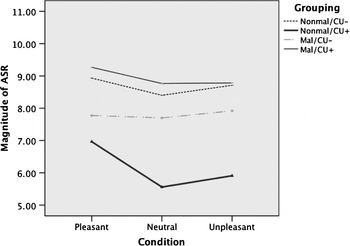
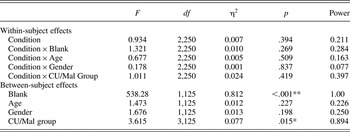
In order to jointly evaluate maltreatment status and CU traits on ASR, the CU/Mal grouping variable was entered as a between-subjects factor in a 4 × 3 repeated measures ANCOVA, with condition as the within-subject factor. Consistent with prior analyses, there were no significant within-subject effects (see Table 1). Child age and gender were not significantly associated with ASR (p > .05), though ASR to blank slides was a significant predictor of overall magnitude of response, F (1, 125) = 538.3, p < .001. The main effect of CU/Mal was significantly associated with ASR, F (1, 125) = 3.61, p < .05. Examination of pairwise comparisons revealed that children in the Nonmal/CU+ group exhibited significantly lower ASR across all conditions than did children in the Nonmal/CU– (M diff = 2.53, SE = 0.88, p = .005) and Mal/CU+ groups (M diff = 2.80, SE = 0.99, p = .006; Figure 1). There was also a marginally significant difference in ASR magnitude for children in the Nonmal/CU+ and Mal/CU– groups (p = .073). Children in the Nonmal/CU–, Mal/CU–, and Mal/CU+ groups did not differ significantly from one another (p > .05).
Differential magnitude of acoustic startle reflex (square-root transformed) across pleasant, neutral, and unpleasant images for children based on group membership (maltreated vs. nonmaltreated, high callous–unemotional vs. low callous–unemotional).

Repeated measures analysis of covariance: Maltreatment and callous–unemotional grouping predicting acoustic startle response magnitude across image conditions

Note: Condition refers to pleasant, unpleasant, and neutral International Affective Picture System images; blank refers to mean acoustic startle response magnitude in response for trials without International Affective Picture System presented. CU/Mal Group refers to classification by maltreatment status (maltreatment, nonmaltreatment) and CU (high vs. low). Sphericity was assumed.
*p < 0.05. **p < 0.001.
ASR, maltreatment subtype, and CU traits
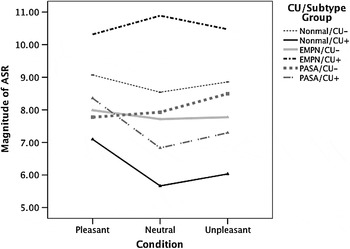
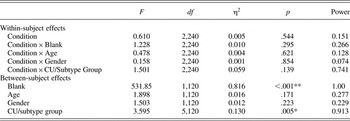
To examine the joint impact of maltreatment subtype and CU traits on ASR, a 6 × 3 repeated measures ANCOVA was performed with the CU/Subtype variable entered as a between-subjects factor and condition as a within-subjects factor. The within-subject effect of condition was not significant, nor were any interactions between condition and other predictors (see Table 2). Child age and gender were not significantly associated with ASR (p > .05), though ASR to blank slides was again a significant predictor of overall response magnitude to emotional images, F (1, 125) = 531.8, p < .001. The main effect of CU/Subtype was significantly associated with ASR, F (1, 120) = 3.59, p < .01. Pairwise comparisons indicated that children in the Nonmal/CU+ group exhibited significantly lower ASR than did children in the Nonmal/CU– group (M diff = 2.56, SE = 0.88, p < .01) and EMPN/CU+ group (M diff = 4.29, SE = 1.15, p < .001), but did not differ in ASR magnitude from children in the EMPN/CU–, PASA/CU–, and PASA/CU+ groups (Figure 2). In addition, children in the EMPN/CU+ group exhibited significantly higher ASR across all conditions did than children in the Nonmal/CU+ (M diff = 4.30, SE = 1.15, p < .0001), EMPN/CU– (M diff = 2.73, SE = 0.99, p < .01), PASA/CU– (M diff = 2.49, SE = 1.07, p < .05), and PASA/CU+ groups (M diff = 3.06, SE = 1.14, p < .01; Figure 2). There was a marginally significant difference between magnitude of ASR for children in the EMPN/CU+ group and those in the Nonmal/CU– group (M diff = 1.74, SE = 0.89, p = .052). There were no significant differences between any of the other group comparisons on magnitude of ASR.
Relationship between grouping across maltreatment subtype and callous–unemotional traits, and acoustic startle reflex magnitude in response to pleasant, neutral, and unpleasant images.

Repeated measures analysis of covariance: Maltreatment subtype and callous–unemotional grouping predicting acoustic startle response magnitude across image conditions

Note: Condition refers to pleasant, unpleasant, and neutral International Affective Picture System images; blank refers to mean acoustic startle response magnitude in response for trials without International Affective Picture System presented. CU/Mal Group refers to classification by maltreatment status (maltreatment, nonmaltreatment) and CU (high vs. low). Sphericity was assumed.
*p < .05. **p < .001.
Post hoc analyses: Group associations with externalizing behavior
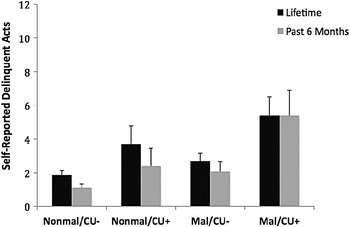
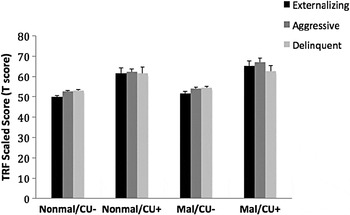
Following initial analyses, we were interested to see whether children in the Nonmal/CU+ group exhibited conduct problems comparable to children in the maltreated groups. One-way analyses of variance were performed, with CU/mal grouping entered as the factor and measures of conduct problems entered as dependent variables. There were significant differences between groups in predicting delinquency over the lifetime, F (1, 127) = 14.98, p < .0001, and the past 6 months, F (1, 126) = 16.18, p < .0001. Children in the Nonmal/CU+ and Mal/CU+ groups did not differ significantly (p > .05), though Mal/CU+ children endorsed significantly greater delinquent acts than did children in the Nonmal/CU– (p < .0001) and Mal/CU– groups (p < .01; Figure 3). There were also significant group differences in counselor report of externalizing, F (1, 131) = 40.03, p < .0001, delinquent F (1, 131) = 37.77, p < .0001, and aggressive behavior, F (1, 131) = 45.47, p < .0001. Children in the Nonmal/CU+ and Mal/CU+ groups did not differ significantly from one another (p > .05), though both groups scored significantly higher did than children in the Nonmal/CU– and Mal/CU– groups on these measures (p < .0001; Figure 4).
Association between maltreatment and callous–unemotional grouping and children's self-report of delinquent behavior within their lifetime and over the past 6 months.

Association between maltreatment and callous–unemotional grouping and counselor report of behavior problems on the Teacher Report Form.

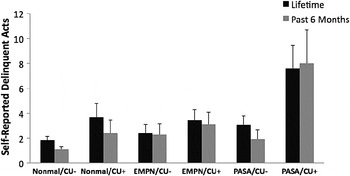
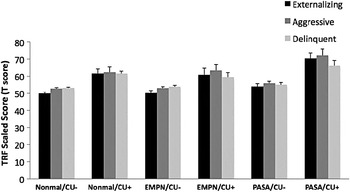
One-way analyses of vavriance were then performed with CU/subtype grouping as the factor and conduct problems entered as dependent variables. There were significant differences between groups in predicting delinquency over the lifetime, F (1, 124) = 20.96, p < .0001, and past 6 months, F (1, 123) = 20.63, p < .0001 (Figure 5). Children in the PASA/CU+ group endorsed significantly greater delinquent acts than did children in all other groups. There were also significant differences across groups on externalizing, F (1, 128) = 47.67, p < .0001, aggressive, F (1, 128) = 55.00, p < .0001, and delinquent behavior, F (1, 128) = 41.69, p < .0001, such that PASA/CU+ children were rated significantly greater on these outcomes than were children in all other groups (Nonmal/CU–, p < .0001; Nonmal/CU+, p < .05; EMPN/CU–, p < .01; EMPN/CU+, p < .05; and PASA/CU–, p < .01; Figure 6). In addition, both Nonmal/CU+ and EMPN/CU+ children were rated significantly higher on externalizing, aggressive, and delinquent behavior than were children in the Nonmal/CU– (vs. Nonmal/CU+: p < .01, p < .001, p < .01; vs. EMPN/CU+: p < .001, p < .001, p < .01; respectively) and EMPN/CU– groups (vs. Nonmal/CU+: p < .01, p < .01, p < .05; vs. EMPN/CU+: p < .01, p < .0001, p < .051, respectively).
Association between maltreatment subtype and callous–unemotional grouping and children's self-report of delinquent behavior within their lifetime and over the past 6 months.

Association between maltreatment subtype and callous–unemotional grouping and counselor report of behavior problems on the Teacher Report Form.

Discussion
This is the first investigation to systematically examine child maltreatment experience and high CU traits as factors conferring risk for dysregulated EMS in children. Consistent with the literature and hypotheses, maltreatment status was significantly predictive of high CU traits, lending additional support to developmental theories of CU traits that emphasize environmental rather than solely biological influences (Bernstein et al., Reference Bernstein, Stein and Handelsman1998; Kimonis et al., Reference Kimonis, Fanti, Isoma and Donoghue2013; Lang et al., Reference Lang, Klinteberg and Alm2002). As expected, children with high CU traits also exhibited higher externalizing behaviors as rated by counselors, and greater self-report of delinquent behaviors over the lifetime and within the past 6 months than low CU children (Kaplow & Widom, Reference Kaplow and Widom2007; Keiley et al., Reference Keiley, Howe, Dodge, Bates and Pettit2001; Rogosch et al., Reference Rogosch, Oshri and Cicchetti2010). Aligned with the existing literature, maltreatment status was associated with increased aggressive behavior and delinquent acts over the 6 months prior to assessment. Overall maltreatment status coded dichotomously was not significantly associated with counselor report of externalizing behavior, rule breaking/delinquent behavior, and self-report of lifetime delinquent behaviors. This finding was clarified when examining subtype effects, which revealed that high CU children who experienced the abusive forms of maltreatment (PASA) exhibited significantly higher conduct problems across all measures compared to all other groups. This finding is important in that it clarifies that not all maltreated children are at the same level of risk for antisocial behavior. Rather, physical and/or sexual abuse confers increased vulnerability for these outcomes.
Contrary to predictions, there was no evidence of EMS within the sample. This finding is aligned with several past investigations of EMS in school-aged children (Armbruster et al., Reference Armbruster, Mueller, Strobel, Kirschbaum, Lesch and Brocke2010; McManis et al., Reference McManis, Bradley, Cuthbert and Lang1995; Waters et al., Reference Waters, Lipp and Spence2005, 2008), but conflicts with other studies that have identified EMS in children (Balaban, Reference Balaban1995; McManis et al., Reference McManis, Bradley, Berg, Cuthbert and Lang2001; Quevedo et al., Reference Quevedo, Benning, Gunnar and Dahl2009, 2010; van Goozen et al., Reference van Goozen, Snoek, Matthys, van Rossum and van Engeland2004). Developmental considerations may underlie discrepancies within the literature, because prior studies examining groups of participants at different ages have found that EMS emerges in later adolescence or early adulthood (Armbruster et al., Reference Armbruster, Mueller, Strobel, Kirschbaum, Lesch and Brocke2010; Waters et al., Reference Waters, Lipp and Spence2005). Age-related differences in the detection of EMS may be due to physiological influences of puberty on emotion processing and arousal given that advanced pubertal stage predicts greater ASR magnitude across valence conditions (Dahl & Spear, Reference Dahl and Spear2004; Patton & Viner, Reference Patton and Viner2007; Quevedo et al., Reference Quevedo, Benning, Gunnar and Dahl2009; Toufexis, Myers, & Davis, Reference Toufexis, Myers and Davis2006). The absence of EMS may have also been due to the paradigm that was used. Higher intensity stimuli more readily activate the HPA axis, thereby contributing to more potent emotion-modulatory responses through the release of CRH (Herman et al., Reference Herman, Ostrander, Mueller and Figueiredo2005; Lang et al., Reference Lang, Bradley and Cuthbert1990). In the absence of stimuli that would elicit sufficient activation of the secondary pathway, EMS may not occur. The research indicates that the most robust potentiating effects are elicited by extremely violent images, and the strongest attenuating effects occur in response to erotic or pornographic images (Armbruster et al., Reference Armbruster, Mueller, Strobel, Kirschbaum, Lesch and Brocke2010; Bradley et al., Reference Bradley, Codispoti and Lang2006; Grillon, Morgan, Davis, & Southwick, Reference Grillon, Morgan, Davis and Southwick1998a, Reference Grillon, Morgan, Davis and Southwick1998b; Morgan, Grillon, Southwick, Davis, & Charney, Reference Morgan, Grillon, Southwick, Davis and Charney1995; Morgan, Grillon, Southwick, Nagy, et al., Reference Morgan, Grillon, Southwick, Nagy, Davis and Krystal1995). The present study only utilized emotional stimuli that were deemed age appropriate by child psychologists. Efforts were made to help children feel safe and comfortable during the paradigm. As such, the absence of emotion-modulatory effects may have been due to the presentation of less activating stimuli within a “safe” context.
We also did not find differences in the magnitude of ASR across maltreatment status or CU traits independently. It is difficult to compare findings with the existing literature given that no studies to date have examined EMS in maltreated children, and few studies have examined the impact of CU traits on EMS independent of significant conduct problems. However, it is important to note that results are not aligned with prior investigations of EMS and psychopathic traits in youth, which have consistently found that EMS is preserved and ASR response is blunted across emotional conditions (Fairchild et al., Reference Fairchild, van Goozen, Stollery and Goodyer2008, 2010; Syngelaki et al., Reference Syngelaki, Fairchild, Moore, Savage and van Goozen2013; van Goozen et al., Reference van Goozen, Snoek, Matthys, van Rossum and van Engeland2004). The absence of EMS specifically for maltreatment or CU traits may be due to factors related to the sample. We examined associations in a community sample of preadolescent children without clinically significant levels of conduct problems. The studies that have found blunted effects as a result of CU traits examined juvenile offenders and children with disruptive behavior disorders, and did not measure associations in maltreated samples (e.g., Fairchild et al., Reference Fairchild, van Goozen, Stollery and Goodyer2008, 2010).
Although maltreatment and CU traits were not independently associated with significant ASR differences across valences, differential physiological patterns emerged across groups when maltreatment status and CU traits were examined jointly. Specifically, children in the Nonmal/CU+ group exhibited significantly blunted ASR to stimuli across valences. We expected that the combination of child maltreatment and high CU would be associated with the greatest reduction in ASR across conditions, given that both are risk factors for altered physiological and emotional responding. In contrast, Nonmal/CU+ children exhibited significantly lower ASR compared to children in the Mal/CU+ group despite both groups exhibiting comparably high self-report of delinquent behavior and counselor report of externalizing, delinquent, and aggressive behavior. This finding highlights two very different pathways toward antisocial behavior for children with high CU traits that are evident only when physiological responding and environmental context are both considered. Along one pathway, children with environmental risk factors (Mal/CU+) exhibit elevated externalizing and antisocial behavior but normative physiological responding. Along a second trajectory, children without psychosocial vulnerability factors exhibit physiological hypoarousal within the threat–response system (Nonmal/CU+). These findings support the hypothesis that differential developmental pathways toward CU traits exist, with some driven more by biology and others more strongly influenced by contextual experiences (Daversa, Reference Daversa2010; Frick & White, Reference Frick and White2008).
Aligned with biological theories of CU trait development, the Nonmal/CU+ children exhibited increased biological vulnerability to CU traits as evidence by hypoarousal within the defensive responsive system. It is likely that these children possess genetic or temperamental risk factors that contribute to these physiological liabilities, and increase the risk for emotional processing deficits and reduced vigilance to fearful cues. Together, these cognitive and physiological abnormalities may contribute to CU trait expression and antisocial behavior (Jones et al., Reference Jones, Laurens, Herba, Barker and Viding2009; Viding et al., Reference Viding, Fontaine and McCrory2012). Further evidence supporting greater risk for antisocial outcomes in these children are post hoc results, which found that Nonmal/CU+ children exhibited comparable TRF behavior problems to Mal/CU+ children, and higher behavior problems than Mal/CU– children. Therefore, despite the lack of early adversity in the form of maltreatment, these children may be at elevated risk for maladaptation given marked disruptions in their responsivity to threat and an emerging pattern of conduct problems. These findings are consistent with Syngelaki et al. (Reference Syngelaki, Fairchild, Moore, Savage and van Goozen2013), who found that children with greater conduct disorder symptoms and CU traits exhibited lower ASR across all emotional conditions. The fact that similar deficits in defensive processing were present in both the current sample and a high-risk sample of adolescent juvenile offenders with conduct disorder symptoms lends support for increased risk for the Nonmal/CU+ children to progress toward more serious antisocial behavior.
In addition to the differential patterns of responses for high CU children when examining maltreatment dichotomously, we were interested in clarifying subtype differences in physiological responding. Further highlighting equifinite and multifinite trajectories toward CU trait expression, significant variation in ASR across maltreatment subtype emerged. Children in the Nonmal/CU+ group continued to exhibit significantly attenuated ASR compared to controls (Nonmal/CU–) and children in the EMPN/CU+ group, highlighting the strength of this pathway. The Nonmal/CU+ children did not differ significantly in magnitude of ASR from children in the EMPN/CU–, PASA/CU–, or PASA/CU+ groups.
Further, we found that children in the EMPN/CU+ group uniquely exhibited a distinct pattern of ASR response across conditions, with significantly higher responses than children in the EMPN/CU–, PASA/CU–, PASA/CU+, and Nonmal/CU+ groups, and marginally higher than children in the Nonmal/CU– group. Thus, these children responded in a hyperresponsive manner to threat compared to other groups. EMPN/CU+ children also exhibited significantly higher conduct problems across multiple measures than children in the EMPN/CU– and Nonmal/CU– groups. These findings indicate that these children have an increased risk for antisocial outcomes, despite having a hyperresponsive response to emotional stimuli, unlike other children with high CU traits. This research highlights potential heterogeneity within children with CU traits and differential pathways for risk.
In addition, we found that children who experienced physical and/or sexual abuse (PASA/CU+, PASA/CU–), exhibited lower startle responses across the paradigm regardless of CU trait level. These children responded comparably to those in the Nonmal/CU+ group. Children in the PASA/CU+ group exhibited the highest conduct problems across all measures, suggesting that they may also be at risk for developing antisocial behavior. Further research is required to clarify whether the reduced physiological response to threat in these children relative to EMPN/CU+ children is due to biological or temperamental characteristics, maltreatment effects on stress-responsive systems, or a combination of these factors.
Limitations, strengths, and future directions
Although the present investigation was the first to examine independent and joint effects of child maltreatment and CU traits on EMS, this study was limited by a number of factors. One issue that has been consistently identified within the literature is the relatively low magnitude of startle response in children (Fairchild et al., Reference Fairchild, Stobbe, van Goozen, Calder and Goodyer2010; Grasso & Simons, Reference Grasso and Simons2012; Klorman et al., Reference Klorman, Cicchetti, Thatcher and Ison2003). Researchers within the literature have sometimes removed participants from analyses who do not have discernable startle responses across at least 40% of trials. Given the substantial number of participants who met “nonresponse” criteria across the experimental session in the present study, these children were included in analyses. Nonresponding was associated with neither maltreatment status nor CU traits. However, the high percentage of nonresponding children may have limited the amount of variance across pleasant, neutral, and unpleasant conditions, leading to reduced ability to detect significant differences.
The ASR has often been examined within very small samples. Therefore, the present study aimed to delineate these associations within a relatively large sample of low-income and trauma-exposed children. Although significant efforts were made to recruit a large cohort of children, factors such as attrition, child absences during camp, and refusal to participate in the startle paradigm reduced the number of children who were eligible for participation. The final sample size was also reduced due to startle equipment difficulties and child behavioral problems, which ultimately led to the exclusion of 14.8% of children (n = 23). The startle paradigm was relatively lengthy, particularly for children who had difficulty staying still, paying attention, and following directions. These difficulties have been well documented in other studies of ASR in children (see Blumenthal et al., Reference Blumenthal, Cuthbert, Filion, Hackley, Lipp and Boxtel2005). Although research assistants noted affected trials and helped children stay on task, some participants were excluded from analyses due to these factors. Future research assessing EMS with high-risk children may explore the possibility of using shortened or blocked design with built-in breaks to increase compliance.
In addition to overall sample size limitations, the number of children who met criteria for high CU was relatively small (n = 31). Children in the present study were recruited based upon maltreatment experience and low family socioeconomic status. Given the high-risk nature of this community-based sample, it was expected that CU traits would be present. However, given that children were not recruited from a clinical sample particularly for CU traits or conduct problems, some of the analyses reflect very small groups of children. Therefore, in the repeated measures analyses examining CU/Mal and CU/Subtype groupings, power to detect significant differences was limited. Consequently, prior to making any conclusive interpretations regarding impacts of CU traits and maltreatment on the ASR in children, it is important for future research to probe these associations using a larger sample of children.
Despite these limitations, this investigation was the first to examine the impact of child maltreatment and CU traits on EMS in a diverse community sample of low-income children with trauma exposure. A particular strength of this investigation was the rigorous measurement of maltreatment status. With the exception of a few studies (e.g., Klorman et al., Reference Klorman, Cicchetti, Thatcher and Ison2003), the existing research on ASR and maltreatment has relied heavily on unsubstantiated or retrospective report of childhood trauma. In addition to contributing to the literature on EMS in children, this study used a multilevel perspective to measure physiological, emotional, and behavioral outcomes for children based on CU trait expression and maltreatment. Our findings underscore the importance of examining antisocial behavior and CU traits from a developmental perspective rather than solely through a biological lens. We found that high CU traits were predictive of hyporesponsive ASR as expected, but only for nonmaltreated children. Further, for maltreated children with high CU traits, the experience of neglect as compared to abuse was associated with significantly different outcomes. Consistent with some developmental theories of CU traits, it is possible that maltreatment experience increases the risk for deficits in emotional processing and responding through socialization or epigenetic mechanisms. Additional research using larger sample sizes so as to examine maltreatment severity, timing, and chronicity is necessary to further clarify, replicate, and extend these findings (Cicchetti & Toth, Reference Cicchetti, Toth, Lamb and Garcia Coll2015).
The present results are encouraging, because they suggest that CU traits and concomitant conduct problems in some children may be more malleable than initially expected. Understanding whether children with high CU traits exhibit impairments in arousal may also help tailor evidence-based interventions to children's symptoms (Frick, Reference Frick2012). For instance, maltreated children who do not exhibit high CU traits but are beginning to demonstrate externalizing behavior may benefit more from trauma-focused treatments (e.g., trauma-focused cognitive behavioral therapy; Cohen, Mannarino, & Deblinger; Reference Cohen, Mannarino and Deblinger2006), family skills-based interventions (e.g., parent–child interaction therapy; Brinkmeyer & Eyberg, Reference Brinkmeyer, Eyberg, Kazdin and Weisz2003), or parenting interventions (e.g., the Incredible Years Parent Program; Webster-Stratton & Reid, Reference Webster-Stratton, Reid, Kazdin and Weisz2003), because conduct problems and CU traits may be secondary to trauma and/or dysfunctional parenting practices within the family. In comparison, interventions that are focused not only on environmental factors but also on the emotional and cognitive impairments specific to children with high CU traits may be more beneficial for children with clear physiological deficits in emotional responding. For instance, a recent study found that children who received an intervention that taught accurate perception and evaluation of emotions in others exhibited increased improvements in affective empathy compared to children whose parents received only a parent-training program (Dadds, Cauchi, Wimalaweera, Hawes, & Brennan, Reference Dadds, Cauchi, Wimalaweera, Hawes and Brennan2012). It is our hope that the results of the present study will further inform differential clinical interventions for maltreated children and clarify developmental models of CU traits.