Divorce rates are incredibly high in Western countries. For example, the Australian Bureau of Statistics (ABS, 2000) predicted that between 32% and 46% of marriages are likely to end in divorce over all the years of marriage, although since peaking in 2001, divorce rates in 2007 were 9.8% lower than they were in 2002 (ABS, 2008). Understandably, potential contributors to relationship and marital dissolution have been examined, with quality and satisfaction of sexual relationships having a dramatic influence (Birnbaum, Reis, Mikulincer, Gillath, & Orpaz, Reference Birnbaum, Reis, Mikulincer, Gillath and Orpaz2006; Butzer & Campbell, Reference Butzer and Campbell2008; Sprecher & Cate, Reference Sprecher, Cate, Harvey, Wenzel and Sprecher2004; Timm & Keiley, Reference Timm and Keiley2011). Attachment theory is particularly applicable to the literature on sexuality in relationships, since insecure attachment patterns involve negative emotions during sex, which predicts sexual dissatisfaction (Birnbaum et al., Reference Barrientos and Paez2006; Butzer & Campbell, Reference Butzer and Campbell2008; Davis et al., Reference Davis, Shaver, Widaman, Vernon, Follette and Beitz2006).
A prime predictor of sexual health and wellbeing is the effectiveness of sexual communication (Byers, Reference Byers2011; Davis et al., Reference Davis, Shaver, Widaman, Vernon, Follette and Beitz2006; Timm & Keiley, Reference Timm and Keiley2011). How well one can self-disclose about one's sexual preferences or dislikes has been shown to be associated with greater levels of sexual satisfaction. Attachment orientation has been found to be intrinsically associated with dysfunctional communication patterns regarding sexual issues and concerns (Davis et al., Reference Davis, Shaver, Widaman, Vernon, Follette and Beitz2006). Since those with insecure attachment tend to have pessimistic expectations or assumptions around a partner's responsiveness in times of need, they are less likely to openly express any sexual issues or needs to their partner. This widens the gap between what they want and desire and what they are subsequently receiving, detrimentally impacting their sexual relationships.
Sexual Satisfaction
Sexual satisfaction is ‘an affective response arising from one's subjective evaluation of the positive and negative dimensions associated with one's sexual relationship’ (Lawrance & Byers, Reference Lawrance and Byers1995, p. 514). There is a degree of variability over which aspects of sexual behaviour are considered to impact on sexual quality, and a number of theories have argued for different driving forces behind sexual activity. These include biological or evolutionary theories (Sprecher & Cate, Reference Sprecher, Cate, Harvey, Wenzel and Sprecher2004), symbolic interaction theory (LaRossa & Reitzes, Reference LaRossa, Reitzes, Boss, Doherty, LaRossa, Schumm and Steinmetz1993), script theory (Gagnon, Reference Gagnon1990), and social exchange theory (Hatfield, Utne, & Traupmann, Reference Hatfield, Utne, Traupmann, Burgess and Huston1979; Rusbult, Reference Rusbult1983). Social exchange theory better captures the individualistic nature that Western society has moved towards (Beck & Beck-Gernsheim, Reference Beck and Beck-Gernsheim2002).
Rusbult (Reference Rusbult1983) suggests that although couples are hedonistic (i.e., self-indulgent) in nature, they know to ‘give’ in order to ‘get’ (Sprecher & Cate, Reference Sprecher, Cate, Harvey, Wenzel and Sprecher2004). In the light of sexual relationships, this exchange process presents itself in the form of rewards (i.e., pleasure, attention) and costs (i.e., time, effort), where spouses aim to maximise their rewards while minimising their investments and costs. Sexual satisfaction is achieved when their profits (rewards minus costs) exceed their expectations about what they deserve to receive (Rusbult, Reference Rusbult1983), or when the perceived ratio of rewards to costs is equal for both parties, and/or when they feel that they are fairly treated (e.g., regardless of whether there are differing levels of sexual rewards, the relationship in general may still be perceived as fair; Hatfield et al., Reference Hatfield, Utne, Traupmann, Burgess and Huston1979; Specher & Cate, Reference Sprecher, Cate, Harvey, Wenzel and Sprecher2004). The New Sexual Satisfaction Scale (NSSS), developed by Stulhofer, Busko, and Brouillard (Reference Stulhofer, Busko and Brouillard2010), reflects the social exchange theory of sexual satisfaction.
The New Sexual Satisfaction Scale
Measures of sexual satisfaction have moved away from global indicators of sexual satisfaction, with items akin to ‘How satisfied are you with your sex life?’ (Barrientos & Paez, Reference Barrientos and Paez2006), and towards a variety of more complex, multi-item measures (e.g., see the Whitley Sexual Satisfaction Inventory, Whitley, Reference Whitley, Davis, Yarber, Bauserman, Schreer and Davis1998; and the Hudson Index of Sexual Satisfaction, Hudson, Reference Hudson, Davis, Yarber, Bauserman, Schreer and Davis1998). More specifically, Stulhofer et al. (Reference Stulhofer, Busko and Brouillard2010) provide evidence that sexual satisfaction is positively correlated with variables such as the frequency and quality of sexual sensations and activity, sexual awareness, the level of intimacy and emotional closeness, and the balance between giving and receiving.
The items of the NSSS are framed to represent three conceptual ‘lenses’ that allow the differing aspects of sexual satisfaction to be approached in a systematic fashion. The individual lens refers to physiological and psychological reactions to sex, and comprises items related to sexual sensations (such as quality and frequency of orgasm, sexual arousal and touch/feel) and sexual awareness (such as feelings of letting oneself go, being focused, and sexual reactions towards one's partner).
The interpersonal lens refers to emotional closeness/intimacy and the sexual exchange between the individual and their partner. The sexual exchange dimension contains items concerning satisfaction with the partner's sexual availability, initiative and creativity, and the balance between giving and receiving. This dimension includes items relating to trust, emotional opening up, the partner's emotional surrender and closeness in sex, and the contribution sex has towards the emotional bond. This has been both clinically and anecdotally associated with sexual satisfaction, and a strong emotional bond has been argued to generate long-term sexual interest (Stulhofer et al., Reference Stulhofer, Busko and Brouillard2010).
Lastly, the behavioural lens focuses on the various characteristics of sexual activity, and comprises items relating to variety, frequency, intensity/passion, duration and sexual experimentation, which have been shown to be an essential component of sexual satisfaction (Stulhofer et al., Reference Stulhofer, Busko and Brouillard2010).
Attachment Style, Sexual Satisfaction and Relationship Satisfaction
Research beginning with Bowlby (Reference Bowlby1969), extended on by Ainsworth, Blehar, Waters and Wall (Reference Ainsworth, Blehar, Waters and Wall1978) and carried through to contemporary studies of adult attachment has found two primary dimensions that characterise individual differences in insecure attachments: avoidance and anxiety (Birnbaum et al., Reference Birnbaum, Reis, Mikulincer, Gillath and Orpaz2006; Brennan, Clark, & Shaver, Reference Brennan, Clark, Shaver, Simpson and Rholes1998). Evidence indicates a joint relationship between the sexual system and the attachment system; such that sexual satisfaction influences relationship stability and satisfaction, and adult attachment orientations impact the way people make sense of their romantic relationships (Birnbaum et al., Reference Barrientos and Paez2006). Particularly, measures of adult attachment have found attachment avoidance and anxiety to be associated with negative emotions during sex and sexual dissatisfaction (Birnbaum et al., Reference Barrientos and Paez2006; Davis et al., Reference Davis, Shaver, Widaman, Vernon, Follette and Beitz2006).
The avoidance dimension typically represents the type of person who generally feels uncomfortable being emotionally close and intimate with their partner (Brennan et al., Reference Brennan, Clark, Shaver, Simpson and Rholes1998; Butzer & Campbell, Reference Butzer and Campbell2008). Avoidant individuals tend to have relatively unstable and unsatisfying relationships due to their emotional distance, fear of intimacy and low levels of trust (Birnbaum et al., Reference Barrientos and Paez2006; Collins & Read, Reference Collins and Read1990; Hazan & Shaver, Reference Hazan and Shaver1994).
As sexual activity inherently involves physical and psychological proximity, avoidant people tend to find sexual relationships unrewarding and uncomfortable due to their general discomfort with closeness and intimacy, and are inclined to find their sexual relationships less satisfying (e.g., Mikulincer & Shaver, Reference Mikulincer and Shaver2007)
The anxiety dimension reflects the type of individual who worries about being abandoned or rejected by their partner in times of need (Butzer & Campbell, Reference Butzer and Campbell2008). They tend to idealise their partners, yet are unsure about their partners’ responsiveness, making them overly needy and clingy in relationships. Such intensity of emotion results in a paradox: their demands for availability and security, in combination with recurrent expressions of distrust and anger, may compel their partner to reject their attempts to be close. This in turn reinforces and intensifies their own insecurities, leaving them with poorer relationship outcomes (Birnbaum et al., Reference Birnbaum, Reis, Mikulincer, Gillath and Orpaz2006).
Birnbaum et al. (Reference Birnbaum, Reis, Mikulincer, Gillath and Orpaz2006) report that anxiously orientated people use ‘sex as a means to achieve emotional intimacy, approval and reassurance; to elicit a partner's caregiving behaviours; and to defuse a partner's anger’ (p. 931). Sexual desire and behaviour can be interpreted as indications of love and reassurance for ongoing romantic interest (Davis et al., Reference Davis, Shaver, Widaman, Vernon, Follette and Beitz2006). In the same way, refusal of sex or a perceived deficit in desire may be interpreted as a lacking of interest and love. Davis et al. (Reference Davis, Shaver, Widaman, Vernon, Follette and Beitz2006) refer to this notion as sex being a ‘barometer’ for relationship status. In other words, for the anxious individual, if the sex is not perceived as ideal, or their partner fails to perform as anticipated, their relationship is seen as at risk. This in turn makes them more prone to having less satisfying sexual interactions, as their unrealistic and unusually high expectations are rarely met.
In contrast, securely attached individuals are characterised by low anxiety and avoidance. They are generally comfortable with intimacy and closeness, are trusting, warm, supportive, and have confidence in the reliability of their spouse to provide support and availability in times of need (Birnbaum et al., Reference Birnbaum, Reis, Mikulincer, Gillath and Orpaz2006). In terms of their sexual relationships, secure individuals tend to treat sexual intimacy and activity as channels for positive experiences, such as a means to express and enjoy love and affection, and thus are more sexually satisfied in their relationships (Butzer & Campbell, Reference Butzer and Campbell2008; Birnbaum et al., Reference Birnbaum, Reis, Mikulincer, Gillath and Orpaz2006; Davis et al., Reference Davis, Shaver, Widaman, Vernon, Follette and Beitz2006).
Insecure Attachment Orientations and Inhibited Communication: A Prime Mediator of Sexual Dissatisfaction
Inhibited communication
Researchers in sexual health have found inhibited communication to be a prime predictor of sexual quality and satisfaction (Byers, Reference Byers2011; Davis et al., Reference Davis, Shaver, Widaman, Vernon, Follette and Beitz2006; Timm & Keiley, Reference Timm and Keiley2011). For clarification purposes, ‘inhibited communication’ and ‘sexual communication’ refer to self-disclosing about sexual likes and dislikes, which is linked with greater levels of sexual wellbeing (Byers, Reference Byers2011). Byers elaborated on work originally formulated by Cupach and Metts (Reference Cupach, Metts, McKinney and Sprecher1991), which involved two pathways linking sexual communication with sexual satisfaction: the instrumental and the expressive pathways. The instrumental pathway posits that greater and more effective sexual communication increases partner understanding of sexual likes and dislikes, which in turn ‘leads to engaging in a sexual script that includes more pleasing and fewer displeasing activities’ (Byers, Reference Byers2011, p. 22), which results in higher sexual satisfaction. The expressive pathway assumes that sexual self-disclosure (i.e., the expression of emotions during sexual encounters) enhances sexual quality by enhancing intimacy, which in itself enhances sexual satisfaction.
Extensive research conducted by Byers and colleagues has shown that couples who self-disclose on sexual matters are more satisfied sexually (MacNeil & Byers, Reference MacNeil and Byers2005, Reference MacNeil and Byers2009); have fewer sexual problems and concerns (MacNeil & Byers, Reference MacNeil and Byers1997); are more likely to have a mutually satisfying sexual script (Byers, Reference Byers2011); and are less likely to have discrepancies between ideal and actual durations of foreplay and intercourse (Miller & Byers, Reference Miller and Byers2004). MacNeil and Byers (Reference MacNeil and Byers2005, Reference MacNeil and Byers2009) have also conducted research using couples with an average relationship duration of 14 years, and found only 62% understood what their partner found pleasing, and only 26% understood what their partner found displeasing. This illustrates how many couples in long-term, committed relationships are not effectively communicating their sexual needs and concerns, which is likely to have damaging effects on their sexual relationships.
Attachment orientation and inhibited communication
Davis et al. (Reference Davis, Shaver, Widaman, Vernon, Follette and Beitz2006) have investigated attachment-related pathways to inhibition of sexual communication, and have found this variable to be a prime predictor of sexual dissatisfaction. Individuals with insecure attachments have dysfunctional communication patterns that began in childhood and persisted into their adult relationships (e.g., Davis et al., Reference Davis, Shaver, Widaman, Vernon, Follette and Beitz2006; Maunder et al., Reference Maunder, Panzer, Viljuer, Owen, Human and Hunter2006; Schachner, Shaver, & Mikulincer, Reference Schachner, Shaver and Mikulincer2005; Timm & Keiley, Reference Timm and Keiley2011), which has been shown to have a vital impact on sexual quality and satisfaction (Byers, Reference Byers2011; Davis et al., Reference Davis, Shaver, Widaman, Vernon, Follette and Beitz2006; MacNeil & Byers, Reference MacNeil and Byers1997, Reference MacNeil and Byers2005, Reference MacNeil and Byers2009; Timm & Keiley, Reference Timm and Keiley2011).
Adults with an insecure attachment style hold pessimistic expectations of the consequences of expressing their needs and concerns, with other attachment-related factors (such as emotions, goals and expectations) likely impacting on such doubts (Davis et al., Reference Davis, Shaver, Widaman, Vernon, Follette and Beitz2006). This in turn makes insecure individuals (as opposed to secure individuals) reluctant to honestly and directly communicate their needs with their partner.
These dysfunctional communication patterns extend to the sexual arena for insecure individuals (Birnbaum et al., Reference Birnbaum, Reis, Mikulincer, Gillath and Orpaz2006; Byers, Reference Byers2011; Davis et al., Reference Davis, Shaver, Widaman, Vernon, Follette and Beitz2006; Timm & Keiley, Reference Timm and Keiley2011). Individual differences, along the anxiety and avoidance dimensions, have been suggested to develop in response to differences in earlier experiences of poor parental and partner responses to the expressions of needs (Davis et al., Reference Davis, Shaver, Widaman, Vernon, Follette and Beitz2006).
For avoidant individuals, considering their general discomfort with intimacy, emotional closeness and lack of trust, it is reasonable to expect them to be uncomfortable with self-disclosure of all kinds, including matters of sexual preferences and needs (Davis et al., Reference Davis, Shaver, Widaman, Vernon, Follette and Beitz2006). Further, they are known to let problems persist rather than engage in successful attempts to resolve them (Davis et al., Reference Davis, Shaver, Widaman, Vernon, Follette and Beitz2006).
For anxiously attached individuals, their tendency to use sex as a barometer for relationship status has been known to make them cautious about expressing their sexual desires and needs, especially their sexual preferences (such as not wanting to engage in intercourse), which may be interpreted as harming the relationship (Davis et al., Reference Davis, Shaver, Widaman, Vernon, Follette and Beitz2006). Further, as anxious individuals are constantly seeking approval and affection, they have been found to inhibit themselves from expressing their own needs in order to satisfy the needs of their partner, and to avoid conflict. Thus insecure individuals tend to poorly communicate their sexual needs and desires, which has been shown to predict sexual dissatisfaction (Birnbaum, et al., Reference Birnbaum, Reis, Mikulincer, Gillath and Orpaz2006; Butzer & Campbell, Reference Butzer and Campbell2008; Byers, Reference Byers2011; Davis et al., Reference Davis, Shaver, Widaman, Vernon, Follette and Beitz2006).
The Present Study
The present study explored attachment orientation and sexual communication as potential predictors of sexual satisfaction. The primary aim of this study was to confirm prior findings that those with insecure attachment orientations (characterised by either anxiety, avoidance, or both) engage in less effective communication on sexual issues, which in turn reduces overall sexual satisfaction (Birnbaum et al., Reference Birnbaum, Reis, Mikulincer, Gillath and Orpaz2006; Butzer & Campbell, Reference Butzer and Campbell2008; Davis et al., Reference Davis, Shaver, Widaman, Vernon, Follette and Beitz2006). This study aimed to expand on previous research by examining the abovementioned variables using an Australian sample.
It was predicted that individuals with insecure attachment styles would have poorer communication skills in regards to expressing sexual needs and concerns, which would in turn predict sexual dissatisfaction. Thus, it was predicted that sexual communication would mediate the relationship between attachment style and sexual satisfaction.
Method
Participants
The sample consisted of 125 participants who were either married (16%), not married but living together (16%), or in a relationship and not living together (67%). There were 81 women and 44 men. The ages ranged from 18 to 65, with most of the participants aged between 18 and 25, followed by 26 and 35, with the remainder 36 and/or older. The mean duration of relationship length among the sample was 4 years and 1 month (SD = 5 years and 10 months), the median was 2 years and 4 months, with the shortest relationship being 2 months, and the longest 34 years. There were 98 participants who were considered to be beyond the ‘honeymoon period’ (first 9 months) of their relationship. Almost two thirds (62.4%) were completing or had completed a higher degree. Fewer than half (43.2%) claimed any religious connection.
Materials
Participants first completed a series of demographic questions, including their age, sex, educational attainments, religious affiliation, relationship status and the length of their relationship. The scales were presented in the questionnaire in the following order.
The Experiences in Close Relationship-Revised Questionnaire (ECR-R; Brennan, Clark & Shaver, Reference Brennan, Clark, Shaver, Simpson and Rholes1998)
This 36-item, self-report scale asks participants to respond regarding how they typically feel in their romantic relationships. Responses were recorded using a 7-point Likert-type scale ranging from 1 (strongly disagree) to 7 (strongly agree). After reverse coding the negatively worded items, the odd and even items are summed separately to obtain one continuous indicator of Anxiety (odd-numbered items) and Avoidance (even-numbered items), with a possible range of 18 to 126 for each dimension. Higher scores of both dimensions indicate insecure attachment styles (i.e., anxious or avoidant attachments). According to Fraley, Waller, and Brennan (Reference Fraley, Waller and Brennan2000), the estimate of internal consistency reliability is around .90 or higher for both scales; however, reliability may be less at the secure end of both dimensions compared to the insecure end.
The New Sexual Satisfaction Scale (NSSS; Stulhofer et al., Reference Stulhofer, Busko and Brouillard2010)
The NSSS is a 20-item, self-report scale that asks participants to respond regarding how satisfied they are with multiple domains of sexual behavior. These include emotional closeness, such as the experience of trust and emotion during sex (e.g., ‘My partner's emotional opening up during sex’); sexual activity, relating to the variety, frequency, intensity, duration and experimentation of sex (e.g., ‘The variety of my sexual activity’); sexual awareness, such as the level of focus and sexual reaction toward one's partner, as well as the feeling of surrender during sex (e.g., ‘My “letting go” and surrender to sexual pleasure during sex’); sexual sensations, such as the quality and frequency of touch, sexual arousal and orgasm during sex (e.g., ‘The way I sexually react to my partner’) and sexual exchange processes, such as the perceived balance of giving and receiving pleasure, and their partner's sexual availability, initiative and creativity during sex (e.g., ‘The balance between what I give and receive in sex’).
Responses were recorded using a 5-point Likert-type scale ranging from 1 (not at all satisfied) to 5 (extremely satisfied). The 20 items were summed to obtain one continuous indicator of Sexual Satisfaction which ranged from 20 to 100, with higher scores indicating higher levels of Sexual Satisfaction. The reported reliability of the NSSS was very high, which was demonstrated by alpha coefficients ranging between .94 and .95, which was taken from five independent samples (involving student samples, community samples and a non-heterosexual sample from the United States and Croatia). Further, the NSSS displays convergent validity by correlating moderately highly with a global measure of sexual satisfaction (Stulhofer et al., Reference Stulhofer, Busko and Brouillard2010).
Inhibition of Need Expression (sexual communication)
Inhibited Communication (operationalised as Inhibition of Need Expression) was measured using 20 items developed by Davis et al. (Reference Davis, Shaver, Widaman, Vernon, Follette and Beitz2006) and used expressly for her study. These items asked participants to respond regarding how they typically communicate with their romantic partner about their sexual needs and concerns (e.g., ‘If I feel something needs to be changed about our sex life, I usually try to talk to my partner about it and try to improve things’). Responses were recorded using a 5-point Likert-type scale ranging from 1 (not at all true of me) to 5 (extremely true of me). After reverse coding the eight positively worded items, the 20 items were summed to obtain one continuous indicator of Inhibited Communication, which ranged from 20 to 100, with higher scores indicating higher levels of Inhibited Communication (i.e., poorer sexual communication). The reported reliability of the 20 items of Inhibited Communication was high, as demonstrated by an alpha coefficient of .87 (Davis et al., Reference Davis, Shaver, Widaman, Vernon, Follette and Beitz2006).
The Marlowe-Crowne Social Desirability Scale (short form; Reynolds, Reference Reynolds1982)
This 13-item scale asks participants to respond regarding how they typically react to a number of social situations in order to determine whether they have a social desirability bias (e.g., ‘I’m always willing to admit it when I make a mistake’). Responses were recorded using a 5-point Likert-type scale ranging from 1 (not true of me) to 5 (very true of me), which replaced the initial true-false response format used by Reynolds (Reference Reynolds1982) to improve the scale's reliability. After reverse coding the five negatively worded items, the 13 items were summed to obtain one continuous indicator of Social Desirability which ranged between 13 and 65, with higher scores indicating a higher tendency to respond in a socially desirable manner. The reported reliability was adequate, with an alpha coefficient of .76 (Reynolds, Reference Reynolds1982).
Considering that the honeymoon phase is usually the peak period for sexual functioning in newly formed relationships (Aubin & Heiman, Reference Aubin, Heiman, Harvey, Wenzel and Sprecher2004), it is reasonable to assume that young couples would have different sexual experiences compared with those in committed, and longer-term relationships. Although there is vast uncertainty around the typical length of the honeymoon period, it is generally accepted that it occurs at the beginning phase of the relationship. For this reason, the present study conducted separate analyses: one comprising the entire sample, and the other comprising those in relationship durations of 9 months or longer. The cut-off of 9 months was arbitrarily chosen for statistical convenience.
Procedure
The data were collected online using a web-based survey program, and participants were recruited via email using a snowball method. Of 205 hits on the site, there were 128 usable questionnaires, a completion rate of 62.4%. Participants had to be in a current romantic relationship, sexually active with their partner and over 18 years of age to be eligible to participate in this study. Via an introductory message, participants were informed of the intimate and personal nature of the questions, and that the study had been approved by the university's Ethics Committee. Completion of the survey was taken as informed consent to participate in the study. Participants were assured that their participation was completely voluntary, and that they were free to withdraw at any time.
Results
Prior to the analyses, all variables were tested for violation of assumptions and checked for missing data. Two cases contained missing values >30% for at least one of the scales, and were removed from the analysis. The remaining missing values were replaced with the series mean (Tabachnick & Fidell, Reference Tabachnick and Fidell2007).
The data were then inspected for deviations of normality. The Anxiety scale was the only one to exceed the critical value (z score = 3.51), displaying positive skew. For that reason, the scores on the Anxiety scale were transformed using a square root transformation, which then produced normal distribution. No outliers were detected amongst any of the scales. A Mahalanobis Distance variable was calculated for each score to identify any multivariate outliers (Mahalanobis Distance values at p < .001). One case was identified to exceed the critical value, and was subsequently removed from the analysis. The remaining assumptions for multiple regression (i.e., linearity and homoscedasticity) were met, and there was no evident violations of the multicollinearity or singularity assumptions (as indicated by tolerance and VIF values).
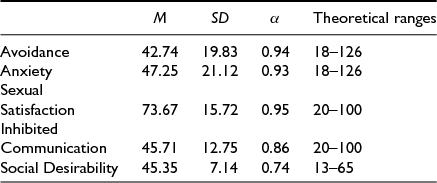
Internal consistency of the scales used in this study was assessed by calculating Cronbach's alpha coefficients, which are presented in Table 1, along with the means, standard deviations and the theoretical ranges. As can be seen in Table 1, the reported reliabilities of the variables ranged from acceptable to excellent. Further, the sample appears to be fairly secure, with most reporting low scores on anxiety and avoidance; and fairly satisfied, with high scores on Sexual Satisfaction, and low scores on Inhibited Communication.
Means, Standard Deviations, Reliabilities and Theoretical Ranges of the Variables
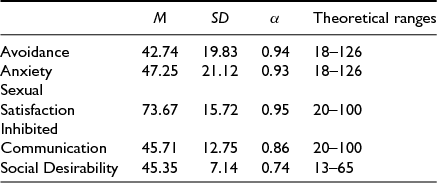
Note: Mean and standard deviations for the anxiety variable were calculated using the untransformed scores.
N = 125
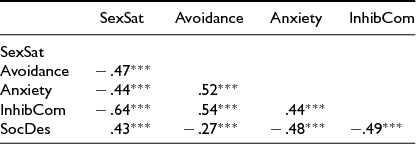
In order to examine the relationships among the measures, the intercorrelations between each of the variables are presented in Table 2.
Summary of Bivariate Correlations Between Study Variables
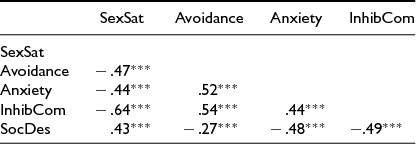
Note: N = 125. SexSat = Sexual Satisfaction, InhibCom = Inhibited Communication, SocDes = Social Desirability.
***p < .001.
As can be seen from Table 2, there were significant negative relationships between the insecure attachment scores (Avoidance and Anxiety) and Sexual Satisfaction. There were significant positive correlations between insecure attachment scores and Inhibited Communication, suggesting that those with insecure attachments engaged in poorer communication. Sexual Satisfaction was significantly and negatively related to Inhibited Communication. This suggests that higher levels of sexual satisfaction are associated with better sexual communication.
In order to test the first hypothesis, that insecure individuals would have poorer sexual communication skills, which would in turn predict lower levels of sexual satisfaction, a hierarchical multiple regression analysis was performed with Social Desirability entered at step 1 of the regression, Avoidance and Anxiety entered at step 2, and the Inhibited Communication variable entered at step 3. A summary of the regression results is shown in Table 3.
Summary of Hierarchical Regression Analysis Predicting Sexual Satisfaction from Insecure Attachment and Inhibited Communication
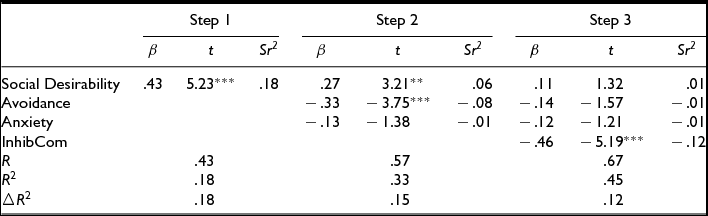
Note: N = 125. InhibCom = Inhibited Communication. ***p < .001, **p < .01.
As can be seen from Table 3, at step 1 of the regression, Social Desirability explained 18% of the variation in Sexual Satisfaction. The inclusion of the Avoidant and Anxious variables at step 2 of the regression explained an additional 15% of the variation in Sexual Satisfaction, F Change (2, 121) = 13.19, p < .001. Only Avoidance uniquely significantly contributed to Sexual Satisfaction. Contrary to expectations, Anxiety did not significantly contribute to Sexual Satisfaction. Introducing the Inhibited Communication variable at step 3 of the regression explained an additional 12% of the variation in Sexual Satisfaction, F Change (1, 120) = 26.93, p < .001.
When all predictors were included in the model, Avoidance was no longer significant. This suggests that the effect Avoidance has on Sexual Satisfaction is completely mediated by the effects of Inhibited Communication. This is in partial support of the hypothesis that insecure attachment style (only avoidance) impacts sexual satisfaction indirectly through its impact on sexual communication. Individuals with an avoidant attachment style tend to have ineffective and/or poor communication skills in terms of expressing sexual needs and concerns, which in turn predicts lower levels of sexual satisfaction. Contrary to expectation, Anxiety did not have this effect.
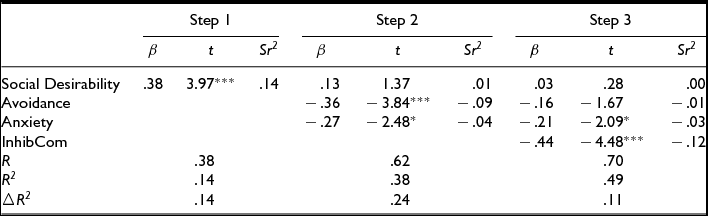
As mentioned previously, participants in relationships of 9 months or longer were perhaps a more relevant group to examine, and thus were considered separately to the rest of the sample. This was done to consider whether the honeymoon phase had differing effects on the results. Therefore, an additional hierarchical multiple regression analysis was performed to examine those in relationships for 9 months or longer. Social Desirability was entered at step 1 of the regression, Avoidant and Anxiety entered at step 2, and Inhibited Communication entered at step 3. A summary of the regression results is presented in Table 4.
Summary of Hierarchical Regression Analysis Predicting Sexual Satisfaction From Insecure Attachment and Inhibited Communication, Using a Sample of Relationship Durations of 9 Months or Longer
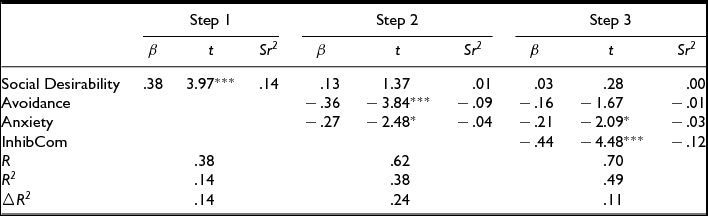
Note: N = 98. InhibCom = Inhibited Communication, ***p < .001, *p < .05.
As can be seen from Table 4, step 1 of the regression indicates that Social Desirability explained 14% of the variation in Sexual Satisfaction. The inclusion of the Avoidant and Anxious variables at step 2 of the regression explained an additional 24% of the variation in Sexual Satisfaction, F Change (2, 94) = 18.19, p < .001. Avoidance and Anxiety both significantly contributed unique variance in sexual satisfaction, though social desirability no longer did. These three variables together explain 38% of the variation in Sexual Satisfaction. Introducing the Inhibited Communication variable at step 3 of the regression explained an additional 11% of the variation in Sexual Satisfaction, F Change (1, 93) = 20.06, p < .001.
When all predictors are included in the model, Avoidance was no longer significant. However, Anxiety remained significant, though with a reduced beta value. Using the Baron and Kenny (Reference Baron and Kenny1986) method, it was established that Inhibited Communication did partially mediate the relationship between Anxiety and Sexual Satisfaction, and a Sobel test indicated that this was significant at p < .05.
This suggests the relationship between Avoidance and Sexual Satisfaction is completely mediated by Inhibited Communication, where the relationship between Anxiety and Sexual Satisfaction is only partially mediated, when using a sample of those in a relationship of 9 months or longer. This is in full support of the hypothesis that insecure attachment style (avoidance and anxiety) impacts sexual satisfaction indirectly through its impact on sexual communication. Individuals in longer-term relationships (of 9 months or more) with insecure attachments tended to have poor communication skills in terms of expressing sexual needs and concerns, which in turn predicted lower levels of sexual satisfaction. It appears that the relationship between Anxiety and Inhibited Communication on Sexual Satisfaction is having a larger impact on those in a relationship of 9 months or longer, compared to the entire sample.
Discussion
In partial support of the hypothesis, the Avoidance attachment dimension was negatively associated with Sexual Satisfaction; however, the Anxiety dimension was not, when entered into a regression calculation with Avoidance, after controlling for Social Desirability. Those with higher scores on Avoidance tended to be less sexually satisfied in their relationships. Further, this association between Avoidance and Sexual Satisfaction was mediated by Inhibited Communication. In other words, avoidant individuals tended to engage in less effective communication on sexual matters, which in turn predicted sexual dissatisfaction. Contrary to expectations, the Anxiety dimension did not have this effect.
Interestingly, when only those participants in a relationship for 9 months or longer were considered in the analysis, both Anxiety and Avoidance had a positive relationship with Inhibited Communication and a negative relationship with Sexual Satisfaction, which was in full support of the hypothesis. Thus, those with insecure attachments (anxiety or avoidance, or both) who were in a relationship of 9 months or longer tended to engage in less effective sexual communication, which in turn contributed to sexual dissatisfaction. It seemed that in this subsample of participants, the effects of anxiety and inhibited communication on sexual satisfaction were larger, as opposed to when the entire sample was considered in the analysis. Additionally, the results indicated that the attachment orientation and inhibited communication variables accounted for a significant amount of variance in sexual satisfaction.
Avoidant Attachment Style
The finding that Avoidant attachment style was associated with Sexual Dissatisfaction, and that this effect was fully mediated by Inhibited Communication is in line with one of the most robust findings regarding avoidant individuals and their rather permissive approach towards sex (Davis et al., Reference Davis, Shaver, Widaman, Vernon, Follette and Beitz2006; Feeney & Noller, Reference Feeney, Noller, Wenzel and Sprecher2004; Mikulincer & Shaver, Reference Mikulincer and Shaver2007). Prior research has shown how disordered patterns of communication have emerged for insecure individuals (Davis et al., Reference Davis, Shaver, Widaman, Vernon, Follette and Beitz2006; Maunder et al., Reference Maunder, Panzer, Viljuer, Owen, Human and Hunter2006; Schachner et al., Reference Schachner, Shaver and Mikulincer2005). Since avoidant individuals experienced their caretakers being unresponsive or insensitive in times of need and distress, they have grown to develop pessimistic expectations around the consequences of expressing needs and concerns. This may explain why avoidant individuals in the current study reported high scores on the 20 items on Inhibition of Need Expression (Davis et al. Reference Davis, Shaver, Widaman, Vernon, Follette and Beitz2006), and thus had ineffective patterns of sexual communication with their partner.
In further support of this finding, and as stated by Byers (Reference Byers2011), the expressive pathway to sexual satisfaction posits that self-disclosing of the emotions felt during sexual intercourse promotes intimacy, enhancing sexual quality and satisfaction. On the other hand, the instrumental pathway acts as a means of exchanging information with one's partner of sexual preferences, enhancing the likelihood of engaging in a mutually satisfying sexual script (Byers, Reference Byers2011). Due to avoidant individuals’ general discomfort with intimacy, emotional closeness and lack of trust in others, it is not surprising that they are also uncomfortable with self-disclosure on matters of sexual preferences and concerns (Davis et al., Reference Davis, Shaver, Widaman, Vernon, Follette and Beitz2006). Therefore, this lack of sexual self-disclosure inhibits the emotional exchange during sex, in turn hindering the development of intimacy. Moreover, the failure to exchange and negotiate sexual preferences hinders the development of a mutually satisfying sexual script. These factors may contribute to why the avoidant individuals in this study reported higher scores on Inhibited Communication and lower Sexual Satisfaction.
In addition to this, avoidant individuals tend to avoid the transaction of emotional support and closeness in short-term relationships, and tend to characterise their sexual motives in terms of self-gratification purposes in long-term relationships. In other words, instead of perceiving sex as a means to be emotionally closer to their partner, they tend to use sex as attempts for manipulation and control, protection from negative emotions, reduction of stress, and inflation of status among peers (Butzer & Campbell, Reference Butzer and Campbell2008).
In addition, emotional closeness and sexual exchange (i.e., the balance between receiving and giving pleasure; Stulhofer et al., Reference Stulhofer, Busko and Brouillard2010) is representative of the second interpersonal lens. Understandably, if one engages in sex for self-gratifying purposes, the balance of pleasure may be disrupted as the rewards of sex (receiving pleasure) may be prioritised over the costs, creating an unfair exchange of sexual practices. Also, the development of emotional closeness does not appear to be a priority for the avoidant individual and tends to be avoided, further worsening the quality of their sexual relationships. It is also possible that these sexual issues are carried over into the third lens, having unfavourable influences on the behavioural aspects of sex, such as passion, intensity, duration and experimentation. Thus, many typical traits of avoidant attachment disrupt many elements of healthy sexual functioning, collectively contributing to overall sexual dissatisfaction.
Anxious Attachment Style
Contrary to the expectations, Anxious attachment style was not uniquely significantly associated with Sexual Satisfaction in the regression, and the inclusion of the Inhibited Communication variable did not have a significant impact on this finding. This is inconsistent with the findings of previous researchers (Birnbaum et al., Reference Birnbaum, Reis, Mikulincer, Gillath and Orpaz2006; Butzer & Campbell, Reference Butzer and Campbell2008; Davis et al., Reference Davis, Shaver, Widaman, Vernon, Follette and Beitz2006). In particular, these results failed to support the findings of Byers (Reference Byers2011) and Davis et al. (Reference Davis, Shaver, Widaman, Vernon, Follette and Beitz2006), who found anxious individuals to have ineffective communication patterns when it came to discussing sexual preferences and concerns, which in turn negatively impacted their sexual relationships.
One possible explanation of this result lies in the research conducted by Davis et al. (Reference Davis, Shaver, Widaman, Vernon, Follette and Beitz2006), whose findings revealed that those with anxious-attachment commonly use sex as a barometer for relationship status. In other words, anxious individuals are more likely than others to anxiously monitor their partners and the interpersonal interactions with their partners for signs of declining physical and emotional interest, support and closeness (Davis et al., Reference Davis, Shaver, Widaman, Vernon, Follette and Beitz2006). If any deficiencies in romance or interest are detected, the relationship is seen as at risk.
In a study investigating insecure attachment, inhibited sexual communication and sexual dissatisfaction, Davis et al. (Reference Davis, Shaver, Widaman, Vernon, Follette and Beitz2006) failed to find any significant correlations with using sex as a barometer of relationship status and inhibited communication among anxiously attached individuals who were currently in a relationship at the time of the study (as opposed to significant associations found with those not in a relationship). Davis et al. suggested that this may indicate that those who construe sex as an indication of relationship quality ‘make an effort to bolster the sexual aspect of their relationship, thereby overcoming tendencies toward inhibited communication’ (p. 479). In other words, considering anxious individuals are more sensitive to signs of threat or withdrawal, which to them indicates a threat to the relationship, they may be more inclined to actively respond in an attempt to enhance the sexual quality (and thus enhance relationship quality) by communicating their sexual issues, concerns or preferences. This may be why the present study failed to find significant associations between Anxious attachment, Inhibited Communication and Sexual Satisfaction when using the entire sample. There is a chance that the anxious individuals in this study used sex as an indication of relationship status, and thus engaged in sexual communication (if considered necessary) to overcome any perceived signs of threat to the relationship. To further understand attachment-anxiety, using sex as a barometer of relationship status and inhibited communication, additional research is required.
Interestingly, when the sample was divided and only those in a relationship of 9 months or longer were considered in the analysis, attachment Anxiety, Avoidance and Inhibited Communication did significantly predict Sexual Dissatisfaction, which was in full support of the hypothesis. According to Aubin and Heiman (Reference Aubin, Heiman, Harvey, Wenzel and Sprecher2004), one of the highest phases for couple cohesiveness and ‘dyadic synchrony’ (p. 497) is the honeymoon period. The honeymoon period is said to occur at the beginning stage of the relationship, and is usually recalled by couples as the ‘peak period’ of their sexual functioning (Aubin & Heiman, Reference Aubin, Heiman, Harvey, Wenzel and Sprecher2004). Within this period, partners are generally focused on mutually building the foundations of the relationship (such as developing intimacy, expressing oneself, getting to know one another). Once secured, the focus shifts outwards to external components of the relationship (e.g., financial responsibilities, discussing children, and so on).
Research results have revealed how the transition out of the honeymoon period tends to accompany an increase in responsibilities, which coincides with a reduction in couple time and a drop in frequency of sexual activities (Aubin & Heiman, Reference Aubin, Heiman, Harvey, Wenzel and Sprecher2004). What is more, the positive aspects of the honeymoon phase may ‘serve to temporarily buffer the severity of sexual dysfunctions and, for some couples, completely mask sexual symptoms that preceded the relationship’ (Aubin & Heiman, Reference Aubin, Heiman, Harvey, Wenzel and Sprecher2004, p. 497). Therefore it is possible that the initial, full sample failed to yield significant results due to honeymoon effects. Particularly as both partners are engaging in mutual efforts to establish the foundation of their relationship, sexual discrepancies and disappointments may not have occurred yet, and thus both partners may be hitherto satisfied. Alternatively, sexual issues may have gone overlooked as the priority for both partners is establishing solid grounds for the relationship, and indulging in the excitement of getting to know one another.
Further, the honeymoon period may have had a bigger influence on anxious individuals than on avoidant individuals due to the tendency of those with anxious-attachment to use sex as a barometer of relationship status. If, in fact, the anxious individuals in this study used sex as an indication of the quality of their relationship, it is understandable how the beginning part of their relationship would be more reason for them to overcome any sexual issues/concerns, especially considering building the foundation of the relationship is the priority for this phase. On the other hand, avoidant people are generally less concerned with the quality of their relationship, and may be less inclined to engage in communication to overcome any sexual concerns, regardless of the stage/phase of the relationship.
Another plausible explanation for why attachment anxiety was more prominent in longer-term relationships may be suggested by the aforesaid study conducted by Davis et al. (Reference Davis, Shaver, Widaman, Vernon, Follette and Beitz2006). Davis et al. expected those with insecure attachment orientations to experience sexual anxiety, which would contribute to their inhibited communication. Sexual anxiety refers to the discomfort or anxiety around sexual performance or behaviour, and in turn heightens unease around expressing one's sexual desires and needs (thus hindering sexual communication). This is understandable when taking into account anxiously attached people's negative expectations and excessive concern over relationship issues, and avoidantly attached people's discomfort with overall intimacy and closeness. Davis et al. found that sexual anxiety was more prominent in people in a current relationship (opposed to those not in a current relationship), which was more predictive of inhibited communication. It was suggested that sexual anxiety may become increasingly apparent in longer-term relationships (Davis et al., Reference Davis, Shaver, Widaman, Vernon, Follette and Beitz2006). As the length of a relationship increases, there may be a greater likelihood of couples realising deficiencies in their sex lives. Alternatively, sexual issues may naturally transpire. Expressing such sexual needs and desires for insecure individuals may cause anxiety, especially those that poorly reflect on one's competence or desirability, such as problems associated with reaching arousal or orgasm ‘(and the need for extensive stimulation), or desires for effortful, unusual, or deviant sexual activities’ (Davis et al., Reference Davis, Shaver, Widaman, Vernon, Follette and Beitz2006, p. 468).
This hypothesis may be related to the previously stated assumptions of the honeymoon phase (Aubin & Heiman, Reference Aubin, Heiman, Harvey, Wenzel and Sprecher2004). Specifically, it is possible that insecurities settle in and reveal themselves after the relationship has passed the honeymoon period. This may occur as the focus moves away from building the relationship, and towards external factors aiding survival of the relationship (Aubin & Heiman, Reference Aubin, Heiman, Harvey, Wenzel and Sprecher2004). This shift in focus may create room for insecurities to emerge, as the increased level of responsibility accompanies a reduction in the couple's time together and in the frequency of sexual activity. This may explain why the influence of sexual anxiety was more prominent in anxiously attached individuals in longer-term relationships (of 9 months of longer), which may in turn have increased levels of Inhibited Communication, as opposed to when the entire sample was considered in the analyses. Future research should explore this relationship further by including sexual anxiety as a variable in this model, and monitor its levels in comparison to relationship durations.
Implications and Future Research Directions
As with all survey research, limitations exist in this study that may have influenced the results. Although the present study did not discriminate across race, socioeconomic status, clinical or non-clinical samples or same-sex couples, it failed to identify these attributes and demographics. Thus, caution should be taken when generalising the results. There is also great value in exploring the fit of this model in more diverse and larger samples. Therefore, future research should consider doing so. This may add valuable information regarding potential demographic-related differences in the model, which were beyond the scope of this study.
Considering the lack of literature investigating the honeymoon phase of a relationship, uncertainty exists around the appropriate duration for this period. As a result, and taking into account the honeymoon phase usually occurs at the beginning of a relationship, the present study arbitrarily chose 9 months as the cut-off point for statistical convenience. Understandably, this decision lacks theoretical underpinnings and may have had unwanted effects on the results. Therefore, future investigation into the nature and technicalities of the honeymoon period and its impact on relationships is warranted. Furthermore, given attachment has been shown to be influenced by other mechanisms in the sexual arena, such as sexual anxiety and the tendency to use sex as a barometer of relationship status, it is worthwhile for future research to include these variables into this model. This may provide more information on mechanisms by which possible changes in attachment, implied by Hazan and Zeifman (Reference Hazan, Zeifner, Bartholomew and Perlman1994), may influence inhibited sexual communication, in turn impacting sexual quality and satisfaction.
In the present study, data was only collected from one half of the relationship and on only one occasion. Although the perceptions of one partner are accounted for, they lack the richness and value of comparing it with the perceptions of the spouse in the same relationship, and ideally studying them longitudinally. Furthermore, considering a secure partner would experience a relationship differently compared with an insecure partner, future research in this area would benefit from repeatedly measured dyadic data to provide a more comprehensive insight into the complexities of relationships. In addition, and like most other research investigating sexuality, the main method of data collection involves self-reports using questionnaires (Feeney & Noller, Reference Feeney, Noller, Wenzel and Sprecher2004). As noted by other researchers (e.g., Catania, Gibson, Chitwood, & Coates, Reference Catania, Gibson, Chitwood and Coates1990), doubts over the validity of self-reports of sexual behaviour can emerge (e.g., skewed answers due to desire for privacy, embarrassment), although the use of a social desirability check somewhat addressed these concerns. Thus, dyadic measurement methods may bring to light potential discrepancies between a couple's reflections on the same relationship, which may be due to individual biases.
This study did not distinguish between long-term and rather serious relationships, or casual and uncommitted relationships, which may have had implications on the results. A clear target sample (e.g., couples in serious and long-term relationships only) may have enhanced validity, especially when generalising and applying the findings. However, this study analysed a group of participants in a relationship of almost 1 year or over, and incorporated research on casual and committed couples, which may have somewhat attended to this issue.
Additionally, the New Sexual Satisfaction Scale (Stulhofer et al., Reference Stulhofer, Busko and Brouillard2010) has not been widely used nor validated by other researchers. However, this scale is relatively new, and was developed using a very large sample size of over 2,000 participants. Further, the authors did claim good reliability. Although reliable in the current sample, further validation in an Australian context would be desirable.
Conclusions
The present study provides some support for previous research on intimate relationships and sexuality. In line with prior findings, the avoidant individuals in this study engaged in poor communication regarding sexual issues, which negatively impacted their sexual relationships. However, the anxious individuals only performed this way if they were in a relationship of 9 months or longer. It was suggested that the honeymoon period, and/or extra anxiety-related variables may be responsible for this finding, but warrants further investigation in the context of this model.