Introduction
Parasite communities in species translocated to new areas usually comprise a reduced number of naturally co-introduced and locally acquired parasites (e.g. Torchin et al., Reference Torchin2003; Prenter et al., Reference Prenter2004). The number of co-introduced parasites depends on both their presence and density in the founder population and their ability to persist in the new environment (MacLeod et al., Reference MacLeod2010). Factors affecting the host's ability to acquire local parasites are less clear, but include both host competence and environmental conditions (Paterson et al., Reference Paterson2012). Introduction of a novel host species can also affect local parasite communities through the introduction of non-native parasite species that may be adopted by local hosts, and through any effects the invading host has on local parasite dynamics (e.g. Telfer & Bown, Reference Telfer and Bown2012; Lagrue, Reference Lagrue2017).
One of the most successful introduced fish species in Europe is the pumpkinseed sunfish Lepomis gibbosus (L., 1758) (Actinopterygii: Centrarchidae). Lepomis gibbosus is native to freshwaters of eastern North America, ranging from New Brunswick in Canada to north-eastern Georgia in the USA (Scott & Crossman, Reference Scott and Crossman1973). At the end of 19th century, the species was imported together with five other centrarchid species to sites in (mainly) western Europe for recreational angling and as an aquarium and garden pond fish (Holčík, Reference Holčík1991). Of the three Lepomis species introduced, only L. gibbosus dispersed successfully over the following century. The species is now established in most European countries following subsequent introductions and natural spreading into adjacent waterbodies (Copp & Fox, Reference Copp, Fox and Gherardi2007). Several European populations have attained high densities, with subsequent impacts on local fish (Ribeiro & Leunda, Reference Ribeiro and Leunda2012) and macroinvertebrate fauna (van Kleef et al., Reference van Kleef2008).
Lepomis gibbosus was first introduced to Germany as a sport fish between 1881 and 1887 (Nehring et al., Reference Nehring2010). An established population was later observed in the wild in the River Neckar (a Rhine tributary). The first record of L. gibbosus in the River Rhine was in 1903, from where it spread further into a number of tributaries. Since 1980, the species has established numerous populations in the Rhine, Main and Danube basins (summarized in Wiesner et al., Reference Wiesner2010). In the Rhine basin, the species commonly occurs in water bodies adjacent to the main river, attaining high local population densities (Lelek & Buhse, Reference Lelek and Buhse1992).
In contrast to the increasing number of studies on life-history traits (e.g. Cucherousset et al., Reference Cucherousset2009), behaviour (e.g. Almeida et al., Reference Almeida2014) and dispersal (e.g. Fobert et al., Reference Fobert2013) throughout Europe in recent decades, knowledge regarding parasite communities in this widely established non-native species remains scarce (but see Hockley et al., Reference Hockley2011 or Stoyanov et al., Reference Stoyanov2018). The majority of parasite studies to date have focused on a single parasite species, either acquired (Stavrescu-Bedivan et al., Reference Stavrescu-Bedivan, Popa and Popa2014; Masson et al., Reference Masson2015) or co-introduced (Rubtsova, Reference Rubtsova2015; Kvach et al., Reference Kvach2017), or a select group of parasites such as endoparasites (Košuthová et al., Reference Košuthová2009), nematodes (Pilecka-Rapacz & Sobecka, Reference Pilecka-Rapacz and Sobecka2008) or monogeneans (Sterud & Jørgensen, Reference Sterud and Jørgensen2006; Havlátová et al., Reference Havlátová, Ondračková and Přikrylová2015). In their native range, centrarchid fishes exhibit high parasite diversity, summarized in Hoffman (Reference Hoffman1999). Native L. gibbosus is known to host over 100 parasite species, with monogenean and digenean parasites being the most common in terms of species richness (Hoffman, Reference Hoffman1999) and abundance (e.g. Chapman et al., Reference Chapman2015).
Therefore, in the present study we aimed to characterize all metazoan parasites of L. gibbosus from two isolated artificial ponds in Germany at the component and infracommunity levels. We also evaluate the potential impact of both acquired and natural North American parasite species on the health of L. gibbosus by assessing the relationship between parasite abundance and host condition indices.
Materials and methods
Study area
Fish were collected from two isolated ponds near the cities of Rheinstetten (Tropfen pond; 48°58′09.55″N, 8°17′43.98″E) and Karlsruhe (Knielingen pond; 49°02′19.29″N, 8°20′12.02″E) on 11 July 2017. Tropfen is a small temporary pond of c. 1100 m2, modified in 2008 to promote threatened amphibian species. Lepomis gibbosus first appeared in the pond in 2010/2011, although the source is unknown. The fish community currently consists of just two species, L. gibbosus and the three-spined stickleback Gasterosteus aculeatus L., 1758, while the reduced invertebrate community consists of one mollusc, the acute bladder snail Physella acuta (Draparnaud, 1805), one ephemeropteran, the pond olive Cloeon dipterum (L., 1761), and a very low abundance of odonata larvae; the most common species are highly mobile aquatic beetles and Heteroptera (Keller, Reference Keller2015; Herzog, Reference Herzog2016). Knielingen, a former gravel pit created in 1940, covers approximately 15,000 m2, with maximum depth of 8 m and mean depth of 4–5 m. It is inhabited by a range of fish species, either stocked by anglers (e.g. common carp Cyprinus carpio (L., 1758), tench Tinca tinca (L., 1758), eel Anguilla anguilla (L., 1758)) or naturally reproducing (L. gibbosus, perch Perca fluviatilis (L., 1758), sunbleak Leucaspius delineatus (Heckel, 1843), roach Rutilus rutilus (L., 1758) and common bream Abramis brama (L., 1758)). The littoral zone supports a range of habitats, with vegetation, woody debris and steep banks. It is not known when L. gibbosus were first introduced to the pond.
Fish and parasite sampling
Twenty individuals of L. gibbosus were collected from each pond in July 2017 using either seine netting (7 m long, 4 mm mesh size; Tropfen) or hook-and-line angling (Knielingen). The fish were transported live in aerated river water to the laboratory and dissected within 48 h of transport to ensure minimum loss of parasites (Kvach et al., Reference Kvach2016). Prior to dissection, the standard length (SL, mm) and total and eviscerated body weight (WT and WE, g) were measured for each fish (table 1). The wet weight of the gonads, liver and spleen (excluding weight of parasites) were measured for each fish to the nearest 0.001 g using an EG 620-3NM laboratory scale (Kern, Balingen, Germany), and sex was determined by inspection of gonads. A sample of scales was also taken to estimate fish age through mean spacing of scale annuli.
Fish length (SL), age, condition index (CI), hepatosomatic index (HSI), splenosomatic index (SSI), gonadosomatic index (GSI) and parasite community descriptors for Lepomis gibbosus in the Knielingen and Tropfen ponds (Upper Rhine near Karlsruhe, Germany). Knielingen: established population; Tropfen pond: founder population.

Individual fish were examined under a binocular microscope (Olympus SZX 10; Olympus Optical Co., Okaya, Japan) for the presence of metazoan parasites, using standard methodology (Ergens & Lom, Reference Ergens and Lom1970). Fish skin, fins, gills and opercula were examined for ectoparasitic species, and eyes, heart, liver, spleen, kidney, peritoneal cavity, intestinal tract and muscle tissue were examined for endoparasitic species. Trematoda and Cestoda were removed from the particular tissues, preserved in 4% formaldehyde, stained with iron acetic carmine, dehydrated in ethanol of increasing concentration, and mounted in Canada balsam as permanent slides (Georgiev et al., Reference Georgiev, Biserkov and Genov1986). Monogenea were gently removed from the gills, preserved in a 1:1 mixture of ammonium picrate and glycerine (Monogenea) as semi-permanent slides (Malmberg, Reference Malmberg1970), and nematodes were preserved in hot 4% formaldehyde and then identified in glycerol temporary slides (Moravec, Reference Moravec2013). Parasites were identified under an Olympus BX50 light microscope equipped with phase contrast, differential interference contrast and Olympus MicroImage™ Digital Image Analysis software (Olympus Optical Co., Okaya, Japan) with corresponding keys. Monogenean parasites were identified according to the shape of sclerotized parts of the haptor and copulatory organs, using the key in Gusev et al. (Reference Gusev and Bauer1985). Scolex morphology was used for identification of Triaenophorus species according to Kuperman (Reference Kupermann1973) and Bothriocephalus species according to Kuchta et al. (Reference Kuchta, Scholz and Bray2008). Moravec (Reference Moravec2013) was used for identification of nematode species, based on the morphology of anterior section, tail and caeca, and the total length of larva (Contracaecum) and length and position of tridents (Camallanus). The methods used for identification of the trematode metacercariae (Posthodiplostomum) followed Kvach et al. (Reference Kvach2017), using both morphological and molecular characteristics. All parasites have been deposited at the Invertebrate Collection of the Faculty of Science, Masaryk University Brno, Czech Republic.
Data analysis
Prevalence was expressed as the percentage of infected fish in a sample and mean abundance was expressed as the mean number of parasites for all hosts in a sample. Metazoan parasite community structure was analysed at the infracommunity (including all parasites on a single host) and component community (all parasites in a host population) levels (Bush et al., Reference Bush1997). Somatic condition (CI) was calculated for eviscerated body weight (WE) using the formula CI = 105 × WE/SLb, where b represents the slope of the weight–length relationship. The weight–length relationship, weight = a × lengthb (Cone, Reference Cone1989), was calculated using all individuals from both sites. Hepatosomatic index (HSI) was calculated as HSI = W(liver minus weight of parasites) × 102/WE; splenosomatic index: SSI = W(spleen) × 103/WE; and gonadosomatic index: GSI = W(gonads) × 102/WE. Mean and range values for condition indices are shown in table 1.
Between-site variability in fish SL and condition index was tested using the t-test (equal variance [CI] or unequal variance [SL, HSI, SSI]) on a sample of fish of the same age (2+) (Knielingen N = 18, Tropfen N = 20). GSI was not analysed because of the low sample size. Data were checked for normality prior to performing parametric tests. Differences in infracommunity species richness and abundance of all and individual parasite species were analysed using the non-parametric Mann–Whitney U test. Because comparisons were conducted for five parasite species, α level was Bonferroni corrected to 0.05/5 = 0.001. Relationships between (1) parasite abundance and fish SL, and (2) parasite abundance and condition index were tested for using Spearman's rank correlation. All statistical analyses were performed using PAST software (PAlaeontologicalSTatistics, v.1.77, http://folk.uio.no/ohammer/past/; Hammer et al., Reference Hammer, Harper and Ryan2001).
Results
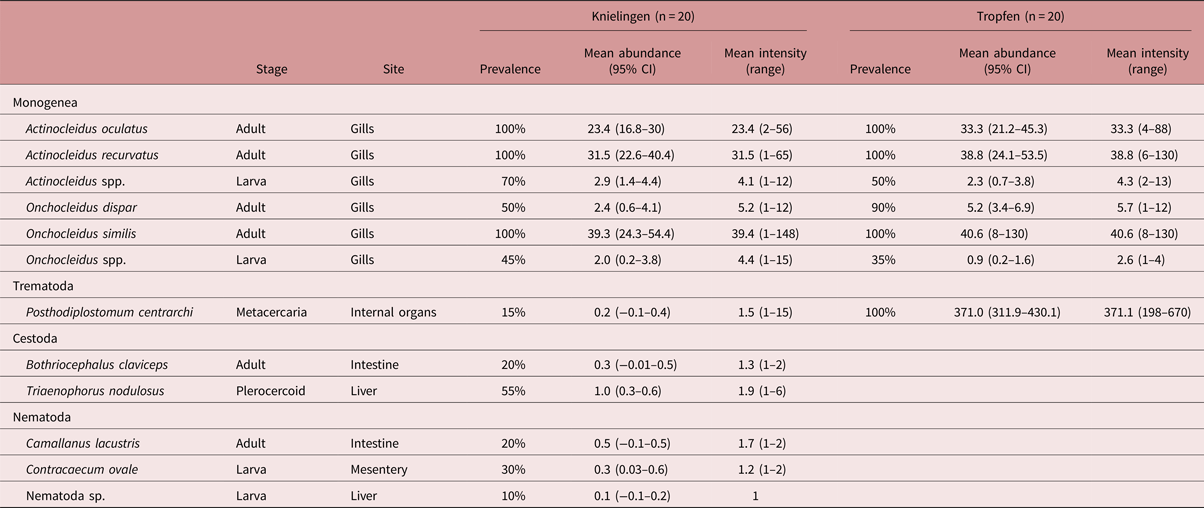
A total of 11,907 metazoan parasites were collected, with a mean abundance (±SD) of 298 ± 228. Nine parasite taxa were identified, and one larval nematode was impossible to identify because of the low quality of the preserved material. All fish examined were infected by three to seven parasite species. Three monogeneans, Onchocleidus similis Müller, 1936, Actinocleidus oculatus (Müller, 1934) and Actinocleidus recurvatus Mizelle & Donahue, 1944, were found on gills at both sites with 100% prevalence. In addition, the gill monogenean Onchocleidus dispar Müller, 1936 and trematode metacercariae of Posthodiplostomum centrarchi (Hoffman, 1958) were observed at both sites. Two cestodes (Bothriocephalus claviceps (Goeze, 1782) and Triaenophorus nodulosus (Pallas, 1781) larvae) and three nematodes (Camallanus lacustris (Zoega, 1776), Contracaecum ovale (von Linstow, 1907) and one unidentified larva) were collected at low abundance and prevalence at Knielingen (table 2).
Stage, infection site, prevalence, mean abundance with 95% confidence intervals (CI) and mean intensity of infection (with range in parentheses) of parasite species found on Lepomis gibbosus in the Knielingen and Tropfen ponds (Upper Rhine, near Karlsruhe, Germany). Knielingen pond: established population; Tropfen pond: founder population.

Mean parasite abundance (table 1) was significantly higher at Tropfen compared to Knielingen (Mann–Whitney U test; Z = 5.4, P < 0.001), reflecting a higher mean abundance of the trematode P. centrarchi (371 found at Tropfen and 0.2 at Knielingen; Z = 5.7, P < 0.001; table 2). Mean abundance of monogenean species was similar between sites. Infracommunity richness ranged from 3–7 at Knielingen and 4–5 at Tropfen and did not differ significantly between the sites (Z = 0.7, P = 0.48).
Aside from two individuals from Knielingen, most of the fish examined were 2+ years old. At Knielingen, the 2+ fish were significantly larger (t = 2.3, P = 0.030) and exhibited higher CI (t = 5.5, P < 0.001) than those from Tropfen. On the other hand, HSI (t = 5.6, P < 0.001) and SSI (t = 7.2, P < 0.001) were significantly higher at Tropfen (table 1). Overall parasite abundance tended to increase with fish SL at Knielingen only (r s = 0.46, P = 0.042), although there was no relationship with any of the condition indices. Likewise, neither site showed any relationship between fish condition and parasite species. At Tropfen, there was a positive relationship between HSI and abundance of P. centrarchi metacercariae and consequently overall abundance (r s = 0.79, P < 0.001 and r s = 0.72, P < 0.001, respectively).
Discussion
The parasite community of L. gibbosus in two isolated ponds in the Rhine river basin mainly consisted of natural centrarchid-specific North American parasites, i.e. four ancyrocephalid monogenean species and the diplostomid trematode P. centrarchi. All five parasites are reported in Germany and in the Rhine river basin for the first time. In addition, two circumpolar cestode species that also infect L. gibbosus in its native range were found at Knielingen, B. claviceps and T. nodulosus. At the same site, three nematode species were acquired by L. gibbosus, with C. lacustris representing a new host record.
Ancyrocephalid monogeneans, which have a direct life cycle and display high host specificity, were co-introduced with their fish hosts to Germany and appear to have persisted and established stable populations at both ponds. Comparable North American ancyrocephalid diversity to ours has also been found in Italian (River Po; Galli et al., Reference Galli2005) and French (River Durance; Havlátová et al., Reference Havlátová, Ondračková and Přikrylová2015) non-native populations of L. gibbosus. In comparison, the monogenean community in Black Sea drainage populations in Ukraine, Bulgaria, Romania, Croatia, and the Czech and Slovak Republics, assessed between the 1950s and 1970s (Roman, Reference Roman1953; Margaritov, Reference Margaritov, Botev, Rusev and Naidenov1968; Pashkevichute, Reference Pashkevichute1971; references in Moravec, Reference Moravec2001) and more recently (Ondračková et al., Reference Ondračková2011; Rubtsova, Reference Rubtsova2015; Kvach et al., Reference Kvach2018; Stoyanov et al., Reference Stoyanov2018), and in isolated ponds in Norway (Sterud & Jørgensen, Reference Sterud and Jørgensen2006) and England (Hockley et al., Reference Hockley2011), was less diverse than in the present study. The first European introductions of L. gibbosus occurred in France and Germany over a hundred years ago (Welcomme, Reference Welcomme1981), with donor populations consisting of hundreds of individuals originating from multiple sources (Wiesner et al., Reference Wiesner2010). Release to open waters and population establishment was documented within a very short period, with the first records in France occurring in 1887 (Copp et al., Reference Copp, Fox and Kováč2002) and 1896 in Germany (Sieglin, Reference Sieglin1902). Current French and German populations, therefore, are likely to represent the progeny of the original source fish. In this case, the high diversity of natural parasites is likely to be the result of co-introduction, survival and establishment from a large and diverse founder population.
Presence of North American P. centrarchi has only recently been confirmed in several widely spaced European L. gibbosus populations (Kvach et al., Reference Kvach2017; Stoyanov et al., Reference Stoyanov2017), despite a long history of L. gibbosus occurrence in Europe. A number of studies over recent decades failed to detect this parasite (e.g. Piasecki & Falandysz, Reference Piasecki and Falandysz1994; references in Moravec, Reference Moravec2001), suggesting its recent introduction and rapid spread, potentially related to the spread of its first intermediate host, physid snails (Kvach et al., Reference Kvach2017). The mollusc P. acuta sensu lato has been recorded in the Rhine since 1870, and was widely distributed in the upper Rhine at the beginning of the 20th century (Bernauer & Jansen, Reference Bernauer and Jansen2006; Leuven et al., Reference Leuven2009), being the only mollusc species found in Tropfen (Keller, Reference Keller2015; Herzog, Reference Herzog2016). Posthodiplostomum centrarchi was found at both our localities, but at markedly different intensities. The sporadic occurrence of P. centrarchi at Knielingen may result from the low density of mollusc intermediate hosts as a result of high predation pressure and/or the encounter-dilution effect, which predicts that the number of parasites per host will be negatively correlated with host density, as the total number of transmission stages is divided between all hosts in the area, reducing the probability of host–parasite contact (Buck & Lutterschmidt, Reference Buck and Lutterschmidt2017). A related alternative hypothesis, encounter-dilution via non-compatible hosts, predicts that frequent encounters with non-competent fish species can decrease a parasite's capability of infecting competent hosts through energy depletion or damage (Gendron & Marcogliese, Reference Gendron and Marcogliese2017). At Knielingen, the fish community comprised a wide range of local species, presumed to be non-compatible for North American Posthodiplostomum cercariae. As Knielingen is ten times larger than Tropfen and L. gibbosus are less dominant, this decreases the parasite's chances of encountering a compatible host.
Generalist parasites (only endoparasitic helminths in this case) were found only at Knielingen, where native fish species such as percids and cyprinids co-occur. Although some of these parasites have a circumpolar distribution encompassing the centrarchid native range, it is assumed that they were acquired in the host's non-native range. Use of L. gibbosus as an intermediate host by the cestode T. nodulosus, and as a paratenic host by B. claviceps, has previously been documented in both its native (Hoffman, Reference Hoffman1999) and introduced range (Košuthová et al., Reference Košuthová2009; Masson et al., Reference Masson2015 for T. nodulosus; Aisa & Gattaponi, Reference Aisa and Gattaponi1981 for B. claviceps). The life cycle of T. nodulosus includes both cyclopoid copepods and a range of fish species as intermediate hosts, with esocid fish as definitive hosts (Kuperman, Reference Kupermann1973). Although L. gibbosus appears to be a competent host for this species, low infection intensities indicate potential resistance to this parasite, as also noted by Masson et al. (Reference Masson2015). The cosmopolitan species B. claviceps is a specific parasite of eels, although other fish species may serve as paratenic hosts, thereby representing a possible additional source of eel infection (Scholz, Reference Scholz1997). While B. claviceps can use L. gibbosus as a paratenic host, it occurs only rarely as the cestode larvae survive only for a short period (Dupont & Gabrion, Reference Dupont and Gabrion1986). The low infection rates recorded in our data, therefore, suggest that L. gibbosus plays a relatively unimportant role in the population dynamics of both these cestode parasites.
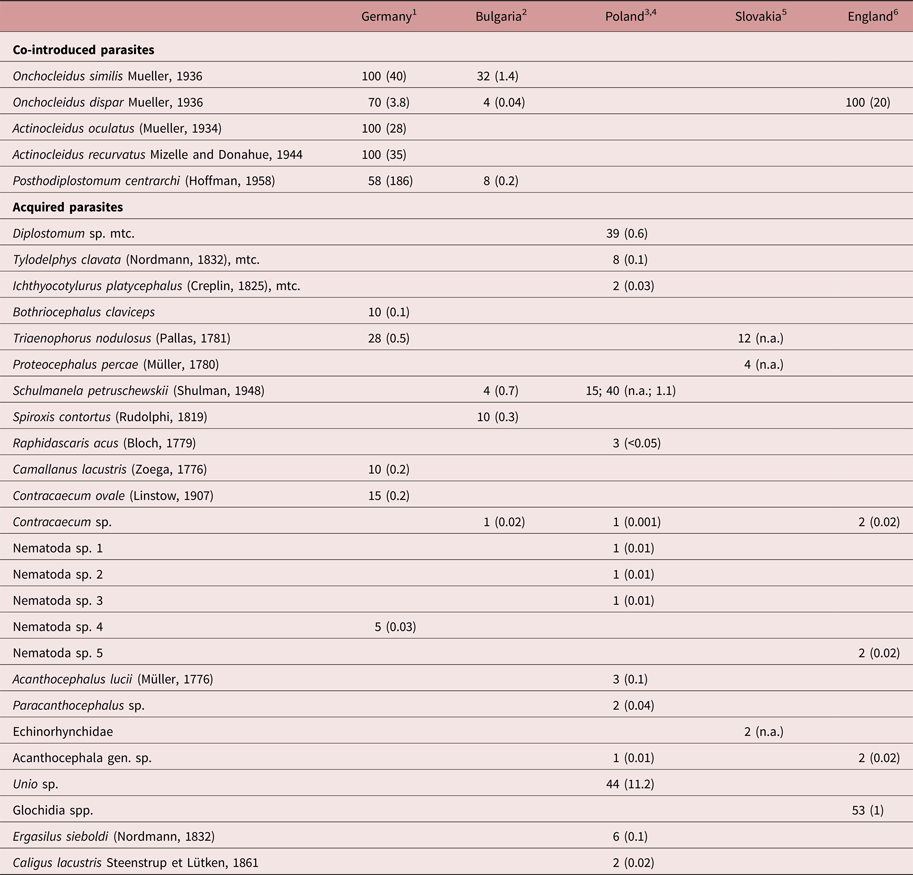
The process of becoming a host for a new parasite depends on a complex set of interactions involving aspects of host biology and particular spatial and temporal scales (Paterson et al., Reference Paterson2012). At Knielingen, we recorded just five specimens of C. lacustris, six specimens of C. ovale nematodes and one unidentified larva. Moravec (Reference Moravec1971) recorded C. lacustris as being able to develop in a range of fish families serving as paradefinitive or post-cyclic hosts, whereas predatory fishes such as Percidae (predominantly P. fluviatilis) and Esocidae serve as typical definitive hosts (Moravec, Reference Moravec2013). Likewise, C. ovale was recorded as a parasite of cyprinid and other fishes with an almost cosmopolitan distribution (Moravec, Reference Moravec2013). Although the records presented here represent new host records for these parasites, the findings are not surprising as L. gibbosus infection by other Camallanus or Contracaecum species has also been documented in North America (Hoffman, Reference Hoffman1999). Both our own results and those from other non-native populations throughout Europe (e.g. Hockley et al., Reference Hockley2011; Stoyanov et al., Reference Stoyanov2018) suggest that L. gibbosus acquire local parasites only occasionally, and at relatively low prevalence and abundance (see table 3).
List of parasite species of Lepomis gibbosus documented in literature from five European countries, with % prevalence (and abundance in parentheses) where available; n.a., not available.

1 This study; 2 Lake Anasovsko Wetlands, Bulgaria (Stoyanov et al., Reference Stoyanov2018); 3,4 Warm-water power plant discharge canal near Szczecin (Piasecki & Falandysz, Reference Piasecki and Falandysz1994, Pilecka-Rapacz & Sobecka, Reference Pilecka-Rapacz and Sobecka2008); 5 Coarse fishing lake in south-west England (Hockley et al., Reference Hockley2011); 6 Rivers Bodrog, Tisa, Latorica, Ondava, Laborec in eastern Slovakia (Košuthová et al., Reference Košuthová2009)
In accordance with Masson et al. (Reference Masson2015), who examined the effect of the cestode T. nodulosus on the health of L. gibbosus in France, there was no relationship between CI and overall or individual parasite abundance in this study. Indeed, a lack of parasitism impact on host condition has previously been documented in many fish host–metazoan parasite systems (e.g. Laffargue et al., Reference Laffargue2004; Ondračková et al., Reference Ondračková2010), this phenomenon usually being explained by low parasite load, host resistance or simply low sample size. However, significant differences in CI were observed between the two ponds, with fish from the larger Knielingen pond (low L. gibbosus density) showing significantly higher CI and SL than fish from the smaller Tropfen pond (abundant and highly parasitized population). The better performance of fish from Knielingen could potentially be the result of a lower fish density, with subsequent lower intraspecific competition and parasite burden. The hundred-times higher infection rate of P. centrarchi at Tropfen was probably reflected in a significantly higher HSI and SSI compared to fish from the less parasitized Knielingen population (table 2). Liver mass is usually associated with energy reserves and metabolic activity in fishes (Wooton, Reference Wooton1984); hence, any variation in liver mass may reflect the cost of parasitization on the host's condition. Although parasites have been shown to reduce HSI in several host–parasite systems (Malek, Reference Malek2001), liver parasites appeared to induce hepatomegaly in our study, as also indicated by the significant increase in liver mass (excluding parasite mass) with increasing number of metacercariae. SSI, which describes the relative size of the spleen, may serve as an indicator of immune activation (Seppänen et al., Reference Seppänen2009), with splenic enlargement in fish infected by P. centrarchi probably representing an adaptive immunological response to cope with the infection, as in the case of trematode infection in Arctic charr (Seppänen et al., Reference Seppänen2009).
Lepomis gibbosus is one of the most successful introduced fish species in Europe, and is currently described as ‘potentially invasive’ in Germany (Nehring et al., Reference Nehring2010). Any improvement in our knowledge of its parasite fauna, including co-introduced non-native species, and competence to local parasite species will contribute to our better understanding of this species’ invasion success. Our results confirm the presence of established co-introduced monogenean populations and a potential negative impact from high North American trematode intensities on host fish health, possibly limiting the host's performance and its overall invasiveness. Given its relatively low competence to local parasites, L. gibbosus is not expected to have any significant effect on local parasite species dynamics through amplification effects.
Acknowledgments
We thank Z. Adámek, M. Hasch, A. Herrmann, J. Imdieke, and M. Janáč for their support during fish sampling, M. Doll for providing data on local fish fauna, the city of Rheinstetten and the fishermen of the Sportfischereivereinigung Knielingen for the opportunity to sample in their waters, and K. Roche and S. White for proofreading the English text.
Financial support
This study received financial support through the European Centre of Ichthyoparasitology under the Grant Agency of the Czech Republic - Centre of Excellence Grant No. P505/12/G112.
Conflict of interest
None.