INTRODUCTION
Species of Haemoproteus and Plasmodium (Sporozoa, Haemosporida) are cosmopolitan dipteran-borne pigment-forming haemosporidian parasites (Atkinson and van Riper, Reference Atkinson, van Riper, Loye and Zuk1991; Valkiūnas, Reference Valkiūnas2005). The genus Haemoproteus (which includes 2 subgenera, Haemoproteus and Parahaemoproteus) consists of over 130 morphologically readily distinguishable species, whose descriptions are based mainly on morphological features of their blood stages and limited experimental information about their vertebrate host specificity; over 50 species of avian malaria parasites of the genus Plasmodium have been described (Garnham, Reference Garnham1966; Bennett et al. Reference Bennett, Okia, Ashford and Campbell1972b; Valkiūnas et al. Reference Valkiūnas, Iezhova, Loiseau, Chasar, Thomas and Sehgal2008a). Such diversity of the parasites has recently been revisited with the introduction of polymerase chain reaction (PCR)-based methods, which greatly improved the opportunities to detect haemosporidian infections in birds (Feldman et al. Reference Feldman, Freed and Cann1995; Bensch et al. Reference Bensch, Stjenman, Hasselquist, Östman, Hansson, Westerdahl and Torres-Pinheiro2000; Hellgren et al. Reference Hellgren, Waldenström and Bensch2004) and made it possible to use gene sequences as an additional criterion for parasite identification and classification. Molecular screening methods not only increase sensitivity of parasite detection, but have also revealed cryptic diversity within parasite lineages recognized by morphological classification, indicating that the number of haemosporidian species are greater than can be distinguished by microscopy (Bensch et al. Reference Bensch, Pérez-Tris, Waldenström and Hellgren2004). These protocols are most often based on methods that amplify a part of the mitochondrial cytochrome b (cyt b) gene (Bensch et al. Reference Bensch, Stjenman, Hasselquist, Östman, Hansson, Westerdahl and Torres-Pinheiro2000; Perkins and Schall, Reference Perkins and Schall2002; Fallon et al. Reference Fallon, Bermingham and Ricklefs2003; Hellgren et al. Reference Hellgren, Waldenström and Bensch2004; Waldenström et al. Reference Waldenström, Bensch, Hasselquist and Östman2004).
Molecular-based methods for parasite identification have become popular due to the ease with which they can be applied by non-taxonomists, and the number of published parasite DNA sequences are multiplying at great pace (Bensch et al. Reference Bensch, Hellgren and Pérez-Tris2009). However, most of the parasites were identified only by their sequences, and thus lack of morphological description and species identification. This therefore makes it unclear where to place genetic boundaries among morphospecies, or how molecular data may be used in taxonomy. In a revealing analysis, Martinsen et al. (Reference Martinsen, Paperna and Schall2006) linked mitochondrial cyt b sequences with several morphospecies of haemosporidians and concluded that detailed studies of morphology usually allow sound identification of these parasites. Using a sample of parasites that had been identified by combining microscopy and molecular techniques Hellgren et al. (Reference Hellgren, Križanauskienė, Valkiūnas and Bensch2007a) suggested that Haemoproteus spp. with a genetic differentiation in mitochondrial cyt b of over 5% are candidates to show morphologically different blood stages that can be identified by microscopy, which is important to further develop the taxonomy of these parasites. The morphospecies in the study by Hellgren et al. (Reference Hellgren, Križanauskienė, Valkiūnas and Bensch2007a) either consisted of one molecular lineage or a group of lineages that formed well-supported monophyletic clades together with lineages identified to the same morphospecies.
Comparisons of genetic and morphological data showed that morphological characters, which have been used in traditional taxonomy for over 100 years, are phylogenetically informative, thus making it possible to integrate the huge knowledge of traditional parasitology with phylogenetic trees constructed using DNA sequences (Hellgren et al. Reference Hellgren, Križanauskienė, Valkiūnas and Bensch2007a; Martinsen et al. Reference Martinsen, Perkins and Schall2008). In addition, these studies suggest that genetic variation is a suitable clue for guiding morphological parasite investigations, so that the taxonomy of this group may greatly benefit from detailed morphological characterization of well-differentiated parasite genetic lineages (Valkiūnas et al. Reference Valkiūnas, Križanauskienė, Iezhova, Hellgren and Bensch2007). Nevertheless, it is important to note that some distinctive morphospecies like Haemoproteus pallidus and Haemoproteus minutus, which parasitize birds belonging to 2 closely related families (Muscicapidae and Turdidae), show low genetic differentiation in mitochondrial cyt b gene (0·7%). This illustrates that the molecular criterion of over 5% sequence divergence in cyt b gene for the identification of haemosporidian morphological diversity should be applied in one direction only. That is, lineages that differ by >5% in cyt b sequence are likely to be morphologically distinct, but that does not mean that lineages that differ by <5% are morphologically indistinguishable.
The blackcap (Sylvia atricapilla) is a common Palearctic migratory songbird (Cramp, Reference Cramp1992), and haemosporidians are common blood parasites in this species, with an overall prevalence of the infection of over 50% in numerous populations across Europe (Valkiūnas, Reference Valkiūnas2005). Recent studies showed that the blackcap harbours the largest proportion of exclusive lineages of haemosporidians observed in any passerine bird species studied to date (Pérez-Tris et al. Reference Hellgren, Waldenström, Pérez-Tris, Szöllősi, Hasselquist, Križanauskienė, Ottosson and Bensch2007). Interestingly, the blackcap shows particularly diverse migratory behaviours in the Palearctic, including sedentary populations, intercontinental migrants, and all intermediate degrees of partial and/or short-distance migration (Cramp, Reference Cramp1992). Such variation in migratory behaviour might favour the evolution of different transmission strategies among blackcap parasites, and finally result in unusually high genetic diversity of parasites in this avian host (Pérez-Tris and Bensch, Reference Pérez-Tris and Bensch2005a). However, these patterns have only been addressed using molecular tools, which sometimes do not read simultaneous infections of haemosporidians (Valkiūnas et al. Reference Valkiūnas, Bensch, Iezhova, Križanauskienė, Hellgren and Bolshakov2006); that calls for a proper morphological investigation of blackcap parasites. The blackcap and its haemosporidian parasites are convenient model organisms to address relationships between phenotypic variation and genetic differences in parasites. In this study, we used both microscopy data and DNA sequences to determine morphological and genetic diversity of pigment-forming haemosporidians of the genera Haemoproteus and Plasmodium of blackcaps across Europe. The main aim of this study was to link information about the astonishing genetic diversity of blackcap's haemosporidians with context of traditional taxonomy of these parasites. A new species of Haemoproteus is also described.
MATERIALS AND METHODS
Study sites and collection of blood samples
Blood samples were collected from 498 individual blackcaps between May and July in 2003–2005. The birds were captured at the Biological Station of the Zoological Institute of the Russian Academy of Sciences on the Curonian Spit in the Baltic Sea (55°05′N, 20°44′E, n=121). For comparative purposes, we also used samples from 2 other studies of this species (Pérez-Tris and Bensch, Reference Pérez-Tris and Bensch2005a; Pérez-Tris et al. Reference Hellgren, Waldenström, Pérez-Tris, Szöllősi, Hasselquist, Križanauskienė, Ottosson and Bensch2007), in which morphological data were not presented. These samples were collected in Dijon in France (47°15′N, 6°31′E, n=18), Lund in Sweden (55°41′N, 13°26′E, n=30), Quievrain in Belgium (50°24′N, 3°50′E, n=18), and in 3 sites in Spain, namely Rascafria in Central Spain (40°54′N, 3°50′E, n=12), Vitoria in Northern Spain (42°50′N, 2°40′E, n=11), and Tarifa in Southern Spain (36°00′N, 5°36′E, n=288), which included both breeding individuals and wintering birds with different European origin.
Blackcaps were caught using mist nets and large Rybachy type traps. The birds were banded to avoid repetition, and a blood sample was taken by puncturing the brachial vein before being released. Blood films were air-dried, fixed in absolute methanol in the field and stained with Giemsa in the laboratory, as described by Valkiūnas, (Reference Valkiūnas2005).
A complementary blood sample (20–50 μl) was collected using heparinized microcapillaries and stored in non-lysis SET- buffer (Waldenström et al. Reference Waldenström, Bensch, Hasselquist and Östman2004). The samples were held at ambient temperature in the field and later at −20°C in the laboratory. The fixed samples were analysed by molecular methods between 1 and 4 months after their collection.
Examination of blood films and parasite morphology
An Olympus BX51 light microscope equipped with an Olympus DP12 digital camera and imaging software DP-SOFT was used to examine blood slides, prepare illustrations and to take measurements. Good quality blood films from 121 birds were examined for 10–15 min at low magnification (×400), and then at least 100 fields were studied at high magnification (×1000), as described by Valkiūnas et al. (Reference Valkiūnas, Iezhova, Križanauskienė, Palinauskas and Bensch2008d). We used the morphometric features (Table 2) and identified parasites according to Valkiūnas (Reference Valkiūnas2005). Intensity of infection was estimated as a percentage by actual counting of the number of parasites per 1000 red blood cells or per 10 000 red blood cells if infections were light (i.e. <0·1%), as recommended by Godfrey et al. (Reference Godfrey, Fedynich and Pence1987).
Morphology of gametocytes of the new species was compared with hapantotypes of Haemoproteus pallidus (Accession no. 963.89) and Haemoproteus minutus (Accession no. 245.85p) from their type hosts pied flycatcher (Ficedula hypoleuca) and blackbird (Turdus merula), respectively, in the Collection of the Institute of Ecology, Vilnius University, Vilnius.
Student's t-test for independent samples was used to determine statistical significance between mean linear parameters. A P value of 0·05 or less was considered significant.
Extraction of DNA, PCR, sequencing and analysis of molecular data
For total DNA extraction from blood we used standard phenol-chloroform or ammonium-acetate protocols. For genetic analysis we used a nested-PCR protocol (Hellgren et al. Reference Hellgren, Waldenström and Bensch2004; Waldenström et al. Reference Waldenström, Bensch, Hasselquist and Östman2004). We amplified a segment of the parasite cyt b gene using the 2 pairs of initial primers HaemFNI and HaemNR3, which are general for species of Haemoproteus, Plasmodium, and Leucocytozoon (Hellgren et al. Reference Hellgren, Waldenström and Bensch2004), or HaemNF and HaemNR2 which amplify longer fragments of cyt b gene of Haemoproteus and Plasmodium (Waldenström et al. Reference Waldenström, Bensch, Hasselquist and Östman2004). For the second PCR, we used primers specific to Haemoproteus and Plasmodium spp., HaemF [5′-ATGGTGCTTTCGATATATGCATG-3′] and HaemR2 [5′-GCATTATCTGGATGTGATAATGGT-3′] (Bensch et al. Reference Bensch, Stjenman, Hasselquist, Östman, Hansson, Westerdahl and Torres-Pinheiro2000).
The first PCR (pre-amplification) was carried out in a 25 μl volume, and included 50 ng of total genomic DNA, 1·5 mm MgCl2, 1X PCR buffer, 1·25 mm of each deoxynucleoside triphosphate, 0·6 mm of each primer, and 0·5 units Taq DNA polymerase. The PCR's were run using the following protocol: initial denaturation for 3 min at 94°C, 30 sec at 94°C, 30 sec at 50°C, 45 sec at 72°C for 20 cycles, followed by final extension at 72°C for 10 min. For the second PCR (final amplification with internal primers) we used 2 μl of the first PCR product, as template in a 25 μl volume with the primers HaemF – R2, including the same reagents and thermal conditions, as the first reaction, except with 35 cycles instead of 20 cycles. The amplification was evaluated by running 1·5 μl of the final PCR on a 2% agarose gel.
For sequencing we used procedures as described by Bensch et al. (Reference Bensch, Stjenman, Hasselquist, Östman, Hansson, Westerdahl and Torres-Pinheiro2000). Fragments were sequenced from the 5′ end with the primer HaemF, and new lineages were sequenced from the 3′ end with the primer HaemR2. We used dye terminator cycling sequencing (big dye) and the samples were loaded on an ABI PRISM™ 3100 capillary sequencing robot (Applied Biosystems, Florida, USA). All multiple infections were resolved using TA-cloning as described by Pérez-Tris and Bensch (Reference Pérez-Tris and Bensch2005b).
Sequences were edited and aligned using the software Bioedit (Hall, Reference Hall1999). A Bayesian phylogeny was constructed using mrBayes version 3.1.2 (Ronquist and Huelsenbeck, Reference Ronquist and Huelsenbeck2003). We used the General Time Reversible model including invariable sites and variation among sites (GTR+I+G) as suggested by the software mrModeltest 2.2 (Nylander, Reference Nylander2004, software available from <http://www.ebc.uu.se/systzoo/staff/nylander.html>). Two simultaneous runs were conducted with a sample frequency of every 100th three over 3million generations. Before constructing a majority consensus tree 25% of the initial trees in each run was discarded as burn-in periods. The phylogenies were visualized using Tree View 1.6.6. (software available from <http://evolution.genetics.washington.edu/phylip/software.html>). GenBank Accession numbers and MalAvi reference names (see Bensch et al. Reference Bensch, Hellgren and Pérez-Tris2009) of all lineages mentioned in this article are given in Fig. 1.
Bayesian phylogeny of 25 Haemoproteus spp. and Plasmodium spp. lineages recorded in blackcap Sylvia atricapilla based on the sequences of mitochondrial cytochrome b gene. Names of the lineages are given before the species names of parasites and GenBank Accession numbers are provided after the species names. Name of new species is given in bold. Vertical bars (A–F) indicate groups of closely related lineages.

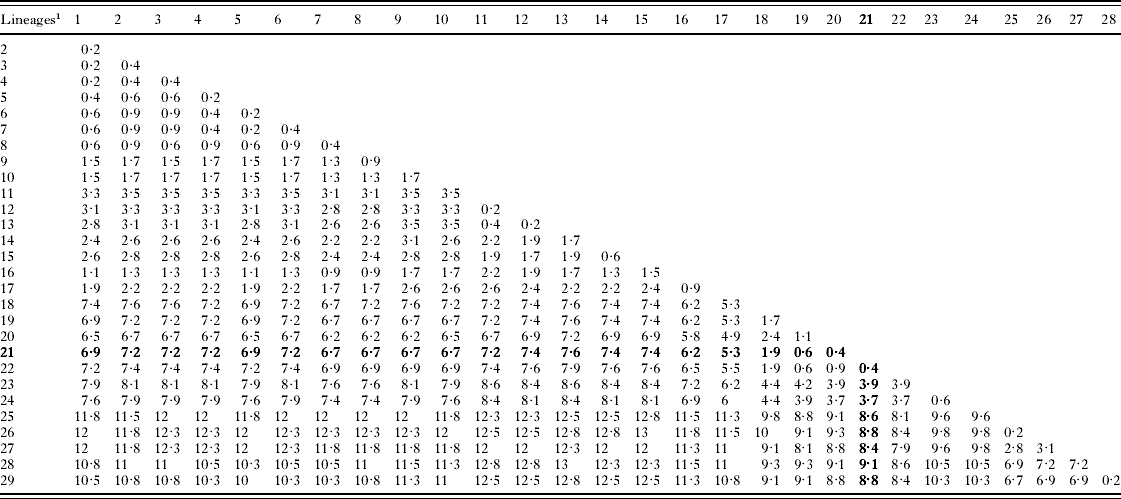
The sequence divergence between the different lineages (Table 1) was calculated with the use of a Jukes-Cantor model of substitution, with all substitution weighted equally, implemented in the program MEGA 4.0 (Kumar et al. Reference Kumar, Tamura and Nei2004).
The sequence divergence (in percentage) between cytochrome b lineages of Haemoproteus and Plasmodium parasites of blackcaps (Sylvia atricapilla)

1 Lineages are numbered as in Fig. 1, in which species names and GenBank Accession numbers are given. The sequence divergence was calculated with the use of a Jukes-Cantor model of substitutions. The data referring to the new species (Haemoproteus pallidulus SYAT03) are given in bold.
RESULTS
Molecular analysis of blood samples
Only haemosporidian parasites of the genera Haemoproteus and Plasmodium were considered during this study. In all, 56% of blackcaps were infected with these parasites. We detected 25 lineages of Haemoproteus spp. and Plasmodium spp. in 270 infected blackcaps. Among them, 21 lineages were Haemoproteus spp. and 4 lineages Plasmodium spp. (Fig. 1). At all study sites, the lineage SYAT02 was most prevalent (23% of all recorded infections). Both the lineage SYAT02 and SYAT01 were found in juvenile birds, thus indicating transmission at the European study sites.
Four relatively well-supported clades of Haemoproteus spp. lineages (A–D) and 2 clades of Plasmodium spp. (E and F) were distinguished in the Bayesian tree (Fig. 1, Table 1). The majority of detected lineages belong to clades A and B, with sequence divergence between lineages within these clades of <0·9% and <2·5%, respectively (Table 1).
The lineages of the clades C, D, E, and F have been recorded in different groups of avian hosts; it seems that these parasites have the ability to infect and successfully complete their life cycles and produce gametocytes in several species of passerine birds. The lineages of clades A and B have been recorded particularly from the blackcap.
Microscopic investigation
Over 60% of all recorded infections were light (<0·001%), so could be regarded as chronic. For many of the detected cyt b lineages we were unable to do morphological identification due to low intensity of parasitaemia and absence on the slides of all blood stages, which are essential for species identification.
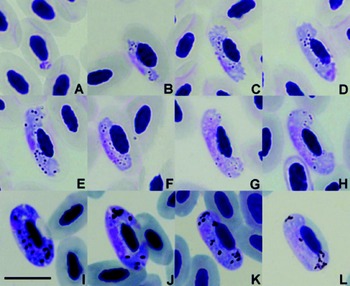
Haemoproteus parabelopolskyi (Figs 1 and 2I, J) (lineages SYAT01, SYAT02, SYAT04 and SYAT11), H. majoris (Figs 1 and 2K, L) (PARUS1 and WW2) and Plasmodium relictum (GRW11 and SGS1) were identified using morphological features of blood stages of the parasites. Unidentified Plasmodium sp. lineage SYAT24 is particularly close to the lineage GRW6 of Plasmodium (Huffia) elongatum with genetic difference of 0·2% between them (Fig. 1, Table 1), so it probably belongs to this morphospecies, although we did not have suitable material for its unequivocal identification using microscopy.
Common haemoproteids of the blackcap Sylvia atricapilla: (A–H) – gametocytes of Haemoproteus pallidulus sp. nov. (lineage SYAT03; (A, B) young gametocytes, (C–E) macrogametocytes, (F–H) microgametocytes), (I, J) – mature gametocytes of Haemoproteus parabelopolskyi (lineage SYAT02) and (K, L) – mature gametocytes of Haemoproteus majoris (lineage PARUS1); (I, K) – macrogametocyes, (J, L) – microgametocytes. Giemsa-stained thin blood films. Scale bar=10 μm.

The lineage SYAT03 of Haemoproteus sp. (Fig. 1, clade C) is genetically similar to the lineage TURDUS2 (Haemoproteus minutus, host is the blackbird Turdus merula) and to the lineage PFC1 (Haemoproteus pallidus, host is the pied flycatcher Ficedula hypoleuca) (Fig. 1). Genetic divergence between these lineages in clade C varies between 0·4% and 1·9% (Table 1). According to investigation of type material, the lineages TURDUS2 and PFC1 belong to morphologically well-differentiated species, which can be easily distinguished from each other based on morphology of their gametocytes. We found that this was also the case for the blood stages of Haemoproteus sp. (SYAT03) as it could be morphologically readily distinguished from H. minutus and H. pallidus and any other haemoproteids of passerine birds described to date. The description of the parasite of the lineage SYAT03 follows below.
Description of parasite
Haemoproteus (Parahaemoproteus) pallidulus n. sp. (Fig. 2, Table 2)
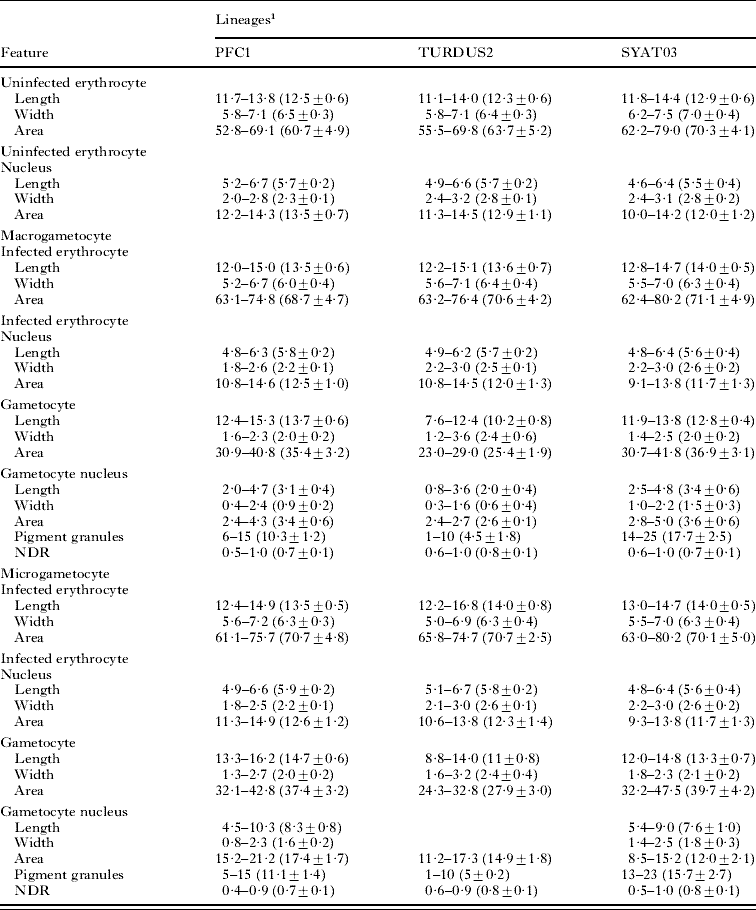
Morphometric parameters of host cells and gametocytes of Haemoproteus pallidus (lineage PFC1), Haemoproteus minutus (TURDUS2) and Haemoproteus pallidulus sp. nov. (SYAT03)

1 All measurements (n=31) are given in micrometers. Minimum and maximum values are provided, followed in parentheses by the arithmetic mean and standard deviation. NDR=nucleus displacement ratio according to Bennett and Campbell (Reference Bennett and Campbell1972a). Morphometry of H. pallidus (lineage PFC1), H. minutus (lineage TURDUS2) is based on the type material.
Type host.: Blackcap Sylvia atricapilla (Passeriformes, Sylviidae).
DNA sequences: Mitochondrial cyt b gene lineage SYAT03 (479 bp, GenBank Accession no. AY831752), dihydrofolate reductase/thymidylate synthase (DHFR-TS) gene lineage SYAT03 (220 bp, GenBank Accession no. AY560370).
Additional hosts: Unknown.
Type locality: The Curonian Spit in the Baltic Sea (55°05′N, 20°44′E).
Prevalence: Eleven of 498 (2·2%). In the type locality, the prevalence was 4 of 121 (3·3%).
Distribution: This morphospecies and its lineage SYAT03 have been recorded on the Curonian Spit in the Baltic Sea (Russia), in Lund (Sweden), Quievrain (Belgium), Rascafria and Tarifa (Spain). It is probable that it is widespread throughout the range of the blackcap in Europe, but the prevalence of infection is low in this host. Because H. pallidulus was recorded in juvenile birds in Southern Europe, it is certainly transmitted at the southern study sites. In northern Europe, this parasite has been found only in adult birds, so it is unclear if it is transmitted here, including the type locality.
Site of infection: Mature erythrocytes, no other data.
Type specimens: Hapantotype (Accession number 5420 NS, Sylvia atricapilla, 2003, collected by T. A. Iezhova) is deposited in the Institute of Ecology, Vilnius University, Vilnius, Lithuania. Parahapantotypes were deposited in the Institute of Ecology, Vilnius University (5345 NS, 5346NS, 5347NS and 5422NS), and in the Queensland Museum, Queensland, Australia (G465373). Simultaneous infection of H. parabelopolskyi, Trypanosoma sp. and microfilariae is present in type material.
Etymology: The species name reflects the pale staining of the cytoplasm of gametocytes of this parasite and shows similarity of morphological and morphometric features of gametocytes to those of closely related species H. pallidus.
Young gametocytes (Fig. 2A, B): The earliest forms (Fig. 2A) can be seen anywhere in the infected erythrocytes; they are roundish or oval, each possesses a large nucleus and prominent cytoplasm. As the parasite develops, gametocytes adhere to the erythrocyte nuclei and extend longitudinally along the nuclei (Fig. 2B).
Macrogametocytes (Fig. 2C–E): The cytoplasm is homogeneous in appearance, sometimes contains small vacuoles; stains relatively pale (compare Fig. 2E and I). Gametocytes are closely appressed to the nuclei and envelope of erythrocytes from early stages of their development (Fig. 2C), and these contacts with host cells remain undisturbed as the parasites develop (Fig. 2D, E). Gametocytes grow around the nuclei of erythrocytes, slightly enclose the nuclei with their ends, but do not encircle them completely (Fig. 2E). Outline of gametocytes is more or less ameboid, it is frequently wavy in appearance in the growing parasites (Fig. 2C–E). Fully grown gametocytes fill erythrocytes up to their poles (Fig. 2E). Parasite nucleus is prominent (Table 1), variable in shape (Fig. 2C–E), frequently of more or less band-like form (Fig. 2E), usually more or less central (Fig. 2E), but sometimes subcentral (Fig. 2C) or even terminal (Fig. 2D) in position. Pigment granules are numerous (Table 2), roundish, of small size (<0·5 μm), usually randomly scattered throughout the cytoplasm. It is important to note that pigment granules do not change size and shape significantly as parasite matures (see Fig. 2B–H), which is a characteristic feature of this species. Mature gametocytes only slightly displace the nucleus of erythrocytes laterally (Table 2).
Microgametocytes (Fig. 2F–H). The general configuration is as for macrogametocytes with the usual haemosporidian sexual dimorphic characters. The parasite nucleus is diffuse, and its size is variable in different gametocytes (compare Fig. 2G and H).
Remarks
H. pallidulus belongs to a group of avian haemoproteids with gametocytes, in which cytoplasm stains relatively pale with Giemsa (Valkiūnas, Reference Valkiūnas2005). It seems that such species of haemoproteids are common in African birds (Valkiūnas et al. Reference Valkiūnas, Iezhova, Loiseau, Chasar, Thomas and Sehgal2008a), but only 2 species have been recorded in the Palearctic so far. These are H. pallidus (Valkiūnas and Iezhova, Reference Valkiūnas and Iezhova1991) and H. minutus (Valkiūnas and Iezhova, Reference Valkiūnas and Iezhova1992).
H. pallidulus is most similar to H. pallidus, and this is the reason for the naming of the species. Mature gametocytes of the latter parasite are closely appressed to the nuclei of infected erythrocytes, but do not touch the envelope of erythrocytes along their entire margin so that more or less evident irregular ‘cleft’ is present between parasite and the envelope of erythrocytes. That is not characteristic of H. pallidulus. Mature gametocytes of H. minutus are appressed to the nuclei and envelope of erythrocytes from early stages of their development, but they do not fill the erythrocytes up to their poles, and average length of mature gametocytes (Table 2) is significantly less than in H. pallidulus (t=9·968, P<0·0001). Furthermore the average number of pigment granules in mature gametocytes of H. pallidulus (Table 2) is significantly greater than in H. pallidus and H. minutus (t=7·912, P<0·0001 and t=17·586, P<0·0001, respectively). It is important to note that size and form of pigment granules do not change as gametocytes of H. pallidulus mature; this is a rather rare feature in avian haemoproteids, and is not characteristic of either H. pallidus or H. minutus.
Due to small size of mature gametocytes and predominantly small size of pigment granules, H. pallidulus is similar to H. fallisi (Bennett and Campbell, Reference Bennett and Campbell1972a) and H. africanus (Bennett and Peirce, Reference Bennett and Peirce1991). Both these parasites have been frequently recorded in birds belonging to the Turdidae and Estrildidae, respectively (Valkiūnas, Reference Valkiūnas2005). Fully grown gametocytes of H. pallidulus fill the infected erythrocytes up to their poles (Fig. 2E, H) and nuclei of macrogametocytes markedly vary in position from central (Fig. 2E) to terminal (Fig. 2D). Neither feature is characteristic of H. fallisi and H. africanus.
It is important to note that all 4 recorded H. pallidulus infections were mixed with H. parabelopolskyi, as determined both by microscopic examination and PCR diagnostics. Morphological and molecular diagnostics for H. parabelopolskyi has been well developed (Valkiūnas et al. Reference Valkiūnas, Križanauskienė, Iezhova, Hellgren and Bensch2007), so it is easy to identify this parasite. The presence of lineages of these 2 parasites in the type material was supported by cloning H. parabelopolskyi and H. pallidulus can be readily distinguished from each other during mixed infection in the same blood films, primarily due to dark staining and large size of mature gametocytes, and large size of pigment granules of the former species (compare Fig. 2E, H and I, J)
DISCUSSION
The blackcap is a widespread passerine bird in Europe and has three main different migration strategies (Žalakevičius, Reference Žalakevičius1986; Cramp, Reference Cramp1992; Pérez-Tris et al. Reference Pérez-Tris, Bensch, Carbonell, Helbig and Telleria2004), i.e. (1) sedentary populations (2) short-distance migrants and (3) long-distance migrants. Due to a variety of migration strategies, this bird lives in different environments, so is exposed to different challenges, including different vector species and abiotic conditions. That might contribute to the high diversity of haemosporidian parasites in this bird species in comparison with other species of the Sylviidae (Pérez-Tris et al. Reference Hellgren, Waldenström, Pérez-Tris, Szöllősi, Hasselquist, Križanauskienė, Ottosson and Bensch2007). The blackcap has the highest proportion of exclusive haemosporidian lineages observed in any bird species studied so far, with other widely sampled birds harbouring a significantly smaller number of species specific lineages (Perez-Tris et al. Reference Perez-Tris, Hellgren, Križanauskienė, Waldenstrom, Secondi, Bonneaud, Fjeldsa, Hasselquist and Bensch2007). The majority of the blackcap exclusive pigment-forming haemosporidians belongs to a monophyletic clade, which unites lineages of Haemoproteus (Parahaemoproteus) spp.. Such closely related parasites of blackcaps represent 18·5% of all Haemoproteus lineages found in 47 host species (Perez-Tris et al. Reference Perez-Tris, Hellgren, Križanauskienė, Waldenstrom, Secondi, Bonneaud, Fjeldsa, Hasselquist and Bensch2007, Bensch et al. Reference Bensch, Hellgren and Pérez-Tris2009).
Parasites from clades A and B are extremely host specific in contrast to H. majoris (clade D, lineages PARUS1, WW2), which appear to be able to infect a broad range of avian hosts (Križanauskienė et al. Reference Križanauskienė, Hellgren, Kosarev, Sokolov, Bensch and Valkiūnas2006). The present study indicates that the level of host specificity can vary markedly between different species of haemoproteids belonging to the same genus.
The lineages PARUS1 and WW2 of H. majoris have been recorded in blackcaps only in Lithuania and Sweden so far (Križanauskienė et al. Reference Križanauskienė, Hellgren, Kosarev, Sokolov, Bensch and Valkiūnas2006). It is possible that this parasite is of recent northern-eastern European origin in blackcaps, so it might become an agent of emerging haemoproteosis in this bird in the South in the future. That warrants further investigation.
In spite of numerous molecular studies describing new lineages of bird blood parasites, only few studies have linked lineages with their morphospecies (Križanauskienė et al. Reference Križanauskienė, Hellgren, Kosarev, Sokolov, Bensch and Valkiūnas2006; Hellgren et al. Reference Hellgren, Waldenström, Pérez-Tris, Szöllősi, Hasselquist, Križanauskienė, Ottosson and Bensch2007a; Martinsen et al. Reference Martinsen, Paperna and Schall2006; Palinauskas et al. Reference Palinauskas, Kosarev, Shapoval, Bensch and Valkiūnas2007; Valkiūnas et al. Reference Valkiūnas, Križanauskienė, Iezhova, Hellgren and Bensch2007, Reference Valkiūnas, Iezhova, Loiseau, Chasar, Thomas and Sehgal2008a, Reference Valkiūnas, Zehtindjiev, Dimitrov, Križanauskienė, Iezhova and Benschb). In addition, several of these parasites are misidentified in GenBank (see Valkiūnas et al. Reference Valkiūnas, Zehtindjiev, Dimitrov, Križanauskienė, Iezhova and Bensch2008b). Linkage between traditional taxonomy and PCR-based data is important for molecular diagnostics of infections and better understanding of phylogenetic relationships between parasites. Hellgren et al. (Reference Hellgren, Križanauskienė, Valkiūnas and Bensch2007a) showed that morphospecies of the genus Haemoproteus either consisted of one molecular lineage or a group of lineages that formed well-supported monophyletic clades together with lineages identified to the same morphospecies. They concluded that cyt b lineages of haemoproteids with a genetic differentiation of over 5% are good candidates to also demonstrate morphological differentiation, although evidence is accumulating that this limit is a conservative one, because there are cases where morphological differences are observed between more closely related species. An illustrative case is the sequence divergence of just 0·7% at the cyt b gene between lineages PFC1 and TURDUS2, belonging to the readily distinguishable morphospecies H. pallidus and H. minutus respectively. Furthermore, H. vacuolatus (lineage hANLA1), which is closely related to these two parasites, has been recently described based on morphology of gametocytes from the yellow-whiskered greenbul (Andropadus latirostris). Genetic divergence in cyt b gene between H. pallidus, H. minutus and H. vacuolatus is less than 2% (Valkiūnas et al. Reference Valkiūnas, Iezhova, Loiseau, Chasar, Thomas and Sehgal2008a). The lineage SYAT03 of H. pallidulus also belongs to the same clade of closely related lineages. This notwithstanding these parasites can be easily distinguished in blood films. They differ in numerous phenotypic characters, particularly in shape and size of mature gametocytes and their position in infected erythrocytes, size and number of pigment granules. It might be that the morphological characters, by which we distinguish these parasites, have evolved recently (Hellgren et al. Reference Hellgren, Križanauskienė, Valkiūnas and Bensch2007a), so genetic difference between these parasites is still small.
It is worth noting that all morphospecies of the clade C are characterized by so-called pale staining of cytoplasm of their gametocytes, particularly macrogametocytes (Valkiūnas, Reference Valkiūnas2005). Because the staining of gametocytes depends on the density of cellular structures (endoplasmic reticulum, ribosomes, asmiophilic bodies, and others), this feature must be genetically determined. That explains the presence in the tree of the clearly separated clade C, which probably represents one of the lines of evolution of avian haemoproteids. These findings contribute to the value of traditional taxonomic characters, which are used in systematics of haemosporidian parasites; they also show the crucial need of combining molecular and microscopic methods for the satisfactory development of taxonomy of these parasites.
Mechanisms of evolution of morphologically different but genetically very similar haemoproteids of clade C are unclear. It is probable that direct hybridization experiments (Valkiūnas et al. Reference Valkiūnas, Iezhova, Križanauskienė, Palinauskas and Bensch2008c) can be used to explain mechanisms contributing to the evolution of such closely related parasites.
In spite of the exceptionally high genetic diversity of haemoproteids in blackcaps, only four lineages of Plasmodium spp. have been found in this bird species. The most prevalent malaria parasite was P. relictum (lineages SGS1 and GRW11), which was described in detail by Palinauskas et al. (Reference Palinauskas, Kosarev, Shapoval, Bensch and Valkiūnas2007). That is expected because the lineage SGS1 of P. relictum is widespread in the Old World (Hellgren et al. Reference Hellgren, Waldenström, Pérez-Tris, Szöllősi, Hasselquist, Križanauskienė, Ottosson and Bensch2007b; Palinauskas et al. Reference Palinauskas, Kosarev, Shapoval, Bensch and Valkiūnas2007; Bensch et al. Reference Bensch, Hellgren and Pérez-Tris2009). The lineage SYAT24 clusters together with GRW6 P. (Huffia) elongatum (Valkiūnas et al. Reference Valkiūnas, Zehtindjiev, Dimitrov, Križanauskienė, Iezhova and Bensch2008b). These lineages differ only at 1 base pair in 479 bp cyt b fragment and probably could be assigned to P. elongatum morphospecies. The lineage SYAT24 was found only in 1 adult bird in Southern Spain which lacked an associated blood film, so we were not able to identify this parasite. We thus stress the importance of preparation of good quality blood films (see Valkiūnas et al. Reference Valkiūnas, Iezhova, Križanauskienė, Palinauskas and Bensch2008d) when collecting blood samples for parasitological and evolutionary biology investigations.
This study demonstrates the importance of combining microscopy and molecular diagnostics in studies of avian blood parasites. The information obtained contributes to the knowledge about genetic diversity of haemosporidians in one host species, including phylogenetic relationships between the parasite lineages and morphospecies. These kinds of studies are relatively rare nowadays, perhaps because PCR methods are easily done and thus genetic analyses proliferate in the literature, while microscopy and taxonomy work requires time-consuming training, so few people in the next generation of scientists are learning these taxonomic skills.
However, combining microscopy and molecular techniques provides the best approach to detailed investigations of host-parasite interactions, vertebrate host specificity, and phylogeography of parasites. As molecular approaches are revealing vastly more parasite diversity than previously anticipated, the need for traditional systematic and biological information is becoming particularly crucial.
ACKNOWLEDGMENTS
The authors are grateful to Casimir V. Bolshakov, for providing excellent opportunities to carry out research at the Biological Station of the Zoological Institute, Russian Academy of Sciences. Tatjana A. Iezhova is gratefully acknowledged for assistance in the laboratory and during fieldwork.
FINANCIAL SUPPORT
The present study was partly supported by the Lithuanian State Science and Studies Foundation and the Spanish Ministry of Science and Technology (CGL2007-62937 to J.P.). The investigations described herein comply with the current laws of Lithuania, Russia, Sweden and Spain.