1 Introduction: Web 2.0 for School 2.0
Web 2.0 is the culture of the competent internet user – the Net Native who wants to take an active role in shaping the design and content of a system his or her parents, members of the Net Generation (Tapscott, Reference Tapscott1998) who grew up with computer culture, used as a service. ICT competence in the school age population shows a steady rise (cf. Education at a Glance, OECD, 1996, 2006), and so does teachers’ willingness to customise and develop digital learning content. According to SITES Module 2,Footnote 1 in which research teams from 28 countries in North America, South America, Europe, Africa and Asia collected 174 case studies about technology supported classroom innovation, the emergence of an internet-based, computer-supported educational community with high level skills in social knowledge construction was revealed (SITES Module 2, 2003; Kozma, Reference Kozma2004).
Web 2.0 is characterised by personal learning spaces designed and maintained by learners (Coach nd). The most important feature of Web 2.0 for language education is the change of direction in communication on the internet: while Web 1.0 was the “readable web”, where the dominant activity was reception of texts, sounds and images, Web 2.0 is the “writable web”, where creation of new content is dominant. The same change of direction is observable in the mass media. Digital television offers view on demand, with the opportunity to select the language of a film. Interactive broadcasting features voting, quiz participation and expression of opinion by telephone that includes the definition of content and form of future programs. Home video has become an established part of the program both on public and private channels – a paradigmatic example of private turned public turned private again, as the audience feels included in the friendship circle of the amateur filmmaker while watching his family fun.
The concept of “Web 2.0” is similar to these collaborative creation models in education and media. The phrase was coined by Tim O’Reilly (2004) who realised that, even after the “dot com collapse”, the bankruptcy of many internet based companies, the world-wide web was more important than ever, with exciting new applications and sites emerging rapidly. Companies that had survived the collapse seemed to have some characteristics in common, features that could not be explained by research on the individual’s use of the internet. New services targeted communities of work and leisure alike and so Web 2.0 soon developed into the Social Web.
The role of technology today seems to be to capture, store and distribute vast amounts of data and enable many-to-many communication in order to create value from the data (Gruber, Reference Gruber2006). Shared conceptualisation – the creation of ontologies – helps us manage and structure knowledge for learning purposes.Footnote 2 Peter Mika (Reference Mika2007) describes how “ontologies are us”. He extends the traditional bipartite model of ontologies with the social dimension, leading to a tripartite model of actors, concepts and instances. In educational terms, these are teachers and learners, knowledge objects and learning opportunities. Characteristics of new web services can be closely related to new educational paradigms and learning solutions. A successful example that unites a learning experience with a social one was the “The Friend of a Friend” (FOAF) project that created a Web of machine-readable personal homepages. A similar network of individual creators of information, the blogosphere “can be thought of as a new, peer-to-peer equivalent to Usenet and bulletin-boards, the conversational watering holes of the early internet. Not only can people subscribe to each other’s sites, and easily link to individual comments on a page, but also, via a mechanism known as trackbacks, they can see when anyone else links to their pages, and can respond, either with reciprocal links, or by adding comments” (O’Reilly, Reference O’Reilly2005).
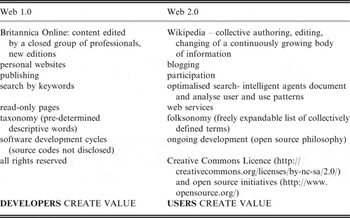
While Web 1.0 resembled the traditional classroom where face-to-face education dominated, Web 2.0 can be closely associated with the emergence of collaborative paradigms in education (see Table 1). These paradigms seem to be associated with ICT literacy – a set of skills and competences that teachers and learners of the 21st century possess on different levels. The philosophy of Web 2.0 closely resembles new paradigms for “School 2.0”, the educational institution that is ready to benefit from the technological achievements and collective knowledge building potential of the Social Web.
Web 1.0 and web 2.0: differences in philosophy and function

Both Web 2.0 and School 2.0 rely on communities of practice – a key term for teaching and learning in the 21st century. These voluntary knowledge building groups are formed at work as well as in private life and are fuelled by the motivation to explore and share topics of common interest. The social theory of learning (Wenger, Reference Wenger2006) explains why these communities are instrumental in making full use of Knowledge Age technologies. He postulates that traditional educational institutions (School 1.0) “address issues of learning […] as an individual process, that has a beginning and an end, that is best separated from the rest of our activities, and that is a result of teaching. […] We design computer-based training programs that walk students through individualised sessions covering reams of information and drill practice. To assess learning we use tests with which students struggle in a one-on-one combat, where knowledge must be demonstrated out of context, and where collaborating is considered cheating. As a result, much of our institutionalised teaching and training is perceived by would-be learners as irrelevant, and most of us come out of this treatment feeling that learning is boring and arduous, and that we are not really cut out for it” (Wenger, Reference Wenger2006: 1).
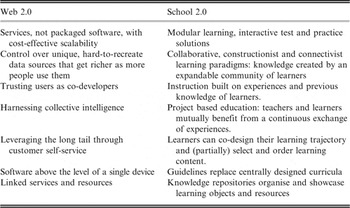
As a response to Web 2.0 technologies, new educational paradigms evolved that incorporate collective knowledge building, the key concept of Web 2.0 and its ongoing evolution into the Social Web. As a replacement for individual instruction in secluded classrooms, social theory of learning proposes participation in learning communities that share historical and/or social resources, frameworks and perspectives that can sustain mutual engagement in action. Members enter these social configurations because they feel that their enterprise – the acquisition of certain skills and construction of shared knowledge objects – are worth pursuing and their participation is recognisable as competence. Being part of such a community enhances self-respect and through learning, it creates a shared identity and places learning in the context of our lived experiences. Web 2.0 technologies help educators set up such collaborative learning environments while safeguarding traditional values of schooling. They place learners in the centre but keep the teacher at their side as mentors and guides, catalysts of knowledge construction and sharing – key activities that unite Web 2.0 with School 2.0 endeavours (see Table 2).
Web 2.0 and School 2.0 – similarities of practice

2 Web 2.0 technologies and education
Web 2.0 technologies quickly found their way into schools. Activity theory and trialogical learning theory are the connecting links between the Social Web and its methodological applications. Activity theory, an extensive approach to human and social sciences was developed initially by Vygotsky (Reference Vygotsky1934/1962, 1978) and emphasises the object-oriented quality of human activity that is mediated by cultural means and artefacts (especially by tools and signs). The focus is on historically developing activity systems where the division of labour and collective activity are essential elements. Trialogical learning occurs when learners collaboratively develop shared objects of activity (such as conceptual artefacts, practices, products) in systematic fashion and this procedure focuses on the interaction through these common objects (or artefacts) of activity between team members as well as within the minds of innovating (and thus learning) individuals. This epistemological approach to learning argues that beyond other metaphors, according to which learning is a process of knowledge acquisition by individual learners (a “monological” approach) or participation in social interaction (a “dialogical” method of inquiry), one should distinguish a “trialogical” model, i.e., learning as a process of knowledge creation which concentrates on mediated processes where common objects of activity are developed collaboratively. Trialogical learning differs from earlier learning theories in its interpretation of the learning process. As Paavola and Hakkarainen (Reference Paavola and Hakkarainen2005) note, “The acquisition view represents a “monological” view on human cognition and activity, where important things are seen to happen within the human mind, whereas the participation view represents a “dialogical” view where the interaction with the culture and other people, but also with the surrounding (material) environment is emphasised. The knowledge creation view represents a “trialogical” approach because the emphasis is not only on individuals or on community, but on the way people collaboratively develop mediating artefacts” (Paavola & Hakkarainen, Reference Paavola and Hakkarainen2005).
The EU-funded research and development project, Knowledge Practice Laboratory Project (KP-Lab), is currently working on the elaboration of new models for professional skills development based on this concept of trialogical knowledge creation. Trialogical technologies are designed to support and enhance learning around the advancement of shared objects. In a blended learning environment, where virtual and real learning spaces are organised to create a synergy of experiences, trialogicality refers to “how shared objects of activity that are collaboratively formulated and developed by using mediating tools, signs, and (conceptual and material) artefacts” (Paavola & Hakkarainen, Reference Paavola, Lipponen and Hakkarainen2004: 4). In this context, technology provides for flexible tool mediation so as to facilitate knowledge-creation processes. Tools that can be characterised as such possess these characteristics:
• They are underpinned by tightly defined pedagogical theories
• They involve collaborative problem solving approaches
• They add value, align with cultures, incur minimum costs and teacher time, and are easy to implement.
In trialogical learning, the importance of the activity of individuals as part of the collective – interaction between personal and social levels, the elicitation of individual and collective agencies and the evolution of epistemic agencies (Scardamalia, Reference Scardamalia2002) – occurs through transformation between various forms of knowledge and practices. Since the knowledge-creation metaphor involves the transformation of social practices through collaborative activities, it also calls for the elaboration of boundary crossing between various activity systems, i.e. heterogeneous communities with different types of agents and artefacts (Lipponen et al., Reference Lipponen, Hakkarainen and Paavola2004) and the cross-fertilisation of various knowledge practices.
This educational paradigm described those forms of learning where learners are collaboratively developing shared objects of activity (such as conceptual artefacts, practices, products) in systematic fashion. Trialogical learning concentrates on the interaction through these common objects (or artefacts) of activity, not just between people (“dialogical” approach), or within one’s mind (“monological” approach) (Paavola & Hakkarainen, Reference Paavola and Hakkarainen2006). The trialogical approach to collaboration facilitates individual initiative for developing shared (material and cultural) objects, resources and social practices and provides models and tools for sustained collaboration. In Web 2.0, such a sustained co-operation is the central feature of internet use. Work is organised by using mediating artefacts: ICT supported collaborative knowledge acquisition tools and practices, some examples of which will be described later in this paper. Shared objects or artefacts can be modified flexibly and systematically, different versions and combinations are developed as a result of user experiences and shared to support more successful use.
According to trialogical learning theory, focus of education should be on processes rather than outcomes – and this is why Web 2.0 technologies are so important for teaching and learning (Gilbert et al., Reference Gilbert, Chen and Sabol2008). They not only support individual and collective adaptation, addition and change, but also retain previous versions for comparison and evaluation. For the language teacher, the work of students on a wiki page or utterances on a discussion forum are valuable documents showing vocabulary and grammar use in authentic, motivating situations, development of communication skills, including adaptation to different social and cultural settings. It is important, however, that work processes, knowledge practices, goals, and concrete objects of activity are reflected upon by teachers and learners during the process. Interaction and transformation between different forms of knowledge (conceptual knowledge, practice-bound knowledge, tacit knowledge, etc.) are emphasised in the course of using Web 2.0 facilities and services. These platforms support interaction and transformation between conceptualisations (models, figures, theories) and practices (tacit knowledge): Conceptualisations arise from previous activities and guide subsequent work.
3 Web 2.0 knowledge building and sharing communities that can support language learning
Web 2.0 is fuelled by collective intelligence. It means intelligent collection – collaborative searching and bookmarking, and results in user-generated taxonomies (termed folksonomies to imply their co-constructed nature). The Social Web generates thousands of web pages every day that manifest a merge between private and public knowledge. Blogs are commented upon and eventually develop into discussion lists. New software generates a FAQ-o-Sphere – a self service Q&A forum – of experienced and novice users. Citizen journalism covers topics in a swift and multi-faceted way. These collaborative activities make Web 2.0 the paradigm of a knowledge building community, – the ideal teacher-learner interaction proposed by contemporary educational theory.
Teachers have to act as insightful mentors during the initiation process to this new, collaborative – and as a consequence, non-regulated, non-filtered, non-reviewed by experts – type of meaning making. The Social Web harnesses collective intelligence: users seem to be increasingly motivated to create large quantities of data which express their knowledge and opinions, that are not necessarily in harmony with those of education (Mika, Reference Mika2007). This was already the case with Web 1.0 (Scardamalia, Reference Scardamalia2002), but the difference is the scope of contributors and the sophistication of tools scaffolding the process. Social Web enables new problem solving approaches: for example, national groups of voluntary Wikipedia editors exchange good practice about detecting and correcting incorrect data and banning harmful or illegal content (Rubinstein, Reference Rubinstein2007). Social information processing and collective problem solving – or the “wisdom of crowds” Footnote 3 – produces efficient, robust solutions beyond the scope of individual capabilities.
The best example of the close connections within the new Internet culture is the genesis and development of Wikipedia, the largest open source online encyclopaedia. Here, an entry can be added by any web user, and edited by any other. According to Tim O’Reilly (Reference O’Reilly2005), “this is a radical experiment in trust, applying Eric Raymond’s dictum (originally coined in the context of open source software) that with enough eyeballs, all bugs are shallow, to content creation”. In the Appendix, we propose several other Social Web applications and services that proved to be useful in language education and briefly outline their possible use.
Though not a purely Web 2.0 development, a similar model of utilising collective intelligence for knowledge advancement lies behind the first European federated Learning Resource Exchange (LRE). (www.lre.eun.org) The European Learning Resource Exchange, designed, built and simultaneously piloted in the course of the CALIBRATE Project in 2005–2007, (http://calibrate.eun.org), enlarged and enhanced currently in the framework of the MELT Project, 2007–2009, (www.melt.eun.org), is an excellent example for the use of Web 2.0 technologies in education.Footnote 4 It involves the syndication of national learning resource repositories, collaborative evaluation of learning objects and resources retrieved from the repository with the help of a sophisticated personalised search system, upload of adapted, modified or individually developed learning resources by teachers and the formation of knowledge building communities.
This new service enables schools to find educational content from many different countries and providers. It includes partners with large content repositories (from ten EU member states, Ministries of Education and their national or regional repositories, large educational content provider companies and representatives of the educational media). At present, 18 partners from 14 countries have made available 37,593 resources and 97,200 assets.Footnote 5 For foreign language education, not only textbooks, online tests and supplementary resources (songs, riddles, quizzes, etc.) are available, but also thousands of authentic materials for cultural studies in the form of texts and images about a wide range of topics developed for different school disciplines by native speakers. For example, illustrated descriptions of cultural monuments (intended for use in Geography classes in Austria and Germany) complete with assessment instruments and suggestions for related activities such as interdisciplinary projects can be used by teachers and learners of German language from other countries.
LeMill, the learning toolbox (www.lemill.net) developed in co-operation with the LRE to offer a platform for collaborative knowledge building and sharing, is another useful Web 2.0 application for the language teacher. It may be used for finding, authoring and sharing learning resources, but may also be a used as a site for fruitful professional co-operation with teachers of the same discipline and also an immersion in professional discussions with native speakers of the culture, the language of which he or she teaches. LeMill’s creators, young educationalists and software developers from the University of Tallinn, Estonia, like to call it a “do it yourself” learning resource website engine. The LeMill engine can be freely downloaded, teachers can install it on their school server and use it online. It allows RSS feeds, a format for syndicating news and the content of news-like sites.Footnote 6 Teachers may link their school home pages or discipline related educational portals to LeMill, and receive notification every time any of their contacts (fellow users of LeMill entered into our contact list) upload new information. This function is called the “live web”, as it results in web pages growing through communication. In a learning group, a syndication of web pages created by students helps in monitoring the development of a group project or an individual assignment. It also facilitates the observation of individual contributions that will be incorporated into a common product.
LeMill resources can be freely used at school, eventually adapted and uploaded again in a new version for others to also benefit from. New content may be easily added to your own collection only or shared with the LeMill community. All content in the LeMill server is free and the host site allows users to create any number of individual web pages (collections of content, methods and tools preferred by a teacher or learner or their communities). These individual developments are federated by the software to be part of the global network of LeMill servers.
There are two kinds of content here: media pieces (single images, short audio files, or short video clips) and learning resources: complete lesson materials ready for use. In the Methods section, different ways of teaching and learning are described. For the teacher trainer, it is a rich collection of examples of good practice for a variety of methods used in different disciplines. Descriptions of the methods function like wiki pages so alteration of text (addition of own experiences) are welcome. Users can also add links to content and tools that could be used with the method.Footnote 7 In the Tools section there are different kinds of virtual or physical tools that teachers have successfully used in teaching and learning. Anyone (even technology-savvy students who may be encouraged to look for materials in this “teacher site”) can link content and methods to them. As in all Web 2.0 web sites, groups producing or editing learning resources can be formed or joined.
The search functionality in the European Learning Resource Exchange is an agent-based search system, where the search process starts with an initialization – gathering information about available Search Agents. Then the received query is analysed and forwarded to selected Search Agents. Collected results (for example, digital learning materials that test comprehension of Passive Voice for English as a Foreign language learners aged 15–16, intermediate level) and are sorted to meet the user’s preferences. Even partial results are available to the user (for example, materials that practise Passive Voice at beginner or advanced level). Results are ranked according to user profiling – data gathered by the personalised search functionality of the system that identifies registered users and stores their personal data and preferences manifest in previous queries. Users express their tastes and preferences through the metadata they create: learning objects and resources they retrieve, evaluations of content that they submit, contacts they add to their social network, the professional groups they join, tags (descriptors selected from a list or coined by them to describe a resource) and content they mark as their favourite.
4 Teachers create and use the Social Web: experiences from piloting the Learning Resource Exchange
The collaborative development and testing of the first European federated Learning Resource Exchange ran parallel with the creation of this huge international repository and used as theoretical foundation the Trialogical Learning Theory outlined in the first part of this paper. This work was related to the Knowledge Practice Laboratory Project mentioned before that elaborates new models for training based on the concept of trialogical knowledge creation. Research in both projects focused on understanding how Web 2.0 technologies can be integrated with teachers’ professional development, how new educational practices and/or artefacts are born and disseminated in the teacher community.
Our major objective was to transfer social cognition processes of Web 2.0 communities in the structured setting of educational resource development and exchange. We tested both the technological feasibility of linking national educational content repositories to LRE, and the pedagogical benefits of enabling schools to exploit this system. We also evaluated the extent to which content accessed via this federated brokerage system could be used to support collaborative learning within LeMill. According to the trialogical learning paradigm teachers, trainers and software developers acted around shared objects which were developed collaboratively. These objects of activities changed during the knowledge-creation processes as they were used as objects to reflect on but also as tools for mediating collaborative activities (Lipponen, Hakkarainen & Paavola, Reference Lipponen, Hakkarainen and Paavola2004). Thus, users took an active part in developing (while testing and enriching) the federated digital content repository and engaged in collaboration around shared digital objects (the resources and tools included in the federated system of national digital content repositories) that changed and improved in the course of use, adaptation and evaluation by teachers. Instead of only evaluating digital tools and learning materials – the usual assessment method for ICT based educational innovations – teachers were asked to form discipline-based educational innovation communities and to tag the resources they found in the LRE according to the educational methods to which they were best suited, in the form of lesson plans (uploaded through a template) or freely described user stories. The best of these teaching scenarios were showcased on national project web sites and in the LeMill learning toolbox communities.
Evaluation of the use of the LRE and LeMill was carried out in seven countries including five new member states.Footnote 8 In the framework of the CALIBRATE project briefly described in Section 3, the participatory evaluation process of the LRE was co-ordinated by the European Schoolnet in co-operation with ELTE University, Budapest. Both individual and collective evaluation of the repository and toolbox by in- and pre-service teachers from various educational settings were considered important. We addressed basic European issues of educational policy making: is it realistic to expect teachers to make regular and effective use of an international set of learning resources and assets in foreign languages, developed for use in a different educational system? Are they able to retrieve, adapt and – after a brief observation or an in-depth a test in the classroom – evaluate learning materials developed by their peers in other countries? In other words, does Web 2.0 or the Social Web work for School 2.0, the educational institution of the age of the internet? Three approaches were used to answer these questions:
1. Participant observation and testing: a core group of pioneer ICT teachers followed the work of software developers, tested beta versions and offered practice-related feedback.
2. School-based case studies that focused on problems of LRE and LeMill introduction and use in the pilot validation phase.
3. In vivo experiments with novice users during National Evaluation Days in 7 countries that included training teachers to act like reflective practitioners – researchers of their own practice.
Evaluation results (published in Kárpáti & Blamire, Reference Kárpáti and Blamire2008), convinced developers about the validity of the concept of a federated European digital learning content repository. Teachers in all participating countries possessed (or were able to obtain during training courses) the ICT competence necessary for the use of an international digital educational content repository and its sophisticated search system. National reports of new EU member states (published in full on the project web site www.calibrate.eun.org) show the potential to use multicultural learning resources that support more advanced pedagogical models than traditionally employed in these countries. Five out of seven countries developed active teacher communities in LeMill that commented on resources found, adapted and shared them or created new learning material from digital learning objects found in the LRE. At the end of the trial period, June 2008, more than 2000 lesson plans in seven languages documented successful and regular use of the repository and its toolbox. However, piloting teachers’ performance revealed huge differences in ICT competence, foreign language skills and motivation to take part in a collaborative educational innovation enterprise. These differences in competences and attitudes towards digital technology, as well as previous experience of working in knowledge building communities, influenced the successful use of this Web 2.0 learning environment. Those coming from countries with a tradition of using collaborative educational models, readily downloaded lesson plans representing innovative use of resources developed in another country and used them as an inspiration for similar pedagogical programmes. Lesson plans of these teachers show evidence of alternative use of the LRE – not as a repository but as an educational portal. When teachers did not find the lesson plans of their peers applicable, they often located a link to an interesting learning resource they could make good use of, in a lesson different from the one it was attached to. These teachers came back to the work of their peers and commented on it, describing the way they made use of shared ideas and content. Fewer than ten percent of all participating teachers used the repository and toolbox as “read-only”: they opted for not even trying resources or methods, because the learning process described or the tools showcased seemed to be irrelevant, complex or obscure. But even these participants described their trialogical learning processes as inspiring and exciting – a truly social experience.
The evaluation of LRE and LeMill showed that, in order to increase the collaborative potential of teachers, regular use of Web 2.0 knowledge building environments is extremely useful. Teachers learnt from each other in a “folksonomic” manner, because they performed try and test, criticism, adaptation or adoption of resources in knowledge building communities – an activity which triggered specific learning mechanisms (Dillenbourg, Reference Dillenbourg1999a, Reference Dillenbourg1999b). Interaction among educators of different disciplines in the national groups generated extra activities (explanation, disagreement, mutual regulation) which triggered extra cognitive mechanisms such as knowledge elicitation, internalisation and reduced cognitive load. When evaluating the LRE, teachers faced the challenge of using Web 2.0 technologies not only for information search or communication, but also for discipline based teaching and learning – and in most piloting countries they clearly needed preparation and professional support to be active participants and make optimal use of social knowledge construction.
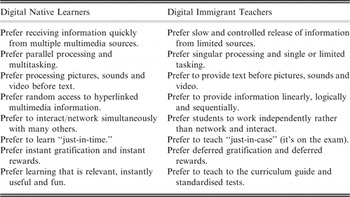
In order to keep in touch with requirements of schooling in the 21th century, profound changes in the detection, retrieval, processing and presentation of knowledge by is needed, not only by learners but also by educators (see Table 3). Evaluation of the first European ICT content development project, LRE, revealed the need to prepare teachers for going beyond national practices and become European professional communities. Through piloting the LRE first in national, than in international learning communities, teachers first faced the need and soon felt the motivation to use international content available through Web 2.0 services, in order to develop collaborative knowledge building characteristics that their students seem to already possess. Also, teachers have to be aware of the collaborative potential of their learners – natives of the age of collective intelligence.
Differences between digital native learners and digital immigrant teachers (Jukes & Dosaj, 2003).

In Hungary, the mentored innovation model was employed to support teachers throughout the LRE piloting process. This in-service training model is realised through scaffolding in discipline-based groups (Tartsay-Németh & Kárpáti, Reference Tartsay-Németh and Kárpáti2007; Kárpáti, Török & Szirmai, forthcoming). Mentored guidance through innovation was employed to facilitate piloting and an evaluation was made of the discourse of in-service teacher groups and their facilitators during an e-training course. The role of mentors in the European repository’s piloting process was clearly identified. National teacher groups who received longer and more substantial training in the use of innovative ICT tools for education, though not necessarily more competent in ICT use, manifested more motivation for collaboration with peers. Therefore, especially with novice ICT users, coaching seems to be crucially important. Pilot trials also proved that informal coaching by peers – a truly Web 2.0 method of co-operation – is a viable option for professional development. User activity analyses showed that the collaborative learning toolbox, LeMill, was an excellent facility for in-service teacher training aimed at introducing profound methodological changes, as it offers a variety of tools for scaffolding through structuring inquirers’ activities in a way that facilitates complex problem solving (Poldoja & Toikkanen, Reference Poldoja and Toikkanen2006).
Teachers who maintain an (educational) profile in Facebook, share slides, videos and text related to their discipline and encourage search for similar information in Flickr, YouTube or Digg; who teach students to write meaningful tags or a content-rich wiki page and contribute to LRE, the first pan-European effort for multinational, multicultural knowledge creation, will be role models for students in becoming an important part of the Social Web. If teachers develop a Net Native frame of mind, they will be able to fully utilise knowledge constructed and shared by creators of the Social Web. For language teachers the use of these services is especially important as they provide authentic language education settings. No safe havens, of course, but with careful observation of the communities we invite our students to enter, the benefits are much larger than the possible bad side effects.
Acknowledgements
This paper is based on research supported by two EU funded research and development projects, CALIBRATE (2005–2007, www.calibrate.eun.org) and Knowledge Practice Laboratory Project (KP-Lab, www.kp-lab.org, 2006–2011). The author is (was) a participant in these projects as a member of the Research Group on the Development of Competences at the University of Szeged, Hungary.
APPENDIX – Web 2.0 applications and services for foreign language education
A. Self-expression: sharing self-made images, ‘everyday’ wisdom, personal experiences and moods through texts and images
MSN Live Spaces (http://home.services.spaces.live.com/), Flickr (http://www.flickr.com/), Photobucket (www.photobucket.com), Imageshack (www.imageshack.com) promote self-expression through sharing personal visual utterances as they offer space to upload photos and videos and invite friends (also those who are not members of this community) to see them anytime they wish. Uploaded images can be cropped, retouched, edited, tagged and organised into collections. For tagging, self-coined descriptors or a tag list may be used. Searches are based on authors and tags. Flickr’s motto describes how these sites may be used for language education: “Share your photos. Watch the world”. These sites represent excellent – though unedited – resources for multicultural studies as they contain images of natives and visitors in thousands of geographical locations.
YouTube (http://www.youtube.com) is famous for speed: global news reports by amateur filmmakers are often faster than media reaction. Documentation of events worthy of public attention (from politics to nature, from events of world significance to quasi-ethnographic reports about country life) is featured side by side with family events. Its motto: “Broadcast yourself!” The “Videos being watched now” selection offers a chance to become part of a virtual audience and share reactions with co-viewers around the world. There are featured and promoted videos (trailers of movies, for instance) and community activities like interest groups and contests.
Yahoo! Podcasts (http://audio.search.yahoo.com/audio) is a customisable teaching resource as it offers audio files from across the Web including music, podcasts and interviews that can be downloaded and added to any learning material. Native speakers from all walks of life can be heard in authentic situations, where background noise makes understanding just as difficult as in real life.
B. Making friends: introducing oneself through answers to a common questionnaire and a self-built collection of photos, video clips, a blog and a contact list. Sites of this nature focus on communication: information shared promotes a better understanding of self, so that potential friends and partners would seek contact. When invited to find pen friends from the country whose language they learn, students may engage in a motivating discovery of subcultures similar or else entirely different from their own.
Yahoo! 360 (http://360.yahoo.com) helps create a simple personal homepage that may contain a blog, photo collections, personal information and a short description of interests. An ideal tool for the presentation of personal details in the foreign language learnt, making self-presentation authentic. It can also be used for finding pen pals with similar interests. As second (third, fourth…) language acquisition continues, the personal home page may be used for the accumulation and arrangement of more detailed personal information.
Facebook (www.facebook.com/) serves a similar function but it also has sophisticated group formation functions that promotes the creation of professional and study groups. Teachers may use it for international exchange of cultural information and enter into contact with school groups of the same age from the country of the target language.
Hi5: www.hi5.com helps find old friends through search by city, school, interests etc. A similar site: Friendster (www.friendster.com).
Friendfeed (www.friendfeed.com) combines a friendship site with social bookmarking: members may not only share their own images and text but also direct visitors through a customised feed to content they find interesting on other collaborative sites. A similar site is MySpace (www.myspace.com).
C. Making professional contacts: these sites specialise in connecting people of the same profession in order to facilitate networking, on both a formal and a personal level.
LeMill (www.lemill.net) is a collaborative knowledge building site for teachers with hundreds of national and international, discipline-based and interdisciplinary professional communities. It connects to the Learning Resource Exchange, the first federated European digital educational content repository. Its evaluation results were discussed in this paper.
LinkedIn (www.linkedin.com) is used mostly to exchange information about professional opportunities. For language learners, the sites provides an authentic resource for teaching about creating a digital professional identity, learning how to address web based queries or how to get a new job online.
Plaxo Pulse (http://www.plaxo.com), another site for professional networking, regularly reviews files of the contacts of members and sends information about changes in partners’ data. It connects to several sites of personal information (for example, Flickr, YouTube) and services (Amazon) and helps enter data about new contacts through a direct connection to the digital organiser Outlook.
D. Communication and collaboration: these services offer network building functions and may be used to create learning groups as well. Here you can track media works that your students created and invite the class to comment or critique. It enables you and your students to assemble collections of interesting stories and images on the web (do social bookmarking) related to topics you discuss during foreign language studies. Thus, project work can include collaborative authoring and peer review.
Second Life (http://www.secondlife.com/), the internet community designed and regulated by its users, includes virtual versions of established educational institutions. Its pedagogical functions are widely researched.Footnote 9 Their use for language education depends on the teacher’s skills and willingness to establish a collaborative virtual space where students can use both their video game skills and language competence for enacting real life situations in the foreign language they are about to acquire.
Google Documents (www.docs.google.com) offers a co-editing utility in real time that saves changes by individual authors for later retrieval. Language teachers can thus track individual learners’ contribution and see how peer support works.
Tokbox (http://www.tokbox.com/) offers free video calls and may be used for communication in learning groups created in Facebook. A similar site: Twitter (www.twitter.com) is a free social messaging utility for staying connected in real-time.
Livejournal (www.livejournal.com): this site can be used as a private journal accessible for the author only, a blog, and a discussion forum for a social network.
E. Sharing expertise, giving advice: offering subject-specific knowledge, giving recommendations, evaluating services, things and places:
Wikipedia (http://wikipedia.org/) – the online lexicon has generated a knowledge sharing format. After having studied the work of volunteers who build the pages, teachers can invite students to co-create wikis on topics currently explored during foreign language studies.Footnote 10
Realtravel.com (http://realtravel.com/) – while offering a series of concise travel books (with attractions, tips, hotel and restaurant deals) for a multitude of destinations, this travel guide and trip planner contains advice from the worldwide community of passionate travellers who compare and contrast services and sights. Language learners may enjoy a multiple introduction to the country whose language they study.
SlideShare (http://www.slideshare.net) is a service for sharing PowerPoint presentations (and similar types of documents) in a searchable database. Uploads cannot be copied or changed but can be viewed any time – an ideal site to share presentations of teachers and students as well as see best (and worst) practice examples for creating an instructive and aesthetically pleasing PowerPoint.
Del.icio.us (http://del.icio.us/) leads you to sites other people find useful or attractive. Social bookmarking may be turned into an educational experience if topics are related to studies. While exploring pages suggested by their peers and strangers, students also explore different mindsets and tastes, “intellect in action”. Descriptors called tags help to locate the page that users relate to this concept. Learning how to assign meaningful and suitable tags to complex content items is a skill related to concept formation, reduction of redundancies and summarising essential information. An assignment to explore, select and tag the best home pages for a topic relevant for CALL may result in a tag cloud (a list of tags where size reflects popularity) and may indicate the depth and breadth of student knowledge.
Digg! (http://digg.com/), the popular alternative to Del.icio.us, is frequented by less serious investigators. Members here also review, tag and evaluate web sites, discover (“dig”) but also erase (“bury”) content. Stories with bad links, off-topic content, or duplicate entries may be omitted. Thus, readers are invited to act as responsible editors – a useful learning experience. The scope of content they “dig out” is much larger. The mission statement of the page postulates that the site is about the collective definition of value: “From the biggest online destinations to the most obscure blog, Digg surfaces the best stuff as voted on by our users. You won’t find editors at Digg – we’re here to provide a place where people can collectively determine the value of content and we’re changing the way people consume information online.” For the language learner, Digg! offers a unique chance to seek out the community closest to his or her interests and engage in authentic conversation. For the language teacher, Digg-ers unpack stories that show the concerns and interests of people from whose language (and culture, frames of mind and moods) students are meant to acquire. Another “internet digest” site for young people: Yahoo! MyWeb2.0 (http://myweb.yahoo.com/) that connects directly to Flickr and YouTube.
F. Edited information services with social contribution: these pages not only offer topic-related, edited and frequently updated information, but also allow RSS feeds, a format for syndicating news and the content of news-like sites. This service provides e-mail notification of changes in the sites you link to and thus may enrich your school website or educational portal with regular information on the everyday life of the country the language of which you teach.
Upcoming.org(http://upcoming.yahoo.com/) – a local event guide.
CiteULike (http://www.citeulike.org/) calls itself “Everyone’s library”. It is sponsored by Springer Publishers and contains freely downloadable literature, poetry and scientific papers. You can also browse current issues of journals.
Housingmaps (http://www.housingmaps.com/), TagMaps (http://tagmaps.research.yahoo.com/worldexplorer.php), Virtual Video Map (http://www.virtualvideomap.com/), Weather Bonk (http://www.weatherbonk.com/weather/index.jsp) provide geographical and meteorological information from all over the world. Basic data are provided by companies editing the sites but community response functions allow free information upload by users and cater for large scale data collection.