Representations of California English have circulated widely in the media for decades, from Moon Zappa's voicing of a “Valley Girl” in a 1982 Frank Zappa song of the same name, to the more recent Saturday Night Live mock soap opera skits depicting “The Californians,” a group of Los Angelenos embroiled in love triangles and traffic talk. These parodies bring to light some popular ideologies about Californians. Namely, people in the coastal Los Angeles Metropolitan Area are often viewed as representative of the entire state, they are people concerned with appearances and driving routes, and they have a distinctive way of speaking.
If the media is guilty of focusing on Los Angeles at the expense of the rest of the state, sociolinguists have not fared much better. Almost all work on Californian varieties of English has been conducted in urban and coastal locations such as San Francisco (Eckert, Reference Eckert2008b; Hall-Lew, Reference Hall-Lew2009, Reference Hall-Lew, Lee and Zee2011; Luthin, Reference Luthin, Denning, Inkelas, McNair-Knox and Rickford1987; Mendoza-Denton, Reference Mendoza-Denton2008; Moonwomon, Reference Moonwomon, Denning, Inkelas, McNair-Knox and Rickford1987; Podesva, Reference Podesva2011), Los Angeles (Fought, Reference Fought1999; Hagiwara, Reference Hagiwara1997), and Santa Barbara (Kennedy & Grama, Reference Kennedy and Grama2012). Though Californianess may be associated with these places ideologically, the focus on these areas in previous work leaves vast portions of California underrepresented both in the popular imagination and in linguistic research. Given the social diversity of the state, this focus erases the many areas of California that are neither urban, nor coastal, and which are organized along very different lines socially, politically, and economically, as compared to California's metropolitan areas.
In this paper, we examine the participation of a noncoastal, nonurban community in a pattern of sound change found on the California coasts—the California Vowel Shift (CVS) (Eckert, Reference Eckert2004). For speakers born and raised in the city of Redding and its neighboring towns, we investigate three dimensions of the CVS: the fronting of back vowels bootFootnote 1 and boat, the nasal pattern of bat, in which the vowel raises prenasally but lowers and retracts before non-nasals, and the low-back merger of bot and bought. Ultimately, it appears that these features have indeed spread to this nonurban locale. This suggests that these features do mark Californian identity beyond the urban coast. However, we also find that a socially salient distinction between speakers who are country-oriented and those who are town-oriented conditions the ways in which these vowel shifts operate in Redding. We argue that different features index different aspects of Californianess, or countryness, which speakers in Redding can recruit to negotiate identities made relevant in a nonurban, Californian locale.
The California Vowel Shift
Like many other states in the Western United States, California's dialectology has been relatively understudied in comparison with communities in the Northeast, Southeast, and Midwest United States. The Atlas of North American English places California together dialectologically with the entire Western half of the United States, as the “West” (Labov, Ash, & Boberg, Reference Labov, Ash and Boberg2006). Furthermore, Labov (Reference Labov and Eckert1991) has posited that California's vowel system fits into a “Third Dialect,” third after the Northern Cities Vowel Shift system and the Southern Vowel Shift (SVS) system. The Third Dialect is said to encompass similar vowel shifts documented in the Western United States and Canada. It seems unlikely, however, that these vast and geographically disparate regions pattern in exactly the same way with respect to sound change, making relevant the need for further research in each of these areas.
Previous investigations of urban, coastal California English have identified regionally distinct vowel patterns, which together have been termed the California Vowel Shift (CVS). Following previous work (Eckert, Reference Eckert2008b; Hall-Lew, Reference Hall-Lew2009; Podesva, Reference Podesva2011), we use this label to refer to the documented changes in progress that characterize Californian speakers’ vowel systems. This label does not make claims as to the phonological relatedness of components of the shift, nor does it imply that these features are exclusive to California — many components of the CVS are attested elsewhere in the United States, particularly in the West (Becker, Aden, Best, & Jacobson, Reference Becker, Aden, Best and Jacobson2015; Fridland, Reference Fridland2008a; Hall-Lew, Reference Hall-Lew2005; Ingle, Wright, & Wassink, Reference Ingle, Wright and Wassink2005; McClarty & Kendall, Reference McClarty and Kendall2014). However, the presence of similar phonological systems in various regions does not necessarily imply that these features are realized in phonetically identical ways, nor that they function in the same ways socially. We thus focus here on the use of CVS features in the state of California in particular.
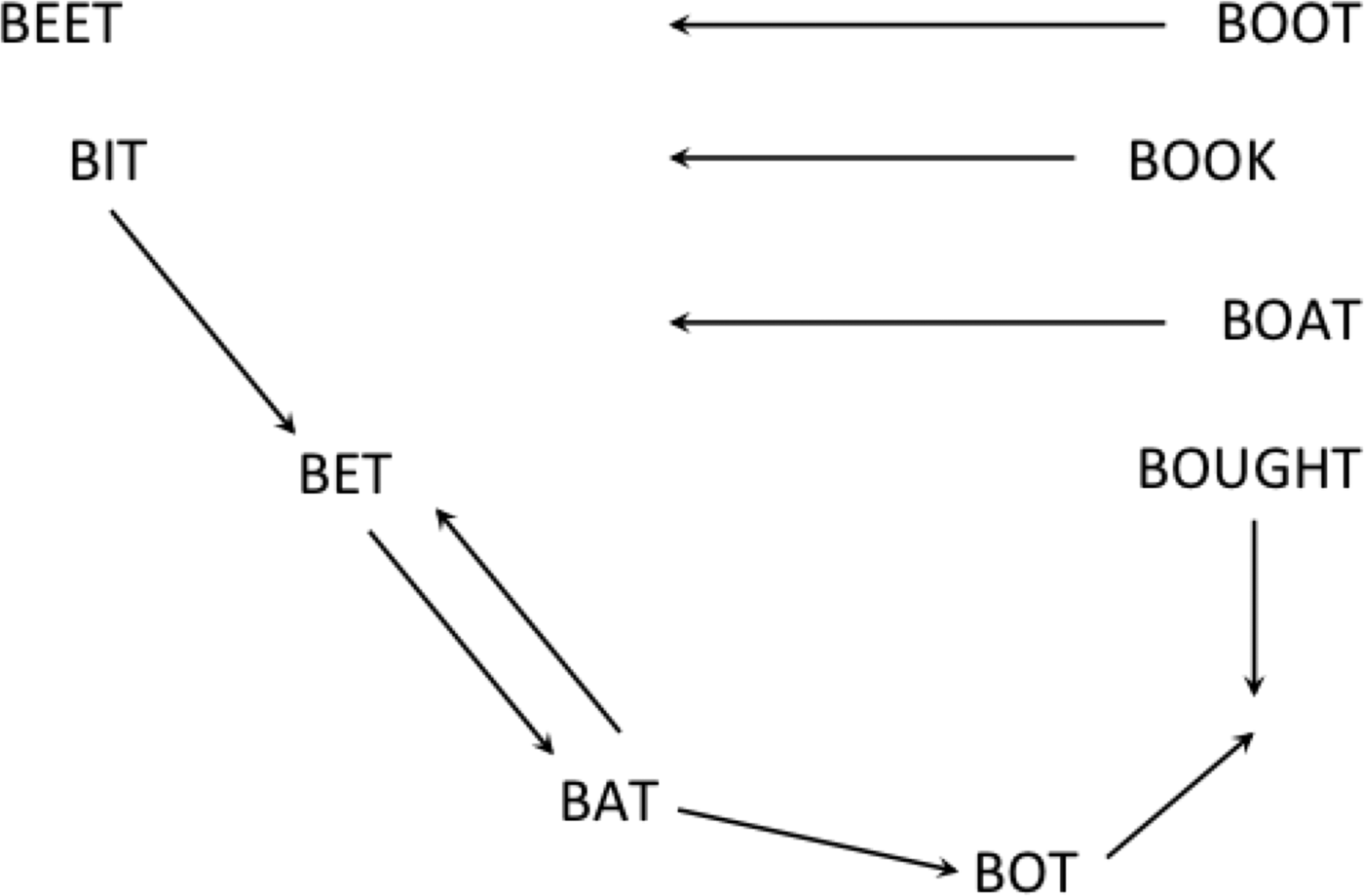
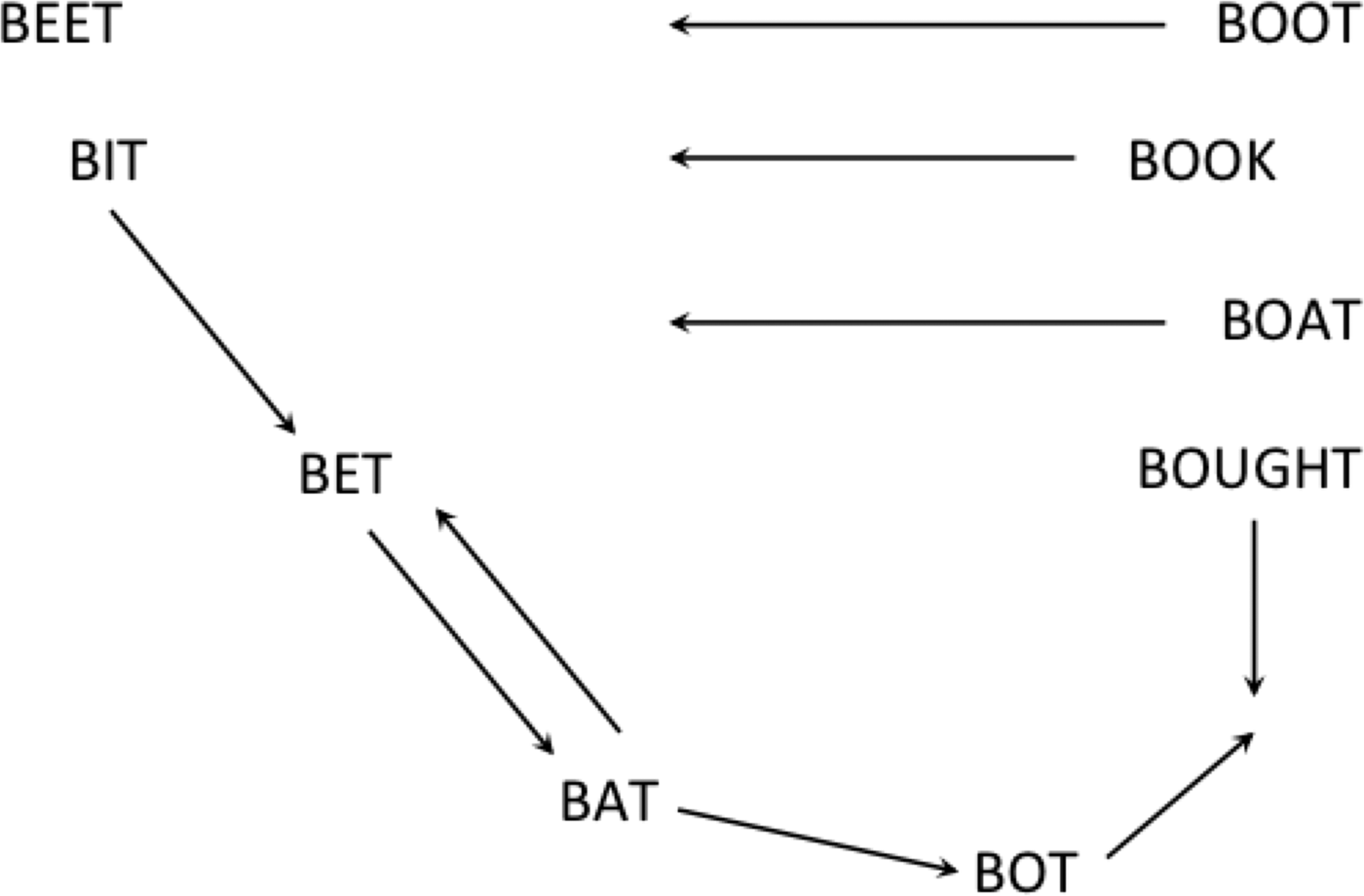
The primary patterns that make up the CVS are shown in Figure 1. The low back vowels bot and bought are merged,Footnote 2 a pattern deemed a hallmark of the West (Labov et al., Reference Labov, Ash and Boberg2006). The back vowels boot, boat, and book are fronted (Hall-Lew, Reference Hall-Lew2009; Hinton, Moonwomon, Bremner, Luthin, Van Clay, Lerner, & Corcoran, Reference Hinton, Moonwomon, Bremner, Luthin, Van Clay, Lerner and Corcoran1987). The front lax vowels bit, bet, and bat are lowered and centralized (Eckert, Reference Eckert2008b; Hagiwara, Reference Hagiwara1997; Kennedy & Grama, Reference Kennedy and Grama2012), with bat's backing and lowering conditioned by its phonological environment: prenasal bat, what we will call ban, raises and fronts, while non-prenasal bat backs and lowers (Eckert, Reference Eckert2008b), a “nasal split” that distinguishes the California vowel system from the Canadian Vowel Shift.
The California vowel shift.
Though the name of the CVS may indicate that this pattern applies uniformly across the state, California's extreme social diversity is reflected in language. While studies of the CVS have privileged the language of white mainstream English speakers as representative of a regional variety, findings indicate that ethnic varieties of African American English and Chicano English within California remain distinct varieties in both Los Angeles (Baugh, Reference Baugh1983; Fought, Reference Fought1999) and the San Francisco Bay Area (Mendoza-Denton, Reference Mendoza-Denton2008; Rickford, Ball, Blake, Jackson, & Martin, Reference Rickford, Ball, Blake, Jackson and Martin1991). It thus appears that this shift most accurately describes the vowel systems of white mainstream American English speakers in California, though variation has been found in the use of these variables both by white and nonwhite speakers.
While descriptive work on the CVS has elucidated prominent patterns characteristic of California speakers, the majority of such studies have analyzed vowel systems of speakers from the urban coast. For example, Kennedy and Grama (Reference Kennedy and Grama2012)'s 13 speakers are all from the San Francisco Bay Area, the Central Coast (e.g., Santa Barbara), or coastal Southern California (e.g., Los Angeles, San Diego). Very few previous investigations of the shift have focused on speakers outside these areas (though cf. Geenberg, Reference Geenberg2014; Holland, Reference Holland2014), leaving the vast region of inland California underexamined. Furthermore, descriptive studies of the CVS have largely focused on speech gathered in reading or citation tasks (e.g., Hagiwara, Reference Hagiwara1997; Kennedy & Grama, Reference Kennedy and Grama2012; Holland, Reference Holland2014). As sociolinguists have repeatedly shown, remarkable intraspeaker differences emerge between these types of tasks and interview speech, and reading or citation tasks may underrepresent the extent of a speaker's use of local features (cf. Labov, Reference Labov1966). By focusing solely on informal interview speech of speakers from the Redding area, a noncoastal, nonurban community, this paper enriches the current understanding of the CVS as a statewide phenomenon. Crucially, focusing on speakers in Redding foregrounds a particular social distinction that is less salient on the urban coast, and has been shown to influence sociolinguistic patterning: town versus country identities.
Country identity and language in California
Though characterizations of California in popular media tend to take its urban centers as indicative of the state as a whole, this assumption erases the diversity of the state, especially with regard to the country identities and ideologies that exist in various Californian communities. Intrastate dichotomies between Californians who maintain attitudes and lifestyles oriented to the country and those who are oriented to the metropolis can be found in evidence from historical, perceptual, and ethnographic approaches, as detailed in what follows. Ideologies linking these identities with linguistic difference are intertwined in these oppositions as well.
The presence of country-oriented identities within California has roots in the patterns of migration that make up California's history. The Dust Bowl of the 1930s brought migrants west from Oklahoma, Texas, and other Southern states, to California's Central Valley (Gregory, Reference Gregory1989). Some remained at the Central Valley's southernmost points, settling in communities such as Bakersfield, while others continued north to locales such as Redding, at the Valley's northern tip. Many found agricultural work in the Central Valley, in the farming, ranching, and logging industries (Cochrane, Reference Cochrane1993). Inevitably, settlers brought with them practices, attitudes, and regional dialects from the Southern agricultural communities from which they came, many aspects of which are associable with “countryness” in national discourses. At a national level, “country” indexes rurality, agricultural pursuits, and the American South, particularly in opposition to urbanity, industry, and the American North (Fox, Reference Fox2004; Niedzielski & Preston, Reference Niedzielski and Preston2003). This opposition on a national level is reflected within the state of California as well. The Central Valley remains a prominent agricultural center both for the state and for the nation as a whole, and it is still home to a large number of farmers and ranchers. Country or Okie heritage is explicitly discussed within these communities (Alexander, Reference Alexander2004; La Chapelle, Reference La Chapelle2007), and regardless of ancestry, many in the Central Valley orient more readily toward rural or country lifestyles than to aspects of urban, coastal California identities endemic to stereotypes of the state. A statewide geographic and ideological opposition thus persists between the agriculturally oriented Central Valley and the technology- and media-oriented urban coastal centers of Los Angeles and the San Francisco Bay Area.
Ideologies of countryness can also be found in attitudes toward language, both on a national scale and within the state of California. Perceptual dialectology work (e.g., Niedzielski & Preston, Reference Niedzielski and Preston2003; Preston, Reference Preston1989) indicates that Country Talk is widely recognized as a linguistic variety in the U.S. popular imagination. In a study of Country Talk in the Red River valley of Texas and Oklahoma, Hall-Lew and Stephens (Reference Hall-Lew and Stephens2012) argued that the linguistic style and its associated features (including the second person plural y'all, /ai/ monophthongization, and alveolar ING) index particular types of local personae that are connected to the land, such as farmers and ranchers. Country personae and associated social meanings related to rurality and Southernness arise in social perceptions within the state of California as well. Bucholtz, Bermudez, Edwards, Fung, and Vargas (Reference Bucholtz, Bermudez, Edwards, Fung and Vargas2007) asked over 700 respondents, mostly California natives from the urban coast, to draw social and linguistic divisions within California. Country-related labels hicks, hillbillies, and rednecks (in addition to others such as cowboys, farmers, ranchers, okies, country, rural, white trash, and twangy) predominated in identifications of the Inland and Northern areas of California, precisely those areas where Dust Bowl migrants settled in the state.
Recent ethnographic work further supports the enduring presence of countryness, and its opposition to more urban oriented identities, in communities of California's Central Valley. Geenberg (Reference Geenberg2014) investigated this opposition in Trinity County, California, just north of the Redding area. Even within this rural, inland county, described by inhabitants as “like Appalachia,” residents maintain an ideological distinction between more rural “outdoorsy” people, called “hillbillies” by some, and the less rural “indoorsy” people, deemed “flatlanders.” Examining the merger of prenasal bit and bet vowels, or the pin-pen merger, which has been found to dominate in the Southern and Midland United States (Labov et al., Reference Labov, Ash and Boberg2006), Geenberg showed that production of the merger had no correlation with whether or not a speaker had “Okie” heritage, or historical ties to the South itself. Rather than simply serving as a remnant of historical migration patterns, the pin-pen merger appears to be a prominent index of outdoorsy identity in this community, with the linguistic divide between outdoorsy and indoorsy speakers increasing over apparent time. Geenberg found that outdoorsy speakers also showed more raised bet—a component of the SVS (Labov et al., Reference Labov, Ash and Boberg2006)—than indoorsy speakers did. These findings show that country identity plays a strong role in the ideological talk, and the phonetic patterns, of speakers in inland California.
Geenberg also examined one aspect of the CVS in this community—the backing of non-prenasal bat, finding it more common in the less rural town of Weaverville than in more rural Hayfork. Speakers who had spent time outside of the county, typically in areas of urban California, were also more likely to exhibit backed bat than were speakers who had not. This provides evidence that at least some aspects of the CVS have spread to rural, inland areas of the state, and that perhaps features of the CVS are used in rural communities to index orientation away from the country, to the urban coastal areas of California.
The present study expands Geenberg's findings regarding the CVS in Northern inland California, examining bat, along with five additional vowels involved in the shift, in the Redding area. Redding provides a unique middle ground between urban cities of the coast and extremely rural Trinity County. Though some inhabitants of Redding are oriented to country ideologies and lifestyles, many are oriented to more urban lifestyles, and speak highly of California's coastal cities. The coexistence of these identities within a single community makes Redding a useful place to investigate the behavior of linguistic patterns associated with California (the CVS) in the context of an area that maintains some ties to country ways of life.
Social meaning and the California Vowel Shift
As sociolinguists have become interested in how linguistic variables can be recruited for identity work, the social meanings tied up in the use of linguistic variables have become relevant. A third-wave variationist approach (Eckert, Reference Eckert2012) foregrounds the importance of these social meanings in creating sociolinguistic styles. Some studies in this vein have investigated the CVS, examining ways that speakers recruit features of the shift to index locally significant identities that can be tied to various heterogeneous ethnic and social groups within California. Such studies demonstrate that macrosocial regional varieties do not simply mark demographic location of origin. Rather, such features and their regionally based social meanings can be recruited (or not recruited) to index local social meanings or personae. In the realm of ethnicity, for example, Hall-Lew (Reference Hall-Lew2009) found that both Asian American and European American speakers in the Sunset neighborhood of San Francisco use the CVS to index local affiliation with the Sunset, a neighborhood that historically has been composed of both Asian and European ethnic groups. Similarly, Eckert (Reference Eckert2008b) found that white and Chicano students at two elementary schools use the raising and fronting of ban to index position in the local social order, regardless of ethnicity. In Los Angeles and the Bay Area, respectively, Fought (Reference Fought1999) and Mendoza-Denton (Reference Mendoza-Denton2008) examined the ways that gang affiliation, rather than broader ethnic group, conditions patterning of CVS features. Adding to these findings of local, stylistic uses of the CVS that are not simply straightforward macrosocial markers, Podesva (Reference Podesva2011) found features of the CVS to be recruited in gay styles, in the enactment of a “partier” persona, for instance, which likely draws upon conventionalized social meanings of California as “cool” or “laidback.”
In this paper, we begin to address the ways that CVS features are recruited by Californians who may not orient to the state and its urban centers in the same way as speakers from Los Angeles or San Francisco do. Oppositions along urban-rural lines emerge in the Redding area—the larger scale opposition between urban coastal cities and the Redding community as a whole is reflected internally between those who orient to the town of Redding and those who are more country-oriented. If elements of the CVS are indexical of the urban coasts from where they originated, we hypothesize that within the Redding community, features of the shift will more strongly index town, as opposed to country, orientation, and that country speakers may show different patterns related to country identity. We therefore expect firstly, to see the shift spreading throughout the community in apparent time, and secondly, to see it patterning according to this town-country distinction within the area.
THE STUDY
This study analyzes vocalic data gathered from sociolinguistic interviews collected on site in Redding, California, and its surrounding communities, in the summer of 2011. These interviews were open-ended and semistructured, conducted by field workers of the Voices of California (VOC) project out of Stanford University. The project's goal has been to document the linguistic diversity and to broaden the sociolinguistic and dialectological understandings of California beyond its urban, coastal centers. This involves not only gathering data at each field site—130 or so interviews, word list recordings, and perceptual dialectology map tasks (cf. Preston, Reference Preston1989)—but also spending quality interpersonal time with residents to learn about the sociocultural features unique to each setting. Because this study investigates the extent to which the CVS is evident in Redding, we focus on the following vowels: (1) bot and bought and whether there is evidence of merger; (2) boot and boat, as well as their postcoronal counterparts too and toe,Footnote 3 and whether they show evidence of fronting; (3) ban and its relative raising and frontness; and (4) bat and the extent to which it is retracted (backed).
Community
Redding is located in Shasta County, California. Speakers in this study come from Redding (Shasta's county seat) and its surrounding towns. Redding proper, population roughly 90,000 as of the 2010 census, is the largest city in the Shasta-Cascade region of far northern California. Known for its rich natural resources and its fierce independence, this region shares geographic and economic realities more akin to those in southern Oregon than to the rest of California. In fact, several referenda have been held over the years proposing secession from the state to create a new State of Jefferson. While these referenda have not been successful politically, the plight of the State of Jefferson is alive and well in the sociocultural consciousness.
The secession movements stem not only from an acknowledgment of the region's geographic disparity from the rest of the state, but also from feelings of political alienation. Redding residents in our interviews repeatedly report frustration that their vital interests are not adequately considered in Sacramento, California's capital, which they believe to be overrun by liberal legislators from the Bay Area and Los Angeles. For example, pointing to Sacramento during the map task, one speaker said, “the capital is right there in the middle, but you'd think it was there [pointing to Los Angeles], and that's all I need to say about that.” One pivotal historical factor driving sentiments like these is the fact that the economic prosperity of the region was decimated in the 1990s, due to environmental regulations coming out of Sacramento. These regulations greatly restricted the region's number one industry—the logging and milling of timber—to the point where local unemployment levels peaked and most residents were forced to pursue other, more service-oriented occupations. More recently, feelings of distaste for “Southerners” (i.e., people from California south of Redding) have worsened as citizens from the Bay Area have been moving up to Shasta County and have gotten involved in local politics. These “equity pioneers,” as one resident called them, with their liberal politics and their big houses, have not been received favorably by lifelong locals. Thus, given the widespread sentiment that Redding is nothing like the cities to the south, the question of whether the CVS is represented in Redding merits further investigation.
Speakers
All 130 or so Redding area residents interviewed during fieldwork were sampled via a snowball sampling technique, of which 30 speakers (15 female; 15 male), ranging in age from 18 through 86, were selected for this study. These 30 interviews were conducted by 10 of the VOC fieldworkers, themselves diverse in terms of sex, age, and native dialect. Interviews were selected on the basis of recording quality and to balance appropriately for age, sex, and country/town orientation. All of the speakers identify as white. While focusing on white speakers does not reflect the aims of the VOC project overall, it is nevertheless true that Redding is an overwhelmingly white community—86% accordingly to the 2010 census.
Few class-based distinctions were reported by interviewees. Residents of the Redding area seem to value egalitarianism regardless of relative socioeconomic success. However, one glaring distinction that emerged over the course of fieldwork was between residents who were rurally oriented (called “Countryfolk” for the purposes of this paper) and those who were oriented toward the town of Redding (“Townies”). Countryfolk and Townies are our labels and were not overtly identified by Redding residents, but they clearly played an important role in shaping community dynamics in Redding. While individual speakers may vary in terms of how strongly they orient to either ideology, interviewers had no trouble classifying speakers into these categories based on explicit talk in the interview and observations of speakers in their community context. If a particular speaker's country/town orientation was not readily categorized by the interviewer, we did not include them in the study.
Countryfolk were classified as such because they lived outside of the Redding town limits, built their livelihood on rural-based industries such as farming or ranching, and/or were seriously involved in country-based recreational pursuits such as regular horseback riding or hunting. One country-oriented speaker, a young female rancher, described tasks like “fixing fence,” which she associated with “being a country girl,” and she cited her love for “the tradition and the heritage … the small town atmosphere, and not having neighbors,” sentiments shared by other Countryfolk. “Townies” were those individuals who were oriented toward the town of Redding. In contrast to Countryfolk, these residents were involved in nonrural livelihoods and activities based in town life. It is important to note that while Townies are decidedly not rurally oriented, they are at the same time not necessarily urban-oriented either. That is, many Townies, like their Countryfolk counterparts, expressed disdain for the big cities down south.
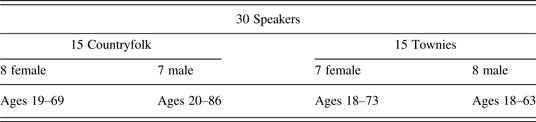
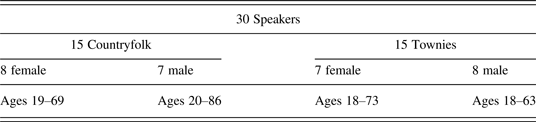
In this community, there is no necessary association between Country orientation and Okie heritage, as Geenberg (Reference Geenberg2014) also found in neighboring Trinity County. While many Redding residents can trace their family's settlement history to the Dust Bowl migration, this does not predict their current interests, livelihoods, or linguistic behavior today. All current sociolinguistic work on the Redding data (and indeed, across the other VOC field sites in the Central Valley) has found the town/country distinction to structure variation for an array of linguistic features, including relative /s/ retraction (Podesva & Van Hofwegen, Reference Podesva and Van Hofwegen2014), the production of voiced stops (Podesva, Eckert, Fine, Hilton, Jeong, King, & Pratt, forthcoming), and creaky voice (Podesva, Callier, & Szakay, Reference Podesva, Callier and Szakay2015). Accordingly, the town/country distinction was noted for all 30 speakers in this sample. In all, there were 15 Countryfolk (8 female; 7 male) and 15 Townies (7 female; 8 male), summarized in Table 1.
Summary of speaker characteristics
Data
All speech data were recorded in the field on Marantz PMD660, Zoom H2, or Sony PCM-M10 recorders using Audio Technica AT831b or Audio Technica ATPro70 lavalier microphones. Recordings were made at a 44.1 kHz sampling frequency with a bit rate of 16. All resulting WAV files were orthographically transcribed and time aligned in Transcriber (Barras, Geoffrois, Wu, & Liberman, Reference Barras, Geoffrois, Wu and Liberman2001) and then force-aligned into phone segments using the FAVE software package (Rosenfelder, Fruehwald, Evanini, & Yuan, Reference Rosenfelder, Fruehwald, Evanini and Yuan2011). Subsequent extraction and analysis of tokens was carried out in Praat (Boersma & Weenink, Reference Boersma and Weenink2012).
For each of the vowels bot, bought,Footnote 4too, boot, toe, boat, ban,Footnote 5 and bat, 25 tokens per speaker were hand selected. Tokens were also extracted for beet and pool,Footnote 6 anchor vowels that were used for normalization and analytical purposes. Several relevant controls were also taken into consideration. First, to control for potential observer effects, tokens were gathered only after 15 min (900 sec) of the interview had elapsed. All tokens were in contexts carrying primary stress, and function words were excluded. Segment boundaries identified through forced alignment were hand corrected, and only those tokens with durations longer than 75 msec were considered. Tokens with preceding vowels, glides, or /r/ were excluded, as were those with following vowels, glides, and liquids, to ensure reliable boundaries between vowels and their neighboring sounds. Finally, no more than two tokens per lemma were considered. In some cases, due to a paucity of appropriate tokens given these controls, the token sample was expanded to include those from the first 15 min or a third lemma as needed. In all, about 6000 tokens were extracted for analysis.
Midpoint F1 and F2 measurements in Hertz were made for each token. Following Hall-Lew (Reference Hall-Lew2009), we took a combination vowel intrinsic and vowel extrinsic normalization approach. Such an approach arguably takes into better account the perceptual/processing salience of relative differences in speakers' vowel spaces. In doing this, first all Hertz measurements were converted to Bark using Traunmüller's (Reference Traunmüller1997) formula. Then, these Bark values were normalized via the NORM vowel normalization suite (Thomas & Kendall, Reference Thomas and Kendall2007), using the “modified” Watt and Fabricius S-centroid procedure (Fabricius, Watt, & Johnson, Reference Fabricius, Watt and Johnson2009). Finally, these normalized vowel measurements were used to create outcome variables for assessing merger or relative vowel distances.
The first specific distance measure created for analysis was the Euclidean distance between each bot token and the overall bought mean for each speaker (called bot–mbought henceforth). While we recognize there are many ways of assessing merger, including normalized F1 or F2 difference (e.g., Irons, Reference Irons2007), spectral overlap (e.g., Wassink, Reference Wassink2006), and pillai scores (e.g., Hall-Lew, Reference Hall-Lew2009; Hay, Warren, & Drager, Reference Hay, Warren and Drager2006), we chose Euclidean distance (e.g., Baranowski, Reference Baranowski2007) from bot tokens to the mean of bought as a means of assessing merger, because in other work (D'Onofrio, Eckert, Podesva, Pratt, & Van Hofwegen, forthcoming) we have found evidence for bot's variable encroachment on a relatively stable bought-like target (not vice versa).
The second Euclidean distance measure was between each ban token and beet's mean for each speaker (ban–mbeet). As previous work on this feature (e.g., Eckert, Reference Eckert2008b) has shown a raising and fronting target for ban in California English (i.e., not unidimensional F1 or F2 movement alone), Euclidean distance from the highest and front-most anchor vowel beet is thus an appropriate measure.
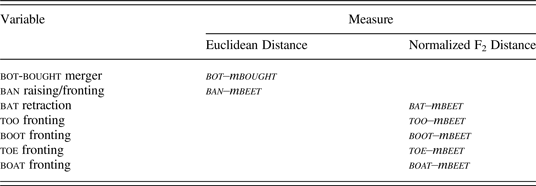
Because the other distance measures examined in this paper are primarily in terms of movement along the F2 axis (i.e., relative fronting/backing, not lowering/raising), they were calculated in terms of relative normalized F2 distances between each vowel under analysis and the mean normalized F2 of beet, for each speaker. beet was chosen as a reference vowel for these measures because it is more stable for California speakers than are the backmost anchor vowels (i.e., pool, bowl, bull, etc.), which may also be undergoing fronting. Thus, relative bat retraction was measured in terms of the F2 distance between each bat token and the mean of beet for each speaker (bat–mbeet); relative too/boot and toe/boat fronting were likewise assessed in terms of F2 distances with a speaker's beet mean (too–mbeet, boot–mbeet, toe–mbeet, and boat–mboat). Considering these vowels in terms of their relative distances from beet provides an additional intraspeaker control, more appropriate than looking at normalized F2 values alone. Table 2 summarizes the outcome variables utilized in the statistical analysis.
Summary of outcome variables

These outcome variables were then incorporated into linear mixed-effect models. Random- and fixed-effect coefficients were estimated in R, using the lmer function of the lme4 package. P values were obtained using R's lmerTest package. In each model, we included fixed effects of speaker age (continuous), sex (binary, male, or female), and orientation (binary, country, or town), with random effects (random slopes only) of speaker, interviewer, word, preceding segment, and following segment. Footnote 7 Continuous variables were centered, while discrete variables were coded using sum contrasts, so that lower order coefficients would refer to the grand mean of the variables when higher order coefficients were included in the model. A separate model was fit for each outcome variable.
RESULTS
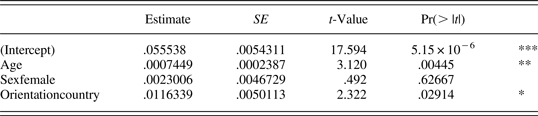
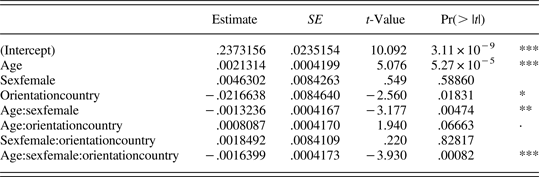
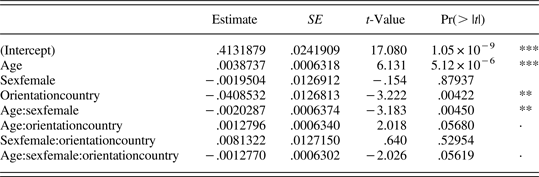
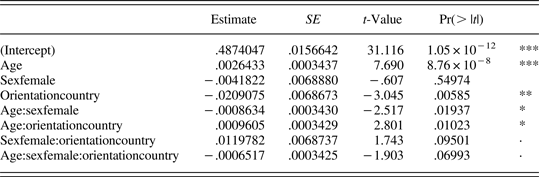
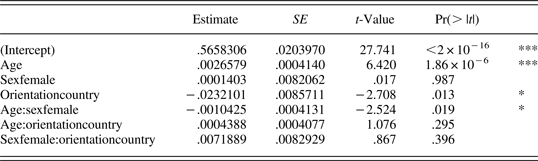
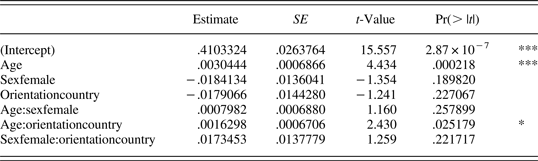
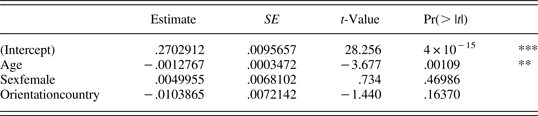
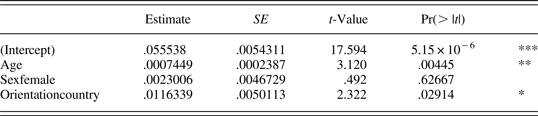
In this section we report the results for each of the outcome variables listed in Table 2, beginning with the fronting of the back vowels (boot, too, boat, toe), continuing with the raising of ban and backing of bat, and ending with the bot-bought merger. Given the large number of variables considered, our focus here is to identify significant correlations between the outcome variables (the distance measures) and the social factors under consideration (age, sex, town vs. country orientation, and their interactions). Models for each outcome variable, including significance values for each factor, are summarized in the regression tables in the Appendix (Table 3 through Table 9). While we focus on significant correlations between the outcome variables and social factors modeled, it should also be borne in mind that, as detailed in the previous section, linguistic factors were included in the models for each outcome variable.
boot and too
Following previous work on back vowel fronting, we investigated the high back vowels in two phonological environments: following coronals (e.g., too), where articulatory constraints encourage fronting, and elsewhere (e.g., boot). The statistical models for the outcome variables (boot–mbeet for boot fronting and too–mbeet for too fronting) were remarkably similar: the same factors emerged as significant, with the levels of each factor exhibiting the same trend for boot–mbeet as for too–mbeet. The only appreciable differences were that the magnitude of fronting was slightly greater for too, as expected, and that a three-way interaction was significant for too–mbeet, but it was just above the alpha level of .05 for boot–mbeet. Given these largely convergent patterns, we discuss here only the results for boot, the more general phonological environment. The model for too fronting can be found in Table 3 in the Appendix.
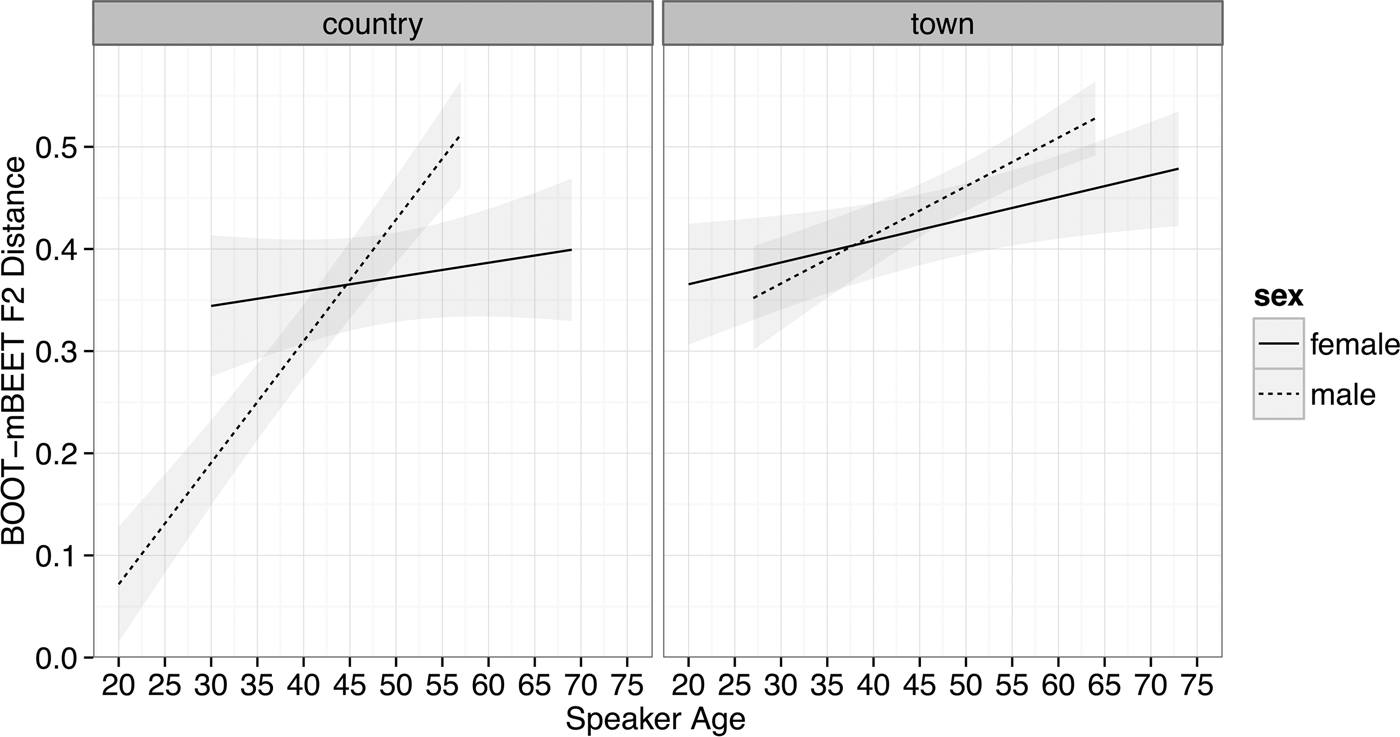
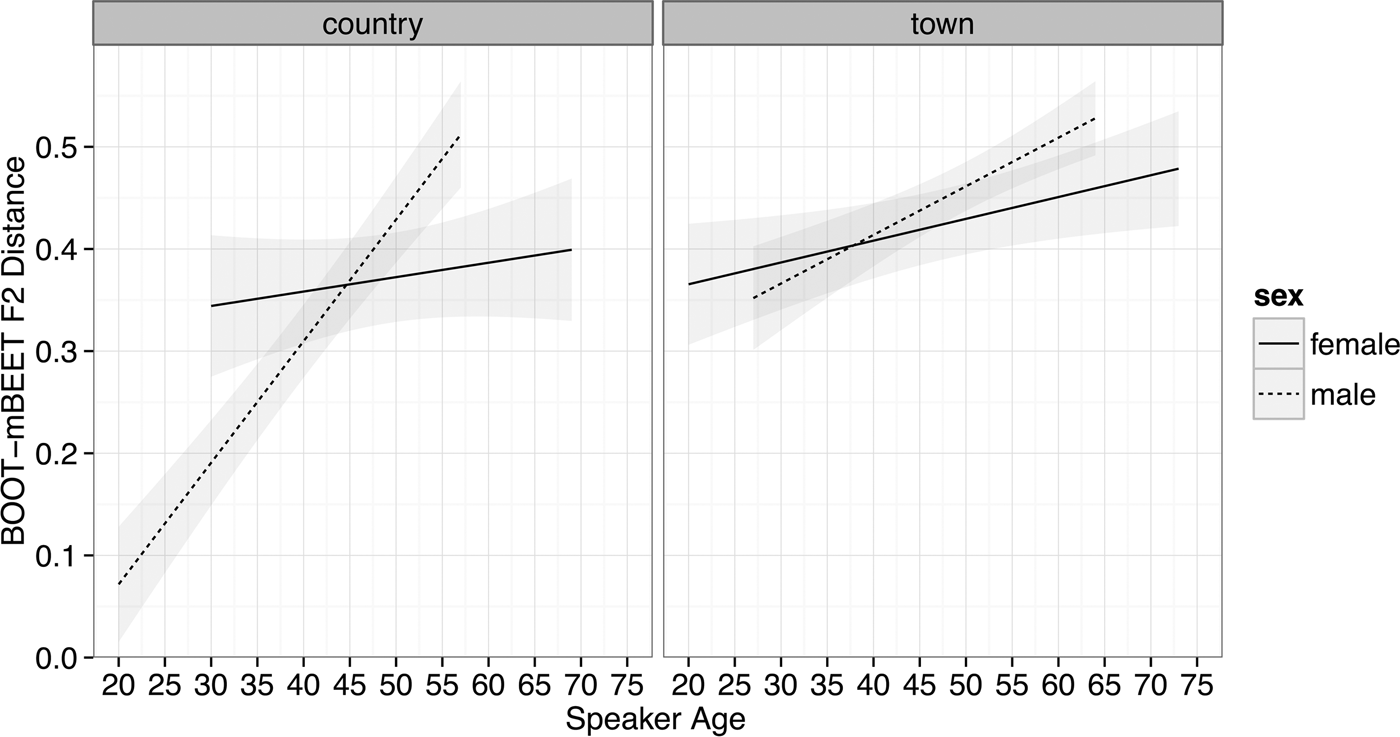
For the outcome variable boot–mbeet, there were main effects of age and orientation. Fronter realizations of boot were produced by younger speakers and by country-oriented speakers, with backer realizations by their older and town-oriented counterparts. The two-way interaction between age and gender emerged as significant, while the two-way interaction between age and orientation and three-way interaction among age, gender, and orientation trended toward significance. The details of the model can be found in Table 4 in the Appendix. Figure 2 depicts the interaction among the social factors. (Note that for this and all similar figures, the lines represent regression lines with the shaded areas being 95% confidence intervals.) All groups show an age effect, with younger speakers fronting to a greater extent than older speakers do; lower values indicate a shorter distance between boot and beet, hence greater fronting. Among Countryfolk, the effect of age is stronger among male speakers. That is, younger country-oriented males front boot more than younger country-oriented females do, while older country-oriented males front boot less than older country-oriented females do. The gender difference with respect to the age pattern does not appear to extend to town-oriented speakers, among whom males and females exhibit similar patterns across the age range.
Normalized F2 distance between boot and beet (boot–mbeet) by age, gender, and orientation (lower values indicate greater boot fronting).
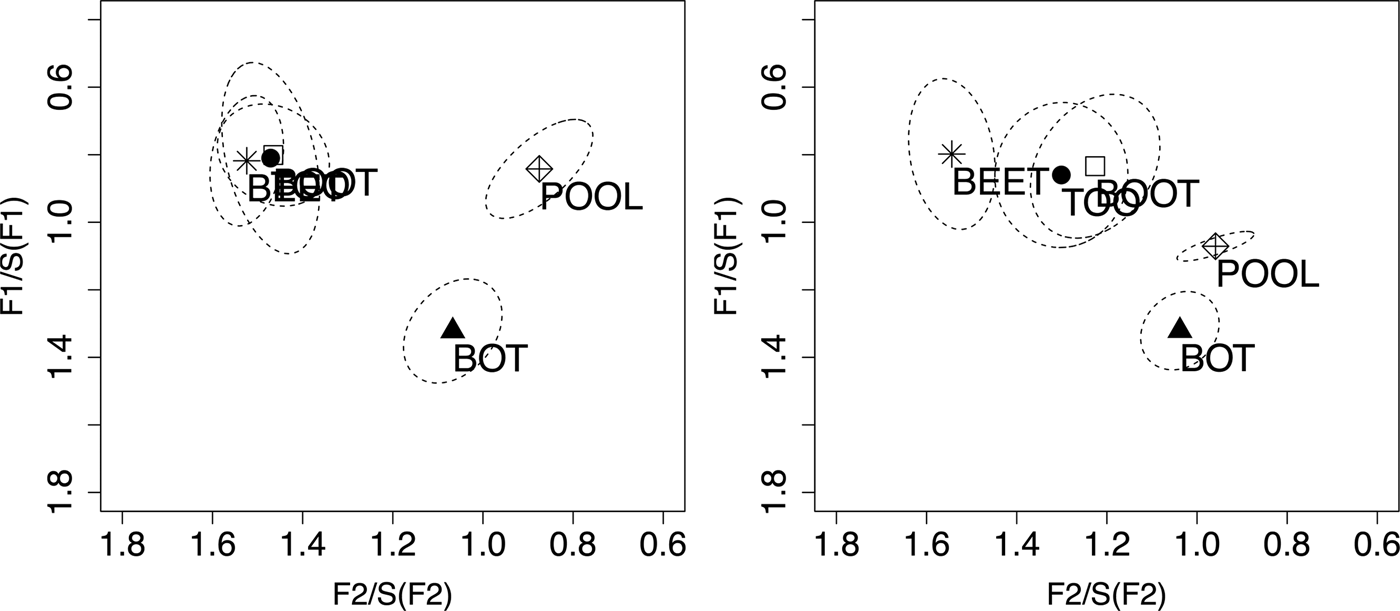
Although numerous social factors appear to constrain the degree of fronting for boot, it is important to note that most speakers in the corpus exhibit some degree of fronting. Figure 3 provides a sense of the range of fronting we observe in the sample. The left panel shows the vowel space for boot and too for a 20-year-old country-oriented male, the speaker who shows the most fronting. In addition to boot and too, the plot shows ellipses (indicating two standard deviations from the mean, a representational practice we follow herein) for the vowels at the periphery of the space—beet, bot, and pool—for reference. This speaker exhibits an extreme degree of fronting, such that boot and too essentially occupy the same position as beet in the F1-F2 plane (though it is likely that the phonological distinction between front and back vowels is maintained in other acoustic dimensions, particularly F3; boot and too are rounded, based on auditory inspection of the speaker's vowels). While few speakers front boot and too to such a great extent, speakers who are least fronted in the sample still exhibit a relatively moderate degree of fronting, such as the 59-year-old country-oriented woman in the right panel in Figure 3. Note that boot is nearly as fronted as too for this speaker, in spite of the fact that the phonological environment does not occasion fronting for this vowel class.
Vowel plots for two speakers exhibiting extreme (left, 20-year-old country-oriented male) and moderate (right, 59-year-old country-oriented female) degrees of boot and too fronting.
In summary, the back vowels boot and too are in the process of fronting in Redding. Nearly all speakers exhibit some degree of fronting, while younger and country-oriented speakers appear to be leading the change. Among the country-oriented speakers, the age effect is more pronounced for males than for females. We turn now to the question of whether the mid back vowels exhibit the same degree of uniformity as boot and too with respect to fronting.
boat and toe
In contrast to boot and too, boat and toe exhibit distinct fronting patterns, so we discuss the results for these two variables separately, beginning with toe. For the outcome variable toe–mbeet (details of the model are summarized in Table 5 in the Appendix), there were significant main effects of age and orientation. The degree of toe fronting decreases with speaker age, and country-oriented speakers front toe more than town-oriented speakers do. The model also shows significant interactions between age and gender and between age and orientation, and a marginal interaction between age and gender. The three-way interaction among age, gender, and orientation was also marginally significant. As was the case for boot and too, the interactions reveal that while all groups of speakers display an age effect for toe fronting, among Countryfolk, the age effect is stronger among men, while there is no gender difference among Townies. These patterns for toe are, by and large, the same as those for boot and too.
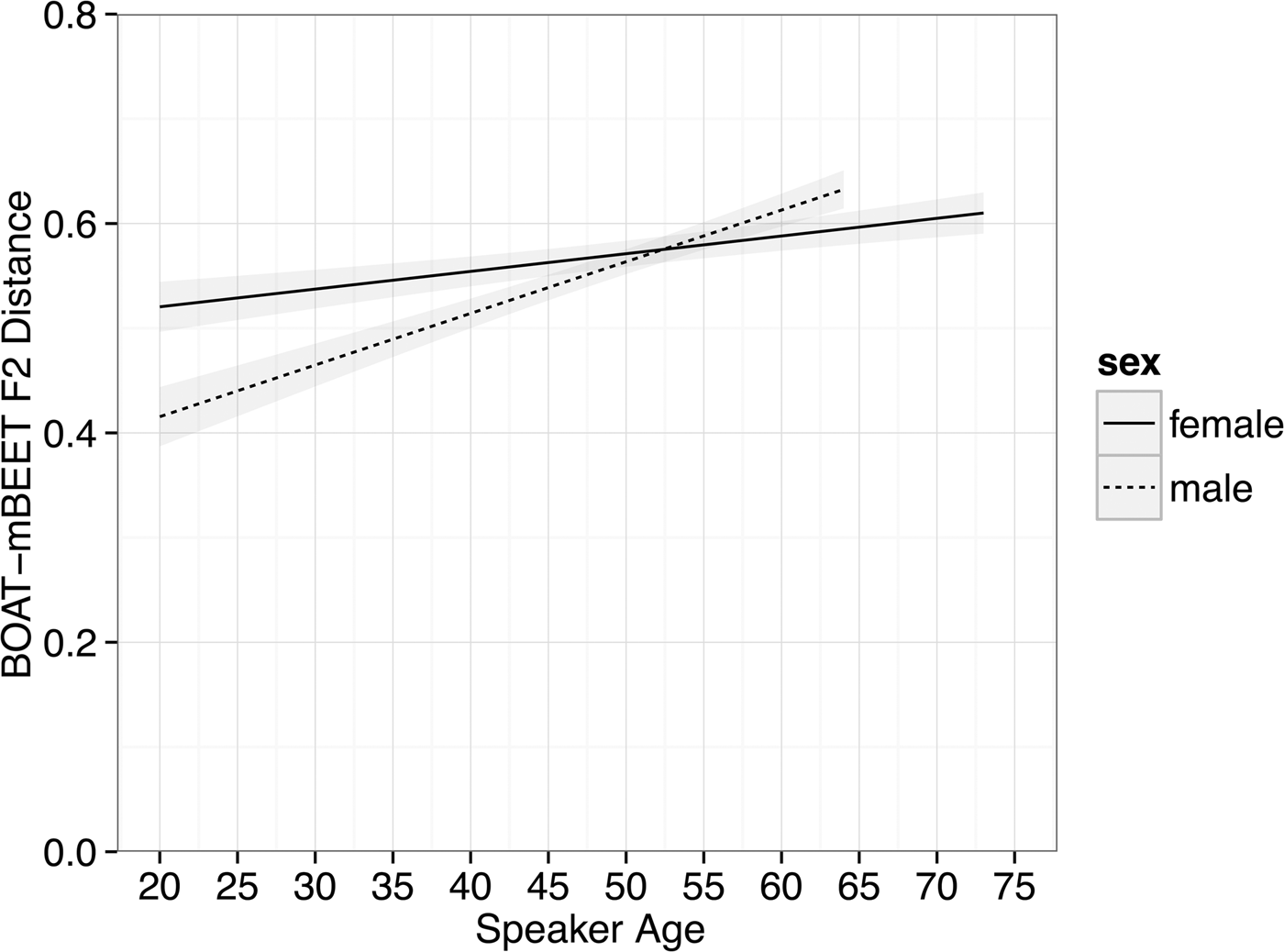
The patterns begin to diverge for boat. The linear regression for the outcome variable boat–mbeet (summarized in Table 6 in the Appendix) reveals a number of similarities, including main effects of age and orientation (with fronting again more prevalent among younger and country-oriented speakers) and a significant interaction between age and gender. This interaction is shown in Figure 4. While an age effect is evident for both male and female speakers, with the degree of fronting decreasing with speaker age, the age effect is stronger for males. Where boat diverges from boot, too, and toe is in the total lack of interactions involving orientation. Whether speakers orient to the town or the country does not interact with age, gender, or the combination of the two. Importantly, the age pattern is remarkably similar for Townies and Countryfolk alike.
Normalized F2 distance between boat and beet (boat–mbeet) by age and gender (lower values indicate greater boot fronting).
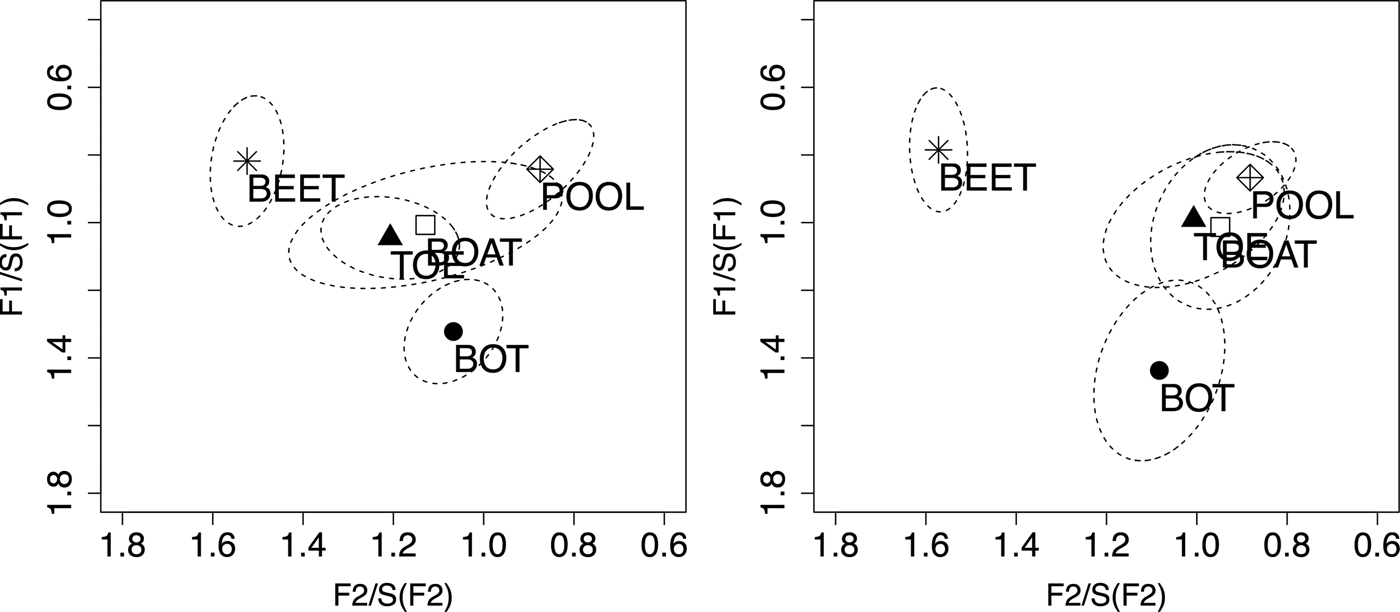
Whereas the high back vowels exhibited robust degrees of fronting across the community, the mid back vowels boat and toe show strikingly smaller degrees of fronting. These patterns are evident in Figure 5, which depicts the range of the boat and toe fronting in the sample with the most fronted speaker (on the left) and a speaker who shows only a modest degree of fronting (on the right). The speaker in the left panel, the same speaker whose boot and too tokens are represented on the left panel of Figure 3, fronts only just past the F2 for bot, which generally sits in the back of the vowel space for speakers in this community, particularly younger speakers such as this one. It is also worth noting that boat, which demonstrates social patterning distinct from that of boot, too, and toe, shows a much wider range of variation in the F2 dimension, encompassing the backest part of the vowel space and much of the front. Such wide variation may be indicative of its relatively recent introduction into the linguistic repertoire of this speaker. Fronting likely began following coronals (i.e., toe), an environment in which the vowel is less dispersed for this speaker, as compared to boat. The range of variation for boat for older speakers is relatively smaller, as indicated in the panel on the right of Figure 5, which depicts the vowel space of a 68-year-old town-oriented female. It should also be noted that this speaker's boat and toe distributions are settled in the back of the space, indicating only a modest participation in the fronting of the mid back vowels.
Vowel plots for two speakers exhibiting the greatest (left, 20-year-old country-oriented male) and modest (right, 68-year-old town-oriented female) degrees of boat and toe fronting.
To summarize the patterns for boat and toe, fronting appears to have begun spreading through Redding, though not to the same extent as it has for the high back vowels. As was the case for high vowel fronting, the fronting of boat and toe is more prevalent among country-oriented speakers than among those oriented to the town. In contrast to the high back vowels, boat shows distinct social patterning from toe, in that the effect of orientation is not mediated by the effects of gender or age. Having discussed the fronting of the high and mid back vowels, we turn our attention to the front vowels in the following section.
bat and ban
As discussed in the introduction, the realization of bat (in urban, coastal communities, at least) depends heavily on the following phonological environment, such that fronting and raising occurs prior to nasals, and backing (and some degree of lowering) occurs elsewhere. Accordingly, we treat ban as a separate vowel class from bat, and indeed, the two vowels exhibit strikingly distinct patterns in Redding.
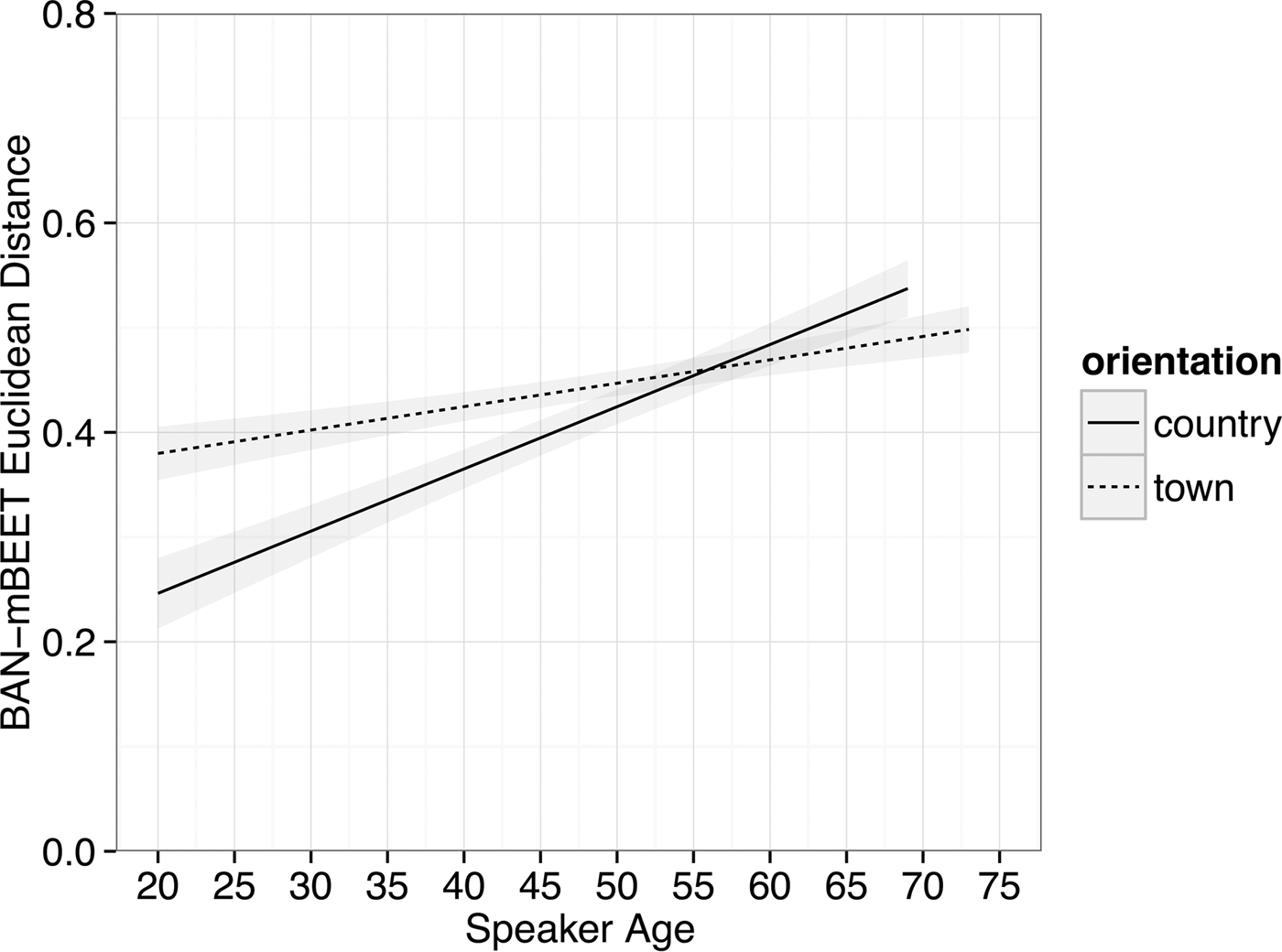
Beginning with ban, the regression analysis (summarized in Table 7 in the Appendix) on the outcome variable (ban–mbeet) reveals a main effect of age. As speaker age decreases, the Euclidean distance between ban and beet decreases, suggesting that younger speakers are moving ban in the direction of beet. There was also a significant interaction between age and orientation, such that the effect of age is stronger among Countryfolk. This interaction is represented in Figure 6, which shows that while there is no main effect of orientation, younger Countryfolk appear to raise ban more than younger Townies do. No other interactions emerged as significant.
Normalized Euclidean distance between ban and beet (ban–mbeet) by age and orientation (lower values indicate greater ban raising).
In stark contrast to the other components of the shift, bat backing shows no significant effect of orientation either as a main effect or as part of an interaction. The regression model for the outcome variable (bat–mbeet), as summarized in Table 8 in the Appendix, shows a main effect of age only. Younger speakers exhibit a wider distance in F2 between bat and beet, suggesting that they are moving the vowel away from the front of the vowel space (i.e., backing). No interactions, including those with orientation, were significant.
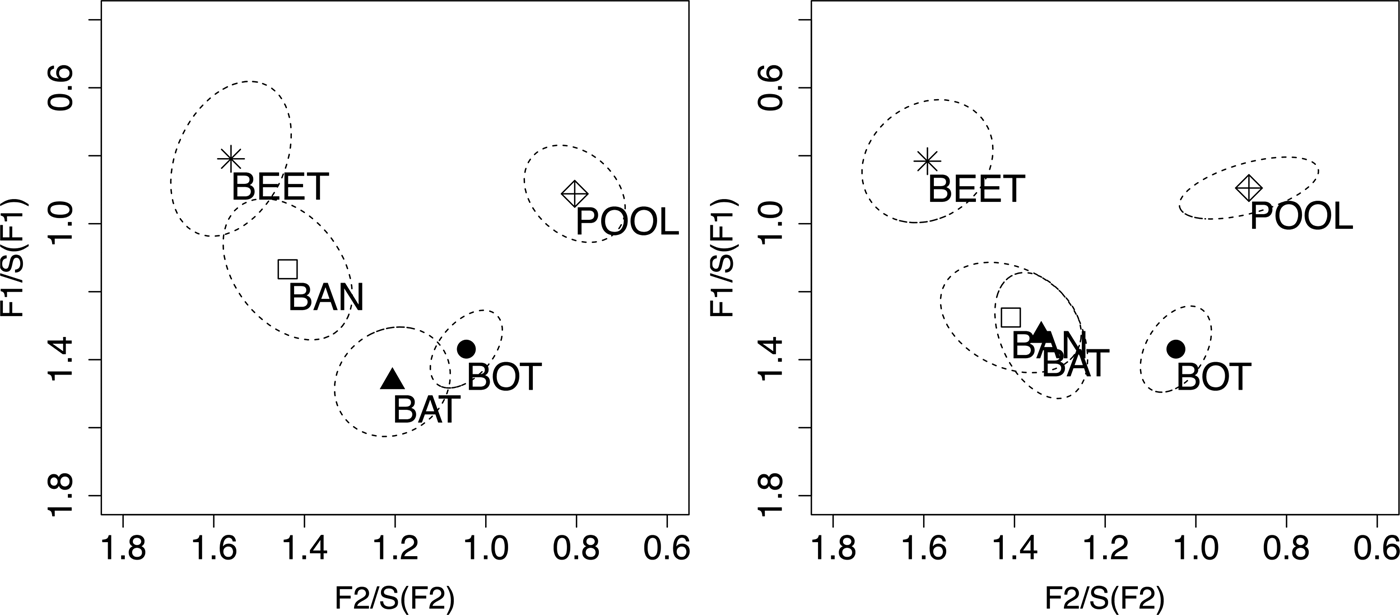
The split between bat and ban, achieved by the raising (and slight fronting) of ban and the backing (and slight lowering) of bat, is therefore evident in Redding. The vowel plots in Figure 7 give a sense of the magnitude of the split. The right panel of Figure 7 shows an 86-year-old country-oriented male speaker with largely overlapping bat/ban vowel classes, indicating that he does not raise ban. The left panel shows bat and ban for the speaker with the greatest distance between the two vowels, an 18-year-old town-oriented female. As can be seen in her vowel plot, bat and ban do not overlap at all, and bat is rather close to (and overlaps partly with) bot, further evidence of bat retraction. The plot also shows that ban approaches, but is not as high as, beet. This contrasts with Eckert's (Reference Eckert2008b) data for preadolescents in the Bay Area whose ban tokens were firmly in beet territory. The youngest Redding speakers exhibit even less raising of ban than Eckert's preadolescents, who would be in their early 30 s today. Thus, while the bat-ban split is evident in Redding, it has not advanced to the degree that it has in urban areas like the Bay Area.
Vowel plots for two speakers exhibiting greater (left, 18-year-old town-oriented female) and lesser (right, 86-year-old country-oriented male) degrees of the bat-ban split.
In summary, the bat-ban split has spread to Redding, with the raising of ban and the backing of bat both significantly more prevalent in the speech of younger speakers. While orientation had an effect on the raising of ban, such that younger Countryfolk raise ban to the greatest extent, orientation had no effect on the backing of bat. For all variables discussed thus far, if orientation influenced the extent to which vowels shifted, it has been country-oriented speakers who have led the change in apparent time. In the following section, we turn to the final variable under consideration, where town-oriented speakers lead the change.
bot and bought
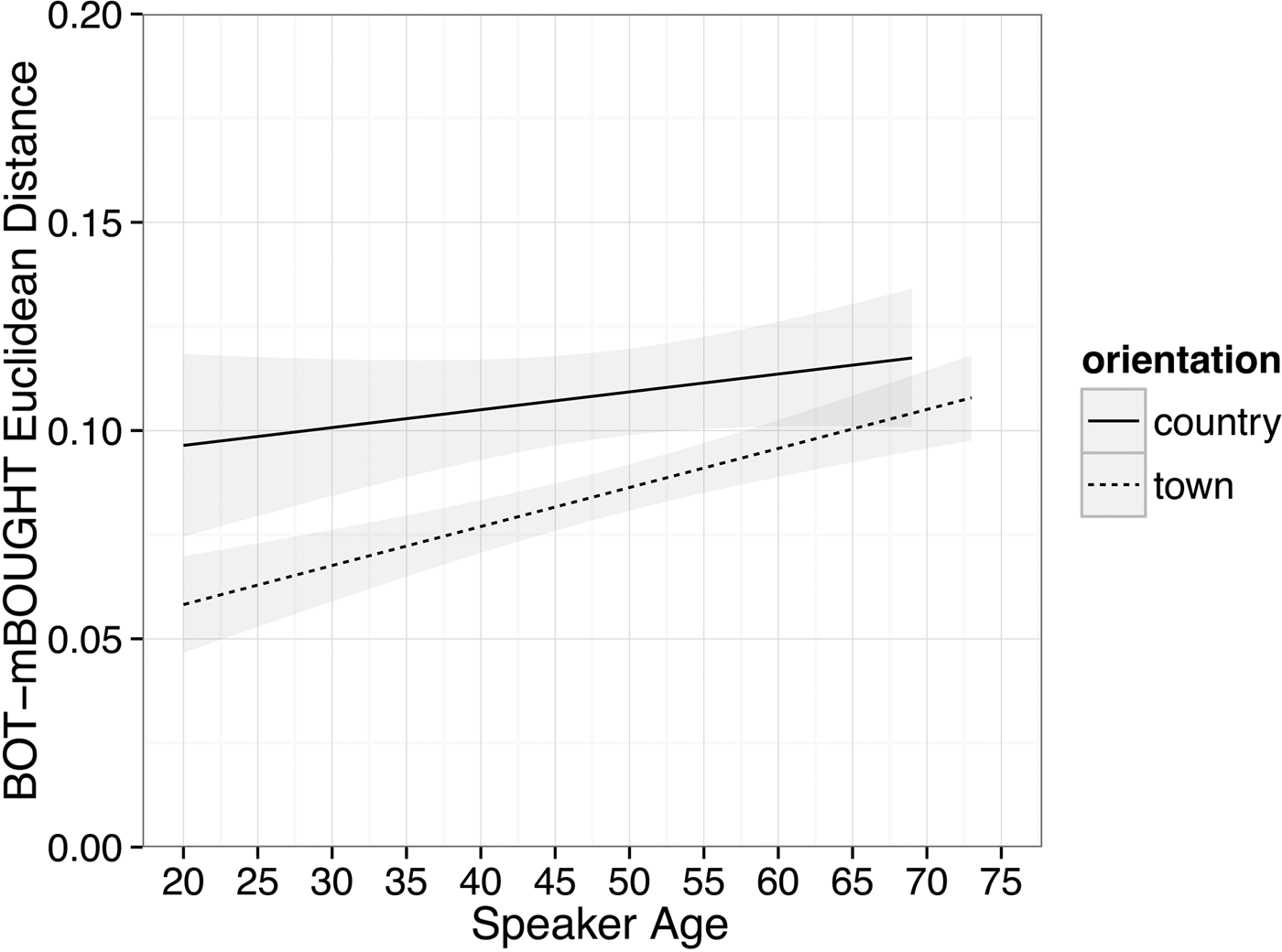
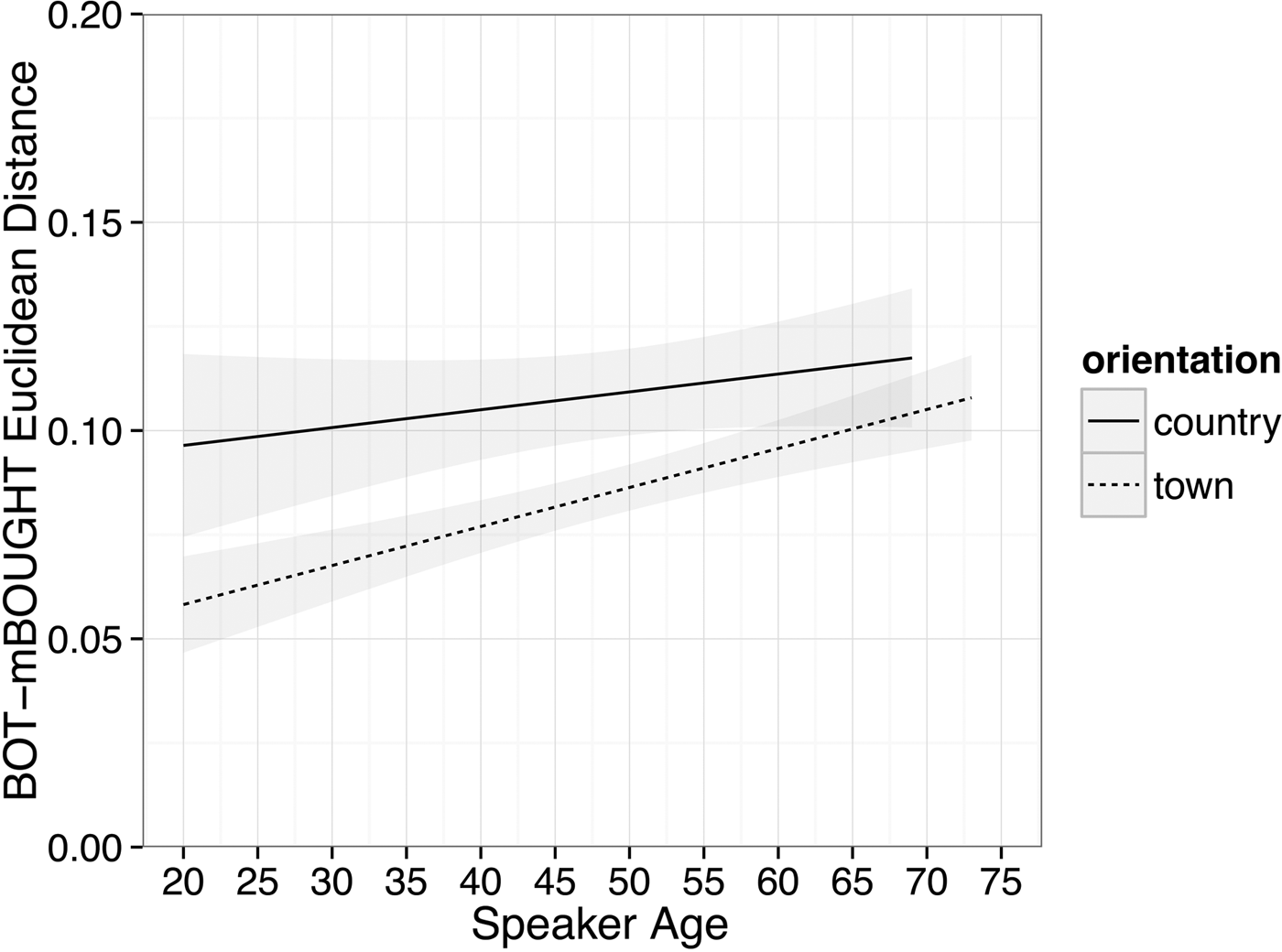
We end by discussing the results for the bot-bought merger. The regression model on the outcome variable (bot–mbought), summarized in Table 9 in the Appendix, reveals significant main effects of age and orientation. Figure 8 illustrates these effects. As age increases, the Euclidean distance between bot and bought increases, suggesting that older speakers maintain a greater distance between these vowels than younger speakers do. There was also a main effect of orientation, revealing that speakers oriented to the town exhibited a shorter distance between the vowels, thus indicating a greater overlap between bot and bought.
Normalized Euclidean distance between bot and bought (bot–mbought) by age and orientation (lower values indicate greater degree of overlap).
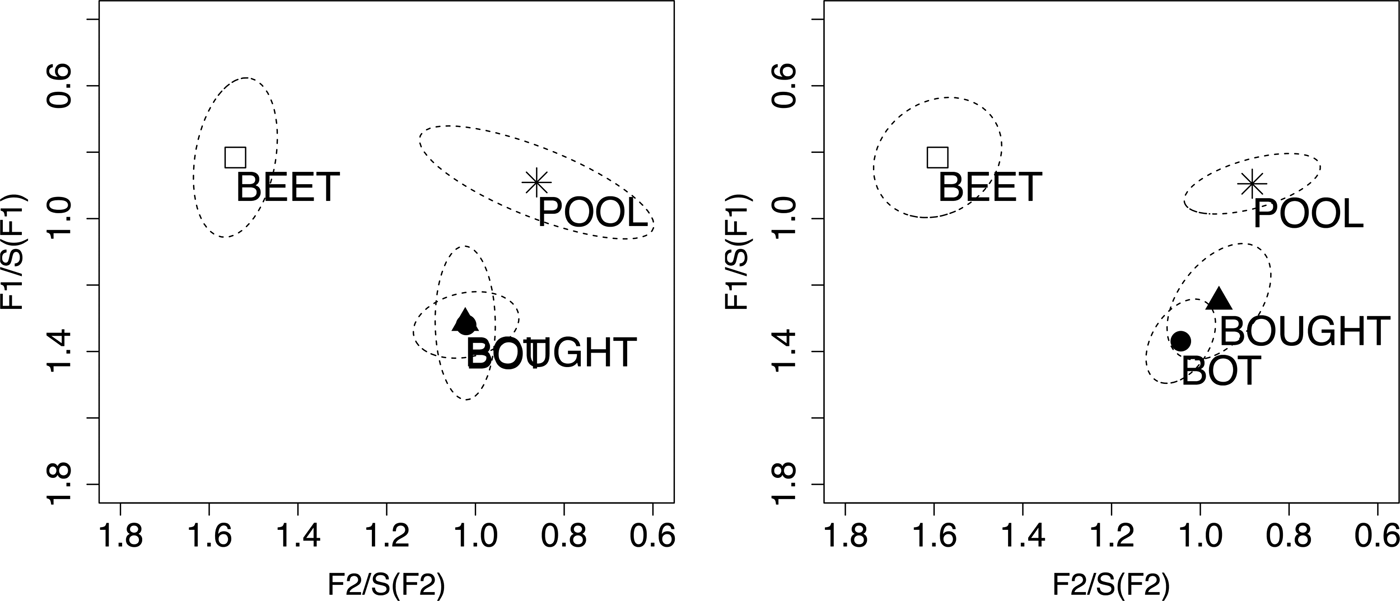
The vowel plots in Figure 9 represent the range of patterns in the community. The left panel shows the pattern for a 19-year-old town-oriented female, the speaker who shows the greatest degree of overlap between the two vowels according to the outcome variable (bot–mbought). Here, the means for bot and bought are nearly identical, their distributions largely overlapping. This contrasts with the bot and bought of the speaker on the right, an 86-year-old country-oriented male. As the figure shows, his bot and bought have distinct means, and their distributions overlap to a lesser extent.
Vowel plots for two speakers who merge (left, 19-year-old town-oriented female) and maintain a distinction between (right, 86-year-old country-oriented male) bot and bought.
To recapitulate, the bot-bought merger is well attested in Redding. While a small number of speakers maintain a distinction between bot and bought, this pattern is exceedingly rare in the community, even among older speakers; most speakers would be classified as exhibiting a merger. Nevertheless, quantitative differences emerge in the distance between the two vowels: younger speakers show a smaller distance than older speakers, and speakers oriented to the town show a smaller distance than those oriented to the country.
Summary of results
To conclude this section, we summarize the primary findings by highlighting some of the most striking trends emerging across the variables. First, age serves as a significant predictor for all variables under consideration, with the extent of the shift correlating inversely with speaker age. Age was the only social factor that was significant for all variables.
Second, speaker orientation to country versus town is a strong predictor of many of the outcome variables. Townies lead Countryfolk in the bot-bought merger, while Countryfolk lead Townies in the fronting of the back vowels (for all four vowel classes considered). The effect of orientation is not uniform across the sample population, as it significantly interacts with age for toe fronting and ban raising, with younger Countryfolk leading in both cases. Orientation and age also interact with gender in the cases of too, boot (trending), and toe (trending) fronting. For all three of these variables, younger country-oriented males lead in fronting.
Remarkably, gender did not emerge as a significant predictor for any variables on its own. In addition to its three-way interactions with orientation and age just discussed, gender interacted with age for all fronting variables (too, boot, toe, and boat). In all four cases, the effects of age are more prevalent among men, with younger men leading in fronting and older men showing the most conservative pattern.
In the following section, we offer explanations for our three primary findings: that younger speakers lead for all components of the CVS considered, that Countryfolk lead for some components of the CVS while Townies lead for others, and that in the few cases where gender structures patterns of variation (and only in interaction with other social factors), it is young, usually country-oriented, men who lead change.
DISCUSSION
Our primary research question is whether people in Redding, an inland, nonurban community in California, participate in the CVS, which has been documented almost exclusively in coastal cities. The fact that all variables are undergoing change in apparent time, with younger speakers more advanced in all cases than older speakers, is strong evidence that the CVS has indeed taken root in Redding. Nearly every speaker in the sample shows evidence of the shift, particularly for too and boot fronting and the bot-bought merger. Other components of the shift, such as the bat-ban split and boat fronting, appear to be lagging compared to more urban communities. Further evidence for the recent introduction of boat fronting into Redding is apparent in the phonological and social constraints on fronting. If one considers the high back vowels, fronting occurs regardless of phonological environment (i.e., boot and too are both heavily fronted), and boot and too fronting exhibit the same social constraints. A change that likely began following coronal consonants (i.e., too) has been generalized to other phonological environments. In contrast, fronting remains phonologically conditioned for the mid back vowel, beginning in the favored toe environment, and boat fronting shows different social patterning from toe fronting. Together, these patterns suggest that the fronting of the high vowels precedes that of the mid vowels (cf. Hall-Lew, Reference Hall-Lew2009), where fronting has only just begun. In any case, even though some components of the CVS are more advanced than others, the shift has spread widely through the community; it is not solely an urban shift.
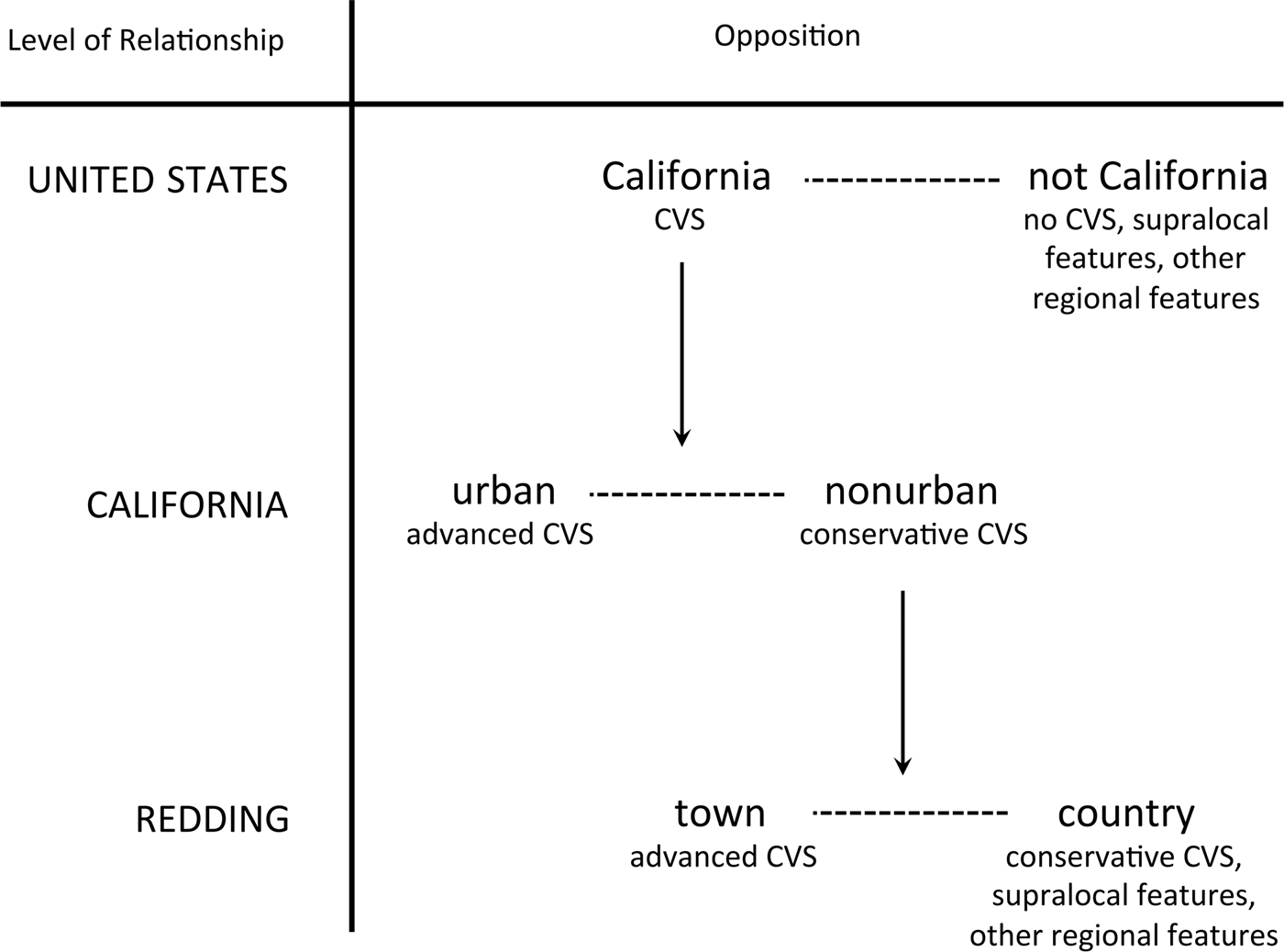
While the macrosocial category of age certainly conditions variation in Redding, the locally relevant divide between town and country also strongly structures the observed patterns. This opposition appears to mimic larger scale contrasts between urban and nonurban, and between California and locations outside of the state, in a system of fractal recursivity (Irvine & Gal, Reference Irvine, Gal and Kroskrity2000). Recursivity is the ideological process that “involves the projection of an opposition, salient at some level of relationship, onto some other level” (Irvine & Gal, Reference Irvine, Gal and Kroskrity2000:38). For example, the gross tendency for women to produce higher pitch levels than men can play out within sex classes, such that in some communities women with higher pitch levels might be evaluated as sounding more feminine than women exhibiting lower pitch levels. In much the same way, even though any feature of the CVS could serve as an ideological resource for differentiating Californians from speakers outside the region, it could also work to draw distinctions among Californians themselves. As schematized in Figure 10, advanced features of the CVS can distinguish urban Californians from nonurban Californians, and in the nonurban location of Redding, they could similarly be used as a means of distinguishing Townies from Countryfolk. Following Gal's (Reference Gal2013) work on qualia, we assume that even though the relevant opposition at some levels of relationship pit one specific quality against another (e.g., town vs. country in Redding), at other levels the relevant distinction may be between a specific quality and its absence (e.g., California vs. not California at the national level).
Fractal oppositions in Redding.
Given the fractal oppositions relevant in Redding, it was hypothesized that features of the CVS would pattern according to the microlevel opposition between town and country, as it reproduces the broader opposition (at the level of the state of California in Figure 10) that conditions the greater or lesser use of CVS features. Namely, we expected town-oriented individuals to show greater use of CVS features, with country-oriented individuals showing more conservative patterns with regard to these vowels. This hypothesis is partially supported by the results, as speakers who were oriented to the relatively more cosmopolitan town exhibited a smaller distance between bot and bought than country-oriented speakers did. To be clear, our claim is not that an advanced bot-bought merger uniquely indexes Californianess, urbanness, or an orientation to the town of Redding, as this merger is well attested across many areas of the United States where California may matter little. Rather, we argue that the closer proximity of these vowel classes in this community can serve as a resource for indexing an orientation to the town. We note an alternative explanation proposed by an anonymous reviewer—that the closer proximity of these vowel classes among Townies (and greater distance among Countryfolk) may represent a faster rate of change (or for the Countryfolk, a slower rate) based on network affiliation—and point out that such an interpretation is both plausible and consistent with our analysis.
Orientation to the country also significantly influenced a number of features considered here in the opposite direction from what we expected. For the fronting of the back vowels and the raising of ban, it is (young) Countryfolk who lead Townies. While it is theoretically possible that Countryfolk could be aligning with urban California in their use of these features, we reject this analysis due to its incompatibility with our ethnographic observations and the greater plausibility of competing explanations. Neither back vowel fronting nor ban raising should be viewed as unambiguous indexes of California, as both features are part of several varieties of American English. As indicated in Figure 10, Countryfolk, as speakers who position themselves in opposition to California and its coastal cities, could draw on a variety of linguistic features to do so, including supralocal features and features of other regional varieties.
Back vowel fronting and ban raising could, on the one hand, be viewed as supralocal features that span a number of dialect areas of the United States. Under such an analysis, country-oriented speakers' relatively more raised ban and heavily fronted back vowels would be motivated more by an alignment with a supralocal standard than an affiliation with California, even if these features are well represented in both the supralocal and local varieties.
On the other hand, both features could alternatively be viewed as components of a local dialect that is not linked to urban California, namely a country dialect with Southern roots. Recall from the introduction that the Central Valley was largely settled by Dust Bowl migrants who brought elements of Southern phonology to the region. Some Southern features have taken root in the Central Valley, such as the pin-pen merger, which has been observed both to the Northwest and South of Redding (Geenberg, Reference Geenberg2014; Labov, Ash, & Boberg, Reference Labov, Ash and Boberg2006; Warren & Fulop, Reference Warren and Fulop2014), and retracted /s/, which has similarly been documented all along the Central Valley (Podesva & Van Hofwegen, Reference Podesva and Van Hofwegen2014). We tentatively suggest that back vowel fronting and ban raising, as Southern features, could serve as indexes of country identity, due to the tight connection between Southern and country identities (Hall-Lew & Stephens, Reference Hall-Lew and Stephens2012). Geenberg (Reference Geenberg2014) advanced a similar argument, reporting that in neighboring Trinity County “outdoorsy” speakers—distinct from, but analogous to Countryfolk in Redding–—have less spectral overlap between pin and pen than their “indoorsy” counterparts do. Given that neither back vowel fronting nor ban raising is a hallmark feature of the SVS, we turn to a brief discussion of their status as Southern features.
The fronting of the back vowels is a well-documented component of Southern vowel systems (e.g., Fridland, Reference Fridland2008b; Fridland & Bartlett, Reference Fridland and Bartlett2006; Fridland, Barlett, & Kreuz, Reference Fridland, Bartlett and Kreuz2004; Thomas, Reference Thomas1989, Reference Thomas2001). One could argue that back vowel fronting constitutes a feature of most varieties of American English, thus calling into question the feature's ability to index Southernness or related country ideologies. Aside from the fact that any given feature has the potential to index a multitude of meanings (Eckert, Reference Eckert2008a), there is also reason to view Southern influenced back vowel fronting as distinct from fronting in other varieties. As Koops (Reference Koops2010) reported, Houston speakers who produce Southern shifted front vowels exhibit a more monophthongal fronted boot, while those who do not produce Southern shifted front vowels tend to produce more diphthongal realizations of the fronted variant. The examination of formant trajectories in future work on back vowel fronting in Redding would shed light on this issue.
While ban raising similarly appears across numerous dialects of American English, it too can be analyzed as a Southern feature. Bigham (Reference Bigham2005) argued that ban raises to fill the gap left by bet, which itself raises before nasals to achieve the pin-pen merger in Southern Illinois. While often characterized as a Southern and Midlands feature, the pin-pen merger is attested in California's Central Valley (Labov et al., Reference Labov, Ash and Boberg2006, Warren & Fulop, Reference Warren and Fulop2014) and in neighboring regions (Geenberg, Reference Geenberg2014). It is possible that the same forces motivating the raising of ban in Southern Illinois are at work in Redding, where we have impressionistically observed the merger of pin-pen in some speakers.
Further work is necessary to better establish the possible influence of Southern vowel phonology on the patterns we observe in Redding. Examining potential correlations between the elements of the CVS examined here and other, less ambiguously Southern features—most notably, the pin-pen merger—will be crucial in such an endeavor.
Regardless of the explanation for why Countryfolk lead Townies for some components of the CVS, the fact remains that the ideological divide between the town and the country heavily structures patterns of variation. Orientation to the country predicts all but one of the features considered here (i.e., bat backing), with Townies leading Countryfolk for one feature (i.e., bot-bought merger), and Countryfolk leading Townies for others.
Strikingly, gender did not have a significant main effect on variation patterns for any of the seven features under investigation. At the very least, this indicates that gender is less important than more locally significant dimensions of social distinction, such as orientation to the country. We do not intend to dismiss gender outright, however, because the interaction of gender with age and orientation proved a significant predictor of too fronting (and a trending predictor of boot and toe fronting). Younger country-oriented men lead in the fronting of this variable, despite the common finding in other communities that women typically lead in change from below. If the fronting of back vowels indexes a country orientation, as this paper has argued, then the fact that it is men who lead in fronting is less surprising, given that the country is experienced as a masculine space in this community. As Podesva and Van Hofwegen (Reference Podesva and Van Hofwegen2014) reported, country-oriented men in the same community lead in the retraction of /s/, another feature linked to country and Southern identity (Campbell-Kibler, Reference Campbell-Kibler2011). Similar patterns are evident in neighboring Trinity County, where men (and outdoorsy speakers) lead in bet raising (Geenberg, Reference Geenberg2014), a characteristic feature of the SVS. How and why the country in inland Northern California has come to be viewed as a masculine space is a question lying beyond the scope of the present paper, though work in rural geography suggests that this ideology originated in the necessity for male physical strength to “‘tame’ the forces of nature to maximize production” in agricultural settings (Little, Reference Little2002:666). While physical strength is no longer necessary to thrive in agricultural communities, as technology has more or less neutralized differences in physical strength, rural technology is marketed in a way that maintains the ideology of the country as masculine (Brandth, Reference Brandth1995).
CONCLUSION
In summary, we have found that the CVS is well represented in Redding, an inland, nonurban community in Northern California, though it is not as far advanced as in the state's coastal cities studied in the previous literature. Features of the CVS serve as resources with which speakers can position themselves with respect to a locally relevant ideological divide between the town and the country. This pattern is reminiscent of findings for Martha's Vineyard reported by Labov (Reference Labov1963), wherein locals used centralized nuclei of the diphthongs (ay) and (aw) to index an oppositional stance to the encroachment of mainland tourists. In Redding, speakers can align with a country ethos, in opposition to a town-oriented stance, by using particular features that are associated with country identity within the community. Future work will need to uncover how linguistic pressures and social ideologies shape the use of particular components of the CVS, and how the sound changes led by country-oriented speakers in Redding are related to other regional or supraregional dialects. While this paper has focused on components of the CVS, it is imperative that the same level of attention be devoted to features originating from the Southern United States in this community, as country orientation maintains historical and ideological ties with the South. It will also likely prove worthwhile to consider the dynamics of formant movement for features that are present in both the CVS and in other regional dialects, such as the SVS, particularly given Koops's (Reference Koops2010) finding that boot fronting is more monophthongal for Houston speakers who participate in other dimensions of the SVS. It is possible that in Redding, speakers can affiliate with the country not only by using fronter variants of the back vowels, but by using more “Southern,” monophthongal front variants of these vowels.
The town-country structuring of the CVS in inland California provides striking evidence for dialect diversity within California, not to mention the Western United States. While the West is typically treated as a monolithic dialect region (Labov, Reference Labov and Eckert1991; Labov et al., Reference Labov, Ash and Boberg2006), it is populated by myriad communities, with distinct settlement histories, local industries, and economic circumstances. The divergent social trajectories among Western communities plausibly give rise to distinct dialects. These dialects should be documented, and their development studied.
In all, we suggest that the development of the dialect in Redding has been determined in part by the way community members orient toward or away from larger cities in the state and what these cities represent to them. That the CVS is more advanced in cities may not be unique when compared to other large-scale sound changes (e.g., the Northern Cities Vowel Shift). But, the characterization of California cities by California residents, along with ideologies about cities versus the country in general, seems to determine the ways in which speakers participate in language change. In light of these findings, we promote a view of language change where vowel shifts, and enregistered speech varieties more generally, are ideologically associated with the particular qualities of the places from which they originate. Each city has a different perceived character, and the emergence of this character as distinctive enables the speech styles of the city to become indexes of it. A crucial step in understanding the trajectory of language variation and change, especially as we turn our gaze outside of cities, is understanding the qualities that cities and their characteristic dialects represent, and how people outside of them orient to those qualities, which may, in turn, condition their language use.
APPENDIX
In Tables 3 to 9, the number of asterisks corresponds to the size of the p-value: *p < 0.05, **p < 0.01, ***p < 0.001, and · p < 0.1.
Summary of fixed factor effects on too-mbeet (too fronting)
n = 552
Summary of fixed factor effects on boot-mbeet (boot fronting)
n = 252
Summary of fixed factor effects on toe-mbeet (toe fronting)
n = 698
Summary of fixed factor effects on boat-mbeet (boat fronting)
n = 647
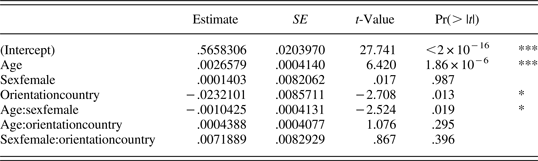
Summary of fixed factor effects on ban-mbeet (ban raising)
n = 709
Summary of fixed factor effects on bat-mbeet (bat backing)
n = 750
Summary of fixed factor effects on bot-mbought (bot-bought merger)
n = 743