Romantic kissing, defined as ‘lip-to-lip contact that may or may not be prolonged between two individuals in a sexual, intimate setting’ (Thompson, Kulibert, & Anisimowicz, Reference Thompson, Kulibert and Anisimowicz2016), is often referred to as a ‘gateway’ behaviour that may serve as a transition into other more intimate and risky behaviours (O'Sullivan, Cheng, Harris, & Brooks-Gunn, Reference O'Sullivan, Cheng, Harris and Brooks-Gunn2007). In fact, romantic kissing serves as a pivotal point in the development of sexual self-concept and intimacy in many romantic relationships (Wlodarski & Dunbar, Reference Wlodarski and Dunbar2013).
Although considered both common and significant enough to include in various studies of sexual behaviour (Mahieu & Gastmans, Reference Mahieu and Gastmans2015; Regan, Durvasula, Howell, Ureño, & Rea, Reference Regan, Durvasula, Howell, Ureño and Rea2004), romantic kissing has seldom been the primary focus of research. Among the few studies that have been conducted, most have focused on the function of kissing and the role it plays in mate selection (Wlodarski & Dunbar, Reference Wlodarski and Dunbar2013, Reference Wlodarski and Dunbar2014). Despite the handful of studies examining the functions of romantic kissing (Welsh, Haugen, Widman, Darling, & Grello, Reference Welsh, Haugen, Widman, Darling and Grello2005; Wlodarski & Dunbar, Reference Wlodarski and Dunbar2013, Reference Wlodarski and Dunbar2014), little research has attempted to examine why people engage in romantic kissing, or one's motives.
Motives for Sexual Behaviors
Motivation, a major construct in psychology, is defined as the basic driving force behind an individual's actions, and includes our goals, desires, and needs (Harackiewicz et al., Reference Harackiewicz, Barron, Carter, Lehto and Elliot1997). Although little research has specifically assessed individuals’ motives for engaging in romantic kissing, related research on motives for sexual behaviour is vast (e.g., oral sex, sexual intercourse; Leigh, Reference Leigh1989; Buss & Meston, Reference Meston and Buss2007; Vannier & O'Sullivan, Reference Vannier and O'Sullivan2012).
Early research assessing motives for sexual behaviour suggests that individuals engage in sexual behaviour for many reasons, including to express affection for a partner (Hawk et al., 2012; Leigh, Reference Leigh1989), to increase commitment within a relationship (Basson, Reference Basson2000), to enact revenge on a current or ex-partner (Greiling & Buss, Reference Greiling and Buss2000), and/or for physical or sexual pleasure (Carroll, Volk, & Hyde, Reference Carroll, Volk and Hyde1985; Hill & Preston, Reference Hill and Preston1996). However, in perhaps the most comprehensive and rigourous research to date, Meston and Buss (Reference Meston and Buss2007) were able to systematically examine what motivates people to engage in sexual behaviour (sexual intercourse specifically) by creating a widely used psychometrically established scale: the YSex? Scale.
The YSex? Scale is comprised of four subscales related to why people have sex: the Physical Motives subscale (e.g., ‘The person had a desirable body’), the Emotional Motives subscale (e.g., ‘I wanted to feel connected to the person’), the Goal Attainment Motives subscale (e.g., ‘I wanted to enhance my reputation’), and the Insecurity Motives subscale (e.g., ‘I wanted my partner to notice me’). Although the extent to which each motive was endorsed varied widely by item, overall physical and emotional motives were reported more frequently than were goal attainment and insecurity motives. Furthermore, gender differences were discovered in the extent to which each of the motives were endorsed (Meston & Buss, Reference Meston and Buss2007). Specifically, men reported having sex for physical motives more frequently than did women, whereas women reported having sex for emotional motives more frequently than did men.
Motives for Romantic Kissing
Despite the large amount of research examining motives for sexual behaviour (e.g., Meston & Buss, Reference Meston and Buss2007; Vannier & O'Sullivan, Reference Vannier and O'Sullivan2012), only one study to date has comprehensively examined motives for romantic kissing (Thompson et al., Reference Thompson, Kulibert and Anisimowicz2016). In doing so, the researchers explored a wide range of potential motives for engaging in romantic kissing by adapting items from the YSex? Scale (Meston & Buss, Reference Meston and Buss2007). In this study, the results of a factor analysis revealed that people engage in romantic kissing for two primary reasons: sexual/relational reasons and goal attainment/insecurity reasons (Thompson et al., Reference Thompson, Kulibert and Anisimowicz2016). Consistent with previous research on motives for sexual intercourse (Meston & Buss, Reference Meston and Buss2007), sexual/relational kissing motives were endorsed more frequently than were goal attainment/insecurity motives. Furthermore, gender differences in kissing motives were also discovered, with men reporting engaging in romantic kissing for goal attainment/insecurity motives more frequently than women, although there were no gender differences for the Sexual/Relational subscale.
Variables Predicting Adults’ Motives for Romantic Kissing
Although the development of the YKiss? Scale was a major contribution to the literature on romantic kissing (Thompson et al., Reference Thompson, Kulibert and Anisimowicz2016), no research to date has comprehensively examined variables beyond gender that may influence these motives. In fact, it is likely that other variables may influence the reasons why people engage in romantic kissing. Thus, the primary objective of the current study was to identify variables that can explain variations in motives for romantic kissing. However, because of the lack of research on romantic kissing, additional bodies of literature were consulted when selecting predictor variables, including literature on motives for sexual behaviour.
Relationship status
Prior research solely examining women found that sexual motives vary as a function of relationship status. In particular, Armstrong and Reissing (Reference Armstrong and Reissing2015) found that women who reported engaging in casual sex with uncommitted partners more strongly endorsed physical motives, whereas women engaging in sex with committed partners more strongly endorsed emotional motives. However, to our knowledge, no research has examined the role of relationship status on men's motives for sexual behaviour. Because of this link between relationship status and sexual motives, it is likely that relationship status will also influence motives for romantic kissing and is therefore examined in the current study for both men and women.
Age
Previous research, focusing exclusively on women, indicates that age influences motives reported for sexual behaviour, with middle-aged women (31–45 years of age) engaging in sexual intercourse for a wider range of motives than those in younger cohorts (18–22 and 22–30 years of age; Meston, Hamilton, & Harte, Reference Meston, Hamilton and Harte2009). Because of this research supporting age differences in motives for sexual intercourse, it is likely that age will also influence motives for romantic kissing. Again, to our knowledge there does not appear to be any research examining the link between age and motives for sexual behaviour among men. Therefore, the current study examined the predictive utility of age on men's and women's motives for romantic kissing.
Sexual attitudes
Links between motives for sexual behaviour and sexual attitudes have also been discovered (Hill & Preston, Reference Hill and Preston1996). In particular, research has determined that individuals reporting more erotophobic attitudes toward sexuality (as assessed by the Sexual Opinion Scale; Fisher, Byrne, White, & Kelley, Reference Fisher, Byrne, White and Kelley1988) were more likely to report engaging in sexual behaviour for reasons associated with ‘feeling valued by a partner’ or ‘providing nurturance’ than were those with more erotophilic attitudes. No gender differences were found between sexual attitudes and motives for sexual behaviour. Thus, because of the link between motives for sexual behaviour and sexual attitudes, it is likely that sexual attitudes will also influence men's and women's motives for romantic kissing and will therefore be examined in the current study.
Personality
Finally, using the YSex? Scale, Meston and Buss (Reference Meston and Buss2007) discovered variations in motives for sexual behaviour according to one's personality, by examining the five-factor model. The personality differences in motives also appeared to vary according to gender, with personality playing a larger role in explaining women's sexual motives as compared to men's. In particular, for women, Agreeableness was negatively related to all YSex? subscales, Conscientiousness was negatively related to all but the emotional subscale, and Neuroticism was positively related to the insecurity subscale. However, for men, Agreeableness was positively related to some of the items on the emotional subscale, Conscientiousness was positively related to some of the items on the insecurity subscale, and Openness to Experience was negatively related to some of the items on the goal attainment subscale (Extraversion was not related to any sexual motives for either gender). Thus, because of the relationship between many of the five-factor personality traits and motives for sexual behaviour, the current study investigated the predictive utility of the five-factor model of personality when explaining variations in men's and women's motives for romantic kissing.
The Current Study
To advance the literature on motives for romantic kissing, the current study sought to explore a range of variables that may explain variations in these motives. Because romantic kissing serves as a gateway behaviour to more risky and intimate sexual behaviours (O'Sullivan et al., Reference O'Sullivan, Cheng, Harris and Brooks-Gunn2007), knowledge pertaining to the variables influencing kissing motives is important. In fact, this knowledge can likely be applied to help improve sexual education programs and to identify individuals who are more likely to engage in risky sexual behaviours (thereby preventing any associated negative consequences).
Based on prior related research, it was expected that relationship status, age, sexual attitudes, and the five-factor model of personality (particularly Agreeableness, Conscientiousness, Neuroticism, and Openness to Experience) would influence motives for romantic kissing. Furthermore, because previous research indicates that one's personality traits predict variations in sexual motives differently for men and women, gender differences were also examined in the current study. However, because this is the first study to examine variations in motives for romantic kissing, it was largely exploratory in nature. Thus, no specific directional hypotheses were formed.
Method
Participants
Four hundred and seventy-five U.S. adults were recruited for the current study via Amazon Mechanical Turk®. However, data screening of the initial 475 participants identified 11 participants who failed to complete the entire survey and 3 participants who showed signs of patterned responding. Thus, the final sample was comprised of 461 adults (216 men and 246 women) ranging in age from 18 to 74 (M = 32.18, SD = 10.73). The majority of participants identified as heterosexual (81.0%), Caucasian/European descent (74.8%), and indicated that they were in a committed romantic relationship (71.3%).
Measures
Demographics
Participants completed a demographic questionnaire that assessed gender, age, ethnicity, relationship status, sexual orientation, and their history, frequency, and enjoyment of romantic kissing.
Kissing motives scale
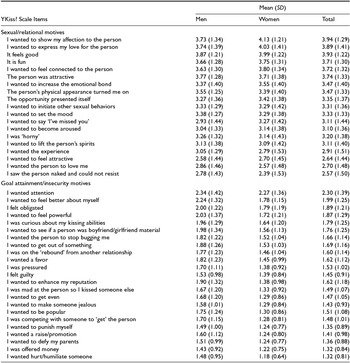
The YKiss? Scale, which was developed and validated in full by Thompson et al. (Reference Thompson, Kulibert and Anisimowicz2016), consists of 42 items organised into two subscales: the Sexual/Relational Motives subscale (e.g., ‘It feels good’, ‘I wanted to express my love’, ‘I wanted to initiate other sexual behaviours’) and the Goal Attainment/Insecurity Motives subscale (e.g., ‘I wanted attention,’ ‘I felt obligated’, ‘I wanted a raise/promotion’). For each item, participants were asked to ‘think back to the past month and indicate how frequently each of the following led them to kiss someone’ on a scale from 1, not at all, to 5, a great deal. All items were randomly presented to participants using Qualtrics®, an online survey software platform. Subscale scores were computed by taking the average of all items in each subscale. The internal consistency for each subscale in the current study was excellent (Sexual/Relational Motives Subscale, α = 0.94; Goal Attainment Motives Subscale, α = 0.95). All items included in the YKiss? Scale are presented in Table 1.
Means and Standard Deviations for Items on the YKiss? Scale

Note: N = 461 adults. Participants were instructed to ‘think back to the past month and indicate how frequently each of the following led them to kiss someone’ on a scale from 1, not at all, to 5, a great deal.
Sexual attitudes scale
Participants completed the Brief Sexual Attitudes Scale (BSAS; Hendrick, Hendrick, & Reich, Reference Hendrick, Hendrick and Reich2006), which was used to measure sexual attitudes by assessing instrumentality, sexual practices, communion/relationality, and conservatism/permissiveness. This scale contained 23 items to which participants indicated their level of agreement from 1, strongly disagree, to 5, strongly agree. Scale scores of the BSAS were computed by taking the average score of all items, with higher scores indicating more permissive attitudes toward sexuality. In the current study, the BSAS demonstrated adequate internal consistency, α = 0.86.
Personality assessment
The short-form of the International Personality Item Pool (IPIP-NEO; Goldberg et al., Reference Goldberg, Johnson, Eber, Hogan, Ashton, Cloninger and Gough2006) consisted of 120 items measuring the five-factor model of personality (i.e., Extraversion, Agreeableness, Conscientiousness, Neuroticism, Openness to Experience). Participants were instructed to indicate how accurately each statement described them from 1, very inaccurate, to 5, very accurate. Scale scores for the five factors were computed by averaging all items on each subscale. All factors demonstrated adequate internal consistency in the current study: Neuroticism α = 0.92; Extraversion α = 0.88; Openness α = 0.79; Agreeableness α = 0.89; Conscientiousness α = 0.91.
Procedure
Following institutional review board approval, participants were recruited through the use of advertising via Amazon's Mechanical Turk®. Participants who were interested in the study were instructed to follow a link to the survey hosted by Qualtrics®. The link directed participants to a consent form describing the nature of the study and eligibility for participation. After agreeing to the eligibility requirements and providing consent, participants were redirected to a second webpage where they completed the battery of online questionnaires. Upon completion of the online surveys, participants were directed to a separate webpage where they were debriefed, thanked for their participation, and asked for their Mechanical Turk® worker ID to receive compensation. The study took approximately 40 minutes to complete, with participants receiving $1.00 USD for their participation in the study via a deposit to their Mechanical Turk® account.
Results
Descriptive Statistics
All data were screened according to procedures outlined by Tabachnik and Fidell (Reference Tabachnick and Fidell2013). Because of the small amount of missing data, all missing values were replaced using mean substitution. On average, participants reported receiving their first romantic kiss at the age of 15.97 (SD = 3.53, range = 7–32 years of age). Participants also revealed romantically kissing an average of 20.36 people in their lifetime (SD = 41.88, range = 0–500 people). When asked to report on the nature of their relationship with those they had kissed, the participants indicated that an average of 45.05% of their past kissing partners were romantic partners at the time (SD = 38.40%, range 0–100%). On average, participants reported enjoying kissing ‘very much’ as evidenced by a mean of 3.93 (SD = 0.92) on a 5-point scale (ranging from 1, not at all, to 5, extremely).
Predicting Motives for Romantic Kissing
Participants reported an average score on the YKiss? Scale of 2.39 (SD = 0.68) out of a possible 5.00. Consistent with previous research (Thompson et al., Reference Thompson, Kulibert and Anisimowicz2016), participants reported kissing for relational/sexual motives more often (M = 3.27, SD = 0.88) than goal attainment/insecurity motives (M = 1.66, SD = 0.81). Means and standard deviations for each item on the YKiss? Scale can be found in Table 1.
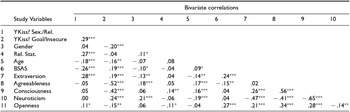
To predict variations in both categories of motives, hierarchical multiple regression analyses were computed to predict variations in motives for romantic kissing separately for the Relational/Sexual Motives subscale and the Goal Attainment/Insecurity Motives subscale. In each regression, the predictor variables included gender (men coded as 0 and women coded as 1), relationship status (those single coded as 0 and those in a relationship coded as 1), age, sexual attitudes, and the five factors of personality. Gender was included on the first step of both regressions because its relationship with kissing motives has already been established in the literature (Thompson et al., Reference Thompson, Kulibert and Anisimowicz2016). All of the novel predictor variables were entered on the second step of the regressions (i.e., relationship status, age, sexual attitudes, Extraversion, Agreeableness, Conscientiousness, Neuroticism, and Openness to Experience). Finally, on the third step of both regressions, the interaction effects between gender and all novel predictors were included. Correlations between the predictor variables and the two criterion variables are shown in Table 2.
Correlations Among Related Variables

Note: N = 461. YKiss? Sex./Rel = scores from the Sexual/Relational Motives subscale. YKiss? Goal/Insecure = scores from the Goal Attainment/Insecurity Motives subscale. Gender = men coded as 0, women coded as 1. Rel. Stat. = single coded as 0, in a romantic relationship coded as 1. Age = age reported in years. Extraversion = scores from the Extraversion subscale of the IPIP-NEO. Agreeableness = scores form the Agreeableness subscale of the IPIP-NEO. Conscientiousness = scores form the Conscientiousness subscale for the IPIP = NEO. Neuroticism = scores from the neuroticism subscale of the IPIP-NEO. Openness = scores form the Openness to Experience subscale of the IPIP-NEO.
***p < .001. **p < .01. *p < .001.
Predicting relational/sexual motives
Consistent with previous research, the first step of the first regression (using gender to predict relational/sexual motives for romantic kissing) did not account for a significant amount of the variance in relational/sexual kissing motives, R 2 = 0.00; F(1, 458) = 0.73, p = .40. However, the novel predictors on the second step of the regression did account for a significant amount of variance in relational/sexual motives, R 2 = 0.23; F(8, 450) = 16.45, p < .001. Examination of the semipartial correlations revealed that relationship status, sr2 = 0.17; β = 0.22; t(457) = 3.58, p < .001, age, sr2 = –0.12; β = –0.16; t(457) = –2.45, p = .02, sexual attitudes, sr2 = 0.17; β = 0.24; t(457) = 3.56, p < .001, and Extraversion, sr2 = 0.15; β = 0.26; t(457) = 3.15, p = .002, each accounted for a significant amount of the unique variance in relational/sexual motives. Finally, on the third step of the first regression, the gender interaction effects did not account for a significant additional proportion of the variance, R2 = 0.24; F(8, 442) = 1.14, p = .34. Taken together, the results of the first regression revealed that those currently in romantic relationships, those younger in age, with more permissive sexual attitudes, and higher levels of Extraversion were more likely to report kissing for relational/sexual reasons in comparison to those not in a romantic relationship, those younger in age, with less permissive sexual attitudes, and lower levels of Extraversion.
Predicting goal attainment/insecurity motives
For the second regression (predicting goal attainment/insecurity motives for romantic kissing), consistent with previous research, gender (on the first step) accounted for a significant amount of the variance in goal attainment motives, R 2 = 0.04; F(1, 458) = 17.80, p < .001. At the second step of the second regression, the novel predictors also accounted for a significant proportion of the variance associated with the goal attainment/insecurity motives, R 2 = 0.39; F(8, 450) = 32.41, p < .001. The semi-partial correlations revealed that gender, sr2 = –0.12; β = –0.11; t(457) = –2.56, p = .01, sexual attitudes, sr2 = 0.12; β = 0.10; t(457) = 2.45, p = .02, Extraversion, sr 2 = 0.26; β = 0.27; t(457) = 5.78, p < .001, Agreeableness, sr 2 = –0.28; β = –0.31; t(457) = –6.12, p < .001, and Conscientiousness, sr 2 = –0.21; β = –0.25; t(457) = –4.46, p < .001, uniquely accounted for a significant amount of the variance in goal attainment/insecurity motives. On the third step of the second regression, the gender interaction effects did not account of a significant additional proportion of the variance, R 2 = 0.41; F(8, 4442) = 1.64, p = .11. Men, those with more permissive sexual attitudes, higher levels of Extraversion, lower levels of Agreeableness, and lower levels of Conscientious were more likely to report kissing for goal attainment/insecurity reasons in comparison to women, those with less permissive sexual attitudes, lower levels of Extraversion, higher levels of Agreeableness, and higher levels of Conscientiousness.
Discussion
The primary objective of the present study was to examine potential variables influencing adults’ motives for romantic kissing. This objective was accomplished by identifying and emphasising the importance of several variables (e.g., gender, relationship status, age, sexual attitudes, and personality) in predicting motives for romantic kissing. Interestingly, the results also suggest that certain factors influence the categories of motives for romantic kissing more so than others, depending on the subscale. All of these variables are discussed below.
Gender
Consistent with previous research (Thompson et al., Reference Thompson, Kulibert and Anisimowicz2016), gender was found to predict differences in goal attainment/insecurity motives but not relational/sexual motives for romantic kissing. Men were significantly more likely to report goal attainment/insecurity motives for romantic kissing in comparison to women. However, this gender difference contradicts the commonly held notion that women use sexual and romantic behaviours as a ‘means to an end’ to a greater extent than do men. This gender difference can be explained by variations in the ways with which men and women are socialised to behave in emotional and sexual relationships (Dworkin & O'Sullivan, Reference Dworkin and O'Sullivan2005; Seal & Ehrhardt, Reference Seal and Ehrhardt2003; Wiederman, Reference Wiederman2005). In particular, research indicates that men report an eagerness to pursue sexual opportunities and are socialised to be the initiators of sexual/intimate relationships (Gagnon, Reference Gagnon1990; Wiederman, Reference Wiederman2005). On the other hand, women are socialised to be receptive and passive in intimate relationships (Simms & Byers, Reference Simms and Byers2013). In fact, people often hold negative attitudes toward women who diverge from the norm (i.e., those initiating sexual behaviours; Seal & Ehrhardt, Reference Seal and Ehrhardt2003). Thus, because men are socialised to adopt the role of sexual initiators, whereas initiation of sex by women is less socially accepted, it is possible that men simply initiate romantic kissing more often and for a broader range of motives than do women.
Relationship Status
Although relationship status did not predict goal attainment/insecurity motives, those in a committed relationship were more likely to report kissing for relational/sexual reasons than those not in a committed relationship. The importance of emotional intimacy, or feeling an emotional connection and closeness with another person (Yoo & Bartle-Haring, Reference Yoo and Bartle-Haring2014) in committed, long-term relationships (as compared to short-term and casual relationships) could explain why relationship status predicted sexual/relational motives but not goal attainment/insecurity motives (Armstrong & Reissing, Reference Armstrong and Reissing2015; Štulhofer, Ferreira, & Landripet, Reference Štulhofer, Ferreira and Landripet2014). In particular, because the Sexual/Relational Motives subscale includes items relating to emotional intimacy (e.g., ‘expression love’, ‘showing affection’, ‘increasing the emotional bond’), these motives are likely more important and used more frequently among those in committed, long-term relationships as compared to those in casual, short-term relationships.
Age
Although age did not relate to goal attainment/insecurity motives, it did predict relational/sexual motives, with those younger in age more likely to report relational/sexual motives for romantic kissing. This can be explained, in part, by differences in goals of courtship between older and younger adults. In particular, older adults are significantly less likely to cite sexual and/or romantic interests when searching for a partner as compared to younger adults (Alterovitz & Mendelsohn, Reference Alterovitz and Mendelsohn2013). Further, sexual desire is shown to decrease with age (DeLamater & Sill, Reference DeLamater and Sill2005). Thus, given that older adults are less likely to report sexual or romantic goals for courtship and also experience decreased sexual desire, this likely explains why those younger in age are more likely to report kissing for relational/sexual motives than those who are older in age.
Sexual Attitudes
Individuals with more permissive sexual attitudes were more likely to report kissing for sexual/relational motives and goal attainment/insecurity motives in comparison to those with more restrictive sexual attitudes. Previous research supports this finding, as individuals with more permissive sexual attitudes are also more likely to report goal attainment/insecurity and physical motives for sex (Meston & Buss, Reference Meston and Buss2007). The relationship between sexual attitudes and motives for romantic kissing can be explained by variations in participation in sexual activities associated with sexual attitudes (Owen, Rhoades, Stanley, & Fincham, Reference Owen, Rhoades, Stanley and Fincham2010; Townsend & Wasserman, Reference Townsend and Wasserman2011). In particular, individuals with more permissive sexual attitudes report being more comfortable participating in sexual behaviours, as evidenced by higher numbers of reported sexual partners and an increased likelihood of engaging in casual sex in comparison to those with more restrictive sexual attitudes (Owen et al., Reference Owen, Rhoades, Stanley and Fincham2010; Townsend & Wasserman, Reference Townsend and Wasserman2011). Thus, it is likely that individuals with more permissive sexual attitudes are more comfortable engaging in a variety of intimate/sexual behaviours (including romantic kissing) and therefore report a broader range of motives for romantic kissing than individuals with less permissive sexual attitudes.
Personality
Contrary to some of the research on sexual motives, the current study revealed that Agreeableness, Conscientiousness, and Extraversion were predictive of variations in motives for romantic kissing and that the relationships between these personality factors did not vary based on gender. Although the negative relationships between Agreeableness and Conscientiousness and goal attainment/insecurity motives are partially supported by prior research on sexual motives (Meston & Buss, Reference Meston and Buss2007), the positive relationship between Extraversion and both types of motives is an entirely novel finding. Eysenck (Reference Eysenck1972) was among the first to argue that broad personality traits could explain differences in sexual behaviours, and claimed that Extraversion predicts many sexual risk-taking behaviours, as well as increased openness to sexual behaviours. In fact, several more recent studies support Eysenck's theory and confirm that those higher in Extraversion often report more accepting attitudes toward sexuality and greater interest in risky or unconventional sexual behaviours than those lower in Extraversion (Barnes, Malmuth, & Check, Reference Barnes, Malamuth and Check1984; Huth-Bocks, Reference Huth-Bocks1996; Miller et al., Reference Miller, Lynam, Zimmerman, Logan, Leukefold and Clayton2003; Turchik, Garske, Probst, & Irvin, Reference Turchik, Garske, Probst and Irvin2010). Consequently, scoring high in Extraversion likely corresponds to greater interest in a variety of intimate behaviours, including romantic kissing. Furthermore, those with a greatest interest in romantic kissing would likely kiss for a broader range of motives, thus resulting in the positive relationship between Extraversion and motives for romantic kissing.
The Importance of Understanding Variables Influencing Motives for Romantic Kissing
Relational/sexual motives for romantic kissing were most frequently endorsed and reflect the most common motives for romantic kissing (e.g., pleasure and affection). Although endorsed less frequently, goal attainment/insecurity motives are no less important. Because these motives are somewhat maladaptive in nature, identifying variables that predict these motives is important for detecting those more likely to engage in other risky sexual behaviours. In addition, several of these motives may have negative social and psychological consequences for both the individual endorsing the motive as well as others that may be involved (e.g., ‘I wanted to get even’, ‘I wanted to make someone jealous’, ‘I wanted to hurt/humiliate someone’, ‘I wanted to punish myself’). Thus, by providing a better understanding of the variables that influence motives for kissing, the results of our study may lead to the prevention of risky sexual behaviours and negative consequences associated with these maladaptive motives. Additionally, the information gathered through this study can better inform sexual education programs and healthcare providers by highlighting the importance of understanding why we engage in romantic kissing and how demographics (i.e., gender, age, relationship status), sexual attitudes, and personality influence these motives.
Limitations and Future Directions
A number of limitations to the current study must be discussed. First, all of the measures used were self-report in design. Thus, because several motives for romantic kissing are socially sensitive in nature, demand characteristics and socially desirable responding may have influenced participants’ responses, particularly to goal attainment/insecurity motives. Consequently, future research should adopt more novel measurement tools for measuring kissing motives that reduce the risk of these response biases. In addition, the external validity of the study may be called into question due to the homogeneity of the sample (majority of participants identify as heterosexual, of Caucasian/European descent, and in a committed romantic relationship). Moving forward, research should make efforts to include a more diverse sample to improve the generalisability of the findings.
Conclusions
Although romantic kissing is one of the most common sexual behaviours, it has remained largely unexamined by scientific research. The current study sought to rectify this dearth of research by exploring, in detail, how motives for romantic kissing vary. In particular, our study revealed a wide range of variables (i.e., gender, relationship status, age, sexual attitudes, and personality) that predict variations in motives for romantic kissing. Thus, it is clear that romantic kissing is a complex behaviour, and further research is necessary to better understand the nuances of romantic kissing.