I. INTRODUCTION
Lightweight, light strength to weight ratio, and good corrosion resistance of aluminum alloys make these materials remarkable. Reference Angappan, Sampath, Ashok and Deepkumar1,Reference Nikseresht, Karimzadeh, Golozar and Heidarbeigy2 Many particles such as precipitations in the microstructure are able to affect the corrosion resistance and localized corrosion. Reference Szklarska-Smialowska3 Because of their age hardening treatment metastable precipitates such as Al–Ag and Al–Cu alloys have attracted the attention of many authors. Reference Changrong, Chunju, Zeting, Cuiping and Yongjuan4–Reference Erni, Heinrich and Kostorz8 Precipitations sequence in Al–Ag alloy is known as solid solution supersaturated (SSS) → Guinier–Preston (GP) Zones → metastable γ′ (Ag3Al) phase → equilibrium γ phase (Ag2Al). Reference Dubey, Schönfeld and Kostorz9,Reference Nicholson and Nutting10
The effect of various heat treatments on different aluminum alloys to investigate their corrosion behavior has been studied by many authors. Solution heat treatment of a 5083F Al alloy at different temperatures, Reference Kim and Jang11 corrosion properties of an Al–Zn–Mg–Cu alloy under various ageing conditions, Reference Nikseresht, Karimzadeh, Golozar and Heidarbeigy12 and some other papers have written about the heat treatment effect on corrosion properties of Al alloys. Reference Nikseresht, Karimzadeh, Golozar and Heidarbeigy2
Corrosion studies and investigations on Al–Ag alloys are limited. Investigations of surface and ageing treatment effects on corrosion behavior of Al–Ag alloys showed that ageing of Al–Ag alloys develops silver-rich intermetallic particles, which are preferred sites for oxygen generation, dissolution of silver species, and formation of damaged film material Reference Riveros, Gulppi, Päez, Zagal, Rangel, Huerta, Skeldon and Thompson13 and anodic oxidation of Al–Ag alloy. Reference Paez, Sandoval, Sepulveda, Monsalve, Skeldon, Thompson and Zhou14 Some investigations have been done in recent years. It is well known that Cl− ions not only destroys the passive film of Al alloys and leads to occurrence of pitting corrosion, but also promotes the growth of pitting corrosion due to the concentration of Cl− ions inside the pits. The propensity for pitting for a given metal-electrolyte system is characterized by its critical breakdown (pitting) potential which represent an electrochemical condition for the instability of the passive film. Extensive efforts have been made to study the effects of alloying elements, temperature, and solution chemistry on pitting potential (E pit) of Al and its alloys. Reference Amin15–Reference Amin, Abdei Rehim, El-Sherbini, Mahmoud and Abbas19
Despite a few studies focusing on the corrosion behavior and precipitations of Al–Ag alloy, no literature has been reported on the corrosion resistance, pitting potential, and complete corrosion behavior and the effect of ageing heat treatment on above parameters of Al–Ag alloy in 3.5% NaCl solution.
The objective of this study is to evaluate the effect of ageing treatment on corrosion behavior as well as to determine the cyclic polarization (CP) and electrochemical impedance spectroscopy (EIS) measured values of the Al–4.2 wt%Ag alloy in 3.5 wt% NaCl solution using cyclic potentiodynamic polarization (CPP) and EIS techniques. The scanning electron microscopy (SEM) images of solution-treated sample and precipitations of age-treated samples are studied.
II. EXPERIMENTAL PROCEDURE
An Al–4.2 wt%Ag Alloy was used in the present study. 3 mm thick sheet of alloy was solution-treated at 540 °C for 2 h in an air furnace, and then quenched in water immediately. The sheet was cut into three plates with dimensions of 3 mm × 10 mm × 10 mm, and then two of them were aged at 250 °C and 150 °C for 8 h.
The microstructures of all three samples (solution-treated at 540 °C, age-treated at 250 °C, and age-treated at 150 °C) were characterized by SEM and the crystalline phase structure was determined by Bruker D8 Advance x-ray diffraction (XRD; Bruker Corporation, Karlsruhe, Germany). Prior to the microstructure characterization, the samples were abrasived with 800, 1000, 1200, 1500, 2000, 2500, and 3000 grit SiC abrasive papers, polished with 1 µm Al2O3 paste until their surfaces became smooth and mirror like bright, followed by degreased with distilled water and acetone, and then dried with hot air. The hardness measurements were executed by micro-Vickers hardness tester. Vickers hardness of the aged samples was determined with a load of 0.98 N for 10 s of loading time. Hardness was measured at five different positions for each specimen and the mean hardness value was calculated from the values except for the maximum and minimum.
The corrosion tests were carried out with a three-electrode electrochemical cell setup in a 3.5% NaCl solution at room temperature. Solution of 3.5% NaCl in double distilled was prepared by dissolving the appropriate mass of NaCl. A platinum (Pt) sheet was used as counter electrode, a silver/silver chloride (Ag/AgCl) was served as reference electrode and samples of 1 cm2 of geometric exposed area were used as working electrodes.
The corrosion resistance properties of the samples were investigated via both potentiodynamic polarization experiments as well as EIS. The stable open circuit potential period before both potentiodynamic polarization and EIS experiments were determined at 45 min. Potentiodynamic polarization measurements were performed by a scanning rate of 5 mV/s in 3.5 wt% NaCl solution with potential range from −1.5 to −0.35 V. Then the CPP was recorded. Afterwards, the specimens were subjected to an EIS device. EIS was performed with potential amplitude of 10 mV (rms) over the frequency range of 100 KHz to 0.01 Hz. The corrosion products (passive layers) of the samples were investigated by XRD to evaluate the corrosion products on the samples after corrosion tests. Furthermore, a SEM was used to study the pits morphology. Each specimen was cleaned with acetone, alcohol, and then rinsed gently with deionized water, dried, and stored in a desiccator before examination.
III. RESULTS AND DISCUSSION
A. Microstructure and hardness
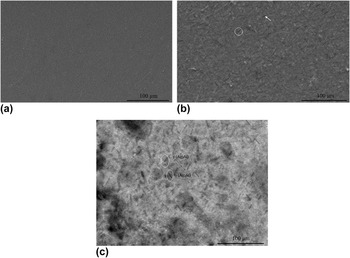
SEM of the Al–4.2 wt%Ag alloy for all samples (solution-treated at 540 °C, age-treated at 250 °C, and age-treated at 150 °C) are presented in Fig. 1. As expected, the solution heat-treated sample at 540 °C has no precipitates in its microstructure [Fig. 1(a)]. The Ag2Al precipitates are formed in the age heat-treated samples at 250 °C and 150 °C [Figs. 1(b) and 1(c), respectively]. The precipitations are indicated in Figs. 1(b) and 1(c). 250 °C age heat-treated sample has uniform and homogeneous precipitation distribution in the Al matrix [Fig. 1(b)]. In the 150 °C age heat-treated sample seems to have discontinuous and heterogeneous precipitation distribution. The presence of more Ag2Al plates in 250 °C sample compared to 150 °C sample is possibly because of higher ageing heat treatment temperature of 250 °C, which causes transformation of GP zones to Ag2Al equilibrium precipitates.
SEM images of Al–4.2 wt%Ag alloys after; (a) solution treatment at 540 °C, (b) age treatment at 250 °C, (c) age treatment at 150 °C.

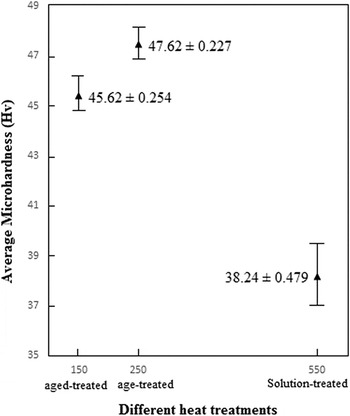
As seen in Fig. 2, the mean Vickers hardness values for solution-treated and aged samples are 38.24 ± 0.479 and 47.62 ± 0.227 Hv, respectively. 24.53% increase in the hardness of 250 °C aged sample in compared with solution-treated sample, indicates precipitation formation in Al matrix. Furthermore, another aged sample at 150 °C is also illustrated in Fig. 2. The mean Vickers hardness of this sample is about 45.62 ± 0.254 which is relatively close to another aged sample at 250 °C (47.62 ± 0.227). Both aged samples are at under ageing condition.
Vickers microhardness of Al–4.2 wt%Ag alloy samples after different heat treatments.

B. Phase analysis
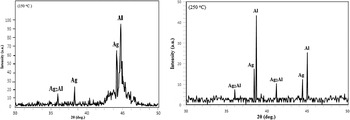
The phase analysis of age-treated specimens were detected by x-ray diffraction (XRD) to understand the precipitation phase by using Cu Kα (λ = 0.154, 056 nm). The 2θ range of the diffraction spectra was from 30 to 50 degree. The XRD pattern revealed that the age-treated specimens exhibited polycrystalline nature and the presence of Al, Ag, and Ag2Al. As seen in Fig. 3, there are two strong diffraction peaks at the scattering angles of 36.00°, 41.13°, for 250 °C specimen and can be assigned to the (100) planes of the Ag2Al crystal lattice and there is one diffraction peak to the (100) planes of the Ag2Al crystal lattice for the 150 °C age treated specimen.
X-ray diffraction pattern of the Al–4.2 wt%Ag age-treated samples.

C. Potentiodynamic polarization measurements
Understanding the corrosion behavior and evaluation of corrosion properties are usually performed by potentiodynamic polarization tests. Reference Liu, Lin, Yang and Qi20 In this section ageing heat treatment effect on corrosion characteristics was analyzed from CP curves.
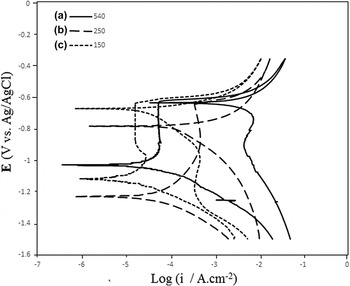
Figure 4 illustrates the CP curves of the Al–4.2 wt%Ag alloy processed at different heat treatments (solution-treated and age-treated). The corrosion current density and corrosion potential for all specimens were determined with Tafel extrapolation method. The anodic polarization curve is the most important feature related to the corrosion resistance behavior. Reference Badawy, Al-Kharafi and El-Azab21–Reference Yan, He and Xia28 Several authors Reference Trueba and Trasatti29–Reference Frignani, Zucchi, Trabanelli and Grassi34 proposed the necessity of determining potentials such as the pitting potential (E pit), protection potential (E prot), and corrosion potential (E corr) to evaluate the corrosion behavior.
CPP curves of the; (a) solution-treated, (b) age-treated samples at 250 °C, (c) age-treated samples at 150 °C.

Table I shows the values of the corrosion potential (E corr), current density (I corr), pitting potential (E pit), repassivation/protection potential (E prot), and polarization resistance (R p). From Table I it can be found that the solution-treated sample exhibits a nobler corrosion potential (−1.025 V) than age-treated samples at 250 and 150 °C (−1.233, −1.115 V respectively) under the tested conditions. It is also shown that the corrosion current densities for solution-treated sample and age-treated samples at 250 and 150 °C are 1.6634 × 10⁻⁵ , 1.9498 × 10⁻⁵, and 1.02329 × 10⁻⁵ A/cm2, respectively. Corrosion current density of age-treated sample at 250 °C is more than the solution–treated sample and the corrosion potential of it is less (more negative) than the solution-treated sample. Moreover, the Corrosion current density of age-treated sample at 150 °C has the least value which shows superior resistance to uniform and general corrosion. The corrosion current densities for solution-treated sample held constant at −0.947 V and for age-treated specimen at 250 and 150 °C are decreased to −0.838 and −0.868 V, respectively. Applied potential is increased until the applied potentials is reached −0.6219 for solution-treated and −0.6438 and −0.6355 V, for 250 and 150 °C, respectively. Then the passive film breakdown and corrosion current densities increased by further increase in the applied potentials. The polarization curves in Fig. 4, illustrates a wide passive range, followed by a sharp increase in the polarization current density signifying passivity breakdown at a critical pitting potential. Pitting potentials of solution-treated and aged samples at 250 and 150 °C are −0.6219, −0.6438 and −0.6355 V, respectively. The decrease in pitting potential, corrosion potential, and increase in corrosion current density of the aged-treated sample at 250 °C in comparison with solution-treated sample and generally decreasing the corrosion resistance of 250 °C specimen, are due to Ag2Al precipitations at Al matrix. Moreover, as seen in Table I, the pitting potential value of 150 °C age-treated specimen is more positive than 250 °C specimen and more negative than 540 °C specimen. This indicates that resistance to pitting corrosion of 150 °C specimen is better than 250 °C specimen and worse than 540 °C sample. Microgalvanic reactions can affect the corrosion resistance. Reference Akiyama, Zhang, Watanabe and Tsuzaki35 Ref. Reference Watkins, Liu, McMahon, Vilar and Ferreira36–Reference Trdan and Grum39 reported that intermetallic particles, second phase particles and precipitations in aluminum alloy, act as local cathodes or anodes with regard to Al matrix and affect the corrosion parameters. Presence of large amount of precipitates (Ag2Al) in the age-treated Al–4.2 wt%Ag alloys, created local galvanic cells and lead to the formation of localized anodic and cathodic sites, hence the corrosion resistance decreases in comparison with the solution-treated sample without any precipitates. In addition, the more resistance to pitting corrosion of 150 °C specimen in comparison with 250 °C sample is possibly because of more Ag2Al plates which are favorable sites for pits nucleation.
Corrosion parameters obtained from CP and EIS tests for Al–4.2 wt%Ag alloys; (a) solution treated, (b) age-treated at 250 °C, and (c) age-treated at 150 °C.

The existence of a hysteresis loop in a CPP curve indicates a delay in repassivation of an existing pit when the potential is scanned toward negative direction. The larger the hysteresis loop in reverse scan, the more susceptible the pitting for a material. Reference Szklarska-Smialowska40
In our study, the result of the CP test indicates expressive localized corrosion attack in an aggressive chloride solution. As seen in Fig. 4 the hysteresis loop in 250 °C age-treated sample is wider than two other specimens and 150 °C age-treated specimen has a little wider hysteresis loop than solution-treated sample. Determination of E prot is essential to establish the passive and pitting regions of the system and at potentials more negative than E prot. The sample is protected by a passive film and pitting will only take place at more positive potentials. Reference Galvele, Frankenthal and Kruger41 The protection potential (E prot) is the potential at which the reverse scan intersects the forward scan. The E prot of solution-treated, age-treated samples at 250 °C and 150 °C are −0.6303, −0.7579, and −0.6657V, respectively. A wider hysteresis loop and consequently a more negative E prot are obtained for age-treated samples. It indicates that the minimal hysteresis and nobler protection potential of solution-treated sample demonstrates are more corrosion resistance than the age-treated samples.
D. Electrochemical impedance spectroscopy (EIS)
The EIS technique is probably one of the most powerful nondestructive steady state methods in electrochemistry. Reference Galvele, Frankenthal and Kruger41–Reference Mansfeld44 EIS is often used for the characterization of electrochemical behavior between electrodes and electrolyte, because of its advantageous such as nondestructivity and sensitivity. Reference Nie, Wang, Qu, Gao, Wharton and Langdon45
An attempt has been made to evaluate the corrosion resistance of Al–4.2 wt%Ag solution-treated and age-treated alloys using EIS as a complementary tool to polarization resistance.
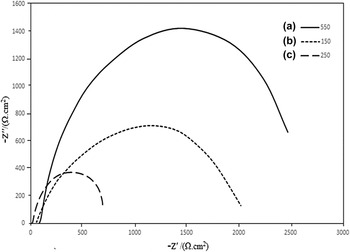
Figure 5 shows the Nyquist plot which presents the real component of impedance (Z real or Zʹ) versus the imaginary component (Z imaginary or Z″). The semicircle diameters in Nyquist plots show polarization resistance (R p) of samples. The overall polarization resistance (R p) values of both samples are listed in Table I. From Table I and Fig. 5 it is observed that the polarization resistance of solution-treated sample (2774.74 ± 1.2 Ω cm2) is more than age-treated samples at 250 °C and 150 °C (774.30 ± 1.88, 2254.74 ± 1.2 Ω cm2), respectively. It indicates that corrosion resistance of the age-treated samples is decreased due to the formation of localize galvanic cells, because of the presence of precipitation of Ag2Al.
EIS spectra presented as Nyquist plot; (a) solution-treated, (b) 250 °C age-treated (c) 150 °C age-treated, samples.

E. Pitting morphology
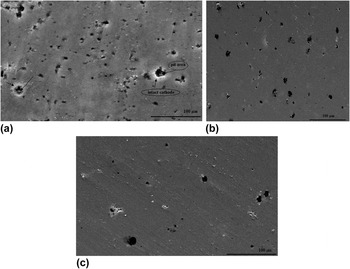
Pitting morphologies after corrosion tests were also studied and they are well agreed with the pitting potential and hysteresis loop and overall corrosion resistance. 250 °C specimen [Fig. 6(a)] includes the most corroded pits. It was observed that the pitting morphology of age-treated samples [Figs. 6(a) and 6(b)] are different from the solution-treated samples [Fig. 6(c)], whereas the number of pits is increased in aged samples. Apparently, the aged samples had more widespread pitting attack due to strong galvanic coupling between intermetallic particles and matrix, and corrosion attack can easily occur in the aged samples. As seen in Fig. 6(a), the pitting sites marked by the arrows, are probably the ageing precipitate (Ag2Al). In addition, existence of more pits in 250 °C sample in comparison with 150 °C samples is because of more Ag2Al plates which are favorable sites for pits nucleation which these results are well agreed with their hysteresis loop area and pitting potentials.
Pitting corrosion morphologies of Al–4.2 wt%Ag; (a) 250 °C age-treated (b) 150 °C age-treated, (c) solution-treated, samples after corrosion tests.

F. Corrosion products
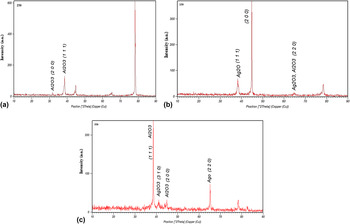
The phase analysis of corrosion products (passive layers) were detected by x-ray diffraction (XRD) to understand the passives phase by using Cu Kα (λ = 0.154, 056 nm). The 2θ angle range of the diffraction spectra was from 10 to 90 degree. The XRD pattern revealed that the passive layer of 250 °C age-treated specimen exhibits the Al2O3 diffraction peaks at scattering angel of 31.7897 degree and 38.5681 degree [Fig. 7(a)]. The 250 °C age-treated specimen shows Ag2O, Al2O3 and Ag2O3 diffraction peaks at scattering angel of 38.61 degree and 6.2207 degree, respectively [Fig. 7(b)]. Also the passive layer of solution-treated specimen exhibits the Al2O3, Ag2O3, and AgO diffraction peaks at scattering angel of 38.61 degree, 41.2148 degree, 44.9606 degree, and 65.2207 degree, respectively [Fig. 7(c)]. The aluminum and silver oxides are corrosion products that realized the major phase of aluminum oxide, because the Al is the main element of the alloy.
X-ray diffraction pattern of passive layer of the Al–4.2 wt%Ag (a) 250 °C age-treated (b) 150 °C age-treated, (c) solution-treated, samples.

IV. CONCLUSIONS
In this paper the corrosion resistance properties of solution-treated (at 540 °C) and age-treated (at 250 °C and 150 °C) Al–4.2 wt%Ag alloys in 3.5 wt% NaCl solution were investigated followed by potentiodynamic CP and EIS tests. The results indicated that the solution-treated alloy has superior corrosion resistance compared to the age-treated alloy. E corr, E pit, and E prot values for age-treated alloys were more negative than solution-treated sample. Also, hysteresis loop area increased after ageing heat treatment. The polarization resistance of the age-treated alloys decreased in comparison with solution-treated sample. Decreasing the corrosion resistance parameters of the aged alloys are due to the precipitation of Ag2Al phase (γ) in microstructure. As shown in SEM images, the presence of Ag2Al precipitates in aged-treated Al–4.2 wt%Ag alloys created local galvanic cells and led to the formation of localized anodic and cathodic sites. Hence the corrosion resistance decreased. The more ageing temperature for 250 °C specimen in comparison with 150 °C sample, made more favorable pits nucleation sites due to more Ag2Al plates and decreased the resistance to pitting corrosion.
ACKNOWLEDGMENT
We acknowledge the financial support provided by Semnan University.