




Non-technical Summary
On the Sinai Peninsula, a thick pile of terrestrial to shallow-marine sediments accumulated during the Jurassic period. The sea floor at that time was colonized chiefly by brachiopods and bivalves. Among the latter, trigoniids were a comparatively rare but diverse faunal element, represented by very small to small individuals. They belong to 14 species and nine genera. One of these species is new to science, but five genera with species occurring also elsewhere in Jurassic seas were recognized as new, all of them characterized by a very small to small size.
Introduction
Although trigoniid bivalves reached their greatest diversity during the Cretaceous period, they steadily increased in species richness during the Jurassic (Stanley, Reference Stanley1977; Kelly, Reference Kelly1995). Trigoniids became widely dispersed during the late Early Jurassic to early Middle Jurassic (Echevarría et al., Reference Echevarría, Damborenea and Manceñido2021), reaching the European Tethys (Francis, Reference Francis2000; Francis and Hallam, Reference Francis and Hallam2003) and the southeast Asian Tethys (Wandel, Reference Wandel1936; Hayami, Reference Hayami1972) by the Toarcian, the high latitudes of Antarctica by the Pliensbachian–Toarcian (Kelly, Reference Kelly1995), New Zealand by the Aalenian (Fleming, Reference Fleming1987), and eastern Africa by the Bajocian (Cox, Reference Cox1965).
The Jurassic succession of Gebel Maghara is the thickest and most complete Jurassic succession not only of northern Sinai but also of the African–Arabian Plate (1800 m thick; Al Far, Reference Al Far1966; Hirsch, Reference Hirsch1980; Keeley, Reference Keeley1994). Bivalves are the most abundant group in the Jurassic strata of Gebel Maghara, followed by gastropods, ammonites, brachiopods, corals, and echinoids. Ayoub-Hannaa et al. (Reference Ayoub-Hannaa, Fürsich and Abdelhady2023) pointed out that the bivalves and gastropods of Gebel Maghara have been neglected from a taxonomic point of view since the pioneering study of Douvillé in the early twentieth century (Douvillé, Reference Douvillé1916). Hirsch (Reference Hirsch1980), Abdelhamid (Reference Abdelhamid2002), and Khalil (Reference Khalil2003) illustrated some bivalve and gastropod taxa from the area, but without a comprehensive taxonomic study. Abdelhady (Reference Abdelhady2014) and Abdelhady and Fürsich (Reference Abdelhady and Fürsich2014, Reference Abdelhady and Fürsich2015a–Reference Abdelhady and Fürsichc) listed 232 benthic and nektonic macrofaunal taxa from Gebel Maghara but did not perform a taxonomic analysis. The faunas are dominated by bivalves (60 species) and gastropods (52 species) (Abdelhady, Reference Abdelhady2014, appendix B). Therefore, Ayoub-Hannaa et al. (Reference Ayoub-Hannaa, Abdelhady and Fürsich2017, Reference Ayoub-Hannaa, Fürsich and Abdelhady2023) began a detailed taxonomic revision of the bivalve fauna, dealing with protobranchs. The present study on the trigoniids is the second part of the comprehensive taxonomic study on the Jurassic bivalves of Gebel Maghara. In addition, the revision of the trigoniid fauna from the Jurassic of Egypt fills a gap in our knowledge of the Jurassic paleobiogeography of the group.
Geologic setting
The Levant region was strongly affected by Neo-Tethys rifting that resulted in the formation of intracratonic graben and horst systems, possibly starting as early as late Permian (e.g., Keeley, Reference Keeley1994). In northern Sinai, Jurassic strata crop out at Gebel Maghara, situated 50 km south of the Mediterranean shoreline, in an anticlinal structure that covers an area of about 400 km2, and represents the fill of a half-graben (Al Far, Reference Al Far1966; Keeley, Reference Keeley1994; Fig. 1.1–1.3). The oldest Jurassic rocks (Mashabba Formation) at Gebel Maghara are ?Pliensbachian to Toarcian in age and represent fluvial, marginal-marine, and shallow-marine environments (e.g., Ghandour and Fürsich, Reference Ghandour and Fürsich2022). Subsequently, shallow-marine and carbonate sediments deposited on a homoclinal ramp prevailed up to the Kimmeridgian, except during the global early Bathonian sea-level fall (Haq et al., Reference Haq, Hardenbol and Vail1987) during which deltaic sandstones and coals of the Safa Formation (Al Far, Reference Al Far1966; Abdelhady and Fürsich, Reference Abdelhady and Fürsich2015a) accumulated. The basin was closed by compressional forces due to convergence between Eurasia and Africa at the Jurassic-Cretaceous transition (Abd El-Motaal and Kusky, Reference Abd El-Motaal and Kusky2003).
(1) Locality map of Gebel Maghara. (2) Landsat image of the Gebel Maghara area showing positions of the three sections (numbered 1–3). (3) Geologic map (modified after Al Far, Reference Al Far1966; Hirsch, Reference Hirsch1980) with positions of the investigated sections. (4) Satellite image of the Middle–Upper Jurassic succession; width of photograph corresponds to 1600 m. (5) Field photograph of the Middle to Upper Jurassic formations, exposed in the eastern saddle of the anticline of Gebel Maghara; thickness of Kehailia Formation is 250 m. (6) Jurassic subdivision and equivalent formations from older to younger (after Abdelhady and Fürsich, Reference Abdelhady and Fürsich2015a) with stratigraphic ranges of the trigoniid taxa. New genera are Magharitrigonia, Cotswoldella, Cornbrashella, Parorthotrigonia, and Retetrigonia.

Bivalve specimens have been collected from four sections, from west to east: Gebel Homayir, Gebel Arousiah, western Bir Maghara, and Gebel Mowerib (Fig. 1.2, 1.3). The first three sections belong to the western flank of the anticline with the strata dipping 15–30°, while the Gebel Mowerib section is exposed on the eastern flank dipping at angles exceeding 60° in some parts. Al Far (Reference Al Far1966) subdivided the succession into seven formations, which were revised in detail by Abdelhady (Reference Abdelhady2014). These formations are, in stratigraphic order, the Mahl, Bir Maghara, Safa, Kehailia, Arousiah, Tauriat, and Masajid formations (Fig. 1.5, 1.6). For more details concerning the litho- and biostratigraphy, faunal content, and lateral facies changes see Abdelhady (Reference Abdelhady2014) and Abdelhady and Fürsich (Reference Abdelhady and Fürsich2015a–Reference Abdelhady and Fürsichc).
Material and methods
The studied trigonioid bivalve fauna consists of specimens collected by F.T. Fürsich in 1993 with complementary sampling by A.A. Abdelhady and F.T. Fürsich in 2012 from the Jurassic succession of Gebel Maghara, northern Sinai. Specimens were recovered from three sections: Gebel Homayir, Gebel Arousiah, and Gebel Mowerib. F.T. Fürsich collected additional specimens from the Toarcian Rajabiah and Shusha formations and the lower Kimmeridgian Masajid Formation of western Bir Maghara (section 4; Fig. 1.2). Abdelhady (Reference Abdelhady2014) and Abdelhady and Fürsich (Reference Abdelhady and Fürsich2015a–Reference Abdelhady and Fürsichc) studied the litho- and biostratigraphy of the four sections, made taphonomic observations, and collected macrofossils bed by bed. Primary identification of the collected fossils took place during 2012–2014 as a part of a Ph.D. project by A.A. Abdelhady (Reference Abdelhady and Fürsich2014). Faunal identification was greatly aided by the Jurassic bivalve catalogue at the GeoZentrum Nordbayern of Friedrich-Alexander-Universität, Erlangen. This catalogue contains photocopies of about 95% of all figured Jurassic bivalves worldwide. The trigonioid bivalves are mostly preserved with shell, are disarticulated, incomplete, and are small (H = 10 to ˂ 20 mm) to very small (H ˂ 10 mm) in size. Few specimens are preserved as composite molds. The hinge and other internal structures are usually covered with poorly indurated matrix, which was removed using diluted hydrogen peroxide (H2O2). Specimens were cleaned in the laboratory and prepared mechanically using steel needles under a binocular microscope. In addition, an air abrasive was used to clean the flank costae, area, and teeth. The specimens were photographed after having been coated with ammonium chloride to enhance details of ornamental features.
The systematic classification of the bivalves is that of Carter et al. (Reference Carter, Altaba, Anderson, Araujo and Biakov2011). The morphological terminology follows Carter et al. (Reference Carter, Harries, Malchus, Sartori and Anderson2012). As in Ayoub-Hannaa et al. (Reference Ayoub-Hannaa, Fürsich and Abdelhady2023), the synonymy lists contain only references, which have been carefully checked by the authors, beginning with the original description of the particular taxon, and followed by literature records from the Jurassic of Egypt. More comprehensive synonymies can be found in the references cited. For abbreviations in synonymy lists and open nomenclature to indicate the degree of confidence in allocation of each entry see Matthews (Reference Matthews1973) and Bengtson (Reference Bengtson1988). Using “cf.” for some specimens refers to a provisional identification due to poor preservation, whereas a question mark indicates uncertain identification at the species level.
Linear measurements (taken with a Vernier caliper, accurate to 0.1 mm) are in millimeters. Measured dimensions, general morphologic terminology, teeth, and orientation are given in Figure 2. Abbreviations for dimensions are: L = length, H = height, I = inflation of articulated valves, and D = distance between umbo and anterior margin with the posterodorsal margin horizontal.
(1–3) Descriptive terminology and orientation of trigoniid shell, (4, 5) hinge structure of left and right trigoniid valves. RV = right valve; LV = left valve; m.b. = myophoric buttress; c.s. = cardinal socket; am = anterior adductor muscle scar; pm = posterior adductor muscle scar; Pl = pallial line; ppr = posterior pedal retractor muscle scar; L = length; D = length between umbo and anterior end; H = height; I = inflation of articulated valves; 2, 4 = cardinal teeth of left valve; 3, 5 = cardinal teeth of right valve; a, b = anterior and cardinal teeth, respectively.

Repository and institutional abbreviation
All specimens are housed in the collections of the Bayerische Staatssammlung für Paläontologie und Geologie in Munich under the prefix BSPG 2014 V.
Systematic paleontology
Infraclass Heteroconchia Hertwig, Reference Hertwig1895
Cohort Uniomorphi J. Gray, Reference Gray1854
Megaorder Unionata J. Gray, Reference Gray1854
Order Trigoniida Dall, Reference Dall1889
Superfamily Trigonioidea Lamarck, Reference Lamarck1819
Family Trigoniidae Lamarck, Reference Lamarck1819
Subfamily Trigoniinae Lamarck, Reference Lamarck1819
Genus Magharitrigonia new genus
Type species
Magharitrigonia asymmetrica n. gen. n. sp., by original designation herein. Lower Toarcian Rajabiah Formation, western Bir Maghara, Sinai, Egypt.
Referred species
Magharitrigonia senex (Kobayashi and Mori, Reference Kobayashi and Mori1954) n. gen. n. comb. (Kobayashi and Mori, Reference Kobayashi and Mori1954, p. 167, pl. 16, fig. 8) from the Hettangian of Japan; Magharitrigonia brevicostata (Kitchin, Reference Kitchin1903) n. gen. n. comb. (Kitchin, Reference Kitchin1903, p. 23, pl. 2, figs. 4, 5) from the Middle Jurassic of Kachchh, western India; Magharitrigonia cristagalli (Bigot, Reference Bigot1893) n. gen. n. comb. (Bigot, Reference Bigot1893, p. 290, pl. 2, fig. 3) from the Bathonian of France.
Diagnosis
Very small to small, subtrigonal, moderately to strongly inflated with orthogyrate to slightly opisthogyrate beak, a wide and smooth antecarinal sulcus, coarsely nodate escutcheon and marginal carinae; escutcheon small, cordate, and smooth; right and left valves of some species differently ornamented on areas; LV with narrow and shallow area, bipartite, divided into two unequal halves by a distinctly crenulated median carina, the dorsal half with tuberculated radial costellae in later growth, its ventral half with reticulate ornament; RV with narrow, deep area, tripartite, divided into three unequal parts by well-developed tuberculated median and additional carinae, all parts covered with widely spaced sharp commarginal costellae; few and widely spaced commarginal flank costae (7–10), terminating in nodes close to the antecarinal sulcus, and separated by smooth and wide intercostal spaces (1.5–3.2 mm).
Occurrence
Upper Lower Jurassic (lower Toarcian) of Sinai, Egypt.
Etymology
Combination of the type locality Gebel Maghara (Sinai, Egypt) and the genus Trigonia.
Remarks
Magharitrigonia n. gen. is established largely on the basis of the different ornamentation of the areas of the two valves but, where only one valve is available, the genus can be easily distinguished from other Jurassic trigoniid genera by its small to very small size, low number of widely spaced commarginal costae terminating in nodes close to the antecarinal sulcus, orthogyrate to slightly opisthogyrate beak, smooth escutcheon and cordate escutcheon carina, and wide and smooth antecarinal sulcus. Trigonia Bruguière, Reference Bruguière1789 (type species: Venus sulcata Hermann, Reference Hermann1781, pl. 4, figs. 2–4, 9, 10) resembles Magharitrigonia n. gen. in having a trigonal outline and commarginal flank costae, but differs in being much larger (L = 75 mm), with reticulate ornament to the entire area that has a broader lower area with at least 12 radial costellae, and a higher number of commarginal flank costae that curve downwards posteriorly and do not terminate in nodes.
Magharitrigonia asymmetrica new species
Figures 3, 4.1, 4.2
Magharitrigonia asymmetrica n. gen. n. sp. from the lower Toarcian Rajabiah Formation, western Bir Maghara. (1–6) Holotype, articulated specimen BSPG 2014V 317/4; (1) left valve view showing smooth and wide intercostal sulcus, (2) dorsal view, (3) right valve view, (4) close-up showing bipartite area of left valve differing in ornamentation, (5) posterior view showing deep area of left valve, (6) close-up showing tripartite area of right valve with widely spaced commarginal costellae. (7, 8) Paratype, articulated specimen BSPG2014V 317/5, showing the differently ornamented area of left (7) and right (8) valve. (9, 10) Paratype, left valve, BSPG2014V 317/6; (9) exterior view with tuberculated escutcheon carina, (10) interior view showing hinge. (11) Paratype, left valve, BSPG2014V 317/7, with few and widely spaced commarginal costae of area. (12) Paratype, left valve, BSPG2014V 317/8, dorsal view. Scale bars = 2 mm.

(1, 2) Magharitrigonia asymmetrica n. gen. n. sp. from the lower Toarcian Rajabiah Formation, western Bir Maghara, paratype, articulated specimen, BSPG 2014V 317/9; (1) dorsal view showing an additional carina in the dorsal half of the area of right valve, (2) right lateral view. (3) Magharitrigonia n. gen. sp. indet. from the lower Kimmeridgian Masajid Formation, western Bir Maghara, right valve, BSPG 2014V 312/23, exterior view showing widely spaced commarginal costae terminating in nodes close to antecarinal sulcus. (4–7) Cotswoldella aff. C. hemisphaerica (Lycett, Reference Lycett1853) n. gen. n. comb., articulated specimen, BSPG 2014V 316/28, from the lower Kimmeridgian Masajid Formation, western Bir Maghara; (4) left lateral view, showing regular, equally spaced commarginal costae, (5) anterior view, (6) right lateral view showing the small area, (7) dorsal view showing faint radial costellae of area. (8) Cotswoldella hemisphaerica (Lycett, Reference Lycett1853) n. gen. n. comb. right valve, BGS GSM 113248, Inferior Oolite, Leckhampton, Gloucestershire, England (figured by Francis, Reference Francis2000, pl. 8, fig. j). (9–12) Cornbrashella pullus (J. de C. Sowerby, Reference Sowerby1826) n. gen. n. comb., from the middle−upper Bathonian Kehailia Formation of Gebel Maghara; (9–11) right valve, BSPG 2014V 325/1, Kehailia Formation, Gebel Mowerib, (9) right lateral view showing the smooth antecarinal sulcus, (10) posterior view showing the wide area with well-developed radial costellae, (11) dorsal view with ornamented escutcheon (arrowed); (12) right valve, BSPG2014V 305/7, Kehailia Formation, Gebel Homayir, posterior view showing ornamented area and escutcheon. (13) Cornbrashella pullus (J. de C. Sowerby, Reference Sowerby1826) n. gen. n. comb., right valve, OMU J21371, upper Bajocian, Hook Norton, Oxfordshire, England (figured by Francis, Reference Francis2000, pl. 4, fig. a). (14–17) Cornbrashella n. gen. sp. indet., right valve, BSPG 2014V 308/54 from the middle–upper Bathonian Kehailia Formation, Gebel Homayir; (14) interior view, (15) dorsal view showing an ornamented area with radial costellae, (16) lateral view showing very wide antecarinal sulcus, (17) close-up showing widely spaced, sharp, sub-straight costae crossed by faint radial riblets (indicated by white arrows), forming a reticulated pattern. Scale bars = 4 mm.

Type material
Holotype: BSPG 2014V 317/4, Lower Jurassic (Lower Toarcian), Rajabiah Formation, western Bir Maghara. Paratypes: eight specimens, BSPG 2014V 317/5–317/12, with shell preservation, mostly articulated, from the same formation and locality.
Diagnosis
Small to very small, outline trigonal; beak orthogyrate to slightly opisthogyrate; commarginal flank costae widely spaced, terminating in nodes close to antecarinal sulcus, and separated by smooth and wide intercostal spaces; escutcheon small, smooth; area of left valve bipartite with different ornamentation patterns; area of right valve tripartite with widely spaced commarginal costellae; antecarinal sulcus wide, smooth.
Description
Shell small to very small, outline trigonal, inequilateral, equivalved, slightly longer than high (Table 1), and moderately inflated. Maximum inflation slightly below umbo. Anterior margin slightly convex, meeting ventral margin in rounded angle. Posterior margin oblique, subtruncated, narrow, forming angle with ventral margin. Posterodorsal margin slightly concave, meeting posterior margin at obtuse angle. Ventral margin irregularly convex. Umbo triangular, inflated, located at about one-third of total valve length from anterior end. Beak orthogyrate to slightly opisthogyrate. Marginal carina distinct, sharp in early growth, thicker and tuberculated towards posteroventral corner (Fig. 3.1). Escutcheon carina slightly tuberculated in early growth, later with prominent oblique nodes. Escutcheon small, elongated-cordate in outline, smooth (Fig. 3.2). Antecarinal sulcus of left valve wide, smooth, broadening gradually towards posteroventral corner, with faint intercalatory radial riblet (Fig. 3.1). Area of left valve narrow, shallow, divided into two unequal parts by distinctly tuberculate median carina; dorsal half ornamented with commarginal costae in early growth followed by faint tuberculated radial costellae running parallel to posterodorsal margin; ventral half with reticulate ornament (Fig. 3.4, 3.5). Area of right valve wider and deeper than that of left valve, tripartite with well-developed tuberculated median carina and additional carina in dorsal half (Fig. 4.1, 4.2), covered with widely spaced commarginal costellae (Fig. 3.6). Flank inflated, triangular, occupying about two-thirds of shell surface, ornamented with 8–10 widely spaced commarginal costae (0.5–0.8 mm), asymmetrical in profile (steepest dorsally), terminating in node close to antecarinal sulcus and separated by very wide and smooth intercostal spaces (1.5–3.2 mm). Terminal nodes with distinct ventral extensions that are connected by thin radial riblet. Hinge of left valve wide, with large triangular cardinal tooth (2) separated from anterior and posterior teeth (4a, 4b) by anterior and posterior sockets, respectively (Fig. 3.10). Posterior tooth (4b) narrower than anterior one and running parallel to posterodorsal margin.
Measurements (in mm) of Magharitrigonia asymmetrica n. gen. n. sp. *Holotype; all other specimens are paratypes; see Figure 2 for measurement key.

Etymology
Asymmetricus (Latin) = asymmetric; after the differently ornamented areas of the right and left valves.
Measurements
See Table 1.
Remarks
Magharitrigonia asymmetrica n. gen. n. sp. is easily distinguished from other trigoniid species identified herein by its small to very small size (Table 1), a smooth and elongated-cordate escutcheon, a flank with few and widely spaced commarginal costae terminating in nodes close to antecarinal sulcus, a bipartite area to the left valve differing in ornamentation, and a tripartite area to the right valve with widely spaced commarginal costellae.
The most closely related species is Magharitrigonia senex (Kobayashi and Mori, Reference Kobayashi and Mori1954) n. gen. n. comb. (Kobayashi and Mori, Reference Kobayashi and Mori1954, p. 167, pl. 16, fig. 8) from the Hettangian of Japan in having widely spaced commarginal costae with small spines close to the antecarinal sulcus, and a bipartite area of the left valve with reticulate ornamentation but differs in being larger and in having strongly convex anterior and ventral margins, a narrower antecarinal sulcus and a rounder valve.
Like M. asymmetrica n. gen. n. sp., Magharitrigonia brevicostata (Kitchin, Reference Kitchin1903) n. gen. n. comb. (Kitchin, Reference Kitchin1903, p. 23, pl. 2, figs. 4, 5) from the Middle Jurassic of Kachchh, western India, has widely spaced commarginal costae, a tuberculated marginal carina, and a wide antecarinal sulcus, but differs in being larger (L = 23–28 mm, H = 20–23 mm as opposed to L = 6.5–15.2 mm, H =6.1–13.5 mm), less inflated, and in having a higher number of commarginal flank costae, which do not terminate in nodes close to the marginal carina. In addition, the ornamentation of the areas (right and left valves) of M. brevicostata n. gen. n. comb. are similar (reticulated).
Magharitrigonia cristagalli (Bigot, Reference Bigot1893) n. gen. n. comb. (Bigot, Reference Bigot1893, p. 290, pl. 2, fig. 3) from the Bathonian of France differs in being more elongated (higher than long) and in having a narrower antecarinal sulcus, and its commarginal costae are straight.
In Trigonia stelzneri Gottsche (Reference Gottsche1878, p. 24, pl. 6, fig. 1a–d) from the Bajocian and Callovian of Argentina (Weaver, Reference Weaver1931, p. 240, pl. 20, figs. 103, 104), the ornamentation of the area of the left valve resembles that of the present species. However, that species differs from M. asymmetrica n. gen. n. sp. in having a wider area, a narrow antecarinal sulcus, a blunt and tuberculated marginal carina, a higher number of commarginal flank costae, and in being larger (L = 58 mm, H = 52 mm; Weaver, Reference Weaver1931, p. 241, as opposed to L = 6.5–15.2 mm, H = 6.1–13.5 mm). Similarly, T. (Lyriodon) sumiyagura Kobayashi and Kaseno (Reference Kobayashi and Kaseno1947, p. 42, pl. 10, figs. 1a–2b) from the Lower Jurassic of Japan has a higher number of commarginal flank costae and is larger than the present species.
Trigonia (Trigonia) patchamensis Fürsich and Heinze (Reference Fürsich and Heinze1998, p. 155, pl. 2, figs. 6–10) from the Middle Jurassic strata of Kachchh, India, has an ornamented escutcheon, strongly rounded anterior and ventral margins, a smaller area that is divided into two parts by a median groove, and is less inflated.
With respect to shell outline and size, T. costata J. Sowerby (Reference Sowerby1815), which was described and figured by Pugaczewska (Reference Pugaczewska1976, p. 83, pl. 17, figs. 1–3, pl. 20, figs. 3, 4, pl. 21, figs. 2, 3) from the Middle Jurassic of Poland and by Francis (Reference Francis2000, p. 62, pl. 1, figs. a–f, pl. 2, figs. a–f, pl. 3, figs. a–e) from the Middle Jurassic of Europe, differs in having a strongly rounded posterior margin, a tripartite area in each valve, a very narrow antecarinal sulcus, and a greater number of commarginal flank costae.
Trigonia triangularis (Goldfuss, Reference Goldfuss1837), figured by the same authors (Pugaczewska, Reference Pugaczewska1976, p. 85, pl. 26, figs. 1–5, pl. 20, figs. 1–2, 6–7, pl. 21, figs. 1, 4, 10) from the Middle Jurassic of Poland, and by Francis (Reference Francis2000, p. 84, pl. 7, figs. e–h) from the Bajocian of Germany is similar to the present species with respect to shell outline. Like M. asymmetrica n. gen. n. sp., it also has a wide and smooth antecarinal sulcus, widely spaced commarginal flank costae, and a small cordate and smooth escutcheon, but differs in having a blunt and strongly tuberculated marginal carina, the areas of the two valves having the same ornamentation (reticulated pattern), and in being larger than the present species. In addition, the ventral margin of T. triangularis is concave below the antecarinal sulcus, and strongly convex anteroventrally.
Trigonia interlaevigata Quenstedt (Reference Quenstedt1857, p. 503, pl. 67, figs. 7–8) from the Middle Jurassic of Germany differs in having strongly convex anterior and ventral margins, a truncated anterodorsal margin, a wider antecarinal sulcus, and in being larger.
A higher number of commarginal flank costae and a wide area distinguish T. castor d'Orbigny, Reference d́Orbigny1850, figured by Thevenin (Reference Thevenin1913, p. 74, pl. 27, fig. 19) from the Bathonian of France from the present species.
Another related species is T. similis Agassiz (Reference Agassiz1840, p. 36, pl. 2, figs. 18–21, pl. 3, fig. 7) from the Lower Jurassic of France. However, that species is larger and has a higher number of commarginal flank costae.
Magharitrigonia n. gen. sp. indet.
Figure 4.3
Description
Shell very small, sub-triangular in outline, strongly inequilateral, slightly longer than high (Table 2). Posterodorsal margin slightly concave. Anterior margin strongly convex, meeting ventral margin in rounded angle. Umbo inflated and located one-third of total valve length from anterior end. Beak sharply pointed and orthogyrate. Marginal carina distinct, blunt, smooth. Escutcheon carina slightly tuberculated in early growth, later with strong nodes. Antecarinal sulcus smooth, widening gradually towards posteroventral corner. Area wide, deep, tripartite with well-developed median and additional carina, and covered by faint commarginal costellae. Flank inflated, triangular, ornamented with nine widely spaced commarginal costae terminating in nodes close to antecarinal sulcus (Fig. 4.3), and separated by very wide, smooth intercostal spaces.
Measurements (in mm) of Magharitrigonia n. gen. sp. indet. See Figure 2 for measurement key.

Materials
A single right valve, with shell preserved, from the lower marl beds of the lower Kimmeridgian Masajid Formation, western Bir Maghara (BSPG 2014V 312/23).
Measurements
See Table 2.
Remarks
The present material is somewhat similar to Magharitrigonia asymmetrica n. gen. n. sp. from the Lower Jurassic of Gebel Maghara in having a small triangular shell, tripartite area with faint commarginal costellae, widely spaced commarginal flank costae, terminating in nodes close to antecarinal sulcus, and on tuberculated escutcheon carina, but differs in having a blunt, smooth marginal carina and in being more elongated (H/L = 0.78). Moreover, Magharitrigonia n. gen. sp. indet. is stratigraphically distinctly younger (lower Kimmeridgian) than M. asymmetrica n. gen. n. sp., which is from the lower Toarcian.
Genus Cotswoldella new genus
Type species
Trigonia hemisphaerica Lycett, Reference Lycett1853 (p. 231, pl. 11, fig. 2); by original designation herein. Inferior Oolite (Bajocian) of England.
Other species
Cotswoldella culleni (Lycett, Reference Lycett1877) n. gen. n. comb. (Lycett, Reference Lycett1877, p. 173, pl. 31, fig. 9), C. elegantissima n. gen. n. comb. (Meek, Reference Meek1873, p. 474; Imlay, Reference Imlay1964, p. C29, pl. 3, figs. 1–7), C. kidugalloensis (Cox, Reference Cox1965) n. gen. n. comb. (Cox Reference Cox1965, p. 75, pl. 2, fig. 3a–c), C. densestriata (Behrendsen, Reference Behrendsen1892) n. gen. n. comb. (Behrendsen, Reference Behrendsen1892, p. 12, pl. 1, fig. 8), C. gadoisi (Cossmann, Reference Cossmann1911) n. gen. n. comb., (Cossmann, Reference Cossmann1911, p. 8, pl. 1, figs. 6–8), C. langrunensis (Bigot, Reference Bigot1893) n. gen. n. comb. (Bigot, Reference Bigot1893, p. 287, pl. 1, figs. 10–12, pl. 2, fig. 10), C. parva (Kitchin, Reference Kitchin1903) n. gen. n. comb. (Kitchin, Reference Kitchin1903, p. 37, pl. 3, figs. 7, 8), C. ranvilliana (Bigot, Reference Bigot1893) n. gen. n. comb. (Bigot, Reference Bigot1893, p. 290, pl. 9, fig. 8), C. hemisphaerica, race asiatica (Douvillé, Reference Douvillé1916) n. gen. n. comb. (Douvillé, Reference Douvillé1916, p. 29, pl. 4, fig. 9), and C. asiatica (Douvillé, Reference Douvillé1916) n. gen. n. comb. of Hirsch (Reference Hirsch1980, pl. 4, figs. 13, 14) from the upper Bajocian of Gebel Maghara.
Diagnosis
Small, moderately inflated, trigonal-ovate to subquadratic, with opisthogyrate beak, low inconspicuous umbo, slightly depressed escutcheon, fine escutcheon carina, and sharp marginal carina; area with feeble to obsolete median carina, with or without longitudinal furrow; ventral part of area with reticulate ornament, dorsal part with radial costellae predominant; antecarinal sulcus narrow; commarginal flank costae numerous (50 or more in large specimens), fine, as narrow as or narrower than interspaces, coarsening ventrally. Upper Sinemurian-lower Kimmeridgian.
Etymology
From the Cotswolds, the rolling hills of central-southwest England, mainly in Gloustershire and Oxfordshire, from where the type species was collected.
Remarks
In the past, species of Cotswoldella n. gen. have been assigned to the genus Trigonia but differ from it in being smaller, possessing an ovate shape and an almost straight posterodorsal margin, lacking a sinus at the posteroventral margin, having fewer (5–9) radial costellae in the ventral part of the area as opposed to 14 in the type species of Trigonia, which are reticulate only in the lower part, and in having a narrower antecarinal sulcus and denser, more numerous flank costellae that barely curve downwards posteriorly, if at all. Except for the areal ornament, which is rarely described in the older literature, these are the characters of the referred species.
Cotswoldella aff. C. hemisphaerica (Lycett, Reference Lycett1853) n. gen. n. comb.
Figure 4.4–4.8
- aff. *Reference Lycett1853
Trigonia hemisphaerica Lycett, p. 231, pl. 11, fig. 2.
- aff. Reference Lycett1877
Trigonia hemisphaerica; Lycett, p. 174, pl. 31, figs. 4–8.
- aff. Reference Lycett1877
Trigonia hemisphaerica var. gregaria Lycett, p. 174, pl. 33, figs. 4–6.
- aff. Reference Lycett1877
Trigonia Culleni Lycett, p. 173, pl. 31, fig. 9.
- aff. Reference Riche1904
Trigonia hemisphaerica; Riche, p. 154, pl. 5, fig. 3a–c.
- aff. Reference Douvillé1916
Trigonia hemisphaerica, race Asiatica Douvillé, p. 29, pl. 4, fig. 9.
- aff. Reference Fabiani and Ruiz1932
Trigonia hemisphaerica; Fabiani and Ruiz, p. 29, pl. 2, figs. 11, 12a–c.
- aff. Reference Poulton1979
Trigonia sp. A aff. T. hemisphaerica; Poulton, p. 15, pl. 1, figs. 1, 2.
- aff. Reference Poulton1979
Trigonia sp. B aff. T. hemisphaerica; Poulton, p. 15, pl. 1, fig. 3.
- aff. Reference Hirsch1980
Trigonia asiatica; Hirsch, pl. 4, figs. 13, 14.
- aff. Reference Parnes1981
Trigonia hemisphaerica; Parnes, p. 35, pl. 4, figs. 36–39.
- aff. Reference Parnes1981
Trigonia hemisphaerica lunulata Parnes, p. 35, pl. 4, figs. 34, 35.
- aff. Reference Francis2000
Trigonia hemisphaerica; Francis, p. 81, pl. 8, figs. i, j (with additional synonyms).
- aff. Reference Khalil2003
Trigonia costulata; Khalil, p. 308, pl. 1, figs. 3–5.
Occurrence
Bajocian of England (Lycett, Reference Lycett1877; Francis, Reference Francis2000), Negev, Israel (Parnes, Reference Parnes1981), upper Sinemurian–Bajocian of California (Poulton, Reference Poulton1979), Bajocian of France (Riche, Reference Riche1904), Middle Jurassic of south Italy (Fabiani and Ruiz, Reference Fabiani and Ruiz1932), and Bajocian–lower Kimmeridgian of Egypt (Douvillé, Reference Douvillé1916; Khalil, Reference Khalil2003; present study).
Description
Shell small, rounded-subquadratic, as long as high, inequilateral, equivalved, moderately inflated (Table 3). Maximum inflation one-third of total shell height from the umbo, gradually fading towards posterior margin. Subvertical anterior margin high, slightly convex, meeting ventral margin in rounded corner. Ventral margin convex, anterodorsal margin slightly convex. Umbo small, moderately inflated, located one-third of total valve length from anterior end. Beak small, sharp, and slightly opisthogyrate. Marginal carina indistinct, slightly concave dorsally. Area slightly concave, divided by submedian groove into two unequal parts, ventral part narrower than dorsal, and ornamented with ~5 faint radial costellae that dominate the dorsal half (Fig. 4.7). Antecarinal sulcus of left valve very narrow, smooth. Escutcheon carina moderately developed. Escutcheon excavated, small, slightly concave, cordate, smooth. Flank moderately inflated, ornamented with regular, equally spaced commarginal costae, narrower than interspaces, coarsening ventrally and fading anteriorly (Fig. 4.4, 4.6).
Measurements (in mm) of Cotswoldella aff. C. hemisphaerica (Lycett, Reference Lycett1853) n. gen. n. comb. See Figure 2 for measurement key.

Material
A single specimen, with shell preserved, from the lower part of the Masajid Formation (lower Kimmeridgian), western Bir Maghara (BSPG 2014V 316/28).
Measurements
See Table 3.
Remarks
Cotswoldella aff. C. hemisphaerica n. gen. n. comb. can be easily separated from Jurassic Trigonia by its regular commarginal flank costae (Fig. 4.4, 4.6), very small escutcheon, faint marginal carina, and small area. The shape of the shell and the ornamentation of the flank of the present specimen resemble C. hemisphaerica (Lycett, Reference Lycett1853) n. gen. n. comb. figured by Lycett (Reference Lycett1877) and Francis (Reference Francis2000) from the Middle Jurassic of England, but differs in having a narrower area with far fewer radial costellae that are not reticulated in the ventral part, a finer marginal carina, and flank costae that are narrower than the interspaces. For this reason, the specimen is referred to Lycett's species with qualification. Hirsch (Reference Hirsch1980) used the “race Asiatica” of Douvillé, Reference Douvillé1916, as a separate species, Trigonia asiatica, on the basis of numerous commarginal flank costae, strong radial costellae of the area, a well-defined marginal carina, and its small size.
Cotswoldella ranvilliana (Bigot, Reference Bigot1893) n. gen. n. comb. (Bigot, Reference Bigot1893, p. 290, pl. 9, fig. 8) from the Bathonian of France resembles Cotswoldella aff. C. hemisphaerica n. gen. n. comb. in having a narrow area, strongly convex anterior and ventral margins, and relatively widely spaced flank costae, but differs in having a well-developed marginal carina and in being larger and more elongated (higher than long).
Cotswoldella langrunensis (Bigot, Reference Bigot1893) n. gen. n. comb. (Bigot, Reference Bigot1893, p. 287, pl. 1, figs. 10–12, pl. 2, fig. 10) from the upper Bathonian of France resembles Cotswoldella aff. C. hemisphaerica n. gen. n. comb. in having a small area and a fine marginal carina, but differs in being larger, more elongated and in having more numerous fine commarginal flank costae.
Cotswoldella parva (Kitchin, Reference Kitchin1903) n. gen. n. comb. (Kitchin, Reference Kitchin1903, p. 37, pl. 3, figs. 7, 8) from the Jurassic of Kachchh, India, resembles Cotswoldella aff. C. hemisphaerica n. gen. n. comb. in having regular commarginal costae, and a small, smooth escutcheon, but differs in having an extended posterior area, a concave posterodorsal margin, and in being smaller (L = 11.0–15.0 mm as opposed to L = ?26.5 mm) and much more elongated. Similarly, C. culleni (Lycett, Reference Lycett1877) n. gen. n. comb. (Lycett, Reference Lycett1877, p. 173, pl. 31, figs. 9, 9a) from the Jurassic of England is posteriorly produced with a deeply concave posterodorsal margin.
Cotswoldella kidugalloensis (Cox, Reference Cox1965) n. gen. n. comb. (Cox, Reference Cox1965, p. 75, pl. 2, fig. 3a–c) from the Bathonian of Kenya differs by its smaller size (L ~17 mm), greater inflation, and in having only 6–7 nodose threads on the area, whereas in adult C. hemisphaerica n. gen. n. comb. there are 13–14.
Cotswoldella gadoisi (Cossmann, Reference Cossmann1911) n. gen. n. comb. (Cossmann, Reference Cossmann1911, p. 8, pl. 1, figs. 6–8) from the Bajocian of France has very fine flank costae.
With respect to general outline and ribbing pattern, C. elegantissima (Meek, Reference Meek1873) n. gen. n. comb. (Meek, Reference Meek1873, p. 474; Imlay Reference Imlay1964, p. C29, pl. 3, figs. 1–7) from the lower Callovian of Utah, USA, resembles Cotswoldella aff. C. hemisphaerica n. gen. n. comb., but differs in being smaller (L = 21 mm, H = 14 mm; Imlay, Reference Imlay1964, p. C29, as opposed to L = ?26.5 mm, H = 26.5 mm) and more elongated (H/L = 0.67).
Cotswoldella densestriata (Behrendsen, Reference Behrendsen1892) n. gen. n. comb. (Behrendsen, Reference Behrendsen1892, p. 12, pl. 1, fig. 8; Leanza, Reference Leanza1993, p. 21, pl. 3, figs. 7–9) from the lower Bajocian of Argentina has a poorly defined marginal carina, flat dorsal surface, and numerous fine flank costae.
Genus Cornbrashella new genus
Type species
Trigonia pullus J. de. C. Sowerby, Reference Sowerby1826, p. 10, pl. 508, figs. 2, 3; by original designation herein. Cornbrash Formation (Bajocian–Bathonian) of England.
Other species
Cornbrashella distincta (Kitchin, Reference Kitchin1903) n. gen. n. comb. (Kitchin, Reference Kitchin1903, p. 25, pl. 2, figs. 6, 7).
Diagnosis
Small, moderately inflated, trigonally ovate to ovate, with small pointed umbo, opisthogyrate beak, wide, slightly depressed cordate escutcheon with finely crenulated transverse costellae, prominent tuberculate escutcheon and marginal carinae; median carina of left valve evanescing posteriorly, lacking on right valve; area dominated by crenulated radial costellae, lower area with three, upper area with four in the type; antecarinal sulcus narrow; up to 20 commarginal flank costae, narrower than interspaces, not curving downwards posteriorly. Bajocian–Callovian.
Etymology
From the Cornbrash Formation, in which the type species is common.
Remarks
Cornbrashella n. gen. is easily distinguished from Trigonia by its small size, trigonally ovate outline, transverse costellae to the escutcheon, and non-reticulate area with few radial costellae. The genus Neuquenitrigonia Leanza and Garate Zubillaga (Reference Leanza and Garate Zubillaga1987, p. 209) is very similar, but the type species Trigonia huenickeni Leanza and Garate, Reference Leanza and Garate1985 (p. 290, fig. 3; pl. 1, figs. 1, 2) from the Bajocian of Argentina differs in being much larger, more inflated, and in having an acute apical angle, well-separated almost straight flank costae, and a larger escutcheon.
Cornbrashella pullus (J. de C. Sowerby, Reference Sowerby1826) n. gen. n. comb.
Figure 4.9–4.13
- *Reference Sowerby1826
Trigonia Pullus J. de. C. Sowerby, p. 10, pl. 508, figs. 2, 3.
- .Reference Lycett1877
Trigonia pullus; Lycett, p. 164, pl. 34, figs. 7–9.
- .Reference Douvillé1886
Trigonia pullus; Douvillé, p. 226, pl. 12, figs. 13, 14.
- .Reference Greppin1888
Trigonia pullus; Greppin, p. 107, pl. 7, fig. 1.
- .Reference Bigot1893
Trigonia pullus; Bigot, p. 283, pl. 2, figs. 4, 5.
- .Reference Newton1895
Trigonia pullus; Newton, p. 82, pl. 3. figs. 6, 7.
- .Reference Dainelli1903
Trigonia pullus; Dainelli, p. 298, pl. 11, figs. 4, 7.
- .Reference Riche1904
Trigonia pullus; Riche, p. 153, pl. 5, fig. 2.
- .Reference Douvillé1916
Trigonia pullus; Douvillé, p. 53, pl. 5, fig. 42.
- .Reference Fischer1969
Trigonia pullus; Fischer, p. 97, pl. 11, figs. 1, 2.
- .Reference Hirsch1980
Trigonia sp. aff. T. pullus; Hirsch, p. 136, pl. 4, fig. 26.
- .Reference Francis2000
Trigonia pulla; Francis, p. 91, pl. 3, figs. f–h, pl. 4, figs. a, b (with exhaustive synonymy list).
- .Reference Néraudeau, Vullo and Mazan2013
Trigonia pullus; Néraudeau et al., pl. 25, fig. c.
Lectotype
BMNH 43133, designated by Cox and Arkell (Reference Cox and Arkell1948, p. 22) from Anc1iff, Wiltshire; figured by J. de. C. Sowerby, Reference Sowerby1826, p. 10, pl. 508, figs. 2, 3.
Occurrence
Bajocian–Bathonian of England (J. de C. Sowerby, Reference Sowerby1829; Lycett, Reference Lycett1877; Francis, Reference Francis2000), Bajocian–lower Kimmeridgian of France (Bigot, Reference Bigot1893; Riche, Reference Riche1904; Fischer, Reference Fischer1969; Néraudeau et al., Reference Néraudeau, Vullo and Mazan2013), Bathonian of Switzerland (Greppin, Reference Greppin1888), Italy (Dainelli, Reference Dainelli1903), Ethiopia (Douvillé, Reference Douvillé1886), Middle Jurassic of Madagascar (Newton, Reference Newton1895), and Bathonian–Callovian of Egypt (Douvillé, Reference Douvillé1916; Hirsch, Reference Hirsch1980; present study).
Description
Shell very small to small, triangular, inequilateral, slightly higher than long (Table 4), moderately inflated. Anterior and ventral margins convex, meeting in rounded curve. Posterodorsal margin slightly concave, meeting posterior margin at obtuse angle. Posterior margin relatively short. Umbo poorly inflated, triangular, located one-third of total valve length from anterior end. Beak sharply pointed, slightly opisthogyrate. Marginal carina well developed. Antecarinal sulcus smooth, narrow dorsally, widening towards posteroventral corner. Area wide, covered with radial, beaded costellae and crossed by fine commarginal growth lines (Fig. 4.9, 4.10). Escutcheon wide, depressed, cordate in outline, and ornamented by transverse costellae (Fig. 4.11, 4.12), bordered by well-developed clavate escutcheon carina. Hinge of right valve with two grooved teeth, running parallel to antero- and posterodorsal margins. Anterior adductor muscle scar subrounded, small, located close to anterodorsal margin. Flank moderately inflated, occupying about two-thirds of shell surface and ornamented with commarginal costae, separated by wide and smooth intercostal spaces (Fig. 4.9, 4.13).
Measurements (in mm) of Cornbrashella pullus (J. de C. Sowerby, Reference Sowerby1826) n. gen. n. comb. See Figure 2 for measurement key.

Materials
Four specimens, fragmented, from the middle-upper Bathonian Kehailia Formation of Gebel Maghara; one from Gebel Mowerib (BSPG 2014V 325/1) and three from Gebel Homayir (BSPG 2014V 305/7–305/9).
Measurements
See Table 4.
Remarks
With respect to general outline and ornamentation of the area and flank, the Egyptian material corresponds very well to Cornbrashella pullus (J. de C. Sowerby, Reference Sowerby1826) n. gen. n. comb. from the Bajocian–Bathonian of southern England. That species can be easily distinguished by its very small shell size and by having a wide area with well-developed radial costellae, a deep, ornamented escutcheon with transverse costellae, a small, smooth antecarinal sulcus, sharp opisthogyrate beaks, and strongly rounded anterior and ventral margins.
Trigonia costata Parkinson, Reference Parkinson1811, of Francis (Reference Francis2000, p. 62, pl. 1, figs. a–f; pl. 2, figs. a–f; pl. 3, figs. a–e) from the Middle Jurassic of England and Germany is somewhat similar to Cornbrashella pullus n. gen. n. comb. Although T. costata is a highly variable species, it differs from the present species in having a subtrigonal valve, an acute umbonal angle, a wide antecarinal sulcus, more numerous flank costae, a raised escutcheon (inset and depressed in C. pullus n. gen. n. comb.), and in being larger.
Cornbrashella distincta (Kitchin, Reference Kitchin1903) n. gen. n. comb. (Kitchin, Reference Kitchin1903, p. 25, pl. 2, figs. 6, 7) from the Middle Jurassic of Kachchh, India, resembles the present species in having an ornamented escutcheon but differs in having an ovate valve, rounded margins, and its radial costellae of the area are fewer and less developed than in C. pullus n. gen. n. comb.
Francis (Reference Francis2000, p. 91) regarded T. langrunensis Bigot, Reference Bigot1893 (p. 287, pl. 2, fig. 10) from the upper Bathonian of France as a synonym of C. pullus n. gen. n. comb. Despite the similarity between the two species, T. langrunensis differs in being larger, more elongated (longer than high) and in having numerous fine flank costae. For more details and comparison with other closely related Jurassic taxa, see Francis (Reference Francis2000, p. 95–98).
Cornbrashella n. gen. sp. indet.
Figure 4.14–4.17
Description
Shell small (L > 16.5 mm), subtriangular, inequilateral, and poorly inflated. Anterodorsal margin slightly convex. Ventral margin missing. Umbo inflated, triangular, located anterior of mid-length of valve. Beak small, sharp, strongly opisthogyrate. Antecarinal sulcus smooth, deep, strongly widening towards posteroventral corner (Fig. 4.16). Area narrow, divided into two unequal parts by median carina and ornamented with radial costellae (Fig. 4.15). Escutcheon carina distinct, elevated. Escutcheon small with transverse riblets. Hinge of right valve large with two striated cardinal teeth (3a, 3b), separated by a wide triangular socket (Fig. 4.14). Anterior muscle scar small, subrounded, located close to anterodorsal margin. Flank weakly convex and ornamented with widely spaced, sharp, sub-straight costae topped with small tubercles (Fig. 4.16). Costae separated by wide intercostal spaces and crossed by faint radial riblets forming a reticulated pattern (Fig. 4.17).
Materials
Two incomplete specimens, with shell preservation, from the middle–upper Bathonian Kehailia Formation, Gebel Homayir (BSPG2014V 308/54, 308/55).
Remarks
The incomplete right valve closely corresponds to similar specimens figured by Cox (Reference Cox1952a, p. 111, pl. 12, figs. 5–9) as Trigonia kheraensis Cox, Reference Cox1952a, from the Middle Jurassic (Bathonian) of India. That species resembles the present material in having a very wide antecarinal sulcus and widely spaced and sub-straight commarginal flank costae, but differs in having a smooth area. The specimens figured by Mongin (Reference Mongin1967, pl. 2, figs. 16–19) as T. kheraensis from the Bathonian of Morocco have an ornamented area and escutcheon and resemble the Egyptian material more closely than the Indian species.
The general outline and ornamentation of the area is close to T. interlaevigata Quenstedt, Reference Quenstedt1857 (p. 503, pl. 67, figs. 7, 8) from the Middle Jurassic of Germany. That species is, however, larger and has a higher number of commarginal flank costae.
Genus Trigonia Bruguière, Reference Bruguière1789
Type species
Venus sulcata Hermann, Reference Hermann1781, by subsequent designation (ICZN, 1955).
Diagnosis
Medium-sized to moderately large, thick-shelled, robust, trigonal to trigonally elongated, strongly inequilateral, moderately inflated, with prominent subterminal umbones, acute umbonal angle and strongly incurved opisthogyrate beaks; anterior margin weakly convex, posteroventral margin with shallow sinus, obliquely truncated respiratory margin, concave posterodorsal margin; escutcheon shallowly sunken with growth rugae and striae; escutcheon carina corded; broad bipartite area with corded median carina and numerous fine radial costellae intersected by strong striae to create a reticulate pattern; prominent marginal carina curved, corded; LV with narrow ante-carinal sulcus, RV with narrow post-carinal groove; flanks with strong, rounded commarginal costellae narrower than interspaces, curving downwards posteriorly.
Trigonia reticulata Agassiz, Reference Agassiz1840
Figure 5.1–5.6
- *Reference Agassiz1840
Trigonia reticulata Agassiz, p. 39, pl. 11, fig. 10.
- .Reference Agassiz1840
Trigonia papillata Agassiz, p. 39, 40, pl. 5, figs. 10–14.
- .Reference Agassiz1840
Trigonia monilifera Agassiz, p. 40, pl. 3, figs. 4–6.
- .Reference Agassiz1840
Trigonia parvula Agassiz, p. 41, pl. 11, fig. 8.
- .Reference Agassiz1840
Trigonia meriani Agassiz, p. 41, pl. 11, fig. 9.
- .Reference Arkell1930
Trigonia reticulata; Arkell, p. 81, pl. 6, figs. 1–4 (with additional synonymies).
- .Reference Francis2000
Trigonia reticulata; Francis, p. 116, pl. 6, figs. a–g, pl. 7, figs. a, b (with additional synonymies).
- .Reference Delvene2001
Trigonia (Trigonia) cf. T. reticulata; Delvene, p. 80, pl. 6, fig. 1.
- .Reference Schneider, Fürsich and Werner2011
Trigonia reticulata; Schneider et al., p. 263, pl. 1, figs. F–L.
- v.Reference Abdelhady and Fürsich2015a
Trigonia costata; Abdelhady and Fürsich, p. 41.
- v.Reference Abdelhady and Fürsich2015c
Trigonia costata; Abdelhady and Fürsich, p. 267.
(1–6) Trigonia reticulata Agassiz, Reference Agassiz1840, from the middle Bathonian–lower Kimmeridgian of Gebel Maghara. (1–3) Articulated specimen, BSPG 2014V 260/1, Kehailia Formation, Gebel Mowerib, (1) left lateral view, (2) dorsal view showing depressed, elongated-cordate escutcheon and tuberculated escutcheon carina, (3) right lateral view with regular, sharp, commarginal costae; (4–6) articulated specimen, BSPG 2014V 432/1, Masajid Formation, western Bir Maghara, (4) left lateral view, (5) dorsal view, (6) close-up showing fine, tuberculated, radial costellae crossed by commarginal costellae, forming a reticulate pattern (arrowed). (7, 8) Trigonia cf. T. castor d'Orbigny, Reference d́Orbigny1849, right valve, BSPG 2014V 323/4, from the Lower Kimmeridgian Masajid Formation, western Bir Maghara, (7) right lateral view showing large area (45% of total valve surface) and strongly elevated escutcheon carina, marked by asterisk (8) dorsal view with strongly opisthogyrate beak; position of escutcheon carina marked by asterisk. (9) Myophorella sp. indet. from the Lower Jurassic (lower Toarcian) Rajabiah Formation, western Bir Maghara, left valve, BSPG 2014V 317/13, left lateral view showing well-developed spinose radial flank costae. (10–23) Parorthotrigonia lepidomorpha (Abdallah and Fahmy, Reference Abdallah and Fahmy1969) n. gen. n. comb. from the lower Toarcian Rajabiah Formation (marl unit), western Bir Maghara. (10–12) Articulated specimen, BSPG 2014V 317/14, (10) left lateral view, (11) dorsal view, (12) right lateral view, sub-rounded form; (13, 14) left valve, BSPG 2014V 317/15, (13) lateral view showing smooth radial costae, deep and smooth intercostal spaces, and smooth area, (14) dorsal view showing smooth area with distinct median groove; (15–17) left valve, BSPG 2014V 317/16, (15) lateral view, subtriangular form, (16) interior view showing teeth, muscle scars, and entire pallial line, (17) dorsal view showing sharp orthogyrate beak; (18, 19) incomplete right valve, BSPG 2014V 317/17, (18) lateral view, elongated form with smooth, broadly rounded radial costae, (19) dorsal view with distinct median groove of area; (20) right valve, BSPG 2014V 317/18, lateral view, rounded form; (21) right valve, BSPG 2014V 317/19, interior view with two large cardinal teeth (3a, 3b); (22, 23) left valve, BSPG 2014V 317/20, (22) dorsal view showing large cardinal tooth 2, (23) interior view. Scale bars = 4 mm.

Holotype
Trigonia reticulata Agassiz, Reference Agassiz1840, p. 39, pl. 11, fig. 10, from Oxfordian-Kimmeridgian strata near Châtelot, W of Montbéliard, Département Doubs, E France; according to Francis (Reference Francis2000, p. 118), housed in the Agassiz Collection, Neuchâtel Museum, Switzerland.
Occurrence
Upper Oxfordian–lower Kimmeridgian of France (Agassiz, Reference Agassiz1840), Spain (Delvene, Reference Delvene2001), central Portugal, and England (Schneider et al., Reference Schneider, Fürsich and Werner2011), and middle Bathonian–lower Kimmeridgian of Egypt (first record).
Description
Shell small, subtriangular, inequilateral, slightly longer than high (H/L = 0.87), equivalved, strongly inflated (I/L = 0.62; Table 5). Area of maximum inflation around mid-height of valve. Anterior margin strongly convex, meeting ventral margin in continuous rounded curve. Posterior margin oblique, subtruncated; ventral margin regularly convex. Posteroventral corner angulated. Posterodorsal margin slightly concave, sloping, forming obtuse angle with posterior margin. Umbo weakly inflated, triangular, located one-fourth of total valve length from anterior end. Beak sharply pointed, strongly opisthogyrate. Marginal carina prominent, rounded, and crenulated. Area wide, subdivided into two equal parts by well-developed median carina, and ornamented with fine, tuberculated radial costellae, crossed by commarginal costellae, creating reticulate pattern (Fig. 5.6). Escutcheon carina low, distinct, crenulated. Escutcheon depressed, elongated-cordate in outline, ornamented with faint tuberculated commarginal riblets. Flank strongly inflated and ornamented with prominent, regular, sharp commarginal costae, separated by wide, smooth intercostal spaces (much wider than costae; Fig. 5.3).
Measurements (in mm) of Trigonia reticulata Agassiz, Reference Agassiz1840. See Figure 2 for measurement key.

Materials
Two specimens with shell preserved from the middle Bathonian–lower Kimmeridgian of Gebel Maghara; one specimen from the middle–upper Bathonian Kehailia Formation, Gebel Mowerib (BSPG 2014V 260/1) and the second one from the upper part of the Masajid Formation, western Bir Maghara (BSPG 2014V 432/1).
Measurements
See Table 5.
Remarks
With respect to shell outline and ornamentation of the area and flank, the present material is very similar to Trigonia monilifera Agassiz, Reference Agassiz1840 (p. 40, pl. 3, figs. 4–6) from the Upper Jurassic of France. Some authors such as Arkell (Reference Arkell1930, p. 81–82) and Schneider et al. (Reference Schneider, Fürsich and Werner2011, p. 263) regarded that species, together with T. papillata Agassiz, T. parvula Agassiz, and T. meriani Agassiz, as junior synonyms of T. reticulata Agassiz. This view is followed here. Schneider et al. (Reference Schneider, Fürsich and Werner2011, p. 264) noted that T. reticulata is a highly variable species, in which the H/L ratio of the shells varies from 0.85 to 0.97, and thus shells are generally slightly longer than high. Although the present specimens are poorly preserved, they exhibit characteristic features of T. reticulata Agassiz, such as the strongly rounded anterior and ventral margins and reticulate area, except that they are smaller.
The most closely related species is T. costata Parkinson, Reference Parkinson1811 (p. 175, pl. 12, fig. 7) figured from the Middle Jurassic of Germany (Quenstedt Reference Quenstedt1856, p. 335, pl. 45, fig. 15, Reference Quenstedt1857, p. 440, pl. 60, figs. 10–12), the Aalenian–Bathonian of France (Schneider Reference Schneider1927, p. 71, pl. 5, fig. 3) and from the Bajocian of England (Cox et al., Reference Cox, Cox, Castell and Muir-Wood1962, p. 74, pl. 15, fig. 8). Trigonia costata strongly resembles the present species in having the same ornamentation of the flank and area, but differs in having an elevated escutcheon (depressed in T. reticulata). In addition, its anterior and anteroventral margins meet at an obtuse angle (rounded curve in T. reticulata). According to Schneider et al. (Reference Schneider, Fürsich and Werner2011, p. 264), the two species are also stratigraphically separated, T. costata ranging from the Toarcian to the earliest Callovian, whereas T. reticulata is recorded from lower Oxfordian to upper Kimmeridgian.
Trigonia infracostata Lycett, Reference Lycett1881 (p. 3, text-figs. 3, 4) differs from T. reticulata in being more elongated and the radial costellae of its area are spinose.
Trigonia elongata J. de C. Sowerby, Reference Sowerby1823, of Bigot (Reference Bigot1893, p. 291, pl. 10, fig. 7) from the Callovian–Oxfordian of France has a reticulated area as in T. reticulata but differs in being much more elongated.
Trigonia cf. T. castor d'Orbigny, Reference d́Orbigny1849
Figure 5.7, 5.8
- cf.*Reference d́Orbigny1849
Trigonia castor d'Orbigny, no. 321.
- cf.Reference Bigot1893
Trigonia castor; Bigot, p. 285, pl. 9, figs. 6–7, pl. 11, fig. 7.
- cf.Reference Thevenin1913
Trigonia castor; Thevenin, p. 146 (74), pl. 27, fig. 19.
Holotype
Trigonia castor d'Orbigny, Reference d́Orbigny1849, no. 321 from Bathonian strata of northern France, figured in the “Types du Prodrome” by Thevenin, Reference Thevenin1913 (p. 146 [74], pl. 27, fig. 19; No. 321, Coll-no. 2798).
Occurrence
Bathonian of France (d'Orbigny, Reference d́Orbigny1849; Bigot, Reference Bigot1893; Thevenin, Reference Thevenin1913) and probably from the lower Kimmeridgian of Egypt (present study, first record).
Description
Shell small (L > 22.0 mm), thick-shelled, subtriangular, inequilateral, moderately inflated. Maximum inflation slightly below umbo. Anterodorsal margin short, slightly convex. Posterodorsal margin long, straight. Ventral margin missing. Umbo narrow, inflated, located anteriorly. Beak small, sharply pointed, strongly opisthogyrate (Fig. 5.8). Marginal carina rounded, strongly tuberculated. Antecarinal sulcus distinct, narrow dorsally, and very widened posteriorly. Escutcheon carina very prominent, strongly elevated (Fig. 5.7). Escutcheon well defined, smooth, deeply excavated. Area well defined, occupying ~45% of total valve surface, bordered by marginal and escutcheon carinae, and ornamented by tuberculated, fine radial costellae running subparallel to marginal carina. Flank moderately inflated and ornamented with strong, tuberculated commarginal costae, separated by wide, deep, smooth intercostal spaces (Fig. 5.7).
Materials
An incomplete specimen, with shell preservation, from the lower Kimmeridgian Masajid Formation, western Bir Maghara (BSPG 2014V 323/4).
Remarks
Trigonia castor d'Orbigny, Reference d́Orbigny1849, can be easily distinguished from other Jurassic Trigonia species by its thick shell, large area, regular flank costae, and thick tuberculated marginal carina. The present specimen is incomplete and is, therefore, placed with reservation in T. castor, a species with similar shell outline and ornamentation of the area and flank.
The most closely related species are T. carinata aliexpandita Leanza and Garate Zubillaga, Reference Leanza and Garate Zubillaga1987 (pl. 5, figs. 1–3; pl. 6, fig. 1; Leanza, Reference Leanza1993, p. 24, pl. 10, figs. 3, 4) and T. stelzneri Gottsche, Reference Gottsche1878 (p. 24, pl. 6, fig. 1a–d; Weaver, Reference Weaver1931, p. 240, pl. 20, figs. 103, 104) from the Lower–Middle Jurassic of Argentina. These species have a strongly protruding escutcheon, but differ in being much larger than the present material (e.g., L = 78.0 mm [Leanza, Reference Leanza1993, p. 24] as opposed to L > 22.0 mm [present study]) and their flank costae appear to be non-tuberculated.
Trigonia wiedmanni Leanza and Garate Zubillaga, Reference Leanza and Garate Zubillaga1987 (p. 209, pl. 6, figs. 3–5; Leanza, Reference Leanza1993, p. 24, pl. 17, figs. 7–10) from the Lower Jurassic of Argentina has fewer flank costae and wider intercostal spaces.
Trigonia similis Agassiz, Reference Agassiz1840 (p. 36, pl. 2, figs. 18–21, pl. 3, fig. 7, 7′) from the Lower Jurassic of France and T. patchamensis Fürsich and Heinze, Reference Fürsich and Heinze1998 (p. 155, pl. 2, figs. 6–10) from the Middle Jurassic of Kachchh, India, have a smaller area than T. castor.
Another similar species is T. bella Lycett, Reference Lycett1877 (p. 162, pl. 32, figs. 6, 7, 8, 8a) from the Bajocian of England. That species resembles T. castor in having a large, ornamented area, a blunt, tuberculated marginal carina, and a protruding escutcheon, but differs in having a narrow antecarinal sulcus, less-tuberculated flank costae, and in being larger.
Trigonia americana Meek, Reference Meek1873 (p. 472; Imlay, Reference Imlay1964, p. C28, pl. 3, figs. 8–13) from the Bajocian–Callovian of Utah, USA, resembles T. castor in having a wide ornamented area, but differs in lacking an antecarinal sulcus and in having an area with regular, smooth, radial costellae.
Superfamily Myophorelloidea T. Kobayashi, Reference Kobayashi1954
Epifamily Myophorelloidae T. Kobayashi, Reference Kobayashi1954
Family Myophorellidae T. Kobayashi, Reference Kobayashi1954
Subfamily Myophorellinae T. Kobayashi, Reference Kobayashi1954
Tribe Myophorellini T. Kobayashi, Reference Kobayashi and Mori1954
Genus Myophorella Bayle, Reference Bayle1878
Type species
Myophorella nodulosa Bayle, Reference Bayle1878, by subsequent designation (Crickmay, Reference Crickmay1932), Oxfordian of France.
Description
Shell small, subtrigonal, distinct inequilateral, moderately inflated, length nearly equaling height (H/L = ?0.96; Table 6). Maximum inflation slightly below umbo. Anterodorsal margin slightly convex, higher than posterodorsal one. Anterior margin regularly curved, strongly convex. Ventral margin incomplete. Posterodorsal margin slightly concave, oblique. Umbo triangular, convex, located one-third of total valve length from anterior end. Beak sharply pointed, slightly opisthogyrate. Marginal carina inconspicuous, becoming tuberculated close to posteroventral corner. Escutcheon carina tuberculated, separating ornamented area from moderately wide, steeply inclined, slightly concave, smooth escutcheon. Area wide, slightly concave, and ornamented with fine, transversely and radially aligned spines. Flanks covered with well-developed spinose oblique costae (14), straight, oblique from marginal carina to mid-flank, strongly curved anteriorly, and separated by wide and smooth intercostal spaces (Fig. 5.9).
Measurements (in mm) of Myophorella sp. indet. See Figure 2 for measurement key.

Materials
A single incomplete left valve, with shell preserved, from the Lower Jurassic (lower Toarcian) Rajabiah Formation, western Bir Maghara (BSPG 2014V 317/13), Gebel Maghara.
Measurements
See Table 6.
Remarks
The poor preservation of the incomplete left valve precludes identification at the species level, and the specimen is, therefore, kept in open nomenclature. With respect to ornamentation of the flank, Myophorella sp. indet. resembles Myophorella (Promyophorella) spinulosa (Yong and Bird, Reference Young and Bird1828) figured by Francis (Reference Francis2000, p. 134. pl. 10, figs. a–g) from the Middle Jurassic (Bajocian) of England, but the latter differs in having a trapezoidal shell (rounded in the present specimen) and in being larger (L = 40 mm as opposed to 11.5 mm) and more elongated.
Genus Parorthotrigonia new genus
(= Awadia Abdallah and Fahmy, Reference Abdallah and Fahmy1969)
Type species
Trigonia (Awadia) lepidomorpha Abdallah and Fahmy, Reference Abdallah and Fahmy1969 (p. 149, figs. 1, 2), from the Middle Jurassic (Bathonian) of Khashm El Galala, Eastern Desert, Egypt.
Other species
Trigonia sp. of Shuwen (Reference Shuwen1999, pl. 1, fig. 9) and Trigonia (s.l.) sp. of Yin and Grant-Mackie (Reference Yin and Grant-Mackie2005, p. 567, fig. 6.16) from the Middle–Upper Jurassic rocks of Tibet, China.
Diagnosis
Triangularly ovate trigoniid, higher than long, inequilateral, equivalved with sharply pointed orthogyrate beak, an area with distinct median groove, a generally sharp, but occasionally blunt escutcheon carina, an elevated smooth escutcheon, smooth area except for growth lines, 9–13 smooth, rounded sub-radial flank costae meeting the marginal carinae in acute angles, separated by deep and smooth intercostal spaces widening ventrally, and with 3–5 V-shaped early growth costae.
Occurrence
Middle Jurassic (Bathonian) of Khashm El Galala, Eastern Desert, Egypt (Abdallah and Fahmy, Reference Abdallah and Fahmy1969), Lower Jurassic (Toarcian) of the Sinai Peninsula, Egypt (Hirsch, Reference Hirsch1980; present study), and Middle–Upper Jurassic of Tibet, China (Shuwen, Reference Shuwen1999; Yin and Grant-Mackie, Reference Yin and Grant-Mackie2005).
Etymology
Combination of Para (Greek) = next to, and the genus Orthotrigonia Cox, Reference Cox1952b.
Remarks
Abdallah and Fahmy (Reference Abdallah and Fahmy1969, p. 149, pl. 1, figs. 1, 2) erected the subgenus Awadia (erroneously labeled as Galalea on their plate 1) to describe Trigonia (Awadia) lepidomorpha from the Middle Jurassic (Bathonian) of Khashm El Galala, Eastern Desert, Egypt, on the basis of rounded sub-radial flank costae, smooth intercostal spaces, and a terminal beak. Abbass (Reference Abbass1962), however, had used the same name to describe his new species Nemocardium (Awadia) magharensis (Abbass, Reference Abbass1962, p. 128, pl. 21, figs. 7, 10, 12) from the Lower Cretaceous (lower Aptian) of Gebel Maghara. Cox et al. (Reference Cox, Newell, Branson, Casey, Chavan, Moore and Teichert1969, p. N589) regarded Nemocardium (Awadia) of Abbass (Reference Abbass1962) as a junior synonym of the genus Nemocardium Meek, Reference Meek1876. According to the International Commission on Zoological Nomenclature (e.g., Richter Reference Richter1948, Article 34; ICZN 1999, Article 59.2), the subgenus of Abdallah and Fahmy (Reference Abdallah and Fahmy1969) is a junior homonym and, therefore, an unavailable name. For this reason, Parorthotrigonia n. gen. is erected to describe T. (A.) lepidomorpha from the Middle Jurassic of the Eastern Desert (Abdallah and Fahmy, Reference Abdallah and Fahmy1969) and Lower Jurassic of Sinai (Hirsch, Reference Hirsch1980; Abdelhady, Reference Abdelhady2014; Abdelhady and Fürsich, Reference Abdelhady and Fürsich2015c). Orthotrigonia Cox, Reference Cox1952b (type species: Trigonia duplicata J. de C. Sowerby, Reference Sowerby1819) resembles Parorthotrigonia n. gen. in general outline, smooth area, and V-shaped costae in early growth, but differs in being larger, more elongated, and its flank costae are sharper, and occasionally bifurcate ventrally. The early commarginal costae and the V-shaped costae that extend across the mid and late growth stages easily distinguish Vaugonia Crickmay, Reference Crickmay1930, from Parorthotrigonia n. gen.
Parorthotrigonia lepidomorpha (Abdallah and Fahmy, Reference Abdallah and Fahmy1969) n. gen. n. comb.
Figures 5.10–5.23, 6.1–6.4, 7
- *Reference Abdallah and Fahmy1969
Trigonia (Awadia) lepidomorpha Abdallah and Fahmy, p. 149, figs. 1, 2.
- .Reference Hirsch1980
Awadia lepidomorpha; Hirsch, p. 136, pl. 4, figs. 15–19.
- v.Reference Abdelhady2014
Awadia lepidomorpha; Abdelhady, p. 68, table 5.1.
- v.Reference Abdelhady and Fürsich2015c
Awadia lepidomorpha; Abdelhady and Fürsich, p. 265.
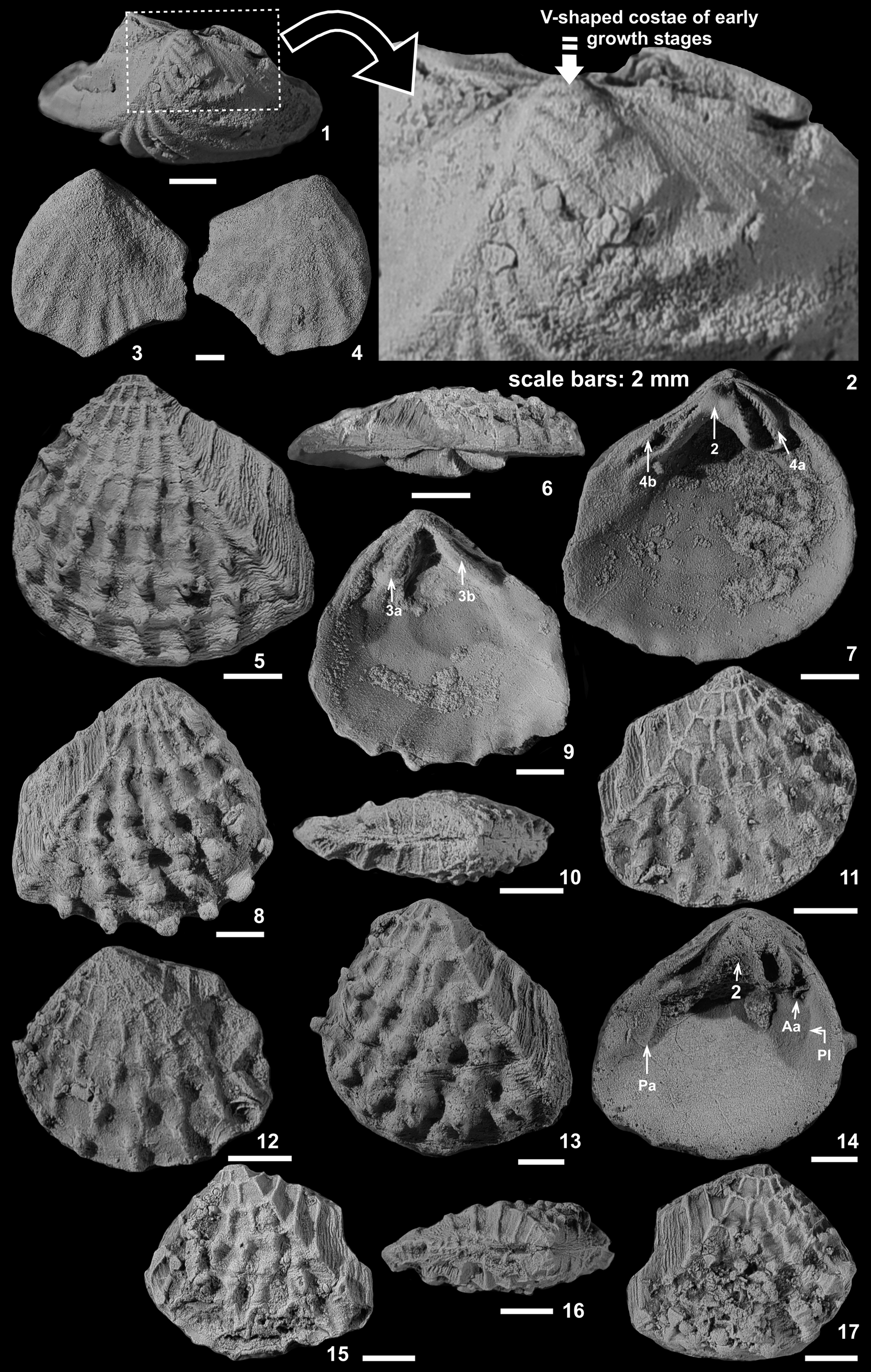
(1–4) Parorthotrigonia lepidomorpha (Abdallah and Fahmy, Reference Abdallah and Fahmy1969) n. gen. n. comb. from the lower Toarcian Rajabiah Formation (marl unit), western Bir Maghara. (1, 2) Right valve, BSPG2014V 317/21, (1) dorsal view, (2) close-up showing V-shaped early growth costae; (3, 4) incomplete composite mold of articulated specimen, BSPG2014V 317/22, (3) left lateral view, (4) right lateral view. (5–17) Variation in outline of Retetrigonia imbricata (J. de C. Sowerby, Reference Sowerby1826) n. gen. n. comb. from the middle–upper Bathonian and lower Kimmeridgian of Gebel Maghara. (5–7) Left valve, BSPG2014V 305/10, middle–upper Bathonian Kehailia Formation, Gebel Homayir, (5) lateral view showing flank with radial costae crossed by commarginal costae forming a reticulate pattern with large spines at their intersections, (6) dorsal view with very narrow, smooth escutcheon, (7) interior view showing teeth (2, 4a. 4b); (8, 9) right valve, BSPG2014V 305/11, (8) lateral view showing reticulate ornamentation with large spines, (9) interior view with two cardinal teeth (3a, 3b); (10–12) articulated specimen, BSPG2014V 316/29, lower Kimmeridgian Masajid Formation, western Bir Maghara, (10) dorsal view showing the absence of median and escutcheon carinae, (11) right lateral view showing widely spaced commarginal area costellae with numerous fine growth lines in between, (12) left lateral view; (13, 14) left valve, BSPG2014V 305/12, Kehailia Formation, Gebel Homayir, (13) lateral view, subrounded form, (14) interior view showing teeth, muscle scars, and pallial line (arrowed); (15–17) articulated specimen, BSPG2014V 305/13, (15) left lateral view, (16) dorsal view, (17) right lateral view. Scale bars = 2 mm.
Sketches of Awadia lepidomorpha Abdallah and Fahmy, Reference Abdallah and Fahmy1969 (= Parorthotrigonia lepidomorpha [Abdallah and Fahmy, Reference Abdallah and Fahmy1969] n. gen. n. comb.) from the Toarcian–early Bajocian of Gebel Maghara. (1–3) Rajabiah Formation, Wadi Mashabba, Gebel Maghara, (1) left valve with distinct median groove, (2) right valve showing smooth, rounded radial costae of flank (subrounded form), (3) dorsal view; (4) Shusha Formation, Wadi Mashabba, Gebel Maghara, interior view of right valve showing two cardinal teeth (3a, 3b) and small rounded posterior adductor muscle scar. Scale bars = 10 mm.

Holotype
Trigonia (Awadia) lepidomorpha Abdallah and Fahmy, Reference Abdallah and Fahmy1969 (p. 149, figs. 1, 2), from the upper Bathonian of Khashm El Galala, Eastern Desert, Egypt. The holotype is housed in the Geological Museum, Cairo, Egypt (G.M.C.L).
Occurrence
Middle Jurassic (Bathonian) of the Eastern Desert (Abdallah and Fahmy, Reference Abdallah and Fahmy1969; Abdel-Gawad and Salama, Reference Abdel-Gawad and Salama2015), Lower–Middle Jurassic (Toarcian–lower Bajocian) of Gebel Maghara, Sinai (Hirsch, Reference Hirsch1980; Abdelhady, Reference Abdelhady2014; Abdelhady and Fürsich, Reference Abdelhady and Fürsich2015c; present study).
Description
Specimens small to medium-sized, variable in outline, subrounded to subtriangular, occasionally elongated-ovate, distinctly inequilateral, equivalved, slightly higher than long, and little inflated (I/L = 0.39 on average). Anterior margin strongly rounded, meeting convex ventral margin in rounded curve. Posterior margin short, less convex, slightly extended posteriorly, meeting posterodorsal margin in an obtuse angle (~125°). Posterodorsal margin faintly concave. Anterodorsal margin slightly convex. Umbo moderately inflated, located slightly more than one-third of total valve length from anterior end (D/L = 0.38 on average; Table 7). Beak sharply pointed, small, orthogyrate to slightly opisthogyrate. Flank subtriangular, separated from area by a distinct, blunt marginal carina. Area wide, smooth, slightly concave, strongly inclined towards the flank, and subdivided into two equal halves by a median groove (Fig. 5.13, 5.14). Marginal carina well defined, sharp dorsally, becoming blunt towards posteroventral corner. Escutcheon narrow, lanceolate, smooth except for growth lines, delimited by distinct escutcheon carina. Left valve with very large triangular cardinal tooth (2), separated from narrow anterior and posterior teeth (4a, 4b) by anterior and posterior sockets, respectively (Fig. 5.16, 5.22, 5.23). Right valve with large cardinal socket and two narrow, striated anterior and posterior teeth (3a, 3b) (Fig. 5.21). Anterior adductor muscle scar small, subrounded, deep, located close to posterior tooth. Posterior adductor muscle scar subrounded, shallow, and larger than anterior one. Pallial line entire (Fig. 5.16). Flank with 9–13 rounded sub-radial costae, meeting marginal carina at acute angle. Early growth costae (3–5) are fine, spinose, and V-shaped (Fig. 6.1, 6.2), followed by sub-radial costae, separated by wide smooth intercostal spaces centrally and ventrally, rapidly narrowing towards dorsal margin (Fig. 5.13).
Measurements (in mm) of Parorthotrigonia lepidomorpha (Abdallah and Fahmy, Reference Abdallah and Fahmy1969) n. gen. n. comb. See Figure 2 for measurement key.

Materials
Fourteen specimens, incomplete and disarticulated; few of them are composite molds, from the lower Toarcian Rajabiah Formation (marl unit), western Bir Maghara (BSPG 2014V 317/14–317/27).
Measurements
See Table 7.
Remarks
Parorthotrigonia lepidomorpha (Abdallah and Fahmy, Reference Abdallah and Fahmy1969) n. gen. n. comb. Differs distinctly from other Jurassic myophorellid species. It can be easily distinguished by its smooth radial costae (folded in cross-section) with V-shaped early growth costae (3–5), a smooth area, an orthogyrate to slightly opisthogyrate sharp beak, and slightly elevated escutcheon.
Shuwen (Reference Shuwen1999, pl. 1, fig. 9) and Yin and Grant-Mackie (Reference Yin and Grant-Mackie2005, p. 567, fig. 6.16) described Trigonia sp. and Trigonia (s.l.) sp., respectively, from the Middle–Upper Jurassic rocks of Tibet, China. Their material strongly resembles P. lepidomorpha n. gen. n. comb. in size (e.g., L = 18.0 mm, Shuwen, Reference Shuwen1999, fig. 9, as opposed to L = 19.8 mm on average, present study, Table 7), in having subtriangular valves, rounded flank costae, and a smooth area. Because only lateral views of incomplete left valves are available, it is difficult to regard their specimens as belonging to P. lepidomorpha n. gen. n. comb.
Another similar species is Trigonia baylei Philippi, Reference Philippi1899 (p. 86, pl. 36, fig. 9) from the Upper Jurassic (Tithonian) of Chile. Although it also has smooth radial costae, it differs from the present species in being much more elongated (L > H) and in having wider intercostal spaces, a blunt marginal carina, and flank costae meeting the marginal carina almost at right angles (acute angles in the present species).
“Trigonia” catenifera Hupé, Reference Hupé and Gray1854 (Philippi Reference Philippi1899, p. 85, pl. 36, fig. 5) from the Upper Jurassic of the same area has, in contrast to P. lepidomorpha n. gen. n. comb., costae that bifurcate towards the anteroventral margin and carry small tubercles on their crests (see Echevarría et al., Reference Echevarría, Damborenea and Manceñido2021, fig. 18.3).
Genus Retetrigonia new genus
Type species
Trigonia imbricata J. de C. Sowerby, Reference Sowerby1826.
Other species
Retetrigonia parcinoda (Lycett, Reference Lycett1872) n. gen. n. comb. from the Middle Jurassic of England.
Diagnosis
Very small myophorellid, outline pentagonal to subrounded, little inflated, inequilateral, with strongly rounded anterior and ventral margins, broad obliquely subtruncated posterior margin, straight posterodorsal margin, and a convex anterodorsal margin. Beaks very small, orthogyrate to slightly prosogyrate, area wide with widely spaced commarginal costellae passing over marginal carina onto flank. Median and escutcheon carinae absent; escutcheon very narrow and smooth; marginal carina distinct, sharp, and tuberculated; flank with radial costae crossed by commarginal costae forming a reticulate pattern with large spines at their intersections.
Occurrence
Middle–upper Bathonian (ammonite Clydomphalites clydocromphalus Zone) to lower Kimmeridgian of Gebel Maghara, Sinai, Egypt.
Etymology
Combination of Rete (Latin) = net, and the genus Trigonia.
Remarks
Retetrigonia n. gen. can be easily distinguished from other Jurassic genera by its reticulate flank ornamentation, wide area, lack of median and escutcheon carinae, a very narrow, smooth escutcheon, a subtruncated posterior margin, and small orthogyrate to slightly prosogyrate beaks.
With respect to shell outline and size, Retetrigonia n. gen. is somewhat similar to Ibotrigonia Kobayashi in Kobayashi and Tamura Reference Kobayashi and Tamura1957, but that genus has a median carina and its flank is covered by widely spaced, tuberculated commarginal costae.
The wide antecarinal sulcus of the genus Frenguelliella Leanza, Reference Leanza1942 (type species: Trigonia inexspectata Jaworski, Reference Jaworski1915, from the Pliensbachian of Argentina) distinguishes it from Retetrigonia. In addition, the flank and area of Frenguelliella is differently ornamented.
Retetrigonia imbricata (J. de C. Sowerby, Reference Sowerby1826) n. gen. n. comb.
Figures 6.5–6.17, 8.1–8.3
- *Reference Sowerby1826
Trigonia imbricata J. de C. Sowerby, p. 8, pl. 507, figs. 2, 3.
- .Reference Morris and Lycett1853
Trigonia imbricata; Morris and Lycett, p. 63, pl. 6, figs. 8, 8a.
- ?Reference Lycett1872
Trigonia imbricata; Lycett, p. 33, pl. 6, fig. 5a, b.
- ?Reference Lycett1879
Trigonia imbricata; Lycett, p. 209, pl. 36, figs. 9, 10, pl. 41, figs. 10–12.
- .Reference Douvillé1916
Trigonia imbricata; Douvillé, p. 54, pl. 5, figs. 43, 44.
- .Reference Marzloff, de la Chavanne and and Moret1936
Trigonia imbricata; Marzloff et al., p. 97, pl. 11, figs. 10–12.
- ?Reference Hirsch1980
Ibotrigonia sp. cf. I. imbricata; Hirsch, pl. 4, fig. 23.
(1–3) Retetrigonia imbricata (J. de C. Sowerby, Reference Sowerby1826) n. gen. n. comb. from the middle–upper Bathonian Kehailia Formation, Gebel Arousiah, (1) articulated specimen, BSPG 2014V 320/5, left lateral view showing reticulate flank ornamentation, (2) dorsal view with very narrow, smooth escutcheon, (3) right lateral view showing wide area with widely spaced commarginal costellae and absence of median and escutcheon carinae. (4–8) Promyophorella tuberculata (Agassiz, Reference Agassiz1840) n. comb. from the Lower Jurassic Toarcian Shusha Formation, .western Bir Maghara; (4) right valve, BSPG2014V 314/15, lateral view; (5–8) articulated specimen, BSPG2014V 317/28, (5) dorsal view, (6) close-up showing thick flank costae, which is coarser close to ventral margin, and carrying well-developed nodes (arrowed), (7) left lateral view showing very widely spaced tuberculated flank costae, (8) right lateral view. (9–11) Orthotrigonia exortiva (Kitchin, Reference Kitchin1903) n. comb. from the lower Kimmeridgian Masajid Formation, western Bir Maghara, right valve, BSPG2014V 313/19; (9) lateral view showing tuberculated, oblique radial flank costae, (10) dorsal view, (11) close-up showing arcuate commarginal costae of early growth stages. (12–15) Orthotrigonia gracilis (Kitchin, Reference Kitchin1903) n. comb. from the Lower Toarcian Rajabiah Formation, western Bir Maghara, articulated specimen, BSPG2014V 317/29; (12) left lateral view showing tuberculated radial costae, (13) right lateral view, (14) dorsal view, (15) close-up showing the arcuate flank costae of early growth stages extending across the marginal carina to cover the dorsal part of the area (arrowed). (16–18) Trigoniid gen. et sp. indet. from the middle–late Bathonian Kehailia Formation, Gebel Arousiah, left valve, BSPG2014V 258/1; (16) left lateral view showing slightly undulated flank costae, meeting anterior margin at right angle, (17) dorsal view, (18) interior view showing large cardinal tooth 2 and anterior tooth 4a. Scale bars = 2 mm.

Holotype
Trigonia imbricata J. de C. Sowerby, Reference Sowerby1826, pl. 507, figs. 2, 3, from the Bajocian of England (Natural History Museum, London).
Occurrence
Upper Jurassic (Bajocian–Bathonian) of England (J. de C. Sowerby, Reference Sowerby1829; Morris and Lycett, Reference Morris and Lycett1853; Lycett, Reference Lycett1872, Reference Lycett1879), Bajocian of France (Marzloff et al., Reference Marzloff, de la Chavanne and and Moret1936), Upper Bajocian–Lower Kimmeridgian of Gebel Maghara, Sinai (Douvillé, Reference Douvillé1916; Hirsch, Reference Hirsch1980; present study).
Description
Shell very small, outline variable, ranging from subrounded to subtriangular, from oval to subpentagonal (Fig. 6.5–6.17), inequilateral, equivalved, slightly longer than high (H/L = 0.84–0.97; Table 8), and weakly inflated. Anterior and ventral margins strongly rounded. Posterior margin broad, obliquely sub-truncated, almost perpendicular to ventral margin. Posterodorsal margin straight, steeply oblique posteriorly, forming an obtuse angle with posterior margin. Anterodorsal margin shorter than posterodorsal one and slightly convex. Umbo weakly inflated, located slightly anterior of mid-length of valve. Beak small, orthogyrate to slightly prosogyrate. Marginal carina narrow, sharp, smooth in early growth, tuberculated in later growth. Area steeply inclined towards flank, wide, covered by widely spaced commarginal costellae with numerous fine growth lines in between. Costellae extending across the marginal carina onto the flank, crossing the radial costae of flank to form a reticulate pattern (Fig. 8.1). No median or escutcheon carina (Fig. 6.10, 6.16). Escutcheon narrow, deep, smooth (Fig. 8.2). Hinge of left valve with a large triangular cardinal tooth (2), a narrow subvertical anterior (4a) one, and very narrow posterior tooth (4b) running parallel to posterodorsal margin (Fig. 6.7). Hinge of right valve with two cardinal teeth (3a, 3b), separated by a deep triangular socket, with narrow anterior tooth (5a) (Fig. 6.9). Pallial line entire. Flank weakly inflated, carrying widely spaced commarginal costae crossed by radial costae and forming a grid-like pattern with spines at intersection points (Figs. 6.5, 6.8, 8.1).
Measurements (in mm) of Retetrigonia imbricata (J. de C. Sowerby, Reference Sowerby1826) n. gen. n. comb.; *inflation of single valve; see Figure 2 for measurement key.

Materials
Thirteen specimens with shell preserved, mostly disarticulated, from the middle–upper Bathonian and lower Kimmeridgian of Gebel Maghara: ten specimens from the middle–upper Bathonian Kehailia Formation, Gebel Homayir (BSPG 2014V 305/10–305/19); a single specimen from the same formation of Gebel Arousiah (BSPG 2014V 320/5); one specimen from Gebel Mowerib (BSPG 2014V 319/5); and a single specimen from the lower marl beds of the lower Kimmeridgian Masajid Formation, western Bir Maghara (BSPG 2014V 316/29).
Measurements
See Table 8.
Remarks
Characteristic features of Retetrigonia imbricata (J. de C. Sowerby, Reference Sowerby1826) n. gen. n. comb. are its very small size, weak inflation, well-developed reticulate pattern of flank costellae with short spines at their intersections, wide and ornamented area, and the lack of median and escutcheon carinae.
The figured specimen of R. parcinoda (Lycett, Reference Lycett1872) n. gen. n. comb. (Lycett, Reference Lycett1872, p. 46, with text-fig.) from the Middle Jurassic of England strongly resembles the present species with respect to shell outline, size, and lack of median and escutcheon carina. Therefore, it probably falls in the variation of R. imbricata n. gen. n. comb. Although R. parcinoda n. gen. n. comb. Also has a reticulate flank ornamentation, it differs by its tiny spines at the intersections of radial and commarginal costae.
Myophorella (Haidaia) pulex Tamura, Reference Tamura1959 (p. 25, pl. 5, figs. 15–18) from the Jurassic of Japan differs from R. imbricata n. gen. n. comb. in having eight or more crenulated flank costae (steep on dorsal area), an ornamented escutcheon, a wide antecarinal sulcus (Tamura, Reference Tamura1959, text-fig. 2.1–2.4), and in being smaller.
Myophorella (H.) gracilenta Kobayashi, Reference Kobayashi1956 (p. 4, pl. 1, fig. 8; see also Tamura, Reference Tamura1984, p. 25, pl. 2, figs. 3–13, text-fig. 2.1–2.4) from the Upper Jurassic of China agrees with the present material with respect to shell outline and size, but differs in having a median groove, wide and ornamented escutcheon, and an indistinct marginal carina.
Genus Promyophorella Kobayashi and Tamura, Reference Kobayashi and Tamura1955
Type species
Myophorella (Promyophorella) sigmoidalis Kobayashi and Tamura, Reference Kobayashi and Tamura1955, from the Bajocian of Japan.
Remarks
Kobayashi and Tamura (Reference Kobayashi and Tamura1955) erected the subgenus Promyophorella based on sharp costae carrying numerous small tubercles. They considered Promyophorella as ancestral to Myophorella s.s., but included it in that genus because they recognized numerous intermediate forms. Echevarría et al. (Reference Echevarría, Damborenea and Manceñido2021, p. 31) modified the diagnostic features listed by Kobayashi and Tamura (Reference Kobayashi and Tamura1955) to include a clearly opisthogyrate shell, crescentic outline, well-defined prominent tuberculate marginal carina in early growth becoming conspicuous angular tubercles later, an ornamented area with commarginal costellae that occasionally fade at late growth stages, with median groove; narrow oblique, diverging flank costae carrying numerous small regularly aligned tubercles, a smooth antecarinal space, and an escutcheon that is smooth or covered with transverse pustulose costellae. Myophorella Bayle (Reference Bayle1878) differs from Promyophorella in having a triangular valve, a slightly orthogyrate to opisthogyrate beak, a conspicuously nodate median carina, strongly tuberculate flank costae, and by its large size.
Moerickella Echevarría, Damborenea, and Manceñido, Reference Echevarría, Damborenea and Manceñido2021 (p. 26, fig. 13) can be easily distinguished by its flank ornamentation. It carries oblique costae, subparallel, anteroventrally sloping, and orthogonal to the antecarinal space, which bear well-developed elongated tubercles on their posterior segments.
Fleming (Reference Fleming1964, Reference Fleming1987) and Kelly (Reference Kelly1995) considered Promyophorella as a junior synonym of Scaphogonia Crickmay, Reference Crickmay1930. According to Francis (Reference Francis2000, p. 133), although Scaphogonia and Promyophorella are closely related, the subgenus Promyophorella should be used to describe those species of Myophorella that have a continuous set of highly aligned tuberculated costae across the flank. Echevarría et al. (Reference Echevarría, Damborenea and Manceñido2021) regarded Scaphogonia as a separate genus, related to Promyophorella, but differing by its flank ornamentation.
Orthotrigonia has V-shaped or L-shaped flank costae in early growth stages and steep, straight costae bifurcating anteriorly at later growth stages. For more details about the generic history of Promyophorella and comparison with other closely related genera, see Francis (Reference Francis2000, p. 133) and Echevarría et al. (Reference Echevarría, Damborenea and Manceñido2021, p. 31).
Based on the diagnostic features mentioned above, the present material can be assigned to Promyophorella with certainty. That genus is recorded here from the Lower Jurassic (Toarcian) rocks of Gebel Maghara, Egypt, for the first time.
Promyophorella tuberculata (Agassiz, Reference Agassiz1840) new combination
Figure 8.4–8.8
- *Reference Agassiz1840
Trigonia tuberculata Agassiz, p. 20, pl. 2, fig. 17, pl. 9, figs. 6–8.
- .Reference Benecke1905
Trigonia tuberculata; Benecke, p. 197, pl. 14, figs. 11, 11a.
- .Reference Schneider1927
Trigonia tuberculata; Schneider, p. 73, pl. 5, figs. 6, 7.
- ?Reference Leanza1993
Myophorella (Myophorella) cf. M. tuberculata; Leanza, p. 29, pl. 1, fig. 9.
Holotype
Trigonia tuberculata Agassiz, Reference Agassiz1840, pl. 2, fig. 17 from the Lower Jurassic of Gundershofen, Swabian Alb, housed in the Agassiz Collection, Neuchâtel Museum, Switzerland.
Occurrences
Lower–lower Middle Jurassic of the Swabian Alb, South Germany (Agassiz, Reference Agassiz1840; Benecke, Reference Benecke1905), lower Middle Jurassic (Aalenian) of France (Schneider, Reference Schneider1927), and upper Lower Jurassic (Toarcian) of Egypt (present study, first record).
Description
Shell very small, crescentic, longer than high (H/L = ?0.63–0.79; Table 9), strongly inequilateral, equivalved, and strongly inflated. Maximum inflation at mid-height of valve. Posterodorsal margin long, slightly concave. Anterodorsal margin short, slightly convex, meeting anterior margin in rounded curve. Anterior margin convex, ventral margin broken off. Umbo inflated, located one-third of total valve length from anterior end. Beak small, sharply pointed, opisthogyrate. Area widening considerably towards posterior end, divided into two unequal parts by sub-median groove, and ornamented with fine commarginal costellae that fade in later growth (Fig. 8.5). Marginal carina well defined, narrow, slightly curved posterodorsally, with small tubercles, coarsening towards posteroventral corner. Antecarinal sulcus narrow, smooth, widening posteriorly. Escutcheon carina distinct, tuberculated. Escutcheon lanceolate, very shallow, ornamented with short irregular transverse costellae. Flank moderately convex with thick costae, coarser close to ventral margin, carrying well-developed nodes, separated by wide and smooth intercostal spaces (1.5–2.1 mm; Fig. 8.6).
Measurements (in mm) of Promyophorella tuberculata (Agassiz, Reference Agassiz1840) n. comb. See Figure 2 for measurement key.

Materials
Two incomplete specimens, with shell preservation, from the Lower Jurassic (Toarcian) Rajabiah and Shusha formations, western Bir Maghara (BSPG 2014V 314/15; 317/28).
Measurements
See Table 9.
Remarks
Promyophorella tuberculata (Agassiz, Reference Agassiz1840) n. comb. can be easily distinguished by its small size, elongated and inflated valves, very widely spaced tuberculated flank costae, smooth intercostal spaces, and a tuberculated escutcheon carina. Francis (Reference Francis2000, p. 140) mentioned that Agassiz (Reference Agassiz1840) erected Trigonia tuberculata based on small and broken specimens from the Lower Jurassic of France. Therefore, he regarded T. tuberculata as a junior synonym of Myophorella (Promyophorella) spinulosa (Young and Bird, Reference Young and Bird1828) from the Middle Jurassic (Bajocian) of England (Francis, Reference Francis2000, p. 134, pl. 10, figs. a–g). However, T. tuberculata differs from Myophorella (Promyophorella) spinulosa in being smaller, more elongated, and in having a crescentic valve, a tuberculated escutcheon carina, a well-developed marginal carina with small tubercles (coarsening towards the posteroventral corner), and aligned well-developed nodes, separated by wide and smooth intercostal spaces.
Promyophorella tuberculata n. comb. closely matches specimens described and illustrated as Trigonia hispida Kitchin, Reference Kitchin1903 (p. 90, pl. 9, figs. 4, 5) from the Bathonian of India, T. aspera Lamarck, Reference Lamarck1819, of Hébert (Reference Hébert1861, p. 183, pl. 7, fig. 3) from the Oxfordian of France, and Myophorella (M.) bolitoensis Pérez and Reyes in Pérez et al., Reference Pérez, Aberhan, Reyes and Hillebrandt2008 (p. 84, pl. 13, figs. 2, 3, 5, 6) from the lower Middle Jurassic (lower Aalenian) of Chile in shell outline and ornamentation of the area and flank. Compared with these species, Promyophorella tuberculata n. comb. differs only in being smaller (L = 11.6–12.2 mm, present material, as opposed to 42.0 mm in Kitchin, Reference Kitchin1903; L = 65.0 mm in Pérez et al., Reference Pérez, Aberhan, Reyes and Hillebrandt2008).
Trigonia formosa Lycett, Reference Lycett1872 (p. 35, pl. 5, figs. 4–6) from the Middle Jurassic of England (see also Benecke, Reference Benecke1898, p. 28, pl. 5, fig. 1; 1905, p. 193, pl. 14, figs. 7, 8; Bigot, Reference Bigot1893, p. 313, pl. 13, fig. 2, from the Lower and Middle Jurassic rocks of France) resembles the present material in having widely spaced tuberculated flank costae, but differs in being less elongated and larger, and in having convex posterodorsal margins and smooth areas.
Trigonia clavellata J. Sowerby, Reference Sowerby1826, of Agassiz (Reference Agassiz1840, p. 17, pl. 5, figs. 16–18) from the Oxfordian of France is much larger and has tuberculate median and escutcheon carina.
Family Vaugoniidae T. Kobayashi, Reference Kobayashi1954
Subfamily Vaugoniinae T. Kobayashi, Reference Kobayashi1954
Tribe Vaugoniini T. Kobayashi, Reference Kobayashi1954
Genus Orthotrigonia Cox, Reference Cox1952
Type species
Trigonia duplicata J. Sowerby, Reference Sowerby1819, Middle Jurassic (Bathonian–Callovian) rocks of India.
Remarks
Cox (Reference Cox1952b, p. 56) erected Orthotrigonia as a subgenus of Myophorella with the type species Myophorella (Orthotrigonia) duplicata (J. Sowerby, Reference Sowerby1819) from the Middle Jurassic (Bathonian–Callovian) strata of England. The subgenus was characterized by relatively straight and steep flank costae, a narrow, prominent umbo, and an ornamented escutcheon (Fürsich and Heinze, Reference Fürsich and Heinze1998). Some authors placed Orthotrigonia Cox, Reference Cox1952b, as a subgenus of Myophorella Bayle, Reference Bayle1878, in the family Vaugoniidae (e.g., Agrawal, Reference Agrawal1956, p. 100; Fischer, Reference Fischer1969, p. 99). Other authors placed it as a genus of the Vaugonia–Myophorella group or as a subgenus of Vaugonia Crickmay, Reference Crickmay1930, in the family Trigoniidae (e.g., Poulton, Reference Poulton1979; Fleming, Reference Fleming1987; Kelly, Reference Kelly1995; Fürsich and Heinze, Reference Fürsich and Heinze1998; Fürsich et al., Reference Fürsich, Heinze and Ayoub-Hannaa2019). Kobayashi (in Kobayashi and Mori, Reference Kobayashi and Mori1955) proposed the new subgenus Hijitrigonia from the Jurassic of Japan within Vaugonia. Cox et al. (Reference Cox, Newell, Branson, Casey, Chavan, Moore and Teichert1969, p. N488) considered V. (Hijitrigonia) as a junior synonym of V. (Vaugonia) and assigned a Jurassic range to the genus, including two subgenera: V. (Vaugonia) and V. (Orthotrigonia). Orthotrigonia resembles Promyophorella in having an ornamented area (commarginal costellae), a median groove, and tuberculate marginal carina, but differs in flank ornamentation. According to Echevarría et al. (Reference Echevarría, Damborenea and Manceñido2021, p. 32), the flank of Orthotrigonia is ornamented with V-shaped or L-shaped costae at early growth stages and steep, straight costae bifurcating anteriorly at late growth stages. In contrast, Vaugonia has V-shaped tuberculated costae, which cover the entire flank. For more details and comparison with other closely related genera, see Echevarría et al. (Reference Echevarría, Damborenea and Manceñido2021, p. 31–32).
Orthotrigonia exortiva (Kitchin, Reference Kitchin1903) new combination
Figure 8.9–8.11
- *Reference Kitchin1903
Trigonia exortiva Kitchin, p. 88, pl. 9, figs. 2, 3.
- .Reference Cox1952a
Trigonia (Scaphotrigonia) exortiva; Cox, p. 117.
- .Reference Fürsich and Heinze1998
Vaugonia (Orthotrigonia) exortiva; Fürsich and Heinze, p. 166, pl. 4, figs. 8, 9.
- .Reference Fürsich, Alberti and Pandey2013
Vaugonia (Orthotrigonia) exortiva; Fürsich et al., fig. 38c.
Holotype
Trigonia exortiva Kitchin, Reference Kitchin1903 (p. 88, pl. 9, figs. 2, 2a, 2b) from the lower part of the Jumara Formation (“Chari Group”), Kachchh, western India (collections of the Geological Survey of India, Kolkatta).
Occurrence
Middle Jurassic of India (Kitchin, Reference Kitchin1903; Fürsich and Heinze, Reference Fürsich and Heinze1998; Fürsich et al., Reference Fürsich, Alberti and Pandey2013) and Upper Jurassic (lower Kimmeridgian) of Gebel Maghara (present study, first record).
Description
Shell small, triangular, inequilateral, longer than high (H/L = ?0.87; Table 10), moderately inflated. Posterior margin subtruncated, forming angle with ventral margin. Posterodorsal margin faintly concave. Anterior and anterodorsal margins broken off. Umbo inflated, located anteriorly of mid-length of valve. Beak sharply pointed and opisthogyrate. Flank subtriangular, weakly inflated, separated from area by blunt marginal carina. Area wide, slightly concave, and covered by widely spaced commarginal costellae. Escutcheon carina distinct, slightly incurved, tuberculated. Escutcheon not well preserved. The flank ornament consists of five arcuate costae with numerous radially arranged riblets that extend from the crest of the costae (Fig. 8.11), followed ventrally by ~13 subradial costae, meeting marginal carina at acute angle and carrying small tubercles. Costae separated by narrow, deep, smooth intercostal spaces (Fig. 8.9).
Measurements (in mm) of Orthotrigonia exortiva (Kitchin, Reference Kitchin1903) n. comb. See Figure 2 for measurement key.

Materials
An incomplete right valve, with shell preserved, from the upper part of the lower Kimmeridgian Masajid Formation, western Bir Maghara (BSPG 2014V 313/19).
Measurements
See Table 10.
Remarks
According to Fürsich and Heinze (Reference Fürsich and Heinze1998, p. 166), Orthotrigonia exortiva (Kitchin, Reference Kitchin1903) n. comb. can be easily distinguished from other Jurassic species of the genus by having a weakly inflated valve, 13–14 fairly dense, tuberculated, oblique radial costae, an area with widely spaced commarginal costellae, and by its much smaller size. With respect to general shape, outline, and ornamentation, the present material strongly corresponds to the figures given by Kitchin (Reference Kitchin1903), Fürsich and Heinze (Reference Fürsich and Heinze1998), and Fürsich et al. (Reference Fürsich, Alberti and Pandey2013) from the Middle–Upper Jurassic of India, but differs in being smaller (L = ?13.0 mm).
Orthotrigonia duplicata (J. Sowerby, Reference Sowerby1819) (Lycett, Reference Lycett1872, p. 14, pl. 1, figs. 8–10) from the Bajocian of England differs from the present species in having bifurcating flank costae close to the anteroventral corner and in being larger and much more inflated than O. exortiva n. comb.
Orthotrigonia gracilis (Kitchin, Reference Kitchin1903) n. comb. can be easily distinguished by having seven arcuate costae in early growth stages, which pass over the marginal carina to cover the dorsal part of the area (Fig. 8.12).
Orthotrigonia hispida (Kitchin, Reference Kitchin1903, p. 93, pl. 9, fig. 6) from the Jurassic rocks of Kachchh, India (see also Fürsich et al., Reference Fürsich, Heinze and Ayoub-Hannaa2019, p. 170, pl. 7, figs. 4, 5, from the Upper Jurassic of Madagascar) is more inflated and has a shorter escutcheon and fewer subvertical radial flank ribs.
Orthotrigonia kutchensis (Kitchin, Reference Kitchin1903) n. comb. (p. 84, pl. 8, figs 7–9) from the Upper Jurassic of Kachchh, India, differs from Orthotrigonia exortiva n. comb. in being larger and in having fewer flank costae (Kitchin, Reference Kitchin1903, p. 85).
Orthotrigonia gracilis (Kitchin, Reference Kitchin1903) n. comb.
Figure 8.12–8.15
- *Reference Kitchin1903
Trigonia gracilis Kitchin, p. 95, pl. 9, fig. 7, 7a.
- .Reference Cox1952a
Trigonia (Scaphotrigonia) gracilis; Cox, p. 117.
- .Reference Fürsich and Heinze1998
Vaugonia (Orthotrigonia) gracilis; Fürsich and Heinze, p. 164, pl. 3, fig. 10, pl. 4, figs. 1–3.
- .Reference Jaitly2017
Vaugonia (Orthotrigonia) gracilis; Jaitly, p. 49, appendix B.
Holotype
Trigonia gracilis Kitchin, Reference Kitchin1903 (p. 95, pl. 9, fig. 7, 7a) from the lower part of the Jumara Formation (“Chari Group”) of Keera Dome, Kachchh, western India (collections of the Geological Survey of India, Kolkatta).
Occurrence
Middle Jurassic of India (Kitchin, Reference Kitchin1903; Fürsich and Heinze, Reference Fürsich and Heinze1998; Jaitly, Reference Jaitly2017) and Lower Jurassic (Toarcian) of Gebel Maghara (present study, first record).
Description
Shell small, crescentic, distinctly inequilateral, equivalved, longer than high, weakly inflated (Table 11). Anterior and ventral margins strongly convex, meeting in continuous curve. Posterior margin narrowly rounded, meeting ventral margin in rounded angle. Posterodorsal margin long, straight. Anterodorsal margin slightly convex. Umbo inflated, located approximately one-fourth of total valve length from anterior end. Beak small, inconspicuous, slightly opisthogyrate. Flank weakly inflated, separated from wide area by distinct, slightly curved and tuberculated marginal carina. Area wide, flat, divided into two equal parts by median groove, and ornamented by irregular commarginal costellae (Fig. 8.13). Escutcheon excavated, moderately wide, ornamented with small, rounded tubercles, forming transverse costellae. Ornamentation of flank consisting dorsally of seven arcuate costae with numerous fine, radially arranged riblets extending from their crests, where they form short spines. Arcuate costae cross over the marginal carina to cover dorsal part of area (Fig. 8.12, 8.15). Ventrally, flank costae extend radially to ventral margin and carry radially elongated tubercles. Costae separated by wide and smooth intercostal spaces.
Measurements (in mm) of Orthotrigonia gracilis (Kitchin, Reference Kitchin1903) n. comb. See Figure 2 for measurement key.

Materials
A single articulated specimen, with shell preserved, from the upper part of the lower Toarcian Rajabiah Formation (marl unit), western Bir Maghara (BSPG 2014V 317/29).
Measurements
See Table 11.
Remarks
The present specimen closely corresponds in outline and ornamentation of area and flank to the figures of Trigonia gracilis Kitchin (Reference Kitchin1903, pl. 9, fig. 7, 7a) from the Middle Jurassic (Callovian) of Kachchh, India. According to Fürsich and Heinze (Reference Fürsich and Heinze1998, p. 164), the flank ornamentation of Orthotrigonia gracilis (Kitchin, Reference Kitchin1903) n. comb. varies and they regarded these variations to be the result of intraspecific variation. The most diagnostic feature of the species appears to be that the arcuate flank costae of the early growth stages extend across the marginal carina to cover the dorsal part of the area (Fig. 8.12, 8.15). Other characteristic features are the low inflation (I/L = ?0.33) and small size (H = 10.8 mm). The most closely related species is O. jumarensis (Kitchin, Reference Kitchin1903) n. comb. (Kitchin, Reference Kitchin1903, p. 93, pl. 9, fig. 6) from the Middle Jurassic of Kachchh, India. Fürsich and Heinze (Reference Fürsich and Heinze1998, p. 167) noted that the most diagnostic features of that species are the strongly tuberculated flank and a flat area covered with strong, but somewhat irregular commarginal growth rugae. Based on the description of Kitchin (Reference Kitchin1903, p. 95), the ornamentation of the flank of O. jumarensis n. comb. and O. gracilis n. comb. is very similar. Therefore, they are possibly synonymous.
Orthotrigonia hispida (Kitchin, Reference Kitchin1903) (p. 90, pl. 9, figs. 4, 5; see also Fürsich and Heinze, Reference Fürsich and Heinze1998, p. 166, pl. 4, fig. 6) from the Middle Jurassic of Kachchh resembles the present species in having strongly rounded shell margins and in the ornamentation of its flank, but is larger (L = 45.0 mm, Fürsich and Heinze, Reference Fürsich and Heinze1998, as opposed to L = 15.7 mm), more inflated (e.g., Kitchin, Reference Kitchin1903, pl. 9, fig. 4a), and has a rounded escutcheon carina. Similarly, O. kutchensis (Kitchin, Reference Kitchin1903) n. comb. (Kitchin, Reference Kitchin1903, p. 84, pl. 8, figs. 7–9) from the Middle Jurassic of Kachchh differs by being larger and has strong radial flank costae that carry large, rounded tubercles.
Trigoniid gen. et sp. indet.
Figures 8.16–8.18, 9
Description
Shell small, triangular, inequilateral, longer than high (Table 12), and moderately inflated. Maximum inflation just below umbo. Ventral and posterior margins broken off. Umbo triangular, moderately inflated, located near mid-length of valve. Beak sharply pointed, slightly opisthogyrate. Antecarinal sulcus narrow, smooth. Hinge of left valve wide, with triangular cardinal tooth (2) and well-developed anterior tooth (4a; Figs. 8.18, 9). Anterior tooth (4a) striated, running parallel to anterodorsal margin. Flank weakly inflated, triangular, ornamented with commarginal costae separated by narrow and deep intercostal spaces, flexing slightly downwards anteriorly (Fig. 8.16).
Drawing of hinge of left valve of Trigoniid gen. et sp. indet. from the middle–late Bathonian Kehailia Formation, Gebel Arousiah, BSPG2014V 258/1.

Measurements (in mm) of Trigoniid gen. et sp. indet. See Figure 2 for measurement key.

Materials
An incomplete left valve, with shell preserved, from the middle–late Bathonian Kehailia Formation, Gebel Arousiah (BSPG 2014V 258/1).
Measurements
See Table 12.
Remarks
Due to the missing area, generic identification is not possible. With respect to shell size, outline, and flank ornamentation, the present specimen is somewhat similar to Trigonia mirandaensis Lambert, Reference Lambert1944 (p. 371, pl. 1, fig. 9) from the Upper Jurassic of Argentina, but the latter differs in having a well-developed marginal carina and a wide and smooth antecarinal sulcus. Trigonia densestriata Behrendsen, Reference Behrendsen1892 (Leanza and Garate-Zubillaga Reference Leanza and Garate Zubillaga1987, p. 207, pl. 1, fig. 4; Leanza, Reference Leanza1993, p. 21, pl. 3, figs. 7–9) from the early Bajocian of the same area has a more elongated valve with a higher number of commarginal flank costae.
Size of trigoniids from Gebel Maghara
In general, trigoniids were very minor elements of Jurassic macrobenthic communities with some notable exceptions such as the Oxfordian “Trigonia clavellata Beds” of Dorset, southern England (Fürsich, Reference Fürsich1977) and the Kimmeridgian strata of Portugal where Myophorella lusitanica (Sharpe, Reference Sharpe1850) and related species are quite common (e.g., Choffat, Reference Choffat1885-1888; personal observation, F.T.F.). Trigoniids are also comparatively rare in the Jurassic succession of Gebel Maghara, (Abdelhady, Reference Abdelhady2014).
Nearly all of the taxa from Gebel Maghara are of very small to small size, most specimens not exceeding 1–2 cm in height. This is quite unusual for the group, in which the average size of most taxa is several times larger. There are several potential explanations for the small size. (1) The individuals could be juveniles, stunted, or could represent small species, but there is no indication that the trigoniids are juveniles. In the Kimmeridgian part of the succession, they occur associated with normal-sized brachiopods and other bivalves and there is no indication of size sorting (the fine-grained sediment pointing to low energy conditions). Moreover, the absence of any large adult specimens is difficult to explain. (2) Stunting, which cannot be ruled out with certainty, would imply adverse environmental conditions. However, normal-sized associated faunal elements and the moderate species diversity do not support such conditions. Stunting is, however, commonly known to affect benthic macrofauna in argillaceous substrates that experienced a certain deficiency of oxygen (e.g., Urlichs, Reference Urlichs2011). Many of the infaunal trigoniids are found in silty marl and other infaunal bivalves, such as nuculids and the astartid Nicaniella, are commonly also smaller than elsewhere (personal observation, F.T.F.), therefore such substrates might not have been fully oxygenated. (3) With the present evidence we cannot exclude that the trigoniid fauna consists of small-sized taxa. In fact, some trigoniids do exhibit crowding of growth lines towards the ventral margin suggesting that they are adults, but other specimens are not well enough preserved to study this feature in detail. Regardless, whether these trigoniids are stunted to a certain degree or represent small species, their morphology does not just reflect juvenile but also adult features, and thus they should be described as taxa in their own right.
Conclusions
Based on newly collected material from the Jurassic strata of Gebel Maghara, Sinai, 14 species belonging to nine genera and two families of the bivalve order Trigoniida are systematically described, including the five new genera Magharitrigonia, Cotswoldella, Cornbrashella, Parorthotrigonia, Retetrigonia, and the new species Magharitrigonia asymmetrica.
Five species, Trigonia reticulata Agassiz, Reference Agassiz1840, T. cf. T. castor d'Orbigny, Reference d́Orbigny1849, Promyophorella tuberculata (Agassiz, Reference Agassiz1840), Orthotrigonia exortiva (Kitchin, Reference Kitchin1903), and O. gracilis (Kitchin, Reference Kitchin1903) have been recorded from the Jurassic rocks of the studied area for the first time.
Acknowledgments
A.A. Abdelhady gratefully acknowledges the German Academic Exchange Service (DAAD) and the Egyptian Ministry of Higher Education and Scientific Research “GERLS” Programme for their financial support. We thank the editor S. Schneider and the reviewers T. Poulton and J. Echevarría for their careful and constructive criticism of the manuscript.
Declaration
The material for this study has been collected by AAA and FTF and identified by WA-H, AAA, and FTF. The manuscript was largely written by WA-H. FTF extensively discussed taxonomic problems with WA-H and improved the manuscript. All authors read and commented on the final version of the manuscript.
Declaration of competing interests
The authors declare none.


 Open access

