Introduction
In the 1970s, a new frontier of Amazon deforestation advanced over the southern and eastern portion of the Basin. During this process, large tracts of forests were converted primarily into pasturelands but more recently into soybean fields (Brando et al. Reference Brando, Coe, Defries and Azevedo2013, Davidson et al. Reference Davidson, Araujo, Artaxo, Balch, Brown, Bustamante, Coe, Defries, Keller, Longo, Munger, Schroeder, Soares-Filho, Souza and Wofsy2012, Fearnside Reference Fearnside2005, Nepstad et al. Reference Nepstad, Stickler, Filho and Merry2008). Normally, fire is used during the deforestation processes and pasture management (Mendonça et al. Reference Mendonça, Vera Diaz, Nepstad, Motta, Alencar, Gomes and Ortiz2004, Nepstad et al. Reference Nepstad, Carvalho, Barros, Alencar, Capobianco, Bishop, Moutinho, Lefebvre, Silva and Prins2001), when it commonly escapes into adjacent forests (Mendonça et al. Reference Mendonça, Vera Diaz, Nepstad, Motta, Alencar, Gomes and Ortiz2004), especially during severe drought episodes (Alencar et al. Reference Alencar, Nepstad and Diaz2006) causing unpredictable damages to vegetation.
Wildfires are rare events in humid tropical forests. This explains why most rain forest species are not adapted to fire (Brando et al. Reference Brando, Nepstad, Balch, Bolker, Christman, Coe and Putz2012, Slik et al. Reference Slik, Breman, Bernard, Van Beek, Cannon, Eichhorn and Sidiyasa2010), contrasting with savanna species, which evolved under occasional fires (Hoffmann et al. Reference Hoffmann, Orthen and Nascimento2003). However, responses of seasonal forests, like those present in Amazon boundaries, are much less known, because they include a variable proportion of savanna species. Additionally, forest fragments are particularly vulnerable to fires because edges are drier and warmer than forest interiors (Cochrane & Laurance Reference Cochrane and Laurance2002). Presently, anthropogenic fire is a strong driver of change of plant community in tropical forests, as even a single, low-intensity fire event can reduce soil seed bank and density of seedlings and saplings (Balch et al. Reference Balch, Nepstad, Curran, Brando, Portela, Guilherme, Reuning-Scherer and Carvalho2011, Reference Balch, Massad, Brando, Nepstad and Curran2013, Slik et al. Reference Slik, Bernard, Van Beek, Breman and Eichhorn2008). The long-term effects of fire on regeneration depend strongly on seed rain, which could be reduced due to increasing mortality of local reproductive trees and reduction in the movement of seed-dispersing animals (Barlow & Peres Reference Barlow and Peres2006, Cintra & Sanaiotti Reference Cintra and Sanaiotti2005, Peres et al. Reference Peres, Barlow and Haugaasen2003). Besides, regeneration mode could also be altered according to fire frequency and intensity, by means of an increase in resprouting and decrease in seedling regeneration (Balch et al. Reference Balch, Massad, Brando, Nepstad and Curran2013).
After several fires, those forests may become impoverished, with lower tree species richness and increasing dominance by graminoids and lianas under an open overstorey of scattered trees, which has been described as a ‘derived savanna’ (Silvério et al. Reference Silvério, Brando, Balch, Putz, Nepstad, Oliveira-Santos and Bustamante2013, Veldman & Putz Reference Veldman and Putz2011). However, these ecosystems are very different from the species-rich Brazilian savanna ecosystems (also known as Cerrado, hereafter only Savanna) (Balch et al. Reference Balch, Nepstad, Curran and Cochrane2009, Cochrane & Schulze Reference Cochrane and Schulze1999, Cochrane et al. Reference Cochrane, Alencar, Schulze, Souza, Nepstad, Lefebvre and Davidson1999, Veldman & Putz Reference Veldman and Putz2011). Nonetheless, it is not clear whether such derived savannas are stable, resilient ecosystems, or if the burned forests retained some resilience itself and thus are able to recover after a time without fire.
Assessing the resilience of the forest ecosystem after fire events is key to understanding the likelihood of the replacement of forests by derived savannas. Long-term recovery of above-ground biomass, ecosystem function and diversity in burned forests is largely dependent on successful post-fire regeneration (Slik et al. Reference Slik, Bernard, Van Beek, Breman and Eichhorn2008). However, post-fire succession under the current increasing fire regimes remains unknown. In this context, the present study aimed to investigate the effects of two different fire frequencies on forest regeneration, two years after the last fire in a seven-year (2004–2010) burning experiment. We asked the following questions to elucidate how increasing fire-frequency affects forest regeneration: (1) Is the diversity of regenerating tree species still altered two years after fire exclusion? (2) What is the contribution of resprouting for persistence of native tree species? (3) Is there an increased recruitment of Savanna or liana species after several fires? (4) Is there an increase in grass cover, associated fire frequency and/or edge effects?
Methods
Study site
A large-scale burning experiment was conducted in a mature forest, located ~30 km north of the southern boundary of the Amazon rainforest and Savanna vegetation, in Mato Grosso State, Brazil (13°04′S, 52°23′W; Supplementary Appendix: Figure S1A) in a privately owned farm (Fazenda Tanguro, ~80 000 ha; Supplementary Appendix: Figure S1B), with ~32 000 hectares converted to soybean crops (Supplementary Appendix: Figure S1C).
The vegetation is classified by IBGE (2012) as Evergreen Seasonal Forest or ‘transitional forests’ of south-eastern Amazonia, a forest formation with an original extent of 400 000 km2 and adjacent to the Brazilian Savanna (Cerrado; Kunz et al. Reference Kunz, Ivanauskas, Martins and Silva2009), with lower deciduousness on dry season than other Brazilian seasonal forests (see detail about above-ground biomass, canopy height and canopy density in Balch et al. Reference Balch, Nepstad, Brando, Curran, Portela, Carvalho and Lefebvre2008).
The forest had a relatively low mean canopy height (20 m) and low plant species diversity in comparison with the wetter forests typical of the central Amazon (97 tree and liana species ≥10 cm dbh in contrast with humid north-western Amazon basin forest sites where the diversity is 2–3 times greater; Balch et al. Reference Balch, Nepstad, Curran, Brando, Portela, Guilherme, Reuning-Scherer and Carvalho2011). The 10 most common species accounted for ~50% of the Vegetation Importance Index (Balch et al. Reference Balch, Nepstad, Brando, Curran, Portela, Carvalho and Lefebvre2008) and, at least 23 forest species of transitional forest also co-occurred in the Savanna (Balch et al. Reference Balch, Nepstad, Brando, Curran, Portela, Carvalho and Lefebvre2008).
According to Köppen–Geiger’s climate classification, the climate is Aw – tropical with seasonal rain. The average annual precipitation was ~1700 mm (data from 2005 to 2011; Rocha et al. Reference Rocha, Metcalfe, Doughty, Brando, Silvério, Halladay, Nepstad, Balch and Malhi2014). The rainy season extends from September to April, and the dry season is between May and August, when rainfall typically is below 10 mm of precipitation per month (Rocha et al. Reference Rocha, Metcalfe, Doughty, Brando, Silvério, Halladay, Nepstad, Balch and Malhi2014).
The average annual temperature was 25°C, with usually less than 5°C seasonal variation around this mean (Rocha et al. Reference Rocha, Metcalfe, Doughty, Brando, Silvério, Halladay, Nepstad, Balch and Malhi2014). Relative humidity was 66% (average daily values used to calculate in 2004–2006; Balch et al. Reference Balch, Nepstad, Brando, Curran, Portela, Carvalho and Lefebvre2008) but can drop below 20% during droughts (Balch et al. Reference Balch, Brando, Nepstad, Coe, Silvério, Massad, Davidson, Lefebvre, Oliveira-Santos, Rocha, Cury, Parsons and Carvalho2015, Brando et al. Reference Brando, Balch, Nepstad, Morton, Putz, Coe, Silvério, Macedo, Davidson, Nóbrega, Alencar and Soares-Filho2014).
Soil is classified as red-yellow typical dystrophic latosol, with a sandy-clay texture, well-drained, with low natural fertility, over flat terrain, and is widespread across eastern Amazonia (IBGE 2007, 2009; Quesada et al. Reference Quesada, Lloyd, Schwarz, Patiño, Baker, Czimczik, Fyllas, Martinelli, Nardoto and Schmerler2010). The groundwater was at a depth of ~15 m (IBGE 2007).
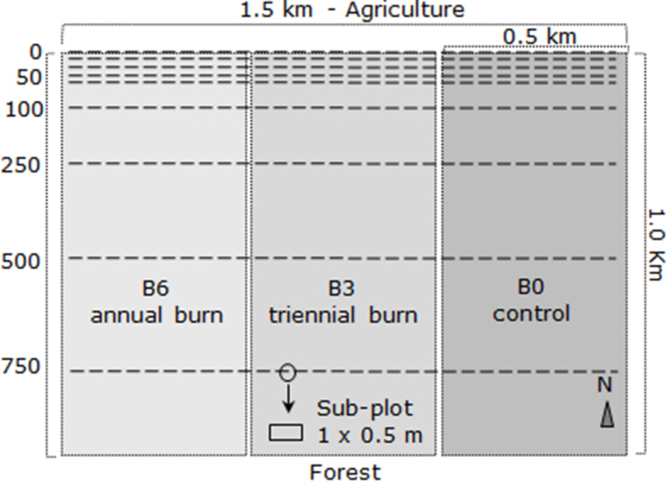
Experimental fires were conducted from 2004–2010 (except for 2008), during late dry season (August), when accidental wildfires are common in the region. The experimental site occupied 1.5 × 1.0 km (150 ha; Figure 1) and was divided into three plots of 0.5 × 1.0 km (50 ha), comprising three treatments: unburned (Control; B0), low fire-frequency (burned every three years – three times; B3) and high fire-frequency (burned annually – six times; B6), see the general appearance of the plots in 2012, two years after the last fire event (Supplementary Appendix: Figure S1A).
Delimitation of burned plots and regeneration sub-plots, southeastern Amazon basin, Brazil. Unburned (Control; B0), low fire-frequency (burned three times; triennially; B3) and high fire-frequency (burned six times; annually; B6). Each plot contains 90 sub-plots (represented by dashes) distributed in nine distances from the cleared edge.

Fires were set with kerosene drip torches along the north–south trails, during 3–4 consecutive days between 9:00 and 16:00 h. Ten kilometres of fire lines were set up per 50 ha plot. Naturally, the fires became extinguished by nightfall. Normally, fires achieved a low-intensity, slow-moving fire across the plot, typical of naturally occurring tropical understorey forest fires (Rocha et al. Reference Rocha, Metcalfe, Doughty, Brando, Silvério, Halladay, Nepstad, Balch and Malhi2014). During the fire events, the temperature and the humidity were around 26.5°C and 54%, respectively (Balch et al. Reference Balch, Nepstad, Brando, Curran, Portela, Carvalho and Lefebvre2008). Details about the experimental design and fire behaviour are provided in Balch et al. (Reference Balch, Nepstad, Brando, Curran, Portela, Carvalho and Lefebvre2008, Reference Balch, Brando, Nepstad, Coe, Silvério, Massad, Davidson, Lefebvre, Oliveira-Santos, Rocha, Cury, Parsons and Carvalho2015).
Regeneration sampling
In 2012, two years after the last experimental burn (2010), we sampled seedlings of tree and liana species in 90 sub-plots (1 × 0.5 m) in each one of three 50-ha plots. All individuals ≥10 cm in height and with stems ≤1 cm dbh (diameter at breast height; ~130 cm above ground; for those individuals, dbh was not recorded) were sampled. The sub-plots were distributed along 0, 10, 15, 30, 50, 100, 250, 500 and 750 m from the edge with agriculture (Figure 1). The regeneration mode of all saplings, i.e. from seed germination or from resprouting, was also visually determined or through small excavations. Both root and stump resprouts were recorded. Grass cover percentage was also visually estimated in all sub-plots. All grasses and woody plants were identified to species level whenever possible, and the remainder to the genus level.
We collected floristic samples and identified them using the botanical collection of Instituto de Pesquisa Ambiental da Amazônia (IPAM) and the herbarium at Universidade Estadual do Mato Grosso (UNEMAT) and Universidade Estadual de Londrina (UEL). Species names followed the Missouri Botanical Garden – TROPICOS database (www.tropicos.org). The species were categorized by ecosystem of occurrence (i.e. in forest exclusively or forest species that are also found in the Savanna, hereafter ‘Forest and Savanna’) by checking floristic inventories conducted in Brazilian Savanna ecosystems, found in Costa et al. (Reference Costa, Araújo and Lima-Verde2004), Durigan et al. (Reference Durigan, Baitelo, Franco and Siqueira2004), Felfili et al. (Reference Felfili, Nogueira, Junior, Marimon and Delitti2002), Medeiros (Reference Medeiros2011), Mendonça et al. (Reference Mendonça, Felfili, Walter, Silva Júnior, Rezende, Filgueiras, Nogueira, Sano and Almeida1998), Neto et al. (Reference Neto, Santos, Silva and Koppe2010), Pinto & Oliveira-Filho (Reference Pinto and Oliveira-Filho1999), Ratter et al. (Reference Ratter, Bridgewater and Ribeiro2003), Ribeiro-Silva et al. (Reference Ribeiro-Silva, Medeiros, Gomes, Seixas and Silva2012), Rosario & Cecco (Reference Rosario and Cecco2006), Sano et al. (Reference Sano, Almeida and Ribeiro2008), Taylor (Reference Taylor2013) and Teles (Reference Teles2005). See Supplementary Appendix (Table S1) for species list and classification.
Environmental data
We measured leaf area index (LAI, a proxy for canopy cover) on all 90 sub-plots of each treatment, using two LiCor-2000 Plant Canopy Analyzers in differential mode (LI-COR Inc., Lincoln, NE, USA). One equipment was placed in an adjacent open field to measure full incoming radiation and the other was simultaneously used to take understorey measurements. Measurements were taken during diffuse light conditions (between 6–8 am). The air temperature (AT) and the air relative humidity (RH) were measured daily during July and August using an Onset Hobo U23 Pro v2 Temperature/Relative Humidity data loggers. The soil temperature (ST) and the soil relative humidity (SH) were taken three times during the driest month (August) in each 5 m2 plot (n = 90), using, respectively, a soil digital thermometer and a portable soil moisture meter (HydroSense TM – Campbell Scientific).
Data analysis
To evaluate the degree in which fire disturbance affects the diversity of woody species regeneration, we analysed species richness using individual-based species accumulation curves (Colwell et al. Reference Colwell, Mao and Chang2004). Community composition and structure was analysed using non-metric multidimensional scaling (NMDS) ordination, generated from a Bray–Curtis dissimilarity matrix (Legendre & Legendre Reference Legendre, Legendre, Legendre and Legendre2012), and compared by means of an Analysis of Similarity (ANOSIM test; Clarke Reference Clarke1993). We also compared rank abundance distribution using a Whittaker plot (Magurran Reference Magurran2004). Finally, percentage of floristic similarity was also estimated using Jaccard index (Magurran Reference Magurran2004).
To test if repeated burns, B3 and B6, can increase the occurrence of Savanna and lianas species, we compared the species proportions by category using Chi-square test (χ2). In addition, we performed similarity percentage analysis (SIMPER), which provides the contribution of each species to the dissimilarity between treatments (Clarke Reference Clarke1993). We also performed an IndVal test to detect which species are associated with each treatment. To test the importance of resprouting for the maintenance of tree species regeneration, we also compared the proportions of seedlings and resprouts with χ2 between treatments and control site.
To test for relationships between plant composition and assemblage structure and grass cover, LAI, microclimate and burning frequency, we calculated Spearman’s correlations from a Bioenv matrix (Clarke & Ainsworth Reference Clarke and Ainsworth1993). Additionally, we used a Generalized Linear Model (GLM) including richness and abundance, environmental factors and fire treatment using Poisson distribution, and for tree abundance, we corrected the standard deviance using a Quasi-Poisson model indicated for overdispersion distribution (Crawley Reference Crawley2013). Reduced models were selected using stepwise selection based on model Akaike Information Criteria.
A GLM was also used to verify the effects of the fire treatment and the distance from the forest edge, as well as the interaction between those factors, on the grass cover and number of tree species regenerating individuals. Because of the data overdispersion we used a quasibinomial distribution for the proportion of grass cover and quasipoisson for the number of regenerating individuals. All analyses, except for χ2 tests, were performed using R (R Core Team 2014) and the package Vegan (Oksanen et al. Reference Oksanen, Blanchet, Kindt, Legendre, Minchin, O’Hara, Simpson, Solymos, Stevens and Wagner2013).
Results
Regeneration diversity
Combined, burned treatment and control plots had 46 species (353 live stems) of seedlings, saplings and resprouts of tree species, which were distributed across 26 botanical families (see sampled species list in the Supplementary Appendix; Table S1).
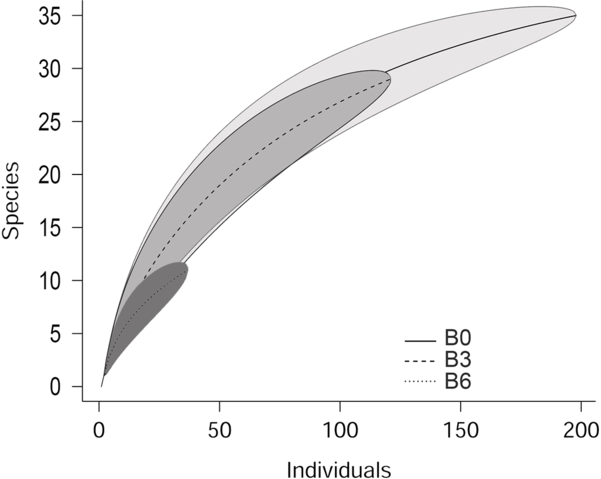
The species regeneration diversity was still altered two years after fire exclusion. There was 30.3% of tree floristic similarity (Jaccard’s index) between the Control and B3, and 11.3% between the Control and B6. The accumulation curve showed a reduction of 24 tree species in B6, a loss of 69% when compared with the Control plot. Surprisingly, we observed no significant difference in tree species richness between the Control and B3 treatment (e.g. B6, B3 and Control had 11, 29 and 35 species, respectively; Figure 2). Likewise, the number of living stems was higher in Control (n = 197; 4.4 individuals m−2) and in B3 (n = 120; 2.7 individuals m−2) than in B6, where abundance was 81% lower than in Control (n = 36; 0.8 individuals m−2).
Accumulation curve for tree species seedlings and saplings ≥10 cm in height and with stems ≤1 cm dbh sampled two years after the last fire in a burning experiment at southern border of Amazon Basin. Unburned (Control; B0), low fire-frequency (burned three times; triennially; B3) and high fire-frequency (burned six times; annually; B6). Grey shaded area denotes 95% confidence interval.

Lianas comprised 37% of total species richness (27 species) and 31% of total abundance (n = 157) of all woody plants measured in regeneration of all plots (see the Supplementary Appendix: Table S1). The accumulation curve showed the same pattern, with a loss of species in B6 (6 species), in comparison with the Control site (19 species). Likewise, the set of liana species showed low floristic similarity between the Control and B3, with 16%, and the Control and B6, with 6.5% (Jaccard’s index).
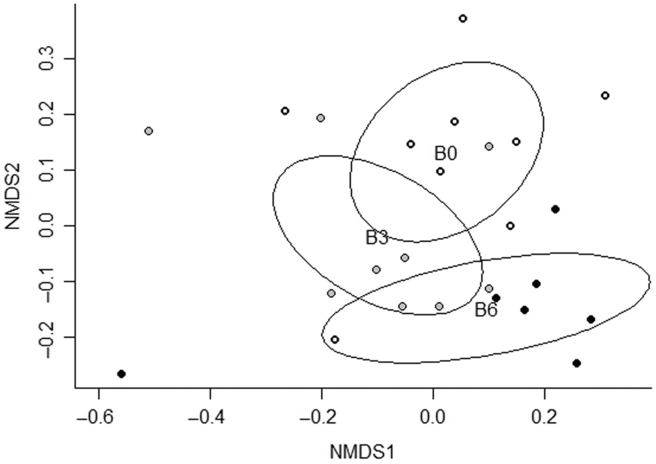
The structure and composition of the understorey community (tree species recruits and resprouts) were also different between the Control and B6, while B3 partially shared species with both the Control and B6 study sites (ANOSIM: R = 0.208, P < 0.005; Figure 3; see stress plot in Supplementary Appendix, Figure S2).
Structure and composition of tree species seedlings and saplings ≥10 cm in height and with stems ≤1 cm dbh sampled two years after the last fire in a burning experiment at southern border of Amazon Basin. Nonmetric multidimensional scaling (NMDS) plot and ellipses based on Bray–Curtis similarity index. Each dot represents a set of 10 sub-plots sample unit. Hollow dots for the unburned (Control; B0), grey dots for low fire-frequency (burned three times; triennially; B3), and black dots for high fire-frequency (burned six times; annually; B6).

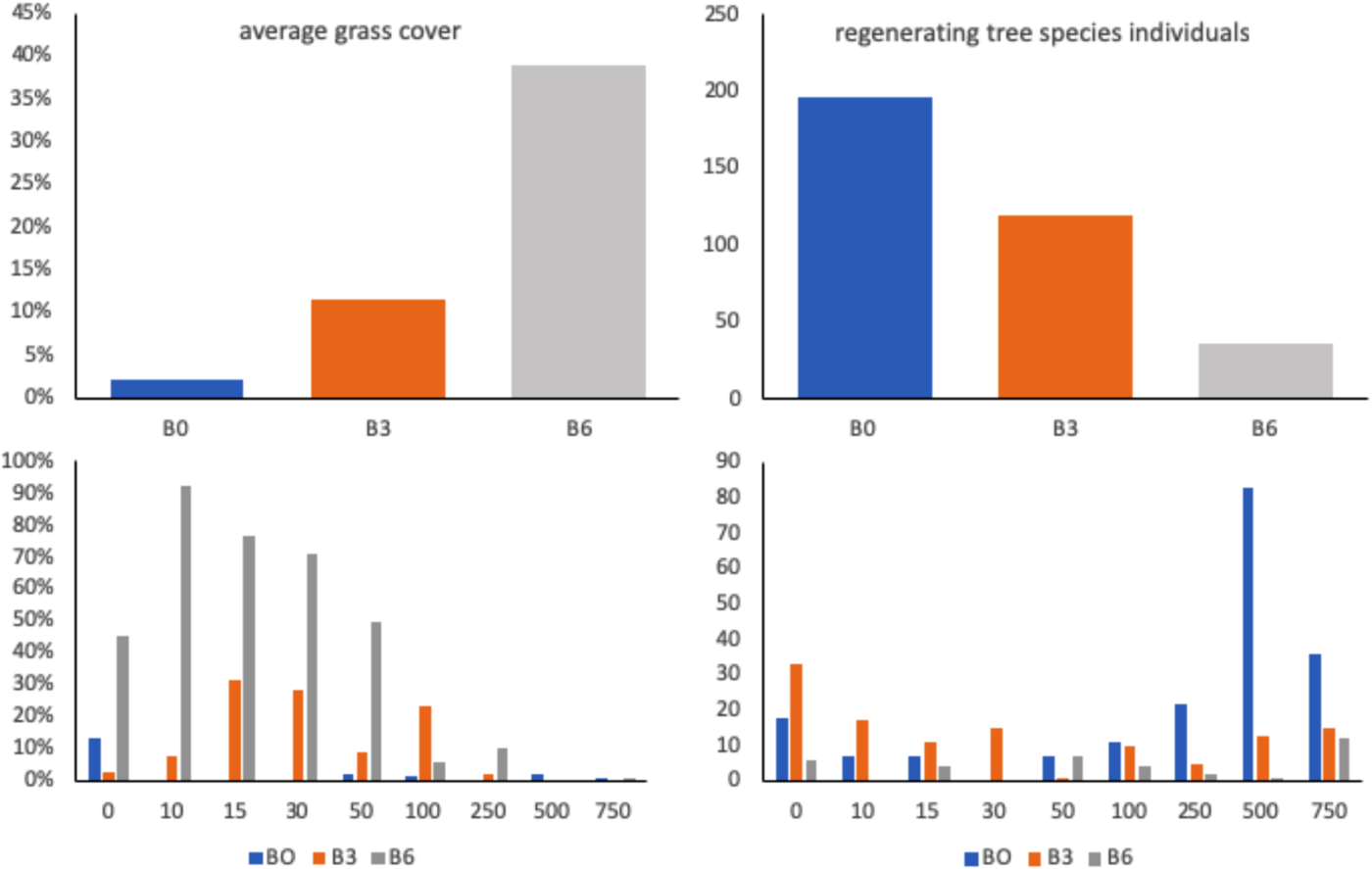
The GLM results showed that the number of regenerating individuals was strongly influenced by the fire treatment (Figure 4). However, only at B3 the distance from the forest edge showed a significant influence (GLM, P <0.001; Figure 4); both in B0 (not burned, high density of regenerating plants) and B6 (six times burned, 18% of B0 abundance) there is no clear edge pattern.
Percentage of mixed-species grass cover (left) and regenerating tree species abundance (right; ≥10 cm in height and with stems ≤1 cm dbh), by treatment (top) and edge distance (bottom) in a forest burning experiment at southern border of Amazon Basin. Unburned (Control; B0), low fire-frequency (burned three times, triennially, B3), and high fire-frequency (burned six times, annually, B6). Sampling was done two years after fire exclusion.

Regeneration species richness was strongly influenced by AT, RH, LAI, burning treatment and grass cover (AIC = 60.13, P < 0.001). Similarly, abundance of seedlings and saplings were influenced by AT, RH, LAI and grass cover (P < 0.001). The structure and composition of regenerating community showed moderate correlation (Spearman’s correlation = 0.308) with microclimate parameters (ST, AT and RH), leaf area index (LAI) and burning treatment (see the Supplementary Appendix: Table S2).
Resprouts versus seedlings
The most remarkable result of this experiment was to highlight a critical threshold of forest recovery ability in burned sites, indicated by a reduction in both species richness and abundance of regenerating plants, and by a reduction in the relative importance of resprouting as regeneration mode in B6.
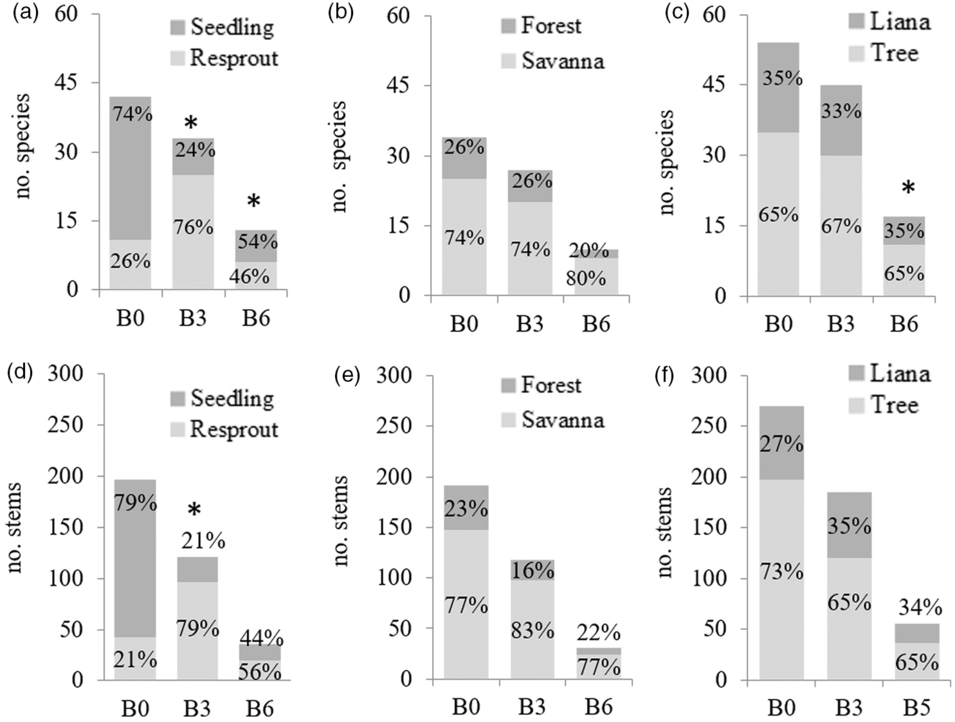
Although resprout numbers increased in both burning treatments, B3 presented higher species richness (Figure 5A) and live stems (Figure 5D) resprouting in comparison to B6 and the Control. Furthermore, there was a decrease in seedling species richness in both fire treatments. For example, B6 had four times less species and 9.6 times less live stems recruited by seeds in comparison with the Control.
Tree species seedlings and saplings ≥ 10 cm in height and with stems ≤1 cm dbh sampled two years after the last fire in a burning experiment at southern border of Amazon Basin. Regeneration mode (A), Forest and Savanna biomes (B) and life form (C) species richness and proportions. Percentage of species recorded in unburned (Control; B0), low fire-frequency (burned three times; triennially; B3) and high fire-frequency (burned six times; annually; B6). * represent statistical differences (χ2 test) in the proportion of species per group between each of the burned treatments and the unburned plot; P <0.05.

Overall, 79% of all resprouting stems in B3 plot belong to species also occurring in Savanna vegetation, against 65% in B6 and 31% in the Control. Two years after fire treatments, the secondary forest showed that 62% of the species resprouted, highlighting a clear change in regeneration mode in both burned sites. Specifically, B3 exhibited higher proportion of resprouting-originated species (76%; χ2 = 18.19, df = 1, P < 0.01; Figure 5A) than in B6. The same pattern was observed for abundance (Figure 5D), with few seed germinated contrasting with the dominance of resprouted stems in B3 (79%; χ2 = 102, df = 1, P < 0.01) and in B6 (55%; χ2 = 18.2, df = 1, P < 0.01) when they were compared with Control (21%).
Savanna and liana species
Savanna species and abundance accounted for 74% and 77%, respectively, growing in the Control. Forest and Savanna species and stems declined by the same proportion in both burned treatments and in the Control (Figure 5B and 5E). However, the absolute amount of Savanna species decreased significantly with increasing fire frequencies, with more than 60% of species loss in B6 compared with Control. Similarly, forest species richness (26%) also had a decrease of 78% in B6 compared with Control.
The two burning regimes caused a decline in plant diversity and a shift in species community toward greater dominance by few tree and liana species, particularly in B3.
For example, two species, Marlierea umbraticola (Kunth) O. Berg, Myrtaceae (IndVal = 0.716, P <0.05) and Tachigali vulgaris L.F. Gomes da Silva & H.C. Lima, Fabaceae (IndVal = 0.617, P <0.05) occurred only in B3. On the other hand, five species were present only in the Control, such as Protium guianensis (Aubl.) Marchand, Burseraceae (IndVal = 0.764, P <0.001), a late successional, forest tree species, with 6% of contribution to community dissimilarity.
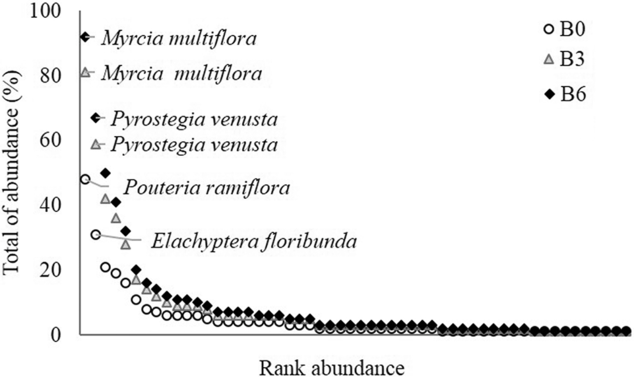
The new community condition showed the strong contribution of a Myrcia multiflora (Lam.) DC. (Myrtaceae), Pyrostegia venusta (Ker Gawl.) Miers (Bignoniaceae) and Mabea fistulifera Mart. (Euphorbiaceae) in B3 treatment compared with the Control (SIMPER test; see the Supplementary Appendix: Table S3). Also, M. multiflora and M. fistulifera comprised almost 42% of individuals in B3 and 30% in B6, against 15% in the Control, reinforcing the floristic dissimilarity between the burned treatments and the control. Whittaker plot also showed the higher dominance of those species (Figure 6).
Ranked percentage contribution to total abundance (Whittaker plot) of tree and liana species of seedlings and saplings ≥10 cm in height and with stems ≤1 cm dbh sampled two years after the last fire in a burning experiment at southern border of Amazon Basin. White marks for unburned (Control; B0), grey marks for low fire-frequency (burned three times; triennially; B3), and black marks for high fire-frequency (burned six times; annually; B6).

The proportion of lianas species did not differ between burned treatment and the Control (~34%; Figure 5C and 5F). However, the liana P. venusta alone was abundant in both burned plots, accounting for more than 42% of total liana stems in each B3 and B6 treatments, about 3.5 times more than registered in the Control (11%).
Grass invasion and persistence
Both burned regimes showed invasion by grasses. However, the grass cover was higher in B6, with 38% against 12% in B3 (GLM, P <0.001; Figure 4). In addition, the grasses were observed mainly from cleared edge (0 m) up to 250 m in both burned treatments, but occurred only at the border in the Control (<10 m) and were virtually absent in the forest interior. Overall, the farther from the forest edge, the lower was the grass cover, but treatments slightly differed in grass distribution along edge distance (GLM, P <0.001, Figure 4).
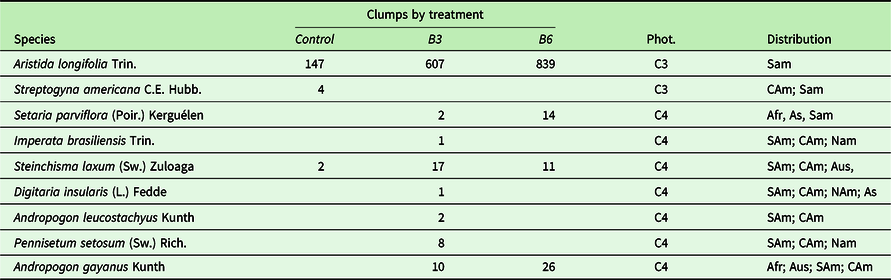
We identified nine grass species in total (Table 1). Aristida longifolia Trin., a native Savanna species, was the most abundant, accounting for 94% grass cover. Another 6% of grass cover corresponded to a mix of native and exotic species, such as Steinchisma laxum (Sw.) Zuloaga, and Andropogon gayanus Kunt., an invasive African grass (Rossiter-Rachor et al. Reference Rossiter-Rachor, Setterfield, Douglas, Hutley, Cook and Schmidt2009).
Species, number of clumps, photosynthetic metabolism (Phot.) and distribution of all grasses sampled in the unburned (Control), low fire-frequency (B3) and high fire-frequency (B6) registered two years after fire exclusion (2012). SAm = South America, CAm = Central America, NAm = North America, Aus = Australia, Afr = Africa, As = Asia

Source: www.tropicos.org.
Discussion
Fire effects on the regeneration depended on the number of fire events and the interval between them. Lower fire-frequency (B3) was not necessarily a threshold for regeneration, but higher fire-frequency (B6) led to a strong decline in the forest regeneration ability, because under higher fire-frequency 77% of seedlings and 45% of resprout-based regeneration species were lost when compared with unburned plot. However, while two years was clearly not enough time for forest recovery, only long-term studies will be able to indicate to what extent forest resilience was reduced.
First, the reduced number of seeds could be one driver for the lower abundance of seedlings, as high mortality of reproductive trees was observed (Brando et al. Reference Brando, Balch, Nepstad, Morton, Putz, Coe, Silvério, Macedo, Davidson, Nóbrega, Alencar and Soares-Filho2014) and likely reduced local seed rain (Barlow & Peres Reference Barlow and Peres2006). This suggestion is compatible with the higher seedling density further from the edge, with more contact with the remnant unburned forest. Second, the soil seed bank could also be affected by repeated fires, as has been documented in other studies (Barlow & Peres Reference Barlow and Peres2006, Melo et al. Reference Melo, Durigan and Gorenstein2007, Montibeller-Santos Reference Montibeller-Santos2013). Third, seed predator populations may increase (e.g. leaf-cutting ants; Carvalho et al. Reference Carvalho, Balch and Moutinho2012, Leal et al. Reference Leal, Wirth and Tabarelli2014, Massad et al. Reference Massad, Balch, Davidson, Brando, Mews, Porto, Quintino, Vieira, Marimon and Trumbore2013), leading to higher pressure on remaining seeds, seedlings and saplings. Fourth, the number of suitable microsites for seed germination could be reduced as humidity drops and temperature increases due to the loss of canopy cover (Balch et al. Reference Balch, Brando, Nepstad, Coe, Silvério, Massad, Davidson, Lefebvre, Oliveira-Santos, Rocha, Cury, Parsons and Carvalho2015). Jointly, these factors may be impairing forest restoration from seedling recruitment.
We highlight that a lower fire-frequency (B3) tended to cause less harm to regenerating woody plant diversity, mainly through allowing the regrowth of native woody species by means of resprouting. Possibly, the forest burning with no interval could be gradually eliminating all aerial biomass of juveniles. As a result, resprout-originated stems may reduce, suggesting a decrease in root and shoot resprouting capacity (Bond & Midgley Reference Bond and Midgley2001, Grady & Hoffmann Reference Grady and Hoffmann2012). On the other hand, the three-year interval between fires probably allowed a more rapid growth of saplings (Grady & Hoffmann Reference Grady and Hoffmann2012) and a vigorous resprouting ability for some species (Vesk Reference Vesk2006), thus maintaining the plant community composition and structure similar to the control plot. As a result of intermediate disturbance, resprouting became an important trait for forest regeneration process, increasing the abundance of live stems. Also, root-sprouting can favour self-replacement of damaged individuals after main stem death (Bellingham & Sparrow Reference Bellingham and Sparrow2000, Bond & Midgley Reference Bond and Midgley2001), maintaining the diversity within functional groups (Thrush et al. Reference Thrush, Hewitt, Dayton, Coco, Lohrer, Norkko, Norkko and Chiantore2009).
Although most rainforest species show little or no fire tolerance (Hoffmann et al. Reference Hoffmann, Orthen and Nascimento2003), we have found that most of the tree species in the transitional forests also occur in the Savanna vegetation and are supposed to be more fire-adapted than forest-only species. This result partially explains a massive regeneration from resprouting, while seedling regeneration was scarce. However, resprouting ability also decreased with increasing fire-frequency, showing a threshold in forest ability to regenerate by resprouting.
We also observed that, although the low fire-frequency (B3) exhibited regenerating diversity similar to the unburned (Control), both burned forests had substantial changes in community structure and composition. Tree-years interval burns led to higher mortality of large trees due to more severe fires, with increased fire-induced adult tree mortality by 462% during drought events in 2007 (Brando et al. Reference Brando, Balch, Nepstad, Morton, Putz, Coe, Silvério, Macedo, Davidson, Nóbrega, Alencar and Soares-Filho2014), reducing canopy cover (Balch et al. Reference Balch, Nepstad, Curran, Brando, Portela, Guilherme, Reuning-Scherer and Carvalho2011) which could be favouring the establishment of heliophyte species (Nepstad et al. Reference Nepstad, Stickler, Filho and Merry2008, Silvério et al. Reference Silvério, Brando, Balch, Putz, Nepstad, Oliveira-Santos and Bustamante2013, Veldman & Putz Reference Veldman and Putz2011). In contrast, with higher fire-frequency (B6), where fire slowly moved through the forest understorey, more negative effects were observed on regenerating plants. There was a reduction in the number of native species and in the abundance of juveniles, followed by dominance by a single liana species and invasion by several grass species. These favoured species could compete with seedlings of native tree species (Gunaratne et al. Reference Gunaratne, Gunatilleke, Gunatilleke, Madawala Weerasinghe and Burslem2010; Silvério et al. Reference Silvério, Brando, Balch, Putz, Nepstad, Oliveira-Santos and Bustamante2013).
Furthermore, the grass species showed a gradual expansion from the edge into the burned forest which points to a positive feedback cycle among fuel accumulation, drought and new fires (Balch et al. Reference Balch, Nepstad, Brando, Curran, Portela, Carvalho and Lefebvre2008, Brooks et al. Reference Brooks, D’Antonio, Richardson, Grace, Keeley, Ditomaso, Hobbs, Pellant and Pyke2004, Cochrane et al. Reference Cochrane, Alencar, Schulze, Souza, Nepstad, Lefebvre and Davidson1999, Silvério et al. Reference Silvério, Brando, Balch, Putz, Nepstad, Oliveira-Santos and Bustamante2013). Also, this increase in opportunistic species can increase the likelihood of future fire events given the increase in fine fuels.
Multiple fire events harmed the regeneration ability of Transitional forests, and two years after the last fire diversity of regenerating tree species was still lower. Regeneration by means of resprouting increased in importance, but does not compensate for the overall loss of native tree species. Likewise, those impoverished burned areas showed a higher proportion of Savanna and liana species. Burning allowed grass invasion, and grass cover was higher with higher fire frequency and near the edges. These results suggest that regeneration ability, and thus forest resilience, is reduced in the short term, and that the recovery will depend to a great extent from external seed sources. Long-term monitoring is essential to understand how these patterns will change in the future, in scenarios with and without fire, in order to shed light on whether these forests can recover from fire disturbance or transition into stable, derived savanna ecosystems.
Acknowledgements
We thank all IPAM staff for help in fieldwork. A. Bordignon and G. Gonzaga helped in species classification. Dr Beatriz Marimon, Dr Simone Vieira, Dr Efraim Rodrigues, Dr Halley de Oliveira, Dr E. Bianchini, Dr J.E. Ribeiro, Dr W. Zangaro-Filho, R. Moratelly, Dra. C. Montibeller-Santos, Nicole Cury and Tyler Lagasse provided helpful suggestions on an earlier draft of this paper.
Financial support
We thank all IPAM and LABRE-UEL for financial support. RTSC grants from both CAPES (Finance Code 001) and CNPq (248491/2013-0) and JMDT from a CNPq research grant (process # 309244/2015-3).
Supplementary material
To view supplementary material for this article, please visit https://doi.org/10.1017/S0266467420000176